

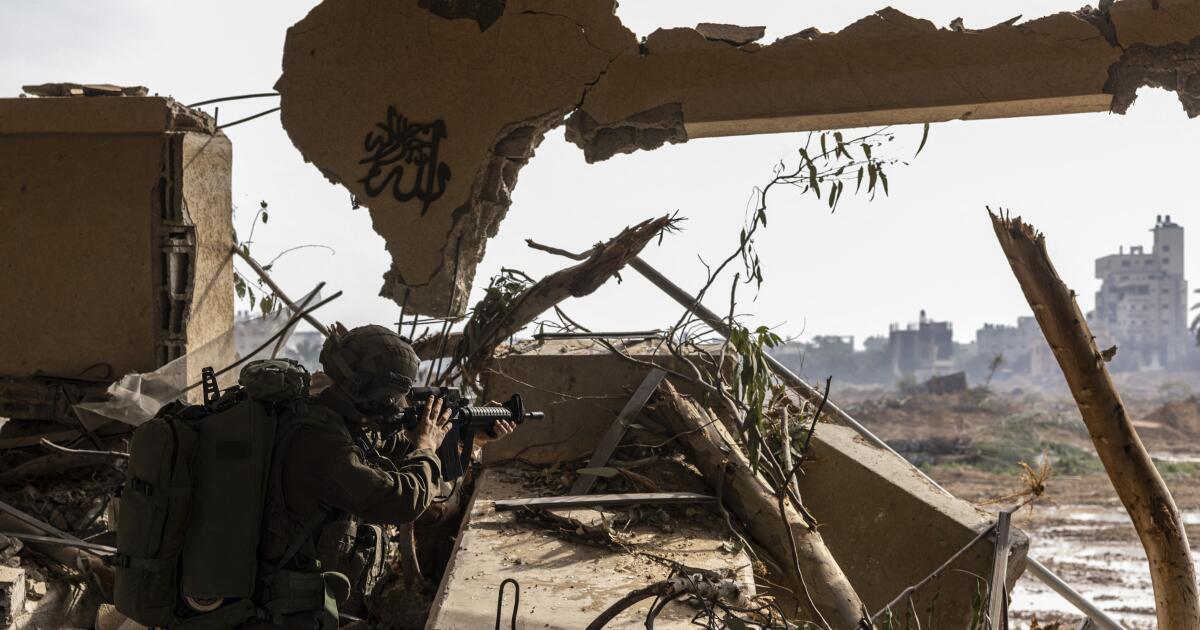


The situation is much different in the West Bank, which has been occupied by Israel since 1967. Troops are deployed throughout the territory, where Palestinian officials have only nominal authority.
The hundreds of thousands of Jewish settlers who have constructed and occupied villages — in violation of international law — receive protection from the army, move about freely and are subject to an Israeli civilian legal system.
Palestinians, on the other hand, face restrictions on where they can go, lose their land to settlers and routinely fight what they describe as onerous bureaucracy to secure the building permits granted easily to settlers. There are even separate roads for Israelis traveling through the West Bank.
Palestinian Authority riot police take control after clearing out protesters near Al Menarah square, in Ramallah, Occupied West Bank.
(Marcus Yam/Los Angeles Times)
Moreover, a Jewish settler who breaks the law goes to a civilian court and often receives minimal punishment while a Palestinian is sent to a military court often without due process, international and Israeli human rights groups say.
Supporters of Israel resist the apartheid label, arguing that the system is necessary for security reasons.
“The South African system of apartheid was driven by unambiguous racism where people were separated in every aspect of their daily lives on the basis of their skin color,” said Jonathan Harounoff, communications director for the Jewish Institute for National Security in America, a Washington advocacy group.
“In the West Bank, on the other hand, any restrictive policies there in place toward Palestinians are not race- or religion-based. They are purely driven by security concerns as a result of past acts of terrorism that led to loss of Israeli life.”

The situation is much different in the West Bank, which has been occupied by Israel since 1967. Troops are deployed throughout the territory, where Palestinian officials have only nominal authority.
The hundreds of thousands of Jewish settlers who have constructed and occupied villages — in violation of international law — receive protection from the army, move about freely and are subject to an Israeli civilian legal system.
Palestinians, on the other hand, face restrictions on where they can go, lose their land to settlers and routinely fight what they describe as onerous bureaucracy to secure the building permits granted easily to settlers. There are even separate roads for Israelis traveling through the West Bank.
Palestinian Authority riot police take control after clearing out protesters near Al Menarah square, in Ramallah, Occupied West Bank.
(Marcus Yam/Los Angeles Times)
Moreover, a Jewish settler who breaks the law goes to a civilian court and often receives minimal punishment while a Palestinian is sent to a military court often without due process, international and Israeli human rights groups say.
Supporters of Israel resist the apartheid label, arguing that the system is necessary for security reasons.
“The South African system of apartheid was driven by unambiguous racism where people were separated in every aspect of their daily lives on the basis of their skin color,” said Jonathan Harounoff, communications director for the Jewish Institute for National Security in America, a Washington advocacy group.
“In the West Bank, on the other hand, any restrictive policies there in place toward Palestinians are not race- or religion-based. They are purely driven by security concerns as a result of past acts of terrorism that led to loss of Israeli life.”

The situation is much different in the West Bank, which has been occupied by Israel since 1967. Troops are deployed throughout the territory, where Palestinian officials have only nominal authority.
The hundreds of thousands of Jewish settlers who have constructed and occupied villages — in violation of international law — receive protection from the army, move about freely and are subject to an Israeli civilian legal system.
Palestinians, on the other hand, face restrictions on where they can go, lose their land to settlers and routinely fight what they describe as onerous bureaucracy to secure the building permits granted easily to settlers. There are even separate roads for Israelis traveling through the West Bank.
Palestinian Authority riot police take control after clearing out protesters near Al Menarah square, in Ramallah, Occupied West Bank.
(Marcus Yam/Los Angeles Times)
Moreover, a Jewish settler who breaks the law goes to a civilian court and often receives minimal punishment while a Palestinian is sent to a military court often without due process, international and Israeli human rights groups say.
Supporters of Israel resist the apartheid label, arguing that the system is necessary for security reasons.
“The South African system of apartheid was driven by unambiguous racism where people were separated in every aspect of their daily lives on the basis of their skin color,” said Jonathan Harounoff, communications director for the Jewish Institute for National Security in America, a Washington advocacy group.
“In the West Bank, on the other hand, any restrictive policies there in place toward Palestinians are not race- or religion-based. They are purely driven by security concerns as a result of past acts of terrorism that led to loss of Israeli life.”