

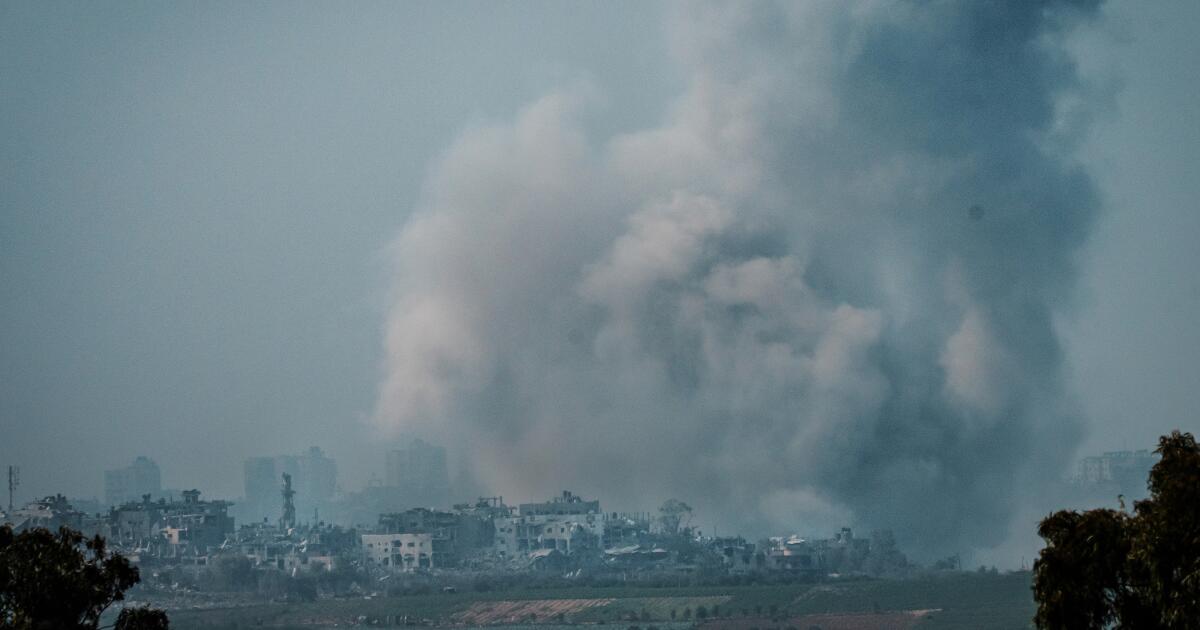
Thirty-six hours after communications in the Gaza Strip went dead in the midst of intense Israeli airstrikes and troop movements, internet and telephone connectivity returned Sunday morning and Gazans such as poet Mosab Abu Toha reported on a new reality: For Abu Toha, it was a sense of amazement that he had survived a bombardment tracked by blasts occurring not in succession, but simultaneously.
“Before, you heard lots of bombing,” he said. “But the duration and capacity now — you hear three blasts at the same time.”
Abu Toha had evacuated his family from the northern Gaza neighborhood of Beit Lahia to a relative’s house in Jabaliya, almost two miles away. But on Saturday, he found out that the apartment building where he and his family lived up until less than two weeks ago had been destroyed in an airstrike.
Palestinians walk around buildings destroyed in the Israeli bombardment in the Nusseirat refugee camp in the Gaza Strip on Oct. 29, 2023.
(Hatem Moussa / Associated Press)
“Four floors. Nothing of it left,” he said. “We’ve never been afraid like this.”
Such were the thoughts of many in Gaza as they faced what Israel is calling a new phase of its war with the Palestinian militant group Hamas: An expanded ground presence within the besieged enclave, combined with airstrikes that have left entire civilian neighborhoods flattened in what many describe as the war’s heaviest bombing to date.
With restored connectivity came fresh images and videos of the devastation.
In one video posted on Instagram, Hind Khoudary, a freelance journalist in Gaza, panned her camera across a landscape denuded of all color save for gray, with buildings ground down to mounds of rubble, floors on top of each other like a layer cake.
“This is new, this bombing, yes?” she asks one man, who tells her it’s from Saturday afternoon.
Another video, from Abdulrahman Battah, a young Instagram influencer doing mock newscasts from Gaza, showed people queuing for bread at one of the few operating bakeries.
With the war entering its fourth week, Israel appears set on making good on its vow to eradicate Hamas, whose fighters surged into southern Israel on Oct. 7, killing some 1,400 people, mainly civilians, and seizing nearly 230 hostages. The death toll in Gaza has exceeded 8,000, according to Palestinian officials, mainly the result of retaliatory Israeli airstrikes that began almost immediately after the Hamas rampage.
Gazans said the intensity of the weekend bombing had raised enormous clouds of smoke and dust, obscuring the sky. “We didn’t see the sun all yesterday,” said one user from Gaza named Almeqdad, who posted on X, the platform formerly known as Twitter.

Palestinians stand inside the remains of a building destroyed in the Israeli bombardment of the Gaza Strip in Rafah on Oct. 29, 2023.
(Hatem Ali / Associated Press)
Restored communication brought relief for Eman Basher, a teacher in Gaza. The first thing she did when the connection restarted was to have her son call his grandfather.
“I missed you,” he says, in a video she posted to X.
But there was also tragedy: Some learned Sunday of relatives who had been hurt, killed or left homeless in airstrikes on Friday night and Saturday.
“We’ve been receiving news of houses of friends and relatives destroyed and details of the death of people we know,” Almeqdad wrote.
Rescue personnel spoke of a medical system unable to keep up with the deluge of casualties.
“Every minute, our crews are dealing with 20 strikes,” said Mahmoud Bassal, the spokesman for the civil defense service in Gaza, told Al Jazeera Arabic on Sunday. He added that hospitals were operating beyond their capacity, with nowhere but the floor to lay wounded.
“We were surprised … to find corpses in the streets and body parts we could not identify,” he said. The current death toll, he said, did not include hundreds still under the rubble.
Fearing another blackout, activists in Egypt and elsewhere were scrambling Sunday to provide alternate methods of communication. Some called on X owner Elon Musk to provide coverage in Gaza for Starlink, the satellite internet service. Others, including Mirna El Helbawi, an Egyptian podcaster, began a worldwide effort to send eSims to Gazan journalists and medical crews, which would allow them to connect to cellphone networks in Egypt or Israel rather than Palestinian networks operating damaged towers.
“I’ve received thousands of eSims donated for Gaza from people from Europe, U.S., Canada, everywhere, all of them wanting to help, and we’ve already started delivering them,” El Helbawi said.
As Gaza residents geared up for another long night, some were engaging in what has since become a ritual — writing their children’s names on their limbs in case everyone is killed and there is no way to identify the dead. Others, including journalist Motaz Azaiza, asked that people wished for Gazans to stay alive till the coming morning.
“The night is crazy,” he said. “The bombing never stops.”

Thirty-six hours after communications in the Gaza Strip went dead in the midst of intense Israeli airstrikes and troop movements, internet and telephone connectivity returned Sunday morning and Gazans such as poet Mosab Abu Toha reported on a new reality: For Abu Toha, it was a sense of amazement that he had survived a bombardment tracked by blasts occurring not in succession, but simultaneously.
“Before, you heard lots of bombing,” he said. “But the duration and capacity now — you hear three blasts at the same time.”
Abu Toha had evacuated his family from the northern Gaza neighborhood of Beit Lahia to a relative’s house in Jabaliya, almost two miles away. But on Saturday, he found out that the apartment building where he and his family lived up until less than two weeks ago had been destroyed in an airstrike.
Palestinians walk around buildings destroyed in the Israeli bombardment in the Nusseirat refugee camp in the Gaza Strip on Oct. 29, 2023.
(Hatem Moussa / Associated Press)
“Four floors. Nothing of it left,” he said. “We’ve never been afraid like this.”
Such were the thoughts of many in Gaza as they faced what Israel is calling a new phase of its war with the Palestinian militant group Hamas: An expanded ground presence within the besieged enclave, combined with airstrikes that have left entire civilian neighborhoods flattened in what many describe as the war’s heaviest bombing to date.
With restored connectivity came fresh images and videos of the devastation.
In one video posted on Instagram, Hind Khoudary, a freelance journalist in Gaza, panned her camera across a landscape denuded of all color save for gray, with buildings ground down to mounds of rubble, floors on top of each other like a layer cake.
“This is new, this bombing, yes?” she asks one man, who tells her it’s from Saturday afternoon.
Another video, from Abdulrahman Battah, a young Instagram influencer doing mock newscasts from Gaza, showed people queuing for bread at one of the few operating bakeries.
With the war entering its fourth week, Israel appears set on making good on its vow to eradicate Hamas, whose fighters surged into southern Israel on Oct. 7, killing some 1,400 people, mainly civilians, and seizing nearly 230 hostages. The death toll in Gaza has exceeded 8,000, according to Palestinian officials, mainly the result of retaliatory Israeli airstrikes that began almost immediately after the Hamas rampage.
Gazans said the intensity of the weekend bombing had raised enormous clouds of smoke and dust, obscuring the sky. “We didn’t see the sun all yesterday,” said one user from Gaza named Almeqdad, who posted on X, the platform formerly known as Twitter.
Palestinians stand inside the remains of a building destroyed in the Israeli bombardment of the Gaza Strip in Rafah on Oct. 29, 2023.
(Hatem Ali / Associated Press)
Restored communication brought relief for Eman Basher, a teacher in Gaza. The first thing she did when the connection restarted was to have her son call his grandfather.
“I missed you,” he says, in a video she posted to X.
But there was also tragedy: Some learned Sunday of relatives who had been hurt, killed or left homeless in airstrikes on Friday night and Saturday.
“We’ve been receiving news of houses of friends and relatives destroyed and details of the death of people we know,” Almeqdad wrote.
Rescue personnel spoke of a medical system unable to keep up with the deluge of casualties.
“Every minute, our crews are dealing with 20 strikes,” said Mahmoud Bassal, the spokesman for the civil defense service in Gaza, told Al Jazeera Arabic on Sunday. He added that hospitals were operating beyond their capacity, with nowhere but the floor to lay wounded.
“We were surprised … to find corpses in the streets and body parts we could not identify,” he said. The current death toll, he said, did not include hundreds still under the rubble.
Fearing another blackout, activists in Egypt and elsewhere were scrambling Sunday to provide alternate methods of communication. Some called on X owner Elon Musk to provide coverage in Gaza for Starlink, the satellite internet service. Others, including Mirna El Helbawi, an Egyptian podcaster, began a worldwide effort to send eSims to Gazan journalists and medical crews, which would allow them to connect to cellphone networks in Egypt or Israel rather than Palestinian networks operating damaged towers.
“I’ve received thousands of eSims donated for Gaza from people from Europe, U.S., Canada, everywhere, all of them wanting to help, and we’ve already started delivering them,” El Helbawi said.
As Gaza residents geared up for another long night, some were engaging in what has since become a ritual — writing their children’s names on their limbs in case everyone is killed and there is no way to identify the dead. Others, including journalist Motaz Azaiza, asked that people wished for Gazans to stay alive till the coming morning.
“The night is crazy,” he said. “The bombing never stops.”

Thirty-six hours after communications in the Gaza Strip went dead in the midst of intense Israeli airstrikes and troop movements, internet and telephone connectivity returned Sunday morning and Gazans such as poet Mosab Abu Toha reported on a new reality: For Abu Toha, it was a sense of amazement that he had survived a bombardment tracked by blasts occurring not in succession, but simultaneously.
“Before, you heard lots of bombing,” he said. “But the duration and capacity now — you hear three blasts at the same time.”
Abu Toha had evacuated his family from the northern Gaza neighborhood of Beit Lahia to a relative’s house in Jabaliya, almost two miles away. But on Saturday, he found out that the apartment building where he and his family lived up until less than two weeks ago had been destroyed in an airstrike.
Palestinians walk around buildings destroyed in the Israeli bombardment in the Nusseirat refugee camp in the Gaza Strip on Oct. 29, 2023.
(Hatem Moussa / Associated Press)
“Four floors. Nothing of it left,” he said. “We’ve never been afraid like this.”
Such were the thoughts of many in Gaza as they faced what Israel is calling a new phase of its war with the Palestinian militant group Hamas: An expanded ground presence within the besieged enclave, combined with airstrikes that have left entire civilian neighborhoods flattened in what many describe as the war’s heaviest bombing to date.
With restored connectivity came fresh images and videos of the devastation.
In one video posted on Instagram, Hind Khoudary, a freelance journalist in Gaza, panned her camera across a landscape denuded of all color save for gray, with buildings ground down to mounds of rubble, floors on top of each other like a layer cake.
“This is new, this bombing, yes?” she asks one man, who tells her it’s from Saturday afternoon.
Another video, from Abdulrahman Battah, a young Instagram influencer doing mock newscasts from Gaza, showed people queuing for bread at one of the few operating bakeries.
With the war entering its fourth week, Israel appears set on making good on its vow to eradicate Hamas, whose fighters surged into southern Israel on Oct. 7, killing some 1,400 people, mainly civilians, and seizing nearly 230 hostages. The death toll in Gaza has exceeded 8,000, according to Palestinian officials, mainly the result of retaliatory Israeli airstrikes that began almost immediately after the Hamas rampage.
Gazans said the intensity of the weekend bombing had raised enormous clouds of smoke and dust, obscuring the sky. “We didn’t see the sun all yesterday,” said one user from Gaza named Almeqdad, who posted on X, the platform formerly known as Twitter.
Palestinians stand inside the remains of a building destroyed in the Israeli bombardment of the Gaza Strip in Rafah on Oct. 29, 2023.
(Hatem Ali / Associated Press)
Restored communication brought relief for Eman Basher, a teacher in Gaza. The first thing she did when the connection restarted was to have her son call his grandfather.
“I missed you,” he says, in a video she posted to X.
But there was also tragedy: Some learned Sunday of relatives who had been hurt, killed or left homeless in airstrikes on Friday night and Saturday.
“We’ve been receiving news of houses of friends and relatives destroyed and details of the death of people we know,” Almeqdad wrote.
Rescue personnel spoke of a medical system unable to keep up with the deluge of casualties.
“Every minute, our crews are dealing with 20 strikes,” said Mahmoud Bassal, the spokesman for the civil defense service in Gaza, told Al Jazeera Arabic on Sunday. He added that hospitals were operating beyond their capacity, with nowhere but the floor to lay wounded.
“We were surprised … to find corpses in the streets and body parts we could not identify,” he said. The current death toll, he said, did not include hundreds still under the rubble.
Fearing another blackout, activists in Egypt and elsewhere were scrambling Sunday to provide alternate methods of communication. Some called on X owner Elon Musk to provide coverage in Gaza for Starlink, the satellite internet service. Others, including Mirna El Helbawi, an Egyptian podcaster, began a worldwide effort to send eSims to Gazan journalists and medical crews, which would allow them to connect to cellphone networks in Egypt or Israel rather than Palestinian networks operating damaged towers.
“I’ve received thousands of eSims donated for Gaza from people from Europe, U.S., Canada, everywhere, all of them wanting to help, and we’ve already started delivering them,” El Helbawi said.
As Gaza residents geared up for another long night, some were engaging in what has since become a ritual — writing their children’s names on their limbs in case everyone is killed and there is no way to identify the dead. Others, including journalist Motaz Azaiza, asked that people wished for Gazans to stay alive till the coming morning.
“The night is crazy,” he said. “The bombing never stops.”
Thirty-six hours after communications in the Gaza Strip went dead in the midst of intense Israeli airstrikes and troop movements, internet and telephone connectivity returned Sunday morning and Gazans such as poet Mosab Abu Toha reported on a new reality: For Abu Toha, it was a sense of amazement that he had survived a bombardment tracked by blasts occurring not in succession, but simultaneously.
“Before, you heard lots of bombing,” he said. “But the duration and capacity now — you hear three blasts at the same time.”
Abu Toha had evacuated his family from the northern Gaza neighborhood of Beit Lahia to a relative’s house in Jabaliya, almost two miles away. But on Saturday, he found out that the apartment building where he and his family lived up until less than two weeks ago had been destroyed in an airstrike.
Palestinians walk around buildings destroyed in the Israeli bombardment in the Nusseirat refugee camp in the Gaza Strip on Oct. 29, 2023.
(Hatem Moussa / Associated Press)
“Four floors. Nothing of it left,” he said. “We’ve never been afraid like this.”
Such were the thoughts of many in Gaza as they faced what Israel is calling a new phase of its war with the Palestinian militant group Hamas: An expanded ground presence within the besieged enclave, combined with airstrikes that have left entire civilian neighborhoods flattened in what many describe as the war’s heaviest bombing to date.
With restored connectivity came fresh images and videos of the devastation.
In one video posted on Instagram, Hind Khoudary, a freelance journalist in Gaza, panned her camera across a landscape denuded of all color save for gray, with buildings ground down to mounds of rubble, floors on top of each other like a layer cake.
“This is new, this bombing, yes?” she asks one man, who tells her it’s from Saturday afternoon.
Another video, from Abdulrahman Battah, a young Instagram influencer doing mock newscasts from Gaza, showed people queuing for bread at one of the few operating bakeries.
With the war entering its fourth week, Israel appears set on making good on its vow to eradicate Hamas, whose fighters surged into southern Israel on Oct. 7, killing some 1,400 people, mainly civilians, and seizing nearly 230 hostages. The death toll in Gaza has exceeded 8,000, according to Palestinian officials, mainly the result of retaliatory Israeli airstrikes that began almost immediately after the Hamas rampage.
Gazans said the intensity of the weekend bombing had raised enormous clouds of smoke and dust, obscuring the sky. “We didn’t see the sun all yesterday,” said one user from Gaza named Almeqdad, who posted on X, the platform formerly known as Twitter.
Palestinians stand inside the remains of a building destroyed in the Israeli bombardment of the Gaza Strip in Rafah on Oct. 29, 2023.
(Hatem Ali / Associated Press)
Restored communication brought relief for Eman Basher, a teacher in Gaza. The first thing she did when the connection restarted was to have her son call his grandfather.
“I missed you,” he says, in a video she posted to X.
But there was also tragedy: Some learned Sunday of relatives who had been hurt, killed or left homeless in airstrikes on Friday night and Saturday.
“We’ve been receiving news of houses of friends and relatives destroyed and details of the death of people we know,” Almeqdad wrote.
Rescue personnel spoke of a medical system unable to keep up with the deluge of casualties.
“Every minute, our crews are dealing with 20 strikes,” said Mahmoud Bassal, the spokesman for the civil defense service in Gaza, told Al Jazeera Arabic on Sunday. He added that hospitals were operating beyond their capacity, with nowhere but the floor to lay wounded.
“We were surprised … to find corpses in the streets and body parts we could not identify,” he said. The current death toll, he said, did not include hundreds still under the rubble.
Fearing another blackout, activists in Egypt and elsewhere were scrambling Sunday to provide alternate methods of communication. Some called on X owner Elon Musk to provide coverage in Gaza for Starlink, the satellite internet service. Others, including Mirna El Helbawi, an Egyptian podcaster, began a worldwide effort to send eSims to Gazan journalists and medical crews, which would allow them to connect to cellphone networks in Egypt or Israel rather than Palestinian networks operating damaged towers.
“I’ve received thousands of eSims donated for Gaza from people from Europe, U.S., Canada, everywhere, all of them wanting to help, and we’ve already started delivering them,” El Helbawi said.
As Gaza residents geared up for another long night, some were engaging in what has since become a ritual — writing their children’s names on their limbs in case everyone is killed and there is no way to identify the dead. Others, including journalist Motaz Azaiza, asked that people wished for Gazans to stay alive till the coming morning.
“The night is crazy,” he said. “The bombing never stops.”

Thirty-six hours after communications in the Gaza Strip went dead in the midst of intense Israeli airstrikes and troop movements, internet and telephone connectivity returned Sunday morning and Gazans such as poet Mosab Abu Toha reported on a new reality: For Abu Toha, it was a sense of amazement that he had survived a bombardment tracked by blasts occurring not in succession, but simultaneously.
“Before, you heard lots of bombing,” he said. “But the duration and capacity now — you hear three blasts at the same time.”
Abu Toha had evacuated his family from the northern Gaza neighborhood of Beit Lahia to a relative’s house in Jabaliya, almost two miles away. But on Saturday, he found out that the apartment building where he and his family lived up until less than two weeks ago had been destroyed in an airstrike.
Palestinians walk around buildings destroyed in the Israeli bombardment in the Nusseirat refugee camp in the Gaza Strip on Oct. 29, 2023.
(Hatem Moussa / Associated Press)
“Four floors. Nothing of it left,” he said. “We’ve never been afraid like this.”
Such were the thoughts of many in Gaza as they faced what Israel is calling a new phase of its war with the Palestinian militant group Hamas: An expanded ground presence within the besieged enclave, combined with airstrikes that have left entire civilian neighborhoods flattened in what many describe as the war’s heaviest bombing to date.
With restored connectivity came fresh images and videos of the devastation.
In one video posted on Instagram, Hind Khoudary, a freelance journalist in Gaza, panned her camera across a landscape denuded of all color save for gray, with buildings ground down to mounds of rubble, floors on top of each other like a layer cake.
“This is new, this bombing, yes?” she asks one man, who tells her it’s from Saturday afternoon.
Another video, from Abdulrahman Battah, a young Instagram influencer doing mock newscasts from Gaza, showed people queuing for bread at one of the few operating bakeries.
With the war entering its fourth week, Israel appears set on making good on its vow to eradicate Hamas, whose fighters surged into southern Israel on Oct. 7, killing some 1,400 people, mainly civilians, and seizing nearly 230 hostages. The death toll in Gaza has exceeded 8,000, according to Palestinian officials, mainly the result of retaliatory Israeli airstrikes that began almost immediately after the Hamas rampage.
Gazans said the intensity of the weekend bombing had raised enormous clouds of smoke and dust, obscuring the sky. “We didn’t see the sun all yesterday,” said one user from Gaza named Almeqdad, who posted on X, the platform formerly known as Twitter.
Palestinians stand inside the remains of a building destroyed in the Israeli bombardment of the Gaza Strip in Rafah on Oct. 29, 2023.
(Hatem Ali / Associated Press)
Restored communication brought relief for Eman Basher, a teacher in Gaza. The first thing she did when the connection restarted was to have her son call his grandfather.
“I missed you,” he says, in a video she posted to X.
But there was also tragedy: Some learned Sunday of relatives who had been hurt, killed or left homeless in airstrikes on Friday night and Saturday.
“We’ve been receiving news of houses of friends and relatives destroyed and details of the death of people we know,” Almeqdad wrote.
Rescue personnel spoke of a medical system unable to keep up with the deluge of casualties.
“Every minute, our crews are dealing with 20 strikes,” said Mahmoud Bassal, the spokesman for the civil defense service in Gaza, told Al Jazeera Arabic on Sunday. He added that hospitals were operating beyond their capacity, with nowhere but the floor to lay wounded.
“We were surprised … to find corpses in the streets and body parts we could not identify,” he said. The current death toll, he said, did not include hundreds still under the rubble.
Fearing another blackout, activists in Egypt and elsewhere were scrambling Sunday to provide alternate methods of communication. Some called on X owner Elon Musk to provide coverage in Gaza for Starlink, the satellite internet service. Others, including Mirna El Helbawi, an Egyptian podcaster, began a worldwide effort to send eSims to Gazan journalists and medical crews, which would allow them to connect to cellphone networks in Egypt or Israel rather than Palestinian networks operating damaged towers.
“I’ve received thousands of eSims donated for Gaza from people from Europe, U.S., Canada, everywhere, all of them wanting to help, and we’ve already started delivering them,” El Helbawi said.
As Gaza residents geared up for another long night, some were engaging in what has since become a ritual — writing their children’s names on their limbs in case everyone is killed and there is no way to identify the dead. Others, including journalist Motaz Azaiza, asked that people wished for Gazans to stay alive till the coming morning.
“The night is crazy,” he said. “The bombing never stops.”
Thirty-six hours after communications in the Gaza Strip went dead in the midst of intense Israeli airstrikes and troop movements, internet and telephone connectivity returned Sunday morning and Gazans such as poet Mosab Abu Toha reported on a new reality: For Abu Toha, it was a sense of amazement that he had survived a bombardment tracked by blasts occurring not in succession, but simultaneously.
“Before, you heard lots of bombing,” he said. “But the duration and capacity now — you hear three blasts at the same time.”
Abu Toha had evacuated his family from the northern Gaza neighborhood of Beit Lahia to a relative’s house in Jabaliya, almost two miles away. But on Saturday, he found out that the apartment building where he and his family lived up until less than two weeks ago had been destroyed in an airstrike.
Palestinians walk around buildings destroyed in the Israeli bombardment in the Nusseirat refugee camp in the Gaza Strip on Oct. 29, 2023.
(Hatem Moussa / Associated Press)
“Four floors. Nothing of it left,” he said. “We’ve never been afraid like this.”
Such were the thoughts of many in Gaza as they faced what Israel is calling a new phase of its war with the Palestinian militant group Hamas: An expanded ground presence within the besieged enclave, combined with airstrikes that have left entire civilian neighborhoods flattened in what many describe as the war’s heaviest bombing to date.
With restored connectivity came fresh images and videos of the devastation.
In one video posted on Instagram, Hind Khoudary, a freelance journalist in Gaza, panned her camera across a landscape denuded of all color save for gray, with buildings ground down to mounds of rubble, floors on top of each other like a layer cake.
“This is new, this bombing, yes?” she asks one man, who tells her it’s from Saturday afternoon.
Another video, from Abdulrahman Battah, a young Instagram influencer doing mock newscasts from Gaza, showed people queuing for bread at one of the few operating bakeries.
With the war entering its fourth week, Israel appears set on making good on its vow to eradicate Hamas, whose fighters surged into southern Israel on Oct. 7, killing some 1,400 people, mainly civilians, and seizing nearly 230 hostages. The death toll in Gaza has exceeded 8,000, according to Palestinian officials, mainly the result of retaliatory Israeli airstrikes that began almost immediately after the Hamas rampage.
Gazans said the intensity of the weekend bombing had raised enormous clouds of smoke and dust, obscuring the sky. “We didn’t see the sun all yesterday,” said one user from Gaza named Almeqdad, who posted on X, the platform formerly known as Twitter.
Palestinians stand inside the remains of a building destroyed in the Israeli bombardment of the Gaza Strip in Rafah on Oct. 29, 2023.
(Hatem Ali / Associated Press)
Restored communication brought relief for Eman Basher, a teacher in Gaza. The first thing she did when the connection restarted was to have her son call his grandfather.
“I missed you,” he says, in a video she posted to X.
But there was also tragedy: Some learned Sunday of relatives who had been hurt, killed or left homeless in airstrikes on Friday night and Saturday.
“We’ve been receiving news of houses of friends and relatives destroyed and details of the death of people we know,” Almeqdad wrote.
Rescue personnel spoke of a medical system unable to keep up with the deluge of casualties.
“Every minute, our crews are dealing with 20 strikes,” said Mahmoud Bassal, the spokesman for the civil defense service in Gaza, told Al Jazeera Arabic on Sunday. He added that hospitals were operating beyond their capacity, with nowhere but the floor to lay wounded.
“We were surprised … to find corpses in the streets and body parts we could not identify,” he said. The current death toll, he said, did not include hundreds still under the rubble.
Fearing another blackout, activists in Egypt and elsewhere were scrambling Sunday to provide alternate methods of communication. Some called on X owner Elon Musk to provide coverage in Gaza for Starlink, the satellite internet service. Others, including Mirna El Helbawi, an Egyptian podcaster, began a worldwide effort to send eSims to Gazan journalists and medical crews, which would allow them to connect to cellphone networks in Egypt or Israel rather than Palestinian networks operating damaged towers.
“I’ve received thousands of eSims donated for Gaza from people from Europe, U.S., Canada, everywhere, all of them wanting to help, and we’ve already started delivering them,” El Helbawi said.
As Gaza residents geared up for another long night, some were engaging in what has since become a ritual — writing their children’s names on their limbs in case everyone is killed and there is no way to identify the dead. Others, including journalist Motaz Azaiza, asked that people wished for Gazans to stay alive till the coming morning.
“The night is crazy,” he said. “The bombing never stops.”
Thirty-six hours after communications in the Gaza Strip went dead in the midst of intense Israeli airstrikes and troop movements, internet and telephone connectivity returned Sunday morning and Gazans such as poet Mosab Abu Toha reported on a new reality: For Abu Toha, it was a sense of amazement that he had survived a bombardment tracked by blasts occurring not in succession, but simultaneously.
“Before, you heard lots of bombing,” he said. “But the duration and capacity now — you hear three blasts at the same time.”
Abu Toha had evacuated his family from the northern Gaza neighborhood of Beit Lahia to a relative’s house in Jabaliya, almost two miles away. But on Saturday, he found out that the apartment building where he and his family lived up until less than two weeks ago had been destroyed in an airstrike.
Palestinians walk around buildings destroyed in the Israeli bombardment in the Nusseirat refugee camp in the Gaza Strip on Oct. 29, 2023.
(Hatem Moussa / Associated Press)
“Four floors. Nothing of it left,” he said. “We’ve never been afraid like this.”
Such were the thoughts of many in Gaza as they faced what Israel is calling a new phase of its war with the Palestinian militant group Hamas: An expanded ground presence within the besieged enclave, combined with airstrikes that have left entire civilian neighborhoods flattened in what many describe as the war’s heaviest bombing to date.
With restored connectivity came fresh images and videos of the devastation.
In one video posted on Instagram, Hind Khoudary, a freelance journalist in Gaza, panned her camera across a landscape denuded of all color save for gray, with buildings ground down to mounds of rubble, floors on top of each other like a layer cake.
“This is new, this bombing, yes?” she asks one man, who tells her it’s from Saturday afternoon.
Another video, from Abdulrahman Battah, a young Instagram influencer doing mock newscasts from Gaza, showed people queuing for bread at one of the few operating bakeries.
With the war entering its fourth week, Israel appears set on making good on its vow to eradicate Hamas, whose fighters surged into southern Israel on Oct. 7, killing some 1,400 people, mainly civilians, and seizing nearly 230 hostages. The death toll in Gaza has exceeded 8,000, according to Palestinian officials, mainly the result of retaliatory Israeli airstrikes that began almost immediately after the Hamas rampage.
Gazans said the intensity of the weekend bombing had raised enormous clouds of smoke and dust, obscuring the sky. “We didn’t see the sun all yesterday,” said one user from Gaza named Almeqdad, who posted on X, the platform formerly known as Twitter.
Palestinians stand inside the remains of a building destroyed in the Israeli bombardment of the Gaza Strip in Rafah on Oct. 29, 2023.
(Hatem Ali / Associated Press)
Restored communication brought relief for Eman Basher, a teacher in Gaza. The first thing she did when the connection restarted was to have her son call his grandfather.
“I missed you,” he says, in a video she posted to X.
But there was also tragedy: Some learned Sunday of relatives who had been hurt, killed or left homeless in airstrikes on Friday night and Saturday.
“We’ve been receiving news of houses of friends and relatives destroyed and details of the death of people we know,” Almeqdad wrote.
Rescue personnel spoke of a medical system unable to keep up with the deluge of casualties.
“Every minute, our crews are dealing with 20 strikes,” said Mahmoud Bassal, the spokesman for the civil defense service in Gaza, told Al Jazeera Arabic on Sunday. He added that hospitals were operating beyond their capacity, with nowhere but the floor to lay wounded.
“We were surprised … to find corpses in the streets and body parts we could not identify,” he said. The current death toll, he said, did not include hundreds still under the rubble.
Fearing another blackout, activists in Egypt and elsewhere were scrambling Sunday to provide alternate methods of communication. Some called on X owner Elon Musk to provide coverage in Gaza for Starlink, the satellite internet service. Others, including Mirna El Helbawi, an Egyptian podcaster, began a worldwide effort to send eSims to Gazan journalists and medical crews, which would allow them to connect to cellphone networks in Egypt or Israel rather than Palestinian networks operating damaged towers.
“I’ve received thousands of eSims donated for Gaza from people from Europe, U.S., Canada, everywhere, all of them wanting to help, and we’ve already started delivering them,” El Helbawi said.
As Gaza residents geared up for another long night, some were engaging in what has since become a ritual — writing their children’s names on their limbs in case everyone is killed and there is no way to identify the dead. Others, including journalist Motaz Azaiza, asked that people wished for Gazans to stay alive till the coming morning.
“The night is crazy,” he said. “The bombing never stops.”
Thirty-six hours after communications in the Gaza Strip went dead in the midst of intense Israeli airstrikes and troop movements, internet and telephone connectivity returned Sunday morning and Gazans such as poet Mosab Abu Toha reported on a new reality: For Abu Toha, it was a sense of amazement that he had survived a bombardment tracked by blasts occurring not in succession, but simultaneously.
“Before, you heard lots of bombing,” he said. “But the duration and capacity now — you hear three blasts at the same time.”
Abu Toha had evacuated his family from the northern Gaza neighborhood of Beit Lahia to a relative’s house in Jabaliya, almost two miles away. But on Saturday, he found out that the apartment building where he and his family lived up until less than two weeks ago had been destroyed in an airstrike.
Palestinians walk around buildings destroyed in the Israeli bombardment in the Nusseirat refugee camp in the Gaza Strip on Oct. 29, 2023.
(Hatem Moussa / Associated Press)
“Four floors. Nothing of it left,” he said. “We’ve never been afraid like this.”
Such were the thoughts of many in Gaza as they faced what Israel is calling a new phase of its war with the Palestinian militant group Hamas: An expanded ground presence within the besieged enclave, combined with airstrikes that have left entire civilian neighborhoods flattened in what many describe as the war’s heaviest bombing to date.
With restored connectivity came fresh images and videos of the devastation.
In one video posted on Instagram, Hind Khoudary, a freelance journalist in Gaza, panned her camera across a landscape denuded of all color save for gray, with buildings ground down to mounds of rubble, floors on top of each other like a layer cake.
“This is new, this bombing, yes?” she asks one man, who tells her it’s from Saturday afternoon.
Another video, from Abdulrahman Battah, a young Instagram influencer doing mock newscasts from Gaza, showed people queuing for bread at one of the few operating bakeries.
With the war entering its fourth week, Israel appears set on making good on its vow to eradicate Hamas, whose fighters surged into southern Israel on Oct. 7, killing some 1,400 people, mainly civilians, and seizing nearly 230 hostages. The death toll in Gaza has exceeded 8,000, according to Palestinian officials, mainly the result of retaliatory Israeli airstrikes that began almost immediately after the Hamas rampage.
Gazans said the intensity of the weekend bombing had raised enormous clouds of smoke and dust, obscuring the sky. “We didn’t see the sun all yesterday,” said one user from Gaza named Almeqdad, who posted on X, the platform formerly known as Twitter.
Palestinians stand inside the remains of a building destroyed in the Israeli bombardment of the Gaza Strip in Rafah on Oct. 29, 2023.
(Hatem Ali / Associated Press)
Restored communication brought relief for Eman Basher, a teacher in Gaza. The first thing she did when the connection restarted was to have her son call his grandfather.
“I missed you,” he says, in a video she posted to X.
But there was also tragedy: Some learned Sunday of relatives who had been hurt, killed or left homeless in airstrikes on Friday night and Saturday.
“We’ve been receiving news of houses of friends and relatives destroyed and details of the death of people we know,” Almeqdad wrote.
Rescue personnel spoke of a medical system unable to keep up with the deluge of casualties.
“Every minute, our crews are dealing with 20 strikes,” said Mahmoud Bassal, the spokesman for the civil defense service in Gaza, told Al Jazeera Arabic on Sunday. He added that hospitals were operating beyond their capacity, with nowhere but the floor to lay wounded.
“We were surprised … to find corpses in the streets and body parts we could not identify,” he said. The current death toll, he said, did not include hundreds still under the rubble.
Fearing another blackout, activists in Egypt and elsewhere were scrambling Sunday to provide alternate methods of communication. Some called on X owner Elon Musk to provide coverage in Gaza for Starlink, the satellite internet service. Others, including Mirna El Helbawi, an Egyptian podcaster, began a worldwide effort to send eSims to Gazan journalists and medical crews, which would allow them to connect to cellphone networks in Egypt or Israel rather than Palestinian networks operating damaged towers.
“I’ve received thousands of eSims donated for Gaza from people from Europe, U.S., Canada, everywhere, all of them wanting to help, and we’ve already started delivering them,” El Helbawi said.
As Gaza residents geared up for another long night, some were engaging in what has since become a ritual — writing their children’s names on their limbs in case everyone is killed and there is no way to identify the dead. Others, including journalist Motaz Azaiza, asked that people wished for Gazans to stay alive till the coming morning.
“The night is crazy,” he said. “The bombing never stops.”

Thirty-six hours after communications in the Gaza Strip went dead in the midst of intense Israeli airstrikes and troop movements, internet and telephone connectivity returned Sunday morning and Gazans such as poet Mosab Abu Toha reported on a new reality: For Abu Toha, it was a sense of amazement that he had survived a bombardment tracked by blasts occurring not in succession, but simultaneously.
“Before, you heard lots of bombing,” he said. “But the duration and capacity now — you hear three blasts at the same time.”
Abu Toha had evacuated his family from the northern Gaza neighborhood of Beit Lahia to a relative’s house in Jabaliya, almost two miles away. But on Saturday, he found out that the apartment building where he and his family lived up until less than two weeks ago had been destroyed in an airstrike.
Palestinians walk around buildings destroyed in the Israeli bombardment in the Nusseirat refugee camp in the Gaza Strip on Oct. 29, 2023.
(Hatem Moussa / Associated Press)
“Four floors. Nothing of it left,” he said. “We’ve never been afraid like this.”
Such were the thoughts of many in Gaza as they faced what Israel is calling a new phase of its war with the Palestinian militant group Hamas: An expanded ground presence within the besieged enclave, combined with airstrikes that have left entire civilian neighborhoods flattened in what many describe as the war’s heaviest bombing to date.
With restored connectivity came fresh images and videos of the devastation.
In one video posted on Instagram, Hind Khoudary, a freelance journalist in Gaza, panned her camera across a landscape denuded of all color save for gray, with buildings ground down to mounds of rubble, floors on top of each other like a layer cake.
“This is new, this bombing, yes?” she asks one man, who tells her it’s from Saturday afternoon.
Another video, from Abdulrahman Battah, a young Instagram influencer doing mock newscasts from Gaza, showed people queuing for bread at one of the few operating bakeries.
With the war entering its fourth week, Israel appears set on making good on its vow to eradicate Hamas, whose fighters surged into southern Israel on Oct. 7, killing some 1,400 people, mainly civilians, and seizing nearly 230 hostages. The death toll in Gaza has exceeded 8,000, according to Palestinian officials, mainly the result of retaliatory Israeli airstrikes that began almost immediately after the Hamas rampage.
Gazans said the intensity of the weekend bombing had raised enormous clouds of smoke and dust, obscuring the sky. “We didn’t see the sun all yesterday,” said one user from Gaza named Almeqdad, who posted on X, the platform formerly known as Twitter.
Palestinians stand inside the remains of a building destroyed in the Israeli bombardment of the Gaza Strip in Rafah on Oct. 29, 2023.
(Hatem Ali / Associated Press)
Restored communication brought relief for Eman Basher, a teacher in Gaza. The first thing she did when the connection restarted was to have her son call his grandfather.
“I missed you,” he says, in a video she posted to X.
But there was also tragedy: Some learned Sunday of relatives who had been hurt, killed or left homeless in airstrikes on Friday night and Saturday.
“We’ve been receiving news of houses of friends and relatives destroyed and details of the death of people we know,” Almeqdad wrote.
Rescue personnel spoke of a medical system unable to keep up with the deluge of casualties.
“Every minute, our crews are dealing with 20 strikes,” said Mahmoud Bassal, the spokesman for the civil defense service in Gaza, told Al Jazeera Arabic on Sunday. He added that hospitals were operating beyond their capacity, with nowhere but the floor to lay wounded.
“We were surprised … to find corpses in the streets and body parts we could not identify,” he said. The current death toll, he said, did not include hundreds still under the rubble.
Fearing another blackout, activists in Egypt and elsewhere were scrambling Sunday to provide alternate methods of communication. Some called on X owner Elon Musk to provide coverage in Gaza for Starlink, the satellite internet service. Others, including Mirna El Helbawi, an Egyptian podcaster, began a worldwide effort to send eSims to Gazan journalists and medical crews, which would allow them to connect to cellphone networks in Egypt or Israel rather than Palestinian networks operating damaged towers.
“I’ve received thousands of eSims donated for Gaza from people from Europe, U.S., Canada, everywhere, all of them wanting to help, and we’ve already started delivering them,” El Helbawi said.
As Gaza residents geared up for another long night, some were engaging in what has since become a ritual — writing their children’s names on their limbs in case everyone is killed and there is no way to identify the dead. Others, including journalist Motaz Azaiza, asked that people wished for Gazans to stay alive till the coming morning.
“The night is crazy,” he said. “The bombing never stops.”
Thirty-six hours after communications in the Gaza Strip went dead in the midst of intense Israeli airstrikes and troop movements, internet and telephone connectivity returned Sunday morning and Gazans such as poet Mosab Abu Toha reported on a new reality: For Abu Toha, it was a sense of amazement that he had survived a bombardment tracked by blasts occurring not in succession, but simultaneously.
“Before, you heard lots of bombing,” he said. “But the duration and capacity now — you hear three blasts at the same time.”
Abu Toha had evacuated his family from the northern Gaza neighborhood of Beit Lahia to a relative’s house in Jabaliya, almost two miles away. But on Saturday, he found out that the apartment building where he and his family lived up until less than two weeks ago had been destroyed in an airstrike.
Palestinians walk around buildings destroyed in the Israeli bombardment in the Nusseirat refugee camp in the Gaza Strip on Oct. 29, 2023.
(Hatem Moussa / Associated Press)
“Four floors. Nothing of it left,” he said. “We’ve never been afraid like this.”
Such were the thoughts of many in Gaza as they faced what Israel is calling a new phase of its war with the Palestinian militant group Hamas: An expanded ground presence within the besieged enclave, combined with airstrikes that have left entire civilian neighborhoods flattened in what many describe as the war’s heaviest bombing to date.
With restored connectivity came fresh images and videos of the devastation.
In one video posted on Instagram, Hind Khoudary, a freelance journalist in Gaza, panned her camera across a landscape denuded of all color save for gray, with buildings ground down to mounds of rubble, floors on top of each other like a layer cake.
“This is new, this bombing, yes?” she asks one man, who tells her it’s from Saturday afternoon.
Another video, from Abdulrahman Battah, a young Instagram influencer doing mock newscasts from Gaza, showed people queuing for bread at one of the few operating bakeries.
With the war entering its fourth week, Israel appears set on making good on its vow to eradicate Hamas, whose fighters surged into southern Israel on Oct. 7, killing some 1,400 people, mainly civilians, and seizing nearly 230 hostages. The death toll in Gaza has exceeded 8,000, according to Palestinian officials, mainly the result of retaliatory Israeli airstrikes that began almost immediately after the Hamas rampage.
Gazans said the intensity of the weekend bombing had raised enormous clouds of smoke and dust, obscuring the sky. “We didn’t see the sun all yesterday,” said one user from Gaza named Almeqdad, who posted on X, the platform formerly known as Twitter.
Palestinians stand inside the remains of a building destroyed in the Israeli bombardment of the Gaza Strip in Rafah on Oct. 29, 2023.
(Hatem Ali / Associated Press)
Restored communication brought relief for Eman Basher, a teacher in Gaza. The first thing she did when the connection restarted was to have her son call his grandfather.
“I missed you,” he says, in a video she posted to X.
But there was also tragedy: Some learned Sunday of relatives who had been hurt, killed or left homeless in airstrikes on Friday night and Saturday.
“We’ve been receiving news of houses of friends and relatives destroyed and details of the death of people we know,” Almeqdad wrote.
Rescue personnel spoke of a medical system unable to keep up with the deluge of casualties.
“Every minute, our crews are dealing with 20 strikes,” said Mahmoud Bassal, the spokesman for the civil defense service in Gaza, told Al Jazeera Arabic on Sunday. He added that hospitals were operating beyond their capacity, with nowhere but the floor to lay wounded.
“We were surprised … to find corpses in the streets and body parts we could not identify,” he said. The current death toll, he said, did not include hundreds still under the rubble.
Fearing another blackout, activists in Egypt and elsewhere were scrambling Sunday to provide alternate methods of communication. Some called on X owner Elon Musk to provide coverage in Gaza for Starlink, the satellite internet service. Others, including Mirna El Helbawi, an Egyptian podcaster, began a worldwide effort to send eSims to Gazan journalists and medical crews, which would allow them to connect to cellphone networks in Egypt or Israel rather than Palestinian networks operating damaged towers.
“I’ve received thousands of eSims donated for Gaza from people from Europe, U.S., Canada, everywhere, all of them wanting to help, and we’ve already started delivering them,” El Helbawi said.
As Gaza residents geared up for another long night, some were engaging in what has since become a ritual — writing their children’s names on their limbs in case everyone is killed and there is no way to identify the dead. Others, including journalist Motaz Azaiza, asked that people wished for Gazans to stay alive till the coming morning.
“The night is crazy,” he said. “The bombing never stops.”
Thirty-six hours after communications in the Gaza Strip went dead in the midst of intense Israeli airstrikes and troop movements, internet and telephone connectivity returned Sunday morning and Gazans such as poet Mosab Abu Toha reported on a new reality: For Abu Toha, it was a sense of amazement that he had survived a bombardment tracked by blasts occurring not in succession, but simultaneously.
“Before, you heard lots of bombing,” he said. “But the duration and capacity now — you hear three blasts at the same time.”
Abu Toha had evacuated his family from the northern Gaza neighborhood of Beit Lahia to a relative’s house in Jabaliya, almost two miles away. But on Saturday, he found out that the apartment building where he and his family lived up until less than two weeks ago had been destroyed in an airstrike.
Palestinians walk around buildings destroyed in the Israeli bombardment in the Nusseirat refugee camp in the Gaza Strip on Oct. 29, 2023.
(Hatem Moussa / Associated Press)
“Four floors. Nothing of it left,” he said. “We’ve never been afraid like this.”
Such were the thoughts of many in Gaza as they faced what Israel is calling a new phase of its war with the Palestinian militant group Hamas: An expanded ground presence within the besieged enclave, combined with airstrikes that have left entire civilian neighborhoods flattened in what many describe as the war’s heaviest bombing to date.
With restored connectivity came fresh images and videos of the devastation.
In one video posted on Instagram, Hind Khoudary, a freelance journalist in Gaza, panned her camera across a landscape denuded of all color save for gray, with buildings ground down to mounds of rubble, floors on top of each other like a layer cake.
“This is new, this bombing, yes?” she asks one man, who tells her it’s from Saturday afternoon.
Another video, from Abdulrahman Battah, a young Instagram influencer doing mock newscasts from Gaza, showed people queuing for bread at one of the few operating bakeries.
With the war entering its fourth week, Israel appears set on making good on its vow to eradicate Hamas, whose fighters surged into southern Israel on Oct. 7, killing some 1,400 people, mainly civilians, and seizing nearly 230 hostages. The death toll in Gaza has exceeded 8,000, according to Palestinian officials, mainly the result of retaliatory Israeli airstrikes that began almost immediately after the Hamas rampage.
Gazans said the intensity of the weekend bombing had raised enormous clouds of smoke and dust, obscuring the sky. “We didn’t see the sun all yesterday,” said one user from Gaza named Almeqdad, who posted on X, the platform formerly known as Twitter.
Palestinians stand inside the remains of a building destroyed in the Israeli bombardment of the Gaza Strip in Rafah on Oct. 29, 2023.
(Hatem Ali / Associated Press)
Restored communication brought relief for Eman Basher, a teacher in Gaza. The first thing she did when the connection restarted was to have her son call his grandfather.
“I missed you,” he says, in a video she posted to X.
But there was also tragedy: Some learned Sunday of relatives who had been hurt, killed or left homeless in airstrikes on Friday night and Saturday.
“We’ve been receiving news of houses of friends and relatives destroyed and details of the death of people we know,” Almeqdad wrote.
Rescue personnel spoke of a medical system unable to keep up with the deluge of casualties.
“Every minute, our crews are dealing with 20 strikes,” said Mahmoud Bassal, the spokesman for the civil defense service in Gaza, told Al Jazeera Arabic on Sunday. He added that hospitals were operating beyond their capacity, with nowhere but the floor to lay wounded.
“We were surprised … to find corpses in the streets and body parts we could not identify,” he said. The current death toll, he said, did not include hundreds still under the rubble.
Fearing another blackout, activists in Egypt and elsewhere were scrambling Sunday to provide alternate methods of communication. Some called on X owner Elon Musk to provide coverage in Gaza for Starlink, the satellite internet service. Others, including Mirna El Helbawi, an Egyptian podcaster, began a worldwide effort to send eSims to Gazan journalists and medical crews, which would allow them to connect to cellphone networks in Egypt or Israel rather than Palestinian networks operating damaged towers.
“I’ve received thousands of eSims donated for Gaza from people from Europe, U.S., Canada, everywhere, all of them wanting to help, and we’ve already started delivering them,” El Helbawi said.
As Gaza residents geared up for another long night, some were engaging in what has since become a ritual — writing their children’s names on their limbs in case everyone is killed and there is no way to identify the dead. Others, including journalist Motaz Azaiza, asked that people wished for Gazans to stay alive till the coming morning.
“The night is crazy,” he said. “The bombing never stops.”
Thirty-six hours after communications in the Gaza Strip went dead in the midst of intense Israeli airstrikes and troop movements, internet and telephone connectivity returned Sunday morning and Gazans such as poet Mosab Abu Toha reported on a new reality: For Abu Toha, it was a sense of amazement that he had survived a bombardment tracked by blasts occurring not in succession, but simultaneously.
“Before, you heard lots of bombing,” he said. “But the duration and capacity now — you hear three blasts at the same time.”
Abu Toha had evacuated his family from the northern Gaza neighborhood of Beit Lahia to a relative’s house in Jabaliya, almost two miles away. But on Saturday, he found out that the apartment building where he and his family lived up until less than two weeks ago had been destroyed in an airstrike.
Palestinians walk around buildings destroyed in the Israeli bombardment in the Nusseirat refugee camp in the Gaza Strip on Oct. 29, 2023.
(Hatem Moussa / Associated Press)
“Four floors. Nothing of it left,” he said. “We’ve never been afraid like this.”
Such were the thoughts of many in Gaza as they faced what Israel is calling a new phase of its war with the Palestinian militant group Hamas: An expanded ground presence within the besieged enclave, combined with airstrikes that have left entire civilian neighborhoods flattened in what many describe as the war’s heaviest bombing to date.
With restored connectivity came fresh images and videos of the devastation.
In one video posted on Instagram, Hind Khoudary, a freelance journalist in Gaza, panned her camera across a landscape denuded of all color save for gray, with buildings ground down to mounds of rubble, floors on top of each other like a layer cake.
“This is new, this bombing, yes?” she asks one man, who tells her it’s from Saturday afternoon.
Another video, from Abdulrahman Battah, a young Instagram influencer doing mock newscasts from Gaza, showed people queuing for bread at one of the few operating bakeries.
With the war entering its fourth week, Israel appears set on making good on its vow to eradicate Hamas, whose fighters surged into southern Israel on Oct. 7, killing some 1,400 people, mainly civilians, and seizing nearly 230 hostages. The death toll in Gaza has exceeded 8,000, according to Palestinian officials, mainly the result of retaliatory Israeli airstrikes that began almost immediately after the Hamas rampage.
Gazans said the intensity of the weekend bombing had raised enormous clouds of smoke and dust, obscuring the sky. “We didn’t see the sun all yesterday,” said one user from Gaza named Almeqdad, who posted on X, the platform formerly known as Twitter.
Palestinians stand inside the remains of a building destroyed in the Israeli bombardment of the Gaza Strip in Rafah on Oct. 29, 2023.
(Hatem Ali / Associated Press)
Restored communication brought relief for Eman Basher, a teacher in Gaza. The first thing she did when the connection restarted was to have her son call his grandfather.
“I missed you,” he says, in a video she posted to X.
But there was also tragedy: Some learned Sunday of relatives who had been hurt, killed or left homeless in airstrikes on Friday night and Saturday.
“We’ve been receiving news of houses of friends and relatives destroyed and details of the death of people we know,” Almeqdad wrote.
Rescue personnel spoke of a medical system unable to keep up with the deluge of casualties.
“Every minute, our crews are dealing with 20 strikes,” said Mahmoud Bassal, the spokesman for the civil defense service in Gaza, told Al Jazeera Arabic on Sunday. He added that hospitals were operating beyond their capacity, with nowhere but the floor to lay wounded.
“We were surprised … to find corpses in the streets and body parts we could not identify,” he said. The current death toll, he said, did not include hundreds still under the rubble.
Fearing another blackout, activists in Egypt and elsewhere were scrambling Sunday to provide alternate methods of communication. Some called on X owner Elon Musk to provide coverage in Gaza for Starlink, the satellite internet service. Others, including Mirna El Helbawi, an Egyptian podcaster, began a worldwide effort to send eSims to Gazan journalists and medical crews, which would allow them to connect to cellphone networks in Egypt or Israel rather than Palestinian networks operating damaged towers.
“I’ve received thousands of eSims donated for Gaza from people from Europe, U.S., Canada, everywhere, all of them wanting to help, and we’ve already started delivering them,” El Helbawi said.
As Gaza residents geared up for another long night, some were engaging in what has since become a ritual — writing their children’s names on their limbs in case everyone is killed and there is no way to identify the dead. Others, including journalist Motaz Azaiza, asked that people wished for Gazans to stay alive till the coming morning.
“The night is crazy,” he said. “The bombing never stops.”
Thirty-six hours after communications in the Gaza Strip went dead in the midst of intense Israeli airstrikes and troop movements, internet and telephone connectivity returned Sunday morning and Gazans such as poet Mosab Abu Toha reported on a new reality: For Abu Toha, it was a sense of amazement that he had survived a bombardment tracked by blasts occurring not in succession, but simultaneously.
“Before, you heard lots of bombing,” he said. “But the duration and capacity now — you hear three blasts at the same time.”
Abu Toha had evacuated his family from the northern Gaza neighborhood of Beit Lahia to a relative’s house in Jabaliya, almost two miles away. But on Saturday, he found out that the apartment building where he and his family lived up until less than two weeks ago had been destroyed in an airstrike.
Palestinians walk around buildings destroyed in the Israeli bombardment in the Nusseirat refugee camp in the Gaza Strip on Oct. 29, 2023.
(Hatem Moussa / Associated Press)
“Four floors. Nothing of it left,” he said. “We’ve never been afraid like this.”
Such were the thoughts of many in Gaza as they faced what Israel is calling a new phase of its war with the Palestinian militant group Hamas: An expanded ground presence within the besieged enclave, combined with airstrikes that have left entire civilian neighborhoods flattened in what many describe as the war’s heaviest bombing to date.
With restored connectivity came fresh images and videos of the devastation.
In one video posted on Instagram, Hind Khoudary, a freelance journalist in Gaza, panned her camera across a landscape denuded of all color save for gray, with buildings ground down to mounds of rubble, floors on top of each other like a layer cake.
“This is new, this bombing, yes?” she asks one man, who tells her it’s from Saturday afternoon.
Another video, from Abdulrahman Battah, a young Instagram influencer doing mock newscasts from Gaza, showed people queuing for bread at one of the few operating bakeries.
With the war entering its fourth week, Israel appears set on making good on its vow to eradicate Hamas, whose fighters surged into southern Israel on Oct. 7, killing some 1,400 people, mainly civilians, and seizing nearly 230 hostages. The death toll in Gaza has exceeded 8,000, according to Palestinian officials, mainly the result of retaliatory Israeli airstrikes that began almost immediately after the Hamas rampage.
Gazans said the intensity of the weekend bombing had raised enormous clouds of smoke and dust, obscuring the sky. “We didn’t see the sun all yesterday,” said one user from Gaza named Almeqdad, who posted on X, the platform formerly known as Twitter.
Palestinians stand inside the remains of a building destroyed in the Israeli bombardment of the Gaza Strip in Rafah on Oct. 29, 2023.
(Hatem Ali / Associated Press)
Restored communication brought relief for Eman Basher, a teacher in Gaza. The first thing she did when the connection restarted was to have her son call his grandfather.
“I missed you,” he says, in a video she posted to X.
But there was also tragedy: Some learned Sunday of relatives who had been hurt, killed or left homeless in airstrikes on Friday night and Saturday.
“We’ve been receiving news of houses of friends and relatives destroyed and details of the death of people we know,” Almeqdad wrote.
Rescue personnel spoke of a medical system unable to keep up with the deluge of casualties.
“Every minute, our crews are dealing with 20 strikes,” said Mahmoud Bassal, the spokesman for the civil defense service in Gaza, told Al Jazeera Arabic on Sunday. He added that hospitals were operating beyond their capacity, with nowhere but the floor to lay wounded.
“We were surprised … to find corpses in the streets and body parts we could not identify,” he said. The current death toll, he said, did not include hundreds still under the rubble.
Fearing another blackout, activists in Egypt and elsewhere were scrambling Sunday to provide alternate methods of communication. Some called on X owner Elon Musk to provide coverage in Gaza for Starlink, the satellite internet service. Others, including Mirna El Helbawi, an Egyptian podcaster, began a worldwide effort to send eSims to Gazan journalists and medical crews, which would allow them to connect to cellphone networks in Egypt or Israel rather than Palestinian networks operating damaged towers.
“I’ve received thousands of eSims donated for Gaza from people from Europe, U.S., Canada, everywhere, all of them wanting to help, and we’ve already started delivering them,” El Helbawi said.
As Gaza residents geared up for another long night, some were engaging in what has since become a ritual — writing their children’s names on their limbs in case everyone is killed and there is no way to identify the dead. Others, including journalist Motaz Azaiza, asked that people wished for Gazans to stay alive till the coming morning.
“The night is crazy,” he said. “The bombing never stops.”
Thirty-six hours after communications in the Gaza Strip went dead in the midst of intense Israeli airstrikes and troop movements, internet and telephone connectivity returned Sunday morning and Gazans such as poet Mosab Abu Toha reported on a new reality: For Abu Toha, it was a sense of amazement that he had survived a bombardment tracked by blasts occurring not in succession, but simultaneously.
“Before, you heard lots of bombing,” he said. “But the duration and capacity now — you hear three blasts at the same time.”
Abu Toha had evacuated his family from the northern Gaza neighborhood of Beit Lahia to a relative’s house in Jabaliya, almost two miles away. But on Saturday, he found out that the apartment building where he and his family lived up until less than two weeks ago had been destroyed in an airstrike.
Palestinians walk around buildings destroyed in the Israeli bombardment in the Nusseirat refugee camp in the Gaza Strip on Oct. 29, 2023.
(Hatem Moussa / Associated Press)
“Four floors. Nothing of it left,” he said. “We’ve never been afraid like this.”
Such were the thoughts of many in Gaza as they faced what Israel is calling a new phase of its war with the Palestinian militant group Hamas: An expanded ground presence within the besieged enclave, combined with airstrikes that have left entire civilian neighborhoods flattened in what many describe as the war’s heaviest bombing to date.
With restored connectivity came fresh images and videos of the devastation.
In one video posted on Instagram, Hind Khoudary, a freelance journalist in Gaza, panned her camera across a landscape denuded of all color save for gray, with buildings ground down to mounds of rubble, floors on top of each other like a layer cake.
“This is new, this bombing, yes?” she asks one man, who tells her it’s from Saturday afternoon.
Another video, from Abdulrahman Battah, a young Instagram influencer doing mock newscasts from Gaza, showed people queuing for bread at one of the few operating bakeries.
With the war entering its fourth week, Israel appears set on making good on its vow to eradicate Hamas, whose fighters surged into southern Israel on Oct. 7, killing some 1,400 people, mainly civilians, and seizing nearly 230 hostages. The death toll in Gaza has exceeded 8,000, according to Palestinian officials, mainly the result of retaliatory Israeli airstrikes that began almost immediately after the Hamas rampage.
Gazans said the intensity of the weekend bombing had raised enormous clouds of smoke and dust, obscuring the sky. “We didn’t see the sun all yesterday,” said one user from Gaza named Almeqdad, who posted on X, the platform formerly known as Twitter.
Palestinians stand inside the remains of a building destroyed in the Israeli bombardment of the Gaza Strip in Rafah on Oct. 29, 2023.
(Hatem Ali / Associated Press)
Restored communication brought relief for Eman Basher, a teacher in Gaza. The first thing she did when the connection restarted was to have her son call his grandfather.
“I missed you,” he says, in a video she posted to X.
But there was also tragedy: Some learned Sunday of relatives who had been hurt, killed or left homeless in airstrikes on Friday night and Saturday.
“We’ve been receiving news of houses of friends and relatives destroyed and details of the death of people we know,” Almeqdad wrote.
Rescue personnel spoke of a medical system unable to keep up with the deluge of casualties.
“Every minute, our crews are dealing with 20 strikes,” said Mahmoud Bassal, the spokesman for the civil defense service in Gaza, told Al Jazeera Arabic on Sunday. He added that hospitals were operating beyond their capacity, with nowhere but the floor to lay wounded.
“We were surprised … to find corpses in the streets and body parts we could not identify,” he said. The current death toll, he said, did not include hundreds still under the rubble.
Fearing another blackout, activists in Egypt and elsewhere were scrambling Sunday to provide alternate methods of communication. Some called on X owner Elon Musk to provide coverage in Gaza for Starlink, the satellite internet service. Others, including Mirna El Helbawi, an Egyptian podcaster, began a worldwide effort to send eSims to Gazan journalists and medical crews, which would allow them to connect to cellphone networks in Egypt or Israel rather than Palestinian networks operating damaged towers.
“I’ve received thousands of eSims donated for Gaza from people from Europe, U.S., Canada, everywhere, all of them wanting to help, and we’ve already started delivering them,” El Helbawi said.
As Gaza residents geared up for another long night, some were engaging in what has since become a ritual — writing their children’s names on their limbs in case everyone is killed and there is no way to identify the dead. Others, including journalist Motaz Azaiza, asked that people wished for Gazans to stay alive till the coming morning.
“The night is crazy,” he said. “The bombing never stops.”
Thirty-six hours after communications in the Gaza Strip went dead in the midst of intense Israeli airstrikes and troop movements, internet and telephone connectivity returned Sunday morning and Gazans such as poet Mosab Abu Toha reported on a new reality: For Abu Toha, it was a sense of amazement that he had survived a bombardment tracked by blasts occurring not in succession, but simultaneously.
“Before, you heard lots of bombing,” he said. “But the duration and capacity now — you hear three blasts at the same time.”
Abu Toha had evacuated his family from the northern Gaza neighborhood of Beit Lahia to a relative’s house in Jabaliya, almost two miles away. But on Saturday, he found out that the apartment building where he and his family lived up until less than two weeks ago had been destroyed in an airstrike.
Palestinians walk around buildings destroyed in the Israeli bombardment in the Nusseirat refugee camp in the Gaza Strip on Oct. 29, 2023.
(Hatem Moussa / Associated Press)
“Four floors. Nothing of it left,” he said. “We’ve never been afraid like this.”
Such were the thoughts of many in Gaza as they faced what Israel is calling a new phase of its war with the Palestinian militant group Hamas: An expanded ground presence within the besieged enclave, combined with airstrikes that have left entire civilian neighborhoods flattened in what many describe as the war’s heaviest bombing to date.
With restored connectivity came fresh images and videos of the devastation.
In one video posted on Instagram, Hind Khoudary, a freelance journalist in Gaza, panned her camera across a landscape denuded of all color save for gray, with buildings ground down to mounds of rubble, floors on top of each other like a layer cake.
“This is new, this bombing, yes?” she asks one man, who tells her it’s from Saturday afternoon.
Another video, from Abdulrahman Battah, a young Instagram influencer doing mock newscasts from Gaza, showed people queuing for bread at one of the few operating bakeries.
With the war entering its fourth week, Israel appears set on making good on its vow to eradicate Hamas, whose fighters surged into southern Israel on Oct. 7, killing some 1,400 people, mainly civilians, and seizing nearly 230 hostages. The death toll in Gaza has exceeded 8,000, according to Palestinian officials, mainly the result of retaliatory Israeli airstrikes that began almost immediately after the Hamas rampage.
Gazans said the intensity of the weekend bombing had raised enormous clouds of smoke and dust, obscuring the sky. “We didn’t see the sun all yesterday,” said one user from Gaza named Almeqdad, who posted on X, the platform formerly known as Twitter.
Palestinians stand inside the remains of a building destroyed in the Israeli bombardment of the Gaza Strip in Rafah on Oct. 29, 2023.
(Hatem Ali / Associated Press)
Restored communication brought relief for Eman Basher, a teacher in Gaza. The first thing she did when the connection restarted was to have her son call his grandfather.
“I missed you,” he says, in a video she posted to X.
But there was also tragedy: Some learned Sunday of relatives who had been hurt, killed or left homeless in airstrikes on Friday night and Saturday.
“We’ve been receiving news of houses of friends and relatives destroyed and details of the death of people we know,” Almeqdad wrote.
Rescue personnel spoke of a medical system unable to keep up with the deluge of casualties.
“Every minute, our crews are dealing with 20 strikes,” said Mahmoud Bassal, the spokesman for the civil defense service in Gaza, told Al Jazeera Arabic on Sunday. He added that hospitals were operating beyond their capacity, with nowhere but the floor to lay wounded.
“We were surprised … to find corpses in the streets and body parts we could not identify,” he said. The current death toll, he said, did not include hundreds still under the rubble.
Fearing another blackout, activists in Egypt and elsewhere were scrambling Sunday to provide alternate methods of communication. Some called on X owner Elon Musk to provide coverage in Gaza for Starlink, the satellite internet service. Others, including Mirna El Helbawi, an Egyptian podcaster, began a worldwide effort to send eSims to Gazan journalists and medical crews, which would allow them to connect to cellphone networks in Egypt or Israel rather than Palestinian networks operating damaged towers.
“I’ve received thousands of eSims donated for Gaza from people from Europe, U.S., Canada, everywhere, all of them wanting to help, and we’ve already started delivering them,” El Helbawi said.
As Gaza residents geared up for another long night, some were engaging in what has since become a ritual — writing their children’s names on their limbs in case everyone is killed and there is no way to identify the dead. Others, including journalist Motaz Azaiza, asked that people wished for Gazans to stay alive till the coming morning.
“The night is crazy,” he said. “The bombing never stops.”
Thirty-six hours after communications in the Gaza Strip went dead in the midst of intense Israeli airstrikes and troop movements, internet and telephone connectivity returned Sunday morning and Gazans such as poet Mosab Abu Toha reported on a new reality: For Abu Toha, it was a sense of amazement that he had survived a bombardment tracked by blasts occurring not in succession, but simultaneously.
“Before, you heard lots of bombing,” he said. “But the duration and capacity now — you hear three blasts at the same time.”
Abu Toha had evacuated his family from the northern Gaza neighborhood of Beit Lahia to a relative’s house in Jabaliya, almost two miles away. But on Saturday, he found out that the apartment building where he and his family lived up until less than two weeks ago had been destroyed in an airstrike.
Palestinians walk around buildings destroyed in the Israeli bombardment in the Nusseirat refugee camp in the Gaza Strip on Oct. 29, 2023.
(Hatem Moussa / Associated Press)
“Four floors. Nothing of it left,” he said. “We’ve never been afraid like this.”
Such were the thoughts of many in Gaza as they faced what Israel is calling a new phase of its war with the Palestinian militant group Hamas: An expanded ground presence within the besieged enclave, combined with airstrikes that have left entire civilian neighborhoods flattened in what many describe as the war’s heaviest bombing to date.
With restored connectivity came fresh images and videos of the devastation.
In one video posted on Instagram, Hind Khoudary, a freelance journalist in Gaza, panned her camera across a landscape denuded of all color save for gray, with buildings ground down to mounds of rubble, floors on top of each other like a layer cake.
“This is new, this bombing, yes?” she asks one man, who tells her it’s from Saturday afternoon.
Another video, from Abdulrahman Battah, a young Instagram influencer doing mock newscasts from Gaza, showed people queuing for bread at one of the few operating bakeries.
With the war entering its fourth week, Israel appears set on making good on its vow to eradicate Hamas, whose fighters surged into southern Israel on Oct. 7, killing some 1,400 people, mainly civilians, and seizing nearly 230 hostages. The death toll in Gaza has exceeded 8,000, according to Palestinian officials, mainly the result of retaliatory Israeli airstrikes that began almost immediately after the Hamas rampage.
Gazans said the intensity of the weekend bombing had raised enormous clouds of smoke and dust, obscuring the sky. “We didn’t see the sun all yesterday,” said one user from Gaza named Almeqdad, who posted on X, the platform formerly known as Twitter.
Palestinians stand inside the remains of a building destroyed in the Israeli bombardment of the Gaza Strip in Rafah on Oct. 29, 2023.
(Hatem Ali / Associated Press)
Restored communication brought relief for Eman Basher, a teacher in Gaza. The first thing she did when the connection restarted was to have her son call his grandfather.
“I missed you,” he says, in a video she posted to X.
But there was also tragedy: Some learned Sunday of relatives who had been hurt, killed or left homeless in airstrikes on Friday night and Saturday.
“We’ve been receiving news of houses of friends and relatives destroyed and details of the death of people we know,” Almeqdad wrote.
Rescue personnel spoke of a medical system unable to keep up with the deluge of casualties.
“Every minute, our crews are dealing with 20 strikes,” said Mahmoud Bassal, the spokesman for the civil defense service in Gaza, told Al Jazeera Arabic on Sunday. He added that hospitals were operating beyond their capacity, with nowhere but the floor to lay wounded.
“We were surprised … to find corpses in the streets and body parts we could not identify,” he said. The current death toll, he said, did not include hundreds still under the rubble.
Fearing another blackout, activists in Egypt and elsewhere were scrambling Sunday to provide alternate methods of communication. Some called on X owner Elon Musk to provide coverage in Gaza for Starlink, the satellite internet service. Others, including Mirna El Helbawi, an Egyptian podcaster, began a worldwide effort to send eSims to Gazan journalists and medical crews, which would allow them to connect to cellphone networks in Egypt or Israel rather than Palestinian networks operating damaged towers.
“I’ve received thousands of eSims donated for Gaza from people from Europe, U.S., Canada, everywhere, all of them wanting to help, and we’ve already started delivering them,” El Helbawi said.
As Gaza residents geared up for another long night, some were engaging in what has since become a ritual — writing their children’s names on their limbs in case everyone is killed and there is no way to identify the dead. Others, including journalist Motaz Azaiza, asked that people wished for Gazans to stay alive till the coming morning.
“The night is crazy,” he said. “The bombing never stops.”

