

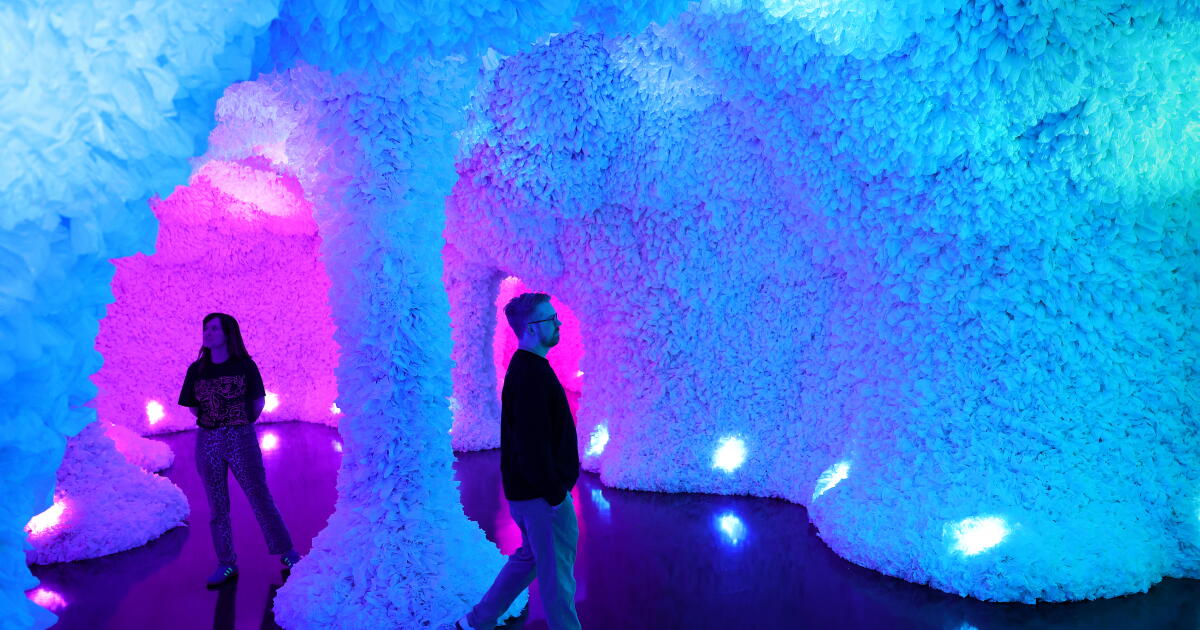
Immersive art firm Hopscotch will on Dec. 11 open a multiroom, walk-through experience, one filled with floor-to-ceiling wonderlands, giant, grown-up-ready ball pits and photo-ready destinations designed to dazzle guests.
Hopscotch is coming to San Pedro’s West Harbor, a long-in-the-works waterfront development initially pegged to have its grand opening last year but just now beginning to launch in phases. The space adds to the growing roster of L.A.-area immersive locations opening soon or in the works.
In the coming weeks, Hopscotch will be joined by Meow Wolf, whose experiential destination is destined for West L.A. Further out but in development is a permanent location of the Museum of Ice Cream in West Adams, and just announced for Anaheim is the first full U.S. exhibition from Tokyo’s TeamLab.
Hopscotch co-founder Nicole Jensen says the space is designed for play.
(Christina House / Los Angeles Times)
“We’re fans,” says Hopscotch co-founder Nicole Jensen of its soon-to-be-peers in the booming immersive art world of SoCal. “In our opinion, there can never be enough art in the world.”
San Pedro’s Hopscotch, the third of the company’s locales after opening spaces in San Antonio and Portland, Ore., has been in the works since 2021. Jensen expects it to be about a 90-minute experience for most guests.
It deviates from other social media-ready art spots with a number of thoughtful rooms that aim to get attendees out of their everyday headspace. Look for a partnership, for instance, with the Human Rights Campaign, as well as a room that seeks to get visitors to open up and be vulnerable.
“We’re all about play and creativity and connection,” Jensen says. “We want you to feel your most authentic self when you’re at Hopscotch, so you can access the play part of your brain.”
Expect plenty of interactive installations, especially those that play with color, light and movement. Here’s a deeper dive into what Hopscotch has to offer.

Hunter Inman, right, and Nicole Jensen, co-founders of Hopscotch, in the space’s introductory room, “Gaze,” a collaboration with the Human Rights Campaign.
(Christina House / Los Angeles Times)
Hopscotch begins with a mission
The first major gallery room in Hopscotch is a maze of 44 transparent, light-infused structures developed in partnership with the Human Rights Campaign (Jensen has served as a member of its board of governors). Dubbed “Gaze,” its clear structures are etched with messages of celebration and unity that reflect HRC’s mission as an LGBTQ+ civil rights organization.
Look, for instance, for glowing purple-pink kittens cheering for “purrrride.” Elsewhere, a wall reflects the local area, providing a light green vision of West Harbor’s ultimate map, and a blue panel is laced with words of inspiration.
“I approached them a few years ago and said I want to bring your messages to life,” Jensen says of the HRC. “So we take messages that are normally on posters, websites and shirts and bring it to life. It’s called ‘Gaze,’ because it’s gazing into a future of love and acceptance for all.”

Hopscotch will feature an installation in which guests listen to the confessions of strangers.
(Christina House / Los Angeles Times)
Listen to the confessions of strangers
One of the most striking installations in Hopscotch is “Secrets,” from Texas studio Wide Awake Creative. Here, guests can enter soundproof telephone-booth-like rooms to either listen to the revelations of strangers, or leave one of their own. The hope, says Jensen, that it is a “shared cathartic experience.” When Hopscotch opens, it will play the secrets of guests from its other locations, but eventually visitors will hear words spoken solely by SoCal attendees.
They’re individually vetted, of course, and Hopscotch has rooms dedicated for grown-ups and children. There’s a wide range, from lighthearted to serious, be it guests expressing fear they’ll never again find love, or just stressing about introducing a partner to their parents. They’re all relatively short, so expect to spend some time listening to strangers get vulnerable. In five years across two locations, Hopscotch has collected more than 400,000 confessions.
“We want it to be as natural and authentic an experience as possible,” Jensen says. Adds co-founder Hunter Inman, “We were surprised when we first did it. We were surprised at how serious some of the sharing was.”

Nicole Jensen, co-founder of Hopscotch, illustrates how the venue will respond to the movements of guests.
(Christina House / Los Angeles Times)
A place to bounce, create and play
It’s not all so serious. Hopscotch ultimately is about play and wonder. That’s why, for instance, it has an adult-sized ball pit. Or a room called the “Quantum Trampoline,” created by international studio Kuflex. Bounce or hop, and each movement is transformed into cosmic-like swirls and twirls. And, of course, Hopscotch has its own version of a mirrored room of hanging lights to mesmerize visitors.
One particularly interactive room is a digital graffiti wall from artist Todd Moyer. Guests, about four or five at a time — Hopscotch intends to pulse people through its 10 installations — can pick up virtual spray cans to decorate computerized brick and concrete walls. From there, attendees will wander into a cotton candy-like explosion of warmth, albeit one designed entirely of thousands of upcycled plastic bags and salvaged fishing nets from artist Barbara Goszczynska. It’s a cavern of soft colors with some not-so-hidden benches and the occasional mirror to create an illusion of a grander space.
Here, too, Hopscotch wants to bridge the worlds of playfulness and thoughtfulness. The rainbow cave, says Jensen, “makes us reconsider our relationship with objects we overuse as a society.”

Onetime San Pedro resident Darel Carey created a large-scale outdoor-indoor mural for Hopscotch.
(Christina House / Los Angeles Times)
Local San Pedro connections
Hopscotch tapped onetime San Pedro resident Darel Carey for a large-scale, indoor-outdoor mural that runs the facade of the building. Carey’s black-and-white, kaleidoscope-like lines are designed as a sort of optical illusion, intended to blur the lines between the inside and outside of the space.
Carey spoke of being influenced by flower blooms in creating the shapes for the spot, and inside Hopscotch the art will serve as the space’s introductory lounge, which will sell walk-up food and beverages, alcoholic and non-alcoholic. Visitors can grab a bite or a beverage without buying a ticket to the full exhibition.
Hopscotch intends to be open daily and tickets will be priced at $25 or less. “We try to make it easy for people to come back again,” Jensen says.
As for why San Pedro, Jensen and Inman say they fell in love with the community soon after touring it in 2021. Jensen was sporting an Arts Open San Pedro shirt on the day of the interview, and cites the area’s arts district as a source of inspiration. But the latter, Jensen adds, could be found just outside the Hopscotch doors.
“Honestly, when you’re down here on the water and these massive ships go by, you feel like a kid again,” Jensen says.

Immersive art firm Hopscotch will on Dec. 11 open a multiroom, walk-through experience, one filled with floor-to-ceiling wonderlands, giant, grown-up-ready ball pits and photo-ready destinations designed to dazzle guests.
Hopscotch is coming to San Pedro’s West Harbor, a long-in-the-works waterfront development initially pegged to have its grand opening last year but just now beginning to launch in phases. The space adds to the growing roster of L.A.-area immersive locations opening soon or in the works.
In the coming weeks, Hopscotch will be joined by Meow Wolf, whose experiential destination is destined for West L.A. Further out but in development is a permanent location of the Museum of Ice Cream in West Adams, and just announced for Anaheim is the first full U.S. exhibition from Tokyo’s TeamLab.
Hopscotch co-founder Nicole Jensen says the space is designed for play.
(Christina House / Los Angeles Times)
“We’re fans,” says Hopscotch co-founder Nicole Jensen of its soon-to-be-peers in the booming immersive art world of SoCal. “In our opinion, there can never be enough art in the world.”
San Pedro’s Hopscotch, the third of the company’s locales after opening spaces in San Antonio and Portland, Ore., has been in the works since 2021. Jensen expects it to be about a 90-minute experience for most guests.
It deviates from other social media-ready art spots with a number of thoughtful rooms that aim to get attendees out of their everyday headspace. Look for a partnership, for instance, with the Human Rights Campaign, as well as a room that seeks to get visitors to open up and be vulnerable.
“We’re all about play and creativity and connection,” Jensen says. “We want you to feel your most authentic self when you’re at Hopscotch, so you can access the play part of your brain.”
Expect plenty of interactive installations, especially those that play with color, light and movement. Here’s a deeper dive into what Hopscotch has to offer.
Hunter Inman, right, and Nicole Jensen, co-founders of Hopscotch, in the space’s introductory room, “Gaze,” a collaboration with the Human Rights Campaign.
(Christina House / Los Angeles Times)
Hopscotch begins with a mission
The first major gallery room in Hopscotch is a maze of 44 transparent, light-infused structures developed in partnership with the Human Rights Campaign (Jensen has served as a member of its board of governors). Dubbed “Gaze,” its clear structures are etched with messages of celebration and unity that reflect HRC’s mission as an LGBTQ+ civil rights organization.
Look, for instance, for glowing purple-pink kittens cheering for “purrrride.” Elsewhere, a wall reflects the local area, providing a light green vision of West Harbor’s ultimate map, and a blue panel is laced with words of inspiration.
“I approached them a few years ago and said I want to bring your messages to life,” Jensen says of the HRC. “So we take messages that are normally on posters, websites and shirts and bring it to life. It’s called ‘Gaze,’ because it’s gazing into a future of love and acceptance for all.”
Hopscotch will feature an installation in which guests listen to the confessions of strangers.
(Christina House / Los Angeles Times)
Listen to the confessions of strangers
One of the most striking installations in Hopscotch is “Secrets,” from Texas studio Wide Awake Creative. Here, guests can enter soundproof telephone-booth-like rooms to either listen to the revelations of strangers, or leave one of their own. The hope, says Jensen, that it is a “shared cathartic experience.” When Hopscotch opens, it will play the secrets of guests from its other locations, but eventually visitors will hear words spoken solely by SoCal attendees.
They’re individually vetted, of course, and Hopscotch has rooms dedicated for grown-ups and children. There’s a wide range, from lighthearted to serious, be it guests expressing fear they’ll never again find love, or just stressing about introducing a partner to their parents. They’re all relatively short, so expect to spend some time listening to strangers get vulnerable. In five years across two locations, Hopscotch has collected more than 400,000 confessions.
“We want it to be as natural and authentic an experience as possible,” Jensen says. Adds co-founder Hunter Inman, “We were surprised when we first did it. We were surprised at how serious some of the sharing was.”
Nicole Jensen, co-founder of Hopscotch, illustrates how the venue will respond to the movements of guests.
(Christina House / Los Angeles Times)
A place to bounce, create and play
It’s not all so serious. Hopscotch ultimately is about play and wonder. That’s why, for instance, it has an adult-sized ball pit. Or a room called the “Quantum Trampoline,” created by international studio Kuflex. Bounce or hop, and each movement is transformed into cosmic-like swirls and twirls. And, of course, Hopscotch has its own version of a mirrored room of hanging lights to mesmerize visitors.
One particularly interactive room is a digital graffiti wall from artist Todd Moyer. Guests, about four or five at a time — Hopscotch intends to pulse people through its 10 installations — can pick up virtual spray cans to decorate computerized brick and concrete walls. From there, attendees will wander into a cotton candy-like explosion of warmth, albeit one designed entirely of thousands of upcycled plastic bags and salvaged fishing nets from artist Barbara Goszczynska. It’s a cavern of soft colors with some not-so-hidden benches and the occasional mirror to create an illusion of a grander space.
Here, too, Hopscotch wants to bridge the worlds of playfulness and thoughtfulness. The rainbow cave, says Jensen, “makes us reconsider our relationship with objects we overuse as a society.”
Onetime San Pedro resident Darel Carey created a large-scale outdoor-indoor mural for Hopscotch.
(Christina House / Los Angeles Times)
Local San Pedro connections
Hopscotch tapped onetime San Pedro resident Darel Carey for a large-scale, indoor-outdoor mural that runs the facade of the building. Carey’s black-and-white, kaleidoscope-like lines are designed as a sort of optical illusion, intended to blur the lines between the inside and outside of the space.
Carey spoke of being influenced by flower blooms in creating the shapes for the spot, and inside Hopscotch the art will serve as the space’s introductory lounge, which will sell walk-up food and beverages, alcoholic and non-alcoholic. Visitors can grab a bite or a beverage without buying a ticket to the full exhibition.
Hopscotch intends to be open daily and tickets will be priced at $25 or less. “We try to make it easy for people to come back again,” Jensen says.
As for why San Pedro, Jensen and Inman say they fell in love with the community soon after touring it in 2021. Jensen was sporting an Arts Open San Pedro shirt on the day of the interview, and cites the area’s arts district as a source of inspiration. But the latter, Jensen adds, could be found just outside the Hopscotch doors.
“Honestly, when you’re down here on the water and these massive ships go by, you feel like a kid again,” Jensen says.

Immersive art firm Hopscotch will on Dec. 11 open a multiroom, walk-through experience, one filled with floor-to-ceiling wonderlands, giant, grown-up-ready ball pits and photo-ready destinations designed to dazzle guests.
Hopscotch is coming to San Pedro’s West Harbor, a long-in-the-works waterfront development initially pegged to have its grand opening last year but just now beginning to launch in phases. The space adds to the growing roster of L.A.-area immersive locations opening soon or in the works.
In the coming weeks, Hopscotch will be joined by Meow Wolf, whose experiential destination is destined for West L.A. Further out but in development is a permanent location of the Museum of Ice Cream in West Adams, and just announced for Anaheim is the first full U.S. exhibition from Tokyo’s TeamLab.
Hopscotch co-founder Nicole Jensen says the space is designed for play.
(Christina House / Los Angeles Times)
“We’re fans,” says Hopscotch co-founder Nicole Jensen of its soon-to-be-peers in the booming immersive art world of SoCal. “In our opinion, there can never be enough art in the world.”
San Pedro’s Hopscotch, the third of the company’s locales after opening spaces in San Antonio and Portland, Ore., has been in the works since 2021. Jensen expects it to be about a 90-minute experience for most guests.
It deviates from other social media-ready art spots with a number of thoughtful rooms that aim to get attendees out of their everyday headspace. Look for a partnership, for instance, with the Human Rights Campaign, as well as a room that seeks to get visitors to open up and be vulnerable.
“We’re all about play and creativity and connection,” Jensen says. “We want you to feel your most authentic self when you’re at Hopscotch, so you can access the play part of your brain.”
Expect plenty of interactive installations, especially those that play with color, light and movement. Here’s a deeper dive into what Hopscotch has to offer.
Hunter Inman, right, and Nicole Jensen, co-founders of Hopscotch, in the space’s introductory room, “Gaze,” a collaboration with the Human Rights Campaign.
(Christina House / Los Angeles Times)
Hopscotch begins with a mission
The first major gallery room in Hopscotch is a maze of 44 transparent, light-infused structures developed in partnership with the Human Rights Campaign (Jensen has served as a member of its board of governors). Dubbed “Gaze,” its clear structures are etched with messages of celebration and unity that reflect HRC’s mission as an LGBTQ+ civil rights organization.
Look, for instance, for glowing purple-pink kittens cheering for “purrrride.” Elsewhere, a wall reflects the local area, providing a light green vision of West Harbor’s ultimate map, and a blue panel is laced with words of inspiration.
“I approached them a few years ago and said I want to bring your messages to life,” Jensen says of the HRC. “So we take messages that are normally on posters, websites and shirts and bring it to life. It’s called ‘Gaze,’ because it’s gazing into a future of love and acceptance for all.”
Hopscotch will feature an installation in which guests listen to the confessions of strangers.
(Christina House / Los Angeles Times)
Listen to the confessions of strangers
One of the most striking installations in Hopscotch is “Secrets,” from Texas studio Wide Awake Creative. Here, guests can enter soundproof telephone-booth-like rooms to either listen to the revelations of strangers, or leave one of their own. The hope, says Jensen, that it is a “shared cathartic experience.” When Hopscotch opens, it will play the secrets of guests from its other locations, but eventually visitors will hear words spoken solely by SoCal attendees.
They’re individually vetted, of course, and Hopscotch has rooms dedicated for grown-ups and children. There’s a wide range, from lighthearted to serious, be it guests expressing fear they’ll never again find love, or just stressing about introducing a partner to their parents. They’re all relatively short, so expect to spend some time listening to strangers get vulnerable. In five years across two locations, Hopscotch has collected more than 400,000 confessions.
“We want it to be as natural and authentic an experience as possible,” Jensen says. Adds co-founder Hunter Inman, “We were surprised when we first did it. We were surprised at how serious some of the sharing was.”
Nicole Jensen, co-founder of Hopscotch, illustrates how the venue will respond to the movements of guests.
(Christina House / Los Angeles Times)
A place to bounce, create and play
It’s not all so serious. Hopscotch ultimately is about play and wonder. That’s why, for instance, it has an adult-sized ball pit. Or a room called the “Quantum Trampoline,” created by international studio Kuflex. Bounce or hop, and each movement is transformed into cosmic-like swirls and twirls. And, of course, Hopscotch has its own version of a mirrored room of hanging lights to mesmerize visitors.
One particularly interactive room is a digital graffiti wall from artist Todd Moyer. Guests, about four or five at a time — Hopscotch intends to pulse people through its 10 installations — can pick up virtual spray cans to decorate computerized brick and concrete walls. From there, attendees will wander into a cotton candy-like explosion of warmth, albeit one designed entirely of thousands of upcycled plastic bags and salvaged fishing nets from artist Barbara Goszczynska. It’s a cavern of soft colors with some not-so-hidden benches and the occasional mirror to create an illusion of a grander space.
Here, too, Hopscotch wants to bridge the worlds of playfulness and thoughtfulness. The rainbow cave, says Jensen, “makes us reconsider our relationship with objects we overuse as a society.”
Onetime San Pedro resident Darel Carey created a large-scale outdoor-indoor mural for Hopscotch.
(Christina House / Los Angeles Times)
Local San Pedro connections
Hopscotch tapped onetime San Pedro resident Darel Carey for a large-scale, indoor-outdoor mural that runs the facade of the building. Carey’s black-and-white, kaleidoscope-like lines are designed as a sort of optical illusion, intended to blur the lines between the inside and outside of the space.
Carey spoke of being influenced by flower blooms in creating the shapes for the spot, and inside Hopscotch the art will serve as the space’s introductory lounge, which will sell walk-up food and beverages, alcoholic and non-alcoholic. Visitors can grab a bite or a beverage without buying a ticket to the full exhibition.
Hopscotch intends to be open daily and tickets will be priced at $25 or less. “We try to make it easy for people to come back again,” Jensen says.
As for why San Pedro, Jensen and Inman say they fell in love with the community soon after touring it in 2021. Jensen was sporting an Arts Open San Pedro shirt on the day of the interview, and cites the area’s arts district as a source of inspiration. But the latter, Jensen adds, could be found just outside the Hopscotch doors.
“Honestly, when you’re down here on the water and these massive ships go by, you feel like a kid again,” Jensen says.

Immersive art firm Hopscotch will on Dec. 11 open a multiroom, walk-through experience, one filled with floor-to-ceiling wonderlands, giant, grown-up-ready ball pits and photo-ready destinations designed to dazzle guests.
Hopscotch is coming to San Pedro’s West Harbor, a long-in-the-works waterfront development initially pegged to have its grand opening last year but just now beginning to launch in phases. The space adds to the growing roster of L.A.-area immersive locations opening soon or in the works.
In the coming weeks, Hopscotch will be joined by Meow Wolf, whose experiential destination is destined for West L.A. Further out but in development is a permanent location of the Museum of Ice Cream in West Adams, and just announced for Anaheim is the first full U.S. exhibition from Tokyo’s TeamLab.
Hopscotch co-founder Nicole Jensen says the space is designed for play.
(Christina House / Los Angeles Times)
“We’re fans,” says Hopscotch co-founder Nicole Jensen of its soon-to-be-peers in the booming immersive art world of SoCal. “In our opinion, there can never be enough art in the world.”
San Pedro’s Hopscotch, the third of the company’s locales after opening spaces in San Antonio and Portland, Ore., has been in the works since 2021. Jensen expects it to be about a 90-minute experience for most guests.
It deviates from other social media-ready art spots with a number of thoughtful rooms that aim to get attendees out of their everyday headspace. Look for a partnership, for instance, with the Human Rights Campaign, as well as a room that seeks to get visitors to open up and be vulnerable.
“We’re all about play and creativity and connection,” Jensen says. “We want you to feel your most authentic self when you’re at Hopscotch, so you can access the play part of your brain.”
Expect plenty of interactive installations, especially those that play with color, light and movement. Here’s a deeper dive into what Hopscotch has to offer.
Hunter Inman, right, and Nicole Jensen, co-founders of Hopscotch, in the space’s introductory room, “Gaze,” a collaboration with the Human Rights Campaign.
(Christina House / Los Angeles Times)
Hopscotch begins with a mission
The first major gallery room in Hopscotch is a maze of 44 transparent, light-infused structures developed in partnership with the Human Rights Campaign (Jensen has served as a member of its board of governors). Dubbed “Gaze,” its clear structures are etched with messages of celebration and unity that reflect HRC’s mission as an LGBTQ+ civil rights organization.
Look, for instance, for glowing purple-pink kittens cheering for “purrrride.” Elsewhere, a wall reflects the local area, providing a light green vision of West Harbor’s ultimate map, and a blue panel is laced with words of inspiration.
“I approached them a few years ago and said I want to bring your messages to life,” Jensen says of the HRC. “So we take messages that are normally on posters, websites and shirts and bring it to life. It’s called ‘Gaze,’ because it’s gazing into a future of love and acceptance for all.”
Hopscotch will feature an installation in which guests listen to the confessions of strangers.
(Christina House / Los Angeles Times)
Listen to the confessions of strangers
One of the most striking installations in Hopscotch is “Secrets,” from Texas studio Wide Awake Creative. Here, guests can enter soundproof telephone-booth-like rooms to either listen to the revelations of strangers, or leave one of their own. The hope, says Jensen, that it is a “shared cathartic experience.” When Hopscotch opens, it will play the secrets of guests from its other locations, but eventually visitors will hear words spoken solely by SoCal attendees.
They’re individually vetted, of course, and Hopscotch has rooms dedicated for grown-ups and children. There’s a wide range, from lighthearted to serious, be it guests expressing fear they’ll never again find love, or just stressing about introducing a partner to their parents. They’re all relatively short, so expect to spend some time listening to strangers get vulnerable. In five years across two locations, Hopscotch has collected more than 400,000 confessions.
“We want it to be as natural and authentic an experience as possible,” Jensen says. Adds co-founder Hunter Inman, “We were surprised when we first did it. We were surprised at how serious some of the sharing was.”
Nicole Jensen, co-founder of Hopscotch, illustrates how the venue will respond to the movements of guests.
(Christina House / Los Angeles Times)
A place to bounce, create and play
It’s not all so serious. Hopscotch ultimately is about play and wonder. That’s why, for instance, it has an adult-sized ball pit. Or a room called the “Quantum Trampoline,” created by international studio Kuflex. Bounce or hop, and each movement is transformed into cosmic-like swirls and twirls. And, of course, Hopscotch has its own version of a mirrored room of hanging lights to mesmerize visitors.
One particularly interactive room is a digital graffiti wall from artist Todd Moyer. Guests, about four or five at a time — Hopscotch intends to pulse people through its 10 installations — can pick up virtual spray cans to decorate computerized brick and concrete walls. From there, attendees will wander into a cotton candy-like explosion of warmth, albeit one designed entirely of thousands of upcycled plastic bags and salvaged fishing nets from artist Barbara Goszczynska. It’s a cavern of soft colors with some not-so-hidden benches and the occasional mirror to create an illusion of a grander space.
Here, too, Hopscotch wants to bridge the worlds of playfulness and thoughtfulness. The rainbow cave, says Jensen, “makes us reconsider our relationship with objects we overuse as a society.”
Onetime San Pedro resident Darel Carey created a large-scale outdoor-indoor mural for Hopscotch.
(Christina House / Los Angeles Times)
Local San Pedro connections
Hopscotch tapped onetime San Pedro resident Darel Carey for a large-scale, indoor-outdoor mural that runs the facade of the building. Carey’s black-and-white, kaleidoscope-like lines are designed as a sort of optical illusion, intended to blur the lines between the inside and outside of the space.
Carey spoke of being influenced by flower blooms in creating the shapes for the spot, and inside Hopscotch the art will serve as the space’s introductory lounge, which will sell walk-up food and beverages, alcoholic and non-alcoholic. Visitors can grab a bite or a beverage without buying a ticket to the full exhibition.
Hopscotch intends to be open daily and tickets will be priced at $25 or less. “We try to make it easy for people to come back again,” Jensen says.
As for why San Pedro, Jensen and Inman say they fell in love with the community soon after touring it in 2021. Jensen was sporting an Arts Open San Pedro shirt on the day of the interview, and cites the area’s arts district as a source of inspiration. But the latter, Jensen adds, could be found just outside the Hopscotch doors.
“Honestly, when you’re down here on the water and these massive ships go by, you feel like a kid again,” Jensen says.

Immersive art firm Hopscotch will on Dec. 11 open a multiroom, walk-through experience, one filled with floor-to-ceiling wonderlands, giant, grown-up-ready ball pits and photo-ready destinations designed to dazzle guests.
Hopscotch is coming to San Pedro’s West Harbor, a long-in-the-works waterfront development initially pegged to have its grand opening last year but just now beginning to launch in phases. The space adds to the growing roster of L.A.-area immersive locations opening soon or in the works.
In the coming weeks, Hopscotch will be joined by Meow Wolf, whose experiential destination is destined for West L.A. Further out but in development is a permanent location of the Museum of Ice Cream in West Adams, and just announced for Anaheim is the first full U.S. exhibition from Tokyo’s TeamLab.
Hopscotch co-founder Nicole Jensen says the space is designed for play.
(Christina House / Los Angeles Times)
“We’re fans,” says Hopscotch co-founder Nicole Jensen of its soon-to-be-peers in the booming immersive art world of SoCal. “In our opinion, there can never be enough art in the world.”
San Pedro’s Hopscotch, the third of the company’s locales after opening spaces in San Antonio and Portland, Ore., has been in the works since 2021. Jensen expects it to be about a 90-minute experience for most guests.
It deviates from other social media-ready art spots with a number of thoughtful rooms that aim to get attendees out of their everyday headspace. Look for a partnership, for instance, with the Human Rights Campaign, as well as a room that seeks to get visitors to open up and be vulnerable.
“We’re all about play and creativity and connection,” Jensen says. “We want you to feel your most authentic self when you’re at Hopscotch, so you can access the play part of your brain.”
Expect plenty of interactive installations, especially those that play with color, light and movement. Here’s a deeper dive into what Hopscotch has to offer.
Hunter Inman, right, and Nicole Jensen, co-founders of Hopscotch, in the space’s introductory room, “Gaze,” a collaboration with the Human Rights Campaign.
(Christina House / Los Angeles Times)
Hopscotch begins with a mission
The first major gallery room in Hopscotch is a maze of 44 transparent, light-infused structures developed in partnership with the Human Rights Campaign (Jensen has served as a member of its board of governors). Dubbed “Gaze,” its clear structures are etched with messages of celebration and unity that reflect HRC’s mission as an LGBTQ+ civil rights organization.
Look, for instance, for glowing purple-pink kittens cheering for “purrrride.” Elsewhere, a wall reflects the local area, providing a light green vision of West Harbor’s ultimate map, and a blue panel is laced with words of inspiration.
“I approached them a few years ago and said I want to bring your messages to life,” Jensen says of the HRC. “So we take messages that are normally on posters, websites and shirts and bring it to life. It’s called ‘Gaze,’ because it’s gazing into a future of love and acceptance for all.”
Hopscotch will feature an installation in which guests listen to the confessions of strangers.
(Christina House / Los Angeles Times)
Listen to the confessions of strangers
One of the most striking installations in Hopscotch is “Secrets,” from Texas studio Wide Awake Creative. Here, guests can enter soundproof telephone-booth-like rooms to either listen to the revelations of strangers, or leave one of their own. The hope, says Jensen, that it is a “shared cathartic experience.” When Hopscotch opens, it will play the secrets of guests from its other locations, but eventually visitors will hear words spoken solely by SoCal attendees.
They’re individually vetted, of course, and Hopscotch has rooms dedicated for grown-ups and children. There’s a wide range, from lighthearted to serious, be it guests expressing fear they’ll never again find love, or just stressing about introducing a partner to their parents. They’re all relatively short, so expect to spend some time listening to strangers get vulnerable. In five years across two locations, Hopscotch has collected more than 400,000 confessions.
“We want it to be as natural and authentic an experience as possible,” Jensen says. Adds co-founder Hunter Inman, “We were surprised when we first did it. We were surprised at how serious some of the sharing was.”
Nicole Jensen, co-founder of Hopscotch, illustrates how the venue will respond to the movements of guests.
(Christina House / Los Angeles Times)
A place to bounce, create and play
It’s not all so serious. Hopscotch ultimately is about play and wonder. That’s why, for instance, it has an adult-sized ball pit. Or a room called the “Quantum Trampoline,” created by international studio Kuflex. Bounce or hop, and each movement is transformed into cosmic-like swirls and twirls. And, of course, Hopscotch has its own version of a mirrored room of hanging lights to mesmerize visitors.
One particularly interactive room is a digital graffiti wall from artist Todd Moyer. Guests, about four or five at a time — Hopscotch intends to pulse people through its 10 installations — can pick up virtual spray cans to decorate computerized brick and concrete walls. From there, attendees will wander into a cotton candy-like explosion of warmth, albeit one designed entirely of thousands of upcycled plastic bags and salvaged fishing nets from artist Barbara Goszczynska. It’s a cavern of soft colors with some not-so-hidden benches and the occasional mirror to create an illusion of a grander space.
Here, too, Hopscotch wants to bridge the worlds of playfulness and thoughtfulness. The rainbow cave, says Jensen, “makes us reconsider our relationship with objects we overuse as a society.”
Onetime San Pedro resident Darel Carey created a large-scale outdoor-indoor mural for Hopscotch.
(Christina House / Los Angeles Times)
Local San Pedro connections
Hopscotch tapped onetime San Pedro resident Darel Carey for a large-scale, indoor-outdoor mural that runs the facade of the building. Carey’s black-and-white, kaleidoscope-like lines are designed as a sort of optical illusion, intended to blur the lines between the inside and outside of the space.
Carey spoke of being influenced by flower blooms in creating the shapes for the spot, and inside Hopscotch the art will serve as the space’s introductory lounge, which will sell walk-up food and beverages, alcoholic and non-alcoholic. Visitors can grab a bite or a beverage without buying a ticket to the full exhibition.
Hopscotch intends to be open daily and tickets will be priced at $25 or less. “We try to make it easy for people to come back again,” Jensen says.
As for why San Pedro, Jensen and Inman say they fell in love with the community soon after touring it in 2021. Jensen was sporting an Arts Open San Pedro shirt on the day of the interview, and cites the area’s arts district as a source of inspiration. But the latter, Jensen adds, could be found just outside the Hopscotch doors.
“Honestly, when you’re down here on the water and these massive ships go by, you feel like a kid again,” Jensen says.

