



This story is part of Image’s November Preservation issue, living in a present that’s shaped by the past.
Los Angeles is dead. Or at least that’s what you might be led to believe if you read social media too much, or consume enough think pieces. Articles with scary titles flog photos of vacant storefronts to prove that we’re a sad sack city in decline. But a city with 4 million residents making the best of their days, working hard and striving for better can’t be dead. Rebirth can look like decay from a distance. L.A. is changing. Into what, it’s impossible to say right now, but it’s certainly not the city of the glory days of the 1980s and 1990s, when Hollywood thrived and the city felt like the center of the universe. Nowhere is that transformation clearer than Sunset Plaza in West Hollywood. Beloved stores and restaurants from the late 20th century seem to close with a stunning regularity — Le Petit Four, Chin Chin, Sushiya. L.A.’s ideas of glamour, sophistication and opulence were honed and flaunted in Sunset Plaza.
At the center of it all was Oliver Peoples, the optical shop that sometimes felt more like a lifestyle brand. Co-founder Larry Leight turned his love of vintage eyewear into a scene, an era-defining look, and a legacy now carried on by his son, Garrett, owner of Garrett Leight California Optical (or GLCO for short). Oliver Peoples might no longer be under family ownership, but its enduring presence in Sunset Plaza is one of the last remaining connections to a golden age. And on the opposite side of town, Garrett’s newest store manages to strengthen that bond even more. Through his Archives store in Silver Lake, Garrett is, in a sense, in conversation with his father, his accomplishments and the iconic period of L.A.’s history that his family business represents.
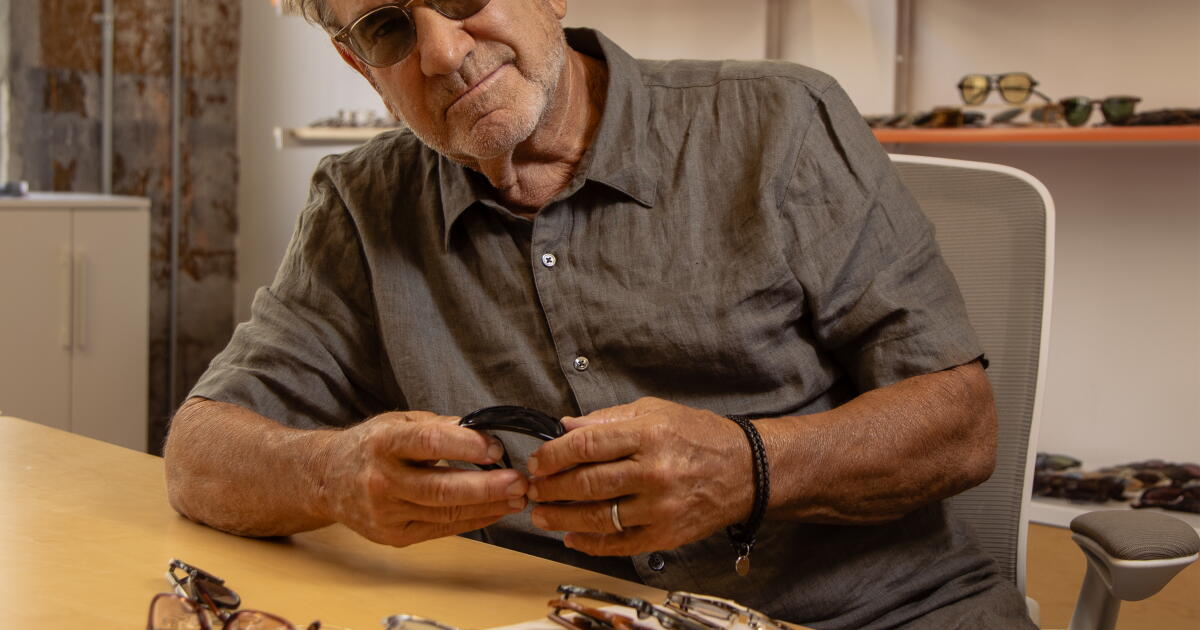
Larry has the casual air of a man who’s satisfied with the output of his life. Hawaii, where he has now lived for six years, has a habit of relaxing even the most ambitious among us. His silvery hair has the loose, rumpled quality that comes with regular exposure to ocean air. But for all his retirement vibes, he retains the fast-talking approach of a great salesman, and the gregarious nature of the successful Westside businessmen of the era.
My own connection to Oliver Peoples is a familial one, too. My ex-wife, the mother of my young son, was around Oliver Peoples through much of her childhood. Her father, photographer Wynn Miller, shot multiple campaigns for the brand. Wynn’s most memorable ad for Oliver Peoples was a photo of miniature versions of the opticians at the store cobbling together frames among books and newspaper clippings. It’s a surrealist image done entirely by hand. I still don’t know how he did it.

Oliver Peoples’ “Working Opticians,” advertising campaign, as imagined by co-founders Larry and Dennis Leight, co-founder, creative and design director Kenny Schwartz, designer Jeff Lancaster and photographer Wynn Miller. Featuring its own employees, it ran in Interview Magazine in 1990.
(Leight family archives; Wynn Miller Estate)
My ex’s mother, Toni, worked in the store. I was privy to the gossip, the lore, the unforgettable parties and the magic of Oliver Peoples through stories — some of which didn’t always add up. One time, Toni claimed that the actor Bruce Dern came into the shop and she casually plucked a hair from his forehead, as though this intimate violation of a celebrity’s personal space was doing him a huge favor. Larry remembers it differently.
“Toni was the funniest girl in the damn world,” he declares during our interview. “Ringo Starr comes in. He’s got a hair hanging from his nose. She goes up to him and says, ‘Don’t move.’ Plucks it from his nose. Ringo’s nose. And we’re looking at her. And he laughs.”
They say to always print the legend, and because I can’t seem to get either Ringo or Bruce on the phone, I choose to print both.
Garrett got his start in the Sunset Plaza store, working in the back. “I remember being 12 years old and reorganizing all the written files of all the patients and seeing Larry David’s name in there. And Jennifer Aniston. That was always wild.”
Like so many L.A. success stories, the Leight family’s rise to the top of the optical world started with what seemed, at the time, to be a quixotic passion. Larry, a Santa Monica native, had struggled to find a career for himself, but found a lifeline as an optician through a program at L.A. City College. He and his partners — his brother Dennis and friend Kenny Schwartz — would eventually start collecting vintage frames to sell in a storefront in Sunset Plaza. Unwittingly, they stumbled upon a treasure trove of glasses through an estate sale of old frames from the mid-century, styles that felt both like a throwback and thoroughly modern, which would prove to be massively popular with customers. The name on the estate sale haul? Oliver Peoples. That name felt like the perfect branding, and the Leights adopted it for their company.
The brand really took off after Larry found a pair of the IM-101 Issey Miyake sunglasses during a trip to Japan. The frames, with their distinctive solid bar over oval lenses, was unlike anything he’d ever seen. He created a play on the design, called the I’dentity. They ended up on Andy Warhol for a Vogue Germany photo shoot. They became a sensation in the U.S. Larry took inspiration from heritage luxury, the vintage ethos of less is more. Simplicity. Elegance over ostentatiousness. And commitment to craft over ubiquity. “My biggest inspiration was Hermès, quite honestly,” he says. “I love what they did, how they did it and how there was no logo on the Birkin bag. And they never departed from it being hard to get. That stuck with me from day one.”
While all of this was going on, the fashions and the posturing of old Hollywood was roaring back into prominence. Giorgio Armani’s louche, billowing designs might have given off a European vibe to the uneducated, but the wide lapels, double-breasted suit jackets, and high-waisted pants were pure 1940s, postwar L.A. Larry remembers riding that wave of timeless sophistication. Historical aesthetics like that were exactly what was on Larry’s mind when building the company. “When we were inspired to design our own collection, we were inspired by old companies like American Optical or Bausch and Lomb from the ’30s and ’40s, ” he says. Oliver Peoples was in the right place, at the right moment. “I just remember every time that we made sales, the best sellers were the simplest, classiest intellectual pieces of eyewear.”

Larry Leight with one of the opticians at the first Oliver Peoples store in Tokyo.
(Leight family archives)

Archival photo of an optical shop that carried Oliver Peoples.
(Leight family archives)

Larry Leight and Cindy Leight prepare for their first trade show in NYC in 1987.
(Leight family archives)
Oliver Peoples was perhaps the opposite of the other most prominent eyewear brand of the previous era, l.a.Eyeworks. Whereas the ‘80s avant-garde prized the bold colors and outré designs coming out of l.a.Eyeworks’ magical Melrose storefront, Oliver Peoples pushed something more restrained, more continental, but no less focused on defining personal style for the wearer. Torrance-based artist and gallerist Michael Brunswick, who has been a fan of the Leight family’s work for years, describes what separated Oliver Peoples from its competitors at the time — a commitment to the human quality of retail. “It’s not about the specific frame. It’s about picturing those frames on people.”
Brent Zerger, director of communications for l.a.Eyeworks, remembers Oliver Peoples being an integral part of his early days in the city when he moved here in 1991 for a curatorial position at MOCA. The ’90s were a time when it was enough to own the right piece of clothing and accessory to be granted some semblance of credibility in the creative world. Today, culture is so staggeringly diffuse and lacking in signifiers of true status that we might never see another family-owned brand like Oliver Peoples carry that much cachet again. “Nobody embraced ’90s minimalism like the art world,” Zerger declares. “And as my curatorial wardrobe transitioned to nearly all-black garments, it was time to trade in my preppy tortoise P3s for something that seemed more elevated and sophisticated; more grown up and thoughtful. I ended up at Oliver Peoples at Sunset Plaza.”
The store was a hot spot for fashion’s elite when they would swing through L.A. — Naomi Campbell, Christy Turlington, and Elle creative director Gilles Bensimon were all cited by Larry as regular customers. In turn, Oliver Peoples frames ended up in high-end fashion campaigns, becoming synonymous with the runway aesthetic of the ’90s. “You can imagine the word of mouth right then just spread all over,” Larry says.
But part of being in business is knowing when to step away. While Oliver Peoples continued to thrive into the 21st century, Larry was ready to get out of the business. In February 2006, Larry and the other founders sold Oliver Peoples to Oakley, which is now owned by the eyewear conglomerate EssilorLuxottica. That might have signaled the end of the Leight family’s story in L.A., but Garrett Leight was waiting in the wings to take over.
“My son worked for us and he totally got what we did. We appealed to customers in the decade of the ‘80s, the people that were between 25 and 45 in the ’90s. That was us. And he had worked for us in the early 2000s. When we sold in 2006, he kind of wished I kept the company. He decided after a trip to Europe that he wanted to open his own optical store.”
Like his father, Garrett is a product of his time. Garrett has the air of the classic Westside dad, rocking a Dodgers hat and unique jewelry, never too far from the beachy, bohemian lifestyle of the neighborhood that birthed his business. Instead of opening a store in West Hollywood or Beverly Hills, the seats of luxury culture in L.A., he chose a sleepy stretch of Abbot Kinney Boulevard in Venice. In the same way that Oliver Peoples defined the hard-charging ’80s and ’90s, GLCO was an early entrant in the race to transform Venice from a gritty, decaying tourist destination known most for its skate and surf culture into the tech enclave it is now. “I was part of the community — the restaurants, the nightlife in Abbott Kinney with my friend group after college,” Garrett says. “I moved to West L.A., but then every weekend, I always just ended up in Venice through some connection or other. The more people I met, the more people I met who were really passionate about Venice.”

Garrett Leight, son of Larry Leight and the owner of Garrett Leight California Optical (GLCO).
(Brandon Kaipo Moningka / For The Times)
The parallels between Oliver Peoples and GLCO are too numerous to miss. “I think [Oliver Peoples] opened November 5 and we opened November 6. His was 1986, mine was 2009.” In both cases, the Leight family businesses opened with archival frames as the core of their offerings. A key difference was Garrett initially seeing GLCO as more of a lifestyle brand at the start.
“When we opened [as A. Kinney Court] on Abbot Kinney in 2009, it was basically entirely archives,” says Garrett. “We took old Oliver Peoples frames and sold vintage. But we also did books, music, shoes and some clothes.” For a while, GLCO even had a print publication that gave a home to writers and photographers Garrett was fond of or that worked for the company. GLCO also didn’t do the glossy, fantasy photo shoots that his father’s business did. His brand would feel more real, more approachable, and less purely Hollywood. There’d be no Andy Warhol or surrealist Wynn Miller photos. Though maybe someone in a GLCO ad campaign could end up being the next Warhol eventually.
It feels like a full circle moment for the Leights in 2026. Garrett turned his Silver Lake storefront into an archive of vintage frames, some of them especially notable — like the Oliver Peoples 523 frames, a style worn by Brad Pitt in the film “Fight Club.” As GLCO firms up its presence east of Hollywood, it feels like the center of luxury culture is shifting yet again. From WeHo to Venice to a drastically gentrified Silver Lake. But Garrett believes the fundamentals of selling eyewear haven’t changed since his father’s heyday. “If you can give a customer a really good experience, especially in a neighborhood type of setting, and then they go to school and there’s other parents that are wearing the glasses and they’re just like, ‘Where’d you get that? Oh, I shop there, too.’ That is super effective. It’s powerful and it hasn’t changed.”
That core principle might not have changed, but everything else has around the Leight family businesses. Sunset Plaza is evolving. Venice’s small restaurants, bars and shops are giving way to chains. Same in Silver Lake. The pull of the old, the vintage, still animates our culture. Cultural history is a continuum, or more accurately, an ever-growing organism. An amoeba of some sort, that grows and feeds off itself. Inspiration and creativity are a well people can tap into if they maintain a level of curiosity about what came before and what’s coming next. Perhaps the most laudable trait of the Leight family is their insistence on curiosity, their love of craft, and the way that they both made their stores monuments to the history of both eyewear and Los Angeles itself.

Garrett Leight, owner of Garrett Leight California Optical (GLCO), left, with his father, Oliver Peoples cofounder Larry Leight.
(Brandon Kaipo Moningka / For The Times)

This story is part of Image’s November Preservation issue, living in a present that’s shaped by the past.
Los Angeles is dead. Or at least that’s what you might be led to believe if you read social media too much, or consume enough think pieces. Articles with scary titles flog photos of vacant storefronts to prove that we’re a sad sack city in decline. But a city with 4 million residents making the best of their days, working hard and striving for better can’t be dead. Rebirth can look like decay from a distance. L.A. is changing. Into what, it’s impossible to say right now, but it’s certainly not the city of the glory days of the 1980s and 1990s, when Hollywood thrived and the city felt like the center of the universe. Nowhere is that transformation clearer than Sunset Plaza in West Hollywood. Beloved stores and restaurants from the late 20th century seem to close with a stunning regularity — Le Petit Four, Chin Chin, Sushiya. L.A.’s ideas of glamour, sophistication and opulence were honed and flaunted in Sunset Plaza.
At the center of it all was Oliver Peoples, the optical shop that sometimes felt more like a lifestyle brand. Co-founder Larry Leight turned his love of vintage eyewear into a scene, an era-defining look, and a legacy now carried on by his son, Garrett, owner of Garrett Leight California Optical (or GLCO for short). Oliver Peoples might no longer be under family ownership, but its enduring presence in Sunset Plaza is one of the last remaining connections to a golden age. And on the opposite side of town, Garrett’s newest store manages to strengthen that bond even more. Through his Archives store in Silver Lake, Garrett is, in a sense, in conversation with his father, his accomplishments and the iconic period of L.A.’s history that his family business represents.
Larry has the casual air of a man who’s satisfied with the output of his life. Hawaii, where he has now lived for six years, has a habit of relaxing even the most ambitious among us. His silvery hair has the loose, rumpled quality that comes with regular exposure to ocean air. But for all his retirement vibes, he retains the fast-talking approach of a great salesman, and the gregarious nature of the successful Westside businessmen of the era.
My own connection to Oliver Peoples is a familial one, too. My ex-wife, the mother of my young son, was around Oliver Peoples through much of her childhood. Her father, photographer Wynn Miller, shot multiple campaigns for the brand. Wynn’s most memorable ad for Oliver Peoples was a photo of miniature versions of the opticians at the store cobbling together frames among books and newspaper clippings. It’s a surrealist image done entirely by hand. I still don’t know how he did it.
Oliver Peoples’ “Working Opticians,” advertising campaign, as imagined by co-founders Larry and Dennis Leight, co-founder, creative and design director Kenny Schwartz, designer Jeff Lancaster and photographer Wynn Miller. Featuring its own employees, it ran in Interview Magazine in 1990.
(Leight family archives; Wynn Miller Estate)
My ex’s mother, Toni, worked in the store. I was privy to the gossip, the lore, the unforgettable parties and the magic of Oliver Peoples through stories — some of which didn’t always add up. One time, Toni claimed that the actor Bruce Dern came into the shop and she casually plucked a hair from his forehead, as though this intimate violation of a celebrity’s personal space was doing him a huge favor. Larry remembers it differently.
“Toni was the funniest girl in the damn world,” he declares during our interview. “Ringo Starr comes in. He’s got a hair hanging from his nose. She goes up to him and says, ‘Don’t move.’ Plucks it from his nose. Ringo’s nose. And we’re looking at her. And he laughs.”
They say to always print the legend, and because I can’t seem to get either Ringo or Bruce on the phone, I choose to print both.
Garrett got his start in the Sunset Plaza store, working in the back. “I remember being 12 years old and reorganizing all the written files of all the patients and seeing Larry David’s name in there. And Jennifer Aniston. That was always wild.”
Like so many L.A. success stories, the Leight family’s rise to the top of the optical world started with what seemed, at the time, to be a quixotic passion. Larry, a Santa Monica native, had struggled to find a career for himself, but found a lifeline as an optician through a program at L.A. City College. He and his partners — his brother Dennis and friend Kenny Schwartz — would eventually start collecting vintage frames to sell in a storefront in Sunset Plaza. Unwittingly, they stumbled upon a treasure trove of glasses through an estate sale of old frames from the mid-century, styles that felt both like a throwback and thoroughly modern, which would prove to be massively popular with customers. The name on the estate sale haul? Oliver Peoples. That name felt like the perfect branding, and the Leights adopted it for their company.
The brand really took off after Larry found a pair of the IM-101 Issey Miyake sunglasses during a trip to Japan. The frames, with their distinctive solid bar over oval lenses, was unlike anything he’d ever seen. He created a play on the design, called the I’dentity. They ended up on Andy Warhol for a Vogue Germany photo shoot. They became a sensation in the U.S. Larry took inspiration from heritage luxury, the vintage ethos of less is more. Simplicity. Elegance over ostentatiousness. And commitment to craft over ubiquity. “My biggest inspiration was Hermès, quite honestly,” he says. “I love what they did, how they did it and how there was no logo on the Birkin bag. And they never departed from it being hard to get. That stuck with me from day one.”
While all of this was going on, the fashions and the posturing of old Hollywood was roaring back into prominence. Giorgio Armani’s louche, billowing designs might have given off a European vibe to the uneducated, but the wide lapels, double-breasted suit jackets, and high-waisted pants were pure 1940s, postwar L.A. Larry remembers riding that wave of timeless sophistication. Historical aesthetics like that were exactly what was on Larry’s mind when building the company. “When we were inspired to design our own collection, we were inspired by old companies like American Optical or Bausch and Lomb from the ’30s and ’40s, ” he says. Oliver Peoples was in the right place, at the right moment. “I just remember every time that we made sales, the best sellers were the simplest, classiest intellectual pieces of eyewear.”
Larry Leight with one of the opticians at the first Oliver Peoples store in Tokyo.
(Leight family archives)
Archival photo of an optical shop that carried Oliver Peoples.
(Leight family archives)
Larry Leight and Cindy Leight prepare for their first trade show in NYC in 1987.
(Leight family archives)
Oliver Peoples was perhaps the opposite of the other most prominent eyewear brand of the previous era, l.a.Eyeworks. Whereas the ‘80s avant-garde prized the bold colors and outré designs coming out of l.a.Eyeworks’ magical Melrose storefront, Oliver Peoples pushed something more restrained, more continental, but no less focused on defining personal style for the wearer. Torrance-based artist and gallerist Michael Brunswick, who has been a fan of the Leight family’s work for years, describes what separated Oliver Peoples from its competitors at the time — a commitment to the human quality of retail. “It’s not about the specific frame. It’s about picturing those frames on people.”
Brent Zerger, director of communications for l.a.Eyeworks, remembers Oliver Peoples being an integral part of his early days in the city when he moved here in 1991 for a curatorial position at MOCA. The ’90s were a time when it was enough to own the right piece of clothing and accessory to be granted some semblance of credibility in the creative world. Today, culture is so staggeringly diffuse and lacking in signifiers of true status that we might never see another family-owned brand like Oliver Peoples carry that much cachet again. “Nobody embraced ’90s minimalism like the art world,” Zerger declares. “And as my curatorial wardrobe transitioned to nearly all-black garments, it was time to trade in my preppy tortoise P3s for something that seemed more elevated and sophisticated; more grown up and thoughtful. I ended up at Oliver Peoples at Sunset Plaza.”
The store was a hot spot for fashion’s elite when they would swing through L.A. — Naomi Campbell, Christy Turlington, and Elle creative director Gilles Bensimon were all cited by Larry as regular customers. In turn, Oliver Peoples frames ended up in high-end fashion campaigns, becoming synonymous with the runway aesthetic of the ’90s. “You can imagine the word of mouth right then just spread all over,” Larry says.
But part of being in business is knowing when to step away. While Oliver Peoples continued to thrive into the 21st century, Larry was ready to get out of the business. In February 2006, Larry and the other founders sold Oliver Peoples to Oakley, which is now owned by the eyewear conglomerate EssilorLuxottica. That might have signaled the end of the Leight family’s story in L.A., but Garrett Leight was waiting in the wings to take over.
“My son worked for us and he totally got what we did. We appealed to customers in the decade of the ‘80s, the people that were between 25 and 45 in the ’90s. That was us. And he had worked for us in the early 2000s. When we sold in 2006, he kind of wished I kept the company. He decided after a trip to Europe that he wanted to open his own optical store.”
Like his father, Garrett is a product of his time. Garrett has the air of the classic Westside dad, rocking a Dodgers hat and unique jewelry, never too far from the beachy, bohemian lifestyle of the neighborhood that birthed his business. Instead of opening a store in West Hollywood or Beverly Hills, the seats of luxury culture in L.A., he chose a sleepy stretch of Abbot Kinney Boulevard in Venice. In the same way that Oliver Peoples defined the hard-charging ’80s and ’90s, GLCO was an early entrant in the race to transform Venice from a gritty, decaying tourist destination known most for its skate and surf culture into the tech enclave it is now. “I was part of the community — the restaurants, the nightlife in Abbott Kinney with my friend group after college,” Garrett says. “I moved to West L.A., but then every weekend, I always just ended up in Venice through some connection or other. The more people I met, the more people I met who were really passionate about Venice.”
Garrett Leight, son of Larry Leight and the owner of Garrett Leight California Optical (GLCO).
(Brandon Kaipo Moningka / For The Times)
The parallels between Oliver Peoples and GLCO are too numerous to miss. “I think [Oliver Peoples] opened November 5 and we opened November 6. His was 1986, mine was 2009.” In both cases, the Leight family businesses opened with archival frames as the core of their offerings. A key difference was Garrett initially seeing GLCO as more of a lifestyle brand at the start.
“When we opened [as A. Kinney Court] on Abbot Kinney in 2009, it was basically entirely archives,” says Garrett. “We took old Oliver Peoples frames and sold vintage. But we also did books, music, shoes and some clothes.” For a while, GLCO even had a print publication that gave a home to writers and photographers Garrett was fond of or that worked for the company. GLCO also didn’t do the glossy, fantasy photo shoots that his father’s business did. His brand would feel more real, more approachable, and less purely Hollywood. There’d be no Andy Warhol or surrealist Wynn Miller photos. Though maybe someone in a GLCO ad campaign could end up being the next Warhol eventually.
It feels like a full circle moment for the Leights in 2026. Garrett turned his Silver Lake storefront into an archive of vintage frames, some of them especially notable — like the Oliver Peoples 523 frames, a style worn by Brad Pitt in the film “Fight Club.” As GLCO firms up its presence east of Hollywood, it feels like the center of luxury culture is shifting yet again. From WeHo to Venice to a drastically gentrified Silver Lake. But Garrett believes the fundamentals of selling eyewear haven’t changed since his father’s heyday. “If you can give a customer a really good experience, especially in a neighborhood type of setting, and then they go to school and there’s other parents that are wearing the glasses and they’re just like, ‘Where’d you get that? Oh, I shop there, too.’ That is super effective. It’s powerful and it hasn’t changed.”
That core principle might not have changed, but everything else has around the Leight family businesses. Sunset Plaza is evolving. Venice’s small restaurants, bars and shops are giving way to chains. Same in Silver Lake. The pull of the old, the vintage, still animates our culture. Cultural history is a continuum, or more accurately, an ever-growing organism. An amoeba of some sort, that grows and feeds off itself. Inspiration and creativity are a well people can tap into if they maintain a level of curiosity about what came before and what’s coming next. Perhaps the most laudable trait of the Leight family is their insistence on curiosity, their love of craft, and the way that they both made their stores monuments to the history of both eyewear and Los Angeles itself.
Garrett Leight, owner of Garrett Leight California Optical (GLCO), left, with his father, Oliver Peoples cofounder Larry Leight.
(Brandon Kaipo Moningka / For The Times)

This story is part of Image’s November Preservation issue, living in a present that’s shaped by the past.
Los Angeles is dead. Or at least that’s what you might be led to believe if you read social media too much, or consume enough think pieces. Articles with scary titles flog photos of vacant storefronts to prove that we’re a sad sack city in decline. But a city with 4 million residents making the best of their days, working hard and striving for better can’t be dead. Rebirth can look like decay from a distance. L.A. is changing. Into what, it’s impossible to say right now, but it’s certainly not the city of the glory days of the 1980s and 1990s, when Hollywood thrived and the city felt like the center of the universe. Nowhere is that transformation clearer than Sunset Plaza in West Hollywood. Beloved stores and restaurants from the late 20th century seem to close with a stunning regularity — Le Petit Four, Chin Chin, Sushiya. L.A.’s ideas of glamour, sophistication and opulence were honed and flaunted in Sunset Plaza.
At the center of it all was Oliver Peoples, the optical shop that sometimes felt more like a lifestyle brand. Co-founder Larry Leight turned his love of vintage eyewear into a scene, an era-defining look, and a legacy now carried on by his son, Garrett, owner of Garrett Leight California Optical (or GLCO for short). Oliver Peoples might no longer be under family ownership, but its enduring presence in Sunset Plaza is one of the last remaining connections to a golden age. And on the opposite side of town, Garrett’s newest store manages to strengthen that bond even more. Through his Archives store in Silver Lake, Garrett is, in a sense, in conversation with his father, his accomplishments and the iconic period of L.A.’s history that his family business represents.
Larry has the casual air of a man who’s satisfied with the output of his life. Hawaii, where he has now lived for six years, has a habit of relaxing even the most ambitious among us. His silvery hair has the loose, rumpled quality that comes with regular exposure to ocean air. But for all his retirement vibes, he retains the fast-talking approach of a great salesman, and the gregarious nature of the successful Westside businessmen of the era.
My own connection to Oliver Peoples is a familial one, too. My ex-wife, the mother of my young son, was around Oliver Peoples through much of her childhood. Her father, photographer Wynn Miller, shot multiple campaigns for the brand. Wynn’s most memorable ad for Oliver Peoples was a photo of miniature versions of the opticians at the store cobbling together frames among books and newspaper clippings. It’s a surrealist image done entirely by hand. I still don’t know how he did it.
Oliver Peoples’ “Working Opticians,” advertising campaign, as imagined by co-founders Larry and Dennis Leight, co-founder, creative and design director Kenny Schwartz, designer Jeff Lancaster and photographer Wynn Miller. Featuring its own employees, it ran in Interview Magazine in 1990.
(Leight family archives; Wynn Miller Estate)
My ex’s mother, Toni, worked in the store. I was privy to the gossip, the lore, the unforgettable parties and the magic of Oliver Peoples through stories — some of which didn’t always add up. One time, Toni claimed that the actor Bruce Dern came into the shop and she casually plucked a hair from his forehead, as though this intimate violation of a celebrity’s personal space was doing him a huge favor. Larry remembers it differently.
“Toni was the funniest girl in the damn world,” he declares during our interview. “Ringo Starr comes in. He’s got a hair hanging from his nose. She goes up to him and says, ‘Don’t move.’ Plucks it from his nose. Ringo’s nose. And we’re looking at her. And he laughs.”
They say to always print the legend, and because I can’t seem to get either Ringo or Bruce on the phone, I choose to print both.
Garrett got his start in the Sunset Plaza store, working in the back. “I remember being 12 years old and reorganizing all the written files of all the patients and seeing Larry David’s name in there. And Jennifer Aniston. That was always wild.”
Like so many L.A. success stories, the Leight family’s rise to the top of the optical world started with what seemed, at the time, to be a quixotic passion. Larry, a Santa Monica native, had struggled to find a career for himself, but found a lifeline as an optician through a program at L.A. City College. He and his partners — his brother Dennis and friend Kenny Schwartz — would eventually start collecting vintage frames to sell in a storefront in Sunset Plaza. Unwittingly, they stumbled upon a treasure trove of glasses through an estate sale of old frames from the mid-century, styles that felt both like a throwback and thoroughly modern, which would prove to be massively popular with customers. The name on the estate sale haul? Oliver Peoples. That name felt like the perfect branding, and the Leights adopted it for their company.
The brand really took off after Larry found a pair of the IM-101 Issey Miyake sunglasses during a trip to Japan. The frames, with their distinctive solid bar over oval lenses, was unlike anything he’d ever seen. He created a play on the design, called the I’dentity. They ended up on Andy Warhol for a Vogue Germany photo shoot. They became a sensation in the U.S. Larry took inspiration from heritage luxury, the vintage ethos of less is more. Simplicity. Elegance over ostentatiousness. And commitment to craft over ubiquity. “My biggest inspiration was Hermès, quite honestly,” he says. “I love what they did, how they did it and how there was no logo on the Birkin bag. And they never departed from it being hard to get. That stuck with me from day one.”
While all of this was going on, the fashions and the posturing of old Hollywood was roaring back into prominence. Giorgio Armani’s louche, billowing designs might have given off a European vibe to the uneducated, but the wide lapels, double-breasted suit jackets, and high-waisted pants were pure 1940s, postwar L.A. Larry remembers riding that wave of timeless sophistication. Historical aesthetics like that were exactly what was on Larry’s mind when building the company. “When we were inspired to design our own collection, we were inspired by old companies like American Optical or Bausch and Lomb from the ’30s and ’40s, ” he says. Oliver Peoples was in the right place, at the right moment. “I just remember every time that we made sales, the best sellers were the simplest, classiest intellectual pieces of eyewear.”
Larry Leight with one of the opticians at the first Oliver Peoples store in Tokyo.
(Leight family archives)
Archival photo of an optical shop that carried Oliver Peoples.
(Leight family archives)
Larry Leight and Cindy Leight prepare for their first trade show in NYC in 1987.
(Leight family archives)
Oliver Peoples was perhaps the opposite of the other most prominent eyewear brand of the previous era, l.a.Eyeworks. Whereas the ‘80s avant-garde prized the bold colors and outré designs coming out of l.a.Eyeworks’ magical Melrose storefront, Oliver Peoples pushed something more restrained, more continental, but no less focused on defining personal style for the wearer. Torrance-based artist and gallerist Michael Brunswick, who has been a fan of the Leight family’s work for years, describes what separated Oliver Peoples from its competitors at the time — a commitment to the human quality of retail. “It’s not about the specific frame. It’s about picturing those frames on people.”
Brent Zerger, director of communications for l.a.Eyeworks, remembers Oliver Peoples being an integral part of his early days in the city when he moved here in 1991 for a curatorial position at MOCA. The ’90s were a time when it was enough to own the right piece of clothing and accessory to be granted some semblance of credibility in the creative world. Today, culture is so staggeringly diffuse and lacking in signifiers of true status that we might never see another family-owned brand like Oliver Peoples carry that much cachet again. “Nobody embraced ’90s minimalism like the art world,” Zerger declares. “And as my curatorial wardrobe transitioned to nearly all-black garments, it was time to trade in my preppy tortoise P3s for something that seemed more elevated and sophisticated; more grown up and thoughtful. I ended up at Oliver Peoples at Sunset Plaza.”
The store was a hot spot for fashion’s elite when they would swing through L.A. — Naomi Campbell, Christy Turlington, and Elle creative director Gilles Bensimon were all cited by Larry as regular customers. In turn, Oliver Peoples frames ended up in high-end fashion campaigns, becoming synonymous with the runway aesthetic of the ’90s. “You can imagine the word of mouth right then just spread all over,” Larry says.
But part of being in business is knowing when to step away. While Oliver Peoples continued to thrive into the 21st century, Larry was ready to get out of the business. In February 2006, Larry and the other founders sold Oliver Peoples to Oakley, which is now owned by the eyewear conglomerate EssilorLuxottica. That might have signaled the end of the Leight family’s story in L.A., but Garrett Leight was waiting in the wings to take over.
“My son worked for us and he totally got what we did. We appealed to customers in the decade of the ‘80s, the people that were between 25 and 45 in the ’90s. That was us. And he had worked for us in the early 2000s. When we sold in 2006, he kind of wished I kept the company. He decided after a trip to Europe that he wanted to open his own optical store.”
Like his father, Garrett is a product of his time. Garrett has the air of the classic Westside dad, rocking a Dodgers hat and unique jewelry, never too far from the beachy, bohemian lifestyle of the neighborhood that birthed his business. Instead of opening a store in West Hollywood or Beverly Hills, the seats of luxury culture in L.A., he chose a sleepy stretch of Abbot Kinney Boulevard in Venice. In the same way that Oliver Peoples defined the hard-charging ’80s and ’90s, GLCO was an early entrant in the race to transform Venice from a gritty, decaying tourist destination known most for its skate and surf culture into the tech enclave it is now. “I was part of the community — the restaurants, the nightlife in Abbott Kinney with my friend group after college,” Garrett says. “I moved to West L.A., but then every weekend, I always just ended up in Venice through some connection or other. The more people I met, the more people I met who were really passionate about Venice.”
Garrett Leight, son of Larry Leight and the owner of Garrett Leight California Optical (GLCO).
(Brandon Kaipo Moningka / For The Times)
The parallels between Oliver Peoples and GLCO are too numerous to miss. “I think [Oliver Peoples] opened November 5 and we opened November 6. His was 1986, mine was 2009.” In both cases, the Leight family businesses opened with archival frames as the core of their offerings. A key difference was Garrett initially seeing GLCO as more of a lifestyle brand at the start.
“When we opened [as A. Kinney Court] on Abbot Kinney in 2009, it was basically entirely archives,” says Garrett. “We took old Oliver Peoples frames and sold vintage. But we also did books, music, shoes and some clothes.” For a while, GLCO even had a print publication that gave a home to writers and photographers Garrett was fond of or that worked for the company. GLCO also didn’t do the glossy, fantasy photo shoots that his father’s business did. His brand would feel more real, more approachable, and less purely Hollywood. There’d be no Andy Warhol or surrealist Wynn Miller photos. Though maybe someone in a GLCO ad campaign could end up being the next Warhol eventually.
It feels like a full circle moment for the Leights in 2026. Garrett turned his Silver Lake storefront into an archive of vintage frames, some of them especially notable — like the Oliver Peoples 523 frames, a style worn by Brad Pitt in the film “Fight Club.” As GLCO firms up its presence east of Hollywood, it feels like the center of luxury culture is shifting yet again. From WeHo to Venice to a drastically gentrified Silver Lake. But Garrett believes the fundamentals of selling eyewear haven’t changed since his father’s heyday. “If you can give a customer a really good experience, especially in a neighborhood type of setting, and then they go to school and there’s other parents that are wearing the glasses and they’re just like, ‘Where’d you get that? Oh, I shop there, too.’ That is super effective. It’s powerful and it hasn’t changed.”
That core principle might not have changed, but everything else has around the Leight family businesses. Sunset Plaza is evolving. Venice’s small restaurants, bars and shops are giving way to chains. Same in Silver Lake. The pull of the old, the vintage, still animates our culture. Cultural history is a continuum, or more accurately, an ever-growing organism. An amoeba of some sort, that grows and feeds off itself. Inspiration and creativity are a well people can tap into if they maintain a level of curiosity about what came before and what’s coming next. Perhaps the most laudable trait of the Leight family is their insistence on curiosity, their love of craft, and the way that they both made their stores monuments to the history of both eyewear and Los Angeles itself.
Garrett Leight, owner of Garrett Leight California Optical (GLCO), left, with his father, Oliver Peoples cofounder Larry Leight.
(Brandon Kaipo Moningka / For The Times)

