

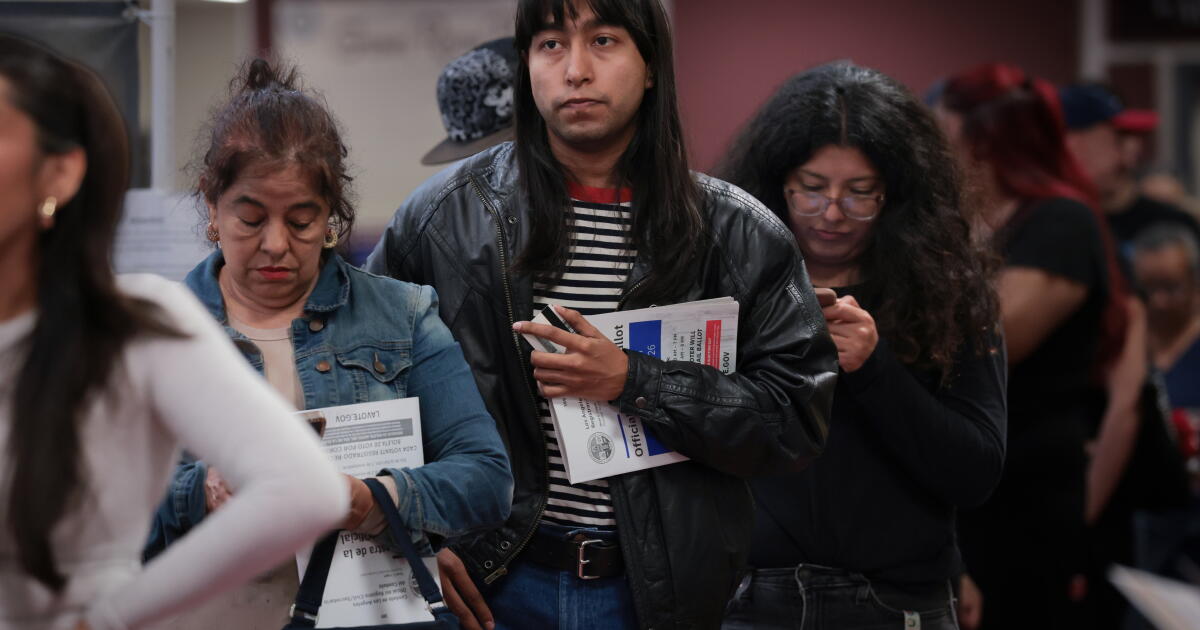

WASHINGTON — Latino voters, whose swing to the right aided President Trump’s election in 2024, helped Democrats reclaim both chambers of Congress on Tuesday in a stunning reversal of support for Republicans.
The shift, which transpired nationwide but was especially pronounced in Texas, is seen as a rebuke of the president and his party by a group of Americans who have watched as their families and neighbors were detained by immigration agents while their cost of living shot up.
“President Trump asked voters to pretend like he was on the ballot, and our observation is that Latino voters did just by that, resoundingly rejecting his extreme policies and actions and anyone who rubber-stamped them,” said Janet Murguía, president of UnidosUS, a Washington-based Latino civil rights and advocacy group.
“While the numbers are still coming in, what we know so far indicates that this will undoubtedly be the largest turnout of Latino voters ever in a midterm election,” she added.
UnidosUS on Wednesday released findings from a poll, conducted by the Los Angeles-based analytics firm BSP Research, of more than 3,000 Latinos who voted in the midterm elections. The findings showed many Latinos are independent, swing voters — 17% of 2024 Trump voters supported Democratic House candidates in this election.
Gary Segura, president of BSP Research, said on a call Wednesday with Murguía and reporters that Latino voters returned this election to historic patterns, with about two-thirds voting for Democrats and one-third voting Republican.
In 2024, Trump won more than 40% of Latino votes, many motivated by his promises to reduce prices.
This year, cost of living and inflation are by far Latino voters’ top concerns, the poll found, with more than half citing food and grocery costs as particular burdens and saying they have no money left over each month or struggle to pay bills.
Immigration was also a factor, with 90% of Latino voters supporting a balanced immigration system and a quarter of them naming ICE and immigration reform as among their top three issues, following cost of living.
“The Republican candidates on the ballot yesterday were really struggling to swim upstream against an administration with this kind of disapproval across issues,” Segura said.
GOP strategist Giancarlo Sopo said right-wing echo chambers didn’t understand that when Latinos hear “criminal illegals” they picture gang members or people who evaded Border Patrol.
“But the vast majority of immigrants without legal status did not swim the Rio Grande,” he wrote in a post on social media. “Conflating people who sneak in with asylum applicants and visa overstayers working through a labyrinthine system is turning off Hispanics.”
In Texas, voters in majority-Latino districts near San Antonio and along the border helped Democrats break Republicans’ longstanding grip on the state to win the races for governor, lieutenant governor and senator. James Talarico’s victory against Republican Atty. Gen. Ken Paxton marks the first time a Democrat has won a Senate seat in Texas since 1988.
NBC exit polling shows that 61% of Latino men, with whom Trump had made particular inroads, voted for Talarico.
Among those casting his ballot was Ronaldo Salgado, the son of Lorenzo Salgado Araujo, who was killed by Immigration and Customs Enforcement agents in Houston. He told MSNOW on Monday that he had placed his “I Voted” sticker on a memorial dedicated to his father.
“I always vote with my parents in mind, with my family in mind, but this year’s vote is definitely with much heavier weight on it,” he said. “I cried as I was casting my vote because I was doing it in honor of my dad.”
Bobby Pulido, a South Texas Tejano singer whose campaign strategy included performing at quinceañeras, beat Republican incumbent Rep. Monica De La Cruz by more than 20 percentage points. De La Cruz was among the battleground Republicans to warn the White House that ICE should focus on criminals and not law-abiding people.
Latino voters told the BSP Research pollsters that both parties, but especially Democrats, reached out to them more in this election cycle than in the past.
Even in districts where Democrats did not prevail, Latino votes made some races tight. In Florida, where Republican Sen. Ashley Moody narrowly won reelection and Rep. Maria Elvira Salazar holds a slim lead, Latinos also shifted left.
Doral, a municipality near Miami with the highest concentration of Venezuelans in the country, favored Trump in 2024 by 23 percentage points over Vice President Kamala Harris. On Tuesday, Doral voters chose Moody’s competitor, Angie Nixon, a member of the Democratic Socialists of America, by 3 percentage points.
Nationally, about 6 in 10 Latino voters opted for the Democratic candidate in their local House race, according to an Associated Press exit poll.
The midterm was also pivotal for Latino representation among elected officials.
In the two states with the most Latino residents, Gina Hinojosa became the first Latina elected governor in Texas, and Xavier Becerra is California’s first Latino governor in more than 150 years.
The Congressional Hispanic Caucus announced that it will have at least 55 members in the new Congress, making it the largest membership in the caucus’s 50-year history.
“Our representation is growing, our voices are stronger, and no one can afford to take Latino voters for granted,” caucus leaders wrote in a statement.
But representation alone won’t cut it, said Julián Castro, chief executive of the Latino Community Foundation. Latinos will look to how their votes translate into policy changes that benefit those who trusted the leaders they helped elect.
“What are they going to do about affordability?” he said on the call with UnidosUS. “What are they going to do about corruption and rooting that out? What are they going to do about ending ICE abuse and cruelty and pursuing a more balanced approach on immigration?”
Rep. Robert Garcia (D-Long Beach), who is likely to become the next chair of the House Committee on Oversight and Government Reform, acknowledged the responsibility that Democrats have.
“One of the big stories coming out of tonight is the enormous swing that Latino voters are now re-entrusting Democrats on,” he told MeidasTouch News. “…We have to deliver on taking on ICE. We have to deliver on passing real immigration solutions and reform.”

WASHINGTON — Latino voters, whose swing to the right aided President Trump’s election in 2024, helped Democrats reclaim both chambers of Congress on Tuesday in a stunning reversal of support for Republicans.
The shift, which transpired nationwide but was especially pronounced in Texas, is seen as a rebuke of the president and his party by a group of Americans who have watched as their families and neighbors were detained by immigration agents while their cost of living shot up.
“President Trump asked voters to pretend like he was on the ballot, and our observation is that Latino voters did just by that, resoundingly rejecting his extreme policies and actions and anyone who rubber-stamped them,” said Janet Murguía, president of UnidosUS, a Washington-based Latino civil rights and advocacy group.
“While the numbers are still coming in, what we know so far indicates that this will undoubtedly be the largest turnout of Latino voters ever in a midterm election,” she added.
UnidosUS on Wednesday released findings from a poll, conducted by the Los Angeles-based analytics firm BSP Research, of more than 3,000 Latinos who voted in the midterm elections. The findings showed many Latinos are independent, swing voters — 17% of 2024 Trump voters supported Democratic House candidates in this election.
Gary Segura, president of BSP Research, said on a call Wednesday with Murguía and reporters that Latino voters returned this election to historic patterns, with about two-thirds voting for Democrats and one-third voting Republican.
In 2024, Trump won more than 40% of Latino votes, many motivated by his promises to reduce prices.
This year, cost of living and inflation are by far Latino voters’ top concerns, the poll found, with more than half citing food and grocery costs as particular burdens and saying they have no money left over each month or struggle to pay bills.
Immigration was also a factor, with 90% of Latino voters supporting a balanced immigration system and a quarter of them naming ICE and immigration reform as among their top three issues, following cost of living.
“The Republican candidates on the ballot yesterday were really struggling to swim upstream against an administration with this kind of disapproval across issues,” Segura said.
GOP strategist Giancarlo Sopo said right-wing echo chambers didn’t understand that when Latinos hear “criminal illegals” they picture gang members or people who evaded Border Patrol.
“But the vast majority of immigrants without legal status did not swim the Rio Grande,” he wrote in a post on social media. “Conflating people who sneak in with asylum applicants and visa overstayers working through a labyrinthine system is turning off Hispanics.”
In Texas, voters in majority-Latino districts near San Antonio and along the border helped Democrats break Republicans’ longstanding grip on the state to win the races for governor, lieutenant governor and senator. James Talarico’s victory against Republican Atty. Gen. Ken Paxton marks the first time a Democrat has won a Senate seat in Texas since 1988.
NBC exit polling shows that 61% of Latino men, with whom Trump had made particular inroads, voted for Talarico.
Among those casting his ballot was Ronaldo Salgado, the son of Lorenzo Salgado Araujo, who was killed by Immigration and Customs Enforcement agents in Houston. He told MSNOW on Monday that he had placed his “I Voted” sticker on a memorial dedicated to his father.
“I always vote with my parents in mind, with my family in mind, but this year’s vote is definitely with much heavier weight on it,” he said. “I cried as I was casting my vote because I was doing it in honor of my dad.”
Bobby Pulido, a South Texas Tejano singer whose campaign strategy included performing at quinceañeras, beat Republican incumbent Rep. Monica De La Cruz by more than 20 percentage points. De La Cruz was among the battleground Republicans to warn the White House that ICE should focus on criminals and not law-abiding people.
Latino voters told the BSP Research pollsters that both parties, but especially Democrats, reached out to them more in this election cycle than in the past.
Even in districts where Democrats did not prevail, Latino votes made some races tight. In Florida, where Republican Sen. Ashley Moody narrowly won reelection and Rep. Maria Elvira Salazar holds a slim lead, Latinos also shifted left.
Doral, a municipality near Miami with the highest concentration of Venezuelans in the country, favored Trump in 2024 by 23 percentage points over Vice President Kamala Harris. On Tuesday, Doral voters chose Moody’s competitor, Angie Nixon, a member of the Democratic Socialists of America, by 3 percentage points.
Nationally, about 6 in 10 Latino voters opted for the Democratic candidate in their local House race, according to an Associated Press exit poll.
The midterm was also pivotal for Latino representation among elected officials.
In the two states with the most Latino residents, Gina Hinojosa became the first Latina elected governor in Texas, and Xavier Becerra is California’s first Latino governor in more than 150 years.
The Congressional Hispanic Caucus announced that it will have at least 55 members in the new Congress, making it the largest membership in the caucus’s 50-year history.
“Our representation is growing, our voices are stronger, and no one can afford to take Latino voters for granted,” caucus leaders wrote in a statement.
But representation alone won’t cut it, said Julián Castro, chief executive of the Latino Community Foundation. Latinos will look to how their votes translate into policy changes that benefit those who trusted the leaders they helped elect.
“What are they going to do about affordability?” he said on the call with UnidosUS. “What are they going to do about corruption and rooting that out? What are they going to do about ending ICE abuse and cruelty and pursuing a more balanced approach on immigration?”
Rep. Robert Garcia (D-Long Beach), who is likely to become the next chair of the House Committee on Oversight and Government Reform, acknowledged the responsibility that Democrats have.
“One of the big stories coming out of tonight is the enormous swing that Latino voters are now re-entrusting Democrats on,” he told MeidasTouch News. “…We have to deliver on taking on ICE. We have to deliver on passing real immigration solutions and reform.”

WASHINGTON — Latino voters, whose swing to the right aided President Trump’s election in 2024, helped Democrats reclaim both chambers of Congress on Tuesday in a stunning reversal of support for Republicans.
The shift, which transpired nationwide but was especially pronounced in Texas, is seen as a rebuke of the president and his party by a group of Americans who have watched as their families and neighbors were detained by immigration agents while their cost of living shot up.
“President Trump asked voters to pretend like he was on the ballot, and our observation is that Latino voters did just by that, resoundingly rejecting his extreme policies and actions and anyone who rubber-stamped them,” said Janet Murguía, president of UnidosUS, a Washington-based Latino civil rights and advocacy group.
“While the numbers are still coming in, what we know so far indicates that this will undoubtedly be the largest turnout of Latino voters ever in a midterm election,” she added.
UnidosUS on Wednesday released findings from a poll, conducted by the Los Angeles-based analytics firm BSP Research, of more than 3,000 Latinos who voted in the midterm elections. The findings showed many Latinos are independent, swing voters — 17% of 2024 Trump voters supported Democratic House candidates in this election.
Gary Segura, president of BSP Research, said on a call Wednesday with Murguía and reporters that Latino voters returned this election to historic patterns, with about two-thirds voting for Democrats and one-third voting Republican.
In 2024, Trump won more than 40% of Latino votes, many motivated by his promises to reduce prices.
This year, cost of living and inflation are by far Latino voters’ top concerns, the poll found, with more than half citing food and grocery costs as particular burdens and saying they have no money left over each month or struggle to pay bills.
Immigration was also a factor, with 90% of Latino voters supporting a balanced immigration system and a quarter of them naming ICE and immigration reform as among their top three issues, following cost of living.
“The Republican candidates on the ballot yesterday were really struggling to swim upstream against an administration with this kind of disapproval across issues,” Segura said.
GOP strategist Giancarlo Sopo said right-wing echo chambers didn’t understand that when Latinos hear “criminal illegals” they picture gang members or people who evaded Border Patrol.
“But the vast majority of immigrants without legal status did not swim the Rio Grande,” he wrote in a post on social media. “Conflating people who sneak in with asylum applicants and visa overstayers working through a labyrinthine system is turning off Hispanics.”
In Texas, voters in majority-Latino districts near San Antonio and along the border helped Democrats break Republicans’ longstanding grip on the state to win the races for governor, lieutenant governor and senator. James Talarico’s victory against Republican Atty. Gen. Ken Paxton marks the first time a Democrat has won a Senate seat in Texas since 1988.
NBC exit polling shows that 61% of Latino men, with whom Trump had made particular inroads, voted for Talarico.
Among those casting his ballot was Ronaldo Salgado, the son of Lorenzo Salgado Araujo, who was killed by Immigration and Customs Enforcement agents in Houston. He told MSNOW on Monday that he had placed his “I Voted” sticker on a memorial dedicated to his father.
“I always vote with my parents in mind, with my family in mind, but this year’s vote is definitely with much heavier weight on it,” he said. “I cried as I was casting my vote because I was doing it in honor of my dad.”
Bobby Pulido, a South Texas Tejano singer whose campaign strategy included performing at quinceañeras, beat Republican incumbent Rep. Monica De La Cruz by more than 20 percentage points. De La Cruz was among the battleground Republicans to warn the White House that ICE should focus on criminals and not law-abiding people.
Latino voters told the BSP Research pollsters that both parties, but especially Democrats, reached out to them more in this election cycle than in the past.
Even in districts where Democrats did not prevail, Latino votes made some races tight. In Florida, where Republican Sen. Ashley Moody narrowly won reelection and Rep. Maria Elvira Salazar holds a slim lead, Latinos also shifted left.
Doral, a municipality near Miami with the highest concentration of Venezuelans in the country, favored Trump in 2024 by 23 percentage points over Vice President Kamala Harris. On Tuesday, Doral voters chose Moody’s competitor, Angie Nixon, a member of the Democratic Socialists of America, by 3 percentage points.
Nationally, about 6 in 10 Latino voters opted for the Democratic candidate in their local House race, according to an Associated Press exit poll.
The midterm was also pivotal for Latino representation among elected officials.
In the two states with the most Latino residents, Gina Hinojosa became the first Latina elected governor in Texas, and Xavier Becerra is California’s first Latino governor in more than 150 years.
The Congressional Hispanic Caucus announced that it will have at least 55 members in the new Congress, making it the largest membership in the caucus’s 50-year history.
“Our representation is growing, our voices are stronger, and no one can afford to take Latino voters for granted,” caucus leaders wrote in a statement.
But representation alone won’t cut it, said Julián Castro, chief executive of the Latino Community Foundation. Latinos will look to how their votes translate into policy changes that benefit those who trusted the leaders they helped elect.
“What are they going to do about affordability?” he said on the call with UnidosUS. “What are they going to do about corruption and rooting that out? What are they going to do about ending ICE abuse and cruelty and pursuing a more balanced approach on immigration?”
Rep. Robert Garcia (D-Long Beach), who is likely to become the next chair of the House Committee on Oversight and Government Reform, acknowledged the responsibility that Democrats have.
“One of the big stories coming out of tonight is the enormous swing that Latino voters are now re-entrusting Democrats on,” he told MeidasTouch News. “…We have to deliver on taking on ICE. We have to deliver on passing real immigration solutions and reform.”

WASHINGTON — Latino voters, whose swing to the right aided President Trump’s election in 2024, helped Democrats reclaim both chambers of Congress on Tuesday in a stunning reversal of support for Republicans.
The shift, which transpired nationwide but was especially pronounced in Texas, is seen as a rebuke of the president and his party by a group of Americans who have watched as their families and neighbors were detained by immigration agents while their cost of living shot up.
“President Trump asked voters to pretend like he was on the ballot, and our observation is that Latino voters did just by that, resoundingly rejecting his extreme policies and actions and anyone who rubber-stamped them,” said Janet Murguía, president of UnidosUS, a Washington-based Latino civil rights and advocacy group.
“While the numbers are still coming in, what we know so far indicates that this will undoubtedly be the largest turnout of Latino voters ever in a midterm election,” she added.
UnidosUS on Wednesday released findings from a poll, conducted by the Los Angeles-based analytics firm BSP Research, of more than 3,000 Latinos who voted in the midterm elections. The findings showed many Latinos are independent, swing voters — 17% of 2024 Trump voters supported Democratic House candidates in this election.
Gary Segura, president of BSP Research, said on a call Wednesday with Murguía and reporters that Latino voters returned this election to historic patterns, with about two-thirds voting for Democrats and one-third voting Republican.
In 2024, Trump won more than 40% of Latino votes, many motivated by his promises to reduce prices.
This year, cost of living and inflation are by far Latino voters’ top concerns, the poll found, with more than half citing food and grocery costs as particular burdens and saying they have no money left over each month or struggle to pay bills.
Immigration was also a factor, with 90% of Latino voters supporting a balanced immigration system and a quarter of them naming ICE and immigration reform as among their top three issues, following cost of living.
“The Republican candidates on the ballot yesterday were really struggling to swim upstream against an administration with this kind of disapproval across issues,” Segura said.
GOP strategist Giancarlo Sopo said right-wing echo chambers didn’t understand that when Latinos hear “criminal illegals” they picture gang members or people who evaded Border Patrol.
“But the vast majority of immigrants without legal status did not swim the Rio Grande,” he wrote in a post on social media. “Conflating people who sneak in with asylum applicants and visa overstayers working through a labyrinthine system is turning off Hispanics.”
In Texas, voters in majority-Latino districts near San Antonio and along the border helped Democrats break Republicans’ longstanding grip on the state to win the races for governor, lieutenant governor and senator. James Talarico’s victory against Republican Atty. Gen. Ken Paxton marks the first time a Democrat has won a Senate seat in Texas since 1988.
NBC exit polling shows that 61% of Latino men, with whom Trump had made particular inroads, voted for Talarico.
Among those casting his ballot was Ronaldo Salgado, the son of Lorenzo Salgado Araujo, who was killed by Immigration and Customs Enforcement agents in Houston. He told MSNOW on Monday that he had placed his “I Voted” sticker on a memorial dedicated to his father.
“I always vote with my parents in mind, with my family in mind, but this year’s vote is definitely with much heavier weight on it,” he said. “I cried as I was casting my vote because I was doing it in honor of my dad.”
Bobby Pulido, a South Texas Tejano singer whose campaign strategy included performing at quinceañeras, beat Republican incumbent Rep. Monica De La Cruz by more than 20 percentage points. De La Cruz was among the battleground Republicans to warn the White House that ICE should focus on criminals and not law-abiding people.
Latino voters told the BSP Research pollsters that both parties, but especially Democrats, reached out to them more in this election cycle than in the past.
Even in districts where Democrats did not prevail, Latino votes made some races tight. In Florida, where Republican Sen. Ashley Moody narrowly won reelection and Rep. Maria Elvira Salazar holds a slim lead, Latinos also shifted left.
Doral, a municipality near Miami with the highest concentration of Venezuelans in the country, favored Trump in 2024 by 23 percentage points over Vice President Kamala Harris. On Tuesday, Doral voters chose Moody’s competitor, Angie Nixon, a member of the Democratic Socialists of America, by 3 percentage points.
Nationally, about 6 in 10 Latino voters opted for the Democratic candidate in their local House race, according to an Associated Press exit poll.
The midterm was also pivotal for Latino representation among elected officials.
In the two states with the most Latino residents, Gina Hinojosa became the first Latina elected governor in Texas, and Xavier Becerra is California’s first Latino governor in more than 150 years.
The Congressional Hispanic Caucus announced that it will have at least 55 members in the new Congress, making it the largest membership in the caucus’s 50-year history.
“Our representation is growing, our voices are stronger, and no one can afford to take Latino voters for granted,” caucus leaders wrote in a statement.
But representation alone won’t cut it, said Julián Castro, chief executive of the Latino Community Foundation. Latinos will look to how their votes translate into policy changes that benefit those who trusted the leaders they helped elect.
“What are they going to do about affordability?” he said on the call with UnidosUS. “What are they going to do about corruption and rooting that out? What are they going to do about ending ICE abuse and cruelty and pursuing a more balanced approach on immigration?”
Rep. Robert Garcia (D-Long Beach), who is likely to become the next chair of the House Committee on Oversight and Government Reform, acknowledged the responsibility that Democrats have.
“One of the big stories coming out of tonight is the enormous swing that Latino voters are now re-entrusting Democrats on,” he told MeidasTouch News. “…We have to deliver on taking on ICE. We have to deliver on passing real immigration solutions and reform.”

