

Alex Lamb and Max Well didn’t set out to make a documentary. Fans of tiki bars, their goal was a web series, one that looked at the colorfully decorative tropical bars in Southern California. What they discovered, however, was an only-in-Hollywood tale that not only cut to the heart of the scene’s roots, but foretold the modern cocktail movement, changed tourism and spawned a subculture.
Now available to rent or buy on most major streaming platforms, “The Donn of Tiki” looks at the life, much of it grounded in self-made myths, of Ernest Raymond Beaumont Gantt, otherwise known as Donn Beach or Donn the Beachcomber. A bootlegger, World War II veteran and nightlife impresario, Beach, as he legally changed his name to, was a sort-of cocktail-focused answer to Walt Disney. He was a pioneer of an industry who trafficked in experimentation, big ideas and, eventually, heavily thematic environments that centered the guest experience.
“Donn and Walt Disney, they’re both hosts,” Lamb says, noting that many have referred to him as the “Walt Disney of rum.”
“They create this experience that people are going to come to and not just see, but they’re going to feel it and hear it,” Lamb says. “It’s for all their senses. They’re very similar in that way.”
Documentary “The Donn of Tiki” uses stop-motion animation to help tell the tale of Donn the Beachcomber.
(Surf Monkey Films / Beachcomber Productions)
“The Donn of Tiki,” first released in 2024, also portrays Beach as a bit of a schemer. Some of his bar inventions, for instance, were less grand thematic ideas and simply tricks to keep patrons indoors and ordering. The filmmakers credit Beach with helping to commercialize the luau, now a staple of many a Hawaiian vacation, and bring his story to life via stop-motion and 2D animation, historical footage, and fresh interviews, including with his widow and some of those who worked for his latter-day establishments.
Yet Lamb and Well are primarily interested in how a once tiny Hollywood bar on McCadden Place became ground zero for a movement that over the decades has regularly come in and out of popularity. Tiki bars have been celebrated, and criticized, but at least here in SoCal many have survived and defied trends. Today, the tiki scene is thriving, a hub for craft cocktails but also a reflection of our city’s penchant for dreaming and escapism.
A tiki bar, at its best, is often a mash-up of cultural ideas and myths — bits of the Caribbean, Polynesia and Asia, and less a reflection of any real place or heritage. It’s an imaginative environment, something that feels dreamed up for a movie.

That’s what drew Well, a cinematographer by trade, to the space.
“Some people are really into the music, the fashion or the cocktails,” Well says. “But the thing I was into was just the visuals. You go into one of these places, and it’s like walking into a film set. It’s been transformed into an experiential thing.”
As a filmmaker, says Lamb, it’s hard not to be transfixed by a well-done tiki bar.

An undated historical image of Donn Beach, credited as starting the tiki movement, from the film “The Donn of Tiki.”
(Surf Monkey Films / Beachcomber Productions)
“You walk in off the street, and it may be daylight outside, but you walk into a dark room, turn a corner and smell burning cinnamon or baking spices and it seems like it’s raining outside. It’s a story,” he says. “And Donn’s drinks were stories. Rum from all these different places, and spices and fruits. It opens up a world of locations.”
Beach’s origin story can differ based on who is doing the telling, but he was born in 1907 and spent his early youth in Texas. Instead of college, he traveled, thanks to a windfall of cash from his father. That would eventually dry up, and Beach found himself in Hollywood, pairing with his brother. When Prohibition hit, he found himself a makeshift career as a rum runner. When it ended, he opened his Hollywood bar that would eventually morph into Donn the Beachcomber.
As for why rum, the filmmakers note it was likely the easiest — and least diluted — liquor to acquire at the time. Beach took the formula behind, say, a Planter’s Punch, and essentially expanded it, increasing the level and mix of ingredients to create, the co-directors say, well over 60 cocktails, many that still today define the tiki bar menu.
“You can go back to a daiquiri, before Donn Beach, which is just rum, lime and sugar,” Well says. “But you go to a Donn Beach cocktail like the zombie, and it might have 10 ingredients. You take a blueprint, and completely blow it up.”
Beach had a significant impact on the craft cocktail movement, says Nick Oehlers, a former music manager turned nightlife maven, who recently opened the tiki pop-up Savage Seas at the Fonda Theatre in Hollywood, which will run at least through the end of the year. Just a few blocks from the original Beachcomber, Oehlers says he designed his bar as a modern ode to the McCadden Place locale. He even tried to copy the exact dimensions of Beach’s debut bar.
“It’s so complicated and complex,” Oehlers says of a tiki drink. “A lot of people don’t eyeball anything. All the drinks are jiggered. It’s precise, a very complex art form. Other bars seem easy once you work in a tiki bar.”
Beach was also a showman, a trait that perhaps developed as something of an accident. “The Donn of Tiki” documents how occasionally Beach would head to the roof of his bar and spray water down on its windows to create the effect of a rainstorm. An attempt to conjure a tropical vibe, or just a way to persuade patrons to run up a tab by avoiding a drenching? Many a tiki bar, such as Disneyland’s popular Trader Sam’s, today have rain effects.

Animation from the film “The Donn of Tiki,” which by telling the story of Donn the Beachcomber traces the beginnings of the tiki movement.
(Surf Monkey Films / Beachcomber Productions)
Tiki bars aren’t without criticism, having occasionally been attacked as escapist fantasy that appropriates Hawaiian or Polynesian iconography. Lamb and Well take a more biographical approach rather than dipping heavily into broader cultural conversations. They also make an effort to capture Beach’s genuine passion for travel and Hawaiian culture, especially in a Honolulu outpost that had a marketplace feel, complete with attempts to create a traditional luau. The excessive proliferation of totems and masks as decor is more closely associated with Beachcomber offshoots and descendants in the ’50s and ’60s.



“Some folks take a hard line that this is just flat-out cultural appropriation,” Well says. “I think it’s a little more nuanced than that…. But we should be talking about it, and we think it’s good to have that conversation. Hopefully the film can help with that. It gives people the history, the backstory.”

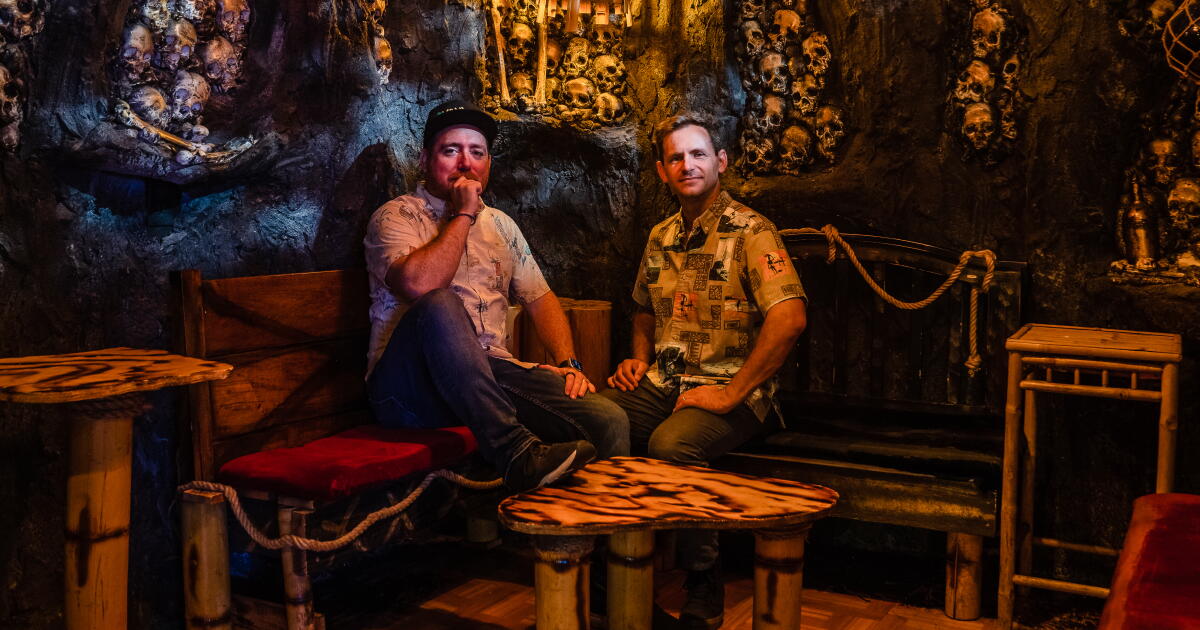
Directors Max Well, left, and Alex Lamb of “The Donn of Tiki” at Tustin’s Stowaway, a modern take on the tiki bar formula.
(Ariana Drehsler / For The Times)
Today’s tiki scene is vast, encompassing everything from historical venues like Silver Lake’s Tiki-Ti, modern takes on the form such as Tustin’s Stowaway or Highland Park’s Lucky Tiki, or twists such as the seafaring tone of Anaheim’s Strong Water. It’s also worth noting that Beach’s initial bar flourished during the Great Depression.
“Most people were never going to go to Hawaii or Jamaica or the Caribbean. So Donn brought it to them. There was a need for that then, and there’s a need for that now,” Lamb says.
Fantasy, ultimately, never goes out of style, despite challenging economic times.

