

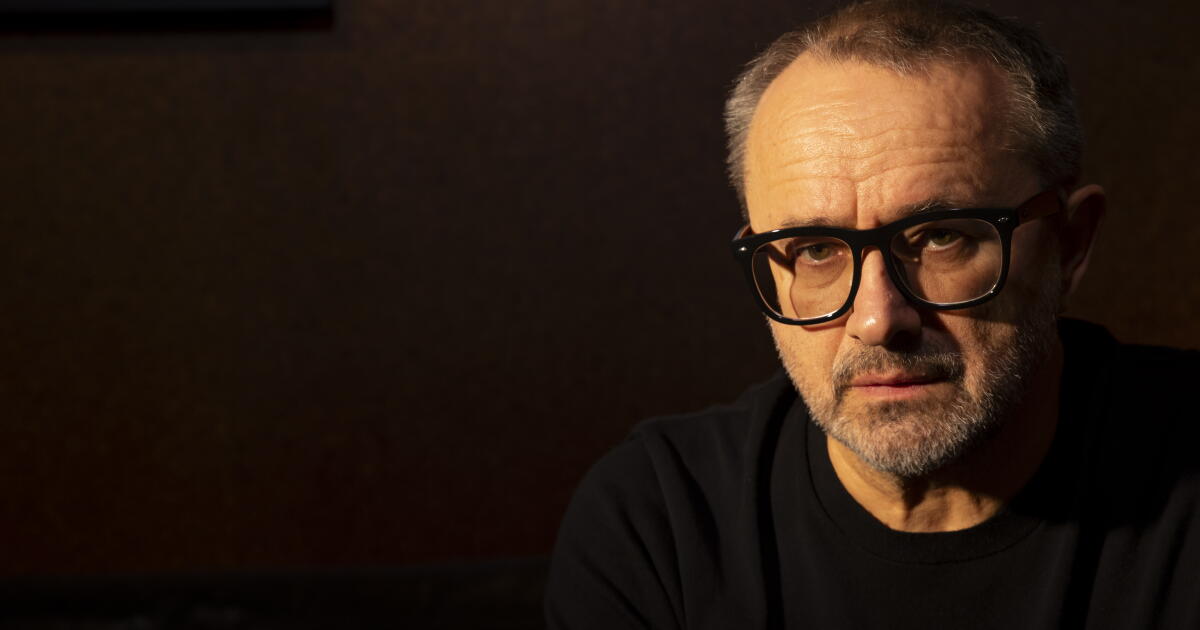


The bracing output of filmmaker Andrey Zvyagintsev shines a light on some of the darker corners of modern-day Russia. So there is something a bit incongruous about the idea of him sitting in the bright California sunshine of a bustling West Hollywood hotel. Having just finished a photo shoot in a closed-off section of the property, he settles into a shadowy and remote corner for an interview. That’s more like it.
Zvyagintsev’s previous two films, “Leviathan” and “Loveless,” were both nominated for the Oscar for international feature and his latest, “Minotaur,” a French-German-Latvian co-production in theaters Friday, is France’s submission this year. When the movie, his first in nine years, premiered at the Cannes Film Festival in May, it won the Grand Prix.
In accepting his award at Cannes, Zvyagintsev directly addressed the war in Ukraine and Russian President Vladimir Putin when he said, “The only person who can stop this butchery is the president of the Russian Federation. Put an end to this carnage — the whole world is waiting for it.”
A picture of Putin pointedly appears on the wall of a local official in “Minotaur,” just as it does in “Leviathan.” Yet Zvyagintsev’s new film addresses conflicts within Russia more forcefully than his previous movies, with the war in Ukraine a constant presence on phones, computers, graffiti, billboards and in the streets.
“It was not something I could just ignore,” Zvyagintsev, 62, says. “I did not see myself making a genre movie, whether a melodrama or a comedy, that would be completely oblivious to what’s going on. I think it would just would have been unacceptable.”
His new film is based on Claude Chabrol’s 1969 proto-erotic thriller “The Unfaithful Wife.” In Zvyagintsev’s version, set in a fictional provincial Russian town in 2022, a successful businessman, Gleb (Dmitriy Mazurov), comes to realize that his spouse, Galina (Iris Lebedeva), is having an affair and decides to confront her lover. At the same time, he is ordered by the local mayor to submit a list of employees to be conscripted to serve in the “special military operation” in Ukraine. Gleb’s personal life and professional life collide in a storm of power, control, jealousy, corruption and distrust.
Dmitriy Mazurov, left, Boris Kudrin and Iris Lebedeva in the movie “Minotaur.”
(Festival de Cannes)
Zvyagintsev is one of the most highly regarded and respected filmmakers on the international festival circuit. And yet in conversation, even via a translator, there is a decided air of mischief about him, a knowing undertone. He is not afraid to stir the pot.
His new status as a Russian filmmaker working outside of the country — “Minotaur” was shot in Latvia and he currently lives in Paris — allows him more leeway than if he were still shooting at home.
“No one in Russia can make a film about the war while the war is going on,” he says. “Not for the lack of talent, but because of censorship. The only movies that can exist about the war are propaganda movies. I do not know for sure, but I assume there are people who write scripts about that but keep them in a drawer for now, in secret.”
But the remaking of a classic thriller is only part of the story of getting “Minotaur” to the screen. In 2021 Zvyagintsev contracted COVID, which resulted in his losing more than 90% of his lung capacity, among other complications. He was eventually transferred from Russia to a hospital in Germany where he was put into a medically induced coma for 40 days. It then took an entire year for him to regain the use of his arms and legs. During his rehabilitation, he and his family moved to France, having already decided not to return to Russia.
Though Zvyagintsev was often careful in the past with how he chose to speak publicly about the Putin regime, he was clearly a prominent public critic of those in power, which led some to speculate there may have been more nefarious forces at work behind his worsening condition.
“I’ve heard that theory, but it’s nothing more than gossip,” he says. “There is nothing to prove that I was poisoned.”
As for the state of his health now, Zvyagintsev says simply, “I wouldn’t say it’s the best.”

“It was not something I could just ignore,” Zvyagintsev says of adding Russia’s current conflict to the backdrop of his erotic thriller. “I did not see myself making a genre movie, whether a melodrama or a comedy, that would be completely oblivious to what’s going on.”
(Ian Spanier / For The Times)
Going through those dark and tough times, he was determined to get back to the thing he knows best: making movies.
“I had all kinds of thoughts, suicidal thoughts, desperation, depression,” he says. “But step by step, my senses were coming back to me and my body’s abilities. I knew that anything and everything I know how to do is cinema, so I definitely wanted to go back to working as soon as possible.”
Zvyagintsev had been trying to raise money while he was still in Russia for an ambitiously scaled story of an oligarch to be called “Jupiter.” (He still hopes to make that project but is reluctant to speak about it until it becomes more of a reality.) In 2018 he had asked a friend in France to send him a list of influential local films of the 1960s and ’70s. The Russian director responded to Chabrol’s film and intended to rework it but at that time could not get the rights to the material.
“The film would have been completely different if we made it back in 2018,” he says. “It’s good that it was made now during this historic catastrophe because it has a completely different dimension to it.”
As for what it was that appealed to him about Chabrol’s original, Zvyagintsev says, “I just really loved the way the movie was constructed and the story was put together. This is exactly what cinema is, when we are observing the lives of people and their actions through some kind of a window. And here, the husband is observing the wife, who is hiding something, and we as the viewer are observing the observer.”
He never told any of the actors or his crew that the story was a remake, something they only learned as they began promoting the project. There was only one assistant director, Oleksii Smoliar, who asked him about the Chabrol film.
“I said, ‘Oleksii, don’t tell anyone,’” recalls Zvyagintsev while zipping his hand across his mouth.
As for Adrian Lyne’s glossy and moody 2002 “Unfaithful,” a remake of the same material starring Diane Lane and Richard Gere, Zvyagintsev purposefully never watched it to keep his focus on Chabrol’s original. “Minotaur” is decidedly sleeker, more chic and sexier than Zvyagintsev’s previous works, something he felt was a natural reflection of the times. The couple’s lakefront house is a showpiece, their luxury Volvo a clear status symbol and Galina’s scenes with her handsome lover have a sensual charge.
“I think you can agree that in 2025, it would have been very strange to show a girl who is covering herself up to the chin while she’s in bed with her lover,” he says. “That would have been very artificial.”
With a smile, he adds, “But the Iranian distributors would have been happy. Or China.”
Zvyagintsev’s major addition is the whole political subtext, an outgrowth of Gleb’s life at the office that is largely absent from the original. Feeling powerless both at home and in his business, he wrenches back control in any way he can, whether through physical violence or arguably worse means.
“I didn’t see it as an obstacle or any kind of a problem to have both of these things in the film,” says Zvyagintsev of balancing the domestic and political conflicts in the story. “The film is 40 minutes longer than the original film, but I think the two lines have been interwoven together in a nice way. These two things both trigger the main character and kind of bite him from different sides, both the story with the wife and the problems he has at work. So it just adds to his anxiety as a character and as a man.”
There is even a double-meaning in the film’s title. While there is the Greek myth of the Minotaur, a creature part man and part bull who must be appeased by the periodic sacrifice of 14 people — pointedly the same number of employees Gleb must submit to be drafted — Zvyagintsev is quick to point out another origin for his title.
Honore de Balzac’s 1829 book “The Physiology of Marriage” sees marriage as a labyrinth, with the husband living in constant fear of his wife’s infidelity, a psychological beast lying in wait. As Zvyagintsev explains it, Balzac makes a verb of “minotaurize” to express that anxiety.
“So it’s like two films inside one,” he says.
His “Minotaur” becomes a portrait of power and corruption in action, how it allows some people to commit unthinkable acts even as it corrodes their soul. Which of course only gives permission for even worse actions, creating an escalating cycle of bad behavior.
“Nothing beyond what really exists,” Zvyagintsev says matter of factly of the way the world works in his film. “We’re just witnessing the truth.”
He makes one major change from the ending of Chabrol’s film, profoundly altering the outcome for the husband.
“It didn’t feel like a big decision,” he says. “Of course, it was kind of breaking the genre because when there is a crime, there’s usually punishment. And what if there isn’t?”
Though Zvyagintsev is reluctant to declare himself formally in exile from his homeland, he does not feel he can return until there are significant changes, most specifically the end of the war with Ukraine.
“If I could, I would,” he says of returning to Russia. “I’ve lived there my whole life. It’s hard for me to get used to these new circumstances around me. I feel like a fish thrown onto the shore.”
For Zvyagintsev, overcoming his health crisis and returning to filmmaking with such a bold and fearless work have become intertwined triumphs.
“It’s a miracle and I’m very happy that I was able to put together a film because that’s something that really helped me come back to life,” he adds. “But I cannot imagine myself going back to the country that is at war. I do not want to be associated with that. When I was leaving that country, it was a different country than it is now.”

The bracing output of filmmaker Andrey Zvyagintsev shines a light on some of the darker corners of modern-day Russia. So there is something a bit incongruous about the idea of him sitting in the bright California sunshine of a bustling West Hollywood hotel. Having just finished a photo shoot in a closed-off section of the property, he settles into a shadowy and remote corner for an interview. That’s more like it.
Zvyagintsev’s previous two films, “Leviathan” and “Loveless,” were both nominated for the Oscar for international feature and his latest, “Minotaur,” a French-German-Latvian co-production in theaters Friday, is France’s submission this year. When the movie, his first in nine years, premiered at the Cannes Film Festival in May, it won the Grand Prix.
In accepting his award at Cannes, Zvyagintsev directly addressed the war in Ukraine and Russian President Vladimir Putin when he said, “The only person who can stop this butchery is the president of the Russian Federation. Put an end to this carnage — the whole world is waiting for it.”
A picture of Putin pointedly appears on the wall of a local official in “Minotaur,” just as it does in “Leviathan.” Yet Zvyagintsev’s new film addresses conflicts within Russia more forcefully than his previous movies, with the war in Ukraine a constant presence on phones, computers, graffiti, billboards and in the streets.
“It was not something I could just ignore,” Zvyagintsev, 62, says. “I did not see myself making a genre movie, whether a melodrama or a comedy, that would be completely oblivious to what’s going on. I think it would just would have been unacceptable.”
His new film is based on Claude Chabrol’s 1969 proto-erotic thriller “The Unfaithful Wife.” In Zvyagintsev’s version, set in a fictional provincial Russian town in 2022, a successful businessman, Gleb (Dmitriy Mazurov), comes to realize that his spouse, Galina (Iris Lebedeva), is having an affair and decides to confront her lover. At the same time, he is ordered by the local mayor to submit a list of employees to be conscripted to serve in the “special military operation” in Ukraine. Gleb’s personal life and professional life collide in a storm of power, control, jealousy, corruption and distrust.
Dmitriy Mazurov, left, Boris Kudrin and Iris Lebedeva in the movie “Minotaur.”
(Festival de Cannes)
Zvyagintsev is one of the most highly regarded and respected filmmakers on the international festival circuit. And yet in conversation, even via a translator, there is a decided air of mischief about him, a knowing undertone. He is not afraid to stir the pot.
His new status as a Russian filmmaker working outside of the country — “Minotaur” was shot in Latvia and he currently lives in Paris — allows him more leeway than if he were still shooting at home.
“No one in Russia can make a film about the war while the war is going on,” he says. “Not for the lack of talent, but because of censorship. The only movies that can exist about the war are propaganda movies. I do not know for sure, but I assume there are people who write scripts about that but keep them in a drawer for now, in secret.”
But the remaking of a classic thriller is only part of the story of getting “Minotaur” to the screen. In 2021 Zvyagintsev contracted COVID, which resulted in his losing more than 90% of his lung capacity, among other complications. He was eventually transferred from Russia to a hospital in Germany where he was put into a medically induced coma for 40 days. It then took an entire year for him to regain the use of his arms and legs. During his rehabilitation, he and his family moved to France, having already decided not to return to Russia.
Though Zvyagintsev was often careful in the past with how he chose to speak publicly about the Putin regime, he was clearly a prominent public critic of those in power, which led some to speculate there may have been more nefarious forces at work behind his worsening condition.
“I’ve heard that theory, but it’s nothing more than gossip,” he says. “There is nothing to prove that I was poisoned.”
As for the state of his health now, Zvyagintsev says simply, “I wouldn’t say it’s the best.”
“It was not something I could just ignore,” Zvyagintsev says of adding Russia’s current conflict to the backdrop of his erotic thriller. “I did not see myself making a genre movie, whether a melodrama or a comedy, that would be completely oblivious to what’s going on.”
(Ian Spanier / For The Times)
Going through those dark and tough times, he was determined to get back to the thing he knows best: making movies.
“I had all kinds of thoughts, suicidal thoughts, desperation, depression,” he says. “But step by step, my senses were coming back to me and my body’s abilities. I knew that anything and everything I know how to do is cinema, so I definitely wanted to go back to working as soon as possible.”
Zvyagintsev had been trying to raise money while he was still in Russia for an ambitiously scaled story of an oligarch to be called “Jupiter.” (He still hopes to make that project but is reluctant to speak about it until it becomes more of a reality.) In 2018 he had asked a friend in France to send him a list of influential local films of the 1960s and ’70s. The Russian director responded to Chabrol’s film and intended to rework it but at that time could not get the rights to the material.
“The film would have been completely different if we made it back in 2018,” he says. “It’s good that it was made now during this historic catastrophe because it has a completely different dimension to it.”
As for what it was that appealed to him about Chabrol’s original, Zvyagintsev says, “I just really loved the way the movie was constructed and the story was put together. This is exactly what cinema is, when we are observing the lives of people and their actions through some kind of a window. And here, the husband is observing the wife, who is hiding something, and we as the viewer are observing the observer.”
He never told any of the actors or his crew that the story was a remake, something they only learned as they began promoting the project. There was only one assistant director, Oleksii Smoliar, who asked him about the Chabrol film.
“I said, ‘Oleksii, don’t tell anyone,’” recalls Zvyagintsev while zipping his hand across his mouth.
As for Adrian Lyne’s glossy and moody 2002 “Unfaithful,” a remake of the same material starring Diane Lane and Richard Gere, Zvyagintsev purposefully never watched it to keep his focus on Chabrol’s original. “Minotaur” is decidedly sleeker, more chic and sexier than Zvyagintsev’s previous works, something he felt was a natural reflection of the times. The couple’s lakefront house is a showpiece, their luxury Volvo a clear status symbol and Galina’s scenes with her handsome lover have a sensual charge.
“I think you can agree that in 2025, it would have been very strange to show a girl who is covering herself up to the chin while she’s in bed with her lover,” he says. “That would have been very artificial.”
With a smile, he adds, “But the Iranian distributors would have been happy. Or China.”
Zvyagintsev’s major addition is the whole political subtext, an outgrowth of Gleb’s life at the office that is largely absent from the original. Feeling powerless both at home and in his business, he wrenches back control in any way he can, whether through physical violence or arguably worse means.
“I didn’t see it as an obstacle or any kind of a problem to have both of these things in the film,” says Zvyagintsev of balancing the domestic and political conflicts in the story. “The film is 40 minutes longer than the original film, but I think the two lines have been interwoven together in a nice way. These two things both trigger the main character and kind of bite him from different sides, both the story with the wife and the problems he has at work. So it just adds to his anxiety as a character and as a man.”
There is even a double-meaning in the film’s title. While there is the Greek myth of the Minotaur, a creature part man and part bull who must be appeased by the periodic sacrifice of 14 people — pointedly the same number of employees Gleb must submit to be drafted — Zvyagintsev is quick to point out another origin for his title.
Honore de Balzac’s 1829 book “The Physiology of Marriage” sees marriage as a labyrinth, with the husband living in constant fear of his wife’s infidelity, a psychological beast lying in wait. As Zvyagintsev explains it, Balzac makes a verb of “minotaurize” to express that anxiety.
“So it’s like two films inside one,” he says.
His “Minotaur” becomes a portrait of power and corruption in action, how it allows some people to commit unthinkable acts even as it corrodes their soul. Which of course only gives permission for even worse actions, creating an escalating cycle of bad behavior.
“Nothing beyond what really exists,” Zvyagintsev says matter of factly of the way the world works in his film. “We’re just witnessing the truth.”
He makes one major change from the ending of Chabrol’s film, profoundly altering the outcome for the husband.
“It didn’t feel like a big decision,” he says. “Of course, it was kind of breaking the genre because when there is a crime, there’s usually punishment. And what if there isn’t?”
Though Zvyagintsev is reluctant to declare himself formally in exile from his homeland, he does not feel he can return until there are significant changes, most specifically the end of the war with Ukraine.
“If I could, I would,” he says of returning to Russia. “I’ve lived there my whole life. It’s hard for me to get used to these new circumstances around me. I feel like a fish thrown onto the shore.”
For Zvyagintsev, overcoming his health crisis and returning to filmmaking with such a bold and fearless work have become intertwined triumphs.
“It’s a miracle and I’m very happy that I was able to put together a film because that’s something that really helped me come back to life,” he adds. “But I cannot imagine myself going back to the country that is at war. I do not want to be associated with that. When I was leaving that country, it was a different country than it is now.”

The bracing output of filmmaker Andrey Zvyagintsev shines a light on some of the darker corners of modern-day Russia. So there is something a bit incongruous about the idea of him sitting in the bright California sunshine of a bustling West Hollywood hotel. Having just finished a photo shoot in a closed-off section of the property, he settles into a shadowy and remote corner for an interview. That’s more like it.
Zvyagintsev’s previous two films, “Leviathan” and “Loveless,” were both nominated for the Oscar for international feature and his latest, “Minotaur,” a French-German-Latvian co-production in theaters Friday, is France’s submission this year. When the movie, his first in nine years, premiered at the Cannes Film Festival in May, it won the Grand Prix.
In accepting his award at Cannes, Zvyagintsev directly addressed the war in Ukraine and Russian President Vladimir Putin when he said, “The only person who can stop this butchery is the president of the Russian Federation. Put an end to this carnage — the whole world is waiting for it.”
A picture of Putin pointedly appears on the wall of a local official in “Minotaur,” just as it does in “Leviathan.” Yet Zvyagintsev’s new film addresses conflicts within Russia more forcefully than his previous movies, with the war in Ukraine a constant presence on phones, computers, graffiti, billboards and in the streets.
“It was not something I could just ignore,” Zvyagintsev, 62, says. “I did not see myself making a genre movie, whether a melodrama or a comedy, that would be completely oblivious to what’s going on. I think it would just would have been unacceptable.”
His new film is based on Claude Chabrol’s 1969 proto-erotic thriller “The Unfaithful Wife.” In Zvyagintsev’s version, set in a fictional provincial Russian town in 2022, a successful businessman, Gleb (Dmitriy Mazurov), comes to realize that his spouse, Galina (Iris Lebedeva), is having an affair and decides to confront her lover. At the same time, he is ordered by the local mayor to submit a list of employees to be conscripted to serve in the “special military operation” in Ukraine. Gleb’s personal life and professional life collide in a storm of power, control, jealousy, corruption and distrust.
Dmitriy Mazurov, left, Boris Kudrin and Iris Lebedeva in the movie “Minotaur.”
(Festival de Cannes)
Zvyagintsev is one of the most highly regarded and respected filmmakers on the international festival circuit. And yet in conversation, even via a translator, there is a decided air of mischief about him, a knowing undertone. He is not afraid to stir the pot.
His new status as a Russian filmmaker working outside of the country — “Minotaur” was shot in Latvia and he currently lives in Paris — allows him more leeway than if he were still shooting at home.
“No one in Russia can make a film about the war while the war is going on,” he says. “Not for the lack of talent, but because of censorship. The only movies that can exist about the war are propaganda movies. I do not know for sure, but I assume there are people who write scripts about that but keep them in a drawer for now, in secret.”
But the remaking of a classic thriller is only part of the story of getting “Minotaur” to the screen. In 2021 Zvyagintsev contracted COVID, which resulted in his losing more than 90% of his lung capacity, among other complications. He was eventually transferred from Russia to a hospital in Germany where he was put into a medically induced coma for 40 days. It then took an entire year for him to regain the use of his arms and legs. During his rehabilitation, he and his family moved to France, having already decided not to return to Russia.
Though Zvyagintsev was often careful in the past with how he chose to speak publicly about the Putin regime, he was clearly a prominent public critic of those in power, which led some to speculate there may have been more nefarious forces at work behind his worsening condition.
“I’ve heard that theory, but it’s nothing more than gossip,” he says. “There is nothing to prove that I was poisoned.”
As for the state of his health now, Zvyagintsev says simply, “I wouldn’t say it’s the best.”
“It was not something I could just ignore,” Zvyagintsev says of adding Russia’s current conflict to the backdrop of his erotic thriller. “I did not see myself making a genre movie, whether a melodrama or a comedy, that would be completely oblivious to what’s going on.”
(Ian Spanier / For The Times)
Going through those dark and tough times, he was determined to get back to the thing he knows best: making movies.
“I had all kinds of thoughts, suicidal thoughts, desperation, depression,” he says. “But step by step, my senses were coming back to me and my body’s abilities. I knew that anything and everything I know how to do is cinema, so I definitely wanted to go back to working as soon as possible.”
Zvyagintsev had been trying to raise money while he was still in Russia for an ambitiously scaled story of an oligarch to be called “Jupiter.” (He still hopes to make that project but is reluctant to speak about it until it becomes more of a reality.) In 2018 he had asked a friend in France to send him a list of influential local films of the 1960s and ’70s. The Russian director responded to Chabrol’s film and intended to rework it but at that time could not get the rights to the material.
“The film would have been completely different if we made it back in 2018,” he says. “It’s good that it was made now during this historic catastrophe because it has a completely different dimension to it.”
As for what it was that appealed to him about Chabrol’s original, Zvyagintsev says, “I just really loved the way the movie was constructed and the story was put together. This is exactly what cinema is, when we are observing the lives of people and their actions through some kind of a window. And here, the husband is observing the wife, who is hiding something, and we as the viewer are observing the observer.”
He never told any of the actors or his crew that the story was a remake, something they only learned as they began promoting the project. There was only one assistant director, Oleksii Smoliar, who asked him about the Chabrol film.
“I said, ‘Oleksii, don’t tell anyone,’” recalls Zvyagintsev while zipping his hand across his mouth.
As for Adrian Lyne’s glossy and moody 2002 “Unfaithful,” a remake of the same material starring Diane Lane and Richard Gere, Zvyagintsev purposefully never watched it to keep his focus on Chabrol’s original. “Minotaur” is decidedly sleeker, more chic and sexier than Zvyagintsev’s previous works, something he felt was a natural reflection of the times. The couple’s lakefront house is a showpiece, their luxury Volvo a clear status symbol and Galina’s scenes with her handsome lover have a sensual charge.
“I think you can agree that in 2025, it would have been very strange to show a girl who is covering herself up to the chin while she’s in bed with her lover,” he says. “That would have been very artificial.”
With a smile, he adds, “But the Iranian distributors would have been happy. Or China.”
Zvyagintsev’s major addition is the whole political subtext, an outgrowth of Gleb’s life at the office that is largely absent from the original. Feeling powerless both at home and in his business, he wrenches back control in any way he can, whether through physical violence or arguably worse means.
“I didn’t see it as an obstacle or any kind of a problem to have both of these things in the film,” says Zvyagintsev of balancing the domestic and political conflicts in the story. “The film is 40 minutes longer than the original film, but I think the two lines have been interwoven together in a nice way. These two things both trigger the main character and kind of bite him from different sides, both the story with the wife and the problems he has at work. So it just adds to his anxiety as a character and as a man.”
There is even a double-meaning in the film’s title. While there is the Greek myth of the Minotaur, a creature part man and part bull who must be appeased by the periodic sacrifice of 14 people — pointedly the same number of employees Gleb must submit to be drafted — Zvyagintsev is quick to point out another origin for his title.
Honore de Balzac’s 1829 book “The Physiology of Marriage” sees marriage as a labyrinth, with the husband living in constant fear of his wife’s infidelity, a psychological beast lying in wait. As Zvyagintsev explains it, Balzac makes a verb of “minotaurize” to express that anxiety.
“So it’s like two films inside one,” he says.
His “Minotaur” becomes a portrait of power and corruption in action, how it allows some people to commit unthinkable acts even as it corrodes their soul. Which of course only gives permission for even worse actions, creating an escalating cycle of bad behavior.
“Nothing beyond what really exists,” Zvyagintsev says matter of factly of the way the world works in his film. “We’re just witnessing the truth.”
He makes one major change from the ending of Chabrol’s film, profoundly altering the outcome for the husband.
“It didn’t feel like a big decision,” he says. “Of course, it was kind of breaking the genre because when there is a crime, there’s usually punishment. And what if there isn’t?”
Though Zvyagintsev is reluctant to declare himself formally in exile from his homeland, he does not feel he can return until there are significant changes, most specifically the end of the war with Ukraine.
“If I could, I would,” he says of returning to Russia. “I’ve lived there my whole life. It’s hard for me to get used to these new circumstances around me. I feel like a fish thrown onto the shore.”
For Zvyagintsev, overcoming his health crisis and returning to filmmaking with such a bold and fearless work have become intertwined triumphs.
“It’s a miracle and I’m very happy that I was able to put together a film because that’s something that really helped me come back to life,” he adds. “But I cannot imagine myself going back to the country that is at war. I do not want to be associated with that. When I was leaving that country, it was a different country than it is now.”

