

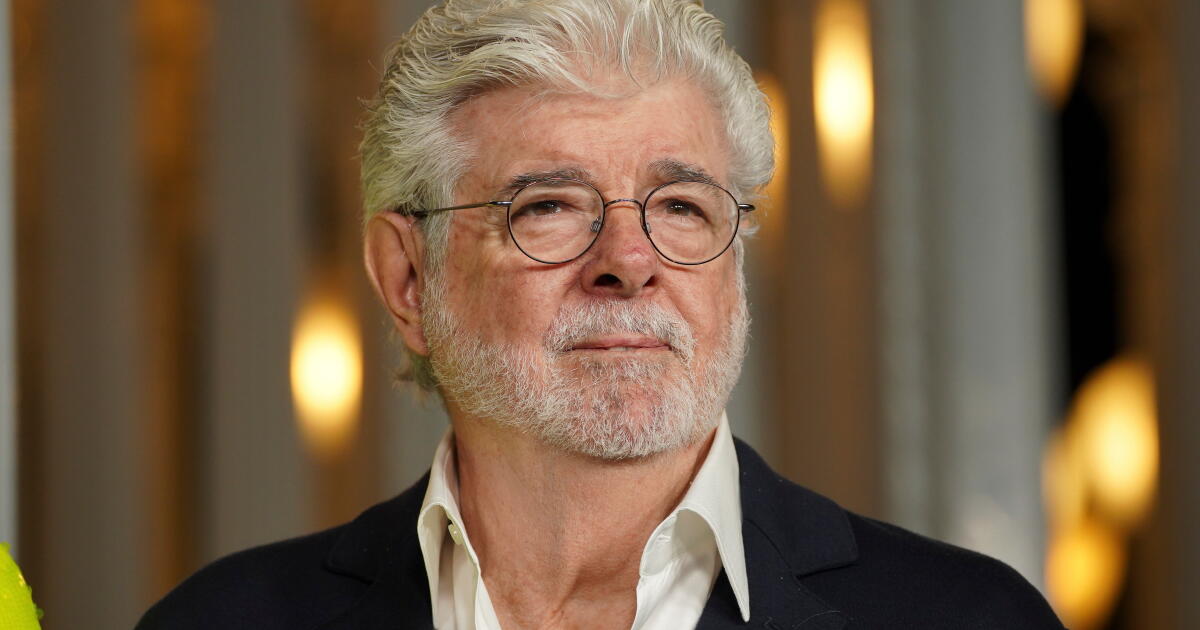

As George Lucas and Mellody Hobson introduced their new $1 billion museum to press, they focused on two things: the long arc of narrative storytelling and the long arc of their hero’s journey to make their dream a reality.
“This has been a long haul … 17 years between getting kicked out of cities and trying to get this built, which is in itself eight years,” Lucas said to about 300 reporters in one of the museum’s two screening rooms; the other held an overflow crowd. “I’m used to doing the impossible. This one almost broke my will.”
Lucas described himself as a contrarian, someone driven by doing what others say he can’t. He added that getting the museum done involved dealing with bureaucracies and people with “contrary thinking.”
Indeed, the very ethos of the museum — if you have an emotional connection to something, then it’s art — has been ruffling feathers since its focus on so-called narrative art was announced long ago. There doesn’t seem to be a consensus on what the term even means, or if all art, in one form or another, is narrative art.
The couple first tried for locations in Chicago and San Francisco and finally ended up in Exposition Park, taking over land that was once parking lots and transforming it into a futuristic museum that has been likened to a spaceship. Architect Ma Yansong, who designed the building with his firm MAD, said he’s heard the spaceship comparison, and that’s fine by him, but he’s also heard it likened to a cloud.
“We want to make people curious,” Yansong said.
The Lucas Museum of Narrative Art rises through the trees of its 11-acre park in advance of its Sept. 22 grand opening.
(Ariana Drehsler / For The Times)
The museum has done just that, with droves of people rushing over the summer to get tickets for its Sept. 22 opening date, and excited onlookers peeping through fencing that has just started to come down.
The 300,000-square-foot Lucas Museum of Narrative Art contains 100,000 square feet of gallery space with 35 galleries organized according to theme, including adventure, motherhood, community, children’s illustrations, manga and comics. It also contains a murals gallery, and galleries devoted to specific artists including Norman Rockwell, N.C. Wyeth, Frank Frazetta and Maxfield Parrish. The sprawling campus contains 11 acres of publicly accessible park space with plenty of public seating and an amphitheater, as well as a large fountain called “The Rain,” which also serves as a cooling mechanism for the building. Other features include a research and reading library, a cafe and a fifth-floor restaurant called Skywalker Grill, which boasts stunning rooftop views of downtown L.A.
“This is a big celebration for us because it took us so long to get here, but it’s something that I felt very very strongly about in terms of honoring illustrators,” said Hobson. “Artists who illustrate stories that are already written, and most of those stories are myths — they’re not real — but the illustrations make them real.”
Hobson added that her focus has been on hammering home the museum’s populist themes.
“When I’m asked, I tell people the Lucas Museum is a museum by the people, for the people. When George is asked he tells people the museum is dedicated to the people’s art,” she said.

As George Lucas and Mellody Hobson introduced their new $1 billion museum to press, they focused on two things: the long arc of narrative storytelling and the long arc of their hero’s journey to make their dream a reality.
“This has been a long haul … 17 years between getting kicked out of cities and trying to get this built, which is in itself eight years,” Lucas said to about 300 reporters in one of the museum’s two screening rooms; the other held an overflow crowd. “I’m used to doing the impossible. This one almost broke my will.”
Lucas described himself as a contrarian, someone driven by doing what others say he can’t. He added that getting the museum done involved dealing with bureaucracies and people with “contrary thinking.”
Indeed, the very ethos of the museum — if you have an emotional connection to something, then it’s art — has been ruffling feathers since its focus on so-called narrative art was announced long ago. There doesn’t seem to be a consensus on what the term even means, or if all art, in one form or another, is narrative art.
The couple first tried for locations in Chicago and San Francisco and finally ended up in Exposition Park, taking over land that was once parking lots and transforming it into a futuristic museum that has been likened to a spaceship. Architect Ma Yansong, who designed the building with his firm MAD, said he’s heard the spaceship comparison, and that’s fine by him, but he’s also heard it likened to a cloud.
“We want to make people curious,” Yansong said.
The Lucas Museum of Narrative Art rises through the trees of its 11-acre park in advance of its Sept. 22 grand opening.
(Ariana Drehsler / For The Times)
The museum has done just that, with droves of people rushing over the summer to get tickets for its Sept. 22 opening date, and excited onlookers peeping through fencing that has just started to come down.
The 300,000-square-foot Lucas Museum of Narrative Art contains 100,000 square feet of gallery space with 35 galleries organized according to theme, including adventure, motherhood, community, children’s illustrations, manga and comics. It also contains a murals gallery, and galleries devoted to specific artists including Norman Rockwell, N.C. Wyeth, Frank Frazetta and Maxfield Parrish. The sprawling campus contains 11 acres of publicly accessible park space with plenty of public seating and an amphitheater, as well as a large fountain called “The Rain,” which also serves as a cooling mechanism for the building. Other features include a research and reading library, a cafe and a fifth-floor restaurant called Skywalker Grill, which boasts stunning rooftop views of downtown L.A.
“This is a big celebration for us because it took us so long to get here, but it’s something that I felt very very strongly about in terms of honoring illustrators,” said Hobson. “Artists who illustrate stories that are already written, and most of those stories are myths — they’re not real — but the illustrations make them real.”
Hobson added that her focus has been on hammering home the museum’s populist themes.
“When I’m asked, I tell people the Lucas Museum is a museum by the people, for the people. When George is asked he tells people the museum is dedicated to the people’s art,” she said.

As George Lucas and Mellody Hobson introduced their new $1 billion museum to press, they focused on two things: the long arc of narrative storytelling and the long arc of their hero’s journey to make their dream a reality.
“This has been a long haul … 17 years between getting kicked out of cities and trying to get this built, which is in itself eight years,” Lucas said to about 300 reporters in one of the museum’s two screening rooms; the other held an overflow crowd. “I’m used to doing the impossible. This one almost broke my will.”
Lucas described himself as a contrarian, someone driven by doing what others say he can’t. He added that getting the museum done involved dealing with bureaucracies and people with “contrary thinking.”
Indeed, the very ethos of the museum — if you have an emotional connection to something, then it’s art — has been ruffling feathers since its focus on so-called narrative art was announced long ago. There doesn’t seem to be a consensus on what the term even means, or if all art, in one form or another, is narrative art.
The couple first tried for locations in Chicago and San Francisco and finally ended up in Exposition Park, taking over land that was once parking lots and transforming it into a futuristic museum that has been likened to a spaceship. Architect Ma Yansong, who designed the building with his firm MAD, said he’s heard the spaceship comparison, and that’s fine by him, but he’s also heard it likened to a cloud.
“We want to make people curious,” Yansong said.
The Lucas Museum of Narrative Art rises through the trees of its 11-acre park in advance of its Sept. 22 grand opening.
(Ariana Drehsler / For The Times)
The museum has done just that, with droves of people rushing over the summer to get tickets for its Sept. 22 opening date, and excited onlookers peeping through fencing that has just started to come down.
The 300,000-square-foot Lucas Museum of Narrative Art contains 100,000 square feet of gallery space with 35 galleries organized according to theme, including adventure, motherhood, community, children’s illustrations, manga and comics. It also contains a murals gallery, and galleries devoted to specific artists including Norman Rockwell, N.C. Wyeth, Frank Frazetta and Maxfield Parrish. The sprawling campus contains 11 acres of publicly accessible park space with plenty of public seating and an amphitheater, as well as a large fountain called “The Rain,” which also serves as a cooling mechanism for the building. Other features include a research and reading library, a cafe and a fifth-floor restaurant called Skywalker Grill, which boasts stunning rooftop views of downtown L.A.
“This is a big celebration for us because it took us so long to get here, but it’s something that I felt very very strongly about in terms of honoring illustrators,” said Hobson. “Artists who illustrate stories that are already written, and most of those stories are myths — they’re not real — but the illustrations make them real.”
Hobson added that her focus has been on hammering home the museum’s populist themes.
“When I’m asked, I tell people the Lucas Museum is a museum by the people, for the people. When George is asked he tells people the museum is dedicated to the people’s art,” she said.
As George Lucas and Mellody Hobson introduced their new $1 billion museum to press, they focused on two things: the long arc of narrative storytelling and the long arc of their hero’s journey to make their dream a reality.
“This has been a long haul … 17 years between getting kicked out of cities and trying to get this built, which is in itself eight years,” Lucas said to about 300 reporters in one of the museum’s two screening rooms; the other held an overflow crowd. “I’m used to doing the impossible. This one almost broke my will.”
Lucas described himself as a contrarian, someone driven by doing what others say he can’t. He added that getting the museum done involved dealing with bureaucracies and people with “contrary thinking.”
Indeed, the very ethos of the museum — if you have an emotional connection to something, then it’s art — has been ruffling feathers since its focus on so-called narrative art was announced long ago. There doesn’t seem to be a consensus on what the term even means, or if all art, in one form or another, is narrative art.
The couple first tried for locations in Chicago and San Francisco and finally ended up in Exposition Park, taking over land that was once parking lots and transforming it into a futuristic museum that has been likened to a spaceship. Architect Ma Yansong, who designed the building with his firm MAD, said he’s heard the spaceship comparison, and that’s fine by him, but he’s also heard it likened to a cloud.
“We want to make people curious,” Yansong said.
The Lucas Museum of Narrative Art rises through the trees of its 11-acre park in advance of its Sept. 22 grand opening.
(Ariana Drehsler / For The Times)
The museum has done just that, with droves of people rushing over the summer to get tickets for its Sept. 22 opening date, and excited onlookers peeping through fencing that has just started to come down.
The 300,000-square-foot Lucas Museum of Narrative Art contains 100,000 square feet of gallery space with 35 galleries organized according to theme, including adventure, motherhood, community, children’s illustrations, manga and comics. It also contains a murals gallery, and galleries devoted to specific artists including Norman Rockwell, N.C. Wyeth, Frank Frazetta and Maxfield Parrish. The sprawling campus contains 11 acres of publicly accessible park space with plenty of public seating and an amphitheater, as well as a large fountain called “The Rain,” which also serves as a cooling mechanism for the building. Other features include a research and reading library, a cafe and a fifth-floor restaurant called Skywalker Grill, which boasts stunning rooftop views of downtown L.A.
“This is a big celebration for us because it took us so long to get here, but it’s something that I felt very very strongly about in terms of honoring illustrators,” said Hobson. “Artists who illustrate stories that are already written, and most of those stories are myths — they’re not real — but the illustrations make them real.”
Hobson added that her focus has been on hammering home the museum’s populist themes.
“When I’m asked, I tell people the Lucas Museum is a museum by the people, for the people. When George is asked he tells people the museum is dedicated to the people’s art,” she said.

As George Lucas and Mellody Hobson introduced their new $1 billion museum to press, they focused on two things: the long arc of narrative storytelling and the long arc of their hero’s journey to make their dream a reality.
“This has been a long haul … 17 years between getting kicked out of cities and trying to get this built, which is in itself eight years,” Lucas said to about 300 reporters in one of the museum’s two screening rooms; the other held an overflow crowd. “I’m used to doing the impossible. This one almost broke my will.”
Lucas described himself as a contrarian, someone driven by doing what others say he can’t. He added that getting the museum done involved dealing with bureaucracies and people with “contrary thinking.”
Indeed, the very ethos of the museum — if you have an emotional connection to something, then it’s art — has been ruffling feathers since its focus on so-called narrative art was announced long ago. There doesn’t seem to be a consensus on what the term even means, or if all art, in one form or another, is narrative art.
The couple first tried for locations in Chicago and San Francisco and finally ended up in Exposition Park, taking over land that was once parking lots and transforming it into a futuristic museum that has been likened to a spaceship. Architect Ma Yansong, who designed the building with his firm MAD, said he’s heard the spaceship comparison, and that’s fine by him, but he’s also heard it likened to a cloud.
“We want to make people curious,” Yansong said.
The Lucas Museum of Narrative Art rises through the trees of its 11-acre park in advance of its Sept. 22 grand opening.
(Ariana Drehsler / For The Times)
The museum has done just that, with droves of people rushing over the summer to get tickets for its Sept. 22 opening date, and excited onlookers peeping through fencing that has just started to come down.
The 300,000-square-foot Lucas Museum of Narrative Art contains 100,000 square feet of gallery space with 35 galleries organized according to theme, including adventure, motherhood, community, children’s illustrations, manga and comics. It also contains a murals gallery, and galleries devoted to specific artists including Norman Rockwell, N.C. Wyeth, Frank Frazetta and Maxfield Parrish. The sprawling campus contains 11 acres of publicly accessible park space with plenty of public seating and an amphitheater, as well as a large fountain called “The Rain,” which also serves as a cooling mechanism for the building. Other features include a research and reading library, a cafe and a fifth-floor restaurant called Skywalker Grill, which boasts stunning rooftop views of downtown L.A.
“This is a big celebration for us because it took us so long to get here, but it’s something that I felt very very strongly about in terms of honoring illustrators,” said Hobson. “Artists who illustrate stories that are already written, and most of those stories are myths — they’re not real — but the illustrations make them real.”
Hobson added that her focus has been on hammering home the museum’s populist themes.
“When I’m asked, I tell people the Lucas Museum is a museum by the people, for the people. When George is asked he tells people the museum is dedicated to the people’s art,” she said.
As George Lucas and Mellody Hobson introduced their new $1 billion museum to press, they focused on two things: the long arc of narrative storytelling and the long arc of their hero’s journey to make their dream a reality.
“This has been a long haul … 17 years between getting kicked out of cities and trying to get this built, which is in itself eight years,” Lucas said to about 300 reporters in one of the museum’s two screening rooms; the other held an overflow crowd. “I’m used to doing the impossible. This one almost broke my will.”
Lucas described himself as a contrarian, someone driven by doing what others say he can’t. He added that getting the museum done involved dealing with bureaucracies and people with “contrary thinking.”
Indeed, the very ethos of the museum — if you have an emotional connection to something, then it’s art — has been ruffling feathers since its focus on so-called narrative art was announced long ago. There doesn’t seem to be a consensus on what the term even means, or if all art, in one form or another, is narrative art.
The couple first tried for locations in Chicago and San Francisco and finally ended up in Exposition Park, taking over land that was once parking lots and transforming it into a futuristic museum that has been likened to a spaceship. Architect Ma Yansong, who designed the building with his firm MAD, said he’s heard the spaceship comparison, and that’s fine by him, but he’s also heard it likened to a cloud.
“We want to make people curious,” Yansong said.
The Lucas Museum of Narrative Art rises through the trees of its 11-acre park in advance of its Sept. 22 grand opening.
(Ariana Drehsler / For The Times)
The museum has done just that, with droves of people rushing over the summer to get tickets for its Sept. 22 opening date, and excited onlookers peeping through fencing that has just started to come down.
The 300,000-square-foot Lucas Museum of Narrative Art contains 100,000 square feet of gallery space with 35 galleries organized according to theme, including adventure, motherhood, community, children’s illustrations, manga and comics. It also contains a murals gallery, and galleries devoted to specific artists including Norman Rockwell, N.C. Wyeth, Frank Frazetta and Maxfield Parrish. The sprawling campus contains 11 acres of publicly accessible park space with plenty of public seating and an amphitheater, as well as a large fountain called “The Rain,” which also serves as a cooling mechanism for the building. Other features include a research and reading library, a cafe and a fifth-floor restaurant called Skywalker Grill, which boasts stunning rooftop views of downtown L.A.
“This is a big celebration for us because it took us so long to get here, but it’s something that I felt very very strongly about in terms of honoring illustrators,” said Hobson. “Artists who illustrate stories that are already written, and most of those stories are myths — they’re not real — but the illustrations make them real.”
Hobson added that her focus has been on hammering home the museum’s populist themes.
“When I’m asked, I tell people the Lucas Museum is a museum by the people, for the people. When George is asked he tells people the museum is dedicated to the people’s art,” she said.
As George Lucas and Mellody Hobson introduced their new $1 billion museum to press, they focused on two things: the long arc of narrative storytelling and the long arc of their hero’s journey to make their dream a reality.
“This has been a long haul … 17 years between getting kicked out of cities and trying to get this built, which is in itself eight years,” Lucas said to about 300 reporters in one of the museum’s two screening rooms; the other held an overflow crowd. “I’m used to doing the impossible. This one almost broke my will.”
Lucas described himself as a contrarian, someone driven by doing what others say he can’t. He added that getting the museum done involved dealing with bureaucracies and people with “contrary thinking.”
Indeed, the very ethos of the museum — if you have an emotional connection to something, then it’s art — has been ruffling feathers since its focus on so-called narrative art was announced long ago. There doesn’t seem to be a consensus on what the term even means, or if all art, in one form or another, is narrative art.
The couple first tried for locations in Chicago and San Francisco and finally ended up in Exposition Park, taking over land that was once parking lots and transforming it into a futuristic museum that has been likened to a spaceship. Architect Ma Yansong, who designed the building with his firm MAD, said he’s heard the spaceship comparison, and that’s fine by him, but he’s also heard it likened to a cloud.
“We want to make people curious,” Yansong said.
The Lucas Museum of Narrative Art rises through the trees of its 11-acre park in advance of its Sept. 22 grand opening.
(Ariana Drehsler / For The Times)
The museum has done just that, with droves of people rushing over the summer to get tickets for its Sept. 22 opening date, and excited onlookers peeping through fencing that has just started to come down.
The 300,000-square-foot Lucas Museum of Narrative Art contains 100,000 square feet of gallery space with 35 galleries organized according to theme, including adventure, motherhood, community, children’s illustrations, manga and comics. It also contains a murals gallery, and galleries devoted to specific artists including Norman Rockwell, N.C. Wyeth, Frank Frazetta and Maxfield Parrish. The sprawling campus contains 11 acres of publicly accessible park space with plenty of public seating and an amphitheater, as well as a large fountain called “The Rain,” which also serves as a cooling mechanism for the building. Other features include a research and reading library, a cafe and a fifth-floor restaurant called Skywalker Grill, which boasts stunning rooftop views of downtown L.A.
“This is a big celebration for us because it took us so long to get here, but it’s something that I felt very very strongly about in terms of honoring illustrators,” said Hobson. “Artists who illustrate stories that are already written, and most of those stories are myths — they’re not real — but the illustrations make them real.”
Hobson added that her focus has been on hammering home the museum’s populist themes.
“When I’m asked, I tell people the Lucas Museum is a museum by the people, for the people. When George is asked he tells people the museum is dedicated to the people’s art,” she said.
As George Lucas and Mellody Hobson introduced their new $1 billion museum to press, they focused on two things: the long arc of narrative storytelling and the long arc of their hero’s journey to make their dream a reality.
“This has been a long haul … 17 years between getting kicked out of cities and trying to get this built, which is in itself eight years,” Lucas said to about 300 reporters in one of the museum’s two screening rooms; the other held an overflow crowd. “I’m used to doing the impossible. This one almost broke my will.”
Lucas described himself as a contrarian, someone driven by doing what others say he can’t. He added that getting the museum done involved dealing with bureaucracies and people with “contrary thinking.”
Indeed, the very ethos of the museum — if you have an emotional connection to something, then it’s art — has been ruffling feathers since its focus on so-called narrative art was announced long ago. There doesn’t seem to be a consensus on what the term even means, or if all art, in one form or another, is narrative art.
The couple first tried for locations in Chicago and San Francisco and finally ended up in Exposition Park, taking over land that was once parking lots and transforming it into a futuristic museum that has been likened to a spaceship. Architect Ma Yansong, who designed the building with his firm MAD, said he’s heard the spaceship comparison, and that’s fine by him, but he’s also heard it likened to a cloud.
“We want to make people curious,” Yansong said.
The Lucas Museum of Narrative Art rises through the trees of its 11-acre park in advance of its Sept. 22 grand opening.
(Ariana Drehsler / For The Times)
The museum has done just that, with droves of people rushing over the summer to get tickets for its Sept. 22 opening date, and excited onlookers peeping through fencing that has just started to come down.
The 300,000-square-foot Lucas Museum of Narrative Art contains 100,000 square feet of gallery space with 35 galleries organized according to theme, including adventure, motherhood, community, children’s illustrations, manga and comics. It also contains a murals gallery, and galleries devoted to specific artists including Norman Rockwell, N.C. Wyeth, Frank Frazetta and Maxfield Parrish. The sprawling campus contains 11 acres of publicly accessible park space with plenty of public seating and an amphitheater, as well as a large fountain called “The Rain,” which also serves as a cooling mechanism for the building. Other features include a research and reading library, a cafe and a fifth-floor restaurant called Skywalker Grill, which boasts stunning rooftop views of downtown L.A.
“This is a big celebration for us because it took us so long to get here, but it’s something that I felt very very strongly about in terms of honoring illustrators,” said Hobson. “Artists who illustrate stories that are already written, and most of those stories are myths — they’re not real — but the illustrations make them real.”
Hobson added that her focus has been on hammering home the museum’s populist themes.
“When I’m asked, I tell people the Lucas Museum is a museum by the people, for the people. When George is asked he tells people the museum is dedicated to the people’s art,” she said.

