

For many celebrities, getting a Funko Pop! doll modeled after themselves is a sign they’ve made it in Hollywood. The 4-inch vinyl “Pop!” figurines, with their oversize heads and black dot eyes, symbolize being ingrained in pop culture — objects fans buy, celebrate and display.
At Funko’s flagship Hollywood store, there are thousands to choose from, ranging from NFL players to Disney princesses and characters from the Netflix period drama “Bridgerton.”
But the publicly traded company behind the popular dolls has been facing significant headwinds.
Funko Inc. last year posted a loss of $67.4 million on sales of $908.2 million, down 13% from the previous year. The company disclosed it had debts of $225 million.
The Everett, Wash.-based company warned investors in filings that there was “substantial doubt” about its ability to generate enough cash to meet its debt payments, citing the effects of tariffs in China, where most of its toys were made, canceled retail orders and loan covenants it expected to breach.
Funko Chief Executive Josh Simon, pictured at the Pokémon convention, says he took over the company at an “inflection point.”
(Carolyn Fong / For The Times)
Now the company is looking to stage a comeback.
Leading the turnaround challenge is Josh Simon, who left his job running global consumer products at Netflix to become Funko’s chief executive in September 2025 — the third person to hold the title in two years.
“Funko was at an interesting inflection point,” said 48-year-old Simon, who lives in Los Feliz. “I felt there was still a lot of really deep fandom and enthusiasm from retailers and at the same time, there were a lot of problems that had to be sorted out at the company. I thought it would be an interesting adventure and hopefully a way to help turn things around a bit and restore it back to that level of fan passion and glory that existed years ago.”
The rise and fall of Funko
Funko began in 1998 when entrepreneur Mike Becker decided bobbleheads would be the next big thing and shipped them out of his garage. After entrepreneur Brian Mariotti bought Funko in 2005, the business began licensing more characters. Sales took off with the launch of its big-headed “Pop!” figurines in 2010.
The company changed ownership over the years, added backpacks and other products, and went public in 2017. Most of its revenue still comes from making licensed characters and selling them through retailers, online and at events.

Funko survived a decline in sales with the rise of kidults — adults who collect toys.
(Carolyn Fong / For The Times)
But Funko’s sales plunged in 2025 following a global trade war.
The company overestimated demand, picked the wrong characters and made too many of dolls, said Gerrick Johnson, senior research analyst at Seaport Research Partners, which has a buy rating on Funko.
President Trump’s heavy tariffs imposed on China substantially raised the costs of making Funko dolls.
Amid lagging sales, retailers marked down the figurines, alienating collectors who want to see items appreciate in value.
“Collectors hate buying things 50% off,” Johnson said. “One of the biggest turnoffs in collectibles is a bargain bin.”
What kept the brand alive through the slump was the rise of kidults — adults who collect toys. Simon was one, picking up Pop! figurines from “Toy Story” and “Back to the Future” long before he worked there. Funko’s job, he said, is to distill what people love about a character into a stylized version of it.
“The number of inbound requests we get from musicians and athletes and celebrities — everyone is excited and pitching us they want a Funko Pop! made of themselves, because in some ways it suggests a mark of establishment in pop culture,” Simon said. “It’s like akin to getting your star on the Hollywood Walk of Fame in some way.”

Convention-goers create custom dolls at a Funko Pop! kiosk.
(Carolyn Fong / For The Times)

One expert said Funko’s job is to distill what people love about a character into a stylized version of it.
(Carolyn Fong / For The Times)
A turnaround plan
Though based in Washington, Funko has a large presence in L.A., where most of its senior leadership is based. They work out of the same offices as the flagship Hollywood store. The company also has employees in Arizona, London, Hong Kong and other markets.
Under Simon, Funko has diversified its supply chain, shifting production out of China to Vietnam and other countries. To improve cash flow, Funko renegotiated the timing of its debt payments and pushed products to market faster.
For example, Funko turned around figurines of the characters from “KPop Demon Hunters” — the Netflix film that became the streamer’s most-watched movie ever after its June 2025 release — in about four months, well ahead of Mattel, whose first items reached stores this spring.
When John Cena stepped into the ring for his final WWE match in December, there were pre-orders for a Funko figure wearing the same outfit down to the shirt reading, “The Last Time is Now,” built from an image Funko received a week earlier. The doll became a bestseller, said Scott Zanghellini, executive vice president of WWE Consumer Products.
“It’s happening in real time and his team being able to move quickly, and us always moving quickly in this world of we have seven hours of programming a week — how do you take advantage of that and give the fans what they want?” Zanghellini said.
Funko is also widening what counts as a license, making figures from “The Folk of the Air,” Holly Black’s fantasy series revived by book lovers on TikTok, as well as creating more original characters that aren’t licensed.
“We really want to make sure that we can be a part of these cultural moments while they’re happening,” Simon said.
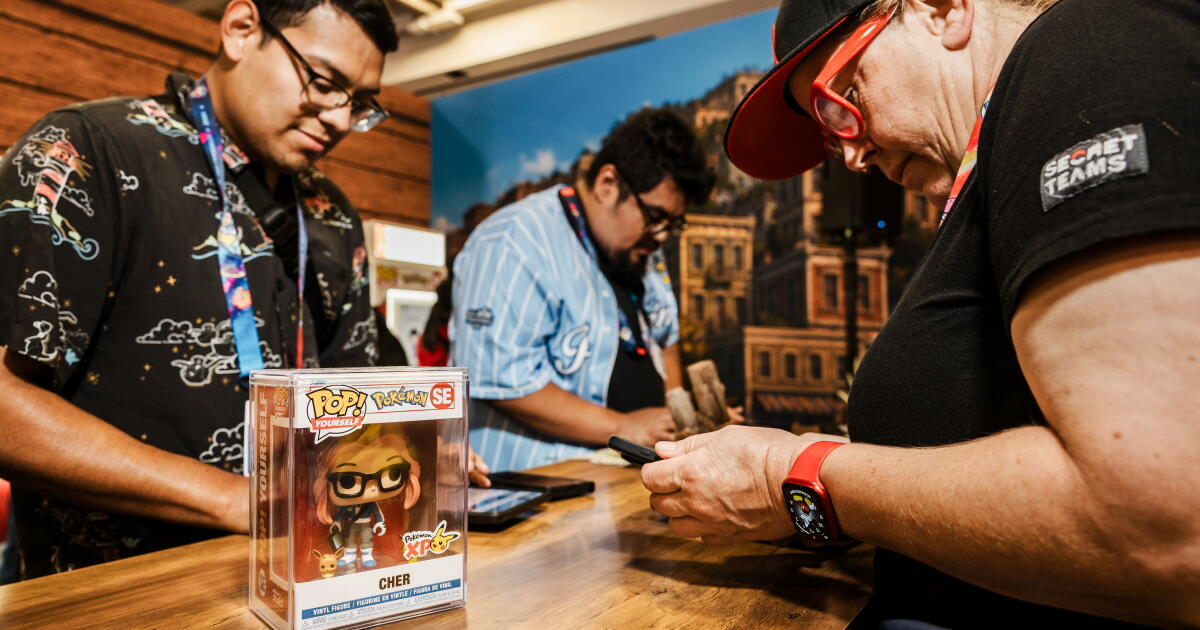
Reaching out to fans is another priority. At PokémonXP, the first official Pokémon fan convention held last month at San Francisco’s Moscone Center, Funko ran a Pop! Yourself booth where attendees built custom figures in exclusive Trainer uniforms with a Pokémon of their choice.

“We really want to make sure that we can be a part of these cultural moments while they’re happening,” Funko’s chief executive said.
(Carolyn Fong / For The Times)
Jeff Leu, 40, of San Francisco spent about $100 there on two figures modeled after his kids. He already owns 40 to 50 “The Simpsons” Pop! figures and tracks his collection in a spreadsheet.
“I feel like there is a Funko for everything,” Leu said.
Now he feels the pull of the Pokémon ones.
“As they add more, there’s more pressure to buy it because I like to collect things,” Leu said. “Luckily I have a lot of room to display my toys.”
So far, the turnaround plan has yielded some positive signs.
Second-quarter sales rose 7% to $207.7 million and the company reported net income of $15.4 million, against a $40.5-million loss a year earlier. The quarter, however, included a $25.4-million benefit from expected tariff refunds, without which Funko would have lost money.
Funko’s share price closed Friday around $5.50, up about 1%. The stock has climbed 38% in the last year but is 60% below what it trade at in January 2025.
“It’s way too early to make any sort of calls on Josh at this point, but I like what he’s doing,” Johnson said. “It’s an interesting point in Funko’s history, and it’s a great opportunity for him to grow this business.”

For many celebrities, getting a Funko Pop! doll modeled after themselves is a sign they’ve made it in Hollywood. The 4-inch vinyl “Pop!” figurines, with their oversize heads and black dot eyes, symbolize being ingrained in pop culture — objects fans buy, celebrate and display.
At Funko’s flagship Hollywood store, there are thousands to choose from, ranging from NFL players to Disney princesses and characters from the Netflix period drama “Bridgerton.”
But the publicly traded company behind the popular dolls has been facing significant headwinds.
Funko Inc. last year posted a loss of $67.4 million on sales of $908.2 million, down 13% from the previous year. The company disclosed it had debts of $225 million.
The Everett, Wash.-based company warned investors in filings that there was “substantial doubt” about its ability to generate enough cash to meet its debt payments, citing the effects of tariffs in China, where most of its toys were made, canceled retail orders and loan covenants it expected to breach.
Funko Chief Executive Josh Simon, pictured at the Pokémon convention, says he took over the company at an “inflection point.”
(Carolyn Fong / For The Times)
Now the company is looking to stage a comeback.
Leading the turnaround challenge is Josh Simon, who left his job running global consumer products at Netflix to become Funko’s chief executive in September 2025 — the third person to hold the title in two years.
“Funko was at an interesting inflection point,” said 48-year-old Simon, who lives in Los Feliz. “I felt there was still a lot of really deep fandom and enthusiasm from retailers and at the same time, there were a lot of problems that had to be sorted out at the company. I thought it would be an interesting adventure and hopefully a way to help turn things around a bit and restore it back to that level of fan passion and glory that existed years ago.”
The rise and fall of Funko
Funko began in 1998 when entrepreneur Mike Becker decided bobbleheads would be the next big thing and shipped them out of his garage. After entrepreneur Brian Mariotti bought Funko in 2005, the business began licensing more characters. Sales took off with the launch of its big-headed “Pop!” figurines in 2010.
The company changed ownership over the years, added backpacks and other products, and went public in 2017. Most of its revenue still comes from making licensed characters and selling them through retailers, online and at events.
Funko survived a decline in sales with the rise of kidults — adults who collect toys.
(Carolyn Fong / For The Times)
But Funko’s sales plunged in 2025 following a global trade war.
The company overestimated demand, picked the wrong characters and made too many of dolls, said Gerrick Johnson, senior research analyst at Seaport Research Partners, which has a buy rating on Funko.
President Trump’s heavy tariffs imposed on China substantially raised the costs of making Funko dolls.
Amid lagging sales, retailers marked down the figurines, alienating collectors who want to see items appreciate in value.
“Collectors hate buying things 50% off,” Johnson said. “One of the biggest turnoffs in collectibles is a bargain bin.”
What kept the brand alive through the slump was the rise of kidults — adults who collect toys. Simon was one, picking up Pop! figurines from “Toy Story” and “Back to the Future” long before he worked there. Funko’s job, he said, is to distill what people love about a character into a stylized version of it.
“The number of inbound requests we get from musicians and athletes and celebrities — everyone is excited and pitching us they want a Funko Pop! made of themselves, because in some ways it suggests a mark of establishment in pop culture,” Simon said. “It’s like akin to getting your star on the Hollywood Walk of Fame in some way.”
Convention-goers create custom dolls at a Funko Pop! kiosk.
(Carolyn Fong / For The Times)
One expert said Funko’s job is to distill what people love about a character into a stylized version of it.
(Carolyn Fong / For The Times)
A turnaround plan
Though based in Washington, Funko has a large presence in L.A., where most of its senior leadership is based. They work out of the same offices as the flagship Hollywood store. The company also has employees in Arizona, London, Hong Kong and other markets.
Under Simon, Funko has diversified its supply chain, shifting production out of China to Vietnam and other countries. To improve cash flow, Funko renegotiated the timing of its debt payments and pushed products to market faster.
For example, Funko turned around figurines of the characters from “KPop Demon Hunters” — the Netflix film that became the streamer’s most-watched movie ever after its June 2025 release — in about four months, well ahead of Mattel, whose first items reached stores this spring.
When John Cena stepped into the ring for his final WWE match in December, there were pre-orders for a Funko figure wearing the same outfit down to the shirt reading, “The Last Time is Now,” built from an image Funko received a week earlier. The doll became a bestseller, said Scott Zanghellini, executive vice president of WWE Consumer Products.
“It’s happening in real time and his team being able to move quickly, and us always moving quickly in this world of we have seven hours of programming a week — how do you take advantage of that and give the fans what they want?” Zanghellini said.
Funko is also widening what counts as a license, making figures from “The Folk of the Air,” Holly Black’s fantasy series revived by book lovers on TikTok, as well as creating more original characters that aren’t licensed.
“We really want to make sure that we can be a part of these cultural moments while they’re happening,” Simon said.
Reaching out to fans is another priority. At PokémonXP, the first official Pokémon fan convention held last month at San Francisco’s Moscone Center, Funko ran a Pop! Yourself booth where attendees built custom figures in exclusive Trainer uniforms with a Pokémon of their choice.
“We really want to make sure that we can be a part of these cultural moments while they’re happening,” Funko’s chief executive said.
(Carolyn Fong / For The Times)
Jeff Leu, 40, of San Francisco spent about $100 there on two figures modeled after his kids. He already owns 40 to 50 “The Simpsons” Pop! figures and tracks his collection in a spreadsheet.
“I feel like there is a Funko for everything,” Leu said.
Now he feels the pull of the Pokémon ones.
“As they add more, there’s more pressure to buy it because I like to collect things,” Leu said. “Luckily I have a lot of room to display my toys.”
So far, the turnaround plan has yielded some positive signs.
Second-quarter sales rose 7% to $207.7 million and the company reported net income of $15.4 million, against a $40.5-million loss a year earlier. The quarter, however, included a $25.4-million benefit from expected tariff refunds, without which Funko would have lost money.
Funko’s share price closed Friday around $5.50, up about 1%. The stock has climbed 38% in the last year but is 60% below what it trade at in January 2025.
“It’s way too early to make any sort of calls on Josh at this point, but I like what he’s doing,” Johnson said. “It’s an interesting point in Funko’s history, and it’s a great opportunity for him to grow this business.”

For many celebrities, getting a Funko Pop! doll modeled after themselves is a sign they’ve made it in Hollywood. The 4-inch vinyl “Pop!” figurines, with their oversize heads and black dot eyes, symbolize being ingrained in pop culture — objects fans buy, celebrate and display.
At Funko’s flagship Hollywood store, there are thousands to choose from, ranging from NFL players to Disney princesses and characters from the Netflix period drama “Bridgerton.”
But the publicly traded company behind the popular dolls has been facing significant headwinds.
Funko Inc. last year posted a loss of $67.4 million on sales of $908.2 million, down 13% from the previous year. The company disclosed it had debts of $225 million.
The Everett, Wash.-based company warned investors in filings that there was “substantial doubt” about its ability to generate enough cash to meet its debt payments, citing the effects of tariffs in China, where most of its toys were made, canceled retail orders and loan covenants it expected to breach.
Funko Chief Executive Josh Simon, pictured at the Pokémon convention, says he took over the company at an “inflection point.”
(Carolyn Fong / For The Times)
Now the company is looking to stage a comeback.
Leading the turnaround challenge is Josh Simon, who left his job running global consumer products at Netflix to become Funko’s chief executive in September 2025 — the third person to hold the title in two years.
“Funko was at an interesting inflection point,” said 48-year-old Simon, who lives in Los Feliz. “I felt there was still a lot of really deep fandom and enthusiasm from retailers and at the same time, there were a lot of problems that had to be sorted out at the company. I thought it would be an interesting adventure and hopefully a way to help turn things around a bit and restore it back to that level of fan passion and glory that existed years ago.”
The rise and fall of Funko
Funko began in 1998 when entrepreneur Mike Becker decided bobbleheads would be the next big thing and shipped them out of his garage. After entrepreneur Brian Mariotti bought Funko in 2005, the business began licensing more characters. Sales took off with the launch of its big-headed “Pop!” figurines in 2010.
The company changed ownership over the years, added backpacks and other products, and went public in 2017. Most of its revenue still comes from making licensed characters and selling them through retailers, online and at events.
Funko survived a decline in sales with the rise of kidults — adults who collect toys.
(Carolyn Fong / For The Times)
But Funko’s sales plunged in 2025 following a global trade war.
The company overestimated demand, picked the wrong characters and made too many of dolls, said Gerrick Johnson, senior research analyst at Seaport Research Partners, which has a buy rating on Funko.
President Trump’s heavy tariffs imposed on China substantially raised the costs of making Funko dolls.
Amid lagging sales, retailers marked down the figurines, alienating collectors who want to see items appreciate in value.
“Collectors hate buying things 50% off,” Johnson said. “One of the biggest turnoffs in collectibles is a bargain bin.”
What kept the brand alive through the slump was the rise of kidults — adults who collect toys. Simon was one, picking up Pop! figurines from “Toy Story” and “Back to the Future” long before he worked there. Funko’s job, he said, is to distill what people love about a character into a stylized version of it.
“The number of inbound requests we get from musicians and athletes and celebrities — everyone is excited and pitching us they want a Funko Pop! made of themselves, because in some ways it suggests a mark of establishment in pop culture,” Simon said. “It’s like akin to getting your star on the Hollywood Walk of Fame in some way.”
Convention-goers create custom dolls at a Funko Pop! kiosk.
(Carolyn Fong / For The Times)
One expert said Funko’s job is to distill what people love about a character into a stylized version of it.
(Carolyn Fong / For The Times)
A turnaround plan
Though based in Washington, Funko has a large presence in L.A., where most of its senior leadership is based. They work out of the same offices as the flagship Hollywood store. The company also has employees in Arizona, London, Hong Kong and other markets.
Under Simon, Funko has diversified its supply chain, shifting production out of China to Vietnam and other countries. To improve cash flow, Funko renegotiated the timing of its debt payments and pushed products to market faster.
For example, Funko turned around figurines of the characters from “KPop Demon Hunters” — the Netflix film that became the streamer’s most-watched movie ever after its June 2025 release — in about four months, well ahead of Mattel, whose first items reached stores this spring.
When John Cena stepped into the ring for his final WWE match in December, there were pre-orders for a Funko figure wearing the same outfit down to the shirt reading, “The Last Time is Now,” built from an image Funko received a week earlier. The doll became a bestseller, said Scott Zanghellini, executive vice president of WWE Consumer Products.
“It’s happening in real time and his team being able to move quickly, and us always moving quickly in this world of we have seven hours of programming a week — how do you take advantage of that and give the fans what they want?” Zanghellini said.
Funko is also widening what counts as a license, making figures from “The Folk of the Air,” Holly Black’s fantasy series revived by book lovers on TikTok, as well as creating more original characters that aren’t licensed.
“We really want to make sure that we can be a part of these cultural moments while they’re happening,” Simon said.
Reaching out to fans is another priority. At PokémonXP, the first official Pokémon fan convention held last month at San Francisco’s Moscone Center, Funko ran a Pop! Yourself booth where attendees built custom figures in exclusive Trainer uniforms with a Pokémon of their choice.
“We really want to make sure that we can be a part of these cultural moments while they’re happening,” Funko’s chief executive said.
(Carolyn Fong / For The Times)
Jeff Leu, 40, of San Francisco spent about $100 there on two figures modeled after his kids. He already owns 40 to 50 “The Simpsons” Pop! figures and tracks his collection in a spreadsheet.
“I feel like there is a Funko for everything,” Leu said.
Now he feels the pull of the Pokémon ones.
“As they add more, there’s more pressure to buy it because I like to collect things,” Leu said. “Luckily I have a lot of room to display my toys.”
So far, the turnaround plan has yielded some positive signs.
Second-quarter sales rose 7% to $207.7 million and the company reported net income of $15.4 million, against a $40.5-million loss a year earlier. The quarter, however, included a $25.4-million benefit from expected tariff refunds, without which Funko would have lost money.
Funko’s share price closed Friday around $5.50, up about 1%. The stock has climbed 38% in the last year but is 60% below what it trade at in January 2025.
“It’s way too early to make any sort of calls on Josh at this point, but I like what he’s doing,” Johnson said. “It’s an interesting point in Funko’s history, and it’s a great opportunity for him to grow this business.”
For many celebrities, getting a Funko Pop! doll modeled after themselves is a sign they’ve made it in Hollywood. The 4-inch vinyl “Pop!” figurines, with their oversize heads and black dot eyes, symbolize being ingrained in pop culture — objects fans buy, celebrate and display.
At Funko’s flagship Hollywood store, there are thousands to choose from, ranging from NFL players to Disney princesses and characters from the Netflix period drama “Bridgerton.”
But the publicly traded company behind the popular dolls has been facing significant headwinds.
Funko Inc. last year posted a loss of $67.4 million on sales of $908.2 million, down 13% from the previous year. The company disclosed it had debts of $225 million.
The Everett, Wash.-based company warned investors in filings that there was “substantial doubt” about its ability to generate enough cash to meet its debt payments, citing the effects of tariffs in China, where most of its toys were made, canceled retail orders and loan covenants it expected to breach.
Funko Chief Executive Josh Simon, pictured at the Pokémon convention, says he took over the company at an “inflection point.”
(Carolyn Fong / For The Times)
Now the company is looking to stage a comeback.
Leading the turnaround challenge is Josh Simon, who left his job running global consumer products at Netflix to become Funko’s chief executive in September 2025 — the third person to hold the title in two years.
“Funko was at an interesting inflection point,” said 48-year-old Simon, who lives in Los Feliz. “I felt there was still a lot of really deep fandom and enthusiasm from retailers and at the same time, there were a lot of problems that had to be sorted out at the company. I thought it would be an interesting adventure and hopefully a way to help turn things around a bit and restore it back to that level of fan passion and glory that existed years ago.”
The rise and fall of Funko
Funko began in 1998 when entrepreneur Mike Becker decided bobbleheads would be the next big thing and shipped them out of his garage. After entrepreneur Brian Mariotti bought Funko in 2005, the business began licensing more characters. Sales took off with the launch of its big-headed “Pop!” figurines in 2010.
The company changed ownership over the years, added backpacks and other products, and went public in 2017. Most of its revenue still comes from making licensed characters and selling them through retailers, online and at events.
Funko survived a decline in sales with the rise of kidults — adults who collect toys.
(Carolyn Fong / For The Times)
But Funko’s sales plunged in 2025 following a global trade war.
The company overestimated demand, picked the wrong characters and made too many of dolls, said Gerrick Johnson, senior research analyst at Seaport Research Partners, which has a buy rating on Funko.
President Trump’s heavy tariffs imposed on China substantially raised the costs of making Funko dolls.
Amid lagging sales, retailers marked down the figurines, alienating collectors who want to see items appreciate in value.
“Collectors hate buying things 50% off,” Johnson said. “One of the biggest turnoffs in collectibles is a bargain bin.”
What kept the brand alive through the slump was the rise of kidults — adults who collect toys. Simon was one, picking up Pop! figurines from “Toy Story” and “Back to the Future” long before he worked there. Funko’s job, he said, is to distill what people love about a character into a stylized version of it.
“The number of inbound requests we get from musicians and athletes and celebrities — everyone is excited and pitching us they want a Funko Pop! made of themselves, because in some ways it suggests a mark of establishment in pop culture,” Simon said. “It’s like akin to getting your star on the Hollywood Walk of Fame in some way.”
Convention-goers create custom dolls at a Funko Pop! kiosk.
(Carolyn Fong / For The Times)
One expert said Funko’s job is to distill what people love about a character into a stylized version of it.
(Carolyn Fong / For The Times)
A turnaround plan
Though based in Washington, Funko has a large presence in L.A., where most of its senior leadership is based. They work out of the same offices as the flagship Hollywood store. The company also has employees in Arizona, London, Hong Kong and other markets.
Under Simon, Funko has diversified its supply chain, shifting production out of China to Vietnam and other countries. To improve cash flow, Funko renegotiated the timing of its debt payments and pushed products to market faster.
For example, Funko turned around figurines of the characters from “KPop Demon Hunters” — the Netflix film that became the streamer’s most-watched movie ever after its June 2025 release — in about four months, well ahead of Mattel, whose first items reached stores this spring.
When John Cena stepped into the ring for his final WWE match in December, there were pre-orders for a Funko figure wearing the same outfit down to the shirt reading, “The Last Time is Now,” built from an image Funko received a week earlier. The doll became a bestseller, said Scott Zanghellini, executive vice president of WWE Consumer Products.
“It’s happening in real time and his team being able to move quickly, and us always moving quickly in this world of we have seven hours of programming a week — how do you take advantage of that and give the fans what they want?” Zanghellini said.
Funko is also widening what counts as a license, making figures from “The Folk of the Air,” Holly Black’s fantasy series revived by book lovers on TikTok, as well as creating more original characters that aren’t licensed.
“We really want to make sure that we can be a part of these cultural moments while they’re happening,” Simon said.
Reaching out to fans is another priority. At PokémonXP, the first official Pokémon fan convention held last month at San Francisco’s Moscone Center, Funko ran a Pop! Yourself booth where attendees built custom figures in exclusive Trainer uniforms with a Pokémon of their choice.
“We really want to make sure that we can be a part of these cultural moments while they’re happening,” Funko’s chief executive said.
(Carolyn Fong / For The Times)
Jeff Leu, 40, of San Francisco spent about $100 there on two figures modeled after his kids. He already owns 40 to 50 “The Simpsons” Pop! figures and tracks his collection in a spreadsheet.
“I feel like there is a Funko for everything,” Leu said.
Now he feels the pull of the Pokémon ones.
“As they add more, there’s more pressure to buy it because I like to collect things,” Leu said. “Luckily I have a lot of room to display my toys.”
So far, the turnaround plan has yielded some positive signs.
Second-quarter sales rose 7% to $207.7 million and the company reported net income of $15.4 million, against a $40.5-million loss a year earlier. The quarter, however, included a $25.4-million benefit from expected tariff refunds, without which Funko would have lost money.
Funko’s share price closed Friday around $5.50, up about 1%. The stock has climbed 38% in the last year but is 60% below what it trade at in January 2025.
“It’s way too early to make any sort of calls on Josh at this point, but I like what he’s doing,” Johnson said. “It’s an interesting point in Funko’s history, and it’s a great opportunity for him to grow this business.”

For many celebrities, getting a Funko Pop! doll modeled after themselves is a sign they’ve made it in Hollywood. The 4-inch vinyl “Pop!” figurines, with their oversize heads and black dot eyes, symbolize being ingrained in pop culture — objects fans buy, celebrate and display.
At Funko’s flagship Hollywood store, there are thousands to choose from, ranging from NFL players to Disney princesses and characters from the Netflix period drama “Bridgerton.”
But the publicly traded company behind the popular dolls has been facing significant headwinds.
Funko Inc. last year posted a loss of $67.4 million on sales of $908.2 million, down 13% from the previous year. The company disclosed it had debts of $225 million.
The Everett, Wash.-based company warned investors in filings that there was “substantial doubt” about its ability to generate enough cash to meet its debt payments, citing the effects of tariffs in China, where most of its toys were made, canceled retail orders and loan covenants it expected to breach.
Funko Chief Executive Josh Simon, pictured at the Pokémon convention, says he took over the company at an “inflection point.”
(Carolyn Fong / For The Times)
Now the company is looking to stage a comeback.
Leading the turnaround challenge is Josh Simon, who left his job running global consumer products at Netflix to become Funko’s chief executive in September 2025 — the third person to hold the title in two years.
“Funko was at an interesting inflection point,” said 48-year-old Simon, who lives in Los Feliz. “I felt there was still a lot of really deep fandom and enthusiasm from retailers and at the same time, there were a lot of problems that had to be sorted out at the company. I thought it would be an interesting adventure and hopefully a way to help turn things around a bit and restore it back to that level of fan passion and glory that existed years ago.”
The rise and fall of Funko
Funko began in 1998 when entrepreneur Mike Becker decided bobbleheads would be the next big thing and shipped them out of his garage. After entrepreneur Brian Mariotti bought Funko in 2005, the business began licensing more characters. Sales took off with the launch of its big-headed “Pop!” figurines in 2010.
The company changed ownership over the years, added backpacks and other products, and went public in 2017. Most of its revenue still comes from making licensed characters and selling them through retailers, online and at events.
Funko survived a decline in sales with the rise of kidults — adults who collect toys.
(Carolyn Fong / For The Times)
But Funko’s sales plunged in 2025 following a global trade war.
The company overestimated demand, picked the wrong characters and made too many of dolls, said Gerrick Johnson, senior research analyst at Seaport Research Partners, which has a buy rating on Funko.
President Trump’s heavy tariffs imposed on China substantially raised the costs of making Funko dolls.
Amid lagging sales, retailers marked down the figurines, alienating collectors who want to see items appreciate in value.
“Collectors hate buying things 50% off,” Johnson said. “One of the biggest turnoffs in collectibles is a bargain bin.”
What kept the brand alive through the slump was the rise of kidults — adults who collect toys. Simon was one, picking up Pop! figurines from “Toy Story” and “Back to the Future” long before he worked there. Funko’s job, he said, is to distill what people love about a character into a stylized version of it.
“The number of inbound requests we get from musicians and athletes and celebrities — everyone is excited and pitching us they want a Funko Pop! made of themselves, because in some ways it suggests a mark of establishment in pop culture,” Simon said. “It’s like akin to getting your star on the Hollywood Walk of Fame in some way.”
Convention-goers create custom dolls at a Funko Pop! kiosk.
(Carolyn Fong / For The Times)
One expert said Funko’s job is to distill what people love about a character into a stylized version of it.
(Carolyn Fong / For The Times)
A turnaround plan
Though based in Washington, Funko has a large presence in L.A., where most of its senior leadership is based. They work out of the same offices as the flagship Hollywood store. The company also has employees in Arizona, London, Hong Kong and other markets.
Under Simon, Funko has diversified its supply chain, shifting production out of China to Vietnam and other countries. To improve cash flow, Funko renegotiated the timing of its debt payments and pushed products to market faster.
For example, Funko turned around figurines of the characters from “KPop Demon Hunters” — the Netflix film that became the streamer’s most-watched movie ever after its June 2025 release — in about four months, well ahead of Mattel, whose first items reached stores this spring.
When John Cena stepped into the ring for his final WWE match in December, there were pre-orders for a Funko figure wearing the same outfit down to the shirt reading, “The Last Time is Now,” built from an image Funko received a week earlier. The doll became a bestseller, said Scott Zanghellini, executive vice president of WWE Consumer Products.
“It’s happening in real time and his team being able to move quickly, and us always moving quickly in this world of we have seven hours of programming a week — how do you take advantage of that and give the fans what they want?” Zanghellini said.
Funko is also widening what counts as a license, making figures from “The Folk of the Air,” Holly Black’s fantasy series revived by book lovers on TikTok, as well as creating more original characters that aren’t licensed.
“We really want to make sure that we can be a part of these cultural moments while they’re happening,” Simon said.
Reaching out to fans is another priority. At PokémonXP, the first official Pokémon fan convention held last month at San Francisco’s Moscone Center, Funko ran a Pop! Yourself booth where attendees built custom figures in exclusive Trainer uniforms with a Pokémon of their choice.
“We really want to make sure that we can be a part of these cultural moments while they’re happening,” Funko’s chief executive said.
(Carolyn Fong / For The Times)
Jeff Leu, 40, of San Francisco spent about $100 there on two figures modeled after his kids. He already owns 40 to 50 “The Simpsons” Pop! figures and tracks his collection in a spreadsheet.
“I feel like there is a Funko for everything,” Leu said.
Now he feels the pull of the Pokémon ones.
“As they add more, there’s more pressure to buy it because I like to collect things,” Leu said. “Luckily I have a lot of room to display my toys.”
So far, the turnaround plan has yielded some positive signs.
Second-quarter sales rose 7% to $207.7 million and the company reported net income of $15.4 million, against a $40.5-million loss a year earlier. The quarter, however, included a $25.4-million benefit from expected tariff refunds, without which Funko would have lost money.
Funko’s share price closed Friday around $5.50, up about 1%. The stock has climbed 38% in the last year but is 60% below what it trade at in January 2025.
“It’s way too early to make any sort of calls on Josh at this point, but I like what he’s doing,” Johnson said. “It’s an interesting point in Funko’s history, and it’s a great opportunity for him to grow this business.”
For many celebrities, getting a Funko Pop! doll modeled after themselves is a sign they’ve made it in Hollywood. The 4-inch vinyl “Pop!” figurines, with their oversize heads and black dot eyes, symbolize being ingrained in pop culture — objects fans buy, celebrate and display.
At Funko’s flagship Hollywood store, there are thousands to choose from, ranging from NFL players to Disney princesses and characters from the Netflix period drama “Bridgerton.”
But the publicly traded company behind the popular dolls has been facing significant headwinds.
Funko Inc. last year posted a loss of $67.4 million on sales of $908.2 million, down 13% from the previous year. The company disclosed it had debts of $225 million.
The Everett, Wash.-based company warned investors in filings that there was “substantial doubt” about its ability to generate enough cash to meet its debt payments, citing the effects of tariffs in China, where most of its toys were made, canceled retail orders and loan covenants it expected to breach.
Funko Chief Executive Josh Simon, pictured at the Pokémon convention, says he took over the company at an “inflection point.”
(Carolyn Fong / For The Times)
Now the company is looking to stage a comeback.
Leading the turnaround challenge is Josh Simon, who left his job running global consumer products at Netflix to become Funko’s chief executive in September 2025 — the third person to hold the title in two years.
“Funko was at an interesting inflection point,” said 48-year-old Simon, who lives in Los Feliz. “I felt there was still a lot of really deep fandom and enthusiasm from retailers and at the same time, there were a lot of problems that had to be sorted out at the company. I thought it would be an interesting adventure and hopefully a way to help turn things around a bit and restore it back to that level of fan passion and glory that existed years ago.”
The rise and fall of Funko
Funko began in 1998 when entrepreneur Mike Becker decided bobbleheads would be the next big thing and shipped them out of his garage. After entrepreneur Brian Mariotti bought Funko in 2005, the business began licensing more characters. Sales took off with the launch of its big-headed “Pop!” figurines in 2010.
The company changed ownership over the years, added backpacks and other products, and went public in 2017. Most of its revenue still comes from making licensed characters and selling them through retailers, online and at events.
Funko survived a decline in sales with the rise of kidults — adults who collect toys.
(Carolyn Fong / For The Times)
But Funko’s sales plunged in 2025 following a global trade war.
The company overestimated demand, picked the wrong characters and made too many of dolls, said Gerrick Johnson, senior research analyst at Seaport Research Partners, which has a buy rating on Funko.
President Trump’s heavy tariffs imposed on China substantially raised the costs of making Funko dolls.
Amid lagging sales, retailers marked down the figurines, alienating collectors who want to see items appreciate in value.
“Collectors hate buying things 50% off,” Johnson said. “One of the biggest turnoffs in collectibles is a bargain bin.”
What kept the brand alive through the slump was the rise of kidults — adults who collect toys. Simon was one, picking up Pop! figurines from “Toy Story” and “Back to the Future” long before he worked there. Funko’s job, he said, is to distill what people love about a character into a stylized version of it.
“The number of inbound requests we get from musicians and athletes and celebrities — everyone is excited and pitching us they want a Funko Pop! made of themselves, because in some ways it suggests a mark of establishment in pop culture,” Simon said. “It’s like akin to getting your star on the Hollywood Walk of Fame in some way.”
Convention-goers create custom dolls at a Funko Pop! kiosk.
(Carolyn Fong / For The Times)
One expert said Funko’s job is to distill what people love about a character into a stylized version of it.
(Carolyn Fong / For The Times)
A turnaround plan
Though based in Washington, Funko has a large presence in L.A., where most of its senior leadership is based. They work out of the same offices as the flagship Hollywood store. The company also has employees in Arizona, London, Hong Kong and other markets.
Under Simon, Funko has diversified its supply chain, shifting production out of China to Vietnam and other countries. To improve cash flow, Funko renegotiated the timing of its debt payments and pushed products to market faster.
For example, Funko turned around figurines of the characters from “KPop Demon Hunters” — the Netflix film that became the streamer’s most-watched movie ever after its June 2025 release — in about four months, well ahead of Mattel, whose first items reached stores this spring.
When John Cena stepped into the ring for his final WWE match in December, there were pre-orders for a Funko figure wearing the same outfit down to the shirt reading, “The Last Time is Now,” built from an image Funko received a week earlier. The doll became a bestseller, said Scott Zanghellini, executive vice president of WWE Consumer Products.
“It’s happening in real time and his team being able to move quickly, and us always moving quickly in this world of we have seven hours of programming a week — how do you take advantage of that and give the fans what they want?” Zanghellini said.
Funko is also widening what counts as a license, making figures from “The Folk of the Air,” Holly Black’s fantasy series revived by book lovers on TikTok, as well as creating more original characters that aren’t licensed.
“We really want to make sure that we can be a part of these cultural moments while they’re happening,” Simon said.
Reaching out to fans is another priority. At PokémonXP, the first official Pokémon fan convention held last month at San Francisco’s Moscone Center, Funko ran a Pop! Yourself booth where attendees built custom figures in exclusive Trainer uniforms with a Pokémon of their choice.
“We really want to make sure that we can be a part of these cultural moments while they’re happening,” Funko’s chief executive said.
(Carolyn Fong / For The Times)
Jeff Leu, 40, of San Francisco spent about $100 there on two figures modeled after his kids. He already owns 40 to 50 “The Simpsons” Pop! figures and tracks his collection in a spreadsheet.
“I feel like there is a Funko for everything,” Leu said.
Now he feels the pull of the Pokémon ones.
“As they add more, there’s more pressure to buy it because I like to collect things,” Leu said. “Luckily I have a lot of room to display my toys.”
So far, the turnaround plan has yielded some positive signs.
Second-quarter sales rose 7% to $207.7 million and the company reported net income of $15.4 million, against a $40.5-million loss a year earlier. The quarter, however, included a $25.4-million benefit from expected tariff refunds, without which Funko would have lost money.
Funko’s share price closed Friday around $5.50, up about 1%. The stock has climbed 38% in the last year but is 60% below what it trade at in January 2025.
“It’s way too early to make any sort of calls on Josh at this point, but I like what he’s doing,” Johnson said. “It’s an interesting point in Funko’s history, and it’s a great opportunity for him to grow this business.”
For many celebrities, getting a Funko Pop! doll modeled after themselves is a sign they’ve made it in Hollywood. The 4-inch vinyl “Pop!” figurines, with their oversize heads and black dot eyes, symbolize being ingrained in pop culture — objects fans buy, celebrate and display.
At Funko’s flagship Hollywood store, there are thousands to choose from, ranging from NFL players to Disney princesses and characters from the Netflix period drama “Bridgerton.”
But the publicly traded company behind the popular dolls has been facing significant headwinds.
Funko Inc. last year posted a loss of $67.4 million on sales of $908.2 million, down 13% from the previous year. The company disclosed it had debts of $225 million.
The Everett, Wash.-based company warned investors in filings that there was “substantial doubt” about its ability to generate enough cash to meet its debt payments, citing the effects of tariffs in China, where most of its toys were made, canceled retail orders and loan covenants it expected to breach.
Funko Chief Executive Josh Simon, pictured at the Pokémon convention, says he took over the company at an “inflection point.”
(Carolyn Fong / For The Times)
Now the company is looking to stage a comeback.
Leading the turnaround challenge is Josh Simon, who left his job running global consumer products at Netflix to become Funko’s chief executive in September 2025 — the third person to hold the title in two years.
“Funko was at an interesting inflection point,” said 48-year-old Simon, who lives in Los Feliz. “I felt there was still a lot of really deep fandom and enthusiasm from retailers and at the same time, there were a lot of problems that had to be sorted out at the company. I thought it would be an interesting adventure and hopefully a way to help turn things around a bit and restore it back to that level of fan passion and glory that existed years ago.”
The rise and fall of Funko
Funko began in 1998 when entrepreneur Mike Becker decided bobbleheads would be the next big thing and shipped them out of his garage. After entrepreneur Brian Mariotti bought Funko in 2005, the business began licensing more characters. Sales took off with the launch of its big-headed “Pop!” figurines in 2010.
The company changed ownership over the years, added backpacks and other products, and went public in 2017. Most of its revenue still comes from making licensed characters and selling them through retailers, online and at events.
Funko survived a decline in sales with the rise of kidults — adults who collect toys.
(Carolyn Fong / For The Times)
But Funko’s sales plunged in 2025 following a global trade war.
The company overestimated demand, picked the wrong characters and made too many of dolls, said Gerrick Johnson, senior research analyst at Seaport Research Partners, which has a buy rating on Funko.
President Trump’s heavy tariffs imposed on China substantially raised the costs of making Funko dolls.
Amid lagging sales, retailers marked down the figurines, alienating collectors who want to see items appreciate in value.
“Collectors hate buying things 50% off,” Johnson said. “One of the biggest turnoffs in collectibles is a bargain bin.”
What kept the brand alive through the slump was the rise of kidults — adults who collect toys. Simon was one, picking up Pop! figurines from “Toy Story” and “Back to the Future” long before he worked there. Funko’s job, he said, is to distill what people love about a character into a stylized version of it.
“The number of inbound requests we get from musicians and athletes and celebrities — everyone is excited and pitching us they want a Funko Pop! made of themselves, because in some ways it suggests a mark of establishment in pop culture,” Simon said. “It’s like akin to getting your star on the Hollywood Walk of Fame in some way.”
Convention-goers create custom dolls at a Funko Pop! kiosk.
(Carolyn Fong / For The Times)
One expert said Funko’s job is to distill what people love about a character into a stylized version of it.
(Carolyn Fong / For The Times)
A turnaround plan
Though based in Washington, Funko has a large presence in L.A., where most of its senior leadership is based. They work out of the same offices as the flagship Hollywood store. The company also has employees in Arizona, London, Hong Kong and other markets.
Under Simon, Funko has diversified its supply chain, shifting production out of China to Vietnam and other countries. To improve cash flow, Funko renegotiated the timing of its debt payments and pushed products to market faster.
For example, Funko turned around figurines of the characters from “KPop Demon Hunters” — the Netflix film that became the streamer’s most-watched movie ever after its June 2025 release — in about four months, well ahead of Mattel, whose first items reached stores this spring.
When John Cena stepped into the ring for his final WWE match in December, there were pre-orders for a Funko figure wearing the same outfit down to the shirt reading, “The Last Time is Now,” built from an image Funko received a week earlier. The doll became a bestseller, said Scott Zanghellini, executive vice president of WWE Consumer Products.
“It’s happening in real time and his team being able to move quickly, and us always moving quickly in this world of we have seven hours of programming a week — how do you take advantage of that and give the fans what they want?” Zanghellini said.
Funko is also widening what counts as a license, making figures from “The Folk of the Air,” Holly Black’s fantasy series revived by book lovers on TikTok, as well as creating more original characters that aren’t licensed.
“We really want to make sure that we can be a part of these cultural moments while they’re happening,” Simon said.
Reaching out to fans is another priority. At PokémonXP, the first official Pokémon fan convention held last month at San Francisco’s Moscone Center, Funko ran a Pop! Yourself booth where attendees built custom figures in exclusive Trainer uniforms with a Pokémon of their choice.
“We really want to make sure that we can be a part of these cultural moments while they’re happening,” Funko’s chief executive said.
(Carolyn Fong / For The Times)
Jeff Leu, 40, of San Francisco spent about $100 there on two figures modeled after his kids. He already owns 40 to 50 “The Simpsons” Pop! figures and tracks his collection in a spreadsheet.
“I feel like there is a Funko for everything,” Leu said.
Now he feels the pull of the Pokémon ones.
“As they add more, there’s more pressure to buy it because I like to collect things,” Leu said. “Luckily I have a lot of room to display my toys.”
So far, the turnaround plan has yielded some positive signs.
Second-quarter sales rose 7% to $207.7 million and the company reported net income of $15.4 million, against a $40.5-million loss a year earlier. The quarter, however, included a $25.4-million benefit from expected tariff refunds, without which Funko would have lost money.
Funko’s share price closed Friday around $5.50, up about 1%. The stock has climbed 38% in the last year but is 60% below what it trade at in January 2025.
“It’s way too early to make any sort of calls on Josh at this point, but I like what he’s doing,” Johnson said. “It’s an interesting point in Funko’s history, and it’s a great opportunity for him to grow this business.”
For many celebrities, getting a Funko Pop! doll modeled after themselves is a sign they’ve made it in Hollywood. The 4-inch vinyl “Pop!” figurines, with their oversize heads and black dot eyes, symbolize being ingrained in pop culture — objects fans buy, celebrate and display.
At Funko’s flagship Hollywood store, there are thousands to choose from, ranging from NFL players to Disney princesses and characters from the Netflix period drama “Bridgerton.”
But the publicly traded company behind the popular dolls has been facing significant headwinds.
Funko Inc. last year posted a loss of $67.4 million on sales of $908.2 million, down 13% from the previous year. The company disclosed it had debts of $225 million.
The Everett, Wash.-based company warned investors in filings that there was “substantial doubt” about its ability to generate enough cash to meet its debt payments, citing the effects of tariffs in China, where most of its toys were made, canceled retail orders and loan covenants it expected to breach.
Funko Chief Executive Josh Simon, pictured at the Pokémon convention, says he took over the company at an “inflection point.”
(Carolyn Fong / For The Times)
Now the company is looking to stage a comeback.
Leading the turnaround challenge is Josh Simon, who left his job running global consumer products at Netflix to become Funko’s chief executive in September 2025 — the third person to hold the title in two years.
“Funko was at an interesting inflection point,” said 48-year-old Simon, who lives in Los Feliz. “I felt there was still a lot of really deep fandom and enthusiasm from retailers and at the same time, there were a lot of problems that had to be sorted out at the company. I thought it would be an interesting adventure and hopefully a way to help turn things around a bit and restore it back to that level of fan passion and glory that existed years ago.”
The rise and fall of Funko
Funko began in 1998 when entrepreneur Mike Becker decided bobbleheads would be the next big thing and shipped them out of his garage. After entrepreneur Brian Mariotti bought Funko in 2005, the business began licensing more characters. Sales took off with the launch of its big-headed “Pop!” figurines in 2010.
The company changed ownership over the years, added backpacks and other products, and went public in 2017. Most of its revenue still comes from making licensed characters and selling them through retailers, online and at events.
Funko survived a decline in sales with the rise of kidults — adults who collect toys.
(Carolyn Fong / For The Times)
But Funko’s sales plunged in 2025 following a global trade war.
The company overestimated demand, picked the wrong characters and made too many of dolls, said Gerrick Johnson, senior research analyst at Seaport Research Partners, which has a buy rating on Funko.
President Trump’s heavy tariffs imposed on China substantially raised the costs of making Funko dolls.
Amid lagging sales, retailers marked down the figurines, alienating collectors who want to see items appreciate in value.
“Collectors hate buying things 50% off,” Johnson said. “One of the biggest turnoffs in collectibles is a bargain bin.”
What kept the brand alive through the slump was the rise of kidults — adults who collect toys. Simon was one, picking up Pop! figurines from “Toy Story” and “Back to the Future” long before he worked there. Funko’s job, he said, is to distill what people love about a character into a stylized version of it.
“The number of inbound requests we get from musicians and athletes and celebrities — everyone is excited and pitching us they want a Funko Pop! made of themselves, because in some ways it suggests a mark of establishment in pop culture,” Simon said. “It’s like akin to getting your star on the Hollywood Walk of Fame in some way.”
Convention-goers create custom dolls at a Funko Pop! kiosk.
(Carolyn Fong / For The Times)
One expert said Funko’s job is to distill what people love about a character into a stylized version of it.
(Carolyn Fong / For The Times)
A turnaround plan
Though based in Washington, Funko has a large presence in L.A., where most of its senior leadership is based. They work out of the same offices as the flagship Hollywood store. The company also has employees in Arizona, London, Hong Kong and other markets.
Under Simon, Funko has diversified its supply chain, shifting production out of China to Vietnam and other countries. To improve cash flow, Funko renegotiated the timing of its debt payments and pushed products to market faster.
For example, Funko turned around figurines of the characters from “KPop Demon Hunters” — the Netflix film that became the streamer’s most-watched movie ever after its June 2025 release — in about four months, well ahead of Mattel, whose first items reached stores this spring.
When John Cena stepped into the ring for his final WWE match in December, there were pre-orders for a Funko figure wearing the same outfit down to the shirt reading, “The Last Time is Now,” built from an image Funko received a week earlier. The doll became a bestseller, said Scott Zanghellini, executive vice president of WWE Consumer Products.
“It’s happening in real time and his team being able to move quickly, and us always moving quickly in this world of we have seven hours of programming a week — how do you take advantage of that and give the fans what they want?” Zanghellini said.
Funko is also widening what counts as a license, making figures from “The Folk of the Air,” Holly Black’s fantasy series revived by book lovers on TikTok, as well as creating more original characters that aren’t licensed.
“We really want to make sure that we can be a part of these cultural moments while they’re happening,” Simon said.
Reaching out to fans is another priority. At PokémonXP, the first official Pokémon fan convention held last month at San Francisco’s Moscone Center, Funko ran a Pop! Yourself booth where attendees built custom figures in exclusive Trainer uniforms with a Pokémon of their choice.
“We really want to make sure that we can be a part of these cultural moments while they’re happening,” Funko’s chief executive said.
(Carolyn Fong / For The Times)
Jeff Leu, 40, of San Francisco spent about $100 there on two figures modeled after his kids. He already owns 40 to 50 “The Simpsons” Pop! figures and tracks his collection in a spreadsheet.
“I feel like there is a Funko for everything,” Leu said.
Now he feels the pull of the Pokémon ones.
“As they add more, there’s more pressure to buy it because I like to collect things,” Leu said. “Luckily I have a lot of room to display my toys.”
So far, the turnaround plan has yielded some positive signs.
Second-quarter sales rose 7% to $207.7 million and the company reported net income of $15.4 million, against a $40.5-million loss a year earlier. The quarter, however, included a $25.4-million benefit from expected tariff refunds, without which Funko would have lost money.
Funko’s share price closed Friday around $5.50, up about 1%. The stock has climbed 38% in the last year but is 60% below what it trade at in January 2025.
“It’s way too early to make any sort of calls on Josh at this point, but I like what he’s doing,” Johnson said. “It’s an interesting point in Funko’s history, and it’s a great opportunity for him to grow this business.”

For many celebrities, getting a Funko Pop! doll modeled after themselves is a sign they’ve made it in Hollywood. The 4-inch vinyl “Pop!” figurines, with their oversize heads and black dot eyes, symbolize being ingrained in pop culture — objects fans buy, celebrate and display.
At Funko’s flagship Hollywood store, there are thousands to choose from, ranging from NFL players to Disney princesses and characters from the Netflix period drama “Bridgerton.”
But the publicly traded company behind the popular dolls has been facing significant headwinds.
Funko Inc. last year posted a loss of $67.4 million on sales of $908.2 million, down 13% from the previous year. The company disclosed it had debts of $225 million.
The Everett, Wash.-based company warned investors in filings that there was “substantial doubt” about its ability to generate enough cash to meet its debt payments, citing the effects of tariffs in China, where most of its toys were made, canceled retail orders and loan covenants it expected to breach.
Funko Chief Executive Josh Simon, pictured at the Pokémon convention, says he took over the company at an “inflection point.”
(Carolyn Fong / For The Times)
Now the company is looking to stage a comeback.
Leading the turnaround challenge is Josh Simon, who left his job running global consumer products at Netflix to become Funko’s chief executive in September 2025 — the third person to hold the title in two years.
“Funko was at an interesting inflection point,” said 48-year-old Simon, who lives in Los Feliz. “I felt there was still a lot of really deep fandom and enthusiasm from retailers and at the same time, there were a lot of problems that had to be sorted out at the company. I thought it would be an interesting adventure and hopefully a way to help turn things around a bit and restore it back to that level of fan passion and glory that existed years ago.”
The rise and fall of Funko
Funko began in 1998 when entrepreneur Mike Becker decided bobbleheads would be the next big thing and shipped them out of his garage. After entrepreneur Brian Mariotti bought Funko in 2005, the business began licensing more characters. Sales took off with the launch of its big-headed “Pop!” figurines in 2010.
The company changed ownership over the years, added backpacks and other products, and went public in 2017. Most of its revenue still comes from making licensed characters and selling them through retailers, online and at events.
Funko survived a decline in sales with the rise of kidults — adults who collect toys.
(Carolyn Fong / For The Times)
But Funko’s sales plunged in 2025 following a global trade war.
The company overestimated demand, picked the wrong characters and made too many of dolls, said Gerrick Johnson, senior research analyst at Seaport Research Partners, which has a buy rating on Funko.
President Trump’s heavy tariffs imposed on China substantially raised the costs of making Funko dolls.
Amid lagging sales, retailers marked down the figurines, alienating collectors who want to see items appreciate in value.
“Collectors hate buying things 50% off,” Johnson said. “One of the biggest turnoffs in collectibles is a bargain bin.”
What kept the brand alive through the slump was the rise of kidults — adults who collect toys. Simon was one, picking up Pop! figurines from “Toy Story” and “Back to the Future” long before he worked there. Funko’s job, he said, is to distill what people love about a character into a stylized version of it.
“The number of inbound requests we get from musicians and athletes and celebrities — everyone is excited and pitching us they want a Funko Pop! made of themselves, because in some ways it suggests a mark of establishment in pop culture,” Simon said. “It’s like akin to getting your star on the Hollywood Walk of Fame in some way.”
Convention-goers create custom dolls at a Funko Pop! kiosk.
(Carolyn Fong / For The Times)
One expert said Funko’s job is to distill what people love about a character into a stylized version of it.
(Carolyn Fong / For The Times)
A turnaround plan
Though based in Washington, Funko has a large presence in L.A., where most of its senior leadership is based. They work out of the same offices as the flagship Hollywood store. The company also has employees in Arizona, London, Hong Kong and other markets.
Under Simon, Funko has diversified its supply chain, shifting production out of China to Vietnam and other countries. To improve cash flow, Funko renegotiated the timing of its debt payments and pushed products to market faster.
For example, Funko turned around figurines of the characters from “KPop Demon Hunters” — the Netflix film that became the streamer’s most-watched movie ever after its June 2025 release — in about four months, well ahead of Mattel, whose first items reached stores this spring.
When John Cena stepped into the ring for his final WWE match in December, there were pre-orders for a Funko figure wearing the same outfit down to the shirt reading, “The Last Time is Now,” built from an image Funko received a week earlier. The doll became a bestseller, said Scott Zanghellini, executive vice president of WWE Consumer Products.
“It’s happening in real time and his team being able to move quickly, and us always moving quickly in this world of we have seven hours of programming a week — how do you take advantage of that and give the fans what they want?” Zanghellini said.
Funko is also widening what counts as a license, making figures from “The Folk of the Air,” Holly Black’s fantasy series revived by book lovers on TikTok, as well as creating more original characters that aren’t licensed.
“We really want to make sure that we can be a part of these cultural moments while they’re happening,” Simon said.
Reaching out to fans is another priority. At PokémonXP, the first official Pokémon fan convention held last month at San Francisco’s Moscone Center, Funko ran a Pop! Yourself booth where attendees built custom figures in exclusive Trainer uniforms with a Pokémon of their choice.
“We really want to make sure that we can be a part of these cultural moments while they’re happening,” Funko’s chief executive said.
(Carolyn Fong / For The Times)
Jeff Leu, 40, of San Francisco spent about $100 there on two figures modeled after his kids. He already owns 40 to 50 “The Simpsons” Pop! figures and tracks his collection in a spreadsheet.
“I feel like there is a Funko for everything,” Leu said.
Now he feels the pull of the Pokémon ones.
“As they add more, there’s more pressure to buy it because I like to collect things,” Leu said. “Luckily I have a lot of room to display my toys.”
So far, the turnaround plan has yielded some positive signs.
Second-quarter sales rose 7% to $207.7 million and the company reported net income of $15.4 million, against a $40.5-million loss a year earlier. The quarter, however, included a $25.4-million benefit from expected tariff refunds, without which Funko would have lost money.
Funko’s share price closed Friday around $5.50, up about 1%. The stock has climbed 38% in the last year but is 60% below what it trade at in January 2025.
“It’s way too early to make any sort of calls on Josh at this point, but I like what he’s doing,” Johnson said. “It’s an interesting point in Funko’s history, and it’s a great opportunity for him to grow this business.”
For many celebrities, getting a Funko Pop! doll modeled after themselves is a sign they’ve made it in Hollywood. The 4-inch vinyl “Pop!” figurines, with their oversize heads and black dot eyes, symbolize being ingrained in pop culture — objects fans buy, celebrate and display.
At Funko’s flagship Hollywood store, there are thousands to choose from, ranging from NFL players to Disney princesses and characters from the Netflix period drama “Bridgerton.”
But the publicly traded company behind the popular dolls has been facing significant headwinds.
Funko Inc. last year posted a loss of $67.4 million on sales of $908.2 million, down 13% from the previous year. The company disclosed it had debts of $225 million.
The Everett, Wash.-based company warned investors in filings that there was “substantial doubt” about its ability to generate enough cash to meet its debt payments, citing the effects of tariffs in China, where most of its toys were made, canceled retail orders and loan covenants it expected to breach.
Funko Chief Executive Josh Simon, pictured at the Pokémon convention, says he took over the company at an “inflection point.”
(Carolyn Fong / For The Times)
Now the company is looking to stage a comeback.
Leading the turnaround challenge is Josh Simon, who left his job running global consumer products at Netflix to become Funko’s chief executive in September 2025 — the third person to hold the title in two years.
“Funko was at an interesting inflection point,” said 48-year-old Simon, who lives in Los Feliz. “I felt there was still a lot of really deep fandom and enthusiasm from retailers and at the same time, there were a lot of problems that had to be sorted out at the company. I thought it would be an interesting adventure and hopefully a way to help turn things around a bit and restore it back to that level of fan passion and glory that existed years ago.”
The rise and fall of Funko
Funko began in 1998 when entrepreneur Mike Becker decided bobbleheads would be the next big thing and shipped them out of his garage. After entrepreneur Brian Mariotti bought Funko in 2005, the business began licensing more characters. Sales took off with the launch of its big-headed “Pop!” figurines in 2010.
The company changed ownership over the years, added backpacks and other products, and went public in 2017. Most of its revenue still comes from making licensed characters and selling them through retailers, online and at events.
Funko survived a decline in sales with the rise of kidults — adults who collect toys.
(Carolyn Fong / For The Times)
But Funko’s sales plunged in 2025 following a global trade war.
The company overestimated demand, picked the wrong characters and made too many of dolls, said Gerrick Johnson, senior research analyst at Seaport Research Partners, which has a buy rating on Funko.
President Trump’s heavy tariffs imposed on China substantially raised the costs of making Funko dolls.
Amid lagging sales, retailers marked down the figurines, alienating collectors who want to see items appreciate in value.
“Collectors hate buying things 50% off,” Johnson said. “One of the biggest turnoffs in collectibles is a bargain bin.”
What kept the brand alive through the slump was the rise of kidults — adults who collect toys. Simon was one, picking up Pop! figurines from “Toy Story” and “Back to the Future” long before he worked there. Funko’s job, he said, is to distill what people love about a character into a stylized version of it.
“The number of inbound requests we get from musicians and athletes and celebrities — everyone is excited and pitching us they want a Funko Pop! made of themselves, because in some ways it suggests a mark of establishment in pop culture,” Simon said. “It’s like akin to getting your star on the Hollywood Walk of Fame in some way.”
Convention-goers create custom dolls at a Funko Pop! kiosk.
(Carolyn Fong / For The Times)
One expert said Funko’s job is to distill what people love about a character into a stylized version of it.
(Carolyn Fong / For The Times)
A turnaround plan
Though based in Washington, Funko has a large presence in L.A., where most of its senior leadership is based. They work out of the same offices as the flagship Hollywood store. The company also has employees in Arizona, London, Hong Kong and other markets.
Under Simon, Funko has diversified its supply chain, shifting production out of China to Vietnam and other countries. To improve cash flow, Funko renegotiated the timing of its debt payments and pushed products to market faster.
For example, Funko turned around figurines of the characters from “KPop Demon Hunters” — the Netflix film that became the streamer’s most-watched movie ever after its June 2025 release — in about four months, well ahead of Mattel, whose first items reached stores this spring.
When John Cena stepped into the ring for his final WWE match in December, there were pre-orders for a Funko figure wearing the same outfit down to the shirt reading, “The Last Time is Now,” built from an image Funko received a week earlier. The doll became a bestseller, said Scott Zanghellini, executive vice president of WWE Consumer Products.
“It’s happening in real time and his team being able to move quickly, and us always moving quickly in this world of we have seven hours of programming a week — how do you take advantage of that and give the fans what they want?” Zanghellini said.
Funko is also widening what counts as a license, making figures from “The Folk of the Air,” Holly Black’s fantasy series revived by book lovers on TikTok, as well as creating more original characters that aren’t licensed.
“We really want to make sure that we can be a part of these cultural moments while they’re happening,” Simon said.
Reaching out to fans is another priority. At PokémonXP, the first official Pokémon fan convention held last month at San Francisco’s Moscone Center, Funko ran a Pop! Yourself booth where attendees built custom figures in exclusive Trainer uniforms with a Pokémon of their choice.
“We really want to make sure that we can be a part of these cultural moments while they’re happening,” Funko’s chief executive said.
(Carolyn Fong / For The Times)
Jeff Leu, 40, of San Francisco spent about $100 there on two figures modeled after his kids. He already owns 40 to 50 “The Simpsons” Pop! figures and tracks his collection in a spreadsheet.
“I feel like there is a Funko for everything,” Leu said.
Now he feels the pull of the Pokémon ones.
“As they add more, there’s more pressure to buy it because I like to collect things,” Leu said. “Luckily I have a lot of room to display my toys.”
So far, the turnaround plan has yielded some positive signs.
Second-quarter sales rose 7% to $207.7 million and the company reported net income of $15.4 million, against a $40.5-million loss a year earlier. The quarter, however, included a $25.4-million benefit from expected tariff refunds, without which Funko would have lost money.
Funko’s share price closed Friday around $5.50, up about 1%. The stock has climbed 38% in the last year but is 60% below what it trade at in January 2025.
“It’s way too early to make any sort of calls on Josh at this point, but I like what he’s doing,” Johnson said. “It’s an interesting point in Funko’s history, and it’s a great opportunity for him to grow this business.”
For many celebrities, getting a Funko Pop! doll modeled after themselves is a sign they’ve made it in Hollywood. The 4-inch vinyl “Pop!” figurines, with their oversize heads and black dot eyes, symbolize being ingrained in pop culture — objects fans buy, celebrate and display.
At Funko’s flagship Hollywood store, there are thousands to choose from, ranging from NFL players to Disney princesses and characters from the Netflix period drama “Bridgerton.”
But the publicly traded company behind the popular dolls has been facing significant headwinds.
Funko Inc. last year posted a loss of $67.4 million on sales of $908.2 million, down 13% from the previous year. The company disclosed it had debts of $225 million.
The Everett, Wash.-based company warned investors in filings that there was “substantial doubt” about its ability to generate enough cash to meet its debt payments, citing the effects of tariffs in China, where most of its toys were made, canceled retail orders and loan covenants it expected to breach.
Funko Chief Executive Josh Simon, pictured at the Pokémon convention, says he took over the company at an “inflection point.”
(Carolyn Fong / For The Times)
Now the company is looking to stage a comeback.
Leading the turnaround challenge is Josh Simon, who left his job running global consumer products at Netflix to become Funko’s chief executive in September 2025 — the third person to hold the title in two years.
“Funko was at an interesting inflection point,” said 48-year-old Simon, who lives in Los Feliz. “I felt there was still a lot of really deep fandom and enthusiasm from retailers and at the same time, there were a lot of problems that had to be sorted out at the company. I thought it would be an interesting adventure and hopefully a way to help turn things around a bit and restore it back to that level of fan passion and glory that existed years ago.”
The rise and fall of Funko
Funko began in 1998 when entrepreneur Mike Becker decided bobbleheads would be the next big thing and shipped them out of his garage. After entrepreneur Brian Mariotti bought Funko in 2005, the business began licensing more characters. Sales took off with the launch of its big-headed “Pop!” figurines in 2010.
The company changed ownership over the years, added backpacks and other products, and went public in 2017. Most of its revenue still comes from making licensed characters and selling them through retailers, online and at events.
Funko survived a decline in sales with the rise of kidults — adults who collect toys.
(Carolyn Fong / For The Times)
But Funko’s sales plunged in 2025 following a global trade war.
The company overestimated demand, picked the wrong characters and made too many of dolls, said Gerrick Johnson, senior research analyst at Seaport Research Partners, which has a buy rating on Funko.
President Trump’s heavy tariffs imposed on China substantially raised the costs of making Funko dolls.
Amid lagging sales, retailers marked down the figurines, alienating collectors who want to see items appreciate in value.
“Collectors hate buying things 50% off,” Johnson said. “One of the biggest turnoffs in collectibles is a bargain bin.”
What kept the brand alive through the slump was the rise of kidults — adults who collect toys. Simon was one, picking up Pop! figurines from “Toy Story” and “Back to the Future” long before he worked there. Funko’s job, he said, is to distill what people love about a character into a stylized version of it.
“The number of inbound requests we get from musicians and athletes and celebrities — everyone is excited and pitching us they want a Funko Pop! made of themselves, because in some ways it suggests a mark of establishment in pop culture,” Simon said. “It’s like akin to getting your star on the Hollywood Walk of Fame in some way.”
Convention-goers create custom dolls at a Funko Pop! kiosk.
(Carolyn Fong / For The Times)
One expert said Funko’s job is to distill what people love about a character into a stylized version of it.
(Carolyn Fong / For The Times)
A turnaround plan
Though based in Washington, Funko has a large presence in L.A., where most of its senior leadership is based. They work out of the same offices as the flagship Hollywood store. The company also has employees in Arizona, London, Hong Kong and other markets.
Under Simon, Funko has diversified its supply chain, shifting production out of China to Vietnam and other countries. To improve cash flow, Funko renegotiated the timing of its debt payments and pushed products to market faster.
For example, Funko turned around figurines of the characters from “KPop Demon Hunters” — the Netflix film that became the streamer’s most-watched movie ever after its June 2025 release — in about four months, well ahead of Mattel, whose first items reached stores this spring.
When John Cena stepped into the ring for his final WWE match in December, there were pre-orders for a Funko figure wearing the same outfit down to the shirt reading, “The Last Time is Now,” built from an image Funko received a week earlier. The doll became a bestseller, said Scott Zanghellini, executive vice president of WWE Consumer Products.
“It’s happening in real time and his team being able to move quickly, and us always moving quickly in this world of we have seven hours of programming a week — how do you take advantage of that and give the fans what they want?” Zanghellini said.
Funko is also widening what counts as a license, making figures from “The Folk of the Air,” Holly Black’s fantasy series revived by book lovers on TikTok, as well as creating more original characters that aren’t licensed.
“We really want to make sure that we can be a part of these cultural moments while they’re happening,” Simon said.
Reaching out to fans is another priority. At PokémonXP, the first official Pokémon fan convention held last month at San Francisco’s Moscone Center, Funko ran a Pop! Yourself booth where attendees built custom figures in exclusive Trainer uniforms with a Pokémon of their choice.
“We really want to make sure that we can be a part of these cultural moments while they’re happening,” Funko’s chief executive said.
(Carolyn Fong / For The Times)
Jeff Leu, 40, of San Francisco spent about $100 there on two figures modeled after his kids. He already owns 40 to 50 “The Simpsons” Pop! figures and tracks his collection in a spreadsheet.
“I feel like there is a Funko for everything,” Leu said.
Now he feels the pull of the Pokémon ones.
“As they add more, there’s more pressure to buy it because I like to collect things,” Leu said. “Luckily I have a lot of room to display my toys.”
So far, the turnaround plan has yielded some positive signs.
Second-quarter sales rose 7% to $207.7 million and the company reported net income of $15.4 million, against a $40.5-million loss a year earlier. The quarter, however, included a $25.4-million benefit from expected tariff refunds, without which Funko would have lost money.
Funko’s share price closed Friday around $5.50, up about 1%. The stock has climbed 38% in the last year but is 60% below what it trade at in January 2025.
“It’s way too early to make any sort of calls on Josh at this point, but I like what he’s doing,” Johnson said. “It’s an interesting point in Funko’s history, and it’s a great opportunity for him to grow this business.”
For many celebrities, getting a Funko Pop! doll modeled after themselves is a sign they’ve made it in Hollywood. The 4-inch vinyl “Pop!” figurines, with their oversize heads and black dot eyes, symbolize being ingrained in pop culture — objects fans buy, celebrate and display.
At Funko’s flagship Hollywood store, there are thousands to choose from, ranging from NFL players to Disney princesses and characters from the Netflix period drama “Bridgerton.”
But the publicly traded company behind the popular dolls has been facing significant headwinds.
Funko Inc. last year posted a loss of $67.4 million on sales of $908.2 million, down 13% from the previous year. The company disclosed it had debts of $225 million.
The Everett, Wash.-based company warned investors in filings that there was “substantial doubt” about its ability to generate enough cash to meet its debt payments, citing the effects of tariffs in China, where most of its toys were made, canceled retail orders and loan covenants it expected to breach.
Funko Chief Executive Josh Simon, pictured at the Pokémon convention, says he took over the company at an “inflection point.”
(Carolyn Fong / For The Times)
Now the company is looking to stage a comeback.
Leading the turnaround challenge is Josh Simon, who left his job running global consumer products at Netflix to become Funko’s chief executive in September 2025 — the third person to hold the title in two years.
“Funko was at an interesting inflection point,” said 48-year-old Simon, who lives in Los Feliz. “I felt there was still a lot of really deep fandom and enthusiasm from retailers and at the same time, there were a lot of problems that had to be sorted out at the company. I thought it would be an interesting adventure and hopefully a way to help turn things around a bit and restore it back to that level of fan passion and glory that existed years ago.”
The rise and fall of Funko
Funko began in 1998 when entrepreneur Mike Becker decided bobbleheads would be the next big thing and shipped them out of his garage. After entrepreneur Brian Mariotti bought Funko in 2005, the business began licensing more characters. Sales took off with the launch of its big-headed “Pop!” figurines in 2010.
The company changed ownership over the years, added backpacks and other products, and went public in 2017. Most of its revenue still comes from making licensed characters and selling them through retailers, online and at events.
Funko survived a decline in sales with the rise of kidults — adults who collect toys.
(Carolyn Fong / For The Times)
But Funko’s sales plunged in 2025 following a global trade war.
The company overestimated demand, picked the wrong characters and made too many of dolls, said Gerrick Johnson, senior research analyst at Seaport Research Partners, which has a buy rating on Funko.
President Trump’s heavy tariffs imposed on China substantially raised the costs of making Funko dolls.
Amid lagging sales, retailers marked down the figurines, alienating collectors who want to see items appreciate in value.
“Collectors hate buying things 50% off,” Johnson said. “One of the biggest turnoffs in collectibles is a bargain bin.”
What kept the brand alive through the slump was the rise of kidults — adults who collect toys. Simon was one, picking up Pop! figurines from “Toy Story” and “Back to the Future” long before he worked there. Funko’s job, he said, is to distill what people love about a character into a stylized version of it.
“The number of inbound requests we get from musicians and athletes and celebrities — everyone is excited and pitching us they want a Funko Pop! made of themselves, because in some ways it suggests a mark of establishment in pop culture,” Simon said. “It’s like akin to getting your star on the Hollywood Walk of Fame in some way.”
Convention-goers create custom dolls at a Funko Pop! kiosk.
(Carolyn Fong / For The Times)
One expert said Funko’s job is to distill what people love about a character into a stylized version of it.
(Carolyn Fong / For The Times)
A turnaround plan
Though based in Washington, Funko has a large presence in L.A., where most of its senior leadership is based. They work out of the same offices as the flagship Hollywood store. The company also has employees in Arizona, London, Hong Kong and other markets.
Under Simon, Funko has diversified its supply chain, shifting production out of China to Vietnam and other countries. To improve cash flow, Funko renegotiated the timing of its debt payments and pushed products to market faster.
For example, Funko turned around figurines of the characters from “KPop Demon Hunters” — the Netflix film that became the streamer’s most-watched movie ever after its June 2025 release — in about four months, well ahead of Mattel, whose first items reached stores this spring.
When John Cena stepped into the ring for his final WWE match in December, there were pre-orders for a Funko figure wearing the same outfit down to the shirt reading, “The Last Time is Now,” built from an image Funko received a week earlier. The doll became a bestseller, said Scott Zanghellini, executive vice president of WWE Consumer Products.
“It’s happening in real time and his team being able to move quickly, and us always moving quickly in this world of we have seven hours of programming a week — how do you take advantage of that and give the fans what they want?” Zanghellini said.
Funko is also widening what counts as a license, making figures from “The Folk of the Air,” Holly Black’s fantasy series revived by book lovers on TikTok, as well as creating more original characters that aren’t licensed.
“We really want to make sure that we can be a part of these cultural moments while they’re happening,” Simon said.
Reaching out to fans is another priority. At PokémonXP, the first official Pokémon fan convention held last month at San Francisco’s Moscone Center, Funko ran a Pop! Yourself booth where attendees built custom figures in exclusive Trainer uniforms with a Pokémon of their choice.
“We really want to make sure that we can be a part of these cultural moments while they’re happening,” Funko’s chief executive said.
(Carolyn Fong / For The Times)
Jeff Leu, 40, of San Francisco spent about $100 there on two figures modeled after his kids. He already owns 40 to 50 “The Simpsons” Pop! figures and tracks his collection in a spreadsheet.
“I feel like there is a Funko for everything,” Leu said.
Now he feels the pull of the Pokémon ones.
“As they add more, there’s more pressure to buy it because I like to collect things,” Leu said. “Luckily I have a lot of room to display my toys.”
So far, the turnaround plan has yielded some positive signs.
Second-quarter sales rose 7% to $207.7 million and the company reported net income of $15.4 million, against a $40.5-million loss a year earlier. The quarter, however, included a $25.4-million benefit from expected tariff refunds, without which Funko would have lost money.
Funko’s share price closed Friday around $5.50, up about 1%. The stock has climbed 38% in the last year but is 60% below what it trade at in January 2025.
“It’s way too early to make any sort of calls on Josh at this point, but I like what he’s doing,” Johnson said. “It’s an interesting point in Funko’s history, and it’s a great opportunity for him to grow this business.”
For many celebrities, getting a Funko Pop! doll modeled after themselves is a sign they’ve made it in Hollywood. The 4-inch vinyl “Pop!” figurines, with their oversize heads and black dot eyes, symbolize being ingrained in pop culture — objects fans buy, celebrate and display.
At Funko’s flagship Hollywood store, there are thousands to choose from, ranging from NFL players to Disney princesses and characters from the Netflix period drama “Bridgerton.”
But the publicly traded company behind the popular dolls has been facing significant headwinds.
Funko Inc. last year posted a loss of $67.4 million on sales of $908.2 million, down 13% from the previous year. The company disclosed it had debts of $225 million.
The Everett, Wash.-based company warned investors in filings that there was “substantial doubt” about its ability to generate enough cash to meet its debt payments, citing the effects of tariffs in China, where most of its toys were made, canceled retail orders and loan covenants it expected to breach.
Funko Chief Executive Josh Simon, pictured at the Pokémon convention, says he took over the company at an “inflection point.”
(Carolyn Fong / For The Times)
Now the company is looking to stage a comeback.
Leading the turnaround challenge is Josh Simon, who left his job running global consumer products at Netflix to become Funko’s chief executive in September 2025 — the third person to hold the title in two years.
“Funko was at an interesting inflection point,” said 48-year-old Simon, who lives in Los Feliz. “I felt there was still a lot of really deep fandom and enthusiasm from retailers and at the same time, there were a lot of problems that had to be sorted out at the company. I thought it would be an interesting adventure and hopefully a way to help turn things around a bit and restore it back to that level of fan passion and glory that existed years ago.”
The rise and fall of Funko
Funko began in 1998 when entrepreneur Mike Becker decided bobbleheads would be the next big thing and shipped them out of his garage. After entrepreneur Brian Mariotti bought Funko in 2005, the business began licensing more characters. Sales took off with the launch of its big-headed “Pop!” figurines in 2010.
The company changed ownership over the years, added backpacks and other products, and went public in 2017. Most of its revenue still comes from making licensed characters and selling them through retailers, online and at events.
Funko survived a decline in sales with the rise of kidults — adults who collect toys.
(Carolyn Fong / For The Times)
But Funko’s sales plunged in 2025 following a global trade war.
The company overestimated demand, picked the wrong characters and made too many of dolls, said Gerrick Johnson, senior research analyst at Seaport Research Partners, which has a buy rating on Funko.
President Trump’s heavy tariffs imposed on China substantially raised the costs of making Funko dolls.
Amid lagging sales, retailers marked down the figurines, alienating collectors who want to see items appreciate in value.
“Collectors hate buying things 50% off,” Johnson said. “One of the biggest turnoffs in collectibles is a bargain bin.”
What kept the brand alive through the slump was the rise of kidults — adults who collect toys. Simon was one, picking up Pop! figurines from “Toy Story” and “Back to the Future” long before he worked there. Funko’s job, he said, is to distill what people love about a character into a stylized version of it.
“The number of inbound requests we get from musicians and athletes and celebrities — everyone is excited and pitching us they want a Funko Pop! made of themselves, because in some ways it suggests a mark of establishment in pop culture,” Simon said. “It’s like akin to getting your star on the Hollywood Walk of Fame in some way.”
Convention-goers create custom dolls at a Funko Pop! kiosk.
(Carolyn Fong / For The Times)
One expert said Funko’s job is to distill what people love about a character into a stylized version of it.
(Carolyn Fong / For The Times)
A turnaround plan
Though based in Washington, Funko has a large presence in L.A., where most of its senior leadership is based. They work out of the same offices as the flagship Hollywood store. The company also has employees in Arizona, London, Hong Kong and other markets.
Under Simon, Funko has diversified its supply chain, shifting production out of China to Vietnam and other countries. To improve cash flow, Funko renegotiated the timing of its debt payments and pushed products to market faster.
For example, Funko turned around figurines of the characters from “KPop Demon Hunters” — the Netflix film that became the streamer’s most-watched movie ever after its June 2025 release — in about four months, well ahead of Mattel, whose first items reached stores this spring.
When John Cena stepped into the ring for his final WWE match in December, there were pre-orders for a Funko figure wearing the same outfit down to the shirt reading, “The Last Time is Now,” built from an image Funko received a week earlier. The doll became a bestseller, said Scott Zanghellini, executive vice president of WWE Consumer Products.
“It’s happening in real time and his team being able to move quickly, and us always moving quickly in this world of we have seven hours of programming a week — how do you take advantage of that and give the fans what they want?” Zanghellini said.
Funko is also widening what counts as a license, making figures from “The Folk of the Air,” Holly Black’s fantasy series revived by book lovers on TikTok, as well as creating more original characters that aren’t licensed.
“We really want to make sure that we can be a part of these cultural moments while they’re happening,” Simon said.
Reaching out to fans is another priority. At PokémonXP, the first official Pokémon fan convention held last month at San Francisco’s Moscone Center, Funko ran a Pop! Yourself booth where attendees built custom figures in exclusive Trainer uniforms with a Pokémon of their choice.
“We really want to make sure that we can be a part of these cultural moments while they’re happening,” Funko’s chief executive said.
(Carolyn Fong / For The Times)
Jeff Leu, 40, of San Francisco spent about $100 there on two figures modeled after his kids. He already owns 40 to 50 “The Simpsons” Pop! figures and tracks his collection in a spreadsheet.
“I feel like there is a Funko for everything,” Leu said.
Now he feels the pull of the Pokémon ones.
“As they add more, there’s more pressure to buy it because I like to collect things,” Leu said. “Luckily I have a lot of room to display my toys.”
So far, the turnaround plan has yielded some positive signs.
Second-quarter sales rose 7% to $207.7 million and the company reported net income of $15.4 million, against a $40.5-million loss a year earlier. The quarter, however, included a $25.4-million benefit from expected tariff refunds, without which Funko would have lost money.
Funko’s share price closed Friday around $5.50, up about 1%. The stock has climbed 38% in the last year but is 60% below what it trade at in January 2025.
“It’s way too early to make any sort of calls on Josh at this point, but I like what he’s doing,” Johnson said. “It’s an interesting point in Funko’s history, and it’s a great opportunity for him to grow this business.”
For many celebrities, getting a Funko Pop! doll modeled after themselves is a sign they’ve made it in Hollywood. The 4-inch vinyl “Pop!” figurines, with their oversize heads and black dot eyes, symbolize being ingrained in pop culture — objects fans buy, celebrate and display.
At Funko’s flagship Hollywood store, there are thousands to choose from, ranging from NFL players to Disney princesses and characters from the Netflix period drama “Bridgerton.”
But the publicly traded company behind the popular dolls has been facing significant headwinds.
Funko Inc. last year posted a loss of $67.4 million on sales of $908.2 million, down 13% from the previous year. The company disclosed it had debts of $225 million.
The Everett, Wash.-based company warned investors in filings that there was “substantial doubt” about its ability to generate enough cash to meet its debt payments, citing the effects of tariffs in China, where most of its toys were made, canceled retail orders and loan covenants it expected to breach.
Funko Chief Executive Josh Simon, pictured at the Pokémon convention, says he took over the company at an “inflection point.”
(Carolyn Fong / For The Times)
Now the company is looking to stage a comeback.
Leading the turnaround challenge is Josh Simon, who left his job running global consumer products at Netflix to become Funko’s chief executive in September 2025 — the third person to hold the title in two years.
“Funko was at an interesting inflection point,” said 48-year-old Simon, who lives in Los Feliz. “I felt there was still a lot of really deep fandom and enthusiasm from retailers and at the same time, there were a lot of problems that had to be sorted out at the company. I thought it would be an interesting adventure and hopefully a way to help turn things around a bit and restore it back to that level of fan passion and glory that existed years ago.”
The rise and fall of Funko
Funko began in 1998 when entrepreneur Mike Becker decided bobbleheads would be the next big thing and shipped them out of his garage. After entrepreneur Brian Mariotti bought Funko in 2005, the business began licensing more characters. Sales took off with the launch of its big-headed “Pop!” figurines in 2010.
The company changed ownership over the years, added backpacks and other products, and went public in 2017. Most of its revenue still comes from making licensed characters and selling them through retailers, online and at events.
Funko survived a decline in sales with the rise of kidults — adults who collect toys.
(Carolyn Fong / For The Times)
But Funko’s sales plunged in 2025 following a global trade war.
The company overestimated demand, picked the wrong characters and made too many of dolls, said Gerrick Johnson, senior research analyst at Seaport Research Partners, which has a buy rating on Funko.
President Trump’s heavy tariffs imposed on China substantially raised the costs of making Funko dolls.
Amid lagging sales, retailers marked down the figurines, alienating collectors who want to see items appreciate in value.
“Collectors hate buying things 50% off,” Johnson said. “One of the biggest turnoffs in collectibles is a bargain bin.”
What kept the brand alive through the slump was the rise of kidults — adults who collect toys. Simon was one, picking up Pop! figurines from “Toy Story” and “Back to the Future” long before he worked there. Funko’s job, he said, is to distill what people love about a character into a stylized version of it.
“The number of inbound requests we get from musicians and athletes and celebrities — everyone is excited and pitching us they want a Funko Pop! made of themselves, because in some ways it suggests a mark of establishment in pop culture,” Simon said. “It’s like akin to getting your star on the Hollywood Walk of Fame in some way.”
Convention-goers create custom dolls at a Funko Pop! kiosk.
(Carolyn Fong / For The Times)
One expert said Funko’s job is to distill what people love about a character into a stylized version of it.
(Carolyn Fong / For The Times)
A turnaround plan
Though based in Washington, Funko has a large presence in L.A., where most of its senior leadership is based. They work out of the same offices as the flagship Hollywood store. The company also has employees in Arizona, London, Hong Kong and other markets.
Under Simon, Funko has diversified its supply chain, shifting production out of China to Vietnam and other countries. To improve cash flow, Funko renegotiated the timing of its debt payments and pushed products to market faster.
For example, Funko turned around figurines of the characters from “KPop Demon Hunters” — the Netflix film that became the streamer’s most-watched movie ever after its June 2025 release — in about four months, well ahead of Mattel, whose first items reached stores this spring.
When John Cena stepped into the ring for his final WWE match in December, there were pre-orders for a Funko figure wearing the same outfit down to the shirt reading, “The Last Time is Now,” built from an image Funko received a week earlier. The doll became a bestseller, said Scott Zanghellini, executive vice president of WWE Consumer Products.
“It’s happening in real time and his team being able to move quickly, and us always moving quickly in this world of we have seven hours of programming a week — how do you take advantage of that and give the fans what they want?” Zanghellini said.
Funko is also widening what counts as a license, making figures from “The Folk of the Air,” Holly Black’s fantasy series revived by book lovers on TikTok, as well as creating more original characters that aren’t licensed.
“We really want to make sure that we can be a part of these cultural moments while they’re happening,” Simon said.
Reaching out to fans is another priority. At PokémonXP, the first official Pokémon fan convention held last month at San Francisco’s Moscone Center, Funko ran a Pop! Yourself booth where attendees built custom figures in exclusive Trainer uniforms with a Pokémon of their choice.
“We really want to make sure that we can be a part of these cultural moments while they’re happening,” Funko’s chief executive said.
(Carolyn Fong / For The Times)
Jeff Leu, 40, of San Francisco spent about $100 there on two figures modeled after his kids. He already owns 40 to 50 “The Simpsons” Pop! figures and tracks his collection in a spreadsheet.
“I feel like there is a Funko for everything,” Leu said.
Now he feels the pull of the Pokémon ones.
“As they add more, there’s more pressure to buy it because I like to collect things,” Leu said. “Luckily I have a lot of room to display my toys.”
So far, the turnaround plan has yielded some positive signs.
Second-quarter sales rose 7% to $207.7 million and the company reported net income of $15.4 million, against a $40.5-million loss a year earlier. The quarter, however, included a $25.4-million benefit from expected tariff refunds, without which Funko would have lost money.
Funko’s share price closed Friday around $5.50, up about 1%. The stock has climbed 38% in the last year but is 60% below what it trade at in January 2025.
“It’s way too early to make any sort of calls on Josh at this point, but I like what he’s doing,” Johnson said. “It’s an interesting point in Funko’s history, and it’s a great opportunity for him to grow this business.”
For many celebrities, getting a Funko Pop! doll modeled after themselves is a sign they’ve made it in Hollywood. The 4-inch vinyl “Pop!” figurines, with their oversize heads and black dot eyes, symbolize being ingrained in pop culture — objects fans buy, celebrate and display.
At Funko’s flagship Hollywood store, there are thousands to choose from, ranging from NFL players to Disney princesses and characters from the Netflix period drama “Bridgerton.”
But the publicly traded company behind the popular dolls has been facing significant headwinds.
Funko Inc. last year posted a loss of $67.4 million on sales of $908.2 million, down 13% from the previous year. The company disclosed it had debts of $225 million.
The Everett, Wash.-based company warned investors in filings that there was “substantial doubt” about its ability to generate enough cash to meet its debt payments, citing the effects of tariffs in China, where most of its toys were made, canceled retail orders and loan covenants it expected to breach.
Funko Chief Executive Josh Simon, pictured at the Pokémon convention, says he took over the company at an “inflection point.”
(Carolyn Fong / For The Times)
Now the company is looking to stage a comeback.
Leading the turnaround challenge is Josh Simon, who left his job running global consumer products at Netflix to become Funko’s chief executive in September 2025 — the third person to hold the title in two years.
“Funko was at an interesting inflection point,” said 48-year-old Simon, who lives in Los Feliz. “I felt there was still a lot of really deep fandom and enthusiasm from retailers and at the same time, there were a lot of problems that had to be sorted out at the company. I thought it would be an interesting adventure and hopefully a way to help turn things around a bit and restore it back to that level of fan passion and glory that existed years ago.”
The rise and fall of Funko
Funko began in 1998 when entrepreneur Mike Becker decided bobbleheads would be the next big thing and shipped them out of his garage. After entrepreneur Brian Mariotti bought Funko in 2005, the business began licensing more characters. Sales took off with the launch of its big-headed “Pop!” figurines in 2010.
The company changed ownership over the years, added backpacks and other products, and went public in 2017. Most of its revenue still comes from making licensed characters and selling them through retailers, online and at events.
Funko survived a decline in sales with the rise of kidults — adults who collect toys.
(Carolyn Fong / For The Times)
But Funko’s sales plunged in 2025 following a global trade war.
The company overestimated demand, picked the wrong characters and made too many of dolls, said Gerrick Johnson, senior research analyst at Seaport Research Partners, which has a buy rating on Funko.
President Trump’s heavy tariffs imposed on China substantially raised the costs of making Funko dolls.
Amid lagging sales, retailers marked down the figurines, alienating collectors who want to see items appreciate in value.
“Collectors hate buying things 50% off,” Johnson said. “One of the biggest turnoffs in collectibles is a bargain bin.”
What kept the brand alive through the slump was the rise of kidults — adults who collect toys. Simon was one, picking up Pop! figurines from “Toy Story” and “Back to the Future” long before he worked there. Funko’s job, he said, is to distill what people love about a character into a stylized version of it.
“The number of inbound requests we get from musicians and athletes and celebrities — everyone is excited and pitching us they want a Funko Pop! made of themselves, because in some ways it suggests a mark of establishment in pop culture,” Simon said. “It’s like akin to getting your star on the Hollywood Walk of Fame in some way.”
Convention-goers create custom dolls at a Funko Pop! kiosk.
(Carolyn Fong / For The Times)
One expert said Funko’s job is to distill what people love about a character into a stylized version of it.
(Carolyn Fong / For The Times)
A turnaround plan
Though based in Washington, Funko has a large presence in L.A., where most of its senior leadership is based. They work out of the same offices as the flagship Hollywood store. The company also has employees in Arizona, London, Hong Kong and other markets.
Under Simon, Funko has diversified its supply chain, shifting production out of China to Vietnam and other countries. To improve cash flow, Funko renegotiated the timing of its debt payments and pushed products to market faster.
For example, Funko turned around figurines of the characters from “KPop Demon Hunters” — the Netflix film that became the streamer’s most-watched movie ever after its June 2025 release — in about four months, well ahead of Mattel, whose first items reached stores this spring.
When John Cena stepped into the ring for his final WWE match in December, there were pre-orders for a Funko figure wearing the same outfit down to the shirt reading, “The Last Time is Now,” built from an image Funko received a week earlier. The doll became a bestseller, said Scott Zanghellini, executive vice president of WWE Consumer Products.
“It’s happening in real time and his team being able to move quickly, and us always moving quickly in this world of we have seven hours of programming a week — how do you take advantage of that and give the fans what they want?” Zanghellini said.
Funko is also widening what counts as a license, making figures from “The Folk of the Air,” Holly Black’s fantasy series revived by book lovers on TikTok, as well as creating more original characters that aren’t licensed.
“We really want to make sure that we can be a part of these cultural moments while they’re happening,” Simon said.
Reaching out to fans is another priority. At PokémonXP, the first official Pokémon fan convention held last month at San Francisco’s Moscone Center, Funko ran a Pop! Yourself booth where attendees built custom figures in exclusive Trainer uniforms with a Pokémon of their choice.
“We really want to make sure that we can be a part of these cultural moments while they’re happening,” Funko’s chief executive said.
(Carolyn Fong / For The Times)
Jeff Leu, 40, of San Francisco spent about $100 there on two figures modeled after his kids. He already owns 40 to 50 “The Simpsons” Pop! figures and tracks his collection in a spreadsheet.
“I feel like there is a Funko for everything,” Leu said.
Now he feels the pull of the Pokémon ones.
“As they add more, there’s more pressure to buy it because I like to collect things,” Leu said. “Luckily I have a lot of room to display my toys.”
So far, the turnaround plan has yielded some positive signs.
Second-quarter sales rose 7% to $207.7 million and the company reported net income of $15.4 million, against a $40.5-million loss a year earlier. The quarter, however, included a $25.4-million benefit from expected tariff refunds, without which Funko would have lost money.
Funko’s share price closed Friday around $5.50, up about 1%. The stock has climbed 38% in the last year but is 60% below what it trade at in January 2025.
“It’s way too early to make any sort of calls on Josh at this point, but I like what he’s doing,” Johnson said. “It’s an interesting point in Funko’s history, and it’s a great opportunity for him to grow this business.”
For many celebrities, getting a Funko Pop! doll modeled after themselves is a sign they’ve made it in Hollywood. The 4-inch vinyl “Pop!” figurines, with their oversize heads and black dot eyes, symbolize being ingrained in pop culture — objects fans buy, celebrate and display.
At Funko’s flagship Hollywood store, there are thousands to choose from, ranging from NFL players to Disney princesses and characters from the Netflix period drama “Bridgerton.”
But the publicly traded company behind the popular dolls has been facing significant headwinds.
Funko Inc. last year posted a loss of $67.4 million on sales of $908.2 million, down 13% from the previous year. The company disclosed it had debts of $225 million.
The Everett, Wash.-based company warned investors in filings that there was “substantial doubt” about its ability to generate enough cash to meet its debt payments, citing the effects of tariffs in China, where most of its toys were made, canceled retail orders and loan covenants it expected to breach.
Funko Chief Executive Josh Simon, pictured at the Pokémon convention, says he took over the company at an “inflection point.”
(Carolyn Fong / For The Times)
Now the company is looking to stage a comeback.
Leading the turnaround challenge is Josh Simon, who left his job running global consumer products at Netflix to become Funko’s chief executive in September 2025 — the third person to hold the title in two years.
“Funko was at an interesting inflection point,” said 48-year-old Simon, who lives in Los Feliz. “I felt there was still a lot of really deep fandom and enthusiasm from retailers and at the same time, there were a lot of problems that had to be sorted out at the company. I thought it would be an interesting adventure and hopefully a way to help turn things around a bit and restore it back to that level of fan passion and glory that existed years ago.”
The rise and fall of Funko
Funko began in 1998 when entrepreneur Mike Becker decided bobbleheads would be the next big thing and shipped them out of his garage. After entrepreneur Brian Mariotti bought Funko in 2005, the business began licensing more characters. Sales took off with the launch of its big-headed “Pop!” figurines in 2010.
The company changed ownership over the years, added backpacks and other products, and went public in 2017. Most of its revenue still comes from making licensed characters and selling them through retailers, online and at events.
Funko survived a decline in sales with the rise of kidults — adults who collect toys.
(Carolyn Fong / For The Times)
But Funko’s sales plunged in 2025 following a global trade war.
The company overestimated demand, picked the wrong characters and made too many of dolls, said Gerrick Johnson, senior research analyst at Seaport Research Partners, which has a buy rating on Funko.
President Trump’s heavy tariffs imposed on China substantially raised the costs of making Funko dolls.
Amid lagging sales, retailers marked down the figurines, alienating collectors who want to see items appreciate in value.
“Collectors hate buying things 50% off,” Johnson said. “One of the biggest turnoffs in collectibles is a bargain bin.”
What kept the brand alive through the slump was the rise of kidults — adults who collect toys. Simon was one, picking up Pop! figurines from “Toy Story” and “Back to the Future” long before he worked there. Funko’s job, he said, is to distill what people love about a character into a stylized version of it.
“The number of inbound requests we get from musicians and athletes and celebrities — everyone is excited and pitching us they want a Funko Pop! made of themselves, because in some ways it suggests a mark of establishment in pop culture,” Simon said. “It’s like akin to getting your star on the Hollywood Walk of Fame in some way.”
Convention-goers create custom dolls at a Funko Pop! kiosk.
(Carolyn Fong / For The Times)
One expert said Funko’s job is to distill what people love about a character into a stylized version of it.
(Carolyn Fong / For The Times)
A turnaround plan
Though based in Washington, Funko has a large presence in L.A., where most of its senior leadership is based. They work out of the same offices as the flagship Hollywood store. The company also has employees in Arizona, London, Hong Kong and other markets.
Under Simon, Funko has diversified its supply chain, shifting production out of China to Vietnam and other countries. To improve cash flow, Funko renegotiated the timing of its debt payments and pushed products to market faster.
For example, Funko turned around figurines of the characters from “KPop Demon Hunters” — the Netflix film that became the streamer’s most-watched movie ever after its June 2025 release — in about four months, well ahead of Mattel, whose first items reached stores this spring.
When John Cena stepped into the ring for his final WWE match in December, there were pre-orders for a Funko figure wearing the same outfit down to the shirt reading, “The Last Time is Now,” built from an image Funko received a week earlier. The doll became a bestseller, said Scott Zanghellini, executive vice president of WWE Consumer Products.
“It’s happening in real time and his team being able to move quickly, and us always moving quickly in this world of we have seven hours of programming a week — how do you take advantage of that and give the fans what they want?” Zanghellini said.
Funko is also widening what counts as a license, making figures from “The Folk of the Air,” Holly Black’s fantasy series revived by book lovers on TikTok, as well as creating more original characters that aren’t licensed.
“We really want to make sure that we can be a part of these cultural moments while they’re happening,” Simon said.
Reaching out to fans is another priority. At PokémonXP, the first official Pokémon fan convention held last month at San Francisco’s Moscone Center, Funko ran a Pop! Yourself booth where attendees built custom figures in exclusive Trainer uniforms with a Pokémon of their choice.
“We really want to make sure that we can be a part of these cultural moments while they’re happening,” Funko’s chief executive said.
(Carolyn Fong / For The Times)
Jeff Leu, 40, of San Francisco spent about $100 there on two figures modeled after his kids. He already owns 40 to 50 “The Simpsons” Pop! figures and tracks his collection in a spreadsheet.
“I feel like there is a Funko for everything,” Leu said.
Now he feels the pull of the Pokémon ones.
“As they add more, there’s more pressure to buy it because I like to collect things,” Leu said. “Luckily I have a lot of room to display my toys.”
So far, the turnaround plan has yielded some positive signs.
Second-quarter sales rose 7% to $207.7 million and the company reported net income of $15.4 million, against a $40.5-million loss a year earlier. The quarter, however, included a $25.4-million benefit from expected tariff refunds, without which Funko would have lost money.
Funko’s share price closed Friday around $5.50, up about 1%. The stock has climbed 38% in the last year but is 60% below what it trade at in January 2025.
“It’s way too early to make any sort of calls on Josh at this point, but I like what he’s doing,” Johnson said. “It’s an interesting point in Funko’s history, and it’s a great opportunity for him to grow this business.”

