

- EU leaders discussed Middle East stability, calling for peace in Iran.
- Strait of Hormuz must reopen freely, with Lebanon’s sovereignty respected.
- EU warns of weaker Iran nuclear deal without experts present.
Edited by: Sean Sinico, Dmytro Hubenko
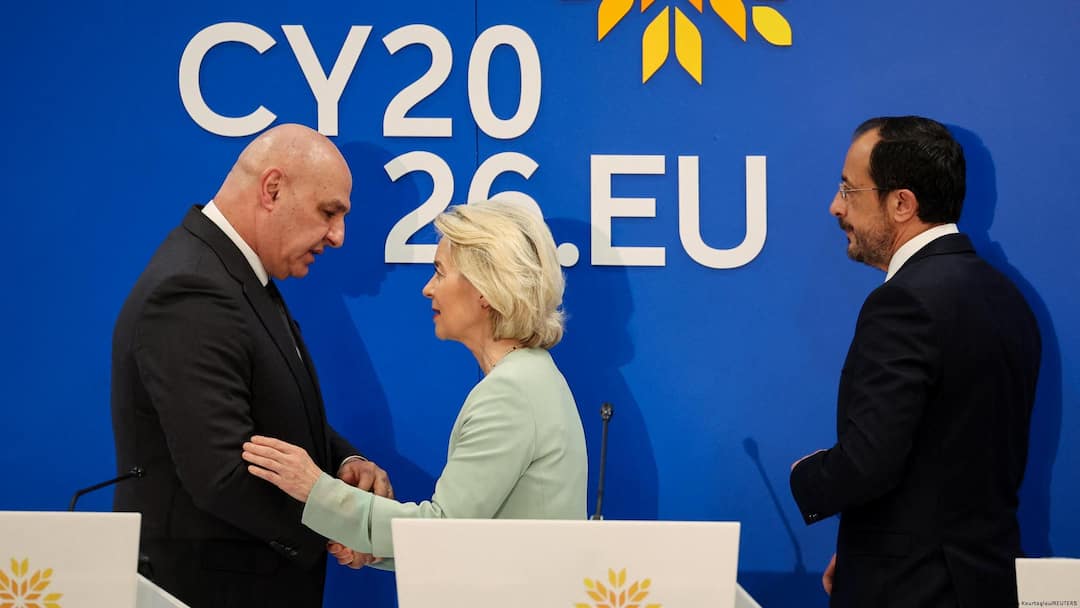
European Commission President Ursula von der Leyen and other EU leaders hosted a delegation of Middle Eastern leaders, including Lebanese President Joseph Aoun, on the second day of their summit in Cyprus.
They held talks on the Middle East over a working lunch with representatives from Egypt, Jordan, Lebanon and Syria on Friday afternoon.

While calling for peace in Iran, a deal to contain Tehran’s nuclear ambitions, and the immediate reopening of the Strait of Hormuz “without tolls,” von der Leyen also stressed that a peace deal should include Lebanon.

“A key lesson of the past weeks is that security is indivisible. You cannot have stability in the Middle East or the Gulf while Lebanon is in flames,” von der Leyen said, nodding at visiting President Aoun as she did so.
Without explicitly calling out Israel for having positioned troops in southern Lebanon to establish a self-declared “buffer zone,” von der Leyen seemed to imply an Israeli military withdrawal should be part of an eventual peace deal.

“So we call for the respect of Lebanon’s sovereignty and territorial integrity. A temporary pause is not enough. We need a permanent path to peace. And on the way we will continue to support the Lebanese people,” she said.
Summit host Cyprus, which lies 300 kilometers (186 miles) from the Lebanese coast, has been directly affected by the conflict — an Iranian drone struck a British military base there soon after the war started in late February.
Iran — EU warns of danger of ‘weaker’ Iran nuclear deal than JCPOA
Von der Leyen and European Council President Antonio Costa both said that the war had shown the dangers of Iran’s nuclear ambitions and said any peace deal needed to address its ballistic missile program.
Earlier on Friday, European Union foreign policy chief Kaja Kallas warned that negotiations to end the US-Israeli war with Iran were at risk of producing a “weaker” agreement on Tehran’s nuclear program than the one struck a decade ago. She called for nuclear experts to be part of proceedings.
“If the talks are only about the nuclear [issue] and there are no nuclear experts around the table, then we will end up with an agreement that is weaker than the JCPoA was,” Kallas told reporters on the second day of an informal EU leaders summit in Cyprus.
The JCPoA, sealed by the Obama administration in 2015, took two years to negotiate and involved some 200 specialists spanning nuclear physics, sanctions, finance and law. US President Donald Trump withdrew from the agreement in 2018. This week he vowed to forge a “far better” nuclear deal.
Kallas said if negotiators do not address Iran’s “missile programs, their support proxies, also hybrid and cyber activities in Europe” there is a possibility “we will end up with a more dangerous Iran.”
EU rejects tolls in the Strait of Hormuz, says European and Middle Eastern security intertwined
Costa welcomed the announcement from US President Donald Trump of a ceasefire extension and called for the Strait of Hormuz to “immediately reopen, without restrictions and without tolling,” in accordance with international law and the freedom of navigation.
“This is vital for the whole world,” Costa said.
Iran has floated the idea of charging for passage through the narrow strait, effectively framing these payments as a way to recoup reparations for damages caused by US and Israeli bombardment. Von der Leyen also stressed the waterway should reopen freely.
“Europe must do even more,” French President Emmanuel Macron told reporters in the Cypriot capital, Nicosia. “It is in all of our interests that stability be restored as soon as possible and that the world’s economies return to normal.”
President of the European Council Antonio Costa called for a ceasefire in Iran and the wider region.
“The war in the Middle East has already had disastrous consequences, for people, for instracture, for the global economy,” Costa said in Nicosia. “And with every day that passes without a solution, the situation is only getting worse.”
He said the current situation “clearly underscores” how closely European security is linked to that of the Middle East, and how vital cooperation on security and defense had become.

Similarly, von der Leyen said that EU and Gulf countries had realized in recent weeks that they needed to deepen their partnerships.
“The events of the past months have taught us a hard truth. Our security is not just related, it is intrinsically linked,” von der Leyen said. “A threat to a merchant vessel in the Strait of Hormuz is a threat to a factory, for example, in Belgium. So today I propose we move beyond reactive crisis management.”
She suggested various potential projects, like expanding the size and scope of naval operations and considering some kind of cooperation on defensive efforts against threats like drones and missiles.
EU budget
On Friday morning, the leaders held a debate on the next EU budget for the 2028-2034 period.
German Chancellor Friedrich Merz stressed that he opposed increasing member state contributions and taking on new debt.
“Europe must make do with the money we have,” Merz said. “We will have to set new priorities.”
“That means we will also have to reduce spending in other areas of the European budget,” the chancellor added.
The EU executive wants a bigger budget of around €2 trillion ($2.3 trillion) to repay debts incurred during the pandemic. A major challenge will be figuring out how to finance goals like boosting the EU’s competitiveness and defense capabilities at a time when many member states are short on funds.
Ukraine
On Thursday, the leaders met with Ukrainian President Volodymyr Zelenskyy and green-lighted a €90 billion loan for Kyiv. They also adopted the 20th sanctions package against Russia over Moscow’s war on Ukraine.
Kallas said Friday that the bloc was already looking to impose the next round of sanctions.
“We’re really pushing to go on the 21st package of sanctions,” she said. “It sends a very clear signal to Russia that they can’t outwait us. It also sends a clear signal to Russia that Ukraine is more important to us than it is to them, and we will keep on supporting them.”
Disclaimer: This report first appeared on Deutsche Welle, and has been republished on ABP Live as part of a special arrangement. Apart from the headline, no changes have been made in the report by ABP Live.
BREAKING: Yogi Adityanath Slams TMC Over “Mafia Raj” in Bengal

