

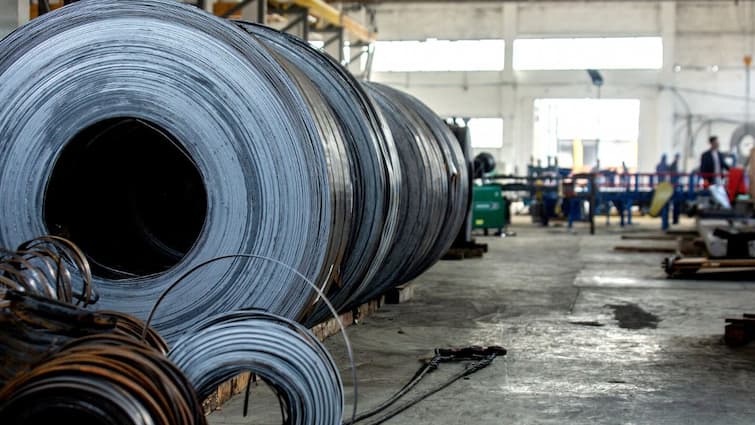
India’s metal exporters are entering a far more demanding trade environment this week as the European Union’s carbon tax regime formally moves closer to full implementation.
From January 1, the EU’s Carbon Border Adjustment Mechanism (CBAM) begins to exert real economic pressure on carbon‑intensive imports, a shift that experts warn could significantly dent India’s steel and aluminium exports unless companies adapt quickly.

According to the Global Trade Research Initiative (GTRI), the new levy is expected to force many Indian exporters to slash prices sharply to retain access to the EU market, even though the tax will technically be paid by European importers, reported PTI.

EU’s Carbon Border Adjustment Mechanism
The CBAM is the European Union’s attempt to align trade with its climate goals. The 27‑nation bloc is imposing a carbon tax on selected imports whose production involves high greenhouse‑gas emissions. The idea is to prevent “carbon leakage”, where production shifts to countries with looser environmental rules.
Under this framework, EU‑based importers, registered as authorised CBAM declarants, must purchase CBAM certificates that correspond to the embedded carbon emissions in imported goods. While Indian exporters will not pay the tax directly, the cost is expected to be passed back to them through lower realised prices.
Why Steel and Aluminium Are in the Firing Line
Steel and aluminium are among the most affected sectors because of their energy‑intensive manufacturing processes. Emissions vary significantly depending on the production route.

In steel, emissions are highest under the Blast Furnace-Basic Oxygen Furnace (BF-BOF) route, lower for gas‑based Direct Reduced Iron (DRI), and lowest for scrap‑based Electric Arc Furnace (EAF) production. In aluminium, the carbon footprint depends heavily on the electricity source. Power generated from coal substantially increases emissions, raising the CBAM cost.
As a result, producers using coal‑heavy energy mixes face a steeper penalty when exporting to Europe.
GTRI estimates that many Indian exporters may be forced to cut prices by 15–22 per cent so that EU importers can absorb the CBAM charge. This squeeze comes at a time when margins are already under pressure due to weak global demand and volatile commodity prices.
Ajay Srivastava, Founder of GTRI, said the real shift begins on January 1, 2026, when CBAM moves from a reporting phase to a payment phase.
“From 1 January 2026, every shipment of Indian steel and aluminium entering the EU will carry a carbon cost,” Srivastava said.
He warned that CBAM is not merely a sustainability disclosure exercise but a detailed, plant‑level emissions accounting regime.

Compliance Costs May Push Out Smaller Exporters
Beyond the tax itself, compliance is emerging as a major challenge. According to GTRI, CBAM’s data and verification requirements will sharply raise operational costs, particularly for smaller exporters.
Manufacturers will need to track fuel usage, electricity consumption, production volumes and emission factors on a quarterly basis. All records must be auditable and aligned with EU methodologies.
“Without this discipline, exporters face default emission values set by the EU – intentionally conservative and often 30-80 per cent higher than actual emissions,” Srivastava said.
From 2026, independent verification of emissions data will become mandatory. Only EU‑recognised or ISO 14065‑compliant verifiers will be accepted. The process will resemble a financial audit, involving document reviews, emissions validation and formal certification.
Competitive Advantage for Cleaner Producers
While the immediate outlook looks challenging, GTRI believes CBAM could also create winners. Exporters using cleaner electricity and low‑emission production methods may gain a competitive edge.
“For low‑emission producers, CBAM can become a competitive advantage in the EU market. Verified low emissions can protect margins and help win market share as higher‑emission suppliers lose ground,” Srivastava said.
He advised Indian exporters to develop an internal “CBAM shadow price”, a method of calculating embedded emissions per tonne and applying the prevailing EU carbon price to assess true export costs.
Exports Already Under Pressure
The timing of the carbon tax is particularly sensitive. India’s steel and aluminium exports to the EU have already fallen sharply, declining 24.4 per cent from $7.71 billion in FY24 to $5.82 billion in FY25.
With CBAM now emerging as a structural trade barrier, industry experts say the mechanism has become a critical issue in the ongoing negotiations for a proposed India‑EU trade agreement.
The EU’s carbon tax marks a turning point in how environmental policy intersects with global trade.
Union Budget 2025: Arvind Kejriwal lists the shortcomings of the Modi government’s budget | ABP News | AAP

