

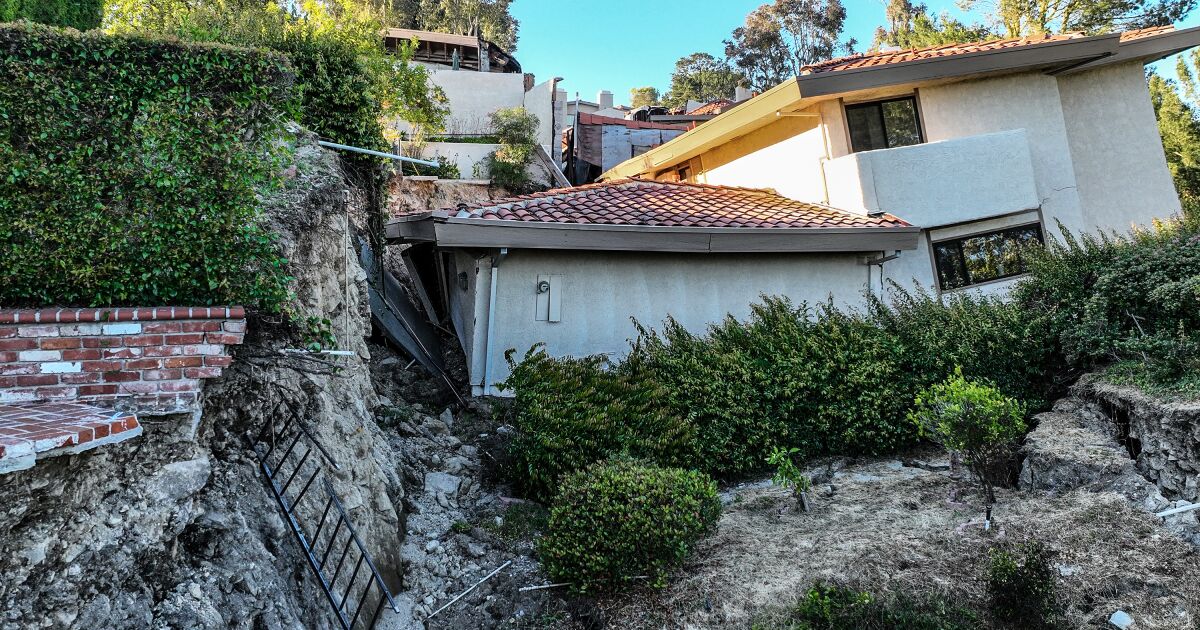
Over the weekend, 12 houses on Peartree Lane in a gated subdivision of Rolling Hills Estates began to slide into the canyon that ran below their back patios. In the days since, several of the houses fell all the way in.
The owners of these homes are unlikely to get any financial assistance from their home insurers, at least under their normal homeowners policies.
The typical policy covers things like burst pipes, storm damage from wind, trees falling onto the house, liability for people who get injured on the property, and fire damage. But once big chunks of terrain get moving, the standard policy no longer applies — which could lead to financial ruin for homeowners in California, a state that logged more than 700 reported landslides in just the last year.
Landslides, mudslides, sinkholes and other dislocations of the dirt are considered “earth movements” by the insurance industry, which fall outside the realm of usual home insurance.
If the dirt in question becomes very wet and rises up from the ground, that might turn into a mudflow, technically speaking, and be covered by flood insurance, something few Californians buy.
If the dirt is moved by one of California’s many tectonic faults, homeowners’ supplementary earthquake insurance steps into the picture, if they’ve ponied up for that. But a surface-based landslide does not fall under earthquake coverage.
And if earth movement is the cause of the damage, there isn’t much wiggle room on a typical policy, according to Janet Ruiz, director of strategic communication at the Insurance Information Institute, an industry group.
“If you put a claim in on your homeowners and it looks like it’s earth movement, they would probably deny the claim,” Ruiz said.
But there is a way out, for those willing to pay. Homeowners can get “difference in conditions” insurance through specialty insurers to cover all sorts of unfortunate happenings: earth movement, earthquakes, floods and the like.
“For people with expensive homes on the hillsides, that could be an important type of coverage,” Ruiz said.
Even if your own home insurance doesn’t cover the damage, there are some scenarios in which other parties could be on the hook. If poorly maintained infrastructure is to blame for damage, homeowners could sue neighbors or local authorities to cover the costs of repair.
In some instances, California courts and insurance regulators have also decided that a normal homeowners policy will cover damage from earth movement — but only if the homeowner can prove that a mudslide stemmed from recent wildfire damage, after rains hit a hillside where all the vegetation burned down. Homeowners policies do cover fire damage, so if fire can be proved to be the “proximate cause” of a wave of mud hitting a house, then the insurance company could still be on the hook.
That doesn’t help the homeowners on Peartree Lane. There haven’t been any recent fires, and Ruiz noted that the canyon looks fairly dry.
“People use mudslide and landslide interchangeably, but I don’t think this one is a mudslide,” Ruiz said. “More of a drought slide,” though geologists on site could determine that the canyon walls were weakened by rains earlier this year, as one Rolling Hills Estates official told The Times.
State officials have announced that the homeowners are, however, eligible for property tax relief for their houses that now sit at the bottom of a ravine.

Over the weekend, 12 houses on Peartree Lane in a gated subdivision of Rolling Hills Estates began to slide into the canyon that ran below their back patios. In the days since, several of the houses fell all the way in.
The owners of these homes are unlikely to get any financial assistance from their home insurers, at least under their normal homeowners policies.
The typical policy covers things like burst pipes, storm damage from wind, trees falling onto the house, liability for people who get injured on the property, and fire damage. But once big chunks of terrain get moving, the standard policy no longer applies — which could lead to financial ruin for homeowners in California, a state that logged more than 700 reported landslides in just the last year.
Landslides, mudslides, sinkholes and other dislocations of the dirt are considered “earth movements” by the insurance industry, which fall outside the realm of usual home insurance.
If the dirt in question becomes very wet and rises up from the ground, that might turn into a mudflow, technically speaking, and be covered by flood insurance, something few Californians buy.
If the dirt is moved by one of California’s many tectonic faults, homeowners’ supplementary earthquake insurance steps into the picture, if they’ve ponied up for that. But a surface-based landslide does not fall under earthquake coverage.
And if earth movement is the cause of the damage, there isn’t much wiggle room on a typical policy, according to Janet Ruiz, director of strategic communication at the Insurance Information Institute, an industry group.
“If you put a claim in on your homeowners and it looks like it’s earth movement, they would probably deny the claim,” Ruiz said.
But there is a way out, for those willing to pay. Homeowners can get “difference in conditions” insurance through specialty insurers to cover all sorts of unfortunate happenings: earth movement, earthquakes, floods and the like.
“For people with expensive homes on the hillsides, that could be an important type of coverage,” Ruiz said.
Even if your own home insurance doesn’t cover the damage, there are some scenarios in which other parties could be on the hook. If poorly maintained infrastructure is to blame for damage, homeowners could sue neighbors or local authorities to cover the costs of repair.
In some instances, California courts and insurance regulators have also decided that a normal homeowners policy will cover damage from earth movement — but only if the homeowner can prove that a mudslide stemmed from recent wildfire damage, after rains hit a hillside where all the vegetation burned down. Homeowners policies do cover fire damage, so if fire can be proved to be the “proximate cause” of a wave of mud hitting a house, then the insurance company could still be on the hook.
That doesn’t help the homeowners on Peartree Lane. There haven’t been any recent fires, and Ruiz noted that the canyon looks fairly dry.
“People use mudslide and landslide interchangeably, but I don’t think this one is a mudslide,” Ruiz said. “More of a drought slide,” though geologists on site could determine that the canyon walls were weakened by rains earlier this year, as one Rolling Hills Estates official told The Times.
State officials have announced that the homeowners are, however, eligible for property tax relief for their houses that now sit at the bottom of a ravine.

Over the weekend, 12 houses on Peartree Lane in a gated subdivision of Rolling Hills Estates began to slide into the canyon that ran below their back patios. In the days since, several of the houses fell all the way in.
The owners of these homes are unlikely to get any financial assistance from their home insurers, at least under their normal homeowners policies.
The typical policy covers things like burst pipes, storm damage from wind, trees falling onto the house, liability for people who get injured on the property, and fire damage. But once big chunks of terrain get moving, the standard policy no longer applies — which could lead to financial ruin for homeowners in California, a state that logged more than 700 reported landslides in just the last year.
Landslides, mudslides, sinkholes and other dislocations of the dirt are considered “earth movements” by the insurance industry, which fall outside the realm of usual home insurance.
If the dirt in question becomes very wet and rises up from the ground, that might turn into a mudflow, technically speaking, and be covered by flood insurance, something few Californians buy.
If the dirt is moved by one of California’s many tectonic faults, homeowners’ supplementary earthquake insurance steps into the picture, if they’ve ponied up for that. But a surface-based landslide does not fall under earthquake coverage.
And if earth movement is the cause of the damage, there isn’t much wiggle room on a typical policy, according to Janet Ruiz, director of strategic communication at the Insurance Information Institute, an industry group.
“If you put a claim in on your homeowners and it looks like it’s earth movement, they would probably deny the claim,” Ruiz said.
But there is a way out, for those willing to pay. Homeowners can get “difference in conditions” insurance through specialty insurers to cover all sorts of unfortunate happenings: earth movement, earthquakes, floods and the like.
“For people with expensive homes on the hillsides, that could be an important type of coverage,” Ruiz said.
Even if your own home insurance doesn’t cover the damage, there are some scenarios in which other parties could be on the hook. If poorly maintained infrastructure is to blame for damage, homeowners could sue neighbors or local authorities to cover the costs of repair.
In some instances, California courts and insurance regulators have also decided that a normal homeowners policy will cover damage from earth movement — but only if the homeowner can prove that a mudslide stemmed from recent wildfire damage, after rains hit a hillside where all the vegetation burned down. Homeowners policies do cover fire damage, so if fire can be proved to be the “proximate cause” of a wave of mud hitting a house, then the insurance company could still be on the hook.
That doesn’t help the homeowners on Peartree Lane. There haven’t been any recent fires, and Ruiz noted that the canyon looks fairly dry.
“People use mudslide and landslide interchangeably, but I don’t think this one is a mudslide,” Ruiz said. “More of a drought slide,” though geologists on site could determine that the canyon walls were weakened by rains earlier this year, as one Rolling Hills Estates official told The Times.
State officials have announced that the homeowners are, however, eligible for property tax relief for their houses that now sit at the bottom of a ravine.
Over the weekend, 12 houses on Peartree Lane in a gated subdivision of Rolling Hills Estates began to slide into the canyon that ran below their back patios. In the days since, several of the houses fell all the way in.
The owners of these homes are unlikely to get any financial assistance from their home insurers, at least under their normal homeowners policies.
The typical policy covers things like burst pipes, storm damage from wind, trees falling onto the house, liability for people who get injured on the property, and fire damage. But once big chunks of terrain get moving, the standard policy no longer applies — which could lead to financial ruin for homeowners in California, a state that logged more than 700 reported landslides in just the last year.
Landslides, mudslides, sinkholes and other dislocations of the dirt are considered “earth movements” by the insurance industry, which fall outside the realm of usual home insurance.
If the dirt in question becomes very wet and rises up from the ground, that might turn into a mudflow, technically speaking, and be covered by flood insurance, something few Californians buy.
If the dirt is moved by one of California’s many tectonic faults, homeowners’ supplementary earthquake insurance steps into the picture, if they’ve ponied up for that. But a surface-based landslide does not fall under earthquake coverage.
And if earth movement is the cause of the damage, there isn’t much wiggle room on a typical policy, according to Janet Ruiz, director of strategic communication at the Insurance Information Institute, an industry group.
“If you put a claim in on your homeowners and it looks like it’s earth movement, they would probably deny the claim,” Ruiz said.
But there is a way out, for those willing to pay. Homeowners can get “difference in conditions” insurance through specialty insurers to cover all sorts of unfortunate happenings: earth movement, earthquakes, floods and the like.
“For people with expensive homes on the hillsides, that could be an important type of coverage,” Ruiz said.
Even if your own home insurance doesn’t cover the damage, there are some scenarios in which other parties could be on the hook. If poorly maintained infrastructure is to blame for damage, homeowners could sue neighbors or local authorities to cover the costs of repair.
In some instances, California courts and insurance regulators have also decided that a normal homeowners policy will cover damage from earth movement — but only if the homeowner can prove that a mudslide stemmed from recent wildfire damage, after rains hit a hillside where all the vegetation burned down. Homeowners policies do cover fire damage, so if fire can be proved to be the “proximate cause” of a wave of mud hitting a house, then the insurance company could still be on the hook.
That doesn’t help the homeowners on Peartree Lane. There haven’t been any recent fires, and Ruiz noted that the canyon looks fairly dry.
“People use mudslide and landslide interchangeably, but I don’t think this one is a mudslide,” Ruiz said. “More of a drought slide,” though geologists on site could determine that the canyon walls were weakened by rains earlier this year, as one Rolling Hills Estates official told The Times.
State officials have announced that the homeowners are, however, eligible for property tax relief for their houses that now sit at the bottom of a ravine.

Over the weekend, 12 houses on Peartree Lane in a gated subdivision of Rolling Hills Estates began to slide into the canyon that ran below their back patios. In the days since, several of the houses fell all the way in.
The owners of these homes are unlikely to get any financial assistance from their home insurers, at least under their normal homeowners policies.
The typical policy covers things like burst pipes, storm damage from wind, trees falling onto the house, liability for people who get injured on the property, and fire damage. But once big chunks of terrain get moving, the standard policy no longer applies — which could lead to financial ruin for homeowners in California, a state that logged more than 700 reported landslides in just the last year.
Landslides, mudslides, sinkholes and other dislocations of the dirt are considered “earth movements” by the insurance industry, which fall outside the realm of usual home insurance.
If the dirt in question becomes very wet and rises up from the ground, that might turn into a mudflow, technically speaking, and be covered by flood insurance, something few Californians buy.
If the dirt is moved by one of California’s many tectonic faults, homeowners’ supplementary earthquake insurance steps into the picture, if they’ve ponied up for that. But a surface-based landslide does not fall under earthquake coverage.
And if earth movement is the cause of the damage, there isn’t much wiggle room on a typical policy, according to Janet Ruiz, director of strategic communication at the Insurance Information Institute, an industry group.
“If you put a claim in on your homeowners and it looks like it’s earth movement, they would probably deny the claim,” Ruiz said.
But there is a way out, for those willing to pay. Homeowners can get “difference in conditions” insurance through specialty insurers to cover all sorts of unfortunate happenings: earth movement, earthquakes, floods and the like.
“For people with expensive homes on the hillsides, that could be an important type of coverage,” Ruiz said.
Even if your own home insurance doesn’t cover the damage, there are some scenarios in which other parties could be on the hook. If poorly maintained infrastructure is to blame for damage, homeowners could sue neighbors or local authorities to cover the costs of repair.
In some instances, California courts and insurance regulators have also decided that a normal homeowners policy will cover damage from earth movement — but only if the homeowner can prove that a mudslide stemmed from recent wildfire damage, after rains hit a hillside where all the vegetation burned down. Homeowners policies do cover fire damage, so if fire can be proved to be the “proximate cause” of a wave of mud hitting a house, then the insurance company could still be on the hook.
That doesn’t help the homeowners on Peartree Lane. There haven’t been any recent fires, and Ruiz noted that the canyon looks fairly dry.
“People use mudslide and landslide interchangeably, but I don’t think this one is a mudslide,” Ruiz said. “More of a drought slide,” though geologists on site could determine that the canyon walls were weakened by rains earlier this year, as one Rolling Hills Estates official told The Times.
State officials have announced that the homeowners are, however, eligible for property tax relief for their houses that now sit at the bottom of a ravine.
Over the weekend, 12 houses on Peartree Lane in a gated subdivision of Rolling Hills Estates began to slide into the canyon that ran below their back patios. In the days since, several of the houses fell all the way in.
The owners of these homes are unlikely to get any financial assistance from their home insurers, at least under their normal homeowners policies.
The typical policy covers things like burst pipes, storm damage from wind, trees falling onto the house, liability for people who get injured on the property, and fire damage. But once big chunks of terrain get moving, the standard policy no longer applies — which could lead to financial ruin for homeowners in California, a state that logged more than 700 reported landslides in just the last year.
Landslides, mudslides, sinkholes and other dislocations of the dirt are considered “earth movements” by the insurance industry, which fall outside the realm of usual home insurance.
If the dirt in question becomes very wet and rises up from the ground, that might turn into a mudflow, technically speaking, and be covered by flood insurance, something few Californians buy.
If the dirt is moved by one of California’s many tectonic faults, homeowners’ supplementary earthquake insurance steps into the picture, if they’ve ponied up for that. But a surface-based landslide does not fall under earthquake coverage.
And if earth movement is the cause of the damage, there isn’t much wiggle room on a typical policy, according to Janet Ruiz, director of strategic communication at the Insurance Information Institute, an industry group.
“If you put a claim in on your homeowners and it looks like it’s earth movement, they would probably deny the claim,” Ruiz said.
But there is a way out, for those willing to pay. Homeowners can get “difference in conditions” insurance through specialty insurers to cover all sorts of unfortunate happenings: earth movement, earthquakes, floods and the like.
“For people with expensive homes on the hillsides, that could be an important type of coverage,” Ruiz said.
Even if your own home insurance doesn’t cover the damage, there are some scenarios in which other parties could be on the hook. If poorly maintained infrastructure is to blame for damage, homeowners could sue neighbors or local authorities to cover the costs of repair.
In some instances, California courts and insurance regulators have also decided that a normal homeowners policy will cover damage from earth movement — but only if the homeowner can prove that a mudslide stemmed from recent wildfire damage, after rains hit a hillside where all the vegetation burned down. Homeowners policies do cover fire damage, so if fire can be proved to be the “proximate cause” of a wave of mud hitting a house, then the insurance company could still be on the hook.
That doesn’t help the homeowners on Peartree Lane. There haven’t been any recent fires, and Ruiz noted that the canyon looks fairly dry.
“People use mudslide and landslide interchangeably, but I don’t think this one is a mudslide,” Ruiz said. “More of a drought slide,” though geologists on site could determine that the canyon walls were weakened by rains earlier this year, as one Rolling Hills Estates official told The Times.
State officials have announced that the homeowners are, however, eligible for property tax relief for their houses that now sit at the bottom of a ravine.
Over the weekend, 12 houses on Peartree Lane in a gated subdivision of Rolling Hills Estates began to slide into the canyon that ran below their back patios. In the days since, several of the houses fell all the way in.
The owners of these homes are unlikely to get any financial assistance from their home insurers, at least under their normal homeowners policies.
The typical policy covers things like burst pipes, storm damage from wind, trees falling onto the house, liability for people who get injured on the property, and fire damage. But once big chunks of terrain get moving, the standard policy no longer applies — which could lead to financial ruin for homeowners in California, a state that logged more than 700 reported landslides in just the last year.
Landslides, mudslides, sinkholes and other dislocations of the dirt are considered “earth movements” by the insurance industry, which fall outside the realm of usual home insurance.
If the dirt in question becomes very wet and rises up from the ground, that might turn into a mudflow, technically speaking, and be covered by flood insurance, something few Californians buy.
If the dirt is moved by one of California’s many tectonic faults, homeowners’ supplementary earthquake insurance steps into the picture, if they’ve ponied up for that. But a surface-based landslide does not fall under earthquake coverage.
And if earth movement is the cause of the damage, there isn’t much wiggle room on a typical policy, according to Janet Ruiz, director of strategic communication at the Insurance Information Institute, an industry group.
“If you put a claim in on your homeowners and it looks like it’s earth movement, they would probably deny the claim,” Ruiz said.
But there is a way out, for those willing to pay. Homeowners can get “difference in conditions” insurance through specialty insurers to cover all sorts of unfortunate happenings: earth movement, earthquakes, floods and the like.
“For people with expensive homes on the hillsides, that could be an important type of coverage,” Ruiz said.
Even if your own home insurance doesn’t cover the damage, there are some scenarios in which other parties could be on the hook. If poorly maintained infrastructure is to blame for damage, homeowners could sue neighbors or local authorities to cover the costs of repair.
In some instances, California courts and insurance regulators have also decided that a normal homeowners policy will cover damage from earth movement — but only if the homeowner can prove that a mudslide stemmed from recent wildfire damage, after rains hit a hillside where all the vegetation burned down. Homeowners policies do cover fire damage, so if fire can be proved to be the “proximate cause” of a wave of mud hitting a house, then the insurance company could still be on the hook.
That doesn’t help the homeowners on Peartree Lane. There haven’t been any recent fires, and Ruiz noted that the canyon looks fairly dry.
“People use mudslide and landslide interchangeably, but I don’t think this one is a mudslide,” Ruiz said. “More of a drought slide,” though geologists on site could determine that the canyon walls were weakened by rains earlier this year, as one Rolling Hills Estates official told The Times.
State officials have announced that the homeowners are, however, eligible for property tax relief for their houses that now sit at the bottom of a ravine.
Over the weekend, 12 houses on Peartree Lane in a gated subdivision of Rolling Hills Estates began to slide into the canyon that ran below their back patios. In the days since, several of the houses fell all the way in.
The owners of these homes are unlikely to get any financial assistance from their home insurers, at least under their normal homeowners policies.
The typical policy covers things like burst pipes, storm damage from wind, trees falling onto the house, liability for people who get injured on the property, and fire damage. But once big chunks of terrain get moving, the standard policy no longer applies — which could lead to financial ruin for homeowners in California, a state that logged more than 700 reported landslides in just the last year.
Landslides, mudslides, sinkholes and other dislocations of the dirt are considered “earth movements” by the insurance industry, which fall outside the realm of usual home insurance.
If the dirt in question becomes very wet and rises up from the ground, that might turn into a mudflow, technically speaking, and be covered by flood insurance, something few Californians buy.
If the dirt is moved by one of California’s many tectonic faults, homeowners’ supplementary earthquake insurance steps into the picture, if they’ve ponied up for that. But a surface-based landslide does not fall under earthquake coverage.
And if earth movement is the cause of the damage, there isn’t much wiggle room on a typical policy, according to Janet Ruiz, director of strategic communication at the Insurance Information Institute, an industry group.
“If you put a claim in on your homeowners and it looks like it’s earth movement, they would probably deny the claim,” Ruiz said.
But there is a way out, for those willing to pay. Homeowners can get “difference in conditions” insurance through specialty insurers to cover all sorts of unfortunate happenings: earth movement, earthquakes, floods and the like.
“For people with expensive homes on the hillsides, that could be an important type of coverage,” Ruiz said.
Even if your own home insurance doesn’t cover the damage, there are some scenarios in which other parties could be on the hook. If poorly maintained infrastructure is to blame for damage, homeowners could sue neighbors or local authorities to cover the costs of repair.
In some instances, California courts and insurance regulators have also decided that a normal homeowners policy will cover damage from earth movement — but only if the homeowner can prove that a mudslide stemmed from recent wildfire damage, after rains hit a hillside where all the vegetation burned down. Homeowners policies do cover fire damage, so if fire can be proved to be the “proximate cause” of a wave of mud hitting a house, then the insurance company could still be on the hook.
That doesn’t help the homeowners on Peartree Lane. There haven’t been any recent fires, and Ruiz noted that the canyon looks fairly dry.
“People use mudslide and landslide interchangeably, but I don’t think this one is a mudslide,” Ruiz said. “More of a drought slide,” though geologists on site could determine that the canyon walls were weakened by rains earlier this year, as one Rolling Hills Estates official told The Times.
State officials have announced that the homeowners are, however, eligible for property tax relief for their houses that now sit at the bottom of a ravine.

Over the weekend, 12 houses on Peartree Lane in a gated subdivision of Rolling Hills Estates began to slide into the canyon that ran below their back patios. In the days since, several of the houses fell all the way in.
The owners of these homes are unlikely to get any financial assistance from their home insurers, at least under their normal homeowners policies.
The typical policy covers things like burst pipes, storm damage from wind, trees falling onto the house, liability for people who get injured on the property, and fire damage. But once big chunks of terrain get moving, the standard policy no longer applies — which could lead to financial ruin for homeowners in California, a state that logged more than 700 reported landslides in just the last year.
Landslides, mudslides, sinkholes and other dislocations of the dirt are considered “earth movements” by the insurance industry, which fall outside the realm of usual home insurance.
If the dirt in question becomes very wet and rises up from the ground, that might turn into a mudflow, technically speaking, and be covered by flood insurance, something few Californians buy.
If the dirt is moved by one of California’s many tectonic faults, homeowners’ supplementary earthquake insurance steps into the picture, if they’ve ponied up for that. But a surface-based landslide does not fall under earthquake coverage.
And if earth movement is the cause of the damage, there isn’t much wiggle room on a typical policy, according to Janet Ruiz, director of strategic communication at the Insurance Information Institute, an industry group.
“If you put a claim in on your homeowners and it looks like it’s earth movement, they would probably deny the claim,” Ruiz said.
But there is a way out, for those willing to pay. Homeowners can get “difference in conditions” insurance through specialty insurers to cover all sorts of unfortunate happenings: earth movement, earthquakes, floods and the like.
“For people with expensive homes on the hillsides, that could be an important type of coverage,” Ruiz said.
Even if your own home insurance doesn’t cover the damage, there are some scenarios in which other parties could be on the hook. If poorly maintained infrastructure is to blame for damage, homeowners could sue neighbors or local authorities to cover the costs of repair.
In some instances, California courts and insurance regulators have also decided that a normal homeowners policy will cover damage from earth movement — but only if the homeowner can prove that a mudslide stemmed from recent wildfire damage, after rains hit a hillside where all the vegetation burned down. Homeowners policies do cover fire damage, so if fire can be proved to be the “proximate cause” of a wave of mud hitting a house, then the insurance company could still be on the hook.
That doesn’t help the homeowners on Peartree Lane. There haven’t been any recent fires, and Ruiz noted that the canyon looks fairly dry.
“People use mudslide and landslide interchangeably, but I don’t think this one is a mudslide,” Ruiz said. “More of a drought slide,” though geologists on site could determine that the canyon walls were weakened by rains earlier this year, as one Rolling Hills Estates official told The Times.
State officials have announced that the homeowners are, however, eligible for property tax relief for their houses that now sit at the bottom of a ravine.
Over the weekend, 12 houses on Peartree Lane in a gated subdivision of Rolling Hills Estates began to slide into the canyon that ran below their back patios. In the days since, several of the houses fell all the way in.
The owners of these homes are unlikely to get any financial assistance from their home insurers, at least under their normal homeowners policies.
The typical policy covers things like burst pipes, storm damage from wind, trees falling onto the house, liability for people who get injured on the property, and fire damage. But once big chunks of terrain get moving, the standard policy no longer applies — which could lead to financial ruin for homeowners in California, a state that logged more than 700 reported landslides in just the last year.
Landslides, mudslides, sinkholes and other dislocations of the dirt are considered “earth movements” by the insurance industry, which fall outside the realm of usual home insurance.
If the dirt in question becomes very wet and rises up from the ground, that might turn into a mudflow, technically speaking, and be covered by flood insurance, something few Californians buy.
If the dirt is moved by one of California’s many tectonic faults, homeowners’ supplementary earthquake insurance steps into the picture, if they’ve ponied up for that. But a surface-based landslide does not fall under earthquake coverage.
And if earth movement is the cause of the damage, there isn’t much wiggle room on a typical policy, according to Janet Ruiz, director of strategic communication at the Insurance Information Institute, an industry group.
“If you put a claim in on your homeowners and it looks like it’s earth movement, they would probably deny the claim,” Ruiz said.
But there is a way out, for those willing to pay. Homeowners can get “difference in conditions” insurance through specialty insurers to cover all sorts of unfortunate happenings: earth movement, earthquakes, floods and the like.
“For people with expensive homes on the hillsides, that could be an important type of coverage,” Ruiz said.
Even if your own home insurance doesn’t cover the damage, there are some scenarios in which other parties could be on the hook. If poorly maintained infrastructure is to blame for damage, homeowners could sue neighbors or local authorities to cover the costs of repair.
In some instances, California courts and insurance regulators have also decided that a normal homeowners policy will cover damage from earth movement — but only if the homeowner can prove that a mudslide stemmed from recent wildfire damage, after rains hit a hillside where all the vegetation burned down. Homeowners policies do cover fire damage, so if fire can be proved to be the “proximate cause” of a wave of mud hitting a house, then the insurance company could still be on the hook.
That doesn’t help the homeowners on Peartree Lane. There haven’t been any recent fires, and Ruiz noted that the canyon looks fairly dry.
“People use mudslide and landslide interchangeably, but I don’t think this one is a mudslide,” Ruiz said. “More of a drought slide,” though geologists on site could determine that the canyon walls were weakened by rains earlier this year, as one Rolling Hills Estates official told The Times.
State officials have announced that the homeowners are, however, eligible for property tax relief for their houses that now sit at the bottom of a ravine.
Over the weekend, 12 houses on Peartree Lane in a gated subdivision of Rolling Hills Estates began to slide into the canyon that ran below their back patios. In the days since, several of the houses fell all the way in.
The owners of these homes are unlikely to get any financial assistance from their home insurers, at least under their normal homeowners policies.
The typical policy covers things like burst pipes, storm damage from wind, trees falling onto the house, liability for people who get injured on the property, and fire damage. But once big chunks of terrain get moving, the standard policy no longer applies — which could lead to financial ruin for homeowners in California, a state that logged more than 700 reported landslides in just the last year.
Landslides, mudslides, sinkholes and other dislocations of the dirt are considered “earth movements” by the insurance industry, which fall outside the realm of usual home insurance.
If the dirt in question becomes very wet and rises up from the ground, that might turn into a mudflow, technically speaking, and be covered by flood insurance, something few Californians buy.
If the dirt is moved by one of California’s many tectonic faults, homeowners’ supplementary earthquake insurance steps into the picture, if they’ve ponied up for that. But a surface-based landslide does not fall under earthquake coverage.
And if earth movement is the cause of the damage, there isn’t much wiggle room on a typical policy, according to Janet Ruiz, director of strategic communication at the Insurance Information Institute, an industry group.
“If you put a claim in on your homeowners and it looks like it’s earth movement, they would probably deny the claim,” Ruiz said.
But there is a way out, for those willing to pay. Homeowners can get “difference in conditions” insurance through specialty insurers to cover all sorts of unfortunate happenings: earth movement, earthquakes, floods and the like.
“For people with expensive homes on the hillsides, that could be an important type of coverage,” Ruiz said.
Even if your own home insurance doesn’t cover the damage, there are some scenarios in which other parties could be on the hook. If poorly maintained infrastructure is to blame for damage, homeowners could sue neighbors or local authorities to cover the costs of repair.
In some instances, California courts and insurance regulators have also decided that a normal homeowners policy will cover damage from earth movement — but only if the homeowner can prove that a mudslide stemmed from recent wildfire damage, after rains hit a hillside where all the vegetation burned down. Homeowners policies do cover fire damage, so if fire can be proved to be the “proximate cause” of a wave of mud hitting a house, then the insurance company could still be on the hook.
That doesn’t help the homeowners on Peartree Lane. There haven’t been any recent fires, and Ruiz noted that the canyon looks fairly dry.
“People use mudslide and landslide interchangeably, but I don’t think this one is a mudslide,” Ruiz said. “More of a drought slide,” though geologists on site could determine that the canyon walls were weakened by rains earlier this year, as one Rolling Hills Estates official told The Times.
State officials have announced that the homeowners are, however, eligible for property tax relief for their houses that now sit at the bottom of a ravine.
Over the weekend, 12 houses on Peartree Lane in a gated subdivision of Rolling Hills Estates began to slide into the canyon that ran below their back patios. In the days since, several of the houses fell all the way in.
The owners of these homes are unlikely to get any financial assistance from their home insurers, at least under their normal homeowners policies.
The typical policy covers things like burst pipes, storm damage from wind, trees falling onto the house, liability for people who get injured on the property, and fire damage. But once big chunks of terrain get moving, the standard policy no longer applies — which could lead to financial ruin for homeowners in California, a state that logged more than 700 reported landslides in just the last year.
Landslides, mudslides, sinkholes and other dislocations of the dirt are considered “earth movements” by the insurance industry, which fall outside the realm of usual home insurance.
If the dirt in question becomes very wet and rises up from the ground, that might turn into a mudflow, technically speaking, and be covered by flood insurance, something few Californians buy.
If the dirt is moved by one of California’s many tectonic faults, homeowners’ supplementary earthquake insurance steps into the picture, if they’ve ponied up for that. But a surface-based landslide does not fall under earthquake coverage.
And if earth movement is the cause of the damage, there isn’t much wiggle room on a typical policy, according to Janet Ruiz, director of strategic communication at the Insurance Information Institute, an industry group.
“If you put a claim in on your homeowners and it looks like it’s earth movement, they would probably deny the claim,” Ruiz said.
But there is a way out, for those willing to pay. Homeowners can get “difference in conditions” insurance through specialty insurers to cover all sorts of unfortunate happenings: earth movement, earthquakes, floods and the like.
“For people with expensive homes on the hillsides, that could be an important type of coverage,” Ruiz said.
Even if your own home insurance doesn’t cover the damage, there are some scenarios in which other parties could be on the hook. If poorly maintained infrastructure is to blame for damage, homeowners could sue neighbors or local authorities to cover the costs of repair.
In some instances, California courts and insurance regulators have also decided that a normal homeowners policy will cover damage from earth movement — but only if the homeowner can prove that a mudslide stemmed from recent wildfire damage, after rains hit a hillside where all the vegetation burned down. Homeowners policies do cover fire damage, so if fire can be proved to be the “proximate cause” of a wave of mud hitting a house, then the insurance company could still be on the hook.
That doesn’t help the homeowners on Peartree Lane. There haven’t been any recent fires, and Ruiz noted that the canyon looks fairly dry.
“People use mudslide and landslide interchangeably, but I don’t think this one is a mudslide,” Ruiz said. “More of a drought slide,” though geologists on site could determine that the canyon walls were weakened by rains earlier this year, as one Rolling Hills Estates official told The Times.
State officials have announced that the homeowners are, however, eligible for property tax relief for their houses that now sit at the bottom of a ravine.
Over the weekend, 12 houses on Peartree Lane in a gated subdivision of Rolling Hills Estates began to slide into the canyon that ran below their back patios. In the days since, several of the houses fell all the way in.
The owners of these homes are unlikely to get any financial assistance from their home insurers, at least under their normal homeowners policies.
The typical policy covers things like burst pipes, storm damage from wind, trees falling onto the house, liability for people who get injured on the property, and fire damage. But once big chunks of terrain get moving, the standard policy no longer applies — which could lead to financial ruin for homeowners in California, a state that logged more than 700 reported landslides in just the last year.
Landslides, mudslides, sinkholes and other dislocations of the dirt are considered “earth movements” by the insurance industry, which fall outside the realm of usual home insurance.
If the dirt in question becomes very wet and rises up from the ground, that might turn into a mudflow, technically speaking, and be covered by flood insurance, something few Californians buy.
If the dirt is moved by one of California’s many tectonic faults, homeowners’ supplementary earthquake insurance steps into the picture, if they’ve ponied up for that. But a surface-based landslide does not fall under earthquake coverage.
And if earth movement is the cause of the damage, there isn’t much wiggle room on a typical policy, according to Janet Ruiz, director of strategic communication at the Insurance Information Institute, an industry group.
“If you put a claim in on your homeowners and it looks like it’s earth movement, they would probably deny the claim,” Ruiz said.
But there is a way out, for those willing to pay. Homeowners can get “difference in conditions” insurance through specialty insurers to cover all sorts of unfortunate happenings: earth movement, earthquakes, floods and the like.
“For people with expensive homes on the hillsides, that could be an important type of coverage,” Ruiz said.
Even if your own home insurance doesn’t cover the damage, there are some scenarios in which other parties could be on the hook. If poorly maintained infrastructure is to blame for damage, homeowners could sue neighbors or local authorities to cover the costs of repair.
In some instances, California courts and insurance regulators have also decided that a normal homeowners policy will cover damage from earth movement — but only if the homeowner can prove that a mudslide stemmed from recent wildfire damage, after rains hit a hillside where all the vegetation burned down. Homeowners policies do cover fire damage, so if fire can be proved to be the “proximate cause” of a wave of mud hitting a house, then the insurance company could still be on the hook.
That doesn’t help the homeowners on Peartree Lane. There haven’t been any recent fires, and Ruiz noted that the canyon looks fairly dry.
“People use mudslide and landslide interchangeably, but I don’t think this one is a mudslide,” Ruiz said. “More of a drought slide,” though geologists on site could determine that the canyon walls were weakened by rains earlier this year, as one Rolling Hills Estates official told The Times.
State officials have announced that the homeowners are, however, eligible for property tax relief for their houses that now sit at the bottom of a ravine.
Over the weekend, 12 houses on Peartree Lane in a gated subdivision of Rolling Hills Estates began to slide into the canyon that ran below their back patios. In the days since, several of the houses fell all the way in.
The owners of these homes are unlikely to get any financial assistance from their home insurers, at least under their normal homeowners policies.
The typical policy covers things like burst pipes, storm damage from wind, trees falling onto the house, liability for people who get injured on the property, and fire damage. But once big chunks of terrain get moving, the standard policy no longer applies — which could lead to financial ruin for homeowners in California, a state that logged more than 700 reported landslides in just the last year.
Landslides, mudslides, sinkholes and other dislocations of the dirt are considered “earth movements” by the insurance industry, which fall outside the realm of usual home insurance.
If the dirt in question becomes very wet and rises up from the ground, that might turn into a mudflow, technically speaking, and be covered by flood insurance, something few Californians buy.
If the dirt is moved by one of California’s many tectonic faults, homeowners’ supplementary earthquake insurance steps into the picture, if they’ve ponied up for that. But a surface-based landslide does not fall under earthquake coverage.
And if earth movement is the cause of the damage, there isn’t much wiggle room on a typical policy, according to Janet Ruiz, director of strategic communication at the Insurance Information Institute, an industry group.
“If you put a claim in on your homeowners and it looks like it’s earth movement, they would probably deny the claim,” Ruiz said.
But there is a way out, for those willing to pay. Homeowners can get “difference in conditions” insurance through specialty insurers to cover all sorts of unfortunate happenings: earth movement, earthquakes, floods and the like.
“For people with expensive homes on the hillsides, that could be an important type of coverage,” Ruiz said.
Even if your own home insurance doesn’t cover the damage, there are some scenarios in which other parties could be on the hook. If poorly maintained infrastructure is to blame for damage, homeowners could sue neighbors or local authorities to cover the costs of repair.
In some instances, California courts and insurance regulators have also decided that a normal homeowners policy will cover damage from earth movement — but only if the homeowner can prove that a mudslide stemmed from recent wildfire damage, after rains hit a hillside where all the vegetation burned down. Homeowners policies do cover fire damage, so if fire can be proved to be the “proximate cause” of a wave of mud hitting a house, then the insurance company could still be on the hook.
That doesn’t help the homeowners on Peartree Lane. There haven’t been any recent fires, and Ruiz noted that the canyon looks fairly dry.
“People use mudslide and landslide interchangeably, but I don’t think this one is a mudslide,” Ruiz said. “More of a drought slide,” though geologists on site could determine that the canyon walls were weakened by rains earlier this year, as one Rolling Hills Estates official told The Times.
State officials have announced that the homeowners are, however, eligible for property tax relief for their houses that now sit at the bottom of a ravine.
Over the weekend, 12 houses on Peartree Lane in a gated subdivision of Rolling Hills Estates began to slide into the canyon that ran below their back patios. In the days since, several of the houses fell all the way in.
The owners of these homes are unlikely to get any financial assistance from their home insurers, at least under their normal homeowners policies.
The typical policy covers things like burst pipes, storm damage from wind, trees falling onto the house, liability for people who get injured on the property, and fire damage. But once big chunks of terrain get moving, the standard policy no longer applies — which could lead to financial ruin for homeowners in California, a state that logged more than 700 reported landslides in just the last year.
Landslides, mudslides, sinkholes and other dislocations of the dirt are considered “earth movements” by the insurance industry, which fall outside the realm of usual home insurance.
If the dirt in question becomes very wet and rises up from the ground, that might turn into a mudflow, technically speaking, and be covered by flood insurance, something few Californians buy.
If the dirt is moved by one of California’s many tectonic faults, homeowners’ supplementary earthquake insurance steps into the picture, if they’ve ponied up for that. But a surface-based landslide does not fall under earthquake coverage.
And if earth movement is the cause of the damage, there isn’t much wiggle room on a typical policy, according to Janet Ruiz, director of strategic communication at the Insurance Information Institute, an industry group.
“If you put a claim in on your homeowners and it looks like it’s earth movement, they would probably deny the claim,” Ruiz said.
But there is a way out, for those willing to pay. Homeowners can get “difference in conditions” insurance through specialty insurers to cover all sorts of unfortunate happenings: earth movement, earthquakes, floods and the like.
“For people with expensive homes on the hillsides, that could be an important type of coverage,” Ruiz said.
Even if your own home insurance doesn’t cover the damage, there are some scenarios in which other parties could be on the hook. If poorly maintained infrastructure is to blame for damage, homeowners could sue neighbors or local authorities to cover the costs of repair.
In some instances, California courts and insurance regulators have also decided that a normal homeowners policy will cover damage from earth movement — but only if the homeowner can prove that a mudslide stemmed from recent wildfire damage, after rains hit a hillside where all the vegetation burned down. Homeowners policies do cover fire damage, so if fire can be proved to be the “proximate cause” of a wave of mud hitting a house, then the insurance company could still be on the hook.
That doesn’t help the homeowners on Peartree Lane. There haven’t been any recent fires, and Ruiz noted that the canyon looks fairly dry.
“People use mudslide and landslide interchangeably, but I don’t think this one is a mudslide,” Ruiz said. “More of a drought slide,” though geologists on site could determine that the canyon walls were weakened by rains earlier this year, as one Rolling Hills Estates official told The Times.
State officials have announced that the homeowners are, however, eligible for property tax relief for their houses that now sit at the bottom of a ravine.
Over the weekend, 12 houses on Peartree Lane in a gated subdivision of Rolling Hills Estates began to slide into the canyon that ran below their back patios. In the days since, several of the houses fell all the way in.
The owners of these homes are unlikely to get any financial assistance from their home insurers, at least under their normal homeowners policies.
The typical policy covers things like burst pipes, storm damage from wind, trees falling onto the house, liability for people who get injured on the property, and fire damage. But once big chunks of terrain get moving, the standard policy no longer applies — which could lead to financial ruin for homeowners in California, a state that logged more than 700 reported landslides in just the last year.
Landslides, mudslides, sinkholes and other dislocations of the dirt are considered “earth movements” by the insurance industry, which fall outside the realm of usual home insurance.
If the dirt in question becomes very wet and rises up from the ground, that might turn into a mudflow, technically speaking, and be covered by flood insurance, something few Californians buy.
If the dirt is moved by one of California’s many tectonic faults, homeowners’ supplementary earthquake insurance steps into the picture, if they’ve ponied up for that. But a surface-based landslide does not fall under earthquake coverage.
And if earth movement is the cause of the damage, there isn’t much wiggle room on a typical policy, according to Janet Ruiz, director of strategic communication at the Insurance Information Institute, an industry group.
“If you put a claim in on your homeowners and it looks like it’s earth movement, they would probably deny the claim,” Ruiz said.
But there is a way out, for those willing to pay. Homeowners can get “difference in conditions” insurance through specialty insurers to cover all sorts of unfortunate happenings: earth movement, earthquakes, floods and the like.
“For people with expensive homes on the hillsides, that could be an important type of coverage,” Ruiz said.
Even if your own home insurance doesn’t cover the damage, there are some scenarios in which other parties could be on the hook. If poorly maintained infrastructure is to blame for damage, homeowners could sue neighbors or local authorities to cover the costs of repair.
In some instances, California courts and insurance regulators have also decided that a normal homeowners policy will cover damage from earth movement — but only if the homeowner can prove that a mudslide stemmed from recent wildfire damage, after rains hit a hillside where all the vegetation burned down. Homeowners policies do cover fire damage, so if fire can be proved to be the “proximate cause” of a wave of mud hitting a house, then the insurance company could still be on the hook.
That doesn’t help the homeowners on Peartree Lane. There haven’t been any recent fires, and Ruiz noted that the canyon looks fairly dry.
“People use mudslide and landslide interchangeably, but I don’t think this one is a mudslide,” Ruiz said. “More of a drought slide,” though geologists on site could determine that the canyon walls were weakened by rains earlier this year, as one Rolling Hills Estates official told The Times.
State officials have announced that the homeowners are, however, eligible for property tax relief for their houses that now sit at the bottom of a ravine.

