


If you get out to Joshua Tree and the night is clear, look up. You’ll see not just the stars, but the entire Milky Way. It’s a reminder that the vastness is always present, beyond the city’s bright lights. And once dawn comes, the desert performs the same magic: long horizons, unfamiliar landscapes, the creeping feeling that we are small, short-lived creatures on an immense ancient planet. No wonder some people find it unsettling.
On the Shelf
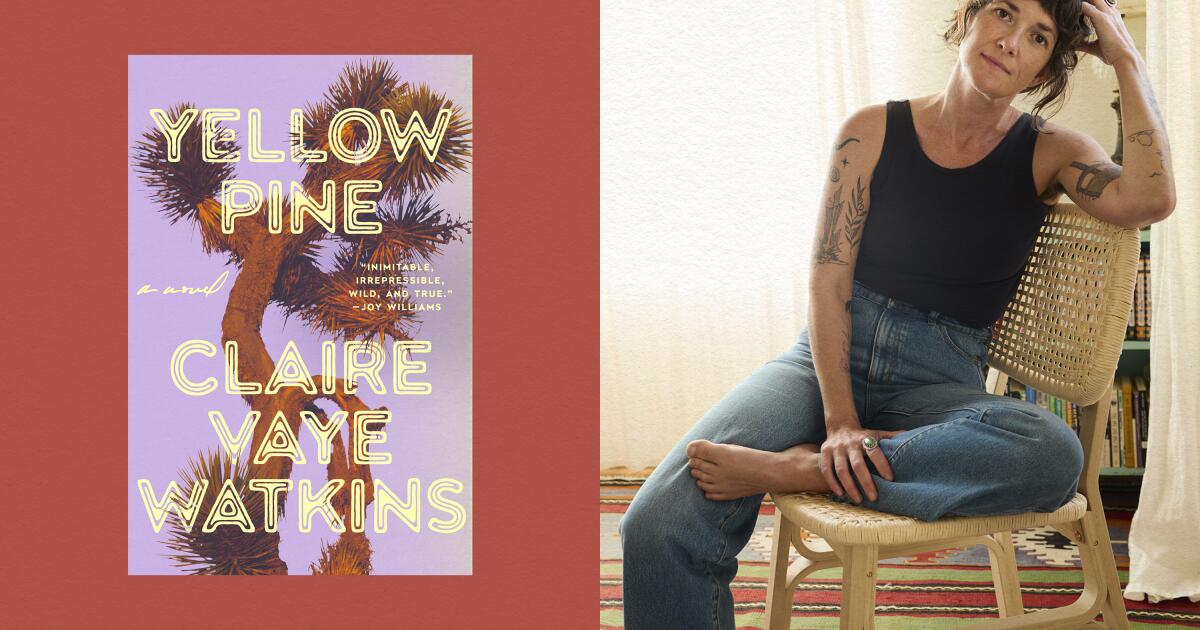
Yellow Pine
By Claire Vaye Watkins
Riverhead Books: 256 pages, $29
If you buy books linked on our site, The Times may earn a commission from Bookshop.org, whose fees support independent bookstores.
Not the characters in Claire Vaye Watkins’ new novel “Yellow Pine,” who embrace the desert in the extreme. They live at the far side of the Mojave Desert where California meets Nevada. Wherefore the pines, you ask? The book’s title is a wry joke — “Yellow Pine” is not a forest, not a tree. It’s a massive solar array slated to be built nearby in the Nevada desert. A ragtag crew of desert dwellers are hoping to stop it, or at least slow down the grinding wheels of capitalism that see the desert merely as an empty space for the taking.
Primary among them is Rose, a 30-something single mom who lives near the end of a very, very long dirt road in a cabin she calls Nothingness Flats. Rose works for an environmental nonprofit that has gone remote because it’s the pandemic; she often spirals at the state of the world. “Sometimes I think I can feel the planet just hemorrhaging under all this greed. Like it’s tectonic,” she laments.
Rampant environmental destruction notwithstanding, the novel kicks off with the joyous return of Miles, the guy who got away. He is an outdoor person, like Rose; has trouble fitting into societal norms, like Rose; and he is an ideal intellectual partner for her, bantering, well-read and ready to engage. Also, they have great sex.
Lest I portray this as a typical summer beach read, Watkins’ writing is in a special, different mode. Her latest books somehow cut past narrative traditions and portray plot and emotion more directly. Another novel might find Rose, after she decides she loves Miles so much that she wants to get pregnant, going to a doctor, getting tests, worrying about being almost 40 and what that means. Rose does none of that — she just suddenly deeply wants a baby, and that desire is vivid in the text. Overexplained storytelling is set aside for something that’s striking and vivid.
When I reached Watkins via Zoom to talk about the book, I asked her how she does it. “Partly it’s an intuition I have about what makes an interesting story,” Watkins says. “A story requires a lot of improbable decisions. Maybe they’re not great decisions, but the person doesn’t know that at the time.”
In “Yellow Pine,” Miles is not without some red flags. In my reviewer’s copy, I found myself scrawling “bad idea!” in the margin, trying to warn Rose about him. It gives the story some tension, and shows that our heroine isn’t perfect — she’s just doing her best under desert skies.
Rose lives in Tecopa, population 120, among people who’ve chosen the isolation, quietude, natural beauty and brutal conditions on purpose. Of the real-life people in these communities, Watkins says, “It’s really tough. The environment is extreme. There are no amenities. There’s no jobs. … I think there’s a refusenik quality to them.”
Nevertheless, some of them come together to try to forestall the installation of the solar array. They point out that “solar farm” is a misnomer because the land — an alluvial plane with Yucca colonies dating back hundreds of years, creosote rhizomatic rings even longer — will be scraped and fenced. What happens to the endangered desert tortoises is awful. These activists are trying every legal recourse and have set up a tiny camp at the edge of the property. Sweetly, and with little hope, they make a small community of people who understand each other and the desert landscape that others see as a blank space on the map.
“In California most of the biodiversity in the state is in the inland deserts, partly because a lot of the other ecosystems have been totally destroyed, you know? It’s a very alive place,” Watkins explains.
In “Yellow Pine,” Rose’s conviction that she should get pregnant grows to a point where she comes up with a wild scheme to make that happen. It is very funny, outsized and unexpected. It’s a small individual resistance to the impending destruction of the desert.
Watkins is very good at making a humorous turn at the end of thoughts, sentences, books. This is her fourth. Her debut, the short story collection “Battleborn” in 2012, set her on a trajectory of accolades; 2021’s “I Love You But I’ve Chosen Darkness,” was an L.A. Times book prize finalist. She is currently a professor of writing at UC Irvine.
“The thing I love about novels, writing them and reading them, is that it’s private thoughts,” Watkins says. “It’s this cool technology that we’ve come up with to deal with the fact that we don’t know what’s going on in each other’s heads and hearts and how painful that can be.”
She adds that a novelist’s job is to care about the reader. “There’s something really beautiful about, I’m going to do my very best with my part and then I give it to you, and I let it go and I trust you and I respect you,” she says. “I love the world when I’m writing and my books are like acts of love, partly because I really struggle. I’m not walking around loving my fellow man easily.”
When our Zoom began, she apologized for the noises outside — construction, dog walkers, gardeners. I couldn’t hear them at all, but I got the impression that those intrusions and distractions were weighing on her. “I feel like I have a very sensitive instrument,” she says. “I get a little agitated and the pace is really, really different.”
I had been expecting to reach her at an improbable desert outpost, like a Death Valley library with Wi-Fi, but instead reached her in Orange County. It’s for her job, and also as a part-time parent, much easier for amenities. It’s a busy town where there are lots of people, lots of businesses, lots of traffic, the hectic pace of modern life — but still, the desert has its pull. She splits her time between the two locales.
“Yellow Pine” is a testament to her beloved remote corner of the Mojave, its beauties, hardships and endangerments. The place has been an essential part of her creative process and project. “What we do for fun in Tecopa is like, watch the sky. That’s our entertainment, you know?” she says, reflecting on the long moments of silence that stretch out over the evenings. “And it’s like, ‘wow.’”

If you get out to Joshua Tree and the night is clear, look up. You’ll see not just the stars, but the entire Milky Way. It’s a reminder that the vastness is always present, beyond the city’s bright lights. And once dawn comes, the desert performs the same magic: long horizons, unfamiliar landscapes, the creeping feeling that we are small, short-lived creatures on an immense ancient planet. No wonder some people find it unsettling.
On the Shelf
Yellow Pine
By Claire Vaye Watkins
Riverhead Books: 256 pages, $29
If you buy books linked on our site, The Times may earn a commission from Bookshop.org, whose fees support independent bookstores.
Not the characters in Claire Vaye Watkins’ new novel “Yellow Pine,” who embrace the desert in the extreme. They live at the far side of the Mojave Desert where California meets Nevada. Wherefore the pines, you ask? The book’s title is a wry joke — “Yellow Pine” is not a forest, not a tree. It’s a massive solar array slated to be built nearby in the Nevada desert. A ragtag crew of desert dwellers are hoping to stop it, or at least slow down the grinding wheels of capitalism that see the desert merely as an empty space for the taking.
Primary among them is Rose, a 30-something single mom who lives near the end of a very, very long dirt road in a cabin she calls Nothingness Flats. Rose works for an environmental nonprofit that has gone remote because it’s the pandemic; she often spirals at the state of the world. “Sometimes I think I can feel the planet just hemorrhaging under all this greed. Like it’s tectonic,” she laments.
Rampant environmental destruction notwithstanding, the novel kicks off with the joyous return of Miles, the guy who got away. He is an outdoor person, like Rose; has trouble fitting into societal norms, like Rose; and he is an ideal intellectual partner for her, bantering, well-read and ready to engage. Also, they have great sex.
Lest I portray this as a typical summer beach read, Watkins’ writing is in a special, different mode. Her latest books somehow cut past narrative traditions and portray plot and emotion more directly. Another novel might find Rose, after she decides she loves Miles so much that she wants to get pregnant, going to a doctor, getting tests, worrying about being almost 40 and what that means. Rose does none of that — she just suddenly deeply wants a baby, and that desire is vivid in the text. Overexplained storytelling is set aside for something that’s striking and vivid.
When I reached Watkins via Zoom to talk about the book, I asked her how she does it. “Partly it’s an intuition I have about what makes an interesting story,” Watkins says. “A story requires a lot of improbable decisions. Maybe they’re not great decisions, but the person doesn’t know that at the time.”
In “Yellow Pine,” Miles is not without some red flags. In my reviewer’s copy, I found myself scrawling “bad idea!” in the margin, trying to warn Rose about him. It gives the story some tension, and shows that our heroine isn’t perfect — she’s just doing her best under desert skies.
Rose lives in Tecopa, population 120, among people who’ve chosen the isolation, quietude, natural beauty and brutal conditions on purpose. Of the real-life people in these communities, Watkins says, “It’s really tough. The environment is extreme. There are no amenities. There’s no jobs. … I think there’s a refusenik quality to them.”
Nevertheless, some of them come together to try to forestall the installation of the solar array. They point out that “solar farm” is a misnomer because the land — an alluvial plane with Yucca colonies dating back hundreds of years, creosote rhizomatic rings even longer — will be scraped and fenced. What happens to the endangered desert tortoises is awful. These activists are trying every legal recourse and have set up a tiny camp at the edge of the property. Sweetly, and with little hope, they make a small community of people who understand each other and the desert landscape that others see as a blank space on the map.
“In California most of the biodiversity in the state is in the inland deserts, partly because a lot of the other ecosystems have been totally destroyed, you know? It’s a very alive place,” Watkins explains.
In “Yellow Pine,” Rose’s conviction that she should get pregnant grows to a point where she comes up with a wild scheme to make that happen. It is very funny, outsized and unexpected. It’s a small individual resistance to the impending destruction of the desert.
Watkins is very good at making a humorous turn at the end of thoughts, sentences, books. This is her fourth. Her debut, the short story collection “Battleborn” in 2012, set her on a trajectory of accolades; 2021’s “I Love You But I’ve Chosen Darkness,” was an L.A. Times book prize finalist. She is currently a professor of writing at UC Irvine.
“The thing I love about novels, writing them and reading them, is that it’s private thoughts,” Watkins says. “It’s this cool technology that we’ve come up with to deal with the fact that we don’t know what’s going on in each other’s heads and hearts and how painful that can be.”
She adds that a novelist’s job is to care about the reader. “There’s something really beautiful about, I’m going to do my very best with my part and then I give it to you, and I let it go and I trust you and I respect you,” she says. “I love the world when I’m writing and my books are like acts of love, partly because I really struggle. I’m not walking around loving my fellow man easily.”
When our Zoom began, she apologized for the noises outside — construction, dog walkers, gardeners. I couldn’t hear them at all, but I got the impression that those intrusions and distractions were weighing on her. “I feel like I have a very sensitive instrument,” she says. “I get a little agitated and the pace is really, really different.”
I had been expecting to reach her at an improbable desert outpost, like a Death Valley library with Wi-Fi, but instead reached her in Orange County. It’s for her job, and also as a part-time parent, much easier for amenities. It’s a busy town where there are lots of people, lots of businesses, lots of traffic, the hectic pace of modern life — but still, the desert has its pull. She splits her time between the two locales.
“Yellow Pine” is a testament to her beloved remote corner of the Mojave, its beauties, hardships and endangerments. The place has been an essential part of her creative process and project. “What we do for fun in Tecopa is like, watch the sky. That’s our entertainment, you know?” she says, reflecting on the long moments of silence that stretch out over the evenings. “And it’s like, ‘wow.’”

If you get out to Joshua Tree and the night is clear, look up. You’ll see not just the stars, but the entire Milky Way. It’s a reminder that the vastness is always present, beyond the city’s bright lights. And once dawn comes, the desert performs the same magic: long horizons, unfamiliar landscapes, the creeping feeling that we are small, short-lived creatures on an immense ancient planet. No wonder some people find it unsettling.
On the Shelf
Yellow Pine
By Claire Vaye Watkins
Riverhead Books: 256 pages, $29
If you buy books linked on our site, The Times may earn a commission from Bookshop.org, whose fees support independent bookstores.
Not the characters in Claire Vaye Watkins’ new novel “Yellow Pine,” who embrace the desert in the extreme. They live at the far side of the Mojave Desert where California meets Nevada. Wherefore the pines, you ask? The book’s title is a wry joke — “Yellow Pine” is not a forest, not a tree. It’s a massive solar array slated to be built nearby in the Nevada desert. A ragtag crew of desert dwellers are hoping to stop it, or at least slow down the grinding wheels of capitalism that see the desert merely as an empty space for the taking.
Primary among them is Rose, a 30-something single mom who lives near the end of a very, very long dirt road in a cabin she calls Nothingness Flats. Rose works for an environmental nonprofit that has gone remote because it’s the pandemic; she often spirals at the state of the world. “Sometimes I think I can feel the planet just hemorrhaging under all this greed. Like it’s tectonic,” she laments.
Rampant environmental destruction notwithstanding, the novel kicks off with the joyous return of Miles, the guy who got away. He is an outdoor person, like Rose; has trouble fitting into societal norms, like Rose; and he is an ideal intellectual partner for her, bantering, well-read and ready to engage. Also, they have great sex.
Lest I portray this as a typical summer beach read, Watkins’ writing is in a special, different mode. Her latest books somehow cut past narrative traditions and portray plot and emotion more directly. Another novel might find Rose, after she decides she loves Miles so much that she wants to get pregnant, going to a doctor, getting tests, worrying about being almost 40 and what that means. Rose does none of that — she just suddenly deeply wants a baby, and that desire is vivid in the text. Overexplained storytelling is set aside for something that’s striking and vivid.
When I reached Watkins via Zoom to talk about the book, I asked her how she does it. “Partly it’s an intuition I have about what makes an interesting story,” Watkins says. “A story requires a lot of improbable decisions. Maybe they’re not great decisions, but the person doesn’t know that at the time.”
In “Yellow Pine,” Miles is not without some red flags. In my reviewer’s copy, I found myself scrawling “bad idea!” in the margin, trying to warn Rose about him. It gives the story some tension, and shows that our heroine isn’t perfect — she’s just doing her best under desert skies.
Rose lives in Tecopa, population 120, among people who’ve chosen the isolation, quietude, natural beauty and brutal conditions on purpose. Of the real-life people in these communities, Watkins says, “It’s really tough. The environment is extreme. There are no amenities. There’s no jobs. … I think there’s a refusenik quality to them.”
Nevertheless, some of them come together to try to forestall the installation of the solar array. They point out that “solar farm” is a misnomer because the land — an alluvial plane with Yucca colonies dating back hundreds of years, creosote rhizomatic rings even longer — will be scraped and fenced. What happens to the endangered desert tortoises is awful. These activists are trying every legal recourse and have set up a tiny camp at the edge of the property. Sweetly, and with little hope, they make a small community of people who understand each other and the desert landscape that others see as a blank space on the map.
“In California most of the biodiversity in the state is in the inland deserts, partly because a lot of the other ecosystems have been totally destroyed, you know? It’s a very alive place,” Watkins explains.
In “Yellow Pine,” Rose’s conviction that she should get pregnant grows to a point where she comes up with a wild scheme to make that happen. It is very funny, outsized and unexpected. It’s a small individual resistance to the impending destruction of the desert.
Watkins is very good at making a humorous turn at the end of thoughts, sentences, books. This is her fourth. Her debut, the short story collection “Battleborn” in 2012, set her on a trajectory of accolades; 2021’s “I Love You But I’ve Chosen Darkness,” was an L.A. Times book prize finalist. She is currently a professor of writing at UC Irvine.
“The thing I love about novels, writing them and reading them, is that it’s private thoughts,” Watkins says. “It’s this cool technology that we’ve come up with to deal with the fact that we don’t know what’s going on in each other’s heads and hearts and how painful that can be.”
She adds that a novelist’s job is to care about the reader. “There’s something really beautiful about, I’m going to do my very best with my part and then I give it to you, and I let it go and I trust you and I respect you,” she says. “I love the world when I’m writing and my books are like acts of love, partly because I really struggle. I’m not walking around loving my fellow man easily.”
When our Zoom began, she apologized for the noises outside — construction, dog walkers, gardeners. I couldn’t hear them at all, but I got the impression that those intrusions and distractions were weighing on her. “I feel like I have a very sensitive instrument,” she says. “I get a little agitated and the pace is really, really different.”
I had been expecting to reach her at an improbable desert outpost, like a Death Valley library with Wi-Fi, but instead reached her in Orange County. It’s for her job, and also as a part-time parent, much easier for amenities. It’s a busy town where there are lots of people, lots of businesses, lots of traffic, the hectic pace of modern life — but still, the desert has its pull. She splits her time between the two locales.
“Yellow Pine” is a testament to her beloved remote corner of the Mojave, its beauties, hardships and endangerments. The place has been an essential part of her creative process and project. “What we do for fun in Tecopa is like, watch the sky. That’s our entertainment, you know?” she says, reflecting on the long moments of silence that stretch out over the evenings. “And it’s like, ‘wow.’”
If you get out to Joshua Tree and the night is clear, look up. You’ll see not just the stars, but the entire Milky Way. It’s a reminder that the vastness is always present, beyond the city’s bright lights. And once dawn comes, the desert performs the same magic: long horizons, unfamiliar landscapes, the creeping feeling that we are small, short-lived creatures on an immense ancient planet. No wonder some people find it unsettling.
On the Shelf
Yellow Pine
By Claire Vaye Watkins
Riverhead Books: 256 pages, $29
If you buy books linked on our site, The Times may earn a commission from Bookshop.org, whose fees support independent bookstores.
Not the characters in Claire Vaye Watkins’ new novel “Yellow Pine,” who embrace the desert in the extreme. They live at the far side of the Mojave Desert where California meets Nevada. Wherefore the pines, you ask? The book’s title is a wry joke — “Yellow Pine” is not a forest, not a tree. It’s a massive solar array slated to be built nearby in the Nevada desert. A ragtag crew of desert dwellers are hoping to stop it, or at least slow down the grinding wheels of capitalism that see the desert merely as an empty space for the taking.
Primary among them is Rose, a 30-something single mom who lives near the end of a very, very long dirt road in a cabin she calls Nothingness Flats. Rose works for an environmental nonprofit that has gone remote because it’s the pandemic; she often spirals at the state of the world. “Sometimes I think I can feel the planet just hemorrhaging under all this greed. Like it’s tectonic,” she laments.
Rampant environmental destruction notwithstanding, the novel kicks off with the joyous return of Miles, the guy who got away. He is an outdoor person, like Rose; has trouble fitting into societal norms, like Rose; and he is an ideal intellectual partner for her, bantering, well-read and ready to engage. Also, they have great sex.
Lest I portray this as a typical summer beach read, Watkins’ writing is in a special, different mode. Her latest books somehow cut past narrative traditions and portray plot and emotion more directly. Another novel might find Rose, after she decides she loves Miles so much that she wants to get pregnant, going to a doctor, getting tests, worrying about being almost 40 and what that means. Rose does none of that — she just suddenly deeply wants a baby, and that desire is vivid in the text. Overexplained storytelling is set aside for something that’s striking and vivid.
When I reached Watkins via Zoom to talk about the book, I asked her how she does it. “Partly it’s an intuition I have about what makes an interesting story,” Watkins says. “A story requires a lot of improbable decisions. Maybe they’re not great decisions, but the person doesn’t know that at the time.”
In “Yellow Pine,” Miles is not without some red flags. In my reviewer’s copy, I found myself scrawling “bad idea!” in the margin, trying to warn Rose about him. It gives the story some tension, and shows that our heroine isn’t perfect — she’s just doing her best under desert skies.
Rose lives in Tecopa, population 120, among people who’ve chosen the isolation, quietude, natural beauty and brutal conditions on purpose. Of the real-life people in these communities, Watkins says, “It’s really tough. The environment is extreme. There are no amenities. There’s no jobs. … I think there’s a refusenik quality to them.”
Nevertheless, some of them come together to try to forestall the installation of the solar array. They point out that “solar farm” is a misnomer because the land — an alluvial plane with Yucca colonies dating back hundreds of years, creosote rhizomatic rings even longer — will be scraped and fenced. What happens to the endangered desert tortoises is awful. These activists are trying every legal recourse and have set up a tiny camp at the edge of the property. Sweetly, and with little hope, they make a small community of people who understand each other and the desert landscape that others see as a blank space on the map.
“In California most of the biodiversity in the state is in the inland deserts, partly because a lot of the other ecosystems have been totally destroyed, you know? It’s a very alive place,” Watkins explains.
In “Yellow Pine,” Rose’s conviction that she should get pregnant grows to a point where she comes up with a wild scheme to make that happen. It is very funny, outsized and unexpected. It’s a small individual resistance to the impending destruction of the desert.
Watkins is very good at making a humorous turn at the end of thoughts, sentences, books. This is her fourth. Her debut, the short story collection “Battleborn” in 2012, set her on a trajectory of accolades; 2021’s “I Love You But I’ve Chosen Darkness,” was an L.A. Times book prize finalist. She is currently a professor of writing at UC Irvine.
“The thing I love about novels, writing them and reading them, is that it’s private thoughts,” Watkins says. “It’s this cool technology that we’ve come up with to deal with the fact that we don’t know what’s going on in each other’s heads and hearts and how painful that can be.”
She adds that a novelist’s job is to care about the reader. “There’s something really beautiful about, I’m going to do my very best with my part and then I give it to you, and I let it go and I trust you and I respect you,” she says. “I love the world when I’m writing and my books are like acts of love, partly because I really struggle. I’m not walking around loving my fellow man easily.”
When our Zoom began, she apologized for the noises outside — construction, dog walkers, gardeners. I couldn’t hear them at all, but I got the impression that those intrusions and distractions were weighing on her. “I feel like I have a very sensitive instrument,” she says. “I get a little agitated and the pace is really, really different.”
I had been expecting to reach her at an improbable desert outpost, like a Death Valley library with Wi-Fi, but instead reached her in Orange County. It’s for her job, and also as a part-time parent, much easier for amenities. It’s a busy town where there are lots of people, lots of businesses, lots of traffic, the hectic pace of modern life — but still, the desert has its pull. She splits her time between the two locales.
“Yellow Pine” is a testament to her beloved remote corner of the Mojave, its beauties, hardships and endangerments. The place has been an essential part of her creative process and project. “What we do for fun in Tecopa is like, watch the sky. That’s our entertainment, you know?” she says, reflecting on the long moments of silence that stretch out over the evenings. “And it’s like, ‘wow.’”

If you get out to Joshua Tree and the night is clear, look up. You’ll see not just the stars, but the entire Milky Way. It’s a reminder that the vastness is always present, beyond the city’s bright lights. And once dawn comes, the desert performs the same magic: long horizons, unfamiliar landscapes, the creeping feeling that we are small, short-lived creatures on an immense ancient planet. No wonder some people find it unsettling.
On the Shelf
Yellow Pine
By Claire Vaye Watkins
Riverhead Books: 256 pages, $29
If you buy books linked on our site, The Times may earn a commission from Bookshop.org, whose fees support independent bookstores.
Not the characters in Claire Vaye Watkins’ new novel “Yellow Pine,” who embrace the desert in the extreme. They live at the far side of the Mojave Desert where California meets Nevada. Wherefore the pines, you ask? The book’s title is a wry joke — “Yellow Pine” is not a forest, not a tree. It’s a massive solar array slated to be built nearby in the Nevada desert. A ragtag crew of desert dwellers are hoping to stop it, or at least slow down the grinding wheels of capitalism that see the desert merely as an empty space for the taking.
Primary among them is Rose, a 30-something single mom who lives near the end of a very, very long dirt road in a cabin she calls Nothingness Flats. Rose works for an environmental nonprofit that has gone remote because it’s the pandemic; she often spirals at the state of the world. “Sometimes I think I can feel the planet just hemorrhaging under all this greed. Like it’s tectonic,” she laments.
Rampant environmental destruction notwithstanding, the novel kicks off with the joyous return of Miles, the guy who got away. He is an outdoor person, like Rose; has trouble fitting into societal norms, like Rose; and he is an ideal intellectual partner for her, bantering, well-read and ready to engage. Also, they have great sex.
Lest I portray this as a typical summer beach read, Watkins’ writing is in a special, different mode. Her latest books somehow cut past narrative traditions and portray plot and emotion more directly. Another novel might find Rose, after she decides she loves Miles so much that she wants to get pregnant, going to a doctor, getting tests, worrying about being almost 40 and what that means. Rose does none of that — she just suddenly deeply wants a baby, and that desire is vivid in the text. Overexplained storytelling is set aside for something that’s striking and vivid.
When I reached Watkins via Zoom to talk about the book, I asked her how she does it. “Partly it’s an intuition I have about what makes an interesting story,” Watkins says. “A story requires a lot of improbable decisions. Maybe they’re not great decisions, but the person doesn’t know that at the time.”
In “Yellow Pine,” Miles is not without some red flags. In my reviewer’s copy, I found myself scrawling “bad idea!” in the margin, trying to warn Rose about him. It gives the story some tension, and shows that our heroine isn’t perfect — she’s just doing her best under desert skies.
Rose lives in Tecopa, population 120, among people who’ve chosen the isolation, quietude, natural beauty and brutal conditions on purpose. Of the real-life people in these communities, Watkins says, “It’s really tough. The environment is extreme. There are no amenities. There’s no jobs. … I think there’s a refusenik quality to them.”
Nevertheless, some of them come together to try to forestall the installation of the solar array. They point out that “solar farm” is a misnomer because the land — an alluvial plane with Yucca colonies dating back hundreds of years, creosote rhizomatic rings even longer — will be scraped and fenced. What happens to the endangered desert tortoises is awful. These activists are trying every legal recourse and have set up a tiny camp at the edge of the property. Sweetly, and with little hope, they make a small community of people who understand each other and the desert landscape that others see as a blank space on the map.
“In California most of the biodiversity in the state is in the inland deserts, partly because a lot of the other ecosystems have been totally destroyed, you know? It’s a very alive place,” Watkins explains.
In “Yellow Pine,” Rose’s conviction that she should get pregnant grows to a point where she comes up with a wild scheme to make that happen. It is very funny, outsized and unexpected. It’s a small individual resistance to the impending destruction of the desert.
Watkins is very good at making a humorous turn at the end of thoughts, sentences, books. This is her fourth. Her debut, the short story collection “Battleborn” in 2012, set her on a trajectory of accolades; 2021’s “I Love You But I’ve Chosen Darkness,” was an L.A. Times book prize finalist. She is currently a professor of writing at UC Irvine.
“The thing I love about novels, writing them and reading them, is that it’s private thoughts,” Watkins says. “It’s this cool technology that we’ve come up with to deal with the fact that we don’t know what’s going on in each other’s heads and hearts and how painful that can be.”
She adds that a novelist’s job is to care about the reader. “There’s something really beautiful about, I’m going to do my very best with my part and then I give it to you, and I let it go and I trust you and I respect you,” she says. “I love the world when I’m writing and my books are like acts of love, partly because I really struggle. I’m not walking around loving my fellow man easily.”
When our Zoom began, she apologized for the noises outside — construction, dog walkers, gardeners. I couldn’t hear them at all, but I got the impression that those intrusions and distractions were weighing on her. “I feel like I have a very sensitive instrument,” she says. “I get a little agitated and the pace is really, really different.”
I had been expecting to reach her at an improbable desert outpost, like a Death Valley library with Wi-Fi, but instead reached her in Orange County. It’s for her job, and also as a part-time parent, much easier for amenities. It’s a busy town where there are lots of people, lots of businesses, lots of traffic, the hectic pace of modern life — but still, the desert has its pull. She splits her time between the two locales.
“Yellow Pine” is a testament to her beloved remote corner of the Mojave, its beauties, hardships and endangerments. The place has been an essential part of her creative process and project. “What we do for fun in Tecopa is like, watch the sky. That’s our entertainment, you know?” she says, reflecting on the long moments of silence that stretch out over the evenings. “And it’s like, ‘wow.’”
If you get out to Joshua Tree and the night is clear, look up. You’ll see not just the stars, but the entire Milky Way. It’s a reminder that the vastness is always present, beyond the city’s bright lights. And once dawn comes, the desert performs the same magic: long horizons, unfamiliar landscapes, the creeping feeling that we are small, short-lived creatures on an immense ancient planet. No wonder some people find it unsettling.
On the Shelf
Yellow Pine
By Claire Vaye Watkins
Riverhead Books: 256 pages, $29
If you buy books linked on our site, The Times may earn a commission from Bookshop.org, whose fees support independent bookstores.
Not the characters in Claire Vaye Watkins’ new novel “Yellow Pine,” who embrace the desert in the extreme. They live at the far side of the Mojave Desert where California meets Nevada. Wherefore the pines, you ask? The book’s title is a wry joke — “Yellow Pine” is not a forest, not a tree. It’s a massive solar array slated to be built nearby in the Nevada desert. A ragtag crew of desert dwellers are hoping to stop it, or at least slow down the grinding wheels of capitalism that see the desert merely as an empty space for the taking.
Primary among them is Rose, a 30-something single mom who lives near the end of a very, very long dirt road in a cabin she calls Nothingness Flats. Rose works for an environmental nonprofit that has gone remote because it’s the pandemic; she often spirals at the state of the world. “Sometimes I think I can feel the planet just hemorrhaging under all this greed. Like it’s tectonic,” she laments.
Rampant environmental destruction notwithstanding, the novel kicks off with the joyous return of Miles, the guy who got away. He is an outdoor person, like Rose; has trouble fitting into societal norms, like Rose; and he is an ideal intellectual partner for her, bantering, well-read and ready to engage. Also, they have great sex.
Lest I portray this as a typical summer beach read, Watkins’ writing is in a special, different mode. Her latest books somehow cut past narrative traditions and portray plot and emotion more directly. Another novel might find Rose, after she decides she loves Miles so much that she wants to get pregnant, going to a doctor, getting tests, worrying about being almost 40 and what that means. Rose does none of that — she just suddenly deeply wants a baby, and that desire is vivid in the text. Overexplained storytelling is set aside for something that’s striking and vivid.
When I reached Watkins via Zoom to talk about the book, I asked her how she does it. “Partly it’s an intuition I have about what makes an interesting story,” Watkins says. “A story requires a lot of improbable decisions. Maybe they’re not great decisions, but the person doesn’t know that at the time.”
In “Yellow Pine,” Miles is not without some red flags. In my reviewer’s copy, I found myself scrawling “bad idea!” in the margin, trying to warn Rose about him. It gives the story some tension, and shows that our heroine isn’t perfect — she’s just doing her best under desert skies.
Rose lives in Tecopa, population 120, among people who’ve chosen the isolation, quietude, natural beauty and brutal conditions on purpose. Of the real-life people in these communities, Watkins says, “It’s really tough. The environment is extreme. There are no amenities. There’s no jobs. … I think there’s a refusenik quality to them.”
Nevertheless, some of them come together to try to forestall the installation of the solar array. They point out that “solar farm” is a misnomer because the land — an alluvial plane with Yucca colonies dating back hundreds of years, creosote rhizomatic rings even longer — will be scraped and fenced. What happens to the endangered desert tortoises is awful. These activists are trying every legal recourse and have set up a tiny camp at the edge of the property. Sweetly, and with little hope, they make a small community of people who understand each other and the desert landscape that others see as a blank space on the map.
“In California most of the biodiversity in the state is in the inland deserts, partly because a lot of the other ecosystems have been totally destroyed, you know? It’s a very alive place,” Watkins explains.
In “Yellow Pine,” Rose’s conviction that she should get pregnant grows to a point where she comes up with a wild scheme to make that happen. It is very funny, outsized and unexpected. It’s a small individual resistance to the impending destruction of the desert.
Watkins is very good at making a humorous turn at the end of thoughts, sentences, books. This is her fourth. Her debut, the short story collection “Battleborn” in 2012, set her on a trajectory of accolades; 2021’s “I Love You But I’ve Chosen Darkness,” was an L.A. Times book prize finalist. She is currently a professor of writing at UC Irvine.
“The thing I love about novels, writing them and reading them, is that it’s private thoughts,” Watkins says. “It’s this cool technology that we’ve come up with to deal with the fact that we don’t know what’s going on in each other’s heads and hearts and how painful that can be.”
She adds that a novelist’s job is to care about the reader. “There’s something really beautiful about, I’m going to do my very best with my part and then I give it to you, and I let it go and I trust you and I respect you,” she says. “I love the world when I’m writing and my books are like acts of love, partly because I really struggle. I’m not walking around loving my fellow man easily.”
When our Zoom began, she apologized for the noises outside — construction, dog walkers, gardeners. I couldn’t hear them at all, but I got the impression that those intrusions and distractions were weighing on her. “I feel like I have a very sensitive instrument,” she says. “I get a little agitated and the pace is really, really different.”
I had been expecting to reach her at an improbable desert outpost, like a Death Valley library with Wi-Fi, but instead reached her in Orange County. It’s for her job, and also as a part-time parent, much easier for amenities. It’s a busy town where there are lots of people, lots of businesses, lots of traffic, the hectic pace of modern life — but still, the desert has its pull. She splits her time between the two locales.
“Yellow Pine” is a testament to her beloved remote corner of the Mojave, its beauties, hardships and endangerments. The place has been an essential part of her creative process and project. “What we do for fun in Tecopa is like, watch the sky. That’s our entertainment, you know?” she says, reflecting on the long moments of silence that stretch out over the evenings. “And it’s like, ‘wow.’”
If you get out to Joshua Tree and the night is clear, look up. You’ll see not just the stars, but the entire Milky Way. It’s a reminder that the vastness is always present, beyond the city’s bright lights. And once dawn comes, the desert performs the same magic: long horizons, unfamiliar landscapes, the creeping feeling that we are small, short-lived creatures on an immense ancient planet. No wonder some people find it unsettling.
On the Shelf
Yellow Pine
By Claire Vaye Watkins
Riverhead Books: 256 pages, $29
If you buy books linked on our site, The Times may earn a commission from Bookshop.org, whose fees support independent bookstores.
Not the characters in Claire Vaye Watkins’ new novel “Yellow Pine,” who embrace the desert in the extreme. They live at the far side of the Mojave Desert where California meets Nevada. Wherefore the pines, you ask? The book’s title is a wry joke — “Yellow Pine” is not a forest, not a tree. It’s a massive solar array slated to be built nearby in the Nevada desert. A ragtag crew of desert dwellers are hoping to stop it, or at least slow down the grinding wheels of capitalism that see the desert merely as an empty space for the taking.
Primary among them is Rose, a 30-something single mom who lives near the end of a very, very long dirt road in a cabin she calls Nothingness Flats. Rose works for an environmental nonprofit that has gone remote because it’s the pandemic; she often spirals at the state of the world. “Sometimes I think I can feel the planet just hemorrhaging under all this greed. Like it’s tectonic,” she laments.
Rampant environmental destruction notwithstanding, the novel kicks off with the joyous return of Miles, the guy who got away. He is an outdoor person, like Rose; has trouble fitting into societal norms, like Rose; and he is an ideal intellectual partner for her, bantering, well-read and ready to engage. Also, they have great sex.
Lest I portray this as a typical summer beach read, Watkins’ writing is in a special, different mode. Her latest books somehow cut past narrative traditions and portray plot and emotion more directly. Another novel might find Rose, after she decides she loves Miles so much that she wants to get pregnant, going to a doctor, getting tests, worrying about being almost 40 and what that means. Rose does none of that — she just suddenly deeply wants a baby, and that desire is vivid in the text. Overexplained storytelling is set aside for something that’s striking and vivid.
When I reached Watkins via Zoom to talk about the book, I asked her how she does it. “Partly it’s an intuition I have about what makes an interesting story,” Watkins says. “A story requires a lot of improbable decisions. Maybe they’re not great decisions, but the person doesn’t know that at the time.”
In “Yellow Pine,” Miles is not without some red flags. In my reviewer’s copy, I found myself scrawling “bad idea!” in the margin, trying to warn Rose about him. It gives the story some tension, and shows that our heroine isn’t perfect — she’s just doing her best under desert skies.
Rose lives in Tecopa, population 120, among people who’ve chosen the isolation, quietude, natural beauty and brutal conditions on purpose. Of the real-life people in these communities, Watkins says, “It’s really tough. The environment is extreme. There are no amenities. There’s no jobs. … I think there’s a refusenik quality to them.”
Nevertheless, some of them come together to try to forestall the installation of the solar array. They point out that “solar farm” is a misnomer because the land — an alluvial plane with Yucca colonies dating back hundreds of years, creosote rhizomatic rings even longer — will be scraped and fenced. What happens to the endangered desert tortoises is awful. These activists are trying every legal recourse and have set up a tiny camp at the edge of the property. Sweetly, and with little hope, they make a small community of people who understand each other and the desert landscape that others see as a blank space on the map.
“In California most of the biodiversity in the state is in the inland deserts, partly because a lot of the other ecosystems have been totally destroyed, you know? It’s a very alive place,” Watkins explains.
In “Yellow Pine,” Rose’s conviction that she should get pregnant grows to a point where she comes up with a wild scheme to make that happen. It is very funny, outsized and unexpected. It’s a small individual resistance to the impending destruction of the desert.
Watkins is very good at making a humorous turn at the end of thoughts, sentences, books. This is her fourth. Her debut, the short story collection “Battleborn” in 2012, set her on a trajectory of accolades; 2021’s “I Love You But I’ve Chosen Darkness,” was an L.A. Times book prize finalist. She is currently a professor of writing at UC Irvine.
“The thing I love about novels, writing them and reading them, is that it’s private thoughts,” Watkins says. “It’s this cool technology that we’ve come up with to deal with the fact that we don’t know what’s going on in each other’s heads and hearts and how painful that can be.”
She adds that a novelist’s job is to care about the reader. “There’s something really beautiful about, I’m going to do my very best with my part and then I give it to you, and I let it go and I trust you and I respect you,” she says. “I love the world when I’m writing and my books are like acts of love, partly because I really struggle. I’m not walking around loving my fellow man easily.”
When our Zoom began, she apologized for the noises outside — construction, dog walkers, gardeners. I couldn’t hear them at all, but I got the impression that those intrusions and distractions were weighing on her. “I feel like I have a very sensitive instrument,” she says. “I get a little agitated and the pace is really, really different.”
I had been expecting to reach her at an improbable desert outpost, like a Death Valley library with Wi-Fi, but instead reached her in Orange County. It’s for her job, and also as a part-time parent, much easier for amenities. It’s a busy town where there are lots of people, lots of businesses, lots of traffic, the hectic pace of modern life — but still, the desert has its pull. She splits her time between the two locales.
“Yellow Pine” is a testament to her beloved remote corner of the Mojave, its beauties, hardships and endangerments. The place has been an essential part of her creative process and project. “What we do for fun in Tecopa is like, watch the sky. That’s our entertainment, you know?” she says, reflecting on the long moments of silence that stretch out over the evenings. “And it’s like, ‘wow.’”
If you get out to Joshua Tree and the night is clear, look up. You’ll see not just the stars, but the entire Milky Way. It’s a reminder that the vastness is always present, beyond the city’s bright lights. And once dawn comes, the desert performs the same magic: long horizons, unfamiliar landscapes, the creeping feeling that we are small, short-lived creatures on an immense ancient planet. No wonder some people find it unsettling.
On the Shelf
Yellow Pine
By Claire Vaye Watkins
Riverhead Books: 256 pages, $29
If you buy books linked on our site, The Times may earn a commission from Bookshop.org, whose fees support independent bookstores.
Not the characters in Claire Vaye Watkins’ new novel “Yellow Pine,” who embrace the desert in the extreme. They live at the far side of the Mojave Desert where California meets Nevada. Wherefore the pines, you ask? The book’s title is a wry joke — “Yellow Pine” is not a forest, not a tree. It’s a massive solar array slated to be built nearby in the Nevada desert. A ragtag crew of desert dwellers are hoping to stop it, or at least slow down the grinding wheels of capitalism that see the desert merely as an empty space for the taking.
Primary among them is Rose, a 30-something single mom who lives near the end of a very, very long dirt road in a cabin she calls Nothingness Flats. Rose works for an environmental nonprofit that has gone remote because it’s the pandemic; she often spirals at the state of the world. “Sometimes I think I can feel the planet just hemorrhaging under all this greed. Like it’s tectonic,” she laments.
Rampant environmental destruction notwithstanding, the novel kicks off with the joyous return of Miles, the guy who got away. He is an outdoor person, like Rose; has trouble fitting into societal norms, like Rose; and he is an ideal intellectual partner for her, bantering, well-read and ready to engage. Also, they have great sex.
Lest I portray this as a typical summer beach read, Watkins’ writing is in a special, different mode. Her latest books somehow cut past narrative traditions and portray plot and emotion more directly. Another novel might find Rose, after she decides she loves Miles so much that she wants to get pregnant, going to a doctor, getting tests, worrying about being almost 40 and what that means. Rose does none of that — she just suddenly deeply wants a baby, and that desire is vivid in the text. Overexplained storytelling is set aside for something that’s striking and vivid.
When I reached Watkins via Zoom to talk about the book, I asked her how she does it. “Partly it’s an intuition I have about what makes an interesting story,” Watkins says. “A story requires a lot of improbable decisions. Maybe they’re not great decisions, but the person doesn’t know that at the time.”
In “Yellow Pine,” Miles is not without some red flags. In my reviewer’s copy, I found myself scrawling “bad idea!” in the margin, trying to warn Rose about him. It gives the story some tension, and shows that our heroine isn’t perfect — she’s just doing her best under desert skies.
Rose lives in Tecopa, population 120, among people who’ve chosen the isolation, quietude, natural beauty and brutal conditions on purpose. Of the real-life people in these communities, Watkins says, “It’s really tough. The environment is extreme. There are no amenities. There’s no jobs. … I think there’s a refusenik quality to them.”
Nevertheless, some of them come together to try to forestall the installation of the solar array. They point out that “solar farm” is a misnomer because the land — an alluvial plane with Yucca colonies dating back hundreds of years, creosote rhizomatic rings even longer — will be scraped and fenced. What happens to the endangered desert tortoises is awful. These activists are trying every legal recourse and have set up a tiny camp at the edge of the property. Sweetly, and with little hope, they make a small community of people who understand each other and the desert landscape that others see as a blank space on the map.
“In California most of the biodiversity in the state is in the inland deserts, partly because a lot of the other ecosystems have been totally destroyed, you know? It’s a very alive place,” Watkins explains.
In “Yellow Pine,” Rose’s conviction that she should get pregnant grows to a point where she comes up with a wild scheme to make that happen. It is very funny, outsized and unexpected. It’s a small individual resistance to the impending destruction of the desert.
Watkins is very good at making a humorous turn at the end of thoughts, sentences, books. This is her fourth. Her debut, the short story collection “Battleborn” in 2012, set her on a trajectory of accolades; 2021’s “I Love You But I’ve Chosen Darkness,” was an L.A. Times book prize finalist. She is currently a professor of writing at UC Irvine.
“The thing I love about novels, writing them and reading them, is that it’s private thoughts,” Watkins says. “It’s this cool technology that we’ve come up with to deal with the fact that we don’t know what’s going on in each other’s heads and hearts and how painful that can be.”
She adds that a novelist’s job is to care about the reader. “There’s something really beautiful about, I’m going to do my very best with my part and then I give it to you, and I let it go and I trust you and I respect you,” she says. “I love the world when I’m writing and my books are like acts of love, partly because I really struggle. I’m not walking around loving my fellow man easily.”
When our Zoom began, she apologized for the noises outside — construction, dog walkers, gardeners. I couldn’t hear them at all, but I got the impression that those intrusions and distractions were weighing on her. “I feel like I have a very sensitive instrument,” she says. “I get a little agitated and the pace is really, really different.”
I had been expecting to reach her at an improbable desert outpost, like a Death Valley library with Wi-Fi, but instead reached her in Orange County. It’s for her job, and also as a part-time parent, much easier for amenities. It’s a busy town where there are lots of people, lots of businesses, lots of traffic, the hectic pace of modern life — but still, the desert has its pull. She splits her time between the two locales.
“Yellow Pine” is a testament to her beloved remote corner of the Mojave, its beauties, hardships and endangerments. The place has been an essential part of her creative process and project. “What we do for fun in Tecopa is like, watch the sky. That’s our entertainment, you know?” she says, reflecting on the long moments of silence that stretch out over the evenings. “And it’s like, ‘wow.’”

