

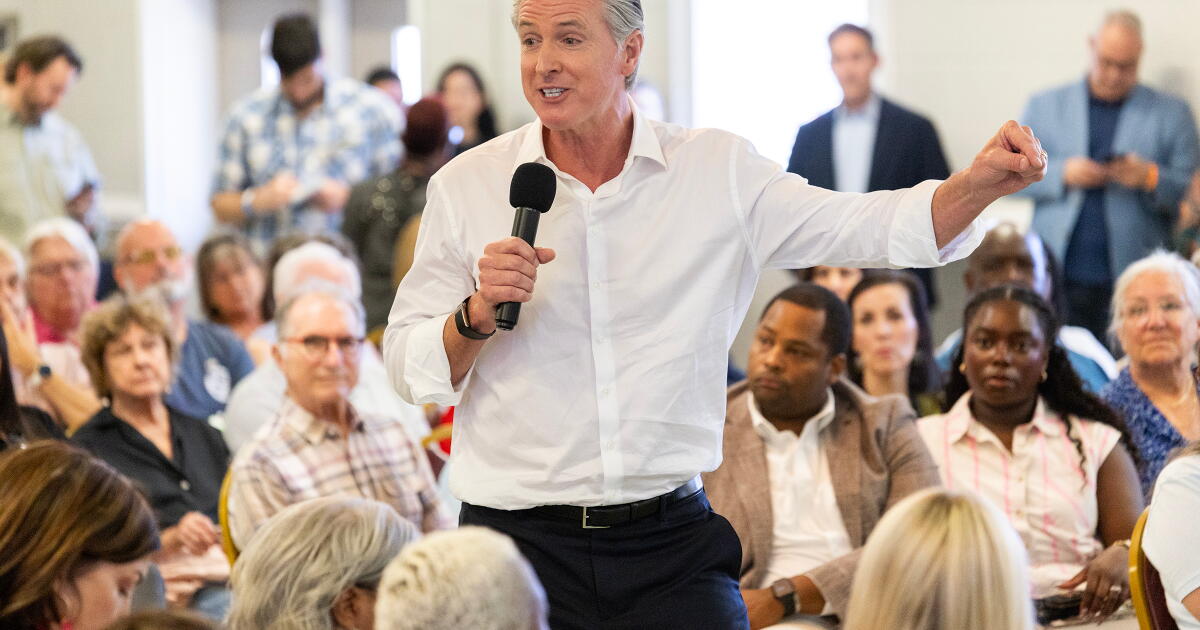

With not-terrible odds heading into the 2028 Democratic primaries, Gov. Gavin Newsom is getting one shared warning whispered in his ear by roughly 3,729 political consultants right now: Do not mess with the murderers.
Do not, under any circumstance, follow that inner voice that may be telling you to commute the death sentences of the 563 killers on California’s death row to life without parole, as Newsom recently admitted he was considering. Doing so would be a stupid move for an Oval Office wannabe, one already hobbled by the progressive persona of the Golden State.
“I’m getting all those people in my ear,” Newsom said during a podcast conversation with Bryan Stevenson, one of the preeminent death penalty lawyers in the country. “Don’t do it. Politics.”
Newsom already dismantled San Quentin’s execution chamber a few years ago, so the state can’t kill people even if it wanted to. But the governor has made it clear that he opposes the death penalty in principle because every year the evidence mounts that its implementation is flawed and racially biased. As he put it, the decision on commuting the largest death row in the Western Hemisphere may be his “rocking chair test,” a measure of whether he will have lived up to his own ideals when he looks back on his life.
Most other western countries have already banned the death penalty, leaving the U.S. in the company of places including North Korea and Libya when it comes to this punishment. Twenty-three states have abolished it, and three besides California have a moratorium. Nine governors over the years have commuted their entire death row, including one Republican. In 2024, on his way out of office, President Biden commuted the death sentences of 37 federal prisoners, in part, Stevenson said, to prevent the Trump administration from using executions as theater.
But none of that is why Newsom should do it.
He should do it because we, the voters, are exhausted by the venality of politicians whose every move is controlled by politics and self-dealing. We need to believe that conscience is not a relic of America’s past, and roll reality back to a time when, occasionally, leaders acted because they believed in something, even if it wasn’t popular.
He should do it because our president glorifies violence and death (more on that in a moment) and people need a reminder that the America of hope and dreams, the America that always strives to be better, may be down, but she’s not out.
He should do it simply because he thinks it’s right.
“A lot of people in this country want a leader who is not trying to promote themselves, who’s not trying to advance themselves, is not always scheming for the angles and the corners,” Stevenson told me. “That’s not trying to just do what makes them get the most votes.”
Showing mercy to murderers historically has not been popular with voters. The tale of Willie Horton, the convicted murderer whose subsequent felonies tanked the 1988 presidential ambitions of then-Massachusetts Gov. Michael Dukakis, is still invoked like a Biblical lesson about the sin of soft-on-crime.
Horton’s warning happened during what now seems like the benign and civilized days of the President George H.W. Bush era, though. This moment is different, and all the advice about dodging this dodgy issue is now wrong.
America is increasingly in the death business, to steal a phrase from the late Supreme Court Justice Harry Blackmun — or at least our leaders are. Under the Trump administration, brutality, cruelty, corruption and even killings are being used as misguided and ugly proxies for strength and power. Fear is a weapon, death the point — the state can kill you if you make its leaders mad.
“It’s a handful of people whose view of the social order is very violent. It uses power. It abuses power. They think death is good for demonstrating strength,” Stevenson said.
Think that sounds overblown?
Just ask the family of Renee Good. Or Alex Pretti. Both Americans were killed by masked federal officers only 10 months ago. But so many other deaths have happened since then, they’re just ghosts in our collective psyche — haunting reminders that faceless, nameless agents are now empowered to roam our streets.
Most of us can no longer place the name Nurul Amin Shah Alam, the near-blind Rohingya refugee dumped by federal agents in the freezing cold on a February night. He was found dead five days later, his passing ruled a homicide.
Do you remember Lorenzo Salgado Araujo? Or Johan Sebastián Duran Guerrero? That’s what the business of death does, normalizes killings until they blend and fade in significance.
What about the 120 Iranian children, many of them little girls, who were killed when the U.S. bombed their school?
Then there are the roughly 238 people who have been executed by U.S. bombings of boats in the Caribbean and Pacific, allegedly while transporting drugs, though the killings took place with no arrests, no trials and no real evidence. Four of those killings happened in October, though they barely made news.
And there is the profiteering from death — the talk of resorts on the shores of Gaza, the government money saved by Elon Musk cutting off aid to starving children.
Now, if Defense Secretary Pete Hegseth has his way, a year that began with televised footage of the death of Good and Pretti will end with the live-streamed execution of Nidal Hasan, the paralyzed, wheelchair-using former Army psychiatrist who 17 years ago killed 13 and wounded 32 at Fort Hood in Texas. If the grotesque spectacle happens, it will be a throwback to the days of the Roman Colosseum when the business of state-sponsored death was at an apex, combining public violence with propaganda, politics and social control.
Stevenson warns that “we’re in the midst of a narrative struggle, and this struggle is for the soul of America.”
Newsom has the chance to, if not change that narrative, offer an alternative one — an America that rejects killing as the ultimate display of power. An America that seeks justice with dignity and wisdom, not arrogance and gore. An America that feels safe because our leaders act with integrity and honor, not with a slavish, intemperate ego.
Though there is a political risk inherent in striking out in a solitary direction, there can also be reward. As Stevenson told Newsom, that’s the “beauty of struggling for things that are right, struggling for things that are moral, struggling for things that are just — all kinds of people will come along, and when you feel like you just can’t take another step, there’ll be something there. There’ll be somebody there.”
My mercy isn’t for those on our death row, many of whom are guilty of gut-churning crimes. I’m not arguing that they are victims themselves, or even that some may have been unfairly tried, or even innocent, though that may be true. I acknowledge some families of victims may be angry if Newsom commutes sentences, though some will not.
My mercy is reserved for America, and those who are exhausted by the business of death, this business Trump wants us to believe is just American business — necessary and unavoidable.
A commutation of California’s death row sentences would be a rejection of Trump’s manic desire to pull us ever lower; a rejection of our growing cynicism that there is no such thing — Republican or Democrat — as a leader who acts from conscience. An assurance, instead, that it is still possible to heed an internal moral compass that is more powerful than the need for power.
Would voters really reject the leader who offered that?
Would you?

With not-terrible odds heading into the 2028 Democratic primaries, Gov. Gavin Newsom is getting one shared warning whispered in his ear by roughly 3,729 political consultants right now: Do not mess with the murderers.
Do not, under any circumstance, follow that inner voice that may be telling you to commute the death sentences of the 563 killers on California’s death row to life without parole, as Newsom recently admitted he was considering. Doing so would be a stupid move for an Oval Office wannabe, one already hobbled by the progressive persona of the Golden State.
“I’m getting all those people in my ear,” Newsom said during a podcast conversation with Bryan Stevenson, one of the preeminent death penalty lawyers in the country. “Don’t do it. Politics.”
Newsom already dismantled San Quentin’s execution chamber a few years ago, so the state can’t kill people even if it wanted to. But the governor has made it clear that he opposes the death penalty in principle because every year the evidence mounts that its implementation is flawed and racially biased. As he put it, the decision on commuting the largest death row in the Western Hemisphere may be his “rocking chair test,” a measure of whether he will have lived up to his own ideals when he looks back on his life.
Most other western countries have already banned the death penalty, leaving the U.S. in the company of places including North Korea and Libya when it comes to this punishment. Twenty-three states have abolished it, and three besides California have a moratorium. Nine governors over the years have commuted their entire death row, including one Republican. In 2024, on his way out of office, President Biden commuted the death sentences of 37 federal prisoners, in part, Stevenson said, to prevent the Trump administration from using executions as theater.
But none of that is why Newsom should do it.
He should do it because we, the voters, are exhausted by the venality of politicians whose every move is controlled by politics and self-dealing. We need to believe that conscience is not a relic of America’s past, and roll reality back to a time when, occasionally, leaders acted because they believed in something, even if it wasn’t popular.
He should do it because our president glorifies violence and death (more on that in a moment) and people need a reminder that the America of hope and dreams, the America that always strives to be better, may be down, but she’s not out.
He should do it simply because he thinks it’s right.
“A lot of people in this country want a leader who is not trying to promote themselves, who’s not trying to advance themselves, is not always scheming for the angles and the corners,” Stevenson told me. “That’s not trying to just do what makes them get the most votes.”
Showing mercy to murderers historically has not been popular with voters. The tale of Willie Horton, the convicted murderer whose subsequent felonies tanked the 1988 presidential ambitions of then-Massachusetts Gov. Michael Dukakis, is still invoked like a Biblical lesson about the sin of soft-on-crime.
Horton’s warning happened during what now seems like the benign and civilized days of the President George H.W. Bush era, though. This moment is different, and all the advice about dodging this dodgy issue is now wrong.
America is increasingly in the death business, to steal a phrase from the late Supreme Court Justice Harry Blackmun — or at least our leaders are. Under the Trump administration, brutality, cruelty, corruption and even killings are being used as misguided and ugly proxies for strength and power. Fear is a weapon, death the point — the state can kill you if you make its leaders mad.
“It’s a handful of people whose view of the social order is very violent. It uses power. It abuses power. They think death is good for demonstrating strength,” Stevenson said.
Think that sounds overblown?
Just ask the family of Renee Good. Or Alex Pretti. Both Americans were killed by masked federal officers only 10 months ago. But so many other deaths have happened since then, they’re just ghosts in our collective psyche — haunting reminders that faceless, nameless agents are now empowered to roam our streets.
Most of us can no longer place the name Nurul Amin Shah Alam, the near-blind Rohingya refugee dumped by federal agents in the freezing cold on a February night. He was found dead five days later, his passing ruled a homicide.
Do you remember Lorenzo Salgado Araujo? Or Johan Sebastián Duran Guerrero? That’s what the business of death does, normalizes killings until they blend and fade in significance.
What about the 120 Iranian children, many of them little girls, who were killed when the U.S. bombed their school?
Then there are the roughly 238 people who have been executed by U.S. bombings of boats in the Caribbean and Pacific, allegedly while transporting drugs, though the killings took place with no arrests, no trials and no real evidence. Four of those killings happened in October, though they barely made news.
And there is the profiteering from death — the talk of resorts on the shores of Gaza, the government money saved by Elon Musk cutting off aid to starving children.
Now, if Defense Secretary Pete Hegseth has his way, a year that began with televised footage of the death of Good and Pretti will end with the live-streamed execution of Nidal Hasan, the paralyzed, wheelchair-using former Army psychiatrist who 17 years ago killed 13 and wounded 32 at Fort Hood in Texas. If the grotesque spectacle happens, it will be a throwback to the days of the Roman Colosseum when the business of state-sponsored death was at an apex, combining public violence with propaganda, politics and social control.
Stevenson warns that “we’re in the midst of a narrative struggle, and this struggle is for the soul of America.”
Newsom has the chance to, if not change that narrative, offer an alternative one — an America that rejects killing as the ultimate display of power. An America that seeks justice with dignity and wisdom, not arrogance and gore. An America that feels safe because our leaders act with integrity and honor, not with a slavish, intemperate ego.
Though there is a political risk inherent in striking out in a solitary direction, there can also be reward. As Stevenson told Newsom, that’s the “beauty of struggling for things that are right, struggling for things that are moral, struggling for things that are just — all kinds of people will come along, and when you feel like you just can’t take another step, there’ll be something there. There’ll be somebody there.”
My mercy isn’t for those on our death row, many of whom are guilty of gut-churning crimes. I’m not arguing that they are victims themselves, or even that some may have been unfairly tried, or even innocent, though that may be true. I acknowledge some families of victims may be angry if Newsom commutes sentences, though some will not.
My mercy is reserved for America, and those who are exhausted by the business of death, this business Trump wants us to believe is just American business — necessary and unavoidable.
A commutation of California’s death row sentences would be a rejection of Trump’s manic desire to pull us ever lower; a rejection of our growing cynicism that there is no such thing — Republican or Democrat — as a leader who acts from conscience. An assurance, instead, that it is still possible to heed an internal moral compass that is more powerful than the need for power.
Would voters really reject the leader who offered that?
Would you?

With not-terrible odds heading into the 2028 Democratic primaries, Gov. Gavin Newsom is getting one shared warning whispered in his ear by roughly 3,729 political consultants right now: Do not mess with the murderers.
Do not, under any circumstance, follow that inner voice that may be telling you to commute the death sentences of the 563 killers on California’s death row to life without parole, as Newsom recently admitted he was considering. Doing so would be a stupid move for an Oval Office wannabe, one already hobbled by the progressive persona of the Golden State.
“I’m getting all those people in my ear,” Newsom said during a podcast conversation with Bryan Stevenson, one of the preeminent death penalty lawyers in the country. “Don’t do it. Politics.”
Newsom already dismantled San Quentin’s execution chamber a few years ago, so the state can’t kill people even if it wanted to. But the governor has made it clear that he opposes the death penalty in principle because every year the evidence mounts that its implementation is flawed and racially biased. As he put it, the decision on commuting the largest death row in the Western Hemisphere may be his “rocking chair test,” a measure of whether he will have lived up to his own ideals when he looks back on his life.
Most other western countries have already banned the death penalty, leaving the U.S. in the company of places including North Korea and Libya when it comes to this punishment. Twenty-three states have abolished it, and three besides California have a moratorium. Nine governors over the years have commuted their entire death row, including one Republican. In 2024, on his way out of office, President Biden commuted the death sentences of 37 federal prisoners, in part, Stevenson said, to prevent the Trump administration from using executions as theater.
But none of that is why Newsom should do it.
He should do it because we, the voters, are exhausted by the venality of politicians whose every move is controlled by politics and self-dealing. We need to believe that conscience is not a relic of America’s past, and roll reality back to a time when, occasionally, leaders acted because they believed in something, even if it wasn’t popular.
He should do it because our president glorifies violence and death (more on that in a moment) and people need a reminder that the America of hope and dreams, the America that always strives to be better, may be down, but she’s not out.
He should do it simply because he thinks it’s right.
“A lot of people in this country want a leader who is not trying to promote themselves, who’s not trying to advance themselves, is not always scheming for the angles and the corners,” Stevenson told me. “That’s not trying to just do what makes them get the most votes.”
Showing mercy to murderers historically has not been popular with voters. The tale of Willie Horton, the convicted murderer whose subsequent felonies tanked the 1988 presidential ambitions of then-Massachusetts Gov. Michael Dukakis, is still invoked like a Biblical lesson about the sin of soft-on-crime.
Horton’s warning happened during what now seems like the benign and civilized days of the President George H.W. Bush era, though. This moment is different, and all the advice about dodging this dodgy issue is now wrong.
America is increasingly in the death business, to steal a phrase from the late Supreme Court Justice Harry Blackmun — or at least our leaders are. Under the Trump administration, brutality, cruelty, corruption and even killings are being used as misguided and ugly proxies for strength and power. Fear is a weapon, death the point — the state can kill you if you make its leaders mad.
“It’s a handful of people whose view of the social order is very violent. It uses power. It abuses power. They think death is good for demonstrating strength,” Stevenson said.
Think that sounds overblown?
Just ask the family of Renee Good. Or Alex Pretti. Both Americans were killed by masked federal officers only 10 months ago. But so many other deaths have happened since then, they’re just ghosts in our collective psyche — haunting reminders that faceless, nameless agents are now empowered to roam our streets.
Most of us can no longer place the name Nurul Amin Shah Alam, the near-blind Rohingya refugee dumped by federal agents in the freezing cold on a February night. He was found dead five days later, his passing ruled a homicide.
Do you remember Lorenzo Salgado Araujo? Or Johan Sebastián Duran Guerrero? That’s what the business of death does, normalizes killings until they blend and fade in significance.
What about the 120 Iranian children, many of them little girls, who were killed when the U.S. bombed their school?
Then there are the roughly 238 people who have been executed by U.S. bombings of boats in the Caribbean and Pacific, allegedly while transporting drugs, though the killings took place with no arrests, no trials and no real evidence. Four of those killings happened in October, though they barely made news.
And there is the profiteering from death — the talk of resorts on the shores of Gaza, the government money saved by Elon Musk cutting off aid to starving children.
Now, if Defense Secretary Pete Hegseth has his way, a year that began with televised footage of the death of Good and Pretti will end with the live-streamed execution of Nidal Hasan, the paralyzed, wheelchair-using former Army psychiatrist who 17 years ago killed 13 and wounded 32 at Fort Hood in Texas. If the grotesque spectacle happens, it will be a throwback to the days of the Roman Colosseum when the business of state-sponsored death was at an apex, combining public violence with propaganda, politics and social control.
Stevenson warns that “we’re in the midst of a narrative struggle, and this struggle is for the soul of America.”
Newsom has the chance to, if not change that narrative, offer an alternative one — an America that rejects killing as the ultimate display of power. An America that seeks justice with dignity and wisdom, not arrogance and gore. An America that feels safe because our leaders act with integrity and honor, not with a slavish, intemperate ego.
Though there is a political risk inherent in striking out in a solitary direction, there can also be reward. As Stevenson told Newsom, that’s the “beauty of struggling for things that are right, struggling for things that are moral, struggling for things that are just — all kinds of people will come along, and when you feel like you just can’t take another step, there’ll be something there. There’ll be somebody there.”
My mercy isn’t for those on our death row, many of whom are guilty of gut-churning crimes. I’m not arguing that they are victims themselves, or even that some may have been unfairly tried, or even innocent, though that may be true. I acknowledge some families of victims may be angry if Newsom commutes sentences, though some will not.
My mercy is reserved for America, and those who are exhausted by the business of death, this business Trump wants us to believe is just American business — necessary and unavoidable.
A commutation of California’s death row sentences would be a rejection of Trump’s manic desire to pull us ever lower; a rejection of our growing cynicism that there is no such thing — Republican or Democrat — as a leader who acts from conscience. An assurance, instead, that it is still possible to heed an internal moral compass that is more powerful than the need for power.
Would voters really reject the leader who offered that?
Would you?
With not-terrible odds heading into the 2028 Democratic primaries, Gov. Gavin Newsom is getting one shared warning whispered in his ear by roughly 3,729 political consultants right now: Do not mess with the murderers.
Do not, under any circumstance, follow that inner voice that may be telling you to commute the death sentences of the 563 killers on California’s death row to life without parole, as Newsom recently admitted he was considering. Doing so would be a stupid move for an Oval Office wannabe, one already hobbled by the progressive persona of the Golden State.
“I’m getting all those people in my ear,” Newsom said during a podcast conversation with Bryan Stevenson, one of the preeminent death penalty lawyers in the country. “Don’t do it. Politics.”
Newsom already dismantled San Quentin’s execution chamber a few years ago, so the state can’t kill people even if it wanted to. But the governor has made it clear that he opposes the death penalty in principle because every year the evidence mounts that its implementation is flawed and racially biased. As he put it, the decision on commuting the largest death row in the Western Hemisphere may be his “rocking chair test,” a measure of whether he will have lived up to his own ideals when he looks back on his life.
Most other western countries have already banned the death penalty, leaving the U.S. in the company of places including North Korea and Libya when it comes to this punishment. Twenty-three states have abolished it, and three besides California have a moratorium. Nine governors over the years have commuted their entire death row, including one Republican. In 2024, on his way out of office, President Biden commuted the death sentences of 37 federal prisoners, in part, Stevenson said, to prevent the Trump administration from using executions as theater.
But none of that is why Newsom should do it.
He should do it because we, the voters, are exhausted by the venality of politicians whose every move is controlled by politics and self-dealing. We need to believe that conscience is not a relic of America’s past, and roll reality back to a time when, occasionally, leaders acted because they believed in something, even if it wasn’t popular.
He should do it because our president glorifies violence and death (more on that in a moment) and people need a reminder that the America of hope and dreams, the America that always strives to be better, may be down, but she’s not out.
He should do it simply because he thinks it’s right.
“A lot of people in this country want a leader who is not trying to promote themselves, who’s not trying to advance themselves, is not always scheming for the angles and the corners,” Stevenson told me. “That’s not trying to just do what makes them get the most votes.”
Showing mercy to murderers historically has not been popular with voters. The tale of Willie Horton, the convicted murderer whose subsequent felonies tanked the 1988 presidential ambitions of then-Massachusetts Gov. Michael Dukakis, is still invoked like a Biblical lesson about the sin of soft-on-crime.
Horton’s warning happened during what now seems like the benign and civilized days of the President George H.W. Bush era, though. This moment is different, and all the advice about dodging this dodgy issue is now wrong.
America is increasingly in the death business, to steal a phrase from the late Supreme Court Justice Harry Blackmun — or at least our leaders are. Under the Trump administration, brutality, cruelty, corruption and even killings are being used as misguided and ugly proxies for strength and power. Fear is a weapon, death the point — the state can kill you if you make its leaders mad.
“It’s a handful of people whose view of the social order is very violent. It uses power. It abuses power. They think death is good for demonstrating strength,” Stevenson said.
Think that sounds overblown?
Just ask the family of Renee Good. Or Alex Pretti. Both Americans were killed by masked federal officers only 10 months ago. But so many other deaths have happened since then, they’re just ghosts in our collective psyche — haunting reminders that faceless, nameless agents are now empowered to roam our streets.
Most of us can no longer place the name Nurul Amin Shah Alam, the near-blind Rohingya refugee dumped by federal agents in the freezing cold on a February night. He was found dead five days later, his passing ruled a homicide.
Do you remember Lorenzo Salgado Araujo? Or Johan Sebastián Duran Guerrero? That’s what the business of death does, normalizes killings until they blend and fade in significance.
What about the 120 Iranian children, many of them little girls, who were killed when the U.S. bombed their school?
Then there are the roughly 238 people who have been executed by U.S. bombings of boats in the Caribbean and Pacific, allegedly while transporting drugs, though the killings took place with no arrests, no trials and no real evidence. Four of those killings happened in October, though they barely made news.
And there is the profiteering from death — the talk of resorts on the shores of Gaza, the government money saved by Elon Musk cutting off aid to starving children.
Now, if Defense Secretary Pete Hegseth has his way, a year that began with televised footage of the death of Good and Pretti will end with the live-streamed execution of Nidal Hasan, the paralyzed, wheelchair-using former Army psychiatrist who 17 years ago killed 13 and wounded 32 at Fort Hood in Texas. If the grotesque spectacle happens, it will be a throwback to the days of the Roman Colosseum when the business of state-sponsored death was at an apex, combining public violence with propaganda, politics and social control.
Stevenson warns that “we’re in the midst of a narrative struggle, and this struggle is for the soul of America.”
Newsom has the chance to, if not change that narrative, offer an alternative one — an America that rejects killing as the ultimate display of power. An America that seeks justice with dignity and wisdom, not arrogance and gore. An America that feels safe because our leaders act with integrity and honor, not with a slavish, intemperate ego.
Though there is a political risk inherent in striking out in a solitary direction, there can also be reward. As Stevenson told Newsom, that’s the “beauty of struggling for things that are right, struggling for things that are moral, struggling for things that are just — all kinds of people will come along, and when you feel like you just can’t take another step, there’ll be something there. There’ll be somebody there.”
My mercy isn’t for those on our death row, many of whom are guilty of gut-churning crimes. I’m not arguing that they are victims themselves, or even that some may have been unfairly tried, or even innocent, though that may be true. I acknowledge some families of victims may be angry if Newsom commutes sentences, though some will not.
My mercy is reserved for America, and those who are exhausted by the business of death, this business Trump wants us to believe is just American business — necessary and unavoidable.
A commutation of California’s death row sentences would be a rejection of Trump’s manic desire to pull us ever lower; a rejection of our growing cynicism that there is no such thing — Republican or Democrat — as a leader who acts from conscience. An assurance, instead, that it is still possible to heed an internal moral compass that is more powerful than the need for power.
Would voters really reject the leader who offered that?
Would you?

With not-terrible odds heading into the 2028 Democratic primaries, Gov. Gavin Newsom is getting one shared warning whispered in his ear by roughly 3,729 political consultants right now: Do not mess with the murderers.
Do not, under any circumstance, follow that inner voice that may be telling you to commute the death sentences of the 563 killers on California’s death row to life without parole, as Newsom recently admitted he was considering. Doing so would be a stupid move for an Oval Office wannabe, one already hobbled by the progressive persona of the Golden State.
“I’m getting all those people in my ear,” Newsom said during a podcast conversation with Bryan Stevenson, one of the preeminent death penalty lawyers in the country. “Don’t do it. Politics.”
Newsom already dismantled San Quentin’s execution chamber a few years ago, so the state can’t kill people even if it wanted to. But the governor has made it clear that he opposes the death penalty in principle because every year the evidence mounts that its implementation is flawed and racially biased. As he put it, the decision on commuting the largest death row in the Western Hemisphere may be his “rocking chair test,” a measure of whether he will have lived up to his own ideals when he looks back on his life.
Most other western countries have already banned the death penalty, leaving the U.S. in the company of places including North Korea and Libya when it comes to this punishment. Twenty-three states have abolished it, and three besides California have a moratorium. Nine governors over the years have commuted their entire death row, including one Republican. In 2024, on his way out of office, President Biden commuted the death sentences of 37 federal prisoners, in part, Stevenson said, to prevent the Trump administration from using executions as theater.
But none of that is why Newsom should do it.
He should do it because we, the voters, are exhausted by the venality of politicians whose every move is controlled by politics and self-dealing. We need to believe that conscience is not a relic of America’s past, and roll reality back to a time when, occasionally, leaders acted because they believed in something, even if it wasn’t popular.
He should do it because our president glorifies violence and death (more on that in a moment) and people need a reminder that the America of hope and dreams, the America that always strives to be better, may be down, but she’s not out.
He should do it simply because he thinks it’s right.
“A lot of people in this country want a leader who is not trying to promote themselves, who’s not trying to advance themselves, is not always scheming for the angles and the corners,” Stevenson told me. “That’s not trying to just do what makes them get the most votes.”
Showing mercy to murderers historically has not been popular with voters. The tale of Willie Horton, the convicted murderer whose subsequent felonies tanked the 1988 presidential ambitions of then-Massachusetts Gov. Michael Dukakis, is still invoked like a Biblical lesson about the sin of soft-on-crime.
Horton’s warning happened during what now seems like the benign and civilized days of the President George H.W. Bush era, though. This moment is different, and all the advice about dodging this dodgy issue is now wrong.
America is increasingly in the death business, to steal a phrase from the late Supreme Court Justice Harry Blackmun — or at least our leaders are. Under the Trump administration, brutality, cruelty, corruption and even killings are being used as misguided and ugly proxies for strength and power. Fear is a weapon, death the point — the state can kill you if you make its leaders mad.
“It’s a handful of people whose view of the social order is very violent. It uses power. It abuses power. They think death is good for demonstrating strength,” Stevenson said.
Think that sounds overblown?
Just ask the family of Renee Good. Or Alex Pretti. Both Americans were killed by masked federal officers only 10 months ago. But so many other deaths have happened since then, they’re just ghosts in our collective psyche — haunting reminders that faceless, nameless agents are now empowered to roam our streets.
Most of us can no longer place the name Nurul Amin Shah Alam, the near-blind Rohingya refugee dumped by federal agents in the freezing cold on a February night. He was found dead five days later, his passing ruled a homicide.
Do you remember Lorenzo Salgado Araujo? Or Johan Sebastián Duran Guerrero? That’s what the business of death does, normalizes killings until they blend and fade in significance.
What about the 120 Iranian children, many of them little girls, who were killed when the U.S. bombed their school?
Then there are the roughly 238 people who have been executed by U.S. bombings of boats in the Caribbean and Pacific, allegedly while transporting drugs, though the killings took place with no arrests, no trials and no real evidence. Four of those killings happened in October, though they barely made news.
And there is the profiteering from death — the talk of resorts on the shores of Gaza, the government money saved by Elon Musk cutting off aid to starving children.
Now, if Defense Secretary Pete Hegseth has his way, a year that began with televised footage of the death of Good and Pretti will end with the live-streamed execution of Nidal Hasan, the paralyzed, wheelchair-using former Army psychiatrist who 17 years ago killed 13 and wounded 32 at Fort Hood in Texas. If the grotesque spectacle happens, it will be a throwback to the days of the Roman Colosseum when the business of state-sponsored death was at an apex, combining public violence with propaganda, politics and social control.
Stevenson warns that “we’re in the midst of a narrative struggle, and this struggle is for the soul of America.”
Newsom has the chance to, if not change that narrative, offer an alternative one — an America that rejects killing as the ultimate display of power. An America that seeks justice with dignity and wisdom, not arrogance and gore. An America that feels safe because our leaders act with integrity and honor, not with a slavish, intemperate ego.
Though there is a political risk inherent in striking out in a solitary direction, there can also be reward. As Stevenson told Newsom, that’s the “beauty of struggling for things that are right, struggling for things that are moral, struggling for things that are just — all kinds of people will come along, and when you feel like you just can’t take another step, there’ll be something there. There’ll be somebody there.”
My mercy isn’t for those on our death row, many of whom are guilty of gut-churning crimes. I’m not arguing that they are victims themselves, or even that some may have been unfairly tried, or even innocent, though that may be true. I acknowledge some families of victims may be angry if Newsom commutes sentences, though some will not.
My mercy is reserved for America, and those who are exhausted by the business of death, this business Trump wants us to believe is just American business — necessary and unavoidable.
A commutation of California’s death row sentences would be a rejection of Trump’s manic desire to pull us ever lower; a rejection of our growing cynicism that there is no such thing — Republican or Democrat — as a leader who acts from conscience. An assurance, instead, that it is still possible to heed an internal moral compass that is more powerful than the need for power.
Would voters really reject the leader who offered that?
Would you?
With not-terrible odds heading into the 2028 Democratic primaries, Gov. Gavin Newsom is getting one shared warning whispered in his ear by roughly 3,729 political consultants right now: Do not mess with the murderers.
Do not, under any circumstance, follow that inner voice that may be telling you to commute the death sentences of the 563 killers on California’s death row to life without parole, as Newsom recently admitted he was considering. Doing so would be a stupid move for an Oval Office wannabe, one already hobbled by the progressive persona of the Golden State.
“I’m getting all those people in my ear,” Newsom said during a podcast conversation with Bryan Stevenson, one of the preeminent death penalty lawyers in the country. “Don’t do it. Politics.”
Newsom already dismantled San Quentin’s execution chamber a few years ago, so the state can’t kill people even if it wanted to. But the governor has made it clear that he opposes the death penalty in principle because every year the evidence mounts that its implementation is flawed and racially biased. As he put it, the decision on commuting the largest death row in the Western Hemisphere may be his “rocking chair test,” a measure of whether he will have lived up to his own ideals when he looks back on his life.
Most other western countries have already banned the death penalty, leaving the U.S. in the company of places including North Korea and Libya when it comes to this punishment. Twenty-three states have abolished it, and three besides California have a moratorium. Nine governors over the years have commuted their entire death row, including one Republican. In 2024, on his way out of office, President Biden commuted the death sentences of 37 federal prisoners, in part, Stevenson said, to prevent the Trump administration from using executions as theater.
But none of that is why Newsom should do it.
He should do it because we, the voters, are exhausted by the venality of politicians whose every move is controlled by politics and self-dealing. We need to believe that conscience is not a relic of America’s past, and roll reality back to a time when, occasionally, leaders acted because they believed in something, even if it wasn’t popular.
He should do it because our president glorifies violence and death (more on that in a moment) and people need a reminder that the America of hope and dreams, the America that always strives to be better, may be down, but she’s not out.
He should do it simply because he thinks it’s right.
“A lot of people in this country want a leader who is not trying to promote themselves, who’s not trying to advance themselves, is not always scheming for the angles and the corners,” Stevenson told me. “That’s not trying to just do what makes them get the most votes.”
Showing mercy to murderers historically has not been popular with voters. The tale of Willie Horton, the convicted murderer whose subsequent felonies tanked the 1988 presidential ambitions of then-Massachusetts Gov. Michael Dukakis, is still invoked like a Biblical lesson about the sin of soft-on-crime.
Horton’s warning happened during what now seems like the benign and civilized days of the President George H.W. Bush era, though. This moment is different, and all the advice about dodging this dodgy issue is now wrong.
America is increasingly in the death business, to steal a phrase from the late Supreme Court Justice Harry Blackmun — or at least our leaders are. Under the Trump administration, brutality, cruelty, corruption and even killings are being used as misguided and ugly proxies for strength and power. Fear is a weapon, death the point — the state can kill you if you make its leaders mad.
“It’s a handful of people whose view of the social order is very violent. It uses power. It abuses power. They think death is good for demonstrating strength,” Stevenson said.
Think that sounds overblown?
Just ask the family of Renee Good. Or Alex Pretti. Both Americans were killed by masked federal officers only 10 months ago. But so many other deaths have happened since then, they’re just ghosts in our collective psyche — haunting reminders that faceless, nameless agents are now empowered to roam our streets.
Most of us can no longer place the name Nurul Amin Shah Alam, the near-blind Rohingya refugee dumped by federal agents in the freezing cold on a February night. He was found dead five days later, his passing ruled a homicide.
Do you remember Lorenzo Salgado Araujo? Or Johan Sebastián Duran Guerrero? That’s what the business of death does, normalizes killings until they blend and fade in significance.
What about the 120 Iranian children, many of them little girls, who were killed when the U.S. bombed their school?
Then there are the roughly 238 people who have been executed by U.S. bombings of boats in the Caribbean and Pacific, allegedly while transporting drugs, though the killings took place with no arrests, no trials and no real evidence. Four of those killings happened in October, though they barely made news.
And there is the profiteering from death — the talk of resorts on the shores of Gaza, the government money saved by Elon Musk cutting off aid to starving children.
Now, if Defense Secretary Pete Hegseth has his way, a year that began with televised footage of the death of Good and Pretti will end with the live-streamed execution of Nidal Hasan, the paralyzed, wheelchair-using former Army psychiatrist who 17 years ago killed 13 and wounded 32 at Fort Hood in Texas. If the grotesque spectacle happens, it will be a throwback to the days of the Roman Colosseum when the business of state-sponsored death was at an apex, combining public violence with propaganda, politics and social control.
Stevenson warns that “we’re in the midst of a narrative struggle, and this struggle is for the soul of America.”
Newsom has the chance to, if not change that narrative, offer an alternative one — an America that rejects killing as the ultimate display of power. An America that seeks justice with dignity and wisdom, not arrogance and gore. An America that feels safe because our leaders act with integrity and honor, not with a slavish, intemperate ego.
Though there is a political risk inherent in striking out in a solitary direction, there can also be reward. As Stevenson told Newsom, that’s the “beauty of struggling for things that are right, struggling for things that are moral, struggling for things that are just — all kinds of people will come along, and when you feel like you just can’t take another step, there’ll be something there. There’ll be somebody there.”
My mercy isn’t for those on our death row, many of whom are guilty of gut-churning crimes. I’m not arguing that they are victims themselves, or even that some may have been unfairly tried, or even innocent, though that may be true. I acknowledge some families of victims may be angry if Newsom commutes sentences, though some will not.
My mercy is reserved for America, and those who are exhausted by the business of death, this business Trump wants us to believe is just American business — necessary and unavoidable.
A commutation of California’s death row sentences would be a rejection of Trump’s manic desire to pull us ever lower; a rejection of our growing cynicism that there is no such thing — Republican or Democrat — as a leader who acts from conscience. An assurance, instead, that it is still possible to heed an internal moral compass that is more powerful than the need for power.
Would voters really reject the leader who offered that?
Would you?
With not-terrible odds heading into the 2028 Democratic primaries, Gov. Gavin Newsom is getting one shared warning whispered in his ear by roughly 3,729 political consultants right now: Do not mess with the murderers.
Do not, under any circumstance, follow that inner voice that may be telling you to commute the death sentences of the 563 killers on California’s death row to life without parole, as Newsom recently admitted he was considering. Doing so would be a stupid move for an Oval Office wannabe, one already hobbled by the progressive persona of the Golden State.
“I’m getting all those people in my ear,” Newsom said during a podcast conversation with Bryan Stevenson, one of the preeminent death penalty lawyers in the country. “Don’t do it. Politics.”
Newsom already dismantled San Quentin’s execution chamber a few years ago, so the state can’t kill people even if it wanted to. But the governor has made it clear that he opposes the death penalty in principle because every year the evidence mounts that its implementation is flawed and racially biased. As he put it, the decision on commuting the largest death row in the Western Hemisphere may be his “rocking chair test,” a measure of whether he will have lived up to his own ideals when he looks back on his life.
Most other western countries have already banned the death penalty, leaving the U.S. in the company of places including North Korea and Libya when it comes to this punishment. Twenty-three states have abolished it, and three besides California have a moratorium. Nine governors over the years have commuted their entire death row, including one Republican. In 2024, on his way out of office, President Biden commuted the death sentences of 37 federal prisoners, in part, Stevenson said, to prevent the Trump administration from using executions as theater.
But none of that is why Newsom should do it.
He should do it because we, the voters, are exhausted by the venality of politicians whose every move is controlled by politics and self-dealing. We need to believe that conscience is not a relic of America’s past, and roll reality back to a time when, occasionally, leaders acted because they believed in something, even if it wasn’t popular.
He should do it because our president glorifies violence and death (more on that in a moment) and people need a reminder that the America of hope and dreams, the America that always strives to be better, may be down, but she’s not out.
He should do it simply because he thinks it’s right.
“A lot of people in this country want a leader who is not trying to promote themselves, who’s not trying to advance themselves, is not always scheming for the angles and the corners,” Stevenson told me. “That’s not trying to just do what makes them get the most votes.”
Showing mercy to murderers historically has not been popular with voters. The tale of Willie Horton, the convicted murderer whose subsequent felonies tanked the 1988 presidential ambitions of then-Massachusetts Gov. Michael Dukakis, is still invoked like a Biblical lesson about the sin of soft-on-crime.
Horton’s warning happened during what now seems like the benign and civilized days of the President George H.W. Bush era, though. This moment is different, and all the advice about dodging this dodgy issue is now wrong.
America is increasingly in the death business, to steal a phrase from the late Supreme Court Justice Harry Blackmun — or at least our leaders are. Under the Trump administration, brutality, cruelty, corruption and even killings are being used as misguided and ugly proxies for strength and power. Fear is a weapon, death the point — the state can kill you if you make its leaders mad.
“It’s a handful of people whose view of the social order is very violent. It uses power. It abuses power. They think death is good for demonstrating strength,” Stevenson said.
Think that sounds overblown?
Just ask the family of Renee Good. Or Alex Pretti. Both Americans were killed by masked federal officers only 10 months ago. But so many other deaths have happened since then, they’re just ghosts in our collective psyche — haunting reminders that faceless, nameless agents are now empowered to roam our streets.
Most of us can no longer place the name Nurul Amin Shah Alam, the near-blind Rohingya refugee dumped by federal agents in the freezing cold on a February night. He was found dead five days later, his passing ruled a homicide.
Do you remember Lorenzo Salgado Araujo? Or Johan Sebastián Duran Guerrero? That’s what the business of death does, normalizes killings until they blend and fade in significance.
What about the 120 Iranian children, many of them little girls, who were killed when the U.S. bombed their school?
Then there are the roughly 238 people who have been executed by U.S. bombings of boats in the Caribbean and Pacific, allegedly while transporting drugs, though the killings took place with no arrests, no trials and no real evidence. Four of those killings happened in October, though they barely made news.
And there is the profiteering from death — the talk of resorts on the shores of Gaza, the government money saved by Elon Musk cutting off aid to starving children.
Now, if Defense Secretary Pete Hegseth has his way, a year that began with televised footage of the death of Good and Pretti will end with the live-streamed execution of Nidal Hasan, the paralyzed, wheelchair-using former Army psychiatrist who 17 years ago killed 13 and wounded 32 at Fort Hood in Texas. If the grotesque spectacle happens, it will be a throwback to the days of the Roman Colosseum when the business of state-sponsored death was at an apex, combining public violence with propaganda, politics and social control.
Stevenson warns that “we’re in the midst of a narrative struggle, and this struggle is for the soul of America.”
Newsom has the chance to, if not change that narrative, offer an alternative one — an America that rejects killing as the ultimate display of power. An America that seeks justice with dignity and wisdom, not arrogance and gore. An America that feels safe because our leaders act with integrity and honor, not with a slavish, intemperate ego.
Though there is a political risk inherent in striking out in a solitary direction, there can also be reward. As Stevenson told Newsom, that’s the “beauty of struggling for things that are right, struggling for things that are moral, struggling for things that are just — all kinds of people will come along, and when you feel like you just can’t take another step, there’ll be something there. There’ll be somebody there.”
My mercy isn’t for those on our death row, many of whom are guilty of gut-churning crimes. I’m not arguing that they are victims themselves, or even that some may have been unfairly tried, or even innocent, though that may be true. I acknowledge some families of victims may be angry if Newsom commutes sentences, though some will not.
My mercy is reserved for America, and those who are exhausted by the business of death, this business Trump wants us to believe is just American business — necessary and unavoidable.
A commutation of California’s death row sentences would be a rejection of Trump’s manic desire to pull us ever lower; a rejection of our growing cynicism that there is no such thing — Republican or Democrat — as a leader who acts from conscience. An assurance, instead, that it is still possible to heed an internal moral compass that is more powerful than the need for power.
Would voters really reject the leader who offered that?
Would you?
With not-terrible odds heading into the 2028 Democratic primaries, Gov. Gavin Newsom is getting one shared warning whispered in his ear by roughly 3,729 political consultants right now: Do not mess with the murderers.
Do not, under any circumstance, follow that inner voice that may be telling you to commute the death sentences of the 563 killers on California’s death row to life without parole, as Newsom recently admitted he was considering. Doing so would be a stupid move for an Oval Office wannabe, one already hobbled by the progressive persona of the Golden State.
“I’m getting all those people in my ear,” Newsom said during a podcast conversation with Bryan Stevenson, one of the preeminent death penalty lawyers in the country. “Don’t do it. Politics.”
Newsom already dismantled San Quentin’s execution chamber a few years ago, so the state can’t kill people even if it wanted to. But the governor has made it clear that he opposes the death penalty in principle because every year the evidence mounts that its implementation is flawed and racially biased. As he put it, the decision on commuting the largest death row in the Western Hemisphere may be his “rocking chair test,” a measure of whether he will have lived up to his own ideals when he looks back on his life.
Most other western countries have already banned the death penalty, leaving the U.S. in the company of places including North Korea and Libya when it comes to this punishment. Twenty-three states have abolished it, and three besides California have a moratorium. Nine governors over the years have commuted their entire death row, including one Republican. In 2024, on his way out of office, President Biden commuted the death sentences of 37 federal prisoners, in part, Stevenson said, to prevent the Trump administration from using executions as theater.
But none of that is why Newsom should do it.
He should do it because we, the voters, are exhausted by the venality of politicians whose every move is controlled by politics and self-dealing. We need to believe that conscience is not a relic of America’s past, and roll reality back to a time when, occasionally, leaders acted because they believed in something, even if it wasn’t popular.
He should do it because our president glorifies violence and death (more on that in a moment) and people need a reminder that the America of hope and dreams, the America that always strives to be better, may be down, but she’s not out.
He should do it simply because he thinks it’s right.
“A lot of people in this country want a leader who is not trying to promote themselves, who’s not trying to advance themselves, is not always scheming for the angles and the corners,” Stevenson told me. “That’s not trying to just do what makes them get the most votes.”
Showing mercy to murderers historically has not been popular with voters. The tale of Willie Horton, the convicted murderer whose subsequent felonies tanked the 1988 presidential ambitions of then-Massachusetts Gov. Michael Dukakis, is still invoked like a Biblical lesson about the sin of soft-on-crime.
Horton’s warning happened during what now seems like the benign and civilized days of the President George H.W. Bush era, though. This moment is different, and all the advice about dodging this dodgy issue is now wrong.
America is increasingly in the death business, to steal a phrase from the late Supreme Court Justice Harry Blackmun — or at least our leaders are. Under the Trump administration, brutality, cruelty, corruption and even killings are being used as misguided and ugly proxies for strength and power. Fear is a weapon, death the point — the state can kill you if you make its leaders mad.
“It’s a handful of people whose view of the social order is very violent. It uses power. It abuses power. They think death is good for demonstrating strength,” Stevenson said.
Think that sounds overblown?
Just ask the family of Renee Good. Or Alex Pretti. Both Americans were killed by masked federal officers only 10 months ago. But so many other deaths have happened since then, they’re just ghosts in our collective psyche — haunting reminders that faceless, nameless agents are now empowered to roam our streets.
Most of us can no longer place the name Nurul Amin Shah Alam, the near-blind Rohingya refugee dumped by federal agents in the freezing cold on a February night. He was found dead five days later, his passing ruled a homicide.
Do you remember Lorenzo Salgado Araujo? Or Johan Sebastián Duran Guerrero? That’s what the business of death does, normalizes killings until they blend and fade in significance.
What about the 120 Iranian children, many of them little girls, who were killed when the U.S. bombed their school?
Then there are the roughly 238 people who have been executed by U.S. bombings of boats in the Caribbean and Pacific, allegedly while transporting drugs, though the killings took place with no arrests, no trials and no real evidence. Four of those killings happened in October, though they barely made news.
And there is the profiteering from death — the talk of resorts on the shores of Gaza, the government money saved by Elon Musk cutting off aid to starving children.
Now, if Defense Secretary Pete Hegseth has his way, a year that began with televised footage of the death of Good and Pretti will end with the live-streamed execution of Nidal Hasan, the paralyzed, wheelchair-using former Army psychiatrist who 17 years ago killed 13 and wounded 32 at Fort Hood in Texas. If the grotesque spectacle happens, it will be a throwback to the days of the Roman Colosseum when the business of state-sponsored death was at an apex, combining public violence with propaganda, politics and social control.
Stevenson warns that “we’re in the midst of a narrative struggle, and this struggle is for the soul of America.”
Newsom has the chance to, if not change that narrative, offer an alternative one — an America that rejects killing as the ultimate display of power. An America that seeks justice with dignity and wisdom, not arrogance and gore. An America that feels safe because our leaders act with integrity and honor, not with a slavish, intemperate ego.
Though there is a political risk inherent in striking out in a solitary direction, there can also be reward. As Stevenson told Newsom, that’s the “beauty of struggling for things that are right, struggling for things that are moral, struggling for things that are just — all kinds of people will come along, and when you feel like you just can’t take another step, there’ll be something there. There’ll be somebody there.”
My mercy isn’t for those on our death row, many of whom are guilty of gut-churning crimes. I’m not arguing that they are victims themselves, or even that some may have been unfairly tried, or even innocent, though that may be true. I acknowledge some families of victims may be angry if Newsom commutes sentences, though some will not.
My mercy is reserved for America, and those who are exhausted by the business of death, this business Trump wants us to believe is just American business — necessary and unavoidable.
A commutation of California’s death row sentences would be a rejection of Trump’s manic desire to pull us ever lower; a rejection of our growing cynicism that there is no such thing — Republican or Democrat — as a leader who acts from conscience. An assurance, instead, that it is still possible to heed an internal moral compass that is more powerful than the need for power.
Would voters really reject the leader who offered that?
Would you?