

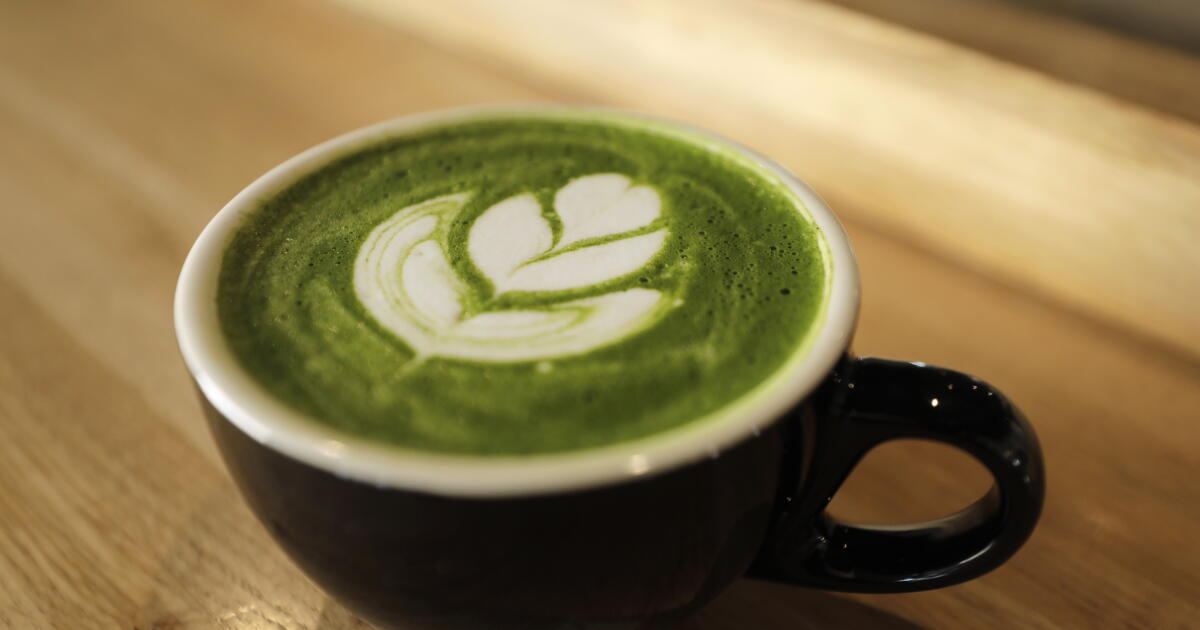
I scan the menu at an L.A. cafe on a recent morning, taking note of the various matcha lattes with plant-based milks, cloud tops and seasonal fruit.
“Can I please have a matcha?” I ask.
“The strawberry one is our most popular,” the cashier replies with a pleasant smile.
“No, thank you. Just a matcha.”
“Ah,” she says. “Sure, what kind of milk?”
“No, just a matcha please. Like the tea and water.”
Her smile quickly turns down, replaced with a look of confusion, and a little disgust.
“You want, like, matcha with just water? We don’t do that here.”
It’s a scenario I’ve experienced more than a dozen times at coffee shops and cafes all over Los Angeles. Matcha seems to be everywhere, but only in latte form.
Matcha is the green powder made from shade-grown tea plants: The leaves are steamed, dried and ground in stone mills into a fine powder. When the powder is whisked with water, you consume the leaves, rather than steep them.
Barista Julia Peng pours hot water into a “chawan” bowl with matcha powder for lattes at Kin Bakeshop in Santa Barbara.
(Juliana Yamada / Los Angeles Times)
“In the bigger sense of how matcha has penetrated pop culture [in the U.S.], it came in as a latte,” says Zach Mangan, who co-founded Kettl tea company with his wife, Minami. Over the last two decades, the couple developed relationships with a number of Japan’s most noticeable tea producers. They sell dozens of varieties of matcha online, and at cafes in Los Feliz and Brooklyn.
The global matcha market is expected to increase in value to $8.9 billion from $5.5 billion by 2033. Mangan says his company receives around seven to 10 emails a day from people looking for help starting a new matcha business.
But somewhere along the way to matcha becoming a global phenomenon, the term became synonymous with the matcha latte, versus the actual tea.
There’s no greater measure of a trend’s prevalence than its appearance on the menu of the country’s largest coffee and tea chain. Starbucks first introduced matcha to its menu with a “green tea latte” in 2006. A study of the brand’s current online offerings shows 19 matcha drinks, ranging from caramel protein matcha to an iced Dubai chocolate matcha.

Matcha is layed over milk and strawberry at Ondo in Los Angeles.
(Shelby Moore / For the Times)
“Our matcha business is now an over $1-billion platform, and it’s growing tremendously year over year,” said Starbucks Chief Financial Officer Cathy Smith during an earnings call in October. “What started as probably just a more simple matcha beverage, now almost everyone puts a cold foam on it, and it is sought after more in the afternoon.”
Of those 19 matcha drinks, all of them include an additional ingredient beyond the tea.
The idea that matcha is a foundational base, rather than a drink itself, has even permeated the Food section of this paper. A colleague complained recently that she had run out of oat milk, and therefore was “raw-dogging matcha.”
As an avid, longtime matcha drinker, I find the matcha latte invasion both baffling and troubling. My desire for actual matcha is three-pronged. I prefer the umami and grassy freshness of unsweetened, unadorned matcha. I am also lactose intolerant. And while I appreciate the existence of plant-based milk, I find the thin, beige liquid to taste like mildly nutty, sweet water.
Matcha production is also extremely laborious, and depending on the grade of matcha you purchase, it can be prohibitively costly. If you purchase single-cultivar matcha, made from the tea leaves of one variety of tea plant, prices can range from $20 to more than $40 per ounce of powder. Like single-varietal wine, the single cultivar showcases the distinct flavor and aroma of its plant. When you sweeten the matcha, or mix it with dairy or nut milk, it’s impossible to discern any flavor or nuance beyond a vague grassiness.

Matcha is whisked at Kin Bakeshop in Santa Barbara.
(Juliana Yamada / Los Angeles Times)
Efficiency is also a factor when preparing matcha properly. Traditional matcha preparation involves a food scale, a chawan (matcha bowl), chashaku (tea scoop), a chasen (tea whisk) and a fine mesh sifter. Many cafes that serve matcha prepare a concentrate that can be distributed quickly in a squeeze bottle.
During a recent visit to the Blue Bottle coffee shop in the Arts District, I was told that the shop made all of its matcha with a prepared matcha concentrate that includes about one gram of sugar.
When I requested matcha with water, I was warned that the drink would taste “leafy” by the barista, and that the addition of sugar was to “take the edge off.”
I ordered it anyway, and watched as the barista squirted the concentrate into a cup with hot water. It was recognizably matcha, but far sweeter and duller than I would have preferred.
I actually find myself frequenting the tonic bar at Erewhon. It’s one of the few places that offers matcha tea, though it uses a familiar coffee term to label the drink on the menu.
“We call it a matcha Americano because Americano gives guests a familiar cue that the matcha is prepared with water,” wrote an Erewhon representative in an email. “When ‘matcha’ on a menu often brings a latte to mind, we wanted to make it easy for guests to order it as a tea, hot or iced.”
It’s a term I’ve started seeing at more cafes around town, with Alfred, Verve Coffee and Cha Cha Matcha all offering matcha Americanos. At the Chamberlain Coffee Cafes in Century City and Abbot Kinney, matcha is listed on the menu as “matcha + water.”

A spakling matcha drink is prepared at Kettl in Los Angeles.
(Shelby Moore / For The Times)
Despite his preference for, and appreciation of, matcha, Mangan couldn’t deny the popularity of the matcha latte.
“The majority of the beverages that people take to go are some form of latte,” says Mangan.
While Kettl cafes offer matcha tea tastings, they also introduced seasonal matcha drinks and lattes to keep up with customer demands. Jacob Morgan, the company’s director of retail, is behind offerings like shiso and white peach matcha soda, or a lychee and sudachi matcha soda finished with sansho peppercorn. The focus is on whole, seasonal ingredients that bolster the tea’s natural textures and flavors, rather than mute them.
“A matcha latte has the power to move people through the sort of trajectory of what it means to be a Japanese tea or matcha drinker,” Mangan says. “We often suggest to then try something without milk. As long as you serve something with a certain level of quality, it’s not hard to make that jump.”
You may have reached the end of this column with the conclusion that I am a lactose-intolerant matcha curmudgeon. That’s partially true. My issue isn’t so much with the existence of the spectrum of banana, strawberry and coconut matcha lattes as it is with the general frustration that accompanies the misuse of the term matcha. But the matcha latte genie has as already left the bottle. I will continue to raw-dog my matcha whenever possible. You should try it some time. And if you hate it, there are plenty of cafes willing to make you a matcha drink that sounds like it belongs on the Cheesecake Factory dessert menu.

I scan the menu at an L.A. cafe on a recent morning, taking note of the various matcha lattes with plant-based milks, cloud tops and seasonal fruit.
“Can I please have a matcha?” I ask.
“The strawberry one is our most popular,” the cashier replies with a pleasant smile.
“No, thank you. Just a matcha.”
“Ah,” she says. “Sure, what kind of milk?”
“No, just a matcha please. Like the tea and water.”
Her smile quickly turns down, replaced with a look of confusion, and a little disgust.
“You want, like, matcha with just water? We don’t do that here.”
It’s a scenario I’ve experienced more than a dozen times at coffee shops and cafes all over Los Angeles. Matcha seems to be everywhere, but only in latte form.
Matcha is the green powder made from shade-grown tea plants: The leaves are steamed, dried and ground in stone mills into a fine powder. When the powder is whisked with water, you consume the leaves, rather than steep them.
Barista Julia Peng pours hot water into a “chawan” bowl with matcha powder for lattes at Kin Bakeshop in Santa Barbara.
(Juliana Yamada / Los Angeles Times)
“In the bigger sense of how matcha has penetrated pop culture [in the U.S.], it came in as a latte,” says Zach Mangan, who co-founded Kettl tea company with his wife, Minami. Over the last two decades, the couple developed relationships with a number of Japan’s most noticeable tea producers. They sell dozens of varieties of matcha online, and at cafes in Los Feliz and Brooklyn.
The global matcha market is expected to increase in value to $8.9 billion from $5.5 billion by 2033. Mangan says his company receives around seven to 10 emails a day from people looking for help starting a new matcha business.
But somewhere along the way to matcha becoming a global phenomenon, the term became synonymous with the matcha latte, versus the actual tea.
There’s no greater measure of a trend’s prevalence than its appearance on the menu of the country’s largest coffee and tea chain. Starbucks first introduced matcha to its menu with a “green tea latte” in 2006. A study of the brand’s current online offerings shows 19 matcha drinks, ranging from caramel protein matcha to an iced Dubai chocolate matcha.
Matcha is layed over milk and strawberry at Ondo in Los Angeles.
(Shelby Moore / For the Times)
“Our matcha business is now an over $1-billion platform, and it’s growing tremendously year over year,” said Starbucks Chief Financial Officer Cathy Smith during an earnings call in October. “What started as probably just a more simple matcha beverage, now almost everyone puts a cold foam on it, and it is sought after more in the afternoon.”
Of those 19 matcha drinks, all of them include an additional ingredient beyond the tea.
The idea that matcha is a foundational base, rather than a drink itself, has even permeated the Food section of this paper. A colleague complained recently that she had run out of oat milk, and therefore was “raw-dogging matcha.”
As an avid, longtime matcha drinker, I find the matcha latte invasion both baffling and troubling. My desire for actual matcha is three-pronged. I prefer the umami and grassy freshness of unsweetened, unadorned matcha. I am also lactose intolerant. And while I appreciate the existence of plant-based milk, I find the thin, beige liquid to taste like mildly nutty, sweet water.
Matcha production is also extremely laborious, and depending on the grade of matcha you purchase, it can be prohibitively costly. If you purchase single-cultivar matcha, made from the tea leaves of one variety of tea plant, prices can range from $20 to more than $40 per ounce of powder. Like single-varietal wine, the single cultivar showcases the distinct flavor and aroma of its plant. When you sweeten the matcha, or mix it with dairy or nut milk, it’s impossible to discern any flavor or nuance beyond a vague grassiness.
Matcha is whisked at Kin Bakeshop in Santa Barbara.
(Juliana Yamada / Los Angeles Times)
Efficiency is also a factor when preparing matcha properly. Traditional matcha preparation involves a food scale, a chawan (matcha bowl), chashaku (tea scoop), a chasen (tea whisk) and a fine mesh sifter. Many cafes that serve matcha prepare a concentrate that can be distributed quickly in a squeeze bottle.
During a recent visit to the Blue Bottle coffee shop in the Arts District, I was told that the shop made all of its matcha with a prepared matcha concentrate that includes about one gram of sugar.
When I requested matcha with water, I was warned that the drink would taste “leafy” by the barista, and that the addition of sugar was to “take the edge off.”
I ordered it anyway, and watched as the barista squirted the concentrate into a cup with hot water. It was recognizably matcha, but far sweeter and duller than I would have preferred.
I actually find myself frequenting the tonic bar at Erewhon. It’s one of the few places that offers matcha tea, though it uses a familiar coffee term to label the drink on the menu.
“We call it a matcha Americano because Americano gives guests a familiar cue that the matcha is prepared with water,” wrote an Erewhon representative in an email. “When ‘matcha’ on a menu often brings a latte to mind, we wanted to make it easy for guests to order it as a tea, hot or iced.”
It’s a term I’ve started seeing at more cafes around town, with Alfred, Verve Coffee and Cha Cha Matcha all offering matcha Americanos. At the Chamberlain Coffee Cafes in Century City and Abbot Kinney, matcha is listed on the menu as “matcha + water.”
A spakling matcha drink is prepared at Kettl in Los Angeles.
(Shelby Moore / For The Times)
Despite his preference for, and appreciation of, matcha, Mangan couldn’t deny the popularity of the matcha latte.
“The majority of the beverages that people take to go are some form of latte,” says Mangan.
While Kettl cafes offer matcha tea tastings, they also introduced seasonal matcha drinks and lattes to keep up with customer demands. Jacob Morgan, the company’s director of retail, is behind offerings like shiso and white peach matcha soda, or a lychee and sudachi matcha soda finished with sansho peppercorn. The focus is on whole, seasonal ingredients that bolster the tea’s natural textures and flavors, rather than mute them.
“A matcha latte has the power to move people through the sort of trajectory of what it means to be a Japanese tea or matcha drinker,” Mangan says. “We often suggest to then try something without milk. As long as you serve something with a certain level of quality, it’s not hard to make that jump.”
You may have reached the end of this column with the conclusion that I am a lactose-intolerant matcha curmudgeon. That’s partially true. My issue isn’t so much with the existence of the spectrum of banana, strawberry and coconut matcha lattes as it is with the general frustration that accompanies the misuse of the term matcha. But the matcha latte genie has as already left the bottle. I will continue to raw-dog my matcha whenever possible. You should try it some time. And if you hate it, there are plenty of cafes willing to make you a matcha drink that sounds like it belongs on the Cheesecake Factory dessert menu.

I scan the menu at an L.A. cafe on a recent morning, taking note of the various matcha lattes with plant-based milks, cloud tops and seasonal fruit.
“Can I please have a matcha?” I ask.
“The strawberry one is our most popular,” the cashier replies with a pleasant smile.
“No, thank you. Just a matcha.”
“Ah,” she says. “Sure, what kind of milk?”
“No, just a matcha please. Like the tea and water.”
Her smile quickly turns down, replaced with a look of confusion, and a little disgust.
“You want, like, matcha with just water? We don’t do that here.”
It’s a scenario I’ve experienced more than a dozen times at coffee shops and cafes all over Los Angeles. Matcha seems to be everywhere, but only in latte form.
Matcha is the green powder made from shade-grown tea plants: The leaves are steamed, dried and ground in stone mills into a fine powder. When the powder is whisked with water, you consume the leaves, rather than steep them.
Barista Julia Peng pours hot water into a “chawan” bowl with matcha powder for lattes at Kin Bakeshop in Santa Barbara.
(Juliana Yamada / Los Angeles Times)
“In the bigger sense of how matcha has penetrated pop culture [in the U.S.], it came in as a latte,” says Zach Mangan, who co-founded Kettl tea company with his wife, Minami. Over the last two decades, the couple developed relationships with a number of Japan’s most noticeable tea producers. They sell dozens of varieties of matcha online, and at cafes in Los Feliz and Brooklyn.
The global matcha market is expected to increase in value to $8.9 billion from $5.5 billion by 2033. Mangan says his company receives around seven to 10 emails a day from people looking for help starting a new matcha business.
But somewhere along the way to matcha becoming a global phenomenon, the term became synonymous with the matcha latte, versus the actual tea.
There’s no greater measure of a trend’s prevalence than its appearance on the menu of the country’s largest coffee and tea chain. Starbucks first introduced matcha to its menu with a “green tea latte” in 2006. A study of the brand’s current online offerings shows 19 matcha drinks, ranging from caramel protein matcha to an iced Dubai chocolate matcha.
Matcha is layed over milk and strawberry at Ondo in Los Angeles.
(Shelby Moore / For the Times)
“Our matcha business is now an over $1-billion platform, and it’s growing tremendously year over year,” said Starbucks Chief Financial Officer Cathy Smith during an earnings call in October. “What started as probably just a more simple matcha beverage, now almost everyone puts a cold foam on it, and it is sought after more in the afternoon.”
Of those 19 matcha drinks, all of them include an additional ingredient beyond the tea.
The idea that matcha is a foundational base, rather than a drink itself, has even permeated the Food section of this paper. A colleague complained recently that she had run out of oat milk, and therefore was “raw-dogging matcha.”
As an avid, longtime matcha drinker, I find the matcha latte invasion both baffling and troubling. My desire for actual matcha is three-pronged. I prefer the umami and grassy freshness of unsweetened, unadorned matcha. I am also lactose intolerant. And while I appreciate the existence of plant-based milk, I find the thin, beige liquid to taste like mildly nutty, sweet water.
Matcha production is also extremely laborious, and depending on the grade of matcha you purchase, it can be prohibitively costly. If you purchase single-cultivar matcha, made from the tea leaves of one variety of tea plant, prices can range from $20 to more than $40 per ounce of powder. Like single-varietal wine, the single cultivar showcases the distinct flavor and aroma of its plant. When you sweeten the matcha, or mix it with dairy or nut milk, it’s impossible to discern any flavor or nuance beyond a vague grassiness.
Matcha is whisked at Kin Bakeshop in Santa Barbara.
(Juliana Yamada / Los Angeles Times)
Efficiency is also a factor when preparing matcha properly. Traditional matcha preparation involves a food scale, a chawan (matcha bowl), chashaku (tea scoop), a chasen (tea whisk) and a fine mesh sifter. Many cafes that serve matcha prepare a concentrate that can be distributed quickly in a squeeze bottle.
During a recent visit to the Blue Bottle coffee shop in the Arts District, I was told that the shop made all of its matcha with a prepared matcha concentrate that includes about one gram of sugar.
When I requested matcha with water, I was warned that the drink would taste “leafy” by the barista, and that the addition of sugar was to “take the edge off.”
I ordered it anyway, and watched as the barista squirted the concentrate into a cup with hot water. It was recognizably matcha, but far sweeter and duller than I would have preferred.
I actually find myself frequenting the tonic bar at Erewhon. It’s one of the few places that offers matcha tea, though it uses a familiar coffee term to label the drink on the menu.
“We call it a matcha Americano because Americano gives guests a familiar cue that the matcha is prepared with water,” wrote an Erewhon representative in an email. “When ‘matcha’ on a menu often brings a latte to mind, we wanted to make it easy for guests to order it as a tea, hot or iced.”
It’s a term I’ve started seeing at more cafes around town, with Alfred, Verve Coffee and Cha Cha Matcha all offering matcha Americanos. At the Chamberlain Coffee Cafes in Century City and Abbot Kinney, matcha is listed on the menu as “matcha + water.”
A spakling matcha drink is prepared at Kettl in Los Angeles.
(Shelby Moore / For The Times)
Despite his preference for, and appreciation of, matcha, Mangan couldn’t deny the popularity of the matcha latte.
“The majority of the beverages that people take to go are some form of latte,” says Mangan.
While Kettl cafes offer matcha tea tastings, they also introduced seasonal matcha drinks and lattes to keep up with customer demands. Jacob Morgan, the company’s director of retail, is behind offerings like shiso and white peach matcha soda, or a lychee and sudachi matcha soda finished with sansho peppercorn. The focus is on whole, seasonal ingredients that bolster the tea’s natural textures and flavors, rather than mute them.
“A matcha latte has the power to move people through the sort of trajectory of what it means to be a Japanese tea or matcha drinker,” Mangan says. “We often suggest to then try something without milk. As long as you serve something with a certain level of quality, it’s not hard to make that jump.”
You may have reached the end of this column with the conclusion that I am a lactose-intolerant matcha curmudgeon. That’s partially true. My issue isn’t so much with the existence of the spectrum of banana, strawberry and coconut matcha lattes as it is with the general frustration that accompanies the misuse of the term matcha. But the matcha latte genie has as already left the bottle. I will continue to raw-dog my matcha whenever possible. You should try it some time. And if you hate it, there are plenty of cafes willing to make you a matcha drink that sounds like it belongs on the Cheesecake Factory dessert menu.

I scan the menu at an L.A. cafe on a recent morning, taking note of the various matcha lattes with plant-based milks, cloud tops and seasonal fruit.
“Can I please have a matcha?” I ask.
“The strawberry one is our most popular,” the cashier replies with a pleasant smile.
“No, thank you. Just a matcha.”
“Ah,” she says. “Sure, what kind of milk?”
“No, just a matcha please. Like the tea and water.”
Her smile quickly turns down, replaced with a look of confusion, and a little disgust.
“You want, like, matcha with just water? We don’t do that here.”
It’s a scenario I’ve experienced more than a dozen times at coffee shops and cafes all over Los Angeles. Matcha seems to be everywhere, but only in latte form.
Matcha is the green powder made from shade-grown tea plants: The leaves are steamed, dried and ground in stone mills into a fine powder. When the powder is whisked with water, you consume the leaves, rather than steep them.
Barista Julia Peng pours hot water into a “chawan” bowl with matcha powder for lattes at Kin Bakeshop in Santa Barbara.
(Juliana Yamada / Los Angeles Times)
“In the bigger sense of how matcha has penetrated pop culture [in the U.S.], it came in as a latte,” says Zach Mangan, who co-founded Kettl tea company with his wife, Minami. Over the last two decades, the couple developed relationships with a number of Japan’s most noticeable tea producers. They sell dozens of varieties of matcha online, and at cafes in Los Feliz and Brooklyn.
The global matcha market is expected to increase in value to $8.9 billion from $5.5 billion by 2033. Mangan says his company receives around seven to 10 emails a day from people looking for help starting a new matcha business.
But somewhere along the way to matcha becoming a global phenomenon, the term became synonymous with the matcha latte, versus the actual tea.
There’s no greater measure of a trend’s prevalence than its appearance on the menu of the country’s largest coffee and tea chain. Starbucks first introduced matcha to its menu with a “green tea latte” in 2006. A study of the brand’s current online offerings shows 19 matcha drinks, ranging from caramel protein matcha to an iced Dubai chocolate matcha.
Matcha is layed over milk and strawberry at Ondo in Los Angeles.
(Shelby Moore / For the Times)
“Our matcha business is now an over $1-billion platform, and it’s growing tremendously year over year,” said Starbucks Chief Financial Officer Cathy Smith during an earnings call in October. “What started as probably just a more simple matcha beverage, now almost everyone puts a cold foam on it, and it is sought after more in the afternoon.”
Of those 19 matcha drinks, all of them include an additional ingredient beyond the tea.
The idea that matcha is a foundational base, rather than a drink itself, has even permeated the Food section of this paper. A colleague complained recently that she had run out of oat milk, and therefore was “raw-dogging matcha.”
As an avid, longtime matcha drinker, I find the matcha latte invasion both baffling and troubling. My desire for actual matcha is three-pronged. I prefer the umami and grassy freshness of unsweetened, unadorned matcha. I am also lactose intolerant. And while I appreciate the existence of plant-based milk, I find the thin, beige liquid to taste like mildly nutty, sweet water.
Matcha production is also extremely laborious, and depending on the grade of matcha you purchase, it can be prohibitively costly. If you purchase single-cultivar matcha, made from the tea leaves of one variety of tea plant, prices can range from $20 to more than $40 per ounce of powder. Like single-varietal wine, the single cultivar showcases the distinct flavor and aroma of its plant. When you sweeten the matcha, or mix it with dairy or nut milk, it’s impossible to discern any flavor or nuance beyond a vague grassiness.
Matcha is whisked at Kin Bakeshop in Santa Barbara.
(Juliana Yamada / Los Angeles Times)
Efficiency is also a factor when preparing matcha properly. Traditional matcha preparation involves a food scale, a chawan (matcha bowl), chashaku (tea scoop), a chasen (tea whisk) and a fine mesh sifter. Many cafes that serve matcha prepare a concentrate that can be distributed quickly in a squeeze bottle.
During a recent visit to the Blue Bottle coffee shop in the Arts District, I was told that the shop made all of its matcha with a prepared matcha concentrate that includes about one gram of sugar.
When I requested matcha with water, I was warned that the drink would taste “leafy” by the barista, and that the addition of sugar was to “take the edge off.”
I ordered it anyway, and watched as the barista squirted the concentrate into a cup with hot water. It was recognizably matcha, but far sweeter and duller than I would have preferred.
I actually find myself frequenting the tonic bar at Erewhon. It’s one of the few places that offers matcha tea, though it uses a familiar coffee term to label the drink on the menu.
“We call it a matcha Americano because Americano gives guests a familiar cue that the matcha is prepared with water,” wrote an Erewhon representative in an email. “When ‘matcha’ on a menu often brings a latte to mind, we wanted to make it easy for guests to order it as a tea, hot or iced.”
It’s a term I’ve started seeing at more cafes around town, with Alfred, Verve Coffee and Cha Cha Matcha all offering matcha Americanos. At the Chamberlain Coffee Cafes in Century City and Abbot Kinney, matcha is listed on the menu as “matcha + water.”
A spakling matcha drink is prepared at Kettl in Los Angeles.
(Shelby Moore / For The Times)
Despite his preference for, and appreciation of, matcha, Mangan couldn’t deny the popularity of the matcha latte.
“The majority of the beverages that people take to go are some form of latte,” says Mangan.
While Kettl cafes offer matcha tea tastings, they also introduced seasonal matcha drinks and lattes to keep up with customer demands. Jacob Morgan, the company’s director of retail, is behind offerings like shiso and white peach matcha soda, or a lychee and sudachi matcha soda finished with sansho peppercorn. The focus is on whole, seasonal ingredients that bolster the tea’s natural textures and flavors, rather than mute them.
“A matcha latte has the power to move people through the sort of trajectory of what it means to be a Japanese tea or matcha drinker,” Mangan says. “We often suggest to then try something without milk. As long as you serve something with a certain level of quality, it’s not hard to make that jump.”
You may have reached the end of this column with the conclusion that I am a lactose-intolerant matcha curmudgeon. That’s partially true. My issue isn’t so much with the existence of the spectrum of banana, strawberry and coconut matcha lattes as it is with the general frustration that accompanies the misuse of the term matcha. But the matcha latte genie has as already left the bottle. I will continue to raw-dog my matcha whenever possible. You should try it some time. And if you hate it, there are plenty of cafes willing to make you a matcha drink that sounds like it belongs on the Cheesecake Factory dessert menu.

I scan the menu at an L.A. cafe on a recent morning, taking note of the various matcha lattes with plant-based milks, cloud tops and seasonal fruit.
“Can I please have a matcha?” I ask.
“The strawberry one is our most popular,” the cashier replies with a pleasant smile.
“No, thank you. Just a matcha.”
“Ah,” she says. “Sure, what kind of milk?”
“No, just a matcha please. Like the tea and water.”
Her smile quickly turns down, replaced with a look of confusion, and a little disgust.
“You want, like, matcha with just water? We don’t do that here.”
It’s a scenario I’ve experienced more than a dozen times at coffee shops and cafes all over Los Angeles. Matcha seems to be everywhere, but only in latte form.
Matcha is the green powder made from shade-grown tea plants: The leaves are steamed, dried and ground in stone mills into a fine powder. When the powder is whisked with water, you consume the leaves, rather than steep them.
Barista Julia Peng pours hot water into a “chawan” bowl with matcha powder for lattes at Kin Bakeshop in Santa Barbara.
(Juliana Yamada / Los Angeles Times)
“In the bigger sense of how matcha has penetrated pop culture [in the U.S.], it came in as a latte,” says Zach Mangan, who co-founded Kettl tea company with his wife, Minami. Over the last two decades, the couple developed relationships with a number of Japan’s most noticeable tea producers. They sell dozens of varieties of matcha online, and at cafes in Los Feliz and Brooklyn.
The global matcha market is expected to increase in value to $8.9 billion from $5.5 billion by 2033. Mangan says his company receives around seven to 10 emails a day from people looking for help starting a new matcha business.
But somewhere along the way to matcha becoming a global phenomenon, the term became synonymous with the matcha latte, versus the actual tea.
There’s no greater measure of a trend’s prevalence than its appearance on the menu of the country’s largest coffee and tea chain. Starbucks first introduced matcha to its menu with a “green tea latte” in 2006. A study of the brand’s current online offerings shows 19 matcha drinks, ranging from caramel protein matcha to an iced Dubai chocolate matcha.
Matcha is layed over milk and strawberry at Ondo in Los Angeles.
(Shelby Moore / For the Times)
“Our matcha business is now an over $1-billion platform, and it’s growing tremendously year over year,” said Starbucks Chief Financial Officer Cathy Smith during an earnings call in October. “What started as probably just a more simple matcha beverage, now almost everyone puts a cold foam on it, and it is sought after more in the afternoon.”
Of those 19 matcha drinks, all of them include an additional ingredient beyond the tea.
The idea that matcha is a foundational base, rather than a drink itself, has even permeated the Food section of this paper. A colleague complained recently that she had run out of oat milk, and therefore was “raw-dogging matcha.”
As an avid, longtime matcha drinker, I find the matcha latte invasion both baffling and troubling. My desire for actual matcha is three-pronged. I prefer the umami and grassy freshness of unsweetened, unadorned matcha. I am also lactose intolerant. And while I appreciate the existence of plant-based milk, I find the thin, beige liquid to taste like mildly nutty, sweet water.
Matcha production is also extremely laborious, and depending on the grade of matcha you purchase, it can be prohibitively costly. If you purchase single-cultivar matcha, made from the tea leaves of one variety of tea plant, prices can range from $20 to more than $40 per ounce of powder. Like single-varietal wine, the single cultivar showcases the distinct flavor and aroma of its plant. When you sweeten the matcha, or mix it with dairy or nut milk, it’s impossible to discern any flavor or nuance beyond a vague grassiness.
Matcha is whisked at Kin Bakeshop in Santa Barbara.
(Juliana Yamada / Los Angeles Times)
Efficiency is also a factor when preparing matcha properly. Traditional matcha preparation involves a food scale, a chawan (matcha bowl), chashaku (tea scoop), a chasen (tea whisk) and a fine mesh sifter. Many cafes that serve matcha prepare a concentrate that can be distributed quickly in a squeeze bottle.
During a recent visit to the Blue Bottle coffee shop in the Arts District, I was told that the shop made all of its matcha with a prepared matcha concentrate that includes about one gram of sugar.
When I requested matcha with water, I was warned that the drink would taste “leafy” by the barista, and that the addition of sugar was to “take the edge off.”
I ordered it anyway, and watched as the barista squirted the concentrate into a cup with hot water. It was recognizably matcha, but far sweeter and duller than I would have preferred.
I actually find myself frequenting the tonic bar at Erewhon. It’s one of the few places that offers matcha tea, though it uses a familiar coffee term to label the drink on the menu.
“We call it a matcha Americano because Americano gives guests a familiar cue that the matcha is prepared with water,” wrote an Erewhon representative in an email. “When ‘matcha’ on a menu often brings a latte to mind, we wanted to make it easy for guests to order it as a tea, hot or iced.”
It’s a term I’ve started seeing at more cafes around town, with Alfred, Verve Coffee and Cha Cha Matcha all offering matcha Americanos. At the Chamberlain Coffee Cafes in Century City and Abbot Kinney, matcha is listed on the menu as “matcha + water.”
A spakling matcha drink is prepared at Kettl in Los Angeles.
(Shelby Moore / For The Times)
Despite his preference for, and appreciation of, matcha, Mangan couldn’t deny the popularity of the matcha latte.
“The majority of the beverages that people take to go are some form of latte,” says Mangan.
While Kettl cafes offer matcha tea tastings, they also introduced seasonal matcha drinks and lattes to keep up with customer demands. Jacob Morgan, the company’s director of retail, is behind offerings like shiso and white peach matcha soda, or a lychee and sudachi matcha soda finished with sansho peppercorn. The focus is on whole, seasonal ingredients that bolster the tea’s natural textures and flavors, rather than mute them.
“A matcha latte has the power to move people through the sort of trajectory of what it means to be a Japanese tea or matcha drinker,” Mangan says. “We often suggest to then try something without milk. As long as you serve something with a certain level of quality, it’s not hard to make that jump.”
You may have reached the end of this column with the conclusion that I am a lactose-intolerant matcha curmudgeon. That’s partially true. My issue isn’t so much with the existence of the spectrum of banana, strawberry and coconut matcha lattes as it is with the general frustration that accompanies the misuse of the term matcha. But the matcha latte genie has as already left the bottle. I will continue to raw-dog my matcha whenever possible. You should try it some time. And if you hate it, there are plenty of cafes willing to make you a matcha drink that sounds like it belongs on the Cheesecake Factory dessert menu.