

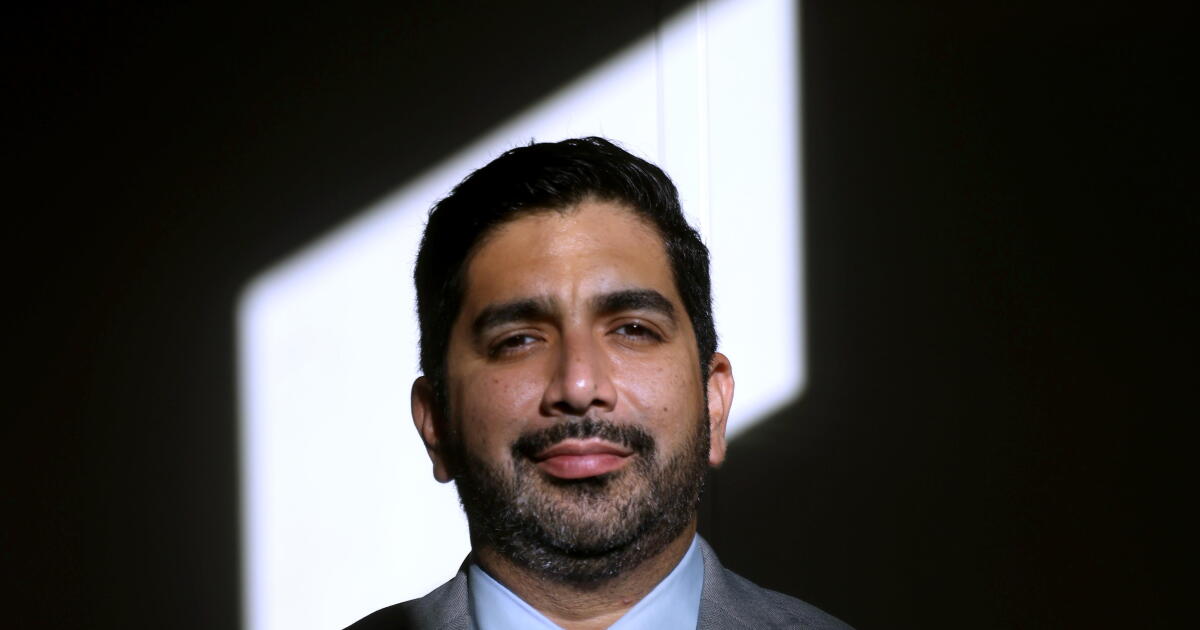

Roberto Lazzeri Montaño has a Sisyphean task ahead of him as Mexico’s new ambassador to the United States.
The relationship between the two countries — forever adversarial yet eternally co-dependent — has become even more fraught under President Trump, who infamously declared, “When Mexico sends its people, they’re not sending their best” during the 2015 speech that launched his first campaign.
This week, Trump threatened to double tariffs on Mexico, our biggest trading partner, if it doesn’t stop a caravan of migrants from reaching the border, which is already effectively shut down thanks to his multibillion-dollar enforcement regime and the masked federal agents terrorizing Latinos nationwide.
He has also repeatedly suggested sending U.S. troops south of the border to pursue drug traffickers, an offer that Mexican President Claudia Sheinbaum has criticized as a threat to her nation’s sovereignty.
“So we have a sad history about intervention that, of course, no one wants to replicate,” Lazzeri said during a one-hour conversation with Times journalists at the newspaper’s El Segundo office last week. “So we arrive to every negotiating table, to every conversation, knowing what’s possible and knowing what’s not possible.”
The Mexico City native exuded diplomatic tact and no arrogance. He sported a tightly cropped beard and wore a simple gray suit, a skinny black tie held in place by a clip. A pin of the Mexican and U.S. flags adorned his lapel. The 42-year-old spoke in flawless but studied English and brought no assistant with him, occasionally jotting down thoughts in a moleskin notebook.
Mostly, he listened and responded to our questions. He was in Los Angeles — where he lived for a few years in the 2010s while studying music management at UCLA Extension — for a few days before returning to Washington to introduce himself to the new Democratic-majority Congress.
When Lazzeri first arrived in the nation’s capital in August, lawmakers were busy getting ready to campaign for the midterms. Now, he said, “we’ll actively try to engage again.”
The conversation started with Steve Padilla, who edits The Times’ Mexico correspondents, asking how relations with the U.S. might change after the midterms and Trump’s promotion of Stephen Miller, who has railed against Mexican culture since his high school years in Santa Monica, to chief of staff.
“It’s business as usual,” Lazzeri responded. “We have no reason to meddle into internal U.S. politics. … But when [it] affects the lives of our people here in the country, or their health, or their well-being, and if it starts to cross into a human rights violation, we’ll raise our voice and we’ll try to work with the administration to find that these things don’t happen again.”
That was the Lazzeri that emerged as we chatted: confident but clear-eyed, knowing he needs to keep el Norte happy — but not at the expense of his patria.
He hailed the 2020 U.S.-Mexico-Canada trilateral trade agreement as beneficial to everyone but especially Americans, who save $900 a year in groceries, he said, “because they have access to produce from Mexico. And they have access all year long.”
A worker selects avocados at a packing plant in Uruapan, Mexico.
(Armando Solis / Associated Press)
Lazzeri called U.S. airstrikes that killed Mexican citizens on fishing boats in international waters west of the Mexican coast “extrajudiciary executions.” The deaths of two CIA officers during a covert mission alongside local authorities in Chihuahua was a “violation” of Mexican national security laws that ban foreign agents from working inside the country without the knowledge of the federal government, he said.
The ambassador thinks yearly visas or “something similar” to the 1950s-era bracero program are a “reasonable solution” for the American demand for cheap labor and the willingness of Mexicans to fill those positions.
And he said the strategy of previous Mexican presidential administrations to target cartel leaders while failing to go after their financial assets and leaving civilians to suffer the subsequent turf wars was “horrible” and a “lesson learned.”
The Sheinbaum administration is trying not to replicate those campaigns, Lazzeri asserted, but nor is it necessary to join U.S.-led hemispheric coalitions like Shield of the Americas.
“What we have heard from the U.S. authorities,” he said, “is that they respect our model, and we’re showing the best results in the region.”
Lazzeri went on to describe overall relations between Mexico and the U.S. as “the highest of collaborations that I have seen,” hailing the state of the border.
“You see — very smartly — [Mexican] security forces talking with Border Patrol to say people are crossing around here — ‘If we do X, Y, Z, this will deter them,’” he said. “So, it feels lot less politicized. It feels like an ongoing, daily basis work of people that know what they’re doing, that know the terrain.”
I commented that his rosy description made it sound as if the Mexican government was capitulating to Trump’s demand of zero migration.
“I mean, illegally, if [migrants] are doing it through polleros [human smugglers], of course we want to deter that,” Lazzeri responded. “Why wouldn’t we?”
His calm, pragmatic responses reminded me of Sheinbaum, whom Lazzeri repeatedly referred to as “my president.” Times Executive Editor Terry Tang brought up the more confrontational approach of Canadian Prime Minister Mark Carney and asked if the low-key way that Sheinbaum deals with Trump’s bluster is intentional.
“My president, she’s very thoughtful,” Lazzeri said. “We try to focus on not getting tangled into the political narrative that sometimes doesn’t come from the [Trump] administration. It comes from many other sources, and it will be a mistake to just engage with that when it’s not actually what we’re discussing.”
We focused mostly on the issues Americans typically associate with Mexico: immigration, drug and trade wars. Even when I brought up food, noting that avocados and Mexican spirits like tequila and mezcal are more popular than ever in the U.S., the conversation inevitably turned to the security concerns surrounding those products. Lazzeri said the Mexican government is making it safe for farmers and other entrepreneurs to alert authorities when they’re victims of extortion and is using satellites to track illegal logging that creates more avocado groves.
It’s all part of Sheinbaum’s effort to avoid turning Mexico into a vassal state of the behemoth to the north, as it too often has been in the past.
“At the end, what is really important for me as an ambassador is that, yes, there’s issues in my country,” Lazzeri said. “And we understand them, and we’re dealing with patience and moving the agenda forward. That being said, what should not happen is that our community gets stigmatized because of those issues.”
He brought up this summer’s World Cup, hosted by Mexico, Canada and the U.S., as a “major opportunity to show a different face of Mexico” with the success of its men’s national team and the experience it offered fans from across the globe.
“I do believe that soft power, if we keep that level of influence at the end, policies can change,” he said.

A Mexico fan is tossed in the air after the Mexico versus England round of 16 knockout match in downtown Santa Ana on Sunday, July 5, 2026.
(Ronaldo Bolaños / Los Angeles Times)
I ended by asking what his message was to the millions of Americans of Mexican descent living in the U.S. The ambassador described Mexico’s “cosmovision” of a nation of great Indigenous empires that preceded the Spanish conquest and that freed itself of colonialism, and how that informs Mexico’s “constant position of dealing with the issues of the world.”
“It’s an honor to be part of that heritage, to be part of that community,” he concluded, “and [Mexican Americans] should be proud, too.”
On that note, what was his favorite soccer club?
“América, más grande,” Lazzeri responded with a smile — the Mexico City team considered to be the New York Yankees of Mexican soccer. It was the first time he spoke in Spanish all afternoon.
“Chivas,” cracked Times Managing Editor Hector Becerra, referring to the Guadalajara club that’s América’s main rival.
We got up and shook hands.
“And who do you root for?” Lazzeri asked me in Spanish. “Don’t tell me LAFC.”
“We’re zacatecanos,” I replied. “We follow baseball.”
He nodded, then jabbed at my jefe Becerra.
“What do you mean, Chivas?”

Roberto Lazzeri Montaño has a Sisyphean task ahead of him as Mexico’s new ambassador to the United States.
The relationship between the two countries — forever adversarial yet eternally co-dependent — has become even more fraught under President Trump, who infamously declared, “When Mexico sends its people, they’re not sending their best” during the 2015 speech that launched his first campaign.
This week, Trump threatened to double tariffs on Mexico, our biggest trading partner, if it doesn’t stop a caravan of migrants from reaching the border, which is already effectively shut down thanks to his multibillion-dollar enforcement regime and the masked federal agents terrorizing Latinos nationwide.
He has also repeatedly suggested sending U.S. troops south of the border to pursue drug traffickers, an offer that Mexican President Claudia Sheinbaum has criticized as a threat to her nation’s sovereignty.
“So we have a sad history about intervention that, of course, no one wants to replicate,” Lazzeri said during a one-hour conversation with Times journalists at the newspaper’s El Segundo office last week. “So we arrive to every negotiating table, to every conversation, knowing what’s possible and knowing what’s not possible.”
The Mexico City native exuded diplomatic tact and no arrogance. He sported a tightly cropped beard and wore a simple gray suit, a skinny black tie held in place by a clip. A pin of the Mexican and U.S. flags adorned his lapel. The 42-year-old spoke in flawless but studied English and brought no assistant with him, occasionally jotting down thoughts in a moleskin notebook.
Mostly, he listened and responded to our questions. He was in Los Angeles — where he lived for a few years in the 2010s while studying music management at UCLA Extension — for a few days before returning to Washington to introduce himself to the new Democratic-majority Congress.
When Lazzeri first arrived in the nation’s capital in August, lawmakers were busy getting ready to campaign for the midterms. Now, he said, “we’ll actively try to engage again.”
The conversation started with Steve Padilla, who edits The Times’ Mexico correspondents, asking how relations with the U.S. might change after the midterms and Trump’s promotion of Stephen Miller, who has railed against Mexican culture since his high school years in Santa Monica, to chief of staff.
“It’s business as usual,” Lazzeri responded. “We have no reason to meddle into internal U.S. politics. … But when [it] affects the lives of our people here in the country, or their health, or their well-being, and if it starts to cross into a human rights violation, we’ll raise our voice and we’ll try to work with the administration to find that these things don’t happen again.”
That was the Lazzeri that emerged as we chatted: confident but clear-eyed, knowing he needs to keep el Norte happy — but not at the expense of his patria.
He hailed the 2020 U.S.-Mexico-Canada trilateral trade agreement as beneficial to everyone but especially Americans, who save $900 a year in groceries, he said, “because they have access to produce from Mexico. And they have access all year long.”
A worker selects avocados at a packing plant in Uruapan, Mexico.
(Armando Solis / Associated Press)
Lazzeri called U.S. airstrikes that killed Mexican citizens on fishing boats in international waters west of the Mexican coast “extrajudiciary executions.” The deaths of two CIA officers during a covert mission alongside local authorities in Chihuahua was a “violation” of Mexican national security laws that ban foreign agents from working inside the country without the knowledge of the federal government, he said.
The ambassador thinks yearly visas or “something similar” to the 1950s-era bracero program are a “reasonable solution” for the American demand for cheap labor and the willingness of Mexicans to fill those positions.
And he said the strategy of previous Mexican presidential administrations to target cartel leaders while failing to go after their financial assets and leaving civilians to suffer the subsequent turf wars was “horrible” and a “lesson learned.”
The Sheinbaum administration is trying not to replicate those campaigns, Lazzeri asserted, but nor is it necessary to join U.S.-led hemispheric coalitions like Shield of the Americas.
“What we have heard from the U.S. authorities,” he said, “is that they respect our model, and we’re showing the best results in the region.”
Lazzeri went on to describe overall relations between Mexico and the U.S. as “the highest of collaborations that I have seen,” hailing the state of the border.
“You see — very smartly — [Mexican] security forces talking with Border Patrol to say people are crossing around here — ‘If we do X, Y, Z, this will deter them,’” he said. “So, it feels lot less politicized. It feels like an ongoing, daily basis work of people that know what they’re doing, that know the terrain.”
I commented that his rosy description made it sound as if the Mexican government was capitulating to Trump’s demand of zero migration.
“I mean, illegally, if [migrants] are doing it through polleros [human smugglers], of course we want to deter that,” Lazzeri responded. “Why wouldn’t we?”
His calm, pragmatic responses reminded me of Sheinbaum, whom Lazzeri repeatedly referred to as “my president.” Times Executive Editor Terry Tang brought up the more confrontational approach of Canadian Prime Minister Mark Carney and asked if the low-key way that Sheinbaum deals with Trump’s bluster is intentional.
“My president, she’s very thoughtful,” Lazzeri said. “We try to focus on not getting tangled into the political narrative that sometimes doesn’t come from the [Trump] administration. It comes from many other sources, and it will be a mistake to just engage with that when it’s not actually what we’re discussing.”
We focused mostly on the issues Americans typically associate with Mexico: immigration, drug and trade wars. Even when I brought up food, noting that avocados and Mexican spirits like tequila and mezcal are more popular than ever in the U.S., the conversation inevitably turned to the security concerns surrounding those products. Lazzeri said the Mexican government is making it safe for farmers and other entrepreneurs to alert authorities when they’re victims of extortion and is using satellites to track illegal logging that creates more avocado groves.
It’s all part of Sheinbaum’s effort to avoid turning Mexico into a vassal state of the behemoth to the north, as it too often has been in the past.
“At the end, what is really important for me as an ambassador is that, yes, there’s issues in my country,” Lazzeri said. “And we understand them, and we’re dealing with patience and moving the agenda forward. That being said, what should not happen is that our community gets stigmatized because of those issues.”
He brought up this summer’s World Cup, hosted by Mexico, Canada and the U.S., as a “major opportunity to show a different face of Mexico” with the success of its men’s national team and the experience it offered fans from across the globe.
“I do believe that soft power, if we keep that level of influence at the end, policies can change,” he said.
A Mexico fan is tossed in the air after the Mexico versus England round of 16 knockout match in downtown Santa Ana on Sunday, July 5, 2026.
(Ronaldo Bolaños / Los Angeles Times)
I ended by asking what his message was to the millions of Americans of Mexican descent living in the U.S. The ambassador described Mexico’s “cosmovision” of a nation of great Indigenous empires that preceded the Spanish conquest and that freed itself of colonialism, and how that informs Mexico’s “constant position of dealing with the issues of the world.”
“It’s an honor to be part of that heritage, to be part of that community,” he concluded, “and [Mexican Americans] should be proud, too.”
On that note, what was his favorite soccer club?
“América, más grande,” Lazzeri responded with a smile — the Mexico City team considered to be the New York Yankees of Mexican soccer. It was the first time he spoke in Spanish all afternoon.
“Chivas,” cracked Times Managing Editor Hector Becerra, referring to the Guadalajara club that’s América’s main rival.
We got up and shook hands.
“And who do you root for?” Lazzeri asked me in Spanish. “Don’t tell me LAFC.”
“We’re zacatecanos,” I replied. “We follow baseball.”
He nodded, then jabbed at my jefe Becerra.
“What do you mean, Chivas?”

Roberto Lazzeri Montaño has a Sisyphean task ahead of him as Mexico’s new ambassador to the United States.
The relationship between the two countries — forever adversarial yet eternally co-dependent — has become even more fraught under President Trump, who infamously declared, “When Mexico sends its people, they’re not sending their best” during the 2015 speech that launched his first campaign.
This week, Trump threatened to double tariffs on Mexico, our biggest trading partner, if it doesn’t stop a caravan of migrants from reaching the border, which is already effectively shut down thanks to his multibillion-dollar enforcement regime and the masked federal agents terrorizing Latinos nationwide.
He has also repeatedly suggested sending U.S. troops south of the border to pursue drug traffickers, an offer that Mexican President Claudia Sheinbaum has criticized as a threat to her nation’s sovereignty.
“So we have a sad history about intervention that, of course, no one wants to replicate,” Lazzeri said during a one-hour conversation with Times journalists at the newspaper’s El Segundo office last week. “So we arrive to every negotiating table, to every conversation, knowing what’s possible and knowing what’s not possible.”
The Mexico City native exuded diplomatic tact and no arrogance. He sported a tightly cropped beard and wore a simple gray suit, a skinny black tie held in place by a clip. A pin of the Mexican and U.S. flags adorned his lapel. The 42-year-old spoke in flawless but studied English and brought no assistant with him, occasionally jotting down thoughts in a moleskin notebook.
Mostly, he listened and responded to our questions. He was in Los Angeles — where he lived for a few years in the 2010s while studying music management at UCLA Extension — for a few days before returning to Washington to introduce himself to the new Democratic-majority Congress.
When Lazzeri first arrived in the nation’s capital in August, lawmakers were busy getting ready to campaign for the midterms. Now, he said, “we’ll actively try to engage again.”
The conversation started with Steve Padilla, who edits The Times’ Mexico correspondents, asking how relations with the U.S. might change after the midterms and Trump’s promotion of Stephen Miller, who has railed against Mexican culture since his high school years in Santa Monica, to chief of staff.
“It’s business as usual,” Lazzeri responded. “We have no reason to meddle into internal U.S. politics. … But when [it] affects the lives of our people here in the country, or their health, or their well-being, and if it starts to cross into a human rights violation, we’ll raise our voice and we’ll try to work with the administration to find that these things don’t happen again.”
That was the Lazzeri that emerged as we chatted: confident but clear-eyed, knowing he needs to keep el Norte happy — but not at the expense of his patria.
He hailed the 2020 U.S.-Mexico-Canada trilateral trade agreement as beneficial to everyone but especially Americans, who save $900 a year in groceries, he said, “because they have access to produce from Mexico. And they have access all year long.”
A worker selects avocados at a packing plant in Uruapan, Mexico.
(Armando Solis / Associated Press)
Lazzeri called U.S. airstrikes that killed Mexican citizens on fishing boats in international waters west of the Mexican coast “extrajudiciary executions.” The deaths of two CIA officers during a covert mission alongside local authorities in Chihuahua was a “violation” of Mexican national security laws that ban foreign agents from working inside the country without the knowledge of the federal government, he said.
The ambassador thinks yearly visas or “something similar” to the 1950s-era bracero program are a “reasonable solution” for the American demand for cheap labor and the willingness of Mexicans to fill those positions.
And he said the strategy of previous Mexican presidential administrations to target cartel leaders while failing to go after their financial assets and leaving civilians to suffer the subsequent turf wars was “horrible” and a “lesson learned.”
The Sheinbaum administration is trying not to replicate those campaigns, Lazzeri asserted, but nor is it necessary to join U.S.-led hemispheric coalitions like Shield of the Americas.
“What we have heard from the U.S. authorities,” he said, “is that they respect our model, and we’re showing the best results in the region.”
Lazzeri went on to describe overall relations between Mexico and the U.S. as “the highest of collaborations that I have seen,” hailing the state of the border.
“You see — very smartly — [Mexican] security forces talking with Border Patrol to say people are crossing around here — ‘If we do X, Y, Z, this will deter them,’” he said. “So, it feels lot less politicized. It feels like an ongoing, daily basis work of people that know what they’re doing, that know the terrain.”
I commented that his rosy description made it sound as if the Mexican government was capitulating to Trump’s demand of zero migration.
“I mean, illegally, if [migrants] are doing it through polleros [human smugglers], of course we want to deter that,” Lazzeri responded. “Why wouldn’t we?”
His calm, pragmatic responses reminded me of Sheinbaum, whom Lazzeri repeatedly referred to as “my president.” Times Executive Editor Terry Tang brought up the more confrontational approach of Canadian Prime Minister Mark Carney and asked if the low-key way that Sheinbaum deals with Trump’s bluster is intentional.
“My president, she’s very thoughtful,” Lazzeri said. “We try to focus on not getting tangled into the political narrative that sometimes doesn’t come from the [Trump] administration. It comes from many other sources, and it will be a mistake to just engage with that when it’s not actually what we’re discussing.”
We focused mostly on the issues Americans typically associate with Mexico: immigration, drug and trade wars. Even when I brought up food, noting that avocados and Mexican spirits like tequila and mezcal are more popular than ever in the U.S., the conversation inevitably turned to the security concerns surrounding those products. Lazzeri said the Mexican government is making it safe for farmers and other entrepreneurs to alert authorities when they’re victims of extortion and is using satellites to track illegal logging that creates more avocado groves.
It’s all part of Sheinbaum’s effort to avoid turning Mexico into a vassal state of the behemoth to the north, as it too often has been in the past.
“At the end, what is really important for me as an ambassador is that, yes, there’s issues in my country,” Lazzeri said. “And we understand them, and we’re dealing with patience and moving the agenda forward. That being said, what should not happen is that our community gets stigmatized because of those issues.”
He brought up this summer’s World Cup, hosted by Mexico, Canada and the U.S., as a “major opportunity to show a different face of Mexico” with the success of its men’s national team and the experience it offered fans from across the globe.
“I do believe that soft power, if we keep that level of influence at the end, policies can change,” he said.
A Mexico fan is tossed in the air after the Mexico versus England round of 16 knockout match in downtown Santa Ana on Sunday, July 5, 2026.
(Ronaldo Bolaños / Los Angeles Times)
I ended by asking what his message was to the millions of Americans of Mexican descent living in the U.S. The ambassador described Mexico’s “cosmovision” of a nation of great Indigenous empires that preceded the Spanish conquest and that freed itself of colonialism, and how that informs Mexico’s “constant position of dealing with the issues of the world.”
“It’s an honor to be part of that heritage, to be part of that community,” he concluded, “and [Mexican Americans] should be proud, too.”
On that note, what was his favorite soccer club?
“América, más grande,” Lazzeri responded with a smile — the Mexico City team considered to be the New York Yankees of Mexican soccer. It was the first time he spoke in Spanish all afternoon.
“Chivas,” cracked Times Managing Editor Hector Becerra, referring to the Guadalajara club that’s América’s main rival.
We got up and shook hands.
“And who do you root for?” Lazzeri asked me in Spanish. “Don’t tell me LAFC.”
“We’re zacatecanos,” I replied. “We follow baseball.”
He nodded, then jabbed at my jefe Becerra.
“What do you mean, Chivas?”

Roberto Lazzeri Montaño has a Sisyphean task ahead of him as Mexico’s new ambassador to the United States.
The relationship between the two countries — forever adversarial yet eternally co-dependent — has become even more fraught under President Trump, who infamously declared, “When Mexico sends its people, they’re not sending their best” during the 2015 speech that launched his first campaign.
This week, Trump threatened to double tariffs on Mexico, our biggest trading partner, if it doesn’t stop a caravan of migrants from reaching the border, which is already effectively shut down thanks to his multibillion-dollar enforcement regime and the masked federal agents terrorizing Latinos nationwide.
He has also repeatedly suggested sending U.S. troops south of the border to pursue drug traffickers, an offer that Mexican President Claudia Sheinbaum has criticized as a threat to her nation’s sovereignty.
“So we have a sad history about intervention that, of course, no one wants to replicate,” Lazzeri said during a one-hour conversation with Times journalists at the newspaper’s El Segundo office last week. “So we arrive to every negotiating table, to every conversation, knowing what’s possible and knowing what’s not possible.”
The Mexico City native exuded diplomatic tact and no arrogance. He sported a tightly cropped beard and wore a simple gray suit, a skinny black tie held in place by a clip. A pin of the Mexican and U.S. flags adorned his lapel. The 42-year-old spoke in flawless but studied English and brought no assistant with him, occasionally jotting down thoughts in a moleskin notebook.
Mostly, he listened and responded to our questions. He was in Los Angeles — where he lived for a few years in the 2010s while studying music management at UCLA Extension — for a few days before returning to Washington to introduce himself to the new Democratic-majority Congress.
When Lazzeri first arrived in the nation’s capital in August, lawmakers were busy getting ready to campaign for the midterms. Now, he said, “we’ll actively try to engage again.”
The conversation started with Steve Padilla, who edits The Times’ Mexico correspondents, asking how relations with the U.S. might change after the midterms and Trump’s promotion of Stephen Miller, who has railed against Mexican culture since his high school years in Santa Monica, to chief of staff.
“It’s business as usual,” Lazzeri responded. “We have no reason to meddle into internal U.S. politics. … But when [it] affects the lives of our people here in the country, or their health, or their well-being, and if it starts to cross into a human rights violation, we’ll raise our voice and we’ll try to work with the administration to find that these things don’t happen again.”
That was the Lazzeri that emerged as we chatted: confident but clear-eyed, knowing he needs to keep el Norte happy — but not at the expense of his patria.
He hailed the 2020 U.S.-Mexico-Canada trilateral trade agreement as beneficial to everyone but especially Americans, who save $900 a year in groceries, he said, “because they have access to produce from Mexico. And they have access all year long.”
A worker selects avocados at a packing plant in Uruapan, Mexico.
(Armando Solis / Associated Press)
Lazzeri called U.S. airstrikes that killed Mexican citizens on fishing boats in international waters west of the Mexican coast “extrajudiciary executions.” The deaths of two CIA officers during a covert mission alongside local authorities in Chihuahua was a “violation” of Mexican national security laws that ban foreign agents from working inside the country without the knowledge of the federal government, he said.
The ambassador thinks yearly visas or “something similar” to the 1950s-era bracero program are a “reasonable solution” for the American demand for cheap labor and the willingness of Mexicans to fill those positions.
And he said the strategy of previous Mexican presidential administrations to target cartel leaders while failing to go after their financial assets and leaving civilians to suffer the subsequent turf wars was “horrible” and a “lesson learned.”
The Sheinbaum administration is trying not to replicate those campaigns, Lazzeri asserted, but nor is it necessary to join U.S.-led hemispheric coalitions like Shield of the Americas.
“What we have heard from the U.S. authorities,” he said, “is that they respect our model, and we’re showing the best results in the region.”
Lazzeri went on to describe overall relations between Mexico and the U.S. as “the highest of collaborations that I have seen,” hailing the state of the border.
“You see — very smartly — [Mexican] security forces talking with Border Patrol to say people are crossing around here — ‘If we do X, Y, Z, this will deter them,’” he said. “So, it feels lot less politicized. It feels like an ongoing, daily basis work of people that know what they’re doing, that know the terrain.”
I commented that his rosy description made it sound as if the Mexican government was capitulating to Trump’s demand of zero migration.
“I mean, illegally, if [migrants] are doing it through polleros [human smugglers], of course we want to deter that,” Lazzeri responded. “Why wouldn’t we?”
His calm, pragmatic responses reminded me of Sheinbaum, whom Lazzeri repeatedly referred to as “my president.” Times Executive Editor Terry Tang brought up the more confrontational approach of Canadian Prime Minister Mark Carney and asked if the low-key way that Sheinbaum deals with Trump’s bluster is intentional.
“My president, she’s very thoughtful,” Lazzeri said. “We try to focus on not getting tangled into the political narrative that sometimes doesn’t come from the [Trump] administration. It comes from many other sources, and it will be a mistake to just engage with that when it’s not actually what we’re discussing.”
We focused mostly on the issues Americans typically associate with Mexico: immigration, drug and trade wars. Even when I brought up food, noting that avocados and Mexican spirits like tequila and mezcal are more popular than ever in the U.S., the conversation inevitably turned to the security concerns surrounding those products. Lazzeri said the Mexican government is making it safe for farmers and other entrepreneurs to alert authorities when they’re victims of extortion and is using satellites to track illegal logging that creates more avocado groves.
It’s all part of Sheinbaum’s effort to avoid turning Mexico into a vassal state of the behemoth to the north, as it too often has been in the past.
“At the end, what is really important for me as an ambassador is that, yes, there’s issues in my country,” Lazzeri said. “And we understand them, and we’re dealing with patience and moving the agenda forward. That being said, what should not happen is that our community gets stigmatized because of those issues.”
He brought up this summer’s World Cup, hosted by Mexico, Canada and the U.S., as a “major opportunity to show a different face of Mexico” with the success of its men’s national team and the experience it offered fans from across the globe.
“I do believe that soft power, if we keep that level of influence at the end, policies can change,” he said.
A Mexico fan is tossed in the air after the Mexico versus England round of 16 knockout match in downtown Santa Ana on Sunday, July 5, 2026.
(Ronaldo Bolaños / Los Angeles Times)
I ended by asking what his message was to the millions of Americans of Mexican descent living in the U.S. The ambassador described Mexico’s “cosmovision” of a nation of great Indigenous empires that preceded the Spanish conquest and that freed itself of colonialism, and how that informs Mexico’s “constant position of dealing with the issues of the world.”
“It’s an honor to be part of that heritage, to be part of that community,” he concluded, “and [Mexican Americans] should be proud, too.”
On that note, what was his favorite soccer club?
“América, más grande,” Lazzeri responded with a smile — the Mexico City team considered to be the New York Yankees of Mexican soccer. It was the first time he spoke in Spanish all afternoon.
“Chivas,” cracked Times Managing Editor Hector Becerra, referring to the Guadalajara club that’s América’s main rival.
We got up and shook hands.
“And who do you root for?” Lazzeri asked me in Spanish. “Don’t tell me LAFC.”
“We’re zacatecanos,” I replied. “We follow baseball.”
He nodded, then jabbed at my jefe Becerra.
“What do you mean, Chivas?”

