


The Justice Department claims that UCLA and other med schools give too much weight to race in choosing students. But its analysis is fundamentally racist.
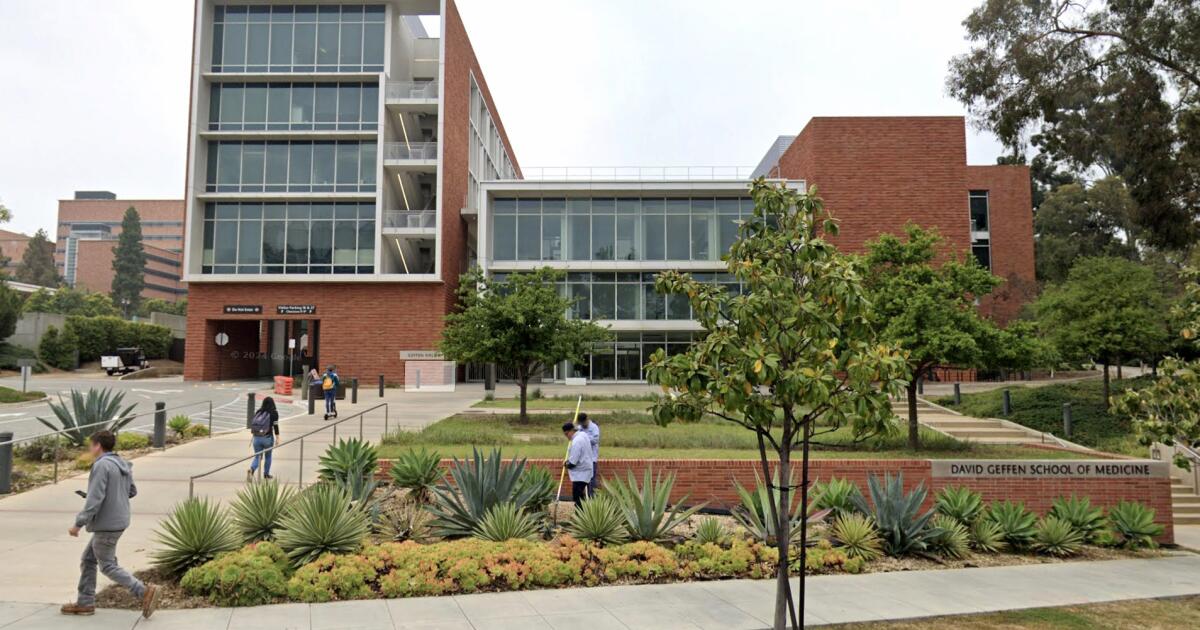
The Trump administration has stepped up its assault on U.S. medical schools in recent days with stern letters to the David Geffen School of Medicine at UCLA on May 6 and a similar missive to the Yale School of Medicine on Thursday.
Both letters from the Department of Justice allege that the schools have quietly allowed the race of applicants to be a consideration in admissions, which the DOJ asserts to be a violation of a 2023 Supreme Court decision that found racial preferences in university admission policies to be unlawful.
But these claims — and a legal filing the DOJ made in February to join a lawsuit accusing UCLA of illicit discrimination against white and Asian applicants — raise questions about its campaign against elite medical schools that the DOJ may not wish to answer.
Entire dimensions of physician quality — judgment, communication, professionalism, leadership, resilience, bedside manner, decision-making under pressure — are dismissed as irrelevant ‘woke’ distractions.
— Terry L. Simpson, M.D.
One is whether it has any conception of what it takes to make a good doctor. The other is whether the DOJ is pursuing a fundamentally racist campaign aimed at keeping white advantages in higher education secure. The short answers, respectively, are no, and yes.
Let’s take a deeper look.
The DOJ’s attack on the medical schools is explicitly part of its campaign against “DEI” programs — those devoted to diversity, equity and inclusion. This has been going on for years, emanating chiefly from the far right. In 2014, I examined one of its origin documents, an article in the right-wing Washington Free Beacon that labeled UCLA a “failed medical school,” ostensibly because it was admitting unqualified Black and Hispanic applicants.
The article and the DOJ complaint have relied on the same observation, which is that Black and Hispanic UCLA applicants’ median undergraduate grade point averages and scores on the Medical College Admissions Test, or MCAT, are lower than those of white and Asian applicants.
Therefore, the argument proceeds, Black and Hispanic applicants get into medical school ahead of whites and Asians with similar scores and grades solely because of their race and ethnic background.
The Beacon article had numerous flaws, which I identified at the time. Among them was its assertion, voiced by an anonymous source, that “a third to a half of the medical school is incredibly unqualified” due to the flood of Black and Hispanic students.
But over the three years examined by the Beacon the number of nonwhite and non-Asian students at the Geffen school, which admits about 170 students each year, had increased by only 30. So even if every single one of those students was “incredibly unqualified,” they only accounted for 17% of the class, not a third to a half.
The DOJ case is based on the notion that MCAT scores and undergraduate grades are the absolute, indisputable, immutable guideposts to applicants’ suitability for admission and consequently, their future medical abilities.
Nothing else matters, such as efforts to measure applicants’ cultural backgrounds, empathy, compassion and interpersonal skills — to list non-academic factors the DOJ suggests should be out-of-bounds for admissions committees. But it’s dead wrong about that.
What do grades and MCAT scores measure? To some extent, they point to a talent for taking tests. “I’m a good test-taker,” says Terry L. Simpson, a practicing bariatric physician in Ventura County and a vigorous debunker of medical folderol online, “but that doesn’t mean I’m smarter or more talented than the guy next to me. It means I’m good at test-taking.”
Simpson, who says he has trained thousands of aspiring surgeons and has participated in admissions judgments at his alma mater, the University of Chicago, says it’s essential for admissions committees to make subjective judgments about applicants’ qualities rather than relying only on objective factors like test scores — “How do they perform in interviews, what do their letters of recommendations say, what activities have they participated in and what do they want to get out of medicine?”
Simpson recently wrote online of having “seen residents with extraordinary scores struggle under pressure, collapse when uncertainty enters the room, communicate poorly with families, or lack operative judgment … and seen others with less dazzling paper metrics become superb clinicians whom nurses trust, patients adore, and colleagues rely upon at 2 AM. The body does not care about your percentile ranking when the anatomy is distorted, the bleeding starts, and the room becomes quiet. At some point experience should teach us that medicine is evaluating human beings, not sorting calculators.”
A comparison of the DOJ’s statistics on MCAT scores and GPAs at UCLA and Yale demolishes the agency’s argument that those stats are the ultimate — indeed, the only — indicators of an applicant’s suitability.
According to those figures for the 2024 entering class, the median MCAT scores and GPA of Black students at Yale (517 or 94th percentile and 3.92, respectively) were higher than those of white students at UCLA (513/86th percentile and 3.83). Following the DOJ’s logic, anyone seeking medical care should avoid the white UCLA grad in favor of the Black Yalie.
That’s not the only sign that the DOJ can’t avoid tripping over its own feet in this campaign. Its Yale letter and the UCLA complaint both cite a line from the Supreme Court’s Harvard decision stating that racial considerations in admissions “may not operate as a stereotype.” Yet that’s exactly what the DOJ has done by categorizing applicants and their test scores solely by race.
The DOJ didn’t respond to my question whether its arguments in the UCLA and Yale cases don’t reflect a racist bias of its own.
The DOJ asserts that factors such as race and national origin are “unrelated to medicine,” as it states in its letter to Yale. The truth is exactly the opposite. A robust medical literature documents that “Black and Hispanic clinicians are more likely than White clinicians to practice primary care in communities where unmet need is highest,” experts from Yale, Harvard and Tufts reported in 2023.
The DOJ’s letter to UCLA dismisses the argument that “increasing ‘diversity’ of the healthcare workforce will improve healthcare outcomes for Black and Hispanic patients,” asserting that the implication is that “denying Black and Hispanic students admission to medical school now will injure and kill Black and Hispanic patients in the future.”
That’s a caricature of the argument, however. What has been found is that matching patients with physicians of their own race, especially Black uninsured patients and Black doctors, reduces patient mortality, quite possibly because the patients have greater trust in their providers and the providers are better equipped to diagnose the patients’ complaints.
That’s especially important for institutions, such as UC, whose mission includes getting trained doctors back to the communities they serve. In few other places are the effects of inattention to social conditions more evident than in Los Angeles, Geffen Medical School Dean Steven Dubinett told me in 2024 when I asked him about the Beacon article. “We can look no further than what’s outside our front door — if I drive 15 minutes to the south from my office, life expectancy falls by 15 years.”
The signs are abundant that for the Department of Justice, the cases against UCLA and Yale amount to a performative assault on elite education, a very Trumpian approach. In announcing her launch of a series of “civil rights investigations” on March 25, Harmeet Dhillon, the Californian culture warrior Trump appointed as his assistant attorney general for civil rights, Dhillon declared online, “Another day in paradise!”
What is made crystal clear from these latest accusations is that the DOJ has shown that it has scant interest in what makes a good doctor. College grades and MCAT scores need to be good enough to get an applicant through the front door, Simpson told me. But that’s the beginning of the admissions process, not the end, and there’s a long path ahead to becoming a good doctor.
The difference in median MCAT scores between the white and Black applicants accepted at UCLA, Simpson points out, could be as few as seven answers on a test with 230 questions. “Meanwhile,” he wrote online Tuesday, “entire dimensions of physician quality — judgment, communication, professionalism, leadership, resilience, bedside manner, decision-making under pressure — are dismissed as irrelevant ‘woke’ distractions.”
Who do you want operating on you when your health is at stake? Someone who aced the MCAT in the year before he or she applied to medical school, or someone who emerged from four years of medical school and years more of professional training with the respect of his or her colleagues? Don’t ask Trump’s DOJ; you’ll get the wrong answer.

The Justice Department claims that UCLA and other med schools give too much weight to race in choosing students. But its analysis is fundamentally racist.
The Trump administration has stepped up its assault on U.S. medical schools in recent days with stern letters to the David Geffen School of Medicine at UCLA on May 6 and a similar missive to the Yale School of Medicine on Thursday.
Both letters from the Department of Justice allege that the schools have quietly allowed the race of applicants to be a consideration in admissions, which the DOJ asserts to be a violation of a 2023 Supreme Court decision that found racial preferences in university admission policies to be unlawful.
But these claims — and a legal filing the DOJ made in February to join a lawsuit accusing UCLA of illicit discrimination against white and Asian applicants — raise questions about its campaign against elite medical schools that the DOJ may not wish to answer.
Entire dimensions of physician quality — judgment, communication, professionalism, leadership, resilience, bedside manner, decision-making under pressure — are dismissed as irrelevant ‘woke’ distractions.
— Terry L. Simpson, M.D.
One is whether it has any conception of what it takes to make a good doctor. The other is whether the DOJ is pursuing a fundamentally racist campaign aimed at keeping white advantages in higher education secure. The short answers, respectively, are no, and yes.
Let’s take a deeper look.
The DOJ’s attack on the medical schools is explicitly part of its campaign against “DEI” programs — those devoted to diversity, equity and inclusion. This has been going on for years, emanating chiefly from the far right. In 2014, I examined one of its origin documents, an article in the right-wing Washington Free Beacon that labeled UCLA a “failed medical school,” ostensibly because it was admitting unqualified Black and Hispanic applicants.
The article and the DOJ complaint have relied on the same observation, which is that Black and Hispanic UCLA applicants’ median undergraduate grade point averages and scores on the Medical College Admissions Test, or MCAT, are lower than those of white and Asian applicants.
Therefore, the argument proceeds, Black and Hispanic applicants get into medical school ahead of whites and Asians with similar scores and grades solely because of their race and ethnic background.
The Beacon article had numerous flaws, which I identified at the time. Among them was its assertion, voiced by an anonymous source, that “a third to a half of the medical school is incredibly unqualified” due to the flood of Black and Hispanic students.
But over the three years examined by the Beacon the number of nonwhite and non-Asian students at the Geffen school, which admits about 170 students each year, had increased by only 30. So even if every single one of those students was “incredibly unqualified,” they only accounted for 17% of the class, not a third to a half.
The DOJ case is based on the notion that MCAT scores and undergraduate grades are the absolute, indisputable, immutable guideposts to applicants’ suitability for admission and consequently, their future medical abilities.
Nothing else matters, such as efforts to measure applicants’ cultural backgrounds, empathy, compassion and interpersonal skills — to list non-academic factors the DOJ suggests should be out-of-bounds for admissions committees. But it’s dead wrong about that.
What do grades and MCAT scores measure? To some extent, they point to a talent for taking tests. “I’m a good test-taker,” says Terry L. Simpson, a practicing bariatric physician in Ventura County and a vigorous debunker of medical folderol online, “but that doesn’t mean I’m smarter or more talented than the guy next to me. It means I’m good at test-taking.”
Simpson, who says he has trained thousands of aspiring surgeons and has participated in admissions judgments at his alma mater, the University of Chicago, says it’s essential for admissions committees to make subjective judgments about applicants’ qualities rather than relying only on objective factors like test scores — “How do they perform in interviews, what do their letters of recommendations say, what activities have they participated in and what do they want to get out of medicine?”
Simpson recently wrote online of having “seen residents with extraordinary scores struggle under pressure, collapse when uncertainty enters the room, communicate poorly with families, or lack operative judgment … and seen others with less dazzling paper metrics become superb clinicians whom nurses trust, patients adore, and colleagues rely upon at 2 AM. The body does not care about your percentile ranking when the anatomy is distorted, the bleeding starts, and the room becomes quiet. At some point experience should teach us that medicine is evaluating human beings, not sorting calculators.”
A comparison of the DOJ’s statistics on MCAT scores and GPAs at UCLA and Yale demolishes the agency’s argument that those stats are the ultimate — indeed, the only — indicators of an applicant’s suitability.
According to those figures for the 2024 entering class, the median MCAT scores and GPA of Black students at Yale (517 or 94th percentile and 3.92, respectively) were higher than those of white students at UCLA (513/86th percentile and 3.83). Following the DOJ’s logic, anyone seeking medical care should avoid the white UCLA grad in favor of the Black Yalie.
That’s not the only sign that the DOJ can’t avoid tripping over its own feet in this campaign. Its Yale letter and the UCLA complaint both cite a line from the Supreme Court’s Harvard decision stating that racial considerations in admissions “may not operate as a stereotype.” Yet that’s exactly what the DOJ has done by categorizing applicants and their test scores solely by race.
The DOJ didn’t respond to my question whether its arguments in the UCLA and Yale cases don’t reflect a racist bias of its own.
The DOJ asserts that factors such as race and national origin are “unrelated to medicine,” as it states in its letter to Yale. The truth is exactly the opposite. A robust medical literature documents that “Black and Hispanic clinicians are more likely than White clinicians to practice primary care in communities where unmet need is highest,” experts from Yale, Harvard and Tufts reported in 2023.
The DOJ’s letter to UCLA dismisses the argument that “increasing ‘diversity’ of the healthcare workforce will improve healthcare outcomes for Black and Hispanic patients,” asserting that the implication is that “denying Black and Hispanic students admission to medical school now will injure and kill Black and Hispanic patients in the future.”
That’s a caricature of the argument, however. What has been found is that matching patients with physicians of their own race, especially Black uninsured patients and Black doctors, reduces patient mortality, quite possibly because the patients have greater trust in their providers and the providers are better equipped to diagnose the patients’ complaints.
That’s especially important for institutions, such as UC, whose mission includes getting trained doctors back to the communities they serve. In few other places are the effects of inattention to social conditions more evident than in Los Angeles, Geffen Medical School Dean Steven Dubinett told me in 2024 when I asked him about the Beacon article. “We can look no further than what’s outside our front door — if I drive 15 minutes to the south from my office, life expectancy falls by 15 years.”
The signs are abundant that for the Department of Justice, the cases against UCLA and Yale amount to a performative assault on elite education, a very Trumpian approach. In announcing her launch of a series of “civil rights investigations” on March 25, Harmeet Dhillon, the Californian culture warrior Trump appointed as his assistant attorney general for civil rights, Dhillon declared online, “Another day in paradise!”
What is made crystal clear from these latest accusations is that the DOJ has shown that it has scant interest in what makes a good doctor. College grades and MCAT scores need to be good enough to get an applicant through the front door, Simpson told me. But that’s the beginning of the admissions process, not the end, and there’s a long path ahead to becoming a good doctor.
The difference in median MCAT scores between the white and Black applicants accepted at UCLA, Simpson points out, could be as few as seven answers on a test with 230 questions. “Meanwhile,” he wrote online Tuesday, “entire dimensions of physician quality — judgment, communication, professionalism, leadership, resilience, bedside manner, decision-making under pressure — are dismissed as irrelevant ‘woke’ distractions.”
Who do you want operating on you when your health is at stake? Someone who aced the MCAT in the year before he or she applied to medical school, or someone who emerged from four years of medical school and years more of professional training with the respect of his or her colleagues? Don’t ask Trump’s DOJ; you’ll get the wrong answer.

The Justice Department claims that UCLA and other med schools give too much weight to race in choosing students. But its analysis is fundamentally racist.
The Trump administration has stepped up its assault on U.S. medical schools in recent days with stern letters to the David Geffen School of Medicine at UCLA on May 6 and a similar missive to the Yale School of Medicine on Thursday.
Both letters from the Department of Justice allege that the schools have quietly allowed the race of applicants to be a consideration in admissions, which the DOJ asserts to be a violation of a 2023 Supreme Court decision that found racial preferences in university admission policies to be unlawful.
But these claims — and a legal filing the DOJ made in February to join a lawsuit accusing UCLA of illicit discrimination against white and Asian applicants — raise questions about its campaign against elite medical schools that the DOJ may not wish to answer.
Entire dimensions of physician quality — judgment, communication, professionalism, leadership, resilience, bedside manner, decision-making under pressure — are dismissed as irrelevant ‘woke’ distractions.
— Terry L. Simpson, M.D.
One is whether it has any conception of what it takes to make a good doctor. The other is whether the DOJ is pursuing a fundamentally racist campaign aimed at keeping white advantages in higher education secure. The short answers, respectively, are no, and yes.
Let’s take a deeper look.
The DOJ’s attack on the medical schools is explicitly part of its campaign against “DEI” programs — those devoted to diversity, equity and inclusion. This has been going on for years, emanating chiefly from the far right. In 2014, I examined one of its origin documents, an article in the right-wing Washington Free Beacon that labeled UCLA a “failed medical school,” ostensibly because it was admitting unqualified Black and Hispanic applicants.
The article and the DOJ complaint have relied on the same observation, which is that Black and Hispanic UCLA applicants’ median undergraduate grade point averages and scores on the Medical College Admissions Test, or MCAT, are lower than those of white and Asian applicants.
Therefore, the argument proceeds, Black and Hispanic applicants get into medical school ahead of whites and Asians with similar scores and grades solely because of their race and ethnic background.
The Beacon article had numerous flaws, which I identified at the time. Among them was its assertion, voiced by an anonymous source, that “a third to a half of the medical school is incredibly unqualified” due to the flood of Black and Hispanic students.
But over the three years examined by the Beacon the number of nonwhite and non-Asian students at the Geffen school, which admits about 170 students each year, had increased by only 30. So even if every single one of those students was “incredibly unqualified,” they only accounted for 17% of the class, not a third to a half.
The DOJ case is based on the notion that MCAT scores and undergraduate grades are the absolute, indisputable, immutable guideposts to applicants’ suitability for admission and consequently, their future medical abilities.
Nothing else matters, such as efforts to measure applicants’ cultural backgrounds, empathy, compassion and interpersonal skills — to list non-academic factors the DOJ suggests should be out-of-bounds for admissions committees. But it’s dead wrong about that.
What do grades and MCAT scores measure? To some extent, they point to a talent for taking tests. “I’m a good test-taker,” says Terry L. Simpson, a practicing bariatric physician in Ventura County and a vigorous debunker of medical folderol online, “but that doesn’t mean I’m smarter or more talented than the guy next to me. It means I’m good at test-taking.”
Simpson, who says he has trained thousands of aspiring surgeons and has participated in admissions judgments at his alma mater, the University of Chicago, says it’s essential for admissions committees to make subjective judgments about applicants’ qualities rather than relying only on objective factors like test scores — “How do they perform in interviews, what do their letters of recommendations say, what activities have they participated in and what do they want to get out of medicine?”
Simpson recently wrote online of having “seen residents with extraordinary scores struggle under pressure, collapse when uncertainty enters the room, communicate poorly with families, or lack operative judgment … and seen others with less dazzling paper metrics become superb clinicians whom nurses trust, patients adore, and colleagues rely upon at 2 AM. The body does not care about your percentile ranking when the anatomy is distorted, the bleeding starts, and the room becomes quiet. At some point experience should teach us that medicine is evaluating human beings, not sorting calculators.”
A comparison of the DOJ’s statistics on MCAT scores and GPAs at UCLA and Yale demolishes the agency’s argument that those stats are the ultimate — indeed, the only — indicators of an applicant’s suitability.
According to those figures for the 2024 entering class, the median MCAT scores and GPA of Black students at Yale (517 or 94th percentile and 3.92, respectively) were higher than those of white students at UCLA (513/86th percentile and 3.83). Following the DOJ’s logic, anyone seeking medical care should avoid the white UCLA grad in favor of the Black Yalie.
That’s not the only sign that the DOJ can’t avoid tripping over its own feet in this campaign. Its Yale letter and the UCLA complaint both cite a line from the Supreme Court’s Harvard decision stating that racial considerations in admissions “may not operate as a stereotype.” Yet that’s exactly what the DOJ has done by categorizing applicants and their test scores solely by race.
The DOJ didn’t respond to my question whether its arguments in the UCLA and Yale cases don’t reflect a racist bias of its own.
The DOJ asserts that factors such as race and national origin are “unrelated to medicine,” as it states in its letter to Yale. The truth is exactly the opposite. A robust medical literature documents that “Black and Hispanic clinicians are more likely than White clinicians to practice primary care in communities where unmet need is highest,” experts from Yale, Harvard and Tufts reported in 2023.
The DOJ’s letter to UCLA dismisses the argument that “increasing ‘diversity’ of the healthcare workforce will improve healthcare outcomes for Black and Hispanic patients,” asserting that the implication is that “denying Black and Hispanic students admission to medical school now will injure and kill Black and Hispanic patients in the future.”
That’s a caricature of the argument, however. What has been found is that matching patients with physicians of their own race, especially Black uninsured patients and Black doctors, reduces patient mortality, quite possibly because the patients have greater trust in their providers and the providers are better equipped to diagnose the patients’ complaints.
That’s especially important for institutions, such as UC, whose mission includes getting trained doctors back to the communities they serve. In few other places are the effects of inattention to social conditions more evident than in Los Angeles, Geffen Medical School Dean Steven Dubinett told me in 2024 when I asked him about the Beacon article. “We can look no further than what’s outside our front door — if I drive 15 minutes to the south from my office, life expectancy falls by 15 years.”
The signs are abundant that for the Department of Justice, the cases against UCLA and Yale amount to a performative assault on elite education, a very Trumpian approach. In announcing her launch of a series of “civil rights investigations” on March 25, Harmeet Dhillon, the Californian culture warrior Trump appointed as his assistant attorney general for civil rights, Dhillon declared online, “Another day in paradise!”
What is made crystal clear from these latest accusations is that the DOJ has shown that it has scant interest in what makes a good doctor. College grades and MCAT scores need to be good enough to get an applicant through the front door, Simpson told me. But that’s the beginning of the admissions process, not the end, and there’s a long path ahead to becoming a good doctor.
The difference in median MCAT scores between the white and Black applicants accepted at UCLA, Simpson points out, could be as few as seven answers on a test with 230 questions. “Meanwhile,” he wrote online Tuesday, “entire dimensions of physician quality — judgment, communication, professionalism, leadership, resilience, bedside manner, decision-making under pressure — are dismissed as irrelevant ‘woke’ distractions.”
Who do you want operating on you when your health is at stake? Someone who aced the MCAT in the year before he or she applied to medical school, or someone who emerged from four years of medical school and years more of professional training with the respect of his or her colleagues? Don’t ask Trump’s DOJ; you’ll get the wrong answer.
The Justice Department claims that UCLA and other med schools give too much weight to race in choosing students. But its analysis is fundamentally racist.
The Trump administration has stepped up its assault on U.S. medical schools in recent days with stern letters to the David Geffen School of Medicine at UCLA on May 6 and a similar missive to the Yale School of Medicine on Thursday.
Both letters from the Department of Justice allege that the schools have quietly allowed the race of applicants to be a consideration in admissions, which the DOJ asserts to be a violation of a 2023 Supreme Court decision that found racial preferences in university admission policies to be unlawful.
But these claims — and a legal filing the DOJ made in February to join a lawsuit accusing UCLA of illicit discrimination against white and Asian applicants — raise questions about its campaign against elite medical schools that the DOJ may not wish to answer.
Entire dimensions of physician quality — judgment, communication, professionalism, leadership, resilience, bedside manner, decision-making under pressure — are dismissed as irrelevant ‘woke’ distractions.
— Terry L. Simpson, M.D.
One is whether it has any conception of what it takes to make a good doctor. The other is whether the DOJ is pursuing a fundamentally racist campaign aimed at keeping white advantages in higher education secure. The short answers, respectively, are no, and yes.
Let’s take a deeper look.
The DOJ’s attack on the medical schools is explicitly part of its campaign against “DEI” programs — those devoted to diversity, equity and inclusion. This has been going on for years, emanating chiefly from the far right. In 2014, I examined one of its origin documents, an article in the right-wing Washington Free Beacon that labeled UCLA a “failed medical school,” ostensibly because it was admitting unqualified Black and Hispanic applicants.
The article and the DOJ complaint have relied on the same observation, which is that Black and Hispanic UCLA applicants’ median undergraduate grade point averages and scores on the Medical College Admissions Test, or MCAT, are lower than those of white and Asian applicants.
Therefore, the argument proceeds, Black and Hispanic applicants get into medical school ahead of whites and Asians with similar scores and grades solely because of their race and ethnic background.
The Beacon article had numerous flaws, which I identified at the time. Among them was its assertion, voiced by an anonymous source, that “a third to a half of the medical school is incredibly unqualified” due to the flood of Black and Hispanic students.
But over the three years examined by the Beacon the number of nonwhite and non-Asian students at the Geffen school, which admits about 170 students each year, had increased by only 30. So even if every single one of those students was “incredibly unqualified,” they only accounted for 17% of the class, not a third to a half.
The DOJ case is based on the notion that MCAT scores and undergraduate grades are the absolute, indisputable, immutable guideposts to applicants’ suitability for admission and consequently, their future medical abilities.
Nothing else matters, such as efforts to measure applicants’ cultural backgrounds, empathy, compassion and interpersonal skills — to list non-academic factors the DOJ suggests should be out-of-bounds for admissions committees. But it’s dead wrong about that.
What do grades and MCAT scores measure? To some extent, they point to a talent for taking tests. “I’m a good test-taker,” says Terry L. Simpson, a practicing bariatric physician in Ventura County and a vigorous debunker of medical folderol online, “but that doesn’t mean I’m smarter or more talented than the guy next to me. It means I’m good at test-taking.”
Simpson, who says he has trained thousands of aspiring surgeons and has participated in admissions judgments at his alma mater, the University of Chicago, says it’s essential for admissions committees to make subjective judgments about applicants’ qualities rather than relying only on objective factors like test scores — “How do they perform in interviews, what do their letters of recommendations say, what activities have they participated in and what do they want to get out of medicine?”
Simpson recently wrote online of having “seen residents with extraordinary scores struggle under pressure, collapse when uncertainty enters the room, communicate poorly with families, or lack operative judgment … and seen others with less dazzling paper metrics become superb clinicians whom nurses trust, patients adore, and colleagues rely upon at 2 AM. The body does not care about your percentile ranking when the anatomy is distorted, the bleeding starts, and the room becomes quiet. At some point experience should teach us that medicine is evaluating human beings, not sorting calculators.”
A comparison of the DOJ’s statistics on MCAT scores and GPAs at UCLA and Yale demolishes the agency’s argument that those stats are the ultimate — indeed, the only — indicators of an applicant’s suitability.
According to those figures for the 2024 entering class, the median MCAT scores and GPA of Black students at Yale (517 or 94th percentile and 3.92, respectively) were higher than those of white students at UCLA (513/86th percentile and 3.83). Following the DOJ’s logic, anyone seeking medical care should avoid the white UCLA grad in favor of the Black Yalie.
That’s not the only sign that the DOJ can’t avoid tripping over its own feet in this campaign. Its Yale letter and the UCLA complaint both cite a line from the Supreme Court’s Harvard decision stating that racial considerations in admissions “may not operate as a stereotype.” Yet that’s exactly what the DOJ has done by categorizing applicants and their test scores solely by race.
The DOJ didn’t respond to my question whether its arguments in the UCLA and Yale cases don’t reflect a racist bias of its own.
The DOJ asserts that factors such as race and national origin are “unrelated to medicine,” as it states in its letter to Yale. The truth is exactly the opposite. A robust medical literature documents that “Black and Hispanic clinicians are more likely than White clinicians to practice primary care in communities where unmet need is highest,” experts from Yale, Harvard and Tufts reported in 2023.
The DOJ’s letter to UCLA dismisses the argument that “increasing ‘diversity’ of the healthcare workforce will improve healthcare outcomes for Black and Hispanic patients,” asserting that the implication is that “denying Black and Hispanic students admission to medical school now will injure and kill Black and Hispanic patients in the future.”
That’s a caricature of the argument, however. What has been found is that matching patients with physicians of their own race, especially Black uninsured patients and Black doctors, reduces patient mortality, quite possibly because the patients have greater trust in their providers and the providers are better equipped to diagnose the patients’ complaints.
That’s especially important for institutions, such as UC, whose mission includes getting trained doctors back to the communities they serve. In few other places are the effects of inattention to social conditions more evident than in Los Angeles, Geffen Medical School Dean Steven Dubinett told me in 2024 when I asked him about the Beacon article. “We can look no further than what’s outside our front door — if I drive 15 minutes to the south from my office, life expectancy falls by 15 years.”
The signs are abundant that for the Department of Justice, the cases against UCLA and Yale amount to a performative assault on elite education, a very Trumpian approach. In announcing her launch of a series of “civil rights investigations” on March 25, Harmeet Dhillon, the Californian culture warrior Trump appointed as his assistant attorney general for civil rights, Dhillon declared online, “Another day in paradise!”
What is made crystal clear from these latest accusations is that the DOJ has shown that it has scant interest in what makes a good doctor. College grades and MCAT scores need to be good enough to get an applicant through the front door, Simpson told me. But that’s the beginning of the admissions process, not the end, and there’s a long path ahead to becoming a good doctor.
The difference in median MCAT scores between the white and Black applicants accepted at UCLA, Simpson points out, could be as few as seven answers on a test with 230 questions. “Meanwhile,” he wrote online Tuesday, “entire dimensions of physician quality — judgment, communication, professionalism, leadership, resilience, bedside manner, decision-making under pressure — are dismissed as irrelevant ‘woke’ distractions.”
Who do you want operating on you when your health is at stake? Someone who aced the MCAT in the year before he or she applied to medical school, or someone who emerged from four years of medical school and years more of professional training with the respect of his or her colleagues? Don’t ask Trump’s DOJ; you’ll get the wrong answer.

The Justice Department claims that UCLA and other med schools give too much weight to race in choosing students. But its analysis is fundamentally racist.
The Trump administration has stepped up its assault on U.S. medical schools in recent days with stern letters to the David Geffen School of Medicine at UCLA on May 6 and a similar missive to the Yale School of Medicine on Thursday.
Both letters from the Department of Justice allege that the schools have quietly allowed the race of applicants to be a consideration in admissions, which the DOJ asserts to be a violation of a 2023 Supreme Court decision that found racial preferences in university admission policies to be unlawful.
But these claims — and a legal filing the DOJ made in February to join a lawsuit accusing UCLA of illicit discrimination against white and Asian applicants — raise questions about its campaign against elite medical schools that the DOJ may not wish to answer.
Entire dimensions of physician quality — judgment, communication, professionalism, leadership, resilience, bedside manner, decision-making under pressure — are dismissed as irrelevant ‘woke’ distractions.
— Terry L. Simpson, M.D.
One is whether it has any conception of what it takes to make a good doctor. The other is whether the DOJ is pursuing a fundamentally racist campaign aimed at keeping white advantages in higher education secure. The short answers, respectively, are no, and yes.
Let’s take a deeper look.
The DOJ’s attack on the medical schools is explicitly part of its campaign against “DEI” programs — those devoted to diversity, equity and inclusion. This has been going on for years, emanating chiefly from the far right. In 2014, I examined one of its origin documents, an article in the right-wing Washington Free Beacon that labeled UCLA a “failed medical school,” ostensibly because it was admitting unqualified Black and Hispanic applicants.
The article and the DOJ complaint have relied on the same observation, which is that Black and Hispanic UCLA applicants’ median undergraduate grade point averages and scores on the Medical College Admissions Test, or MCAT, are lower than those of white and Asian applicants.
Therefore, the argument proceeds, Black and Hispanic applicants get into medical school ahead of whites and Asians with similar scores and grades solely because of their race and ethnic background.
The Beacon article had numerous flaws, which I identified at the time. Among them was its assertion, voiced by an anonymous source, that “a third to a half of the medical school is incredibly unqualified” due to the flood of Black and Hispanic students.
But over the three years examined by the Beacon the number of nonwhite and non-Asian students at the Geffen school, which admits about 170 students each year, had increased by only 30. So even if every single one of those students was “incredibly unqualified,” they only accounted for 17% of the class, not a third to a half.
The DOJ case is based on the notion that MCAT scores and undergraduate grades are the absolute, indisputable, immutable guideposts to applicants’ suitability for admission and consequently, their future medical abilities.
Nothing else matters, such as efforts to measure applicants’ cultural backgrounds, empathy, compassion and interpersonal skills — to list non-academic factors the DOJ suggests should be out-of-bounds for admissions committees. But it’s dead wrong about that.
What do grades and MCAT scores measure? To some extent, they point to a talent for taking tests. “I’m a good test-taker,” says Terry L. Simpson, a practicing bariatric physician in Ventura County and a vigorous debunker of medical folderol online, “but that doesn’t mean I’m smarter or more talented than the guy next to me. It means I’m good at test-taking.”
Simpson, who says he has trained thousands of aspiring surgeons and has participated in admissions judgments at his alma mater, the University of Chicago, says it’s essential for admissions committees to make subjective judgments about applicants’ qualities rather than relying only on objective factors like test scores — “How do they perform in interviews, what do their letters of recommendations say, what activities have they participated in and what do they want to get out of medicine?”
Simpson recently wrote online of having “seen residents with extraordinary scores struggle under pressure, collapse when uncertainty enters the room, communicate poorly with families, or lack operative judgment … and seen others with less dazzling paper metrics become superb clinicians whom nurses trust, patients adore, and colleagues rely upon at 2 AM. The body does not care about your percentile ranking when the anatomy is distorted, the bleeding starts, and the room becomes quiet. At some point experience should teach us that medicine is evaluating human beings, not sorting calculators.”
A comparison of the DOJ’s statistics on MCAT scores and GPAs at UCLA and Yale demolishes the agency’s argument that those stats are the ultimate — indeed, the only — indicators of an applicant’s suitability.
According to those figures for the 2024 entering class, the median MCAT scores and GPA of Black students at Yale (517 or 94th percentile and 3.92, respectively) were higher than those of white students at UCLA (513/86th percentile and 3.83). Following the DOJ’s logic, anyone seeking medical care should avoid the white UCLA grad in favor of the Black Yalie.
That’s not the only sign that the DOJ can’t avoid tripping over its own feet in this campaign. Its Yale letter and the UCLA complaint both cite a line from the Supreme Court’s Harvard decision stating that racial considerations in admissions “may not operate as a stereotype.” Yet that’s exactly what the DOJ has done by categorizing applicants and their test scores solely by race.
The DOJ didn’t respond to my question whether its arguments in the UCLA and Yale cases don’t reflect a racist bias of its own.
The DOJ asserts that factors such as race and national origin are “unrelated to medicine,” as it states in its letter to Yale. The truth is exactly the opposite. A robust medical literature documents that “Black and Hispanic clinicians are more likely than White clinicians to practice primary care in communities where unmet need is highest,” experts from Yale, Harvard and Tufts reported in 2023.
The DOJ’s letter to UCLA dismisses the argument that “increasing ‘diversity’ of the healthcare workforce will improve healthcare outcomes for Black and Hispanic patients,” asserting that the implication is that “denying Black and Hispanic students admission to medical school now will injure and kill Black and Hispanic patients in the future.”
That’s a caricature of the argument, however. What has been found is that matching patients with physicians of their own race, especially Black uninsured patients and Black doctors, reduces patient mortality, quite possibly because the patients have greater trust in their providers and the providers are better equipped to diagnose the patients’ complaints.
That’s especially important for institutions, such as UC, whose mission includes getting trained doctors back to the communities they serve. In few other places are the effects of inattention to social conditions more evident than in Los Angeles, Geffen Medical School Dean Steven Dubinett told me in 2024 when I asked him about the Beacon article. “We can look no further than what’s outside our front door — if I drive 15 minutes to the south from my office, life expectancy falls by 15 years.”
The signs are abundant that for the Department of Justice, the cases against UCLA and Yale amount to a performative assault on elite education, a very Trumpian approach. In announcing her launch of a series of “civil rights investigations” on March 25, Harmeet Dhillon, the Californian culture warrior Trump appointed as his assistant attorney general for civil rights, Dhillon declared online, “Another day in paradise!”
What is made crystal clear from these latest accusations is that the DOJ has shown that it has scant interest in what makes a good doctor. College grades and MCAT scores need to be good enough to get an applicant through the front door, Simpson told me. But that’s the beginning of the admissions process, not the end, and there’s a long path ahead to becoming a good doctor.
The difference in median MCAT scores between the white and Black applicants accepted at UCLA, Simpson points out, could be as few as seven answers on a test with 230 questions. “Meanwhile,” he wrote online Tuesday, “entire dimensions of physician quality — judgment, communication, professionalism, leadership, resilience, bedside manner, decision-making under pressure — are dismissed as irrelevant ‘woke’ distractions.”
Who do you want operating on you when your health is at stake? Someone who aced the MCAT in the year before he or she applied to medical school, or someone who emerged from four years of medical school and years more of professional training with the respect of his or her colleagues? Don’t ask Trump’s DOJ; you’ll get the wrong answer.
The Justice Department claims that UCLA and other med schools give too much weight to race in choosing students. But its analysis is fundamentally racist.
The Trump administration has stepped up its assault on U.S. medical schools in recent days with stern letters to the David Geffen School of Medicine at UCLA on May 6 and a similar missive to the Yale School of Medicine on Thursday.
Both letters from the Department of Justice allege that the schools have quietly allowed the race of applicants to be a consideration in admissions, which the DOJ asserts to be a violation of a 2023 Supreme Court decision that found racial preferences in university admission policies to be unlawful.
But these claims — and a legal filing the DOJ made in February to join a lawsuit accusing UCLA of illicit discrimination against white and Asian applicants — raise questions about its campaign against elite medical schools that the DOJ may not wish to answer.
Entire dimensions of physician quality — judgment, communication, professionalism, leadership, resilience, bedside manner, decision-making under pressure — are dismissed as irrelevant ‘woke’ distractions.
— Terry L. Simpson, M.D.
One is whether it has any conception of what it takes to make a good doctor. The other is whether the DOJ is pursuing a fundamentally racist campaign aimed at keeping white advantages in higher education secure. The short answers, respectively, are no, and yes.
Let’s take a deeper look.
The DOJ’s attack on the medical schools is explicitly part of its campaign against “DEI” programs — those devoted to diversity, equity and inclusion. This has been going on for years, emanating chiefly from the far right. In 2014, I examined one of its origin documents, an article in the right-wing Washington Free Beacon that labeled UCLA a “failed medical school,” ostensibly because it was admitting unqualified Black and Hispanic applicants.
The article and the DOJ complaint have relied on the same observation, which is that Black and Hispanic UCLA applicants’ median undergraduate grade point averages and scores on the Medical College Admissions Test, or MCAT, are lower than those of white and Asian applicants.
Therefore, the argument proceeds, Black and Hispanic applicants get into medical school ahead of whites and Asians with similar scores and grades solely because of their race and ethnic background.
The Beacon article had numerous flaws, which I identified at the time. Among them was its assertion, voiced by an anonymous source, that “a third to a half of the medical school is incredibly unqualified” due to the flood of Black and Hispanic students.
But over the three years examined by the Beacon the number of nonwhite and non-Asian students at the Geffen school, which admits about 170 students each year, had increased by only 30. So even if every single one of those students was “incredibly unqualified,” they only accounted for 17% of the class, not a third to a half.
The DOJ case is based on the notion that MCAT scores and undergraduate grades are the absolute, indisputable, immutable guideposts to applicants’ suitability for admission and consequently, their future medical abilities.
Nothing else matters, such as efforts to measure applicants’ cultural backgrounds, empathy, compassion and interpersonal skills — to list non-academic factors the DOJ suggests should be out-of-bounds for admissions committees. But it’s dead wrong about that.
What do grades and MCAT scores measure? To some extent, they point to a talent for taking tests. “I’m a good test-taker,” says Terry L. Simpson, a practicing bariatric physician in Ventura County and a vigorous debunker of medical folderol online, “but that doesn’t mean I’m smarter or more talented than the guy next to me. It means I’m good at test-taking.”
Simpson, who says he has trained thousands of aspiring surgeons and has participated in admissions judgments at his alma mater, the University of Chicago, says it’s essential for admissions committees to make subjective judgments about applicants’ qualities rather than relying only on objective factors like test scores — “How do they perform in interviews, what do their letters of recommendations say, what activities have they participated in and what do they want to get out of medicine?”
Simpson recently wrote online of having “seen residents with extraordinary scores struggle under pressure, collapse when uncertainty enters the room, communicate poorly with families, or lack operative judgment … and seen others with less dazzling paper metrics become superb clinicians whom nurses trust, patients adore, and colleagues rely upon at 2 AM. The body does not care about your percentile ranking when the anatomy is distorted, the bleeding starts, and the room becomes quiet. At some point experience should teach us that medicine is evaluating human beings, not sorting calculators.”
A comparison of the DOJ’s statistics on MCAT scores and GPAs at UCLA and Yale demolishes the agency’s argument that those stats are the ultimate — indeed, the only — indicators of an applicant’s suitability.
According to those figures for the 2024 entering class, the median MCAT scores and GPA of Black students at Yale (517 or 94th percentile and 3.92, respectively) were higher than those of white students at UCLA (513/86th percentile and 3.83). Following the DOJ’s logic, anyone seeking medical care should avoid the white UCLA grad in favor of the Black Yalie.
That’s not the only sign that the DOJ can’t avoid tripping over its own feet in this campaign. Its Yale letter and the UCLA complaint both cite a line from the Supreme Court’s Harvard decision stating that racial considerations in admissions “may not operate as a stereotype.” Yet that’s exactly what the DOJ has done by categorizing applicants and their test scores solely by race.
The DOJ didn’t respond to my question whether its arguments in the UCLA and Yale cases don’t reflect a racist bias of its own.
The DOJ asserts that factors such as race and national origin are “unrelated to medicine,” as it states in its letter to Yale. The truth is exactly the opposite. A robust medical literature documents that “Black and Hispanic clinicians are more likely than White clinicians to practice primary care in communities where unmet need is highest,” experts from Yale, Harvard and Tufts reported in 2023.
The DOJ’s letter to UCLA dismisses the argument that “increasing ‘diversity’ of the healthcare workforce will improve healthcare outcomes for Black and Hispanic patients,” asserting that the implication is that “denying Black and Hispanic students admission to medical school now will injure and kill Black and Hispanic patients in the future.”
That’s a caricature of the argument, however. What has been found is that matching patients with physicians of their own race, especially Black uninsured patients and Black doctors, reduces patient mortality, quite possibly because the patients have greater trust in their providers and the providers are better equipped to diagnose the patients’ complaints.
That’s especially important for institutions, such as UC, whose mission includes getting trained doctors back to the communities they serve. In few other places are the effects of inattention to social conditions more evident than in Los Angeles, Geffen Medical School Dean Steven Dubinett told me in 2024 when I asked him about the Beacon article. “We can look no further than what’s outside our front door — if I drive 15 minutes to the south from my office, life expectancy falls by 15 years.”
The signs are abundant that for the Department of Justice, the cases against UCLA and Yale amount to a performative assault on elite education, a very Trumpian approach. In announcing her launch of a series of “civil rights investigations” on March 25, Harmeet Dhillon, the Californian culture warrior Trump appointed as his assistant attorney general for civil rights, Dhillon declared online, “Another day in paradise!”
What is made crystal clear from these latest accusations is that the DOJ has shown that it has scant interest in what makes a good doctor. College grades and MCAT scores need to be good enough to get an applicant through the front door, Simpson told me. But that’s the beginning of the admissions process, not the end, and there’s a long path ahead to becoming a good doctor.
The difference in median MCAT scores between the white and Black applicants accepted at UCLA, Simpson points out, could be as few as seven answers on a test with 230 questions. “Meanwhile,” he wrote online Tuesday, “entire dimensions of physician quality — judgment, communication, professionalism, leadership, resilience, bedside manner, decision-making under pressure — are dismissed as irrelevant ‘woke’ distractions.”
Who do you want operating on you when your health is at stake? Someone who aced the MCAT in the year before he or she applied to medical school, or someone who emerged from four years of medical school and years more of professional training with the respect of his or her colleagues? Don’t ask Trump’s DOJ; you’ll get the wrong answer.
The Justice Department claims that UCLA and other med schools give too much weight to race in choosing students. But its analysis is fundamentally racist.
The Trump administration has stepped up its assault on U.S. medical schools in recent days with stern letters to the David Geffen School of Medicine at UCLA on May 6 and a similar missive to the Yale School of Medicine on Thursday.
Both letters from the Department of Justice allege that the schools have quietly allowed the race of applicants to be a consideration in admissions, which the DOJ asserts to be a violation of a 2023 Supreme Court decision that found racial preferences in university admission policies to be unlawful.
But these claims — and a legal filing the DOJ made in February to join a lawsuit accusing UCLA of illicit discrimination against white and Asian applicants — raise questions about its campaign against elite medical schools that the DOJ may not wish to answer.
Entire dimensions of physician quality — judgment, communication, professionalism, leadership, resilience, bedside manner, decision-making under pressure — are dismissed as irrelevant ‘woke’ distractions.
— Terry L. Simpson, M.D.
One is whether it has any conception of what it takes to make a good doctor. The other is whether the DOJ is pursuing a fundamentally racist campaign aimed at keeping white advantages in higher education secure. The short answers, respectively, are no, and yes.
Let’s take a deeper look.
The DOJ’s attack on the medical schools is explicitly part of its campaign against “DEI” programs — those devoted to diversity, equity and inclusion. This has been going on for years, emanating chiefly from the far right. In 2014, I examined one of its origin documents, an article in the right-wing Washington Free Beacon that labeled UCLA a “failed medical school,” ostensibly because it was admitting unqualified Black and Hispanic applicants.
The article and the DOJ complaint have relied on the same observation, which is that Black and Hispanic UCLA applicants’ median undergraduate grade point averages and scores on the Medical College Admissions Test, or MCAT, are lower than those of white and Asian applicants.
Therefore, the argument proceeds, Black and Hispanic applicants get into medical school ahead of whites and Asians with similar scores and grades solely because of their race and ethnic background.
The Beacon article had numerous flaws, which I identified at the time. Among them was its assertion, voiced by an anonymous source, that “a third to a half of the medical school is incredibly unqualified” due to the flood of Black and Hispanic students.
But over the three years examined by the Beacon the number of nonwhite and non-Asian students at the Geffen school, which admits about 170 students each year, had increased by only 30. So even if every single one of those students was “incredibly unqualified,” they only accounted for 17% of the class, not a third to a half.
The DOJ case is based on the notion that MCAT scores and undergraduate grades are the absolute, indisputable, immutable guideposts to applicants’ suitability for admission and consequently, their future medical abilities.
Nothing else matters, such as efforts to measure applicants’ cultural backgrounds, empathy, compassion and interpersonal skills — to list non-academic factors the DOJ suggests should be out-of-bounds for admissions committees. But it’s dead wrong about that.
What do grades and MCAT scores measure? To some extent, they point to a talent for taking tests. “I’m a good test-taker,” says Terry L. Simpson, a practicing bariatric physician in Ventura County and a vigorous debunker of medical folderol online, “but that doesn’t mean I’m smarter or more talented than the guy next to me. It means I’m good at test-taking.”
Simpson, who says he has trained thousands of aspiring surgeons and has participated in admissions judgments at his alma mater, the University of Chicago, says it’s essential for admissions committees to make subjective judgments about applicants’ qualities rather than relying only on objective factors like test scores — “How do they perform in interviews, what do their letters of recommendations say, what activities have they participated in and what do they want to get out of medicine?”
Simpson recently wrote online of having “seen residents with extraordinary scores struggle under pressure, collapse when uncertainty enters the room, communicate poorly with families, or lack operative judgment … and seen others with less dazzling paper metrics become superb clinicians whom nurses trust, patients adore, and colleagues rely upon at 2 AM. The body does not care about your percentile ranking when the anatomy is distorted, the bleeding starts, and the room becomes quiet. At some point experience should teach us that medicine is evaluating human beings, not sorting calculators.”
A comparison of the DOJ’s statistics on MCAT scores and GPAs at UCLA and Yale demolishes the agency’s argument that those stats are the ultimate — indeed, the only — indicators of an applicant’s suitability.
According to those figures for the 2024 entering class, the median MCAT scores and GPA of Black students at Yale (517 or 94th percentile and 3.92, respectively) were higher than those of white students at UCLA (513/86th percentile and 3.83). Following the DOJ’s logic, anyone seeking medical care should avoid the white UCLA grad in favor of the Black Yalie.
That’s not the only sign that the DOJ can’t avoid tripping over its own feet in this campaign. Its Yale letter and the UCLA complaint both cite a line from the Supreme Court’s Harvard decision stating that racial considerations in admissions “may not operate as a stereotype.” Yet that’s exactly what the DOJ has done by categorizing applicants and their test scores solely by race.
The DOJ didn’t respond to my question whether its arguments in the UCLA and Yale cases don’t reflect a racist bias of its own.
The DOJ asserts that factors such as race and national origin are “unrelated to medicine,” as it states in its letter to Yale. The truth is exactly the opposite. A robust medical literature documents that “Black and Hispanic clinicians are more likely than White clinicians to practice primary care in communities where unmet need is highest,” experts from Yale, Harvard and Tufts reported in 2023.
The DOJ’s letter to UCLA dismisses the argument that “increasing ‘diversity’ of the healthcare workforce will improve healthcare outcomes for Black and Hispanic patients,” asserting that the implication is that “denying Black and Hispanic students admission to medical school now will injure and kill Black and Hispanic patients in the future.”
That’s a caricature of the argument, however. What has been found is that matching patients with physicians of their own race, especially Black uninsured patients and Black doctors, reduces patient mortality, quite possibly because the patients have greater trust in their providers and the providers are better equipped to diagnose the patients’ complaints.
That’s especially important for institutions, such as UC, whose mission includes getting trained doctors back to the communities they serve. In few other places are the effects of inattention to social conditions more evident than in Los Angeles, Geffen Medical School Dean Steven Dubinett told me in 2024 when I asked him about the Beacon article. “We can look no further than what’s outside our front door — if I drive 15 minutes to the south from my office, life expectancy falls by 15 years.”
The signs are abundant that for the Department of Justice, the cases against UCLA and Yale amount to a performative assault on elite education, a very Trumpian approach. In announcing her launch of a series of “civil rights investigations” on March 25, Harmeet Dhillon, the Californian culture warrior Trump appointed as his assistant attorney general for civil rights, Dhillon declared online, “Another day in paradise!”
What is made crystal clear from these latest accusations is that the DOJ has shown that it has scant interest in what makes a good doctor. College grades and MCAT scores need to be good enough to get an applicant through the front door, Simpson told me. But that’s the beginning of the admissions process, not the end, and there’s a long path ahead to becoming a good doctor.
The difference in median MCAT scores between the white and Black applicants accepted at UCLA, Simpson points out, could be as few as seven answers on a test with 230 questions. “Meanwhile,” he wrote online Tuesday, “entire dimensions of physician quality — judgment, communication, professionalism, leadership, resilience, bedside manner, decision-making under pressure — are dismissed as irrelevant ‘woke’ distractions.”
Who do you want operating on you when your health is at stake? Someone who aced the MCAT in the year before he or she applied to medical school, or someone who emerged from four years of medical school and years more of professional training with the respect of his or her colleagues? Don’t ask Trump’s DOJ; you’ll get the wrong answer.
The Justice Department claims that UCLA and other med schools give too much weight to race in choosing students. But its analysis is fundamentally racist.
The Trump administration has stepped up its assault on U.S. medical schools in recent days with stern letters to the David Geffen School of Medicine at UCLA on May 6 and a similar missive to the Yale School of Medicine on Thursday.
Both letters from the Department of Justice allege that the schools have quietly allowed the race of applicants to be a consideration in admissions, which the DOJ asserts to be a violation of a 2023 Supreme Court decision that found racial preferences in university admission policies to be unlawful.
But these claims — and a legal filing the DOJ made in February to join a lawsuit accusing UCLA of illicit discrimination against white and Asian applicants — raise questions about its campaign against elite medical schools that the DOJ may not wish to answer.
Entire dimensions of physician quality — judgment, communication, professionalism, leadership, resilience, bedside manner, decision-making under pressure — are dismissed as irrelevant ‘woke’ distractions.
— Terry L. Simpson, M.D.
One is whether it has any conception of what it takes to make a good doctor. The other is whether the DOJ is pursuing a fundamentally racist campaign aimed at keeping white advantages in higher education secure. The short answers, respectively, are no, and yes.
Let’s take a deeper look.
The DOJ’s attack on the medical schools is explicitly part of its campaign against “DEI” programs — those devoted to diversity, equity and inclusion. This has been going on for years, emanating chiefly from the far right. In 2014, I examined one of its origin documents, an article in the right-wing Washington Free Beacon that labeled UCLA a “failed medical school,” ostensibly because it was admitting unqualified Black and Hispanic applicants.
The article and the DOJ complaint have relied on the same observation, which is that Black and Hispanic UCLA applicants’ median undergraduate grade point averages and scores on the Medical College Admissions Test, or MCAT, are lower than those of white and Asian applicants.
Therefore, the argument proceeds, Black and Hispanic applicants get into medical school ahead of whites and Asians with similar scores and grades solely because of their race and ethnic background.
The Beacon article had numerous flaws, which I identified at the time. Among them was its assertion, voiced by an anonymous source, that “a third to a half of the medical school is incredibly unqualified” due to the flood of Black and Hispanic students.
But over the three years examined by the Beacon the number of nonwhite and non-Asian students at the Geffen school, which admits about 170 students each year, had increased by only 30. So even if every single one of those students was “incredibly unqualified,” they only accounted for 17% of the class, not a third to a half.
The DOJ case is based on the notion that MCAT scores and undergraduate grades are the absolute, indisputable, immutable guideposts to applicants’ suitability for admission and consequently, their future medical abilities.
Nothing else matters, such as efforts to measure applicants’ cultural backgrounds, empathy, compassion and interpersonal skills — to list non-academic factors the DOJ suggests should be out-of-bounds for admissions committees. But it’s dead wrong about that.
What do grades and MCAT scores measure? To some extent, they point to a talent for taking tests. “I’m a good test-taker,” says Terry L. Simpson, a practicing bariatric physician in Ventura County and a vigorous debunker of medical folderol online, “but that doesn’t mean I’m smarter or more talented than the guy next to me. It means I’m good at test-taking.”
Simpson, who says he has trained thousands of aspiring surgeons and has participated in admissions judgments at his alma mater, the University of Chicago, says it’s essential for admissions committees to make subjective judgments about applicants’ qualities rather than relying only on objective factors like test scores — “How do they perform in interviews, what do their letters of recommendations say, what activities have they participated in and what do they want to get out of medicine?”
Simpson recently wrote online of having “seen residents with extraordinary scores struggle under pressure, collapse when uncertainty enters the room, communicate poorly with families, or lack operative judgment … and seen others with less dazzling paper metrics become superb clinicians whom nurses trust, patients adore, and colleagues rely upon at 2 AM. The body does not care about your percentile ranking when the anatomy is distorted, the bleeding starts, and the room becomes quiet. At some point experience should teach us that medicine is evaluating human beings, not sorting calculators.”
A comparison of the DOJ’s statistics on MCAT scores and GPAs at UCLA and Yale demolishes the agency’s argument that those stats are the ultimate — indeed, the only — indicators of an applicant’s suitability.
According to those figures for the 2024 entering class, the median MCAT scores and GPA of Black students at Yale (517 or 94th percentile and 3.92, respectively) were higher than those of white students at UCLA (513/86th percentile and 3.83). Following the DOJ’s logic, anyone seeking medical care should avoid the white UCLA grad in favor of the Black Yalie.
That’s not the only sign that the DOJ can’t avoid tripping over its own feet in this campaign. Its Yale letter and the UCLA complaint both cite a line from the Supreme Court’s Harvard decision stating that racial considerations in admissions “may not operate as a stereotype.” Yet that’s exactly what the DOJ has done by categorizing applicants and their test scores solely by race.
The DOJ didn’t respond to my question whether its arguments in the UCLA and Yale cases don’t reflect a racist bias of its own.
The DOJ asserts that factors such as race and national origin are “unrelated to medicine,” as it states in its letter to Yale. The truth is exactly the opposite. A robust medical literature documents that “Black and Hispanic clinicians are more likely than White clinicians to practice primary care in communities where unmet need is highest,” experts from Yale, Harvard and Tufts reported in 2023.
The DOJ’s letter to UCLA dismisses the argument that “increasing ‘diversity’ of the healthcare workforce will improve healthcare outcomes for Black and Hispanic patients,” asserting that the implication is that “denying Black and Hispanic students admission to medical school now will injure and kill Black and Hispanic patients in the future.”
That’s a caricature of the argument, however. What has been found is that matching patients with physicians of their own race, especially Black uninsured patients and Black doctors, reduces patient mortality, quite possibly because the patients have greater trust in their providers and the providers are better equipped to diagnose the patients’ complaints.
That’s especially important for institutions, such as UC, whose mission includes getting trained doctors back to the communities they serve. In few other places are the effects of inattention to social conditions more evident than in Los Angeles, Geffen Medical School Dean Steven Dubinett told me in 2024 when I asked him about the Beacon article. “We can look no further than what’s outside our front door — if I drive 15 minutes to the south from my office, life expectancy falls by 15 years.”
The signs are abundant that for the Department of Justice, the cases against UCLA and Yale amount to a performative assault on elite education, a very Trumpian approach. In announcing her launch of a series of “civil rights investigations” on March 25, Harmeet Dhillon, the Californian culture warrior Trump appointed as his assistant attorney general for civil rights, Dhillon declared online, “Another day in paradise!”
What is made crystal clear from these latest accusations is that the DOJ has shown that it has scant interest in what makes a good doctor. College grades and MCAT scores need to be good enough to get an applicant through the front door, Simpson told me. But that’s the beginning of the admissions process, not the end, and there’s a long path ahead to becoming a good doctor.
The difference in median MCAT scores between the white and Black applicants accepted at UCLA, Simpson points out, could be as few as seven answers on a test with 230 questions. “Meanwhile,” he wrote online Tuesday, “entire dimensions of physician quality — judgment, communication, professionalism, leadership, resilience, bedside manner, decision-making under pressure — are dismissed as irrelevant ‘woke’ distractions.”
Who do you want operating on you when your health is at stake? Someone who aced the MCAT in the year before he or she applied to medical school, or someone who emerged from four years of medical school and years more of professional training with the respect of his or her colleagues? Don’t ask Trump’s DOJ; you’ll get the wrong answer.

