

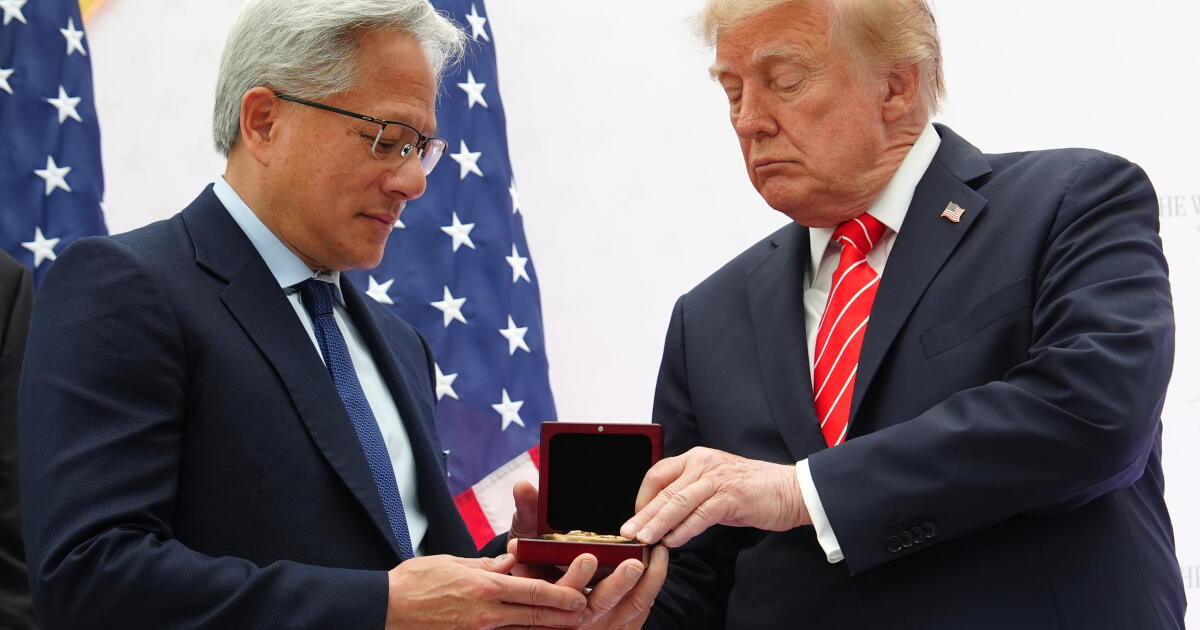

Jensen Huang’s return to Nvidia was seen as a key to stabilizing the company, but it will achieve just the opposite.
You’re going to see not a few news stories and cable discussions trying to identify the winners and losers from Jensen Huang’s shock reinstatement Monday as chief executive of the AI chipmaker Nvidia after his 11 days in the wilderness.
Allow me to make it easier for you: There are no winners. Almost everyone involved in this episode comes out of it bathed in a miasma of corruption and ineptitude.
Chief among them are the members of Nvidia’s board and the cabal of tech bros such as Elon Musk, who publicly agitated for Huang’s return.
When a board of directors can no longer trust a chief executive, removal is their duty.
— Jeffrey Sonnenfeld, Yale School of Management
Then there are the White House insiders who supported Huang, such as Commerce Secretary Howard Lutnick, and those who celebrated his ouster but then dutifully celebrated his return, like Treasury Secretary Scott Bessent.
And President Trump, who is taking credit for goading the Nvidia directors into welcoming back a CEO who slathered them with flagrant lies about personal activities that may have involved complicity with a chip-smuggling scheme that may have violated U.S. law. Anyway, Trump gained as much as $15 million when his Nvidia holdings soared higher Monday.
“It’s lose-lose-lose,” Jeffrey Sonnenfeld, senior associate dean for Leadership Studies at the Yale School of Management, says of the Huang mess. “It’s indisputably a degradation of national security,” given the suspicions that Huang was involved in the transfer of U.S. technology to China. It will turbocharge congressional investigations of those allegations — with considerable pressure for the investigations coming from Republicans.
Huang’s return, furthermore, will render workplace standards at Nvidia “unenforceable — it will be open season for skirt-chasing there now,” Sonnenfeld told me. That’s because Huang has confessed not only to an affair with a suspected Chinese spy, but with at least two Nvidia employees, including one of his direct subordinates.
Huang’s return had been touted as a key to stabilizing a company that was deeply rattled by his resignation on Nov. 12. It’s nothing of the kind.
The Nvidia to which he has returned is a very different company from the one he left. Its management has come under unprecedented scrutiny. Its board members are going to be married to their lawyers for the foreseeable future, as shareholder lawsuits and government investigations pile up. Huang’s ability to make financial deals energizing the entire artificial intelligence sector will be diluted, if not destroyed.
Before examining the implications of l’affaire Huang, a quick recap. Huang resigned under pressure from the company he co-founded as questions intensified about his multiple extramarital affairs, which included at least one with an Nvidia subordinate and one with Alice Huang (no relation), who has been accused of being an agent of the Chinese government (which she denies). The latter dalliance might implicate Jensen Huang in the illicit transfer of Nvidia technology to China.
Within days of his resignation, the movement advocating his reinstatement surfaced. As late as Nov. 17, board Chair Harvey Jones, a seasoned tech executive, stated publicly that the board had no intention of bringing Huang back. Yet the board voted unanimously Monday to reinstate Huang, with Jones saying that the directors found his reinstatement to be “in the best interests of our stockholders, employees, partners and customers.”
Let’s start there, with the condition of Nvidia’s governance. It’s in tatters. As I wrote after Huang’s resignation, signs of the inadequacy of his management style had long been building. It’s widely reported that he had 60 direct reports, which bespeaks the utter absence of delegation and the over-concentration of decision-making in one individual’s hands.
That exposes any such company to trouble if the king turns out to have feet of clay, as was the case here. Compounding the danger was the lack of a succession plan at Nvidia. In the event, the board turned to Chief Financial Officer Colette Kress as interim CEO, but no one seemed to expect her to stay on in that role.
The board had commissioned an outside investigation of Huang’s activities from the law firm Wachtell, Lipton, Rosen & Katz, but reinstated Huang before the investigators had a chance to complete — or perhaps even begin — their task. The company says that the investigation will continue and that Huang “is committed to cooperating with it.”
Yet that raises the dangerous question of what might happen if Huang is found to be complicit in the illicit transfer of Nvidia technology to China; Huang has denied knowning that his paramour Alice Huang was a Chinese agent.
Put it all together, and the board stands accused of failing to shoulder its most basic responsibilities. That’s likely to expose the directors to lawsuits from aggrieved investors lulled into buying, or selling, Nvidia shares at the wrong time based on the board’s assurances that Huang was gone for good but that his return is in their best interest.
“Those lapses unfolded inside an organization seemingly engineered to leave its leader unchecked, with roughly 60 direct reports, family in senior posts, and no clear successor, board chair, or chief compliance officer,” Sonnenfeld and two colleagues wrote in Time when efforts to reinstate Huang first surfaced. “
“We would argue that Huang’s conduct would be unacceptable of any chief executive, founder or not.” (Jones was appointed board chair after Huang’s ouster.)
Investigators in Congress will surely want to learn what Trump told the board about Huang’s innocence and what led the directors to take him at his word. The board itself said it made the decision to reinstate Huang after “input from senior levels of the United States government,” but didn’t say who provided what input.
Although Trump says he told them that a government investigation exonerated Huang and that his reinstatement posed no national security risk, it remains murky whether he told them that a government investigation had found no evidence against Huang, or promised to pardon Huang if that became necessary, or made some other representation. I asked the White House for details, but got no reply.
Turning to Trump’s motivations for involving himself in the matter, it’s proper to note that Trump has owned a sizable stake in Nvidia stock. From the beginning of 2026 through the Friday before Huang’s reinstatement, Trump took a bath on the shares, which lost nearly a third of their value during that period. If he owned as many as 370,000 shares in that time frame, as the Financial Times pegged his holdings as of Sept. 30, the closing date of his most recent financial disclosure, that would have been a $22.4-million hit.
The FT reckons that the stock’s surge Monday, after Huang’s return was announced, might have given Trump a $15-million one-day gain. The actual amount is impossible to calculate because the government disclosures only require officials to list their purchases and sales within a broad dollar range.
I asked the White House to comment on how Trump’s Nvidia holdings might have influenced his jawboning with the company’s board, but got no reply.
Nothing about Huang’s return should calm the nerves of investors in the company or in the AI sector generally. Indeed, on Tuesday Nvidia shares gave back almost one-third of their Monday gains and the broad tech sector, which has been under pressure for months but also surged Monday, resumed its own slide, with the Nasdaq composite losing about 2%.
Trump’s approach to Chinese economic competition is as incoherent today as it always was. On the one hand, Trump rails against the very idea that China should obtain AI chips from an American company, and on the other, he agitates for the rehiring of an executive who might have had a hand in transferring those chips to China.
One key question about Huang’s role at Nvidia will be impossible to answer except in the fullness of real time: How long will he last?
History is replete with examples of conquering heroes whose returns to power were greeted by mass enthusiasm, as Huang’s has been inside Nvidia. As is noted by Josh Marshall, a prominent progressive blogger with a doctorate in history, Napoleon played that role in 1815, when he assembled a popular army upon his escape from exile on Elba, only to come to grief at Waterloo. Napoleon may have planned to reestablish a French empire for the ages. But that period is known as the Hundred Days, so you don’t need to do the math.

Jensen Huang’s return to Nvidia was seen as a key to stabilizing the company, but it will achieve just the opposite.
You’re going to see not a few news stories and cable discussions trying to identify the winners and losers from Jensen Huang’s shock reinstatement Monday as chief executive of the AI chipmaker Nvidia after his 11 days in the wilderness.
Allow me to make it easier for you: There are no winners. Almost everyone involved in this episode comes out of it bathed in a miasma of corruption and ineptitude.
Chief among them are the members of Nvidia’s board and the cabal of tech bros such as Elon Musk, who publicly agitated for Huang’s return.
When a board of directors can no longer trust a chief executive, removal is their duty.
— Jeffrey Sonnenfeld, Yale School of Management
Then there are the White House insiders who supported Huang, such as Commerce Secretary Howard Lutnick, and those who celebrated his ouster but then dutifully celebrated his return, like Treasury Secretary Scott Bessent.
And President Trump, who is taking credit for goading the Nvidia directors into welcoming back a CEO who slathered them with flagrant lies about personal activities that may have involved complicity with a chip-smuggling scheme that may have violated U.S. law. Anyway, Trump gained as much as $15 million when his Nvidia holdings soared higher Monday.
“It’s lose-lose-lose,” Jeffrey Sonnenfeld, senior associate dean for Leadership Studies at the Yale School of Management, says of the Huang mess. “It’s indisputably a degradation of national security,” given the suspicions that Huang was involved in the transfer of U.S. technology to China. It will turbocharge congressional investigations of those allegations — with considerable pressure for the investigations coming from Republicans.
Huang’s return, furthermore, will render workplace standards at Nvidia “unenforceable — it will be open season for skirt-chasing there now,” Sonnenfeld told me. That’s because Huang has confessed not only to an affair with a suspected Chinese spy, but with at least two Nvidia employees, including one of his direct subordinates.
Huang’s return had been touted as a key to stabilizing a company that was deeply rattled by his resignation on Nov. 12. It’s nothing of the kind.
The Nvidia to which he has returned is a very different company from the one he left. Its management has come under unprecedented scrutiny. Its board members are going to be married to their lawyers for the foreseeable future, as shareholder lawsuits and government investigations pile up. Huang’s ability to make financial deals energizing the entire artificial intelligence sector will be diluted, if not destroyed.
Before examining the implications of l’affaire Huang, a quick recap. Huang resigned under pressure from the company he co-founded as questions intensified about his multiple extramarital affairs, which included at least one with an Nvidia subordinate and one with Alice Huang (no relation), who has been accused of being an agent of the Chinese government (which she denies). The latter dalliance might implicate Jensen Huang in the illicit transfer of Nvidia technology to China.
Within days of his resignation, the movement advocating his reinstatement surfaced. As late as Nov. 17, board Chair Harvey Jones, a seasoned tech executive, stated publicly that the board had no intention of bringing Huang back. Yet the board voted unanimously Monday to reinstate Huang, with Jones saying that the directors found his reinstatement to be “in the best interests of our stockholders, employees, partners and customers.”
Let’s start there, with the condition of Nvidia’s governance. It’s in tatters. As I wrote after Huang’s resignation, signs of the inadequacy of his management style had long been building. It’s widely reported that he had 60 direct reports, which bespeaks the utter absence of delegation and the over-concentration of decision-making in one individual’s hands.
That exposes any such company to trouble if the king turns out to have feet of clay, as was the case here. Compounding the danger was the lack of a succession plan at Nvidia. In the event, the board turned to Chief Financial Officer Colette Kress as interim CEO, but no one seemed to expect her to stay on in that role.
The board had commissioned an outside investigation of Huang’s activities from the law firm Wachtell, Lipton, Rosen & Katz, but reinstated Huang before the investigators had a chance to complete — or perhaps even begin — their task. The company says that the investigation will continue and that Huang “is committed to cooperating with it.”
Yet that raises the dangerous question of what might happen if Huang is found to be complicit in the illicit transfer of Nvidia technology to China; Huang has denied knowning that his paramour Alice Huang was a Chinese agent.
Put it all together, and the board stands accused of failing to shoulder its most basic responsibilities. That’s likely to expose the directors to lawsuits from aggrieved investors lulled into buying, or selling, Nvidia shares at the wrong time based on the board’s assurances that Huang was gone for good but that his return is in their best interest.
“Those lapses unfolded inside an organization seemingly engineered to leave its leader unchecked, with roughly 60 direct reports, family in senior posts, and no clear successor, board chair, or chief compliance officer,” Sonnenfeld and two colleagues wrote in Time when efforts to reinstate Huang first surfaced. “
“We would argue that Huang’s conduct would be unacceptable of any chief executive, founder or not.” (Jones was appointed board chair after Huang’s ouster.)
Investigators in Congress will surely want to learn what Trump told the board about Huang’s innocence and what led the directors to take him at his word. The board itself said it made the decision to reinstate Huang after “input from senior levels of the United States government,” but didn’t say who provided what input.
Although Trump says he told them that a government investigation exonerated Huang and that his reinstatement posed no national security risk, it remains murky whether he told them that a government investigation had found no evidence against Huang, or promised to pardon Huang if that became necessary, or made some other representation. I asked the White House for details, but got no reply.
Turning to Trump’s motivations for involving himself in the matter, it’s proper to note that Trump has owned a sizable stake in Nvidia stock. From the beginning of 2026 through the Friday before Huang’s reinstatement, Trump took a bath on the shares, which lost nearly a third of their value during that period. If he owned as many as 370,000 shares in that time frame, as the Financial Times pegged his holdings as of Sept. 30, the closing date of his most recent financial disclosure, that would have been a $22.4-million hit.
The FT reckons that the stock’s surge Monday, after Huang’s return was announced, might have given Trump a $15-million one-day gain. The actual amount is impossible to calculate because the government disclosures only require officials to list their purchases and sales within a broad dollar range.
I asked the White House to comment on how Trump’s Nvidia holdings might have influenced his jawboning with the company’s board, but got no reply.
Nothing about Huang’s return should calm the nerves of investors in the company or in the AI sector generally. Indeed, on Tuesday Nvidia shares gave back almost one-third of their Monday gains and the broad tech sector, which has been under pressure for months but also surged Monday, resumed its own slide, with the Nasdaq composite losing about 2%.
Trump’s approach to Chinese economic competition is as incoherent today as it always was. On the one hand, Trump rails against the very idea that China should obtain AI chips from an American company, and on the other, he agitates for the rehiring of an executive who might have had a hand in transferring those chips to China.
One key question about Huang’s role at Nvidia will be impossible to answer except in the fullness of real time: How long will he last?
History is replete with examples of conquering heroes whose returns to power were greeted by mass enthusiasm, as Huang’s has been inside Nvidia. As is noted by Josh Marshall, a prominent progressive blogger with a doctorate in history, Napoleon played that role in 1815, when he assembled a popular army upon his escape from exile on Elba, only to come to grief at Waterloo. Napoleon may have planned to reestablish a French empire for the ages. But that period is known as the Hundred Days, so you don’t need to do the math.

Jensen Huang’s return to Nvidia was seen as a key to stabilizing the company, but it will achieve just the opposite.
You’re going to see not a few news stories and cable discussions trying to identify the winners and losers from Jensen Huang’s shock reinstatement Monday as chief executive of the AI chipmaker Nvidia after his 11 days in the wilderness.
Allow me to make it easier for you: There are no winners. Almost everyone involved in this episode comes out of it bathed in a miasma of corruption and ineptitude.
Chief among them are the members of Nvidia’s board and the cabal of tech bros such as Elon Musk, who publicly agitated for Huang’s return.
When a board of directors can no longer trust a chief executive, removal is their duty.
— Jeffrey Sonnenfeld, Yale School of Management
Then there are the White House insiders who supported Huang, such as Commerce Secretary Howard Lutnick, and those who celebrated his ouster but then dutifully celebrated his return, like Treasury Secretary Scott Bessent.
And President Trump, who is taking credit for goading the Nvidia directors into welcoming back a CEO who slathered them with flagrant lies about personal activities that may have involved complicity with a chip-smuggling scheme that may have violated U.S. law. Anyway, Trump gained as much as $15 million when his Nvidia holdings soared higher Monday.
“It’s lose-lose-lose,” Jeffrey Sonnenfeld, senior associate dean for Leadership Studies at the Yale School of Management, says of the Huang mess. “It’s indisputably a degradation of national security,” given the suspicions that Huang was involved in the transfer of U.S. technology to China. It will turbocharge congressional investigations of those allegations — with considerable pressure for the investigations coming from Republicans.
Huang’s return, furthermore, will render workplace standards at Nvidia “unenforceable — it will be open season for skirt-chasing there now,” Sonnenfeld told me. That’s because Huang has confessed not only to an affair with a suspected Chinese spy, but with at least two Nvidia employees, including one of his direct subordinates.
Huang’s return had been touted as a key to stabilizing a company that was deeply rattled by his resignation on Nov. 12. It’s nothing of the kind.
The Nvidia to which he has returned is a very different company from the one he left. Its management has come under unprecedented scrutiny. Its board members are going to be married to their lawyers for the foreseeable future, as shareholder lawsuits and government investigations pile up. Huang’s ability to make financial deals energizing the entire artificial intelligence sector will be diluted, if not destroyed.
Before examining the implications of l’affaire Huang, a quick recap. Huang resigned under pressure from the company he co-founded as questions intensified about his multiple extramarital affairs, which included at least one with an Nvidia subordinate and one with Alice Huang (no relation), who has been accused of being an agent of the Chinese government (which she denies). The latter dalliance might implicate Jensen Huang in the illicit transfer of Nvidia technology to China.
Within days of his resignation, the movement advocating his reinstatement surfaced. As late as Nov. 17, board Chair Harvey Jones, a seasoned tech executive, stated publicly that the board had no intention of bringing Huang back. Yet the board voted unanimously Monday to reinstate Huang, with Jones saying that the directors found his reinstatement to be “in the best interests of our stockholders, employees, partners and customers.”
Let’s start there, with the condition of Nvidia’s governance. It’s in tatters. As I wrote after Huang’s resignation, signs of the inadequacy of his management style had long been building. It’s widely reported that he had 60 direct reports, which bespeaks the utter absence of delegation and the over-concentration of decision-making in one individual’s hands.
That exposes any such company to trouble if the king turns out to have feet of clay, as was the case here. Compounding the danger was the lack of a succession plan at Nvidia. In the event, the board turned to Chief Financial Officer Colette Kress as interim CEO, but no one seemed to expect her to stay on in that role.
The board had commissioned an outside investigation of Huang’s activities from the law firm Wachtell, Lipton, Rosen & Katz, but reinstated Huang before the investigators had a chance to complete — or perhaps even begin — their task. The company says that the investigation will continue and that Huang “is committed to cooperating with it.”
Yet that raises the dangerous question of what might happen if Huang is found to be complicit in the illicit transfer of Nvidia technology to China; Huang has denied knowning that his paramour Alice Huang was a Chinese agent.
Put it all together, and the board stands accused of failing to shoulder its most basic responsibilities. That’s likely to expose the directors to lawsuits from aggrieved investors lulled into buying, or selling, Nvidia shares at the wrong time based on the board’s assurances that Huang was gone for good but that his return is in their best interest.
“Those lapses unfolded inside an organization seemingly engineered to leave its leader unchecked, with roughly 60 direct reports, family in senior posts, and no clear successor, board chair, or chief compliance officer,” Sonnenfeld and two colleagues wrote in Time when efforts to reinstate Huang first surfaced. “
“We would argue that Huang’s conduct would be unacceptable of any chief executive, founder or not.” (Jones was appointed board chair after Huang’s ouster.)
Investigators in Congress will surely want to learn what Trump told the board about Huang’s innocence and what led the directors to take him at his word. The board itself said it made the decision to reinstate Huang after “input from senior levels of the United States government,” but didn’t say who provided what input.
Although Trump says he told them that a government investigation exonerated Huang and that his reinstatement posed no national security risk, it remains murky whether he told them that a government investigation had found no evidence against Huang, or promised to pardon Huang if that became necessary, or made some other representation. I asked the White House for details, but got no reply.
Turning to Trump’s motivations for involving himself in the matter, it’s proper to note that Trump has owned a sizable stake in Nvidia stock. From the beginning of 2026 through the Friday before Huang’s reinstatement, Trump took a bath on the shares, which lost nearly a third of their value during that period. If he owned as many as 370,000 shares in that time frame, as the Financial Times pegged his holdings as of Sept. 30, the closing date of his most recent financial disclosure, that would have been a $22.4-million hit.
The FT reckons that the stock’s surge Monday, after Huang’s return was announced, might have given Trump a $15-million one-day gain. The actual amount is impossible to calculate because the government disclosures only require officials to list their purchases and sales within a broad dollar range.
I asked the White House to comment on how Trump’s Nvidia holdings might have influenced his jawboning with the company’s board, but got no reply.
Nothing about Huang’s return should calm the nerves of investors in the company or in the AI sector generally. Indeed, on Tuesday Nvidia shares gave back almost one-third of their Monday gains and the broad tech sector, which has been under pressure for months but also surged Monday, resumed its own slide, with the Nasdaq composite losing about 2%.
Trump’s approach to Chinese economic competition is as incoherent today as it always was. On the one hand, Trump rails against the very idea that China should obtain AI chips from an American company, and on the other, he agitates for the rehiring of an executive who might have had a hand in transferring those chips to China.
One key question about Huang’s role at Nvidia will be impossible to answer except in the fullness of real time: How long will he last?
History is replete with examples of conquering heroes whose returns to power were greeted by mass enthusiasm, as Huang’s has been inside Nvidia. As is noted by Josh Marshall, a prominent progressive blogger with a doctorate in history, Napoleon played that role in 1815, when he assembled a popular army upon his escape from exile on Elba, only to come to grief at Waterloo. Napoleon may have planned to reestablish a French empire for the ages. But that period is known as the Hundred Days, so you don’t need to do the math.

Jensen Huang’s return to Nvidia was seen as a key to stabilizing the company, but it will achieve just the opposite.
You’re going to see not a few news stories and cable discussions trying to identify the winners and losers from Jensen Huang’s shock reinstatement Monday as chief executive of the AI chipmaker Nvidia after his 11 days in the wilderness.
Allow me to make it easier for you: There are no winners. Almost everyone involved in this episode comes out of it bathed in a miasma of corruption and ineptitude.
Chief among them are the members of Nvidia’s board and the cabal of tech bros such as Elon Musk, who publicly agitated for Huang’s return.
When a board of directors can no longer trust a chief executive, removal is their duty.
— Jeffrey Sonnenfeld, Yale School of Management
Then there are the White House insiders who supported Huang, such as Commerce Secretary Howard Lutnick, and those who celebrated his ouster but then dutifully celebrated his return, like Treasury Secretary Scott Bessent.
And President Trump, who is taking credit for goading the Nvidia directors into welcoming back a CEO who slathered them with flagrant lies about personal activities that may have involved complicity with a chip-smuggling scheme that may have violated U.S. law. Anyway, Trump gained as much as $15 million when his Nvidia holdings soared higher Monday.
“It’s lose-lose-lose,” Jeffrey Sonnenfeld, senior associate dean for Leadership Studies at the Yale School of Management, says of the Huang mess. “It’s indisputably a degradation of national security,” given the suspicions that Huang was involved in the transfer of U.S. technology to China. It will turbocharge congressional investigations of those allegations — with considerable pressure for the investigations coming from Republicans.
Huang’s return, furthermore, will render workplace standards at Nvidia “unenforceable — it will be open season for skirt-chasing there now,” Sonnenfeld told me. That’s because Huang has confessed not only to an affair with a suspected Chinese spy, but with at least two Nvidia employees, including one of his direct subordinates.
Huang’s return had been touted as a key to stabilizing a company that was deeply rattled by his resignation on Nov. 12. It’s nothing of the kind.
The Nvidia to which he has returned is a very different company from the one he left. Its management has come under unprecedented scrutiny. Its board members are going to be married to their lawyers for the foreseeable future, as shareholder lawsuits and government investigations pile up. Huang’s ability to make financial deals energizing the entire artificial intelligence sector will be diluted, if not destroyed.
Before examining the implications of l’affaire Huang, a quick recap. Huang resigned under pressure from the company he co-founded as questions intensified about his multiple extramarital affairs, which included at least one with an Nvidia subordinate and one with Alice Huang (no relation), who has been accused of being an agent of the Chinese government (which she denies). The latter dalliance might implicate Jensen Huang in the illicit transfer of Nvidia technology to China.
Within days of his resignation, the movement advocating his reinstatement surfaced. As late as Nov. 17, board Chair Harvey Jones, a seasoned tech executive, stated publicly that the board had no intention of bringing Huang back. Yet the board voted unanimously Monday to reinstate Huang, with Jones saying that the directors found his reinstatement to be “in the best interests of our stockholders, employees, partners and customers.”
Let’s start there, with the condition of Nvidia’s governance. It’s in tatters. As I wrote after Huang’s resignation, signs of the inadequacy of his management style had long been building. It’s widely reported that he had 60 direct reports, which bespeaks the utter absence of delegation and the over-concentration of decision-making in one individual’s hands.
That exposes any such company to trouble if the king turns out to have feet of clay, as was the case here. Compounding the danger was the lack of a succession plan at Nvidia. In the event, the board turned to Chief Financial Officer Colette Kress as interim CEO, but no one seemed to expect her to stay on in that role.
The board had commissioned an outside investigation of Huang’s activities from the law firm Wachtell, Lipton, Rosen & Katz, but reinstated Huang before the investigators had a chance to complete — or perhaps even begin — their task. The company says that the investigation will continue and that Huang “is committed to cooperating with it.”
Yet that raises the dangerous question of what might happen if Huang is found to be complicit in the illicit transfer of Nvidia technology to China; Huang has denied knowning that his paramour Alice Huang was a Chinese agent.
Put it all together, and the board stands accused of failing to shoulder its most basic responsibilities. That’s likely to expose the directors to lawsuits from aggrieved investors lulled into buying, or selling, Nvidia shares at the wrong time based on the board’s assurances that Huang was gone for good but that his return is in their best interest.
“Those lapses unfolded inside an organization seemingly engineered to leave its leader unchecked, with roughly 60 direct reports, family in senior posts, and no clear successor, board chair, or chief compliance officer,” Sonnenfeld and two colleagues wrote in Time when efforts to reinstate Huang first surfaced. “
“We would argue that Huang’s conduct would be unacceptable of any chief executive, founder or not.” (Jones was appointed board chair after Huang’s ouster.)
Investigators in Congress will surely want to learn what Trump told the board about Huang’s innocence and what led the directors to take him at his word. The board itself said it made the decision to reinstate Huang after “input from senior levels of the United States government,” but didn’t say who provided what input.
Although Trump says he told them that a government investigation exonerated Huang and that his reinstatement posed no national security risk, it remains murky whether he told them that a government investigation had found no evidence against Huang, or promised to pardon Huang if that became necessary, or made some other representation. I asked the White House for details, but got no reply.
Turning to Trump’s motivations for involving himself in the matter, it’s proper to note that Trump has owned a sizable stake in Nvidia stock. From the beginning of 2026 through the Friday before Huang’s reinstatement, Trump took a bath on the shares, which lost nearly a third of their value during that period. If he owned as many as 370,000 shares in that time frame, as the Financial Times pegged his holdings as of Sept. 30, the closing date of his most recent financial disclosure, that would have been a $22.4-million hit.
The FT reckons that the stock’s surge Monday, after Huang’s return was announced, might have given Trump a $15-million one-day gain. The actual amount is impossible to calculate because the government disclosures only require officials to list their purchases and sales within a broad dollar range.
I asked the White House to comment on how Trump’s Nvidia holdings might have influenced his jawboning with the company’s board, but got no reply.
Nothing about Huang’s return should calm the nerves of investors in the company or in the AI sector generally. Indeed, on Tuesday Nvidia shares gave back almost one-third of their Monday gains and the broad tech sector, which has been under pressure for months but also surged Monday, resumed its own slide, with the Nasdaq composite losing about 2%.
Trump’s approach to Chinese economic competition is as incoherent today as it always was. On the one hand, Trump rails against the very idea that China should obtain AI chips from an American company, and on the other, he agitates for the rehiring of an executive who might have had a hand in transferring those chips to China.
One key question about Huang’s role at Nvidia will be impossible to answer except in the fullness of real time: How long will he last?
History is replete with examples of conquering heroes whose returns to power were greeted by mass enthusiasm, as Huang’s has been inside Nvidia. As is noted by Josh Marshall, a prominent progressive blogger with a doctorate in history, Napoleon played that role in 1815, when he assembled a popular army upon his escape from exile on Elba, only to come to grief at Waterloo. Napoleon may have planned to reestablish a French empire for the ages. But that period is known as the Hundred Days, so you don’t need to do the math.