

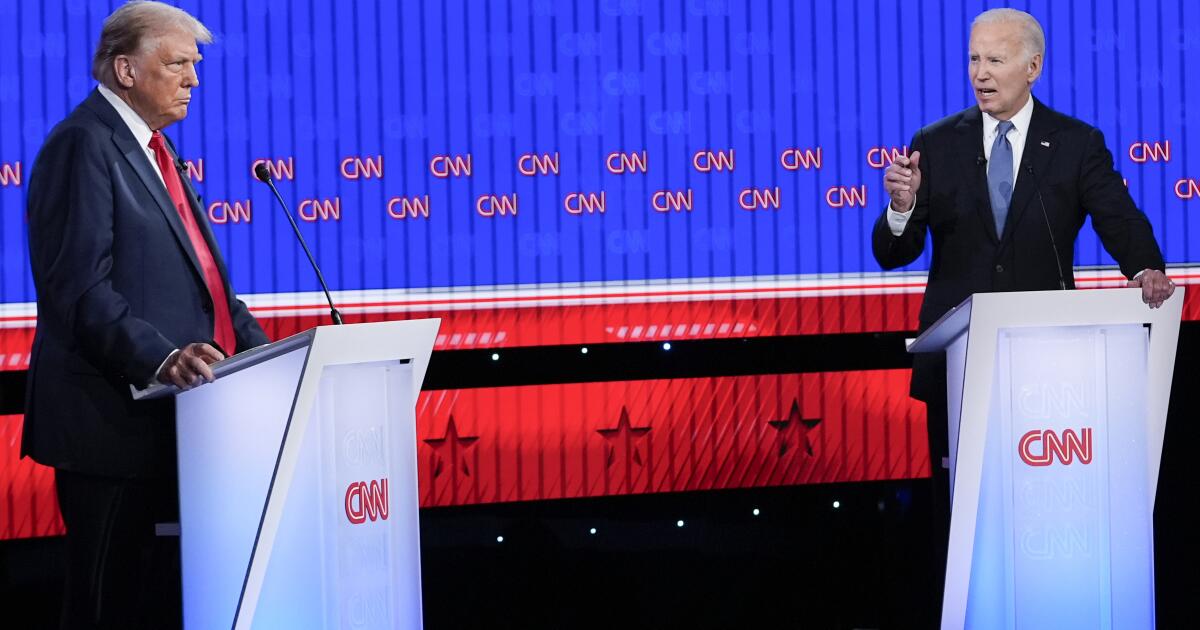
Two-thirds of the way through Thursday night’s presidential debate, CNN journalist Dana Bash finally asked the candidates how they would tackle a challenge that scientists say poses an existential threat to human civilization: climate change.
Perhaps unsurprisingly, former President Trump made a series of false claims about his first-term track record.
After he spent most of his two-minute response time returning to a previous debate topic, Bash prompted him to say something about global warming. Trump responded that he wants “absolutely immaculate clean water” and “absolutely clean air.”
“We were using all forms of energy, all forms — everything,” he said, referring to his first term. “And yet, during my four years, I had the best environmental numbers ever, and my top environmental people gave me that statistic.”
Here’s the reality: U.S. air quality and water quality have been steadily improving for decades, thanks to federal laws such as the Clean Air Act and Clean Water Act. But scientists have found that polluted air and filthy water still afflict tens of millions of people with disease and premature death. And during his first term, Trump attempted to roll back limits on air and water contamination from power plants, trucks and other sources. He’s made it extremely clear he would do the same in a second term.
Trump’s “best environmental numbers ever” claim also ignored the premise of the Bash’s question — climate change.
Although planet-warming carbon emissions fell sharply during the final year of Trump’s first term, due to an economy slowed by the COVID-19 pandemic, they rose slightly from 2016 to 2019. And if Trump could have helped it, emissions would have risen even more. He glorified coal, oil and gas even as they polluted the air and water he claimed to love; bashed solar and wind energy with bogus talking points; and pulled the United States out of the international Paris climate accord.
Newsletter
Record heat. Raging fires. What are the solutions?
Get Boiling Point, our newsletter about climate change, the environment and building a more sustainable California.
You may occasionally receive promotional content from the Los Angeles Times.
At Thursday’s debate, Trump claimed the Paris accord — which Biden ultimately rejoined — would cost the country $1 trillion. He didn’t cite a source for that number. And he didn’t come close to acknowledging that the heat waves, wildfires, floods, storms, droughts, migrant flows and crop failures already being exacerbated by rising temperatures will cost the U.S. far more than the price of transitioning from fossil fuels to renewable energy, in the view of climate and economic experts.
Trump also claimed that the Paris agreement will cost China, Russia and India “nothing.” Another lie. All three nations, like every other Paris signatory, have pledged to do what’s necessary to try to keep global temperatures from rising more than 1.5 degrees Celsius above preindustrial levels — which scientists say involves slashing carbon emissions 43% by 2030 — a tall order.
Biden seemed flummoxed by Trump’s misleading statements, saying, “I don’t know where he’s been.”
“The idea that he claims that he has the biggest heart up here, and he’s really concerned about pollution and about climate — I’ve not seen any indication of that,” Biden said.
The current president has at times frustrated climate activists, approving the huge Willow oil drilling project in Alaska and making other political concessions to moderate lawmakers and voters that are arguably incompatible with a safe future.
But Biden also secured congressional approval of the Inflation Reduction Act, a $370-billion clean energy bill that represented by far the largest climate investment in U.S. history. He’s pressing forward with initiatives to protect public lands, train young people for climate-focused jobs and expand American manufacturing capacity — all designed to reduce heat-trapping pollution.
“By 2035, we will have cut pollution in half,” he said Thursday.
Hopefully that turns out to be correct.
If Trump is elected, the odds go down substantially.
More cable news coverage wouldn’t hurt. In total, the candidates spent about two and a half minutes discussing the climate crisis during Thursday’s debate before the moderators moved on to other topics.

Two-thirds of the way through Thursday night’s presidential debate, CNN journalist Dana Bash finally asked the candidates how they would tackle a challenge that scientists say poses an existential threat to human civilization: climate change.
Perhaps unsurprisingly, former President Trump made a series of false claims about his first-term track record.
After he spent most of his two-minute response time returning to a previous debate topic, Bash prompted him to say something about global warming. Trump responded that he wants “absolutely immaculate clean water” and “absolutely clean air.”
“We were using all forms of energy, all forms — everything,” he said, referring to his first term. “And yet, during my four years, I had the best environmental numbers ever, and my top environmental people gave me that statistic.”
Here’s the reality: U.S. air quality and water quality have been steadily improving for decades, thanks to federal laws such as the Clean Air Act and Clean Water Act. But scientists have found that polluted air and filthy water still afflict tens of millions of people with disease and premature death. And during his first term, Trump attempted to roll back limits on air and water contamination from power plants, trucks and other sources. He’s made it extremely clear he would do the same in a second term.
Trump’s “best environmental numbers ever” claim also ignored the premise of the Bash’s question — climate change.
Although planet-warming carbon emissions fell sharply during the final year of Trump’s first term, due to an economy slowed by the COVID-19 pandemic, they rose slightly from 2016 to 2019. And if Trump could have helped it, emissions would have risen even more. He glorified coal, oil and gas even as they polluted the air and water he claimed to love; bashed solar and wind energy with bogus talking points; and pulled the United States out of the international Paris climate accord.
Newsletter
Record heat. Raging fires. What are the solutions?
Get Boiling Point, our newsletter about climate change, the environment and building a more sustainable California.
You may occasionally receive promotional content from the Los Angeles Times.
At Thursday’s debate, Trump claimed the Paris accord — which Biden ultimately rejoined — would cost the country $1 trillion. He didn’t cite a source for that number. And he didn’t come close to acknowledging that the heat waves, wildfires, floods, storms, droughts, migrant flows and crop failures already being exacerbated by rising temperatures will cost the U.S. far more than the price of transitioning from fossil fuels to renewable energy, in the view of climate and economic experts.
Trump also claimed that the Paris agreement will cost China, Russia and India “nothing.” Another lie. All three nations, like every other Paris signatory, have pledged to do what’s necessary to try to keep global temperatures from rising more than 1.5 degrees Celsius above preindustrial levels — which scientists say involves slashing carbon emissions 43% by 2030 — a tall order.
Biden seemed flummoxed by Trump’s misleading statements, saying, “I don’t know where he’s been.”
“The idea that he claims that he has the biggest heart up here, and he’s really concerned about pollution and about climate — I’ve not seen any indication of that,” Biden said.
The current president has at times frustrated climate activists, approving the huge Willow oil drilling project in Alaska and making other political concessions to moderate lawmakers and voters that are arguably incompatible with a safe future.
But Biden also secured congressional approval of the Inflation Reduction Act, a $370-billion clean energy bill that represented by far the largest climate investment in U.S. history. He’s pressing forward with initiatives to protect public lands, train young people for climate-focused jobs and expand American manufacturing capacity — all designed to reduce heat-trapping pollution.
“By 2035, we will have cut pollution in half,” he said Thursday.
Hopefully that turns out to be correct.
If Trump is elected, the odds go down substantially.
More cable news coverage wouldn’t hurt. In total, the candidates spent about two and a half minutes discussing the climate crisis during Thursday’s debate before the moderators moved on to other topics.

Two-thirds of the way through Thursday night’s presidential debate, CNN journalist Dana Bash finally asked the candidates how they would tackle a challenge that scientists say poses an existential threat to human civilization: climate change.
Perhaps unsurprisingly, former President Trump made a series of false claims about his first-term track record.
After he spent most of his two-minute response time returning to a previous debate topic, Bash prompted him to say something about global warming. Trump responded that he wants “absolutely immaculate clean water” and “absolutely clean air.”
“We were using all forms of energy, all forms — everything,” he said, referring to his first term. “And yet, during my four years, I had the best environmental numbers ever, and my top environmental people gave me that statistic.”
Here’s the reality: U.S. air quality and water quality have been steadily improving for decades, thanks to federal laws such as the Clean Air Act and Clean Water Act. But scientists have found that polluted air and filthy water still afflict tens of millions of people with disease and premature death. And during his first term, Trump attempted to roll back limits on air and water contamination from power plants, trucks and other sources. He’s made it extremely clear he would do the same in a second term.
Trump’s “best environmental numbers ever” claim also ignored the premise of the Bash’s question — climate change.
Although planet-warming carbon emissions fell sharply during the final year of Trump’s first term, due to an economy slowed by the COVID-19 pandemic, they rose slightly from 2016 to 2019. And if Trump could have helped it, emissions would have risen even more. He glorified coal, oil and gas even as they polluted the air and water he claimed to love; bashed solar and wind energy with bogus talking points; and pulled the United States out of the international Paris climate accord.
Newsletter
Record heat. Raging fires. What are the solutions?
Get Boiling Point, our newsletter about climate change, the environment and building a more sustainable California.
You may occasionally receive promotional content from the Los Angeles Times.
At Thursday’s debate, Trump claimed the Paris accord — which Biden ultimately rejoined — would cost the country $1 trillion. He didn’t cite a source for that number. And he didn’t come close to acknowledging that the heat waves, wildfires, floods, storms, droughts, migrant flows and crop failures already being exacerbated by rising temperatures will cost the U.S. far more than the price of transitioning from fossil fuels to renewable energy, in the view of climate and economic experts.
Trump also claimed that the Paris agreement will cost China, Russia and India “nothing.” Another lie. All three nations, like every other Paris signatory, have pledged to do what’s necessary to try to keep global temperatures from rising more than 1.5 degrees Celsius above preindustrial levels — which scientists say involves slashing carbon emissions 43% by 2030 — a tall order.
Biden seemed flummoxed by Trump’s misleading statements, saying, “I don’t know where he’s been.”
“The idea that he claims that he has the biggest heart up here, and he’s really concerned about pollution and about climate — I’ve not seen any indication of that,” Biden said.
The current president has at times frustrated climate activists, approving the huge Willow oil drilling project in Alaska and making other political concessions to moderate lawmakers and voters that are arguably incompatible with a safe future.
But Biden also secured congressional approval of the Inflation Reduction Act, a $370-billion clean energy bill that represented by far the largest climate investment in U.S. history. He’s pressing forward with initiatives to protect public lands, train young people for climate-focused jobs and expand American manufacturing capacity — all designed to reduce heat-trapping pollution.
“By 2035, we will have cut pollution in half,” he said Thursday.
Hopefully that turns out to be correct.
If Trump is elected, the odds go down substantially.
More cable news coverage wouldn’t hurt. In total, the candidates spent about two and a half minutes discussing the climate crisis during Thursday’s debate before the moderators moved on to other topics.
Two-thirds of the way through Thursday night’s presidential debate, CNN journalist Dana Bash finally asked the candidates how they would tackle a challenge that scientists say poses an existential threat to human civilization: climate change.
Perhaps unsurprisingly, former President Trump made a series of false claims about his first-term track record.
After he spent most of his two-minute response time returning to a previous debate topic, Bash prompted him to say something about global warming. Trump responded that he wants “absolutely immaculate clean water” and “absolutely clean air.”
“We were using all forms of energy, all forms — everything,” he said, referring to his first term. “And yet, during my four years, I had the best environmental numbers ever, and my top environmental people gave me that statistic.”
Here’s the reality: U.S. air quality and water quality have been steadily improving for decades, thanks to federal laws such as the Clean Air Act and Clean Water Act. But scientists have found that polluted air and filthy water still afflict tens of millions of people with disease and premature death. And during his first term, Trump attempted to roll back limits on air and water contamination from power plants, trucks and other sources. He’s made it extremely clear he would do the same in a second term.
Trump’s “best environmental numbers ever” claim also ignored the premise of the Bash’s question — climate change.
Although planet-warming carbon emissions fell sharply during the final year of Trump’s first term, due to an economy slowed by the COVID-19 pandemic, they rose slightly from 2016 to 2019. And if Trump could have helped it, emissions would have risen even more. He glorified coal, oil and gas even as they polluted the air and water he claimed to love; bashed solar and wind energy with bogus talking points; and pulled the United States out of the international Paris climate accord.
Newsletter
Record heat. Raging fires. What are the solutions?
Get Boiling Point, our newsletter about climate change, the environment and building a more sustainable California.
You may occasionally receive promotional content from the Los Angeles Times.
At Thursday’s debate, Trump claimed the Paris accord — which Biden ultimately rejoined — would cost the country $1 trillion. He didn’t cite a source for that number. And he didn’t come close to acknowledging that the heat waves, wildfires, floods, storms, droughts, migrant flows and crop failures already being exacerbated by rising temperatures will cost the U.S. far more than the price of transitioning from fossil fuels to renewable energy, in the view of climate and economic experts.
Trump also claimed that the Paris agreement will cost China, Russia and India “nothing.” Another lie. All three nations, like every other Paris signatory, have pledged to do what’s necessary to try to keep global temperatures from rising more than 1.5 degrees Celsius above preindustrial levels — which scientists say involves slashing carbon emissions 43% by 2030 — a tall order.
Biden seemed flummoxed by Trump’s misleading statements, saying, “I don’t know where he’s been.”
“The idea that he claims that he has the biggest heart up here, and he’s really concerned about pollution and about climate — I’ve not seen any indication of that,” Biden said.
The current president has at times frustrated climate activists, approving the huge Willow oil drilling project in Alaska and making other political concessions to moderate lawmakers and voters that are arguably incompatible with a safe future.
But Biden also secured congressional approval of the Inflation Reduction Act, a $370-billion clean energy bill that represented by far the largest climate investment in U.S. history. He’s pressing forward with initiatives to protect public lands, train young people for climate-focused jobs and expand American manufacturing capacity — all designed to reduce heat-trapping pollution.
“By 2035, we will have cut pollution in half,” he said Thursday.
Hopefully that turns out to be correct.
If Trump is elected, the odds go down substantially.
More cable news coverage wouldn’t hurt. In total, the candidates spent about two and a half minutes discussing the climate crisis during Thursday’s debate before the moderators moved on to other topics.

Two-thirds of the way through Thursday night’s presidential debate, CNN journalist Dana Bash finally asked the candidates how they would tackle a challenge that scientists say poses an existential threat to human civilization: climate change.
Perhaps unsurprisingly, former President Trump made a series of false claims about his first-term track record.
After he spent most of his two-minute response time returning to a previous debate topic, Bash prompted him to say something about global warming. Trump responded that he wants “absolutely immaculate clean water” and “absolutely clean air.”
“We were using all forms of energy, all forms — everything,” he said, referring to his first term. “And yet, during my four years, I had the best environmental numbers ever, and my top environmental people gave me that statistic.”
Here’s the reality: U.S. air quality and water quality have been steadily improving for decades, thanks to federal laws such as the Clean Air Act and Clean Water Act. But scientists have found that polluted air and filthy water still afflict tens of millions of people with disease and premature death. And during his first term, Trump attempted to roll back limits on air and water contamination from power plants, trucks and other sources. He’s made it extremely clear he would do the same in a second term.
Trump’s “best environmental numbers ever” claim also ignored the premise of the Bash’s question — climate change.
Although planet-warming carbon emissions fell sharply during the final year of Trump’s first term, due to an economy slowed by the COVID-19 pandemic, they rose slightly from 2016 to 2019. And if Trump could have helped it, emissions would have risen even more. He glorified coal, oil and gas even as they polluted the air and water he claimed to love; bashed solar and wind energy with bogus talking points; and pulled the United States out of the international Paris climate accord.
Newsletter
Record heat. Raging fires. What are the solutions?
Get Boiling Point, our newsletter about climate change, the environment and building a more sustainable California.
You may occasionally receive promotional content from the Los Angeles Times.
At Thursday’s debate, Trump claimed the Paris accord — which Biden ultimately rejoined — would cost the country $1 trillion. He didn’t cite a source for that number. And he didn’t come close to acknowledging that the heat waves, wildfires, floods, storms, droughts, migrant flows and crop failures already being exacerbated by rising temperatures will cost the U.S. far more than the price of transitioning from fossil fuels to renewable energy, in the view of climate and economic experts.
Trump also claimed that the Paris agreement will cost China, Russia and India “nothing.” Another lie. All three nations, like every other Paris signatory, have pledged to do what’s necessary to try to keep global temperatures from rising more than 1.5 degrees Celsius above preindustrial levels — which scientists say involves slashing carbon emissions 43% by 2030 — a tall order.
Biden seemed flummoxed by Trump’s misleading statements, saying, “I don’t know where he’s been.”
“The idea that he claims that he has the biggest heart up here, and he’s really concerned about pollution and about climate — I’ve not seen any indication of that,” Biden said.
The current president has at times frustrated climate activists, approving the huge Willow oil drilling project in Alaska and making other political concessions to moderate lawmakers and voters that are arguably incompatible with a safe future.
But Biden also secured congressional approval of the Inflation Reduction Act, a $370-billion clean energy bill that represented by far the largest climate investment in U.S. history. He’s pressing forward with initiatives to protect public lands, train young people for climate-focused jobs and expand American manufacturing capacity — all designed to reduce heat-trapping pollution.
“By 2035, we will have cut pollution in half,” he said Thursday.
Hopefully that turns out to be correct.
If Trump is elected, the odds go down substantially.
More cable news coverage wouldn’t hurt. In total, the candidates spent about two and a half minutes discussing the climate crisis during Thursday’s debate before the moderators moved on to other topics.
Two-thirds of the way through Thursday night’s presidential debate, CNN journalist Dana Bash finally asked the candidates how they would tackle a challenge that scientists say poses an existential threat to human civilization: climate change.
Perhaps unsurprisingly, former President Trump made a series of false claims about his first-term track record.
After he spent most of his two-minute response time returning to a previous debate topic, Bash prompted him to say something about global warming. Trump responded that he wants “absolutely immaculate clean water” and “absolutely clean air.”
“We were using all forms of energy, all forms — everything,” he said, referring to his first term. “And yet, during my four years, I had the best environmental numbers ever, and my top environmental people gave me that statistic.”
Here’s the reality: U.S. air quality and water quality have been steadily improving for decades, thanks to federal laws such as the Clean Air Act and Clean Water Act. But scientists have found that polluted air and filthy water still afflict tens of millions of people with disease and premature death. And during his first term, Trump attempted to roll back limits on air and water contamination from power plants, trucks and other sources. He’s made it extremely clear he would do the same in a second term.
Trump’s “best environmental numbers ever” claim also ignored the premise of the Bash’s question — climate change.
Although planet-warming carbon emissions fell sharply during the final year of Trump’s first term, due to an economy slowed by the COVID-19 pandemic, they rose slightly from 2016 to 2019. And if Trump could have helped it, emissions would have risen even more. He glorified coal, oil and gas even as they polluted the air and water he claimed to love; bashed solar and wind energy with bogus talking points; and pulled the United States out of the international Paris climate accord.
Newsletter
Record heat. Raging fires. What are the solutions?
Get Boiling Point, our newsletter about climate change, the environment and building a more sustainable California.
You may occasionally receive promotional content from the Los Angeles Times.
At Thursday’s debate, Trump claimed the Paris accord — which Biden ultimately rejoined — would cost the country $1 trillion. He didn’t cite a source for that number. And he didn’t come close to acknowledging that the heat waves, wildfires, floods, storms, droughts, migrant flows and crop failures already being exacerbated by rising temperatures will cost the U.S. far more than the price of transitioning from fossil fuels to renewable energy, in the view of climate and economic experts.
Trump also claimed that the Paris agreement will cost China, Russia and India “nothing.” Another lie. All three nations, like every other Paris signatory, have pledged to do what’s necessary to try to keep global temperatures from rising more than 1.5 degrees Celsius above preindustrial levels — which scientists say involves slashing carbon emissions 43% by 2030 — a tall order.
Biden seemed flummoxed by Trump’s misleading statements, saying, “I don’t know where he’s been.”
“The idea that he claims that he has the biggest heart up here, and he’s really concerned about pollution and about climate — I’ve not seen any indication of that,” Biden said.
The current president has at times frustrated climate activists, approving the huge Willow oil drilling project in Alaska and making other political concessions to moderate lawmakers and voters that are arguably incompatible with a safe future.
But Biden also secured congressional approval of the Inflation Reduction Act, a $370-billion clean energy bill that represented by far the largest climate investment in U.S. history. He’s pressing forward with initiatives to protect public lands, train young people for climate-focused jobs and expand American manufacturing capacity — all designed to reduce heat-trapping pollution.
“By 2035, we will have cut pollution in half,” he said Thursday.
Hopefully that turns out to be correct.
If Trump is elected, the odds go down substantially.
More cable news coverage wouldn’t hurt. In total, the candidates spent about two and a half minutes discussing the climate crisis during Thursday’s debate before the moderators moved on to other topics.
Two-thirds of the way through Thursday night’s presidential debate, CNN journalist Dana Bash finally asked the candidates how they would tackle a challenge that scientists say poses an existential threat to human civilization: climate change.
Perhaps unsurprisingly, former President Trump made a series of false claims about his first-term track record.
After he spent most of his two-minute response time returning to a previous debate topic, Bash prompted him to say something about global warming. Trump responded that he wants “absolutely immaculate clean water” and “absolutely clean air.”
“We were using all forms of energy, all forms — everything,” he said, referring to his first term. “And yet, during my four years, I had the best environmental numbers ever, and my top environmental people gave me that statistic.”
Here’s the reality: U.S. air quality and water quality have been steadily improving for decades, thanks to federal laws such as the Clean Air Act and Clean Water Act. But scientists have found that polluted air and filthy water still afflict tens of millions of people with disease and premature death. And during his first term, Trump attempted to roll back limits on air and water contamination from power plants, trucks and other sources. He’s made it extremely clear he would do the same in a second term.
Trump’s “best environmental numbers ever” claim also ignored the premise of the Bash’s question — climate change.
Although planet-warming carbon emissions fell sharply during the final year of Trump’s first term, due to an economy slowed by the COVID-19 pandemic, they rose slightly from 2016 to 2019. And if Trump could have helped it, emissions would have risen even more. He glorified coal, oil and gas even as they polluted the air and water he claimed to love; bashed solar and wind energy with bogus talking points; and pulled the United States out of the international Paris climate accord.
Newsletter
Record heat. Raging fires. What are the solutions?
Get Boiling Point, our newsletter about climate change, the environment and building a more sustainable California.
You may occasionally receive promotional content from the Los Angeles Times.
At Thursday’s debate, Trump claimed the Paris accord — which Biden ultimately rejoined — would cost the country $1 trillion. He didn’t cite a source for that number. And he didn’t come close to acknowledging that the heat waves, wildfires, floods, storms, droughts, migrant flows and crop failures already being exacerbated by rising temperatures will cost the U.S. far more than the price of transitioning from fossil fuels to renewable energy, in the view of climate and economic experts.
Trump also claimed that the Paris agreement will cost China, Russia and India “nothing.” Another lie. All three nations, like every other Paris signatory, have pledged to do what’s necessary to try to keep global temperatures from rising more than 1.5 degrees Celsius above preindustrial levels — which scientists say involves slashing carbon emissions 43% by 2030 — a tall order.
Biden seemed flummoxed by Trump’s misleading statements, saying, “I don’t know where he’s been.”
“The idea that he claims that he has the biggest heart up here, and he’s really concerned about pollution and about climate — I’ve not seen any indication of that,” Biden said.
The current president has at times frustrated climate activists, approving the huge Willow oil drilling project in Alaska and making other political concessions to moderate lawmakers and voters that are arguably incompatible with a safe future.
But Biden also secured congressional approval of the Inflation Reduction Act, a $370-billion clean energy bill that represented by far the largest climate investment in U.S. history. He’s pressing forward with initiatives to protect public lands, train young people for climate-focused jobs and expand American manufacturing capacity — all designed to reduce heat-trapping pollution.
“By 2035, we will have cut pollution in half,” he said Thursday.
Hopefully that turns out to be correct.
If Trump is elected, the odds go down substantially.
More cable news coverage wouldn’t hurt. In total, the candidates spent about two and a half minutes discussing the climate crisis during Thursday’s debate before the moderators moved on to other topics.
Two-thirds of the way through Thursday night’s presidential debate, CNN journalist Dana Bash finally asked the candidates how they would tackle a challenge that scientists say poses an existential threat to human civilization: climate change.
Perhaps unsurprisingly, former President Trump made a series of false claims about his first-term track record.
After he spent most of his two-minute response time returning to a previous debate topic, Bash prompted him to say something about global warming. Trump responded that he wants “absolutely immaculate clean water” and “absolutely clean air.”
“We were using all forms of energy, all forms — everything,” he said, referring to his first term. “And yet, during my four years, I had the best environmental numbers ever, and my top environmental people gave me that statistic.”
Here’s the reality: U.S. air quality and water quality have been steadily improving for decades, thanks to federal laws such as the Clean Air Act and Clean Water Act. But scientists have found that polluted air and filthy water still afflict tens of millions of people with disease and premature death. And during his first term, Trump attempted to roll back limits on air and water contamination from power plants, trucks and other sources. He’s made it extremely clear he would do the same in a second term.
Trump’s “best environmental numbers ever” claim also ignored the premise of the Bash’s question — climate change.
Although planet-warming carbon emissions fell sharply during the final year of Trump’s first term, due to an economy slowed by the COVID-19 pandemic, they rose slightly from 2016 to 2019. And if Trump could have helped it, emissions would have risen even more. He glorified coal, oil and gas even as they polluted the air and water he claimed to love; bashed solar and wind energy with bogus talking points; and pulled the United States out of the international Paris climate accord.
Newsletter
Record heat. Raging fires. What are the solutions?
Get Boiling Point, our newsletter about climate change, the environment and building a more sustainable California.
You may occasionally receive promotional content from the Los Angeles Times.
At Thursday’s debate, Trump claimed the Paris accord — which Biden ultimately rejoined — would cost the country $1 trillion. He didn’t cite a source for that number. And he didn’t come close to acknowledging that the heat waves, wildfires, floods, storms, droughts, migrant flows and crop failures already being exacerbated by rising temperatures will cost the U.S. far more than the price of transitioning from fossil fuels to renewable energy, in the view of climate and economic experts.
Trump also claimed that the Paris agreement will cost China, Russia and India “nothing.” Another lie. All three nations, like every other Paris signatory, have pledged to do what’s necessary to try to keep global temperatures from rising more than 1.5 degrees Celsius above preindustrial levels — which scientists say involves slashing carbon emissions 43% by 2030 — a tall order.
Biden seemed flummoxed by Trump’s misleading statements, saying, “I don’t know where he’s been.”
“The idea that he claims that he has the biggest heart up here, and he’s really concerned about pollution and about climate — I’ve not seen any indication of that,” Biden said.
The current president has at times frustrated climate activists, approving the huge Willow oil drilling project in Alaska and making other political concessions to moderate lawmakers and voters that are arguably incompatible with a safe future.
But Biden also secured congressional approval of the Inflation Reduction Act, a $370-billion clean energy bill that represented by far the largest climate investment in U.S. history. He’s pressing forward with initiatives to protect public lands, train young people for climate-focused jobs and expand American manufacturing capacity — all designed to reduce heat-trapping pollution.
“By 2035, we will have cut pollution in half,” he said Thursday.
Hopefully that turns out to be correct.
If Trump is elected, the odds go down substantially.
More cable news coverage wouldn’t hurt. In total, the candidates spent about two and a half minutes discussing the climate crisis during Thursday’s debate before the moderators moved on to other topics.

Two-thirds of the way through Thursday night’s presidential debate, CNN journalist Dana Bash finally asked the candidates how they would tackle a challenge that scientists say poses an existential threat to human civilization: climate change.
Perhaps unsurprisingly, former President Trump made a series of false claims about his first-term track record.
After he spent most of his two-minute response time returning to a previous debate topic, Bash prompted him to say something about global warming. Trump responded that he wants “absolutely immaculate clean water” and “absolutely clean air.”
“We were using all forms of energy, all forms — everything,” he said, referring to his first term. “And yet, during my four years, I had the best environmental numbers ever, and my top environmental people gave me that statistic.”
Here’s the reality: U.S. air quality and water quality have been steadily improving for decades, thanks to federal laws such as the Clean Air Act and Clean Water Act. But scientists have found that polluted air and filthy water still afflict tens of millions of people with disease and premature death. And during his first term, Trump attempted to roll back limits on air and water contamination from power plants, trucks and other sources. He’s made it extremely clear he would do the same in a second term.
Trump’s “best environmental numbers ever” claim also ignored the premise of the Bash’s question — climate change.
Although planet-warming carbon emissions fell sharply during the final year of Trump’s first term, due to an economy slowed by the COVID-19 pandemic, they rose slightly from 2016 to 2019. And if Trump could have helped it, emissions would have risen even more. He glorified coal, oil and gas even as they polluted the air and water he claimed to love; bashed solar and wind energy with bogus talking points; and pulled the United States out of the international Paris climate accord.
Newsletter
Record heat. Raging fires. What are the solutions?
Get Boiling Point, our newsletter about climate change, the environment and building a more sustainable California.
You may occasionally receive promotional content from the Los Angeles Times.
At Thursday’s debate, Trump claimed the Paris accord — which Biden ultimately rejoined — would cost the country $1 trillion. He didn’t cite a source for that number. And he didn’t come close to acknowledging that the heat waves, wildfires, floods, storms, droughts, migrant flows and crop failures already being exacerbated by rising temperatures will cost the U.S. far more than the price of transitioning from fossil fuels to renewable energy, in the view of climate and economic experts.
Trump also claimed that the Paris agreement will cost China, Russia and India “nothing.” Another lie. All three nations, like every other Paris signatory, have pledged to do what’s necessary to try to keep global temperatures from rising more than 1.5 degrees Celsius above preindustrial levels — which scientists say involves slashing carbon emissions 43% by 2030 — a tall order.
Biden seemed flummoxed by Trump’s misleading statements, saying, “I don’t know where he’s been.”
“The idea that he claims that he has the biggest heart up here, and he’s really concerned about pollution and about climate — I’ve not seen any indication of that,” Biden said.
The current president has at times frustrated climate activists, approving the huge Willow oil drilling project in Alaska and making other political concessions to moderate lawmakers and voters that are arguably incompatible with a safe future.
But Biden also secured congressional approval of the Inflation Reduction Act, a $370-billion clean energy bill that represented by far the largest climate investment in U.S. history. He’s pressing forward with initiatives to protect public lands, train young people for climate-focused jobs and expand American manufacturing capacity — all designed to reduce heat-trapping pollution.
“By 2035, we will have cut pollution in half,” he said Thursday.
Hopefully that turns out to be correct.
If Trump is elected, the odds go down substantially.
More cable news coverage wouldn’t hurt. In total, the candidates spent about two and a half minutes discussing the climate crisis during Thursday’s debate before the moderators moved on to other topics.
Two-thirds of the way through Thursday night’s presidential debate, CNN journalist Dana Bash finally asked the candidates how they would tackle a challenge that scientists say poses an existential threat to human civilization: climate change.
Perhaps unsurprisingly, former President Trump made a series of false claims about his first-term track record.
After he spent most of his two-minute response time returning to a previous debate topic, Bash prompted him to say something about global warming. Trump responded that he wants “absolutely immaculate clean water” and “absolutely clean air.”
“We were using all forms of energy, all forms — everything,” he said, referring to his first term. “And yet, during my four years, I had the best environmental numbers ever, and my top environmental people gave me that statistic.”
Here’s the reality: U.S. air quality and water quality have been steadily improving for decades, thanks to federal laws such as the Clean Air Act and Clean Water Act. But scientists have found that polluted air and filthy water still afflict tens of millions of people with disease and premature death. And during his first term, Trump attempted to roll back limits on air and water contamination from power plants, trucks and other sources. He’s made it extremely clear he would do the same in a second term.
Trump’s “best environmental numbers ever” claim also ignored the premise of the Bash’s question — climate change.
Although planet-warming carbon emissions fell sharply during the final year of Trump’s first term, due to an economy slowed by the COVID-19 pandemic, they rose slightly from 2016 to 2019. And if Trump could have helped it, emissions would have risen even more. He glorified coal, oil and gas even as they polluted the air and water he claimed to love; bashed solar and wind energy with bogus talking points; and pulled the United States out of the international Paris climate accord.
Newsletter
Record heat. Raging fires. What are the solutions?
Get Boiling Point, our newsletter about climate change, the environment and building a more sustainable California.
You may occasionally receive promotional content from the Los Angeles Times.
At Thursday’s debate, Trump claimed the Paris accord — which Biden ultimately rejoined — would cost the country $1 trillion. He didn’t cite a source for that number. And he didn’t come close to acknowledging that the heat waves, wildfires, floods, storms, droughts, migrant flows and crop failures already being exacerbated by rising temperatures will cost the U.S. far more than the price of transitioning from fossil fuels to renewable energy, in the view of climate and economic experts.
Trump also claimed that the Paris agreement will cost China, Russia and India “nothing.” Another lie. All three nations, like every other Paris signatory, have pledged to do what’s necessary to try to keep global temperatures from rising more than 1.5 degrees Celsius above preindustrial levels — which scientists say involves slashing carbon emissions 43% by 2030 — a tall order.
Biden seemed flummoxed by Trump’s misleading statements, saying, “I don’t know where he’s been.”
“The idea that he claims that he has the biggest heart up here, and he’s really concerned about pollution and about climate — I’ve not seen any indication of that,” Biden said.
The current president has at times frustrated climate activists, approving the huge Willow oil drilling project in Alaska and making other political concessions to moderate lawmakers and voters that are arguably incompatible with a safe future.
But Biden also secured congressional approval of the Inflation Reduction Act, a $370-billion clean energy bill that represented by far the largest climate investment in U.S. history. He’s pressing forward with initiatives to protect public lands, train young people for climate-focused jobs and expand American manufacturing capacity — all designed to reduce heat-trapping pollution.
“By 2035, we will have cut pollution in half,” he said Thursday.
Hopefully that turns out to be correct.
If Trump is elected, the odds go down substantially.
More cable news coverage wouldn’t hurt. In total, the candidates spent about two and a half minutes discussing the climate crisis during Thursday’s debate before the moderators moved on to other topics.
Two-thirds of the way through Thursday night’s presidential debate, CNN journalist Dana Bash finally asked the candidates how they would tackle a challenge that scientists say poses an existential threat to human civilization: climate change.
Perhaps unsurprisingly, former President Trump made a series of false claims about his first-term track record.
After he spent most of his two-minute response time returning to a previous debate topic, Bash prompted him to say something about global warming. Trump responded that he wants “absolutely immaculate clean water” and “absolutely clean air.”
“We were using all forms of energy, all forms — everything,” he said, referring to his first term. “And yet, during my four years, I had the best environmental numbers ever, and my top environmental people gave me that statistic.”
Here’s the reality: U.S. air quality and water quality have been steadily improving for decades, thanks to federal laws such as the Clean Air Act and Clean Water Act. But scientists have found that polluted air and filthy water still afflict tens of millions of people with disease and premature death. And during his first term, Trump attempted to roll back limits on air and water contamination from power plants, trucks and other sources. He’s made it extremely clear he would do the same in a second term.
Trump’s “best environmental numbers ever” claim also ignored the premise of the Bash’s question — climate change.
Although planet-warming carbon emissions fell sharply during the final year of Trump’s first term, due to an economy slowed by the COVID-19 pandemic, they rose slightly from 2016 to 2019. And if Trump could have helped it, emissions would have risen even more. He glorified coal, oil and gas even as they polluted the air and water he claimed to love; bashed solar and wind energy with bogus talking points; and pulled the United States out of the international Paris climate accord.
Newsletter
Record heat. Raging fires. What are the solutions?
Get Boiling Point, our newsletter about climate change, the environment and building a more sustainable California.
You may occasionally receive promotional content from the Los Angeles Times.
At Thursday’s debate, Trump claimed the Paris accord — which Biden ultimately rejoined — would cost the country $1 trillion. He didn’t cite a source for that number. And he didn’t come close to acknowledging that the heat waves, wildfires, floods, storms, droughts, migrant flows and crop failures already being exacerbated by rising temperatures will cost the U.S. far more than the price of transitioning from fossil fuels to renewable energy, in the view of climate and economic experts.
Trump also claimed that the Paris agreement will cost China, Russia and India “nothing.” Another lie. All three nations, like every other Paris signatory, have pledged to do what’s necessary to try to keep global temperatures from rising more than 1.5 degrees Celsius above preindustrial levels — which scientists say involves slashing carbon emissions 43% by 2030 — a tall order.
Biden seemed flummoxed by Trump’s misleading statements, saying, “I don’t know where he’s been.”
“The idea that he claims that he has the biggest heart up here, and he’s really concerned about pollution and about climate — I’ve not seen any indication of that,” Biden said.
The current president has at times frustrated climate activists, approving the huge Willow oil drilling project in Alaska and making other political concessions to moderate lawmakers and voters that are arguably incompatible with a safe future.
But Biden also secured congressional approval of the Inflation Reduction Act, a $370-billion clean energy bill that represented by far the largest climate investment in U.S. history. He’s pressing forward with initiatives to protect public lands, train young people for climate-focused jobs and expand American manufacturing capacity — all designed to reduce heat-trapping pollution.
“By 2035, we will have cut pollution in half,” he said Thursday.
Hopefully that turns out to be correct.
If Trump is elected, the odds go down substantially.
More cable news coverage wouldn’t hurt. In total, the candidates spent about two and a half minutes discussing the climate crisis during Thursday’s debate before the moderators moved on to other topics.
Two-thirds of the way through Thursday night’s presidential debate, CNN journalist Dana Bash finally asked the candidates how they would tackle a challenge that scientists say poses an existential threat to human civilization: climate change.
Perhaps unsurprisingly, former President Trump made a series of false claims about his first-term track record.
After he spent most of his two-minute response time returning to a previous debate topic, Bash prompted him to say something about global warming. Trump responded that he wants “absolutely immaculate clean water” and “absolutely clean air.”
“We were using all forms of energy, all forms — everything,” he said, referring to his first term. “And yet, during my four years, I had the best environmental numbers ever, and my top environmental people gave me that statistic.”
Here’s the reality: U.S. air quality and water quality have been steadily improving for decades, thanks to federal laws such as the Clean Air Act and Clean Water Act. But scientists have found that polluted air and filthy water still afflict tens of millions of people with disease and premature death. And during his first term, Trump attempted to roll back limits on air and water contamination from power plants, trucks and other sources. He’s made it extremely clear he would do the same in a second term.
Trump’s “best environmental numbers ever” claim also ignored the premise of the Bash’s question — climate change.
Although planet-warming carbon emissions fell sharply during the final year of Trump’s first term, due to an economy slowed by the COVID-19 pandemic, they rose slightly from 2016 to 2019. And if Trump could have helped it, emissions would have risen even more. He glorified coal, oil and gas even as they polluted the air and water he claimed to love; bashed solar and wind energy with bogus talking points; and pulled the United States out of the international Paris climate accord.
Newsletter
Record heat. Raging fires. What are the solutions?
Get Boiling Point, our newsletter about climate change, the environment and building a more sustainable California.
You may occasionally receive promotional content from the Los Angeles Times.
At Thursday’s debate, Trump claimed the Paris accord — which Biden ultimately rejoined — would cost the country $1 trillion. He didn’t cite a source for that number. And he didn’t come close to acknowledging that the heat waves, wildfires, floods, storms, droughts, migrant flows and crop failures already being exacerbated by rising temperatures will cost the U.S. far more than the price of transitioning from fossil fuels to renewable energy, in the view of climate and economic experts.
Trump also claimed that the Paris agreement will cost China, Russia and India “nothing.” Another lie. All three nations, like every other Paris signatory, have pledged to do what’s necessary to try to keep global temperatures from rising more than 1.5 degrees Celsius above preindustrial levels — which scientists say involves slashing carbon emissions 43% by 2030 — a tall order.
Biden seemed flummoxed by Trump’s misleading statements, saying, “I don’t know where he’s been.”
“The idea that he claims that he has the biggest heart up here, and he’s really concerned about pollution and about climate — I’ve not seen any indication of that,” Biden said.
The current president has at times frustrated climate activists, approving the huge Willow oil drilling project in Alaska and making other political concessions to moderate lawmakers and voters that are arguably incompatible with a safe future.
But Biden also secured congressional approval of the Inflation Reduction Act, a $370-billion clean energy bill that represented by far the largest climate investment in U.S. history. He’s pressing forward with initiatives to protect public lands, train young people for climate-focused jobs and expand American manufacturing capacity — all designed to reduce heat-trapping pollution.
“By 2035, we will have cut pollution in half,” he said Thursday.
Hopefully that turns out to be correct.
If Trump is elected, the odds go down substantially.
More cable news coverage wouldn’t hurt. In total, the candidates spent about two and a half minutes discussing the climate crisis during Thursday’s debate before the moderators moved on to other topics.
Two-thirds of the way through Thursday night’s presidential debate, CNN journalist Dana Bash finally asked the candidates how they would tackle a challenge that scientists say poses an existential threat to human civilization: climate change.
Perhaps unsurprisingly, former President Trump made a series of false claims about his first-term track record.
After he spent most of his two-minute response time returning to a previous debate topic, Bash prompted him to say something about global warming. Trump responded that he wants “absolutely immaculate clean water” and “absolutely clean air.”
“We were using all forms of energy, all forms — everything,” he said, referring to his first term. “And yet, during my four years, I had the best environmental numbers ever, and my top environmental people gave me that statistic.”
Here’s the reality: U.S. air quality and water quality have been steadily improving for decades, thanks to federal laws such as the Clean Air Act and Clean Water Act. But scientists have found that polluted air and filthy water still afflict tens of millions of people with disease and premature death. And during his first term, Trump attempted to roll back limits on air and water contamination from power plants, trucks and other sources. He’s made it extremely clear he would do the same in a second term.
Trump’s “best environmental numbers ever” claim also ignored the premise of the Bash’s question — climate change.
Although planet-warming carbon emissions fell sharply during the final year of Trump’s first term, due to an economy slowed by the COVID-19 pandemic, they rose slightly from 2016 to 2019. And if Trump could have helped it, emissions would have risen even more. He glorified coal, oil and gas even as they polluted the air and water he claimed to love; bashed solar and wind energy with bogus talking points; and pulled the United States out of the international Paris climate accord.
Newsletter
Record heat. Raging fires. What are the solutions?
Get Boiling Point, our newsletter about climate change, the environment and building a more sustainable California.
You may occasionally receive promotional content from the Los Angeles Times.
At Thursday’s debate, Trump claimed the Paris accord — which Biden ultimately rejoined — would cost the country $1 trillion. He didn’t cite a source for that number. And he didn’t come close to acknowledging that the heat waves, wildfires, floods, storms, droughts, migrant flows and crop failures already being exacerbated by rising temperatures will cost the U.S. far more than the price of transitioning from fossil fuels to renewable energy, in the view of climate and economic experts.
Trump also claimed that the Paris agreement will cost China, Russia and India “nothing.” Another lie. All three nations, like every other Paris signatory, have pledged to do what’s necessary to try to keep global temperatures from rising more than 1.5 degrees Celsius above preindustrial levels — which scientists say involves slashing carbon emissions 43% by 2030 — a tall order.
Biden seemed flummoxed by Trump’s misleading statements, saying, “I don’t know where he’s been.”
“The idea that he claims that he has the biggest heart up here, and he’s really concerned about pollution and about climate — I’ve not seen any indication of that,” Biden said.
The current president has at times frustrated climate activists, approving the huge Willow oil drilling project in Alaska and making other political concessions to moderate lawmakers and voters that are arguably incompatible with a safe future.
But Biden also secured congressional approval of the Inflation Reduction Act, a $370-billion clean energy bill that represented by far the largest climate investment in U.S. history. He’s pressing forward with initiatives to protect public lands, train young people for climate-focused jobs and expand American manufacturing capacity — all designed to reduce heat-trapping pollution.
“By 2035, we will have cut pollution in half,” he said Thursday.
Hopefully that turns out to be correct.
If Trump is elected, the odds go down substantially.
More cable news coverage wouldn’t hurt. In total, the candidates spent about two and a half minutes discussing the climate crisis during Thursday’s debate before the moderators moved on to other topics.
Two-thirds of the way through Thursday night’s presidential debate, CNN journalist Dana Bash finally asked the candidates how they would tackle a challenge that scientists say poses an existential threat to human civilization: climate change.
Perhaps unsurprisingly, former President Trump made a series of false claims about his first-term track record.
After he spent most of his two-minute response time returning to a previous debate topic, Bash prompted him to say something about global warming. Trump responded that he wants “absolutely immaculate clean water” and “absolutely clean air.”
“We were using all forms of energy, all forms — everything,” he said, referring to his first term. “And yet, during my four years, I had the best environmental numbers ever, and my top environmental people gave me that statistic.”
Here’s the reality: U.S. air quality and water quality have been steadily improving for decades, thanks to federal laws such as the Clean Air Act and Clean Water Act. But scientists have found that polluted air and filthy water still afflict tens of millions of people with disease and premature death. And during his first term, Trump attempted to roll back limits on air and water contamination from power plants, trucks and other sources. He’s made it extremely clear he would do the same in a second term.
Trump’s “best environmental numbers ever” claim also ignored the premise of the Bash’s question — climate change.
Although planet-warming carbon emissions fell sharply during the final year of Trump’s first term, due to an economy slowed by the COVID-19 pandemic, they rose slightly from 2016 to 2019. And if Trump could have helped it, emissions would have risen even more. He glorified coal, oil and gas even as they polluted the air and water he claimed to love; bashed solar and wind energy with bogus talking points; and pulled the United States out of the international Paris climate accord.
Newsletter
Record heat. Raging fires. What are the solutions?
Get Boiling Point, our newsletter about climate change, the environment and building a more sustainable California.
You may occasionally receive promotional content from the Los Angeles Times.
At Thursday’s debate, Trump claimed the Paris accord — which Biden ultimately rejoined — would cost the country $1 trillion. He didn’t cite a source for that number. And he didn’t come close to acknowledging that the heat waves, wildfires, floods, storms, droughts, migrant flows and crop failures already being exacerbated by rising temperatures will cost the U.S. far more than the price of transitioning from fossil fuels to renewable energy, in the view of climate and economic experts.
Trump also claimed that the Paris agreement will cost China, Russia and India “nothing.” Another lie. All three nations, like every other Paris signatory, have pledged to do what’s necessary to try to keep global temperatures from rising more than 1.5 degrees Celsius above preindustrial levels — which scientists say involves slashing carbon emissions 43% by 2030 — a tall order.
Biden seemed flummoxed by Trump’s misleading statements, saying, “I don’t know where he’s been.”
“The idea that he claims that he has the biggest heart up here, and he’s really concerned about pollution and about climate — I’ve not seen any indication of that,” Biden said.
The current president has at times frustrated climate activists, approving the huge Willow oil drilling project in Alaska and making other political concessions to moderate lawmakers and voters that are arguably incompatible with a safe future.
But Biden also secured congressional approval of the Inflation Reduction Act, a $370-billion clean energy bill that represented by far the largest climate investment in U.S. history. He’s pressing forward with initiatives to protect public lands, train young people for climate-focused jobs and expand American manufacturing capacity — all designed to reduce heat-trapping pollution.
“By 2035, we will have cut pollution in half,” he said Thursday.
Hopefully that turns out to be correct.
If Trump is elected, the odds go down substantially.
More cable news coverage wouldn’t hurt. In total, the candidates spent about two and a half minutes discussing the climate crisis during Thursday’s debate before the moderators moved on to other topics.
Two-thirds of the way through Thursday night’s presidential debate, CNN journalist Dana Bash finally asked the candidates how they would tackle a challenge that scientists say poses an existential threat to human civilization: climate change.
Perhaps unsurprisingly, former President Trump made a series of false claims about his first-term track record.
After he spent most of his two-minute response time returning to a previous debate topic, Bash prompted him to say something about global warming. Trump responded that he wants “absolutely immaculate clean water” and “absolutely clean air.”
“We were using all forms of energy, all forms — everything,” he said, referring to his first term. “And yet, during my four years, I had the best environmental numbers ever, and my top environmental people gave me that statistic.”
Here’s the reality: U.S. air quality and water quality have been steadily improving for decades, thanks to federal laws such as the Clean Air Act and Clean Water Act. But scientists have found that polluted air and filthy water still afflict tens of millions of people with disease and premature death. And during his first term, Trump attempted to roll back limits on air and water contamination from power plants, trucks and other sources. He’s made it extremely clear he would do the same in a second term.
Trump’s “best environmental numbers ever” claim also ignored the premise of the Bash’s question — climate change.
Although planet-warming carbon emissions fell sharply during the final year of Trump’s first term, due to an economy slowed by the COVID-19 pandemic, they rose slightly from 2016 to 2019. And if Trump could have helped it, emissions would have risen even more. He glorified coal, oil and gas even as they polluted the air and water he claimed to love; bashed solar and wind energy with bogus talking points; and pulled the United States out of the international Paris climate accord.
Newsletter
Record heat. Raging fires. What are the solutions?
Get Boiling Point, our newsletter about climate change, the environment and building a more sustainable California.
You may occasionally receive promotional content from the Los Angeles Times.
At Thursday’s debate, Trump claimed the Paris accord — which Biden ultimately rejoined — would cost the country $1 trillion. He didn’t cite a source for that number. And he didn’t come close to acknowledging that the heat waves, wildfires, floods, storms, droughts, migrant flows and crop failures already being exacerbated by rising temperatures will cost the U.S. far more than the price of transitioning from fossil fuels to renewable energy, in the view of climate and economic experts.
Trump also claimed that the Paris agreement will cost China, Russia and India “nothing.” Another lie. All three nations, like every other Paris signatory, have pledged to do what’s necessary to try to keep global temperatures from rising more than 1.5 degrees Celsius above preindustrial levels — which scientists say involves slashing carbon emissions 43% by 2030 — a tall order.
Biden seemed flummoxed by Trump’s misleading statements, saying, “I don’t know where he’s been.”
“The idea that he claims that he has the biggest heart up here, and he’s really concerned about pollution and about climate — I’ve not seen any indication of that,” Biden said.
The current president has at times frustrated climate activists, approving the huge Willow oil drilling project in Alaska and making other political concessions to moderate lawmakers and voters that are arguably incompatible with a safe future.
But Biden also secured congressional approval of the Inflation Reduction Act, a $370-billion clean energy bill that represented by far the largest climate investment in U.S. history. He’s pressing forward with initiatives to protect public lands, train young people for climate-focused jobs and expand American manufacturing capacity — all designed to reduce heat-trapping pollution.
“By 2035, we will have cut pollution in half,” he said Thursday.
Hopefully that turns out to be correct.
If Trump is elected, the odds go down substantially.
More cable news coverage wouldn’t hurt. In total, the candidates spent about two and a half minutes discussing the climate crisis during Thursday’s debate before the moderators moved on to other topics.
Two-thirds of the way through Thursday night’s presidential debate, CNN journalist Dana Bash finally asked the candidates how they would tackle a challenge that scientists say poses an existential threat to human civilization: climate change.
Perhaps unsurprisingly, former President Trump made a series of false claims about his first-term track record.
After he spent most of his two-minute response time returning to a previous debate topic, Bash prompted him to say something about global warming. Trump responded that he wants “absolutely immaculate clean water” and “absolutely clean air.”
“We were using all forms of energy, all forms — everything,” he said, referring to his first term. “And yet, during my four years, I had the best environmental numbers ever, and my top environmental people gave me that statistic.”
Here’s the reality: U.S. air quality and water quality have been steadily improving for decades, thanks to federal laws such as the Clean Air Act and Clean Water Act. But scientists have found that polluted air and filthy water still afflict tens of millions of people with disease and premature death. And during his first term, Trump attempted to roll back limits on air and water contamination from power plants, trucks and other sources. He’s made it extremely clear he would do the same in a second term.
Trump’s “best environmental numbers ever” claim also ignored the premise of the Bash’s question — climate change.
Although planet-warming carbon emissions fell sharply during the final year of Trump’s first term, due to an economy slowed by the COVID-19 pandemic, they rose slightly from 2016 to 2019. And if Trump could have helped it, emissions would have risen even more. He glorified coal, oil and gas even as they polluted the air and water he claimed to love; bashed solar and wind energy with bogus talking points; and pulled the United States out of the international Paris climate accord.
Newsletter
Record heat. Raging fires. What are the solutions?
Get Boiling Point, our newsletter about climate change, the environment and building a more sustainable California.
You may occasionally receive promotional content from the Los Angeles Times.
At Thursday’s debate, Trump claimed the Paris accord — which Biden ultimately rejoined — would cost the country $1 trillion. He didn’t cite a source for that number. And he didn’t come close to acknowledging that the heat waves, wildfires, floods, storms, droughts, migrant flows and crop failures already being exacerbated by rising temperatures will cost the U.S. far more than the price of transitioning from fossil fuels to renewable energy, in the view of climate and economic experts.
Trump also claimed that the Paris agreement will cost China, Russia and India “nothing.” Another lie. All three nations, like every other Paris signatory, have pledged to do what’s necessary to try to keep global temperatures from rising more than 1.5 degrees Celsius above preindustrial levels — which scientists say involves slashing carbon emissions 43% by 2030 — a tall order.
Biden seemed flummoxed by Trump’s misleading statements, saying, “I don’t know where he’s been.”
“The idea that he claims that he has the biggest heart up here, and he’s really concerned about pollution and about climate — I’ve not seen any indication of that,” Biden said.
The current president has at times frustrated climate activists, approving the huge Willow oil drilling project in Alaska and making other political concessions to moderate lawmakers and voters that are arguably incompatible with a safe future.
But Biden also secured congressional approval of the Inflation Reduction Act, a $370-billion clean energy bill that represented by far the largest climate investment in U.S. history. He’s pressing forward with initiatives to protect public lands, train young people for climate-focused jobs and expand American manufacturing capacity — all designed to reduce heat-trapping pollution.
“By 2035, we will have cut pollution in half,” he said Thursday.
Hopefully that turns out to be correct.
If Trump is elected, the odds go down substantially.
More cable news coverage wouldn’t hurt. In total, the candidates spent about two and a half minutes discussing the climate crisis during Thursday’s debate before the moderators moved on to other topics.

