

Lynn Nguyen had just begun working at the Chinatown Branch Library in 2019, when she learned that Ai Hoa and G&G markets were shuttering. As the last two full-service grocery stores in Chinatown, these closures left a gap in food access in the neighborhood, where one in four residents are above the age of 65 and 30% of households live below the poverty line.
-
Share via
Nguyen was inspired to leverage her position as young adult librarian to address neighborhood food scarcity. A resident of Chinatown herself, Nguyen applied for a $5,000 grant that provided upfront funds for wagons and a storage unit. Interviews from the teenage volunteers’ related multimedia project provided insight that pointed toward focusing on residents living in single residence occupancy apartments, or SROs.
“We learned that we really needed to find a way to bring food to those living in the SROs,” Nguyen said. “A lot of them are homebound, they’re disabled, they don’t have the means to go outside.”
Since 2022, Nguyen and her teenage volunteers have gone door-to-door delivering truckloads of groceries provided by nonprofit API Forward Movement and Councilmember Eunisses Hernandez’s office.
Today, Nguyen organizes a network of nearly 400 teenagers through a Discord server, which gained traction through library fliers and word-of-mouth from teens elected to the Chinatown Teen Council. She also meets students while tabling at local high schools to promote library programs. Teens who volunteer are eligible for community service hours, and Nguyen often writes them recommendation letters for college and scholarship applications.
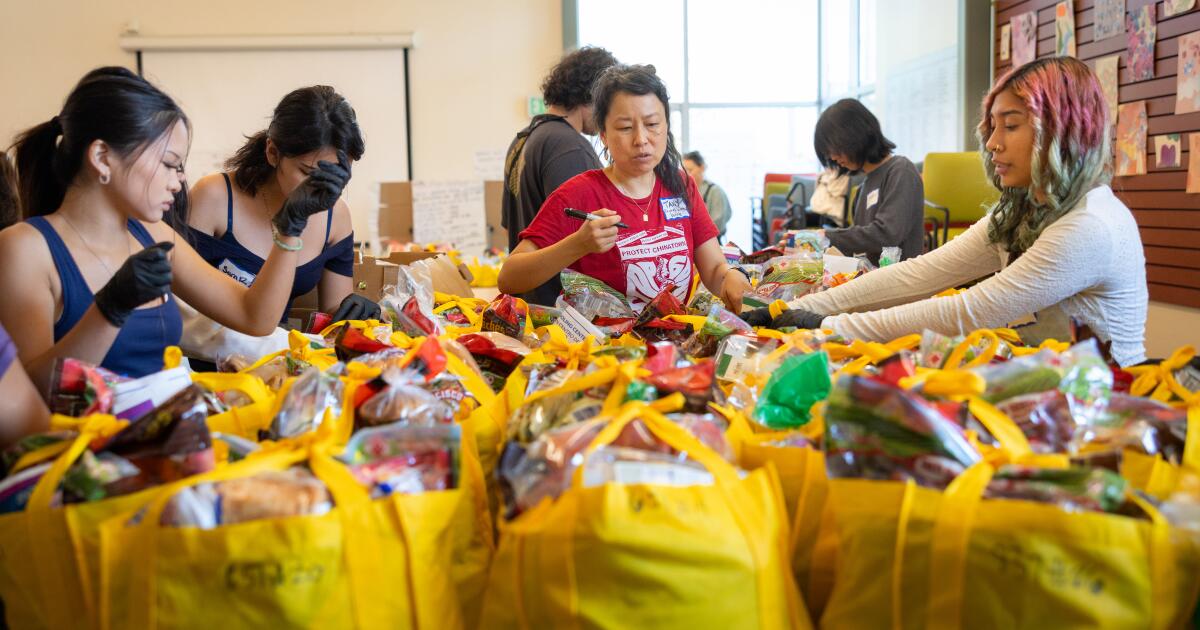
More than 20 volunteers showed up at the Chinatown Branch Library on a hot Tuesday morning in July to fill reusable bags with fruit, lettuce, sliced bread and packaged ravioli. It took more than an hour to finish sorting the goods and packing them into half a dozen wagons.

Volunteers deliver truckloads of fresh produce and food to people in need throughout Chinatown.
(Jason Armond / Los Angeles Times)
From there, Nyugen and her volunteers split up into two teams before dragging the wagons along the streets of Chinatown.
“There are a lot of people desperate for food,” Nguyen said. “They will run red lights just to cross the street and tackle you down, to see if they can get a free bag of groceries.”
In anticipation of this, she advised volunteers to stick to the list of four addresses suggested by local nonprofit Southeast Asian Community Alliance, a youth organization that advocates for tenant rights in Chinatown. If passersby express interest in receiving groceries, volunteers direct them to the library’s front desk.
One stop was a single room occupancy apartment on Broadway with 80- to 100-square-foot rooms, where residents share bathrooms and kitchens. The rooms do not have air conditioning.
For residents who didn’t respond to knocks on their doors, their bags were left for safekeeping with Mai Mei Su, the building’s residential manager. She pays around $500 in rent for her room, and shares it with her husband.
“You have given us so many things. Thank you for paying attention to our apartments,” she said to a volunteer.


1. Chinatown librarian Lynn Nguyen and a group of volunteers deliver wagons of food to Chinatown residents. 2. Chinatown librarian Lynn Nguyen organizes a network of nearly 400 teenage volunteers through a Discord server. 3. Volunteers Cammy Au (second from left) and Chuck Woo (right) deliver bags filled with fresh produce and food to Chinatown residents living in SROs. (Jason Armond/Los Angeles Times)
Sara Ma, a member of the Chinatown Teen Council, said her brother was involved with Nguyen’s grocery distributions in the past and inspired her to tag along.
“A lot of [the elders] do not seem like they can commute far,” Ma said. “I’m grateful and glad they’re able to get a whole bag of produce.”
After spending two hours in the sun, volunteers regrouped in the library to debrief the day over slices of Papa John’s pizza. They compiled a list of things that went well: splitting into two teams made the process efficient, the groceries made seniors happy and the volunteers made new connections along the way.
For Jayden Nguyen, a rising senior at Downtown Magnet High School, the door-to-door distribution is a way of honoring his late great-grandfather, who lived in Chinatown and died from COVID during the height of the pandemic.
“I wanted to spend my time with him, but I couldn’t,” said Jayden Nguyen, “so now I’m going to try to spend my time with the elderly in the community.”
With students returning to school this month, Nguyen’s next grocery distribution is slated for Nov. 23, the week of Thanksgiving. In the meantime, Chinatown Branch Library is hosting monthly help sessions for residents interested in enrolling in CalFresh.

Lynn Nguyen had just begun working at the Chinatown Branch Library in 2019, when she learned that Ai Hoa and G&G markets were shuttering. As the last two full-service grocery stores in Chinatown, these closures left a gap in food access in the neighborhood, where one in four residents are above the age of 65 and 30% of households live below the poverty line.
-
Share via
Nguyen was inspired to leverage her position as young adult librarian to address neighborhood food scarcity. A resident of Chinatown herself, Nguyen applied for a $5,000 grant that provided upfront funds for wagons and a storage unit. Interviews from the teenage volunteers’ related multimedia project provided insight that pointed toward focusing on residents living in single residence occupancy apartments, or SROs.
“We learned that we really needed to find a way to bring food to those living in the SROs,” Nguyen said. “A lot of them are homebound, they’re disabled, they don’t have the means to go outside.”
Since 2022, Nguyen and her teenage volunteers have gone door-to-door delivering truckloads of groceries provided by nonprofit API Forward Movement and Councilmember Eunisses Hernandez’s office.
Today, Nguyen organizes a network of nearly 400 teenagers through a Discord server, which gained traction through library fliers and word-of-mouth from teens elected to the Chinatown Teen Council. She also meets students while tabling at local high schools to promote library programs. Teens who volunteer are eligible for community service hours, and Nguyen often writes them recommendation letters for college and scholarship applications.
More than 20 volunteers showed up at the Chinatown Branch Library on a hot Tuesday morning in July to fill reusable bags with fruit, lettuce, sliced bread and packaged ravioli. It took more than an hour to finish sorting the goods and packing them into half a dozen wagons.
Volunteers deliver truckloads of fresh produce and food to people in need throughout Chinatown.
(Jason Armond / Los Angeles Times)
From there, Nyugen and her volunteers split up into two teams before dragging the wagons along the streets of Chinatown.
“There are a lot of people desperate for food,” Nguyen said. “They will run red lights just to cross the street and tackle you down, to see if they can get a free bag of groceries.”
In anticipation of this, she advised volunteers to stick to the list of four addresses suggested by local nonprofit Southeast Asian Community Alliance, a youth organization that advocates for tenant rights in Chinatown. If passersby express interest in receiving groceries, volunteers direct them to the library’s front desk.
One stop was a single room occupancy apartment on Broadway with 80- to 100-square-foot rooms, where residents share bathrooms and kitchens. The rooms do not have air conditioning.
For residents who didn’t respond to knocks on their doors, their bags were left for safekeeping with Mai Mei Su, the building’s residential manager. She pays around $500 in rent for her room, and shares it with her husband.
“You have given us so many things. Thank you for paying attention to our apartments,” she said to a volunteer.
1. Chinatown librarian Lynn Nguyen and a group of volunteers deliver wagons of food to Chinatown residents. 2. Chinatown librarian Lynn Nguyen organizes a network of nearly 400 teenage volunteers through a Discord server. 3. Volunteers Cammy Au (second from left) and Chuck Woo (right) deliver bags filled with fresh produce and food to Chinatown residents living in SROs. (Jason Armond/Los Angeles Times)
Sara Ma, a member of the Chinatown Teen Council, said her brother was involved with Nguyen’s grocery distributions in the past and inspired her to tag along.
“A lot of [the elders] do not seem like they can commute far,” Ma said. “I’m grateful and glad they’re able to get a whole bag of produce.”
After spending two hours in the sun, volunteers regrouped in the library to debrief the day over slices of Papa John’s pizza. They compiled a list of things that went well: splitting into two teams made the process efficient, the groceries made seniors happy and the volunteers made new connections along the way.
For Jayden Nguyen, a rising senior at Downtown Magnet High School, the door-to-door distribution is a way of honoring his late great-grandfather, who lived in Chinatown and died from COVID during the height of the pandemic.
“I wanted to spend my time with him, but I couldn’t,” said Jayden Nguyen, “so now I’m going to try to spend my time with the elderly in the community.”
With students returning to school this month, Nguyen’s next grocery distribution is slated for Nov. 23, the week of Thanksgiving. In the meantime, Chinatown Branch Library is hosting monthly help sessions for residents interested in enrolling in CalFresh.

Lynn Nguyen had just begun working at the Chinatown Branch Library in 2019, when she learned that Ai Hoa and G&G markets were shuttering. As the last two full-service grocery stores in Chinatown, these closures left a gap in food access in the neighborhood, where one in four residents are above the age of 65 and 30% of households live below the poverty line.
-
Share via
Nguyen was inspired to leverage her position as young adult librarian to address neighborhood food scarcity. A resident of Chinatown herself, Nguyen applied for a $5,000 grant that provided upfront funds for wagons and a storage unit. Interviews from the teenage volunteers’ related multimedia project provided insight that pointed toward focusing on residents living in single residence occupancy apartments, or SROs.
“We learned that we really needed to find a way to bring food to those living in the SROs,” Nguyen said. “A lot of them are homebound, they’re disabled, they don’t have the means to go outside.”
Since 2022, Nguyen and her teenage volunteers have gone door-to-door delivering truckloads of groceries provided by nonprofit API Forward Movement and Councilmember Eunisses Hernandez’s office.
Today, Nguyen organizes a network of nearly 400 teenagers through a Discord server, which gained traction through library fliers and word-of-mouth from teens elected to the Chinatown Teen Council. She also meets students while tabling at local high schools to promote library programs. Teens who volunteer are eligible for community service hours, and Nguyen often writes them recommendation letters for college and scholarship applications.
More than 20 volunteers showed up at the Chinatown Branch Library on a hot Tuesday morning in July to fill reusable bags with fruit, lettuce, sliced bread and packaged ravioli. It took more than an hour to finish sorting the goods and packing them into half a dozen wagons.
Volunteers deliver truckloads of fresh produce and food to people in need throughout Chinatown.
(Jason Armond / Los Angeles Times)
From there, Nyugen and her volunteers split up into two teams before dragging the wagons along the streets of Chinatown.
“There are a lot of people desperate for food,” Nguyen said. “They will run red lights just to cross the street and tackle you down, to see if they can get a free bag of groceries.”
In anticipation of this, she advised volunteers to stick to the list of four addresses suggested by local nonprofit Southeast Asian Community Alliance, a youth organization that advocates for tenant rights in Chinatown. If passersby express interest in receiving groceries, volunteers direct them to the library’s front desk.
One stop was a single room occupancy apartment on Broadway with 80- to 100-square-foot rooms, where residents share bathrooms and kitchens. The rooms do not have air conditioning.
For residents who didn’t respond to knocks on their doors, their bags were left for safekeeping with Mai Mei Su, the building’s residential manager. She pays around $500 in rent for her room, and shares it with her husband.
“You have given us so many things. Thank you for paying attention to our apartments,” she said to a volunteer.
1. Chinatown librarian Lynn Nguyen and a group of volunteers deliver wagons of food to Chinatown residents. 2. Chinatown librarian Lynn Nguyen organizes a network of nearly 400 teenage volunteers through a Discord server. 3. Volunteers Cammy Au (second from left) and Chuck Woo (right) deliver bags filled with fresh produce and food to Chinatown residents living in SROs. (Jason Armond/Los Angeles Times)
Sara Ma, a member of the Chinatown Teen Council, said her brother was involved with Nguyen’s grocery distributions in the past and inspired her to tag along.
“A lot of [the elders] do not seem like they can commute far,” Ma said. “I’m grateful and glad they’re able to get a whole bag of produce.”
After spending two hours in the sun, volunteers regrouped in the library to debrief the day over slices of Papa John’s pizza. They compiled a list of things that went well: splitting into two teams made the process efficient, the groceries made seniors happy and the volunteers made new connections along the way.
For Jayden Nguyen, a rising senior at Downtown Magnet High School, the door-to-door distribution is a way of honoring his late great-grandfather, who lived in Chinatown and died from COVID during the height of the pandemic.
“I wanted to spend my time with him, but I couldn’t,” said Jayden Nguyen, “so now I’m going to try to spend my time with the elderly in the community.”
With students returning to school this month, Nguyen’s next grocery distribution is slated for Nov. 23, the week of Thanksgiving. In the meantime, Chinatown Branch Library is hosting monthly help sessions for residents interested in enrolling in CalFresh.
Lynn Nguyen had just begun working at the Chinatown Branch Library in 2019, when she learned that Ai Hoa and G&G markets were shuttering. As the last two full-service grocery stores in Chinatown, these closures left a gap in food access in the neighborhood, where one in four residents are above the age of 65 and 30% of households live below the poverty line.
-
Share via
Nguyen was inspired to leverage her position as young adult librarian to address neighborhood food scarcity. A resident of Chinatown herself, Nguyen applied for a $5,000 grant that provided upfront funds for wagons and a storage unit. Interviews from the teenage volunteers’ related multimedia project provided insight that pointed toward focusing on residents living in single residence occupancy apartments, or SROs.
“We learned that we really needed to find a way to bring food to those living in the SROs,” Nguyen said. “A lot of them are homebound, they’re disabled, they don’t have the means to go outside.”
Since 2022, Nguyen and her teenage volunteers have gone door-to-door delivering truckloads of groceries provided by nonprofit API Forward Movement and Councilmember Eunisses Hernandez’s office.
Today, Nguyen organizes a network of nearly 400 teenagers through a Discord server, which gained traction through library fliers and word-of-mouth from teens elected to the Chinatown Teen Council. She also meets students while tabling at local high schools to promote library programs. Teens who volunteer are eligible for community service hours, and Nguyen often writes them recommendation letters for college and scholarship applications.
More than 20 volunteers showed up at the Chinatown Branch Library on a hot Tuesday morning in July to fill reusable bags with fruit, lettuce, sliced bread and packaged ravioli. It took more than an hour to finish sorting the goods and packing them into half a dozen wagons.
Volunteers deliver truckloads of fresh produce and food to people in need throughout Chinatown.
(Jason Armond / Los Angeles Times)
From there, Nyugen and her volunteers split up into two teams before dragging the wagons along the streets of Chinatown.
“There are a lot of people desperate for food,” Nguyen said. “They will run red lights just to cross the street and tackle you down, to see if they can get a free bag of groceries.”
In anticipation of this, she advised volunteers to stick to the list of four addresses suggested by local nonprofit Southeast Asian Community Alliance, a youth organization that advocates for tenant rights in Chinatown. If passersby express interest in receiving groceries, volunteers direct them to the library’s front desk.
One stop was a single room occupancy apartment on Broadway with 80- to 100-square-foot rooms, where residents share bathrooms and kitchens. The rooms do not have air conditioning.
For residents who didn’t respond to knocks on their doors, their bags were left for safekeeping with Mai Mei Su, the building’s residential manager. She pays around $500 in rent for her room, and shares it with her husband.
“You have given us so many things. Thank you for paying attention to our apartments,” she said to a volunteer.
1. Chinatown librarian Lynn Nguyen and a group of volunteers deliver wagons of food to Chinatown residents. 2. Chinatown librarian Lynn Nguyen organizes a network of nearly 400 teenage volunteers through a Discord server. 3. Volunteers Cammy Au (second from left) and Chuck Woo (right) deliver bags filled with fresh produce and food to Chinatown residents living in SROs. (Jason Armond/Los Angeles Times)
Sara Ma, a member of the Chinatown Teen Council, said her brother was involved with Nguyen’s grocery distributions in the past and inspired her to tag along.
“A lot of [the elders] do not seem like they can commute far,” Ma said. “I’m grateful and glad they’re able to get a whole bag of produce.”
After spending two hours in the sun, volunteers regrouped in the library to debrief the day over slices of Papa John’s pizza. They compiled a list of things that went well: splitting into two teams made the process efficient, the groceries made seniors happy and the volunteers made new connections along the way.
For Jayden Nguyen, a rising senior at Downtown Magnet High School, the door-to-door distribution is a way of honoring his late great-grandfather, who lived in Chinatown and died from COVID during the height of the pandemic.
“I wanted to spend my time with him, but I couldn’t,” said Jayden Nguyen, “so now I’m going to try to spend my time with the elderly in the community.”
With students returning to school this month, Nguyen’s next grocery distribution is slated for Nov. 23, the week of Thanksgiving. In the meantime, Chinatown Branch Library is hosting monthly help sessions for residents interested in enrolling in CalFresh.

Lynn Nguyen had just begun working at the Chinatown Branch Library in 2019, when she learned that Ai Hoa and G&G markets were shuttering. As the last two full-service grocery stores in Chinatown, these closures left a gap in food access in the neighborhood, where one in four residents are above the age of 65 and 30% of households live below the poverty line.
-
Share via
Nguyen was inspired to leverage her position as young adult librarian to address neighborhood food scarcity. A resident of Chinatown herself, Nguyen applied for a $5,000 grant that provided upfront funds for wagons and a storage unit. Interviews from the teenage volunteers’ related multimedia project provided insight that pointed toward focusing on residents living in single residence occupancy apartments, or SROs.
“We learned that we really needed to find a way to bring food to those living in the SROs,” Nguyen said. “A lot of them are homebound, they’re disabled, they don’t have the means to go outside.”
Since 2022, Nguyen and her teenage volunteers have gone door-to-door delivering truckloads of groceries provided by nonprofit API Forward Movement and Councilmember Eunisses Hernandez’s office.
Today, Nguyen organizes a network of nearly 400 teenagers through a Discord server, which gained traction through library fliers and word-of-mouth from teens elected to the Chinatown Teen Council. She also meets students while tabling at local high schools to promote library programs. Teens who volunteer are eligible for community service hours, and Nguyen often writes them recommendation letters for college and scholarship applications.
More than 20 volunteers showed up at the Chinatown Branch Library on a hot Tuesday morning in July to fill reusable bags with fruit, lettuce, sliced bread and packaged ravioli. It took more than an hour to finish sorting the goods and packing them into half a dozen wagons.
Volunteers deliver truckloads of fresh produce and food to people in need throughout Chinatown.
(Jason Armond / Los Angeles Times)
From there, Nyugen and her volunteers split up into two teams before dragging the wagons along the streets of Chinatown.
“There are a lot of people desperate for food,” Nguyen said. “They will run red lights just to cross the street and tackle you down, to see if they can get a free bag of groceries.”
In anticipation of this, she advised volunteers to stick to the list of four addresses suggested by local nonprofit Southeast Asian Community Alliance, a youth organization that advocates for tenant rights in Chinatown. If passersby express interest in receiving groceries, volunteers direct them to the library’s front desk.
One stop was a single room occupancy apartment on Broadway with 80- to 100-square-foot rooms, where residents share bathrooms and kitchens. The rooms do not have air conditioning.
For residents who didn’t respond to knocks on their doors, their bags were left for safekeeping with Mai Mei Su, the building’s residential manager. She pays around $500 in rent for her room, and shares it with her husband.
“You have given us so many things. Thank you for paying attention to our apartments,” she said to a volunteer.
1. Chinatown librarian Lynn Nguyen and a group of volunteers deliver wagons of food to Chinatown residents. 2. Chinatown librarian Lynn Nguyen organizes a network of nearly 400 teenage volunteers through a Discord server. 3. Volunteers Cammy Au (second from left) and Chuck Woo (right) deliver bags filled with fresh produce and food to Chinatown residents living in SROs. (Jason Armond/Los Angeles Times)
Sara Ma, a member of the Chinatown Teen Council, said her brother was involved with Nguyen’s grocery distributions in the past and inspired her to tag along.
“A lot of [the elders] do not seem like they can commute far,” Ma said. “I’m grateful and glad they’re able to get a whole bag of produce.”
After spending two hours in the sun, volunteers regrouped in the library to debrief the day over slices of Papa John’s pizza. They compiled a list of things that went well: splitting into two teams made the process efficient, the groceries made seniors happy and the volunteers made new connections along the way.
For Jayden Nguyen, a rising senior at Downtown Magnet High School, the door-to-door distribution is a way of honoring his late great-grandfather, who lived in Chinatown and died from COVID during the height of the pandemic.
“I wanted to spend my time with him, but I couldn’t,” said Jayden Nguyen, “so now I’m going to try to spend my time with the elderly in the community.”
With students returning to school this month, Nguyen’s next grocery distribution is slated for Nov. 23, the week of Thanksgiving. In the meantime, Chinatown Branch Library is hosting monthly help sessions for residents interested in enrolling in CalFresh.
Lynn Nguyen had just begun working at the Chinatown Branch Library in 2019, when she learned that Ai Hoa and G&G markets were shuttering. As the last two full-service grocery stores in Chinatown, these closures left a gap in food access in the neighborhood, where one in four residents are above the age of 65 and 30% of households live below the poverty line.
-
Share via
Nguyen was inspired to leverage her position as young adult librarian to address neighborhood food scarcity. A resident of Chinatown herself, Nguyen applied for a $5,000 grant that provided upfront funds for wagons and a storage unit. Interviews from the teenage volunteers’ related multimedia project provided insight that pointed toward focusing on residents living in single residence occupancy apartments, or SROs.
“We learned that we really needed to find a way to bring food to those living in the SROs,” Nguyen said. “A lot of them are homebound, they’re disabled, they don’t have the means to go outside.”
Since 2022, Nguyen and her teenage volunteers have gone door-to-door delivering truckloads of groceries provided by nonprofit API Forward Movement and Councilmember Eunisses Hernandez’s office.
Today, Nguyen organizes a network of nearly 400 teenagers through a Discord server, which gained traction through library fliers and word-of-mouth from teens elected to the Chinatown Teen Council. She also meets students while tabling at local high schools to promote library programs. Teens who volunteer are eligible for community service hours, and Nguyen often writes them recommendation letters for college and scholarship applications.
More than 20 volunteers showed up at the Chinatown Branch Library on a hot Tuesday morning in July to fill reusable bags with fruit, lettuce, sliced bread and packaged ravioli. It took more than an hour to finish sorting the goods and packing them into half a dozen wagons.
Volunteers deliver truckloads of fresh produce and food to people in need throughout Chinatown.
(Jason Armond / Los Angeles Times)
From there, Nyugen and her volunteers split up into two teams before dragging the wagons along the streets of Chinatown.
“There are a lot of people desperate for food,” Nguyen said. “They will run red lights just to cross the street and tackle you down, to see if they can get a free bag of groceries.”
In anticipation of this, she advised volunteers to stick to the list of four addresses suggested by local nonprofit Southeast Asian Community Alliance, a youth organization that advocates for tenant rights in Chinatown. If passersby express interest in receiving groceries, volunteers direct them to the library’s front desk.
One stop was a single room occupancy apartment on Broadway with 80- to 100-square-foot rooms, where residents share bathrooms and kitchens. The rooms do not have air conditioning.
For residents who didn’t respond to knocks on their doors, their bags were left for safekeeping with Mai Mei Su, the building’s residential manager. She pays around $500 in rent for her room, and shares it with her husband.
“You have given us so many things. Thank you for paying attention to our apartments,” she said to a volunteer.
1. Chinatown librarian Lynn Nguyen and a group of volunteers deliver wagons of food to Chinatown residents. 2. Chinatown librarian Lynn Nguyen organizes a network of nearly 400 teenage volunteers through a Discord server. 3. Volunteers Cammy Au (second from left) and Chuck Woo (right) deliver bags filled with fresh produce and food to Chinatown residents living in SROs. (Jason Armond/Los Angeles Times)
Sara Ma, a member of the Chinatown Teen Council, said her brother was involved with Nguyen’s grocery distributions in the past and inspired her to tag along.
“A lot of [the elders] do not seem like they can commute far,” Ma said. “I’m grateful and glad they’re able to get a whole bag of produce.”
After spending two hours in the sun, volunteers regrouped in the library to debrief the day over slices of Papa John’s pizza. They compiled a list of things that went well: splitting into two teams made the process efficient, the groceries made seniors happy and the volunteers made new connections along the way.
For Jayden Nguyen, a rising senior at Downtown Magnet High School, the door-to-door distribution is a way of honoring his late great-grandfather, who lived in Chinatown and died from COVID during the height of the pandemic.
“I wanted to spend my time with him, but I couldn’t,” said Jayden Nguyen, “so now I’m going to try to spend my time with the elderly in the community.”
With students returning to school this month, Nguyen’s next grocery distribution is slated for Nov. 23, the week of Thanksgiving. In the meantime, Chinatown Branch Library is hosting monthly help sessions for residents interested in enrolling in CalFresh.
Lynn Nguyen had just begun working at the Chinatown Branch Library in 2019, when she learned that Ai Hoa and G&G markets were shuttering. As the last two full-service grocery stores in Chinatown, these closures left a gap in food access in the neighborhood, where one in four residents are above the age of 65 and 30% of households live below the poverty line.
-
Share via
Nguyen was inspired to leverage her position as young adult librarian to address neighborhood food scarcity. A resident of Chinatown herself, Nguyen applied for a $5,000 grant that provided upfront funds for wagons and a storage unit. Interviews from the teenage volunteers’ related multimedia project provided insight that pointed toward focusing on residents living in single residence occupancy apartments, or SROs.
“We learned that we really needed to find a way to bring food to those living in the SROs,” Nguyen said. “A lot of them are homebound, they’re disabled, they don’t have the means to go outside.”
Since 2022, Nguyen and her teenage volunteers have gone door-to-door delivering truckloads of groceries provided by nonprofit API Forward Movement and Councilmember Eunisses Hernandez’s office.
Today, Nguyen organizes a network of nearly 400 teenagers through a Discord server, which gained traction through library fliers and word-of-mouth from teens elected to the Chinatown Teen Council. She also meets students while tabling at local high schools to promote library programs. Teens who volunteer are eligible for community service hours, and Nguyen often writes them recommendation letters for college and scholarship applications.
More than 20 volunteers showed up at the Chinatown Branch Library on a hot Tuesday morning in July to fill reusable bags with fruit, lettuce, sliced bread and packaged ravioli. It took more than an hour to finish sorting the goods and packing them into half a dozen wagons.
Volunteers deliver truckloads of fresh produce and food to people in need throughout Chinatown.
(Jason Armond / Los Angeles Times)
From there, Nyugen and her volunteers split up into two teams before dragging the wagons along the streets of Chinatown.
“There are a lot of people desperate for food,” Nguyen said. “They will run red lights just to cross the street and tackle you down, to see if they can get a free bag of groceries.”
In anticipation of this, she advised volunteers to stick to the list of four addresses suggested by local nonprofit Southeast Asian Community Alliance, a youth organization that advocates for tenant rights in Chinatown. If passersby express interest in receiving groceries, volunteers direct them to the library’s front desk.
One stop was a single room occupancy apartment on Broadway with 80- to 100-square-foot rooms, where residents share bathrooms and kitchens. The rooms do not have air conditioning.
For residents who didn’t respond to knocks on their doors, their bags were left for safekeeping with Mai Mei Su, the building’s residential manager. She pays around $500 in rent for her room, and shares it with her husband.
“You have given us so many things. Thank you for paying attention to our apartments,” she said to a volunteer.
1. Chinatown librarian Lynn Nguyen and a group of volunteers deliver wagons of food to Chinatown residents. 2. Chinatown librarian Lynn Nguyen organizes a network of nearly 400 teenage volunteers through a Discord server. 3. Volunteers Cammy Au (second from left) and Chuck Woo (right) deliver bags filled with fresh produce and food to Chinatown residents living in SROs. (Jason Armond/Los Angeles Times)
Sara Ma, a member of the Chinatown Teen Council, said her brother was involved with Nguyen’s grocery distributions in the past and inspired her to tag along.
“A lot of [the elders] do not seem like they can commute far,” Ma said. “I’m grateful and glad they’re able to get a whole bag of produce.”
After spending two hours in the sun, volunteers regrouped in the library to debrief the day over slices of Papa John’s pizza. They compiled a list of things that went well: splitting into two teams made the process efficient, the groceries made seniors happy and the volunteers made new connections along the way.
For Jayden Nguyen, a rising senior at Downtown Magnet High School, the door-to-door distribution is a way of honoring his late great-grandfather, who lived in Chinatown and died from COVID during the height of the pandemic.
“I wanted to spend my time with him, but I couldn’t,” said Jayden Nguyen, “so now I’m going to try to spend my time with the elderly in the community.”
With students returning to school this month, Nguyen’s next grocery distribution is slated for Nov. 23, the week of Thanksgiving. In the meantime, Chinatown Branch Library is hosting monthly help sessions for residents interested in enrolling in CalFresh.
Lynn Nguyen had just begun working at the Chinatown Branch Library in 2019, when she learned that Ai Hoa and G&G markets were shuttering. As the last two full-service grocery stores in Chinatown, these closures left a gap in food access in the neighborhood, where one in four residents are above the age of 65 and 30% of households live below the poverty line.
-
Share via
Nguyen was inspired to leverage her position as young adult librarian to address neighborhood food scarcity. A resident of Chinatown herself, Nguyen applied for a $5,000 grant that provided upfront funds for wagons and a storage unit. Interviews from the teenage volunteers’ related multimedia project provided insight that pointed toward focusing on residents living in single residence occupancy apartments, or SROs.
“We learned that we really needed to find a way to bring food to those living in the SROs,” Nguyen said. “A lot of them are homebound, they’re disabled, they don’t have the means to go outside.”
Since 2022, Nguyen and her teenage volunteers have gone door-to-door delivering truckloads of groceries provided by nonprofit API Forward Movement and Councilmember Eunisses Hernandez’s office.
Today, Nguyen organizes a network of nearly 400 teenagers through a Discord server, which gained traction through library fliers and word-of-mouth from teens elected to the Chinatown Teen Council. She also meets students while tabling at local high schools to promote library programs. Teens who volunteer are eligible for community service hours, and Nguyen often writes them recommendation letters for college and scholarship applications.
More than 20 volunteers showed up at the Chinatown Branch Library on a hot Tuesday morning in July to fill reusable bags with fruit, lettuce, sliced bread and packaged ravioli. It took more than an hour to finish sorting the goods and packing them into half a dozen wagons.
Volunteers deliver truckloads of fresh produce and food to people in need throughout Chinatown.
(Jason Armond / Los Angeles Times)
From there, Nyugen and her volunteers split up into two teams before dragging the wagons along the streets of Chinatown.
“There are a lot of people desperate for food,” Nguyen said. “They will run red lights just to cross the street and tackle you down, to see if they can get a free bag of groceries.”
In anticipation of this, she advised volunteers to stick to the list of four addresses suggested by local nonprofit Southeast Asian Community Alliance, a youth organization that advocates for tenant rights in Chinatown. If passersby express interest in receiving groceries, volunteers direct them to the library’s front desk.
One stop was a single room occupancy apartment on Broadway with 80- to 100-square-foot rooms, where residents share bathrooms and kitchens. The rooms do not have air conditioning.
For residents who didn’t respond to knocks on their doors, their bags were left for safekeeping with Mai Mei Su, the building’s residential manager. She pays around $500 in rent for her room, and shares it with her husband.
“You have given us so many things. Thank you for paying attention to our apartments,” she said to a volunteer.
1. Chinatown librarian Lynn Nguyen and a group of volunteers deliver wagons of food to Chinatown residents. 2. Chinatown librarian Lynn Nguyen organizes a network of nearly 400 teenage volunteers through a Discord server. 3. Volunteers Cammy Au (second from left) and Chuck Woo (right) deliver bags filled with fresh produce and food to Chinatown residents living in SROs. (Jason Armond/Los Angeles Times)
Sara Ma, a member of the Chinatown Teen Council, said her brother was involved with Nguyen’s grocery distributions in the past and inspired her to tag along.
“A lot of [the elders] do not seem like they can commute far,” Ma said. “I’m grateful and glad they’re able to get a whole bag of produce.”
After spending two hours in the sun, volunteers regrouped in the library to debrief the day over slices of Papa John’s pizza. They compiled a list of things that went well: splitting into two teams made the process efficient, the groceries made seniors happy and the volunteers made new connections along the way.
For Jayden Nguyen, a rising senior at Downtown Magnet High School, the door-to-door distribution is a way of honoring his late great-grandfather, who lived in Chinatown and died from COVID during the height of the pandemic.
“I wanted to spend my time with him, but I couldn’t,” said Jayden Nguyen, “so now I’m going to try to spend my time with the elderly in the community.”
With students returning to school this month, Nguyen’s next grocery distribution is slated for Nov. 23, the week of Thanksgiving. In the meantime, Chinatown Branch Library is hosting monthly help sessions for residents interested in enrolling in CalFresh.

Lynn Nguyen had just begun working at the Chinatown Branch Library in 2019, when she learned that Ai Hoa and G&G markets were shuttering. As the last two full-service grocery stores in Chinatown, these closures left a gap in food access in the neighborhood, where one in four residents are above the age of 65 and 30% of households live below the poverty line.
-
Share via
Nguyen was inspired to leverage her position as young adult librarian to address neighborhood food scarcity. A resident of Chinatown herself, Nguyen applied for a $5,000 grant that provided upfront funds for wagons and a storage unit. Interviews from the teenage volunteers’ related multimedia project provided insight that pointed toward focusing on residents living in single residence occupancy apartments, or SROs.
“We learned that we really needed to find a way to bring food to those living in the SROs,” Nguyen said. “A lot of them are homebound, they’re disabled, they don’t have the means to go outside.”
Since 2022, Nguyen and her teenage volunteers have gone door-to-door delivering truckloads of groceries provided by nonprofit API Forward Movement and Councilmember Eunisses Hernandez’s office.
Today, Nguyen organizes a network of nearly 400 teenagers through a Discord server, which gained traction through library fliers and word-of-mouth from teens elected to the Chinatown Teen Council. She also meets students while tabling at local high schools to promote library programs. Teens who volunteer are eligible for community service hours, and Nguyen often writes them recommendation letters for college and scholarship applications.
More than 20 volunteers showed up at the Chinatown Branch Library on a hot Tuesday morning in July to fill reusable bags with fruit, lettuce, sliced bread and packaged ravioli. It took more than an hour to finish sorting the goods and packing them into half a dozen wagons.
Volunteers deliver truckloads of fresh produce and food to people in need throughout Chinatown.
(Jason Armond / Los Angeles Times)
From there, Nyugen and her volunteers split up into two teams before dragging the wagons along the streets of Chinatown.
“There are a lot of people desperate for food,” Nguyen said. “They will run red lights just to cross the street and tackle you down, to see if they can get a free bag of groceries.”
In anticipation of this, she advised volunteers to stick to the list of four addresses suggested by local nonprofit Southeast Asian Community Alliance, a youth organization that advocates for tenant rights in Chinatown. If passersby express interest in receiving groceries, volunteers direct them to the library’s front desk.
One stop was a single room occupancy apartment on Broadway with 80- to 100-square-foot rooms, where residents share bathrooms and kitchens. The rooms do not have air conditioning.
For residents who didn’t respond to knocks on their doors, their bags were left for safekeeping with Mai Mei Su, the building’s residential manager. She pays around $500 in rent for her room, and shares it with her husband.
“You have given us so many things. Thank you for paying attention to our apartments,” she said to a volunteer.
1. Chinatown librarian Lynn Nguyen and a group of volunteers deliver wagons of food to Chinatown residents. 2. Chinatown librarian Lynn Nguyen organizes a network of nearly 400 teenage volunteers through a Discord server. 3. Volunteers Cammy Au (second from left) and Chuck Woo (right) deliver bags filled with fresh produce and food to Chinatown residents living in SROs. (Jason Armond/Los Angeles Times)
Sara Ma, a member of the Chinatown Teen Council, said her brother was involved with Nguyen’s grocery distributions in the past and inspired her to tag along.
“A lot of [the elders] do not seem like they can commute far,” Ma said. “I’m grateful and glad they’re able to get a whole bag of produce.”
After spending two hours in the sun, volunteers regrouped in the library to debrief the day over slices of Papa John’s pizza. They compiled a list of things that went well: splitting into two teams made the process efficient, the groceries made seniors happy and the volunteers made new connections along the way.
For Jayden Nguyen, a rising senior at Downtown Magnet High School, the door-to-door distribution is a way of honoring his late great-grandfather, who lived in Chinatown and died from COVID during the height of the pandemic.
“I wanted to spend my time with him, but I couldn’t,” said Jayden Nguyen, “so now I’m going to try to spend my time with the elderly in the community.”
With students returning to school this month, Nguyen’s next grocery distribution is slated for Nov. 23, the week of Thanksgiving. In the meantime, Chinatown Branch Library is hosting monthly help sessions for residents interested in enrolling in CalFresh.
Lynn Nguyen had just begun working at the Chinatown Branch Library in 2019, when she learned that Ai Hoa and G&G markets were shuttering. As the last two full-service grocery stores in Chinatown, these closures left a gap in food access in the neighborhood, where one in four residents are above the age of 65 and 30% of households live below the poverty line.
-
Share via
Nguyen was inspired to leverage her position as young adult librarian to address neighborhood food scarcity. A resident of Chinatown herself, Nguyen applied for a $5,000 grant that provided upfront funds for wagons and a storage unit. Interviews from the teenage volunteers’ related multimedia project provided insight that pointed toward focusing on residents living in single residence occupancy apartments, or SROs.
“We learned that we really needed to find a way to bring food to those living in the SROs,” Nguyen said. “A lot of them are homebound, they’re disabled, they don’t have the means to go outside.”
Since 2022, Nguyen and her teenage volunteers have gone door-to-door delivering truckloads of groceries provided by nonprofit API Forward Movement and Councilmember Eunisses Hernandez’s office.
Today, Nguyen organizes a network of nearly 400 teenagers through a Discord server, which gained traction through library fliers and word-of-mouth from teens elected to the Chinatown Teen Council. She also meets students while tabling at local high schools to promote library programs. Teens who volunteer are eligible for community service hours, and Nguyen often writes them recommendation letters for college and scholarship applications.
More than 20 volunteers showed up at the Chinatown Branch Library on a hot Tuesday morning in July to fill reusable bags with fruit, lettuce, sliced bread and packaged ravioli. It took more than an hour to finish sorting the goods and packing them into half a dozen wagons.
Volunteers deliver truckloads of fresh produce and food to people in need throughout Chinatown.
(Jason Armond / Los Angeles Times)
From there, Nyugen and her volunteers split up into two teams before dragging the wagons along the streets of Chinatown.
“There are a lot of people desperate for food,” Nguyen said. “They will run red lights just to cross the street and tackle you down, to see if they can get a free bag of groceries.”
In anticipation of this, she advised volunteers to stick to the list of four addresses suggested by local nonprofit Southeast Asian Community Alliance, a youth organization that advocates for tenant rights in Chinatown. If passersby express interest in receiving groceries, volunteers direct them to the library’s front desk.
One stop was a single room occupancy apartment on Broadway with 80- to 100-square-foot rooms, where residents share bathrooms and kitchens. The rooms do not have air conditioning.
For residents who didn’t respond to knocks on their doors, their bags were left for safekeeping with Mai Mei Su, the building’s residential manager. She pays around $500 in rent for her room, and shares it with her husband.
“You have given us so many things. Thank you for paying attention to our apartments,” she said to a volunteer.
1. Chinatown librarian Lynn Nguyen and a group of volunteers deliver wagons of food to Chinatown residents. 2. Chinatown librarian Lynn Nguyen organizes a network of nearly 400 teenage volunteers through a Discord server. 3. Volunteers Cammy Au (second from left) and Chuck Woo (right) deliver bags filled with fresh produce and food to Chinatown residents living in SROs. (Jason Armond/Los Angeles Times)
Sara Ma, a member of the Chinatown Teen Council, said her brother was involved with Nguyen’s grocery distributions in the past and inspired her to tag along.
“A lot of [the elders] do not seem like they can commute far,” Ma said. “I’m grateful and glad they’re able to get a whole bag of produce.”
After spending two hours in the sun, volunteers regrouped in the library to debrief the day over slices of Papa John’s pizza. They compiled a list of things that went well: splitting into two teams made the process efficient, the groceries made seniors happy and the volunteers made new connections along the way.
For Jayden Nguyen, a rising senior at Downtown Magnet High School, the door-to-door distribution is a way of honoring his late great-grandfather, who lived in Chinatown and died from COVID during the height of the pandemic.
“I wanted to spend my time with him, but I couldn’t,” said Jayden Nguyen, “so now I’m going to try to spend my time with the elderly in the community.”
With students returning to school this month, Nguyen’s next grocery distribution is slated for Nov. 23, the week of Thanksgiving. In the meantime, Chinatown Branch Library is hosting monthly help sessions for residents interested in enrolling in CalFresh.
Lynn Nguyen had just begun working at the Chinatown Branch Library in 2019, when she learned that Ai Hoa and G&G markets were shuttering. As the last two full-service grocery stores in Chinatown, these closures left a gap in food access in the neighborhood, where one in four residents are above the age of 65 and 30% of households live below the poverty line.
-
Share via
Nguyen was inspired to leverage her position as young adult librarian to address neighborhood food scarcity. A resident of Chinatown herself, Nguyen applied for a $5,000 grant that provided upfront funds for wagons and a storage unit. Interviews from the teenage volunteers’ related multimedia project provided insight that pointed toward focusing on residents living in single residence occupancy apartments, or SROs.
“We learned that we really needed to find a way to bring food to those living in the SROs,” Nguyen said. “A lot of them are homebound, they’re disabled, they don’t have the means to go outside.”
Since 2022, Nguyen and her teenage volunteers have gone door-to-door delivering truckloads of groceries provided by nonprofit API Forward Movement and Councilmember Eunisses Hernandez’s office.
Today, Nguyen organizes a network of nearly 400 teenagers through a Discord server, which gained traction through library fliers and word-of-mouth from teens elected to the Chinatown Teen Council. She also meets students while tabling at local high schools to promote library programs. Teens who volunteer are eligible for community service hours, and Nguyen often writes them recommendation letters for college and scholarship applications.
More than 20 volunteers showed up at the Chinatown Branch Library on a hot Tuesday morning in July to fill reusable bags with fruit, lettuce, sliced bread and packaged ravioli. It took more than an hour to finish sorting the goods and packing them into half a dozen wagons.
Volunteers deliver truckloads of fresh produce and food to people in need throughout Chinatown.
(Jason Armond / Los Angeles Times)
From there, Nyugen and her volunteers split up into two teams before dragging the wagons along the streets of Chinatown.
“There are a lot of people desperate for food,” Nguyen said. “They will run red lights just to cross the street and tackle you down, to see if they can get a free bag of groceries.”
In anticipation of this, she advised volunteers to stick to the list of four addresses suggested by local nonprofit Southeast Asian Community Alliance, a youth organization that advocates for tenant rights in Chinatown. If passersby express interest in receiving groceries, volunteers direct them to the library’s front desk.
One stop was a single room occupancy apartment on Broadway with 80- to 100-square-foot rooms, where residents share bathrooms and kitchens. The rooms do not have air conditioning.
For residents who didn’t respond to knocks on their doors, their bags were left for safekeeping with Mai Mei Su, the building’s residential manager. She pays around $500 in rent for her room, and shares it with her husband.
“You have given us so many things. Thank you for paying attention to our apartments,” she said to a volunteer.
1. Chinatown librarian Lynn Nguyen and a group of volunteers deliver wagons of food to Chinatown residents. 2. Chinatown librarian Lynn Nguyen organizes a network of nearly 400 teenage volunteers through a Discord server. 3. Volunteers Cammy Au (second from left) and Chuck Woo (right) deliver bags filled with fresh produce and food to Chinatown residents living in SROs. (Jason Armond/Los Angeles Times)
Sara Ma, a member of the Chinatown Teen Council, said her brother was involved with Nguyen’s grocery distributions in the past and inspired her to tag along.
“A lot of [the elders] do not seem like they can commute far,” Ma said. “I’m grateful and glad they’re able to get a whole bag of produce.”
After spending two hours in the sun, volunteers regrouped in the library to debrief the day over slices of Papa John’s pizza. They compiled a list of things that went well: splitting into two teams made the process efficient, the groceries made seniors happy and the volunteers made new connections along the way.
For Jayden Nguyen, a rising senior at Downtown Magnet High School, the door-to-door distribution is a way of honoring his late great-grandfather, who lived in Chinatown and died from COVID during the height of the pandemic.
“I wanted to spend my time with him, but I couldn’t,” said Jayden Nguyen, “so now I’m going to try to spend my time with the elderly in the community.”
With students returning to school this month, Nguyen’s next grocery distribution is slated for Nov. 23, the week of Thanksgiving. In the meantime, Chinatown Branch Library is hosting monthly help sessions for residents interested in enrolling in CalFresh.
Lynn Nguyen had just begun working at the Chinatown Branch Library in 2019, when she learned that Ai Hoa and G&G markets were shuttering. As the last two full-service grocery stores in Chinatown, these closures left a gap in food access in the neighborhood, where one in four residents are above the age of 65 and 30% of households live below the poverty line.
-
Share via
Nguyen was inspired to leverage her position as young adult librarian to address neighborhood food scarcity. A resident of Chinatown herself, Nguyen applied for a $5,000 grant that provided upfront funds for wagons and a storage unit. Interviews from the teenage volunteers’ related multimedia project provided insight that pointed toward focusing on residents living in single residence occupancy apartments, or SROs.
“We learned that we really needed to find a way to bring food to those living in the SROs,” Nguyen said. “A lot of them are homebound, they’re disabled, they don’t have the means to go outside.”
Since 2022, Nguyen and her teenage volunteers have gone door-to-door delivering truckloads of groceries provided by nonprofit API Forward Movement and Councilmember Eunisses Hernandez’s office.
Today, Nguyen organizes a network of nearly 400 teenagers through a Discord server, which gained traction through library fliers and word-of-mouth from teens elected to the Chinatown Teen Council. She also meets students while tabling at local high schools to promote library programs. Teens who volunteer are eligible for community service hours, and Nguyen often writes them recommendation letters for college and scholarship applications.
More than 20 volunteers showed up at the Chinatown Branch Library on a hot Tuesday morning in July to fill reusable bags with fruit, lettuce, sliced bread and packaged ravioli. It took more than an hour to finish sorting the goods and packing them into half a dozen wagons.
Volunteers deliver truckloads of fresh produce and food to people in need throughout Chinatown.
(Jason Armond / Los Angeles Times)
From there, Nyugen and her volunteers split up into two teams before dragging the wagons along the streets of Chinatown.
“There are a lot of people desperate for food,” Nguyen said. “They will run red lights just to cross the street and tackle you down, to see if they can get a free bag of groceries.”
In anticipation of this, she advised volunteers to stick to the list of four addresses suggested by local nonprofit Southeast Asian Community Alliance, a youth organization that advocates for tenant rights in Chinatown. If passersby express interest in receiving groceries, volunteers direct them to the library’s front desk.
One stop was a single room occupancy apartment on Broadway with 80- to 100-square-foot rooms, where residents share bathrooms and kitchens. The rooms do not have air conditioning.
For residents who didn’t respond to knocks on their doors, their bags were left for safekeeping with Mai Mei Su, the building’s residential manager. She pays around $500 in rent for her room, and shares it with her husband.
“You have given us so many things. Thank you for paying attention to our apartments,” she said to a volunteer.
1. Chinatown librarian Lynn Nguyen and a group of volunteers deliver wagons of food to Chinatown residents. 2. Chinatown librarian Lynn Nguyen organizes a network of nearly 400 teenage volunteers through a Discord server. 3. Volunteers Cammy Au (second from left) and Chuck Woo (right) deliver bags filled with fresh produce and food to Chinatown residents living in SROs. (Jason Armond/Los Angeles Times)
Sara Ma, a member of the Chinatown Teen Council, said her brother was involved with Nguyen’s grocery distributions in the past and inspired her to tag along.
“A lot of [the elders] do not seem like they can commute far,” Ma said. “I’m grateful and glad they’re able to get a whole bag of produce.”
After spending two hours in the sun, volunteers regrouped in the library to debrief the day over slices of Papa John’s pizza. They compiled a list of things that went well: splitting into two teams made the process efficient, the groceries made seniors happy and the volunteers made new connections along the way.
For Jayden Nguyen, a rising senior at Downtown Magnet High School, the door-to-door distribution is a way of honoring his late great-grandfather, who lived in Chinatown and died from COVID during the height of the pandemic.
“I wanted to spend my time with him, but I couldn’t,” said Jayden Nguyen, “so now I’m going to try to spend my time with the elderly in the community.”
With students returning to school this month, Nguyen’s next grocery distribution is slated for Nov. 23, the week of Thanksgiving. In the meantime, Chinatown Branch Library is hosting monthly help sessions for residents interested in enrolling in CalFresh.
Lynn Nguyen had just begun working at the Chinatown Branch Library in 2019, when she learned that Ai Hoa and G&G markets were shuttering. As the last two full-service grocery stores in Chinatown, these closures left a gap in food access in the neighborhood, where one in four residents are above the age of 65 and 30% of households live below the poverty line.
-
Share via
Nguyen was inspired to leverage her position as young adult librarian to address neighborhood food scarcity. A resident of Chinatown herself, Nguyen applied for a $5,000 grant that provided upfront funds for wagons and a storage unit. Interviews from the teenage volunteers’ related multimedia project provided insight that pointed toward focusing on residents living in single residence occupancy apartments, or SROs.
“We learned that we really needed to find a way to bring food to those living in the SROs,” Nguyen said. “A lot of them are homebound, they’re disabled, they don’t have the means to go outside.”
Since 2022, Nguyen and her teenage volunteers have gone door-to-door delivering truckloads of groceries provided by nonprofit API Forward Movement and Councilmember Eunisses Hernandez’s office.
Today, Nguyen organizes a network of nearly 400 teenagers through a Discord server, which gained traction through library fliers and word-of-mouth from teens elected to the Chinatown Teen Council. She also meets students while tabling at local high schools to promote library programs. Teens who volunteer are eligible for community service hours, and Nguyen often writes them recommendation letters for college and scholarship applications.
More than 20 volunteers showed up at the Chinatown Branch Library on a hot Tuesday morning in July to fill reusable bags with fruit, lettuce, sliced bread and packaged ravioli. It took more than an hour to finish sorting the goods and packing them into half a dozen wagons.
Volunteers deliver truckloads of fresh produce and food to people in need throughout Chinatown.
(Jason Armond / Los Angeles Times)
From there, Nyugen and her volunteers split up into two teams before dragging the wagons along the streets of Chinatown.
“There are a lot of people desperate for food,” Nguyen said. “They will run red lights just to cross the street and tackle you down, to see if they can get a free bag of groceries.”
In anticipation of this, she advised volunteers to stick to the list of four addresses suggested by local nonprofit Southeast Asian Community Alliance, a youth organization that advocates for tenant rights in Chinatown. If passersby express interest in receiving groceries, volunteers direct them to the library’s front desk.
One stop was a single room occupancy apartment on Broadway with 80- to 100-square-foot rooms, where residents share bathrooms and kitchens. The rooms do not have air conditioning.
For residents who didn’t respond to knocks on their doors, their bags were left for safekeeping with Mai Mei Su, the building’s residential manager. She pays around $500 in rent for her room, and shares it with her husband.
“You have given us so many things. Thank you for paying attention to our apartments,” she said to a volunteer.
1. Chinatown librarian Lynn Nguyen and a group of volunteers deliver wagons of food to Chinatown residents. 2. Chinatown librarian Lynn Nguyen organizes a network of nearly 400 teenage volunteers through a Discord server. 3. Volunteers Cammy Au (second from left) and Chuck Woo (right) deliver bags filled with fresh produce and food to Chinatown residents living in SROs. (Jason Armond/Los Angeles Times)
Sara Ma, a member of the Chinatown Teen Council, said her brother was involved with Nguyen’s grocery distributions in the past and inspired her to tag along.
“A lot of [the elders] do not seem like they can commute far,” Ma said. “I’m grateful and glad they’re able to get a whole bag of produce.”
After spending two hours in the sun, volunteers regrouped in the library to debrief the day over slices of Papa John’s pizza. They compiled a list of things that went well: splitting into two teams made the process efficient, the groceries made seniors happy and the volunteers made new connections along the way.
For Jayden Nguyen, a rising senior at Downtown Magnet High School, the door-to-door distribution is a way of honoring his late great-grandfather, who lived in Chinatown and died from COVID during the height of the pandemic.
“I wanted to spend my time with him, but I couldn’t,” said Jayden Nguyen, “so now I’m going to try to spend my time with the elderly in the community.”
With students returning to school this month, Nguyen’s next grocery distribution is slated for Nov. 23, the week of Thanksgiving. In the meantime, Chinatown Branch Library is hosting monthly help sessions for residents interested in enrolling in CalFresh.
Lynn Nguyen had just begun working at the Chinatown Branch Library in 2019, when she learned that Ai Hoa and G&G markets were shuttering. As the last two full-service grocery stores in Chinatown, these closures left a gap in food access in the neighborhood, where one in four residents are above the age of 65 and 30% of households live below the poverty line.
-
Share via
Nguyen was inspired to leverage her position as young adult librarian to address neighborhood food scarcity. A resident of Chinatown herself, Nguyen applied for a $5,000 grant that provided upfront funds for wagons and a storage unit. Interviews from the teenage volunteers’ related multimedia project provided insight that pointed toward focusing on residents living in single residence occupancy apartments, or SROs.
“We learned that we really needed to find a way to bring food to those living in the SROs,” Nguyen said. “A lot of them are homebound, they’re disabled, they don’t have the means to go outside.”
Since 2022, Nguyen and her teenage volunteers have gone door-to-door delivering truckloads of groceries provided by nonprofit API Forward Movement and Councilmember Eunisses Hernandez’s office.
Today, Nguyen organizes a network of nearly 400 teenagers through a Discord server, which gained traction through library fliers and word-of-mouth from teens elected to the Chinatown Teen Council. She also meets students while tabling at local high schools to promote library programs. Teens who volunteer are eligible for community service hours, and Nguyen often writes them recommendation letters for college and scholarship applications.
More than 20 volunteers showed up at the Chinatown Branch Library on a hot Tuesday morning in July to fill reusable bags with fruit, lettuce, sliced bread and packaged ravioli. It took more than an hour to finish sorting the goods and packing them into half a dozen wagons.
Volunteers deliver truckloads of fresh produce and food to people in need throughout Chinatown.
(Jason Armond / Los Angeles Times)
From there, Nyugen and her volunteers split up into two teams before dragging the wagons along the streets of Chinatown.
“There are a lot of people desperate for food,” Nguyen said. “They will run red lights just to cross the street and tackle you down, to see if they can get a free bag of groceries.”
In anticipation of this, she advised volunteers to stick to the list of four addresses suggested by local nonprofit Southeast Asian Community Alliance, a youth organization that advocates for tenant rights in Chinatown. If passersby express interest in receiving groceries, volunteers direct them to the library’s front desk.
One stop was a single room occupancy apartment on Broadway with 80- to 100-square-foot rooms, where residents share bathrooms and kitchens. The rooms do not have air conditioning.
For residents who didn’t respond to knocks on their doors, their bags were left for safekeeping with Mai Mei Su, the building’s residential manager. She pays around $500 in rent for her room, and shares it with her husband.
“You have given us so many things. Thank you for paying attention to our apartments,” she said to a volunteer.
1. Chinatown librarian Lynn Nguyen and a group of volunteers deliver wagons of food to Chinatown residents. 2. Chinatown librarian Lynn Nguyen organizes a network of nearly 400 teenage volunteers through a Discord server. 3. Volunteers Cammy Au (second from left) and Chuck Woo (right) deliver bags filled with fresh produce and food to Chinatown residents living in SROs. (Jason Armond/Los Angeles Times)
Sara Ma, a member of the Chinatown Teen Council, said her brother was involved with Nguyen’s grocery distributions in the past and inspired her to tag along.
“A lot of [the elders] do not seem like they can commute far,” Ma said. “I’m grateful and glad they’re able to get a whole bag of produce.”
After spending two hours in the sun, volunteers regrouped in the library to debrief the day over slices of Papa John’s pizza. They compiled a list of things that went well: splitting into two teams made the process efficient, the groceries made seniors happy and the volunteers made new connections along the way.
For Jayden Nguyen, a rising senior at Downtown Magnet High School, the door-to-door distribution is a way of honoring his late great-grandfather, who lived in Chinatown and died from COVID during the height of the pandemic.
“I wanted to spend my time with him, but I couldn’t,” said Jayden Nguyen, “so now I’m going to try to spend my time with the elderly in the community.”
With students returning to school this month, Nguyen’s next grocery distribution is slated for Nov. 23, the week of Thanksgiving. In the meantime, Chinatown Branch Library is hosting monthly help sessions for residents interested in enrolling in CalFresh.
Lynn Nguyen had just begun working at the Chinatown Branch Library in 2019, when she learned that Ai Hoa and G&G markets were shuttering. As the last two full-service grocery stores in Chinatown, these closures left a gap in food access in the neighborhood, where one in four residents are above the age of 65 and 30% of households live below the poverty line.
-
Share via
Nguyen was inspired to leverage her position as young adult librarian to address neighborhood food scarcity. A resident of Chinatown herself, Nguyen applied for a $5,000 grant that provided upfront funds for wagons and a storage unit. Interviews from the teenage volunteers’ related multimedia project provided insight that pointed toward focusing on residents living in single residence occupancy apartments, or SROs.
“We learned that we really needed to find a way to bring food to those living in the SROs,” Nguyen said. “A lot of them are homebound, they’re disabled, they don’t have the means to go outside.”
Since 2022, Nguyen and her teenage volunteers have gone door-to-door delivering truckloads of groceries provided by nonprofit API Forward Movement and Councilmember Eunisses Hernandez’s office.
Today, Nguyen organizes a network of nearly 400 teenagers through a Discord server, which gained traction through library fliers and word-of-mouth from teens elected to the Chinatown Teen Council. She also meets students while tabling at local high schools to promote library programs. Teens who volunteer are eligible for community service hours, and Nguyen often writes them recommendation letters for college and scholarship applications.
More than 20 volunteers showed up at the Chinatown Branch Library on a hot Tuesday morning in July to fill reusable bags with fruit, lettuce, sliced bread and packaged ravioli. It took more than an hour to finish sorting the goods and packing them into half a dozen wagons.
Volunteers deliver truckloads of fresh produce and food to people in need throughout Chinatown.
(Jason Armond / Los Angeles Times)
From there, Nyugen and her volunteers split up into two teams before dragging the wagons along the streets of Chinatown.
“There are a lot of people desperate for food,” Nguyen said. “They will run red lights just to cross the street and tackle you down, to see if they can get a free bag of groceries.”
In anticipation of this, she advised volunteers to stick to the list of four addresses suggested by local nonprofit Southeast Asian Community Alliance, a youth organization that advocates for tenant rights in Chinatown. If passersby express interest in receiving groceries, volunteers direct them to the library’s front desk.
One stop was a single room occupancy apartment on Broadway with 80- to 100-square-foot rooms, where residents share bathrooms and kitchens. The rooms do not have air conditioning.
For residents who didn’t respond to knocks on their doors, their bags were left for safekeeping with Mai Mei Su, the building’s residential manager. She pays around $500 in rent for her room, and shares it with her husband.
“You have given us so many things. Thank you for paying attention to our apartments,” she said to a volunteer.
1. Chinatown librarian Lynn Nguyen and a group of volunteers deliver wagons of food to Chinatown residents. 2. Chinatown librarian Lynn Nguyen organizes a network of nearly 400 teenage volunteers through a Discord server. 3. Volunteers Cammy Au (second from left) and Chuck Woo (right) deliver bags filled with fresh produce and food to Chinatown residents living in SROs. (Jason Armond/Los Angeles Times)
Sara Ma, a member of the Chinatown Teen Council, said her brother was involved with Nguyen’s grocery distributions in the past and inspired her to tag along.
“A lot of [the elders] do not seem like they can commute far,” Ma said. “I’m grateful and glad they’re able to get a whole bag of produce.”
After spending two hours in the sun, volunteers regrouped in the library to debrief the day over slices of Papa John’s pizza. They compiled a list of things that went well: splitting into two teams made the process efficient, the groceries made seniors happy and the volunteers made new connections along the way.
For Jayden Nguyen, a rising senior at Downtown Magnet High School, the door-to-door distribution is a way of honoring his late great-grandfather, who lived in Chinatown and died from COVID during the height of the pandemic.
“I wanted to spend my time with him, but I couldn’t,” said Jayden Nguyen, “so now I’m going to try to spend my time with the elderly in the community.”
With students returning to school this month, Nguyen’s next grocery distribution is slated for Nov. 23, the week of Thanksgiving. In the meantime, Chinatown Branch Library is hosting monthly help sessions for residents interested in enrolling in CalFresh.
Lynn Nguyen had just begun working at the Chinatown Branch Library in 2019, when she learned that Ai Hoa and G&G markets were shuttering. As the last two full-service grocery stores in Chinatown, these closures left a gap in food access in the neighborhood, where one in four residents are above the age of 65 and 30% of households live below the poverty line.
-
Share via
Nguyen was inspired to leverage her position as young adult librarian to address neighborhood food scarcity. A resident of Chinatown herself, Nguyen applied for a $5,000 grant that provided upfront funds for wagons and a storage unit. Interviews from the teenage volunteers’ related multimedia project provided insight that pointed toward focusing on residents living in single residence occupancy apartments, or SROs.
“We learned that we really needed to find a way to bring food to those living in the SROs,” Nguyen said. “A lot of them are homebound, they’re disabled, they don’t have the means to go outside.”
Since 2022, Nguyen and her teenage volunteers have gone door-to-door delivering truckloads of groceries provided by nonprofit API Forward Movement and Councilmember Eunisses Hernandez’s office.
Today, Nguyen organizes a network of nearly 400 teenagers through a Discord server, which gained traction through library fliers and word-of-mouth from teens elected to the Chinatown Teen Council. She also meets students while tabling at local high schools to promote library programs. Teens who volunteer are eligible for community service hours, and Nguyen often writes them recommendation letters for college and scholarship applications.
More than 20 volunteers showed up at the Chinatown Branch Library on a hot Tuesday morning in July to fill reusable bags with fruit, lettuce, sliced bread and packaged ravioli. It took more than an hour to finish sorting the goods and packing them into half a dozen wagons.
Volunteers deliver truckloads of fresh produce and food to people in need throughout Chinatown.
(Jason Armond / Los Angeles Times)
From there, Nyugen and her volunteers split up into two teams before dragging the wagons along the streets of Chinatown.
“There are a lot of people desperate for food,” Nguyen said. “They will run red lights just to cross the street and tackle you down, to see if they can get a free bag of groceries.”
In anticipation of this, she advised volunteers to stick to the list of four addresses suggested by local nonprofit Southeast Asian Community Alliance, a youth organization that advocates for tenant rights in Chinatown. If passersby express interest in receiving groceries, volunteers direct them to the library’s front desk.
One stop was a single room occupancy apartment on Broadway with 80- to 100-square-foot rooms, where residents share bathrooms and kitchens. The rooms do not have air conditioning.
For residents who didn’t respond to knocks on their doors, their bags were left for safekeeping with Mai Mei Su, the building’s residential manager. She pays around $500 in rent for her room, and shares it with her husband.
“You have given us so many things. Thank you for paying attention to our apartments,” she said to a volunteer.
1. Chinatown librarian Lynn Nguyen and a group of volunteers deliver wagons of food to Chinatown residents. 2. Chinatown librarian Lynn Nguyen organizes a network of nearly 400 teenage volunteers through a Discord server. 3. Volunteers Cammy Au (second from left) and Chuck Woo (right) deliver bags filled with fresh produce and food to Chinatown residents living in SROs. (Jason Armond/Los Angeles Times)
Sara Ma, a member of the Chinatown Teen Council, said her brother was involved with Nguyen’s grocery distributions in the past and inspired her to tag along.
“A lot of [the elders] do not seem like they can commute far,” Ma said. “I’m grateful and glad they’re able to get a whole bag of produce.”
After spending two hours in the sun, volunteers regrouped in the library to debrief the day over slices of Papa John’s pizza. They compiled a list of things that went well: splitting into two teams made the process efficient, the groceries made seniors happy and the volunteers made new connections along the way.
For Jayden Nguyen, a rising senior at Downtown Magnet High School, the door-to-door distribution is a way of honoring his late great-grandfather, who lived in Chinatown and died from COVID during the height of the pandemic.
“I wanted to spend my time with him, but I couldn’t,” said Jayden Nguyen, “so now I’m going to try to spend my time with the elderly in the community.”
With students returning to school this month, Nguyen’s next grocery distribution is slated for Nov. 23, the week of Thanksgiving. In the meantime, Chinatown Branch Library is hosting monthly help sessions for residents interested in enrolling in CalFresh.

