

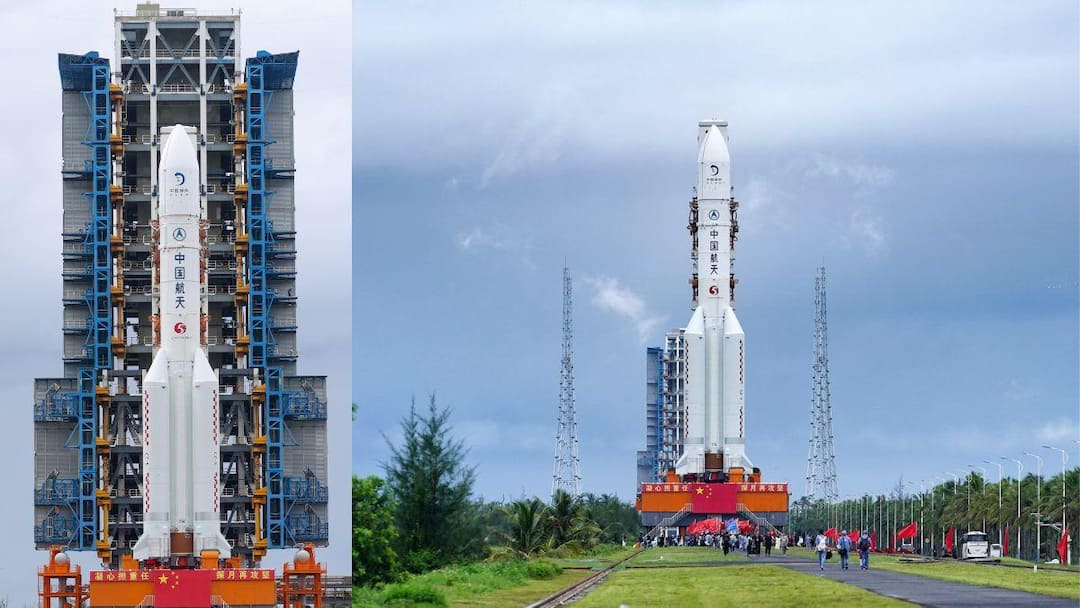
China is preparing to launch Chang’e-7, a highly advanced uncrewed lunar mission designed to search for frozen water in permanently shadowed craters near the Moon’s south pole. The mission will use a robotic lander, rover and “hopping” probe to investigate an extremely cold region of the lunar surface.
According to media reports, Chang’e-7 is scheduled to launch from the Wenchang Space Launch Site in Hainan on a Long March 5 rocket. The spacecraft will carry scientific equipment including water analysers, cameras and radars. After reaching lunar orbit, it will examine possible landing areas around the south pole before attempting a touchdown.

ALSO READ: China’s ‘Superman’ Robot Can Jump 2 Metres And Claims To Outrun Usain Bolt | WATCH

Why China Is Searching For Ice On The Moon
The key objective of Chang’e-7 is to investigate whether frozen water exists in the Moon’s permanently shadowed regions. Some craters around the lunar south pole have remained untouched by sunlight for billions of years.
These locations can become extraordinarily cold. Temperatures in some of the shadowed terrain can fall to minus 203 degrees Celsius (minus 334 Fahrenheit), according to NASA.
Scientists believe these extremely cold environments could preserve ancient water and volatile organic compounds. For future lunar exploration, accessible water could be particularly valuable because it could provide drinking water and oxygen for astronauts and potentially be used as raw rocket propellant.

Chang’e-7 Targets The Moon’s South Pole
The mission will first assess possible landing locations after entering orbit around the Moon. One candidate area is close to the rim of the Shackleton crater, whose interior remains permanently shadowed while parts of its rugged rim receive almost continuous sunlight.
China has not publicly announced a specific landing date for Chang’e-7. However, space watchers cited in media reports estimate that a landing attempt could take place around November.
Once the spacecraft reaches the surface, its rover and hopping probe will begin surveying the region.
Why The Lunar South Pole Matters For Future Bases
The south pole is attracting attention not only because of its possible ice deposits but also because of its unusual lighting conditions.
Most parts of the Moon experience lunar nights lasting as long as 14 Earth days. In contrast, some high peaks and crater rims near the south pole receive near-constant sunlight.

Those areas could offer favourable locations for a future lunar outpost because they would have a relatively stable thermal environment along with a continuous source of solar power.
China is not the only country interested in the region. The United States, India and Russia have also targeted the Moon’s south pole. India landed near the region with Chandrayaan-3 in 2023.
China’s ‘Hopping’ Probe Will Enter Dark Craters
One of Chang’e-7’s most unusual components is its hopping probe. The steep terrain surrounding some lunar craters could make it difficult for conventional wheeled rovers to reach their deeply shadowed interiors.
The probe is designed to overcome that challenge using small thrusters. It will fly into the shadowed craters and then land using six articulated legs.
After exploring the dark terrain, the hopper is expected to return towards sunlit areas to recharge. It will also carry a water molecule analyser to investigate the presence of water.
Details including the hopper’s weight, engine performance and flight range have not been disclosed.
India And Other Countries Also Target Lunar South Pole
The competition to investigate lunar water resources is expected to intensify in the coming years. NASA’s VIPER rover, the European Space Agency’s PROSPECT drilling package and the Japan-India LUPEX rover are expected to head towards the Moon’s south pole.
For India, the region already holds significance following the Chandrayaan-3 landing in 2023. Chang’e-7’s exploration could add another major development to the international effort to understand the Moon’s water resources.
ALSO READ: Astronauts Remove Faulty ISS Antenna During Spacewalk
Chang’e-7 Part Of China’s Larger Lunar Plans
Chang’e-7 is also connected to China’s broader plans for lunar exploration. Beijing is working towards a crewed lunar landing before 2030 and plans to establish a joint research station with Russia by 2035.
The mission’s focus on lunar ice and the south pole could therefore be important beyond the immediate scientific survey. The data gathered by Chang’e-7 is expected to contribute to China’s longer-term ambitions for establishing a permanent human presence on the Moon. Media reports have described Chang’e-7 as a major step in that wider programme.
Education Loan Information:
Calculate Education Loan EMI

