

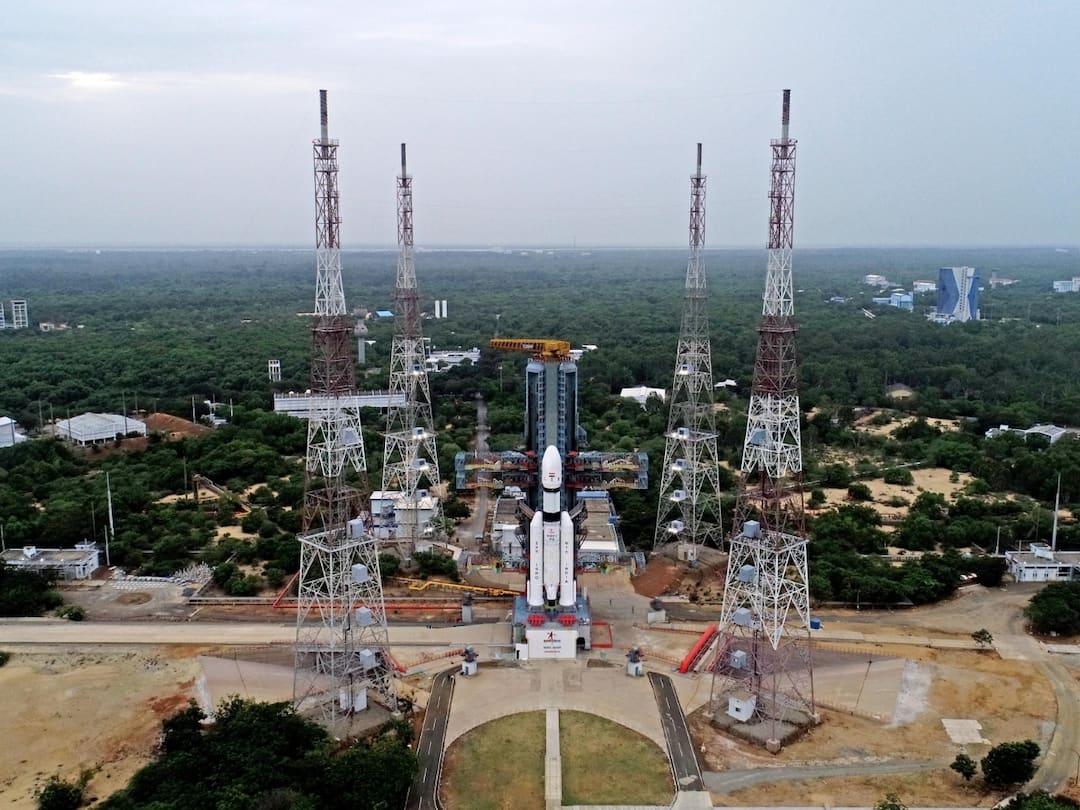
Chandrayaan-3 Launch Countdown Live Updates: Welcome to the live blog for the launch countdown of Chandrayaan-3. Chandrayaan-3, the succeeding mission to Chandrayaan-2, is set to launch on Friday, July 14, 2023, at 2:45 pm IST. The Launch Vehicle Mark III (LVM3), the Indian Space Research Organisation’s (ISRO’s) most powerful rocket, will launch Chandrayaan-3 from Satish Dhawan Space Centre, Sriharikota, Andhra Pradesh. Unlike its predecessor, Chandrayaan-3 will not carry an orbiter.
The launch vehicle to be used this time is called LVM3-M4. The spacecraft has a mission life of one lunar day, which is equivalent to 14 Earth days.
Chandrayaan-3: Objectives, Payloads, And Planned Trajectory
Chandrayaan-3 aims to put a lander and a rover on the Moon’s highlands near the south pole, and to demonstrate end-to-end landing and roving capabilities. The objectives of Chandrayaan-3, apart from demonstrating a safe and soft landing and roving capabilities on the lunar surface, is to conduct in-situ scientific experiments, and develop and demonstrate new technologies required for interplanetary missions.
Chandrayaan-3’s lander will be equipped with five payloads. These are the Chandra’s Surface Thermophysical Experiment (ChasTE), Instrument for Lunar Seismic Activity (ILSA), Langmuir Probe, Laser Retroreflector Array (LRA) Rover, and Radio Anatomy of Moon Bound Hypersensitive ionosphere and Atmosphere (RAMBHA).
The Chandrayaan-3 lander has been designed in such a way that it can land softly on the Moon at a specified site, and deploy the rover, whose aim is to conduct in-situ chemical analysis of the lunar surface. The propulsion module will carry the lander module to the final 100-kilometre circular orbit. After reaching this orbit, the lander module and the propulsion module will separate.
The propulsion module, after separation, will remain in orbit around the Moon, and act as a communications relay satellite.
The propulsion module is equipped with a payload called Spectro-polimetry of HAbitable Planet Earth (SHAPE). The function of SHAPE is to study the spectral and polarimetric measurements of Earth from lunar orbit. This means that SHAPE will analyse the spectro-polarimetric signatures of Earth.
Chandrayaan-3: When And How To Watch Launch Online
One can watch the launch of Chandrayaan-3 online on the official Youtube channel of ISRO, or on Doordarshan.
The electrical tests on the vehicle assembly of LVM3-M4 and Chandrayaan-3 spacecraft have been completed. People who wish to watch the launch live from the Launch View Gallery at Satish Dhawan Space Centre can register themselves at ivg.shar.gov.in/.

Chandrayaan-3 Launch Countdown Live Updates: Welcome to the live blog for the launch countdown of Chandrayaan-3. Chandrayaan-3, the succeeding mission to Chandrayaan-2, is set to launch on Friday, July 14, 2023, at 2:45 pm IST. The Launch Vehicle Mark III (LVM3), the Indian Space Research Organisation’s (ISRO’s) most powerful rocket, will launch Chandrayaan-3 from Satish Dhawan Space Centre, Sriharikota, Andhra Pradesh. Unlike its predecessor, Chandrayaan-3 will not carry an orbiter.
The launch vehicle to be used this time is called LVM3-M4. The spacecraft has a mission life of one lunar day, which is equivalent to 14 Earth days.
Chandrayaan-3: Objectives, Payloads, And Planned Trajectory
Chandrayaan-3 aims to put a lander and a rover on the Moon’s highlands near the south pole, and to demonstrate end-to-end landing and roving capabilities. The objectives of Chandrayaan-3, apart from demonstrating a safe and soft landing and roving capabilities on the lunar surface, is to conduct in-situ scientific experiments, and develop and demonstrate new technologies required for interplanetary missions.
Chandrayaan-3’s lander will be equipped with five payloads. These are the Chandra’s Surface Thermophysical Experiment (ChasTE), Instrument for Lunar Seismic Activity (ILSA), Langmuir Probe, Laser Retroreflector Array (LRA) Rover, and Radio Anatomy of Moon Bound Hypersensitive ionosphere and Atmosphere (RAMBHA).
The Chandrayaan-3 lander has been designed in such a way that it can land softly on the Moon at a specified site, and deploy the rover, whose aim is to conduct in-situ chemical analysis of the lunar surface. The propulsion module will carry the lander module to the final 100-kilometre circular orbit. After reaching this orbit, the lander module and the propulsion module will separate.
The propulsion module, after separation, will remain in orbit around the Moon, and act as a communications relay satellite.
The propulsion module is equipped with a payload called Spectro-polimetry of HAbitable Planet Earth (SHAPE). The function of SHAPE is to study the spectral and polarimetric measurements of Earth from lunar orbit. This means that SHAPE will analyse the spectro-polarimetric signatures of Earth.
Chandrayaan-3: When And How To Watch Launch Online
One can watch the launch of Chandrayaan-3 online on the official Youtube channel of ISRO, or on Doordarshan.
The electrical tests on the vehicle assembly of LVM3-M4 and Chandrayaan-3 spacecraft have been completed. People who wish to watch the launch live from the Launch View Gallery at Satish Dhawan Space Centre can register themselves at ivg.shar.gov.in/.

Chandrayaan-3 Launch Countdown Live Updates: Welcome to the live blog for the launch countdown of Chandrayaan-3. Chandrayaan-3, the succeeding mission to Chandrayaan-2, is set to launch on Friday, July 14, 2023, at 2:45 pm IST. The Launch Vehicle Mark III (LVM3), the Indian Space Research Organisation’s (ISRO’s) most powerful rocket, will launch Chandrayaan-3 from Satish Dhawan Space Centre, Sriharikota, Andhra Pradesh. Unlike its predecessor, Chandrayaan-3 will not carry an orbiter.
The launch vehicle to be used this time is called LVM3-M4. The spacecraft has a mission life of one lunar day, which is equivalent to 14 Earth days.
Chandrayaan-3: Objectives, Payloads, And Planned Trajectory
Chandrayaan-3 aims to put a lander and a rover on the Moon’s highlands near the south pole, and to demonstrate end-to-end landing and roving capabilities. The objectives of Chandrayaan-3, apart from demonstrating a safe and soft landing and roving capabilities on the lunar surface, is to conduct in-situ scientific experiments, and develop and demonstrate new technologies required for interplanetary missions.
Chandrayaan-3’s lander will be equipped with five payloads. These are the Chandra’s Surface Thermophysical Experiment (ChasTE), Instrument for Lunar Seismic Activity (ILSA), Langmuir Probe, Laser Retroreflector Array (LRA) Rover, and Radio Anatomy of Moon Bound Hypersensitive ionosphere and Atmosphere (RAMBHA).
The Chandrayaan-3 lander has been designed in such a way that it can land softly on the Moon at a specified site, and deploy the rover, whose aim is to conduct in-situ chemical analysis of the lunar surface. The propulsion module will carry the lander module to the final 100-kilometre circular orbit. After reaching this orbit, the lander module and the propulsion module will separate.
The propulsion module, after separation, will remain in orbit around the Moon, and act as a communications relay satellite.
The propulsion module is equipped with a payload called Spectro-polimetry of HAbitable Planet Earth (SHAPE). The function of SHAPE is to study the spectral and polarimetric measurements of Earth from lunar orbit. This means that SHAPE will analyse the spectro-polarimetric signatures of Earth.
Chandrayaan-3: When And How To Watch Launch Online
One can watch the launch of Chandrayaan-3 online on the official Youtube channel of ISRO, or on Doordarshan.
The electrical tests on the vehicle assembly of LVM3-M4 and Chandrayaan-3 spacecraft have been completed. People who wish to watch the launch live from the Launch View Gallery at Satish Dhawan Space Centre can register themselves at ivg.shar.gov.in/.
Chandrayaan-3 Launch Countdown Live Updates: Welcome to the live blog for the launch countdown of Chandrayaan-3. Chandrayaan-3, the succeeding mission to Chandrayaan-2, is set to launch on Friday, July 14, 2023, at 2:45 pm IST. The Launch Vehicle Mark III (LVM3), the Indian Space Research Organisation’s (ISRO’s) most powerful rocket, will launch Chandrayaan-3 from Satish Dhawan Space Centre, Sriharikota, Andhra Pradesh. Unlike its predecessor, Chandrayaan-3 will not carry an orbiter.
The launch vehicle to be used this time is called LVM3-M4. The spacecraft has a mission life of one lunar day, which is equivalent to 14 Earth days.
Chandrayaan-3: Objectives, Payloads, And Planned Trajectory
Chandrayaan-3 aims to put a lander and a rover on the Moon’s highlands near the south pole, and to demonstrate end-to-end landing and roving capabilities. The objectives of Chandrayaan-3, apart from demonstrating a safe and soft landing and roving capabilities on the lunar surface, is to conduct in-situ scientific experiments, and develop and demonstrate new technologies required for interplanetary missions.
Chandrayaan-3’s lander will be equipped with five payloads. These are the Chandra’s Surface Thermophysical Experiment (ChasTE), Instrument for Lunar Seismic Activity (ILSA), Langmuir Probe, Laser Retroreflector Array (LRA) Rover, and Radio Anatomy of Moon Bound Hypersensitive ionosphere and Atmosphere (RAMBHA).
The Chandrayaan-3 lander has been designed in such a way that it can land softly on the Moon at a specified site, and deploy the rover, whose aim is to conduct in-situ chemical analysis of the lunar surface. The propulsion module will carry the lander module to the final 100-kilometre circular orbit. After reaching this orbit, the lander module and the propulsion module will separate.
The propulsion module, after separation, will remain in orbit around the Moon, and act as a communications relay satellite.
The propulsion module is equipped with a payload called Spectro-polimetry of HAbitable Planet Earth (SHAPE). The function of SHAPE is to study the spectral and polarimetric measurements of Earth from lunar orbit. This means that SHAPE will analyse the spectro-polarimetric signatures of Earth.
Chandrayaan-3: When And How To Watch Launch Online
One can watch the launch of Chandrayaan-3 online on the official Youtube channel of ISRO, or on Doordarshan.
The electrical tests on the vehicle assembly of LVM3-M4 and Chandrayaan-3 spacecraft have been completed. People who wish to watch the launch live from the Launch View Gallery at Satish Dhawan Space Centre can register themselves at ivg.shar.gov.in/.

Chandrayaan-3 Launch Countdown Live Updates: Welcome to the live blog for the launch countdown of Chandrayaan-3. Chandrayaan-3, the succeeding mission to Chandrayaan-2, is set to launch on Friday, July 14, 2023, at 2:45 pm IST. The Launch Vehicle Mark III (LVM3), the Indian Space Research Organisation’s (ISRO’s) most powerful rocket, will launch Chandrayaan-3 from Satish Dhawan Space Centre, Sriharikota, Andhra Pradesh. Unlike its predecessor, Chandrayaan-3 will not carry an orbiter.
The launch vehicle to be used this time is called LVM3-M4. The spacecraft has a mission life of one lunar day, which is equivalent to 14 Earth days.
Chandrayaan-3: Objectives, Payloads, And Planned Trajectory
Chandrayaan-3 aims to put a lander and a rover on the Moon’s highlands near the south pole, and to demonstrate end-to-end landing and roving capabilities. The objectives of Chandrayaan-3, apart from demonstrating a safe and soft landing and roving capabilities on the lunar surface, is to conduct in-situ scientific experiments, and develop and demonstrate new technologies required for interplanetary missions.
Chandrayaan-3’s lander will be equipped with five payloads. These are the Chandra’s Surface Thermophysical Experiment (ChasTE), Instrument for Lunar Seismic Activity (ILSA), Langmuir Probe, Laser Retroreflector Array (LRA) Rover, and Radio Anatomy of Moon Bound Hypersensitive ionosphere and Atmosphere (RAMBHA).
The Chandrayaan-3 lander has been designed in such a way that it can land softly on the Moon at a specified site, and deploy the rover, whose aim is to conduct in-situ chemical analysis of the lunar surface. The propulsion module will carry the lander module to the final 100-kilometre circular orbit. After reaching this orbit, the lander module and the propulsion module will separate.
The propulsion module, after separation, will remain in orbit around the Moon, and act as a communications relay satellite.
The propulsion module is equipped with a payload called Spectro-polimetry of HAbitable Planet Earth (SHAPE). The function of SHAPE is to study the spectral and polarimetric measurements of Earth from lunar orbit. This means that SHAPE will analyse the spectro-polarimetric signatures of Earth.
Chandrayaan-3: When And How To Watch Launch Online
One can watch the launch of Chandrayaan-3 online on the official Youtube channel of ISRO, or on Doordarshan.
The electrical tests on the vehicle assembly of LVM3-M4 and Chandrayaan-3 spacecraft have been completed. People who wish to watch the launch live from the Launch View Gallery at Satish Dhawan Space Centre can register themselves at ivg.shar.gov.in/.
Chandrayaan-3 Launch Countdown Live Updates: Welcome to the live blog for the launch countdown of Chandrayaan-3. Chandrayaan-3, the succeeding mission to Chandrayaan-2, is set to launch on Friday, July 14, 2023, at 2:45 pm IST. The Launch Vehicle Mark III (LVM3), the Indian Space Research Organisation’s (ISRO’s) most powerful rocket, will launch Chandrayaan-3 from Satish Dhawan Space Centre, Sriharikota, Andhra Pradesh. Unlike its predecessor, Chandrayaan-3 will not carry an orbiter.
The launch vehicle to be used this time is called LVM3-M4. The spacecraft has a mission life of one lunar day, which is equivalent to 14 Earth days.
Chandrayaan-3: Objectives, Payloads, And Planned Trajectory
Chandrayaan-3 aims to put a lander and a rover on the Moon’s highlands near the south pole, and to demonstrate end-to-end landing and roving capabilities. The objectives of Chandrayaan-3, apart from demonstrating a safe and soft landing and roving capabilities on the lunar surface, is to conduct in-situ scientific experiments, and develop and demonstrate new technologies required for interplanetary missions.
Chandrayaan-3’s lander will be equipped with five payloads. These are the Chandra’s Surface Thermophysical Experiment (ChasTE), Instrument for Lunar Seismic Activity (ILSA), Langmuir Probe, Laser Retroreflector Array (LRA) Rover, and Radio Anatomy of Moon Bound Hypersensitive ionosphere and Atmosphere (RAMBHA).
The Chandrayaan-3 lander has been designed in such a way that it can land softly on the Moon at a specified site, and deploy the rover, whose aim is to conduct in-situ chemical analysis of the lunar surface. The propulsion module will carry the lander module to the final 100-kilometre circular orbit. After reaching this orbit, the lander module and the propulsion module will separate.
The propulsion module, after separation, will remain in orbit around the Moon, and act as a communications relay satellite.
The propulsion module is equipped with a payload called Spectro-polimetry of HAbitable Planet Earth (SHAPE). The function of SHAPE is to study the spectral and polarimetric measurements of Earth from lunar orbit. This means that SHAPE will analyse the spectro-polarimetric signatures of Earth.
Chandrayaan-3: When And How To Watch Launch Online
One can watch the launch of Chandrayaan-3 online on the official Youtube channel of ISRO, or on Doordarshan.
The electrical tests on the vehicle assembly of LVM3-M4 and Chandrayaan-3 spacecraft have been completed. People who wish to watch the launch live from the Launch View Gallery at Satish Dhawan Space Centre can register themselves at ivg.shar.gov.in/.
Chandrayaan-3 Launch Countdown Live Updates: Welcome to the live blog for the launch countdown of Chandrayaan-3. Chandrayaan-3, the succeeding mission to Chandrayaan-2, is set to launch on Friday, July 14, 2023, at 2:45 pm IST. The Launch Vehicle Mark III (LVM3), the Indian Space Research Organisation’s (ISRO’s) most powerful rocket, will launch Chandrayaan-3 from Satish Dhawan Space Centre, Sriharikota, Andhra Pradesh. Unlike its predecessor, Chandrayaan-3 will not carry an orbiter.
The launch vehicle to be used this time is called LVM3-M4. The spacecraft has a mission life of one lunar day, which is equivalent to 14 Earth days.
Chandrayaan-3: Objectives, Payloads, And Planned Trajectory
Chandrayaan-3 aims to put a lander and a rover on the Moon’s highlands near the south pole, and to demonstrate end-to-end landing and roving capabilities. The objectives of Chandrayaan-3, apart from demonstrating a safe and soft landing and roving capabilities on the lunar surface, is to conduct in-situ scientific experiments, and develop and demonstrate new technologies required for interplanetary missions.
Chandrayaan-3’s lander will be equipped with five payloads. These are the Chandra’s Surface Thermophysical Experiment (ChasTE), Instrument for Lunar Seismic Activity (ILSA), Langmuir Probe, Laser Retroreflector Array (LRA) Rover, and Radio Anatomy of Moon Bound Hypersensitive ionosphere and Atmosphere (RAMBHA).
The Chandrayaan-3 lander has been designed in such a way that it can land softly on the Moon at a specified site, and deploy the rover, whose aim is to conduct in-situ chemical analysis of the lunar surface. The propulsion module will carry the lander module to the final 100-kilometre circular orbit. After reaching this orbit, the lander module and the propulsion module will separate.
The propulsion module, after separation, will remain in orbit around the Moon, and act as a communications relay satellite.
The propulsion module is equipped with a payload called Spectro-polimetry of HAbitable Planet Earth (SHAPE). The function of SHAPE is to study the spectral and polarimetric measurements of Earth from lunar orbit. This means that SHAPE will analyse the spectro-polarimetric signatures of Earth.
Chandrayaan-3: When And How To Watch Launch Online
One can watch the launch of Chandrayaan-3 online on the official Youtube channel of ISRO, or on Doordarshan.
The electrical tests on the vehicle assembly of LVM3-M4 and Chandrayaan-3 spacecraft have been completed. People who wish to watch the launch live from the Launch View Gallery at Satish Dhawan Space Centre can register themselves at ivg.shar.gov.in/.
Chandrayaan-3 Launch Countdown Live Updates: Welcome to the live blog for the launch countdown of Chandrayaan-3. Chandrayaan-3, the succeeding mission to Chandrayaan-2, is set to launch on Friday, July 14, 2023, at 2:45 pm IST. The Launch Vehicle Mark III (LVM3), the Indian Space Research Organisation’s (ISRO’s) most powerful rocket, will launch Chandrayaan-3 from Satish Dhawan Space Centre, Sriharikota, Andhra Pradesh. Unlike its predecessor, Chandrayaan-3 will not carry an orbiter.
The launch vehicle to be used this time is called LVM3-M4. The spacecraft has a mission life of one lunar day, which is equivalent to 14 Earth days.
Chandrayaan-3: Objectives, Payloads, And Planned Trajectory
Chandrayaan-3 aims to put a lander and a rover on the Moon’s highlands near the south pole, and to demonstrate end-to-end landing and roving capabilities. The objectives of Chandrayaan-3, apart from demonstrating a safe and soft landing and roving capabilities on the lunar surface, is to conduct in-situ scientific experiments, and develop and demonstrate new technologies required for interplanetary missions.
Chandrayaan-3’s lander will be equipped with five payloads. These are the Chandra’s Surface Thermophysical Experiment (ChasTE), Instrument for Lunar Seismic Activity (ILSA), Langmuir Probe, Laser Retroreflector Array (LRA) Rover, and Radio Anatomy of Moon Bound Hypersensitive ionosphere and Atmosphere (RAMBHA).
The Chandrayaan-3 lander has been designed in such a way that it can land softly on the Moon at a specified site, and deploy the rover, whose aim is to conduct in-situ chemical analysis of the lunar surface. The propulsion module will carry the lander module to the final 100-kilometre circular orbit. After reaching this orbit, the lander module and the propulsion module will separate.
The propulsion module, after separation, will remain in orbit around the Moon, and act as a communications relay satellite.
The propulsion module is equipped with a payload called Spectro-polimetry of HAbitable Planet Earth (SHAPE). The function of SHAPE is to study the spectral and polarimetric measurements of Earth from lunar orbit. This means that SHAPE will analyse the spectro-polarimetric signatures of Earth.
Chandrayaan-3: When And How To Watch Launch Online
One can watch the launch of Chandrayaan-3 online on the official Youtube channel of ISRO, or on Doordarshan.
The electrical tests on the vehicle assembly of LVM3-M4 and Chandrayaan-3 spacecraft have been completed. People who wish to watch the launch live from the Launch View Gallery at Satish Dhawan Space Centre can register themselves at ivg.shar.gov.in/.

Chandrayaan-3 Launch Countdown Live Updates: Welcome to the live blog for the launch countdown of Chandrayaan-3. Chandrayaan-3, the succeeding mission to Chandrayaan-2, is set to launch on Friday, July 14, 2023, at 2:45 pm IST. The Launch Vehicle Mark III (LVM3), the Indian Space Research Organisation’s (ISRO’s) most powerful rocket, will launch Chandrayaan-3 from Satish Dhawan Space Centre, Sriharikota, Andhra Pradesh. Unlike its predecessor, Chandrayaan-3 will not carry an orbiter.
The launch vehicle to be used this time is called LVM3-M4. The spacecraft has a mission life of one lunar day, which is equivalent to 14 Earth days.
Chandrayaan-3: Objectives, Payloads, And Planned Trajectory
Chandrayaan-3 aims to put a lander and a rover on the Moon’s highlands near the south pole, and to demonstrate end-to-end landing and roving capabilities. The objectives of Chandrayaan-3, apart from demonstrating a safe and soft landing and roving capabilities on the lunar surface, is to conduct in-situ scientific experiments, and develop and demonstrate new technologies required for interplanetary missions.
Chandrayaan-3’s lander will be equipped with five payloads. These are the Chandra’s Surface Thermophysical Experiment (ChasTE), Instrument for Lunar Seismic Activity (ILSA), Langmuir Probe, Laser Retroreflector Array (LRA) Rover, and Radio Anatomy of Moon Bound Hypersensitive ionosphere and Atmosphere (RAMBHA).
The Chandrayaan-3 lander has been designed in such a way that it can land softly on the Moon at a specified site, and deploy the rover, whose aim is to conduct in-situ chemical analysis of the lunar surface. The propulsion module will carry the lander module to the final 100-kilometre circular orbit. After reaching this orbit, the lander module and the propulsion module will separate.
The propulsion module, after separation, will remain in orbit around the Moon, and act as a communications relay satellite.
The propulsion module is equipped with a payload called Spectro-polimetry of HAbitable Planet Earth (SHAPE). The function of SHAPE is to study the spectral and polarimetric measurements of Earth from lunar orbit. This means that SHAPE will analyse the spectro-polarimetric signatures of Earth.
Chandrayaan-3: When And How To Watch Launch Online
One can watch the launch of Chandrayaan-3 online on the official Youtube channel of ISRO, or on Doordarshan.
The electrical tests on the vehicle assembly of LVM3-M4 and Chandrayaan-3 spacecraft have been completed. People who wish to watch the launch live from the Launch View Gallery at Satish Dhawan Space Centre can register themselves at ivg.shar.gov.in/.
Chandrayaan-3 Launch Countdown Live Updates: Welcome to the live blog for the launch countdown of Chandrayaan-3. Chandrayaan-3, the succeeding mission to Chandrayaan-2, is set to launch on Friday, July 14, 2023, at 2:45 pm IST. The Launch Vehicle Mark III (LVM3), the Indian Space Research Organisation’s (ISRO’s) most powerful rocket, will launch Chandrayaan-3 from Satish Dhawan Space Centre, Sriharikota, Andhra Pradesh. Unlike its predecessor, Chandrayaan-3 will not carry an orbiter.
The launch vehicle to be used this time is called LVM3-M4. The spacecraft has a mission life of one lunar day, which is equivalent to 14 Earth days.
Chandrayaan-3: Objectives, Payloads, And Planned Trajectory
Chandrayaan-3 aims to put a lander and a rover on the Moon’s highlands near the south pole, and to demonstrate end-to-end landing and roving capabilities. The objectives of Chandrayaan-3, apart from demonstrating a safe and soft landing and roving capabilities on the lunar surface, is to conduct in-situ scientific experiments, and develop and demonstrate new technologies required for interplanetary missions.
Chandrayaan-3’s lander will be equipped with five payloads. These are the Chandra’s Surface Thermophysical Experiment (ChasTE), Instrument for Lunar Seismic Activity (ILSA), Langmuir Probe, Laser Retroreflector Array (LRA) Rover, and Radio Anatomy of Moon Bound Hypersensitive ionosphere and Atmosphere (RAMBHA).
The Chandrayaan-3 lander has been designed in such a way that it can land softly on the Moon at a specified site, and deploy the rover, whose aim is to conduct in-situ chemical analysis of the lunar surface. The propulsion module will carry the lander module to the final 100-kilometre circular orbit. After reaching this orbit, the lander module and the propulsion module will separate.
The propulsion module, after separation, will remain in orbit around the Moon, and act as a communications relay satellite.
The propulsion module is equipped with a payload called Spectro-polimetry of HAbitable Planet Earth (SHAPE). The function of SHAPE is to study the spectral and polarimetric measurements of Earth from lunar orbit. This means that SHAPE will analyse the spectro-polarimetric signatures of Earth.
Chandrayaan-3: When And How To Watch Launch Online
One can watch the launch of Chandrayaan-3 online on the official Youtube channel of ISRO, or on Doordarshan.
The electrical tests on the vehicle assembly of LVM3-M4 and Chandrayaan-3 spacecraft have been completed. People who wish to watch the launch live from the Launch View Gallery at Satish Dhawan Space Centre can register themselves at ivg.shar.gov.in/.
Chandrayaan-3 Launch Countdown Live Updates: Welcome to the live blog for the launch countdown of Chandrayaan-3. Chandrayaan-3, the succeeding mission to Chandrayaan-2, is set to launch on Friday, July 14, 2023, at 2:45 pm IST. The Launch Vehicle Mark III (LVM3), the Indian Space Research Organisation’s (ISRO’s) most powerful rocket, will launch Chandrayaan-3 from Satish Dhawan Space Centre, Sriharikota, Andhra Pradesh. Unlike its predecessor, Chandrayaan-3 will not carry an orbiter.
The launch vehicle to be used this time is called LVM3-M4. The spacecraft has a mission life of one lunar day, which is equivalent to 14 Earth days.
Chandrayaan-3: Objectives, Payloads, And Planned Trajectory
Chandrayaan-3 aims to put a lander and a rover on the Moon’s highlands near the south pole, and to demonstrate end-to-end landing and roving capabilities. The objectives of Chandrayaan-3, apart from demonstrating a safe and soft landing and roving capabilities on the lunar surface, is to conduct in-situ scientific experiments, and develop and demonstrate new technologies required for interplanetary missions.
Chandrayaan-3’s lander will be equipped with five payloads. These are the Chandra’s Surface Thermophysical Experiment (ChasTE), Instrument for Lunar Seismic Activity (ILSA), Langmuir Probe, Laser Retroreflector Array (LRA) Rover, and Radio Anatomy of Moon Bound Hypersensitive ionosphere and Atmosphere (RAMBHA).
The Chandrayaan-3 lander has been designed in such a way that it can land softly on the Moon at a specified site, and deploy the rover, whose aim is to conduct in-situ chemical analysis of the lunar surface. The propulsion module will carry the lander module to the final 100-kilometre circular orbit. After reaching this orbit, the lander module and the propulsion module will separate.
The propulsion module, after separation, will remain in orbit around the Moon, and act as a communications relay satellite.
The propulsion module is equipped with a payload called Spectro-polimetry of HAbitable Planet Earth (SHAPE). The function of SHAPE is to study the spectral and polarimetric measurements of Earth from lunar orbit. This means that SHAPE will analyse the spectro-polarimetric signatures of Earth.
Chandrayaan-3: When And How To Watch Launch Online
One can watch the launch of Chandrayaan-3 online on the official Youtube channel of ISRO, or on Doordarshan.
The electrical tests on the vehicle assembly of LVM3-M4 and Chandrayaan-3 spacecraft have been completed. People who wish to watch the launch live from the Launch View Gallery at Satish Dhawan Space Centre can register themselves at ivg.shar.gov.in/.
Chandrayaan-3 Launch Countdown Live Updates: Welcome to the live blog for the launch countdown of Chandrayaan-3. Chandrayaan-3, the succeeding mission to Chandrayaan-2, is set to launch on Friday, July 14, 2023, at 2:45 pm IST. The Launch Vehicle Mark III (LVM3), the Indian Space Research Organisation’s (ISRO’s) most powerful rocket, will launch Chandrayaan-3 from Satish Dhawan Space Centre, Sriharikota, Andhra Pradesh. Unlike its predecessor, Chandrayaan-3 will not carry an orbiter.
The launch vehicle to be used this time is called LVM3-M4. The spacecraft has a mission life of one lunar day, which is equivalent to 14 Earth days.
Chandrayaan-3: Objectives, Payloads, And Planned Trajectory
Chandrayaan-3 aims to put a lander and a rover on the Moon’s highlands near the south pole, and to demonstrate end-to-end landing and roving capabilities. The objectives of Chandrayaan-3, apart from demonstrating a safe and soft landing and roving capabilities on the lunar surface, is to conduct in-situ scientific experiments, and develop and demonstrate new technologies required for interplanetary missions.
Chandrayaan-3’s lander will be equipped with five payloads. These are the Chandra’s Surface Thermophysical Experiment (ChasTE), Instrument for Lunar Seismic Activity (ILSA), Langmuir Probe, Laser Retroreflector Array (LRA) Rover, and Radio Anatomy of Moon Bound Hypersensitive ionosphere and Atmosphere (RAMBHA).
The Chandrayaan-3 lander has been designed in such a way that it can land softly on the Moon at a specified site, and deploy the rover, whose aim is to conduct in-situ chemical analysis of the lunar surface. The propulsion module will carry the lander module to the final 100-kilometre circular orbit. After reaching this orbit, the lander module and the propulsion module will separate.
The propulsion module, after separation, will remain in orbit around the Moon, and act as a communications relay satellite.
The propulsion module is equipped with a payload called Spectro-polimetry of HAbitable Planet Earth (SHAPE). The function of SHAPE is to study the spectral and polarimetric measurements of Earth from lunar orbit. This means that SHAPE will analyse the spectro-polarimetric signatures of Earth.
Chandrayaan-3: When And How To Watch Launch Online
One can watch the launch of Chandrayaan-3 online on the official Youtube channel of ISRO, or on Doordarshan.
The electrical tests on the vehicle assembly of LVM3-M4 and Chandrayaan-3 spacecraft have been completed. People who wish to watch the launch live from the Launch View Gallery at Satish Dhawan Space Centre can register themselves at ivg.shar.gov.in/.
Chandrayaan-3 Launch Countdown Live Updates: Welcome to the live blog for the launch countdown of Chandrayaan-3. Chandrayaan-3, the succeeding mission to Chandrayaan-2, is set to launch on Friday, July 14, 2023, at 2:45 pm IST. The Launch Vehicle Mark III (LVM3), the Indian Space Research Organisation’s (ISRO’s) most powerful rocket, will launch Chandrayaan-3 from Satish Dhawan Space Centre, Sriharikota, Andhra Pradesh. Unlike its predecessor, Chandrayaan-3 will not carry an orbiter.
The launch vehicle to be used this time is called LVM3-M4. The spacecraft has a mission life of one lunar day, which is equivalent to 14 Earth days.
Chandrayaan-3: Objectives, Payloads, And Planned Trajectory
Chandrayaan-3 aims to put a lander and a rover on the Moon’s highlands near the south pole, and to demonstrate end-to-end landing and roving capabilities. The objectives of Chandrayaan-3, apart from demonstrating a safe and soft landing and roving capabilities on the lunar surface, is to conduct in-situ scientific experiments, and develop and demonstrate new technologies required for interplanetary missions.
Chandrayaan-3’s lander will be equipped with five payloads. These are the Chandra’s Surface Thermophysical Experiment (ChasTE), Instrument for Lunar Seismic Activity (ILSA), Langmuir Probe, Laser Retroreflector Array (LRA) Rover, and Radio Anatomy of Moon Bound Hypersensitive ionosphere and Atmosphere (RAMBHA).
The Chandrayaan-3 lander has been designed in such a way that it can land softly on the Moon at a specified site, and deploy the rover, whose aim is to conduct in-situ chemical analysis of the lunar surface. The propulsion module will carry the lander module to the final 100-kilometre circular orbit. After reaching this orbit, the lander module and the propulsion module will separate.
The propulsion module, after separation, will remain in orbit around the Moon, and act as a communications relay satellite.
The propulsion module is equipped with a payload called Spectro-polimetry of HAbitable Planet Earth (SHAPE). The function of SHAPE is to study the spectral and polarimetric measurements of Earth from lunar orbit. This means that SHAPE will analyse the spectro-polarimetric signatures of Earth.
Chandrayaan-3: When And How To Watch Launch Online
One can watch the launch of Chandrayaan-3 online on the official Youtube channel of ISRO, or on Doordarshan.
The electrical tests on the vehicle assembly of LVM3-M4 and Chandrayaan-3 spacecraft have been completed. People who wish to watch the launch live from the Launch View Gallery at Satish Dhawan Space Centre can register themselves at ivg.shar.gov.in/.
Chandrayaan-3 Launch Countdown Live Updates: Welcome to the live blog for the launch countdown of Chandrayaan-3. Chandrayaan-3, the succeeding mission to Chandrayaan-2, is set to launch on Friday, July 14, 2023, at 2:45 pm IST. The Launch Vehicle Mark III (LVM3), the Indian Space Research Organisation’s (ISRO’s) most powerful rocket, will launch Chandrayaan-3 from Satish Dhawan Space Centre, Sriharikota, Andhra Pradesh. Unlike its predecessor, Chandrayaan-3 will not carry an orbiter.
The launch vehicle to be used this time is called LVM3-M4. The spacecraft has a mission life of one lunar day, which is equivalent to 14 Earth days.
Chandrayaan-3: Objectives, Payloads, And Planned Trajectory
Chandrayaan-3 aims to put a lander and a rover on the Moon’s highlands near the south pole, and to demonstrate end-to-end landing and roving capabilities. The objectives of Chandrayaan-3, apart from demonstrating a safe and soft landing and roving capabilities on the lunar surface, is to conduct in-situ scientific experiments, and develop and demonstrate new technologies required for interplanetary missions.
Chandrayaan-3’s lander will be equipped with five payloads. These are the Chandra’s Surface Thermophysical Experiment (ChasTE), Instrument for Lunar Seismic Activity (ILSA), Langmuir Probe, Laser Retroreflector Array (LRA) Rover, and Radio Anatomy of Moon Bound Hypersensitive ionosphere and Atmosphere (RAMBHA).
The Chandrayaan-3 lander has been designed in such a way that it can land softly on the Moon at a specified site, and deploy the rover, whose aim is to conduct in-situ chemical analysis of the lunar surface. The propulsion module will carry the lander module to the final 100-kilometre circular orbit. After reaching this orbit, the lander module and the propulsion module will separate.
The propulsion module, after separation, will remain in orbit around the Moon, and act as a communications relay satellite.
The propulsion module is equipped with a payload called Spectro-polimetry of HAbitable Planet Earth (SHAPE). The function of SHAPE is to study the spectral and polarimetric measurements of Earth from lunar orbit. This means that SHAPE will analyse the spectro-polarimetric signatures of Earth.
Chandrayaan-3: When And How To Watch Launch Online
One can watch the launch of Chandrayaan-3 online on the official Youtube channel of ISRO, or on Doordarshan.
The electrical tests on the vehicle assembly of LVM3-M4 and Chandrayaan-3 spacecraft have been completed. People who wish to watch the launch live from the Launch View Gallery at Satish Dhawan Space Centre can register themselves at ivg.shar.gov.in/.
Chandrayaan-3 Launch Countdown Live Updates: Welcome to the live blog for the launch countdown of Chandrayaan-3. Chandrayaan-3, the succeeding mission to Chandrayaan-2, is set to launch on Friday, July 14, 2023, at 2:45 pm IST. The Launch Vehicle Mark III (LVM3), the Indian Space Research Organisation’s (ISRO’s) most powerful rocket, will launch Chandrayaan-3 from Satish Dhawan Space Centre, Sriharikota, Andhra Pradesh. Unlike its predecessor, Chandrayaan-3 will not carry an orbiter.
The launch vehicle to be used this time is called LVM3-M4. The spacecraft has a mission life of one lunar day, which is equivalent to 14 Earth days.
Chandrayaan-3: Objectives, Payloads, And Planned Trajectory
Chandrayaan-3 aims to put a lander and a rover on the Moon’s highlands near the south pole, and to demonstrate end-to-end landing and roving capabilities. The objectives of Chandrayaan-3, apart from demonstrating a safe and soft landing and roving capabilities on the lunar surface, is to conduct in-situ scientific experiments, and develop and demonstrate new technologies required for interplanetary missions.
Chandrayaan-3’s lander will be equipped with five payloads. These are the Chandra’s Surface Thermophysical Experiment (ChasTE), Instrument for Lunar Seismic Activity (ILSA), Langmuir Probe, Laser Retroreflector Array (LRA) Rover, and Radio Anatomy of Moon Bound Hypersensitive ionosphere and Atmosphere (RAMBHA).
The Chandrayaan-3 lander has been designed in such a way that it can land softly on the Moon at a specified site, and deploy the rover, whose aim is to conduct in-situ chemical analysis of the lunar surface. The propulsion module will carry the lander module to the final 100-kilometre circular orbit. After reaching this orbit, the lander module and the propulsion module will separate.
The propulsion module, after separation, will remain in orbit around the Moon, and act as a communications relay satellite.
The propulsion module is equipped with a payload called Spectro-polimetry of HAbitable Planet Earth (SHAPE). The function of SHAPE is to study the spectral and polarimetric measurements of Earth from lunar orbit. This means that SHAPE will analyse the spectro-polarimetric signatures of Earth.
Chandrayaan-3: When And How To Watch Launch Online
One can watch the launch of Chandrayaan-3 online on the official Youtube channel of ISRO, or on Doordarshan.
The electrical tests on the vehicle assembly of LVM3-M4 and Chandrayaan-3 spacecraft have been completed. People who wish to watch the launch live from the Launch View Gallery at Satish Dhawan Space Centre can register themselves at ivg.shar.gov.in/.
Chandrayaan-3 Launch Countdown Live Updates: Welcome to the live blog for the launch countdown of Chandrayaan-3. Chandrayaan-3, the succeeding mission to Chandrayaan-2, is set to launch on Friday, July 14, 2023, at 2:45 pm IST. The Launch Vehicle Mark III (LVM3), the Indian Space Research Organisation’s (ISRO’s) most powerful rocket, will launch Chandrayaan-3 from Satish Dhawan Space Centre, Sriharikota, Andhra Pradesh. Unlike its predecessor, Chandrayaan-3 will not carry an orbiter.
The launch vehicle to be used this time is called LVM3-M4. The spacecraft has a mission life of one lunar day, which is equivalent to 14 Earth days.
Chandrayaan-3: Objectives, Payloads, And Planned Trajectory
Chandrayaan-3 aims to put a lander and a rover on the Moon’s highlands near the south pole, and to demonstrate end-to-end landing and roving capabilities. The objectives of Chandrayaan-3, apart from demonstrating a safe and soft landing and roving capabilities on the lunar surface, is to conduct in-situ scientific experiments, and develop and demonstrate new technologies required for interplanetary missions.
Chandrayaan-3’s lander will be equipped with five payloads. These are the Chandra’s Surface Thermophysical Experiment (ChasTE), Instrument for Lunar Seismic Activity (ILSA), Langmuir Probe, Laser Retroreflector Array (LRA) Rover, and Radio Anatomy of Moon Bound Hypersensitive ionosphere and Atmosphere (RAMBHA).
The Chandrayaan-3 lander has been designed in such a way that it can land softly on the Moon at a specified site, and deploy the rover, whose aim is to conduct in-situ chemical analysis of the lunar surface. The propulsion module will carry the lander module to the final 100-kilometre circular orbit. After reaching this orbit, the lander module and the propulsion module will separate.
The propulsion module, after separation, will remain in orbit around the Moon, and act as a communications relay satellite.
The propulsion module is equipped with a payload called Spectro-polimetry of HAbitable Planet Earth (SHAPE). The function of SHAPE is to study the spectral and polarimetric measurements of Earth from lunar orbit. This means that SHAPE will analyse the spectro-polarimetric signatures of Earth.
Chandrayaan-3: When And How To Watch Launch Online
One can watch the launch of Chandrayaan-3 online on the official Youtube channel of ISRO, or on Doordarshan.
The electrical tests on the vehicle assembly of LVM3-M4 and Chandrayaan-3 spacecraft have been completed. People who wish to watch the launch live from the Launch View Gallery at Satish Dhawan Space Centre can register themselves at ivg.shar.gov.in/.

