


The leaders of California’s embryonic hydrogen hub announced Wednesday that they have signed a contract with the U.S. Department of Energy worth billions.
The California hub is part of a $7-billion federal project to build the infrastructure for a “clean” hydrogen economy to replace fossil fuels and reduce greenhouse gas emissions. The California hub — known as ARCHES, or the Alliance for Renewable Clean Hydrogen Energy Systems — will net $1.2 billion of that federal money, with plans to bring in another $11.2 billion in private investment. California was awarded hub status in October.
Private participants include oil and gas companies, labor unions, fuel cell makers, electric utilities, truck manufacturers and more.
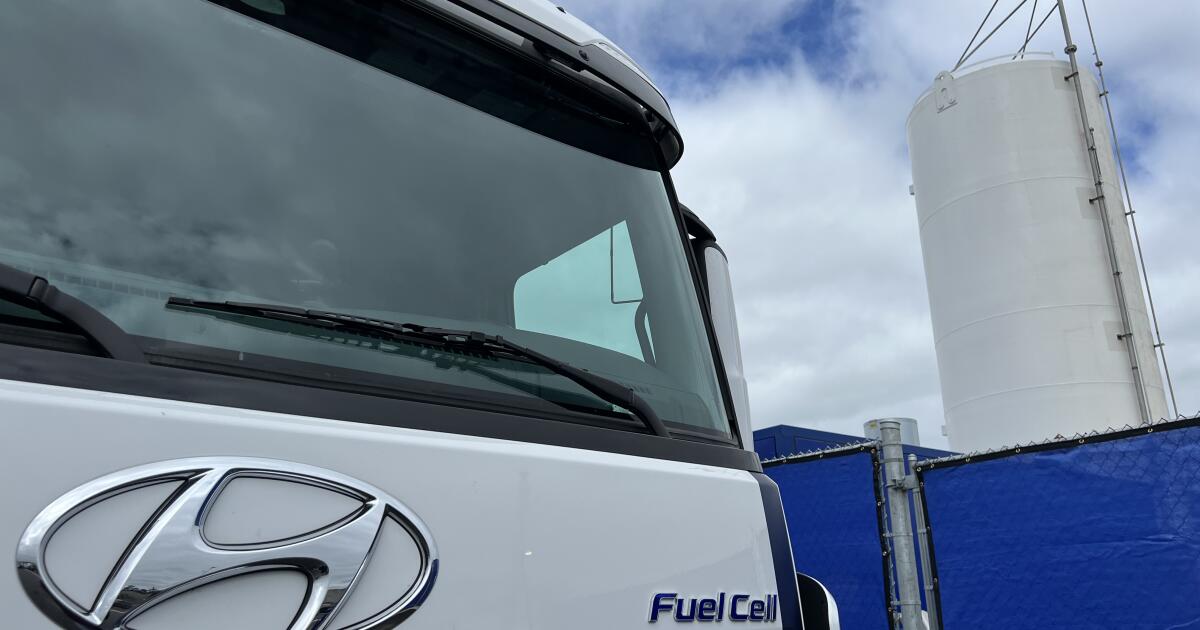
A hydrogen hub is a network of hydrogen production plants, trucks and pipelines for distribution, and customers that include long-haul fuel cell trucks and buses, port equipment and electric generators.
ARCHES is the first of seven U.S. regional hubs to sign a contract with the Department of Energy.
In a news release, ARCHES Chief Executive Angelina Galiteva called the hub “a monumental step forward in the state’s effort to achieve its air qualify, climate and energy goals, while improving the health and well-being of Californians, and creating green jobs across the state.”
ARCHES board member Bill Burke was even more effusive: The hub’s creation serves as “a testament to our collective dream of a sustainable future where clean energy and equal opportunity uplift every community and provide equitable advancement for the future of our workforce. Together, we are planting seeds of change and nurturing a brighter, more inclusive tomorrow.”
Whether ARCHES can deliver remains to be seen. Clean hydrogen is enormously expensive, with prices far too high to compete against fossil fuels in a competitive market economy. The aim is to subsidize the cost of hydrogen fuel until the industry reduces costs and grows big enough to stand on its own. Galiteva said hydrogen fuel prices could be competitive by 2032.
Some environmentalists are wary of hydrogen, claiming it’s not as clean as its proponents make it out to be. That issue is sure to be debated as ARCHES moves forward. Depending on how the hydrogen is made, it could provide cleaner energy alternatives for hard-to-decarbonize sectors, such as steelmaking and cement production.
California’s hydrogen projects will be located around the state, though heavily concentrated in the Central Valley. Trucks and pipelines will carry hydrogen to end users.
The money will be handed out to dozens of individual, although tightly coordinated, projects. They’ll include 10 hydrogen production sites, truck fueling stations, replacement of diesel-powered cargo-handling equipment at the state’s major ports and experimental prototypes for uses such as ocean shipping.
ARCHES said 220,000 well-paying jobs will be created, with special attention to disadvantaged communities. The hub “will create thousands of union careers while providing continued employment for for existing skilled and trained union members,” said Chris Hannan, president of the State Building and Construction Trades Council of California and a member of the ARCHES board.
Reduction in local pollutants will result in $2.95 billion per year in decreased healthcare costs, ARCHES said.
ARCHES is not a government body but a public-private partnership. It’s registered as a limited liability company, or LLC, with four partners: the California Governor’s Office of Business and Economic Development, the University of California system, the State Building and Construction Trades Council of California and the Renewables 100 Policy Institute.

The leaders of California’s embryonic hydrogen hub announced Wednesday that they have signed a contract with the U.S. Department of Energy worth billions.
The California hub is part of a $7-billion federal project to build the infrastructure for a “clean” hydrogen economy to replace fossil fuels and reduce greenhouse gas emissions. The California hub — known as ARCHES, or the Alliance for Renewable Clean Hydrogen Energy Systems — will net $1.2 billion of that federal money, with plans to bring in another $11.2 billion in private investment. California was awarded hub status in October.
Private participants include oil and gas companies, labor unions, fuel cell makers, electric utilities, truck manufacturers and more.
A hydrogen hub is a network of hydrogen production plants, trucks and pipelines for distribution, and customers that include long-haul fuel cell trucks and buses, port equipment and electric generators.
ARCHES is the first of seven U.S. regional hubs to sign a contract with the Department of Energy.
In a news release, ARCHES Chief Executive Angelina Galiteva called the hub “a monumental step forward in the state’s effort to achieve its air qualify, climate and energy goals, while improving the health and well-being of Californians, and creating green jobs across the state.”
ARCHES board member Bill Burke was even more effusive: The hub’s creation serves as “a testament to our collective dream of a sustainable future where clean energy and equal opportunity uplift every community and provide equitable advancement for the future of our workforce. Together, we are planting seeds of change and nurturing a brighter, more inclusive tomorrow.”
Whether ARCHES can deliver remains to be seen. Clean hydrogen is enormously expensive, with prices far too high to compete against fossil fuels in a competitive market economy. The aim is to subsidize the cost of hydrogen fuel until the industry reduces costs and grows big enough to stand on its own. Galiteva said hydrogen fuel prices could be competitive by 2032.
Some environmentalists are wary of hydrogen, claiming it’s not as clean as its proponents make it out to be. That issue is sure to be debated as ARCHES moves forward. Depending on how the hydrogen is made, it could provide cleaner energy alternatives for hard-to-decarbonize sectors, such as steelmaking and cement production.
California’s hydrogen projects will be located around the state, though heavily concentrated in the Central Valley. Trucks and pipelines will carry hydrogen to end users.
The money will be handed out to dozens of individual, although tightly coordinated, projects. They’ll include 10 hydrogen production sites, truck fueling stations, replacement of diesel-powered cargo-handling equipment at the state’s major ports and experimental prototypes for uses such as ocean shipping.
ARCHES said 220,000 well-paying jobs will be created, with special attention to disadvantaged communities. The hub “will create thousands of union careers while providing continued employment for for existing skilled and trained union members,” said Chris Hannan, president of the State Building and Construction Trades Council of California and a member of the ARCHES board.
Reduction in local pollutants will result in $2.95 billion per year in decreased healthcare costs, ARCHES said.
ARCHES is not a government body but a public-private partnership. It’s registered as a limited liability company, or LLC, with four partners: the California Governor’s Office of Business and Economic Development, the University of California system, the State Building and Construction Trades Council of California and the Renewables 100 Policy Institute.

The leaders of California’s embryonic hydrogen hub announced Wednesday that they have signed a contract with the U.S. Department of Energy worth billions.
The California hub is part of a $7-billion federal project to build the infrastructure for a “clean” hydrogen economy to replace fossil fuels and reduce greenhouse gas emissions. The California hub — known as ARCHES, or the Alliance for Renewable Clean Hydrogen Energy Systems — will net $1.2 billion of that federal money, with plans to bring in another $11.2 billion in private investment. California was awarded hub status in October.
Private participants include oil and gas companies, labor unions, fuel cell makers, electric utilities, truck manufacturers and more.
A hydrogen hub is a network of hydrogen production plants, trucks and pipelines for distribution, and customers that include long-haul fuel cell trucks and buses, port equipment and electric generators.
ARCHES is the first of seven U.S. regional hubs to sign a contract with the Department of Energy.
In a news release, ARCHES Chief Executive Angelina Galiteva called the hub “a monumental step forward in the state’s effort to achieve its air qualify, climate and energy goals, while improving the health and well-being of Californians, and creating green jobs across the state.”
ARCHES board member Bill Burke was even more effusive: The hub’s creation serves as “a testament to our collective dream of a sustainable future where clean energy and equal opportunity uplift every community and provide equitable advancement for the future of our workforce. Together, we are planting seeds of change and nurturing a brighter, more inclusive tomorrow.”
Whether ARCHES can deliver remains to be seen. Clean hydrogen is enormously expensive, with prices far too high to compete against fossil fuels in a competitive market economy. The aim is to subsidize the cost of hydrogen fuel until the industry reduces costs and grows big enough to stand on its own. Galiteva said hydrogen fuel prices could be competitive by 2032.
Some environmentalists are wary of hydrogen, claiming it’s not as clean as its proponents make it out to be. That issue is sure to be debated as ARCHES moves forward. Depending on how the hydrogen is made, it could provide cleaner energy alternatives for hard-to-decarbonize sectors, such as steelmaking and cement production.
California’s hydrogen projects will be located around the state, though heavily concentrated in the Central Valley. Trucks and pipelines will carry hydrogen to end users.
The money will be handed out to dozens of individual, although tightly coordinated, projects. They’ll include 10 hydrogen production sites, truck fueling stations, replacement of diesel-powered cargo-handling equipment at the state’s major ports and experimental prototypes for uses such as ocean shipping.
ARCHES said 220,000 well-paying jobs will be created, with special attention to disadvantaged communities. The hub “will create thousands of union careers while providing continued employment for for existing skilled and trained union members,” said Chris Hannan, president of the State Building and Construction Trades Council of California and a member of the ARCHES board.
Reduction in local pollutants will result in $2.95 billion per year in decreased healthcare costs, ARCHES said.
ARCHES is not a government body but a public-private partnership. It’s registered as a limited liability company, or LLC, with four partners: the California Governor’s Office of Business and Economic Development, the University of California system, the State Building and Construction Trades Council of California and the Renewables 100 Policy Institute.
The leaders of California’s embryonic hydrogen hub announced Wednesday that they have signed a contract with the U.S. Department of Energy worth billions.
The California hub is part of a $7-billion federal project to build the infrastructure for a “clean” hydrogen economy to replace fossil fuels and reduce greenhouse gas emissions. The California hub — known as ARCHES, or the Alliance for Renewable Clean Hydrogen Energy Systems — will net $1.2 billion of that federal money, with plans to bring in another $11.2 billion in private investment. California was awarded hub status in October.
Private participants include oil and gas companies, labor unions, fuel cell makers, electric utilities, truck manufacturers and more.
A hydrogen hub is a network of hydrogen production plants, trucks and pipelines for distribution, and customers that include long-haul fuel cell trucks and buses, port equipment and electric generators.
ARCHES is the first of seven U.S. regional hubs to sign a contract with the Department of Energy.
In a news release, ARCHES Chief Executive Angelina Galiteva called the hub “a monumental step forward in the state’s effort to achieve its air qualify, climate and energy goals, while improving the health and well-being of Californians, and creating green jobs across the state.”
ARCHES board member Bill Burke was even more effusive: The hub’s creation serves as “a testament to our collective dream of a sustainable future where clean energy and equal opportunity uplift every community and provide equitable advancement for the future of our workforce. Together, we are planting seeds of change and nurturing a brighter, more inclusive tomorrow.”
Whether ARCHES can deliver remains to be seen. Clean hydrogen is enormously expensive, with prices far too high to compete against fossil fuels in a competitive market economy. The aim is to subsidize the cost of hydrogen fuel until the industry reduces costs and grows big enough to stand on its own. Galiteva said hydrogen fuel prices could be competitive by 2032.
Some environmentalists are wary of hydrogen, claiming it’s not as clean as its proponents make it out to be. That issue is sure to be debated as ARCHES moves forward. Depending on how the hydrogen is made, it could provide cleaner energy alternatives for hard-to-decarbonize sectors, such as steelmaking and cement production.
California’s hydrogen projects will be located around the state, though heavily concentrated in the Central Valley. Trucks and pipelines will carry hydrogen to end users.
The money will be handed out to dozens of individual, although tightly coordinated, projects. They’ll include 10 hydrogen production sites, truck fueling stations, replacement of diesel-powered cargo-handling equipment at the state’s major ports and experimental prototypes for uses such as ocean shipping.
ARCHES said 220,000 well-paying jobs will be created, with special attention to disadvantaged communities. The hub “will create thousands of union careers while providing continued employment for for existing skilled and trained union members,” said Chris Hannan, president of the State Building and Construction Trades Council of California and a member of the ARCHES board.
Reduction in local pollutants will result in $2.95 billion per year in decreased healthcare costs, ARCHES said.
ARCHES is not a government body but a public-private partnership. It’s registered as a limited liability company, or LLC, with four partners: the California Governor’s Office of Business and Economic Development, the University of California system, the State Building and Construction Trades Council of California and the Renewables 100 Policy Institute.

The leaders of California’s embryonic hydrogen hub announced Wednesday that they have signed a contract with the U.S. Department of Energy worth billions.
The California hub is part of a $7-billion federal project to build the infrastructure for a “clean” hydrogen economy to replace fossil fuels and reduce greenhouse gas emissions. The California hub — known as ARCHES, or the Alliance for Renewable Clean Hydrogen Energy Systems — will net $1.2 billion of that federal money, with plans to bring in another $11.2 billion in private investment. California was awarded hub status in October.
Private participants include oil and gas companies, labor unions, fuel cell makers, electric utilities, truck manufacturers and more.
A hydrogen hub is a network of hydrogen production plants, trucks and pipelines for distribution, and customers that include long-haul fuel cell trucks and buses, port equipment and electric generators.
ARCHES is the first of seven U.S. regional hubs to sign a contract with the Department of Energy.
In a news release, ARCHES Chief Executive Angelina Galiteva called the hub “a monumental step forward in the state’s effort to achieve its air qualify, climate and energy goals, while improving the health and well-being of Californians, and creating green jobs across the state.”
ARCHES board member Bill Burke was even more effusive: The hub’s creation serves as “a testament to our collective dream of a sustainable future where clean energy and equal opportunity uplift every community and provide equitable advancement for the future of our workforce. Together, we are planting seeds of change and nurturing a brighter, more inclusive tomorrow.”
Whether ARCHES can deliver remains to be seen. Clean hydrogen is enormously expensive, with prices far too high to compete against fossil fuels in a competitive market economy. The aim is to subsidize the cost of hydrogen fuel until the industry reduces costs and grows big enough to stand on its own. Galiteva said hydrogen fuel prices could be competitive by 2032.
Some environmentalists are wary of hydrogen, claiming it’s not as clean as its proponents make it out to be. That issue is sure to be debated as ARCHES moves forward. Depending on how the hydrogen is made, it could provide cleaner energy alternatives for hard-to-decarbonize sectors, such as steelmaking and cement production.
California’s hydrogen projects will be located around the state, though heavily concentrated in the Central Valley. Trucks and pipelines will carry hydrogen to end users.
The money will be handed out to dozens of individual, although tightly coordinated, projects. They’ll include 10 hydrogen production sites, truck fueling stations, replacement of diesel-powered cargo-handling equipment at the state’s major ports and experimental prototypes for uses such as ocean shipping.
ARCHES said 220,000 well-paying jobs will be created, with special attention to disadvantaged communities. The hub “will create thousands of union careers while providing continued employment for for existing skilled and trained union members,” said Chris Hannan, president of the State Building and Construction Trades Council of California and a member of the ARCHES board.
Reduction in local pollutants will result in $2.95 billion per year in decreased healthcare costs, ARCHES said.
ARCHES is not a government body but a public-private partnership. It’s registered as a limited liability company, or LLC, with four partners: the California Governor’s Office of Business and Economic Development, the University of California system, the State Building and Construction Trades Council of California and the Renewables 100 Policy Institute.
The leaders of California’s embryonic hydrogen hub announced Wednesday that they have signed a contract with the U.S. Department of Energy worth billions.
The California hub is part of a $7-billion federal project to build the infrastructure for a “clean” hydrogen economy to replace fossil fuels and reduce greenhouse gas emissions. The California hub — known as ARCHES, or the Alliance for Renewable Clean Hydrogen Energy Systems — will net $1.2 billion of that federal money, with plans to bring in another $11.2 billion in private investment. California was awarded hub status in October.
Private participants include oil and gas companies, labor unions, fuel cell makers, electric utilities, truck manufacturers and more.
A hydrogen hub is a network of hydrogen production plants, trucks and pipelines for distribution, and customers that include long-haul fuel cell trucks and buses, port equipment and electric generators.
ARCHES is the first of seven U.S. regional hubs to sign a contract with the Department of Energy.
In a news release, ARCHES Chief Executive Angelina Galiteva called the hub “a monumental step forward in the state’s effort to achieve its air qualify, climate and energy goals, while improving the health and well-being of Californians, and creating green jobs across the state.”
ARCHES board member Bill Burke was even more effusive: The hub’s creation serves as “a testament to our collective dream of a sustainable future where clean energy and equal opportunity uplift every community and provide equitable advancement for the future of our workforce. Together, we are planting seeds of change and nurturing a brighter, more inclusive tomorrow.”
Whether ARCHES can deliver remains to be seen. Clean hydrogen is enormously expensive, with prices far too high to compete against fossil fuels in a competitive market economy. The aim is to subsidize the cost of hydrogen fuel until the industry reduces costs and grows big enough to stand on its own. Galiteva said hydrogen fuel prices could be competitive by 2032.
Some environmentalists are wary of hydrogen, claiming it’s not as clean as its proponents make it out to be. That issue is sure to be debated as ARCHES moves forward. Depending on how the hydrogen is made, it could provide cleaner energy alternatives for hard-to-decarbonize sectors, such as steelmaking and cement production.
California’s hydrogen projects will be located around the state, though heavily concentrated in the Central Valley. Trucks and pipelines will carry hydrogen to end users.
The money will be handed out to dozens of individual, although tightly coordinated, projects. They’ll include 10 hydrogen production sites, truck fueling stations, replacement of diesel-powered cargo-handling equipment at the state’s major ports and experimental prototypes for uses such as ocean shipping.
ARCHES said 220,000 well-paying jobs will be created, with special attention to disadvantaged communities. The hub “will create thousands of union careers while providing continued employment for for existing skilled and trained union members,” said Chris Hannan, president of the State Building and Construction Trades Council of California and a member of the ARCHES board.
Reduction in local pollutants will result in $2.95 billion per year in decreased healthcare costs, ARCHES said.
ARCHES is not a government body but a public-private partnership. It’s registered as a limited liability company, or LLC, with four partners: the California Governor’s Office of Business and Economic Development, the University of California system, the State Building and Construction Trades Council of California and the Renewables 100 Policy Institute.
The leaders of California’s embryonic hydrogen hub announced Wednesday that they have signed a contract with the U.S. Department of Energy worth billions.
The California hub is part of a $7-billion federal project to build the infrastructure for a “clean” hydrogen economy to replace fossil fuels and reduce greenhouse gas emissions. The California hub — known as ARCHES, or the Alliance for Renewable Clean Hydrogen Energy Systems — will net $1.2 billion of that federal money, with plans to bring in another $11.2 billion in private investment. California was awarded hub status in October.
Private participants include oil and gas companies, labor unions, fuel cell makers, electric utilities, truck manufacturers and more.
A hydrogen hub is a network of hydrogen production plants, trucks and pipelines for distribution, and customers that include long-haul fuel cell trucks and buses, port equipment and electric generators.
ARCHES is the first of seven U.S. regional hubs to sign a contract with the Department of Energy.
In a news release, ARCHES Chief Executive Angelina Galiteva called the hub “a monumental step forward in the state’s effort to achieve its air qualify, climate and energy goals, while improving the health and well-being of Californians, and creating green jobs across the state.”
ARCHES board member Bill Burke was even more effusive: The hub’s creation serves as “a testament to our collective dream of a sustainable future where clean energy and equal opportunity uplift every community and provide equitable advancement for the future of our workforce. Together, we are planting seeds of change and nurturing a brighter, more inclusive tomorrow.”
Whether ARCHES can deliver remains to be seen. Clean hydrogen is enormously expensive, with prices far too high to compete against fossil fuels in a competitive market economy. The aim is to subsidize the cost of hydrogen fuel until the industry reduces costs and grows big enough to stand on its own. Galiteva said hydrogen fuel prices could be competitive by 2032.
Some environmentalists are wary of hydrogen, claiming it’s not as clean as its proponents make it out to be. That issue is sure to be debated as ARCHES moves forward. Depending on how the hydrogen is made, it could provide cleaner energy alternatives for hard-to-decarbonize sectors, such as steelmaking and cement production.
California’s hydrogen projects will be located around the state, though heavily concentrated in the Central Valley. Trucks and pipelines will carry hydrogen to end users.
The money will be handed out to dozens of individual, although tightly coordinated, projects. They’ll include 10 hydrogen production sites, truck fueling stations, replacement of diesel-powered cargo-handling equipment at the state’s major ports and experimental prototypes for uses such as ocean shipping.
ARCHES said 220,000 well-paying jobs will be created, with special attention to disadvantaged communities. The hub “will create thousands of union careers while providing continued employment for for existing skilled and trained union members,” said Chris Hannan, president of the State Building and Construction Trades Council of California and a member of the ARCHES board.
Reduction in local pollutants will result in $2.95 billion per year in decreased healthcare costs, ARCHES said.
ARCHES is not a government body but a public-private partnership. It’s registered as a limited liability company, or LLC, with four partners: the California Governor’s Office of Business and Economic Development, the University of California system, the State Building and Construction Trades Council of California and the Renewables 100 Policy Institute.
The leaders of California’s embryonic hydrogen hub announced Wednesday that they have signed a contract with the U.S. Department of Energy worth billions.
The California hub is part of a $7-billion federal project to build the infrastructure for a “clean” hydrogen economy to replace fossil fuels and reduce greenhouse gas emissions. The California hub — known as ARCHES, or the Alliance for Renewable Clean Hydrogen Energy Systems — will net $1.2 billion of that federal money, with plans to bring in another $11.2 billion in private investment. California was awarded hub status in October.
Private participants include oil and gas companies, labor unions, fuel cell makers, electric utilities, truck manufacturers and more.
A hydrogen hub is a network of hydrogen production plants, trucks and pipelines for distribution, and customers that include long-haul fuel cell trucks and buses, port equipment and electric generators.
ARCHES is the first of seven U.S. regional hubs to sign a contract with the Department of Energy.
In a news release, ARCHES Chief Executive Angelina Galiteva called the hub “a monumental step forward in the state’s effort to achieve its air qualify, climate and energy goals, while improving the health and well-being of Californians, and creating green jobs across the state.”
ARCHES board member Bill Burke was even more effusive: The hub’s creation serves as “a testament to our collective dream of a sustainable future where clean energy and equal opportunity uplift every community and provide equitable advancement for the future of our workforce. Together, we are planting seeds of change and nurturing a brighter, more inclusive tomorrow.”
Whether ARCHES can deliver remains to be seen. Clean hydrogen is enormously expensive, with prices far too high to compete against fossil fuels in a competitive market economy. The aim is to subsidize the cost of hydrogen fuel until the industry reduces costs and grows big enough to stand on its own. Galiteva said hydrogen fuel prices could be competitive by 2032.
Some environmentalists are wary of hydrogen, claiming it’s not as clean as its proponents make it out to be. That issue is sure to be debated as ARCHES moves forward. Depending on how the hydrogen is made, it could provide cleaner energy alternatives for hard-to-decarbonize sectors, such as steelmaking and cement production.
California’s hydrogen projects will be located around the state, though heavily concentrated in the Central Valley. Trucks and pipelines will carry hydrogen to end users.
The money will be handed out to dozens of individual, although tightly coordinated, projects. They’ll include 10 hydrogen production sites, truck fueling stations, replacement of diesel-powered cargo-handling equipment at the state’s major ports and experimental prototypes for uses such as ocean shipping.
ARCHES said 220,000 well-paying jobs will be created, with special attention to disadvantaged communities. The hub “will create thousands of union careers while providing continued employment for for existing skilled and trained union members,” said Chris Hannan, president of the State Building and Construction Trades Council of California and a member of the ARCHES board.
Reduction in local pollutants will result in $2.95 billion per year in decreased healthcare costs, ARCHES said.
ARCHES is not a government body but a public-private partnership. It’s registered as a limited liability company, or LLC, with four partners: the California Governor’s Office of Business and Economic Development, the University of California system, the State Building and Construction Trades Council of California and the Renewables 100 Policy Institute.

