

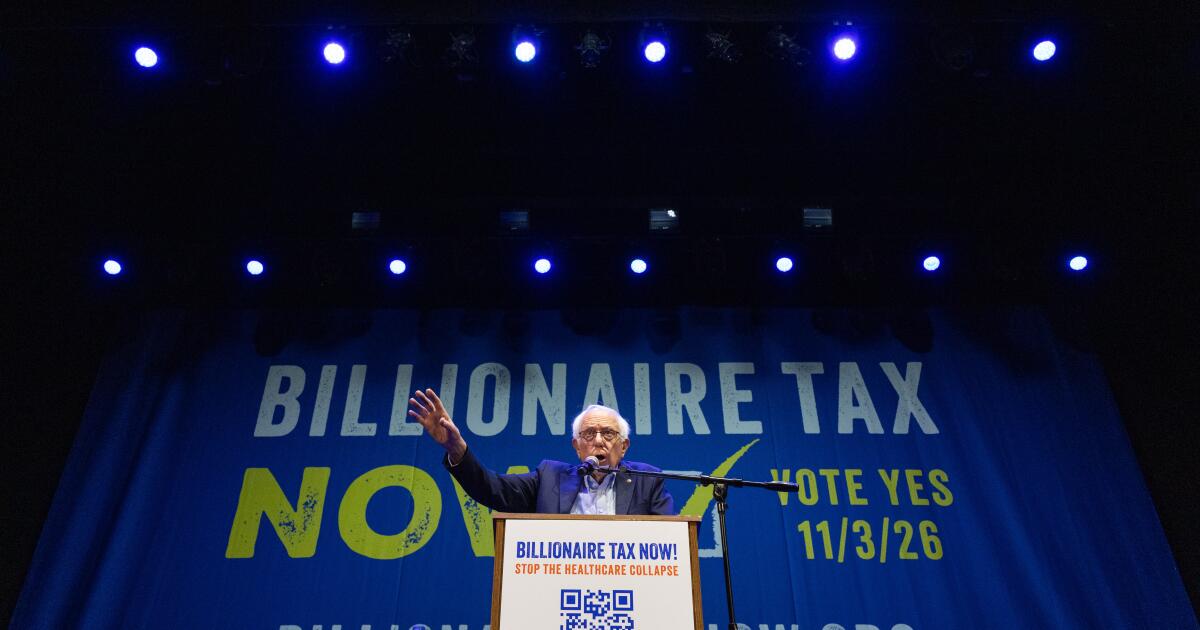
California voters are sharply divided over a ballot measure to impose a one-time tax on billionaires to help fund healthcare programs, a proposal already triggering a fierce and expensive political fight as the November election approaches, according to a poll released Friday.
More than half of likely voters oppose a separate measure that would require Californians to provide identification when voting and election officials to verify registered voters are U.S. citizens, the survey showed.
The two controversial proposals are among the 14 ballot measures Californians will decide in the Nov. 3 election. Proposition 40, which would impose the tax on billionaires’ assets, has reached the precipice of nationwide debates over economic inequality and liberal overreach. The Republican-led voter ID measure, Proposition 39, emerged amid President Trump’s baseless claims of widespread voter fraud.
Among likely California voters, 48% support Proposition 40, compared with 41% who oppose the proposed wealth tax and 11% who are undecided, according to a new poll by UC Berkeley’s Institute of Governmental Studies that is co-sponsored by The Times.
Proposition 40’s failure to crack 50% support among voters at this point in the electoral cycle is a potential red flag, said IGS poll director Mark DiCamillo. Traditionally, Californians who are undecided on ballot measures tend to vote against them, he said.
“It’s got an early lead, but it’s not a very large lead, and it’s not a majority,” he said. “Usually, for ballot propositions, you want the yes side to be above 50%, and that’s not where it is right now.”
The proposal was crafted by a healthcare workers’ union to compensate for an estimated $100 billion in federal healthcare cuts approved by Trump and congressional Republicans that it argues will cause devastating harm to millions of California’s most vulnerable residents. Proposition 40 would impose a one-time 5% tax on the assets of billionaires who resided in California as of Jan. 1, with some exceptions.
Democrats and their allies are splintered over the proposal. Some, including Gov. Gavin Newsom, argue it will prompt the wealthy to flee California, further harming its volatile budget, which is dependent on the state’s richest residents. The California Democratic Party and leading progressives support the measure, with Sen. Bernie Sanders (I-Vt.) calling it a modest tax necessary to help Californians struggling because of cuts imposed by Republicans to pay for tax breaks for the wealthy.
While Democratic voters mostly support the ballot measure and Republicans largely oppose it, younger Californians are far more likely to say they plan to vote for it compared to seniors. Minorities, women and lower-income voters are also more supportive of the measure than white voters, men and Californians who earn at least $200,000 annually. Union households support the measure, while non-union families are evenly divided about it.
Turnout will be pivotal, DiCamillo said. While younger Californians are historically less likely to vote, especially in midterm elections, if they are energized by the issues championed by socialist Democrats, including New York City Mayor Zohran Mamdani, that could boost the wealth tax proposal’s prospects.
The survey found that voters are far less aware of two competing ballot measures aimed at nullifying the proposed wealth tax.
Proposition 41 would prohibit new taxes from being exempt from voter-approved state spending limits and require audits of new levies. Proposition 42 would ban new taxes on personal property and some retroactive state taxes. If the wealth tax is approved and either of the countermeasures receives more votes, the proposed billionaires’ tax would not go into effect.
The poll found that 35% of likely voters supported Proposition 41, with 37% opposing it. On Proposition 42, 40% of voters backed the measure, and 37% opposed it.

Roughly one out of every four of the voters surveyed on those two measures said they were undecided. DiCamillo said he expects that to change as the anti-wealth tax campaigns, which are expected to be well-organized and well-funded, ramp up their messaging to voters.
“There’s going to be a lot of campaigning, apparently on the no side especially. So we’ll see,” he said. “But you know, I think it’s confusing to voters in some ways.”
Among the other controversial measures on the Nov. 3 ballot is Proposition 39, a measure pushed by Republicans that would require all voters in future elections to show government-issued identification every time they vote in person or provide a special PIN or the last four digits of their Social Security number when submitting mail-in ballots.
The measure would also require the California secretary of state and county election officials to verify that registered voters are U.S. citizens by “using government data,” which according to supporters could include information in the federal Social Security Administration database, jury summons information and other government records.
Just over half of California’s likely voters oppose the ballot measure, while 42% support it. Californians are predictably divided along partisan lines. Eight out of 10 Democrats oppose the proposal, while more than nine out of 10 Republicans support it. Voters not affiliated with either major political party oppose it 54%, while 36% support it.

Proponents of voter ID contend that such laws prevent election fraud and, along with proof-of-citizenship mandates, prevent noncitizens from voting. Opponents say ID mandates threaten the fundamental constitutional rights of Americans who do not have the mandated documentation readily available, and that the restrictions are unnecessary given that voting by noncitizens is rare and already outlawed in the U.S.
The Republican-led push for the voter ID initiative comes at a time of growing distrust in the integrity of the electoral process nationwide, a wariness intensified by President Trump’s baseless claims that the 2020 election was stolen from him and false assertions that droves of undocumented immigrants are swaying elections with illegal votes.
“It’s a very traditional Democrat versus Republican split,” DiCamillo said, adding that it would be surprising to see major shifts in the numbers. “Once these things get solidified in terms of the partisan splits, without any other kinds of splits like we’re seeing in Prop. 40, you know that’s usually the dominant theme.”
The Berkeley IGS/Times poll findings are based on an online survey in English and Spanish of 4,207 California registered voters, 2,310 of whom are considered likely voters, from Aug. 3-9. The results are estimated to have a margin of error of about 2.5 percentage points in either direction in the likely voter sample, and larger numbers for subgroups.

California voters are sharply divided over a ballot measure to impose a one-time tax on billionaires to help fund healthcare programs, a proposal already triggering a fierce and expensive political fight as the November election approaches, according to a poll released Friday.
More than half of likely voters oppose a separate measure that would require Californians to provide identification when voting and election officials to verify registered voters are U.S. citizens, the survey showed.
The two controversial proposals are among the 14 ballot measures Californians will decide in the Nov. 3 election. Proposition 40, which would impose the tax on billionaires’ assets, has reached the precipice of nationwide debates over economic inequality and liberal overreach. The Republican-led voter ID measure, Proposition 39, emerged amid President Trump’s baseless claims of widespread voter fraud.
Among likely California voters, 48% support Proposition 40, compared with 41% who oppose the proposed wealth tax and 11% who are undecided, according to a new poll by UC Berkeley’s Institute of Governmental Studies that is co-sponsored by The Times.
Proposition 40’s failure to crack 50% support among voters at this point in the electoral cycle is a potential red flag, said IGS poll director Mark DiCamillo. Traditionally, Californians who are undecided on ballot measures tend to vote against them, he said.
“It’s got an early lead, but it’s not a very large lead, and it’s not a majority,” he said. “Usually, for ballot propositions, you want the yes side to be above 50%, and that’s not where it is right now.”
The proposal was crafted by a healthcare workers’ union to compensate for an estimated $100 billion in federal healthcare cuts approved by Trump and congressional Republicans that it argues will cause devastating harm to millions of California’s most vulnerable residents. Proposition 40 would impose a one-time 5% tax on the assets of billionaires who resided in California as of Jan. 1, with some exceptions.
Democrats and their allies are splintered over the proposal. Some, including Gov. Gavin Newsom, argue it will prompt the wealthy to flee California, further harming its volatile budget, which is dependent on the state’s richest residents. The California Democratic Party and leading progressives support the measure, with Sen. Bernie Sanders (I-Vt.) calling it a modest tax necessary to help Californians struggling because of cuts imposed by Republicans to pay for tax breaks for the wealthy.
While Democratic voters mostly support the ballot measure and Republicans largely oppose it, younger Californians are far more likely to say they plan to vote for it compared to seniors. Minorities, women and lower-income voters are also more supportive of the measure than white voters, men and Californians who earn at least $200,000 annually. Union households support the measure, while non-union families are evenly divided about it.
Turnout will be pivotal, DiCamillo said. While younger Californians are historically less likely to vote, especially in midterm elections, if they are energized by the issues championed by socialist Democrats, including New York City Mayor Zohran Mamdani, that could boost the wealth tax proposal’s prospects.
The survey found that voters are far less aware of two competing ballot measures aimed at nullifying the proposed wealth tax.
Proposition 41 would prohibit new taxes from being exempt from voter-approved state spending limits and require audits of new levies. Proposition 42 would ban new taxes on personal property and some retroactive state taxes. If the wealth tax is approved and either of the countermeasures receives more votes, the proposed billionaires’ tax would not go into effect.
The poll found that 35% of likely voters supported Proposition 41, with 37% opposing it. On Proposition 42, 40% of voters backed the measure, and 37% opposed it.
Roughly one out of every four of the voters surveyed on those two measures said they were undecided. DiCamillo said he expects that to change as the anti-wealth tax campaigns, which are expected to be well-organized and well-funded, ramp up their messaging to voters.
“There’s going to be a lot of campaigning, apparently on the no side especially. So we’ll see,” he said. “But you know, I think it’s confusing to voters in some ways.”
Among the other controversial measures on the Nov. 3 ballot is Proposition 39, a measure pushed by Republicans that would require all voters in future elections to show government-issued identification every time they vote in person or provide a special PIN or the last four digits of their Social Security number when submitting mail-in ballots.
The measure would also require the California secretary of state and county election officials to verify that registered voters are U.S. citizens by “using government data,” which according to supporters could include information in the federal Social Security Administration database, jury summons information and other government records.
Just over half of California’s likely voters oppose the ballot measure, while 42% support it. Californians are predictably divided along partisan lines. Eight out of 10 Democrats oppose the proposal, while more than nine out of 10 Republicans support it. Voters not affiliated with either major political party oppose it 54%, while 36% support it.
Proponents of voter ID contend that such laws prevent election fraud and, along with proof-of-citizenship mandates, prevent noncitizens from voting. Opponents say ID mandates threaten the fundamental constitutional rights of Americans who do not have the mandated documentation readily available, and that the restrictions are unnecessary given that voting by noncitizens is rare and already outlawed in the U.S.
The Republican-led push for the voter ID initiative comes at a time of growing distrust in the integrity of the electoral process nationwide, a wariness intensified by President Trump’s baseless claims that the 2020 election was stolen from him and false assertions that droves of undocumented immigrants are swaying elections with illegal votes.
“It’s a very traditional Democrat versus Republican split,” DiCamillo said, adding that it would be surprising to see major shifts in the numbers. “Once these things get solidified in terms of the partisan splits, without any other kinds of splits like we’re seeing in Prop. 40, you know that’s usually the dominant theme.”
The Berkeley IGS/Times poll findings are based on an online survey in English and Spanish of 4,207 California registered voters, 2,310 of whom are considered likely voters, from Aug. 3-9. The results are estimated to have a margin of error of about 2.5 percentage points in either direction in the likely voter sample, and larger numbers for subgroups.

California voters are sharply divided over a ballot measure to impose a one-time tax on billionaires to help fund healthcare programs, a proposal already triggering a fierce and expensive political fight as the November election approaches, according to a poll released Friday.
More than half of likely voters oppose a separate measure that would require Californians to provide identification when voting and election officials to verify registered voters are U.S. citizens, the survey showed.
The two controversial proposals are among the 14 ballot measures Californians will decide in the Nov. 3 election. Proposition 40, which would impose the tax on billionaires’ assets, has reached the precipice of nationwide debates over economic inequality and liberal overreach. The Republican-led voter ID measure, Proposition 39, emerged amid President Trump’s baseless claims of widespread voter fraud.
Among likely California voters, 48% support Proposition 40, compared with 41% who oppose the proposed wealth tax and 11% who are undecided, according to a new poll by UC Berkeley’s Institute of Governmental Studies that is co-sponsored by The Times.
Proposition 40’s failure to crack 50% support among voters at this point in the electoral cycle is a potential red flag, said IGS poll director Mark DiCamillo. Traditionally, Californians who are undecided on ballot measures tend to vote against them, he said.
“It’s got an early lead, but it’s not a very large lead, and it’s not a majority,” he said. “Usually, for ballot propositions, you want the yes side to be above 50%, and that’s not where it is right now.”
The proposal was crafted by a healthcare workers’ union to compensate for an estimated $100 billion in federal healthcare cuts approved by Trump and congressional Republicans that it argues will cause devastating harm to millions of California’s most vulnerable residents. Proposition 40 would impose a one-time 5% tax on the assets of billionaires who resided in California as of Jan. 1, with some exceptions.
Democrats and their allies are splintered over the proposal. Some, including Gov. Gavin Newsom, argue it will prompt the wealthy to flee California, further harming its volatile budget, which is dependent on the state’s richest residents. The California Democratic Party and leading progressives support the measure, with Sen. Bernie Sanders (I-Vt.) calling it a modest tax necessary to help Californians struggling because of cuts imposed by Republicans to pay for tax breaks for the wealthy.
While Democratic voters mostly support the ballot measure and Republicans largely oppose it, younger Californians are far more likely to say they plan to vote for it compared to seniors. Minorities, women and lower-income voters are also more supportive of the measure than white voters, men and Californians who earn at least $200,000 annually. Union households support the measure, while non-union families are evenly divided about it.
Turnout will be pivotal, DiCamillo said. While younger Californians are historically less likely to vote, especially in midterm elections, if they are energized by the issues championed by socialist Democrats, including New York City Mayor Zohran Mamdani, that could boost the wealth tax proposal’s prospects.
The survey found that voters are far less aware of two competing ballot measures aimed at nullifying the proposed wealth tax.
Proposition 41 would prohibit new taxes from being exempt from voter-approved state spending limits and require audits of new levies. Proposition 42 would ban new taxes on personal property and some retroactive state taxes. If the wealth tax is approved and either of the countermeasures receives more votes, the proposed billionaires’ tax would not go into effect.
The poll found that 35% of likely voters supported Proposition 41, with 37% opposing it. On Proposition 42, 40% of voters backed the measure, and 37% opposed it.
Roughly one out of every four of the voters surveyed on those two measures said they were undecided. DiCamillo said he expects that to change as the anti-wealth tax campaigns, which are expected to be well-organized and well-funded, ramp up their messaging to voters.
“There’s going to be a lot of campaigning, apparently on the no side especially. So we’ll see,” he said. “But you know, I think it’s confusing to voters in some ways.”
Among the other controversial measures on the Nov. 3 ballot is Proposition 39, a measure pushed by Republicans that would require all voters in future elections to show government-issued identification every time they vote in person or provide a special PIN or the last four digits of their Social Security number when submitting mail-in ballots.
The measure would also require the California secretary of state and county election officials to verify that registered voters are U.S. citizens by “using government data,” which according to supporters could include information in the federal Social Security Administration database, jury summons information and other government records.
Just over half of California’s likely voters oppose the ballot measure, while 42% support it. Californians are predictably divided along partisan lines. Eight out of 10 Democrats oppose the proposal, while more than nine out of 10 Republicans support it. Voters not affiliated with either major political party oppose it 54%, while 36% support it.
Proponents of voter ID contend that such laws prevent election fraud and, along with proof-of-citizenship mandates, prevent noncitizens from voting. Opponents say ID mandates threaten the fundamental constitutional rights of Americans who do not have the mandated documentation readily available, and that the restrictions are unnecessary given that voting by noncitizens is rare and already outlawed in the U.S.
The Republican-led push for the voter ID initiative comes at a time of growing distrust in the integrity of the electoral process nationwide, a wariness intensified by President Trump’s baseless claims that the 2020 election was stolen from him and false assertions that droves of undocumented immigrants are swaying elections with illegal votes.
“It’s a very traditional Democrat versus Republican split,” DiCamillo said, adding that it would be surprising to see major shifts in the numbers. “Once these things get solidified in terms of the partisan splits, without any other kinds of splits like we’re seeing in Prop. 40, you know that’s usually the dominant theme.”
The Berkeley IGS/Times poll findings are based on an online survey in English and Spanish of 4,207 California registered voters, 2,310 of whom are considered likely voters, from Aug. 3-9. The results are estimated to have a margin of error of about 2.5 percentage points in either direction in the likely voter sample, and larger numbers for subgroups.
California voters are sharply divided over a ballot measure to impose a one-time tax on billionaires to help fund healthcare programs, a proposal already triggering a fierce and expensive political fight as the November election approaches, according to a poll released Friday.
More than half of likely voters oppose a separate measure that would require Californians to provide identification when voting and election officials to verify registered voters are U.S. citizens, the survey showed.
The two controversial proposals are among the 14 ballot measures Californians will decide in the Nov. 3 election. Proposition 40, which would impose the tax on billionaires’ assets, has reached the precipice of nationwide debates over economic inequality and liberal overreach. The Republican-led voter ID measure, Proposition 39, emerged amid President Trump’s baseless claims of widespread voter fraud.
Among likely California voters, 48% support Proposition 40, compared with 41% who oppose the proposed wealth tax and 11% who are undecided, according to a new poll by UC Berkeley’s Institute of Governmental Studies that is co-sponsored by The Times.
Proposition 40’s failure to crack 50% support among voters at this point in the electoral cycle is a potential red flag, said IGS poll director Mark DiCamillo. Traditionally, Californians who are undecided on ballot measures tend to vote against them, he said.
“It’s got an early lead, but it’s not a very large lead, and it’s not a majority,” he said. “Usually, for ballot propositions, you want the yes side to be above 50%, and that’s not where it is right now.”
The proposal was crafted by a healthcare workers’ union to compensate for an estimated $100 billion in federal healthcare cuts approved by Trump and congressional Republicans that it argues will cause devastating harm to millions of California’s most vulnerable residents. Proposition 40 would impose a one-time 5% tax on the assets of billionaires who resided in California as of Jan. 1, with some exceptions.
Democrats and their allies are splintered over the proposal. Some, including Gov. Gavin Newsom, argue it will prompt the wealthy to flee California, further harming its volatile budget, which is dependent on the state’s richest residents. The California Democratic Party and leading progressives support the measure, with Sen. Bernie Sanders (I-Vt.) calling it a modest tax necessary to help Californians struggling because of cuts imposed by Republicans to pay for tax breaks for the wealthy.
While Democratic voters mostly support the ballot measure and Republicans largely oppose it, younger Californians are far more likely to say they plan to vote for it compared to seniors. Minorities, women and lower-income voters are also more supportive of the measure than white voters, men and Californians who earn at least $200,000 annually. Union households support the measure, while non-union families are evenly divided about it.
Turnout will be pivotal, DiCamillo said. While younger Californians are historically less likely to vote, especially in midterm elections, if they are energized by the issues championed by socialist Democrats, including New York City Mayor Zohran Mamdani, that could boost the wealth tax proposal’s prospects.
The survey found that voters are far less aware of two competing ballot measures aimed at nullifying the proposed wealth tax.
Proposition 41 would prohibit new taxes from being exempt from voter-approved state spending limits and require audits of new levies. Proposition 42 would ban new taxes on personal property and some retroactive state taxes. If the wealth tax is approved and either of the countermeasures receives more votes, the proposed billionaires’ tax would not go into effect.
The poll found that 35% of likely voters supported Proposition 41, with 37% opposing it. On Proposition 42, 40% of voters backed the measure, and 37% opposed it.
Roughly one out of every four of the voters surveyed on those two measures said they were undecided. DiCamillo said he expects that to change as the anti-wealth tax campaigns, which are expected to be well-organized and well-funded, ramp up their messaging to voters.
“There’s going to be a lot of campaigning, apparently on the no side especially. So we’ll see,” he said. “But you know, I think it’s confusing to voters in some ways.”
Among the other controversial measures on the Nov. 3 ballot is Proposition 39, a measure pushed by Republicans that would require all voters in future elections to show government-issued identification every time they vote in person or provide a special PIN or the last four digits of their Social Security number when submitting mail-in ballots.
The measure would also require the California secretary of state and county election officials to verify that registered voters are U.S. citizens by “using government data,” which according to supporters could include information in the federal Social Security Administration database, jury summons information and other government records.
Just over half of California’s likely voters oppose the ballot measure, while 42% support it. Californians are predictably divided along partisan lines. Eight out of 10 Democrats oppose the proposal, while more than nine out of 10 Republicans support it. Voters not affiliated with either major political party oppose it 54%, while 36% support it.
Proponents of voter ID contend that such laws prevent election fraud and, along with proof-of-citizenship mandates, prevent noncitizens from voting. Opponents say ID mandates threaten the fundamental constitutional rights of Americans who do not have the mandated documentation readily available, and that the restrictions are unnecessary given that voting by noncitizens is rare and already outlawed in the U.S.
The Republican-led push for the voter ID initiative comes at a time of growing distrust in the integrity of the electoral process nationwide, a wariness intensified by President Trump’s baseless claims that the 2020 election was stolen from him and false assertions that droves of undocumented immigrants are swaying elections with illegal votes.
“It’s a very traditional Democrat versus Republican split,” DiCamillo said, adding that it would be surprising to see major shifts in the numbers. “Once these things get solidified in terms of the partisan splits, without any other kinds of splits like we’re seeing in Prop. 40, you know that’s usually the dominant theme.”
The Berkeley IGS/Times poll findings are based on an online survey in English and Spanish of 4,207 California registered voters, 2,310 of whom are considered likely voters, from Aug. 3-9. The results are estimated to have a margin of error of about 2.5 percentage points in either direction in the likely voter sample, and larger numbers for subgroups.

California voters are sharply divided over a ballot measure to impose a one-time tax on billionaires to help fund healthcare programs, a proposal already triggering a fierce and expensive political fight as the November election approaches, according to a poll released Friday.
More than half of likely voters oppose a separate measure that would require Californians to provide identification when voting and election officials to verify registered voters are U.S. citizens, the survey showed.
The two controversial proposals are among the 14 ballot measures Californians will decide in the Nov. 3 election. Proposition 40, which would impose the tax on billionaires’ assets, has reached the precipice of nationwide debates over economic inequality and liberal overreach. The Republican-led voter ID measure, Proposition 39, emerged amid President Trump’s baseless claims of widespread voter fraud.
Among likely California voters, 48% support Proposition 40, compared with 41% who oppose the proposed wealth tax and 11% who are undecided, according to a new poll by UC Berkeley’s Institute of Governmental Studies that is co-sponsored by The Times.
Proposition 40’s failure to crack 50% support among voters at this point in the electoral cycle is a potential red flag, said IGS poll director Mark DiCamillo. Traditionally, Californians who are undecided on ballot measures tend to vote against them, he said.
“It’s got an early lead, but it’s not a very large lead, and it’s not a majority,” he said. “Usually, for ballot propositions, you want the yes side to be above 50%, and that’s not where it is right now.”
The proposal was crafted by a healthcare workers’ union to compensate for an estimated $100 billion in federal healthcare cuts approved by Trump and congressional Republicans that it argues will cause devastating harm to millions of California’s most vulnerable residents. Proposition 40 would impose a one-time 5% tax on the assets of billionaires who resided in California as of Jan. 1, with some exceptions.
Democrats and their allies are splintered over the proposal. Some, including Gov. Gavin Newsom, argue it will prompt the wealthy to flee California, further harming its volatile budget, which is dependent on the state’s richest residents. The California Democratic Party and leading progressives support the measure, with Sen. Bernie Sanders (I-Vt.) calling it a modest tax necessary to help Californians struggling because of cuts imposed by Republicans to pay for tax breaks for the wealthy.
While Democratic voters mostly support the ballot measure and Republicans largely oppose it, younger Californians are far more likely to say they plan to vote for it compared to seniors. Minorities, women and lower-income voters are also more supportive of the measure than white voters, men and Californians who earn at least $200,000 annually. Union households support the measure, while non-union families are evenly divided about it.
Turnout will be pivotal, DiCamillo said. While younger Californians are historically less likely to vote, especially in midterm elections, if they are energized by the issues championed by socialist Democrats, including New York City Mayor Zohran Mamdani, that could boost the wealth tax proposal’s prospects.
The survey found that voters are far less aware of two competing ballot measures aimed at nullifying the proposed wealth tax.
Proposition 41 would prohibit new taxes from being exempt from voter-approved state spending limits and require audits of new levies. Proposition 42 would ban new taxes on personal property and some retroactive state taxes. If the wealth tax is approved and either of the countermeasures receives more votes, the proposed billionaires’ tax would not go into effect.
The poll found that 35% of likely voters supported Proposition 41, with 37% opposing it. On Proposition 42, 40% of voters backed the measure, and 37% opposed it.
Roughly one out of every four of the voters surveyed on those two measures said they were undecided. DiCamillo said he expects that to change as the anti-wealth tax campaigns, which are expected to be well-organized and well-funded, ramp up their messaging to voters.
“There’s going to be a lot of campaigning, apparently on the no side especially. So we’ll see,” he said. “But you know, I think it’s confusing to voters in some ways.”
Among the other controversial measures on the Nov. 3 ballot is Proposition 39, a measure pushed by Republicans that would require all voters in future elections to show government-issued identification every time they vote in person or provide a special PIN or the last four digits of their Social Security number when submitting mail-in ballots.
The measure would also require the California secretary of state and county election officials to verify that registered voters are U.S. citizens by “using government data,” which according to supporters could include information in the federal Social Security Administration database, jury summons information and other government records.
Just over half of California’s likely voters oppose the ballot measure, while 42% support it. Californians are predictably divided along partisan lines. Eight out of 10 Democrats oppose the proposal, while more than nine out of 10 Republicans support it. Voters not affiliated with either major political party oppose it 54%, while 36% support it.
Proponents of voter ID contend that such laws prevent election fraud and, along with proof-of-citizenship mandates, prevent noncitizens from voting. Opponents say ID mandates threaten the fundamental constitutional rights of Americans who do not have the mandated documentation readily available, and that the restrictions are unnecessary given that voting by noncitizens is rare and already outlawed in the U.S.
The Republican-led push for the voter ID initiative comes at a time of growing distrust in the integrity of the electoral process nationwide, a wariness intensified by President Trump’s baseless claims that the 2020 election was stolen from him and false assertions that droves of undocumented immigrants are swaying elections with illegal votes.
“It’s a very traditional Democrat versus Republican split,” DiCamillo said, adding that it would be surprising to see major shifts in the numbers. “Once these things get solidified in terms of the partisan splits, without any other kinds of splits like we’re seeing in Prop. 40, you know that’s usually the dominant theme.”
The Berkeley IGS/Times poll findings are based on an online survey in English and Spanish of 4,207 California registered voters, 2,310 of whom are considered likely voters, from Aug. 3-9. The results are estimated to have a margin of error of about 2.5 percentage points in either direction in the likely voter sample, and larger numbers for subgroups.
California voters are sharply divided over a ballot measure to impose a one-time tax on billionaires to help fund healthcare programs, a proposal already triggering a fierce and expensive political fight as the November election approaches, according to a poll released Friday.
More than half of likely voters oppose a separate measure that would require Californians to provide identification when voting and election officials to verify registered voters are U.S. citizens, the survey showed.
The two controversial proposals are among the 14 ballot measures Californians will decide in the Nov. 3 election. Proposition 40, which would impose the tax on billionaires’ assets, has reached the precipice of nationwide debates over economic inequality and liberal overreach. The Republican-led voter ID measure, Proposition 39, emerged amid President Trump’s baseless claims of widespread voter fraud.
Among likely California voters, 48% support Proposition 40, compared with 41% who oppose the proposed wealth tax and 11% who are undecided, according to a new poll by UC Berkeley’s Institute of Governmental Studies that is co-sponsored by The Times.
Proposition 40’s failure to crack 50% support among voters at this point in the electoral cycle is a potential red flag, said IGS poll director Mark DiCamillo. Traditionally, Californians who are undecided on ballot measures tend to vote against them, he said.
“It’s got an early lead, but it’s not a very large lead, and it’s not a majority,” he said. “Usually, for ballot propositions, you want the yes side to be above 50%, and that’s not where it is right now.”
The proposal was crafted by a healthcare workers’ union to compensate for an estimated $100 billion in federal healthcare cuts approved by Trump and congressional Republicans that it argues will cause devastating harm to millions of California’s most vulnerable residents. Proposition 40 would impose a one-time 5% tax on the assets of billionaires who resided in California as of Jan. 1, with some exceptions.
Democrats and their allies are splintered over the proposal. Some, including Gov. Gavin Newsom, argue it will prompt the wealthy to flee California, further harming its volatile budget, which is dependent on the state’s richest residents. The California Democratic Party and leading progressives support the measure, with Sen. Bernie Sanders (I-Vt.) calling it a modest tax necessary to help Californians struggling because of cuts imposed by Republicans to pay for tax breaks for the wealthy.
While Democratic voters mostly support the ballot measure and Republicans largely oppose it, younger Californians are far more likely to say they plan to vote for it compared to seniors. Minorities, women and lower-income voters are also more supportive of the measure than white voters, men and Californians who earn at least $200,000 annually. Union households support the measure, while non-union families are evenly divided about it.
Turnout will be pivotal, DiCamillo said. While younger Californians are historically less likely to vote, especially in midterm elections, if they are energized by the issues championed by socialist Democrats, including New York City Mayor Zohran Mamdani, that could boost the wealth tax proposal’s prospects.
The survey found that voters are far less aware of two competing ballot measures aimed at nullifying the proposed wealth tax.
Proposition 41 would prohibit new taxes from being exempt from voter-approved state spending limits and require audits of new levies. Proposition 42 would ban new taxes on personal property and some retroactive state taxes. If the wealth tax is approved and either of the countermeasures receives more votes, the proposed billionaires’ tax would not go into effect.
The poll found that 35% of likely voters supported Proposition 41, with 37% opposing it. On Proposition 42, 40% of voters backed the measure, and 37% opposed it.
Roughly one out of every four of the voters surveyed on those two measures said they were undecided. DiCamillo said he expects that to change as the anti-wealth tax campaigns, which are expected to be well-organized and well-funded, ramp up their messaging to voters.
“There’s going to be a lot of campaigning, apparently on the no side especially. So we’ll see,” he said. “But you know, I think it’s confusing to voters in some ways.”
Among the other controversial measures on the Nov. 3 ballot is Proposition 39, a measure pushed by Republicans that would require all voters in future elections to show government-issued identification every time they vote in person or provide a special PIN or the last four digits of their Social Security number when submitting mail-in ballots.
The measure would also require the California secretary of state and county election officials to verify that registered voters are U.S. citizens by “using government data,” which according to supporters could include information in the federal Social Security Administration database, jury summons information and other government records.
Just over half of California’s likely voters oppose the ballot measure, while 42% support it. Californians are predictably divided along partisan lines. Eight out of 10 Democrats oppose the proposal, while more than nine out of 10 Republicans support it. Voters not affiliated with either major political party oppose it 54%, while 36% support it.
Proponents of voter ID contend that such laws prevent election fraud and, along with proof-of-citizenship mandates, prevent noncitizens from voting. Opponents say ID mandates threaten the fundamental constitutional rights of Americans who do not have the mandated documentation readily available, and that the restrictions are unnecessary given that voting by noncitizens is rare and already outlawed in the U.S.
The Republican-led push for the voter ID initiative comes at a time of growing distrust in the integrity of the electoral process nationwide, a wariness intensified by President Trump’s baseless claims that the 2020 election was stolen from him and false assertions that droves of undocumented immigrants are swaying elections with illegal votes.
“It’s a very traditional Democrat versus Republican split,” DiCamillo said, adding that it would be surprising to see major shifts in the numbers. “Once these things get solidified in terms of the partisan splits, without any other kinds of splits like we’re seeing in Prop. 40, you know that’s usually the dominant theme.”
The Berkeley IGS/Times poll findings are based on an online survey in English and Spanish of 4,207 California registered voters, 2,310 of whom are considered likely voters, from Aug. 3-9. The results are estimated to have a margin of error of about 2.5 percentage points in either direction in the likely voter sample, and larger numbers for subgroups.
California voters are sharply divided over a ballot measure to impose a one-time tax on billionaires to help fund healthcare programs, a proposal already triggering a fierce and expensive political fight as the November election approaches, according to a poll released Friday.
More than half of likely voters oppose a separate measure that would require Californians to provide identification when voting and election officials to verify registered voters are U.S. citizens, the survey showed.
The two controversial proposals are among the 14 ballot measures Californians will decide in the Nov. 3 election. Proposition 40, which would impose the tax on billionaires’ assets, has reached the precipice of nationwide debates over economic inequality and liberal overreach. The Republican-led voter ID measure, Proposition 39, emerged amid President Trump’s baseless claims of widespread voter fraud.
Among likely California voters, 48% support Proposition 40, compared with 41% who oppose the proposed wealth tax and 11% who are undecided, according to a new poll by UC Berkeley’s Institute of Governmental Studies that is co-sponsored by The Times.
Proposition 40’s failure to crack 50% support among voters at this point in the electoral cycle is a potential red flag, said IGS poll director Mark DiCamillo. Traditionally, Californians who are undecided on ballot measures tend to vote against them, he said.
“It’s got an early lead, but it’s not a very large lead, and it’s not a majority,” he said. “Usually, for ballot propositions, you want the yes side to be above 50%, and that’s not where it is right now.”
The proposal was crafted by a healthcare workers’ union to compensate for an estimated $100 billion in federal healthcare cuts approved by Trump and congressional Republicans that it argues will cause devastating harm to millions of California’s most vulnerable residents. Proposition 40 would impose a one-time 5% tax on the assets of billionaires who resided in California as of Jan. 1, with some exceptions.
Democrats and their allies are splintered over the proposal. Some, including Gov. Gavin Newsom, argue it will prompt the wealthy to flee California, further harming its volatile budget, which is dependent on the state’s richest residents. The California Democratic Party and leading progressives support the measure, with Sen. Bernie Sanders (I-Vt.) calling it a modest tax necessary to help Californians struggling because of cuts imposed by Republicans to pay for tax breaks for the wealthy.
While Democratic voters mostly support the ballot measure and Republicans largely oppose it, younger Californians are far more likely to say they plan to vote for it compared to seniors. Minorities, women and lower-income voters are also more supportive of the measure than white voters, men and Californians who earn at least $200,000 annually. Union households support the measure, while non-union families are evenly divided about it.
Turnout will be pivotal, DiCamillo said. While younger Californians are historically less likely to vote, especially in midterm elections, if they are energized by the issues championed by socialist Democrats, including New York City Mayor Zohran Mamdani, that could boost the wealth tax proposal’s prospects.
The survey found that voters are far less aware of two competing ballot measures aimed at nullifying the proposed wealth tax.
Proposition 41 would prohibit new taxes from being exempt from voter-approved state spending limits and require audits of new levies. Proposition 42 would ban new taxes on personal property and some retroactive state taxes. If the wealth tax is approved and either of the countermeasures receives more votes, the proposed billionaires’ tax would not go into effect.
The poll found that 35% of likely voters supported Proposition 41, with 37% opposing it. On Proposition 42, 40% of voters backed the measure, and 37% opposed it.
Roughly one out of every four of the voters surveyed on those two measures said they were undecided. DiCamillo said he expects that to change as the anti-wealth tax campaigns, which are expected to be well-organized and well-funded, ramp up their messaging to voters.
“There’s going to be a lot of campaigning, apparently on the no side especially. So we’ll see,” he said. “But you know, I think it’s confusing to voters in some ways.”
Among the other controversial measures on the Nov. 3 ballot is Proposition 39, a measure pushed by Republicans that would require all voters in future elections to show government-issued identification every time they vote in person or provide a special PIN or the last four digits of their Social Security number when submitting mail-in ballots.
The measure would also require the California secretary of state and county election officials to verify that registered voters are U.S. citizens by “using government data,” which according to supporters could include information in the federal Social Security Administration database, jury summons information and other government records.
Just over half of California’s likely voters oppose the ballot measure, while 42% support it. Californians are predictably divided along partisan lines. Eight out of 10 Democrats oppose the proposal, while more than nine out of 10 Republicans support it. Voters not affiliated with either major political party oppose it 54%, while 36% support it.
Proponents of voter ID contend that such laws prevent election fraud and, along with proof-of-citizenship mandates, prevent noncitizens from voting. Opponents say ID mandates threaten the fundamental constitutional rights of Americans who do not have the mandated documentation readily available, and that the restrictions are unnecessary given that voting by noncitizens is rare and already outlawed in the U.S.
The Republican-led push for the voter ID initiative comes at a time of growing distrust in the integrity of the electoral process nationwide, a wariness intensified by President Trump’s baseless claims that the 2020 election was stolen from him and false assertions that droves of undocumented immigrants are swaying elections with illegal votes.
“It’s a very traditional Democrat versus Republican split,” DiCamillo said, adding that it would be surprising to see major shifts in the numbers. “Once these things get solidified in terms of the partisan splits, without any other kinds of splits like we’re seeing in Prop. 40, you know that’s usually the dominant theme.”
The Berkeley IGS/Times poll findings are based on an online survey in English and Spanish of 4,207 California registered voters, 2,310 of whom are considered likely voters, from Aug. 3-9. The results are estimated to have a margin of error of about 2.5 percentage points in either direction in the likely voter sample, and larger numbers for subgroups.
California voters are sharply divided over a ballot measure to impose a one-time tax on billionaires to help fund healthcare programs, a proposal already triggering a fierce and expensive political fight as the November election approaches, according to a poll released Friday.
More than half of likely voters oppose a separate measure that would require Californians to provide identification when voting and election officials to verify registered voters are U.S. citizens, the survey showed.
The two controversial proposals are among the 14 ballot measures Californians will decide in the Nov. 3 election. Proposition 40, which would impose the tax on billionaires’ assets, has reached the precipice of nationwide debates over economic inequality and liberal overreach. The Republican-led voter ID measure, Proposition 39, emerged amid President Trump’s baseless claims of widespread voter fraud.
Among likely California voters, 48% support Proposition 40, compared with 41% who oppose the proposed wealth tax and 11% who are undecided, according to a new poll by UC Berkeley’s Institute of Governmental Studies that is co-sponsored by The Times.
Proposition 40’s failure to crack 50% support among voters at this point in the electoral cycle is a potential red flag, said IGS poll director Mark DiCamillo. Traditionally, Californians who are undecided on ballot measures tend to vote against them, he said.
“It’s got an early lead, but it’s not a very large lead, and it’s not a majority,” he said. “Usually, for ballot propositions, you want the yes side to be above 50%, and that’s not where it is right now.”
The proposal was crafted by a healthcare workers’ union to compensate for an estimated $100 billion in federal healthcare cuts approved by Trump and congressional Republicans that it argues will cause devastating harm to millions of California’s most vulnerable residents. Proposition 40 would impose a one-time 5% tax on the assets of billionaires who resided in California as of Jan. 1, with some exceptions.
Democrats and their allies are splintered over the proposal. Some, including Gov. Gavin Newsom, argue it will prompt the wealthy to flee California, further harming its volatile budget, which is dependent on the state’s richest residents. The California Democratic Party and leading progressives support the measure, with Sen. Bernie Sanders (I-Vt.) calling it a modest tax necessary to help Californians struggling because of cuts imposed by Republicans to pay for tax breaks for the wealthy.
While Democratic voters mostly support the ballot measure and Republicans largely oppose it, younger Californians are far more likely to say they plan to vote for it compared to seniors. Minorities, women and lower-income voters are also more supportive of the measure than white voters, men and Californians who earn at least $200,000 annually. Union households support the measure, while non-union families are evenly divided about it.
Turnout will be pivotal, DiCamillo said. While younger Californians are historically less likely to vote, especially in midterm elections, if they are energized by the issues championed by socialist Democrats, including New York City Mayor Zohran Mamdani, that could boost the wealth tax proposal’s prospects.
The survey found that voters are far less aware of two competing ballot measures aimed at nullifying the proposed wealth tax.
Proposition 41 would prohibit new taxes from being exempt from voter-approved state spending limits and require audits of new levies. Proposition 42 would ban new taxes on personal property and some retroactive state taxes. If the wealth tax is approved and either of the countermeasures receives more votes, the proposed billionaires’ tax would not go into effect.
The poll found that 35% of likely voters supported Proposition 41, with 37% opposing it. On Proposition 42, 40% of voters backed the measure, and 37% opposed it.
Roughly one out of every four of the voters surveyed on those two measures said they were undecided. DiCamillo said he expects that to change as the anti-wealth tax campaigns, which are expected to be well-organized and well-funded, ramp up their messaging to voters.
“There’s going to be a lot of campaigning, apparently on the no side especially. So we’ll see,” he said. “But you know, I think it’s confusing to voters in some ways.”
Among the other controversial measures on the Nov. 3 ballot is Proposition 39, a measure pushed by Republicans that would require all voters in future elections to show government-issued identification every time they vote in person or provide a special PIN or the last four digits of their Social Security number when submitting mail-in ballots.
The measure would also require the California secretary of state and county election officials to verify that registered voters are U.S. citizens by “using government data,” which according to supporters could include information in the federal Social Security Administration database, jury summons information and other government records.
Just over half of California’s likely voters oppose the ballot measure, while 42% support it. Californians are predictably divided along partisan lines. Eight out of 10 Democrats oppose the proposal, while more than nine out of 10 Republicans support it. Voters not affiliated with either major political party oppose it 54%, while 36% support it.
Proponents of voter ID contend that such laws prevent election fraud and, along with proof-of-citizenship mandates, prevent noncitizens from voting. Opponents say ID mandates threaten the fundamental constitutional rights of Americans who do not have the mandated documentation readily available, and that the restrictions are unnecessary given that voting by noncitizens is rare and already outlawed in the U.S.
The Republican-led push for the voter ID initiative comes at a time of growing distrust in the integrity of the electoral process nationwide, a wariness intensified by President Trump’s baseless claims that the 2020 election was stolen from him and false assertions that droves of undocumented immigrants are swaying elections with illegal votes.
“It’s a very traditional Democrat versus Republican split,” DiCamillo said, adding that it would be surprising to see major shifts in the numbers. “Once these things get solidified in terms of the partisan splits, without any other kinds of splits like we’re seeing in Prop. 40, you know that’s usually the dominant theme.”
The Berkeley IGS/Times poll findings are based on an online survey in English and Spanish of 4,207 California registered voters, 2,310 of whom are considered likely voters, from Aug. 3-9. The results are estimated to have a margin of error of about 2.5 percentage points in either direction in the likely voter sample, and larger numbers for subgroups.

California voters are sharply divided over a ballot measure to impose a one-time tax on billionaires to help fund healthcare programs, a proposal already triggering a fierce and expensive political fight as the November election approaches, according to a poll released Friday.
More than half of likely voters oppose a separate measure that would require Californians to provide identification when voting and election officials to verify registered voters are U.S. citizens, the survey showed.
The two controversial proposals are among the 14 ballot measures Californians will decide in the Nov. 3 election. Proposition 40, which would impose the tax on billionaires’ assets, has reached the precipice of nationwide debates over economic inequality and liberal overreach. The Republican-led voter ID measure, Proposition 39, emerged amid President Trump’s baseless claims of widespread voter fraud.
Among likely California voters, 48% support Proposition 40, compared with 41% who oppose the proposed wealth tax and 11% who are undecided, according to a new poll by UC Berkeley’s Institute of Governmental Studies that is co-sponsored by The Times.
Proposition 40’s failure to crack 50% support among voters at this point in the electoral cycle is a potential red flag, said IGS poll director Mark DiCamillo. Traditionally, Californians who are undecided on ballot measures tend to vote against them, he said.
“It’s got an early lead, but it’s not a very large lead, and it’s not a majority,” he said. “Usually, for ballot propositions, you want the yes side to be above 50%, and that’s not where it is right now.”
The proposal was crafted by a healthcare workers’ union to compensate for an estimated $100 billion in federal healthcare cuts approved by Trump and congressional Republicans that it argues will cause devastating harm to millions of California’s most vulnerable residents. Proposition 40 would impose a one-time 5% tax on the assets of billionaires who resided in California as of Jan. 1, with some exceptions.
Democrats and their allies are splintered over the proposal. Some, including Gov. Gavin Newsom, argue it will prompt the wealthy to flee California, further harming its volatile budget, which is dependent on the state’s richest residents. The California Democratic Party and leading progressives support the measure, with Sen. Bernie Sanders (I-Vt.) calling it a modest tax necessary to help Californians struggling because of cuts imposed by Republicans to pay for tax breaks for the wealthy.
While Democratic voters mostly support the ballot measure and Republicans largely oppose it, younger Californians are far more likely to say they plan to vote for it compared to seniors. Minorities, women and lower-income voters are also more supportive of the measure than white voters, men and Californians who earn at least $200,000 annually. Union households support the measure, while non-union families are evenly divided about it.
Turnout will be pivotal, DiCamillo said. While younger Californians are historically less likely to vote, especially in midterm elections, if they are energized by the issues championed by socialist Democrats, including New York City Mayor Zohran Mamdani, that could boost the wealth tax proposal’s prospects.
The survey found that voters are far less aware of two competing ballot measures aimed at nullifying the proposed wealth tax.
Proposition 41 would prohibit new taxes from being exempt from voter-approved state spending limits and require audits of new levies. Proposition 42 would ban new taxes on personal property and some retroactive state taxes. If the wealth tax is approved and either of the countermeasures receives more votes, the proposed billionaires’ tax would not go into effect.
The poll found that 35% of likely voters supported Proposition 41, with 37% opposing it. On Proposition 42, 40% of voters backed the measure, and 37% opposed it.
Roughly one out of every four of the voters surveyed on those two measures said they were undecided. DiCamillo said he expects that to change as the anti-wealth tax campaigns, which are expected to be well-organized and well-funded, ramp up their messaging to voters.
“There’s going to be a lot of campaigning, apparently on the no side especially. So we’ll see,” he said. “But you know, I think it’s confusing to voters in some ways.”
Among the other controversial measures on the Nov. 3 ballot is Proposition 39, a measure pushed by Republicans that would require all voters in future elections to show government-issued identification every time they vote in person or provide a special PIN or the last four digits of their Social Security number when submitting mail-in ballots.
The measure would also require the California secretary of state and county election officials to verify that registered voters are U.S. citizens by “using government data,” which according to supporters could include information in the federal Social Security Administration database, jury summons information and other government records.
Just over half of California’s likely voters oppose the ballot measure, while 42% support it. Californians are predictably divided along partisan lines. Eight out of 10 Democrats oppose the proposal, while more than nine out of 10 Republicans support it. Voters not affiliated with either major political party oppose it 54%, while 36% support it.
Proponents of voter ID contend that such laws prevent election fraud and, along with proof-of-citizenship mandates, prevent noncitizens from voting. Opponents say ID mandates threaten the fundamental constitutional rights of Americans who do not have the mandated documentation readily available, and that the restrictions are unnecessary given that voting by noncitizens is rare and already outlawed in the U.S.
The Republican-led push for the voter ID initiative comes at a time of growing distrust in the integrity of the electoral process nationwide, a wariness intensified by President Trump’s baseless claims that the 2020 election was stolen from him and false assertions that droves of undocumented immigrants are swaying elections with illegal votes.
“It’s a very traditional Democrat versus Republican split,” DiCamillo said, adding that it would be surprising to see major shifts in the numbers. “Once these things get solidified in terms of the partisan splits, without any other kinds of splits like we’re seeing in Prop. 40, you know that’s usually the dominant theme.”
The Berkeley IGS/Times poll findings are based on an online survey in English and Spanish of 4,207 California registered voters, 2,310 of whom are considered likely voters, from Aug. 3-9. The results are estimated to have a margin of error of about 2.5 percentage points in either direction in the likely voter sample, and larger numbers for subgroups.
California voters are sharply divided over a ballot measure to impose a one-time tax on billionaires to help fund healthcare programs, a proposal already triggering a fierce and expensive political fight as the November election approaches, according to a poll released Friday.
More than half of likely voters oppose a separate measure that would require Californians to provide identification when voting and election officials to verify registered voters are U.S. citizens, the survey showed.
The two controversial proposals are among the 14 ballot measures Californians will decide in the Nov. 3 election. Proposition 40, which would impose the tax on billionaires’ assets, has reached the precipice of nationwide debates over economic inequality and liberal overreach. The Republican-led voter ID measure, Proposition 39, emerged amid President Trump’s baseless claims of widespread voter fraud.
Among likely California voters, 48% support Proposition 40, compared with 41% who oppose the proposed wealth tax and 11% who are undecided, according to a new poll by UC Berkeley’s Institute of Governmental Studies that is co-sponsored by The Times.
Proposition 40’s failure to crack 50% support among voters at this point in the electoral cycle is a potential red flag, said IGS poll director Mark DiCamillo. Traditionally, Californians who are undecided on ballot measures tend to vote against them, he said.
“It’s got an early lead, but it’s not a very large lead, and it’s not a majority,” he said. “Usually, for ballot propositions, you want the yes side to be above 50%, and that’s not where it is right now.”
The proposal was crafted by a healthcare workers’ union to compensate for an estimated $100 billion in federal healthcare cuts approved by Trump and congressional Republicans that it argues will cause devastating harm to millions of California’s most vulnerable residents. Proposition 40 would impose a one-time 5% tax on the assets of billionaires who resided in California as of Jan. 1, with some exceptions.
Democrats and their allies are splintered over the proposal. Some, including Gov. Gavin Newsom, argue it will prompt the wealthy to flee California, further harming its volatile budget, which is dependent on the state’s richest residents. The California Democratic Party and leading progressives support the measure, with Sen. Bernie Sanders (I-Vt.) calling it a modest tax necessary to help Californians struggling because of cuts imposed by Republicans to pay for tax breaks for the wealthy.
While Democratic voters mostly support the ballot measure and Republicans largely oppose it, younger Californians are far more likely to say they plan to vote for it compared to seniors. Minorities, women and lower-income voters are also more supportive of the measure than white voters, men and Californians who earn at least $200,000 annually. Union households support the measure, while non-union families are evenly divided about it.
Turnout will be pivotal, DiCamillo said. While younger Californians are historically less likely to vote, especially in midterm elections, if they are energized by the issues championed by socialist Democrats, including New York City Mayor Zohran Mamdani, that could boost the wealth tax proposal’s prospects.
The survey found that voters are far less aware of two competing ballot measures aimed at nullifying the proposed wealth tax.
Proposition 41 would prohibit new taxes from being exempt from voter-approved state spending limits and require audits of new levies. Proposition 42 would ban new taxes on personal property and some retroactive state taxes. If the wealth tax is approved and either of the countermeasures receives more votes, the proposed billionaires’ tax would not go into effect.
The poll found that 35% of likely voters supported Proposition 41, with 37% opposing it. On Proposition 42, 40% of voters backed the measure, and 37% opposed it.
Roughly one out of every four of the voters surveyed on those two measures said they were undecided. DiCamillo said he expects that to change as the anti-wealth tax campaigns, which are expected to be well-organized and well-funded, ramp up their messaging to voters.
“There’s going to be a lot of campaigning, apparently on the no side especially. So we’ll see,” he said. “But you know, I think it’s confusing to voters in some ways.”
Among the other controversial measures on the Nov. 3 ballot is Proposition 39, a measure pushed by Republicans that would require all voters in future elections to show government-issued identification every time they vote in person or provide a special PIN or the last four digits of their Social Security number when submitting mail-in ballots.
The measure would also require the California secretary of state and county election officials to verify that registered voters are U.S. citizens by “using government data,” which according to supporters could include information in the federal Social Security Administration database, jury summons information and other government records.
Just over half of California’s likely voters oppose the ballot measure, while 42% support it. Californians are predictably divided along partisan lines. Eight out of 10 Democrats oppose the proposal, while more than nine out of 10 Republicans support it. Voters not affiliated with either major political party oppose it 54%, while 36% support it.
Proponents of voter ID contend that such laws prevent election fraud and, along with proof-of-citizenship mandates, prevent noncitizens from voting. Opponents say ID mandates threaten the fundamental constitutional rights of Americans who do not have the mandated documentation readily available, and that the restrictions are unnecessary given that voting by noncitizens is rare and already outlawed in the U.S.
The Republican-led push for the voter ID initiative comes at a time of growing distrust in the integrity of the electoral process nationwide, a wariness intensified by President Trump’s baseless claims that the 2020 election was stolen from him and false assertions that droves of undocumented immigrants are swaying elections with illegal votes.
“It’s a very traditional Democrat versus Republican split,” DiCamillo said, adding that it would be surprising to see major shifts in the numbers. “Once these things get solidified in terms of the partisan splits, without any other kinds of splits like we’re seeing in Prop. 40, you know that’s usually the dominant theme.”
The Berkeley IGS/Times poll findings are based on an online survey in English and Spanish of 4,207 California registered voters, 2,310 of whom are considered likely voters, from Aug. 3-9. The results are estimated to have a margin of error of about 2.5 percentage points in either direction in the likely voter sample, and larger numbers for subgroups.
California voters are sharply divided over a ballot measure to impose a one-time tax on billionaires to help fund healthcare programs, a proposal already triggering a fierce and expensive political fight as the November election approaches, according to a poll released Friday.
More than half of likely voters oppose a separate measure that would require Californians to provide identification when voting and election officials to verify registered voters are U.S. citizens, the survey showed.
The two controversial proposals are among the 14 ballot measures Californians will decide in the Nov. 3 election. Proposition 40, which would impose the tax on billionaires’ assets, has reached the precipice of nationwide debates over economic inequality and liberal overreach. The Republican-led voter ID measure, Proposition 39, emerged amid President Trump’s baseless claims of widespread voter fraud.
Among likely California voters, 48% support Proposition 40, compared with 41% who oppose the proposed wealth tax and 11% who are undecided, according to a new poll by UC Berkeley’s Institute of Governmental Studies that is co-sponsored by The Times.
Proposition 40’s failure to crack 50% support among voters at this point in the electoral cycle is a potential red flag, said IGS poll director Mark DiCamillo. Traditionally, Californians who are undecided on ballot measures tend to vote against them, he said.
“It’s got an early lead, but it’s not a very large lead, and it’s not a majority,” he said. “Usually, for ballot propositions, you want the yes side to be above 50%, and that’s not where it is right now.”
The proposal was crafted by a healthcare workers’ union to compensate for an estimated $100 billion in federal healthcare cuts approved by Trump and congressional Republicans that it argues will cause devastating harm to millions of California’s most vulnerable residents. Proposition 40 would impose a one-time 5% tax on the assets of billionaires who resided in California as of Jan. 1, with some exceptions.
Democrats and their allies are splintered over the proposal. Some, including Gov. Gavin Newsom, argue it will prompt the wealthy to flee California, further harming its volatile budget, which is dependent on the state’s richest residents. The California Democratic Party and leading progressives support the measure, with Sen. Bernie Sanders (I-Vt.) calling it a modest tax necessary to help Californians struggling because of cuts imposed by Republicans to pay for tax breaks for the wealthy.
While Democratic voters mostly support the ballot measure and Republicans largely oppose it, younger Californians are far more likely to say they plan to vote for it compared to seniors. Minorities, women and lower-income voters are also more supportive of the measure than white voters, men and Californians who earn at least $200,000 annually. Union households support the measure, while non-union families are evenly divided about it.
Turnout will be pivotal, DiCamillo said. While younger Californians are historically less likely to vote, especially in midterm elections, if they are energized by the issues championed by socialist Democrats, including New York City Mayor Zohran Mamdani, that could boost the wealth tax proposal’s prospects.
The survey found that voters are far less aware of two competing ballot measures aimed at nullifying the proposed wealth tax.
Proposition 41 would prohibit new taxes from being exempt from voter-approved state spending limits and require audits of new levies. Proposition 42 would ban new taxes on personal property and some retroactive state taxes. If the wealth tax is approved and either of the countermeasures receives more votes, the proposed billionaires’ tax would not go into effect.
The poll found that 35% of likely voters supported Proposition 41, with 37% opposing it. On Proposition 42, 40% of voters backed the measure, and 37% opposed it.
Roughly one out of every four of the voters surveyed on those two measures said they were undecided. DiCamillo said he expects that to change as the anti-wealth tax campaigns, which are expected to be well-organized and well-funded, ramp up their messaging to voters.
“There’s going to be a lot of campaigning, apparently on the no side especially. So we’ll see,” he said. “But you know, I think it’s confusing to voters in some ways.”
Among the other controversial measures on the Nov. 3 ballot is Proposition 39, a measure pushed by Republicans that would require all voters in future elections to show government-issued identification every time they vote in person or provide a special PIN or the last four digits of their Social Security number when submitting mail-in ballots.
The measure would also require the California secretary of state and county election officials to verify that registered voters are U.S. citizens by “using government data,” which according to supporters could include information in the federal Social Security Administration database, jury summons information and other government records.
Just over half of California’s likely voters oppose the ballot measure, while 42% support it. Californians are predictably divided along partisan lines. Eight out of 10 Democrats oppose the proposal, while more than nine out of 10 Republicans support it. Voters not affiliated with either major political party oppose it 54%, while 36% support it.
Proponents of voter ID contend that such laws prevent election fraud and, along with proof-of-citizenship mandates, prevent noncitizens from voting. Opponents say ID mandates threaten the fundamental constitutional rights of Americans who do not have the mandated documentation readily available, and that the restrictions are unnecessary given that voting by noncitizens is rare and already outlawed in the U.S.
The Republican-led push for the voter ID initiative comes at a time of growing distrust in the integrity of the electoral process nationwide, a wariness intensified by President Trump’s baseless claims that the 2020 election was stolen from him and false assertions that droves of undocumented immigrants are swaying elections with illegal votes.
“It’s a very traditional Democrat versus Republican split,” DiCamillo said, adding that it would be surprising to see major shifts in the numbers. “Once these things get solidified in terms of the partisan splits, without any other kinds of splits like we’re seeing in Prop. 40, you know that’s usually the dominant theme.”
The Berkeley IGS/Times poll findings are based on an online survey in English and Spanish of 4,207 California registered voters, 2,310 of whom are considered likely voters, from Aug. 3-9. The results are estimated to have a margin of error of about 2.5 percentage points in either direction in the likely voter sample, and larger numbers for subgroups.
California voters are sharply divided over a ballot measure to impose a one-time tax on billionaires to help fund healthcare programs, a proposal already triggering a fierce and expensive political fight as the November election approaches, according to a poll released Friday.
More than half of likely voters oppose a separate measure that would require Californians to provide identification when voting and election officials to verify registered voters are U.S. citizens, the survey showed.
The two controversial proposals are among the 14 ballot measures Californians will decide in the Nov. 3 election. Proposition 40, which would impose the tax on billionaires’ assets, has reached the precipice of nationwide debates over economic inequality and liberal overreach. The Republican-led voter ID measure, Proposition 39, emerged amid President Trump’s baseless claims of widespread voter fraud.
Among likely California voters, 48% support Proposition 40, compared with 41% who oppose the proposed wealth tax and 11% who are undecided, according to a new poll by UC Berkeley’s Institute of Governmental Studies that is co-sponsored by The Times.
Proposition 40’s failure to crack 50% support among voters at this point in the electoral cycle is a potential red flag, said IGS poll director Mark DiCamillo. Traditionally, Californians who are undecided on ballot measures tend to vote against them, he said.
“It’s got an early lead, but it’s not a very large lead, and it’s not a majority,” he said. “Usually, for ballot propositions, you want the yes side to be above 50%, and that’s not where it is right now.”
The proposal was crafted by a healthcare workers’ union to compensate for an estimated $100 billion in federal healthcare cuts approved by Trump and congressional Republicans that it argues will cause devastating harm to millions of California’s most vulnerable residents. Proposition 40 would impose a one-time 5% tax on the assets of billionaires who resided in California as of Jan. 1, with some exceptions.
Democrats and their allies are splintered over the proposal. Some, including Gov. Gavin Newsom, argue it will prompt the wealthy to flee California, further harming its volatile budget, which is dependent on the state’s richest residents. The California Democratic Party and leading progressives support the measure, with Sen. Bernie Sanders (I-Vt.) calling it a modest tax necessary to help Californians struggling because of cuts imposed by Republicans to pay for tax breaks for the wealthy.
While Democratic voters mostly support the ballot measure and Republicans largely oppose it, younger Californians are far more likely to say they plan to vote for it compared to seniors. Minorities, women and lower-income voters are also more supportive of the measure than white voters, men and Californians who earn at least $200,000 annually. Union households support the measure, while non-union families are evenly divided about it.
Turnout will be pivotal, DiCamillo said. While younger Californians are historically less likely to vote, especially in midterm elections, if they are energized by the issues championed by socialist Democrats, including New York City Mayor Zohran Mamdani, that could boost the wealth tax proposal’s prospects.
The survey found that voters are far less aware of two competing ballot measures aimed at nullifying the proposed wealth tax.
Proposition 41 would prohibit new taxes from being exempt from voter-approved state spending limits and require audits of new levies. Proposition 42 would ban new taxes on personal property and some retroactive state taxes. If the wealth tax is approved and either of the countermeasures receives more votes, the proposed billionaires’ tax would not go into effect.
The poll found that 35% of likely voters supported Proposition 41, with 37% opposing it. On Proposition 42, 40% of voters backed the measure, and 37% opposed it.
Roughly one out of every four of the voters surveyed on those two measures said they were undecided. DiCamillo said he expects that to change as the anti-wealth tax campaigns, which are expected to be well-organized and well-funded, ramp up their messaging to voters.
“There’s going to be a lot of campaigning, apparently on the no side especially. So we’ll see,” he said. “But you know, I think it’s confusing to voters in some ways.”
Among the other controversial measures on the Nov. 3 ballot is Proposition 39, a measure pushed by Republicans that would require all voters in future elections to show government-issued identification every time they vote in person or provide a special PIN or the last four digits of their Social Security number when submitting mail-in ballots.
The measure would also require the California secretary of state and county election officials to verify that registered voters are U.S. citizens by “using government data,” which according to supporters could include information in the federal Social Security Administration database, jury summons information and other government records.
Just over half of California’s likely voters oppose the ballot measure, while 42% support it. Californians are predictably divided along partisan lines. Eight out of 10 Democrats oppose the proposal, while more than nine out of 10 Republicans support it. Voters not affiliated with either major political party oppose it 54%, while 36% support it.
Proponents of voter ID contend that such laws prevent election fraud and, along with proof-of-citizenship mandates, prevent noncitizens from voting. Opponents say ID mandates threaten the fundamental constitutional rights of Americans who do not have the mandated documentation readily available, and that the restrictions are unnecessary given that voting by noncitizens is rare and already outlawed in the U.S.
The Republican-led push for the voter ID initiative comes at a time of growing distrust in the integrity of the electoral process nationwide, a wariness intensified by President Trump’s baseless claims that the 2020 election was stolen from him and false assertions that droves of undocumented immigrants are swaying elections with illegal votes.
“It’s a very traditional Democrat versus Republican split,” DiCamillo said, adding that it would be surprising to see major shifts in the numbers. “Once these things get solidified in terms of the partisan splits, without any other kinds of splits like we’re seeing in Prop. 40, you know that’s usually the dominant theme.”
The Berkeley IGS/Times poll findings are based on an online survey in English and Spanish of 4,207 California registered voters, 2,310 of whom are considered likely voters, from Aug. 3-9. The results are estimated to have a margin of error of about 2.5 percentage points in either direction in the likely voter sample, and larger numbers for subgroups.
California voters are sharply divided over a ballot measure to impose a one-time tax on billionaires to help fund healthcare programs, a proposal already triggering a fierce and expensive political fight as the November election approaches, according to a poll released Friday.
More than half of likely voters oppose a separate measure that would require Californians to provide identification when voting and election officials to verify registered voters are U.S. citizens, the survey showed.
The two controversial proposals are among the 14 ballot measures Californians will decide in the Nov. 3 election. Proposition 40, which would impose the tax on billionaires’ assets, has reached the precipice of nationwide debates over economic inequality and liberal overreach. The Republican-led voter ID measure, Proposition 39, emerged amid President Trump’s baseless claims of widespread voter fraud.
Among likely California voters, 48% support Proposition 40, compared with 41% who oppose the proposed wealth tax and 11% who are undecided, according to a new poll by UC Berkeley’s Institute of Governmental Studies that is co-sponsored by The Times.
Proposition 40’s failure to crack 50% support among voters at this point in the electoral cycle is a potential red flag, said IGS poll director Mark DiCamillo. Traditionally, Californians who are undecided on ballot measures tend to vote against them, he said.
“It’s got an early lead, but it’s not a very large lead, and it’s not a majority,” he said. “Usually, for ballot propositions, you want the yes side to be above 50%, and that’s not where it is right now.”
The proposal was crafted by a healthcare workers’ union to compensate for an estimated $100 billion in federal healthcare cuts approved by Trump and congressional Republicans that it argues will cause devastating harm to millions of California’s most vulnerable residents. Proposition 40 would impose a one-time 5% tax on the assets of billionaires who resided in California as of Jan. 1, with some exceptions.
Democrats and their allies are splintered over the proposal. Some, including Gov. Gavin Newsom, argue it will prompt the wealthy to flee California, further harming its volatile budget, which is dependent on the state’s richest residents. The California Democratic Party and leading progressives support the measure, with Sen. Bernie Sanders (I-Vt.) calling it a modest tax necessary to help Californians struggling because of cuts imposed by Republicans to pay for tax breaks for the wealthy.
While Democratic voters mostly support the ballot measure and Republicans largely oppose it, younger Californians are far more likely to say they plan to vote for it compared to seniors. Minorities, women and lower-income voters are also more supportive of the measure than white voters, men and Californians who earn at least $200,000 annually. Union households support the measure, while non-union families are evenly divided about it.
Turnout will be pivotal, DiCamillo said. While younger Californians are historically less likely to vote, especially in midterm elections, if they are energized by the issues championed by socialist Democrats, including New York City Mayor Zohran Mamdani, that could boost the wealth tax proposal’s prospects.
The survey found that voters are far less aware of two competing ballot measures aimed at nullifying the proposed wealth tax.
Proposition 41 would prohibit new taxes from being exempt from voter-approved state spending limits and require audits of new levies. Proposition 42 would ban new taxes on personal property and some retroactive state taxes. If the wealth tax is approved and either of the countermeasures receives more votes, the proposed billionaires’ tax would not go into effect.
The poll found that 35% of likely voters supported Proposition 41, with 37% opposing it. On Proposition 42, 40% of voters backed the measure, and 37% opposed it.
Roughly one out of every four of the voters surveyed on those two measures said they were undecided. DiCamillo said he expects that to change as the anti-wealth tax campaigns, which are expected to be well-organized and well-funded, ramp up their messaging to voters.
“There’s going to be a lot of campaigning, apparently on the no side especially. So we’ll see,” he said. “But you know, I think it’s confusing to voters in some ways.”
Among the other controversial measures on the Nov. 3 ballot is Proposition 39, a measure pushed by Republicans that would require all voters in future elections to show government-issued identification every time they vote in person or provide a special PIN or the last four digits of their Social Security number when submitting mail-in ballots.
The measure would also require the California secretary of state and county election officials to verify that registered voters are U.S. citizens by “using government data,” which according to supporters could include information in the federal Social Security Administration database, jury summons information and other government records.
Just over half of California’s likely voters oppose the ballot measure, while 42% support it. Californians are predictably divided along partisan lines. Eight out of 10 Democrats oppose the proposal, while more than nine out of 10 Republicans support it. Voters not affiliated with either major political party oppose it 54%, while 36% support it.
Proponents of voter ID contend that such laws prevent election fraud and, along with proof-of-citizenship mandates, prevent noncitizens from voting. Opponents say ID mandates threaten the fundamental constitutional rights of Americans who do not have the mandated documentation readily available, and that the restrictions are unnecessary given that voting by noncitizens is rare and already outlawed in the U.S.
The Republican-led push for the voter ID initiative comes at a time of growing distrust in the integrity of the electoral process nationwide, a wariness intensified by President Trump’s baseless claims that the 2020 election was stolen from him and false assertions that droves of undocumented immigrants are swaying elections with illegal votes.
“It’s a very traditional Democrat versus Republican split,” DiCamillo said, adding that it would be surprising to see major shifts in the numbers. “Once these things get solidified in terms of the partisan splits, without any other kinds of splits like we’re seeing in Prop. 40, you know that’s usually the dominant theme.”
The Berkeley IGS/Times poll findings are based on an online survey in English and Spanish of 4,207 California registered voters, 2,310 of whom are considered likely voters, from Aug. 3-9. The results are estimated to have a margin of error of about 2.5 percentage points in either direction in the likely voter sample, and larger numbers for subgroups.
California voters are sharply divided over a ballot measure to impose a one-time tax on billionaires to help fund healthcare programs, a proposal already triggering a fierce and expensive political fight as the November election approaches, according to a poll released Friday.
More than half of likely voters oppose a separate measure that would require Californians to provide identification when voting and election officials to verify registered voters are U.S. citizens, the survey showed.
The two controversial proposals are among the 14 ballot measures Californians will decide in the Nov. 3 election. Proposition 40, which would impose the tax on billionaires’ assets, has reached the precipice of nationwide debates over economic inequality and liberal overreach. The Republican-led voter ID measure, Proposition 39, emerged amid President Trump’s baseless claims of widespread voter fraud.
Among likely California voters, 48% support Proposition 40, compared with 41% who oppose the proposed wealth tax and 11% who are undecided, according to a new poll by UC Berkeley’s Institute of Governmental Studies that is co-sponsored by The Times.
Proposition 40’s failure to crack 50% support among voters at this point in the electoral cycle is a potential red flag, said IGS poll director Mark DiCamillo. Traditionally, Californians who are undecided on ballot measures tend to vote against them, he said.
“It’s got an early lead, but it’s not a very large lead, and it’s not a majority,” he said. “Usually, for ballot propositions, you want the yes side to be above 50%, and that’s not where it is right now.”
The proposal was crafted by a healthcare workers’ union to compensate for an estimated $100 billion in federal healthcare cuts approved by Trump and congressional Republicans that it argues will cause devastating harm to millions of California’s most vulnerable residents. Proposition 40 would impose a one-time 5% tax on the assets of billionaires who resided in California as of Jan. 1, with some exceptions.
Democrats and their allies are splintered over the proposal. Some, including Gov. Gavin Newsom, argue it will prompt the wealthy to flee California, further harming its volatile budget, which is dependent on the state’s richest residents. The California Democratic Party and leading progressives support the measure, with Sen. Bernie Sanders (I-Vt.) calling it a modest tax necessary to help Californians struggling because of cuts imposed by Republicans to pay for tax breaks for the wealthy.
While Democratic voters mostly support the ballot measure and Republicans largely oppose it, younger Californians are far more likely to say they plan to vote for it compared to seniors. Minorities, women and lower-income voters are also more supportive of the measure than white voters, men and Californians who earn at least $200,000 annually. Union households support the measure, while non-union families are evenly divided about it.
Turnout will be pivotal, DiCamillo said. While younger Californians are historically less likely to vote, especially in midterm elections, if they are energized by the issues championed by socialist Democrats, including New York City Mayor Zohran Mamdani, that could boost the wealth tax proposal’s prospects.
The survey found that voters are far less aware of two competing ballot measures aimed at nullifying the proposed wealth tax.
Proposition 41 would prohibit new taxes from being exempt from voter-approved state spending limits and require audits of new levies. Proposition 42 would ban new taxes on personal property and some retroactive state taxes. If the wealth tax is approved and either of the countermeasures receives more votes, the proposed billionaires’ tax would not go into effect.
The poll found that 35% of likely voters supported Proposition 41, with 37% opposing it. On Proposition 42, 40% of voters backed the measure, and 37% opposed it.
Roughly one out of every four of the voters surveyed on those two measures said they were undecided. DiCamillo said he expects that to change as the anti-wealth tax campaigns, which are expected to be well-organized and well-funded, ramp up their messaging to voters.
“There’s going to be a lot of campaigning, apparently on the no side especially. So we’ll see,” he said. “But you know, I think it’s confusing to voters in some ways.”
Among the other controversial measures on the Nov. 3 ballot is Proposition 39, a measure pushed by Republicans that would require all voters in future elections to show government-issued identification every time they vote in person or provide a special PIN or the last four digits of their Social Security number when submitting mail-in ballots.
The measure would also require the California secretary of state and county election officials to verify that registered voters are U.S. citizens by “using government data,” which according to supporters could include information in the federal Social Security Administration database, jury summons information and other government records.
Just over half of California’s likely voters oppose the ballot measure, while 42% support it. Californians are predictably divided along partisan lines. Eight out of 10 Democrats oppose the proposal, while more than nine out of 10 Republicans support it. Voters not affiliated with either major political party oppose it 54%, while 36% support it.
Proponents of voter ID contend that such laws prevent election fraud and, along with proof-of-citizenship mandates, prevent noncitizens from voting. Opponents say ID mandates threaten the fundamental constitutional rights of Americans who do not have the mandated documentation readily available, and that the restrictions are unnecessary given that voting by noncitizens is rare and already outlawed in the U.S.
The Republican-led push for the voter ID initiative comes at a time of growing distrust in the integrity of the electoral process nationwide, a wariness intensified by President Trump’s baseless claims that the 2020 election was stolen from him and false assertions that droves of undocumented immigrants are swaying elections with illegal votes.
“It’s a very traditional Democrat versus Republican split,” DiCamillo said, adding that it would be surprising to see major shifts in the numbers. “Once these things get solidified in terms of the partisan splits, without any other kinds of splits like we’re seeing in Prop. 40, you know that’s usually the dominant theme.”
The Berkeley IGS/Times poll findings are based on an online survey in English and Spanish of 4,207 California registered voters, 2,310 of whom are considered likely voters, from Aug. 3-9. The results are estimated to have a margin of error of about 2.5 percentage points in either direction in the likely voter sample, and larger numbers for subgroups.
California voters are sharply divided over a ballot measure to impose a one-time tax on billionaires to help fund healthcare programs, a proposal already triggering a fierce and expensive political fight as the November election approaches, according to a poll released Friday.
More than half of likely voters oppose a separate measure that would require Californians to provide identification when voting and election officials to verify registered voters are U.S. citizens, the survey showed.
The two controversial proposals are among the 14 ballot measures Californians will decide in the Nov. 3 election. Proposition 40, which would impose the tax on billionaires’ assets, has reached the precipice of nationwide debates over economic inequality and liberal overreach. The Republican-led voter ID measure, Proposition 39, emerged amid President Trump’s baseless claims of widespread voter fraud.
Among likely California voters, 48% support Proposition 40, compared with 41% who oppose the proposed wealth tax and 11% who are undecided, according to a new poll by UC Berkeley’s Institute of Governmental Studies that is co-sponsored by The Times.
Proposition 40’s failure to crack 50% support among voters at this point in the electoral cycle is a potential red flag, said IGS poll director Mark DiCamillo. Traditionally, Californians who are undecided on ballot measures tend to vote against them, he said.
“It’s got an early lead, but it’s not a very large lead, and it’s not a majority,” he said. “Usually, for ballot propositions, you want the yes side to be above 50%, and that’s not where it is right now.”
The proposal was crafted by a healthcare workers’ union to compensate for an estimated $100 billion in federal healthcare cuts approved by Trump and congressional Republicans that it argues will cause devastating harm to millions of California’s most vulnerable residents. Proposition 40 would impose a one-time 5% tax on the assets of billionaires who resided in California as of Jan. 1, with some exceptions.
Democrats and their allies are splintered over the proposal. Some, including Gov. Gavin Newsom, argue it will prompt the wealthy to flee California, further harming its volatile budget, which is dependent on the state’s richest residents. The California Democratic Party and leading progressives support the measure, with Sen. Bernie Sanders (I-Vt.) calling it a modest tax necessary to help Californians struggling because of cuts imposed by Republicans to pay for tax breaks for the wealthy.
While Democratic voters mostly support the ballot measure and Republicans largely oppose it, younger Californians are far more likely to say they plan to vote for it compared to seniors. Minorities, women and lower-income voters are also more supportive of the measure than white voters, men and Californians who earn at least $200,000 annually. Union households support the measure, while non-union families are evenly divided about it.
Turnout will be pivotal, DiCamillo said. While younger Californians are historically less likely to vote, especially in midterm elections, if they are energized by the issues championed by socialist Democrats, including New York City Mayor Zohran Mamdani, that could boost the wealth tax proposal’s prospects.
The survey found that voters are far less aware of two competing ballot measures aimed at nullifying the proposed wealth tax.
Proposition 41 would prohibit new taxes from being exempt from voter-approved state spending limits and require audits of new levies. Proposition 42 would ban new taxes on personal property and some retroactive state taxes. If the wealth tax is approved and either of the countermeasures receives more votes, the proposed billionaires’ tax would not go into effect.
The poll found that 35% of likely voters supported Proposition 41, with 37% opposing it. On Proposition 42, 40% of voters backed the measure, and 37% opposed it.
Roughly one out of every four of the voters surveyed on those two measures said they were undecided. DiCamillo said he expects that to change as the anti-wealth tax campaigns, which are expected to be well-organized and well-funded, ramp up their messaging to voters.
“There’s going to be a lot of campaigning, apparently on the no side especially. So we’ll see,” he said. “But you know, I think it’s confusing to voters in some ways.”
Among the other controversial measures on the Nov. 3 ballot is Proposition 39, a measure pushed by Republicans that would require all voters in future elections to show government-issued identification every time they vote in person or provide a special PIN or the last four digits of their Social Security number when submitting mail-in ballots.
The measure would also require the California secretary of state and county election officials to verify that registered voters are U.S. citizens by “using government data,” which according to supporters could include information in the federal Social Security Administration database, jury summons information and other government records.
Just over half of California’s likely voters oppose the ballot measure, while 42% support it. Californians are predictably divided along partisan lines. Eight out of 10 Democrats oppose the proposal, while more than nine out of 10 Republicans support it. Voters not affiliated with either major political party oppose it 54%, while 36% support it.
Proponents of voter ID contend that such laws prevent election fraud and, along with proof-of-citizenship mandates, prevent noncitizens from voting. Opponents say ID mandates threaten the fundamental constitutional rights of Americans who do not have the mandated documentation readily available, and that the restrictions are unnecessary given that voting by noncitizens is rare and already outlawed in the U.S.
The Republican-led push for the voter ID initiative comes at a time of growing distrust in the integrity of the electoral process nationwide, a wariness intensified by President Trump’s baseless claims that the 2020 election was stolen from him and false assertions that droves of undocumented immigrants are swaying elections with illegal votes.
“It’s a very traditional Democrat versus Republican split,” DiCamillo said, adding that it would be surprising to see major shifts in the numbers. “Once these things get solidified in terms of the partisan splits, without any other kinds of splits like we’re seeing in Prop. 40, you know that’s usually the dominant theme.”
The Berkeley IGS/Times poll findings are based on an online survey in English and Spanish of 4,207 California registered voters, 2,310 of whom are considered likely voters, from Aug. 3-9. The results are estimated to have a margin of error of about 2.5 percentage points in either direction in the likely voter sample, and larger numbers for subgroups.
California voters are sharply divided over a ballot measure to impose a one-time tax on billionaires to help fund healthcare programs, a proposal already triggering a fierce and expensive political fight as the November election approaches, according to a poll released Friday.
More than half of likely voters oppose a separate measure that would require Californians to provide identification when voting and election officials to verify registered voters are U.S. citizens, the survey showed.
The two controversial proposals are among the 14 ballot measures Californians will decide in the Nov. 3 election. Proposition 40, which would impose the tax on billionaires’ assets, has reached the precipice of nationwide debates over economic inequality and liberal overreach. The Republican-led voter ID measure, Proposition 39, emerged amid President Trump’s baseless claims of widespread voter fraud.
Among likely California voters, 48% support Proposition 40, compared with 41% who oppose the proposed wealth tax and 11% who are undecided, according to a new poll by UC Berkeley’s Institute of Governmental Studies that is co-sponsored by The Times.
Proposition 40’s failure to crack 50% support among voters at this point in the electoral cycle is a potential red flag, said IGS poll director Mark DiCamillo. Traditionally, Californians who are undecided on ballot measures tend to vote against them, he said.
“It’s got an early lead, but it’s not a very large lead, and it’s not a majority,” he said. “Usually, for ballot propositions, you want the yes side to be above 50%, and that’s not where it is right now.”
The proposal was crafted by a healthcare workers’ union to compensate for an estimated $100 billion in federal healthcare cuts approved by Trump and congressional Republicans that it argues will cause devastating harm to millions of California’s most vulnerable residents. Proposition 40 would impose a one-time 5% tax on the assets of billionaires who resided in California as of Jan. 1, with some exceptions.
Democrats and their allies are splintered over the proposal. Some, including Gov. Gavin Newsom, argue it will prompt the wealthy to flee California, further harming its volatile budget, which is dependent on the state’s richest residents. The California Democratic Party and leading progressives support the measure, with Sen. Bernie Sanders (I-Vt.) calling it a modest tax necessary to help Californians struggling because of cuts imposed by Republicans to pay for tax breaks for the wealthy.
While Democratic voters mostly support the ballot measure and Republicans largely oppose it, younger Californians are far more likely to say they plan to vote for it compared to seniors. Minorities, women and lower-income voters are also more supportive of the measure than white voters, men and Californians who earn at least $200,000 annually. Union households support the measure, while non-union families are evenly divided about it.
Turnout will be pivotal, DiCamillo said. While younger Californians are historically less likely to vote, especially in midterm elections, if they are energized by the issues championed by socialist Democrats, including New York City Mayor Zohran Mamdani, that could boost the wealth tax proposal’s prospects.
The survey found that voters are far less aware of two competing ballot measures aimed at nullifying the proposed wealth tax.
Proposition 41 would prohibit new taxes from being exempt from voter-approved state spending limits and require audits of new levies. Proposition 42 would ban new taxes on personal property and some retroactive state taxes. If the wealth tax is approved and either of the countermeasures receives more votes, the proposed billionaires’ tax would not go into effect.
The poll found that 35% of likely voters supported Proposition 41, with 37% opposing it. On Proposition 42, 40% of voters backed the measure, and 37% opposed it.
Roughly one out of every four of the voters surveyed on those two measures said they were undecided. DiCamillo said he expects that to change as the anti-wealth tax campaigns, which are expected to be well-organized and well-funded, ramp up their messaging to voters.
“There’s going to be a lot of campaigning, apparently on the no side especially. So we’ll see,” he said. “But you know, I think it’s confusing to voters in some ways.”
Among the other controversial measures on the Nov. 3 ballot is Proposition 39, a measure pushed by Republicans that would require all voters in future elections to show government-issued identification every time they vote in person or provide a special PIN or the last four digits of their Social Security number when submitting mail-in ballots.
The measure would also require the California secretary of state and county election officials to verify that registered voters are U.S. citizens by “using government data,” which according to supporters could include information in the federal Social Security Administration database, jury summons information and other government records.
Just over half of California’s likely voters oppose the ballot measure, while 42% support it. Californians are predictably divided along partisan lines. Eight out of 10 Democrats oppose the proposal, while more than nine out of 10 Republicans support it. Voters not affiliated with either major political party oppose it 54%, while 36% support it.
Proponents of voter ID contend that such laws prevent election fraud and, along with proof-of-citizenship mandates, prevent noncitizens from voting. Opponents say ID mandates threaten the fundamental constitutional rights of Americans who do not have the mandated documentation readily available, and that the restrictions are unnecessary given that voting by noncitizens is rare and already outlawed in the U.S.
The Republican-led push for the voter ID initiative comes at a time of growing distrust in the integrity of the electoral process nationwide, a wariness intensified by President Trump’s baseless claims that the 2020 election was stolen from him and false assertions that droves of undocumented immigrants are swaying elections with illegal votes.
“It’s a very traditional Democrat versus Republican split,” DiCamillo said, adding that it would be surprising to see major shifts in the numbers. “Once these things get solidified in terms of the partisan splits, without any other kinds of splits like we’re seeing in Prop. 40, you know that’s usually the dominant theme.”
The Berkeley IGS/Times poll findings are based on an online survey in English and Spanish of 4,207 California registered voters, 2,310 of whom are considered likely voters, from Aug. 3-9. The results are estimated to have a margin of error of about 2.5 percentage points in either direction in the likely voter sample, and larger numbers for subgroups.

