

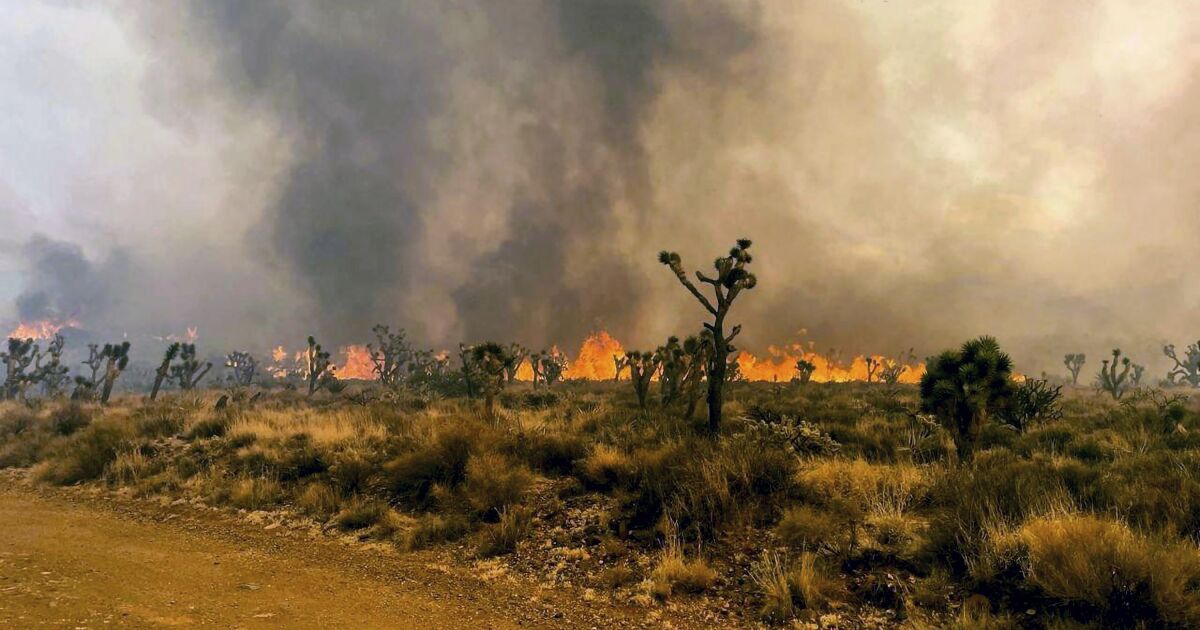
Unpredictable winds and dry fuels were creating challenges for firefighters who were struggling on Sunday to slow a 70,000-acre wildfire that started in California’s Mojave National Preserve and spread across the border into Nevada. It was 0% contained as of Sunday afternoon, officials said.
The wildfire was rampaging across a Mojave Desert landscape that is a vast, deceptively delicate and vital ecosystem rich in wildlife — tortoises, foxes, badgers, bobcats, bighorn sheep — and Joshua trees, and the animals and plants are vulnerable to wildfires.
Earlier this year, heavy rains triggered explosive growth of exotic grasses throughout Southern California’s desert regions. Feeding off nitrogen-laden smog wafting in from the Los Angeles area, the grasses left Joshua tree forests vulnerable to large-scale brush fires.
A tanker drops fire retardant Saturday over the York fire.
(R. Almendinger/ InciWeb /National Park Service Mojave National Preserve)
“Miles upon miles of invasive grasses are like flash paper in the understory of the Mojave Desert,” Frazier Haney, executive director of the Wildlands Conservancy, told The Times on Sunday.
“A wildfire like this one can, in a matter of minutes, wipe out a remarkable diversity of species created by nature over tens of thousands of years,” Haney said.
In 2020, the Dome fire killed as many as 1.3 million of the plants across more than 40,000 acres of California desert, including a large portion of Mojave National Preserve.
For the York fire, gusting, erratic winds have complicated the firefight.
“Over the last couple of days, there’s been general breezy south-to-southwest winds across the region, and that’s helped push it off [to] the northeast,” said Ashley Nickerson, a meteorologist with the National Weather Service in Las Vegas. “We’ve also had showers and thunderstorms in the area, which have caused sudden, erratic winds, and that makes it really hard to contain a fire, as well.”
Nickerson said the difficult conditions were not expected to let up over the next couple of days as the winds continued with gusts of 20 to 30 mph and moisture increased, bringing the possibility of more thunderstorms.
Despite the size of the fire and lack of containment, officials said there were no plans as of about 7 p.m. Sunday to issue evacuation orders for residential areas, including Nipton and Searchlight in Nevada. “The fire … remains some distance from these areas,” Clark County officials tweeted, “and [Clark County Fire Department] continues to coordinate response and resources with partner agencies.”
The blaze started in federal lands in Mojave National Preserve and was first observed Friday burning near Caruthers Canyon, said Stephanie Bishop, a National Park Service public information officer and spokesperson for the York fire. The cause of the blaze has not yet been determined, Bishop said.
Clark County advised the public to avoid State Route 164.
The National Park Service, Bureau of Land Management, San Bernardino County Fire Protection District, and Clark County Fire were providing resources to support suppression efforts, which included air and ground crews. Officials said there were more than 200 personnel fighting the blaze.

Unpredictable winds and dry fuels were creating challenges for firefighters who were struggling on Sunday to slow a 70,000-acre wildfire that started in California’s Mojave National Preserve and spread across the border into Nevada. It was 0% contained as of Sunday afternoon, officials said.
The wildfire was rampaging across a Mojave Desert landscape that is a vast, deceptively delicate and vital ecosystem rich in wildlife — tortoises, foxes, badgers, bobcats, bighorn sheep — and Joshua trees, and the animals and plants are vulnerable to wildfires.
Earlier this year, heavy rains triggered explosive growth of exotic grasses throughout Southern California’s desert regions. Feeding off nitrogen-laden smog wafting in from the Los Angeles area, the grasses left Joshua tree forests vulnerable to large-scale brush fires.
A tanker drops fire retardant Saturday over the York fire.
(R. Almendinger/ InciWeb /National Park Service Mojave National Preserve)
“Miles upon miles of invasive grasses are like flash paper in the understory of the Mojave Desert,” Frazier Haney, executive director of the Wildlands Conservancy, told The Times on Sunday.
“A wildfire like this one can, in a matter of minutes, wipe out a remarkable diversity of species created by nature over tens of thousands of years,” Haney said.
In 2020, the Dome fire killed as many as 1.3 million of the plants across more than 40,000 acres of California desert, including a large portion of Mojave National Preserve.
For the York fire, gusting, erratic winds have complicated the firefight.
“Over the last couple of days, there’s been general breezy south-to-southwest winds across the region, and that’s helped push it off [to] the northeast,” said Ashley Nickerson, a meteorologist with the National Weather Service in Las Vegas. “We’ve also had showers and thunderstorms in the area, which have caused sudden, erratic winds, and that makes it really hard to contain a fire, as well.”
Nickerson said the difficult conditions were not expected to let up over the next couple of days as the winds continued with gusts of 20 to 30 mph and moisture increased, bringing the possibility of more thunderstorms.
Despite the size of the fire and lack of containment, officials said there were no plans as of about 7 p.m. Sunday to issue evacuation orders for residential areas, including Nipton and Searchlight in Nevada. “The fire … remains some distance from these areas,” Clark County officials tweeted, “and [Clark County Fire Department] continues to coordinate response and resources with partner agencies.”
The blaze started in federal lands in Mojave National Preserve and was first observed Friday burning near Caruthers Canyon, said Stephanie Bishop, a National Park Service public information officer and spokesperson for the York fire. The cause of the blaze has not yet been determined, Bishop said.
Clark County advised the public to avoid State Route 164.
The National Park Service, Bureau of Land Management, San Bernardino County Fire Protection District, and Clark County Fire were providing resources to support suppression efforts, which included air and ground crews. Officials said there were more than 200 personnel fighting the blaze.

Unpredictable winds and dry fuels were creating challenges for firefighters who were struggling on Sunday to slow a 70,000-acre wildfire that started in California’s Mojave National Preserve and spread across the border into Nevada. It was 0% contained as of Sunday afternoon, officials said.
The wildfire was rampaging across a Mojave Desert landscape that is a vast, deceptively delicate and vital ecosystem rich in wildlife — tortoises, foxes, badgers, bobcats, bighorn sheep — and Joshua trees, and the animals and plants are vulnerable to wildfires.
Earlier this year, heavy rains triggered explosive growth of exotic grasses throughout Southern California’s desert regions. Feeding off nitrogen-laden smog wafting in from the Los Angeles area, the grasses left Joshua tree forests vulnerable to large-scale brush fires.
A tanker drops fire retardant Saturday over the York fire.
(R. Almendinger/ InciWeb /National Park Service Mojave National Preserve)
“Miles upon miles of invasive grasses are like flash paper in the understory of the Mojave Desert,” Frazier Haney, executive director of the Wildlands Conservancy, told The Times on Sunday.
“A wildfire like this one can, in a matter of minutes, wipe out a remarkable diversity of species created by nature over tens of thousands of years,” Haney said.
In 2020, the Dome fire killed as many as 1.3 million of the plants across more than 40,000 acres of California desert, including a large portion of Mojave National Preserve.
For the York fire, gusting, erratic winds have complicated the firefight.
“Over the last couple of days, there’s been general breezy south-to-southwest winds across the region, and that’s helped push it off [to] the northeast,” said Ashley Nickerson, a meteorologist with the National Weather Service in Las Vegas. “We’ve also had showers and thunderstorms in the area, which have caused sudden, erratic winds, and that makes it really hard to contain a fire, as well.”
Nickerson said the difficult conditions were not expected to let up over the next couple of days as the winds continued with gusts of 20 to 30 mph and moisture increased, bringing the possibility of more thunderstorms.
Despite the size of the fire and lack of containment, officials said there were no plans as of about 7 p.m. Sunday to issue evacuation orders for residential areas, including Nipton and Searchlight in Nevada. “The fire … remains some distance from these areas,” Clark County officials tweeted, “and [Clark County Fire Department] continues to coordinate response and resources with partner agencies.”
The blaze started in federal lands in Mojave National Preserve and was first observed Friday burning near Caruthers Canyon, said Stephanie Bishop, a National Park Service public information officer and spokesperson for the York fire. The cause of the blaze has not yet been determined, Bishop said.
Clark County advised the public to avoid State Route 164.
The National Park Service, Bureau of Land Management, San Bernardino County Fire Protection District, and Clark County Fire were providing resources to support suppression efforts, which included air and ground crews. Officials said there were more than 200 personnel fighting the blaze.
Unpredictable winds and dry fuels were creating challenges for firefighters who were struggling on Sunday to slow a 70,000-acre wildfire that started in California’s Mojave National Preserve and spread across the border into Nevada. It was 0% contained as of Sunday afternoon, officials said.
The wildfire was rampaging across a Mojave Desert landscape that is a vast, deceptively delicate and vital ecosystem rich in wildlife — tortoises, foxes, badgers, bobcats, bighorn sheep — and Joshua trees, and the animals and plants are vulnerable to wildfires.
Earlier this year, heavy rains triggered explosive growth of exotic grasses throughout Southern California’s desert regions. Feeding off nitrogen-laden smog wafting in from the Los Angeles area, the grasses left Joshua tree forests vulnerable to large-scale brush fires.
A tanker drops fire retardant Saturday over the York fire.
(R. Almendinger/ InciWeb /National Park Service Mojave National Preserve)
“Miles upon miles of invasive grasses are like flash paper in the understory of the Mojave Desert,” Frazier Haney, executive director of the Wildlands Conservancy, told The Times on Sunday.
“A wildfire like this one can, in a matter of minutes, wipe out a remarkable diversity of species created by nature over tens of thousands of years,” Haney said.
In 2020, the Dome fire killed as many as 1.3 million of the plants across more than 40,000 acres of California desert, including a large portion of Mojave National Preserve.
For the York fire, gusting, erratic winds have complicated the firefight.
“Over the last couple of days, there’s been general breezy south-to-southwest winds across the region, and that’s helped push it off [to] the northeast,” said Ashley Nickerson, a meteorologist with the National Weather Service in Las Vegas. “We’ve also had showers and thunderstorms in the area, which have caused sudden, erratic winds, and that makes it really hard to contain a fire, as well.”
Nickerson said the difficult conditions were not expected to let up over the next couple of days as the winds continued with gusts of 20 to 30 mph and moisture increased, bringing the possibility of more thunderstorms.
Despite the size of the fire and lack of containment, officials said there were no plans as of about 7 p.m. Sunday to issue evacuation orders for residential areas, including Nipton and Searchlight in Nevada. “The fire … remains some distance from these areas,” Clark County officials tweeted, “and [Clark County Fire Department] continues to coordinate response and resources with partner agencies.”
The blaze started in federal lands in Mojave National Preserve and was first observed Friday burning near Caruthers Canyon, said Stephanie Bishop, a National Park Service public information officer and spokesperson for the York fire. The cause of the blaze has not yet been determined, Bishop said.
Clark County advised the public to avoid State Route 164.
The National Park Service, Bureau of Land Management, San Bernardino County Fire Protection District, and Clark County Fire were providing resources to support suppression efforts, which included air and ground crews. Officials said there were more than 200 personnel fighting the blaze.

Unpredictable winds and dry fuels were creating challenges for firefighters who were struggling on Sunday to slow a 70,000-acre wildfire that started in California’s Mojave National Preserve and spread across the border into Nevada. It was 0% contained as of Sunday afternoon, officials said.
The wildfire was rampaging across a Mojave Desert landscape that is a vast, deceptively delicate and vital ecosystem rich in wildlife — tortoises, foxes, badgers, bobcats, bighorn sheep — and Joshua trees, and the animals and plants are vulnerable to wildfires.
Earlier this year, heavy rains triggered explosive growth of exotic grasses throughout Southern California’s desert regions. Feeding off nitrogen-laden smog wafting in from the Los Angeles area, the grasses left Joshua tree forests vulnerable to large-scale brush fires.
A tanker drops fire retardant Saturday over the York fire.
(R. Almendinger/ InciWeb /National Park Service Mojave National Preserve)
“Miles upon miles of invasive grasses are like flash paper in the understory of the Mojave Desert,” Frazier Haney, executive director of the Wildlands Conservancy, told The Times on Sunday.
“A wildfire like this one can, in a matter of minutes, wipe out a remarkable diversity of species created by nature over tens of thousands of years,” Haney said.
In 2020, the Dome fire killed as many as 1.3 million of the plants across more than 40,000 acres of California desert, including a large portion of Mojave National Preserve.
For the York fire, gusting, erratic winds have complicated the firefight.
“Over the last couple of days, there’s been general breezy south-to-southwest winds across the region, and that’s helped push it off [to] the northeast,” said Ashley Nickerson, a meteorologist with the National Weather Service in Las Vegas. “We’ve also had showers and thunderstorms in the area, which have caused sudden, erratic winds, and that makes it really hard to contain a fire, as well.”
Nickerson said the difficult conditions were not expected to let up over the next couple of days as the winds continued with gusts of 20 to 30 mph and moisture increased, bringing the possibility of more thunderstorms.
Despite the size of the fire and lack of containment, officials said there were no plans as of about 7 p.m. Sunday to issue evacuation orders for residential areas, including Nipton and Searchlight in Nevada. “The fire … remains some distance from these areas,” Clark County officials tweeted, “and [Clark County Fire Department] continues to coordinate response and resources with partner agencies.”
The blaze started in federal lands in Mojave National Preserve and was first observed Friday burning near Caruthers Canyon, said Stephanie Bishop, a National Park Service public information officer and spokesperson for the York fire. The cause of the blaze has not yet been determined, Bishop said.
Clark County advised the public to avoid State Route 164.
The National Park Service, Bureau of Land Management, San Bernardino County Fire Protection District, and Clark County Fire were providing resources to support suppression efforts, which included air and ground crews. Officials said there were more than 200 personnel fighting the blaze.
Unpredictable winds and dry fuels were creating challenges for firefighters who were struggling on Sunday to slow a 70,000-acre wildfire that started in California’s Mojave National Preserve and spread across the border into Nevada. It was 0% contained as of Sunday afternoon, officials said.
The wildfire was rampaging across a Mojave Desert landscape that is a vast, deceptively delicate and vital ecosystem rich in wildlife — tortoises, foxes, badgers, bobcats, bighorn sheep — and Joshua trees, and the animals and plants are vulnerable to wildfires.
Earlier this year, heavy rains triggered explosive growth of exotic grasses throughout Southern California’s desert regions. Feeding off nitrogen-laden smog wafting in from the Los Angeles area, the grasses left Joshua tree forests vulnerable to large-scale brush fires.
A tanker drops fire retardant Saturday over the York fire.
(R. Almendinger/ InciWeb /National Park Service Mojave National Preserve)
“Miles upon miles of invasive grasses are like flash paper in the understory of the Mojave Desert,” Frazier Haney, executive director of the Wildlands Conservancy, told The Times on Sunday.
“A wildfire like this one can, in a matter of minutes, wipe out a remarkable diversity of species created by nature over tens of thousands of years,” Haney said.
In 2020, the Dome fire killed as many as 1.3 million of the plants across more than 40,000 acres of California desert, including a large portion of Mojave National Preserve.
For the York fire, gusting, erratic winds have complicated the firefight.
“Over the last couple of days, there’s been general breezy south-to-southwest winds across the region, and that’s helped push it off [to] the northeast,” said Ashley Nickerson, a meteorologist with the National Weather Service in Las Vegas. “We’ve also had showers and thunderstorms in the area, which have caused sudden, erratic winds, and that makes it really hard to contain a fire, as well.”
Nickerson said the difficult conditions were not expected to let up over the next couple of days as the winds continued with gusts of 20 to 30 mph and moisture increased, bringing the possibility of more thunderstorms.
Despite the size of the fire and lack of containment, officials said there were no plans as of about 7 p.m. Sunday to issue evacuation orders for residential areas, including Nipton and Searchlight in Nevada. “The fire … remains some distance from these areas,” Clark County officials tweeted, “and [Clark County Fire Department] continues to coordinate response and resources with partner agencies.”
The blaze started in federal lands in Mojave National Preserve and was first observed Friday burning near Caruthers Canyon, said Stephanie Bishop, a National Park Service public information officer and spokesperson for the York fire. The cause of the blaze has not yet been determined, Bishop said.
Clark County advised the public to avoid State Route 164.
The National Park Service, Bureau of Land Management, San Bernardino County Fire Protection District, and Clark County Fire were providing resources to support suppression efforts, which included air and ground crews. Officials said there were more than 200 personnel fighting the blaze.
Unpredictable winds and dry fuels were creating challenges for firefighters who were struggling on Sunday to slow a 70,000-acre wildfire that started in California’s Mojave National Preserve and spread across the border into Nevada. It was 0% contained as of Sunday afternoon, officials said.
The wildfire was rampaging across a Mojave Desert landscape that is a vast, deceptively delicate and vital ecosystem rich in wildlife — tortoises, foxes, badgers, bobcats, bighorn sheep — and Joshua trees, and the animals and plants are vulnerable to wildfires.
Earlier this year, heavy rains triggered explosive growth of exotic grasses throughout Southern California’s desert regions. Feeding off nitrogen-laden smog wafting in from the Los Angeles area, the grasses left Joshua tree forests vulnerable to large-scale brush fires.
A tanker drops fire retardant Saturday over the York fire.
(R. Almendinger/ InciWeb /National Park Service Mojave National Preserve)
“Miles upon miles of invasive grasses are like flash paper in the understory of the Mojave Desert,” Frazier Haney, executive director of the Wildlands Conservancy, told The Times on Sunday.
“A wildfire like this one can, in a matter of minutes, wipe out a remarkable diversity of species created by nature over tens of thousands of years,” Haney said.
In 2020, the Dome fire killed as many as 1.3 million of the plants across more than 40,000 acres of California desert, including a large portion of Mojave National Preserve.
For the York fire, gusting, erratic winds have complicated the firefight.
“Over the last couple of days, there’s been general breezy south-to-southwest winds across the region, and that’s helped push it off [to] the northeast,” said Ashley Nickerson, a meteorologist with the National Weather Service in Las Vegas. “We’ve also had showers and thunderstorms in the area, which have caused sudden, erratic winds, and that makes it really hard to contain a fire, as well.”
Nickerson said the difficult conditions were not expected to let up over the next couple of days as the winds continued with gusts of 20 to 30 mph and moisture increased, bringing the possibility of more thunderstorms.
Despite the size of the fire and lack of containment, officials said there were no plans as of about 7 p.m. Sunday to issue evacuation orders for residential areas, including Nipton and Searchlight in Nevada. “The fire … remains some distance from these areas,” Clark County officials tweeted, “and [Clark County Fire Department] continues to coordinate response and resources with partner agencies.”
The blaze started in federal lands in Mojave National Preserve and was first observed Friday burning near Caruthers Canyon, said Stephanie Bishop, a National Park Service public information officer and spokesperson for the York fire. The cause of the blaze has not yet been determined, Bishop said.
Clark County advised the public to avoid State Route 164.
The National Park Service, Bureau of Land Management, San Bernardino County Fire Protection District, and Clark County Fire were providing resources to support suppression efforts, which included air and ground crews. Officials said there were more than 200 personnel fighting the blaze.
Unpredictable winds and dry fuels were creating challenges for firefighters who were struggling on Sunday to slow a 70,000-acre wildfire that started in California’s Mojave National Preserve and spread across the border into Nevada. It was 0% contained as of Sunday afternoon, officials said.
The wildfire was rampaging across a Mojave Desert landscape that is a vast, deceptively delicate and vital ecosystem rich in wildlife — tortoises, foxes, badgers, bobcats, bighorn sheep — and Joshua trees, and the animals and plants are vulnerable to wildfires.
Earlier this year, heavy rains triggered explosive growth of exotic grasses throughout Southern California’s desert regions. Feeding off nitrogen-laden smog wafting in from the Los Angeles area, the grasses left Joshua tree forests vulnerable to large-scale brush fires.
A tanker drops fire retardant Saturday over the York fire.
(R. Almendinger/ InciWeb /National Park Service Mojave National Preserve)
“Miles upon miles of invasive grasses are like flash paper in the understory of the Mojave Desert,” Frazier Haney, executive director of the Wildlands Conservancy, told The Times on Sunday.
“A wildfire like this one can, in a matter of minutes, wipe out a remarkable diversity of species created by nature over tens of thousands of years,” Haney said.
In 2020, the Dome fire killed as many as 1.3 million of the plants across more than 40,000 acres of California desert, including a large portion of Mojave National Preserve.
For the York fire, gusting, erratic winds have complicated the firefight.
“Over the last couple of days, there’s been general breezy south-to-southwest winds across the region, and that’s helped push it off [to] the northeast,” said Ashley Nickerson, a meteorologist with the National Weather Service in Las Vegas. “We’ve also had showers and thunderstorms in the area, which have caused sudden, erratic winds, and that makes it really hard to contain a fire, as well.”
Nickerson said the difficult conditions were not expected to let up over the next couple of days as the winds continued with gusts of 20 to 30 mph and moisture increased, bringing the possibility of more thunderstorms.
Despite the size of the fire and lack of containment, officials said there were no plans as of about 7 p.m. Sunday to issue evacuation orders for residential areas, including Nipton and Searchlight in Nevada. “The fire … remains some distance from these areas,” Clark County officials tweeted, “and [Clark County Fire Department] continues to coordinate response and resources with partner agencies.”
The blaze started in federal lands in Mojave National Preserve and was first observed Friday burning near Caruthers Canyon, said Stephanie Bishop, a National Park Service public information officer and spokesperson for the York fire. The cause of the blaze has not yet been determined, Bishop said.
Clark County advised the public to avoid State Route 164.
The National Park Service, Bureau of Land Management, San Bernardino County Fire Protection District, and Clark County Fire were providing resources to support suppression efforts, which included air and ground crews. Officials said there were more than 200 personnel fighting the blaze.

Unpredictable winds and dry fuels were creating challenges for firefighters who were struggling on Sunday to slow a 70,000-acre wildfire that started in California’s Mojave National Preserve and spread across the border into Nevada. It was 0% contained as of Sunday afternoon, officials said.
The wildfire was rampaging across a Mojave Desert landscape that is a vast, deceptively delicate and vital ecosystem rich in wildlife — tortoises, foxes, badgers, bobcats, bighorn sheep — and Joshua trees, and the animals and plants are vulnerable to wildfires.
Earlier this year, heavy rains triggered explosive growth of exotic grasses throughout Southern California’s desert regions. Feeding off nitrogen-laden smog wafting in from the Los Angeles area, the grasses left Joshua tree forests vulnerable to large-scale brush fires.
A tanker drops fire retardant Saturday over the York fire.
(R. Almendinger/ InciWeb /National Park Service Mojave National Preserve)
“Miles upon miles of invasive grasses are like flash paper in the understory of the Mojave Desert,” Frazier Haney, executive director of the Wildlands Conservancy, told The Times on Sunday.
“A wildfire like this one can, in a matter of minutes, wipe out a remarkable diversity of species created by nature over tens of thousands of years,” Haney said.
In 2020, the Dome fire killed as many as 1.3 million of the plants across more than 40,000 acres of California desert, including a large portion of Mojave National Preserve.
For the York fire, gusting, erratic winds have complicated the firefight.
“Over the last couple of days, there’s been general breezy south-to-southwest winds across the region, and that’s helped push it off [to] the northeast,” said Ashley Nickerson, a meteorologist with the National Weather Service in Las Vegas. “We’ve also had showers and thunderstorms in the area, which have caused sudden, erratic winds, and that makes it really hard to contain a fire, as well.”
Nickerson said the difficult conditions were not expected to let up over the next couple of days as the winds continued with gusts of 20 to 30 mph and moisture increased, bringing the possibility of more thunderstorms.
Despite the size of the fire and lack of containment, officials said there were no plans as of about 7 p.m. Sunday to issue evacuation orders for residential areas, including Nipton and Searchlight in Nevada. “The fire … remains some distance from these areas,” Clark County officials tweeted, “and [Clark County Fire Department] continues to coordinate response and resources with partner agencies.”
The blaze started in federal lands in Mojave National Preserve and was first observed Friday burning near Caruthers Canyon, said Stephanie Bishop, a National Park Service public information officer and spokesperson for the York fire. The cause of the blaze has not yet been determined, Bishop said.
Clark County advised the public to avoid State Route 164.
The National Park Service, Bureau of Land Management, San Bernardino County Fire Protection District, and Clark County Fire were providing resources to support suppression efforts, which included air and ground crews. Officials said there were more than 200 personnel fighting the blaze.
Unpredictable winds and dry fuels were creating challenges for firefighters who were struggling on Sunday to slow a 70,000-acre wildfire that started in California’s Mojave National Preserve and spread across the border into Nevada. It was 0% contained as of Sunday afternoon, officials said.
The wildfire was rampaging across a Mojave Desert landscape that is a vast, deceptively delicate and vital ecosystem rich in wildlife — tortoises, foxes, badgers, bobcats, bighorn sheep — and Joshua trees, and the animals and plants are vulnerable to wildfires.
Earlier this year, heavy rains triggered explosive growth of exotic grasses throughout Southern California’s desert regions. Feeding off nitrogen-laden smog wafting in from the Los Angeles area, the grasses left Joshua tree forests vulnerable to large-scale brush fires.
A tanker drops fire retardant Saturday over the York fire.
(R. Almendinger/ InciWeb /National Park Service Mojave National Preserve)
“Miles upon miles of invasive grasses are like flash paper in the understory of the Mojave Desert,” Frazier Haney, executive director of the Wildlands Conservancy, told The Times on Sunday.
“A wildfire like this one can, in a matter of minutes, wipe out a remarkable diversity of species created by nature over tens of thousands of years,” Haney said.
In 2020, the Dome fire killed as many as 1.3 million of the plants across more than 40,000 acres of California desert, including a large portion of Mojave National Preserve.
For the York fire, gusting, erratic winds have complicated the firefight.
“Over the last couple of days, there’s been general breezy south-to-southwest winds across the region, and that’s helped push it off [to] the northeast,” said Ashley Nickerson, a meteorologist with the National Weather Service in Las Vegas. “We’ve also had showers and thunderstorms in the area, which have caused sudden, erratic winds, and that makes it really hard to contain a fire, as well.”
Nickerson said the difficult conditions were not expected to let up over the next couple of days as the winds continued with gusts of 20 to 30 mph and moisture increased, bringing the possibility of more thunderstorms.
Despite the size of the fire and lack of containment, officials said there were no plans as of about 7 p.m. Sunday to issue evacuation orders for residential areas, including Nipton and Searchlight in Nevada. “The fire … remains some distance from these areas,” Clark County officials tweeted, “and [Clark County Fire Department] continues to coordinate response and resources with partner agencies.”
The blaze started in federal lands in Mojave National Preserve and was first observed Friday burning near Caruthers Canyon, said Stephanie Bishop, a National Park Service public information officer and spokesperson for the York fire. The cause of the blaze has not yet been determined, Bishop said.
Clark County advised the public to avoid State Route 164.
The National Park Service, Bureau of Land Management, San Bernardino County Fire Protection District, and Clark County Fire were providing resources to support suppression efforts, which included air and ground crews. Officials said there were more than 200 personnel fighting the blaze.
Unpredictable winds and dry fuels were creating challenges for firefighters who were struggling on Sunday to slow a 70,000-acre wildfire that started in California’s Mojave National Preserve and spread across the border into Nevada. It was 0% contained as of Sunday afternoon, officials said.
The wildfire was rampaging across a Mojave Desert landscape that is a vast, deceptively delicate and vital ecosystem rich in wildlife — tortoises, foxes, badgers, bobcats, bighorn sheep — and Joshua trees, and the animals and plants are vulnerable to wildfires.
Earlier this year, heavy rains triggered explosive growth of exotic grasses throughout Southern California’s desert regions. Feeding off nitrogen-laden smog wafting in from the Los Angeles area, the grasses left Joshua tree forests vulnerable to large-scale brush fires.
A tanker drops fire retardant Saturday over the York fire.
(R. Almendinger/ InciWeb /National Park Service Mojave National Preserve)
“Miles upon miles of invasive grasses are like flash paper in the understory of the Mojave Desert,” Frazier Haney, executive director of the Wildlands Conservancy, told The Times on Sunday.
“A wildfire like this one can, in a matter of minutes, wipe out a remarkable diversity of species created by nature over tens of thousands of years,” Haney said.
In 2020, the Dome fire killed as many as 1.3 million of the plants across more than 40,000 acres of California desert, including a large portion of Mojave National Preserve.
For the York fire, gusting, erratic winds have complicated the firefight.
“Over the last couple of days, there’s been general breezy south-to-southwest winds across the region, and that’s helped push it off [to] the northeast,” said Ashley Nickerson, a meteorologist with the National Weather Service in Las Vegas. “We’ve also had showers and thunderstorms in the area, which have caused sudden, erratic winds, and that makes it really hard to contain a fire, as well.”
Nickerson said the difficult conditions were not expected to let up over the next couple of days as the winds continued with gusts of 20 to 30 mph and moisture increased, bringing the possibility of more thunderstorms.
Despite the size of the fire and lack of containment, officials said there were no plans as of about 7 p.m. Sunday to issue evacuation orders for residential areas, including Nipton and Searchlight in Nevada. “The fire … remains some distance from these areas,” Clark County officials tweeted, “and [Clark County Fire Department] continues to coordinate response and resources with partner agencies.”
The blaze started in federal lands in Mojave National Preserve and was first observed Friday burning near Caruthers Canyon, said Stephanie Bishop, a National Park Service public information officer and spokesperson for the York fire. The cause of the blaze has not yet been determined, Bishop said.
Clark County advised the public to avoid State Route 164.
The National Park Service, Bureau of Land Management, San Bernardino County Fire Protection District, and Clark County Fire were providing resources to support suppression efforts, which included air and ground crews. Officials said there were more than 200 personnel fighting the blaze.
Unpredictable winds and dry fuels were creating challenges for firefighters who were struggling on Sunday to slow a 70,000-acre wildfire that started in California’s Mojave National Preserve and spread across the border into Nevada. It was 0% contained as of Sunday afternoon, officials said.
The wildfire was rampaging across a Mojave Desert landscape that is a vast, deceptively delicate and vital ecosystem rich in wildlife — tortoises, foxes, badgers, bobcats, bighorn sheep — and Joshua trees, and the animals and plants are vulnerable to wildfires.
Earlier this year, heavy rains triggered explosive growth of exotic grasses throughout Southern California’s desert regions. Feeding off nitrogen-laden smog wafting in from the Los Angeles area, the grasses left Joshua tree forests vulnerable to large-scale brush fires.
A tanker drops fire retardant Saturday over the York fire.
(R. Almendinger/ InciWeb /National Park Service Mojave National Preserve)
“Miles upon miles of invasive grasses are like flash paper in the understory of the Mojave Desert,” Frazier Haney, executive director of the Wildlands Conservancy, told The Times on Sunday.
“A wildfire like this one can, in a matter of minutes, wipe out a remarkable diversity of species created by nature over tens of thousands of years,” Haney said.
In 2020, the Dome fire killed as many as 1.3 million of the plants across more than 40,000 acres of California desert, including a large portion of Mojave National Preserve.
For the York fire, gusting, erratic winds have complicated the firefight.
“Over the last couple of days, there’s been general breezy south-to-southwest winds across the region, and that’s helped push it off [to] the northeast,” said Ashley Nickerson, a meteorologist with the National Weather Service in Las Vegas. “We’ve also had showers and thunderstorms in the area, which have caused sudden, erratic winds, and that makes it really hard to contain a fire, as well.”
Nickerson said the difficult conditions were not expected to let up over the next couple of days as the winds continued with gusts of 20 to 30 mph and moisture increased, bringing the possibility of more thunderstorms.
Despite the size of the fire and lack of containment, officials said there were no plans as of about 7 p.m. Sunday to issue evacuation orders for residential areas, including Nipton and Searchlight in Nevada. “The fire … remains some distance from these areas,” Clark County officials tweeted, “and [Clark County Fire Department] continues to coordinate response and resources with partner agencies.”
The blaze started in federal lands in Mojave National Preserve and was first observed Friday burning near Caruthers Canyon, said Stephanie Bishop, a National Park Service public information officer and spokesperson for the York fire. The cause of the blaze has not yet been determined, Bishop said.
Clark County advised the public to avoid State Route 164.
The National Park Service, Bureau of Land Management, San Bernardino County Fire Protection District, and Clark County Fire were providing resources to support suppression efforts, which included air and ground crews. Officials said there were more than 200 personnel fighting the blaze.
Unpredictable winds and dry fuels were creating challenges for firefighters who were struggling on Sunday to slow a 70,000-acre wildfire that started in California’s Mojave National Preserve and spread across the border into Nevada. It was 0% contained as of Sunday afternoon, officials said.
The wildfire was rampaging across a Mojave Desert landscape that is a vast, deceptively delicate and vital ecosystem rich in wildlife — tortoises, foxes, badgers, bobcats, bighorn sheep — and Joshua trees, and the animals and plants are vulnerable to wildfires.
Earlier this year, heavy rains triggered explosive growth of exotic grasses throughout Southern California’s desert regions. Feeding off nitrogen-laden smog wafting in from the Los Angeles area, the grasses left Joshua tree forests vulnerable to large-scale brush fires.
A tanker drops fire retardant Saturday over the York fire.
(R. Almendinger/ InciWeb /National Park Service Mojave National Preserve)
“Miles upon miles of invasive grasses are like flash paper in the understory of the Mojave Desert,” Frazier Haney, executive director of the Wildlands Conservancy, told The Times on Sunday.
“A wildfire like this one can, in a matter of minutes, wipe out a remarkable diversity of species created by nature over tens of thousands of years,” Haney said.
In 2020, the Dome fire killed as many as 1.3 million of the plants across more than 40,000 acres of California desert, including a large portion of Mojave National Preserve.
For the York fire, gusting, erratic winds have complicated the firefight.
“Over the last couple of days, there’s been general breezy south-to-southwest winds across the region, and that’s helped push it off [to] the northeast,” said Ashley Nickerson, a meteorologist with the National Weather Service in Las Vegas. “We’ve also had showers and thunderstorms in the area, which have caused sudden, erratic winds, and that makes it really hard to contain a fire, as well.”
Nickerson said the difficult conditions were not expected to let up over the next couple of days as the winds continued with gusts of 20 to 30 mph and moisture increased, bringing the possibility of more thunderstorms.
Despite the size of the fire and lack of containment, officials said there were no plans as of about 7 p.m. Sunday to issue evacuation orders for residential areas, including Nipton and Searchlight in Nevada. “The fire … remains some distance from these areas,” Clark County officials tweeted, “and [Clark County Fire Department] continues to coordinate response and resources with partner agencies.”
The blaze started in federal lands in Mojave National Preserve and was first observed Friday burning near Caruthers Canyon, said Stephanie Bishop, a National Park Service public information officer and spokesperson for the York fire. The cause of the blaze has not yet been determined, Bishop said.
Clark County advised the public to avoid State Route 164.
The National Park Service, Bureau of Land Management, San Bernardino County Fire Protection District, and Clark County Fire were providing resources to support suppression efforts, which included air and ground crews. Officials said there were more than 200 personnel fighting the blaze.
Unpredictable winds and dry fuels were creating challenges for firefighters who were struggling on Sunday to slow a 70,000-acre wildfire that started in California’s Mojave National Preserve and spread across the border into Nevada. It was 0% contained as of Sunday afternoon, officials said.
The wildfire was rampaging across a Mojave Desert landscape that is a vast, deceptively delicate and vital ecosystem rich in wildlife — tortoises, foxes, badgers, bobcats, bighorn sheep — and Joshua trees, and the animals and plants are vulnerable to wildfires.
Earlier this year, heavy rains triggered explosive growth of exotic grasses throughout Southern California’s desert regions. Feeding off nitrogen-laden smog wafting in from the Los Angeles area, the grasses left Joshua tree forests vulnerable to large-scale brush fires.
A tanker drops fire retardant Saturday over the York fire.
(R. Almendinger/ InciWeb /National Park Service Mojave National Preserve)
“Miles upon miles of invasive grasses are like flash paper in the understory of the Mojave Desert,” Frazier Haney, executive director of the Wildlands Conservancy, told The Times on Sunday.
“A wildfire like this one can, in a matter of minutes, wipe out a remarkable diversity of species created by nature over tens of thousands of years,” Haney said.
In 2020, the Dome fire killed as many as 1.3 million of the plants across more than 40,000 acres of California desert, including a large portion of Mojave National Preserve.
For the York fire, gusting, erratic winds have complicated the firefight.
“Over the last couple of days, there’s been general breezy south-to-southwest winds across the region, and that’s helped push it off [to] the northeast,” said Ashley Nickerson, a meteorologist with the National Weather Service in Las Vegas. “We’ve also had showers and thunderstorms in the area, which have caused sudden, erratic winds, and that makes it really hard to contain a fire, as well.”
Nickerson said the difficult conditions were not expected to let up over the next couple of days as the winds continued with gusts of 20 to 30 mph and moisture increased, bringing the possibility of more thunderstorms.
Despite the size of the fire and lack of containment, officials said there were no plans as of about 7 p.m. Sunday to issue evacuation orders for residential areas, including Nipton and Searchlight in Nevada. “The fire … remains some distance from these areas,” Clark County officials tweeted, “and [Clark County Fire Department] continues to coordinate response and resources with partner agencies.”
The blaze started in federal lands in Mojave National Preserve and was first observed Friday burning near Caruthers Canyon, said Stephanie Bishop, a National Park Service public information officer and spokesperson for the York fire. The cause of the blaze has not yet been determined, Bishop said.
Clark County advised the public to avoid State Route 164.
The National Park Service, Bureau of Land Management, San Bernardino County Fire Protection District, and Clark County Fire were providing resources to support suppression efforts, which included air and ground crews. Officials said there were more than 200 personnel fighting the blaze.
Unpredictable winds and dry fuels were creating challenges for firefighters who were struggling on Sunday to slow a 70,000-acre wildfire that started in California’s Mojave National Preserve and spread across the border into Nevada. It was 0% contained as of Sunday afternoon, officials said.
The wildfire was rampaging across a Mojave Desert landscape that is a vast, deceptively delicate and vital ecosystem rich in wildlife — tortoises, foxes, badgers, bobcats, bighorn sheep — and Joshua trees, and the animals and plants are vulnerable to wildfires.
Earlier this year, heavy rains triggered explosive growth of exotic grasses throughout Southern California’s desert regions. Feeding off nitrogen-laden smog wafting in from the Los Angeles area, the grasses left Joshua tree forests vulnerable to large-scale brush fires.
A tanker drops fire retardant Saturday over the York fire.
(R. Almendinger/ InciWeb /National Park Service Mojave National Preserve)
“Miles upon miles of invasive grasses are like flash paper in the understory of the Mojave Desert,” Frazier Haney, executive director of the Wildlands Conservancy, told The Times on Sunday.
“A wildfire like this one can, in a matter of minutes, wipe out a remarkable diversity of species created by nature over tens of thousands of years,” Haney said.
In 2020, the Dome fire killed as many as 1.3 million of the plants across more than 40,000 acres of California desert, including a large portion of Mojave National Preserve.
For the York fire, gusting, erratic winds have complicated the firefight.
“Over the last couple of days, there’s been general breezy south-to-southwest winds across the region, and that’s helped push it off [to] the northeast,” said Ashley Nickerson, a meteorologist with the National Weather Service in Las Vegas. “We’ve also had showers and thunderstorms in the area, which have caused sudden, erratic winds, and that makes it really hard to contain a fire, as well.”
Nickerson said the difficult conditions were not expected to let up over the next couple of days as the winds continued with gusts of 20 to 30 mph and moisture increased, bringing the possibility of more thunderstorms.
Despite the size of the fire and lack of containment, officials said there were no plans as of about 7 p.m. Sunday to issue evacuation orders for residential areas, including Nipton and Searchlight in Nevada. “The fire … remains some distance from these areas,” Clark County officials tweeted, “and [Clark County Fire Department] continues to coordinate response and resources with partner agencies.”
The blaze started in federal lands in Mojave National Preserve and was first observed Friday burning near Caruthers Canyon, said Stephanie Bishop, a National Park Service public information officer and spokesperson for the York fire. The cause of the blaze has not yet been determined, Bishop said.
Clark County advised the public to avoid State Route 164.
The National Park Service, Bureau of Land Management, San Bernardino County Fire Protection District, and Clark County Fire were providing resources to support suppression efforts, which included air and ground crews. Officials said there were more than 200 personnel fighting the blaze.
Unpredictable winds and dry fuels were creating challenges for firefighters who were struggling on Sunday to slow a 70,000-acre wildfire that started in California’s Mojave National Preserve and spread across the border into Nevada. It was 0% contained as of Sunday afternoon, officials said.
The wildfire was rampaging across a Mojave Desert landscape that is a vast, deceptively delicate and vital ecosystem rich in wildlife — tortoises, foxes, badgers, bobcats, bighorn sheep — and Joshua trees, and the animals and plants are vulnerable to wildfires.
Earlier this year, heavy rains triggered explosive growth of exotic grasses throughout Southern California’s desert regions. Feeding off nitrogen-laden smog wafting in from the Los Angeles area, the grasses left Joshua tree forests vulnerable to large-scale brush fires.
A tanker drops fire retardant Saturday over the York fire.
(R. Almendinger/ InciWeb /National Park Service Mojave National Preserve)
“Miles upon miles of invasive grasses are like flash paper in the understory of the Mojave Desert,” Frazier Haney, executive director of the Wildlands Conservancy, told The Times on Sunday.
“A wildfire like this one can, in a matter of minutes, wipe out a remarkable diversity of species created by nature over tens of thousands of years,” Haney said.
In 2020, the Dome fire killed as many as 1.3 million of the plants across more than 40,000 acres of California desert, including a large portion of Mojave National Preserve.
For the York fire, gusting, erratic winds have complicated the firefight.
“Over the last couple of days, there’s been general breezy south-to-southwest winds across the region, and that’s helped push it off [to] the northeast,” said Ashley Nickerson, a meteorologist with the National Weather Service in Las Vegas. “We’ve also had showers and thunderstorms in the area, which have caused sudden, erratic winds, and that makes it really hard to contain a fire, as well.”
Nickerson said the difficult conditions were not expected to let up over the next couple of days as the winds continued with gusts of 20 to 30 mph and moisture increased, bringing the possibility of more thunderstorms.
Despite the size of the fire and lack of containment, officials said there were no plans as of about 7 p.m. Sunday to issue evacuation orders for residential areas, including Nipton and Searchlight in Nevada. “The fire … remains some distance from these areas,” Clark County officials tweeted, “and [Clark County Fire Department] continues to coordinate response and resources with partner agencies.”
The blaze started in federal lands in Mojave National Preserve and was first observed Friday burning near Caruthers Canyon, said Stephanie Bishop, a National Park Service public information officer and spokesperson for the York fire. The cause of the blaze has not yet been determined, Bishop said.
Clark County advised the public to avoid State Route 164.
The National Park Service, Bureau of Land Management, San Bernardino County Fire Protection District, and Clark County Fire were providing resources to support suppression efforts, which included air and ground crews. Officials said there were more than 200 personnel fighting the blaze.

