

California regulators have approved the sale of Cox Communications to cable giant Charter Communications — the final hurdle in a marathon review to clear the $34.5-billion cable consolidation.
With Thursday’s sign-off by the California Public Utilities Commission, the mammoth merger is expected to close next week.
The deal will make Charter’s Spectrum the dominant broadband internet and cable television service in Southern California, with millions of customers scattered throughout Santa Barbara, Bakersfield, Los Angeles, Palos Verdes Estates, Newport Beach, Irvine, Riverside and San Diego.
Charter’s acquisition of Cox, unveiled 15 months ago, will solidify Charter’s status as the nation’s largest cable company, eclipsing Philadelphia-based Comcast Corp., which serves San Francisco and other Northern California communities.
“This transformative deal will benefit millions of consumers who will soon have access to greater value and opportunities to save, including our fully converged mobile-broadband bundle savings guarantee, combined with our industry-leading Customer Commitment and the 100% U.S.-based sales and service employees Spectrum is known for,” Charter said in a statement.
After weeks of behind-the-scenes wrangling, the CPUC voted unanimously to approve two settlement agreements with Charter that allow the merger to move forward. The agency attached conditions that it hopes will protect consumers and expand broadband access.
“This decision secures significant commitments that will benefit Californians through expanded affordable broadband options, major infrastructure investments, improved customer protections, and meaningful support for digital inclusion,” Commissioner Matthew Baker, who helped negotiate the agreements, said in a statement.
Federal regulators approved the deal months ago, as had other state regulators.
“This proceeding was a heavy lift for everyone,” Commissioner Darcie L. Houck acknowledged during Thursday’s hearing, which was held in San Francisco.
Through the settlements, Houck said she hoped Charter would address a disparity in which low-income residents are often stuck with higher phone and internet bills than residents in more affluent areas. Higher-income neighborhoods often benefit from increased competition as multiple providers jockey for business.
“There are many areas of the state that do have low-income communities that are paying higher costs for telecommunication services,” Houck said. “I’m hopeful that the provisions in this settlement agreement will help ensure more equity in pricing.”
Atlanta-based Cox has long been viewed as a lucrative prize. In addition to serving coastal communities in Southern California, it also has customers in growing population hubs such as Las Vegas, Phoenix and Tucson.
To win CPUC approval, the Stamford, Conn.-based cable giant agreed to offer more affordable packages for low-income residents, including several tiers of the California LifeLine service, for up to five years.
Advocates had pushed for a longer commitment.
Charter promised to invest $30 million in education and awareness initiatives in California, including community outreach and digital literacy training. In addition, Charter agreed to spend at least $275 million on upgrades to its equipment in its existing Spectrum service area — including completing a 1-gigabit service buildout — within three years.
The company also must provide free broadband and Wi-Fi service for dozens of eligible community centers, including schools and libraries.
Spectrum will be required to provide automatic bill credits for customers for qualifying service outages that last at least two hours. And the company must honor eligible “price for life” service agreements held by some residential subscribers.
Charter Chief Executive Chris Winfrey has told investors that his firm was aiming to close the merger this month. Several commissioners noted the looming deadline as they opted for the settlement that Baker helped negotiate.
Regulators said the two companies generate more than $10 billion in revenue from their California customers. In addition to serving more than 5 million homes, they also provide telephone service to 1.5 million subscribers in the state.
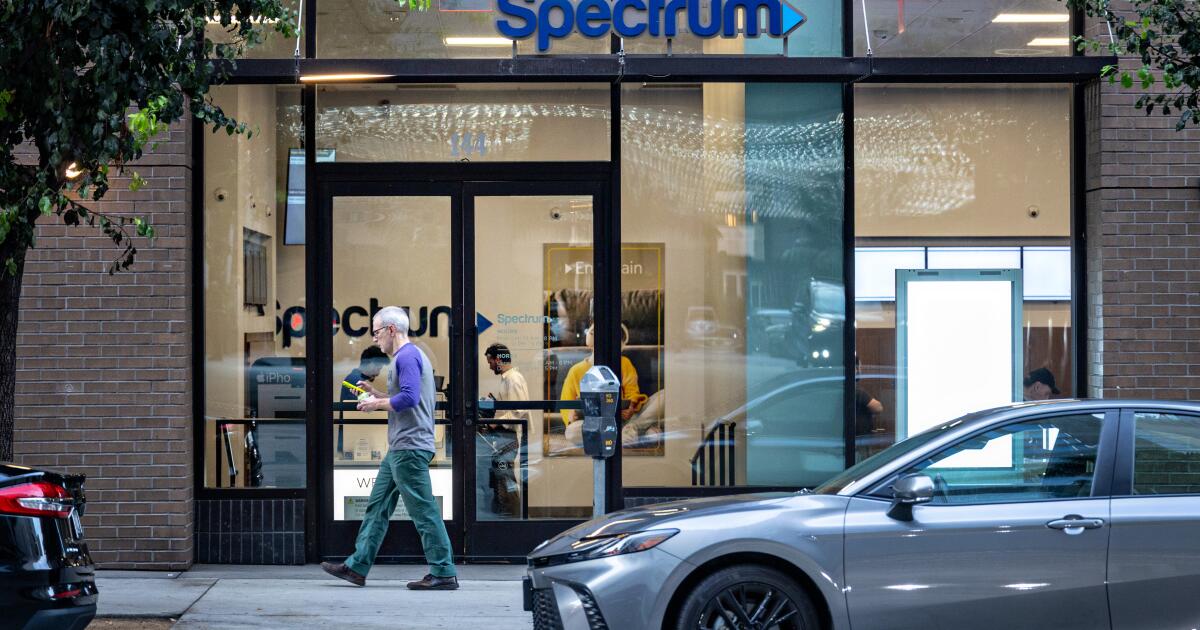
California regulators have approved Charter’s $34.5-billion purchase of Cox Communications.
(Kevin Dietsch / Getty Images)
When the deal closes, Cox customers will immediately be switched to Spectrum service and should see SportsNet LA — the Dodgers’ television channel — added to their lineups.
For more than a decade, Cox has refused to carry the channel, owned by the Dodgers organization, due to its high license fee — leading to one of the television industry’s longest blackouts.

California regulators have approved the sale of Cox Communications to cable giant Charter Communications — the final hurdle in a marathon review to clear the $34.5-billion cable consolidation.
With Thursday’s sign-off by the California Public Utilities Commission, the mammoth merger is expected to close next week.
The deal will make Charter’s Spectrum the dominant broadband internet and cable television service in Southern California, with millions of customers scattered throughout Santa Barbara, Bakersfield, Los Angeles, Palos Verdes Estates, Newport Beach, Irvine, Riverside and San Diego.
Charter’s acquisition of Cox, unveiled 15 months ago, will solidify Charter’s status as the nation’s largest cable company, eclipsing Philadelphia-based Comcast Corp., which serves San Francisco and other Northern California communities.
“This transformative deal will benefit millions of consumers who will soon have access to greater value and opportunities to save, including our fully converged mobile-broadband bundle savings guarantee, combined with our industry-leading Customer Commitment and the 100% U.S.-based sales and service employees Spectrum is known for,” Charter said in a statement.
After weeks of behind-the-scenes wrangling, the CPUC voted unanimously to approve two settlement agreements with Charter that allow the merger to move forward. The agency attached conditions that it hopes will protect consumers and expand broadband access.
“This decision secures significant commitments that will benefit Californians through expanded affordable broadband options, major infrastructure investments, improved customer protections, and meaningful support for digital inclusion,” Commissioner Matthew Baker, who helped negotiate the agreements, said in a statement.
Federal regulators approved the deal months ago, as had other state regulators.
“This proceeding was a heavy lift for everyone,” Commissioner Darcie L. Houck acknowledged during Thursday’s hearing, which was held in San Francisco.
Through the settlements, Houck said she hoped Charter would address a disparity in which low-income residents are often stuck with higher phone and internet bills than residents in more affluent areas. Higher-income neighborhoods often benefit from increased competition as multiple providers jockey for business.
“There are many areas of the state that do have low-income communities that are paying higher costs for telecommunication services,” Houck said. “I’m hopeful that the provisions in this settlement agreement will help ensure more equity in pricing.”
Atlanta-based Cox has long been viewed as a lucrative prize. In addition to serving coastal communities in Southern California, it also has customers in growing population hubs such as Las Vegas, Phoenix and Tucson.
To win CPUC approval, the Stamford, Conn.-based cable giant agreed to offer more affordable packages for low-income residents, including several tiers of the California LifeLine service, for up to five years.
Advocates had pushed for a longer commitment.
Charter promised to invest $30 million in education and awareness initiatives in California, including community outreach and digital literacy training. In addition, Charter agreed to spend at least $275 million on upgrades to its equipment in its existing Spectrum service area — including completing a 1-gigabit service buildout — within three years.
The company also must provide free broadband and Wi-Fi service for dozens of eligible community centers, including schools and libraries.
Spectrum will be required to provide automatic bill credits for customers for qualifying service outages that last at least two hours. And the company must honor eligible “price for life” service agreements held by some residential subscribers.
Charter Chief Executive Chris Winfrey has told investors that his firm was aiming to close the merger this month. Several commissioners noted the looming deadline as they opted for the settlement that Baker helped negotiate.
Regulators said the two companies generate more than $10 billion in revenue from their California customers. In addition to serving more than 5 million homes, they also provide telephone service to 1.5 million subscribers in the state.
California regulators have approved Charter’s $34.5-billion purchase of Cox Communications.
(Kevin Dietsch / Getty Images)
When the deal closes, Cox customers will immediately be switched to Spectrum service and should see SportsNet LA — the Dodgers’ television channel — added to their lineups.
For more than a decade, Cox has refused to carry the channel, owned by the Dodgers organization, due to its high license fee — leading to one of the television industry’s longest blackouts.

California regulators have approved the sale of Cox Communications to cable giant Charter Communications — the final hurdle in a marathon review to clear the $34.5-billion cable consolidation.
With Thursday’s sign-off by the California Public Utilities Commission, the mammoth merger is expected to close next week.
The deal will make Charter’s Spectrum the dominant broadband internet and cable television service in Southern California, with millions of customers scattered throughout Santa Barbara, Bakersfield, Los Angeles, Palos Verdes Estates, Newport Beach, Irvine, Riverside and San Diego.
Charter’s acquisition of Cox, unveiled 15 months ago, will solidify Charter’s status as the nation’s largest cable company, eclipsing Philadelphia-based Comcast Corp., which serves San Francisco and other Northern California communities.
“This transformative deal will benefit millions of consumers who will soon have access to greater value and opportunities to save, including our fully converged mobile-broadband bundle savings guarantee, combined with our industry-leading Customer Commitment and the 100% U.S.-based sales and service employees Spectrum is known for,” Charter said in a statement.
After weeks of behind-the-scenes wrangling, the CPUC voted unanimously to approve two settlement agreements with Charter that allow the merger to move forward. The agency attached conditions that it hopes will protect consumers and expand broadband access.
“This decision secures significant commitments that will benefit Californians through expanded affordable broadband options, major infrastructure investments, improved customer protections, and meaningful support for digital inclusion,” Commissioner Matthew Baker, who helped negotiate the agreements, said in a statement.
Federal regulators approved the deal months ago, as had other state regulators.
“This proceeding was a heavy lift for everyone,” Commissioner Darcie L. Houck acknowledged during Thursday’s hearing, which was held in San Francisco.
Through the settlements, Houck said she hoped Charter would address a disparity in which low-income residents are often stuck with higher phone and internet bills than residents in more affluent areas. Higher-income neighborhoods often benefit from increased competition as multiple providers jockey for business.
“There are many areas of the state that do have low-income communities that are paying higher costs for telecommunication services,” Houck said. “I’m hopeful that the provisions in this settlement agreement will help ensure more equity in pricing.”
Atlanta-based Cox has long been viewed as a lucrative prize. In addition to serving coastal communities in Southern California, it also has customers in growing population hubs such as Las Vegas, Phoenix and Tucson.
To win CPUC approval, the Stamford, Conn.-based cable giant agreed to offer more affordable packages for low-income residents, including several tiers of the California LifeLine service, for up to five years.
Advocates had pushed for a longer commitment.
Charter promised to invest $30 million in education and awareness initiatives in California, including community outreach and digital literacy training. In addition, Charter agreed to spend at least $275 million on upgrades to its equipment in its existing Spectrum service area — including completing a 1-gigabit service buildout — within three years.
The company also must provide free broadband and Wi-Fi service for dozens of eligible community centers, including schools and libraries.
Spectrum will be required to provide automatic bill credits for customers for qualifying service outages that last at least two hours. And the company must honor eligible “price for life” service agreements held by some residential subscribers.
Charter Chief Executive Chris Winfrey has told investors that his firm was aiming to close the merger this month. Several commissioners noted the looming deadline as they opted for the settlement that Baker helped negotiate.
Regulators said the two companies generate more than $10 billion in revenue from their California customers. In addition to serving more than 5 million homes, they also provide telephone service to 1.5 million subscribers in the state.
California regulators have approved Charter’s $34.5-billion purchase of Cox Communications.
(Kevin Dietsch / Getty Images)
When the deal closes, Cox customers will immediately be switched to Spectrum service and should see SportsNet LA — the Dodgers’ television channel — added to their lineups.
For more than a decade, Cox has refused to carry the channel, owned by the Dodgers organization, due to its high license fee — leading to one of the television industry’s longest blackouts.
California regulators have approved the sale of Cox Communications to cable giant Charter Communications — the final hurdle in a marathon review to clear the $34.5-billion cable consolidation.
With Thursday’s sign-off by the California Public Utilities Commission, the mammoth merger is expected to close next week.
The deal will make Charter’s Spectrum the dominant broadband internet and cable television service in Southern California, with millions of customers scattered throughout Santa Barbara, Bakersfield, Los Angeles, Palos Verdes Estates, Newport Beach, Irvine, Riverside and San Diego.
Charter’s acquisition of Cox, unveiled 15 months ago, will solidify Charter’s status as the nation’s largest cable company, eclipsing Philadelphia-based Comcast Corp., which serves San Francisco and other Northern California communities.
“This transformative deal will benefit millions of consumers who will soon have access to greater value and opportunities to save, including our fully converged mobile-broadband bundle savings guarantee, combined with our industry-leading Customer Commitment and the 100% U.S.-based sales and service employees Spectrum is known for,” Charter said in a statement.
After weeks of behind-the-scenes wrangling, the CPUC voted unanimously to approve two settlement agreements with Charter that allow the merger to move forward. The agency attached conditions that it hopes will protect consumers and expand broadband access.
“This decision secures significant commitments that will benefit Californians through expanded affordable broadband options, major infrastructure investments, improved customer protections, and meaningful support for digital inclusion,” Commissioner Matthew Baker, who helped negotiate the agreements, said in a statement.
Federal regulators approved the deal months ago, as had other state regulators.
“This proceeding was a heavy lift for everyone,” Commissioner Darcie L. Houck acknowledged during Thursday’s hearing, which was held in San Francisco.
Through the settlements, Houck said she hoped Charter would address a disparity in which low-income residents are often stuck with higher phone and internet bills than residents in more affluent areas. Higher-income neighborhoods often benefit from increased competition as multiple providers jockey for business.
“There are many areas of the state that do have low-income communities that are paying higher costs for telecommunication services,” Houck said. “I’m hopeful that the provisions in this settlement agreement will help ensure more equity in pricing.”
Atlanta-based Cox has long been viewed as a lucrative prize. In addition to serving coastal communities in Southern California, it also has customers in growing population hubs such as Las Vegas, Phoenix and Tucson.
To win CPUC approval, the Stamford, Conn.-based cable giant agreed to offer more affordable packages for low-income residents, including several tiers of the California LifeLine service, for up to five years.
Advocates had pushed for a longer commitment.
Charter promised to invest $30 million in education and awareness initiatives in California, including community outreach and digital literacy training. In addition, Charter agreed to spend at least $275 million on upgrades to its equipment in its existing Spectrum service area — including completing a 1-gigabit service buildout — within three years.
The company also must provide free broadband and Wi-Fi service for dozens of eligible community centers, including schools and libraries.
Spectrum will be required to provide automatic bill credits for customers for qualifying service outages that last at least two hours. And the company must honor eligible “price for life” service agreements held by some residential subscribers.
Charter Chief Executive Chris Winfrey has told investors that his firm was aiming to close the merger this month. Several commissioners noted the looming deadline as they opted for the settlement that Baker helped negotiate.
Regulators said the two companies generate more than $10 billion in revenue from their California customers. In addition to serving more than 5 million homes, they also provide telephone service to 1.5 million subscribers in the state.
California regulators have approved Charter’s $34.5-billion purchase of Cox Communications.
(Kevin Dietsch / Getty Images)
When the deal closes, Cox customers will immediately be switched to Spectrum service and should see SportsNet LA — the Dodgers’ television channel — added to their lineups.
For more than a decade, Cox has refused to carry the channel, owned by the Dodgers organization, due to its high license fee — leading to one of the television industry’s longest blackouts.

California regulators have approved the sale of Cox Communications to cable giant Charter Communications — the final hurdle in a marathon review to clear the $34.5-billion cable consolidation.
With Thursday’s sign-off by the California Public Utilities Commission, the mammoth merger is expected to close next week.
The deal will make Charter’s Spectrum the dominant broadband internet and cable television service in Southern California, with millions of customers scattered throughout Santa Barbara, Bakersfield, Los Angeles, Palos Verdes Estates, Newport Beach, Irvine, Riverside and San Diego.
Charter’s acquisition of Cox, unveiled 15 months ago, will solidify Charter’s status as the nation’s largest cable company, eclipsing Philadelphia-based Comcast Corp., which serves San Francisco and other Northern California communities.
“This transformative deal will benefit millions of consumers who will soon have access to greater value and opportunities to save, including our fully converged mobile-broadband bundle savings guarantee, combined with our industry-leading Customer Commitment and the 100% U.S.-based sales and service employees Spectrum is known for,” Charter said in a statement.
After weeks of behind-the-scenes wrangling, the CPUC voted unanimously to approve two settlement agreements with Charter that allow the merger to move forward. The agency attached conditions that it hopes will protect consumers and expand broadband access.
“This decision secures significant commitments that will benefit Californians through expanded affordable broadband options, major infrastructure investments, improved customer protections, and meaningful support for digital inclusion,” Commissioner Matthew Baker, who helped negotiate the agreements, said in a statement.
Federal regulators approved the deal months ago, as had other state regulators.
“This proceeding was a heavy lift for everyone,” Commissioner Darcie L. Houck acknowledged during Thursday’s hearing, which was held in San Francisco.
Through the settlements, Houck said she hoped Charter would address a disparity in which low-income residents are often stuck with higher phone and internet bills than residents in more affluent areas. Higher-income neighborhoods often benefit from increased competition as multiple providers jockey for business.
“There are many areas of the state that do have low-income communities that are paying higher costs for telecommunication services,” Houck said. “I’m hopeful that the provisions in this settlement agreement will help ensure more equity in pricing.”
Atlanta-based Cox has long been viewed as a lucrative prize. In addition to serving coastal communities in Southern California, it also has customers in growing population hubs such as Las Vegas, Phoenix and Tucson.
To win CPUC approval, the Stamford, Conn.-based cable giant agreed to offer more affordable packages for low-income residents, including several tiers of the California LifeLine service, for up to five years.
Advocates had pushed for a longer commitment.
Charter promised to invest $30 million in education and awareness initiatives in California, including community outreach and digital literacy training. In addition, Charter agreed to spend at least $275 million on upgrades to its equipment in its existing Spectrum service area — including completing a 1-gigabit service buildout — within three years.
The company also must provide free broadband and Wi-Fi service for dozens of eligible community centers, including schools and libraries.
Spectrum will be required to provide automatic bill credits for customers for qualifying service outages that last at least two hours. And the company must honor eligible “price for life” service agreements held by some residential subscribers.
Charter Chief Executive Chris Winfrey has told investors that his firm was aiming to close the merger this month. Several commissioners noted the looming deadline as they opted for the settlement that Baker helped negotiate.
Regulators said the two companies generate more than $10 billion in revenue from their California customers. In addition to serving more than 5 million homes, they also provide telephone service to 1.5 million subscribers in the state.
California regulators have approved Charter’s $34.5-billion purchase of Cox Communications.
(Kevin Dietsch / Getty Images)
When the deal closes, Cox customers will immediately be switched to Spectrum service and should see SportsNet LA — the Dodgers’ television channel — added to their lineups.
For more than a decade, Cox has refused to carry the channel, owned by the Dodgers organization, due to its high license fee — leading to one of the television industry’s longest blackouts.
California regulators have approved the sale of Cox Communications to cable giant Charter Communications — the final hurdle in a marathon review to clear the $34.5-billion cable consolidation.
With Thursday’s sign-off by the California Public Utilities Commission, the mammoth merger is expected to close next week.
The deal will make Charter’s Spectrum the dominant broadband internet and cable television service in Southern California, with millions of customers scattered throughout Santa Barbara, Bakersfield, Los Angeles, Palos Verdes Estates, Newport Beach, Irvine, Riverside and San Diego.
Charter’s acquisition of Cox, unveiled 15 months ago, will solidify Charter’s status as the nation’s largest cable company, eclipsing Philadelphia-based Comcast Corp., which serves San Francisco and other Northern California communities.
“This transformative deal will benefit millions of consumers who will soon have access to greater value and opportunities to save, including our fully converged mobile-broadband bundle savings guarantee, combined with our industry-leading Customer Commitment and the 100% U.S.-based sales and service employees Spectrum is known for,” Charter said in a statement.
After weeks of behind-the-scenes wrangling, the CPUC voted unanimously to approve two settlement agreements with Charter that allow the merger to move forward. The agency attached conditions that it hopes will protect consumers and expand broadband access.
“This decision secures significant commitments that will benefit Californians through expanded affordable broadband options, major infrastructure investments, improved customer protections, and meaningful support for digital inclusion,” Commissioner Matthew Baker, who helped negotiate the agreements, said in a statement.
Federal regulators approved the deal months ago, as had other state regulators.
“This proceeding was a heavy lift for everyone,” Commissioner Darcie L. Houck acknowledged during Thursday’s hearing, which was held in San Francisco.
Through the settlements, Houck said she hoped Charter would address a disparity in which low-income residents are often stuck with higher phone and internet bills than residents in more affluent areas. Higher-income neighborhoods often benefit from increased competition as multiple providers jockey for business.
“There are many areas of the state that do have low-income communities that are paying higher costs for telecommunication services,” Houck said. “I’m hopeful that the provisions in this settlement agreement will help ensure more equity in pricing.”
Atlanta-based Cox has long been viewed as a lucrative prize. In addition to serving coastal communities in Southern California, it also has customers in growing population hubs such as Las Vegas, Phoenix and Tucson.
To win CPUC approval, the Stamford, Conn.-based cable giant agreed to offer more affordable packages for low-income residents, including several tiers of the California LifeLine service, for up to five years.
Advocates had pushed for a longer commitment.
Charter promised to invest $30 million in education and awareness initiatives in California, including community outreach and digital literacy training. In addition, Charter agreed to spend at least $275 million on upgrades to its equipment in its existing Spectrum service area — including completing a 1-gigabit service buildout — within three years.
The company also must provide free broadband and Wi-Fi service for dozens of eligible community centers, including schools and libraries.
Spectrum will be required to provide automatic bill credits for customers for qualifying service outages that last at least two hours. And the company must honor eligible “price for life” service agreements held by some residential subscribers.
Charter Chief Executive Chris Winfrey has told investors that his firm was aiming to close the merger this month. Several commissioners noted the looming deadline as they opted for the settlement that Baker helped negotiate.
Regulators said the two companies generate more than $10 billion in revenue from their California customers. In addition to serving more than 5 million homes, they also provide telephone service to 1.5 million subscribers in the state.
California regulators have approved Charter’s $34.5-billion purchase of Cox Communications.
(Kevin Dietsch / Getty Images)
When the deal closes, Cox customers will immediately be switched to Spectrum service and should see SportsNet LA — the Dodgers’ television channel — added to their lineups.
For more than a decade, Cox has refused to carry the channel, owned by the Dodgers organization, due to its high license fee — leading to one of the television industry’s longest blackouts.
California regulators have approved the sale of Cox Communications to cable giant Charter Communications — the final hurdle in a marathon review to clear the $34.5-billion cable consolidation.
With Thursday’s sign-off by the California Public Utilities Commission, the mammoth merger is expected to close next week.
The deal will make Charter’s Spectrum the dominant broadband internet and cable television service in Southern California, with millions of customers scattered throughout Santa Barbara, Bakersfield, Los Angeles, Palos Verdes Estates, Newport Beach, Irvine, Riverside and San Diego.
Charter’s acquisition of Cox, unveiled 15 months ago, will solidify Charter’s status as the nation’s largest cable company, eclipsing Philadelphia-based Comcast Corp., which serves San Francisco and other Northern California communities.
“This transformative deal will benefit millions of consumers who will soon have access to greater value and opportunities to save, including our fully converged mobile-broadband bundle savings guarantee, combined with our industry-leading Customer Commitment and the 100% U.S.-based sales and service employees Spectrum is known for,” Charter said in a statement.
After weeks of behind-the-scenes wrangling, the CPUC voted unanimously to approve two settlement agreements with Charter that allow the merger to move forward. The agency attached conditions that it hopes will protect consumers and expand broadband access.
“This decision secures significant commitments that will benefit Californians through expanded affordable broadband options, major infrastructure investments, improved customer protections, and meaningful support for digital inclusion,” Commissioner Matthew Baker, who helped negotiate the agreements, said in a statement.
Federal regulators approved the deal months ago, as had other state regulators.
“This proceeding was a heavy lift for everyone,” Commissioner Darcie L. Houck acknowledged during Thursday’s hearing, which was held in San Francisco.
Through the settlements, Houck said she hoped Charter would address a disparity in which low-income residents are often stuck with higher phone and internet bills than residents in more affluent areas. Higher-income neighborhoods often benefit from increased competition as multiple providers jockey for business.
“There are many areas of the state that do have low-income communities that are paying higher costs for telecommunication services,” Houck said. “I’m hopeful that the provisions in this settlement agreement will help ensure more equity in pricing.”
Atlanta-based Cox has long been viewed as a lucrative prize. In addition to serving coastal communities in Southern California, it also has customers in growing population hubs such as Las Vegas, Phoenix and Tucson.
To win CPUC approval, the Stamford, Conn.-based cable giant agreed to offer more affordable packages for low-income residents, including several tiers of the California LifeLine service, for up to five years.
Advocates had pushed for a longer commitment.
Charter promised to invest $30 million in education and awareness initiatives in California, including community outreach and digital literacy training. In addition, Charter agreed to spend at least $275 million on upgrades to its equipment in its existing Spectrum service area — including completing a 1-gigabit service buildout — within three years.
The company also must provide free broadband and Wi-Fi service for dozens of eligible community centers, including schools and libraries.
Spectrum will be required to provide automatic bill credits for customers for qualifying service outages that last at least two hours. And the company must honor eligible “price for life” service agreements held by some residential subscribers.
Charter Chief Executive Chris Winfrey has told investors that his firm was aiming to close the merger this month. Several commissioners noted the looming deadline as they opted for the settlement that Baker helped negotiate.
Regulators said the two companies generate more than $10 billion in revenue from their California customers. In addition to serving more than 5 million homes, they also provide telephone service to 1.5 million subscribers in the state.
California regulators have approved Charter’s $34.5-billion purchase of Cox Communications.
(Kevin Dietsch / Getty Images)
When the deal closes, Cox customers will immediately be switched to Spectrum service and should see SportsNet LA — the Dodgers’ television channel — added to their lineups.
For more than a decade, Cox has refused to carry the channel, owned by the Dodgers organization, due to its high license fee — leading to one of the television industry’s longest blackouts.
California regulators have approved the sale of Cox Communications to cable giant Charter Communications — the final hurdle in a marathon review to clear the $34.5-billion cable consolidation.
With Thursday’s sign-off by the California Public Utilities Commission, the mammoth merger is expected to close next week.
The deal will make Charter’s Spectrum the dominant broadband internet and cable television service in Southern California, with millions of customers scattered throughout Santa Barbara, Bakersfield, Los Angeles, Palos Verdes Estates, Newport Beach, Irvine, Riverside and San Diego.
Charter’s acquisition of Cox, unveiled 15 months ago, will solidify Charter’s status as the nation’s largest cable company, eclipsing Philadelphia-based Comcast Corp., which serves San Francisco and other Northern California communities.
“This transformative deal will benefit millions of consumers who will soon have access to greater value and opportunities to save, including our fully converged mobile-broadband bundle savings guarantee, combined with our industry-leading Customer Commitment and the 100% U.S.-based sales and service employees Spectrum is known for,” Charter said in a statement.
After weeks of behind-the-scenes wrangling, the CPUC voted unanimously to approve two settlement agreements with Charter that allow the merger to move forward. The agency attached conditions that it hopes will protect consumers and expand broadband access.
“This decision secures significant commitments that will benefit Californians through expanded affordable broadband options, major infrastructure investments, improved customer protections, and meaningful support for digital inclusion,” Commissioner Matthew Baker, who helped negotiate the agreements, said in a statement.
Federal regulators approved the deal months ago, as had other state regulators.
“This proceeding was a heavy lift for everyone,” Commissioner Darcie L. Houck acknowledged during Thursday’s hearing, which was held in San Francisco.
Through the settlements, Houck said she hoped Charter would address a disparity in which low-income residents are often stuck with higher phone and internet bills than residents in more affluent areas. Higher-income neighborhoods often benefit from increased competition as multiple providers jockey for business.
“There are many areas of the state that do have low-income communities that are paying higher costs for telecommunication services,” Houck said. “I’m hopeful that the provisions in this settlement agreement will help ensure more equity in pricing.”
Atlanta-based Cox has long been viewed as a lucrative prize. In addition to serving coastal communities in Southern California, it also has customers in growing population hubs such as Las Vegas, Phoenix and Tucson.
To win CPUC approval, the Stamford, Conn.-based cable giant agreed to offer more affordable packages for low-income residents, including several tiers of the California LifeLine service, for up to five years.
Advocates had pushed for a longer commitment.
Charter promised to invest $30 million in education and awareness initiatives in California, including community outreach and digital literacy training. In addition, Charter agreed to spend at least $275 million on upgrades to its equipment in its existing Spectrum service area — including completing a 1-gigabit service buildout — within three years.
The company also must provide free broadband and Wi-Fi service for dozens of eligible community centers, including schools and libraries.
Spectrum will be required to provide automatic bill credits for customers for qualifying service outages that last at least two hours. And the company must honor eligible “price for life” service agreements held by some residential subscribers.
Charter Chief Executive Chris Winfrey has told investors that his firm was aiming to close the merger this month. Several commissioners noted the looming deadline as they opted for the settlement that Baker helped negotiate.
Regulators said the two companies generate more than $10 billion in revenue from their California customers. In addition to serving more than 5 million homes, they also provide telephone service to 1.5 million subscribers in the state.
California regulators have approved Charter’s $34.5-billion purchase of Cox Communications.
(Kevin Dietsch / Getty Images)
When the deal closes, Cox customers will immediately be switched to Spectrum service and should see SportsNet LA — the Dodgers’ television channel — added to their lineups.
For more than a decade, Cox has refused to carry the channel, owned by the Dodgers organization, due to its high license fee — leading to one of the television industry’s longest blackouts.

California regulators have approved the sale of Cox Communications to cable giant Charter Communications — the final hurdle in a marathon review to clear the $34.5-billion cable consolidation.
With Thursday’s sign-off by the California Public Utilities Commission, the mammoth merger is expected to close next week.
The deal will make Charter’s Spectrum the dominant broadband internet and cable television service in Southern California, with millions of customers scattered throughout Santa Barbara, Bakersfield, Los Angeles, Palos Verdes Estates, Newport Beach, Irvine, Riverside and San Diego.
Charter’s acquisition of Cox, unveiled 15 months ago, will solidify Charter’s status as the nation’s largest cable company, eclipsing Philadelphia-based Comcast Corp., which serves San Francisco and other Northern California communities.
“This transformative deal will benefit millions of consumers who will soon have access to greater value and opportunities to save, including our fully converged mobile-broadband bundle savings guarantee, combined with our industry-leading Customer Commitment and the 100% U.S.-based sales and service employees Spectrum is known for,” Charter said in a statement.
After weeks of behind-the-scenes wrangling, the CPUC voted unanimously to approve two settlement agreements with Charter that allow the merger to move forward. The agency attached conditions that it hopes will protect consumers and expand broadband access.
“This decision secures significant commitments that will benefit Californians through expanded affordable broadband options, major infrastructure investments, improved customer protections, and meaningful support for digital inclusion,” Commissioner Matthew Baker, who helped negotiate the agreements, said in a statement.
Federal regulators approved the deal months ago, as had other state regulators.
“This proceeding was a heavy lift for everyone,” Commissioner Darcie L. Houck acknowledged during Thursday’s hearing, which was held in San Francisco.
Through the settlements, Houck said she hoped Charter would address a disparity in which low-income residents are often stuck with higher phone and internet bills than residents in more affluent areas. Higher-income neighborhoods often benefit from increased competition as multiple providers jockey for business.
“There are many areas of the state that do have low-income communities that are paying higher costs for telecommunication services,” Houck said. “I’m hopeful that the provisions in this settlement agreement will help ensure more equity in pricing.”
Atlanta-based Cox has long been viewed as a lucrative prize. In addition to serving coastal communities in Southern California, it also has customers in growing population hubs such as Las Vegas, Phoenix and Tucson.
To win CPUC approval, the Stamford, Conn.-based cable giant agreed to offer more affordable packages for low-income residents, including several tiers of the California LifeLine service, for up to five years.
Advocates had pushed for a longer commitment.
Charter promised to invest $30 million in education and awareness initiatives in California, including community outreach and digital literacy training. In addition, Charter agreed to spend at least $275 million on upgrades to its equipment in its existing Spectrum service area — including completing a 1-gigabit service buildout — within three years.
The company also must provide free broadband and Wi-Fi service for dozens of eligible community centers, including schools and libraries.
Spectrum will be required to provide automatic bill credits for customers for qualifying service outages that last at least two hours. And the company must honor eligible “price for life” service agreements held by some residential subscribers.
Charter Chief Executive Chris Winfrey has told investors that his firm was aiming to close the merger this month. Several commissioners noted the looming deadline as they opted for the settlement that Baker helped negotiate.
Regulators said the two companies generate more than $10 billion in revenue from their California customers. In addition to serving more than 5 million homes, they also provide telephone service to 1.5 million subscribers in the state.
California regulators have approved Charter’s $34.5-billion purchase of Cox Communications.
(Kevin Dietsch / Getty Images)
When the deal closes, Cox customers will immediately be switched to Spectrum service and should see SportsNet LA — the Dodgers’ television channel — added to their lineups.
For more than a decade, Cox has refused to carry the channel, owned by the Dodgers organization, due to its high license fee — leading to one of the television industry’s longest blackouts.
California regulators have approved the sale of Cox Communications to cable giant Charter Communications — the final hurdle in a marathon review to clear the $34.5-billion cable consolidation.
With Thursday’s sign-off by the California Public Utilities Commission, the mammoth merger is expected to close next week.
The deal will make Charter’s Spectrum the dominant broadband internet and cable television service in Southern California, with millions of customers scattered throughout Santa Barbara, Bakersfield, Los Angeles, Palos Verdes Estates, Newport Beach, Irvine, Riverside and San Diego.
Charter’s acquisition of Cox, unveiled 15 months ago, will solidify Charter’s status as the nation’s largest cable company, eclipsing Philadelphia-based Comcast Corp., which serves San Francisco and other Northern California communities.
“This transformative deal will benefit millions of consumers who will soon have access to greater value and opportunities to save, including our fully converged mobile-broadband bundle savings guarantee, combined with our industry-leading Customer Commitment and the 100% U.S.-based sales and service employees Spectrum is known for,” Charter said in a statement.
After weeks of behind-the-scenes wrangling, the CPUC voted unanimously to approve two settlement agreements with Charter that allow the merger to move forward. The agency attached conditions that it hopes will protect consumers and expand broadband access.
“This decision secures significant commitments that will benefit Californians through expanded affordable broadband options, major infrastructure investments, improved customer protections, and meaningful support for digital inclusion,” Commissioner Matthew Baker, who helped negotiate the agreements, said in a statement.
Federal regulators approved the deal months ago, as had other state regulators.
“This proceeding was a heavy lift for everyone,” Commissioner Darcie L. Houck acknowledged during Thursday’s hearing, which was held in San Francisco.
Through the settlements, Houck said she hoped Charter would address a disparity in which low-income residents are often stuck with higher phone and internet bills than residents in more affluent areas. Higher-income neighborhoods often benefit from increased competition as multiple providers jockey for business.
“There are many areas of the state that do have low-income communities that are paying higher costs for telecommunication services,” Houck said. “I’m hopeful that the provisions in this settlement agreement will help ensure more equity in pricing.”
Atlanta-based Cox has long been viewed as a lucrative prize. In addition to serving coastal communities in Southern California, it also has customers in growing population hubs such as Las Vegas, Phoenix and Tucson.
To win CPUC approval, the Stamford, Conn.-based cable giant agreed to offer more affordable packages for low-income residents, including several tiers of the California LifeLine service, for up to five years.
Advocates had pushed for a longer commitment.
Charter promised to invest $30 million in education and awareness initiatives in California, including community outreach and digital literacy training. In addition, Charter agreed to spend at least $275 million on upgrades to its equipment in its existing Spectrum service area — including completing a 1-gigabit service buildout — within three years.
The company also must provide free broadband and Wi-Fi service for dozens of eligible community centers, including schools and libraries.
Spectrum will be required to provide automatic bill credits for customers for qualifying service outages that last at least two hours. And the company must honor eligible “price for life” service agreements held by some residential subscribers.
Charter Chief Executive Chris Winfrey has told investors that his firm was aiming to close the merger this month. Several commissioners noted the looming deadline as they opted for the settlement that Baker helped negotiate.
Regulators said the two companies generate more than $10 billion in revenue from their California customers. In addition to serving more than 5 million homes, they also provide telephone service to 1.5 million subscribers in the state.
California regulators have approved Charter’s $34.5-billion purchase of Cox Communications.
(Kevin Dietsch / Getty Images)
When the deal closes, Cox customers will immediately be switched to Spectrum service and should see SportsNet LA — the Dodgers’ television channel — added to their lineups.
For more than a decade, Cox has refused to carry the channel, owned by the Dodgers organization, due to its high license fee — leading to one of the television industry’s longest blackouts.
California regulators have approved the sale of Cox Communications to cable giant Charter Communications — the final hurdle in a marathon review to clear the $34.5-billion cable consolidation.
With Thursday’s sign-off by the California Public Utilities Commission, the mammoth merger is expected to close next week.
The deal will make Charter’s Spectrum the dominant broadband internet and cable television service in Southern California, with millions of customers scattered throughout Santa Barbara, Bakersfield, Los Angeles, Palos Verdes Estates, Newport Beach, Irvine, Riverside and San Diego.
Charter’s acquisition of Cox, unveiled 15 months ago, will solidify Charter’s status as the nation’s largest cable company, eclipsing Philadelphia-based Comcast Corp., which serves San Francisco and other Northern California communities.
“This transformative deal will benefit millions of consumers who will soon have access to greater value and opportunities to save, including our fully converged mobile-broadband bundle savings guarantee, combined with our industry-leading Customer Commitment and the 100% U.S.-based sales and service employees Spectrum is known for,” Charter said in a statement.
After weeks of behind-the-scenes wrangling, the CPUC voted unanimously to approve two settlement agreements with Charter that allow the merger to move forward. The agency attached conditions that it hopes will protect consumers and expand broadband access.
“This decision secures significant commitments that will benefit Californians through expanded affordable broadband options, major infrastructure investments, improved customer protections, and meaningful support for digital inclusion,” Commissioner Matthew Baker, who helped negotiate the agreements, said in a statement.
Federal regulators approved the deal months ago, as had other state regulators.
“This proceeding was a heavy lift for everyone,” Commissioner Darcie L. Houck acknowledged during Thursday’s hearing, which was held in San Francisco.
Through the settlements, Houck said she hoped Charter would address a disparity in which low-income residents are often stuck with higher phone and internet bills than residents in more affluent areas. Higher-income neighborhoods often benefit from increased competition as multiple providers jockey for business.
“There are many areas of the state that do have low-income communities that are paying higher costs for telecommunication services,” Houck said. “I’m hopeful that the provisions in this settlement agreement will help ensure more equity in pricing.”
Atlanta-based Cox has long been viewed as a lucrative prize. In addition to serving coastal communities in Southern California, it also has customers in growing population hubs such as Las Vegas, Phoenix and Tucson.
To win CPUC approval, the Stamford, Conn.-based cable giant agreed to offer more affordable packages for low-income residents, including several tiers of the California LifeLine service, for up to five years.
Advocates had pushed for a longer commitment.
Charter promised to invest $30 million in education and awareness initiatives in California, including community outreach and digital literacy training. In addition, Charter agreed to spend at least $275 million on upgrades to its equipment in its existing Spectrum service area — including completing a 1-gigabit service buildout — within three years.
The company also must provide free broadband and Wi-Fi service for dozens of eligible community centers, including schools and libraries.
Spectrum will be required to provide automatic bill credits for customers for qualifying service outages that last at least two hours. And the company must honor eligible “price for life” service agreements held by some residential subscribers.
Charter Chief Executive Chris Winfrey has told investors that his firm was aiming to close the merger this month. Several commissioners noted the looming deadline as they opted for the settlement that Baker helped negotiate.
Regulators said the two companies generate more than $10 billion in revenue from their California customers. In addition to serving more than 5 million homes, they also provide telephone service to 1.5 million subscribers in the state.
California regulators have approved Charter’s $34.5-billion purchase of Cox Communications.
(Kevin Dietsch / Getty Images)
When the deal closes, Cox customers will immediately be switched to Spectrum service and should see SportsNet LA — the Dodgers’ television channel — added to their lineups.
For more than a decade, Cox has refused to carry the channel, owned by the Dodgers organization, due to its high license fee — leading to one of the television industry’s longest blackouts.
California regulators have approved the sale of Cox Communications to cable giant Charter Communications — the final hurdle in a marathon review to clear the $34.5-billion cable consolidation.
With Thursday’s sign-off by the California Public Utilities Commission, the mammoth merger is expected to close next week.
The deal will make Charter’s Spectrum the dominant broadband internet and cable television service in Southern California, with millions of customers scattered throughout Santa Barbara, Bakersfield, Los Angeles, Palos Verdes Estates, Newport Beach, Irvine, Riverside and San Diego.
Charter’s acquisition of Cox, unveiled 15 months ago, will solidify Charter’s status as the nation’s largest cable company, eclipsing Philadelphia-based Comcast Corp., which serves San Francisco and other Northern California communities.
“This transformative deal will benefit millions of consumers who will soon have access to greater value and opportunities to save, including our fully converged mobile-broadband bundle savings guarantee, combined with our industry-leading Customer Commitment and the 100% U.S.-based sales and service employees Spectrum is known for,” Charter said in a statement.
After weeks of behind-the-scenes wrangling, the CPUC voted unanimously to approve two settlement agreements with Charter that allow the merger to move forward. The agency attached conditions that it hopes will protect consumers and expand broadband access.
“This decision secures significant commitments that will benefit Californians through expanded affordable broadband options, major infrastructure investments, improved customer protections, and meaningful support for digital inclusion,” Commissioner Matthew Baker, who helped negotiate the agreements, said in a statement.
Federal regulators approved the deal months ago, as had other state regulators.
“This proceeding was a heavy lift for everyone,” Commissioner Darcie L. Houck acknowledged during Thursday’s hearing, which was held in San Francisco.
Through the settlements, Houck said she hoped Charter would address a disparity in which low-income residents are often stuck with higher phone and internet bills than residents in more affluent areas. Higher-income neighborhoods often benefit from increased competition as multiple providers jockey for business.
“There are many areas of the state that do have low-income communities that are paying higher costs for telecommunication services,” Houck said. “I’m hopeful that the provisions in this settlement agreement will help ensure more equity in pricing.”
Atlanta-based Cox has long been viewed as a lucrative prize. In addition to serving coastal communities in Southern California, it also has customers in growing population hubs such as Las Vegas, Phoenix and Tucson.
To win CPUC approval, the Stamford, Conn.-based cable giant agreed to offer more affordable packages for low-income residents, including several tiers of the California LifeLine service, for up to five years.
Advocates had pushed for a longer commitment.
Charter promised to invest $30 million in education and awareness initiatives in California, including community outreach and digital literacy training. In addition, Charter agreed to spend at least $275 million on upgrades to its equipment in its existing Spectrum service area — including completing a 1-gigabit service buildout — within three years.
The company also must provide free broadband and Wi-Fi service for dozens of eligible community centers, including schools and libraries.
Spectrum will be required to provide automatic bill credits for customers for qualifying service outages that last at least two hours. And the company must honor eligible “price for life” service agreements held by some residential subscribers.
Charter Chief Executive Chris Winfrey has told investors that his firm was aiming to close the merger this month. Several commissioners noted the looming deadline as they opted for the settlement that Baker helped negotiate.
Regulators said the two companies generate more than $10 billion in revenue from their California customers. In addition to serving more than 5 million homes, they also provide telephone service to 1.5 million subscribers in the state.
California regulators have approved Charter’s $34.5-billion purchase of Cox Communications.
(Kevin Dietsch / Getty Images)
When the deal closes, Cox customers will immediately be switched to Spectrum service and should see SportsNet LA — the Dodgers’ television channel — added to their lineups.
For more than a decade, Cox has refused to carry the channel, owned by the Dodgers organization, due to its high license fee — leading to one of the television industry’s longest blackouts.
California regulators have approved the sale of Cox Communications to cable giant Charter Communications — the final hurdle in a marathon review to clear the $34.5-billion cable consolidation.
With Thursday’s sign-off by the California Public Utilities Commission, the mammoth merger is expected to close next week.
The deal will make Charter’s Spectrum the dominant broadband internet and cable television service in Southern California, with millions of customers scattered throughout Santa Barbara, Bakersfield, Los Angeles, Palos Verdes Estates, Newport Beach, Irvine, Riverside and San Diego.
Charter’s acquisition of Cox, unveiled 15 months ago, will solidify Charter’s status as the nation’s largest cable company, eclipsing Philadelphia-based Comcast Corp., which serves San Francisco and other Northern California communities.
“This transformative deal will benefit millions of consumers who will soon have access to greater value and opportunities to save, including our fully converged mobile-broadband bundle savings guarantee, combined with our industry-leading Customer Commitment and the 100% U.S.-based sales and service employees Spectrum is known for,” Charter said in a statement.
After weeks of behind-the-scenes wrangling, the CPUC voted unanimously to approve two settlement agreements with Charter that allow the merger to move forward. The agency attached conditions that it hopes will protect consumers and expand broadband access.
“This decision secures significant commitments that will benefit Californians through expanded affordable broadband options, major infrastructure investments, improved customer protections, and meaningful support for digital inclusion,” Commissioner Matthew Baker, who helped negotiate the agreements, said in a statement.
Federal regulators approved the deal months ago, as had other state regulators.
“This proceeding was a heavy lift for everyone,” Commissioner Darcie L. Houck acknowledged during Thursday’s hearing, which was held in San Francisco.
Through the settlements, Houck said she hoped Charter would address a disparity in which low-income residents are often stuck with higher phone and internet bills than residents in more affluent areas. Higher-income neighborhoods often benefit from increased competition as multiple providers jockey for business.
“There are many areas of the state that do have low-income communities that are paying higher costs for telecommunication services,” Houck said. “I’m hopeful that the provisions in this settlement agreement will help ensure more equity in pricing.”
Atlanta-based Cox has long been viewed as a lucrative prize. In addition to serving coastal communities in Southern California, it also has customers in growing population hubs such as Las Vegas, Phoenix and Tucson.
To win CPUC approval, the Stamford, Conn.-based cable giant agreed to offer more affordable packages for low-income residents, including several tiers of the California LifeLine service, for up to five years.
Advocates had pushed for a longer commitment.
Charter promised to invest $30 million in education and awareness initiatives in California, including community outreach and digital literacy training. In addition, Charter agreed to spend at least $275 million on upgrades to its equipment in its existing Spectrum service area — including completing a 1-gigabit service buildout — within three years.
The company also must provide free broadband and Wi-Fi service for dozens of eligible community centers, including schools and libraries.
Spectrum will be required to provide automatic bill credits for customers for qualifying service outages that last at least two hours. And the company must honor eligible “price for life” service agreements held by some residential subscribers.
Charter Chief Executive Chris Winfrey has told investors that his firm was aiming to close the merger this month. Several commissioners noted the looming deadline as they opted for the settlement that Baker helped negotiate.
Regulators said the two companies generate more than $10 billion in revenue from their California customers. In addition to serving more than 5 million homes, they also provide telephone service to 1.5 million subscribers in the state.
California regulators have approved Charter’s $34.5-billion purchase of Cox Communications.
(Kevin Dietsch / Getty Images)
When the deal closes, Cox customers will immediately be switched to Spectrum service and should see SportsNet LA — the Dodgers’ television channel — added to their lineups.
For more than a decade, Cox has refused to carry the channel, owned by the Dodgers organization, due to its high license fee — leading to one of the television industry’s longest blackouts.
California regulators have approved the sale of Cox Communications to cable giant Charter Communications — the final hurdle in a marathon review to clear the $34.5-billion cable consolidation.
With Thursday’s sign-off by the California Public Utilities Commission, the mammoth merger is expected to close next week.
The deal will make Charter’s Spectrum the dominant broadband internet and cable television service in Southern California, with millions of customers scattered throughout Santa Barbara, Bakersfield, Los Angeles, Palos Verdes Estates, Newport Beach, Irvine, Riverside and San Diego.
Charter’s acquisition of Cox, unveiled 15 months ago, will solidify Charter’s status as the nation’s largest cable company, eclipsing Philadelphia-based Comcast Corp., which serves San Francisco and other Northern California communities.
“This transformative deal will benefit millions of consumers who will soon have access to greater value and opportunities to save, including our fully converged mobile-broadband bundle savings guarantee, combined with our industry-leading Customer Commitment and the 100% U.S.-based sales and service employees Spectrum is known for,” Charter said in a statement.
After weeks of behind-the-scenes wrangling, the CPUC voted unanimously to approve two settlement agreements with Charter that allow the merger to move forward. The agency attached conditions that it hopes will protect consumers and expand broadband access.
“This decision secures significant commitments that will benefit Californians through expanded affordable broadband options, major infrastructure investments, improved customer protections, and meaningful support for digital inclusion,” Commissioner Matthew Baker, who helped negotiate the agreements, said in a statement.
Federal regulators approved the deal months ago, as had other state regulators.
“This proceeding was a heavy lift for everyone,” Commissioner Darcie L. Houck acknowledged during Thursday’s hearing, which was held in San Francisco.
Through the settlements, Houck said she hoped Charter would address a disparity in which low-income residents are often stuck with higher phone and internet bills than residents in more affluent areas. Higher-income neighborhoods often benefit from increased competition as multiple providers jockey for business.
“There are many areas of the state that do have low-income communities that are paying higher costs for telecommunication services,” Houck said. “I’m hopeful that the provisions in this settlement agreement will help ensure more equity in pricing.”
Atlanta-based Cox has long been viewed as a lucrative prize. In addition to serving coastal communities in Southern California, it also has customers in growing population hubs such as Las Vegas, Phoenix and Tucson.
To win CPUC approval, the Stamford, Conn.-based cable giant agreed to offer more affordable packages for low-income residents, including several tiers of the California LifeLine service, for up to five years.
Advocates had pushed for a longer commitment.
Charter promised to invest $30 million in education and awareness initiatives in California, including community outreach and digital literacy training. In addition, Charter agreed to spend at least $275 million on upgrades to its equipment in its existing Spectrum service area — including completing a 1-gigabit service buildout — within three years.
The company also must provide free broadband and Wi-Fi service for dozens of eligible community centers, including schools and libraries.
Spectrum will be required to provide automatic bill credits for customers for qualifying service outages that last at least two hours. And the company must honor eligible “price for life” service agreements held by some residential subscribers.
Charter Chief Executive Chris Winfrey has told investors that his firm was aiming to close the merger this month. Several commissioners noted the looming deadline as they opted for the settlement that Baker helped negotiate.
Regulators said the two companies generate more than $10 billion in revenue from their California customers. In addition to serving more than 5 million homes, they also provide telephone service to 1.5 million subscribers in the state.
California regulators have approved Charter’s $34.5-billion purchase of Cox Communications.
(Kevin Dietsch / Getty Images)
When the deal closes, Cox customers will immediately be switched to Spectrum service and should see SportsNet LA — the Dodgers’ television channel — added to their lineups.
For more than a decade, Cox has refused to carry the channel, owned by the Dodgers organization, due to its high license fee — leading to one of the television industry’s longest blackouts.
California regulators have approved the sale of Cox Communications to cable giant Charter Communications — the final hurdle in a marathon review to clear the $34.5-billion cable consolidation.
With Thursday’s sign-off by the California Public Utilities Commission, the mammoth merger is expected to close next week.
The deal will make Charter’s Spectrum the dominant broadband internet and cable television service in Southern California, with millions of customers scattered throughout Santa Barbara, Bakersfield, Los Angeles, Palos Verdes Estates, Newport Beach, Irvine, Riverside and San Diego.
Charter’s acquisition of Cox, unveiled 15 months ago, will solidify Charter’s status as the nation’s largest cable company, eclipsing Philadelphia-based Comcast Corp., which serves San Francisco and other Northern California communities.
“This transformative deal will benefit millions of consumers who will soon have access to greater value and opportunities to save, including our fully converged mobile-broadband bundle savings guarantee, combined with our industry-leading Customer Commitment and the 100% U.S.-based sales and service employees Spectrum is known for,” Charter said in a statement.
After weeks of behind-the-scenes wrangling, the CPUC voted unanimously to approve two settlement agreements with Charter that allow the merger to move forward. The agency attached conditions that it hopes will protect consumers and expand broadband access.
“This decision secures significant commitments that will benefit Californians through expanded affordable broadband options, major infrastructure investments, improved customer protections, and meaningful support for digital inclusion,” Commissioner Matthew Baker, who helped negotiate the agreements, said in a statement.
Federal regulators approved the deal months ago, as had other state regulators.
“This proceeding was a heavy lift for everyone,” Commissioner Darcie L. Houck acknowledged during Thursday’s hearing, which was held in San Francisco.
Through the settlements, Houck said she hoped Charter would address a disparity in which low-income residents are often stuck with higher phone and internet bills than residents in more affluent areas. Higher-income neighborhoods often benefit from increased competition as multiple providers jockey for business.
“There are many areas of the state that do have low-income communities that are paying higher costs for telecommunication services,” Houck said. “I’m hopeful that the provisions in this settlement agreement will help ensure more equity in pricing.”
Atlanta-based Cox has long been viewed as a lucrative prize. In addition to serving coastal communities in Southern California, it also has customers in growing population hubs such as Las Vegas, Phoenix and Tucson.
To win CPUC approval, the Stamford, Conn.-based cable giant agreed to offer more affordable packages for low-income residents, including several tiers of the California LifeLine service, for up to five years.
Advocates had pushed for a longer commitment.
Charter promised to invest $30 million in education and awareness initiatives in California, including community outreach and digital literacy training. In addition, Charter agreed to spend at least $275 million on upgrades to its equipment in its existing Spectrum service area — including completing a 1-gigabit service buildout — within three years.
The company also must provide free broadband and Wi-Fi service for dozens of eligible community centers, including schools and libraries.
Spectrum will be required to provide automatic bill credits for customers for qualifying service outages that last at least two hours. And the company must honor eligible “price for life” service agreements held by some residential subscribers.
Charter Chief Executive Chris Winfrey has told investors that his firm was aiming to close the merger this month. Several commissioners noted the looming deadline as they opted for the settlement that Baker helped negotiate.
Regulators said the two companies generate more than $10 billion in revenue from their California customers. In addition to serving more than 5 million homes, they also provide telephone service to 1.5 million subscribers in the state.
California regulators have approved Charter’s $34.5-billion purchase of Cox Communications.
(Kevin Dietsch / Getty Images)
When the deal closes, Cox customers will immediately be switched to Spectrum service and should see SportsNet LA — the Dodgers’ television channel — added to their lineups.
For more than a decade, Cox has refused to carry the channel, owned by the Dodgers organization, due to its high license fee — leading to one of the television industry’s longest blackouts.
California regulators have approved the sale of Cox Communications to cable giant Charter Communications — the final hurdle in a marathon review to clear the $34.5-billion cable consolidation.
With Thursday’s sign-off by the California Public Utilities Commission, the mammoth merger is expected to close next week.
The deal will make Charter’s Spectrum the dominant broadband internet and cable television service in Southern California, with millions of customers scattered throughout Santa Barbara, Bakersfield, Los Angeles, Palos Verdes Estates, Newport Beach, Irvine, Riverside and San Diego.
Charter’s acquisition of Cox, unveiled 15 months ago, will solidify Charter’s status as the nation’s largest cable company, eclipsing Philadelphia-based Comcast Corp., which serves San Francisco and other Northern California communities.
“This transformative deal will benefit millions of consumers who will soon have access to greater value and opportunities to save, including our fully converged mobile-broadband bundle savings guarantee, combined with our industry-leading Customer Commitment and the 100% U.S.-based sales and service employees Spectrum is known for,” Charter said in a statement.
After weeks of behind-the-scenes wrangling, the CPUC voted unanimously to approve two settlement agreements with Charter that allow the merger to move forward. The agency attached conditions that it hopes will protect consumers and expand broadband access.
“This decision secures significant commitments that will benefit Californians through expanded affordable broadband options, major infrastructure investments, improved customer protections, and meaningful support for digital inclusion,” Commissioner Matthew Baker, who helped negotiate the agreements, said in a statement.
Federal regulators approved the deal months ago, as had other state regulators.
“This proceeding was a heavy lift for everyone,” Commissioner Darcie L. Houck acknowledged during Thursday’s hearing, which was held in San Francisco.
Through the settlements, Houck said she hoped Charter would address a disparity in which low-income residents are often stuck with higher phone and internet bills than residents in more affluent areas. Higher-income neighborhoods often benefit from increased competition as multiple providers jockey for business.
“There are many areas of the state that do have low-income communities that are paying higher costs for telecommunication services,” Houck said. “I’m hopeful that the provisions in this settlement agreement will help ensure more equity in pricing.”
Atlanta-based Cox has long been viewed as a lucrative prize. In addition to serving coastal communities in Southern California, it also has customers in growing population hubs such as Las Vegas, Phoenix and Tucson.
To win CPUC approval, the Stamford, Conn.-based cable giant agreed to offer more affordable packages for low-income residents, including several tiers of the California LifeLine service, for up to five years.
Advocates had pushed for a longer commitment.
Charter promised to invest $30 million in education and awareness initiatives in California, including community outreach and digital literacy training. In addition, Charter agreed to spend at least $275 million on upgrades to its equipment in its existing Spectrum service area — including completing a 1-gigabit service buildout — within three years.
The company also must provide free broadband and Wi-Fi service for dozens of eligible community centers, including schools and libraries.
Spectrum will be required to provide automatic bill credits for customers for qualifying service outages that last at least two hours. And the company must honor eligible “price for life” service agreements held by some residential subscribers.
Charter Chief Executive Chris Winfrey has told investors that his firm was aiming to close the merger this month. Several commissioners noted the looming deadline as they opted for the settlement that Baker helped negotiate.
Regulators said the two companies generate more than $10 billion in revenue from their California customers. In addition to serving more than 5 million homes, they also provide telephone service to 1.5 million subscribers in the state.
California regulators have approved Charter’s $34.5-billion purchase of Cox Communications.
(Kevin Dietsch / Getty Images)
When the deal closes, Cox customers will immediately be switched to Spectrum service and should see SportsNet LA — the Dodgers’ television channel — added to their lineups.
For more than a decade, Cox has refused to carry the channel, owned by the Dodgers organization, due to its high license fee — leading to one of the television industry’s longest blackouts.

