

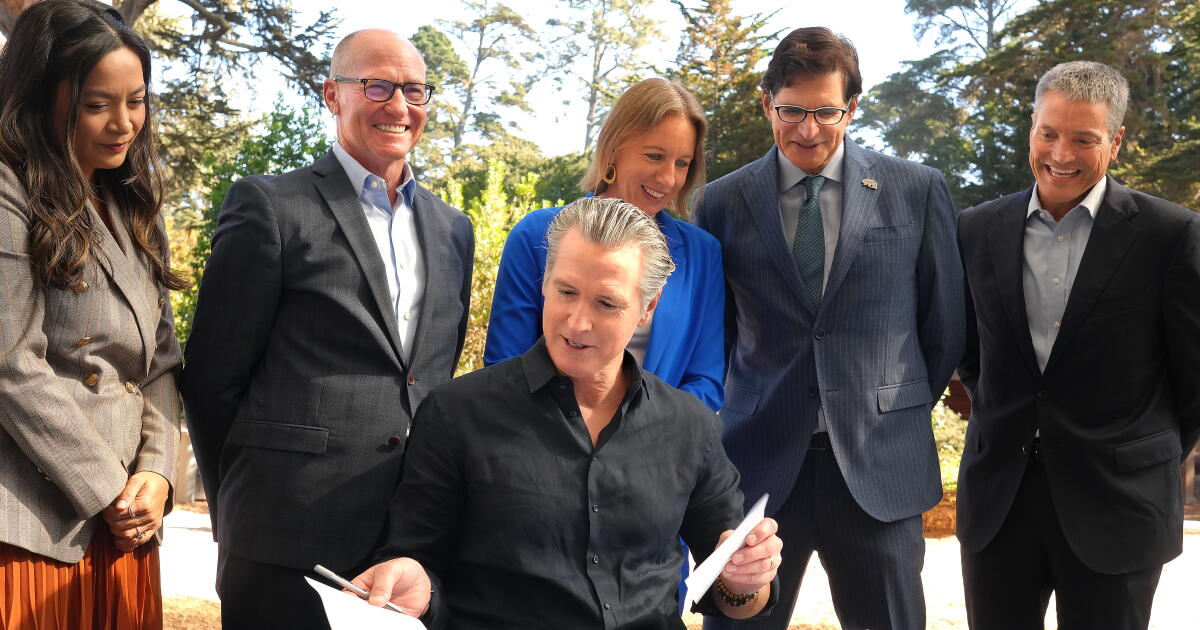
In the final hours of the 2026 California legislative season, Gov. Gavin Newsom signed a suite of closely watched legislation on energy and the environment.
Among them are laws that will reshape how California pays for and operates its energy system — including limiting utility profit and making greater use of clean energy at home — and how the state protects itself against environmental challenges from the federal government.
Senate Bill 913 from Sen. Josh Becker (D-Menlo Park) will advance the use of virtual power plants — networks of customer-owned home batteries, solar panels, electric vehicle chargers and smart thermostats — that can be linked together to relieve the state’s electric grid during times of peak demand.
Specifically, the law directs the California Public Utilities Commission to create a pathway for these separate devices to be aggregated to export electricity by June 30, 2027. Existing rules limited how much people can be paid for the electricity these appliances provide for the grid.
“Instead of simply building more expensive infrastructure and passing those costs on to ratepayers, SB 913 helps us get more out of the resources Californians have already paid for,” Becker said in a statement. “That means more competition, a cleaner and more reliable grid, and an opportunity to lower costs for everyone.”
A related bill from Becker, SB 905, will require the CPUC to consider lowering utilities’ profit on lower-risk investments, such as undergrounding power lines. Utilities often see a return of 9% or 10% on new transmission projects.
It will also require utilities to identify where the existing grid has room for more electricity — and be more transparent about unused capacity — so they can make better use of batteries and other resources.
Taken together, the laws “are the legislative session’s clearest attempt to hold down electricity bills by using equipment installed at homes and businesses rather than expanding utility expenditures which are passed on to customers,” according to the California Solar and Storage Assn., the state’s largest clean-energy business group.
But two of the state’s largest utilities, Pacific Gas & Electric and Southern California Edison, opposed SB 905, with SCE spokesperson David Eisenhauer stating that “keeping electricity affordable for customers requires policies that both reduce costs and support continued investment in the reliable and resilient energy system Californians depend on.”
PG&E spokeswoman Lynsey Paulo said similarly that the utility is concerned the law will discourage the investments needed to accommodate rising electricity demand and stabilize rates and affordability.
Both said they were neutral on the virtual power plant law, with Paulo noting that PG&E “supports efforts to better recognize the value distributed energy resources can provide to the grid.”
Becker’s bills were seen as companions to a new law from Sen. Scott Wiener (D-San Francisco) that allows Californians to use small plug-in solar systems — sometimes called “balcony solar” — without going through the normal rooftop solar permitting process. It’s seen as particularly beneficial for apartment dwellers and renters.
“Together, these three common sense clean energy bills will allow California to continue advancing toward a cleaner, healthier future, in which we rely more on abundant renewable resources including rooftop solar to power our lives,” said Laura Deehan, state director at the nonprofit Environment California.
And although energy affordability and reliability were key issues in Sacramento this year, the governor on Wednesday also signed important legislation to address efforts by the Trump administration to advance the sale and production of fossil fuels in and around California.
They include a bill from Assemblymember Mia Bonta (D-Alameda) that will require a new environmental impact report before any major bulk coal facility is approved, giving the state more control over such projects. The bill was largely a response to President Trump’s $75-million investment in a new coal export terminal in Oakland, which would receive more than 13 million tons of coal each year from interior states to be shipped overseas.
California no longer burns or buys electricity generated by coal. Opponents of the project, who have long been concerned about increased pollution in the surrounding area, celebrated the bill’s passage.
“Today California is standing up for public health, the environment, and our climate. We will not sacrifice our communities to prop up the failing coal industry,” said Ada Waelder, senior state legislative representative with the nonprofit Earthjustice.
This week, Newsom also signed a bill that will make it illegal for oil producers to use oil rigs, pipelines and other equipment in state waters to support any new federal offshore oil leases. It was largely a response to Trump’s plan to open up California’s entire coastline to offshore oil and gas drilling for the first time in more than 40 years.
The legislative session also brought some disappointments for some community groups, such as Newsom’s decision to veto SB 954. It would have closed a loophole that makes it easier for advanced manufacturing facilities to be sited in vulnerable neighborhoods without environmental review. He also vetoed an effort to overhaul the state’s struggling community-solar program.
But Newsom did highlight the environment in his final bill signing of the session, which he announced at the top of the Golden Gate Bridge on Wednesday.
The bill, SB 895 by Sen. Wiener, will put a $7.5-billion science and health research bond before voters in March 2028, “supporting research at California universities and institutions in medicine, public health, climate, wildfire prevention, agriculture and other fields,” according to the governor’s office.
It was the last of 1,160 bills acted on during this legislative session, and 7,803 bills since the start of Newsom’s administration in 2019.

In the final hours of the 2026 California legislative season, Gov. Gavin Newsom signed a suite of closely watched legislation on energy and the environment.
Among them are laws that will reshape how California pays for and operates its energy system — including limiting utility profit and making greater use of clean energy at home — and how the state protects itself against environmental challenges from the federal government.
Senate Bill 913 from Sen. Josh Becker (D-Menlo Park) will advance the use of virtual power plants — networks of customer-owned home batteries, solar panels, electric vehicle chargers and smart thermostats — that can be linked together to relieve the state’s electric grid during times of peak demand.
Specifically, the law directs the California Public Utilities Commission to create a pathway for these separate devices to be aggregated to export electricity by June 30, 2027. Existing rules limited how much people can be paid for the electricity these appliances provide for the grid.
“Instead of simply building more expensive infrastructure and passing those costs on to ratepayers, SB 913 helps us get more out of the resources Californians have already paid for,” Becker said in a statement. “That means more competition, a cleaner and more reliable grid, and an opportunity to lower costs for everyone.”
A related bill from Becker, SB 905, will require the CPUC to consider lowering utilities’ profit on lower-risk investments, such as undergrounding power lines. Utilities often see a return of 9% or 10% on new transmission projects.
It will also require utilities to identify where the existing grid has room for more electricity — and be more transparent about unused capacity — so they can make better use of batteries and other resources.
Taken together, the laws “are the legislative session’s clearest attempt to hold down electricity bills by using equipment installed at homes and businesses rather than expanding utility expenditures which are passed on to customers,” according to the California Solar and Storage Assn., the state’s largest clean-energy business group.
But two of the state’s largest utilities, Pacific Gas & Electric and Southern California Edison, opposed SB 905, with SCE spokesperson David Eisenhauer stating that “keeping electricity affordable for customers requires policies that both reduce costs and support continued investment in the reliable and resilient energy system Californians depend on.”
PG&E spokeswoman Lynsey Paulo said similarly that the utility is concerned the law will discourage the investments needed to accommodate rising electricity demand and stabilize rates and affordability.
Both said they were neutral on the virtual power plant law, with Paulo noting that PG&E “supports efforts to better recognize the value distributed energy resources can provide to the grid.”
Becker’s bills were seen as companions to a new law from Sen. Scott Wiener (D-San Francisco) that allows Californians to use small plug-in solar systems — sometimes called “balcony solar” — without going through the normal rooftop solar permitting process. It’s seen as particularly beneficial for apartment dwellers and renters.
“Together, these three common sense clean energy bills will allow California to continue advancing toward a cleaner, healthier future, in which we rely more on abundant renewable resources including rooftop solar to power our lives,” said Laura Deehan, state director at the nonprofit Environment California.
And although energy affordability and reliability were key issues in Sacramento this year, the governor on Wednesday also signed important legislation to address efforts by the Trump administration to advance the sale and production of fossil fuels in and around California.
They include a bill from Assemblymember Mia Bonta (D-Alameda) that will require a new environmental impact report before any major bulk coal facility is approved, giving the state more control over such projects. The bill was largely a response to President Trump’s $75-million investment in a new coal export terminal in Oakland, which would receive more than 13 million tons of coal each year from interior states to be shipped overseas.
California no longer burns or buys electricity generated by coal. Opponents of the project, who have long been concerned about increased pollution in the surrounding area, celebrated the bill’s passage.
“Today California is standing up for public health, the environment, and our climate. We will not sacrifice our communities to prop up the failing coal industry,” said Ada Waelder, senior state legislative representative with the nonprofit Earthjustice.
This week, Newsom also signed a bill that will make it illegal for oil producers to use oil rigs, pipelines and other equipment in state waters to support any new federal offshore oil leases. It was largely a response to Trump’s plan to open up California’s entire coastline to offshore oil and gas drilling for the first time in more than 40 years.
The legislative session also brought some disappointments for some community groups, such as Newsom’s decision to veto SB 954. It would have closed a loophole that makes it easier for advanced manufacturing facilities to be sited in vulnerable neighborhoods without environmental review. He also vetoed an effort to overhaul the state’s struggling community-solar program.
But Newsom did highlight the environment in his final bill signing of the session, which he announced at the top of the Golden Gate Bridge on Wednesday.
The bill, SB 895 by Sen. Wiener, will put a $7.5-billion science and health research bond before voters in March 2028, “supporting research at California universities and institutions in medicine, public health, climate, wildfire prevention, agriculture and other fields,” according to the governor’s office.
It was the last of 1,160 bills acted on during this legislative session, and 7,803 bills since the start of Newsom’s administration in 2019.

In the final hours of the 2026 California legislative season, Gov. Gavin Newsom signed a suite of closely watched legislation on energy and the environment.
Among them are laws that will reshape how California pays for and operates its energy system — including limiting utility profit and making greater use of clean energy at home — and how the state protects itself against environmental challenges from the federal government.
Senate Bill 913 from Sen. Josh Becker (D-Menlo Park) will advance the use of virtual power plants — networks of customer-owned home batteries, solar panels, electric vehicle chargers and smart thermostats — that can be linked together to relieve the state’s electric grid during times of peak demand.
Specifically, the law directs the California Public Utilities Commission to create a pathway for these separate devices to be aggregated to export electricity by June 30, 2027. Existing rules limited how much people can be paid for the electricity these appliances provide for the grid.
“Instead of simply building more expensive infrastructure and passing those costs on to ratepayers, SB 913 helps us get more out of the resources Californians have already paid for,” Becker said in a statement. “That means more competition, a cleaner and more reliable grid, and an opportunity to lower costs for everyone.”
A related bill from Becker, SB 905, will require the CPUC to consider lowering utilities’ profit on lower-risk investments, such as undergrounding power lines. Utilities often see a return of 9% or 10% on new transmission projects.
It will also require utilities to identify where the existing grid has room for more electricity — and be more transparent about unused capacity — so they can make better use of batteries and other resources.
Taken together, the laws “are the legislative session’s clearest attempt to hold down electricity bills by using equipment installed at homes and businesses rather than expanding utility expenditures which are passed on to customers,” according to the California Solar and Storage Assn., the state’s largest clean-energy business group.
But two of the state’s largest utilities, Pacific Gas & Electric and Southern California Edison, opposed SB 905, with SCE spokesperson David Eisenhauer stating that “keeping electricity affordable for customers requires policies that both reduce costs and support continued investment in the reliable and resilient energy system Californians depend on.”
PG&E spokeswoman Lynsey Paulo said similarly that the utility is concerned the law will discourage the investments needed to accommodate rising electricity demand and stabilize rates and affordability.
Both said they were neutral on the virtual power plant law, with Paulo noting that PG&E “supports efforts to better recognize the value distributed energy resources can provide to the grid.”
Becker’s bills were seen as companions to a new law from Sen. Scott Wiener (D-San Francisco) that allows Californians to use small plug-in solar systems — sometimes called “balcony solar” — without going through the normal rooftop solar permitting process. It’s seen as particularly beneficial for apartment dwellers and renters.
“Together, these three common sense clean energy bills will allow California to continue advancing toward a cleaner, healthier future, in which we rely more on abundant renewable resources including rooftop solar to power our lives,” said Laura Deehan, state director at the nonprofit Environment California.
And although energy affordability and reliability were key issues in Sacramento this year, the governor on Wednesday also signed important legislation to address efforts by the Trump administration to advance the sale and production of fossil fuels in and around California.
They include a bill from Assemblymember Mia Bonta (D-Alameda) that will require a new environmental impact report before any major bulk coal facility is approved, giving the state more control over such projects. The bill was largely a response to President Trump’s $75-million investment in a new coal export terminal in Oakland, which would receive more than 13 million tons of coal each year from interior states to be shipped overseas.
California no longer burns or buys electricity generated by coal. Opponents of the project, who have long been concerned about increased pollution in the surrounding area, celebrated the bill’s passage.
“Today California is standing up for public health, the environment, and our climate. We will not sacrifice our communities to prop up the failing coal industry,” said Ada Waelder, senior state legislative representative with the nonprofit Earthjustice.
This week, Newsom also signed a bill that will make it illegal for oil producers to use oil rigs, pipelines and other equipment in state waters to support any new federal offshore oil leases. It was largely a response to Trump’s plan to open up California’s entire coastline to offshore oil and gas drilling for the first time in more than 40 years.
The legislative session also brought some disappointments for some community groups, such as Newsom’s decision to veto SB 954. It would have closed a loophole that makes it easier for advanced manufacturing facilities to be sited in vulnerable neighborhoods without environmental review. He also vetoed an effort to overhaul the state’s struggling community-solar program.
But Newsom did highlight the environment in his final bill signing of the session, which he announced at the top of the Golden Gate Bridge on Wednesday.
The bill, SB 895 by Sen. Wiener, will put a $7.5-billion science and health research bond before voters in March 2028, “supporting research at California universities and institutions in medicine, public health, climate, wildfire prevention, agriculture and other fields,” according to the governor’s office.
It was the last of 1,160 bills acted on during this legislative session, and 7,803 bills since the start of Newsom’s administration in 2019.
In the final hours of the 2026 California legislative season, Gov. Gavin Newsom signed a suite of closely watched legislation on energy and the environment.
Among them are laws that will reshape how California pays for and operates its energy system — including limiting utility profit and making greater use of clean energy at home — and how the state protects itself against environmental challenges from the federal government.
Senate Bill 913 from Sen. Josh Becker (D-Menlo Park) will advance the use of virtual power plants — networks of customer-owned home batteries, solar panels, electric vehicle chargers and smart thermostats — that can be linked together to relieve the state’s electric grid during times of peak demand.
Specifically, the law directs the California Public Utilities Commission to create a pathway for these separate devices to be aggregated to export electricity by June 30, 2027. Existing rules limited how much people can be paid for the electricity these appliances provide for the grid.
“Instead of simply building more expensive infrastructure and passing those costs on to ratepayers, SB 913 helps us get more out of the resources Californians have already paid for,” Becker said in a statement. “That means more competition, a cleaner and more reliable grid, and an opportunity to lower costs for everyone.”
A related bill from Becker, SB 905, will require the CPUC to consider lowering utilities’ profit on lower-risk investments, such as undergrounding power lines. Utilities often see a return of 9% or 10% on new transmission projects.
It will also require utilities to identify where the existing grid has room for more electricity — and be more transparent about unused capacity — so they can make better use of batteries and other resources.
Taken together, the laws “are the legislative session’s clearest attempt to hold down electricity bills by using equipment installed at homes and businesses rather than expanding utility expenditures which are passed on to customers,” according to the California Solar and Storage Assn., the state’s largest clean-energy business group.
But two of the state’s largest utilities, Pacific Gas & Electric and Southern California Edison, opposed SB 905, with SCE spokesperson David Eisenhauer stating that “keeping electricity affordable for customers requires policies that both reduce costs and support continued investment in the reliable and resilient energy system Californians depend on.”
PG&E spokeswoman Lynsey Paulo said similarly that the utility is concerned the law will discourage the investments needed to accommodate rising electricity demand and stabilize rates and affordability.
Both said they were neutral on the virtual power plant law, with Paulo noting that PG&E “supports efforts to better recognize the value distributed energy resources can provide to the grid.”
Becker’s bills were seen as companions to a new law from Sen. Scott Wiener (D-San Francisco) that allows Californians to use small plug-in solar systems — sometimes called “balcony solar” — without going through the normal rooftop solar permitting process. It’s seen as particularly beneficial for apartment dwellers and renters.
“Together, these three common sense clean energy bills will allow California to continue advancing toward a cleaner, healthier future, in which we rely more on abundant renewable resources including rooftop solar to power our lives,” said Laura Deehan, state director at the nonprofit Environment California.
And although energy affordability and reliability were key issues in Sacramento this year, the governor on Wednesday also signed important legislation to address efforts by the Trump administration to advance the sale and production of fossil fuels in and around California.
They include a bill from Assemblymember Mia Bonta (D-Alameda) that will require a new environmental impact report before any major bulk coal facility is approved, giving the state more control over such projects. The bill was largely a response to President Trump’s $75-million investment in a new coal export terminal in Oakland, which would receive more than 13 million tons of coal each year from interior states to be shipped overseas.
California no longer burns or buys electricity generated by coal. Opponents of the project, who have long been concerned about increased pollution in the surrounding area, celebrated the bill’s passage.
“Today California is standing up for public health, the environment, and our climate. We will not sacrifice our communities to prop up the failing coal industry,” said Ada Waelder, senior state legislative representative with the nonprofit Earthjustice.
This week, Newsom also signed a bill that will make it illegal for oil producers to use oil rigs, pipelines and other equipment in state waters to support any new federal offshore oil leases. It was largely a response to Trump’s plan to open up California’s entire coastline to offshore oil and gas drilling for the first time in more than 40 years.
The legislative session also brought some disappointments for some community groups, such as Newsom’s decision to veto SB 954. It would have closed a loophole that makes it easier for advanced manufacturing facilities to be sited in vulnerable neighborhoods without environmental review. He also vetoed an effort to overhaul the state’s struggling community-solar program.
But Newsom did highlight the environment in his final bill signing of the session, which he announced at the top of the Golden Gate Bridge on Wednesday.
The bill, SB 895 by Sen. Wiener, will put a $7.5-billion science and health research bond before voters in March 2028, “supporting research at California universities and institutions in medicine, public health, climate, wildfire prevention, agriculture and other fields,” according to the governor’s office.
It was the last of 1,160 bills acted on during this legislative session, and 7,803 bills since the start of Newsom’s administration in 2019.

In the final hours of the 2026 California legislative season, Gov. Gavin Newsom signed a suite of closely watched legislation on energy and the environment.
Among them are laws that will reshape how California pays for and operates its energy system — including limiting utility profit and making greater use of clean energy at home — and how the state protects itself against environmental challenges from the federal government.
Senate Bill 913 from Sen. Josh Becker (D-Menlo Park) will advance the use of virtual power plants — networks of customer-owned home batteries, solar panels, electric vehicle chargers and smart thermostats — that can be linked together to relieve the state’s electric grid during times of peak demand.
Specifically, the law directs the California Public Utilities Commission to create a pathway for these separate devices to be aggregated to export electricity by June 30, 2027. Existing rules limited how much people can be paid for the electricity these appliances provide for the grid.
“Instead of simply building more expensive infrastructure and passing those costs on to ratepayers, SB 913 helps us get more out of the resources Californians have already paid for,” Becker said in a statement. “That means more competition, a cleaner and more reliable grid, and an opportunity to lower costs for everyone.”
A related bill from Becker, SB 905, will require the CPUC to consider lowering utilities’ profit on lower-risk investments, such as undergrounding power lines. Utilities often see a return of 9% or 10% on new transmission projects.
It will also require utilities to identify where the existing grid has room for more electricity — and be more transparent about unused capacity — so they can make better use of batteries and other resources.
Taken together, the laws “are the legislative session’s clearest attempt to hold down electricity bills by using equipment installed at homes and businesses rather than expanding utility expenditures which are passed on to customers,” according to the California Solar and Storage Assn., the state’s largest clean-energy business group.
But two of the state’s largest utilities, Pacific Gas & Electric and Southern California Edison, opposed SB 905, with SCE spokesperson David Eisenhauer stating that “keeping electricity affordable for customers requires policies that both reduce costs and support continued investment in the reliable and resilient energy system Californians depend on.”
PG&E spokeswoman Lynsey Paulo said similarly that the utility is concerned the law will discourage the investments needed to accommodate rising electricity demand and stabilize rates and affordability.
Both said they were neutral on the virtual power plant law, with Paulo noting that PG&E “supports efforts to better recognize the value distributed energy resources can provide to the grid.”
Becker’s bills were seen as companions to a new law from Sen. Scott Wiener (D-San Francisco) that allows Californians to use small plug-in solar systems — sometimes called “balcony solar” — without going through the normal rooftop solar permitting process. It’s seen as particularly beneficial for apartment dwellers and renters.
“Together, these three common sense clean energy bills will allow California to continue advancing toward a cleaner, healthier future, in which we rely more on abundant renewable resources including rooftop solar to power our lives,” said Laura Deehan, state director at the nonprofit Environment California.
And although energy affordability and reliability were key issues in Sacramento this year, the governor on Wednesday also signed important legislation to address efforts by the Trump administration to advance the sale and production of fossil fuels in and around California.
They include a bill from Assemblymember Mia Bonta (D-Alameda) that will require a new environmental impact report before any major bulk coal facility is approved, giving the state more control over such projects. The bill was largely a response to President Trump’s $75-million investment in a new coal export terminal in Oakland, which would receive more than 13 million tons of coal each year from interior states to be shipped overseas.
California no longer burns or buys electricity generated by coal. Opponents of the project, who have long been concerned about increased pollution in the surrounding area, celebrated the bill’s passage.
“Today California is standing up for public health, the environment, and our climate. We will not sacrifice our communities to prop up the failing coal industry,” said Ada Waelder, senior state legislative representative with the nonprofit Earthjustice.
This week, Newsom also signed a bill that will make it illegal for oil producers to use oil rigs, pipelines and other equipment in state waters to support any new federal offshore oil leases. It was largely a response to Trump’s plan to open up California’s entire coastline to offshore oil and gas drilling for the first time in more than 40 years.
The legislative session also brought some disappointments for some community groups, such as Newsom’s decision to veto SB 954. It would have closed a loophole that makes it easier for advanced manufacturing facilities to be sited in vulnerable neighborhoods without environmental review. He also vetoed an effort to overhaul the state’s struggling community-solar program.
But Newsom did highlight the environment in his final bill signing of the session, which he announced at the top of the Golden Gate Bridge on Wednesday.
The bill, SB 895 by Sen. Wiener, will put a $7.5-billion science and health research bond before voters in March 2028, “supporting research at California universities and institutions in medicine, public health, climate, wildfire prevention, agriculture and other fields,” according to the governor’s office.
It was the last of 1,160 bills acted on during this legislative session, and 7,803 bills since the start of Newsom’s administration in 2019.
In the final hours of the 2026 California legislative season, Gov. Gavin Newsom signed a suite of closely watched legislation on energy and the environment.
Among them are laws that will reshape how California pays for and operates its energy system — including limiting utility profit and making greater use of clean energy at home — and how the state protects itself against environmental challenges from the federal government.
Senate Bill 913 from Sen. Josh Becker (D-Menlo Park) will advance the use of virtual power plants — networks of customer-owned home batteries, solar panels, electric vehicle chargers and smart thermostats — that can be linked together to relieve the state’s electric grid during times of peak demand.
Specifically, the law directs the California Public Utilities Commission to create a pathway for these separate devices to be aggregated to export electricity by June 30, 2027. Existing rules limited how much people can be paid for the electricity these appliances provide for the grid.
“Instead of simply building more expensive infrastructure and passing those costs on to ratepayers, SB 913 helps us get more out of the resources Californians have already paid for,” Becker said in a statement. “That means more competition, a cleaner and more reliable grid, and an opportunity to lower costs for everyone.”
A related bill from Becker, SB 905, will require the CPUC to consider lowering utilities’ profit on lower-risk investments, such as undergrounding power lines. Utilities often see a return of 9% or 10% on new transmission projects.
It will also require utilities to identify where the existing grid has room for more electricity — and be more transparent about unused capacity — so they can make better use of batteries and other resources.
Taken together, the laws “are the legislative session’s clearest attempt to hold down electricity bills by using equipment installed at homes and businesses rather than expanding utility expenditures which are passed on to customers,” according to the California Solar and Storage Assn., the state’s largest clean-energy business group.
But two of the state’s largest utilities, Pacific Gas & Electric and Southern California Edison, opposed SB 905, with SCE spokesperson David Eisenhauer stating that “keeping electricity affordable for customers requires policies that both reduce costs and support continued investment in the reliable and resilient energy system Californians depend on.”
PG&E spokeswoman Lynsey Paulo said similarly that the utility is concerned the law will discourage the investments needed to accommodate rising electricity demand and stabilize rates and affordability.
Both said they were neutral on the virtual power plant law, with Paulo noting that PG&E “supports efforts to better recognize the value distributed energy resources can provide to the grid.”
Becker’s bills were seen as companions to a new law from Sen. Scott Wiener (D-San Francisco) that allows Californians to use small plug-in solar systems — sometimes called “balcony solar” — without going through the normal rooftop solar permitting process. It’s seen as particularly beneficial for apartment dwellers and renters.
“Together, these three common sense clean energy bills will allow California to continue advancing toward a cleaner, healthier future, in which we rely more on abundant renewable resources including rooftop solar to power our lives,” said Laura Deehan, state director at the nonprofit Environment California.
And although energy affordability and reliability were key issues in Sacramento this year, the governor on Wednesday also signed important legislation to address efforts by the Trump administration to advance the sale and production of fossil fuels in and around California.
They include a bill from Assemblymember Mia Bonta (D-Alameda) that will require a new environmental impact report before any major bulk coal facility is approved, giving the state more control over such projects. The bill was largely a response to President Trump’s $75-million investment in a new coal export terminal in Oakland, which would receive more than 13 million tons of coal each year from interior states to be shipped overseas.
California no longer burns or buys electricity generated by coal. Opponents of the project, who have long been concerned about increased pollution in the surrounding area, celebrated the bill’s passage.
“Today California is standing up for public health, the environment, and our climate. We will not sacrifice our communities to prop up the failing coal industry,” said Ada Waelder, senior state legislative representative with the nonprofit Earthjustice.
This week, Newsom also signed a bill that will make it illegal for oil producers to use oil rigs, pipelines and other equipment in state waters to support any new federal offshore oil leases. It was largely a response to Trump’s plan to open up California’s entire coastline to offshore oil and gas drilling for the first time in more than 40 years.
The legislative session also brought some disappointments for some community groups, such as Newsom’s decision to veto SB 954. It would have closed a loophole that makes it easier for advanced manufacturing facilities to be sited in vulnerable neighborhoods without environmental review. He also vetoed an effort to overhaul the state’s struggling community-solar program.
But Newsom did highlight the environment in his final bill signing of the session, which he announced at the top of the Golden Gate Bridge on Wednesday.
The bill, SB 895 by Sen. Wiener, will put a $7.5-billion science and health research bond before voters in March 2028, “supporting research at California universities and institutions in medicine, public health, climate, wildfire prevention, agriculture and other fields,” according to the governor’s office.
It was the last of 1,160 bills acted on during this legislative session, and 7,803 bills since the start of Newsom’s administration in 2019.
In the final hours of the 2026 California legislative season, Gov. Gavin Newsom signed a suite of closely watched legislation on energy and the environment.
Among them are laws that will reshape how California pays for and operates its energy system — including limiting utility profit and making greater use of clean energy at home — and how the state protects itself against environmental challenges from the federal government.
Senate Bill 913 from Sen. Josh Becker (D-Menlo Park) will advance the use of virtual power plants — networks of customer-owned home batteries, solar panels, electric vehicle chargers and smart thermostats — that can be linked together to relieve the state’s electric grid during times of peak demand.
Specifically, the law directs the California Public Utilities Commission to create a pathway for these separate devices to be aggregated to export electricity by June 30, 2027. Existing rules limited how much people can be paid for the electricity these appliances provide for the grid.
“Instead of simply building more expensive infrastructure and passing those costs on to ratepayers, SB 913 helps us get more out of the resources Californians have already paid for,” Becker said in a statement. “That means more competition, a cleaner and more reliable grid, and an opportunity to lower costs for everyone.”
A related bill from Becker, SB 905, will require the CPUC to consider lowering utilities’ profit on lower-risk investments, such as undergrounding power lines. Utilities often see a return of 9% or 10% on new transmission projects.
It will also require utilities to identify where the existing grid has room for more electricity — and be more transparent about unused capacity — so they can make better use of batteries and other resources.
Taken together, the laws “are the legislative session’s clearest attempt to hold down electricity bills by using equipment installed at homes and businesses rather than expanding utility expenditures which are passed on to customers,” according to the California Solar and Storage Assn., the state’s largest clean-energy business group.
But two of the state’s largest utilities, Pacific Gas & Electric and Southern California Edison, opposed SB 905, with SCE spokesperson David Eisenhauer stating that “keeping electricity affordable for customers requires policies that both reduce costs and support continued investment in the reliable and resilient energy system Californians depend on.”
PG&E spokeswoman Lynsey Paulo said similarly that the utility is concerned the law will discourage the investments needed to accommodate rising electricity demand and stabilize rates and affordability.
Both said they were neutral on the virtual power plant law, with Paulo noting that PG&E “supports efforts to better recognize the value distributed energy resources can provide to the grid.”
Becker’s bills were seen as companions to a new law from Sen. Scott Wiener (D-San Francisco) that allows Californians to use small plug-in solar systems — sometimes called “balcony solar” — without going through the normal rooftop solar permitting process. It’s seen as particularly beneficial for apartment dwellers and renters.
“Together, these three common sense clean energy bills will allow California to continue advancing toward a cleaner, healthier future, in which we rely more on abundant renewable resources including rooftop solar to power our lives,” said Laura Deehan, state director at the nonprofit Environment California.
And although energy affordability and reliability were key issues in Sacramento this year, the governor on Wednesday also signed important legislation to address efforts by the Trump administration to advance the sale and production of fossil fuels in and around California.
They include a bill from Assemblymember Mia Bonta (D-Alameda) that will require a new environmental impact report before any major bulk coal facility is approved, giving the state more control over such projects. The bill was largely a response to President Trump’s $75-million investment in a new coal export terminal in Oakland, which would receive more than 13 million tons of coal each year from interior states to be shipped overseas.
California no longer burns or buys electricity generated by coal. Opponents of the project, who have long been concerned about increased pollution in the surrounding area, celebrated the bill’s passage.
“Today California is standing up for public health, the environment, and our climate. We will not sacrifice our communities to prop up the failing coal industry,” said Ada Waelder, senior state legislative representative with the nonprofit Earthjustice.
This week, Newsom also signed a bill that will make it illegal for oil producers to use oil rigs, pipelines and other equipment in state waters to support any new federal offshore oil leases. It was largely a response to Trump’s plan to open up California’s entire coastline to offshore oil and gas drilling for the first time in more than 40 years.
The legislative session also brought some disappointments for some community groups, such as Newsom’s decision to veto SB 954. It would have closed a loophole that makes it easier for advanced manufacturing facilities to be sited in vulnerable neighborhoods without environmental review. He also vetoed an effort to overhaul the state’s struggling community-solar program.
But Newsom did highlight the environment in his final bill signing of the session, which he announced at the top of the Golden Gate Bridge on Wednesday.
The bill, SB 895 by Sen. Wiener, will put a $7.5-billion science and health research bond before voters in March 2028, “supporting research at California universities and institutions in medicine, public health, climate, wildfire prevention, agriculture and other fields,” according to the governor’s office.
It was the last of 1,160 bills acted on during this legislative session, and 7,803 bills since the start of Newsom’s administration in 2019.
In the final hours of the 2026 California legislative season, Gov. Gavin Newsom signed a suite of closely watched legislation on energy and the environment.
Among them are laws that will reshape how California pays for and operates its energy system — including limiting utility profit and making greater use of clean energy at home — and how the state protects itself against environmental challenges from the federal government.
Senate Bill 913 from Sen. Josh Becker (D-Menlo Park) will advance the use of virtual power plants — networks of customer-owned home batteries, solar panels, electric vehicle chargers and smart thermostats — that can be linked together to relieve the state’s electric grid during times of peak demand.
Specifically, the law directs the California Public Utilities Commission to create a pathway for these separate devices to be aggregated to export electricity by June 30, 2027. Existing rules limited how much people can be paid for the electricity these appliances provide for the grid.
“Instead of simply building more expensive infrastructure and passing those costs on to ratepayers, SB 913 helps us get more out of the resources Californians have already paid for,” Becker said in a statement. “That means more competition, a cleaner and more reliable grid, and an opportunity to lower costs for everyone.”
A related bill from Becker, SB 905, will require the CPUC to consider lowering utilities’ profit on lower-risk investments, such as undergrounding power lines. Utilities often see a return of 9% or 10% on new transmission projects.
It will also require utilities to identify where the existing grid has room for more electricity — and be more transparent about unused capacity — so they can make better use of batteries and other resources.
Taken together, the laws “are the legislative session’s clearest attempt to hold down electricity bills by using equipment installed at homes and businesses rather than expanding utility expenditures which are passed on to customers,” according to the California Solar and Storage Assn., the state’s largest clean-energy business group.
But two of the state’s largest utilities, Pacific Gas & Electric and Southern California Edison, opposed SB 905, with SCE spokesperson David Eisenhauer stating that “keeping electricity affordable for customers requires policies that both reduce costs and support continued investment in the reliable and resilient energy system Californians depend on.”
PG&E spokeswoman Lynsey Paulo said similarly that the utility is concerned the law will discourage the investments needed to accommodate rising electricity demand and stabilize rates and affordability.
Both said they were neutral on the virtual power plant law, with Paulo noting that PG&E “supports efforts to better recognize the value distributed energy resources can provide to the grid.”
Becker’s bills were seen as companions to a new law from Sen. Scott Wiener (D-San Francisco) that allows Californians to use small plug-in solar systems — sometimes called “balcony solar” — without going through the normal rooftop solar permitting process. It’s seen as particularly beneficial for apartment dwellers and renters.
“Together, these three common sense clean energy bills will allow California to continue advancing toward a cleaner, healthier future, in which we rely more on abundant renewable resources including rooftop solar to power our lives,” said Laura Deehan, state director at the nonprofit Environment California.
And although energy affordability and reliability were key issues in Sacramento this year, the governor on Wednesday also signed important legislation to address efforts by the Trump administration to advance the sale and production of fossil fuels in and around California.
They include a bill from Assemblymember Mia Bonta (D-Alameda) that will require a new environmental impact report before any major bulk coal facility is approved, giving the state more control over such projects. The bill was largely a response to President Trump’s $75-million investment in a new coal export terminal in Oakland, which would receive more than 13 million tons of coal each year from interior states to be shipped overseas.
California no longer burns or buys electricity generated by coal. Opponents of the project, who have long been concerned about increased pollution in the surrounding area, celebrated the bill’s passage.
“Today California is standing up for public health, the environment, and our climate. We will not sacrifice our communities to prop up the failing coal industry,” said Ada Waelder, senior state legislative representative with the nonprofit Earthjustice.
This week, Newsom also signed a bill that will make it illegal for oil producers to use oil rigs, pipelines and other equipment in state waters to support any new federal offshore oil leases. It was largely a response to Trump’s plan to open up California’s entire coastline to offshore oil and gas drilling for the first time in more than 40 years.
The legislative session also brought some disappointments for some community groups, such as Newsom’s decision to veto SB 954. It would have closed a loophole that makes it easier for advanced manufacturing facilities to be sited in vulnerable neighborhoods without environmental review. He also vetoed an effort to overhaul the state’s struggling community-solar program.
But Newsom did highlight the environment in his final bill signing of the session, which he announced at the top of the Golden Gate Bridge on Wednesday.
The bill, SB 895 by Sen. Wiener, will put a $7.5-billion science and health research bond before voters in March 2028, “supporting research at California universities and institutions in medicine, public health, climate, wildfire prevention, agriculture and other fields,” according to the governor’s office.
It was the last of 1,160 bills acted on during this legislative session, and 7,803 bills since the start of Newsom’s administration in 2019.

In the final hours of the 2026 California legislative season, Gov. Gavin Newsom signed a suite of closely watched legislation on energy and the environment.
Among them are laws that will reshape how California pays for and operates its energy system — including limiting utility profit and making greater use of clean energy at home — and how the state protects itself against environmental challenges from the federal government.
Senate Bill 913 from Sen. Josh Becker (D-Menlo Park) will advance the use of virtual power plants — networks of customer-owned home batteries, solar panels, electric vehicle chargers and smart thermostats — that can be linked together to relieve the state’s electric grid during times of peak demand.
Specifically, the law directs the California Public Utilities Commission to create a pathway for these separate devices to be aggregated to export electricity by June 30, 2027. Existing rules limited how much people can be paid for the electricity these appliances provide for the grid.
“Instead of simply building more expensive infrastructure and passing those costs on to ratepayers, SB 913 helps us get more out of the resources Californians have already paid for,” Becker said in a statement. “That means more competition, a cleaner and more reliable grid, and an opportunity to lower costs for everyone.”
A related bill from Becker, SB 905, will require the CPUC to consider lowering utilities’ profit on lower-risk investments, such as undergrounding power lines. Utilities often see a return of 9% or 10% on new transmission projects.
It will also require utilities to identify where the existing grid has room for more electricity — and be more transparent about unused capacity — so they can make better use of batteries and other resources.
Taken together, the laws “are the legislative session’s clearest attempt to hold down electricity bills by using equipment installed at homes and businesses rather than expanding utility expenditures which are passed on to customers,” according to the California Solar and Storage Assn., the state’s largest clean-energy business group.
But two of the state’s largest utilities, Pacific Gas & Electric and Southern California Edison, opposed SB 905, with SCE spokesperson David Eisenhauer stating that “keeping electricity affordable for customers requires policies that both reduce costs and support continued investment in the reliable and resilient energy system Californians depend on.”
PG&E spokeswoman Lynsey Paulo said similarly that the utility is concerned the law will discourage the investments needed to accommodate rising electricity demand and stabilize rates and affordability.
Both said they were neutral on the virtual power plant law, with Paulo noting that PG&E “supports efforts to better recognize the value distributed energy resources can provide to the grid.”
Becker’s bills were seen as companions to a new law from Sen. Scott Wiener (D-San Francisco) that allows Californians to use small plug-in solar systems — sometimes called “balcony solar” — without going through the normal rooftop solar permitting process. It’s seen as particularly beneficial for apartment dwellers and renters.
“Together, these three common sense clean energy bills will allow California to continue advancing toward a cleaner, healthier future, in which we rely more on abundant renewable resources including rooftop solar to power our lives,” said Laura Deehan, state director at the nonprofit Environment California.
And although energy affordability and reliability were key issues in Sacramento this year, the governor on Wednesday also signed important legislation to address efforts by the Trump administration to advance the sale and production of fossil fuels in and around California.
They include a bill from Assemblymember Mia Bonta (D-Alameda) that will require a new environmental impact report before any major bulk coal facility is approved, giving the state more control over such projects. The bill was largely a response to President Trump’s $75-million investment in a new coal export terminal in Oakland, which would receive more than 13 million tons of coal each year from interior states to be shipped overseas.
California no longer burns or buys electricity generated by coal. Opponents of the project, who have long been concerned about increased pollution in the surrounding area, celebrated the bill’s passage.
“Today California is standing up for public health, the environment, and our climate. We will not sacrifice our communities to prop up the failing coal industry,” said Ada Waelder, senior state legislative representative with the nonprofit Earthjustice.
This week, Newsom also signed a bill that will make it illegal for oil producers to use oil rigs, pipelines and other equipment in state waters to support any new federal offshore oil leases. It was largely a response to Trump’s plan to open up California’s entire coastline to offshore oil and gas drilling for the first time in more than 40 years.
The legislative session also brought some disappointments for some community groups, such as Newsom’s decision to veto SB 954. It would have closed a loophole that makes it easier for advanced manufacturing facilities to be sited in vulnerable neighborhoods without environmental review. He also vetoed an effort to overhaul the state’s struggling community-solar program.
But Newsom did highlight the environment in his final bill signing of the session, which he announced at the top of the Golden Gate Bridge on Wednesday.
The bill, SB 895 by Sen. Wiener, will put a $7.5-billion science and health research bond before voters in March 2028, “supporting research at California universities and institutions in medicine, public health, climate, wildfire prevention, agriculture and other fields,” according to the governor’s office.
It was the last of 1,160 bills acted on during this legislative session, and 7,803 bills since the start of Newsom’s administration in 2019.
In the final hours of the 2026 California legislative season, Gov. Gavin Newsom signed a suite of closely watched legislation on energy and the environment.
Among them are laws that will reshape how California pays for and operates its energy system — including limiting utility profit and making greater use of clean energy at home — and how the state protects itself against environmental challenges from the federal government.
Senate Bill 913 from Sen. Josh Becker (D-Menlo Park) will advance the use of virtual power plants — networks of customer-owned home batteries, solar panels, electric vehicle chargers and smart thermostats — that can be linked together to relieve the state’s electric grid during times of peak demand.
Specifically, the law directs the California Public Utilities Commission to create a pathway for these separate devices to be aggregated to export electricity by June 30, 2027. Existing rules limited how much people can be paid for the electricity these appliances provide for the grid.
“Instead of simply building more expensive infrastructure and passing those costs on to ratepayers, SB 913 helps us get more out of the resources Californians have already paid for,” Becker said in a statement. “That means more competition, a cleaner and more reliable grid, and an opportunity to lower costs for everyone.”
A related bill from Becker, SB 905, will require the CPUC to consider lowering utilities’ profit on lower-risk investments, such as undergrounding power lines. Utilities often see a return of 9% or 10% on new transmission projects.
It will also require utilities to identify where the existing grid has room for more electricity — and be more transparent about unused capacity — so they can make better use of batteries and other resources.
Taken together, the laws “are the legislative session’s clearest attempt to hold down electricity bills by using equipment installed at homes and businesses rather than expanding utility expenditures which are passed on to customers,” according to the California Solar and Storage Assn., the state’s largest clean-energy business group.
But two of the state’s largest utilities, Pacific Gas & Electric and Southern California Edison, opposed SB 905, with SCE spokesperson David Eisenhauer stating that “keeping electricity affordable for customers requires policies that both reduce costs and support continued investment in the reliable and resilient energy system Californians depend on.”
PG&E spokeswoman Lynsey Paulo said similarly that the utility is concerned the law will discourage the investments needed to accommodate rising electricity demand and stabilize rates and affordability.
Both said they were neutral on the virtual power plant law, with Paulo noting that PG&E “supports efforts to better recognize the value distributed energy resources can provide to the grid.”
Becker’s bills were seen as companions to a new law from Sen. Scott Wiener (D-San Francisco) that allows Californians to use small plug-in solar systems — sometimes called “balcony solar” — without going through the normal rooftop solar permitting process. It’s seen as particularly beneficial for apartment dwellers and renters.
“Together, these three common sense clean energy bills will allow California to continue advancing toward a cleaner, healthier future, in which we rely more on abundant renewable resources including rooftop solar to power our lives,” said Laura Deehan, state director at the nonprofit Environment California.
And although energy affordability and reliability were key issues in Sacramento this year, the governor on Wednesday also signed important legislation to address efforts by the Trump administration to advance the sale and production of fossil fuels in and around California.
They include a bill from Assemblymember Mia Bonta (D-Alameda) that will require a new environmental impact report before any major bulk coal facility is approved, giving the state more control over such projects. The bill was largely a response to President Trump’s $75-million investment in a new coal export terminal in Oakland, which would receive more than 13 million tons of coal each year from interior states to be shipped overseas.
California no longer burns or buys electricity generated by coal. Opponents of the project, who have long been concerned about increased pollution in the surrounding area, celebrated the bill’s passage.
“Today California is standing up for public health, the environment, and our climate. We will not sacrifice our communities to prop up the failing coal industry,” said Ada Waelder, senior state legislative representative with the nonprofit Earthjustice.
This week, Newsom also signed a bill that will make it illegal for oil producers to use oil rigs, pipelines and other equipment in state waters to support any new federal offshore oil leases. It was largely a response to Trump’s plan to open up California’s entire coastline to offshore oil and gas drilling for the first time in more than 40 years.
The legislative session also brought some disappointments for some community groups, such as Newsom’s decision to veto SB 954. It would have closed a loophole that makes it easier for advanced manufacturing facilities to be sited in vulnerable neighborhoods without environmental review. He also vetoed an effort to overhaul the state’s struggling community-solar program.
But Newsom did highlight the environment in his final bill signing of the session, which he announced at the top of the Golden Gate Bridge on Wednesday.
The bill, SB 895 by Sen. Wiener, will put a $7.5-billion science and health research bond before voters in March 2028, “supporting research at California universities and institutions in medicine, public health, climate, wildfire prevention, agriculture and other fields,” according to the governor’s office.
It was the last of 1,160 bills acted on during this legislative session, and 7,803 bills since the start of Newsom’s administration in 2019.
In the final hours of the 2026 California legislative season, Gov. Gavin Newsom signed a suite of closely watched legislation on energy and the environment.
Among them are laws that will reshape how California pays for and operates its energy system — including limiting utility profit and making greater use of clean energy at home — and how the state protects itself against environmental challenges from the federal government.
Senate Bill 913 from Sen. Josh Becker (D-Menlo Park) will advance the use of virtual power plants — networks of customer-owned home batteries, solar panels, electric vehicle chargers and smart thermostats — that can be linked together to relieve the state’s electric grid during times of peak demand.
Specifically, the law directs the California Public Utilities Commission to create a pathway for these separate devices to be aggregated to export electricity by June 30, 2027. Existing rules limited how much people can be paid for the electricity these appliances provide for the grid.
“Instead of simply building more expensive infrastructure and passing those costs on to ratepayers, SB 913 helps us get more out of the resources Californians have already paid for,” Becker said in a statement. “That means more competition, a cleaner and more reliable grid, and an opportunity to lower costs for everyone.”
A related bill from Becker, SB 905, will require the CPUC to consider lowering utilities’ profit on lower-risk investments, such as undergrounding power lines. Utilities often see a return of 9% or 10% on new transmission projects.
It will also require utilities to identify where the existing grid has room for more electricity — and be more transparent about unused capacity — so they can make better use of batteries and other resources.
Taken together, the laws “are the legislative session’s clearest attempt to hold down electricity bills by using equipment installed at homes and businesses rather than expanding utility expenditures which are passed on to customers,” according to the California Solar and Storage Assn., the state’s largest clean-energy business group.
But two of the state’s largest utilities, Pacific Gas & Electric and Southern California Edison, opposed SB 905, with SCE spokesperson David Eisenhauer stating that “keeping electricity affordable for customers requires policies that both reduce costs and support continued investment in the reliable and resilient energy system Californians depend on.”
PG&E spokeswoman Lynsey Paulo said similarly that the utility is concerned the law will discourage the investments needed to accommodate rising electricity demand and stabilize rates and affordability.
Both said they were neutral on the virtual power plant law, with Paulo noting that PG&E “supports efforts to better recognize the value distributed energy resources can provide to the grid.”
Becker’s bills were seen as companions to a new law from Sen. Scott Wiener (D-San Francisco) that allows Californians to use small plug-in solar systems — sometimes called “balcony solar” — without going through the normal rooftop solar permitting process. It’s seen as particularly beneficial for apartment dwellers and renters.
“Together, these three common sense clean energy bills will allow California to continue advancing toward a cleaner, healthier future, in which we rely more on abundant renewable resources including rooftop solar to power our lives,” said Laura Deehan, state director at the nonprofit Environment California.
And although energy affordability and reliability were key issues in Sacramento this year, the governor on Wednesday also signed important legislation to address efforts by the Trump administration to advance the sale and production of fossil fuels in and around California.
They include a bill from Assemblymember Mia Bonta (D-Alameda) that will require a new environmental impact report before any major bulk coal facility is approved, giving the state more control over such projects. The bill was largely a response to President Trump’s $75-million investment in a new coal export terminal in Oakland, which would receive more than 13 million tons of coal each year from interior states to be shipped overseas.
California no longer burns or buys electricity generated by coal. Opponents of the project, who have long been concerned about increased pollution in the surrounding area, celebrated the bill’s passage.
“Today California is standing up for public health, the environment, and our climate. We will not sacrifice our communities to prop up the failing coal industry,” said Ada Waelder, senior state legislative representative with the nonprofit Earthjustice.
This week, Newsom also signed a bill that will make it illegal for oil producers to use oil rigs, pipelines and other equipment in state waters to support any new federal offshore oil leases. It was largely a response to Trump’s plan to open up California’s entire coastline to offshore oil and gas drilling for the first time in more than 40 years.
The legislative session also brought some disappointments for some community groups, such as Newsom’s decision to veto SB 954. It would have closed a loophole that makes it easier for advanced manufacturing facilities to be sited in vulnerable neighborhoods without environmental review. He also vetoed an effort to overhaul the state’s struggling community-solar program.
But Newsom did highlight the environment in his final bill signing of the session, which he announced at the top of the Golden Gate Bridge on Wednesday.
The bill, SB 895 by Sen. Wiener, will put a $7.5-billion science and health research bond before voters in March 2028, “supporting research at California universities and institutions in medicine, public health, climate, wildfire prevention, agriculture and other fields,” according to the governor’s office.
It was the last of 1,160 bills acted on during this legislative session, and 7,803 bills since the start of Newsom’s administration in 2019.
In the final hours of the 2026 California legislative season, Gov. Gavin Newsom signed a suite of closely watched legislation on energy and the environment.
Among them are laws that will reshape how California pays for and operates its energy system — including limiting utility profit and making greater use of clean energy at home — and how the state protects itself against environmental challenges from the federal government.
Senate Bill 913 from Sen. Josh Becker (D-Menlo Park) will advance the use of virtual power plants — networks of customer-owned home batteries, solar panels, electric vehicle chargers and smart thermostats — that can be linked together to relieve the state’s electric grid during times of peak demand.
Specifically, the law directs the California Public Utilities Commission to create a pathway for these separate devices to be aggregated to export electricity by June 30, 2027. Existing rules limited how much people can be paid for the electricity these appliances provide for the grid.
“Instead of simply building more expensive infrastructure and passing those costs on to ratepayers, SB 913 helps us get more out of the resources Californians have already paid for,” Becker said in a statement. “That means more competition, a cleaner and more reliable grid, and an opportunity to lower costs for everyone.”
A related bill from Becker, SB 905, will require the CPUC to consider lowering utilities’ profit on lower-risk investments, such as undergrounding power lines. Utilities often see a return of 9% or 10% on new transmission projects.
It will also require utilities to identify where the existing grid has room for more electricity — and be more transparent about unused capacity — so they can make better use of batteries and other resources.
Taken together, the laws “are the legislative session’s clearest attempt to hold down electricity bills by using equipment installed at homes and businesses rather than expanding utility expenditures which are passed on to customers,” according to the California Solar and Storage Assn., the state’s largest clean-energy business group.
But two of the state’s largest utilities, Pacific Gas & Electric and Southern California Edison, opposed SB 905, with SCE spokesperson David Eisenhauer stating that “keeping electricity affordable for customers requires policies that both reduce costs and support continued investment in the reliable and resilient energy system Californians depend on.”
PG&E spokeswoman Lynsey Paulo said similarly that the utility is concerned the law will discourage the investments needed to accommodate rising electricity demand and stabilize rates and affordability.
Both said they were neutral on the virtual power plant law, with Paulo noting that PG&E “supports efforts to better recognize the value distributed energy resources can provide to the grid.”
Becker’s bills were seen as companions to a new law from Sen. Scott Wiener (D-San Francisco) that allows Californians to use small plug-in solar systems — sometimes called “balcony solar” — without going through the normal rooftop solar permitting process. It’s seen as particularly beneficial for apartment dwellers and renters.
“Together, these three common sense clean energy bills will allow California to continue advancing toward a cleaner, healthier future, in which we rely more on abundant renewable resources including rooftop solar to power our lives,” said Laura Deehan, state director at the nonprofit Environment California.
And although energy affordability and reliability were key issues in Sacramento this year, the governor on Wednesday also signed important legislation to address efforts by the Trump administration to advance the sale and production of fossil fuels in and around California.
They include a bill from Assemblymember Mia Bonta (D-Alameda) that will require a new environmental impact report before any major bulk coal facility is approved, giving the state more control over such projects. The bill was largely a response to President Trump’s $75-million investment in a new coal export terminal in Oakland, which would receive more than 13 million tons of coal each year from interior states to be shipped overseas.
California no longer burns or buys electricity generated by coal. Opponents of the project, who have long been concerned about increased pollution in the surrounding area, celebrated the bill’s passage.
“Today California is standing up for public health, the environment, and our climate. We will not sacrifice our communities to prop up the failing coal industry,” said Ada Waelder, senior state legislative representative with the nonprofit Earthjustice.
This week, Newsom also signed a bill that will make it illegal for oil producers to use oil rigs, pipelines and other equipment in state waters to support any new federal offshore oil leases. It was largely a response to Trump’s plan to open up California’s entire coastline to offshore oil and gas drilling for the first time in more than 40 years.
The legislative session also brought some disappointments for some community groups, such as Newsom’s decision to veto SB 954. It would have closed a loophole that makes it easier for advanced manufacturing facilities to be sited in vulnerable neighborhoods without environmental review. He also vetoed an effort to overhaul the state’s struggling community-solar program.
But Newsom did highlight the environment in his final bill signing of the session, which he announced at the top of the Golden Gate Bridge on Wednesday.
The bill, SB 895 by Sen. Wiener, will put a $7.5-billion science and health research bond before voters in March 2028, “supporting research at California universities and institutions in medicine, public health, climate, wildfire prevention, agriculture and other fields,” according to the governor’s office.
It was the last of 1,160 bills acted on during this legislative session, and 7,803 bills since the start of Newsom’s administration in 2019.
In the final hours of the 2026 California legislative season, Gov. Gavin Newsom signed a suite of closely watched legislation on energy and the environment.
Among them are laws that will reshape how California pays for and operates its energy system — including limiting utility profit and making greater use of clean energy at home — and how the state protects itself against environmental challenges from the federal government.
Senate Bill 913 from Sen. Josh Becker (D-Menlo Park) will advance the use of virtual power plants — networks of customer-owned home batteries, solar panels, electric vehicle chargers and smart thermostats — that can be linked together to relieve the state’s electric grid during times of peak demand.
Specifically, the law directs the California Public Utilities Commission to create a pathway for these separate devices to be aggregated to export electricity by June 30, 2027. Existing rules limited how much people can be paid for the electricity these appliances provide for the grid.
“Instead of simply building more expensive infrastructure and passing those costs on to ratepayers, SB 913 helps us get more out of the resources Californians have already paid for,” Becker said in a statement. “That means more competition, a cleaner and more reliable grid, and an opportunity to lower costs for everyone.”
A related bill from Becker, SB 905, will require the CPUC to consider lowering utilities’ profit on lower-risk investments, such as undergrounding power lines. Utilities often see a return of 9% or 10% on new transmission projects.
It will also require utilities to identify where the existing grid has room for more electricity — and be more transparent about unused capacity — so they can make better use of batteries and other resources.
Taken together, the laws “are the legislative session’s clearest attempt to hold down electricity bills by using equipment installed at homes and businesses rather than expanding utility expenditures which are passed on to customers,” according to the California Solar and Storage Assn., the state’s largest clean-energy business group.
But two of the state’s largest utilities, Pacific Gas & Electric and Southern California Edison, opposed SB 905, with SCE spokesperson David Eisenhauer stating that “keeping electricity affordable for customers requires policies that both reduce costs and support continued investment in the reliable and resilient energy system Californians depend on.”
PG&E spokeswoman Lynsey Paulo said similarly that the utility is concerned the law will discourage the investments needed to accommodate rising electricity demand and stabilize rates and affordability.
Both said they were neutral on the virtual power plant law, with Paulo noting that PG&E “supports efforts to better recognize the value distributed energy resources can provide to the grid.”
Becker’s bills were seen as companions to a new law from Sen. Scott Wiener (D-San Francisco) that allows Californians to use small plug-in solar systems — sometimes called “balcony solar” — without going through the normal rooftop solar permitting process. It’s seen as particularly beneficial for apartment dwellers and renters.
“Together, these three common sense clean energy bills will allow California to continue advancing toward a cleaner, healthier future, in which we rely more on abundant renewable resources including rooftop solar to power our lives,” said Laura Deehan, state director at the nonprofit Environment California.
And although energy affordability and reliability were key issues in Sacramento this year, the governor on Wednesday also signed important legislation to address efforts by the Trump administration to advance the sale and production of fossil fuels in and around California.
They include a bill from Assemblymember Mia Bonta (D-Alameda) that will require a new environmental impact report before any major bulk coal facility is approved, giving the state more control over such projects. The bill was largely a response to President Trump’s $75-million investment in a new coal export terminal in Oakland, which would receive more than 13 million tons of coal each year from interior states to be shipped overseas.
California no longer burns or buys electricity generated by coal. Opponents of the project, who have long been concerned about increased pollution in the surrounding area, celebrated the bill’s passage.
“Today California is standing up for public health, the environment, and our climate. We will not sacrifice our communities to prop up the failing coal industry,” said Ada Waelder, senior state legislative representative with the nonprofit Earthjustice.
This week, Newsom also signed a bill that will make it illegal for oil producers to use oil rigs, pipelines and other equipment in state waters to support any new federal offshore oil leases. It was largely a response to Trump’s plan to open up California’s entire coastline to offshore oil and gas drilling for the first time in more than 40 years.
The legislative session also brought some disappointments for some community groups, such as Newsom’s decision to veto SB 954. It would have closed a loophole that makes it easier for advanced manufacturing facilities to be sited in vulnerable neighborhoods without environmental review. He also vetoed an effort to overhaul the state’s struggling community-solar program.
But Newsom did highlight the environment in his final bill signing of the session, which he announced at the top of the Golden Gate Bridge on Wednesday.
The bill, SB 895 by Sen. Wiener, will put a $7.5-billion science and health research bond before voters in March 2028, “supporting research at California universities and institutions in medicine, public health, climate, wildfire prevention, agriculture and other fields,” according to the governor’s office.
It was the last of 1,160 bills acted on during this legislative session, and 7,803 bills since the start of Newsom’s administration in 2019.
In the final hours of the 2026 California legislative season, Gov. Gavin Newsom signed a suite of closely watched legislation on energy and the environment.
Among them are laws that will reshape how California pays for and operates its energy system — including limiting utility profit and making greater use of clean energy at home — and how the state protects itself against environmental challenges from the federal government.
Senate Bill 913 from Sen. Josh Becker (D-Menlo Park) will advance the use of virtual power plants — networks of customer-owned home batteries, solar panels, electric vehicle chargers and smart thermostats — that can be linked together to relieve the state’s electric grid during times of peak demand.
Specifically, the law directs the California Public Utilities Commission to create a pathway for these separate devices to be aggregated to export electricity by June 30, 2027. Existing rules limited how much people can be paid for the electricity these appliances provide for the grid.
“Instead of simply building more expensive infrastructure and passing those costs on to ratepayers, SB 913 helps us get more out of the resources Californians have already paid for,” Becker said in a statement. “That means more competition, a cleaner and more reliable grid, and an opportunity to lower costs for everyone.”
A related bill from Becker, SB 905, will require the CPUC to consider lowering utilities’ profit on lower-risk investments, such as undergrounding power lines. Utilities often see a return of 9% or 10% on new transmission projects.
It will also require utilities to identify where the existing grid has room for more electricity — and be more transparent about unused capacity — so they can make better use of batteries and other resources.
Taken together, the laws “are the legislative session’s clearest attempt to hold down electricity bills by using equipment installed at homes and businesses rather than expanding utility expenditures which are passed on to customers,” according to the California Solar and Storage Assn., the state’s largest clean-energy business group.
But two of the state’s largest utilities, Pacific Gas & Electric and Southern California Edison, opposed SB 905, with SCE spokesperson David Eisenhauer stating that “keeping electricity affordable for customers requires policies that both reduce costs and support continued investment in the reliable and resilient energy system Californians depend on.”
PG&E spokeswoman Lynsey Paulo said similarly that the utility is concerned the law will discourage the investments needed to accommodate rising electricity demand and stabilize rates and affordability.
Both said they were neutral on the virtual power plant law, with Paulo noting that PG&E “supports efforts to better recognize the value distributed energy resources can provide to the grid.”
Becker’s bills were seen as companions to a new law from Sen. Scott Wiener (D-San Francisco) that allows Californians to use small plug-in solar systems — sometimes called “balcony solar” — without going through the normal rooftop solar permitting process. It’s seen as particularly beneficial for apartment dwellers and renters.
“Together, these three common sense clean energy bills will allow California to continue advancing toward a cleaner, healthier future, in which we rely more on abundant renewable resources including rooftop solar to power our lives,” said Laura Deehan, state director at the nonprofit Environment California.
And although energy affordability and reliability were key issues in Sacramento this year, the governor on Wednesday also signed important legislation to address efforts by the Trump administration to advance the sale and production of fossil fuels in and around California.
They include a bill from Assemblymember Mia Bonta (D-Alameda) that will require a new environmental impact report before any major bulk coal facility is approved, giving the state more control over such projects. The bill was largely a response to President Trump’s $75-million investment in a new coal export terminal in Oakland, which would receive more than 13 million tons of coal each year from interior states to be shipped overseas.
California no longer burns or buys electricity generated by coal. Opponents of the project, who have long been concerned about increased pollution in the surrounding area, celebrated the bill’s passage.
“Today California is standing up for public health, the environment, and our climate. We will not sacrifice our communities to prop up the failing coal industry,” said Ada Waelder, senior state legislative representative with the nonprofit Earthjustice.
This week, Newsom also signed a bill that will make it illegal for oil producers to use oil rigs, pipelines and other equipment in state waters to support any new federal offshore oil leases. It was largely a response to Trump’s plan to open up California’s entire coastline to offshore oil and gas drilling for the first time in more than 40 years.
The legislative session also brought some disappointments for some community groups, such as Newsom’s decision to veto SB 954. It would have closed a loophole that makes it easier for advanced manufacturing facilities to be sited in vulnerable neighborhoods without environmental review. He also vetoed an effort to overhaul the state’s struggling community-solar program.
But Newsom did highlight the environment in his final bill signing of the session, which he announced at the top of the Golden Gate Bridge on Wednesday.
The bill, SB 895 by Sen. Wiener, will put a $7.5-billion science and health research bond before voters in March 2028, “supporting research at California universities and institutions in medicine, public health, climate, wildfire prevention, agriculture and other fields,” according to the governor’s office.
It was the last of 1,160 bills acted on during this legislative session, and 7,803 bills since the start of Newsom’s administration in 2019.
In the final hours of the 2026 California legislative season, Gov. Gavin Newsom signed a suite of closely watched legislation on energy and the environment.
Among them are laws that will reshape how California pays for and operates its energy system — including limiting utility profit and making greater use of clean energy at home — and how the state protects itself against environmental challenges from the federal government.
Senate Bill 913 from Sen. Josh Becker (D-Menlo Park) will advance the use of virtual power plants — networks of customer-owned home batteries, solar panels, electric vehicle chargers and smart thermostats — that can be linked together to relieve the state’s electric grid during times of peak demand.
Specifically, the law directs the California Public Utilities Commission to create a pathway for these separate devices to be aggregated to export electricity by June 30, 2027. Existing rules limited how much people can be paid for the electricity these appliances provide for the grid.
“Instead of simply building more expensive infrastructure and passing those costs on to ratepayers, SB 913 helps us get more out of the resources Californians have already paid for,” Becker said in a statement. “That means more competition, a cleaner and more reliable grid, and an opportunity to lower costs for everyone.”
A related bill from Becker, SB 905, will require the CPUC to consider lowering utilities’ profit on lower-risk investments, such as undergrounding power lines. Utilities often see a return of 9% or 10% on new transmission projects.
It will also require utilities to identify where the existing grid has room for more electricity — and be more transparent about unused capacity — so they can make better use of batteries and other resources.
Taken together, the laws “are the legislative session’s clearest attempt to hold down electricity bills by using equipment installed at homes and businesses rather than expanding utility expenditures which are passed on to customers,” according to the California Solar and Storage Assn., the state’s largest clean-energy business group.
But two of the state’s largest utilities, Pacific Gas & Electric and Southern California Edison, opposed SB 905, with SCE spokesperson David Eisenhauer stating that “keeping electricity affordable for customers requires policies that both reduce costs and support continued investment in the reliable and resilient energy system Californians depend on.”
PG&E spokeswoman Lynsey Paulo said similarly that the utility is concerned the law will discourage the investments needed to accommodate rising electricity demand and stabilize rates and affordability.
Both said they were neutral on the virtual power plant law, with Paulo noting that PG&E “supports efforts to better recognize the value distributed energy resources can provide to the grid.”
Becker’s bills were seen as companions to a new law from Sen. Scott Wiener (D-San Francisco) that allows Californians to use small plug-in solar systems — sometimes called “balcony solar” — without going through the normal rooftop solar permitting process. It’s seen as particularly beneficial for apartment dwellers and renters.
“Together, these three common sense clean energy bills will allow California to continue advancing toward a cleaner, healthier future, in which we rely more on abundant renewable resources including rooftop solar to power our lives,” said Laura Deehan, state director at the nonprofit Environment California.
And although energy affordability and reliability were key issues in Sacramento this year, the governor on Wednesday also signed important legislation to address efforts by the Trump administration to advance the sale and production of fossil fuels in and around California.
They include a bill from Assemblymember Mia Bonta (D-Alameda) that will require a new environmental impact report before any major bulk coal facility is approved, giving the state more control over such projects. The bill was largely a response to President Trump’s $75-million investment in a new coal export terminal in Oakland, which would receive more than 13 million tons of coal each year from interior states to be shipped overseas.
California no longer burns or buys electricity generated by coal. Opponents of the project, who have long been concerned about increased pollution in the surrounding area, celebrated the bill’s passage.
“Today California is standing up for public health, the environment, and our climate. We will not sacrifice our communities to prop up the failing coal industry,” said Ada Waelder, senior state legislative representative with the nonprofit Earthjustice.
This week, Newsom also signed a bill that will make it illegal for oil producers to use oil rigs, pipelines and other equipment in state waters to support any new federal offshore oil leases. It was largely a response to Trump’s plan to open up California’s entire coastline to offshore oil and gas drilling for the first time in more than 40 years.
The legislative session also brought some disappointments for some community groups, such as Newsom’s decision to veto SB 954. It would have closed a loophole that makes it easier for advanced manufacturing facilities to be sited in vulnerable neighborhoods without environmental review. He also vetoed an effort to overhaul the state’s struggling community-solar program.
But Newsom did highlight the environment in his final bill signing of the session, which he announced at the top of the Golden Gate Bridge on Wednesday.
The bill, SB 895 by Sen. Wiener, will put a $7.5-billion science and health research bond before voters in March 2028, “supporting research at California universities and institutions in medicine, public health, climate, wildfire prevention, agriculture and other fields,” according to the governor’s office.
It was the last of 1,160 bills acted on during this legislative session, and 7,803 bills since the start of Newsom’s administration in 2019.
In the final hours of the 2026 California legislative season, Gov. Gavin Newsom signed a suite of closely watched legislation on energy and the environment.
Among them are laws that will reshape how California pays for and operates its energy system — including limiting utility profit and making greater use of clean energy at home — and how the state protects itself against environmental challenges from the federal government.
Senate Bill 913 from Sen. Josh Becker (D-Menlo Park) will advance the use of virtual power plants — networks of customer-owned home batteries, solar panels, electric vehicle chargers and smart thermostats — that can be linked together to relieve the state’s electric grid during times of peak demand.
Specifically, the law directs the California Public Utilities Commission to create a pathway for these separate devices to be aggregated to export electricity by June 30, 2027. Existing rules limited how much people can be paid for the electricity these appliances provide for the grid.
“Instead of simply building more expensive infrastructure and passing those costs on to ratepayers, SB 913 helps us get more out of the resources Californians have already paid for,” Becker said in a statement. “That means more competition, a cleaner and more reliable grid, and an opportunity to lower costs for everyone.”
A related bill from Becker, SB 905, will require the CPUC to consider lowering utilities’ profit on lower-risk investments, such as undergrounding power lines. Utilities often see a return of 9% or 10% on new transmission projects.
It will also require utilities to identify where the existing grid has room for more electricity — and be more transparent about unused capacity — so they can make better use of batteries and other resources.
Taken together, the laws “are the legislative session’s clearest attempt to hold down electricity bills by using equipment installed at homes and businesses rather than expanding utility expenditures which are passed on to customers,” according to the California Solar and Storage Assn., the state’s largest clean-energy business group.
But two of the state’s largest utilities, Pacific Gas & Electric and Southern California Edison, opposed SB 905, with SCE spokesperson David Eisenhauer stating that “keeping electricity affordable for customers requires policies that both reduce costs and support continued investment in the reliable and resilient energy system Californians depend on.”
PG&E spokeswoman Lynsey Paulo said similarly that the utility is concerned the law will discourage the investments needed to accommodate rising electricity demand and stabilize rates and affordability.
Both said they were neutral on the virtual power plant law, with Paulo noting that PG&E “supports efforts to better recognize the value distributed energy resources can provide to the grid.”
Becker’s bills were seen as companions to a new law from Sen. Scott Wiener (D-San Francisco) that allows Californians to use small plug-in solar systems — sometimes called “balcony solar” — without going through the normal rooftop solar permitting process. It’s seen as particularly beneficial for apartment dwellers and renters.
“Together, these three common sense clean energy bills will allow California to continue advancing toward a cleaner, healthier future, in which we rely more on abundant renewable resources including rooftop solar to power our lives,” said Laura Deehan, state director at the nonprofit Environment California.
And although energy affordability and reliability were key issues in Sacramento this year, the governor on Wednesday also signed important legislation to address efforts by the Trump administration to advance the sale and production of fossil fuels in and around California.
They include a bill from Assemblymember Mia Bonta (D-Alameda) that will require a new environmental impact report before any major bulk coal facility is approved, giving the state more control over such projects. The bill was largely a response to President Trump’s $75-million investment in a new coal export terminal in Oakland, which would receive more than 13 million tons of coal each year from interior states to be shipped overseas.
California no longer burns or buys electricity generated by coal. Opponents of the project, who have long been concerned about increased pollution in the surrounding area, celebrated the bill’s passage.
“Today California is standing up for public health, the environment, and our climate. We will not sacrifice our communities to prop up the failing coal industry,” said Ada Waelder, senior state legislative representative with the nonprofit Earthjustice.
This week, Newsom also signed a bill that will make it illegal for oil producers to use oil rigs, pipelines and other equipment in state waters to support any new federal offshore oil leases. It was largely a response to Trump’s plan to open up California’s entire coastline to offshore oil and gas drilling for the first time in more than 40 years.
The legislative session also brought some disappointments for some community groups, such as Newsom’s decision to veto SB 954. It would have closed a loophole that makes it easier for advanced manufacturing facilities to be sited in vulnerable neighborhoods without environmental review. He also vetoed an effort to overhaul the state’s struggling community-solar program.
But Newsom did highlight the environment in his final bill signing of the session, which he announced at the top of the Golden Gate Bridge on Wednesday.
The bill, SB 895 by Sen. Wiener, will put a $7.5-billion science and health research bond before voters in March 2028, “supporting research at California universities and institutions in medicine, public health, climate, wildfire prevention, agriculture and other fields,” according to the governor’s office.
It was the last of 1,160 bills acted on during this legislative session, and 7,803 bills since the start of Newsom’s administration in 2019.

