

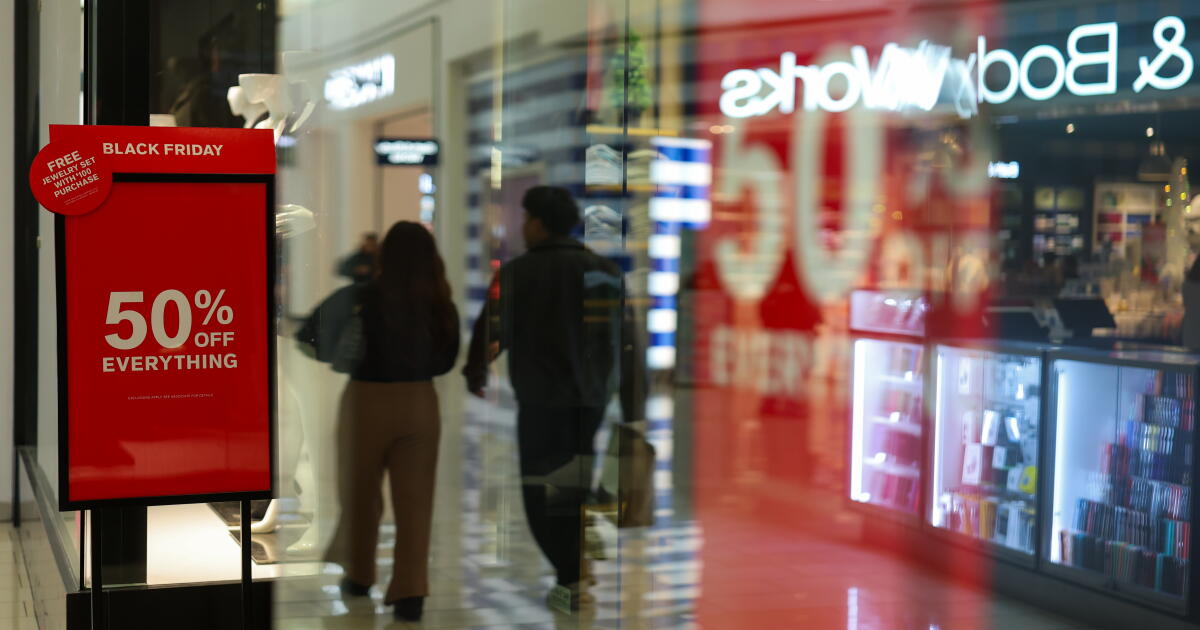

Sale-seeking shoppers mobbed many malls Friday, but their careful consumption may reflect economic anxiety.
Average consumers are ready to splurge on holiday gifts, but they say they want a great deal. Many are cutting back on who they buy gifts for and spending more time shopping.
Uncertainty about how high fuel prices, stubborn inflation and artificial intelligence will shake up the economy in the coming year is clouding confidence.
On Friday morning at the Glendale Galleria, shoppers lined up outside stores an hour before the mall opened at 9 a.m. Although it is a holiday tradition for Hawthorne resident Karen Smith, she doesn’t plan to spend much this year
“We don’t know what 2027 will bring,” she said. “I’m just being very careful with my money.”
Overall holiday spending is projected to increase this weekend. Still, many shoppers have been buying before the after-Thanksgiving rush and plan to keep shopping selectively for sales that run beyond the coming week. More than 80% of shoppers surveyed by the National Retail Federation plan to rein in spending by choosing cheaper gifts and buying for fewer people.
Spending in the U.S. has shifted toward less expensive retail brands more than at any time in the past 15 years, according to research from the Bank of America Institute. Walmart and Kohl’s say they are seeing more visits from higher-income consumers looking to save, as their average customers increasingly choose cheaper in-house brands.
“Busy families are watching their budgets and being thoughtful about where they spend,” Target Chief Executive Michael Fiddelke said earlier this month.
After a dip in 2025, overall holiday spending is expected to be up 13% this year in Los Angeles, according to a Deloitte survey. People from the region are projected to spend $1,836 per household during the holiday period, 10% more than the national average.
Data show holiday shopping peaks in late November and early December. Deloitte data suggest Black Friday participation will hit a 10-year high this year.
“Gen Z shoppers, in particular, appear to be embracing the promotional week as a way to maximize value and stretch their holiday budgets further,” said Natalie Martini, U.S. retail and consumer products sector leader at Deloitte.
A shopper, who declined to give her name, sits on stairs with Target shopping bags outside of a Levi’s store offering a 40% off sale on Black Friday at Glendale Galleria in Glendale.
(Eric Thayer / Los Angeles Times)
Los Angeles-area residents are spending more because salaries and the cost of goods are higher in California. Economic sentiment in the state is also healthier than in the rest of the country.
More than 50% of Los Angeles respondents expect the economy to stay the same or improve this year, up from 38% last year, the survey said. According to Deloitte’s national holiday retail survey, 45% of Americans overall think the economy will remain the same or improve.
Last year’s Black Friday foot traffic at Glendale Galleria totaled 110,000, and Alex Cover, the mall’s general manager, said they expected more this year. More than 30 stores have opened at the Galleria over the last two years, and foot traffic has exceeded pre-pandemic levels, Cover said.
To compete with e-commerce giants, the mall is leaning on activations, like one with Nintendo, and on in-person experiences. JCPenney was one of the first stores to open at 4 a.m. and offered extra rewards to in-store shoppers.
“Malls are gathering places,” Cover said. “We bring happiness and experiences to people. There’s always something for somebody at the mall.”
Recent wealth generated by artificial intelligence and other tech ventures may be boosting sales as money from recent market listings of SpaceX and Anthropic floods into the state.
As AI blossoms, Californians are using it to shop, too. Half of Los Angeles survey respondents said they would use generative AI as their primary tool for at least one holiday shopping task. Still, 65% said they are concerned about how AI assistants on retail websites use their data.
Although some California shoppers may be more optimistic than shoppers in other states, value-seeking behavior remains widespread on Black Friday. Shoppers want the best deals and to save money on daily expenses.
“People are continuing to look for value, and they’re doing that by waiting for deals, switching brands when prices rise, shopping more affordable retailers, spreading their purchases out over time, or cutting other spending to fund holidays,” said Rebecca Lohrey, a Los Angeles-based partner at Deloitte.

Shoppers wait outside an Every Jewels store before it opens on Black Friday at Glendale Galleria in Glendale.
(Eric Thayer / Los Angeles Times)
In the contest for those budget-minded shoppers, the survey points to a shift toward Walmart. Among households earning under $75,000, 71% planned to shop at both Walmart and Amazon last year. This year, more say they plan to shop at Walmart.
Walmart’s chief financial officer said in May that higher-income customers were spending with confidence, while lower-income consumers were more budget-conscious. The retailer has leaned on price cuts, using tariff refunds to temporarily lower prices on 11,000 items in the second quarter.

Sale-seeking shoppers mobbed many malls Friday, but their careful consumption may reflect economic anxiety.
Average consumers are ready to splurge on holiday gifts, but they say they want a great deal. Many are cutting back on who they buy gifts for and spending more time shopping.
Uncertainty about how high fuel prices, stubborn inflation and artificial intelligence will shake up the economy in the coming year is clouding confidence.
On Friday morning at the Glendale Galleria, shoppers lined up outside stores an hour before the mall opened at 9 a.m. Although it is a holiday tradition for Hawthorne resident Karen Smith, she doesn’t plan to spend much this year
“We don’t know what 2027 will bring,” she said. “I’m just being very careful with my money.”
Overall holiday spending is projected to increase this weekend. Still, many shoppers have been buying before the after-Thanksgiving rush and plan to keep shopping selectively for sales that run beyond the coming week. More than 80% of shoppers surveyed by the National Retail Federation plan to rein in spending by choosing cheaper gifts and buying for fewer people.
Spending in the U.S. has shifted toward less expensive retail brands more than at any time in the past 15 years, according to research from the Bank of America Institute. Walmart and Kohl’s say they are seeing more visits from higher-income consumers looking to save, as their average customers increasingly choose cheaper in-house brands.
“Busy families are watching their budgets and being thoughtful about where they spend,” Target Chief Executive Michael Fiddelke said earlier this month.
After a dip in 2025, overall holiday spending is expected to be up 13% this year in Los Angeles, according to a Deloitte survey. People from the region are projected to spend $1,836 per household during the holiday period, 10% more than the national average.
Data show holiday shopping peaks in late November and early December. Deloitte data suggest Black Friday participation will hit a 10-year high this year.
“Gen Z shoppers, in particular, appear to be embracing the promotional week as a way to maximize value and stretch their holiday budgets further,” said Natalie Martini, U.S. retail and consumer products sector leader at Deloitte.
A shopper, who declined to give her name, sits on stairs with Target shopping bags outside of a Levi’s store offering a 40% off sale on Black Friday at Glendale Galleria in Glendale.
(Eric Thayer / Los Angeles Times)
Los Angeles-area residents are spending more because salaries and the cost of goods are higher in California. Economic sentiment in the state is also healthier than in the rest of the country.
More than 50% of Los Angeles respondents expect the economy to stay the same or improve this year, up from 38% last year, the survey said. According to Deloitte’s national holiday retail survey, 45% of Americans overall think the economy will remain the same or improve.
Last year’s Black Friday foot traffic at Glendale Galleria totaled 110,000, and Alex Cover, the mall’s general manager, said they expected more this year. More than 30 stores have opened at the Galleria over the last two years, and foot traffic has exceeded pre-pandemic levels, Cover said.
To compete with e-commerce giants, the mall is leaning on activations, like one with Nintendo, and on in-person experiences. JCPenney was one of the first stores to open at 4 a.m. and offered extra rewards to in-store shoppers.
“Malls are gathering places,” Cover said. “We bring happiness and experiences to people. There’s always something for somebody at the mall.”
Recent wealth generated by artificial intelligence and other tech ventures may be boosting sales as money from recent market listings of SpaceX and Anthropic floods into the state.
As AI blossoms, Californians are using it to shop, too. Half of Los Angeles survey respondents said they would use generative AI as their primary tool for at least one holiday shopping task. Still, 65% said they are concerned about how AI assistants on retail websites use their data.
Although some California shoppers may be more optimistic than shoppers in other states, value-seeking behavior remains widespread on Black Friday. Shoppers want the best deals and to save money on daily expenses.
“People are continuing to look for value, and they’re doing that by waiting for deals, switching brands when prices rise, shopping more affordable retailers, spreading their purchases out over time, or cutting other spending to fund holidays,” said Rebecca Lohrey, a Los Angeles-based partner at Deloitte.
Shoppers wait outside an Every Jewels store before it opens on Black Friday at Glendale Galleria in Glendale.
(Eric Thayer / Los Angeles Times)
In the contest for those budget-minded shoppers, the survey points to a shift toward Walmart. Among households earning under $75,000, 71% planned to shop at both Walmart and Amazon last year. This year, more say they plan to shop at Walmart.
Walmart’s chief financial officer said in May that higher-income customers were spending with confidence, while lower-income consumers were more budget-conscious. The retailer has leaned on price cuts, using tariff refunds to temporarily lower prices on 11,000 items in the second quarter.

Sale-seeking shoppers mobbed many malls Friday, but their careful consumption may reflect economic anxiety.
Average consumers are ready to splurge on holiday gifts, but they say they want a great deal. Many are cutting back on who they buy gifts for and spending more time shopping.
Uncertainty about how high fuel prices, stubborn inflation and artificial intelligence will shake up the economy in the coming year is clouding confidence.
On Friday morning at the Glendale Galleria, shoppers lined up outside stores an hour before the mall opened at 9 a.m. Although it is a holiday tradition for Hawthorne resident Karen Smith, she doesn’t plan to spend much this year
“We don’t know what 2027 will bring,” she said. “I’m just being very careful with my money.”
Overall holiday spending is projected to increase this weekend. Still, many shoppers have been buying before the after-Thanksgiving rush and plan to keep shopping selectively for sales that run beyond the coming week. More than 80% of shoppers surveyed by the National Retail Federation plan to rein in spending by choosing cheaper gifts and buying for fewer people.
Spending in the U.S. has shifted toward less expensive retail brands more than at any time in the past 15 years, according to research from the Bank of America Institute. Walmart and Kohl’s say they are seeing more visits from higher-income consumers looking to save, as their average customers increasingly choose cheaper in-house brands.
“Busy families are watching their budgets and being thoughtful about where they spend,” Target Chief Executive Michael Fiddelke said earlier this month.
After a dip in 2025, overall holiday spending is expected to be up 13% this year in Los Angeles, according to a Deloitte survey. People from the region are projected to spend $1,836 per household during the holiday period, 10% more than the national average.
Data show holiday shopping peaks in late November and early December. Deloitte data suggest Black Friday participation will hit a 10-year high this year.
“Gen Z shoppers, in particular, appear to be embracing the promotional week as a way to maximize value and stretch their holiday budgets further,” said Natalie Martini, U.S. retail and consumer products sector leader at Deloitte.
A shopper, who declined to give her name, sits on stairs with Target shopping bags outside of a Levi’s store offering a 40% off sale on Black Friday at Glendale Galleria in Glendale.
(Eric Thayer / Los Angeles Times)
Los Angeles-area residents are spending more because salaries and the cost of goods are higher in California. Economic sentiment in the state is also healthier than in the rest of the country.
More than 50% of Los Angeles respondents expect the economy to stay the same or improve this year, up from 38% last year, the survey said. According to Deloitte’s national holiday retail survey, 45% of Americans overall think the economy will remain the same or improve.
Last year’s Black Friday foot traffic at Glendale Galleria totaled 110,000, and Alex Cover, the mall’s general manager, said they expected more this year. More than 30 stores have opened at the Galleria over the last two years, and foot traffic has exceeded pre-pandemic levels, Cover said.
To compete with e-commerce giants, the mall is leaning on activations, like one with Nintendo, and on in-person experiences. JCPenney was one of the first stores to open at 4 a.m. and offered extra rewards to in-store shoppers.
“Malls are gathering places,” Cover said. “We bring happiness and experiences to people. There’s always something for somebody at the mall.”
Recent wealth generated by artificial intelligence and other tech ventures may be boosting sales as money from recent market listings of SpaceX and Anthropic floods into the state.
As AI blossoms, Californians are using it to shop, too. Half of Los Angeles survey respondents said they would use generative AI as their primary tool for at least one holiday shopping task. Still, 65% said they are concerned about how AI assistants on retail websites use their data.
Although some California shoppers may be more optimistic than shoppers in other states, value-seeking behavior remains widespread on Black Friday. Shoppers want the best deals and to save money on daily expenses.
“People are continuing to look for value, and they’re doing that by waiting for deals, switching brands when prices rise, shopping more affordable retailers, spreading their purchases out over time, or cutting other spending to fund holidays,” said Rebecca Lohrey, a Los Angeles-based partner at Deloitte.
Shoppers wait outside an Every Jewels store before it opens on Black Friday at Glendale Galleria in Glendale.
(Eric Thayer / Los Angeles Times)
In the contest for those budget-minded shoppers, the survey points to a shift toward Walmart. Among households earning under $75,000, 71% planned to shop at both Walmart and Amazon last year. This year, more say they plan to shop at Walmart.
Walmart’s chief financial officer said in May that higher-income customers were spending with confidence, while lower-income consumers were more budget-conscious. The retailer has leaned on price cuts, using tariff refunds to temporarily lower prices on 11,000 items in the second quarter.

Sale-seeking shoppers mobbed many malls Friday, but their careful consumption may reflect economic anxiety.
Average consumers are ready to splurge on holiday gifts, but they say they want a great deal. Many are cutting back on who they buy gifts for and spending more time shopping.
Uncertainty about how high fuel prices, stubborn inflation and artificial intelligence will shake up the economy in the coming year is clouding confidence.
On Friday morning at the Glendale Galleria, shoppers lined up outside stores an hour before the mall opened at 9 a.m. Although it is a holiday tradition for Hawthorne resident Karen Smith, she doesn’t plan to spend much this year
“We don’t know what 2027 will bring,” she said. “I’m just being very careful with my money.”
Overall holiday spending is projected to increase this weekend. Still, many shoppers have been buying before the after-Thanksgiving rush and plan to keep shopping selectively for sales that run beyond the coming week. More than 80% of shoppers surveyed by the National Retail Federation plan to rein in spending by choosing cheaper gifts and buying for fewer people.
Spending in the U.S. has shifted toward less expensive retail brands more than at any time in the past 15 years, according to research from the Bank of America Institute. Walmart and Kohl’s say they are seeing more visits from higher-income consumers looking to save, as their average customers increasingly choose cheaper in-house brands.
“Busy families are watching their budgets and being thoughtful about where they spend,” Target Chief Executive Michael Fiddelke said earlier this month.
After a dip in 2025, overall holiday spending is expected to be up 13% this year in Los Angeles, according to a Deloitte survey. People from the region are projected to spend $1,836 per household during the holiday period, 10% more than the national average.
Data show holiday shopping peaks in late November and early December. Deloitte data suggest Black Friday participation will hit a 10-year high this year.
“Gen Z shoppers, in particular, appear to be embracing the promotional week as a way to maximize value and stretch their holiday budgets further,” said Natalie Martini, U.S. retail and consumer products sector leader at Deloitte.
A shopper, who declined to give her name, sits on stairs with Target shopping bags outside of a Levi’s store offering a 40% off sale on Black Friday at Glendale Galleria in Glendale.
(Eric Thayer / Los Angeles Times)
Los Angeles-area residents are spending more because salaries and the cost of goods are higher in California. Economic sentiment in the state is also healthier than in the rest of the country.
More than 50% of Los Angeles respondents expect the economy to stay the same or improve this year, up from 38% last year, the survey said. According to Deloitte’s national holiday retail survey, 45% of Americans overall think the economy will remain the same or improve.
Last year’s Black Friday foot traffic at Glendale Galleria totaled 110,000, and Alex Cover, the mall’s general manager, said they expected more this year. More than 30 stores have opened at the Galleria over the last two years, and foot traffic has exceeded pre-pandemic levels, Cover said.
To compete with e-commerce giants, the mall is leaning on activations, like one with Nintendo, and on in-person experiences. JCPenney was one of the first stores to open at 4 a.m. and offered extra rewards to in-store shoppers.
“Malls are gathering places,” Cover said. “We bring happiness and experiences to people. There’s always something for somebody at the mall.”
Recent wealth generated by artificial intelligence and other tech ventures may be boosting sales as money from recent market listings of SpaceX and Anthropic floods into the state.
As AI blossoms, Californians are using it to shop, too. Half of Los Angeles survey respondents said they would use generative AI as their primary tool for at least one holiday shopping task. Still, 65% said they are concerned about how AI assistants on retail websites use their data.
Although some California shoppers may be more optimistic than shoppers in other states, value-seeking behavior remains widespread on Black Friday. Shoppers want the best deals and to save money on daily expenses.
“People are continuing to look for value, and they’re doing that by waiting for deals, switching brands when prices rise, shopping more affordable retailers, spreading their purchases out over time, or cutting other spending to fund holidays,” said Rebecca Lohrey, a Los Angeles-based partner at Deloitte.
Shoppers wait outside an Every Jewels store before it opens on Black Friday at Glendale Galleria in Glendale.
(Eric Thayer / Los Angeles Times)
In the contest for those budget-minded shoppers, the survey points to a shift toward Walmart. Among households earning under $75,000, 71% planned to shop at both Walmart and Amazon last year. This year, more say they plan to shop at Walmart.
Walmart’s chief financial officer said in May that higher-income customers were spending with confidence, while lower-income consumers were more budget-conscious. The retailer has leaned on price cuts, using tariff refunds to temporarily lower prices on 11,000 items in the second quarter.