

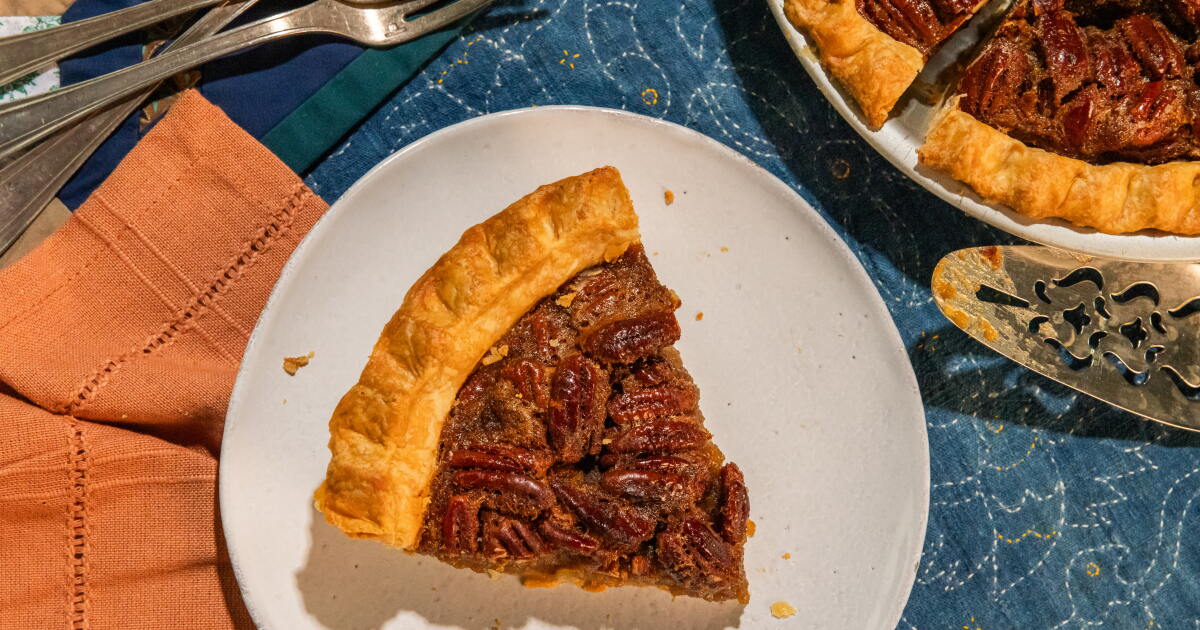
This is my mom’s flaky, crispy-crunchy, custard-y pecan pie. There’s an extra egg yolk in her custard for enhanced lushness (with the added benefit of mitigating sweetness), just the right amount of vanilla oomph to complement the nuttiness, and enough salt to bump up the savoriness (which also balances the sugar).
My mom is from Tokyo and doesn’t like too-sweet desserts, but when she moved to the U.S. she fell in love with pecan pie at a holiday potluck. It became the mainstay dessert at our Thanksgivings. She was an avid baker (cream puffs, birthday cakes, pies), and her major cooking reference was a worn copy of “The Better Homes and Gardens New Cook Book.” Over the years she made many, many tweaks to the classic pecan pie recipe. These are adjustments that she is adamant about, and they do result in a superior pie.
Her technique for making the dough strictly calls for using a pastry cutter (she’s not a fan of pie dough made with a food processor, but then again, she’s not your mom, so she’s not going to admonish you if you use yours). She cuts the dough until the butter is the texture of fine crumbs (not the “peas” in many recipes); this takes longer than you think it will because all of the dough ingredients are fridge-cold — and the bowl is freezer-cold (see note below).
She uses a mixture of half brown sugar and half granulated sugar, and only dark (never light) corn syrup, for a more molasses-y custard.
The oven temperature starts high, at 425 degrees, so that the bottom crust is as flaky, crisp and golden as the edges — with two temperature decreases during baking. This is an old-school technique for three “zones” of baking so that, in the end, the crust is crisp, the custard is velvety, and the nuts are very toasted. (She also drizzles melted butter on top before baking, for extra-caramelized pecans.)
A version of this recipe was published in “Amá: A Modern Tex-Mex Kitchen” (Chronicle Books), which I co-authored with chef Josef Centeno (who is from San Antonio, Texas, where pecan pie is the official state dessert).
Note: The day before you make the pie, sift the flour with the salt and put the mixture, as well as the butter pieces, in the refrigerator. Put a mixing bowl in the freezer overnight, too.

This is my mom’s flaky, crispy-crunchy, custard-y pecan pie. There’s an extra egg yolk in her custard for enhanced lushness (with the added benefit of mitigating sweetness), just the right amount of vanilla oomph to complement the nuttiness, and enough salt to bump up the savoriness (which also balances the sugar).
My mom is from Tokyo and doesn’t like too-sweet desserts, but when she moved to the U.S. she fell in love with pecan pie at a holiday potluck. It became the mainstay dessert at our Thanksgivings. She was an avid baker (cream puffs, birthday cakes, pies), and her major cooking reference was a worn copy of “The Better Homes and Gardens New Cook Book.” Over the years she made many, many tweaks to the classic pecan pie recipe. These are adjustments that she is adamant about, and they do result in a superior pie.
Her technique for making the dough strictly calls for using a pastry cutter (she’s not a fan of pie dough made with a food processor, but then again, she’s not your mom, so she’s not going to admonish you if you use yours). She cuts the dough until the butter is the texture of fine crumbs (not the “peas” in many recipes); this takes longer than you think it will because all of the dough ingredients are fridge-cold — and the bowl is freezer-cold (see note below).
She uses a mixture of half brown sugar and half granulated sugar, and only dark (never light) corn syrup, for a more molasses-y custard.
The oven temperature starts high, at 425 degrees, so that the bottom crust is as flaky, crisp and golden as the edges — with two temperature decreases during baking. This is an old-school technique for three “zones” of baking so that, in the end, the crust is crisp, the custard is velvety, and the nuts are very toasted. (She also drizzles melted butter on top before baking, for extra-caramelized pecans.)
A version of this recipe was published in “Amá: A Modern Tex-Mex Kitchen” (Chronicle Books), which I co-authored with chef Josef Centeno (who is from San Antonio, Texas, where pecan pie is the official state dessert).
Note: The day before you make the pie, sift the flour with the salt and put the mixture, as well as the butter pieces, in the refrigerator. Put a mixing bowl in the freezer overnight, too.

This is my mom’s flaky, crispy-crunchy, custard-y pecan pie. There’s an extra egg yolk in her custard for enhanced lushness (with the added benefit of mitigating sweetness), just the right amount of vanilla oomph to complement the nuttiness, and enough salt to bump up the savoriness (which also balances the sugar).
My mom is from Tokyo and doesn’t like too-sweet desserts, but when she moved to the U.S. she fell in love with pecan pie at a holiday potluck. It became the mainstay dessert at our Thanksgivings. She was an avid baker (cream puffs, birthday cakes, pies), and her major cooking reference was a worn copy of “The Better Homes and Gardens New Cook Book.” Over the years she made many, many tweaks to the classic pecan pie recipe. These are adjustments that she is adamant about, and they do result in a superior pie.
Her technique for making the dough strictly calls for using a pastry cutter (she’s not a fan of pie dough made with a food processor, but then again, she’s not your mom, so she’s not going to admonish you if you use yours). She cuts the dough until the butter is the texture of fine crumbs (not the “peas” in many recipes); this takes longer than you think it will because all of the dough ingredients are fridge-cold — and the bowl is freezer-cold (see note below).
She uses a mixture of half brown sugar and half granulated sugar, and only dark (never light) corn syrup, for a more molasses-y custard.
The oven temperature starts high, at 425 degrees, so that the bottom crust is as flaky, crisp and golden as the edges — with two temperature decreases during baking. This is an old-school technique for three “zones” of baking so that, in the end, the crust is crisp, the custard is velvety, and the nuts are very toasted. (She also drizzles melted butter on top before baking, for extra-caramelized pecans.)
A version of this recipe was published in “Amá: A Modern Tex-Mex Kitchen” (Chronicle Books), which I co-authored with chef Josef Centeno (who is from San Antonio, Texas, where pecan pie is the official state dessert).
Note: The day before you make the pie, sift the flour with the salt and put the mixture, as well as the butter pieces, in the refrigerator. Put a mixing bowl in the freezer overnight, too.

This is my mom’s flaky, crispy-crunchy, custard-y pecan pie. There’s an extra egg yolk in her custard for enhanced lushness (with the added benefit of mitigating sweetness), just the right amount of vanilla oomph to complement the nuttiness, and enough salt to bump up the savoriness (which also balances the sugar).
My mom is from Tokyo and doesn’t like too-sweet desserts, but when she moved to the U.S. she fell in love with pecan pie at a holiday potluck. It became the mainstay dessert at our Thanksgivings. She was an avid baker (cream puffs, birthday cakes, pies), and her major cooking reference was a worn copy of “The Better Homes and Gardens New Cook Book.” Over the years she made many, many tweaks to the classic pecan pie recipe. These are adjustments that she is adamant about, and they do result in a superior pie.
Her technique for making the dough strictly calls for using a pastry cutter (she’s not a fan of pie dough made with a food processor, but then again, she’s not your mom, so she’s not going to admonish you if you use yours). She cuts the dough until the butter is the texture of fine crumbs (not the “peas” in many recipes); this takes longer than you think it will because all of the dough ingredients are fridge-cold — and the bowl is freezer-cold (see note below).
She uses a mixture of half brown sugar and half granulated sugar, and only dark (never light) corn syrup, for a more molasses-y custard.
The oven temperature starts high, at 425 degrees, so that the bottom crust is as flaky, crisp and golden as the edges — with two temperature decreases during baking. This is an old-school technique for three “zones” of baking so that, in the end, the crust is crisp, the custard is velvety, and the nuts are very toasted. (She also drizzles melted butter on top before baking, for extra-caramelized pecans.)
A version of this recipe was published in “Amá: A Modern Tex-Mex Kitchen” (Chronicle Books), which I co-authored with chef Josef Centeno (who is from San Antonio, Texas, where pecan pie is the official state dessert).
Note: The day before you make the pie, sift the flour with the salt and put the mixture, as well as the butter pieces, in the refrigerator. Put a mixing bowl in the freezer overnight, too.

This is my mom’s flaky, crispy-crunchy, custard-y pecan pie. There’s an extra egg yolk in her custard for enhanced lushness (with the added benefit of mitigating sweetness), just the right amount of vanilla oomph to complement the nuttiness, and enough salt to bump up the savoriness (which also balances the sugar).
My mom is from Tokyo and doesn’t like too-sweet desserts, but when she moved to the U.S. she fell in love with pecan pie at a holiday potluck. It became the mainstay dessert at our Thanksgivings. She was an avid baker (cream puffs, birthday cakes, pies), and her major cooking reference was a worn copy of “The Better Homes and Gardens New Cook Book.” Over the years she made many, many tweaks to the classic pecan pie recipe. These are adjustments that she is adamant about, and they do result in a superior pie.
Her technique for making the dough strictly calls for using a pastry cutter (she’s not a fan of pie dough made with a food processor, but then again, she’s not your mom, so she’s not going to admonish you if you use yours). She cuts the dough until the butter is the texture of fine crumbs (not the “peas” in many recipes); this takes longer than you think it will because all of the dough ingredients are fridge-cold — and the bowl is freezer-cold (see note below).
She uses a mixture of half brown sugar and half granulated sugar, and only dark (never light) corn syrup, for a more molasses-y custard.
The oven temperature starts high, at 425 degrees, so that the bottom crust is as flaky, crisp and golden as the edges — with two temperature decreases during baking. This is an old-school technique for three “zones” of baking so that, in the end, the crust is crisp, the custard is velvety, and the nuts are very toasted. (She also drizzles melted butter on top before baking, for extra-caramelized pecans.)
A version of this recipe was published in “Amá: A Modern Tex-Mex Kitchen” (Chronicle Books), which I co-authored with chef Josef Centeno (who is from San Antonio, Texas, where pecan pie is the official state dessert).
Note: The day before you make the pie, sift the flour with the salt and put the mixture, as well as the butter pieces, in the refrigerator. Put a mixing bowl in the freezer overnight, too.

