


The L.A. City Council took modest steps Tuesday to help the homegrown film industry as it struggles to keep production in California.
The City Council passed two film-friendly measures, one that creates free permits for so-called micro-shoot productions and another that limits parking fees on city-owned lots, yards and civic properties and staging areas to $1 a day, regardless of the size of the project.
The city currently charges $450 a day for base camp parking at city-owned parks and $100 to $300 a day for crew parking, according to FilmLA.
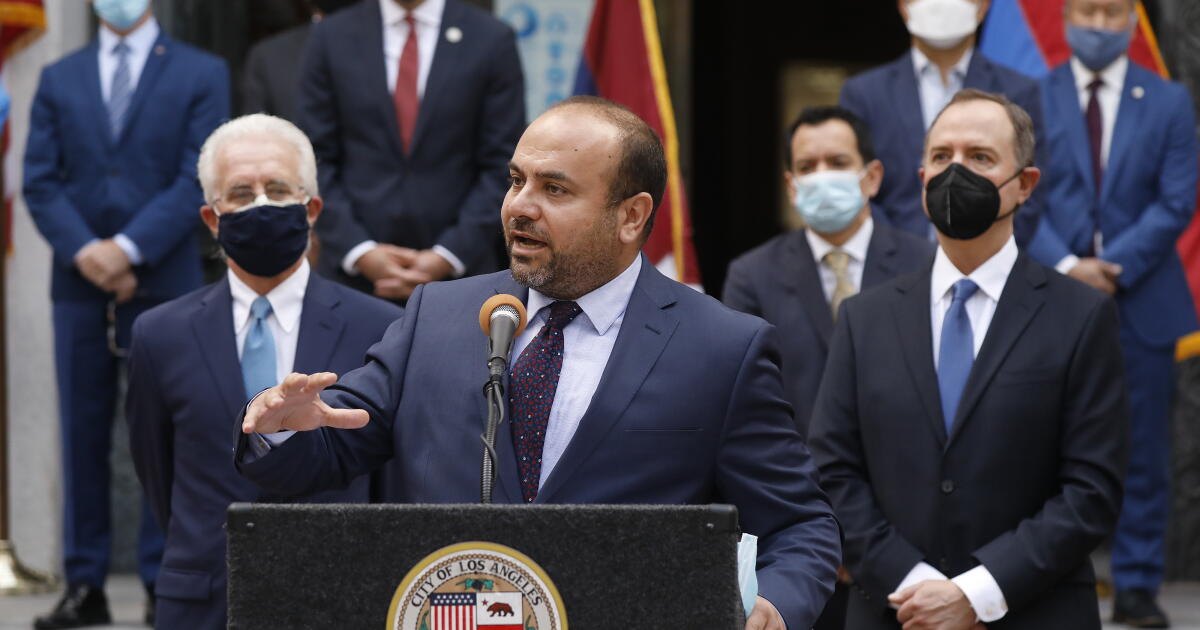
“Both efforts advanced today aim to support independent shoots and attract aspiring storytellers to our city,” Councilmember Adrin Nazarian, who introduced the initiatives, said in a statement. “As we work to protect established productions, we must also uphold Los Angeles’ reputation as a hub for the next generation of filmmakers. People need to believe that this is still the town to turn their filmmaking dreams into reality.”
Micro-shoot permits refer to sets with up to 10 filmmakers on site that have a minimal community impact. Under this new ordinance, student filmmakers, documentary crews and ultra-low-budget projects will be able to obtain free permits. City departments soon will report back to the Council on how they plan to implement this.
The idea behind the $1 permits is to turn more areas of L.A. into homes for all kinds of productions.
Nazarian is chairman of the Council’s recently formed Ad Hoc Committee on Film, Entertainment and the Creative Industry, aimed at making filming in L.A. more accessible.
The steps come as film and TV production in the area continues on a downward trend. FilmLA, the nonprofit group that handles film permits for the region, recently reported that shoot days between July and September were down 4.8% from the same period last year and nearly 29% below the five-year average.
“The stark reality is that California is on the brink of losing its position as the nation’s premier destination for production spending,” Nazarian said during a City Council meeting this month. “While we retain the Hollywood name, the data makes it urgently clear, crisis-level clear, that Los Angeles is fast losing its footing as the center of film and television production.”

The L.A. City Council took modest steps Tuesday to help the homegrown film industry as it struggles to keep production in California.
The City Council passed two film-friendly measures, one that creates free permits for so-called micro-shoot productions and another that limits parking fees on city-owned lots, yards and civic properties and staging areas to $1 a day, regardless of the size of the project.
The city currently charges $450 a day for base camp parking at city-owned parks and $100 to $300 a day for crew parking, according to FilmLA.
“Both efforts advanced today aim to support independent shoots and attract aspiring storytellers to our city,” Councilmember Adrin Nazarian, who introduced the initiatives, said in a statement. “As we work to protect established productions, we must also uphold Los Angeles’ reputation as a hub for the next generation of filmmakers. People need to believe that this is still the town to turn their filmmaking dreams into reality.”
Micro-shoot permits refer to sets with up to 10 filmmakers on site that have a minimal community impact. Under this new ordinance, student filmmakers, documentary crews and ultra-low-budget projects will be able to obtain free permits. City departments soon will report back to the Council on how they plan to implement this.
The idea behind the $1 permits is to turn more areas of L.A. into homes for all kinds of productions.
Nazarian is chairman of the Council’s recently formed Ad Hoc Committee on Film, Entertainment and the Creative Industry, aimed at making filming in L.A. more accessible.
The steps come as film and TV production in the area continues on a downward trend. FilmLA, the nonprofit group that handles film permits for the region, recently reported that shoot days between July and September were down 4.8% from the same period last year and nearly 29% below the five-year average.
“The stark reality is that California is on the brink of losing its position as the nation’s premier destination for production spending,” Nazarian said during a City Council meeting this month. “While we retain the Hollywood name, the data makes it urgently clear, crisis-level clear, that Los Angeles is fast losing its footing as the center of film and television production.”

The L.A. City Council took modest steps Tuesday to help the homegrown film industry as it struggles to keep production in California.
The City Council passed two film-friendly measures, one that creates free permits for so-called micro-shoot productions and another that limits parking fees on city-owned lots, yards and civic properties and staging areas to $1 a day, regardless of the size of the project.
The city currently charges $450 a day for base camp parking at city-owned parks and $100 to $300 a day for crew parking, according to FilmLA.
“Both efforts advanced today aim to support independent shoots and attract aspiring storytellers to our city,” Councilmember Adrin Nazarian, who introduced the initiatives, said in a statement. “As we work to protect established productions, we must also uphold Los Angeles’ reputation as a hub for the next generation of filmmakers. People need to believe that this is still the town to turn their filmmaking dreams into reality.”
Micro-shoot permits refer to sets with up to 10 filmmakers on site that have a minimal community impact. Under this new ordinance, student filmmakers, documentary crews and ultra-low-budget projects will be able to obtain free permits. City departments soon will report back to the Council on how they plan to implement this.
The idea behind the $1 permits is to turn more areas of L.A. into homes for all kinds of productions.
Nazarian is chairman of the Council’s recently formed Ad Hoc Committee on Film, Entertainment and the Creative Industry, aimed at making filming in L.A. more accessible.
The steps come as film and TV production in the area continues on a downward trend. FilmLA, the nonprofit group that handles film permits for the region, recently reported that shoot days between July and September were down 4.8% from the same period last year and nearly 29% below the five-year average.
“The stark reality is that California is on the brink of losing its position as the nation’s premier destination for production spending,” Nazarian said during a City Council meeting this month. “While we retain the Hollywood name, the data makes it urgently clear, crisis-level clear, that Los Angeles is fast losing its footing as the center of film and television production.”

The L.A. City Council took modest steps Tuesday to help the homegrown film industry as it struggles to keep production in California.
The City Council passed two film-friendly measures, one that creates free permits for so-called micro-shoot productions and another that limits parking fees on city-owned lots, yards and civic properties and staging areas to $1 a day, regardless of the size of the project.
The city currently charges $450 a day for base camp parking at city-owned parks and $100 to $300 a day for crew parking, according to FilmLA.
“Both efforts advanced today aim to support independent shoots and attract aspiring storytellers to our city,” Councilmember Adrin Nazarian, who introduced the initiatives, said in a statement. “As we work to protect established productions, we must also uphold Los Angeles’ reputation as a hub for the next generation of filmmakers. People need to believe that this is still the town to turn their filmmaking dreams into reality.”
Micro-shoot permits refer to sets with up to 10 filmmakers on site that have a minimal community impact. Under this new ordinance, student filmmakers, documentary crews and ultra-low-budget projects will be able to obtain free permits. City departments soon will report back to the Council on how they plan to implement this.
The idea behind the $1 permits is to turn more areas of L.A. into homes for all kinds of productions.
Nazarian is chairman of the Council’s recently formed Ad Hoc Committee on Film, Entertainment and the Creative Industry, aimed at making filming in L.A. more accessible.
The steps come as film and TV production in the area continues on a downward trend. FilmLA, the nonprofit group that handles film permits for the region, recently reported that shoot days between July and September were down 4.8% from the same period last year and nearly 29% below the five-year average.
“The stark reality is that California is on the brink of losing its position as the nation’s premier destination for production spending,” Nazarian said during a City Council meeting this month. “While we retain the Hollywood name, the data makes it urgently clear, crisis-level clear, that Los Angeles is fast losing its footing as the center of film and television production.”

