

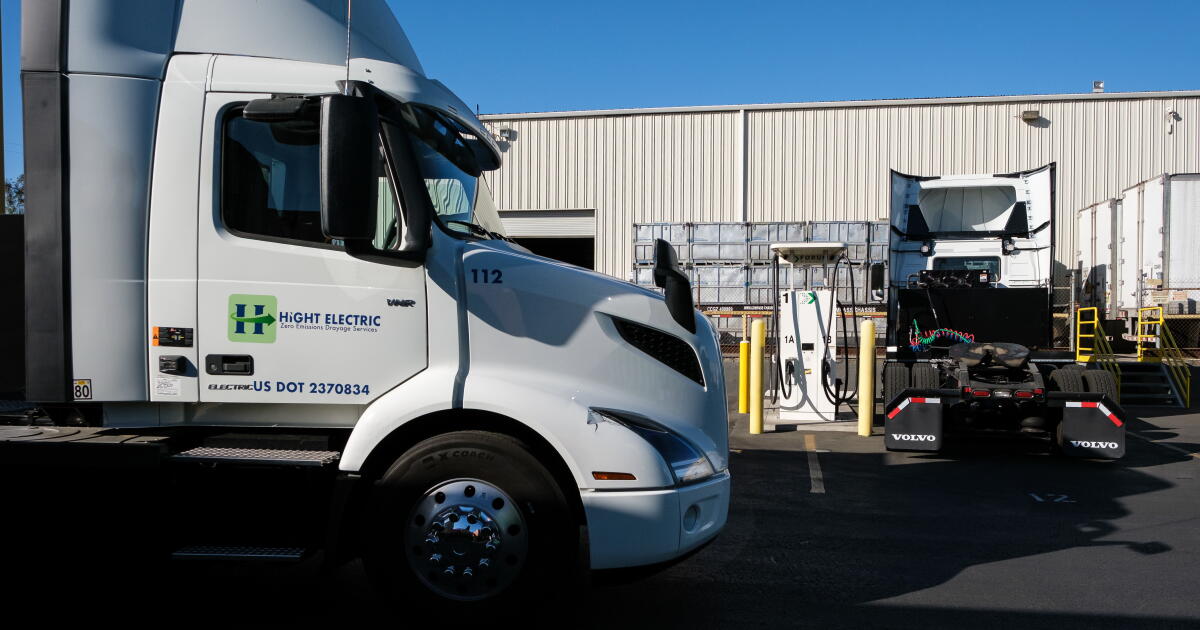

The region’s struggling truckers say they need more aid to help ports reach their green goals.
The ports of Los Angeles and Long Beach, each with some of the country’s most ambitious emissions targets, are considering additional incentives to help truckers switch to electric big rigs.
Even as record diesel prices have triggered a wave of trucking bankruptcies, driving diesel-free vehicles has turned out to be more expensive than expected. As deadlines for the ports’ clean-air goals are approaching, they are motivated to accelerate the transition to green vehicles.
California’s two biggest ports have been raising money to support electric trucking since 2022, when they imposed a $10 clean truck fee on diesel rigs.
The ports plan to jointly spend $60 million from that fund on a per-move incentive program that would award battery-electric truck operators $60 for each one-way trip to or from the ports.
The Port of Long Beach aims to eliminate its carbon emissions by 2050. The Port of Los Angeles aims to transition to zero-emissions cargo-handling equipment by 2030 and then, by 2035, change the fleet of trucks that transport containers short distances to and from the port to all-electric as well.
“When I talk about 100% zero emissions, the way we get there is by having 100% zero-emission trucks,” Port of Long Beach chief executive Noel Hacegaba said in an interview. “Everyone recognizes the importance of rewarding zero-emission truck usage.”
According to port data, about 4% of trucks visiting the ports are zero-emission. The Port of Long Beach has already taken action to increase that number, setting aside nearly $5 million for one-time payments of $10,000 to early adopters of electric cargo trucks.
Nearly 9,000 medium- and heavy-duty zero-emission vehicles were registered in California at the end of 2025, according to the California Energy Commission. Of those vehicles, 2,075 were trucks, and the rest were buses and delivery vans.
Although the loss of federal electric vehicle incentives last year slowed the EV market in California and across the country, other programs still bolster electric trucks. California’s Clean Truck and Bus Voucher Incentive Project offers point-of-sale discounts on zero-emission trucks and buses and has distributed $1 billion so far.
The ports’ proposed per-move incentive program is the first of its kind in the state and could distribute funds based on how many trips a truck takes. The program hasn’t yet gone to the harbor commissions for approval. The ports are currently awaiting stakeholder feedback, Hacegaba said.
The incentive funds would go to trucking companies and be capped at $36,000 per truck per year. The more electric trucks a company deploys, the more funds it’s eligible to receive.
“Our goal is to reduce port-related emissions while ensuring that the supply chain remains efficient and competitive,” Hacegaba said.
The Harbor Trucking Assn. approached the ports earlier this year to ask for support with electric trucking operations. Although electric trucks have fewer moving parts and typically require less maintenance than diesel trucks, other factors drive up the cost.
Electric big rigs need to be charged more often than diesel trucks need to be refueled — about once a day compared to once every three or four days. One tank of diesel can fuel more than 1,000 miles of range, while a fully charged electric truck has a range closer to 200 miles.
The new Tesla Semi truck is supposed to have an estimated range of 325 miles for the standard version and up to 500 miles for the long-range version.
With average diesel prices in California nearing $8.50 per gallon, EVs are more competitive to run. However, charging takes much longer than filling a tank, creating costs associated with the truck’s downtime.
“We were asking for support to see if they were able to do anything to help… with the cost of ownership and the cost of operating those units,” said Robert Loya, chief executive of the Harbor Trucking Assn.
The upfront cost difference is stark. A truck operator can buy a used diesel truck for around $70,000, but first-generation electric trucks cost more than $500,000. The new Tesla Semi will probably cost nearly $400,000 after taxes and fees.
Maintenance costs add up, too. Electric trucks weigh thousands of pounds more than traditional trucks, so their tires wear out faster and need replacing more often. Loya said the batteries need replacing every five to seven years, which can cost as much as $7,000.
Because few electric trucks are already hauling cargo on the roads, insurance prices are often high.
“There are just so many variables that the insurance companies didn’t really know how to price it, and so it’s been very expensive for motor carriers to insure these trucks,” Loya said.
Hacegaba said there’s no timeline yet for when the per-move incentive program could launch. The program still requires approval from each port’s governing body.

The region’s struggling truckers say they need more aid to help ports reach their green goals.
The ports of Los Angeles and Long Beach, each with some of the country’s most ambitious emissions targets, are considering additional incentives to help truckers switch to electric big rigs.
Even as record diesel prices have triggered a wave of trucking bankruptcies, driving diesel-free vehicles has turned out to be more expensive than expected. As deadlines for the ports’ clean-air goals are approaching, they are motivated to accelerate the transition to green vehicles.
California’s two biggest ports have been raising money to support electric trucking since 2022, when they imposed a $10 clean truck fee on diesel rigs.
The ports plan to jointly spend $60 million from that fund on a per-move incentive program that would award battery-electric truck operators $60 for each one-way trip to or from the ports.
The Port of Long Beach aims to eliminate its carbon emissions by 2050. The Port of Los Angeles aims to transition to zero-emissions cargo-handling equipment by 2030 and then, by 2035, change the fleet of trucks that transport containers short distances to and from the port to all-electric as well.
“When I talk about 100% zero emissions, the way we get there is by having 100% zero-emission trucks,” Port of Long Beach chief executive Noel Hacegaba said in an interview. “Everyone recognizes the importance of rewarding zero-emission truck usage.”
According to port data, about 4% of trucks visiting the ports are zero-emission. The Port of Long Beach has already taken action to increase that number, setting aside nearly $5 million for one-time payments of $10,000 to early adopters of electric cargo trucks.
Nearly 9,000 medium- and heavy-duty zero-emission vehicles were registered in California at the end of 2025, according to the California Energy Commission. Of those vehicles, 2,075 were trucks, and the rest were buses and delivery vans.
Although the loss of federal electric vehicle incentives last year slowed the EV market in California and across the country, other programs still bolster electric trucks. California’s Clean Truck and Bus Voucher Incentive Project offers point-of-sale discounts on zero-emission trucks and buses and has distributed $1 billion so far.
The ports’ proposed per-move incentive program is the first of its kind in the state and could distribute funds based on how many trips a truck takes. The program hasn’t yet gone to the harbor commissions for approval. The ports are currently awaiting stakeholder feedback, Hacegaba said.
The incentive funds would go to trucking companies and be capped at $36,000 per truck per year. The more electric trucks a company deploys, the more funds it’s eligible to receive.
“Our goal is to reduce port-related emissions while ensuring that the supply chain remains efficient and competitive,” Hacegaba said.
The Harbor Trucking Assn. approached the ports earlier this year to ask for support with electric trucking operations. Although electric trucks have fewer moving parts and typically require less maintenance than diesel trucks, other factors drive up the cost.
Electric big rigs need to be charged more often than diesel trucks need to be refueled — about once a day compared to once every three or four days. One tank of diesel can fuel more than 1,000 miles of range, while a fully charged electric truck has a range closer to 200 miles.
The new Tesla Semi truck is supposed to have an estimated range of 325 miles for the standard version and up to 500 miles for the long-range version.
With average diesel prices in California nearing $8.50 per gallon, EVs are more competitive to run. However, charging takes much longer than filling a tank, creating costs associated with the truck’s downtime.
“We were asking for support to see if they were able to do anything to help… with the cost of ownership and the cost of operating those units,” said Robert Loya, chief executive of the Harbor Trucking Assn.
The upfront cost difference is stark. A truck operator can buy a used diesel truck for around $70,000, but first-generation electric trucks cost more than $500,000. The new Tesla Semi will probably cost nearly $400,000 after taxes and fees.
Maintenance costs add up, too. Electric trucks weigh thousands of pounds more than traditional trucks, so their tires wear out faster and need replacing more often. Loya said the batteries need replacing every five to seven years, which can cost as much as $7,000.
Because few electric trucks are already hauling cargo on the roads, insurance prices are often high.
“There are just so many variables that the insurance companies didn’t really know how to price it, and so it’s been very expensive for motor carriers to insure these trucks,” Loya said.
Hacegaba said there’s no timeline yet for when the per-move incentive program could launch. The program still requires approval from each port’s governing body.

The region’s struggling truckers say they need more aid to help ports reach their green goals.
The ports of Los Angeles and Long Beach, each with some of the country’s most ambitious emissions targets, are considering additional incentives to help truckers switch to electric big rigs.
Even as record diesel prices have triggered a wave of trucking bankruptcies, driving diesel-free vehicles has turned out to be more expensive than expected. As deadlines for the ports’ clean-air goals are approaching, they are motivated to accelerate the transition to green vehicles.
California’s two biggest ports have been raising money to support electric trucking since 2022, when they imposed a $10 clean truck fee on diesel rigs.
The ports plan to jointly spend $60 million from that fund on a per-move incentive program that would award battery-electric truck operators $60 for each one-way trip to or from the ports.
The Port of Long Beach aims to eliminate its carbon emissions by 2050. The Port of Los Angeles aims to transition to zero-emissions cargo-handling equipment by 2030 and then, by 2035, change the fleet of trucks that transport containers short distances to and from the port to all-electric as well.
“When I talk about 100% zero emissions, the way we get there is by having 100% zero-emission trucks,” Port of Long Beach chief executive Noel Hacegaba said in an interview. “Everyone recognizes the importance of rewarding zero-emission truck usage.”
According to port data, about 4% of trucks visiting the ports are zero-emission. The Port of Long Beach has already taken action to increase that number, setting aside nearly $5 million for one-time payments of $10,000 to early adopters of electric cargo trucks.
Nearly 9,000 medium- and heavy-duty zero-emission vehicles were registered in California at the end of 2025, according to the California Energy Commission. Of those vehicles, 2,075 were trucks, and the rest were buses and delivery vans.
Although the loss of federal electric vehicle incentives last year slowed the EV market in California and across the country, other programs still bolster electric trucks. California’s Clean Truck and Bus Voucher Incentive Project offers point-of-sale discounts on zero-emission trucks and buses and has distributed $1 billion so far.
The ports’ proposed per-move incentive program is the first of its kind in the state and could distribute funds based on how many trips a truck takes. The program hasn’t yet gone to the harbor commissions for approval. The ports are currently awaiting stakeholder feedback, Hacegaba said.
The incentive funds would go to trucking companies and be capped at $36,000 per truck per year. The more electric trucks a company deploys, the more funds it’s eligible to receive.
“Our goal is to reduce port-related emissions while ensuring that the supply chain remains efficient and competitive,” Hacegaba said.
The Harbor Trucking Assn. approached the ports earlier this year to ask for support with electric trucking operations. Although electric trucks have fewer moving parts and typically require less maintenance than diesel trucks, other factors drive up the cost.
Electric big rigs need to be charged more often than diesel trucks need to be refueled — about once a day compared to once every three or four days. One tank of diesel can fuel more than 1,000 miles of range, while a fully charged electric truck has a range closer to 200 miles.
The new Tesla Semi truck is supposed to have an estimated range of 325 miles for the standard version and up to 500 miles for the long-range version.
With average diesel prices in California nearing $8.50 per gallon, EVs are more competitive to run. However, charging takes much longer than filling a tank, creating costs associated with the truck’s downtime.
“We were asking for support to see if they were able to do anything to help… with the cost of ownership and the cost of operating those units,” said Robert Loya, chief executive of the Harbor Trucking Assn.
The upfront cost difference is stark. A truck operator can buy a used diesel truck for around $70,000, but first-generation electric trucks cost more than $500,000. The new Tesla Semi will probably cost nearly $400,000 after taxes and fees.
Maintenance costs add up, too. Electric trucks weigh thousands of pounds more than traditional trucks, so their tires wear out faster and need replacing more often. Loya said the batteries need replacing every five to seven years, which can cost as much as $7,000.
Because few electric trucks are already hauling cargo on the roads, insurance prices are often high.
“There are just so many variables that the insurance companies didn’t really know how to price it, and so it’s been very expensive for motor carriers to insure these trucks,” Loya said.
Hacegaba said there’s no timeline yet for when the per-move incentive program could launch. The program still requires approval from each port’s governing body.

The region’s struggling truckers say they need more aid to help ports reach their green goals.
The ports of Los Angeles and Long Beach, each with some of the country’s most ambitious emissions targets, are considering additional incentives to help truckers switch to electric big rigs.
Even as record diesel prices have triggered a wave of trucking bankruptcies, driving diesel-free vehicles has turned out to be more expensive than expected. As deadlines for the ports’ clean-air goals are approaching, they are motivated to accelerate the transition to green vehicles.
California’s two biggest ports have been raising money to support electric trucking since 2022, when they imposed a $10 clean truck fee on diesel rigs.
The ports plan to jointly spend $60 million from that fund on a per-move incentive program that would award battery-electric truck operators $60 for each one-way trip to or from the ports.
The Port of Long Beach aims to eliminate its carbon emissions by 2050. The Port of Los Angeles aims to transition to zero-emissions cargo-handling equipment by 2030 and then, by 2035, change the fleet of trucks that transport containers short distances to and from the port to all-electric as well.
“When I talk about 100% zero emissions, the way we get there is by having 100% zero-emission trucks,” Port of Long Beach chief executive Noel Hacegaba said in an interview. “Everyone recognizes the importance of rewarding zero-emission truck usage.”
According to port data, about 4% of trucks visiting the ports are zero-emission. The Port of Long Beach has already taken action to increase that number, setting aside nearly $5 million for one-time payments of $10,000 to early adopters of electric cargo trucks.
Nearly 9,000 medium- and heavy-duty zero-emission vehicles were registered in California at the end of 2025, according to the California Energy Commission. Of those vehicles, 2,075 were trucks, and the rest were buses and delivery vans.
Although the loss of federal electric vehicle incentives last year slowed the EV market in California and across the country, other programs still bolster electric trucks. California’s Clean Truck and Bus Voucher Incentive Project offers point-of-sale discounts on zero-emission trucks and buses and has distributed $1 billion so far.
The ports’ proposed per-move incentive program is the first of its kind in the state and could distribute funds based on how many trips a truck takes. The program hasn’t yet gone to the harbor commissions for approval. The ports are currently awaiting stakeholder feedback, Hacegaba said.
The incentive funds would go to trucking companies and be capped at $36,000 per truck per year. The more electric trucks a company deploys, the more funds it’s eligible to receive.
“Our goal is to reduce port-related emissions while ensuring that the supply chain remains efficient and competitive,” Hacegaba said.
The Harbor Trucking Assn. approached the ports earlier this year to ask for support with electric trucking operations. Although electric trucks have fewer moving parts and typically require less maintenance than diesel trucks, other factors drive up the cost.
Electric big rigs need to be charged more often than diesel trucks need to be refueled — about once a day compared to once every three or four days. One tank of diesel can fuel more than 1,000 miles of range, while a fully charged electric truck has a range closer to 200 miles.
The new Tesla Semi truck is supposed to have an estimated range of 325 miles for the standard version and up to 500 miles for the long-range version.
With average diesel prices in California nearing $8.50 per gallon, EVs are more competitive to run. However, charging takes much longer than filling a tank, creating costs associated with the truck’s downtime.
“We were asking for support to see if they were able to do anything to help… with the cost of ownership and the cost of operating those units,” said Robert Loya, chief executive of the Harbor Trucking Assn.
The upfront cost difference is stark. A truck operator can buy a used diesel truck for around $70,000, but first-generation electric trucks cost more than $500,000. The new Tesla Semi will probably cost nearly $400,000 after taxes and fees.
Maintenance costs add up, too. Electric trucks weigh thousands of pounds more than traditional trucks, so their tires wear out faster and need replacing more often. Loya said the batteries need replacing every five to seven years, which can cost as much as $7,000.
Because few electric trucks are already hauling cargo on the roads, insurance prices are often high.
“There are just so many variables that the insurance companies didn’t really know how to price it, and so it’s been very expensive for motor carriers to insure these trucks,” Loya said.
Hacegaba said there’s no timeline yet for when the per-move incentive program could launch. The program still requires approval from each port’s governing body.

