

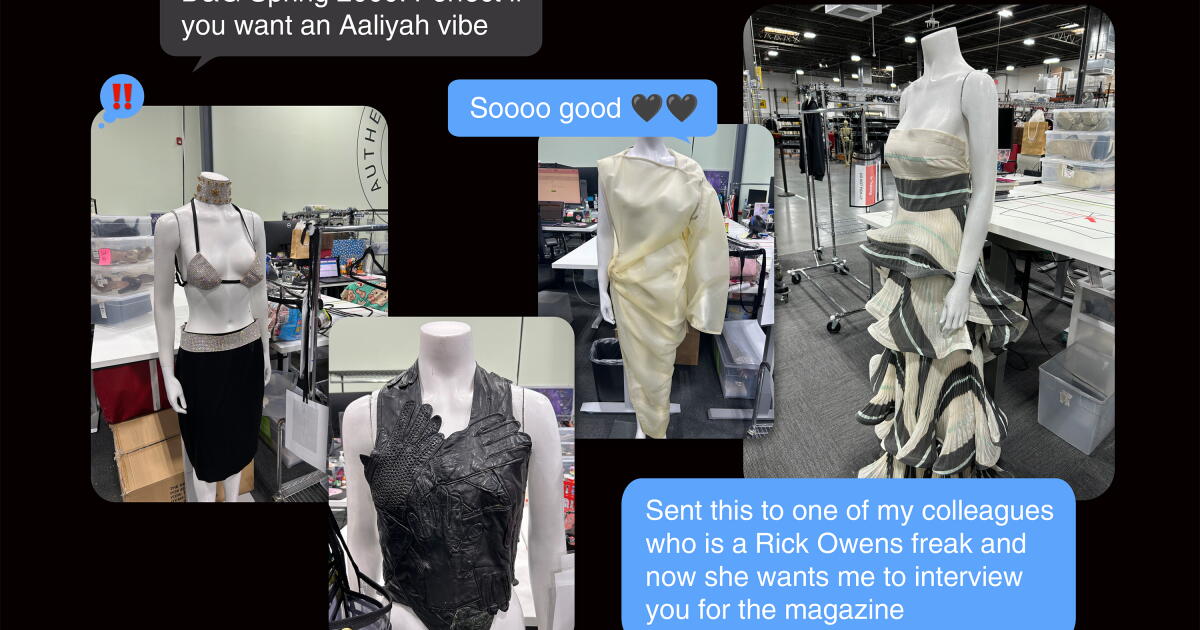
Sometime this spring, I started receiving sporadic texts from my college friend Nick Dinerstein, who has been the master authenticator of home and art at the RealReal, where he’s worked for the last nine years. Included in his missives were photos of incredible vintage fashion pieces that had been consigned to the RealReal, along with a note of archival context like the classically-trained art historian that Nick is. “Rick Owens spring 23. 100% leather dress.” “Spring 01 Maison Margiela. Made with old gloves!” “Spring 2000 JPG. The ladies in my office are going apes— over this.” As delighted by the looks as I was, it was more surprising that Nick was the one sending them to me. I screenshotted each message and shared them in Image’s Slack. Nick has always been my college bud, but to my fellow Image staffers, he was a professional, a master authenticator with access to pieces we could only dream about seeing in person one day.
Still, his proximity to anything Rick Owens-related was beyond amusing. At the risk of absolutely roasting him, I’ll just say that back when we shared a dorm, he was an art history major who cared more about antiquities than what he was wearing — which was usually the college bro standard-issue big shorts and graphic tee. (It was also the height of my indie sleaze era so, to be fair, my college aesthetic might even be more embarrassing in retrospect.)
When Nick reached out for a long call earlier this year, I was happy to hear from him. For over an hour, we gossiped about our beloved dorm friends and reminisced about the good old days before our brains were fully developed. Eventually, we did the mature thing and caught up on our solidly-adult lives. How crazy, we agreed, that we somehow both ended up in fashion-adjacent careers we loved. I couldn’t believe that this cargo-loving dude was now at the RealReal. And he’s the first to admit that he wasn’t always appreciative of fashion. But, “… when you listen to someone [at the RealReal] talk about a brand that they know backwards and forwards and that they’ve been studying since they were 15 or 16,” Nick later shared, “it relates to how I think about certain art things. Like actually, my background did prepare me for this line of work and this career path. It just wasn’t something that I was thinking about at the time.”
On a recent Tuesday afternoon, Nick and I met in the Balenciaga room. To clarify, this wasn’t a room full of Balenciaga pieces — although at the RealReal, it wouldn’t surprise me if such a room actually existed. Alas, it was just the name of the meeting room at the RealReal’s offices from which Nick was joining me on Zoom. And so, Nick and I did the most adult thing yet in the course of our decades-long friendship: I interviewed him about fashion as art, fake receipts, portable Chihulies and, of course, his favorite Birkin.
Claire Salinda: So what does it mean to be a master authenticator? What do you actually do all day at the RealReal?
Nick Dinerstein: I focus on two areas. The first is home and art. My job is to monitor and execute the authentication processes that are being used for home and art items. [My other focus] is running and developing the scientific testing that we’re doing on various fashion items, namely handbags and shoes.
CS: Where do your eyes go first when something comes your way to authenticate? I’m imagining you in a kind of laboratory with a piece of art, and you’re fully gloved out, looking at something that we would never notice.
ND: The first thing I look at, even before I look at the art itself, is whatever documentation [a consigner] sent in with the art. Sometimes it might be a certificate of authenticity. Sometimes it’ll be a receipt from a dealer. There are a lot of galleries that have gone under because of fraud issues, so if I see a certificate that comes through with a known gallery that’s been caught up in this, I have an initial red flag there.

A two-piece skirt set from the Jean Paul Gaultier spring/summer 2000 collection.
(Claire Salinda / Los Angeles Times)
When I inspect the piece itself, the first thing that I look at is the materials. You really have to be a master of materials when you are authenticating items, whether it’s fashion or art. From there, I’ll look at signatures, I’ll compare it to other things in the artist’s body of work and see if it makes sense. I always look at who the consigner is as well, just to see what other things they’ve consigned. Have there been any other pieces that they’ve sent in that have had issues? Is there a pattern we’re seeing there?
You’ve said [you picture me] with my microscope looking at one specific little piece. That does happen, but authenticity very rarely hinges on one small detail. It’s usually a cavalcade of issues that lead up to it.
CS: The RealReal has blocked over 250,000 fakes from entering the market. How have superfakes evolved since you started?
ND: The fakes have gotten a lot more sophisticated. A lot of brands have started putting NFC [Near Field Communication] chips in their items. There are now fake NFC chips that [counterfeiters] will put into handbags to trick people. But it isn’t always super sophisticated. For example, the feet on a Birkin handbag are riveted on. So if I can unscrew the foot, that’s a fake bag. Well, then [a counterfeiter] can put two drops of superglue in the screw hole and now I can’t turn it, so it feels like it’s riveted.
In the past, we might have seen a handbag come in and we’re like, “OK, it’s a naked handbag. It doesn’t have any collateral with it, so it’s fake.” But now [with superfakes] we’ll get the handbag in the Hermès box with all the collateral with the receipt, and all of it is fake. There are websites where you can literally print fake receipts for 50 bucks.
CS: But you’re working on some scientific processes and developments for handbags and shoes, right?
ND: Yeah, I can use a Birkin as an example. The first process we introduced is X-ray fluorescence testing, which is most commonly and primarily used in the jewelry industry to test an item for its metal purity and its metal content. You hold a little XRF device over whatever metal you’re testing and 10 seconds later it spits out a breakdown of what elements are in a particular alloy. We’ve started doing that on handbag hardware, so I might test something like the feet on an Hermès Birkin. More often than not, they’re usually made of some kind of stainless steel. But there are a lot of grades of stainless steel, and so we’ve tested thousands of items, figured out what the alloy should look like on all of these different parts of a handbag, how that changes per brand — because of course the metal that Hermès is sourcing isn’t necessarily going to be the same metal at Chanel — and the year. The feet of a Birkin from 1987 are going to test differently than ones from 2025.
I also have a big X-ray machine downstairs in my office. We literally will put bags and shoes into the machine and we’ll look at the internal construction. The example I gave earlier with the Birkin bags and the screw holes getting glued? Throw that into an X-ray and I can see the screw threads in the feet.
CS: You know, it’s so funny to hear you talk about Birkins because it’s just not a word I associate with you.
ND: That’s fair —
CS: — but it’s cool.
ND: And I see probably a couple dozen Birkins a day at this point.
CS: Really? Insane. Well, this is a great transition because the whole reason we’re doing this interview is because you periodically text me photos of amazing archival fashion pieces you see. I know you as the art and home guy, and now I know you’re also a Birkin man, but what about these fashion pieces catches your eye? What makes you think, “I need to send Claire a picture of this”?
ND: Our vintage team has been growing in recent years in terms of sales and headcount — vintage is just getting more and more popular. [The RealReal has seen a 432% increase in searches on vintage over the last year alone.] When we get some of these vintage pieces, it’s a piece that we’ll only see once every few years, if that. They’re exceedingly rare pieces. Our master authenticator for vintage, Dominik Halás, gets very excited and his excitement is contagious. [The vintage team] will put it on a mannequin and we’ll all go over and look at it so we can appreciate it together. I’m usually listening to Dom explain the history of a piece when I send you a photo.
CS: Speaking of Dom, what have you learned from these fashion freaks — and I use “freaks” lovingly — in your office? And do you now feel pressure to get a fit off?
ND: I’ve upgraded my wardrobe significantly in the past few years. All the cargo shorts are gone.

A Maison Margiela glove top from the spring/summer 2001 collection, as seen in the “Martin Margiela, Collections Femme 1989-2009” exhibition at the Palais Galliera.
(Claire Salinda / Los Angeles Times)
CS: But wait, cargos are back!
ND: Oh great, OK. I’ll have to go to Goodwill then and get them back.
CS: Returning to Birkins for a sec: The argument could be made that a piece of fine art and an Hermès bag share the same DNA when it comes to craftsmanship.
ND: Oh, 100%. We’re dealing with pieces of art here. And the way that you put an outfit together on yourself? That’s like a very individualized piece of art. You can give five shirts and five pairs of pants to 10 different people, and they’ll all come up with a different outfit.
I didn’t used to have the same appreciation for fashion as I did other areas of art, and now I do. Last summer, I went to Paris and the Louvre had their first fashion exhibit, “Louvre Couture.” It was all of these famous designers who have gotten inspiration from pieces at the Louvre. The exhibition was set up in the regular gallery space, so you would be looking at a medieval reliquary, and then next to it would be a dress from a French designer that was based on the medieval reliquary. Seeing that kind of flipped it for me. It really made me be like, “Ah, dressing isn’t something I just have to do in terms of grabbing what I can and rushing out the door because I gotta go to work. There are very particular things that I can show people by the way I dress, by the way I present myself.” [Fashion] is a unique art form because it’s very personal to whoever is wearing the items, in a way visual art isn’t. I really appreciate that.
CS: Over your last nine years at the RealReal, what was the hardest piece to let go of?
ND: That’s tough. There were these Dale Chihuly pieces that we had a couple years ago, these shell form dishes that were unbelievable, and I love Dale Chihuly. Usually, when I see Chihulies, they’re giant exhibits — like installations at hotels. So seeing [a Chihuly] that’s very small and contained that I could bring home was very cool. The most expensive piece we sold in home and art was a Giacometti sculpture. That one was gorgeous. It was just one of these smaller nude female sculptures, maybe 16 inches, 18 inches tall. So not a huge piece, but it had a lot of character.
In terms of fashion, there have been some Chrome Hearts pieces that are just over the top. That’s one of those where you see it and you’re just like, “Oh my God, this is so cool even though I don’t necessarily know the occasion I would wear it.” There was, of course, the Himalayan Birkin that I was eyeing for my wife — she would look lovely with the Himalayan Birkin, with the 18-karat gold hardware and the diamond encrusted locks. When you see pieces like that, pieces entering into the six figures, there’s usually a different kind of quality with it. It gives off a very particular aura, and it’s that aura that I chase after.

A shirt from the Enfants Riches Déprimés spring/summer 2017 collection.
(Claire Salinda / Los Angeles Times)

Sometime this spring, I started receiving sporadic texts from my college friend Nick Dinerstein, who has been the master authenticator of home and art at the RealReal, where he’s worked for the last nine years. Included in his missives were photos of incredible vintage fashion pieces that had been consigned to the RealReal, along with a note of archival context like the classically-trained art historian that Nick is. “Rick Owens spring 23. 100% leather dress.” “Spring 01 Maison Margiela. Made with old gloves!” “Spring 2000 JPG. The ladies in my office are going apes— over this.” As delighted by the looks as I was, it was more surprising that Nick was the one sending them to me. I screenshotted each message and shared them in Image’s Slack. Nick has always been my college bud, but to my fellow Image staffers, he was a professional, a master authenticator with access to pieces we could only dream about seeing in person one day.
Still, his proximity to anything Rick Owens-related was beyond amusing. At the risk of absolutely roasting him, I’ll just say that back when we shared a dorm, he was an art history major who cared more about antiquities than what he was wearing — which was usually the college bro standard-issue big shorts and graphic tee. (It was also the height of my indie sleaze era so, to be fair, my college aesthetic might even be more embarrassing in retrospect.)
When Nick reached out for a long call earlier this year, I was happy to hear from him. For over an hour, we gossiped about our beloved dorm friends and reminisced about the good old days before our brains were fully developed. Eventually, we did the mature thing and caught up on our solidly-adult lives. How crazy, we agreed, that we somehow both ended up in fashion-adjacent careers we loved. I couldn’t believe that this cargo-loving dude was now at the RealReal. And he’s the first to admit that he wasn’t always appreciative of fashion. But, “… when you listen to someone [at the RealReal] talk about a brand that they know backwards and forwards and that they’ve been studying since they were 15 or 16,” Nick later shared, “it relates to how I think about certain art things. Like actually, my background did prepare me for this line of work and this career path. It just wasn’t something that I was thinking about at the time.”
On a recent Tuesday afternoon, Nick and I met in the Balenciaga room. To clarify, this wasn’t a room full of Balenciaga pieces — although at the RealReal, it wouldn’t surprise me if such a room actually existed. Alas, it was just the name of the meeting room at the RealReal’s offices from which Nick was joining me on Zoom. And so, Nick and I did the most adult thing yet in the course of our decades-long friendship: I interviewed him about fashion as art, fake receipts, portable Chihulies and, of course, his favorite Birkin.
Claire Salinda: So what does it mean to be a master authenticator? What do you actually do all day at the RealReal?
Nick Dinerstein: I focus on two areas. The first is home and art. My job is to monitor and execute the authentication processes that are being used for home and art items. [My other focus] is running and developing the scientific testing that we’re doing on various fashion items, namely handbags and shoes.
CS: Where do your eyes go first when something comes your way to authenticate? I’m imagining you in a kind of laboratory with a piece of art, and you’re fully gloved out, looking at something that we would never notice.
ND: The first thing I look at, even before I look at the art itself, is whatever documentation [a consigner] sent in with the art. Sometimes it might be a certificate of authenticity. Sometimes it’ll be a receipt from a dealer. There are a lot of galleries that have gone under because of fraud issues, so if I see a certificate that comes through with a known gallery that’s been caught up in this, I have an initial red flag there.
A two-piece skirt set from the Jean Paul Gaultier spring/summer 2000 collection.
(Claire Salinda / Los Angeles Times)
When I inspect the piece itself, the first thing that I look at is the materials. You really have to be a master of materials when you are authenticating items, whether it’s fashion or art. From there, I’ll look at signatures, I’ll compare it to other things in the artist’s body of work and see if it makes sense. I always look at who the consigner is as well, just to see what other things they’ve consigned. Have there been any other pieces that they’ve sent in that have had issues? Is there a pattern we’re seeing there?
You’ve said [you picture me] with my microscope looking at one specific little piece. That does happen, but authenticity very rarely hinges on one small detail. It’s usually a cavalcade of issues that lead up to it.
CS: The RealReal has blocked over 250,000 fakes from entering the market. How have superfakes evolved since you started?
ND: The fakes have gotten a lot more sophisticated. A lot of brands have started putting NFC [Near Field Communication] chips in their items. There are now fake NFC chips that [counterfeiters] will put into handbags to trick people. But it isn’t always super sophisticated. For example, the feet on a Birkin handbag are riveted on. So if I can unscrew the foot, that’s a fake bag. Well, then [a counterfeiter] can put two drops of superglue in the screw hole and now I can’t turn it, so it feels like it’s riveted.
In the past, we might have seen a handbag come in and we’re like, “OK, it’s a naked handbag. It doesn’t have any collateral with it, so it’s fake.” But now [with superfakes] we’ll get the handbag in the Hermès box with all the collateral with the receipt, and all of it is fake. There are websites where you can literally print fake receipts for 50 bucks.
CS: But you’re working on some scientific processes and developments for handbags and shoes, right?
ND: Yeah, I can use a Birkin as an example. The first process we introduced is X-ray fluorescence testing, which is most commonly and primarily used in the jewelry industry to test an item for its metal purity and its metal content. You hold a little XRF device over whatever metal you’re testing and 10 seconds later it spits out a breakdown of what elements are in a particular alloy. We’ve started doing that on handbag hardware, so I might test something like the feet on an Hermès Birkin. More often than not, they’re usually made of some kind of stainless steel. But there are a lot of grades of stainless steel, and so we’ve tested thousands of items, figured out what the alloy should look like on all of these different parts of a handbag, how that changes per brand — because of course the metal that Hermès is sourcing isn’t necessarily going to be the same metal at Chanel — and the year. The feet of a Birkin from 1987 are going to test differently than ones from 2025.
I also have a big X-ray machine downstairs in my office. We literally will put bags and shoes into the machine and we’ll look at the internal construction. The example I gave earlier with the Birkin bags and the screw holes getting glued? Throw that into an X-ray and I can see the screw threads in the feet.
CS: You know, it’s so funny to hear you talk about Birkins because it’s just not a word I associate with you.
ND: That’s fair —
CS: — but it’s cool.
ND: And I see probably a couple dozen Birkins a day at this point.
CS: Really? Insane. Well, this is a great transition because the whole reason we’re doing this interview is because you periodically text me photos of amazing archival fashion pieces you see. I know you as the art and home guy, and now I know you’re also a Birkin man, but what about these fashion pieces catches your eye? What makes you think, “I need to send Claire a picture of this”?
ND: Our vintage team has been growing in recent years in terms of sales and headcount — vintage is just getting more and more popular. [The RealReal has seen a 432% increase in searches on vintage over the last year alone.] When we get some of these vintage pieces, it’s a piece that we’ll only see once every few years, if that. They’re exceedingly rare pieces. Our master authenticator for vintage, Dominik Halás, gets very excited and his excitement is contagious. [The vintage team] will put it on a mannequin and we’ll all go over and look at it so we can appreciate it together. I’m usually listening to Dom explain the history of a piece when I send you a photo.
CS: Speaking of Dom, what have you learned from these fashion freaks — and I use “freaks” lovingly — in your office? And do you now feel pressure to get a fit off?
ND: I’ve upgraded my wardrobe significantly in the past few years. All the cargo shorts are gone.
A Maison Margiela glove top from the spring/summer 2001 collection, as seen in the “Martin Margiela, Collections Femme 1989-2009” exhibition at the Palais Galliera.
(Claire Salinda / Los Angeles Times)
CS: But wait, cargos are back!
ND: Oh great, OK. I’ll have to go to Goodwill then and get them back.
CS: Returning to Birkins for a sec: The argument could be made that a piece of fine art and an Hermès bag share the same DNA when it comes to craftsmanship.
ND: Oh, 100%. We’re dealing with pieces of art here. And the way that you put an outfit together on yourself? That’s like a very individualized piece of art. You can give five shirts and five pairs of pants to 10 different people, and they’ll all come up with a different outfit.
I didn’t used to have the same appreciation for fashion as I did other areas of art, and now I do. Last summer, I went to Paris and the Louvre had their first fashion exhibit, “Louvre Couture.” It was all of these famous designers who have gotten inspiration from pieces at the Louvre. The exhibition was set up in the regular gallery space, so you would be looking at a medieval reliquary, and then next to it would be a dress from a French designer that was based on the medieval reliquary. Seeing that kind of flipped it for me. It really made me be like, “Ah, dressing isn’t something I just have to do in terms of grabbing what I can and rushing out the door because I gotta go to work. There are very particular things that I can show people by the way I dress, by the way I present myself.” [Fashion] is a unique art form because it’s very personal to whoever is wearing the items, in a way visual art isn’t. I really appreciate that.
CS: Over your last nine years at the RealReal, what was the hardest piece to let go of?
ND: That’s tough. There were these Dale Chihuly pieces that we had a couple years ago, these shell form dishes that were unbelievable, and I love Dale Chihuly. Usually, when I see Chihulies, they’re giant exhibits — like installations at hotels. So seeing [a Chihuly] that’s very small and contained that I could bring home was very cool. The most expensive piece we sold in home and art was a Giacometti sculpture. That one was gorgeous. It was just one of these smaller nude female sculptures, maybe 16 inches, 18 inches tall. So not a huge piece, but it had a lot of character.
In terms of fashion, there have been some Chrome Hearts pieces that are just over the top. That’s one of those where you see it and you’re just like, “Oh my God, this is so cool even though I don’t necessarily know the occasion I would wear it.” There was, of course, the Himalayan Birkin that I was eyeing for my wife — she would look lovely with the Himalayan Birkin, with the 18-karat gold hardware and the diamond encrusted locks. When you see pieces like that, pieces entering into the six figures, there’s usually a different kind of quality with it. It gives off a very particular aura, and it’s that aura that I chase after.
A shirt from the Enfants Riches Déprimés spring/summer 2017 collection.
(Claire Salinda / Los Angeles Times)

Sometime this spring, I started receiving sporadic texts from my college friend Nick Dinerstein, who has been the master authenticator of home and art at the RealReal, where he’s worked for the last nine years. Included in his missives were photos of incredible vintage fashion pieces that had been consigned to the RealReal, along with a note of archival context like the classically-trained art historian that Nick is. “Rick Owens spring 23. 100% leather dress.” “Spring 01 Maison Margiela. Made with old gloves!” “Spring 2000 JPG. The ladies in my office are going apes— over this.” As delighted by the looks as I was, it was more surprising that Nick was the one sending them to me. I screenshotted each message and shared them in Image’s Slack. Nick has always been my college bud, but to my fellow Image staffers, he was a professional, a master authenticator with access to pieces we could only dream about seeing in person one day.
Still, his proximity to anything Rick Owens-related was beyond amusing. At the risk of absolutely roasting him, I’ll just say that back when we shared a dorm, he was an art history major who cared more about antiquities than what he was wearing — which was usually the college bro standard-issue big shorts and graphic tee. (It was also the height of my indie sleaze era so, to be fair, my college aesthetic might even be more embarrassing in retrospect.)
When Nick reached out for a long call earlier this year, I was happy to hear from him. For over an hour, we gossiped about our beloved dorm friends and reminisced about the good old days before our brains were fully developed. Eventually, we did the mature thing and caught up on our solidly-adult lives. How crazy, we agreed, that we somehow both ended up in fashion-adjacent careers we loved. I couldn’t believe that this cargo-loving dude was now at the RealReal. And he’s the first to admit that he wasn’t always appreciative of fashion. But, “… when you listen to someone [at the RealReal] talk about a brand that they know backwards and forwards and that they’ve been studying since they were 15 or 16,” Nick later shared, “it relates to how I think about certain art things. Like actually, my background did prepare me for this line of work and this career path. It just wasn’t something that I was thinking about at the time.”
On a recent Tuesday afternoon, Nick and I met in the Balenciaga room. To clarify, this wasn’t a room full of Balenciaga pieces — although at the RealReal, it wouldn’t surprise me if such a room actually existed. Alas, it was just the name of the meeting room at the RealReal’s offices from which Nick was joining me on Zoom. And so, Nick and I did the most adult thing yet in the course of our decades-long friendship: I interviewed him about fashion as art, fake receipts, portable Chihulies and, of course, his favorite Birkin.
Claire Salinda: So what does it mean to be a master authenticator? What do you actually do all day at the RealReal?
Nick Dinerstein: I focus on two areas. The first is home and art. My job is to monitor and execute the authentication processes that are being used for home and art items. [My other focus] is running and developing the scientific testing that we’re doing on various fashion items, namely handbags and shoes.
CS: Where do your eyes go first when something comes your way to authenticate? I’m imagining you in a kind of laboratory with a piece of art, and you’re fully gloved out, looking at something that we would never notice.
ND: The first thing I look at, even before I look at the art itself, is whatever documentation [a consigner] sent in with the art. Sometimes it might be a certificate of authenticity. Sometimes it’ll be a receipt from a dealer. There are a lot of galleries that have gone under because of fraud issues, so if I see a certificate that comes through with a known gallery that’s been caught up in this, I have an initial red flag there.
A two-piece skirt set from the Jean Paul Gaultier spring/summer 2000 collection.
(Claire Salinda / Los Angeles Times)
When I inspect the piece itself, the first thing that I look at is the materials. You really have to be a master of materials when you are authenticating items, whether it’s fashion or art. From there, I’ll look at signatures, I’ll compare it to other things in the artist’s body of work and see if it makes sense. I always look at who the consigner is as well, just to see what other things they’ve consigned. Have there been any other pieces that they’ve sent in that have had issues? Is there a pattern we’re seeing there?
You’ve said [you picture me] with my microscope looking at one specific little piece. That does happen, but authenticity very rarely hinges on one small detail. It’s usually a cavalcade of issues that lead up to it.
CS: The RealReal has blocked over 250,000 fakes from entering the market. How have superfakes evolved since you started?
ND: The fakes have gotten a lot more sophisticated. A lot of brands have started putting NFC [Near Field Communication] chips in their items. There are now fake NFC chips that [counterfeiters] will put into handbags to trick people. But it isn’t always super sophisticated. For example, the feet on a Birkin handbag are riveted on. So if I can unscrew the foot, that’s a fake bag. Well, then [a counterfeiter] can put two drops of superglue in the screw hole and now I can’t turn it, so it feels like it’s riveted.
In the past, we might have seen a handbag come in and we’re like, “OK, it’s a naked handbag. It doesn’t have any collateral with it, so it’s fake.” But now [with superfakes] we’ll get the handbag in the Hermès box with all the collateral with the receipt, and all of it is fake. There are websites where you can literally print fake receipts for 50 bucks.
CS: But you’re working on some scientific processes and developments for handbags and shoes, right?
ND: Yeah, I can use a Birkin as an example. The first process we introduced is X-ray fluorescence testing, which is most commonly and primarily used in the jewelry industry to test an item for its metal purity and its metal content. You hold a little XRF device over whatever metal you’re testing and 10 seconds later it spits out a breakdown of what elements are in a particular alloy. We’ve started doing that on handbag hardware, so I might test something like the feet on an Hermès Birkin. More often than not, they’re usually made of some kind of stainless steel. But there are a lot of grades of stainless steel, and so we’ve tested thousands of items, figured out what the alloy should look like on all of these different parts of a handbag, how that changes per brand — because of course the metal that Hermès is sourcing isn’t necessarily going to be the same metal at Chanel — and the year. The feet of a Birkin from 1987 are going to test differently than ones from 2025.
I also have a big X-ray machine downstairs in my office. We literally will put bags and shoes into the machine and we’ll look at the internal construction. The example I gave earlier with the Birkin bags and the screw holes getting glued? Throw that into an X-ray and I can see the screw threads in the feet.
CS: You know, it’s so funny to hear you talk about Birkins because it’s just not a word I associate with you.
ND: That’s fair —
CS: — but it’s cool.
ND: And I see probably a couple dozen Birkins a day at this point.
CS: Really? Insane. Well, this is a great transition because the whole reason we’re doing this interview is because you periodically text me photos of amazing archival fashion pieces you see. I know you as the art and home guy, and now I know you’re also a Birkin man, but what about these fashion pieces catches your eye? What makes you think, “I need to send Claire a picture of this”?
ND: Our vintage team has been growing in recent years in terms of sales and headcount — vintage is just getting more and more popular. [The RealReal has seen a 432% increase in searches on vintage over the last year alone.] When we get some of these vintage pieces, it’s a piece that we’ll only see once every few years, if that. They’re exceedingly rare pieces. Our master authenticator for vintage, Dominik Halás, gets very excited and his excitement is contagious. [The vintage team] will put it on a mannequin and we’ll all go over and look at it so we can appreciate it together. I’m usually listening to Dom explain the history of a piece when I send you a photo.
CS: Speaking of Dom, what have you learned from these fashion freaks — and I use “freaks” lovingly — in your office? And do you now feel pressure to get a fit off?
ND: I’ve upgraded my wardrobe significantly in the past few years. All the cargo shorts are gone.
A Maison Margiela glove top from the spring/summer 2001 collection, as seen in the “Martin Margiela, Collections Femme 1989-2009” exhibition at the Palais Galliera.
(Claire Salinda / Los Angeles Times)
CS: But wait, cargos are back!
ND: Oh great, OK. I’ll have to go to Goodwill then and get them back.
CS: Returning to Birkins for a sec: The argument could be made that a piece of fine art and an Hermès bag share the same DNA when it comes to craftsmanship.
ND: Oh, 100%. We’re dealing with pieces of art here. And the way that you put an outfit together on yourself? That’s like a very individualized piece of art. You can give five shirts and five pairs of pants to 10 different people, and they’ll all come up with a different outfit.
I didn’t used to have the same appreciation for fashion as I did other areas of art, and now I do. Last summer, I went to Paris and the Louvre had their first fashion exhibit, “Louvre Couture.” It was all of these famous designers who have gotten inspiration from pieces at the Louvre. The exhibition was set up in the regular gallery space, so you would be looking at a medieval reliquary, and then next to it would be a dress from a French designer that was based on the medieval reliquary. Seeing that kind of flipped it for me. It really made me be like, “Ah, dressing isn’t something I just have to do in terms of grabbing what I can and rushing out the door because I gotta go to work. There are very particular things that I can show people by the way I dress, by the way I present myself.” [Fashion] is a unique art form because it’s very personal to whoever is wearing the items, in a way visual art isn’t. I really appreciate that.
CS: Over your last nine years at the RealReal, what was the hardest piece to let go of?
ND: That’s tough. There were these Dale Chihuly pieces that we had a couple years ago, these shell form dishes that were unbelievable, and I love Dale Chihuly. Usually, when I see Chihulies, they’re giant exhibits — like installations at hotels. So seeing [a Chihuly] that’s very small and contained that I could bring home was very cool. The most expensive piece we sold in home and art was a Giacometti sculpture. That one was gorgeous. It was just one of these smaller nude female sculptures, maybe 16 inches, 18 inches tall. So not a huge piece, but it had a lot of character.
In terms of fashion, there have been some Chrome Hearts pieces that are just over the top. That’s one of those where you see it and you’re just like, “Oh my God, this is so cool even though I don’t necessarily know the occasion I would wear it.” There was, of course, the Himalayan Birkin that I was eyeing for my wife — she would look lovely with the Himalayan Birkin, with the 18-karat gold hardware and the diamond encrusted locks. When you see pieces like that, pieces entering into the six figures, there’s usually a different kind of quality with it. It gives off a very particular aura, and it’s that aura that I chase after.
A shirt from the Enfants Riches Déprimés spring/summer 2017 collection.
(Claire Salinda / Los Angeles Times)

Sometime this spring, I started receiving sporadic texts from my college friend Nick Dinerstein, who has been the master authenticator of home and art at the RealReal, where he’s worked for the last nine years. Included in his missives were photos of incredible vintage fashion pieces that had been consigned to the RealReal, along with a note of archival context like the classically-trained art historian that Nick is. “Rick Owens spring 23. 100% leather dress.” “Spring 01 Maison Margiela. Made with old gloves!” “Spring 2000 JPG. The ladies in my office are going apes— over this.” As delighted by the looks as I was, it was more surprising that Nick was the one sending them to me. I screenshotted each message and shared them in Image’s Slack. Nick has always been my college bud, but to my fellow Image staffers, he was a professional, a master authenticator with access to pieces we could only dream about seeing in person one day.
Still, his proximity to anything Rick Owens-related was beyond amusing. At the risk of absolutely roasting him, I’ll just say that back when we shared a dorm, he was an art history major who cared more about antiquities than what he was wearing — which was usually the college bro standard-issue big shorts and graphic tee. (It was also the height of my indie sleaze era so, to be fair, my college aesthetic might even be more embarrassing in retrospect.)
When Nick reached out for a long call earlier this year, I was happy to hear from him. For over an hour, we gossiped about our beloved dorm friends and reminisced about the good old days before our brains were fully developed. Eventually, we did the mature thing and caught up on our solidly-adult lives. How crazy, we agreed, that we somehow both ended up in fashion-adjacent careers we loved. I couldn’t believe that this cargo-loving dude was now at the RealReal. And he’s the first to admit that he wasn’t always appreciative of fashion. But, “… when you listen to someone [at the RealReal] talk about a brand that they know backwards and forwards and that they’ve been studying since they were 15 or 16,” Nick later shared, “it relates to how I think about certain art things. Like actually, my background did prepare me for this line of work and this career path. It just wasn’t something that I was thinking about at the time.”
On a recent Tuesday afternoon, Nick and I met in the Balenciaga room. To clarify, this wasn’t a room full of Balenciaga pieces — although at the RealReal, it wouldn’t surprise me if such a room actually existed. Alas, it was just the name of the meeting room at the RealReal’s offices from which Nick was joining me on Zoom. And so, Nick and I did the most adult thing yet in the course of our decades-long friendship: I interviewed him about fashion as art, fake receipts, portable Chihulies and, of course, his favorite Birkin.
Claire Salinda: So what does it mean to be a master authenticator? What do you actually do all day at the RealReal?
Nick Dinerstein: I focus on two areas. The first is home and art. My job is to monitor and execute the authentication processes that are being used for home and art items. [My other focus] is running and developing the scientific testing that we’re doing on various fashion items, namely handbags and shoes.
CS: Where do your eyes go first when something comes your way to authenticate? I’m imagining you in a kind of laboratory with a piece of art, and you’re fully gloved out, looking at something that we would never notice.
ND: The first thing I look at, even before I look at the art itself, is whatever documentation [a consigner] sent in with the art. Sometimes it might be a certificate of authenticity. Sometimes it’ll be a receipt from a dealer. There are a lot of galleries that have gone under because of fraud issues, so if I see a certificate that comes through with a known gallery that’s been caught up in this, I have an initial red flag there.
A two-piece skirt set from the Jean Paul Gaultier spring/summer 2000 collection.
(Claire Salinda / Los Angeles Times)
When I inspect the piece itself, the first thing that I look at is the materials. You really have to be a master of materials when you are authenticating items, whether it’s fashion or art. From there, I’ll look at signatures, I’ll compare it to other things in the artist’s body of work and see if it makes sense. I always look at who the consigner is as well, just to see what other things they’ve consigned. Have there been any other pieces that they’ve sent in that have had issues? Is there a pattern we’re seeing there?
You’ve said [you picture me] with my microscope looking at one specific little piece. That does happen, but authenticity very rarely hinges on one small detail. It’s usually a cavalcade of issues that lead up to it.
CS: The RealReal has blocked over 250,000 fakes from entering the market. How have superfakes evolved since you started?
ND: The fakes have gotten a lot more sophisticated. A lot of brands have started putting NFC [Near Field Communication] chips in their items. There are now fake NFC chips that [counterfeiters] will put into handbags to trick people. But it isn’t always super sophisticated. For example, the feet on a Birkin handbag are riveted on. So if I can unscrew the foot, that’s a fake bag. Well, then [a counterfeiter] can put two drops of superglue in the screw hole and now I can’t turn it, so it feels like it’s riveted.
In the past, we might have seen a handbag come in and we’re like, “OK, it’s a naked handbag. It doesn’t have any collateral with it, so it’s fake.” But now [with superfakes] we’ll get the handbag in the Hermès box with all the collateral with the receipt, and all of it is fake. There are websites where you can literally print fake receipts for 50 bucks.
CS: But you’re working on some scientific processes and developments for handbags and shoes, right?
ND: Yeah, I can use a Birkin as an example. The first process we introduced is X-ray fluorescence testing, which is most commonly and primarily used in the jewelry industry to test an item for its metal purity and its metal content. You hold a little XRF device over whatever metal you’re testing and 10 seconds later it spits out a breakdown of what elements are in a particular alloy. We’ve started doing that on handbag hardware, so I might test something like the feet on an Hermès Birkin. More often than not, they’re usually made of some kind of stainless steel. But there are a lot of grades of stainless steel, and so we’ve tested thousands of items, figured out what the alloy should look like on all of these different parts of a handbag, how that changes per brand — because of course the metal that Hermès is sourcing isn’t necessarily going to be the same metal at Chanel — and the year. The feet of a Birkin from 1987 are going to test differently than ones from 2025.
I also have a big X-ray machine downstairs in my office. We literally will put bags and shoes into the machine and we’ll look at the internal construction. The example I gave earlier with the Birkin bags and the screw holes getting glued? Throw that into an X-ray and I can see the screw threads in the feet.
CS: You know, it’s so funny to hear you talk about Birkins because it’s just not a word I associate with you.
ND: That’s fair —
CS: — but it’s cool.
ND: And I see probably a couple dozen Birkins a day at this point.
CS: Really? Insane. Well, this is a great transition because the whole reason we’re doing this interview is because you periodically text me photos of amazing archival fashion pieces you see. I know you as the art and home guy, and now I know you’re also a Birkin man, but what about these fashion pieces catches your eye? What makes you think, “I need to send Claire a picture of this”?
ND: Our vintage team has been growing in recent years in terms of sales and headcount — vintage is just getting more and more popular. [The RealReal has seen a 432% increase in searches on vintage over the last year alone.] When we get some of these vintage pieces, it’s a piece that we’ll only see once every few years, if that. They’re exceedingly rare pieces. Our master authenticator for vintage, Dominik Halás, gets very excited and his excitement is contagious. [The vintage team] will put it on a mannequin and we’ll all go over and look at it so we can appreciate it together. I’m usually listening to Dom explain the history of a piece when I send you a photo.
CS: Speaking of Dom, what have you learned from these fashion freaks — and I use “freaks” lovingly — in your office? And do you now feel pressure to get a fit off?
ND: I’ve upgraded my wardrobe significantly in the past few years. All the cargo shorts are gone.
A Maison Margiela glove top from the spring/summer 2001 collection, as seen in the “Martin Margiela, Collections Femme 1989-2009” exhibition at the Palais Galliera.
(Claire Salinda / Los Angeles Times)
CS: But wait, cargos are back!
ND: Oh great, OK. I’ll have to go to Goodwill then and get them back.
CS: Returning to Birkins for a sec: The argument could be made that a piece of fine art and an Hermès bag share the same DNA when it comes to craftsmanship.
ND: Oh, 100%. We’re dealing with pieces of art here. And the way that you put an outfit together on yourself? That’s like a very individualized piece of art. You can give five shirts and five pairs of pants to 10 different people, and they’ll all come up with a different outfit.
I didn’t used to have the same appreciation for fashion as I did other areas of art, and now I do. Last summer, I went to Paris and the Louvre had their first fashion exhibit, “Louvre Couture.” It was all of these famous designers who have gotten inspiration from pieces at the Louvre. The exhibition was set up in the regular gallery space, so you would be looking at a medieval reliquary, and then next to it would be a dress from a French designer that was based on the medieval reliquary. Seeing that kind of flipped it for me. It really made me be like, “Ah, dressing isn’t something I just have to do in terms of grabbing what I can and rushing out the door because I gotta go to work. There are very particular things that I can show people by the way I dress, by the way I present myself.” [Fashion] is a unique art form because it’s very personal to whoever is wearing the items, in a way visual art isn’t. I really appreciate that.
CS: Over your last nine years at the RealReal, what was the hardest piece to let go of?
ND: That’s tough. There were these Dale Chihuly pieces that we had a couple years ago, these shell form dishes that were unbelievable, and I love Dale Chihuly. Usually, when I see Chihulies, they’re giant exhibits — like installations at hotels. So seeing [a Chihuly] that’s very small and contained that I could bring home was very cool. The most expensive piece we sold in home and art was a Giacometti sculpture. That one was gorgeous. It was just one of these smaller nude female sculptures, maybe 16 inches, 18 inches tall. So not a huge piece, but it had a lot of character.
In terms of fashion, there have been some Chrome Hearts pieces that are just over the top. That’s one of those where you see it and you’re just like, “Oh my God, this is so cool even though I don’t necessarily know the occasion I would wear it.” There was, of course, the Himalayan Birkin that I was eyeing for my wife — she would look lovely with the Himalayan Birkin, with the 18-karat gold hardware and the diamond encrusted locks. When you see pieces like that, pieces entering into the six figures, there’s usually a different kind of quality with it. It gives off a very particular aura, and it’s that aura that I chase after.
A shirt from the Enfants Riches Déprimés spring/summer 2017 collection.
(Claire Salinda / Los Angeles Times)

Sometime this spring, I started receiving sporadic texts from my college friend Nick Dinerstein, who has been the master authenticator of home and art at the RealReal, where he’s worked for the last nine years. Included in his missives were photos of incredible vintage fashion pieces that had been consigned to the RealReal, along with a note of archival context like the classically-trained art historian that Nick is. “Rick Owens spring 23. 100% leather dress.” “Spring 01 Maison Margiela. Made with old gloves!” “Spring 2000 JPG. The ladies in my office are going apes— over this.” As delighted by the looks as I was, it was more surprising that Nick was the one sending them to me. I screenshotted each message and shared them in Image’s Slack. Nick has always been my college bud, but to my fellow Image staffers, he was a professional, a master authenticator with access to pieces we could only dream about seeing in person one day.
Still, his proximity to anything Rick Owens-related was beyond amusing. At the risk of absolutely roasting him, I’ll just say that back when we shared a dorm, he was an art history major who cared more about antiquities than what he was wearing — which was usually the college bro standard-issue big shorts and graphic tee. (It was also the height of my indie sleaze era so, to be fair, my college aesthetic might even be more embarrassing in retrospect.)
When Nick reached out for a long call earlier this year, I was happy to hear from him. For over an hour, we gossiped about our beloved dorm friends and reminisced about the good old days before our brains were fully developed. Eventually, we did the mature thing and caught up on our solidly-adult lives. How crazy, we agreed, that we somehow both ended up in fashion-adjacent careers we loved. I couldn’t believe that this cargo-loving dude was now at the RealReal. And he’s the first to admit that he wasn’t always appreciative of fashion. But, “… when you listen to someone [at the RealReal] talk about a brand that they know backwards and forwards and that they’ve been studying since they were 15 or 16,” Nick later shared, “it relates to how I think about certain art things. Like actually, my background did prepare me for this line of work and this career path. It just wasn’t something that I was thinking about at the time.”
On a recent Tuesday afternoon, Nick and I met in the Balenciaga room. To clarify, this wasn’t a room full of Balenciaga pieces — although at the RealReal, it wouldn’t surprise me if such a room actually existed. Alas, it was just the name of the meeting room at the RealReal’s offices from which Nick was joining me on Zoom. And so, Nick and I did the most adult thing yet in the course of our decades-long friendship: I interviewed him about fashion as art, fake receipts, portable Chihulies and, of course, his favorite Birkin.
Claire Salinda: So what does it mean to be a master authenticator? What do you actually do all day at the RealReal?
Nick Dinerstein: I focus on two areas. The first is home and art. My job is to monitor and execute the authentication processes that are being used for home and art items. [My other focus] is running and developing the scientific testing that we’re doing on various fashion items, namely handbags and shoes.
CS: Where do your eyes go first when something comes your way to authenticate? I’m imagining you in a kind of laboratory with a piece of art, and you’re fully gloved out, looking at something that we would never notice.
ND: The first thing I look at, even before I look at the art itself, is whatever documentation [a consigner] sent in with the art. Sometimes it might be a certificate of authenticity. Sometimes it’ll be a receipt from a dealer. There are a lot of galleries that have gone under because of fraud issues, so if I see a certificate that comes through with a known gallery that’s been caught up in this, I have an initial red flag there.
A two-piece skirt set from the Jean Paul Gaultier spring/summer 2000 collection.
(Claire Salinda / Los Angeles Times)
When I inspect the piece itself, the first thing that I look at is the materials. You really have to be a master of materials when you are authenticating items, whether it’s fashion or art. From there, I’ll look at signatures, I’ll compare it to other things in the artist’s body of work and see if it makes sense. I always look at who the consigner is as well, just to see what other things they’ve consigned. Have there been any other pieces that they’ve sent in that have had issues? Is there a pattern we’re seeing there?
You’ve said [you picture me] with my microscope looking at one specific little piece. That does happen, but authenticity very rarely hinges on one small detail. It’s usually a cavalcade of issues that lead up to it.
CS: The RealReal has blocked over 250,000 fakes from entering the market. How have superfakes evolved since you started?
ND: The fakes have gotten a lot more sophisticated. A lot of brands have started putting NFC [Near Field Communication] chips in their items. There are now fake NFC chips that [counterfeiters] will put into handbags to trick people. But it isn’t always super sophisticated. For example, the feet on a Birkin handbag are riveted on. So if I can unscrew the foot, that’s a fake bag. Well, then [a counterfeiter] can put two drops of superglue in the screw hole and now I can’t turn it, so it feels like it’s riveted.
In the past, we might have seen a handbag come in and we’re like, “OK, it’s a naked handbag. It doesn’t have any collateral with it, so it’s fake.” But now [with superfakes] we’ll get the handbag in the Hermès box with all the collateral with the receipt, and all of it is fake. There are websites where you can literally print fake receipts for 50 bucks.
CS: But you’re working on some scientific processes and developments for handbags and shoes, right?
ND: Yeah, I can use a Birkin as an example. The first process we introduced is X-ray fluorescence testing, which is most commonly and primarily used in the jewelry industry to test an item for its metal purity and its metal content. You hold a little XRF device over whatever metal you’re testing and 10 seconds later it spits out a breakdown of what elements are in a particular alloy. We’ve started doing that on handbag hardware, so I might test something like the feet on an Hermès Birkin. More often than not, they’re usually made of some kind of stainless steel. But there are a lot of grades of stainless steel, and so we’ve tested thousands of items, figured out what the alloy should look like on all of these different parts of a handbag, how that changes per brand — because of course the metal that Hermès is sourcing isn’t necessarily going to be the same metal at Chanel — and the year. The feet of a Birkin from 1987 are going to test differently than ones from 2025.
I also have a big X-ray machine downstairs in my office. We literally will put bags and shoes into the machine and we’ll look at the internal construction. The example I gave earlier with the Birkin bags and the screw holes getting glued? Throw that into an X-ray and I can see the screw threads in the feet.
CS: You know, it’s so funny to hear you talk about Birkins because it’s just not a word I associate with you.
ND: That’s fair —
CS: — but it’s cool.
ND: And I see probably a couple dozen Birkins a day at this point.
CS: Really? Insane. Well, this is a great transition because the whole reason we’re doing this interview is because you periodically text me photos of amazing archival fashion pieces you see. I know you as the art and home guy, and now I know you’re also a Birkin man, but what about these fashion pieces catches your eye? What makes you think, “I need to send Claire a picture of this”?
ND: Our vintage team has been growing in recent years in terms of sales and headcount — vintage is just getting more and more popular. [The RealReal has seen a 432% increase in searches on vintage over the last year alone.] When we get some of these vintage pieces, it’s a piece that we’ll only see once every few years, if that. They’re exceedingly rare pieces. Our master authenticator for vintage, Dominik Halás, gets very excited and his excitement is contagious. [The vintage team] will put it on a mannequin and we’ll all go over and look at it so we can appreciate it together. I’m usually listening to Dom explain the history of a piece when I send you a photo.
CS: Speaking of Dom, what have you learned from these fashion freaks — and I use “freaks” lovingly — in your office? And do you now feel pressure to get a fit off?
ND: I’ve upgraded my wardrobe significantly in the past few years. All the cargo shorts are gone.
A Maison Margiela glove top from the spring/summer 2001 collection, as seen in the “Martin Margiela, Collections Femme 1989-2009” exhibition at the Palais Galliera.
(Claire Salinda / Los Angeles Times)
CS: But wait, cargos are back!
ND: Oh great, OK. I’ll have to go to Goodwill then and get them back.
CS: Returning to Birkins for a sec: The argument could be made that a piece of fine art and an Hermès bag share the same DNA when it comes to craftsmanship.
ND: Oh, 100%. We’re dealing with pieces of art here. And the way that you put an outfit together on yourself? That’s like a very individualized piece of art. You can give five shirts and five pairs of pants to 10 different people, and they’ll all come up with a different outfit.
I didn’t used to have the same appreciation for fashion as I did other areas of art, and now I do. Last summer, I went to Paris and the Louvre had their first fashion exhibit, “Louvre Couture.” It was all of these famous designers who have gotten inspiration from pieces at the Louvre. The exhibition was set up in the regular gallery space, so you would be looking at a medieval reliquary, and then next to it would be a dress from a French designer that was based on the medieval reliquary. Seeing that kind of flipped it for me. It really made me be like, “Ah, dressing isn’t something I just have to do in terms of grabbing what I can and rushing out the door because I gotta go to work. There are very particular things that I can show people by the way I dress, by the way I present myself.” [Fashion] is a unique art form because it’s very personal to whoever is wearing the items, in a way visual art isn’t. I really appreciate that.
CS: Over your last nine years at the RealReal, what was the hardest piece to let go of?
ND: That’s tough. There were these Dale Chihuly pieces that we had a couple years ago, these shell form dishes that were unbelievable, and I love Dale Chihuly. Usually, when I see Chihulies, they’re giant exhibits — like installations at hotels. So seeing [a Chihuly] that’s very small and contained that I could bring home was very cool. The most expensive piece we sold in home and art was a Giacometti sculpture. That one was gorgeous. It was just one of these smaller nude female sculptures, maybe 16 inches, 18 inches tall. So not a huge piece, but it had a lot of character.
In terms of fashion, there have been some Chrome Hearts pieces that are just over the top. That’s one of those where you see it and you’re just like, “Oh my God, this is so cool even though I don’t necessarily know the occasion I would wear it.” There was, of course, the Himalayan Birkin that I was eyeing for my wife — she would look lovely with the Himalayan Birkin, with the 18-karat gold hardware and the diamond encrusted locks. When you see pieces like that, pieces entering into the six figures, there’s usually a different kind of quality with it. It gives off a very particular aura, and it’s that aura that I chase after.
A shirt from the Enfants Riches Déprimés spring/summer 2017 collection.
(Claire Salinda / Los Angeles Times)

