

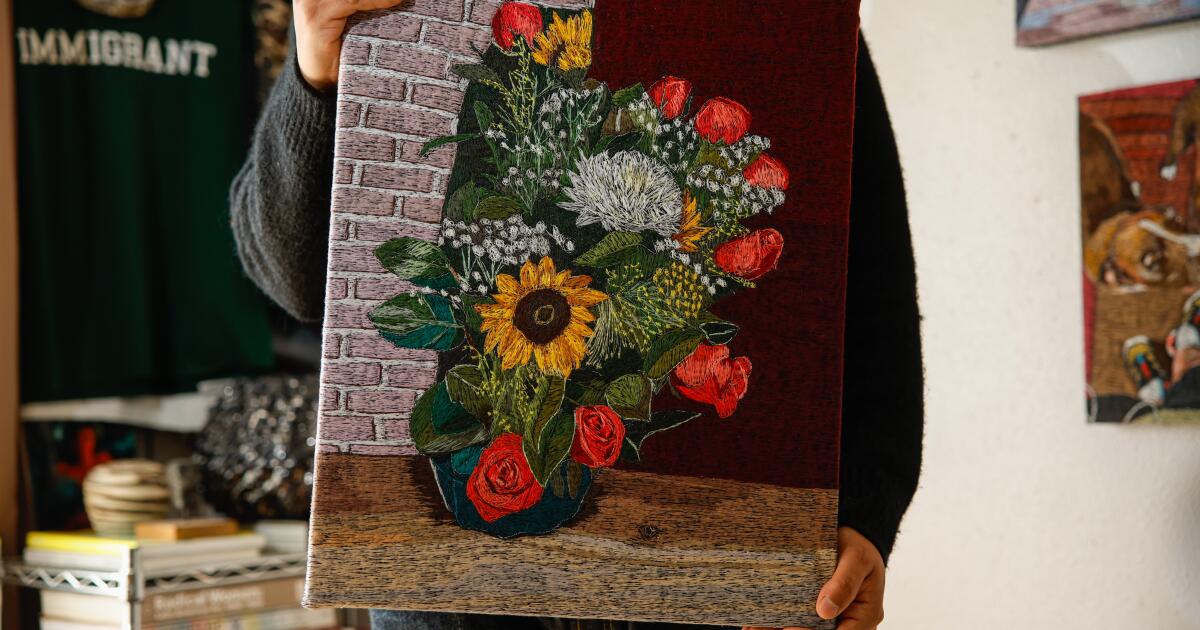
I always start with a photograph on my phone. Sometimes I’m not looking for images — the images are just there, and I happen to capture things. Last year, I started making works portraying flowers in buckets, what flower sellers sell on the freeways or just on the street. I started thinking of them as still lifes. I kept continuing with them. Walking around the Flower District, there’s so much beauty, and I started to think about the people who make them. They created something beautiful, but then maybe it’s just a job for them. It makes me think of my own family history — my dad’s family is from Puebla, Mexico, and their business is to grow flowers. One of my uncles on my dad’s side also came to the U.S. a while back, and because he had the knowledge already, he ended up landing in the Flower District. So that’s what I’ve been thinking about as I make more flower pieces.
My main goal as an artist is always to make work that reflects my identity and experience. I’m an immigrant, and a lot of what I do is through that lens, how we as immigrants live.

Medel works on one of his textile art pieces in his studio in L.A.
(Jason Armond/Los Angeles Times)

“I think of the durability of the denim, and I think of my dad, who is a gardener. He wears jeans because it’s thick enough to protect him from roses.”
(Jason Armond/Los Angeles Times)
I used to make work a lot with vinyl, and because I used to work in the Fashion District, I was around all the fabrics there and it became a way for me to experiment. One time I tried denim. Since then, I’ve been working with heavyweight denim. I think of the durability of the denim, and I think of my dad, who is a gardener. He wears jeans because it’s thick enough to protect him from roses. I think of the working class and think of the whole history of denim in the U.S. — the fashion, the Americana, the whole world that denim represents. It’s very rooted in American identity and this myth of America.

This flower piece is an ongoing exploration of my own identity and who I am as a person, but also my connection to L.A. What is my connection to this place? I moved to the U.S. when I was 13. Through the assimilation process, I feel like I lost a lot of my own sense of who I was, and I had to sort of become American. It took me a lot of years to circle back and realize that there’s so much here, so much culture, that connects to Mexico.

—As told to Elisa Wouk Almino.
Erick Medel embroiders denim with an industrial sewing machine, making works that touch on everyday life in Los Angeles, particularly those living and working in Boyle Heights and the city’s Eastside. The painstaking craft of his embroidery is slow and meticulous, a complement to the snapshot-like scenes it depicts.

I always start with a photograph on my phone. Sometimes I’m not looking for images — the images are just there, and I happen to capture things. Last year, I started making works portraying flowers in buckets, what flower sellers sell on the freeways or just on the street. I started thinking of them as still lifes. I kept continuing with them. Walking around the Flower District, there’s so much beauty, and I started to think about the people who make them. They created something beautiful, but then maybe it’s just a job for them. It makes me think of my own family history — my dad’s family is from Puebla, Mexico, and their business is to grow flowers. One of my uncles on my dad’s side also came to the U.S. a while back, and because he had the knowledge already, he ended up landing in the Flower District. So that’s what I’ve been thinking about as I make more flower pieces.
My main goal as an artist is always to make work that reflects my identity and experience. I’m an immigrant, and a lot of what I do is through that lens, how we as immigrants live.
Medel works on one of his textile art pieces in his studio in L.A.
(Jason Armond/Los Angeles Times)
“I think of the durability of the denim, and I think of my dad, who is a gardener. He wears jeans because it’s thick enough to protect him from roses.”
(Jason Armond/Los Angeles Times)
I used to make work a lot with vinyl, and because I used to work in the Fashion District, I was around all the fabrics there and it became a way for me to experiment. One time I tried denim. Since then, I’ve been working with heavyweight denim. I think of the durability of the denim, and I think of my dad, who is a gardener. He wears jeans because it’s thick enough to protect him from roses. I think of the working class and think of the whole history of denim in the U.S. — the fashion, the Americana, the whole world that denim represents. It’s very rooted in American identity and this myth of America.
This flower piece is an ongoing exploration of my own identity and who I am as a person, but also my connection to L.A. What is my connection to this place? I moved to the U.S. when I was 13. Through the assimilation process, I feel like I lost a lot of my own sense of who I was, and I had to sort of become American. It took me a lot of years to circle back and realize that there’s so much here, so much culture, that connects to Mexico.
—As told to Elisa Wouk Almino.
Erick Medel embroiders denim with an industrial sewing machine, making works that touch on everyday life in Los Angeles, particularly those living and working in Boyle Heights and the city’s Eastside. The painstaking craft of his embroidery is slow and meticulous, a complement to the snapshot-like scenes it depicts.

I always start with a photograph on my phone. Sometimes I’m not looking for images — the images are just there, and I happen to capture things. Last year, I started making works portraying flowers in buckets, what flower sellers sell on the freeways or just on the street. I started thinking of them as still lifes. I kept continuing with them. Walking around the Flower District, there’s so much beauty, and I started to think about the people who make them. They created something beautiful, but then maybe it’s just a job for them. It makes me think of my own family history — my dad’s family is from Puebla, Mexico, and their business is to grow flowers. One of my uncles on my dad’s side also came to the U.S. a while back, and because he had the knowledge already, he ended up landing in the Flower District. So that’s what I’ve been thinking about as I make more flower pieces.
My main goal as an artist is always to make work that reflects my identity and experience. I’m an immigrant, and a lot of what I do is through that lens, how we as immigrants live.
Medel works on one of his textile art pieces in his studio in L.A.
(Jason Armond/Los Angeles Times)
“I think of the durability of the denim, and I think of my dad, who is a gardener. He wears jeans because it’s thick enough to protect him from roses.”
(Jason Armond/Los Angeles Times)
I used to make work a lot with vinyl, and because I used to work in the Fashion District, I was around all the fabrics there and it became a way for me to experiment. One time I tried denim. Since then, I’ve been working with heavyweight denim. I think of the durability of the denim, and I think of my dad, who is a gardener. He wears jeans because it’s thick enough to protect him from roses. I think of the working class and think of the whole history of denim in the U.S. — the fashion, the Americana, the whole world that denim represents. It’s very rooted in American identity and this myth of America.
This flower piece is an ongoing exploration of my own identity and who I am as a person, but also my connection to L.A. What is my connection to this place? I moved to the U.S. when I was 13. Through the assimilation process, I feel like I lost a lot of my own sense of who I was, and I had to sort of become American. It took me a lot of years to circle back and realize that there’s so much here, so much culture, that connects to Mexico.
—As told to Elisa Wouk Almino.
Erick Medel embroiders denim with an industrial sewing machine, making works that touch on everyday life in Los Angeles, particularly those living and working in Boyle Heights and the city’s Eastside. The painstaking craft of his embroidery is slow and meticulous, a complement to the snapshot-like scenes it depicts.

I always start with a photograph on my phone. Sometimes I’m not looking for images — the images are just there, and I happen to capture things. Last year, I started making works portraying flowers in buckets, what flower sellers sell on the freeways or just on the street. I started thinking of them as still lifes. I kept continuing with them. Walking around the Flower District, there’s so much beauty, and I started to think about the people who make them. They created something beautiful, but then maybe it’s just a job for them. It makes me think of my own family history — my dad’s family is from Puebla, Mexico, and their business is to grow flowers. One of my uncles on my dad’s side also came to the U.S. a while back, and because he had the knowledge already, he ended up landing in the Flower District. So that’s what I’ve been thinking about as I make more flower pieces.
My main goal as an artist is always to make work that reflects my identity and experience. I’m an immigrant, and a lot of what I do is through that lens, how we as immigrants live.
Medel works on one of his textile art pieces in his studio in L.A.
(Jason Armond/Los Angeles Times)
“I think of the durability of the denim, and I think of my dad, who is a gardener. He wears jeans because it’s thick enough to protect him from roses.”
(Jason Armond/Los Angeles Times)
I used to make work a lot with vinyl, and because I used to work in the Fashion District, I was around all the fabrics there and it became a way for me to experiment. One time I tried denim. Since then, I’ve been working with heavyweight denim. I think of the durability of the denim, and I think of my dad, who is a gardener. He wears jeans because it’s thick enough to protect him from roses. I think of the working class and think of the whole history of denim in the U.S. — the fashion, the Americana, the whole world that denim represents. It’s very rooted in American identity and this myth of America.
This flower piece is an ongoing exploration of my own identity and who I am as a person, but also my connection to L.A. What is my connection to this place? I moved to the U.S. when I was 13. Through the assimilation process, I feel like I lost a lot of my own sense of who I was, and I had to sort of become American. It took me a lot of years to circle back and realize that there’s so much here, so much culture, that connects to Mexico.
—As told to Elisa Wouk Almino.
Erick Medel embroiders denim with an industrial sewing machine, making works that touch on everyday life in Los Angeles, particularly those living and working in Boyle Heights and the city’s Eastside. The painstaking craft of his embroidery is slow and meticulous, a complement to the snapshot-like scenes it depicts.

I always start with a photograph on my phone. Sometimes I’m not looking for images — the images are just there, and I happen to capture things. Last year, I started making works portraying flowers in buckets, what flower sellers sell on the freeways or just on the street. I started thinking of them as still lifes. I kept continuing with them. Walking around the Flower District, there’s so much beauty, and I started to think about the people who make them. They created something beautiful, but then maybe it’s just a job for them. It makes me think of my own family history — my dad’s family is from Puebla, Mexico, and their business is to grow flowers. One of my uncles on my dad’s side also came to the U.S. a while back, and because he had the knowledge already, he ended up landing in the Flower District. So that’s what I’ve been thinking about as I make more flower pieces.
My main goal as an artist is always to make work that reflects my identity and experience. I’m an immigrant, and a lot of what I do is through that lens, how we as immigrants live.
Medel works on one of his textile art pieces in his studio in L.A.
(Jason Armond/Los Angeles Times)
“I think of the durability of the denim, and I think of my dad, who is a gardener. He wears jeans because it’s thick enough to protect him from roses.”
(Jason Armond/Los Angeles Times)
I used to make work a lot with vinyl, and because I used to work in the Fashion District, I was around all the fabrics there and it became a way for me to experiment. One time I tried denim. Since then, I’ve been working with heavyweight denim. I think of the durability of the denim, and I think of my dad, who is a gardener. He wears jeans because it’s thick enough to protect him from roses. I think of the working class and think of the whole history of denim in the U.S. — the fashion, the Americana, the whole world that denim represents. It’s very rooted in American identity and this myth of America.
This flower piece is an ongoing exploration of my own identity and who I am as a person, but also my connection to L.A. What is my connection to this place? I moved to the U.S. when I was 13. Through the assimilation process, I feel like I lost a lot of my own sense of who I was, and I had to sort of become American. It took me a lot of years to circle back and realize that there’s so much here, so much culture, that connects to Mexico.
—As told to Elisa Wouk Almino.
Erick Medel embroiders denim with an industrial sewing machine, making works that touch on everyday life in Los Angeles, particularly those living and working in Boyle Heights and the city’s Eastside. The painstaking craft of his embroidery is slow and meticulous, a complement to the snapshot-like scenes it depicts.