

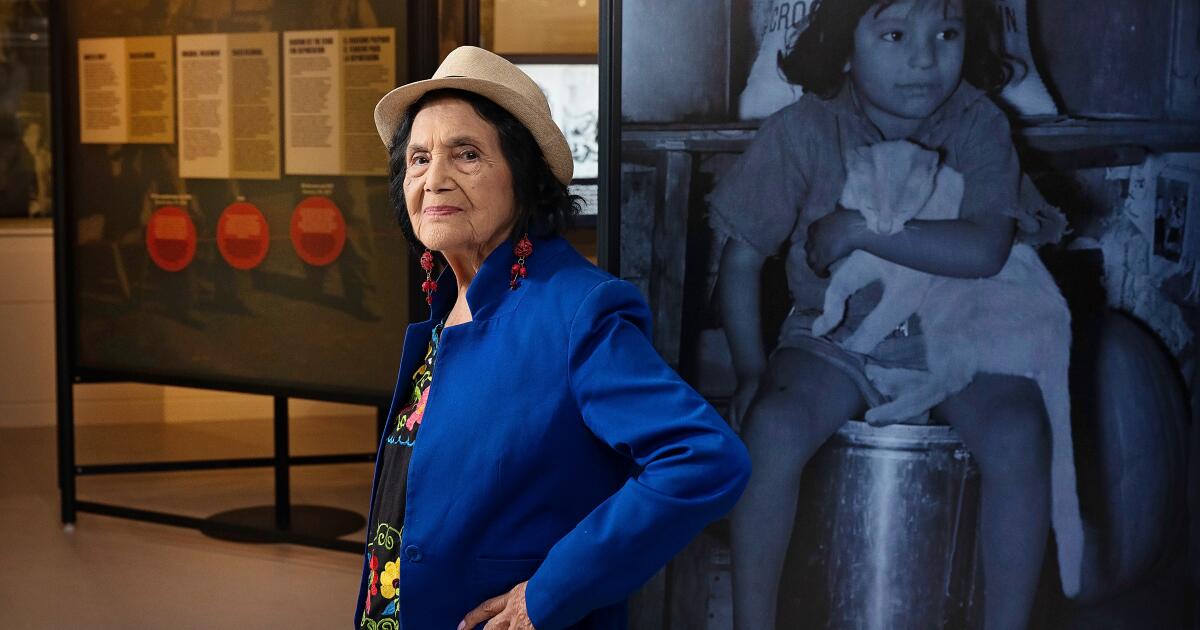

Nearly six months after Dolores Huerta went public with sexual abuse allegations against former labor leader Cesar Chavez, with whom she co-founded United Farmworkers, the 96-year-old activist said she’s prioritized involving herself in labor and women’s rights.
Part of that work is now on view at the California Museum in Sacramento in an exhibition called “Help Wanted/Leave Now: ‘Operation Wetback’ and the Revolving Door of Mass Deportation,” which examines decades of the federal government’s deportation campaigns against Mexican immigrants even while it recruited millions of these farmworkers and rail workers to fill labor shortages during and after World War II.
The show opened last week and runs through Jan. 10 in Sacramento, with plans then to travel to other institutions. It was developed with guidance from an advisory board that included Huerta, academics and other experts on immigration history.
“There are a lot of similarities with what’s going on now with what happened,” Huerta said in a recent Zoom interview.
One such story is that of muralist Victor Ochoa, who was just 7 years old in 1955, when two men wearing “Gestapo-looking” uniforms arrived at his East Los Angeles family home. The day before, he’d attended the opening of Disneyland. Hours later, Ochoa watched as a firearm-bearing agent told his mother that she had three days to move her family to Mexico.
“I was frightened about it,” Ochoa, now 78, who was born in Los Angeles and spoke no Spanish at the time, said in an interview.
Victor Ochoa shared his story of being deported as a boy as part of the new California Museum show, “Help Wanted/Leave Now: ‘Operation Wetback’ and the Revolving Door of Mass Deportation.”
(Beth Baugher / California Museum)
Heeding the stranger’s orders, Ochoa’s family left for Tijuana in their trailer on the heels of then-President Eisenhower’s “Operation Wetback,” a mass deportation operation that expelled hundreds of thousands of Mexican immigrants in 1954 and reverberated into 1955.
His account is one of the many such stories of coerced expulsion — including those of other Los Angeles residents — featured in the bilingual exhibition.
“Help Wanted/Leave Now” comes months after President Trump told Congress he would dethrone Eisenhower’s 1954 record for the “largest deportation operation in American history.” The show also comes after a federal immigration agent was caught on body camera footage using racist language during a Los Angeles immigration operation last year.

An exhibition view of “Help Wanted/Leave Now” at California Museum in Sacramento. The bilingual show about deportation in the U.S. is to travel to a variety of institutions after its Sacramento run ends in January.
(Bryn Wieking / California Museum)
“It’s devastating, the amount of cruelty that we’re seeing … and a lot of the people that are in detention centers are workers,” Huerta said. “Whether they’re farmworkers or construction workers, hotel workers, restaurant workers, nannies who take care of children, these are working people, and yet they are being treated as if they were some sort of horrible criminals.”
For about a decade, the Sacramento museum’s trustees have discussed creating a traveling exhibition on mass deportations. But it wasn’t until it convened an expert advisory committee in 2024 that it entered development. After its run in Sacramento ends in January, the exhibition will move to other institutions, to be announced in the coming months.
Drawing from Huerta’s experience as a farmworker organizer, the show tells the story of Mexican workers who toiled on temporary labor contracts as part of the bracero program, a series of agreements between the U.S. and Mexican governments that recruited over 4 million men from 1942 to 1964.
Growing up in Stockton, where a high concentration of braceros tended fields, Huerta said witnessing the workers’ subpar conditions drove her early activism.
“The workers were not fed properly, the shelter that they gave them was not appropriate, and many times workers were injured,” she said. “They were sent back to Mexico injured.”

A portion of the California Museum exhibition “Help Wanted/Leave Now,” which tells the story of mass deportations in the U.S. during the 20th century but resonates with the events of today.
(Bryn Wieking / California Museum)
United Farmworkers lobbied Congress to end the bracero program, arguing that the program exploited workers.
“I found myself finding places [for them] when they were injured, finding doctors for them, finding lawyers for them,” Huerta said.
She recalled the story of one bracero who was crushed under a car in what she described as a “labor camp” where he worked as a mechanic, and another young man who lost his fingers while operating a lathe machine.
According to Huerta, many of the men who came to work as braceros had no experience with the type of labor they would encounter upon their arrival.
“Of course, once they got here and they put them in the fields, that is not what they knew how to do or wanted to do,” Huerta said. “So a lot of them skipped their contract … And of course, a lot of them were deported.”
The bracero program’s modern-day descendant, according to Huerta, is the H2-A temporary agricultural worker program, which she describes as “a step away from slavery.” Last year, the Trump administration moved to drastically cut the hourly wages for immigrant laborers in the program.
Among the original braceros who arrived in the 1940s was the grandfather of one of the show’s advisory council members, Martha Escutia, an attorney and former state senator who represented parts of Southeast Los Angeles.
Escutia was raised in East Los Angeles and now works for USC. A photo of her grandfather Ricardo Ovilla and her mother in front of his bracero living quarters appears in “Help Wanted/Leave Now.”
When she saw the exhibition last week, Escutia cried. The photographs on the walls, she said, corroborated parts of the stories she’d heard from her grandfather about the bracero program, including that he was made to shower in chemicals upon entry into the United States.
In addition to “Operation Wetback” and the bracero program, the exhibition covers the forced “repatriation” of over 1 million Mexican immigrants and Mexican Americans during the 1930s and ‘40s, inflamed by fears that immigrants were taking jobs from “real Americans” amid the Depression.

An exhibition view of “Help Wanted/Leave Now,” at California Museum in Sacramento.
(Bryn Wieking / California Museum)
An estimated 400,000 people were expelled from California alone during that time.
One of the largest public immigration raids associated with the campaign happened in the wake of the 1931 La Placita raid on Olvera Street in downtown L.A.
According to some estimates, about 60% of the individuals sent to Mexico during the so-called “Mexican Repatriation,” a joint effort between state and federal authorities, were American citizens.
One of the U.S. citizens forced to relocate was the late Emilia Castañeda, who was born in 1926 and lived in Boyle Heights.
Castañeda’s daughter, Christine Valenciana, associate professor emeritus of elementary and bilingual education at Cal State Fullerton, said her mother was forced to leave Los Angeles by train when she was 9 years old.
When she was a teenager, Castañeda returned to Los Angeles to live with her godmother. Castañeda’s father was never able to return.
In her 70s, Castañeda testified before state legislators about her experience, excerpts of which appear in the exhibition. In 2005, the California government formally apologized for these forced removals, recognizing they were “fundamental violations of … basic civil liberties and constitutional rights” during a period “of illegal deportation and coerced emigration.”
Last week, Valenciana attended the opening of “Help Wanted/Leave Now” in Sacramento.
“I came down in tears when I heard my mom’s voice and saw that panel,” Valenciana said. “She wants people to know what happened so it doesn’t happen again.”
Like Castañeda, Ochoa — the boy expelled during Eisenhower’s operation — returned to the United States as a teenager. He went on to become a celebrated muralist in San Diego, where he now lives.

Activist Dolores Huerta likens the cruelty of mass deportations in the 20th century to the ICE raids happening in America today.
(Beth Baugher / California Museum)
Huerta, who visited the exhibition last week, described the display as a “reminder.”
“A reminder of what these people had to go through, and the lack of respect of the United States government had for people that were brought in to help the U.S., and then treated them badly once they were here,” she said.
She said she hopes the show’s visitors will be encouraged to “treat our immigrants as humanely as possible.”
“A lot of the people that are in detention centers are the Indigenous people of the North American continent, the South American continent,” she continued. “This is their land. … They are not intruders.”
She hopes there will be a program like the 1986 Immigration Reform and Control Act she lobbied for, which created amnesty for nearly 3 million undocumented immigrants.
“When young people see pictures of people that look like their grandfather, they should be very proud [because] … Mexican braceros came here to the United States and saved us during World War II,” she said. “We have an eternal debt to them that has never been paid. Sí se puede.”

Nearly six months after Dolores Huerta went public with sexual abuse allegations against former labor leader Cesar Chavez, with whom she co-founded United Farmworkers, the 96-year-old activist said she’s prioritized involving herself in labor and women’s rights.
Part of that work is now on view at the California Museum in Sacramento in an exhibition called “Help Wanted/Leave Now: ‘Operation Wetback’ and the Revolving Door of Mass Deportation,” which examines decades of the federal government’s deportation campaigns against Mexican immigrants even while it recruited millions of these farmworkers and rail workers to fill labor shortages during and after World War II.
The show opened last week and runs through Jan. 10 in Sacramento, with plans then to travel to other institutions. It was developed with guidance from an advisory board that included Huerta, academics and other experts on immigration history.
“There are a lot of similarities with what’s going on now with what happened,” Huerta said in a recent Zoom interview.
One such story is that of muralist Victor Ochoa, who was just 7 years old in 1955, when two men wearing “Gestapo-looking” uniforms arrived at his East Los Angeles family home. The day before, he’d attended the opening of Disneyland. Hours later, Ochoa watched as a firearm-bearing agent told his mother that she had three days to move her family to Mexico.
“I was frightened about it,” Ochoa, now 78, who was born in Los Angeles and spoke no Spanish at the time, said in an interview.
Victor Ochoa shared his story of being deported as a boy as part of the new California Museum show, “Help Wanted/Leave Now: ‘Operation Wetback’ and the Revolving Door of Mass Deportation.”
(Beth Baugher / California Museum)
Heeding the stranger’s orders, Ochoa’s family left for Tijuana in their trailer on the heels of then-President Eisenhower’s “Operation Wetback,” a mass deportation operation that expelled hundreds of thousands of Mexican immigrants in 1954 and reverberated into 1955.
His account is one of the many such stories of coerced expulsion — including those of other Los Angeles residents — featured in the bilingual exhibition.
“Help Wanted/Leave Now” comes months after President Trump told Congress he would dethrone Eisenhower’s 1954 record for the “largest deportation operation in American history.” The show also comes after a federal immigration agent was caught on body camera footage using racist language during a Los Angeles immigration operation last year.
An exhibition view of “Help Wanted/Leave Now” at California Museum in Sacramento. The bilingual show about deportation in the U.S. is to travel to a variety of institutions after its Sacramento run ends in January.
(Bryn Wieking / California Museum)
“It’s devastating, the amount of cruelty that we’re seeing … and a lot of the people that are in detention centers are workers,” Huerta said. “Whether they’re farmworkers or construction workers, hotel workers, restaurant workers, nannies who take care of children, these are working people, and yet they are being treated as if they were some sort of horrible criminals.”
For about a decade, the Sacramento museum’s trustees have discussed creating a traveling exhibition on mass deportations. But it wasn’t until it convened an expert advisory committee in 2024 that it entered development. After its run in Sacramento ends in January, the exhibition will move to other institutions, to be announced in the coming months.
Drawing from Huerta’s experience as a farmworker organizer, the show tells the story of Mexican workers who toiled on temporary labor contracts as part of the bracero program, a series of agreements between the U.S. and Mexican governments that recruited over 4 million men from 1942 to 1964.
Growing up in Stockton, where a high concentration of braceros tended fields, Huerta said witnessing the workers’ subpar conditions drove her early activism.
“The workers were not fed properly, the shelter that they gave them was not appropriate, and many times workers were injured,” she said. “They were sent back to Mexico injured.”
A portion of the California Museum exhibition “Help Wanted/Leave Now,” which tells the story of mass deportations in the U.S. during the 20th century but resonates with the events of today.
(Bryn Wieking / California Museum)
United Farmworkers lobbied Congress to end the bracero program, arguing that the program exploited workers.
“I found myself finding places [for them] when they were injured, finding doctors for them, finding lawyers for them,” Huerta said.
She recalled the story of one bracero who was crushed under a car in what she described as a “labor camp” where he worked as a mechanic, and another young man who lost his fingers while operating a lathe machine.
According to Huerta, many of the men who came to work as braceros had no experience with the type of labor they would encounter upon their arrival.
“Of course, once they got here and they put them in the fields, that is not what they knew how to do or wanted to do,” Huerta said. “So a lot of them skipped their contract … And of course, a lot of them were deported.”
The bracero program’s modern-day descendant, according to Huerta, is the H2-A temporary agricultural worker program, which she describes as “a step away from slavery.” Last year, the Trump administration moved to drastically cut the hourly wages for immigrant laborers in the program.
Among the original braceros who arrived in the 1940s was the grandfather of one of the show’s advisory council members, Martha Escutia, an attorney and former state senator who represented parts of Southeast Los Angeles.
Escutia was raised in East Los Angeles and now works for USC. A photo of her grandfather Ricardo Ovilla and her mother in front of his bracero living quarters appears in “Help Wanted/Leave Now.”
When she saw the exhibition last week, Escutia cried. The photographs on the walls, she said, corroborated parts of the stories she’d heard from her grandfather about the bracero program, including that he was made to shower in chemicals upon entry into the United States.
In addition to “Operation Wetback” and the bracero program, the exhibition covers the forced “repatriation” of over 1 million Mexican immigrants and Mexican Americans during the 1930s and ‘40s, inflamed by fears that immigrants were taking jobs from “real Americans” amid the Depression.
An exhibition view of “Help Wanted/Leave Now,” at California Museum in Sacramento.
(Bryn Wieking / California Museum)
An estimated 400,000 people were expelled from California alone during that time.
One of the largest public immigration raids associated with the campaign happened in the wake of the 1931 La Placita raid on Olvera Street in downtown L.A.
According to some estimates, about 60% of the individuals sent to Mexico during the so-called “Mexican Repatriation,” a joint effort between state and federal authorities, were American citizens.
One of the U.S. citizens forced to relocate was the late Emilia Castañeda, who was born in 1926 and lived in Boyle Heights.
Castañeda’s daughter, Christine Valenciana, associate professor emeritus of elementary and bilingual education at Cal State Fullerton, said her mother was forced to leave Los Angeles by train when she was 9 years old.
When she was a teenager, Castañeda returned to Los Angeles to live with her godmother. Castañeda’s father was never able to return.
In her 70s, Castañeda testified before state legislators about her experience, excerpts of which appear in the exhibition. In 2005, the California government formally apologized for these forced removals, recognizing they were “fundamental violations of … basic civil liberties and constitutional rights” during a period “of illegal deportation and coerced emigration.”
Last week, Valenciana attended the opening of “Help Wanted/Leave Now” in Sacramento.
“I came down in tears when I heard my mom’s voice and saw that panel,” Valenciana said. “She wants people to know what happened so it doesn’t happen again.”
Like Castañeda, Ochoa — the boy expelled during Eisenhower’s operation — returned to the United States as a teenager. He went on to become a celebrated muralist in San Diego, where he now lives.
Activist Dolores Huerta likens the cruelty of mass deportations in the 20th century to the ICE raids happening in America today.
(Beth Baugher / California Museum)
Huerta, who visited the exhibition last week, described the display as a “reminder.”
“A reminder of what these people had to go through, and the lack of respect of the United States government had for people that were brought in to help the U.S., and then treated them badly once they were here,” she said.
She said she hopes the show’s visitors will be encouraged to “treat our immigrants as humanely as possible.”
“A lot of the people that are in detention centers are the Indigenous people of the North American continent, the South American continent,” she continued. “This is their land. … They are not intruders.”
She hopes there will be a program like the 1986 Immigration Reform and Control Act she lobbied for, which created amnesty for nearly 3 million undocumented immigrants.
“When young people see pictures of people that look like their grandfather, they should be very proud [because] … Mexican braceros came here to the United States and saved us during World War II,” she said. “We have an eternal debt to them that has never been paid. Sí se puede.”

Nearly six months after Dolores Huerta went public with sexual abuse allegations against former labor leader Cesar Chavez, with whom she co-founded United Farmworkers, the 96-year-old activist said she’s prioritized involving herself in labor and women’s rights.
Part of that work is now on view at the California Museum in Sacramento in an exhibition called “Help Wanted/Leave Now: ‘Operation Wetback’ and the Revolving Door of Mass Deportation,” which examines decades of the federal government’s deportation campaigns against Mexican immigrants even while it recruited millions of these farmworkers and rail workers to fill labor shortages during and after World War II.
The show opened last week and runs through Jan. 10 in Sacramento, with plans then to travel to other institutions. It was developed with guidance from an advisory board that included Huerta, academics and other experts on immigration history.
“There are a lot of similarities with what’s going on now with what happened,” Huerta said in a recent Zoom interview.
One such story is that of muralist Victor Ochoa, who was just 7 years old in 1955, when two men wearing “Gestapo-looking” uniforms arrived at his East Los Angeles family home. The day before, he’d attended the opening of Disneyland. Hours later, Ochoa watched as a firearm-bearing agent told his mother that she had three days to move her family to Mexico.
“I was frightened about it,” Ochoa, now 78, who was born in Los Angeles and spoke no Spanish at the time, said in an interview.
Victor Ochoa shared his story of being deported as a boy as part of the new California Museum show, “Help Wanted/Leave Now: ‘Operation Wetback’ and the Revolving Door of Mass Deportation.”
(Beth Baugher / California Museum)
Heeding the stranger’s orders, Ochoa’s family left for Tijuana in their trailer on the heels of then-President Eisenhower’s “Operation Wetback,” a mass deportation operation that expelled hundreds of thousands of Mexican immigrants in 1954 and reverberated into 1955.
His account is one of the many such stories of coerced expulsion — including those of other Los Angeles residents — featured in the bilingual exhibition.
“Help Wanted/Leave Now” comes months after President Trump told Congress he would dethrone Eisenhower’s 1954 record for the “largest deportation operation in American history.” The show also comes after a federal immigration agent was caught on body camera footage using racist language during a Los Angeles immigration operation last year.
An exhibition view of “Help Wanted/Leave Now” at California Museum in Sacramento. The bilingual show about deportation in the U.S. is to travel to a variety of institutions after its Sacramento run ends in January.
(Bryn Wieking / California Museum)
“It’s devastating, the amount of cruelty that we’re seeing … and a lot of the people that are in detention centers are workers,” Huerta said. “Whether they’re farmworkers or construction workers, hotel workers, restaurant workers, nannies who take care of children, these are working people, and yet they are being treated as if they were some sort of horrible criminals.”
For about a decade, the Sacramento museum’s trustees have discussed creating a traveling exhibition on mass deportations. But it wasn’t until it convened an expert advisory committee in 2024 that it entered development. After its run in Sacramento ends in January, the exhibition will move to other institutions, to be announced in the coming months.
Drawing from Huerta’s experience as a farmworker organizer, the show tells the story of Mexican workers who toiled on temporary labor contracts as part of the bracero program, a series of agreements between the U.S. and Mexican governments that recruited over 4 million men from 1942 to 1964.
Growing up in Stockton, where a high concentration of braceros tended fields, Huerta said witnessing the workers’ subpar conditions drove her early activism.
“The workers were not fed properly, the shelter that they gave them was not appropriate, and many times workers were injured,” she said. “They were sent back to Mexico injured.”
A portion of the California Museum exhibition “Help Wanted/Leave Now,” which tells the story of mass deportations in the U.S. during the 20th century but resonates with the events of today.
(Bryn Wieking / California Museum)
United Farmworkers lobbied Congress to end the bracero program, arguing that the program exploited workers.
“I found myself finding places [for them] when they were injured, finding doctors for them, finding lawyers for them,” Huerta said.
She recalled the story of one bracero who was crushed under a car in what she described as a “labor camp” where he worked as a mechanic, and another young man who lost his fingers while operating a lathe machine.
According to Huerta, many of the men who came to work as braceros had no experience with the type of labor they would encounter upon their arrival.
“Of course, once they got here and they put them in the fields, that is not what they knew how to do or wanted to do,” Huerta said. “So a lot of them skipped their contract … And of course, a lot of them were deported.”
The bracero program’s modern-day descendant, according to Huerta, is the H2-A temporary agricultural worker program, which she describes as “a step away from slavery.” Last year, the Trump administration moved to drastically cut the hourly wages for immigrant laborers in the program.
Among the original braceros who arrived in the 1940s was the grandfather of one of the show’s advisory council members, Martha Escutia, an attorney and former state senator who represented parts of Southeast Los Angeles.
Escutia was raised in East Los Angeles and now works for USC. A photo of her grandfather Ricardo Ovilla and her mother in front of his bracero living quarters appears in “Help Wanted/Leave Now.”
When she saw the exhibition last week, Escutia cried. The photographs on the walls, she said, corroborated parts of the stories she’d heard from her grandfather about the bracero program, including that he was made to shower in chemicals upon entry into the United States.
In addition to “Operation Wetback” and the bracero program, the exhibition covers the forced “repatriation” of over 1 million Mexican immigrants and Mexican Americans during the 1930s and ‘40s, inflamed by fears that immigrants were taking jobs from “real Americans” amid the Depression.
An exhibition view of “Help Wanted/Leave Now,” at California Museum in Sacramento.
(Bryn Wieking / California Museum)
An estimated 400,000 people were expelled from California alone during that time.
One of the largest public immigration raids associated with the campaign happened in the wake of the 1931 La Placita raid on Olvera Street in downtown L.A.
According to some estimates, about 60% of the individuals sent to Mexico during the so-called “Mexican Repatriation,” a joint effort between state and federal authorities, were American citizens.
One of the U.S. citizens forced to relocate was the late Emilia Castañeda, who was born in 1926 and lived in Boyle Heights.
Castañeda’s daughter, Christine Valenciana, associate professor emeritus of elementary and bilingual education at Cal State Fullerton, said her mother was forced to leave Los Angeles by train when she was 9 years old.
When she was a teenager, Castañeda returned to Los Angeles to live with her godmother. Castañeda’s father was never able to return.
In her 70s, Castañeda testified before state legislators about her experience, excerpts of which appear in the exhibition. In 2005, the California government formally apologized for these forced removals, recognizing they were “fundamental violations of … basic civil liberties and constitutional rights” during a period “of illegal deportation and coerced emigration.”
Last week, Valenciana attended the opening of “Help Wanted/Leave Now” in Sacramento.
“I came down in tears when I heard my mom’s voice and saw that panel,” Valenciana said. “She wants people to know what happened so it doesn’t happen again.”
Like Castañeda, Ochoa — the boy expelled during Eisenhower’s operation — returned to the United States as a teenager. He went on to become a celebrated muralist in San Diego, where he now lives.
Activist Dolores Huerta likens the cruelty of mass deportations in the 20th century to the ICE raids happening in America today.
(Beth Baugher / California Museum)
Huerta, who visited the exhibition last week, described the display as a “reminder.”
“A reminder of what these people had to go through, and the lack of respect of the United States government had for people that were brought in to help the U.S., and then treated them badly once they were here,” she said.
She said she hopes the show’s visitors will be encouraged to “treat our immigrants as humanely as possible.”
“A lot of the people that are in detention centers are the Indigenous people of the North American continent, the South American continent,” she continued. “This is their land. … They are not intruders.”
She hopes there will be a program like the 1986 Immigration Reform and Control Act she lobbied for, which created amnesty for nearly 3 million undocumented immigrants.
“When young people see pictures of people that look like their grandfather, they should be very proud [because] … Mexican braceros came here to the United States and saved us during World War II,” she said. “We have an eternal debt to them that has never been paid. Sí se puede.”
Nearly six months after Dolores Huerta went public with sexual abuse allegations against former labor leader Cesar Chavez, with whom she co-founded United Farmworkers, the 96-year-old activist said she’s prioritized involving herself in labor and women’s rights.
Part of that work is now on view at the California Museum in Sacramento in an exhibition called “Help Wanted/Leave Now: ‘Operation Wetback’ and the Revolving Door of Mass Deportation,” which examines decades of the federal government’s deportation campaigns against Mexican immigrants even while it recruited millions of these farmworkers and rail workers to fill labor shortages during and after World War II.
The show opened last week and runs through Jan. 10 in Sacramento, with plans then to travel to other institutions. It was developed with guidance from an advisory board that included Huerta, academics and other experts on immigration history.
“There are a lot of similarities with what’s going on now with what happened,” Huerta said in a recent Zoom interview.
One such story is that of muralist Victor Ochoa, who was just 7 years old in 1955, when two men wearing “Gestapo-looking” uniforms arrived at his East Los Angeles family home. The day before, he’d attended the opening of Disneyland. Hours later, Ochoa watched as a firearm-bearing agent told his mother that she had three days to move her family to Mexico.
“I was frightened about it,” Ochoa, now 78, who was born in Los Angeles and spoke no Spanish at the time, said in an interview.
Victor Ochoa shared his story of being deported as a boy as part of the new California Museum show, “Help Wanted/Leave Now: ‘Operation Wetback’ and the Revolving Door of Mass Deportation.”
(Beth Baugher / California Museum)
Heeding the stranger’s orders, Ochoa’s family left for Tijuana in their trailer on the heels of then-President Eisenhower’s “Operation Wetback,” a mass deportation operation that expelled hundreds of thousands of Mexican immigrants in 1954 and reverberated into 1955.
His account is one of the many such stories of coerced expulsion — including those of other Los Angeles residents — featured in the bilingual exhibition.
“Help Wanted/Leave Now” comes months after President Trump told Congress he would dethrone Eisenhower’s 1954 record for the “largest deportation operation in American history.” The show also comes after a federal immigration agent was caught on body camera footage using racist language during a Los Angeles immigration operation last year.
An exhibition view of “Help Wanted/Leave Now” at California Museum in Sacramento. The bilingual show about deportation in the U.S. is to travel to a variety of institutions after its Sacramento run ends in January.
(Bryn Wieking / California Museum)
“It’s devastating, the amount of cruelty that we’re seeing … and a lot of the people that are in detention centers are workers,” Huerta said. “Whether they’re farmworkers or construction workers, hotel workers, restaurant workers, nannies who take care of children, these are working people, and yet they are being treated as if they were some sort of horrible criminals.”
For about a decade, the Sacramento museum’s trustees have discussed creating a traveling exhibition on mass deportations. But it wasn’t until it convened an expert advisory committee in 2024 that it entered development. After its run in Sacramento ends in January, the exhibition will move to other institutions, to be announced in the coming months.
Drawing from Huerta’s experience as a farmworker organizer, the show tells the story of Mexican workers who toiled on temporary labor contracts as part of the bracero program, a series of agreements between the U.S. and Mexican governments that recruited over 4 million men from 1942 to 1964.
Growing up in Stockton, where a high concentration of braceros tended fields, Huerta said witnessing the workers’ subpar conditions drove her early activism.
“The workers were not fed properly, the shelter that they gave them was not appropriate, and many times workers were injured,” she said. “They were sent back to Mexico injured.”
A portion of the California Museum exhibition “Help Wanted/Leave Now,” which tells the story of mass deportations in the U.S. during the 20th century but resonates with the events of today.
(Bryn Wieking / California Museum)
United Farmworkers lobbied Congress to end the bracero program, arguing that the program exploited workers.
“I found myself finding places [for them] when they were injured, finding doctors for them, finding lawyers for them,” Huerta said.
She recalled the story of one bracero who was crushed under a car in what she described as a “labor camp” where he worked as a mechanic, and another young man who lost his fingers while operating a lathe machine.
According to Huerta, many of the men who came to work as braceros had no experience with the type of labor they would encounter upon their arrival.
“Of course, once they got here and they put them in the fields, that is not what they knew how to do or wanted to do,” Huerta said. “So a lot of them skipped their contract … And of course, a lot of them were deported.”
The bracero program’s modern-day descendant, according to Huerta, is the H2-A temporary agricultural worker program, which she describes as “a step away from slavery.” Last year, the Trump administration moved to drastically cut the hourly wages for immigrant laborers in the program.
Among the original braceros who arrived in the 1940s was the grandfather of one of the show’s advisory council members, Martha Escutia, an attorney and former state senator who represented parts of Southeast Los Angeles.
Escutia was raised in East Los Angeles and now works for USC. A photo of her grandfather Ricardo Ovilla and her mother in front of his bracero living quarters appears in “Help Wanted/Leave Now.”
When she saw the exhibition last week, Escutia cried. The photographs on the walls, she said, corroborated parts of the stories she’d heard from her grandfather about the bracero program, including that he was made to shower in chemicals upon entry into the United States.
In addition to “Operation Wetback” and the bracero program, the exhibition covers the forced “repatriation” of over 1 million Mexican immigrants and Mexican Americans during the 1930s and ‘40s, inflamed by fears that immigrants were taking jobs from “real Americans” amid the Depression.
An exhibition view of “Help Wanted/Leave Now,” at California Museum in Sacramento.
(Bryn Wieking / California Museum)
An estimated 400,000 people were expelled from California alone during that time.
One of the largest public immigration raids associated with the campaign happened in the wake of the 1931 La Placita raid on Olvera Street in downtown L.A.
According to some estimates, about 60% of the individuals sent to Mexico during the so-called “Mexican Repatriation,” a joint effort between state and federal authorities, were American citizens.
One of the U.S. citizens forced to relocate was the late Emilia Castañeda, who was born in 1926 and lived in Boyle Heights.
Castañeda’s daughter, Christine Valenciana, associate professor emeritus of elementary and bilingual education at Cal State Fullerton, said her mother was forced to leave Los Angeles by train when she was 9 years old.
When she was a teenager, Castañeda returned to Los Angeles to live with her godmother. Castañeda’s father was never able to return.
In her 70s, Castañeda testified before state legislators about her experience, excerpts of which appear in the exhibition. In 2005, the California government formally apologized for these forced removals, recognizing they were “fundamental violations of … basic civil liberties and constitutional rights” during a period “of illegal deportation and coerced emigration.”
Last week, Valenciana attended the opening of “Help Wanted/Leave Now” in Sacramento.
“I came down in tears when I heard my mom’s voice and saw that panel,” Valenciana said. “She wants people to know what happened so it doesn’t happen again.”
Like Castañeda, Ochoa — the boy expelled during Eisenhower’s operation — returned to the United States as a teenager. He went on to become a celebrated muralist in San Diego, where he now lives.
Activist Dolores Huerta likens the cruelty of mass deportations in the 20th century to the ICE raids happening in America today.
(Beth Baugher / California Museum)
Huerta, who visited the exhibition last week, described the display as a “reminder.”
“A reminder of what these people had to go through, and the lack of respect of the United States government had for people that were brought in to help the U.S., and then treated them badly once they were here,” she said.
She said she hopes the show’s visitors will be encouraged to “treat our immigrants as humanely as possible.”
“A lot of the people that are in detention centers are the Indigenous people of the North American continent, the South American continent,” she continued. “This is their land. … They are not intruders.”
She hopes there will be a program like the 1986 Immigration Reform and Control Act she lobbied for, which created amnesty for nearly 3 million undocumented immigrants.
“When young people see pictures of people that look like their grandfather, they should be very proud [because] … Mexican braceros came here to the United States and saved us during World War II,” she said. “We have an eternal debt to them that has never been paid. Sí se puede.”

Nearly six months after Dolores Huerta went public with sexual abuse allegations against former labor leader Cesar Chavez, with whom she co-founded United Farmworkers, the 96-year-old activist said she’s prioritized involving herself in labor and women’s rights.
Part of that work is now on view at the California Museum in Sacramento in an exhibition called “Help Wanted/Leave Now: ‘Operation Wetback’ and the Revolving Door of Mass Deportation,” which examines decades of the federal government’s deportation campaigns against Mexican immigrants even while it recruited millions of these farmworkers and rail workers to fill labor shortages during and after World War II.
The show opened last week and runs through Jan. 10 in Sacramento, with plans then to travel to other institutions. It was developed with guidance from an advisory board that included Huerta, academics and other experts on immigration history.
“There are a lot of similarities with what’s going on now with what happened,” Huerta said in a recent Zoom interview.
One such story is that of muralist Victor Ochoa, who was just 7 years old in 1955, when two men wearing “Gestapo-looking” uniforms arrived at his East Los Angeles family home. The day before, he’d attended the opening of Disneyland. Hours later, Ochoa watched as a firearm-bearing agent told his mother that she had three days to move her family to Mexico.
“I was frightened about it,” Ochoa, now 78, who was born in Los Angeles and spoke no Spanish at the time, said in an interview.
Victor Ochoa shared his story of being deported as a boy as part of the new California Museum show, “Help Wanted/Leave Now: ‘Operation Wetback’ and the Revolving Door of Mass Deportation.”
(Beth Baugher / California Museum)
Heeding the stranger’s orders, Ochoa’s family left for Tijuana in their trailer on the heels of then-President Eisenhower’s “Operation Wetback,” a mass deportation operation that expelled hundreds of thousands of Mexican immigrants in 1954 and reverberated into 1955.
His account is one of the many such stories of coerced expulsion — including those of other Los Angeles residents — featured in the bilingual exhibition.
“Help Wanted/Leave Now” comes months after President Trump told Congress he would dethrone Eisenhower’s 1954 record for the “largest deportation operation in American history.” The show also comes after a federal immigration agent was caught on body camera footage using racist language during a Los Angeles immigration operation last year.
An exhibition view of “Help Wanted/Leave Now” at California Museum in Sacramento. The bilingual show about deportation in the U.S. is to travel to a variety of institutions after its Sacramento run ends in January.
(Bryn Wieking / California Museum)
“It’s devastating, the amount of cruelty that we’re seeing … and a lot of the people that are in detention centers are workers,” Huerta said. “Whether they’re farmworkers or construction workers, hotel workers, restaurant workers, nannies who take care of children, these are working people, and yet they are being treated as if they were some sort of horrible criminals.”
For about a decade, the Sacramento museum’s trustees have discussed creating a traveling exhibition on mass deportations. But it wasn’t until it convened an expert advisory committee in 2024 that it entered development. After its run in Sacramento ends in January, the exhibition will move to other institutions, to be announced in the coming months.
Drawing from Huerta’s experience as a farmworker organizer, the show tells the story of Mexican workers who toiled on temporary labor contracts as part of the bracero program, a series of agreements between the U.S. and Mexican governments that recruited over 4 million men from 1942 to 1964.
Growing up in Stockton, where a high concentration of braceros tended fields, Huerta said witnessing the workers’ subpar conditions drove her early activism.
“The workers were not fed properly, the shelter that they gave them was not appropriate, and many times workers were injured,” she said. “They were sent back to Mexico injured.”
A portion of the California Museum exhibition “Help Wanted/Leave Now,” which tells the story of mass deportations in the U.S. during the 20th century but resonates with the events of today.
(Bryn Wieking / California Museum)
United Farmworkers lobbied Congress to end the bracero program, arguing that the program exploited workers.
“I found myself finding places [for them] when they were injured, finding doctors for them, finding lawyers for them,” Huerta said.
She recalled the story of one bracero who was crushed under a car in what she described as a “labor camp” where he worked as a mechanic, and another young man who lost his fingers while operating a lathe machine.
According to Huerta, many of the men who came to work as braceros had no experience with the type of labor they would encounter upon their arrival.
“Of course, once they got here and they put them in the fields, that is not what they knew how to do or wanted to do,” Huerta said. “So a lot of them skipped their contract … And of course, a lot of them were deported.”
The bracero program’s modern-day descendant, according to Huerta, is the H2-A temporary agricultural worker program, which she describes as “a step away from slavery.” Last year, the Trump administration moved to drastically cut the hourly wages for immigrant laborers in the program.
Among the original braceros who arrived in the 1940s was the grandfather of one of the show’s advisory council members, Martha Escutia, an attorney and former state senator who represented parts of Southeast Los Angeles.
Escutia was raised in East Los Angeles and now works for USC. A photo of her grandfather Ricardo Ovilla and her mother in front of his bracero living quarters appears in “Help Wanted/Leave Now.”
When she saw the exhibition last week, Escutia cried. The photographs on the walls, she said, corroborated parts of the stories she’d heard from her grandfather about the bracero program, including that he was made to shower in chemicals upon entry into the United States.
In addition to “Operation Wetback” and the bracero program, the exhibition covers the forced “repatriation” of over 1 million Mexican immigrants and Mexican Americans during the 1930s and ‘40s, inflamed by fears that immigrants were taking jobs from “real Americans” amid the Depression.
An exhibition view of “Help Wanted/Leave Now,” at California Museum in Sacramento.
(Bryn Wieking / California Museum)
An estimated 400,000 people were expelled from California alone during that time.
One of the largest public immigration raids associated with the campaign happened in the wake of the 1931 La Placita raid on Olvera Street in downtown L.A.
According to some estimates, about 60% of the individuals sent to Mexico during the so-called “Mexican Repatriation,” a joint effort between state and federal authorities, were American citizens.
One of the U.S. citizens forced to relocate was the late Emilia Castañeda, who was born in 1926 and lived in Boyle Heights.
Castañeda’s daughter, Christine Valenciana, associate professor emeritus of elementary and bilingual education at Cal State Fullerton, said her mother was forced to leave Los Angeles by train when she was 9 years old.
When she was a teenager, Castañeda returned to Los Angeles to live with her godmother. Castañeda’s father was never able to return.
In her 70s, Castañeda testified before state legislators about her experience, excerpts of which appear in the exhibition. In 2005, the California government formally apologized for these forced removals, recognizing they were “fundamental violations of … basic civil liberties and constitutional rights” during a period “of illegal deportation and coerced emigration.”
Last week, Valenciana attended the opening of “Help Wanted/Leave Now” in Sacramento.
“I came down in tears when I heard my mom’s voice and saw that panel,” Valenciana said. “She wants people to know what happened so it doesn’t happen again.”
Like Castañeda, Ochoa — the boy expelled during Eisenhower’s operation — returned to the United States as a teenager. He went on to become a celebrated muralist in San Diego, where he now lives.
Activist Dolores Huerta likens the cruelty of mass deportations in the 20th century to the ICE raids happening in America today.
(Beth Baugher / California Museum)
Huerta, who visited the exhibition last week, described the display as a “reminder.”
“A reminder of what these people had to go through, and the lack of respect of the United States government had for people that were brought in to help the U.S., and then treated them badly once they were here,” she said.
She said she hopes the show’s visitors will be encouraged to “treat our immigrants as humanely as possible.”
“A lot of the people that are in detention centers are the Indigenous people of the North American continent, the South American continent,” she continued. “This is their land. … They are not intruders.”
She hopes there will be a program like the 1986 Immigration Reform and Control Act she lobbied for, which created amnesty for nearly 3 million undocumented immigrants.
“When young people see pictures of people that look like their grandfather, they should be very proud [because] … Mexican braceros came here to the United States and saved us during World War II,” she said. “We have an eternal debt to them that has never been paid. Sí se puede.”
Nearly six months after Dolores Huerta went public with sexual abuse allegations against former labor leader Cesar Chavez, with whom she co-founded United Farmworkers, the 96-year-old activist said she’s prioritized involving herself in labor and women’s rights.
Part of that work is now on view at the California Museum in Sacramento in an exhibition called “Help Wanted/Leave Now: ‘Operation Wetback’ and the Revolving Door of Mass Deportation,” which examines decades of the federal government’s deportation campaigns against Mexican immigrants even while it recruited millions of these farmworkers and rail workers to fill labor shortages during and after World War II.
The show opened last week and runs through Jan. 10 in Sacramento, with plans then to travel to other institutions. It was developed with guidance from an advisory board that included Huerta, academics and other experts on immigration history.
“There are a lot of similarities with what’s going on now with what happened,” Huerta said in a recent Zoom interview.
One such story is that of muralist Victor Ochoa, who was just 7 years old in 1955, when two men wearing “Gestapo-looking” uniforms arrived at his East Los Angeles family home. The day before, he’d attended the opening of Disneyland. Hours later, Ochoa watched as a firearm-bearing agent told his mother that she had three days to move her family to Mexico.
“I was frightened about it,” Ochoa, now 78, who was born in Los Angeles and spoke no Spanish at the time, said in an interview.
Victor Ochoa shared his story of being deported as a boy as part of the new California Museum show, “Help Wanted/Leave Now: ‘Operation Wetback’ and the Revolving Door of Mass Deportation.”
(Beth Baugher / California Museum)
Heeding the stranger’s orders, Ochoa’s family left for Tijuana in their trailer on the heels of then-President Eisenhower’s “Operation Wetback,” a mass deportation operation that expelled hundreds of thousands of Mexican immigrants in 1954 and reverberated into 1955.
His account is one of the many such stories of coerced expulsion — including those of other Los Angeles residents — featured in the bilingual exhibition.
“Help Wanted/Leave Now” comes months after President Trump told Congress he would dethrone Eisenhower’s 1954 record for the “largest deportation operation in American history.” The show also comes after a federal immigration agent was caught on body camera footage using racist language during a Los Angeles immigration operation last year.
An exhibition view of “Help Wanted/Leave Now” at California Museum in Sacramento. The bilingual show about deportation in the U.S. is to travel to a variety of institutions after its Sacramento run ends in January.
(Bryn Wieking / California Museum)
“It’s devastating, the amount of cruelty that we’re seeing … and a lot of the people that are in detention centers are workers,” Huerta said. “Whether they’re farmworkers or construction workers, hotel workers, restaurant workers, nannies who take care of children, these are working people, and yet they are being treated as if they were some sort of horrible criminals.”
For about a decade, the Sacramento museum’s trustees have discussed creating a traveling exhibition on mass deportations. But it wasn’t until it convened an expert advisory committee in 2024 that it entered development. After its run in Sacramento ends in January, the exhibition will move to other institutions, to be announced in the coming months.
Drawing from Huerta’s experience as a farmworker organizer, the show tells the story of Mexican workers who toiled on temporary labor contracts as part of the bracero program, a series of agreements between the U.S. and Mexican governments that recruited over 4 million men from 1942 to 1964.
Growing up in Stockton, where a high concentration of braceros tended fields, Huerta said witnessing the workers’ subpar conditions drove her early activism.
“The workers were not fed properly, the shelter that they gave them was not appropriate, and many times workers were injured,” she said. “They were sent back to Mexico injured.”
A portion of the California Museum exhibition “Help Wanted/Leave Now,” which tells the story of mass deportations in the U.S. during the 20th century but resonates with the events of today.
(Bryn Wieking / California Museum)
United Farmworkers lobbied Congress to end the bracero program, arguing that the program exploited workers.
“I found myself finding places [for them] when they were injured, finding doctors for them, finding lawyers for them,” Huerta said.
She recalled the story of one bracero who was crushed under a car in what she described as a “labor camp” where he worked as a mechanic, and another young man who lost his fingers while operating a lathe machine.
According to Huerta, many of the men who came to work as braceros had no experience with the type of labor they would encounter upon their arrival.
“Of course, once they got here and they put them in the fields, that is not what they knew how to do or wanted to do,” Huerta said. “So a lot of them skipped their contract … And of course, a lot of them were deported.”
The bracero program’s modern-day descendant, according to Huerta, is the H2-A temporary agricultural worker program, which she describes as “a step away from slavery.” Last year, the Trump administration moved to drastically cut the hourly wages for immigrant laborers in the program.
Among the original braceros who arrived in the 1940s was the grandfather of one of the show’s advisory council members, Martha Escutia, an attorney and former state senator who represented parts of Southeast Los Angeles.
Escutia was raised in East Los Angeles and now works for USC. A photo of her grandfather Ricardo Ovilla and her mother in front of his bracero living quarters appears in “Help Wanted/Leave Now.”
When she saw the exhibition last week, Escutia cried. The photographs on the walls, she said, corroborated parts of the stories she’d heard from her grandfather about the bracero program, including that he was made to shower in chemicals upon entry into the United States.
In addition to “Operation Wetback” and the bracero program, the exhibition covers the forced “repatriation” of over 1 million Mexican immigrants and Mexican Americans during the 1930s and ‘40s, inflamed by fears that immigrants were taking jobs from “real Americans” amid the Depression.
An exhibition view of “Help Wanted/Leave Now,” at California Museum in Sacramento.
(Bryn Wieking / California Museum)
An estimated 400,000 people were expelled from California alone during that time.
One of the largest public immigration raids associated with the campaign happened in the wake of the 1931 La Placita raid on Olvera Street in downtown L.A.
According to some estimates, about 60% of the individuals sent to Mexico during the so-called “Mexican Repatriation,” a joint effort between state and federal authorities, were American citizens.
One of the U.S. citizens forced to relocate was the late Emilia Castañeda, who was born in 1926 and lived in Boyle Heights.
Castañeda’s daughter, Christine Valenciana, associate professor emeritus of elementary and bilingual education at Cal State Fullerton, said her mother was forced to leave Los Angeles by train when she was 9 years old.
When she was a teenager, Castañeda returned to Los Angeles to live with her godmother. Castañeda’s father was never able to return.
In her 70s, Castañeda testified before state legislators about her experience, excerpts of which appear in the exhibition. In 2005, the California government formally apologized for these forced removals, recognizing they were “fundamental violations of … basic civil liberties and constitutional rights” during a period “of illegal deportation and coerced emigration.”
Last week, Valenciana attended the opening of “Help Wanted/Leave Now” in Sacramento.
“I came down in tears when I heard my mom’s voice and saw that panel,” Valenciana said. “She wants people to know what happened so it doesn’t happen again.”
Like Castañeda, Ochoa — the boy expelled during Eisenhower’s operation — returned to the United States as a teenager. He went on to become a celebrated muralist in San Diego, where he now lives.
Activist Dolores Huerta likens the cruelty of mass deportations in the 20th century to the ICE raids happening in America today.
(Beth Baugher / California Museum)
Huerta, who visited the exhibition last week, described the display as a “reminder.”
“A reminder of what these people had to go through, and the lack of respect of the United States government had for people that were brought in to help the U.S., and then treated them badly once they were here,” she said.
She said she hopes the show’s visitors will be encouraged to “treat our immigrants as humanely as possible.”
“A lot of the people that are in detention centers are the Indigenous people of the North American continent, the South American continent,” she continued. “This is their land. … They are not intruders.”
She hopes there will be a program like the 1986 Immigration Reform and Control Act she lobbied for, which created amnesty for nearly 3 million undocumented immigrants.
“When young people see pictures of people that look like their grandfather, they should be very proud [because] … Mexican braceros came here to the United States and saved us during World War II,” she said. “We have an eternal debt to them that has never been paid. Sí se puede.”
Nearly six months after Dolores Huerta went public with sexual abuse allegations against former labor leader Cesar Chavez, with whom she co-founded United Farmworkers, the 96-year-old activist said she’s prioritized involving herself in labor and women’s rights.
Part of that work is now on view at the California Museum in Sacramento in an exhibition called “Help Wanted/Leave Now: ‘Operation Wetback’ and the Revolving Door of Mass Deportation,” which examines decades of the federal government’s deportation campaigns against Mexican immigrants even while it recruited millions of these farmworkers and rail workers to fill labor shortages during and after World War II.
The show opened last week and runs through Jan. 10 in Sacramento, with plans then to travel to other institutions. It was developed with guidance from an advisory board that included Huerta, academics and other experts on immigration history.
“There are a lot of similarities with what’s going on now with what happened,” Huerta said in a recent Zoom interview.
One such story is that of muralist Victor Ochoa, who was just 7 years old in 1955, when two men wearing “Gestapo-looking” uniforms arrived at his East Los Angeles family home. The day before, he’d attended the opening of Disneyland. Hours later, Ochoa watched as a firearm-bearing agent told his mother that she had three days to move her family to Mexico.
“I was frightened about it,” Ochoa, now 78, who was born in Los Angeles and spoke no Spanish at the time, said in an interview.
Victor Ochoa shared his story of being deported as a boy as part of the new California Museum show, “Help Wanted/Leave Now: ‘Operation Wetback’ and the Revolving Door of Mass Deportation.”
(Beth Baugher / California Museum)
Heeding the stranger’s orders, Ochoa’s family left for Tijuana in their trailer on the heels of then-President Eisenhower’s “Operation Wetback,” a mass deportation operation that expelled hundreds of thousands of Mexican immigrants in 1954 and reverberated into 1955.
His account is one of the many such stories of coerced expulsion — including those of other Los Angeles residents — featured in the bilingual exhibition.
“Help Wanted/Leave Now” comes months after President Trump told Congress he would dethrone Eisenhower’s 1954 record for the “largest deportation operation in American history.” The show also comes after a federal immigration agent was caught on body camera footage using racist language during a Los Angeles immigration operation last year.
An exhibition view of “Help Wanted/Leave Now” at California Museum in Sacramento. The bilingual show about deportation in the U.S. is to travel to a variety of institutions after its Sacramento run ends in January.
(Bryn Wieking / California Museum)
“It’s devastating, the amount of cruelty that we’re seeing … and a lot of the people that are in detention centers are workers,” Huerta said. “Whether they’re farmworkers or construction workers, hotel workers, restaurant workers, nannies who take care of children, these are working people, and yet they are being treated as if they were some sort of horrible criminals.”
For about a decade, the Sacramento museum’s trustees have discussed creating a traveling exhibition on mass deportations. But it wasn’t until it convened an expert advisory committee in 2024 that it entered development. After its run in Sacramento ends in January, the exhibition will move to other institutions, to be announced in the coming months.
Drawing from Huerta’s experience as a farmworker organizer, the show tells the story of Mexican workers who toiled on temporary labor contracts as part of the bracero program, a series of agreements between the U.S. and Mexican governments that recruited over 4 million men from 1942 to 1964.
Growing up in Stockton, where a high concentration of braceros tended fields, Huerta said witnessing the workers’ subpar conditions drove her early activism.
“The workers were not fed properly, the shelter that they gave them was not appropriate, and many times workers were injured,” she said. “They were sent back to Mexico injured.”
A portion of the California Museum exhibition “Help Wanted/Leave Now,” which tells the story of mass deportations in the U.S. during the 20th century but resonates with the events of today.
(Bryn Wieking / California Museum)
United Farmworkers lobbied Congress to end the bracero program, arguing that the program exploited workers.
“I found myself finding places [for them] when they were injured, finding doctors for them, finding lawyers for them,” Huerta said.
She recalled the story of one bracero who was crushed under a car in what she described as a “labor camp” where he worked as a mechanic, and another young man who lost his fingers while operating a lathe machine.
According to Huerta, many of the men who came to work as braceros had no experience with the type of labor they would encounter upon their arrival.
“Of course, once they got here and they put them in the fields, that is not what they knew how to do or wanted to do,” Huerta said. “So a lot of them skipped their contract … And of course, a lot of them were deported.”
The bracero program’s modern-day descendant, according to Huerta, is the H2-A temporary agricultural worker program, which she describes as “a step away from slavery.” Last year, the Trump administration moved to drastically cut the hourly wages for immigrant laborers in the program.
Among the original braceros who arrived in the 1940s was the grandfather of one of the show’s advisory council members, Martha Escutia, an attorney and former state senator who represented parts of Southeast Los Angeles.
Escutia was raised in East Los Angeles and now works for USC. A photo of her grandfather Ricardo Ovilla and her mother in front of his bracero living quarters appears in “Help Wanted/Leave Now.”
When she saw the exhibition last week, Escutia cried. The photographs on the walls, she said, corroborated parts of the stories she’d heard from her grandfather about the bracero program, including that he was made to shower in chemicals upon entry into the United States.
In addition to “Operation Wetback” and the bracero program, the exhibition covers the forced “repatriation” of over 1 million Mexican immigrants and Mexican Americans during the 1930s and ‘40s, inflamed by fears that immigrants were taking jobs from “real Americans” amid the Depression.
An exhibition view of “Help Wanted/Leave Now,” at California Museum in Sacramento.
(Bryn Wieking / California Museum)
An estimated 400,000 people were expelled from California alone during that time.
One of the largest public immigration raids associated with the campaign happened in the wake of the 1931 La Placita raid on Olvera Street in downtown L.A.
According to some estimates, about 60% of the individuals sent to Mexico during the so-called “Mexican Repatriation,” a joint effort between state and federal authorities, were American citizens.
One of the U.S. citizens forced to relocate was the late Emilia Castañeda, who was born in 1926 and lived in Boyle Heights.
Castañeda’s daughter, Christine Valenciana, associate professor emeritus of elementary and bilingual education at Cal State Fullerton, said her mother was forced to leave Los Angeles by train when she was 9 years old.
When she was a teenager, Castañeda returned to Los Angeles to live with her godmother. Castañeda’s father was never able to return.
In her 70s, Castañeda testified before state legislators about her experience, excerpts of which appear in the exhibition. In 2005, the California government formally apologized for these forced removals, recognizing they were “fundamental violations of … basic civil liberties and constitutional rights” during a period “of illegal deportation and coerced emigration.”
Last week, Valenciana attended the opening of “Help Wanted/Leave Now” in Sacramento.
“I came down in tears when I heard my mom’s voice and saw that panel,” Valenciana said. “She wants people to know what happened so it doesn’t happen again.”
Like Castañeda, Ochoa — the boy expelled during Eisenhower’s operation — returned to the United States as a teenager. He went on to become a celebrated muralist in San Diego, where he now lives.
Activist Dolores Huerta likens the cruelty of mass deportations in the 20th century to the ICE raids happening in America today.
(Beth Baugher / California Museum)
Huerta, who visited the exhibition last week, described the display as a “reminder.”
“A reminder of what these people had to go through, and the lack of respect of the United States government had for people that were brought in to help the U.S., and then treated them badly once they were here,” she said.
She said she hopes the show’s visitors will be encouraged to “treat our immigrants as humanely as possible.”
“A lot of the people that are in detention centers are the Indigenous people of the North American continent, the South American continent,” she continued. “This is their land. … They are not intruders.”
She hopes there will be a program like the 1986 Immigration Reform and Control Act she lobbied for, which created amnesty for nearly 3 million undocumented immigrants.
“When young people see pictures of people that look like their grandfather, they should be very proud [because] … Mexican braceros came here to the United States and saved us during World War II,” she said. “We have an eternal debt to them that has never been paid. Sí se puede.”
Nearly six months after Dolores Huerta went public with sexual abuse allegations against former labor leader Cesar Chavez, with whom she co-founded United Farmworkers, the 96-year-old activist said she’s prioritized involving herself in labor and women’s rights.
Part of that work is now on view at the California Museum in Sacramento in an exhibition called “Help Wanted/Leave Now: ‘Operation Wetback’ and the Revolving Door of Mass Deportation,” which examines decades of the federal government’s deportation campaigns against Mexican immigrants even while it recruited millions of these farmworkers and rail workers to fill labor shortages during and after World War II.
The show opened last week and runs through Jan. 10 in Sacramento, with plans then to travel to other institutions. It was developed with guidance from an advisory board that included Huerta, academics and other experts on immigration history.
“There are a lot of similarities with what’s going on now with what happened,” Huerta said in a recent Zoom interview.
One such story is that of muralist Victor Ochoa, who was just 7 years old in 1955, when two men wearing “Gestapo-looking” uniforms arrived at his East Los Angeles family home. The day before, he’d attended the opening of Disneyland. Hours later, Ochoa watched as a firearm-bearing agent told his mother that she had three days to move her family to Mexico.
“I was frightened about it,” Ochoa, now 78, who was born in Los Angeles and spoke no Spanish at the time, said in an interview.
Victor Ochoa shared his story of being deported as a boy as part of the new California Museum show, “Help Wanted/Leave Now: ‘Operation Wetback’ and the Revolving Door of Mass Deportation.”
(Beth Baugher / California Museum)
Heeding the stranger’s orders, Ochoa’s family left for Tijuana in their trailer on the heels of then-President Eisenhower’s “Operation Wetback,” a mass deportation operation that expelled hundreds of thousands of Mexican immigrants in 1954 and reverberated into 1955.
His account is one of the many such stories of coerced expulsion — including those of other Los Angeles residents — featured in the bilingual exhibition.
“Help Wanted/Leave Now” comes months after President Trump told Congress he would dethrone Eisenhower’s 1954 record for the “largest deportation operation in American history.” The show also comes after a federal immigration agent was caught on body camera footage using racist language during a Los Angeles immigration operation last year.
An exhibition view of “Help Wanted/Leave Now” at California Museum in Sacramento. The bilingual show about deportation in the U.S. is to travel to a variety of institutions after its Sacramento run ends in January.
(Bryn Wieking / California Museum)
“It’s devastating, the amount of cruelty that we’re seeing … and a lot of the people that are in detention centers are workers,” Huerta said. “Whether they’re farmworkers or construction workers, hotel workers, restaurant workers, nannies who take care of children, these are working people, and yet they are being treated as if they were some sort of horrible criminals.”
For about a decade, the Sacramento museum’s trustees have discussed creating a traveling exhibition on mass deportations. But it wasn’t until it convened an expert advisory committee in 2024 that it entered development. After its run in Sacramento ends in January, the exhibition will move to other institutions, to be announced in the coming months.
Drawing from Huerta’s experience as a farmworker organizer, the show tells the story of Mexican workers who toiled on temporary labor contracts as part of the bracero program, a series of agreements between the U.S. and Mexican governments that recruited over 4 million men from 1942 to 1964.
Growing up in Stockton, where a high concentration of braceros tended fields, Huerta said witnessing the workers’ subpar conditions drove her early activism.
“The workers were not fed properly, the shelter that they gave them was not appropriate, and many times workers were injured,” she said. “They were sent back to Mexico injured.”
A portion of the California Museum exhibition “Help Wanted/Leave Now,” which tells the story of mass deportations in the U.S. during the 20th century but resonates with the events of today.
(Bryn Wieking / California Museum)
United Farmworkers lobbied Congress to end the bracero program, arguing that the program exploited workers.
“I found myself finding places [for them] when they were injured, finding doctors for them, finding lawyers for them,” Huerta said.
She recalled the story of one bracero who was crushed under a car in what she described as a “labor camp” where he worked as a mechanic, and another young man who lost his fingers while operating a lathe machine.
According to Huerta, many of the men who came to work as braceros had no experience with the type of labor they would encounter upon their arrival.
“Of course, once they got here and they put them in the fields, that is not what they knew how to do or wanted to do,” Huerta said. “So a lot of them skipped their contract … And of course, a lot of them were deported.”
The bracero program’s modern-day descendant, according to Huerta, is the H2-A temporary agricultural worker program, which she describes as “a step away from slavery.” Last year, the Trump administration moved to drastically cut the hourly wages for immigrant laborers in the program.
Among the original braceros who arrived in the 1940s was the grandfather of one of the show’s advisory council members, Martha Escutia, an attorney and former state senator who represented parts of Southeast Los Angeles.
Escutia was raised in East Los Angeles and now works for USC. A photo of her grandfather Ricardo Ovilla and her mother in front of his bracero living quarters appears in “Help Wanted/Leave Now.”
When she saw the exhibition last week, Escutia cried. The photographs on the walls, she said, corroborated parts of the stories she’d heard from her grandfather about the bracero program, including that he was made to shower in chemicals upon entry into the United States.
In addition to “Operation Wetback” and the bracero program, the exhibition covers the forced “repatriation” of over 1 million Mexican immigrants and Mexican Americans during the 1930s and ‘40s, inflamed by fears that immigrants were taking jobs from “real Americans” amid the Depression.
An exhibition view of “Help Wanted/Leave Now,” at California Museum in Sacramento.
(Bryn Wieking / California Museum)
An estimated 400,000 people were expelled from California alone during that time.
One of the largest public immigration raids associated with the campaign happened in the wake of the 1931 La Placita raid on Olvera Street in downtown L.A.
According to some estimates, about 60% of the individuals sent to Mexico during the so-called “Mexican Repatriation,” a joint effort between state and federal authorities, were American citizens.
One of the U.S. citizens forced to relocate was the late Emilia Castañeda, who was born in 1926 and lived in Boyle Heights.
Castañeda’s daughter, Christine Valenciana, associate professor emeritus of elementary and bilingual education at Cal State Fullerton, said her mother was forced to leave Los Angeles by train when she was 9 years old.
When she was a teenager, Castañeda returned to Los Angeles to live with her godmother. Castañeda’s father was never able to return.
In her 70s, Castañeda testified before state legislators about her experience, excerpts of which appear in the exhibition. In 2005, the California government formally apologized for these forced removals, recognizing they were “fundamental violations of … basic civil liberties and constitutional rights” during a period “of illegal deportation and coerced emigration.”
Last week, Valenciana attended the opening of “Help Wanted/Leave Now” in Sacramento.
“I came down in tears when I heard my mom’s voice and saw that panel,” Valenciana said. “She wants people to know what happened so it doesn’t happen again.”
Like Castañeda, Ochoa — the boy expelled during Eisenhower’s operation — returned to the United States as a teenager. He went on to become a celebrated muralist in San Diego, where he now lives.
Activist Dolores Huerta likens the cruelty of mass deportations in the 20th century to the ICE raids happening in America today.
(Beth Baugher / California Museum)
Huerta, who visited the exhibition last week, described the display as a “reminder.”
“A reminder of what these people had to go through, and the lack of respect of the United States government had for people that were brought in to help the U.S., and then treated them badly once they were here,” she said.
She said she hopes the show’s visitors will be encouraged to “treat our immigrants as humanely as possible.”
“A lot of the people that are in detention centers are the Indigenous people of the North American continent, the South American continent,” she continued. “This is their land. … They are not intruders.”
She hopes there will be a program like the 1986 Immigration Reform and Control Act she lobbied for, which created amnesty for nearly 3 million undocumented immigrants.
“When young people see pictures of people that look like their grandfather, they should be very proud [because] … Mexican braceros came here to the United States and saved us during World War II,” she said. “We have an eternal debt to them that has never been paid. Sí se puede.”

