

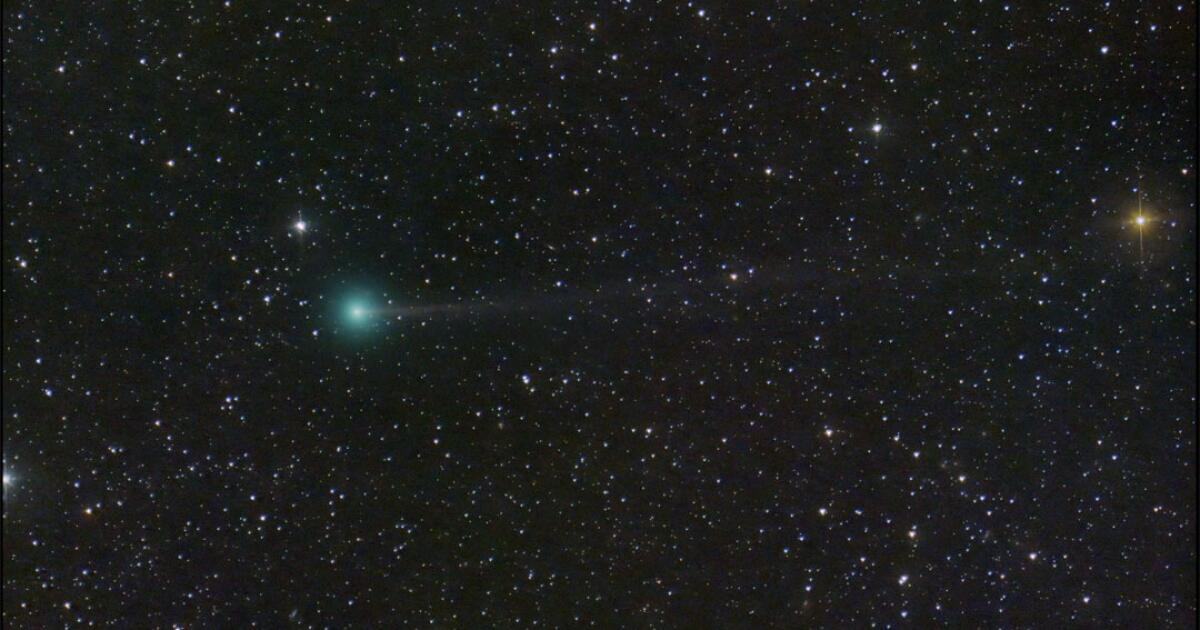
With a little work, you may be able to see a rare celestial sight in the next few days just as the sun is setting over Southern California: an emerald dot gliding across the sky.
Comet Nishimura, discovered by Japanese amateur astronomer Hideo Nishimura in early August, is expected to reach peak brightness on Saturday, according to Griffith Observatory officials.
Whether you catch a glimpse of the newly discovered celestial body depends on a few factors.
Vanessa Alarcon, Griffith Observatory’s astronomical observer, who oversees telescopes, recommends binoculars.
She said the green comet’s path is close to the sun, making viewing difficult.
The best chance to see the comet will be Saturday, Alarcon said. Observers should look to the west right at sunset — focusing low on the horizon, at around 11 angular degrees.
She recommended holding your arm straight out and making a fist. “Put the bottom of your fist at the horizon,” she said. “The top of your fist is approximately the height of the comet.”
Alarcon noted that “the amount of time you can observe it really depends on the landscape” where you’re watching.
Alarcon said the window to see the comet is from 6:58 p.m. to 7:56 p.m., with the comet scheduled to dip below the horizon shortly afterward.
“It will be visible, but it will be difficult with just your eyes,” Alarcon said.
The comet will become brighter as it nears the sun and joins the orbit of Mercury, NASA officials said. There is even a chance the object may break up, according to officials.
Earlier this week, the comet was visible at sunrise. Alarcon said, however, that Tuesday was probably the last day to get a glimpse in the morning and that evenings were now the best bet.
Alarcon said that the comet is made up of ice and rocks and that its body and tail are green because of the carbon interacting with the high temperature and ions from the sun.
The comet was set to reach its closest point from Earth on Tuesday, coming within 78 million miles, and its nearest point to the sun on Monday, according to the Planetary Society.

With a little work, you may be able to see a rare celestial sight in the next few days just as the sun is setting over Southern California: an emerald dot gliding across the sky.
Comet Nishimura, discovered by Japanese amateur astronomer Hideo Nishimura in early August, is expected to reach peak brightness on Saturday, according to Griffith Observatory officials.
Whether you catch a glimpse of the newly discovered celestial body depends on a few factors.
Vanessa Alarcon, Griffith Observatory’s astronomical observer, who oversees telescopes, recommends binoculars.
She said the green comet’s path is close to the sun, making viewing difficult.
The best chance to see the comet will be Saturday, Alarcon said. Observers should look to the west right at sunset — focusing low on the horizon, at around 11 angular degrees.
She recommended holding your arm straight out and making a fist. “Put the bottom of your fist at the horizon,” she said. “The top of your fist is approximately the height of the comet.”
Alarcon noted that “the amount of time you can observe it really depends on the landscape” where you’re watching.
Alarcon said the window to see the comet is from 6:58 p.m. to 7:56 p.m., with the comet scheduled to dip below the horizon shortly afterward.
“It will be visible, but it will be difficult with just your eyes,” Alarcon said.
The comet will become brighter as it nears the sun and joins the orbit of Mercury, NASA officials said. There is even a chance the object may break up, according to officials.
Earlier this week, the comet was visible at sunrise. Alarcon said, however, that Tuesday was probably the last day to get a glimpse in the morning and that evenings were now the best bet.
Alarcon said that the comet is made up of ice and rocks and that its body and tail are green because of the carbon interacting with the high temperature and ions from the sun.
The comet was set to reach its closest point from Earth on Tuesday, coming within 78 million miles, and its nearest point to the sun on Monday, according to the Planetary Society.

With a little work, you may be able to see a rare celestial sight in the next few days just as the sun is setting over Southern California: an emerald dot gliding across the sky.
Comet Nishimura, discovered by Japanese amateur astronomer Hideo Nishimura in early August, is expected to reach peak brightness on Saturday, according to Griffith Observatory officials.
Whether you catch a glimpse of the newly discovered celestial body depends on a few factors.
Vanessa Alarcon, Griffith Observatory’s astronomical observer, who oversees telescopes, recommends binoculars.
She said the green comet’s path is close to the sun, making viewing difficult.
The best chance to see the comet will be Saturday, Alarcon said. Observers should look to the west right at sunset — focusing low on the horizon, at around 11 angular degrees.
She recommended holding your arm straight out and making a fist. “Put the bottom of your fist at the horizon,” she said. “The top of your fist is approximately the height of the comet.”
Alarcon noted that “the amount of time you can observe it really depends on the landscape” where you’re watching.
Alarcon said the window to see the comet is from 6:58 p.m. to 7:56 p.m., with the comet scheduled to dip below the horizon shortly afterward.
“It will be visible, but it will be difficult with just your eyes,” Alarcon said.
The comet will become brighter as it nears the sun and joins the orbit of Mercury, NASA officials said. There is even a chance the object may break up, according to officials.
Earlier this week, the comet was visible at sunrise. Alarcon said, however, that Tuesday was probably the last day to get a glimpse in the morning and that evenings were now the best bet.
Alarcon said that the comet is made up of ice and rocks and that its body and tail are green because of the carbon interacting with the high temperature and ions from the sun.
The comet was set to reach its closest point from Earth on Tuesday, coming within 78 million miles, and its nearest point to the sun on Monday, according to the Planetary Society.
With a little work, you may be able to see a rare celestial sight in the next few days just as the sun is setting over Southern California: an emerald dot gliding across the sky.
Comet Nishimura, discovered by Japanese amateur astronomer Hideo Nishimura in early August, is expected to reach peak brightness on Saturday, according to Griffith Observatory officials.
Whether you catch a glimpse of the newly discovered celestial body depends on a few factors.
Vanessa Alarcon, Griffith Observatory’s astronomical observer, who oversees telescopes, recommends binoculars.
She said the green comet’s path is close to the sun, making viewing difficult.
The best chance to see the comet will be Saturday, Alarcon said. Observers should look to the west right at sunset — focusing low on the horizon, at around 11 angular degrees.
She recommended holding your arm straight out and making a fist. “Put the bottom of your fist at the horizon,” she said. “The top of your fist is approximately the height of the comet.”
Alarcon noted that “the amount of time you can observe it really depends on the landscape” where you’re watching.
Alarcon said the window to see the comet is from 6:58 p.m. to 7:56 p.m., with the comet scheduled to dip below the horizon shortly afterward.
“It will be visible, but it will be difficult with just your eyes,” Alarcon said.
The comet will become brighter as it nears the sun and joins the orbit of Mercury, NASA officials said. There is even a chance the object may break up, according to officials.
Earlier this week, the comet was visible at sunrise. Alarcon said, however, that Tuesday was probably the last day to get a glimpse in the morning and that evenings were now the best bet.
Alarcon said that the comet is made up of ice and rocks and that its body and tail are green because of the carbon interacting with the high temperature and ions from the sun.
The comet was set to reach its closest point from Earth on Tuesday, coming within 78 million miles, and its nearest point to the sun on Monday, according to the Planetary Society.

With a little work, you may be able to see a rare celestial sight in the next few days just as the sun is setting over Southern California: an emerald dot gliding across the sky.
Comet Nishimura, discovered by Japanese amateur astronomer Hideo Nishimura in early August, is expected to reach peak brightness on Saturday, according to Griffith Observatory officials.
Whether you catch a glimpse of the newly discovered celestial body depends on a few factors.
Vanessa Alarcon, Griffith Observatory’s astronomical observer, who oversees telescopes, recommends binoculars.
She said the green comet’s path is close to the sun, making viewing difficult.
The best chance to see the comet will be Saturday, Alarcon said. Observers should look to the west right at sunset — focusing low on the horizon, at around 11 angular degrees.
She recommended holding your arm straight out and making a fist. “Put the bottom of your fist at the horizon,” she said. “The top of your fist is approximately the height of the comet.”
Alarcon noted that “the amount of time you can observe it really depends on the landscape” where you’re watching.
Alarcon said the window to see the comet is from 6:58 p.m. to 7:56 p.m., with the comet scheduled to dip below the horizon shortly afterward.
“It will be visible, but it will be difficult with just your eyes,” Alarcon said.
The comet will become brighter as it nears the sun and joins the orbit of Mercury, NASA officials said. There is even a chance the object may break up, according to officials.
Earlier this week, the comet was visible at sunrise. Alarcon said, however, that Tuesday was probably the last day to get a glimpse in the morning and that evenings were now the best bet.
Alarcon said that the comet is made up of ice and rocks and that its body and tail are green because of the carbon interacting with the high temperature and ions from the sun.
The comet was set to reach its closest point from Earth on Tuesday, coming within 78 million miles, and its nearest point to the sun on Monday, according to the Planetary Society.
With a little work, you may be able to see a rare celestial sight in the next few days just as the sun is setting over Southern California: an emerald dot gliding across the sky.
Comet Nishimura, discovered by Japanese amateur astronomer Hideo Nishimura in early August, is expected to reach peak brightness on Saturday, according to Griffith Observatory officials.
Whether you catch a glimpse of the newly discovered celestial body depends on a few factors.
Vanessa Alarcon, Griffith Observatory’s astronomical observer, who oversees telescopes, recommends binoculars.
She said the green comet’s path is close to the sun, making viewing difficult.
The best chance to see the comet will be Saturday, Alarcon said. Observers should look to the west right at sunset — focusing low on the horizon, at around 11 angular degrees.
She recommended holding your arm straight out and making a fist. “Put the bottom of your fist at the horizon,” she said. “The top of your fist is approximately the height of the comet.”
Alarcon noted that “the amount of time you can observe it really depends on the landscape” where you’re watching.
Alarcon said the window to see the comet is from 6:58 p.m. to 7:56 p.m., with the comet scheduled to dip below the horizon shortly afterward.
“It will be visible, but it will be difficult with just your eyes,” Alarcon said.
The comet will become brighter as it nears the sun and joins the orbit of Mercury, NASA officials said. There is even a chance the object may break up, according to officials.
Earlier this week, the comet was visible at sunrise. Alarcon said, however, that Tuesday was probably the last day to get a glimpse in the morning and that evenings were now the best bet.
Alarcon said that the comet is made up of ice and rocks and that its body and tail are green because of the carbon interacting with the high temperature and ions from the sun.
The comet was set to reach its closest point from Earth on Tuesday, coming within 78 million miles, and its nearest point to the sun on Monday, according to the Planetary Society.
With a little work, you may be able to see a rare celestial sight in the next few days just as the sun is setting over Southern California: an emerald dot gliding across the sky.
Comet Nishimura, discovered by Japanese amateur astronomer Hideo Nishimura in early August, is expected to reach peak brightness on Saturday, according to Griffith Observatory officials.
Whether you catch a glimpse of the newly discovered celestial body depends on a few factors.
Vanessa Alarcon, Griffith Observatory’s astronomical observer, who oversees telescopes, recommends binoculars.
She said the green comet’s path is close to the sun, making viewing difficult.
The best chance to see the comet will be Saturday, Alarcon said. Observers should look to the west right at sunset — focusing low on the horizon, at around 11 angular degrees.
She recommended holding your arm straight out and making a fist. “Put the bottom of your fist at the horizon,” she said. “The top of your fist is approximately the height of the comet.”
Alarcon noted that “the amount of time you can observe it really depends on the landscape” where you’re watching.
Alarcon said the window to see the comet is from 6:58 p.m. to 7:56 p.m., with the comet scheduled to dip below the horizon shortly afterward.
“It will be visible, but it will be difficult with just your eyes,” Alarcon said.
The comet will become brighter as it nears the sun and joins the orbit of Mercury, NASA officials said. There is even a chance the object may break up, according to officials.
Earlier this week, the comet was visible at sunrise. Alarcon said, however, that Tuesday was probably the last day to get a glimpse in the morning and that evenings were now the best bet.
Alarcon said that the comet is made up of ice and rocks and that its body and tail are green because of the carbon interacting with the high temperature and ions from the sun.
The comet was set to reach its closest point from Earth on Tuesday, coming within 78 million miles, and its nearest point to the sun on Monday, according to the Planetary Society.
With a little work, you may be able to see a rare celestial sight in the next few days just as the sun is setting over Southern California: an emerald dot gliding across the sky.
Comet Nishimura, discovered by Japanese amateur astronomer Hideo Nishimura in early August, is expected to reach peak brightness on Saturday, according to Griffith Observatory officials.
Whether you catch a glimpse of the newly discovered celestial body depends on a few factors.
Vanessa Alarcon, Griffith Observatory’s astronomical observer, who oversees telescopes, recommends binoculars.
She said the green comet’s path is close to the sun, making viewing difficult.
The best chance to see the comet will be Saturday, Alarcon said. Observers should look to the west right at sunset — focusing low on the horizon, at around 11 angular degrees.
She recommended holding your arm straight out and making a fist. “Put the bottom of your fist at the horizon,” she said. “The top of your fist is approximately the height of the comet.”
Alarcon noted that “the amount of time you can observe it really depends on the landscape” where you’re watching.
Alarcon said the window to see the comet is from 6:58 p.m. to 7:56 p.m., with the comet scheduled to dip below the horizon shortly afterward.
“It will be visible, but it will be difficult with just your eyes,” Alarcon said.
The comet will become brighter as it nears the sun and joins the orbit of Mercury, NASA officials said. There is even a chance the object may break up, according to officials.
Earlier this week, the comet was visible at sunrise. Alarcon said, however, that Tuesday was probably the last day to get a glimpse in the morning and that evenings were now the best bet.
Alarcon said that the comet is made up of ice and rocks and that its body and tail are green because of the carbon interacting with the high temperature and ions from the sun.
The comet was set to reach its closest point from Earth on Tuesday, coming within 78 million miles, and its nearest point to the sun on Monday, according to the Planetary Society.

With a little work, you may be able to see a rare celestial sight in the next few days just as the sun is setting over Southern California: an emerald dot gliding across the sky.
Comet Nishimura, discovered by Japanese amateur astronomer Hideo Nishimura in early August, is expected to reach peak brightness on Saturday, according to Griffith Observatory officials.
Whether you catch a glimpse of the newly discovered celestial body depends on a few factors.
Vanessa Alarcon, Griffith Observatory’s astronomical observer, who oversees telescopes, recommends binoculars.
She said the green comet’s path is close to the sun, making viewing difficult.
The best chance to see the comet will be Saturday, Alarcon said. Observers should look to the west right at sunset — focusing low on the horizon, at around 11 angular degrees.
She recommended holding your arm straight out and making a fist. “Put the bottom of your fist at the horizon,” she said. “The top of your fist is approximately the height of the comet.”
Alarcon noted that “the amount of time you can observe it really depends on the landscape” where you’re watching.
Alarcon said the window to see the comet is from 6:58 p.m. to 7:56 p.m., with the comet scheduled to dip below the horizon shortly afterward.
“It will be visible, but it will be difficult with just your eyes,” Alarcon said.
The comet will become brighter as it nears the sun and joins the orbit of Mercury, NASA officials said. There is even a chance the object may break up, according to officials.
Earlier this week, the comet was visible at sunrise. Alarcon said, however, that Tuesday was probably the last day to get a glimpse in the morning and that evenings were now the best bet.
Alarcon said that the comet is made up of ice and rocks and that its body and tail are green because of the carbon interacting with the high temperature and ions from the sun.
The comet was set to reach its closest point from Earth on Tuesday, coming within 78 million miles, and its nearest point to the sun on Monday, according to the Planetary Society.
With a little work, you may be able to see a rare celestial sight in the next few days just as the sun is setting over Southern California: an emerald dot gliding across the sky.
Comet Nishimura, discovered by Japanese amateur astronomer Hideo Nishimura in early August, is expected to reach peak brightness on Saturday, according to Griffith Observatory officials.
Whether you catch a glimpse of the newly discovered celestial body depends on a few factors.
Vanessa Alarcon, Griffith Observatory’s astronomical observer, who oversees telescopes, recommends binoculars.
She said the green comet’s path is close to the sun, making viewing difficult.
The best chance to see the comet will be Saturday, Alarcon said. Observers should look to the west right at sunset — focusing low on the horizon, at around 11 angular degrees.
She recommended holding your arm straight out and making a fist. “Put the bottom of your fist at the horizon,” she said. “The top of your fist is approximately the height of the comet.”
Alarcon noted that “the amount of time you can observe it really depends on the landscape” where you’re watching.
Alarcon said the window to see the comet is from 6:58 p.m. to 7:56 p.m., with the comet scheduled to dip below the horizon shortly afterward.
“It will be visible, but it will be difficult with just your eyes,” Alarcon said.
The comet will become brighter as it nears the sun and joins the orbit of Mercury, NASA officials said. There is even a chance the object may break up, according to officials.
Earlier this week, the comet was visible at sunrise. Alarcon said, however, that Tuesday was probably the last day to get a glimpse in the morning and that evenings were now the best bet.
Alarcon said that the comet is made up of ice and rocks and that its body and tail are green because of the carbon interacting with the high temperature and ions from the sun.
The comet was set to reach its closest point from Earth on Tuesday, coming within 78 million miles, and its nearest point to the sun on Monday, according to the Planetary Society.
With a little work, you may be able to see a rare celestial sight in the next few days just as the sun is setting over Southern California: an emerald dot gliding across the sky.
Comet Nishimura, discovered by Japanese amateur astronomer Hideo Nishimura in early August, is expected to reach peak brightness on Saturday, according to Griffith Observatory officials.
Whether you catch a glimpse of the newly discovered celestial body depends on a few factors.
Vanessa Alarcon, Griffith Observatory’s astronomical observer, who oversees telescopes, recommends binoculars.
She said the green comet’s path is close to the sun, making viewing difficult.
The best chance to see the comet will be Saturday, Alarcon said. Observers should look to the west right at sunset — focusing low on the horizon, at around 11 angular degrees.
She recommended holding your arm straight out and making a fist. “Put the bottom of your fist at the horizon,” she said. “The top of your fist is approximately the height of the comet.”
Alarcon noted that “the amount of time you can observe it really depends on the landscape” where you’re watching.
Alarcon said the window to see the comet is from 6:58 p.m. to 7:56 p.m., with the comet scheduled to dip below the horizon shortly afterward.
“It will be visible, but it will be difficult with just your eyes,” Alarcon said.
The comet will become brighter as it nears the sun and joins the orbit of Mercury, NASA officials said. There is even a chance the object may break up, according to officials.
Earlier this week, the comet was visible at sunrise. Alarcon said, however, that Tuesday was probably the last day to get a glimpse in the morning and that evenings were now the best bet.
Alarcon said that the comet is made up of ice and rocks and that its body and tail are green because of the carbon interacting with the high temperature and ions from the sun.
The comet was set to reach its closest point from Earth on Tuesday, coming within 78 million miles, and its nearest point to the sun on Monday, according to the Planetary Society.
With a little work, you may be able to see a rare celestial sight in the next few days just as the sun is setting over Southern California: an emerald dot gliding across the sky.
Comet Nishimura, discovered by Japanese amateur astronomer Hideo Nishimura in early August, is expected to reach peak brightness on Saturday, according to Griffith Observatory officials.
Whether you catch a glimpse of the newly discovered celestial body depends on a few factors.
Vanessa Alarcon, Griffith Observatory’s astronomical observer, who oversees telescopes, recommends binoculars.
She said the green comet’s path is close to the sun, making viewing difficult.
The best chance to see the comet will be Saturday, Alarcon said. Observers should look to the west right at sunset — focusing low on the horizon, at around 11 angular degrees.
She recommended holding your arm straight out and making a fist. “Put the bottom of your fist at the horizon,” she said. “The top of your fist is approximately the height of the comet.”
Alarcon noted that “the amount of time you can observe it really depends on the landscape” where you’re watching.
Alarcon said the window to see the comet is from 6:58 p.m. to 7:56 p.m., with the comet scheduled to dip below the horizon shortly afterward.
“It will be visible, but it will be difficult with just your eyes,” Alarcon said.
The comet will become brighter as it nears the sun and joins the orbit of Mercury, NASA officials said. There is even a chance the object may break up, according to officials.
Earlier this week, the comet was visible at sunrise. Alarcon said, however, that Tuesday was probably the last day to get a glimpse in the morning and that evenings were now the best bet.
Alarcon said that the comet is made up of ice and rocks and that its body and tail are green because of the carbon interacting with the high temperature and ions from the sun.
The comet was set to reach its closest point from Earth on Tuesday, coming within 78 million miles, and its nearest point to the sun on Monday, according to the Planetary Society.
With a little work, you may be able to see a rare celestial sight in the next few days just as the sun is setting over Southern California: an emerald dot gliding across the sky.
Comet Nishimura, discovered by Japanese amateur astronomer Hideo Nishimura in early August, is expected to reach peak brightness on Saturday, according to Griffith Observatory officials.
Whether you catch a glimpse of the newly discovered celestial body depends on a few factors.
Vanessa Alarcon, Griffith Observatory’s astronomical observer, who oversees telescopes, recommends binoculars.
She said the green comet’s path is close to the sun, making viewing difficult.
The best chance to see the comet will be Saturday, Alarcon said. Observers should look to the west right at sunset — focusing low on the horizon, at around 11 angular degrees.
She recommended holding your arm straight out and making a fist. “Put the bottom of your fist at the horizon,” she said. “The top of your fist is approximately the height of the comet.”
Alarcon noted that “the amount of time you can observe it really depends on the landscape” where you’re watching.
Alarcon said the window to see the comet is from 6:58 p.m. to 7:56 p.m., with the comet scheduled to dip below the horizon shortly afterward.
“It will be visible, but it will be difficult with just your eyes,” Alarcon said.
The comet will become brighter as it nears the sun and joins the orbit of Mercury, NASA officials said. There is even a chance the object may break up, according to officials.
Earlier this week, the comet was visible at sunrise. Alarcon said, however, that Tuesday was probably the last day to get a glimpse in the morning and that evenings were now the best bet.
Alarcon said that the comet is made up of ice and rocks and that its body and tail are green because of the carbon interacting with the high temperature and ions from the sun.
The comet was set to reach its closest point from Earth on Tuesday, coming within 78 million miles, and its nearest point to the sun on Monday, according to the Planetary Society.
With a little work, you may be able to see a rare celestial sight in the next few days just as the sun is setting over Southern California: an emerald dot gliding across the sky.
Comet Nishimura, discovered by Japanese amateur astronomer Hideo Nishimura in early August, is expected to reach peak brightness on Saturday, according to Griffith Observatory officials.
Whether you catch a glimpse of the newly discovered celestial body depends on a few factors.
Vanessa Alarcon, Griffith Observatory’s astronomical observer, who oversees telescopes, recommends binoculars.
She said the green comet’s path is close to the sun, making viewing difficult.
The best chance to see the comet will be Saturday, Alarcon said. Observers should look to the west right at sunset — focusing low on the horizon, at around 11 angular degrees.
She recommended holding your arm straight out and making a fist. “Put the bottom of your fist at the horizon,” she said. “The top of your fist is approximately the height of the comet.”
Alarcon noted that “the amount of time you can observe it really depends on the landscape” where you’re watching.
Alarcon said the window to see the comet is from 6:58 p.m. to 7:56 p.m., with the comet scheduled to dip below the horizon shortly afterward.
“It will be visible, but it will be difficult with just your eyes,” Alarcon said.
The comet will become brighter as it nears the sun and joins the orbit of Mercury, NASA officials said. There is even a chance the object may break up, according to officials.
Earlier this week, the comet was visible at sunrise. Alarcon said, however, that Tuesday was probably the last day to get a glimpse in the morning and that evenings were now the best bet.
Alarcon said that the comet is made up of ice and rocks and that its body and tail are green because of the carbon interacting with the high temperature and ions from the sun.
The comet was set to reach its closest point from Earth on Tuesday, coming within 78 million miles, and its nearest point to the sun on Monday, according to the Planetary Society.
With a little work, you may be able to see a rare celestial sight in the next few days just as the sun is setting over Southern California: an emerald dot gliding across the sky.
Comet Nishimura, discovered by Japanese amateur astronomer Hideo Nishimura in early August, is expected to reach peak brightness on Saturday, according to Griffith Observatory officials.
Whether you catch a glimpse of the newly discovered celestial body depends on a few factors.
Vanessa Alarcon, Griffith Observatory’s astronomical observer, who oversees telescopes, recommends binoculars.
She said the green comet’s path is close to the sun, making viewing difficult.
The best chance to see the comet will be Saturday, Alarcon said. Observers should look to the west right at sunset — focusing low on the horizon, at around 11 angular degrees.
She recommended holding your arm straight out and making a fist. “Put the bottom of your fist at the horizon,” she said. “The top of your fist is approximately the height of the comet.”
Alarcon noted that “the amount of time you can observe it really depends on the landscape” where you’re watching.
Alarcon said the window to see the comet is from 6:58 p.m. to 7:56 p.m., with the comet scheduled to dip below the horizon shortly afterward.
“It will be visible, but it will be difficult with just your eyes,” Alarcon said.
The comet will become brighter as it nears the sun and joins the orbit of Mercury, NASA officials said. There is even a chance the object may break up, according to officials.
Earlier this week, the comet was visible at sunrise. Alarcon said, however, that Tuesday was probably the last day to get a glimpse in the morning and that evenings were now the best bet.
Alarcon said that the comet is made up of ice and rocks and that its body and tail are green because of the carbon interacting with the high temperature and ions from the sun.
The comet was set to reach its closest point from Earth on Tuesday, coming within 78 million miles, and its nearest point to the sun on Monday, according to the Planetary Society.
With a little work, you may be able to see a rare celestial sight in the next few days just as the sun is setting over Southern California: an emerald dot gliding across the sky.
Comet Nishimura, discovered by Japanese amateur astronomer Hideo Nishimura in early August, is expected to reach peak brightness on Saturday, according to Griffith Observatory officials.
Whether you catch a glimpse of the newly discovered celestial body depends on a few factors.
Vanessa Alarcon, Griffith Observatory’s astronomical observer, who oversees telescopes, recommends binoculars.
She said the green comet’s path is close to the sun, making viewing difficult.
The best chance to see the comet will be Saturday, Alarcon said. Observers should look to the west right at sunset — focusing low on the horizon, at around 11 angular degrees.
She recommended holding your arm straight out and making a fist. “Put the bottom of your fist at the horizon,” she said. “The top of your fist is approximately the height of the comet.”
Alarcon noted that “the amount of time you can observe it really depends on the landscape” where you’re watching.
Alarcon said the window to see the comet is from 6:58 p.m. to 7:56 p.m., with the comet scheduled to dip below the horizon shortly afterward.
“It will be visible, but it will be difficult with just your eyes,” Alarcon said.
The comet will become brighter as it nears the sun and joins the orbit of Mercury, NASA officials said. There is even a chance the object may break up, according to officials.
Earlier this week, the comet was visible at sunrise. Alarcon said, however, that Tuesday was probably the last day to get a glimpse in the morning and that evenings were now the best bet.
Alarcon said that the comet is made up of ice and rocks and that its body and tail are green because of the carbon interacting with the high temperature and ions from the sun.
The comet was set to reach its closest point from Earth on Tuesday, coming within 78 million miles, and its nearest point to the sun on Monday, according to the Planetary Society.

