


At a time when news about the pace of film and television production seems to be relentlessly bad, a Hollywood real estate developer is ignoring the headlines and building a brand new studio.
Construction is far along on Echelon Studios Hollywood: an old-school movie studio with all the standard features, but stacked in a single building rather than spread out on a sprawling lot.
The challenge was to design a 10-acre movie studio for a 5-acre site, architect Andrew Wright of RIOS said. “Everything is crammed as tight as it can possibly go,” he said.
Behind the $450-million venture is real estate developer and landlord David Simon, a true believer in Hollywood who came up with the idea of knocking down a former Sears store on Santa Monica Boulevard west of the Hollywood Freeway and building a studio that is set to open early next year.
A rendering of Echelon Studios Hollywood being built on Santa Monica Boulevard at St. Andrew’s Place in Hollywood.
(Design by RIOS / Rendering by Omegarender)
He is a rare optimist in a business that has been struggling.
Demand for film facilities in Southern California has sharply fallen as production has dwindled in recent years. In late July, the nonprofit FilmLA reported that feature film shoots were down 20% in the second quarter versus last year. Even worse, TV production — once the lifeblood of L.A.’s entertainment industry — decreased by 30%.
Given the changes in the industry — the slimmer film and TV lineups, the established and experienced film hubs outside the Golden State and lower costs elsewhere — it’s unlikely production in L.A. will reach the heights it once did.
Simon launched the project about five years ago when there appeared to be bottomless demand for soundstages as cash-flush newcomers like Netflix, Amazon and Apple raced longtime studio powers to crank out movies and television shows for growing legions of couch potatoes around the world who got hooked on home entertainment during the pandemic.
Nonetheless, he is confident that a steady volume of shows and movies will still be made locally, and thinks he can create an attractive place to make them that stands out from the competition.
Echelon Studios Hollywood will have five soundstages and support facilities, including offices, mills to make sets, and “base camp” space for trucks, production equipment and actors’ trailers. There will be screening rooms and cafes.
At the top will be a landscaped warren of bungalows with panoramic views of the Hollywood sign, Griffith Observatory, downtown L.A. and Hollywood that Simon hopes will be a draw for studio tenants.
Bungalows are such a beloved feature of classic movie studios that Simon felt he needed to have them to get his studio vibe right. Often thrown together as low-cost office and dressing spaces in the early days of Hollywood, they evolved into coveted, private sanctuaries for elite talent, writer-producers and studio moguls.
“People fell in love with them, and so they became the premier real estate on the lot,” Wright said. “Every production team wanted to live in one for a year while they filmed their production. We built this neighborhood in the sky based on this extremely Hollywood typology.”

A pedestrian runs by Echelon Studios, being built in Hollywood on Sept. 4, 2026. The construction of the new movie studio is a rarity in the currently challenged climate for the entertainment industry.
(Genaro Molina / Los Angeles Times)
Film and television executive Jamie Crosbie, who will head studio operations, acknowledged that the days of “maximum spend” when streamers were “throwing money like confetti” are over, but opportunities still lie ahead.
“This recalibration has cleared the landscape a little bit,” he said. “I think we’re on the precipice of a real renaissance of creative and economic growth because we need entertainment.”
Expanded state tax credits and a pending 20% federal tax credit for filming are also spurring production interest in Hollywood, Simon said. “Everybody I talk to in this industry would like nothing more than to stay home and film in L.A.,” he said.

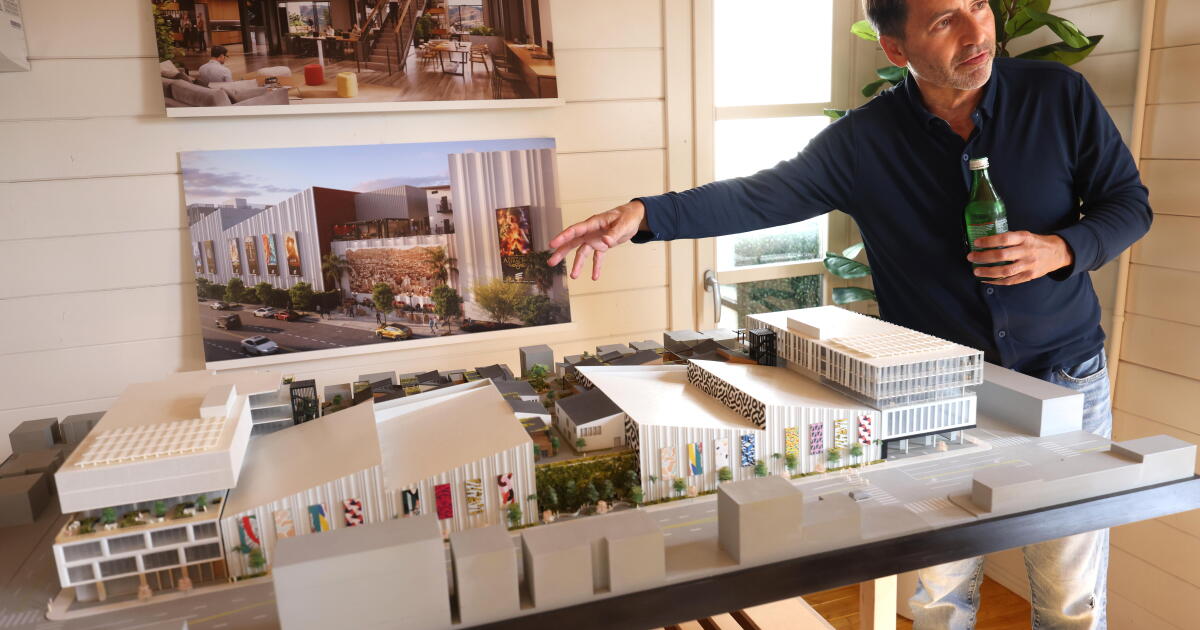
Developer and landlord David Simon stands on the top floor of Echelon Studios. The building includes bungalows providing views of the Hollywood sign, Griffith Observatory and downtown L.A.
(Genaro Molina / Los Angeles Times)
The new Hollywood studio is a labyrinth connected by ramps, stairways and elevators that allow its functions to operate independently — visitors to the bungalows can take an elevator to a meeting without passing through production areas or head straight to where shooting is taking place.
Soundproofing the stages was a top priority and an engineering challenge, especially with parking for more than 1,000 cars going on below.
“Soundstages are acoustically isolated boxes, and any adjacent vibration is a risk to compromise the building,” so having parking lots too close is usually avoided, Wright said.
The solution was layers of insulation, drywall and thick concrete to absorb sounds from vehicles running below, which the builders believe will keep the stages free of outside noise or vibrations.
A public element of the studio that will soon stand out on Santa Monica Boulevard is an art piece by Los Angeles artist Matthew Brandt showing a collage of images of the Hollywood skyline on weathered stainless steel panels.
Simon is building the studio through his company BARDAS Investment Group, which focuses on Hollywood, where it builds offices and other facilities catering to the media and technology industries. Among them is PUMA Studio LA, where the athletic apparel maker’s global entertainment marketing team is based.
On nearby Romaine Street, Simon is planning a $600-million renovation and expansion of Echelon at Television Center, which was once home to Technicolor’s film manufacturing laboratory and Metro Pictures Corp., which became part of Metro-Goldwyn-Mayer in the 1920s. Among Metro’s stars were Rudolph Valentino, Lillian Gish, Ramon Novarro and Buster Keaton.
Before he founded his own company in 2018, he oversaw two large-scale Hollywood projects for Kilroy Realty: the $420-million office, residential and retail redevelopment of the former CBS headquarters in Hollywood now known as Columbia Square and the $450-million office and residential redevelopment of the former Academy of Motion Picture Arts and Sciences headquarters site now known as On Vine.
Hollywood has legs and will retain its appeal for growth, Simon said. Potential tenants are already touring his studio under construction and in discussions to lease space, he said.
“Hollywood is the greatest brand in the world,” he said. “It’s not only a place, it’s an industry.”

At a time when news about the pace of film and television production seems to be relentlessly bad, a Hollywood real estate developer is ignoring the headlines and building a brand new studio.
Construction is far along on Echelon Studios Hollywood: an old-school movie studio with all the standard features, but stacked in a single building rather than spread out on a sprawling lot.
The challenge was to design a 10-acre movie studio for a 5-acre site, architect Andrew Wright of RIOS said. “Everything is crammed as tight as it can possibly go,” he said.
Behind the $450-million venture is real estate developer and landlord David Simon, a true believer in Hollywood who came up with the idea of knocking down a former Sears store on Santa Monica Boulevard west of the Hollywood Freeway and building a studio that is set to open early next year.
A rendering of Echelon Studios Hollywood being built on Santa Monica Boulevard at St. Andrew’s Place in Hollywood.
(Design by RIOS / Rendering by Omegarender)
He is a rare optimist in a business that has been struggling.
Demand for film facilities in Southern California has sharply fallen as production has dwindled in recent years. In late July, the nonprofit FilmLA reported that feature film shoots were down 20% in the second quarter versus last year. Even worse, TV production — once the lifeblood of L.A.’s entertainment industry — decreased by 30%.
Given the changes in the industry — the slimmer film and TV lineups, the established and experienced film hubs outside the Golden State and lower costs elsewhere — it’s unlikely production in L.A. will reach the heights it once did.
Simon launched the project about five years ago when there appeared to be bottomless demand for soundstages as cash-flush newcomers like Netflix, Amazon and Apple raced longtime studio powers to crank out movies and television shows for growing legions of couch potatoes around the world who got hooked on home entertainment during the pandemic.
Nonetheless, he is confident that a steady volume of shows and movies will still be made locally, and thinks he can create an attractive place to make them that stands out from the competition.
Echelon Studios Hollywood will have five soundstages and support facilities, including offices, mills to make sets, and “base camp” space for trucks, production equipment and actors’ trailers. There will be screening rooms and cafes.
At the top will be a landscaped warren of bungalows with panoramic views of the Hollywood sign, Griffith Observatory, downtown L.A. and Hollywood that Simon hopes will be a draw for studio tenants.
Bungalows are such a beloved feature of classic movie studios that Simon felt he needed to have them to get his studio vibe right. Often thrown together as low-cost office and dressing spaces in the early days of Hollywood, they evolved into coveted, private sanctuaries for elite talent, writer-producers and studio moguls.
“People fell in love with them, and so they became the premier real estate on the lot,” Wright said. “Every production team wanted to live in one for a year while they filmed their production. We built this neighborhood in the sky based on this extremely Hollywood typology.”
A pedestrian runs by Echelon Studios, being built in Hollywood on Sept. 4, 2026. The construction of the new movie studio is a rarity in the currently challenged climate for the entertainment industry.
(Genaro Molina / Los Angeles Times)
Film and television executive Jamie Crosbie, who will head studio operations, acknowledged that the days of “maximum spend” when streamers were “throwing money like confetti” are over, but opportunities still lie ahead.
“This recalibration has cleared the landscape a little bit,” he said. “I think we’re on the precipice of a real renaissance of creative and economic growth because we need entertainment.”
Expanded state tax credits and a pending 20% federal tax credit for filming are also spurring production interest in Hollywood, Simon said. “Everybody I talk to in this industry would like nothing more than to stay home and film in L.A.,” he said.
Developer and landlord David Simon stands on the top floor of Echelon Studios. The building includes bungalows providing views of the Hollywood sign, Griffith Observatory and downtown L.A.
(Genaro Molina / Los Angeles Times)
The new Hollywood studio is a labyrinth connected by ramps, stairways and elevators that allow its functions to operate independently — visitors to the bungalows can take an elevator to a meeting without passing through production areas or head straight to where shooting is taking place.
Soundproofing the stages was a top priority and an engineering challenge, especially with parking for more than 1,000 cars going on below.
“Soundstages are acoustically isolated boxes, and any adjacent vibration is a risk to compromise the building,” so having parking lots too close is usually avoided, Wright said.
The solution was layers of insulation, drywall and thick concrete to absorb sounds from vehicles running below, which the builders believe will keep the stages free of outside noise or vibrations.
A public element of the studio that will soon stand out on Santa Monica Boulevard is an art piece by Los Angeles artist Matthew Brandt showing a collage of images of the Hollywood skyline on weathered stainless steel panels.
Simon is building the studio through his company BARDAS Investment Group, which focuses on Hollywood, where it builds offices and other facilities catering to the media and technology industries. Among them is PUMA Studio LA, where the athletic apparel maker’s global entertainment marketing team is based.
On nearby Romaine Street, Simon is planning a $600-million renovation and expansion of Echelon at Television Center, which was once home to Technicolor’s film manufacturing laboratory and Metro Pictures Corp., which became part of Metro-Goldwyn-Mayer in the 1920s. Among Metro’s stars were Rudolph Valentino, Lillian Gish, Ramon Novarro and Buster Keaton.
Before he founded his own company in 2018, he oversaw two large-scale Hollywood projects for Kilroy Realty: the $420-million office, residential and retail redevelopment of the former CBS headquarters in Hollywood now known as Columbia Square and the $450-million office and residential redevelopment of the former Academy of Motion Picture Arts and Sciences headquarters site now known as On Vine.
Hollywood has legs and will retain its appeal for growth, Simon said. Potential tenants are already touring his studio under construction and in discussions to lease space, he said.
“Hollywood is the greatest brand in the world,” he said. “It’s not only a place, it’s an industry.”

At a time when news about the pace of film and television production seems to be relentlessly bad, a Hollywood real estate developer is ignoring the headlines and building a brand new studio.
Construction is far along on Echelon Studios Hollywood: an old-school movie studio with all the standard features, but stacked in a single building rather than spread out on a sprawling lot.
The challenge was to design a 10-acre movie studio for a 5-acre site, architect Andrew Wright of RIOS said. “Everything is crammed as tight as it can possibly go,” he said.
Behind the $450-million venture is real estate developer and landlord David Simon, a true believer in Hollywood who came up with the idea of knocking down a former Sears store on Santa Monica Boulevard west of the Hollywood Freeway and building a studio that is set to open early next year.
A rendering of Echelon Studios Hollywood being built on Santa Monica Boulevard at St. Andrew’s Place in Hollywood.
(Design by RIOS / Rendering by Omegarender)
He is a rare optimist in a business that has been struggling.
Demand for film facilities in Southern California has sharply fallen as production has dwindled in recent years. In late July, the nonprofit FilmLA reported that feature film shoots were down 20% in the second quarter versus last year. Even worse, TV production — once the lifeblood of L.A.’s entertainment industry — decreased by 30%.
Given the changes in the industry — the slimmer film and TV lineups, the established and experienced film hubs outside the Golden State and lower costs elsewhere — it’s unlikely production in L.A. will reach the heights it once did.
Simon launched the project about five years ago when there appeared to be bottomless demand for soundstages as cash-flush newcomers like Netflix, Amazon and Apple raced longtime studio powers to crank out movies and television shows for growing legions of couch potatoes around the world who got hooked on home entertainment during the pandemic.
Nonetheless, he is confident that a steady volume of shows and movies will still be made locally, and thinks he can create an attractive place to make them that stands out from the competition.
Echelon Studios Hollywood will have five soundstages and support facilities, including offices, mills to make sets, and “base camp” space for trucks, production equipment and actors’ trailers. There will be screening rooms and cafes.
At the top will be a landscaped warren of bungalows with panoramic views of the Hollywood sign, Griffith Observatory, downtown L.A. and Hollywood that Simon hopes will be a draw for studio tenants.
Bungalows are such a beloved feature of classic movie studios that Simon felt he needed to have them to get his studio vibe right. Often thrown together as low-cost office and dressing spaces in the early days of Hollywood, they evolved into coveted, private sanctuaries for elite talent, writer-producers and studio moguls.
“People fell in love with them, and so they became the premier real estate on the lot,” Wright said. “Every production team wanted to live in one for a year while they filmed their production. We built this neighborhood in the sky based on this extremely Hollywood typology.”
A pedestrian runs by Echelon Studios, being built in Hollywood on Sept. 4, 2026. The construction of the new movie studio is a rarity in the currently challenged climate for the entertainment industry.
(Genaro Molina / Los Angeles Times)
Film and television executive Jamie Crosbie, who will head studio operations, acknowledged that the days of “maximum spend” when streamers were “throwing money like confetti” are over, but opportunities still lie ahead.
“This recalibration has cleared the landscape a little bit,” he said. “I think we’re on the precipice of a real renaissance of creative and economic growth because we need entertainment.”
Expanded state tax credits and a pending 20% federal tax credit for filming are also spurring production interest in Hollywood, Simon said. “Everybody I talk to in this industry would like nothing more than to stay home and film in L.A.,” he said.
Developer and landlord David Simon stands on the top floor of Echelon Studios. The building includes bungalows providing views of the Hollywood sign, Griffith Observatory and downtown L.A.
(Genaro Molina / Los Angeles Times)
The new Hollywood studio is a labyrinth connected by ramps, stairways and elevators that allow its functions to operate independently — visitors to the bungalows can take an elevator to a meeting without passing through production areas or head straight to where shooting is taking place.
Soundproofing the stages was a top priority and an engineering challenge, especially with parking for more than 1,000 cars going on below.
“Soundstages are acoustically isolated boxes, and any adjacent vibration is a risk to compromise the building,” so having parking lots too close is usually avoided, Wright said.
The solution was layers of insulation, drywall and thick concrete to absorb sounds from vehicles running below, which the builders believe will keep the stages free of outside noise or vibrations.
A public element of the studio that will soon stand out on Santa Monica Boulevard is an art piece by Los Angeles artist Matthew Brandt showing a collage of images of the Hollywood skyline on weathered stainless steel panels.
Simon is building the studio through his company BARDAS Investment Group, which focuses on Hollywood, where it builds offices and other facilities catering to the media and technology industries. Among them is PUMA Studio LA, where the athletic apparel maker’s global entertainment marketing team is based.
On nearby Romaine Street, Simon is planning a $600-million renovation and expansion of Echelon at Television Center, which was once home to Technicolor’s film manufacturing laboratory and Metro Pictures Corp., which became part of Metro-Goldwyn-Mayer in the 1920s. Among Metro’s stars were Rudolph Valentino, Lillian Gish, Ramon Novarro and Buster Keaton.
Before he founded his own company in 2018, he oversaw two large-scale Hollywood projects for Kilroy Realty: the $420-million office, residential and retail redevelopment of the former CBS headquarters in Hollywood now known as Columbia Square and the $450-million office and residential redevelopment of the former Academy of Motion Picture Arts and Sciences headquarters site now known as On Vine.
Hollywood has legs and will retain its appeal for growth, Simon said. Potential tenants are already touring his studio under construction and in discussions to lease space, he said.
“Hollywood is the greatest brand in the world,” he said. “It’s not only a place, it’s an industry.”
At a time when news about the pace of film and television production seems to be relentlessly bad, a Hollywood real estate developer is ignoring the headlines and building a brand new studio.
Construction is far along on Echelon Studios Hollywood: an old-school movie studio with all the standard features, but stacked in a single building rather than spread out on a sprawling lot.
The challenge was to design a 10-acre movie studio for a 5-acre site, architect Andrew Wright of RIOS said. “Everything is crammed as tight as it can possibly go,” he said.
Behind the $450-million venture is real estate developer and landlord David Simon, a true believer in Hollywood who came up with the idea of knocking down a former Sears store on Santa Monica Boulevard west of the Hollywood Freeway and building a studio that is set to open early next year.
A rendering of Echelon Studios Hollywood being built on Santa Monica Boulevard at St. Andrew’s Place in Hollywood.
(Design by RIOS / Rendering by Omegarender)
He is a rare optimist in a business that has been struggling.
Demand for film facilities in Southern California has sharply fallen as production has dwindled in recent years. In late July, the nonprofit FilmLA reported that feature film shoots were down 20% in the second quarter versus last year. Even worse, TV production — once the lifeblood of L.A.’s entertainment industry — decreased by 30%.
Given the changes in the industry — the slimmer film and TV lineups, the established and experienced film hubs outside the Golden State and lower costs elsewhere — it’s unlikely production in L.A. will reach the heights it once did.
Simon launched the project about five years ago when there appeared to be bottomless demand for soundstages as cash-flush newcomers like Netflix, Amazon and Apple raced longtime studio powers to crank out movies and television shows for growing legions of couch potatoes around the world who got hooked on home entertainment during the pandemic.
Nonetheless, he is confident that a steady volume of shows and movies will still be made locally, and thinks he can create an attractive place to make them that stands out from the competition.
Echelon Studios Hollywood will have five soundstages and support facilities, including offices, mills to make sets, and “base camp” space for trucks, production equipment and actors’ trailers. There will be screening rooms and cafes.
At the top will be a landscaped warren of bungalows with panoramic views of the Hollywood sign, Griffith Observatory, downtown L.A. and Hollywood that Simon hopes will be a draw for studio tenants.
Bungalows are such a beloved feature of classic movie studios that Simon felt he needed to have them to get his studio vibe right. Often thrown together as low-cost office and dressing spaces in the early days of Hollywood, they evolved into coveted, private sanctuaries for elite talent, writer-producers and studio moguls.
“People fell in love with them, and so they became the premier real estate on the lot,” Wright said. “Every production team wanted to live in one for a year while they filmed their production. We built this neighborhood in the sky based on this extremely Hollywood typology.”
A pedestrian runs by Echelon Studios, being built in Hollywood on Sept. 4, 2026. The construction of the new movie studio is a rarity in the currently challenged climate for the entertainment industry.
(Genaro Molina / Los Angeles Times)
Film and television executive Jamie Crosbie, who will head studio operations, acknowledged that the days of “maximum spend” when streamers were “throwing money like confetti” are over, but opportunities still lie ahead.
“This recalibration has cleared the landscape a little bit,” he said. “I think we’re on the precipice of a real renaissance of creative and economic growth because we need entertainment.”
Expanded state tax credits and a pending 20% federal tax credit for filming are also spurring production interest in Hollywood, Simon said. “Everybody I talk to in this industry would like nothing more than to stay home and film in L.A.,” he said.
Developer and landlord David Simon stands on the top floor of Echelon Studios. The building includes bungalows providing views of the Hollywood sign, Griffith Observatory and downtown L.A.
(Genaro Molina / Los Angeles Times)
The new Hollywood studio is a labyrinth connected by ramps, stairways and elevators that allow its functions to operate independently — visitors to the bungalows can take an elevator to a meeting without passing through production areas or head straight to where shooting is taking place.
Soundproofing the stages was a top priority and an engineering challenge, especially with parking for more than 1,000 cars going on below.
“Soundstages are acoustically isolated boxes, and any adjacent vibration is a risk to compromise the building,” so having parking lots too close is usually avoided, Wright said.
The solution was layers of insulation, drywall and thick concrete to absorb sounds from vehicles running below, which the builders believe will keep the stages free of outside noise or vibrations.
A public element of the studio that will soon stand out on Santa Monica Boulevard is an art piece by Los Angeles artist Matthew Brandt showing a collage of images of the Hollywood skyline on weathered stainless steel panels.
Simon is building the studio through his company BARDAS Investment Group, which focuses on Hollywood, where it builds offices and other facilities catering to the media and technology industries. Among them is PUMA Studio LA, where the athletic apparel maker’s global entertainment marketing team is based.
On nearby Romaine Street, Simon is planning a $600-million renovation and expansion of Echelon at Television Center, which was once home to Technicolor’s film manufacturing laboratory and Metro Pictures Corp., which became part of Metro-Goldwyn-Mayer in the 1920s. Among Metro’s stars were Rudolph Valentino, Lillian Gish, Ramon Novarro and Buster Keaton.
Before he founded his own company in 2018, he oversaw two large-scale Hollywood projects for Kilroy Realty: the $420-million office, residential and retail redevelopment of the former CBS headquarters in Hollywood now known as Columbia Square and the $450-million office and residential redevelopment of the former Academy of Motion Picture Arts and Sciences headquarters site now known as On Vine.
Hollywood has legs and will retain its appeal for growth, Simon said. Potential tenants are already touring his studio under construction and in discussions to lease space, he said.
“Hollywood is the greatest brand in the world,” he said. “It’s not only a place, it’s an industry.”

At a time when news about the pace of film and television production seems to be relentlessly bad, a Hollywood real estate developer is ignoring the headlines and building a brand new studio.
Construction is far along on Echelon Studios Hollywood: an old-school movie studio with all the standard features, but stacked in a single building rather than spread out on a sprawling lot.
The challenge was to design a 10-acre movie studio for a 5-acre site, architect Andrew Wright of RIOS said. “Everything is crammed as tight as it can possibly go,” he said.
Behind the $450-million venture is real estate developer and landlord David Simon, a true believer in Hollywood who came up with the idea of knocking down a former Sears store on Santa Monica Boulevard west of the Hollywood Freeway and building a studio that is set to open early next year.
A rendering of Echelon Studios Hollywood being built on Santa Monica Boulevard at St. Andrew’s Place in Hollywood.
(Design by RIOS / Rendering by Omegarender)
He is a rare optimist in a business that has been struggling.
Demand for film facilities in Southern California has sharply fallen as production has dwindled in recent years. In late July, the nonprofit FilmLA reported that feature film shoots were down 20% in the second quarter versus last year. Even worse, TV production — once the lifeblood of L.A.’s entertainment industry — decreased by 30%.
Given the changes in the industry — the slimmer film and TV lineups, the established and experienced film hubs outside the Golden State and lower costs elsewhere — it’s unlikely production in L.A. will reach the heights it once did.
Simon launched the project about five years ago when there appeared to be bottomless demand for soundstages as cash-flush newcomers like Netflix, Amazon and Apple raced longtime studio powers to crank out movies and television shows for growing legions of couch potatoes around the world who got hooked on home entertainment during the pandemic.
Nonetheless, he is confident that a steady volume of shows and movies will still be made locally, and thinks he can create an attractive place to make them that stands out from the competition.
Echelon Studios Hollywood will have five soundstages and support facilities, including offices, mills to make sets, and “base camp” space for trucks, production equipment and actors’ trailers. There will be screening rooms and cafes.
At the top will be a landscaped warren of bungalows with panoramic views of the Hollywood sign, Griffith Observatory, downtown L.A. and Hollywood that Simon hopes will be a draw for studio tenants.
Bungalows are such a beloved feature of classic movie studios that Simon felt he needed to have them to get his studio vibe right. Often thrown together as low-cost office and dressing spaces in the early days of Hollywood, they evolved into coveted, private sanctuaries for elite talent, writer-producers and studio moguls.
“People fell in love with them, and so they became the premier real estate on the lot,” Wright said. “Every production team wanted to live in one for a year while they filmed their production. We built this neighborhood in the sky based on this extremely Hollywood typology.”
A pedestrian runs by Echelon Studios, being built in Hollywood on Sept. 4, 2026. The construction of the new movie studio is a rarity in the currently challenged climate for the entertainment industry.
(Genaro Molina / Los Angeles Times)
Film and television executive Jamie Crosbie, who will head studio operations, acknowledged that the days of “maximum spend” when streamers were “throwing money like confetti” are over, but opportunities still lie ahead.
“This recalibration has cleared the landscape a little bit,” he said. “I think we’re on the precipice of a real renaissance of creative and economic growth because we need entertainment.”
Expanded state tax credits and a pending 20% federal tax credit for filming are also spurring production interest in Hollywood, Simon said. “Everybody I talk to in this industry would like nothing more than to stay home and film in L.A.,” he said.
Developer and landlord David Simon stands on the top floor of Echelon Studios. The building includes bungalows providing views of the Hollywood sign, Griffith Observatory and downtown L.A.
(Genaro Molina / Los Angeles Times)
The new Hollywood studio is a labyrinth connected by ramps, stairways and elevators that allow its functions to operate independently — visitors to the bungalows can take an elevator to a meeting without passing through production areas or head straight to where shooting is taking place.
Soundproofing the stages was a top priority and an engineering challenge, especially with parking for more than 1,000 cars going on below.
“Soundstages are acoustically isolated boxes, and any adjacent vibration is a risk to compromise the building,” so having parking lots too close is usually avoided, Wright said.
The solution was layers of insulation, drywall and thick concrete to absorb sounds from vehicles running below, which the builders believe will keep the stages free of outside noise or vibrations.
A public element of the studio that will soon stand out on Santa Monica Boulevard is an art piece by Los Angeles artist Matthew Brandt showing a collage of images of the Hollywood skyline on weathered stainless steel panels.
Simon is building the studio through his company BARDAS Investment Group, which focuses on Hollywood, where it builds offices and other facilities catering to the media and technology industries. Among them is PUMA Studio LA, where the athletic apparel maker’s global entertainment marketing team is based.
On nearby Romaine Street, Simon is planning a $600-million renovation and expansion of Echelon at Television Center, which was once home to Technicolor’s film manufacturing laboratory and Metro Pictures Corp., which became part of Metro-Goldwyn-Mayer in the 1920s. Among Metro’s stars were Rudolph Valentino, Lillian Gish, Ramon Novarro and Buster Keaton.
Before he founded his own company in 2018, he oversaw two large-scale Hollywood projects for Kilroy Realty: the $420-million office, residential and retail redevelopment of the former CBS headquarters in Hollywood now known as Columbia Square and the $450-million office and residential redevelopment of the former Academy of Motion Picture Arts and Sciences headquarters site now known as On Vine.
Hollywood has legs and will retain its appeal for growth, Simon said. Potential tenants are already touring his studio under construction and in discussions to lease space, he said.
“Hollywood is the greatest brand in the world,” he said. “It’s not only a place, it’s an industry.”
At a time when news about the pace of film and television production seems to be relentlessly bad, a Hollywood real estate developer is ignoring the headlines and building a brand new studio.
Construction is far along on Echelon Studios Hollywood: an old-school movie studio with all the standard features, but stacked in a single building rather than spread out on a sprawling lot.
The challenge was to design a 10-acre movie studio for a 5-acre site, architect Andrew Wright of RIOS said. “Everything is crammed as tight as it can possibly go,” he said.
Behind the $450-million venture is real estate developer and landlord David Simon, a true believer in Hollywood who came up with the idea of knocking down a former Sears store on Santa Monica Boulevard west of the Hollywood Freeway and building a studio that is set to open early next year.
A rendering of Echelon Studios Hollywood being built on Santa Monica Boulevard at St. Andrew’s Place in Hollywood.
(Design by RIOS / Rendering by Omegarender)
He is a rare optimist in a business that has been struggling.
Demand for film facilities in Southern California has sharply fallen as production has dwindled in recent years. In late July, the nonprofit FilmLA reported that feature film shoots were down 20% in the second quarter versus last year. Even worse, TV production — once the lifeblood of L.A.’s entertainment industry — decreased by 30%.
Given the changes in the industry — the slimmer film and TV lineups, the established and experienced film hubs outside the Golden State and lower costs elsewhere — it’s unlikely production in L.A. will reach the heights it once did.
Simon launched the project about five years ago when there appeared to be bottomless demand for soundstages as cash-flush newcomers like Netflix, Amazon and Apple raced longtime studio powers to crank out movies and television shows for growing legions of couch potatoes around the world who got hooked on home entertainment during the pandemic.
Nonetheless, he is confident that a steady volume of shows and movies will still be made locally, and thinks he can create an attractive place to make them that stands out from the competition.
Echelon Studios Hollywood will have five soundstages and support facilities, including offices, mills to make sets, and “base camp” space for trucks, production equipment and actors’ trailers. There will be screening rooms and cafes.
At the top will be a landscaped warren of bungalows with panoramic views of the Hollywood sign, Griffith Observatory, downtown L.A. and Hollywood that Simon hopes will be a draw for studio tenants.
Bungalows are such a beloved feature of classic movie studios that Simon felt he needed to have them to get his studio vibe right. Often thrown together as low-cost office and dressing spaces in the early days of Hollywood, they evolved into coveted, private sanctuaries for elite talent, writer-producers and studio moguls.
“People fell in love with them, and so they became the premier real estate on the lot,” Wright said. “Every production team wanted to live in one for a year while they filmed their production. We built this neighborhood in the sky based on this extremely Hollywood typology.”
A pedestrian runs by Echelon Studios, being built in Hollywood on Sept. 4, 2026. The construction of the new movie studio is a rarity in the currently challenged climate for the entertainment industry.
(Genaro Molina / Los Angeles Times)
Film and television executive Jamie Crosbie, who will head studio operations, acknowledged that the days of “maximum spend” when streamers were “throwing money like confetti” are over, but opportunities still lie ahead.
“This recalibration has cleared the landscape a little bit,” he said. “I think we’re on the precipice of a real renaissance of creative and economic growth because we need entertainment.”
Expanded state tax credits and a pending 20% federal tax credit for filming are also spurring production interest in Hollywood, Simon said. “Everybody I talk to in this industry would like nothing more than to stay home and film in L.A.,” he said.
Developer and landlord David Simon stands on the top floor of Echelon Studios. The building includes bungalows providing views of the Hollywood sign, Griffith Observatory and downtown L.A.
(Genaro Molina / Los Angeles Times)
The new Hollywood studio is a labyrinth connected by ramps, stairways and elevators that allow its functions to operate independently — visitors to the bungalows can take an elevator to a meeting without passing through production areas or head straight to where shooting is taking place.
Soundproofing the stages was a top priority and an engineering challenge, especially with parking for more than 1,000 cars going on below.
“Soundstages are acoustically isolated boxes, and any adjacent vibration is a risk to compromise the building,” so having parking lots too close is usually avoided, Wright said.
The solution was layers of insulation, drywall and thick concrete to absorb sounds from vehicles running below, which the builders believe will keep the stages free of outside noise or vibrations.
A public element of the studio that will soon stand out on Santa Monica Boulevard is an art piece by Los Angeles artist Matthew Brandt showing a collage of images of the Hollywood skyline on weathered stainless steel panels.
Simon is building the studio through his company BARDAS Investment Group, which focuses on Hollywood, where it builds offices and other facilities catering to the media and technology industries. Among them is PUMA Studio LA, where the athletic apparel maker’s global entertainment marketing team is based.
On nearby Romaine Street, Simon is planning a $600-million renovation and expansion of Echelon at Television Center, which was once home to Technicolor’s film manufacturing laboratory and Metro Pictures Corp., which became part of Metro-Goldwyn-Mayer in the 1920s. Among Metro’s stars were Rudolph Valentino, Lillian Gish, Ramon Novarro and Buster Keaton.
Before he founded his own company in 2018, he oversaw two large-scale Hollywood projects for Kilroy Realty: the $420-million office, residential and retail redevelopment of the former CBS headquarters in Hollywood now known as Columbia Square and the $450-million office and residential redevelopment of the former Academy of Motion Picture Arts and Sciences headquarters site now known as On Vine.
Hollywood has legs and will retain its appeal for growth, Simon said. Potential tenants are already touring his studio under construction and in discussions to lease space, he said.
“Hollywood is the greatest brand in the world,” he said. “It’s not only a place, it’s an industry.”
At a time when news about the pace of film and television production seems to be relentlessly bad, a Hollywood real estate developer is ignoring the headlines and building a brand new studio.
Construction is far along on Echelon Studios Hollywood: an old-school movie studio with all the standard features, but stacked in a single building rather than spread out on a sprawling lot.
The challenge was to design a 10-acre movie studio for a 5-acre site, architect Andrew Wright of RIOS said. “Everything is crammed as tight as it can possibly go,” he said.
Behind the $450-million venture is real estate developer and landlord David Simon, a true believer in Hollywood who came up with the idea of knocking down a former Sears store on Santa Monica Boulevard west of the Hollywood Freeway and building a studio that is set to open early next year.
A rendering of Echelon Studios Hollywood being built on Santa Monica Boulevard at St. Andrew’s Place in Hollywood.
(Design by RIOS / Rendering by Omegarender)
He is a rare optimist in a business that has been struggling.
Demand for film facilities in Southern California has sharply fallen as production has dwindled in recent years. In late July, the nonprofit FilmLA reported that feature film shoots were down 20% in the second quarter versus last year. Even worse, TV production — once the lifeblood of L.A.’s entertainment industry — decreased by 30%.
Given the changes in the industry — the slimmer film and TV lineups, the established and experienced film hubs outside the Golden State and lower costs elsewhere — it’s unlikely production in L.A. will reach the heights it once did.
Simon launched the project about five years ago when there appeared to be bottomless demand for soundstages as cash-flush newcomers like Netflix, Amazon and Apple raced longtime studio powers to crank out movies and television shows for growing legions of couch potatoes around the world who got hooked on home entertainment during the pandemic.
Nonetheless, he is confident that a steady volume of shows and movies will still be made locally, and thinks he can create an attractive place to make them that stands out from the competition.
Echelon Studios Hollywood will have five soundstages and support facilities, including offices, mills to make sets, and “base camp” space for trucks, production equipment and actors’ trailers. There will be screening rooms and cafes.
At the top will be a landscaped warren of bungalows with panoramic views of the Hollywood sign, Griffith Observatory, downtown L.A. and Hollywood that Simon hopes will be a draw for studio tenants.
Bungalows are such a beloved feature of classic movie studios that Simon felt he needed to have them to get his studio vibe right. Often thrown together as low-cost office and dressing spaces in the early days of Hollywood, they evolved into coveted, private sanctuaries for elite talent, writer-producers and studio moguls.
“People fell in love with them, and so they became the premier real estate on the lot,” Wright said. “Every production team wanted to live in one for a year while they filmed their production. We built this neighborhood in the sky based on this extremely Hollywood typology.”
A pedestrian runs by Echelon Studios, being built in Hollywood on Sept. 4, 2026. The construction of the new movie studio is a rarity in the currently challenged climate for the entertainment industry.
(Genaro Molina / Los Angeles Times)
Film and television executive Jamie Crosbie, who will head studio operations, acknowledged that the days of “maximum spend” when streamers were “throwing money like confetti” are over, but opportunities still lie ahead.
“This recalibration has cleared the landscape a little bit,” he said. “I think we’re on the precipice of a real renaissance of creative and economic growth because we need entertainment.”
Expanded state tax credits and a pending 20% federal tax credit for filming are also spurring production interest in Hollywood, Simon said. “Everybody I talk to in this industry would like nothing more than to stay home and film in L.A.,” he said.
Developer and landlord David Simon stands on the top floor of Echelon Studios. The building includes bungalows providing views of the Hollywood sign, Griffith Observatory and downtown L.A.
(Genaro Molina / Los Angeles Times)
The new Hollywood studio is a labyrinth connected by ramps, stairways and elevators that allow its functions to operate independently — visitors to the bungalows can take an elevator to a meeting without passing through production areas or head straight to where shooting is taking place.
Soundproofing the stages was a top priority and an engineering challenge, especially with parking for more than 1,000 cars going on below.
“Soundstages are acoustically isolated boxes, and any adjacent vibration is a risk to compromise the building,” so having parking lots too close is usually avoided, Wright said.
The solution was layers of insulation, drywall and thick concrete to absorb sounds from vehicles running below, which the builders believe will keep the stages free of outside noise or vibrations.
A public element of the studio that will soon stand out on Santa Monica Boulevard is an art piece by Los Angeles artist Matthew Brandt showing a collage of images of the Hollywood skyline on weathered stainless steel panels.
Simon is building the studio through his company BARDAS Investment Group, which focuses on Hollywood, where it builds offices and other facilities catering to the media and technology industries. Among them is PUMA Studio LA, where the athletic apparel maker’s global entertainment marketing team is based.
On nearby Romaine Street, Simon is planning a $600-million renovation and expansion of Echelon at Television Center, which was once home to Technicolor’s film manufacturing laboratory and Metro Pictures Corp., which became part of Metro-Goldwyn-Mayer in the 1920s. Among Metro’s stars were Rudolph Valentino, Lillian Gish, Ramon Novarro and Buster Keaton.
Before he founded his own company in 2018, he oversaw two large-scale Hollywood projects for Kilroy Realty: the $420-million office, residential and retail redevelopment of the former CBS headquarters in Hollywood now known as Columbia Square and the $450-million office and residential redevelopment of the former Academy of Motion Picture Arts and Sciences headquarters site now known as On Vine.
Hollywood has legs and will retain its appeal for growth, Simon said. Potential tenants are already touring his studio under construction and in discussions to lease space, he said.
“Hollywood is the greatest brand in the world,” he said. “It’s not only a place, it’s an industry.”
At a time when news about the pace of film and television production seems to be relentlessly bad, a Hollywood real estate developer is ignoring the headlines and building a brand new studio.
Construction is far along on Echelon Studios Hollywood: an old-school movie studio with all the standard features, but stacked in a single building rather than spread out on a sprawling lot.
The challenge was to design a 10-acre movie studio for a 5-acre site, architect Andrew Wright of RIOS said. “Everything is crammed as tight as it can possibly go,” he said.
Behind the $450-million venture is real estate developer and landlord David Simon, a true believer in Hollywood who came up with the idea of knocking down a former Sears store on Santa Monica Boulevard west of the Hollywood Freeway and building a studio that is set to open early next year.
A rendering of Echelon Studios Hollywood being built on Santa Monica Boulevard at St. Andrew’s Place in Hollywood.
(Design by RIOS / Rendering by Omegarender)
He is a rare optimist in a business that has been struggling.
Demand for film facilities in Southern California has sharply fallen as production has dwindled in recent years. In late July, the nonprofit FilmLA reported that feature film shoots were down 20% in the second quarter versus last year. Even worse, TV production — once the lifeblood of L.A.’s entertainment industry — decreased by 30%.
Given the changes in the industry — the slimmer film and TV lineups, the established and experienced film hubs outside the Golden State and lower costs elsewhere — it’s unlikely production in L.A. will reach the heights it once did.
Simon launched the project about five years ago when there appeared to be bottomless demand for soundstages as cash-flush newcomers like Netflix, Amazon and Apple raced longtime studio powers to crank out movies and television shows for growing legions of couch potatoes around the world who got hooked on home entertainment during the pandemic.
Nonetheless, he is confident that a steady volume of shows and movies will still be made locally, and thinks he can create an attractive place to make them that stands out from the competition.
Echelon Studios Hollywood will have five soundstages and support facilities, including offices, mills to make sets, and “base camp” space for trucks, production equipment and actors’ trailers. There will be screening rooms and cafes.
At the top will be a landscaped warren of bungalows with panoramic views of the Hollywood sign, Griffith Observatory, downtown L.A. and Hollywood that Simon hopes will be a draw for studio tenants.
Bungalows are such a beloved feature of classic movie studios that Simon felt he needed to have them to get his studio vibe right. Often thrown together as low-cost office and dressing spaces in the early days of Hollywood, they evolved into coveted, private sanctuaries for elite talent, writer-producers and studio moguls.
“People fell in love with them, and so they became the premier real estate on the lot,” Wright said. “Every production team wanted to live in one for a year while they filmed their production. We built this neighborhood in the sky based on this extremely Hollywood typology.”
A pedestrian runs by Echelon Studios, being built in Hollywood on Sept. 4, 2026. The construction of the new movie studio is a rarity in the currently challenged climate for the entertainment industry.
(Genaro Molina / Los Angeles Times)
Film and television executive Jamie Crosbie, who will head studio operations, acknowledged that the days of “maximum spend” when streamers were “throwing money like confetti” are over, but opportunities still lie ahead.
“This recalibration has cleared the landscape a little bit,” he said. “I think we’re on the precipice of a real renaissance of creative and economic growth because we need entertainment.”
Expanded state tax credits and a pending 20% federal tax credit for filming are also spurring production interest in Hollywood, Simon said. “Everybody I talk to in this industry would like nothing more than to stay home and film in L.A.,” he said.
Developer and landlord David Simon stands on the top floor of Echelon Studios. The building includes bungalows providing views of the Hollywood sign, Griffith Observatory and downtown L.A.
(Genaro Molina / Los Angeles Times)
The new Hollywood studio is a labyrinth connected by ramps, stairways and elevators that allow its functions to operate independently — visitors to the bungalows can take an elevator to a meeting without passing through production areas or head straight to where shooting is taking place.
Soundproofing the stages was a top priority and an engineering challenge, especially with parking for more than 1,000 cars going on below.
“Soundstages are acoustically isolated boxes, and any adjacent vibration is a risk to compromise the building,” so having parking lots too close is usually avoided, Wright said.
The solution was layers of insulation, drywall and thick concrete to absorb sounds from vehicles running below, which the builders believe will keep the stages free of outside noise or vibrations.
A public element of the studio that will soon stand out on Santa Monica Boulevard is an art piece by Los Angeles artist Matthew Brandt showing a collage of images of the Hollywood skyline on weathered stainless steel panels.
Simon is building the studio through his company BARDAS Investment Group, which focuses on Hollywood, where it builds offices and other facilities catering to the media and technology industries. Among them is PUMA Studio LA, where the athletic apparel maker’s global entertainment marketing team is based.
On nearby Romaine Street, Simon is planning a $600-million renovation and expansion of Echelon at Television Center, which was once home to Technicolor’s film manufacturing laboratory and Metro Pictures Corp., which became part of Metro-Goldwyn-Mayer in the 1920s. Among Metro’s stars were Rudolph Valentino, Lillian Gish, Ramon Novarro and Buster Keaton.
Before he founded his own company in 2018, he oversaw two large-scale Hollywood projects for Kilroy Realty: the $420-million office, residential and retail redevelopment of the former CBS headquarters in Hollywood now known as Columbia Square and the $450-million office and residential redevelopment of the former Academy of Motion Picture Arts and Sciences headquarters site now known as On Vine.
Hollywood has legs and will retain its appeal for growth, Simon said. Potential tenants are already touring his studio under construction and in discussions to lease space, he said.
“Hollywood is the greatest brand in the world,” he said. “It’s not only a place, it’s an industry.”

