

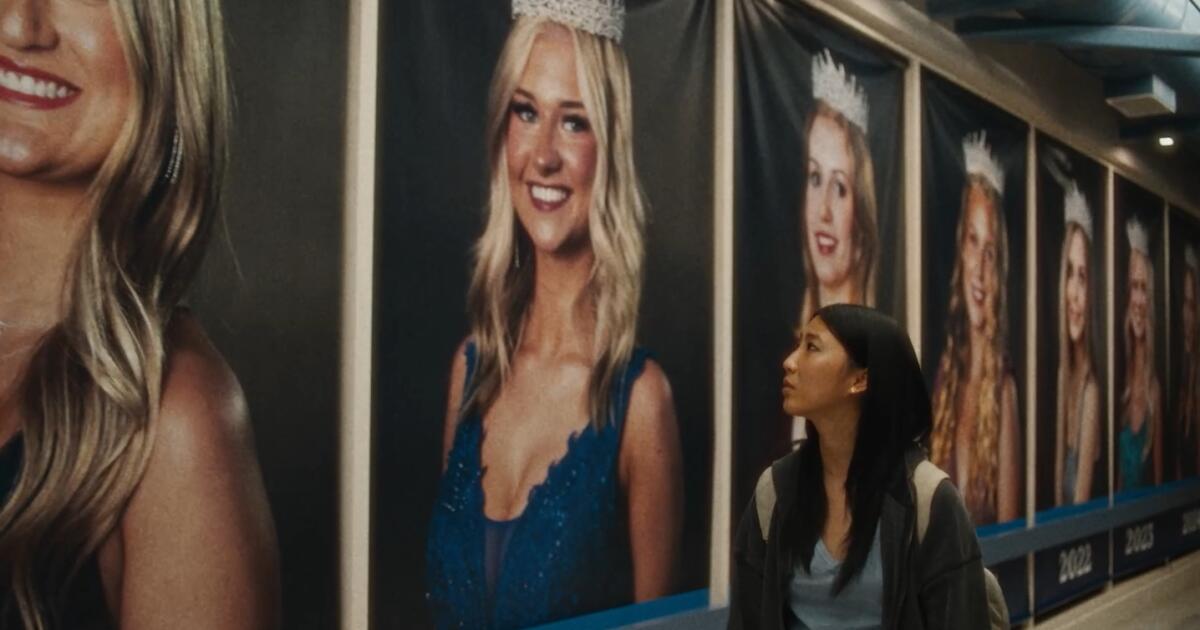
Fitting in comes at a steep cost in “Slanted,” a sci-fi-horror satire in which a Chinese American teen makes a Faustian bargain seeking acceptance the only way that fashion magazines, her social media algorithm and the world at large suggest she can: by becoming white. Literally. Desperate to erase her Asian features, she takes the bait when a shady cosmetic company offers the ultimate makeover. The only catch? It’s irreversible. And you thought permanent eyebrows were a commitment.
A few fleshy shreds of late-breaking gore eventually follow, though writer-director Amy Wang’s SXSW-winning assimilation horror never cuts as deeply as it should. Still, credit the debuting feature filmmaker for venturing pretty far out there with a risky conceit in which two actresses, one Asian and the other white, play the same person while convincing us that we’re watching one conflicted girl stuck in two different bodies.
“Slanted” opens as 8-year-old Joan Huang (Kristen Cui) moves from China to wealthy suburban Georgia with her working-class parents Roger (Fang Du), a musician turned janitor, and her pragmatic mother Sofia (Vivian Wu). Scarred by the racist rejections of her white classmates on the first day of school, she’s awed by the prom coronation she witnesses the same night. Almost 10 years later and torn between her Chineseness and her desire to be embraced as American, the spunky Joan (Shirley Chen, a sardonic standout in “Dìdi” and wonderfully vulnerable here) would do anything to be crowned prom queen, the ultimate emblem of popularity. When the mysterious Ethnos Inc. sells her on an “ethnic modification” surgery guaranteeing a happier, whiter life, Joan eagerly signs up for the procedure that will replace her Asian identity and turn her into, well, Mckenna Grace (“Regretting You”).
What exactly is Ethnos? Call it the med spa from hell with a killer targeted marketing campaign. (Don’t worry about how the fictional science works. The film certainly doesn’t.) Testimonials from satisfied patients boast of improved post-op job opportunities and love lives, the idea being that erasing one’s race is a shortcut to equality — as long as the default complexion is white.
“Slanted” begs comparison to the identity horrors of “Get Out” and the beauty-industry carnage of “The Substance” (with a hazy nod to the prom scene in “Carrie”), but it’s the echoes of “Eternal Sunshine of the Spotless Mind,” a stated influence, that give the movie its “be careful what you wish for” poignancy. When Dr. Singer (R. Keith Harris) plies Joan with promises of relief from the exhaustion of being non-white in America (“If you can’t beat them, be them”), it’s a sales pitch reminiscent of George S. Schuyler’s 1931 novel “Black No More,” about a Black man who undergoes a scientific process to turn his skin white.
Given the slights Joan endures while cleaning a condescending white woman’s home or the way she clothespins her nose thinner and mimics Western beauty tutorials each morning before school, you wish you could assure her that comfort in her own skin will come in a few years’ time. Her only real cheerleader is her confident bestie Brindha (a sparkling Maitreyi Ramakrishnan in a too-brief appearance), who offers a model of what self-love and community could look like.
But assimilation is both survival and validation for Joan, who returns to school as “Jo Hunt,” now played by Grace. Cozying up to the cool kids that ignored her as an Asian girl but now offer her a seat at their “Mean Girls”-esque lunch table, she ingratiates herself to Olivia (Amelie Zilber), the queen-bee influencer she idolizes. Her prom dreams inch closer as her lies begin to mount and her new alabaster skin starts peeling off at extremely inopportune moments.
The gambit of “Slanted” hinges on the audience accepting that Joan is still the same person when Chen hands her off to Grace midway through the film. Like John Travolta and Nicolas Cage in “Face/Off,” the actors tag team the lead role seamlessly. Where Chen’s Joan runs on a naive, frantic despair, Grace carries heavy emotions and shame in her eyes, creating an especially loaded chemistry with Du and Wu, all three excellent (Grace also delivers a portion of her dialogue in Mandarin).
Informed by Wang’s own life growing up Chinese Australian, “Slanted” nails the micro-aggressions, body dysmorphia and desire to belong that can make coming of age while being “other” its own perplexing kind of hell, giving a voice to third-culture kids everywhere with gut-churning specificity. (For more on the subject, listen to the “Asian Enough” podcast I co-hosted for the L.A. Times.) But immigrant-tale clichés of stinky lunchboxes and intergenerational disappointment can feel rote and simplistic, and the film doesn’t probe as deeply into Jo’s regrets as it does the reasons she sought a new face to begin with.
Briefly, the larger picture of a heightened America comes into view, Wang envisioning Starbucks re-skinned as “Freedom Beans,” Whole Foods as “AR-15 Foods Market” and billboards adorned with buxom blondes in red, white and blue hawking burgers and beer. The concepts feel half-formed at best, disconnected from Joan/Jo’s story. We’re left with a nightmare of identity that feels slighter than it should, unsure of where to point its knife.
‘Slanted’
In English and Mandarin, with subtitles
Rated: R, for language, some sexual material, teen drug use and brief violent content/bloody images
Running time: 1 hour, 42 minutes
Playing: Opens Friday, March 13 in limited release

Fitting in comes at a steep cost in “Slanted,” a sci-fi-horror satire in which a Chinese American teen makes a Faustian bargain seeking acceptance the only way that fashion magazines, her social media algorithm and the world at large suggest she can: by becoming white. Literally. Desperate to erase her Asian features, she takes the bait when a shady cosmetic company offers the ultimate makeover. The only catch? It’s irreversible. And you thought permanent eyebrows were a commitment.
A few fleshy shreds of late-breaking gore eventually follow, though writer-director Amy Wang’s SXSW-winning assimilation horror never cuts as deeply as it should. Still, credit the debuting feature filmmaker for venturing pretty far out there with a risky conceit in which two actresses, one Asian and the other white, play the same person while convincing us that we’re watching one conflicted girl stuck in two different bodies.
“Slanted” opens as 8-year-old Joan Huang (Kristen Cui) moves from China to wealthy suburban Georgia with her working-class parents Roger (Fang Du), a musician turned janitor, and her pragmatic mother Sofia (Vivian Wu). Scarred by the racist rejections of her white classmates on the first day of school, she’s awed by the prom coronation she witnesses the same night. Almost 10 years later and torn between her Chineseness and her desire to be embraced as American, the spunky Joan (Shirley Chen, a sardonic standout in “Dìdi” and wonderfully vulnerable here) would do anything to be crowned prom queen, the ultimate emblem of popularity. When the mysterious Ethnos Inc. sells her on an “ethnic modification” surgery guaranteeing a happier, whiter life, Joan eagerly signs up for the procedure that will replace her Asian identity and turn her into, well, Mckenna Grace (“Regretting You”).
What exactly is Ethnos? Call it the med spa from hell with a killer targeted marketing campaign. (Don’t worry about how the fictional science works. The film certainly doesn’t.) Testimonials from satisfied patients boast of improved post-op job opportunities and love lives, the idea being that erasing one’s race is a shortcut to equality — as long as the default complexion is white.
“Slanted” begs comparison to the identity horrors of “Get Out” and the beauty-industry carnage of “The Substance” (with a hazy nod to the prom scene in “Carrie”), but it’s the echoes of “Eternal Sunshine of the Spotless Mind,” a stated influence, that give the movie its “be careful what you wish for” poignancy. When Dr. Singer (R. Keith Harris) plies Joan with promises of relief from the exhaustion of being non-white in America (“If you can’t beat them, be them”), it’s a sales pitch reminiscent of George S. Schuyler’s 1931 novel “Black No More,” about a Black man who undergoes a scientific process to turn his skin white.
Given the slights Joan endures while cleaning a condescending white woman’s home or the way she clothespins her nose thinner and mimics Western beauty tutorials each morning before school, you wish you could assure her that comfort in her own skin will come in a few years’ time. Her only real cheerleader is her confident bestie Brindha (a sparkling Maitreyi Ramakrishnan in a too-brief appearance), who offers a model of what self-love and community could look like.
But assimilation is both survival and validation for Joan, who returns to school as “Jo Hunt,” now played by Grace. Cozying up to the cool kids that ignored her as an Asian girl but now offer her a seat at their “Mean Girls”-esque lunch table, she ingratiates herself to Olivia (Amelie Zilber), the queen-bee influencer she idolizes. Her prom dreams inch closer as her lies begin to mount and her new alabaster skin starts peeling off at extremely inopportune moments.
The gambit of “Slanted” hinges on the audience accepting that Joan is still the same person when Chen hands her off to Grace midway through the film. Like John Travolta and Nicolas Cage in “Face/Off,” the actors tag team the lead role seamlessly. Where Chen’s Joan runs on a naive, frantic despair, Grace carries heavy emotions and shame in her eyes, creating an especially loaded chemistry with Du and Wu, all three excellent (Grace also delivers a portion of her dialogue in Mandarin).
Informed by Wang’s own life growing up Chinese Australian, “Slanted” nails the micro-aggressions, body dysmorphia and desire to belong that can make coming of age while being “other” its own perplexing kind of hell, giving a voice to third-culture kids everywhere with gut-churning specificity. (For more on the subject, listen to the “Asian Enough” podcast I co-hosted for the L.A. Times.) But immigrant-tale clichés of stinky lunchboxes and intergenerational disappointment can feel rote and simplistic, and the film doesn’t probe as deeply into Jo’s regrets as it does the reasons she sought a new face to begin with.
Briefly, the larger picture of a heightened America comes into view, Wang envisioning Starbucks re-skinned as “Freedom Beans,” Whole Foods as “AR-15 Foods Market” and billboards adorned with buxom blondes in red, white and blue hawking burgers and beer. The concepts feel half-formed at best, disconnected from Joan/Jo’s story. We’re left with a nightmare of identity that feels slighter than it should, unsure of where to point its knife.
‘Slanted’
In English and Mandarin, with subtitles
Rated: R, for language, some sexual material, teen drug use and brief violent content/bloody images
Running time: 1 hour, 42 minutes
Playing: Opens Friday, March 13 in limited release

Fitting in comes at a steep cost in “Slanted,” a sci-fi-horror satire in which a Chinese American teen makes a Faustian bargain seeking acceptance the only way that fashion magazines, her social media algorithm and the world at large suggest she can: by becoming white. Literally. Desperate to erase her Asian features, she takes the bait when a shady cosmetic company offers the ultimate makeover. The only catch? It’s irreversible. And you thought permanent eyebrows were a commitment.
A few fleshy shreds of late-breaking gore eventually follow, though writer-director Amy Wang’s SXSW-winning assimilation horror never cuts as deeply as it should. Still, credit the debuting feature filmmaker for venturing pretty far out there with a risky conceit in which two actresses, one Asian and the other white, play the same person while convincing us that we’re watching one conflicted girl stuck in two different bodies.
“Slanted” opens as 8-year-old Joan Huang (Kristen Cui) moves from China to wealthy suburban Georgia with her working-class parents Roger (Fang Du), a musician turned janitor, and her pragmatic mother Sofia (Vivian Wu). Scarred by the racist rejections of her white classmates on the first day of school, she’s awed by the prom coronation she witnesses the same night. Almost 10 years later and torn between her Chineseness and her desire to be embraced as American, the spunky Joan (Shirley Chen, a sardonic standout in “Dìdi” and wonderfully vulnerable here) would do anything to be crowned prom queen, the ultimate emblem of popularity. When the mysterious Ethnos Inc. sells her on an “ethnic modification” surgery guaranteeing a happier, whiter life, Joan eagerly signs up for the procedure that will replace her Asian identity and turn her into, well, Mckenna Grace (“Regretting You”).
What exactly is Ethnos? Call it the med spa from hell with a killer targeted marketing campaign. (Don’t worry about how the fictional science works. The film certainly doesn’t.) Testimonials from satisfied patients boast of improved post-op job opportunities and love lives, the idea being that erasing one’s race is a shortcut to equality — as long as the default complexion is white.
“Slanted” begs comparison to the identity horrors of “Get Out” and the beauty-industry carnage of “The Substance” (with a hazy nod to the prom scene in “Carrie”), but it’s the echoes of “Eternal Sunshine of the Spotless Mind,” a stated influence, that give the movie its “be careful what you wish for” poignancy. When Dr. Singer (R. Keith Harris) plies Joan with promises of relief from the exhaustion of being non-white in America (“If you can’t beat them, be them”), it’s a sales pitch reminiscent of George S. Schuyler’s 1931 novel “Black No More,” about a Black man who undergoes a scientific process to turn his skin white.
Given the slights Joan endures while cleaning a condescending white woman’s home or the way she clothespins her nose thinner and mimics Western beauty tutorials each morning before school, you wish you could assure her that comfort in her own skin will come in a few years’ time. Her only real cheerleader is her confident bestie Brindha (a sparkling Maitreyi Ramakrishnan in a too-brief appearance), who offers a model of what self-love and community could look like.
But assimilation is both survival and validation for Joan, who returns to school as “Jo Hunt,” now played by Grace. Cozying up to the cool kids that ignored her as an Asian girl but now offer her a seat at their “Mean Girls”-esque lunch table, she ingratiates herself to Olivia (Amelie Zilber), the queen-bee influencer she idolizes. Her prom dreams inch closer as her lies begin to mount and her new alabaster skin starts peeling off at extremely inopportune moments.
The gambit of “Slanted” hinges on the audience accepting that Joan is still the same person when Chen hands her off to Grace midway through the film. Like John Travolta and Nicolas Cage in “Face/Off,” the actors tag team the lead role seamlessly. Where Chen’s Joan runs on a naive, frantic despair, Grace carries heavy emotions and shame in her eyes, creating an especially loaded chemistry with Du and Wu, all three excellent (Grace also delivers a portion of her dialogue in Mandarin).
Informed by Wang’s own life growing up Chinese Australian, “Slanted” nails the micro-aggressions, body dysmorphia and desire to belong that can make coming of age while being “other” its own perplexing kind of hell, giving a voice to third-culture kids everywhere with gut-churning specificity. (For more on the subject, listen to the “Asian Enough” podcast I co-hosted for the L.A. Times.) But immigrant-tale clichés of stinky lunchboxes and intergenerational disappointment can feel rote and simplistic, and the film doesn’t probe as deeply into Jo’s regrets as it does the reasons she sought a new face to begin with.
Briefly, the larger picture of a heightened America comes into view, Wang envisioning Starbucks re-skinned as “Freedom Beans,” Whole Foods as “AR-15 Foods Market” and billboards adorned with buxom blondes in red, white and blue hawking burgers and beer. The concepts feel half-formed at best, disconnected from Joan/Jo’s story. We’re left with a nightmare of identity that feels slighter than it should, unsure of where to point its knife.
‘Slanted’
In English and Mandarin, with subtitles
Rated: R, for language, some sexual material, teen drug use and brief violent content/bloody images
Running time: 1 hour, 42 minutes
Playing: Opens Friday, March 13 in limited release
Fitting in comes at a steep cost in “Slanted,” a sci-fi-horror satire in which a Chinese American teen makes a Faustian bargain seeking acceptance the only way that fashion magazines, her social media algorithm and the world at large suggest she can: by becoming white. Literally. Desperate to erase her Asian features, she takes the bait when a shady cosmetic company offers the ultimate makeover. The only catch? It’s irreversible. And you thought permanent eyebrows were a commitment.
A few fleshy shreds of late-breaking gore eventually follow, though writer-director Amy Wang’s SXSW-winning assimilation horror never cuts as deeply as it should. Still, credit the debuting feature filmmaker for venturing pretty far out there with a risky conceit in which two actresses, one Asian and the other white, play the same person while convincing us that we’re watching one conflicted girl stuck in two different bodies.
“Slanted” opens as 8-year-old Joan Huang (Kristen Cui) moves from China to wealthy suburban Georgia with her working-class parents Roger (Fang Du), a musician turned janitor, and her pragmatic mother Sofia (Vivian Wu). Scarred by the racist rejections of her white classmates on the first day of school, she’s awed by the prom coronation she witnesses the same night. Almost 10 years later and torn between her Chineseness and her desire to be embraced as American, the spunky Joan (Shirley Chen, a sardonic standout in “Dìdi” and wonderfully vulnerable here) would do anything to be crowned prom queen, the ultimate emblem of popularity. When the mysterious Ethnos Inc. sells her on an “ethnic modification” surgery guaranteeing a happier, whiter life, Joan eagerly signs up for the procedure that will replace her Asian identity and turn her into, well, Mckenna Grace (“Regretting You”).
What exactly is Ethnos? Call it the med spa from hell with a killer targeted marketing campaign. (Don’t worry about how the fictional science works. The film certainly doesn’t.) Testimonials from satisfied patients boast of improved post-op job opportunities and love lives, the idea being that erasing one’s race is a shortcut to equality — as long as the default complexion is white.
“Slanted” begs comparison to the identity horrors of “Get Out” and the beauty-industry carnage of “The Substance” (with a hazy nod to the prom scene in “Carrie”), but it’s the echoes of “Eternal Sunshine of the Spotless Mind,” a stated influence, that give the movie its “be careful what you wish for” poignancy. When Dr. Singer (R. Keith Harris) plies Joan with promises of relief from the exhaustion of being non-white in America (“If you can’t beat them, be them”), it’s a sales pitch reminiscent of George S. Schuyler’s 1931 novel “Black No More,” about a Black man who undergoes a scientific process to turn his skin white.
Given the slights Joan endures while cleaning a condescending white woman’s home or the way she clothespins her nose thinner and mimics Western beauty tutorials each morning before school, you wish you could assure her that comfort in her own skin will come in a few years’ time. Her only real cheerleader is her confident bestie Brindha (a sparkling Maitreyi Ramakrishnan in a too-brief appearance), who offers a model of what self-love and community could look like.
But assimilation is both survival and validation for Joan, who returns to school as “Jo Hunt,” now played by Grace. Cozying up to the cool kids that ignored her as an Asian girl but now offer her a seat at their “Mean Girls”-esque lunch table, she ingratiates herself to Olivia (Amelie Zilber), the queen-bee influencer she idolizes. Her prom dreams inch closer as her lies begin to mount and her new alabaster skin starts peeling off at extremely inopportune moments.
The gambit of “Slanted” hinges on the audience accepting that Joan is still the same person when Chen hands her off to Grace midway through the film. Like John Travolta and Nicolas Cage in “Face/Off,” the actors tag team the lead role seamlessly. Where Chen’s Joan runs on a naive, frantic despair, Grace carries heavy emotions and shame in her eyes, creating an especially loaded chemistry with Du and Wu, all three excellent (Grace also delivers a portion of her dialogue in Mandarin).
Informed by Wang’s own life growing up Chinese Australian, “Slanted” nails the micro-aggressions, body dysmorphia and desire to belong that can make coming of age while being “other” its own perplexing kind of hell, giving a voice to third-culture kids everywhere with gut-churning specificity. (For more on the subject, listen to the “Asian Enough” podcast I co-hosted for the L.A. Times.) But immigrant-tale clichés of stinky lunchboxes and intergenerational disappointment can feel rote and simplistic, and the film doesn’t probe as deeply into Jo’s regrets as it does the reasons she sought a new face to begin with.
Briefly, the larger picture of a heightened America comes into view, Wang envisioning Starbucks re-skinned as “Freedom Beans,” Whole Foods as “AR-15 Foods Market” and billboards adorned with buxom blondes in red, white and blue hawking burgers and beer. The concepts feel half-formed at best, disconnected from Joan/Jo’s story. We’re left with a nightmare of identity that feels slighter than it should, unsure of where to point its knife.
‘Slanted’
In English and Mandarin, with subtitles
Rated: R, for language, some sexual material, teen drug use and brief violent content/bloody images
Running time: 1 hour, 42 minutes
Playing: Opens Friday, March 13 in limited release

Fitting in comes at a steep cost in “Slanted,” a sci-fi-horror satire in which a Chinese American teen makes a Faustian bargain seeking acceptance the only way that fashion magazines, her social media algorithm and the world at large suggest she can: by becoming white. Literally. Desperate to erase her Asian features, she takes the bait when a shady cosmetic company offers the ultimate makeover. The only catch? It’s irreversible. And you thought permanent eyebrows were a commitment.
A few fleshy shreds of late-breaking gore eventually follow, though writer-director Amy Wang’s SXSW-winning assimilation horror never cuts as deeply as it should. Still, credit the debuting feature filmmaker for venturing pretty far out there with a risky conceit in which two actresses, one Asian and the other white, play the same person while convincing us that we’re watching one conflicted girl stuck in two different bodies.
“Slanted” opens as 8-year-old Joan Huang (Kristen Cui) moves from China to wealthy suburban Georgia with her working-class parents Roger (Fang Du), a musician turned janitor, and her pragmatic mother Sofia (Vivian Wu). Scarred by the racist rejections of her white classmates on the first day of school, she’s awed by the prom coronation she witnesses the same night. Almost 10 years later and torn between her Chineseness and her desire to be embraced as American, the spunky Joan (Shirley Chen, a sardonic standout in “Dìdi” and wonderfully vulnerable here) would do anything to be crowned prom queen, the ultimate emblem of popularity. When the mysterious Ethnos Inc. sells her on an “ethnic modification” surgery guaranteeing a happier, whiter life, Joan eagerly signs up for the procedure that will replace her Asian identity and turn her into, well, Mckenna Grace (“Regretting You”).
What exactly is Ethnos? Call it the med spa from hell with a killer targeted marketing campaign. (Don’t worry about how the fictional science works. The film certainly doesn’t.) Testimonials from satisfied patients boast of improved post-op job opportunities and love lives, the idea being that erasing one’s race is a shortcut to equality — as long as the default complexion is white.
“Slanted” begs comparison to the identity horrors of “Get Out” and the beauty-industry carnage of “The Substance” (with a hazy nod to the prom scene in “Carrie”), but it’s the echoes of “Eternal Sunshine of the Spotless Mind,” a stated influence, that give the movie its “be careful what you wish for” poignancy. When Dr. Singer (R. Keith Harris) plies Joan with promises of relief from the exhaustion of being non-white in America (“If you can’t beat them, be them”), it’s a sales pitch reminiscent of George S. Schuyler’s 1931 novel “Black No More,” about a Black man who undergoes a scientific process to turn his skin white.
Given the slights Joan endures while cleaning a condescending white woman’s home or the way she clothespins her nose thinner and mimics Western beauty tutorials each morning before school, you wish you could assure her that comfort in her own skin will come in a few years’ time. Her only real cheerleader is her confident bestie Brindha (a sparkling Maitreyi Ramakrishnan in a too-brief appearance), who offers a model of what self-love and community could look like.
But assimilation is both survival and validation for Joan, who returns to school as “Jo Hunt,” now played by Grace. Cozying up to the cool kids that ignored her as an Asian girl but now offer her a seat at their “Mean Girls”-esque lunch table, she ingratiates herself to Olivia (Amelie Zilber), the queen-bee influencer she idolizes. Her prom dreams inch closer as her lies begin to mount and her new alabaster skin starts peeling off at extremely inopportune moments.
The gambit of “Slanted” hinges on the audience accepting that Joan is still the same person when Chen hands her off to Grace midway through the film. Like John Travolta and Nicolas Cage in “Face/Off,” the actors tag team the lead role seamlessly. Where Chen’s Joan runs on a naive, frantic despair, Grace carries heavy emotions and shame in her eyes, creating an especially loaded chemistry with Du and Wu, all three excellent (Grace also delivers a portion of her dialogue in Mandarin).
Informed by Wang’s own life growing up Chinese Australian, “Slanted” nails the micro-aggressions, body dysmorphia and desire to belong that can make coming of age while being “other” its own perplexing kind of hell, giving a voice to third-culture kids everywhere with gut-churning specificity. (For more on the subject, listen to the “Asian Enough” podcast I co-hosted for the L.A. Times.) But immigrant-tale clichés of stinky lunchboxes and intergenerational disappointment can feel rote and simplistic, and the film doesn’t probe as deeply into Jo’s regrets as it does the reasons she sought a new face to begin with.
Briefly, the larger picture of a heightened America comes into view, Wang envisioning Starbucks re-skinned as “Freedom Beans,” Whole Foods as “AR-15 Foods Market” and billboards adorned with buxom blondes in red, white and blue hawking burgers and beer. The concepts feel half-formed at best, disconnected from Joan/Jo’s story. We’re left with a nightmare of identity that feels slighter than it should, unsure of where to point its knife.
‘Slanted’
In English and Mandarin, with subtitles
Rated: R, for language, some sexual material, teen drug use and brief violent content/bloody images
Running time: 1 hour, 42 minutes
Playing: Opens Friday, March 13 in limited release
Fitting in comes at a steep cost in “Slanted,” a sci-fi-horror satire in which a Chinese American teen makes a Faustian bargain seeking acceptance the only way that fashion magazines, her social media algorithm and the world at large suggest she can: by becoming white. Literally. Desperate to erase her Asian features, she takes the bait when a shady cosmetic company offers the ultimate makeover. The only catch? It’s irreversible. And you thought permanent eyebrows were a commitment.
A few fleshy shreds of late-breaking gore eventually follow, though writer-director Amy Wang’s SXSW-winning assimilation horror never cuts as deeply as it should. Still, credit the debuting feature filmmaker for venturing pretty far out there with a risky conceit in which two actresses, one Asian and the other white, play the same person while convincing us that we’re watching one conflicted girl stuck in two different bodies.
“Slanted” opens as 8-year-old Joan Huang (Kristen Cui) moves from China to wealthy suburban Georgia with her working-class parents Roger (Fang Du), a musician turned janitor, and her pragmatic mother Sofia (Vivian Wu). Scarred by the racist rejections of her white classmates on the first day of school, she’s awed by the prom coronation she witnesses the same night. Almost 10 years later and torn between her Chineseness and her desire to be embraced as American, the spunky Joan (Shirley Chen, a sardonic standout in “Dìdi” and wonderfully vulnerable here) would do anything to be crowned prom queen, the ultimate emblem of popularity. When the mysterious Ethnos Inc. sells her on an “ethnic modification” surgery guaranteeing a happier, whiter life, Joan eagerly signs up for the procedure that will replace her Asian identity and turn her into, well, Mckenna Grace (“Regretting You”).
What exactly is Ethnos? Call it the med spa from hell with a killer targeted marketing campaign. (Don’t worry about how the fictional science works. The film certainly doesn’t.) Testimonials from satisfied patients boast of improved post-op job opportunities and love lives, the idea being that erasing one’s race is a shortcut to equality — as long as the default complexion is white.
“Slanted” begs comparison to the identity horrors of “Get Out” and the beauty-industry carnage of “The Substance” (with a hazy nod to the prom scene in “Carrie”), but it’s the echoes of “Eternal Sunshine of the Spotless Mind,” a stated influence, that give the movie its “be careful what you wish for” poignancy. When Dr. Singer (R. Keith Harris) plies Joan with promises of relief from the exhaustion of being non-white in America (“If you can’t beat them, be them”), it’s a sales pitch reminiscent of George S. Schuyler’s 1931 novel “Black No More,” about a Black man who undergoes a scientific process to turn his skin white.
Given the slights Joan endures while cleaning a condescending white woman’s home or the way she clothespins her nose thinner and mimics Western beauty tutorials each morning before school, you wish you could assure her that comfort in her own skin will come in a few years’ time. Her only real cheerleader is her confident bestie Brindha (a sparkling Maitreyi Ramakrishnan in a too-brief appearance), who offers a model of what self-love and community could look like.
But assimilation is both survival and validation for Joan, who returns to school as “Jo Hunt,” now played by Grace. Cozying up to the cool kids that ignored her as an Asian girl but now offer her a seat at their “Mean Girls”-esque lunch table, she ingratiates herself to Olivia (Amelie Zilber), the queen-bee influencer she idolizes. Her prom dreams inch closer as her lies begin to mount and her new alabaster skin starts peeling off at extremely inopportune moments.
The gambit of “Slanted” hinges on the audience accepting that Joan is still the same person when Chen hands her off to Grace midway through the film. Like John Travolta and Nicolas Cage in “Face/Off,” the actors tag team the lead role seamlessly. Where Chen’s Joan runs on a naive, frantic despair, Grace carries heavy emotions and shame in her eyes, creating an especially loaded chemistry with Du and Wu, all three excellent (Grace also delivers a portion of her dialogue in Mandarin).
Informed by Wang’s own life growing up Chinese Australian, “Slanted” nails the micro-aggressions, body dysmorphia and desire to belong that can make coming of age while being “other” its own perplexing kind of hell, giving a voice to third-culture kids everywhere with gut-churning specificity. (For more on the subject, listen to the “Asian Enough” podcast I co-hosted for the L.A. Times.) But immigrant-tale clichés of stinky lunchboxes and intergenerational disappointment can feel rote and simplistic, and the film doesn’t probe as deeply into Jo’s regrets as it does the reasons she sought a new face to begin with.
Briefly, the larger picture of a heightened America comes into view, Wang envisioning Starbucks re-skinned as “Freedom Beans,” Whole Foods as “AR-15 Foods Market” and billboards adorned with buxom blondes in red, white and blue hawking burgers and beer. The concepts feel half-formed at best, disconnected from Joan/Jo’s story. We’re left with a nightmare of identity that feels slighter than it should, unsure of where to point its knife.
‘Slanted’
In English and Mandarin, with subtitles
Rated: R, for language, some sexual material, teen drug use and brief violent content/bloody images
Running time: 1 hour, 42 minutes
Playing: Opens Friday, March 13 in limited release
Fitting in comes at a steep cost in “Slanted,” a sci-fi-horror satire in which a Chinese American teen makes a Faustian bargain seeking acceptance the only way that fashion magazines, her social media algorithm and the world at large suggest she can: by becoming white. Literally. Desperate to erase her Asian features, she takes the bait when a shady cosmetic company offers the ultimate makeover. The only catch? It’s irreversible. And you thought permanent eyebrows were a commitment.
A few fleshy shreds of late-breaking gore eventually follow, though writer-director Amy Wang’s SXSW-winning assimilation horror never cuts as deeply as it should. Still, credit the debuting feature filmmaker for venturing pretty far out there with a risky conceit in which two actresses, one Asian and the other white, play the same person while convincing us that we’re watching one conflicted girl stuck in two different bodies.
“Slanted” opens as 8-year-old Joan Huang (Kristen Cui) moves from China to wealthy suburban Georgia with her working-class parents Roger (Fang Du), a musician turned janitor, and her pragmatic mother Sofia (Vivian Wu). Scarred by the racist rejections of her white classmates on the first day of school, she’s awed by the prom coronation she witnesses the same night. Almost 10 years later and torn between her Chineseness and her desire to be embraced as American, the spunky Joan (Shirley Chen, a sardonic standout in “Dìdi” and wonderfully vulnerable here) would do anything to be crowned prom queen, the ultimate emblem of popularity. When the mysterious Ethnos Inc. sells her on an “ethnic modification” surgery guaranteeing a happier, whiter life, Joan eagerly signs up for the procedure that will replace her Asian identity and turn her into, well, Mckenna Grace (“Regretting You”).
What exactly is Ethnos? Call it the med spa from hell with a killer targeted marketing campaign. (Don’t worry about how the fictional science works. The film certainly doesn’t.) Testimonials from satisfied patients boast of improved post-op job opportunities and love lives, the idea being that erasing one’s race is a shortcut to equality — as long as the default complexion is white.
“Slanted” begs comparison to the identity horrors of “Get Out” and the beauty-industry carnage of “The Substance” (with a hazy nod to the prom scene in “Carrie”), but it’s the echoes of “Eternal Sunshine of the Spotless Mind,” a stated influence, that give the movie its “be careful what you wish for” poignancy. When Dr. Singer (R. Keith Harris) plies Joan with promises of relief from the exhaustion of being non-white in America (“If you can’t beat them, be them”), it’s a sales pitch reminiscent of George S. Schuyler’s 1931 novel “Black No More,” about a Black man who undergoes a scientific process to turn his skin white.
Given the slights Joan endures while cleaning a condescending white woman’s home or the way she clothespins her nose thinner and mimics Western beauty tutorials each morning before school, you wish you could assure her that comfort in her own skin will come in a few years’ time. Her only real cheerleader is her confident bestie Brindha (a sparkling Maitreyi Ramakrishnan in a too-brief appearance), who offers a model of what self-love and community could look like.
But assimilation is both survival and validation for Joan, who returns to school as “Jo Hunt,” now played by Grace. Cozying up to the cool kids that ignored her as an Asian girl but now offer her a seat at their “Mean Girls”-esque lunch table, she ingratiates herself to Olivia (Amelie Zilber), the queen-bee influencer she idolizes. Her prom dreams inch closer as her lies begin to mount and her new alabaster skin starts peeling off at extremely inopportune moments.
The gambit of “Slanted” hinges on the audience accepting that Joan is still the same person when Chen hands her off to Grace midway through the film. Like John Travolta and Nicolas Cage in “Face/Off,” the actors tag team the lead role seamlessly. Where Chen’s Joan runs on a naive, frantic despair, Grace carries heavy emotions and shame in her eyes, creating an especially loaded chemistry with Du and Wu, all three excellent (Grace also delivers a portion of her dialogue in Mandarin).
Informed by Wang’s own life growing up Chinese Australian, “Slanted” nails the micro-aggressions, body dysmorphia and desire to belong that can make coming of age while being “other” its own perplexing kind of hell, giving a voice to third-culture kids everywhere with gut-churning specificity. (For more on the subject, listen to the “Asian Enough” podcast I co-hosted for the L.A. Times.) But immigrant-tale clichés of stinky lunchboxes and intergenerational disappointment can feel rote and simplistic, and the film doesn’t probe as deeply into Jo’s regrets as it does the reasons she sought a new face to begin with.
Briefly, the larger picture of a heightened America comes into view, Wang envisioning Starbucks re-skinned as “Freedom Beans,” Whole Foods as “AR-15 Foods Market” and billboards adorned with buxom blondes in red, white and blue hawking burgers and beer. The concepts feel half-formed at best, disconnected from Joan/Jo’s story. We’re left with a nightmare of identity that feels slighter than it should, unsure of where to point its knife.
‘Slanted’
In English and Mandarin, with subtitles
Rated: R, for language, some sexual material, teen drug use and brief violent content/bloody images
Running time: 1 hour, 42 minutes
Playing: Opens Friday, March 13 in limited release
Fitting in comes at a steep cost in “Slanted,” a sci-fi-horror satire in which a Chinese American teen makes a Faustian bargain seeking acceptance the only way that fashion magazines, her social media algorithm and the world at large suggest she can: by becoming white. Literally. Desperate to erase her Asian features, she takes the bait when a shady cosmetic company offers the ultimate makeover. The only catch? It’s irreversible. And you thought permanent eyebrows were a commitment.
A few fleshy shreds of late-breaking gore eventually follow, though writer-director Amy Wang’s SXSW-winning assimilation horror never cuts as deeply as it should. Still, credit the debuting feature filmmaker for venturing pretty far out there with a risky conceit in which two actresses, one Asian and the other white, play the same person while convincing us that we’re watching one conflicted girl stuck in two different bodies.
“Slanted” opens as 8-year-old Joan Huang (Kristen Cui) moves from China to wealthy suburban Georgia with her working-class parents Roger (Fang Du), a musician turned janitor, and her pragmatic mother Sofia (Vivian Wu). Scarred by the racist rejections of her white classmates on the first day of school, she’s awed by the prom coronation she witnesses the same night. Almost 10 years later and torn between her Chineseness and her desire to be embraced as American, the spunky Joan (Shirley Chen, a sardonic standout in “Dìdi” and wonderfully vulnerable here) would do anything to be crowned prom queen, the ultimate emblem of popularity. When the mysterious Ethnos Inc. sells her on an “ethnic modification” surgery guaranteeing a happier, whiter life, Joan eagerly signs up for the procedure that will replace her Asian identity and turn her into, well, Mckenna Grace (“Regretting You”).
What exactly is Ethnos? Call it the med spa from hell with a killer targeted marketing campaign. (Don’t worry about how the fictional science works. The film certainly doesn’t.) Testimonials from satisfied patients boast of improved post-op job opportunities and love lives, the idea being that erasing one’s race is a shortcut to equality — as long as the default complexion is white.
“Slanted” begs comparison to the identity horrors of “Get Out” and the beauty-industry carnage of “The Substance” (with a hazy nod to the prom scene in “Carrie”), but it’s the echoes of “Eternal Sunshine of the Spotless Mind,” a stated influence, that give the movie its “be careful what you wish for” poignancy. When Dr. Singer (R. Keith Harris) plies Joan with promises of relief from the exhaustion of being non-white in America (“If you can’t beat them, be them”), it’s a sales pitch reminiscent of George S. Schuyler’s 1931 novel “Black No More,” about a Black man who undergoes a scientific process to turn his skin white.
Given the slights Joan endures while cleaning a condescending white woman’s home or the way she clothespins her nose thinner and mimics Western beauty tutorials each morning before school, you wish you could assure her that comfort in her own skin will come in a few years’ time. Her only real cheerleader is her confident bestie Brindha (a sparkling Maitreyi Ramakrishnan in a too-brief appearance), who offers a model of what self-love and community could look like.
But assimilation is both survival and validation for Joan, who returns to school as “Jo Hunt,” now played by Grace. Cozying up to the cool kids that ignored her as an Asian girl but now offer her a seat at their “Mean Girls”-esque lunch table, she ingratiates herself to Olivia (Amelie Zilber), the queen-bee influencer she idolizes. Her prom dreams inch closer as her lies begin to mount and her new alabaster skin starts peeling off at extremely inopportune moments.
The gambit of “Slanted” hinges on the audience accepting that Joan is still the same person when Chen hands her off to Grace midway through the film. Like John Travolta and Nicolas Cage in “Face/Off,” the actors tag team the lead role seamlessly. Where Chen’s Joan runs on a naive, frantic despair, Grace carries heavy emotions and shame in her eyes, creating an especially loaded chemistry with Du and Wu, all three excellent (Grace also delivers a portion of her dialogue in Mandarin).
Informed by Wang’s own life growing up Chinese Australian, “Slanted” nails the micro-aggressions, body dysmorphia and desire to belong that can make coming of age while being “other” its own perplexing kind of hell, giving a voice to third-culture kids everywhere with gut-churning specificity. (For more on the subject, listen to the “Asian Enough” podcast I co-hosted for the L.A. Times.) But immigrant-tale clichés of stinky lunchboxes and intergenerational disappointment can feel rote and simplistic, and the film doesn’t probe as deeply into Jo’s regrets as it does the reasons she sought a new face to begin with.
Briefly, the larger picture of a heightened America comes into view, Wang envisioning Starbucks re-skinned as “Freedom Beans,” Whole Foods as “AR-15 Foods Market” and billboards adorned with buxom blondes in red, white and blue hawking burgers and beer. The concepts feel half-formed at best, disconnected from Joan/Jo’s story. We’re left with a nightmare of identity that feels slighter than it should, unsure of where to point its knife.
‘Slanted’
In English and Mandarin, with subtitles
Rated: R, for language, some sexual material, teen drug use and brief violent content/bloody images
Running time: 1 hour, 42 minutes
Playing: Opens Friday, March 13 in limited release

Fitting in comes at a steep cost in “Slanted,” a sci-fi-horror satire in which a Chinese American teen makes a Faustian bargain seeking acceptance the only way that fashion magazines, her social media algorithm and the world at large suggest she can: by becoming white. Literally. Desperate to erase her Asian features, she takes the bait when a shady cosmetic company offers the ultimate makeover. The only catch? It’s irreversible. And you thought permanent eyebrows were a commitment.
A few fleshy shreds of late-breaking gore eventually follow, though writer-director Amy Wang’s SXSW-winning assimilation horror never cuts as deeply as it should. Still, credit the debuting feature filmmaker for venturing pretty far out there with a risky conceit in which two actresses, one Asian and the other white, play the same person while convincing us that we’re watching one conflicted girl stuck in two different bodies.
“Slanted” opens as 8-year-old Joan Huang (Kristen Cui) moves from China to wealthy suburban Georgia with her working-class parents Roger (Fang Du), a musician turned janitor, and her pragmatic mother Sofia (Vivian Wu). Scarred by the racist rejections of her white classmates on the first day of school, she’s awed by the prom coronation she witnesses the same night. Almost 10 years later and torn between her Chineseness and her desire to be embraced as American, the spunky Joan (Shirley Chen, a sardonic standout in “Dìdi” and wonderfully vulnerable here) would do anything to be crowned prom queen, the ultimate emblem of popularity. When the mysterious Ethnos Inc. sells her on an “ethnic modification” surgery guaranteeing a happier, whiter life, Joan eagerly signs up for the procedure that will replace her Asian identity and turn her into, well, Mckenna Grace (“Regretting You”).
What exactly is Ethnos? Call it the med spa from hell with a killer targeted marketing campaign. (Don’t worry about how the fictional science works. The film certainly doesn’t.) Testimonials from satisfied patients boast of improved post-op job opportunities and love lives, the idea being that erasing one’s race is a shortcut to equality — as long as the default complexion is white.
“Slanted” begs comparison to the identity horrors of “Get Out” and the beauty-industry carnage of “The Substance” (with a hazy nod to the prom scene in “Carrie”), but it’s the echoes of “Eternal Sunshine of the Spotless Mind,” a stated influence, that give the movie its “be careful what you wish for” poignancy. When Dr. Singer (R. Keith Harris) plies Joan with promises of relief from the exhaustion of being non-white in America (“If you can’t beat them, be them”), it’s a sales pitch reminiscent of George S. Schuyler’s 1931 novel “Black No More,” about a Black man who undergoes a scientific process to turn his skin white.
Given the slights Joan endures while cleaning a condescending white woman’s home or the way she clothespins her nose thinner and mimics Western beauty tutorials each morning before school, you wish you could assure her that comfort in her own skin will come in a few years’ time. Her only real cheerleader is her confident bestie Brindha (a sparkling Maitreyi Ramakrishnan in a too-brief appearance), who offers a model of what self-love and community could look like.
But assimilation is both survival and validation for Joan, who returns to school as “Jo Hunt,” now played by Grace. Cozying up to the cool kids that ignored her as an Asian girl but now offer her a seat at their “Mean Girls”-esque lunch table, she ingratiates herself to Olivia (Amelie Zilber), the queen-bee influencer she idolizes. Her prom dreams inch closer as her lies begin to mount and her new alabaster skin starts peeling off at extremely inopportune moments.
The gambit of “Slanted” hinges on the audience accepting that Joan is still the same person when Chen hands her off to Grace midway through the film. Like John Travolta and Nicolas Cage in “Face/Off,” the actors tag team the lead role seamlessly. Where Chen’s Joan runs on a naive, frantic despair, Grace carries heavy emotions and shame in her eyes, creating an especially loaded chemistry with Du and Wu, all three excellent (Grace also delivers a portion of her dialogue in Mandarin).
Informed by Wang’s own life growing up Chinese Australian, “Slanted” nails the micro-aggressions, body dysmorphia and desire to belong that can make coming of age while being “other” its own perplexing kind of hell, giving a voice to third-culture kids everywhere with gut-churning specificity. (For more on the subject, listen to the “Asian Enough” podcast I co-hosted for the L.A. Times.) But immigrant-tale clichés of stinky lunchboxes and intergenerational disappointment can feel rote and simplistic, and the film doesn’t probe as deeply into Jo’s regrets as it does the reasons she sought a new face to begin with.
Briefly, the larger picture of a heightened America comes into view, Wang envisioning Starbucks re-skinned as “Freedom Beans,” Whole Foods as “AR-15 Foods Market” and billboards adorned with buxom blondes in red, white and blue hawking burgers and beer. The concepts feel half-formed at best, disconnected from Joan/Jo’s story. We’re left with a nightmare of identity that feels slighter than it should, unsure of where to point its knife.
‘Slanted’
In English and Mandarin, with subtitles
Rated: R, for language, some sexual material, teen drug use and brief violent content/bloody images
Running time: 1 hour, 42 minutes
Playing: Opens Friday, March 13 in limited release
Fitting in comes at a steep cost in “Slanted,” a sci-fi-horror satire in which a Chinese American teen makes a Faustian bargain seeking acceptance the only way that fashion magazines, her social media algorithm and the world at large suggest she can: by becoming white. Literally. Desperate to erase her Asian features, she takes the bait when a shady cosmetic company offers the ultimate makeover. The only catch? It’s irreversible. And you thought permanent eyebrows were a commitment.
A few fleshy shreds of late-breaking gore eventually follow, though writer-director Amy Wang’s SXSW-winning assimilation horror never cuts as deeply as it should. Still, credit the debuting feature filmmaker for venturing pretty far out there with a risky conceit in which two actresses, one Asian and the other white, play the same person while convincing us that we’re watching one conflicted girl stuck in two different bodies.
“Slanted” opens as 8-year-old Joan Huang (Kristen Cui) moves from China to wealthy suburban Georgia with her working-class parents Roger (Fang Du), a musician turned janitor, and her pragmatic mother Sofia (Vivian Wu). Scarred by the racist rejections of her white classmates on the first day of school, she’s awed by the prom coronation she witnesses the same night. Almost 10 years later and torn between her Chineseness and her desire to be embraced as American, the spunky Joan (Shirley Chen, a sardonic standout in “Dìdi” and wonderfully vulnerable here) would do anything to be crowned prom queen, the ultimate emblem of popularity. When the mysterious Ethnos Inc. sells her on an “ethnic modification” surgery guaranteeing a happier, whiter life, Joan eagerly signs up for the procedure that will replace her Asian identity and turn her into, well, Mckenna Grace (“Regretting You”).
What exactly is Ethnos? Call it the med spa from hell with a killer targeted marketing campaign. (Don’t worry about how the fictional science works. The film certainly doesn’t.) Testimonials from satisfied patients boast of improved post-op job opportunities and love lives, the idea being that erasing one’s race is a shortcut to equality — as long as the default complexion is white.
“Slanted” begs comparison to the identity horrors of “Get Out” and the beauty-industry carnage of “The Substance” (with a hazy nod to the prom scene in “Carrie”), but it’s the echoes of “Eternal Sunshine of the Spotless Mind,” a stated influence, that give the movie its “be careful what you wish for” poignancy. When Dr. Singer (R. Keith Harris) plies Joan with promises of relief from the exhaustion of being non-white in America (“If you can’t beat them, be them”), it’s a sales pitch reminiscent of George S. Schuyler’s 1931 novel “Black No More,” about a Black man who undergoes a scientific process to turn his skin white.
Given the slights Joan endures while cleaning a condescending white woman’s home or the way she clothespins her nose thinner and mimics Western beauty tutorials each morning before school, you wish you could assure her that comfort in her own skin will come in a few years’ time. Her only real cheerleader is her confident bestie Brindha (a sparkling Maitreyi Ramakrishnan in a too-brief appearance), who offers a model of what self-love and community could look like.
But assimilation is both survival and validation for Joan, who returns to school as “Jo Hunt,” now played by Grace. Cozying up to the cool kids that ignored her as an Asian girl but now offer her a seat at their “Mean Girls”-esque lunch table, she ingratiates herself to Olivia (Amelie Zilber), the queen-bee influencer she idolizes. Her prom dreams inch closer as her lies begin to mount and her new alabaster skin starts peeling off at extremely inopportune moments.
The gambit of “Slanted” hinges on the audience accepting that Joan is still the same person when Chen hands her off to Grace midway through the film. Like John Travolta and Nicolas Cage in “Face/Off,” the actors tag team the lead role seamlessly. Where Chen’s Joan runs on a naive, frantic despair, Grace carries heavy emotions and shame in her eyes, creating an especially loaded chemistry with Du and Wu, all three excellent (Grace also delivers a portion of her dialogue in Mandarin).
Informed by Wang’s own life growing up Chinese Australian, “Slanted” nails the micro-aggressions, body dysmorphia and desire to belong that can make coming of age while being “other” its own perplexing kind of hell, giving a voice to third-culture kids everywhere with gut-churning specificity. (For more on the subject, listen to the “Asian Enough” podcast I co-hosted for the L.A. Times.) But immigrant-tale clichés of stinky lunchboxes and intergenerational disappointment can feel rote and simplistic, and the film doesn’t probe as deeply into Jo’s regrets as it does the reasons she sought a new face to begin with.
Briefly, the larger picture of a heightened America comes into view, Wang envisioning Starbucks re-skinned as “Freedom Beans,” Whole Foods as “AR-15 Foods Market” and billboards adorned with buxom blondes in red, white and blue hawking burgers and beer. The concepts feel half-formed at best, disconnected from Joan/Jo’s story. We’re left with a nightmare of identity that feels slighter than it should, unsure of where to point its knife.
‘Slanted’
In English and Mandarin, with subtitles
Rated: R, for language, some sexual material, teen drug use and brief violent content/bloody images
Running time: 1 hour, 42 minutes
Playing: Opens Friday, March 13 in limited release
Fitting in comes at a steep cost in “Slanted,” a sci-fi-horror satire in which a Chinese American teen makes a Faustian bargain seeking acceptance the only way that fashion magazines, her social media algorithm and the world at large suggest she can: by becoming white. Literally. Desperate to erase her Asian features, she takes the bait when a shady cosmetic company offers the ultimate makeover. The only catch? It’s irreversible. And you thought permanent eyebrows were a commitment.
A few fleshy shreds of late-breaking gore eventually follow, though writer-director Amy Wang’s SXSW-winning assimilation horror never cuts as deeply as it should. Still, credit the debuting feature filmmaker for venturing pretty far out there with a risky conceit in which two actresses, one Asian and the other white, play the same person while convincing us that we’re watching one conflicted girl stuck in two different bodies.
“Slanted” opens as 8-year-old Joan Huang (Kristen Cui) moves from China to wealthy suburban Georgia with her working-class parents Roger (Fang Du), a musician turned janitor, and her pragmatic mother Sofia (Vivian Wu). Scarred by the racist rejections of her white classmates on the first day of school, she’s awed by the prom coronation she witnesses the same night. Almost 10 years later and torn between her Chineseness and her desire to be embraced as American, the spunky Joan (Shirley Chen, a sardonic standout in “Dìdi” and wonderfully vulnerable here) would do anything to be crowned prom queen, the ultimate emblem of popularity. When the mysterious Ethnos Inc. sells her on an “ethnic modification” surgery guaranteeing a happier, whiter life, Joan eagerly signs up for the procedure that will replace her Asian identity and turn her into, well, Mckenna Grace (“Regretting You”).
What exactly is Ethnos? Call it the med spa from hell with a killer targeted marketing campaign. (Don’t worry about how the fictional science works. The film certainly doesn’t.) Testimonials from satisfied patients boast of improved post-op job opportunities and love lives, the idea being that erasing one’s race is a shortcut to equality — as long as the default complexion is white.
“Slanted” begs comparison to the identity horrors of “Get Out” and the beauty-industry carnage of “The Substance” (with a hazy nod to the prom scene in “Carrie”), but it’s the echoes of “Eternal Sunshine of the Spotless Mind,” a stated influence, that give the movie its “be careful what you wish for” poignancy. When Dr. Singer (R. Keith Harris) plies Joan with promises of relief from the exhaustion of being non-white in America (“If you can’t beat them, be them”), it’s a sales pitch reminiscent of George S. Schuyler’s 1931 novel “Black No More,” about a Black man who undergoes a scientific process to turn his skin white.
Given the slights Joan endures while cleaning a condescending white woman’s home or the way she clothespins her nose thinner and mimics Western beauty tutorials each morning before school, you wish you could assure her that comfort in her own skin will come in a few years’ time. Her only real cheerleader is her confident bestie Brindha (a sparkling Maitreyi Ramakrishnan in a too-brief appearance), who offers a model of what self-love and community could look like.
But assimilation is both survival and validation for Joan, who returns to school as “Jo Hunt,” now played by Grace. Cozying up to the cool kids that ignored her as an Asian girl but now offer her a seat at their “Mean Girls”-esque lunch table, she ingratiates herself to Olivia (Amelie Zilber), the queen-bee influencer she idolizes. Her prom dreams inch closer as her lies begin to mount and her new alabaster skin starts peeling off at extremely inopportune moments.
The gambit of “Slanted” hinges on the audience accepting that Joan is still the same person when Chen hands her off to Grace midway through the film. Like John Travolta and Nicolas Cage in “Face/Off,” the actors tag team the lead role seamlessly. Where Chen’s Joan runs on a naive, frantic despair, Grace carries heavy emotions and shame in her eyes, creating an especially loaded chemistry with Du and Wu, all three excellent (Grace also delivers a portion of her dialogue in Mandarin).
Informed by Wang’s own life growing up Chinese Australian, “Slanted” nails the micro-aggressions, body dysmorphia and desire to belong that can make coming of age while being “other” its own perplexing kind of hell, giving a voice to third-culture kids everywhere with gut-churning specificity. (For more on the subject, listen to the “Asian Enough” podcast I co-hosted for the L.A. Times.) But immigrant-tale clichés of stinky lunchboxes and intergenerational disappointment can feel rote and simplistic, and the film doesn’t probe as deeply into Jo’s regrets as it does the reasons she sought a new face to begin with.
Briefly, the larger picture of a heightened America comes into view, Wang envisioning Starbucks re-skinned as “Freedom Beans,” Whole Foods as “AR-15 Foods Market” and billboards adorned with buxom blondes in red, white and blue hawking burgers and beer. The concepts feel half-formed at best, disconnected from Joan/Jo’s story. We’re left with a nightmare of identity that feels slighter than it should, unsure of where to point its knife.
‘Slanted’
In English and Mandarin, with subtitles
Rated: R, for language, some sexual material, teen drug use and brief violent content/bloody images
Running time: 1 hour, 42 minutes
Playing: Opens Friday, March 13 in limited release
Fitting in comes at a steep cost in “Slanted,” a sci-fi-horror satire in which a Chinese American teen makes a Faustian bargain seeking acceptance the only way that fashion magazines, her social media algorithm and the world at large suggest she can: by becoming white. Literally. Desperate to erase her Asian features, she takes the bait when a shady cosmetic company offers the ultimate makeover. The only catch? It’s irreversible. And you thought permanent eyebrows were a commitment.
A few fleshy shreds of late-breaking gore eventually follow, though writer-director Amy Wang’s SXSW-winning assimilation horror never cuts as deeply as it should. Still, credit the debuting feature filmmaker for venturing pretty far out there with a risky conceit in which two actresses, one Asian and the other white, play the same person while convincing us that we’re watching one conflicted girl stuck in two different bodies.
“Slanted” opens as 8-year-old Joan Huang (Kristen Cui) moves from China to wealthy suburban Georgia with her working-class parents Roger (Fang Du), a musician turned janitor, and her pragmatic mother Sofia (Vivian Wu). Scarred by the racist rejections of her white classmates on the first day of school, she’s awed by the prom coronation she witnesses the same night. Almost 10 years later and torn between her Chineseness and her desire to be embraced as American, the spunky Joan (Shirley Chen, a sardonic standout in “Dìdi” and wonderfully vulnerable here) would do anything to be crowned prom queen, the ultimate emblem of popularity. When the mysterious Ethnos Inc. sells her on an “ethnic modification” surgery guaranteeing a happier, whiter life, Joan eagerly signs up for the procedure that will replace her Asian identity and turn her into, well, Mckenna Grace (“Regretting You”).
What exactly is Ethnos? Call it the med spa from hell with a killer targeted marketing campaign. (Don’t worry about how the fictional science works. The film certainly doesn’t.) Testimonials from satisfied patients boast of improved post-op job opportunities and love lives, the idea being that erasing one’s race is a shortcut to equality — as long as the default complexion is white.
“Slanted” begs comparison to the identity horrors of “Get Out” and the beauty-industry carnage of “The Substance” (with a hazy nod to the prom scene in “Carrie”), but it’s the echoes of “Eternal Sunshine of the Spotless Mind,” a stated influence, that give the movie its “be careful what you wish for” poignancy. When Dr. Singer (R. Keith Harris) plies Joan with promises of relief from the exhaustion of being non-white in America (“If you can’t beat them, be them”), it’s a sales pitch reminiscent of George S. Schuyler’s 1931 novel “Black No More,” about a Black man who undergoes a scientific process to turn his skin white.
Given the slights Joan endures while cleaning a condescending white woman’s home or the way she clothespins her nose thinner and mimics Western beauty tutorials each morning before school, you wish you could assure her that comfort in her own skin will come in a few years’ time. Her only real cheerleader is her confident bestie Brindha (a sparkling Maitreyi Ramakrishnan in a too-brief appearance), who offers a model of what self-love and community could look like.
But assimilation is both survival and validation for Joan, who returns to school as “Jo Hunt,” now played by Grace. Cozying up to the cool kids that ignored her as an Asian girl but now offer her a seat at their “Mean Girls”-esque lunch table, she ingratiates herself to Olivia (Amelie Zilber), the queen-bee influencer she idolizes. Her prom dreams inch closer as her lies begin to mount and her new alabaster skin starts peeling off at extremely inopportune moments.
The gambit of “Slanted” hinges on the audience accepting that Joan is still the same person when Chen hands her off to Grace midway through the film. Like John Travolta and Nicolas Cage in “Face/Off,” the actors tag team the lead role seamlessly. Where Chen’s Joan runs on a naive, frantic despair, Grace carries heavy emotions and shame in her eyes, creating an especially loaded chemistry with Du and Wu, all three excellent (Grace also delivers a portion of her dialogue in Mandarin).
Informed by Wang’s own life growing up Chinese Australian, “Slanted” nails the micro-aggressions, body dysmorphia and desire to belong that can make coming of age while being “other” its own perplexing kind of hell, giving a voice to third-culture kids everywhere with gut-churning specificity. (For more on the subject, listen to the “Asian Enough” podcast I co-hosted for the L.A. Times.) But immigrant-tale clichés of stinky lunchboxes and intergenerational disappointment can feel rote and simplistic, and the film doesn’t probe as deeply into Jo’s regrets as it does the reasons she sought a new face to begin with.
Briefly, the larger picture of a heightened America comes into view, Wang envisioning Starbucks re-skinned as “Freedom Beans,” Whole Foods as “AR-15 Foods Market” and billboards adorned with buxom blondes in red, white and blue hawking burgers and beer. The concepts feel half-formed at best, disconnected from Joan/Jo’s story. We’re left with a nightmare of identity that feels slighter than it should, unsure of where to point its knife.
‘Slanted’
In English and Mandarin, with subtitles
Rated: R, for language, some sexual material, teen drug use and brief violent content/bloody images
Running time: 1 hour, 42 minutes
Playing: Opens Friday, March 13 in limited release
Fitting in comes at a steep cost in “Slanted,” a sci-fi-horror satire in which a Chinese American teen makes a Faustian bargain seeking acceptance the only way that fashion magazines, her social media algorithm and the world at large suggest she can: by becoming white. Literally. Desperate to erase her Asian features, she takes the bait when a shady cosmetic company offers the ultimate makeover. The only catch? It’s irreversible. And you thought permanent eyebrows were a commitment.
A few fleshy shreds of late-breaking gore eventually follow, though writer-director Amy Wang’s SXSW-winning assimilation horror never cuts as deeply as it should. Still, credit the debuting feature filmmaker for venturing pretty far out there with a risky conceit in which two actresses, one Asian and the other white, play the same person while convincing us that we’re watching one conflicted girl stuck in two different bodies.
“Slanted” opens as 8-year-old Joan Huang (Kristen Cui) moves from China to wealthy suburban Georgia with her working-class parents Roger (Fang Du), a musician turned janitor, and her pragmatic mother Sofia (Vivian Wu). Scarred by the racist rejections of her white classmates on the first day of school, she’s awed by the prom coronation she witnesses the same night. Almost 10 years later and torn between her Chineseness and her desire to be embraced as American, the spunky Joan (Shirley Chen, a sardonic standout in “Dìdi” and wonderfully vulnerable here) would do anything to be crowned prom queen, the ultimate emblem of popularity. When the mysterious Ethnos Inc. sells her on an “ethnic modification” surgery guaranteeing a happier, whiter life, Joan eagerly signs up for the procedure that will replace her Asian identity and turn her into, well, Mckenna Grace (“Regretting You”).
What exactly is Ethnos? Call it the med spa from hell with a killer targeted marketing campaign. (Don’t worry about how the fictional science works. The film certainly doesn’t.) Testimonials from satisfied patients boast of improved post-op job opportunities and love lives, the idea being that erasing one’s race is a shortcut to equality — as long as the default complexion is white.
“Slanted” begs comparison to the identity horrors of “Get Out” and the beauty-industry carnage of “The Substance” (with a hazy nod to the prom scene in “Carrie”), but it’s the echoes of “Eternal Sunshine of the Spotless Mind,” a stated influence, that give the movie its “be careful what you wish for” poignancy. When Dr. Singer (R. Keith Harris) plies Joan with promises of relief from the exhaustion of being non-white in America (“If you can’t beat them, be them”), it’s a sales pitch reminiscent of George S. Schuyler’s 1931 novel “Black No More,” about a Black man who undergoes a scientific process to turn his skin white.
Given the slights Joan endures while cleaning a condescending white woman’s home or the way she clothespins her nose thinner and mimics Western beauty tutorials each morning before school, you wish you could assure her that comfort in her own skin will come in a few years’ time. Her only real cheerleader is her confident bestie Brindha (a sparkling Maitreyi Ramakrishnan in a too-brief appearance), who offers a model of what self-love and community could look like.
But assimilation is both survival and validation for Joan, who returns to school as “Jo Hunt,” now played by Grace. Cozying up to the cool kids that ignored her as an Asian girl but now offer her a seat at their “Mean Girls”-esque lunch table, she ingratiates herself to Olivia (Amelie Zilber), the queen-bee influencer she idolizes. Her prom dreams inch closer as her lies begin to mount and her new alabaster skin starts peeling off at extremely inopportune moments.
The gambit of “Slanted” hinges on the audience accepting that Joan is still the same person when Chen hands her off to Grace midway through the film. Like John Travolta and Nicolas Cage in “Face/Off,” the actors tag team the lead role seamlessly. Where Chen’s Joan runs on a naive, frantic despair, Grace carries heavy emotions and shame in her eyes, creating an especially loaded chemistry with Du and Wu, all three excellent (Grace also delivers a portion of her dialogue in Mandarin).
Informed by Wang’s own life growing up Chinese Australian, “Slanted” nails the micro-aggressions, body dysmorphia and desire to belong that can make coming of age while being “other” its own perplexing kind of hell, giving a voice to third-culture kids everywhere with gut-churning specificity. (For more on the subject, listen to the “Asian Enough” podcast I co-hosted for the L.A. Times.) But immigrant-tale clichés of stinky lunchboxes and intergenerational disappointment can feel rote and simplistic, and the film doesn’t probe as deeply into Jo’s regrets as it does the reasons she sought a new face to begin with.
Briefly, the larger picture of a heightened America comes into view, Wang envisioning Starbucks re-skinned as “Freedom Beans,” Whole Foods as “AR-15 Foods Market” and billboards adorned with buxom blondes in red, white and blue hawking burgers and beer. The concepts feel half-formed at best, disconnected from Joan/Jo’s story. We’re left with a nightmare of identity that feels slighter than it should, unsure of where to point its knife.
‘Slanted’
In English and Mandarin, with subtitles
Rated: R, for language, some sexual material, teen drug use and brief violent content/bloody images
Running time: 1 hour, 42 minutes
Playing: Opens Friday, March 13 in limited release
Fitting in comes at a steep cost in “Slanted,” a sci-fi-horror satire in which a Chinese American teen makes a Faustian bargain seeking acceptance the only way that fashion magazines, her social media algorithm and the world at large suggest she can: by becoming white. Literally. Desperate to erase her Asian features, she takes the bait when a shady cosmetic company offers the ultimate makeover. The only catch? It’s irreversible. And you thought permanent eyebrows were a commitment.
A few fleshy shreds of late-breaking gore eventually follow, though writer-director Amy Wang’s SXSW-winning assimilation horror never cuts as deeply as it should. Still, credit the debuting feature filmmaker for venturing pretty far out there with a risky conceit in which two actresses, one Asian and the other white, play the same person while convincing us that we’re watching one conflicted girl stuck in two different bodies.
“Slanted” opens as 8-year-old Joan Huang (Kristen Cui) moves from China to wealthy suburban Georgia with her working-class parents Roger (Fang Du), a musician turned janitor, and her pragmatic mother Sofia (Vivian Wu). Scarred by the racist rejections of her white classmates on the first day of school, she’s awed by the prom coronation she witnesses the same night. Almost 10 years later and torn between her Chineseness and her desire to be embraced as American, the spunky Joan (Shirley Chen, a sardonic standout in “Dìdi” and wonderfully vulnerable here) would do anything to be crowned prom queen, the ultimate emblem of popularity. When the mysterious Ethnos Inc. sells her on an “ethnic modification” surgery guaranteeing a happier, whiter life, Joan eagerly signs up for the procedure that will replace her Asian identity and turn her into, well, Mckenna Grace (“Regretting You”).
What exactly is Ethnos? Call it the med spa from hell with a killer targeted marketing campaign. (Don’t worry about how the fictional science works. The film certainly doesn’t.) Testimonials from satisfied patients boast of improved post-op job opportunities and love lives, the idea being that erasing one’s race is a shortcut to equality — as long as the default complexion is white.
“Slanted” begs comparison to the identity horrors of “Get Out” and the beauty-industry carnage of “The Substance” (with a hazy nod to the prom scene in “Carrie”), but it’s the echoes of “Eternal Sunshine of the Spotless Mind,” a stated influence, that give the movie its “be careful what you wish for” poignancy. When Dr. Singer (R. Keith Harris) plies Joan with promises of relief from the exhaustion of being non-white in America (“If you can’t beat them, be them”), it’s a sales pitch reminiscent of George S. Schuyler’s 1931 novel “Black No More,” about a Black man who undergoes a scientific process to turn his skin white.
Given the slights Joan endures while cleaning a condescending white woman’s home or the way she clothespins her nose thinner and mimics Western beauty tutorials each morning before school, you wish you could assure her that comfort in her own skin will come in a few years’ time. Her only real cheerleader is her confident bestie Brindha (a sparkling Maitreyi Ramakrishnan in a too-brief appearance), who offers a model of what self-love and community could look like.
But assimilation is both survival and validation for Joan, who returns to school as “Jo Hunt,” now played by Grace. Cozying up to the cool kids that ignored her as an Asian girl but now offer her a seat at their “Mean Girls”-esque lunch table, she ingratiates herself to Olivia (Amelie Zilber), the queen-bee influencer she idolizes. Her prom dreams inch closer as her lies begin to mount and her new alabaster skin starts peeling off at extremely inopportune moments.
The gambit of “Slanted” hinges on the audience accepting that Joan is still the same person when Chen hands her off to Grace midway through the film. Like John Travolta and Nicolas Cage in “Face/Off,” the actors tag team the lead role seamlessly. Where Chen’s Joan runs on a naive, frantic despair, Grace carries heavy emotions and shame in her eyes, creating an especially loaded chemistry with Du and Wu, all three excellent (Grace also delivers a portion of her dialogue in Mandarin).
Informed by Wang’s own life growing up Chinese Australian, “Slanted” nails the micro-aggressions, body dysmorphia and desire to belong that can make coming of age while being “other” its own perplexing kind of hell, giving a voice to third-culture kids everywhere with gut-churning specificity. (For more on the subject, listen to the “Asian Enough” podcast I co-hosted for the L.A. Times.) But immigrant-tale clichés of stinky lunchboxes and intergenerational disappointment can feel rote and simplistic, and the film doesn’t probe as deeply into Jo’s regrets as it does the reasons she sought a new face to begin with.
Briefly, the larger picture of a heightened America comes into view, Wang envisioning Starbucks re-skinned as “Freedom Beans,” Whole Foods as “AR-15 Foods Market” and billboards adorned with buxom blondes in red, white and blue hawking burgers and beer. The concepts feel half-formed at best, disconnected from Joan/Jo’s story. We’re left with a nightmare of identity that feels slighter than it should, unsure of where to point its knife.
‘Slanted’
In English and Mandarin, with subtitles
Rated: R, for language, some sexual material, teen drug use and brief violent content/bloody images
Running time: 1 hour, 42 minutes
Playing: Opens Friday, March 13 in limited release
Fitting in comes at a steep cost in “Slanted,” a sci-fi-horror satire in which a Chinese American teen makes a Faustian bargain seeking acceptance the only way that fashion magazines, her social media algorithm and the world at large suggest she can: by becoming white. Literally. Desperate to erase her Asian features, she takes the bait when a shady cosmetic company offers the ultimate makeover. The only catch? It’s irreversible. And you thought permanent eyebrows were a commitment.
A few fleshy shreds of late-breaking gore eventually follow, though writer-director Amy Wang’s SXSW-winning assimilation horror never cuts as deeply as it should. Still, credit the debuting feature filmmaker for venturing pretty far out there with a risky conceit in which two actresses, one Asian and the other white, play the same person while convincing us that we’re watching one conflicted girl stuck in two different bodies.
“Slanted” opens as 8-year-old Joan Huang (Kristen Cui) moves from China to wealthy suburban Georgia with her working-class parents Roger (Fang Du), a musician turned janitor, and her pragmatic mother Sofia (Vivian Wu). Scarred by the racist rejections of her white classmates on the first day of school, she’s awed by the prom coronation she witnesses the same night. Almost 10 years later and torn between her Chineseness and her desire to be embraced as American, the spunky Joan (Shirley Chen, a sardonic standout in “Dìdi” and wonderfully vulnerable here) would do anything to be crowned prom queen, the ultimate emblem of popularity. When the mysterious Ethnos Inc. sells her on an “ethnic modification” surgery guaranteeing a happier, whiter life, Joan eagerly signs up for the procedure that will replace her Asian identity and turn her into, well, Mckenna Grace (“Regretting You”).
What exactly is Ethnos? Call it the med spa from hell with a killer targeted marketing campaign. (Don’t worry about how the fictional science works. The film certainly doesn’t.) Testimonials from satisfied patients boast of improved post-op job opportunities and love lives, the idea being that erasing one’s race is a shortcut to equality — as long as the default complexion is white.
“Slanted” begs comparison to the identity horrors of “Get Out” and the beauty-industry carnage of “The Substance” (with a hazy nod to the prom scene in “Carrie”), but it’s the echoes of “Eternal Sunshine of the Spotless Mind,” a stated influence, that give the movie its “be careful what you wish for” poignancy. When Dr. Singer (R. Keith Harris) plies Joan with promises of relief from the exhaustion of being non-white in America (“If you can’t beat them, be them”), it’s a sales pitch reminiscent of George S. Schuyler’s 1931 novel “Black No More,” about a Black man who undergoes a scientific process to turn his skin white.
Given the slights Joan endures while cleaning a condescending white woman’s home or the way she clothespins her nose thinner and mimics Western beauty tutorials each morning before school, you wish you could assure her that comfort in her own skin will come in a few years’ time. Her only real cheerleader is her confident bestie Brindha (a sparkling Maitreyi Ramakrishnan in a too-brief appearance), who offers a model of what self-love and community could look like.
But assimilation is both survival and validation for Joan, who returns to school as “Jo Hunt,” now played by Grace. Cozying up to the cool kids that ignored her as an Asian girl but now offer her a seat at their “Mean Girls”-esque lunch table, she ingratiates herself to Olivia (Amelie Zilber), the queen-bee influencer she idolizes. Her prom dreams inch closer as her lies begin to mount and her new alabaster skin starts peeling off at extremely inopportune moments.
The gambit of “Slanted” hinges on the audience accepting that Joan is still the same person when Chen hands her off to Grace midway through the film. Like John Travolta and Nicolas Cage in “Face/Off,” the actors tag team the lead role seamlessly. Where Chen’s Joan runs on a naive, frantic despair, Grace carries heavy emotions and shame in her eyes, creating an especially loaded chemistry with Du and Wu, all three excellent (Grace also delivers a portion of her dialogue in Mandarin).
Informed by Wang’s own life growing up Chinese Australian, “Slanted” nails the micro-aggressions, body dysmorphia and desire to belong that can make coming of age while being “other” its own perplexing kind of hell, giving a voice to third-culture kids everywhere with gut-churning specificity. (For more on the subject, listen to the “Asian Enough” podcast I co-hosted for the L.A. Times.) But immigrant-tale clichés of stinky lunchboxes and intergenerational disappointment can feel rote and simplistic, and the film doesn’t probe as deeply into Jo’s regrets as it does the reasons she sought a new face to begin with.
Briefly, the larger picture of a heightened America comes into view, Wang envisioning Starbucks re-skinned as “Freedom Beans,” Whole Foods as “AR-15 Foods Market” and billboards adorned with buxom blondes in red, white and blue hawking burgers and beer. The concepts feel half-formed at best, disconnected from Joan/Jo’s story. We’re left with a nightmare of identity that feels slighter than it should, unsure of where to point its knife.
‘Slanted’
In English and Mandarin, with subtitles
Rated: R, for language, some sexual material, teen drug use and brief violent content/bloody images
Running time: 1 hour, 42 minutes
Playing: Opens Friday, March 13 in limited release
Fitting in comes at a steep cost in “Slanted,” a sci-fi-horror satire in which a Chinese American teen makes a Faustian bargain seeking acceptance the only way that fashion magazines, her social media algorithm and the world at large suggest she can: by becoming white. Literally. Desperate to erase her Asian features, she takes the bait when a shady cosmetic company offers the ultimate makeover. The only catch? It’s irreversible. And you thought permanent eyebrows were a commitment.
A few fleshy shreds of late-breaking gore eventually follow, though writer-director Amy Wang’s SXSW-winning assimilation horror never cuts as deeply as it should. Still, credit the debuting feature filmmaker for venturing pretty far out there with a risky conceit in which two actresses, one Asian and the other white, play the same person while convincing us that we’re watching one conflicted girl stuck in two different bodies.
“Slanted” opens as 8-year-old Joan Huang (Kristen Cui) moves from China to wealthy suburban Georgia with her working-class parents Roger (Fang Du), a musician turned janitor, and her pragmatic mother Sofia (Vivian Wu). Scarred by the racist rejections of her white classmates on the first day of school, she’s awed by the prom coronation she witnesses the same night. Almost 10 years later and torn between her Chineseness and her desire to be embraced as American, the spunky Joan (Shirley Chen, a sardonic standout in “Dìdi” and wonderfully vulnerable here) would do anything to be crowned prom queen, the ultimate emblem of popularity. When the mysterious Ethnos Inc. sells her on an “ethnic modification” surgery guaranteeing a happier, whiter life, Joan eagerly signs up for the procedure that will replace her Asian identity and turn her into, well, Mckenna Grace (“Regretting You”).
What exactly is Ethnos? Call it the med spa from hell with a killer targeted marketing campaign. (Don’t worry about how the fictional science works. The film certainly doesn’t.) Testimonials from satisfied patients boast of improved post-op job opportunities and love lives, the idea being that erasing one’s race is a shortcut to equality — as long as the default complexion is white.
“Slanted” begs comparison to the identity horrors of “Get Out” and the beauty-industry carnage of “The Substance” (with a hazy nod to the prom scene in “Carrie”), but it’s the echoes of “Eternal Sunshine of the Spotless Mind,” a stated influence, that give the movie its “be careful what you wish for” poignancy. When Dr. Singer (R. Keith Harris) plies Joan with promises of relief from the exhaustion of being non-white in America (“If you can’t beat them, be them”), it’s a sales pitch reminiscent of George S. Schuyler’s 1931 novel “Black No More,” about a Black man who undergoes a scientific process to turn his skin white.
Given the slights Joan endures while cleaning a condescending white woman’s home or the way she clothespins her nose thinner and mimics Western beauty tutorials each morning before school, you wish you could assure her that comfort in her own skin will come in a few years’ time. Her only real cheerleader is her confident bestie Brindha (a sparkling Maitreyi Ramakrishnan in a too-brief appearance), who offers a model of what self-love and community could look like.
But assimilation is both survival and validation for Joan, who returns to school as “Jo Hunt,” now played by Grace. Cozying up to the cool kids that ignored her as an Asian girl but now offer her a seat at their “Mean Girls”-esque lunch table, she ingratiates herself to Olivia (Amelie Zilber), the queen-bee influencer she idolizes. Her prom dreams inch closer as her lies begin to mount and her new alabaster skin starts peeling off at extremely inopportune moments.
The gambit of “Slanted” hinges on the audience accepting that Joan is still the same person when Chen hands her off to Grace midway through the film. Like John Travolta and Nicolas Cage in “Face/Off,” the actors tag team the lead role seamlessly. Where Chen’s Joan runs on a naive, frantic despair, Grace carries heavy emotions and shame in her eyes, creating an especially loaded chemistry with Du and Wu, all three excellent (Grace also delivers a portion of her dialogue in Mandarin).
Informed by Wang’s own life growing up Chinese Australian, “Slanted” nails the micro-aggressions, body dysmorphia and desire to belong that can make coming of age while being “other” its own perplexing kind of hell, giving a voice to third-culture kids everywhere with gut-churning specificity. (For more on the subject, listen to the “Asian Enough” podcast I co-hosted for the L.A. Times.) But immigrant-tale clichés of stinky lunchboxes and intergenerational disappointment can feel rote and simplistic, and the film doesn’t probe as deeply into Jo’s regrets as it does the reasons she sought a new face to begin with.
Briefly, the larger picture of a heightened America comes into view, Wang envisioning Starbucks re-skinned as “Freedom Beans,” Whole Foods as “AR-15 Foods Market” and billboards adorned with buxom blondes in red, white and blue hawking burgers and beer. The concepts feel half-formed at best, disconnected from Joan/Jo’s story. We’re left with a nightmare of identity that feels slighter than it should, unsure of where to point its knife.
‘Slanted’
In English and Mandarin, with subtitles
Rated: R, for language, some sexual material, teen drug use and brief violent content/bloody images
Running time: 1 hour, 42 minutes
Playing: Opens Friday, March 13 in limited release

