

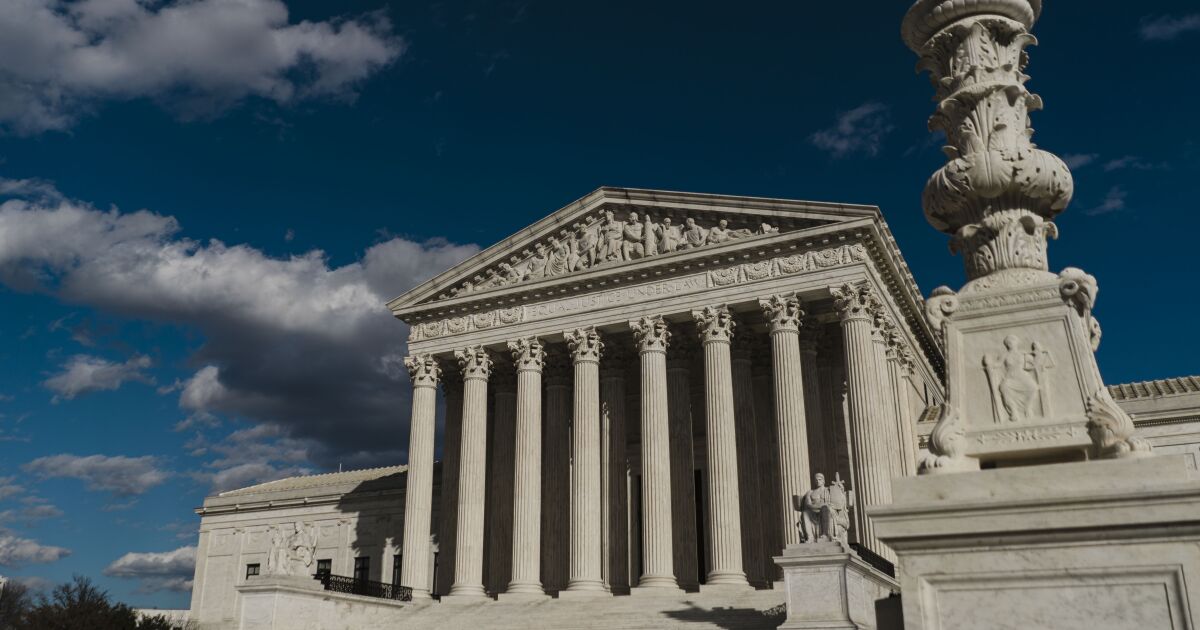
The Supreme Court warned unions on Thursday that they may face suits for damages if striking workers destroy their employer’s property.
In an 8-1 decision, the justices revived a suit brought in Washington state against union drivers who allegedly walked off the job one morning after their trucks had been loaded with fresh concrete. The workers did not notify their employer in advance. If left unattended, concrete can harden and destroy the trucks that carry it, the company said.
At issue was whether the unions may be sued for allegedly damaging the property or whether such a labor dispute must be reviewed and resolved first by the National Labor Relations Board.
With only Justice Ketanji Brown Jackson in dissent, the court ruled the company may press its suit for damages in a state court.
Union leaders said they feared a decision for the company in Glacier Northwest vs. Teamsters could badly undercut the right to strike.
But Justice Amy Coney Barrett said the labor law has long required striking workers to take “reasonable precautions to protect their employer’s property” from damages “due to the sudden cessation of work.”
“In this instance, the Union’s choice to call a strike after its drivers had loaded a large amount of wet concrete into Glacier’s delivery trucks strongly suggests that it failed to take reasonable precautions to avoid foreseeable, aggravated, and imminent harm to Glacier’s property,” she said.
Her opinion sends the case back to a state court in Washington. Chief Justice John G. Roberts Jr. and Justices Sonia Sotomayor, Elena Kagan and Brett M. Kavanaugh agreed.
Justices Clarence Thomas, Samuel A. Alito Jr. and Neil M. Gorsuch concurred in the outcome but would have gone further to limit the authority of the NLRB.
Jackson wrote a 27-page dissent. “Today’s misguided foray underscores the wisdom of Congress’s decision to create an agency that is uniquely positioned to evaluate the facts and apply the law in cases such as this one,” she argued.
The company sought to “shift the duty of protecting [its] property from damage or loss incident to a strike onto the striking workers,” she added. “In my view, doing that places a significant burden on the employees’ exercise of their statutory right to strike, unjustifiably undermining Congress’s intent. Workers are not indentured servants, bound to continue laboring until any planned work stoppage would be as painless as possible for their master. They are employees whose collective and peaceful decision to withhold their labor is protected by the NLRA [National Labor Relations Act] even if economic injury results.”

The Supreme Court warned unions on Thursday that they may face suits for damages if striking workers destroy their employer’s property.
In an 8-1 decision, the justices revived a suit brought in Washington state against union drivers who allegedly walked off the job one morning after their trucks had been loaded with fresh concrete. The workers did not notify their employer in advance. If left unattended, concrete can harden and destroy the trucks that carry it, the company said.
At issue was whether the unions may be sued for allegedly damaging the property or whether such a labor dispute must be reviewed and resolved first by the National Labor Relations Board.
With only Justice Ketanji Brown Jackson in dissent, the court ruled the company may press its suit for damages in a state court.
Union leaders said they feared a decision for the company in Glacier Northwest vs. Teamsters could badly undercut the right to strike.
But Justice Amy Coney Barrett said the labor law has long required striking workers to take “reasonable precautions to protect their employer’s property” from damages “due to the sudden cessation of work.”
“In this instance, the Union’s choice to call a strike after its drivers had loaded a large amount of wet concrete into Glacier’s delivery trucks strongly suggests that it failed to take reasonable precautions to avoid foreseeable, aggravated, and imminent harm to Glacier’s property,” she said.
Her opinion sends the case back to a state court in Washington. Chief Justice John G. Roberts Jr. and Justices Sonia Sotomayor, Elena Kagan and Brett M. Kavanaugh agreed.
Justices Clarence Thomas, Samuel A. Alito Jr. and Neil M. Gorsuch concurred in the outcome but would have gone further to limit the authority of the NLRB.
Jackson wrote a 27-page dissent. “Today’s misguided foray underscores the wisdom of Congress’s decision to create an agency that is uniquely positioned to evaluate the facts and apply the law in cases such as this one,” she argued.
The company sought to “shift the duty of protecting [its] property from damage or loss incident to a strike onto the striking workers,” she added. “In my view, doing that places a significant burden on the employees’ exercise of their statutory right to strike, unjustifiably undermining Congress’s intent. Workers are not indentured servants, bound to continue laboring until any planned work stoppage would be as painless as possible for their master. They are employees whose collective and peaceful decision to withhold their labor is protected by the NLRA [National Labor Relations Act] even if economic injury results.”

The Supreme Court warned unions on Thursday that they may face suits for damages if striking workers destroy their employer’s property.
In an 8-1 decision, the justices revived a suit brought in Washington state against union drivers who allegedly walked off the job one morning after their trucks had been loaded with fresh concrete. The workers did not notify their employer in advance. If left unattended, concrete can harden and destroy the trucks that carry it, the company said.
At issue was whether the unions may be sued for allegedly damaging the property or whether such a labor dispute must be reviewed and resolved first by the National Labor Relations Board.
With only Justice Ketanji Brown Jackson in dissent, the court ruled the company may press its suit for damages in a state court.
Union leaders said they feared a decision for the company in Glacier Northwest vs. Teamsters could badly undercut the right to strike.
But Justice Amy Coney Barrett said the labor law has long required striking workers to take “reasonable precautions to protect their employer’s property” from damages “due to the sudden cessation of work.”
“In this instance, the Union’s choice to call a strike after its drivers had loaded a large amount of wet concrete into Glacier’s delivery trucks strongly suggests that it failed to take reasonable precautions to avoid foreseeable, aggravated, and imminent harm to Glacier’s property,” she said.
Her opinion sends the case back to a state court in Washington. Chief Justice John G. Roberts Jr. and Justices Sonia Sotomayor, Elena Kagan and Brett M. Kavanaugh agreed.
Justices Clarence Thomas, Samuel A. Alito Jr. and Neil M. Gorsuch concurred in the outcome but would have gone further to limit the authority of the NLRB.
Jackson wrote a 27-page dissent. “Today’s misguided foray underscores the wisdom of Congress’s decision to create an agency that is uniquely positioned to evaluate the facts and apply the law in cases such as this one,” she argued.
The company sought to “shift the duty of protecting [its] property from damage or loss incident to a strike onto the striking workers,” she added. “In my view, doing that places a significant burden on the employees’ exercise of their statutory right to strike, unjustifiably undermining Congress’s intent. Workers are not indentured servants, bound to continue laboring until any planned work stoppage would be as painless as possible for their master. They are employees whose collective and peaceful decision to withhold their labor is protected by the NLRA [National Labor Relations Act] even if economic injury results.”
The Supreme Court warned unions on Thursday that they may face suits for damages if striking workers destroy their employer’s property.
In an 8-1 decision, the justices revived a suit brought in Washington state against union drivers who allegedly walked off the job one morning after their trucks had been loaded with fresh concrete. The workers did not notify their employer in advance. If left unattended, concrete can harden and destroy the trucks that carry it, the company said.
At issue was whether the unions may be sued for allegedly damaging the property or whether such a labor dispute must be reviewed and resolved first by the National Labor Relations Board.
With only Justice Ketanji Brown Jackson in dissent, the court ruled the company may press its suit for damages in a state court.
Union leaders said they feared a decision for the company in Glacier Northwest vs. Teamsters could badly undercut the right to strike.
But Justice Amy Coney Barrett said the labor law has long required striking workers to take “reasonable precautions to protect their employer’s property” from damages “due to the sudden cessation of work.”
“In this instance, the Union’s choice to call a strike after its drivers had loaded a large amount of wet concrete into Glacier’s delivery trucks strongly suggests that it failed to take reasonable precautions to avoid foreseeable, aggravated, and imminent harm to Glacier’s property,” she said.
Her opinion sends the case back to a state court in Washington. Chief Justice John G. Roberts Jr. and Justices Sonia Sotomayor, Elena Kagan and Brett M. Kavanaugh agreed.
Justices Clarence Thomas, Samuel A. Alito Jr. and Neil M. Gorsuch concurred in the outcome but would have gone further to limit the authority of the NLRB.
Jackson wrote a 27-page dissent. “Today’s misguided foray underscores the wisdom of Congress’s decision to create an agency that is uniquely positioned to evaluate the facts and apply the law in cases such as this one,” she argued.
The company sought to “shift the duty of protecting [its] property from damage or loss incident to a strike onto the striking workers,” she added. “In my view, doing that places a significant burden on the employees’ exercise of their statutory right to strike, unjustifiably undermining Congress’s intent. Workers are not indentured servants, bound to continue laboring until any planned work stoppage would be as painless as possible for their master. They are employees whose collective and peaceful decision to withhold their labor is protected by the NLRA [National Labor Relations Act] even if economic injury results.”

The Supreme Court warned unions on Thursday that they may face suits for damages if striking workers destroy their employer’s property.
In an 8-1 decision, the justices revived a suit brought in Washington state against union drivers who allegedly walked off the job one morning after their trucks had been loaded with fresh concrete. The workers did not notify their employer in advance. If left unattended, concrete can harden and destroy the trucks that carry it, the company said.
At issue was whether the unions may be sued for allegedly damaging the property or whether such a labor dispute must be reviewed and resolved first by the National Labor Relations Board.
With only Justice Ketanji Brown Jackson in dissent, the court ruled the company may press its suit for damages in a state court.
Union leaders said they feared a decision for the company in Glacier Northwest vs. Teamsters could badly undercut the right to strike.
But Justice Amy Coney Barrett said the labor law has long required striking workers to take “reasonable precautions to protect their employer’s property” from damages “due to the sudden cessation of work.”
“In this instance, the Union’s choice to call a strike after its drivers had loaded a large amount of wet concrete into Glacier’s delivery trucks strongly suggests that it failed to take reasonable precautions to avoid foreseeable, aggravated, and imminent harm to Glacier’s property,” she said.
Her opinion sends the case back to a state court in Washington. Chief Justice John G. Roberts Jr. and Justices Sonia Sotomayor, Elena Kagan and Brett M. Kavanaugh agreed.
Justices Clarence Thomas, Samuel A. Alito Jr. and Neil M. Gorsuch concurred in the outcome but would have gone further to limit the authority of the NLRB.
Jackson wrote a 27-page dissent. “Today’s misguided foray underscores the wisdom of Congress’s decision to create an agency that is uniquely positioned to evaluate the facts and apply the law in cases such as this one,” she argued.
The company sought to “shift the duty of protecting [its] property from damage or loss incident to a strike onto the striking workers,” she added. “In my view, doing that places a significant burden on the employees’ exercise of their statutory right to strike, unjustifiably undermining Congress’s intent. Workers are not indentured servants, bound to continue laboring until any planned work stoppage would be as painless as possible for their master. They are employees whose collective and peaceful decision to withhold their labor is protected by the NLRA [National Labor Relations Act] even if economic injury results.”
The Supreme Court warned unions on Thursday that they may face suits for damages if striking workers destroy their employer’s property.
In an 8-1 decision, the justices revived a suit brought in Washington state against union drivers who allegedly walked off the job one morning after their trucks had been loaded with fresh concrete. The workers did not notify their employer in advance. If left unattended, concrete can harden and destroy the trucks that carry it, the company said.
At issue was whether the unions may be sued for allegedly damaging the property or whether such a labor dispute must be reviewed and resolved first by the National Labor Relations Board.
With only Justice Ketanji Brown Jackson in dissent, the court ruled the company may press its suit for damages in a state court.
Union leaders said they feared a decision for the company in Glacier Northwest vs. Teamsters could badly undercut the right to strike.
But Justice Amy Coney Barrett said the labor law has long required striking workers to take “reasonable precautions to protect their employer’s property” from damages “due to the sudden cessation of work.”
“In this instance, the Union’s choice to call a strike after its drivers had loaded a large amount of wet concrete into Glacier’s delivery trucks strongly suggests that it failed to take reasonable precautions to avoid foreseeable, aggravated, and imminent harm to Glacier’s property,” she said.
Her opinion sends the case back to a state court in Washington. Chief Justice John G. Roberts Jr. and Justices Sonia Sotomayor, Elena Kagan and Brett M. Kavanaugh agreed.
Justices Clarence Thomas, Samuel A. Alito Jr. and Neil M. Gorsuch concurred in the outcome but would have gone further to limit the authority of the NLRB.
Jackson wrote a 27-page dissent. “Today’s misguided foray underscores the wisdom of Congress’s decision to create an agency that is uniquely positioned to evaluate the facts and apply the law in cases such as this one,” she argued.
The company sought to “shift the duty of protecting [its] property from damage or loss incident to a strike onto the striking workers,” she added. “In my view, doing that places a significant burden on the employees’ exercise of their statutory right to strike, unjustifiably undermining Congress’s intent. Workers are not indentured servants, bound to continue laboring until any planned work stoppage would be as painless as possible for their master. They are employees whose collective and peaceful decision to withhold their labor is protected by the NLRA [National Labor Relations Act] even if economic injury results.”
The Supreme Court warned unions on Thursday that they may face suits for damages if striking workers destroy their employer’s property.
In an 8-1 decision, the justices revived a suit brought in Washington state against union drivers who allegedly walked off the job one morning after their trucks had been loaded with fresh concrete. The workers did not notify their employer in advance. If left unattended, concrete can harden and destroy the trucks that carry it, the company said.
At issue was whether the unions may be sued for allegedly damaging the property or whether such a labor dispute must be reviewed and resolved first by the National Labor Relations Board.
With only Justice Ketanji Brown Jackson in dissent, the court ruled the company may press its suit for damages in a state court.
Union leaders said they feared a decision for the company in Glacier Northwest vs. Teamsters could badly undercut the right to strike.
But Justice Amy Coney Barrett said the labor law has long required striking workers to take “reasonable precautions to protect their employer’s property” from damages “due to the sudden cessation of work.”
“In this instance, the Union’s choice to call a strike after its drivers had loaded a large amount of wet concrete into Glacier’s delivery trucks strongly suggests that it failed to take reasonable precautions to avoid foreseeable, aggravated, and imminent harm to Glacier’s property,” she said.
Her opinion sends the case back to a state court in Washington. Chief Justice John G. Roberts Jr. and Justices Sonia Sotomayor, Elena Kagan and Brett M. Kavanaugh agreed.
Justices Clarence Thomas, Samuel A. Alito Jr. and Neil M. Gorsuch concurred in the outcome but would have gone further to limit the authority of the NLRB.
Jackson wrote a 27-page dissent. “Today’s misguided foray underscores the wisdom of Congress’s decision to create an agency that is uniquely positioned to evaluate the facts and apply the law in cases such as this one,” she argued.
The company sought to “shift the duty of protecting [its] property from damage or loss incident to a strike onto the striking workers,” she added. “In my view, doing that places a significant burden on the employees’ exercise of their statutory right to strike, unjustifiably undermining Congress’s intent. Workers are not indentured servants, bound to continue laboring until any planned work stoppage would be as painless as possible for their master. They are employees whose collective and peaceful decision to withhold their labor is protected by the NLRA [National Labor Relations Act] even if economic injury results.”
The Supreme Court warned unions on Thursday that they may face suits for damages if striking workers destroy their employer’s property.
In an 8-1 decision, the justices revived a suit brought in Washington state against union drivers who allegedly walked off the job one morning after their trucks had been loaded with fresh concrete. The workers did not notify their employer in advance. If left unattended, concrete can harden and destroy the trucks that carry it, the company said.
At issue was whether the unions may be sued for allegedly damaging the property or whether such a labor dispute must be reviewed and resolved first by the National Labor Relations Board.
With only Justice Ketanji Brown Jackson in dissent, the court ruled the company may press its suit for damages in a state court.
Union leaders said they feared a decision for the company in Glacier Northwest vs. Teamsters could badly undercut the right to strike.
But Justice Amy Coney Barrett said the labor law has long required striking workers to take “reasonable precautions to protect their employer’s property” from damages “due to the sudden cessation of work.”
“In this instance, the Union’s choice to call a strike after its drivers had loaded a large amount of wet concrete into Glacier’s delivery trucks strongly suggests that it failed to take reasonable precautions to avoid foreseeable, aggravated, and imminent harm to Glacier’s property,” she said.
Her opinion sends the case back to a state court in Washington. Chief Justice John G. Roberts Jr. and Justices Sonia Sotomayor, Elena Kagan and Brett M. Kavanaugh agreed.
Justices Clarence Thomas, Samuel A. Alito Jr. and Neil M. Gorsuch concurred in the outcome but would have gone further to limit the authority of the NLRB.
Jackson wrote a 27-page dissent. “Today’s misguided foray underscores the wisdom of Congress’s decision to create an agency that is uniquely positioned to evaluate the facts and apply the law in cases such as this one,” she argued.
The company sought to “shift the duty of protecting [its] property from damage or loss incident to a strike onto the striking workers,” she added. “In my view, doing that places a significant burden on the employees’ exercise of their statutory right to strike, unjustifiably undermining Congress’s intent. Workers are not indentured servants, bound to continue laboring until any planned work stoppage would be as painless as possible for their master. They are employees whose collective and peaceful decision to withhold their labor is protected by the NLRA [National Labor Relations Act] even if economic injury results.”

The Supreme Court warned unions on Thursday that they may face suits for damages if striking workers destroy their employer’s property.
In an 8-1 decision, the justices revived a suit brought in Washington state against union drivers who allegedly walked off the job one morning after their trucks had been loaded with fresh concrete. The workers did not notify their employer in advance. If left unattended, concrete can harden and destroy the trucks that carry it, the company said.
At issue was whether the unions may be sued for allegedly damaging the property or whether such a labor dispute must be reviewed and resolved first by the National Labor Relations Board.
With only Justice Ketanji Brown Jackson in dissent, the court ruled the company may press its suit for damages in a state court.
Union leaders said they feared a decision for the company in Glacier Northwest vs. Teamsters could badly undercut the right to strike.
But Justice Amy Coney Barrett said the labor law has long required striking workers to take “reasonable precautions to protect their employer’s property” from damages “due to the sudden cessation of work.”
“In this instance, the Union’s choice to call a strike after its drivers had loaded a large amount of wet concrete into Glacier’s delivery trucks strongly suggests that it failed to take reasonable precautions to avoid foreseeable, aggravated, and imminent harm to Glacier’s property,” she said.
Her opinion sends the case back to a state court in Washington. Chief Justice John G. Roberts Jr. and Justices Sonia Sotomayor, Elena Kagan and Brett M. Kavanaugh agreed.
Justices Clarence Thomas, Samuel A. Alito Jr. and Neil M. Gorsuch concurred in the outcome but would have gone further to limit the authority of the NLRB.
Jackson wrote a 27-page dissent. “Today’s misguided foray underscores the wisdom of Congress’s decision to create an agency that is uniquely positioned to evaluate the facts and apply the law in cases such as this one,” she argued.
The company sought to “shift the duty of protecting [its] property from damage or loss incident to a strike onto the striking workers,” she added. “In my view, doing that places a significant burden on the employees’ exercise of their statutory right to strike, unjustifiably undermining Congress’s intent. Workers are not indentured servants, bound to continue laboring until any planned work stoppage would be as painless as possible for their master. They are employees whose collective and peaceful decision to withhold their labor is protected by the NLRA [National Labor Relations Act] even if economic injury results.”
The Supreme Court warned unions on Thursday that they may face suits for damages if striking workers destroy their employer’s property.
In an 8-1 decision, the justices revived a suit brought in Washington state against union drivers who allegedly walked off the job one morning after their trucks had been loaded with fresh concrete. The workers did not notify their employer in advance. If left unattended, concrete can harden and destroy the trucks that carry it, the company said.
At issue was whether the unions may be sued for allegedly damaging the property or whether such a labor dispute must be reviewed and resolved first by the National Labor Relations Board.
With only Justice Ketanji Brown Jackson in dissent, the court ruled the company may press its suit for damages in a state court.
Union leaders said they feared a decision for the company in Glacier Northwest vs. Teamsters could badly undercut the right to strike.
But Justice Amy Coney Barrett said the labor law has long required striking workers to take “reasonable precautions to protect their employer’s property” from damages “due to the sudden cessation of work.”
“In this instance, the Union’s choice to call a strike after its drivers had loaded a large amount of wet concrete into Glacier’s delivery trucks strongly suggests that it failed to take reasonable precautions to avoid foreseeable, aggravated, and imminent harm to Glacier’s property,” she said.
Her opinion sends the case back to a state court in Washington. Chief Justice John G. Roberts Jr. and Justices Sonia Sotomayor, Elena Kagan and Brett M. Kavanaugh agreed.
Justices Clarence Thomas, Samuel A. Alito Jr. and Neil M. Gorsuch concurred in the outcome but would have gone further to limit the authority of the NLRB.
Jackson wrote a 27-page dissent. “Today’s misguided foray underscores the wisdom of Congress’s decision to create an agency that is uniquely positioned to evaluate the facts and apply the law in cases such as this one,” she argued.
The company sought to “shift the duty of protecting [its] property from damage or loss incident to a strike onto the striking workers,” she added. “In my view, doing that places a significant burden on the employees’ exercise of their statutory right to strike, unjustifiably undermining Congress’s intent. Workers are not indentured servants, bound to continue laboring until any planned work stoppage would be as painless as possible for their master. They are employees whose collective and peaceful decision to withhold their labor is protected by the NLRA [National Labor Relations Act] even if economic injury results.”
The Supreme Court warned unions on Thursday that they may face suits for damages if striking workers destroy their employer’s property.
In an 8-1 decision, the justices revived a suit brought in Washington state against union drivers who allegedly walked off the job one morning after their trucks had been loaded with fresh concrete. The workers did not notify their employer in advance. If left unattended, concrete can harden and destroy the trucks that carry it, the company said.
At issue was whether the unions may be sued for allegedly damaging the property or whether such a labor dispute must be reviewed and resolved first by the National Labor Relations Board.
With only Justice Ketanji Brown Jackson in dissent, the court ruled the company may press its suit for damages in a state court.
Union leaders said they feared a decision for the company in Glacier Northwest vs. Teamsters could badly undercut the right to strike.
But Justice Amy Coney Barrett said the labor law has long required striking workers to take “reasonable precautions to protect their employer’s property” from damages “due to the sudden cessation of work.”
“In this instance, the Union’s choice to call a strike after its drivers had loaded a large amount of wet concrete into Glacier’s delivery trucks strongly suggests that it failed to take reasonable precautions to avoid foreseeable, aggravated, and imminent harm to Glacier’s property,” she said.
Her opinion sends the case back to a state court in Washington. Chief Justice John G. Roberts Jr. and Justices Sonia Sotomayor, Elena Kagan and Brett M. Kavanaugh agreed.
Justices Clarence Thomas, Samuel A. Alito Jr. and Neil M. Gorsuch concurred in the outcome but would have gone further to limit the authority of the NLRB.
Jackson wrote a 27-page dissent. “Today’s misguided foray underscores the wisdom of Congress’s decision to create an agency that is uniquely positioned to evaluate the facts and apply the law in cases such as this one,” she argued.
The company sought to “shift the duty of protecting [its] property from damage or loss incident to a strike onto the striking workers,” she added. “In my view, doing that places a significant burden on the employees’ exercise of their statutory right to strike, unjustifiably undermining Congress’s intent. Workers are not indentured servants, bound to continue laboring until any planned work stoppage would be as painless as possible for their master. They are employees whose collective and peaceful decision to withhold their labor is protected by the NLRA [National Labor Relations Act] even if economic injury results.”
The Supreme Court warned unions on Thursday that they may face suits for damages if striking workers destroy their employer’s property.
In an 8-1 decision, the justices revived a suit brought in Washington state against union drivers who allegedly walked off the job one morning after their trucks had been loaded with fresh concrete. The workers did not notify their employer in advance. If left unattended, concrete can harden and destroy the trucks that carry it, the company said.
At issue was whether the unions may be sued for allegedly damaging the property or whether such a labor dispute must be reviewed and resolved first by the National Labor Relations Board.
With only Justice Ketanji Brown Jackson in dissent, the court ruled the company may press its suit for damages in a state court.
Union leaders said they feared a decision for the company in Glacier Northwest vs. Teamsters could badly undercut the right to strike.
But Justice Amy Coney Barrett said the labor law has long required striking workers to take “reasonable precautions to protect their employer’s property” from damages “due to the sudden cessation of work.”
“In this instance, the Union’s choice to call a strike after its drivers had loaded a large amount of wet concrete into Glacier’s delivery trucks strongly suggests that it failed to take reasonable precautions to avoid foreseeable, aggravated, and imminent harm to Glacier’s property,” she said.
Her opinion sends the case back to a state court in Washington. Chief Justice John G. Roberts Jr. and Justices Sonia Sotomayor, Elena Kagan and Brett M. Kavanaugh agreed.
Justices Clarence Thomas, Samuel A. Alito Jr. and Neil M. Gorsuch concurred in the outcome but would have gone further to limit the authority of the NLRB.
Jackson wrote a 27-page dissent. “Today’s misguided foray underscores the wisdom of Congress’s decision to create an agency that is uniquely positioned to evaluate the facts and apply the law in cases such as this one,” she argued.
The company sought to “shift the duty of protecting [its] property from damage or loss incident to a strike onto the striking workers,” she added. “In my view, doing that places a significant burden on the employees’ exercise of their statutory right to strike, unjustifiably undermining Congress’s intent. Workers are not indentured servants, bound to continue laboring until any planned work stoppage would be as painless as possible for their master. They are employees whose collective and peaceful decision to withhold their labor is protected by the NLRA [National Labor Relations Act] even if economic injury results.”
The Supreme Court warned unions on Thursday that they may face suits for damages if striking workers destroy their employer’s property.
In an 8-1 decision, the justices revived a suit brought in Washington state against union drivers who allegedly walked off the job one morning after their trucks had been loaded with fresh concrete. The workers did not notify their employer in advance. If left unattended, concrete can harden and destroy the trucks that carry it, the company said.
At issue was whether the unions may be sued for allegedly damaging the property or whether such a labor dispute must be reviewed and resolved first by the National Labor Relations Board.
With only Justice Ketanji Brown Jackson in dissent, the court ruled the company may press its suit for damages in a state court.
Union leaders said they feared a decision for the company in Glacier Northwest vs. Teamsters could badly undercut the right to strike.
But Justice Amy Coney Barrett said the labor law has long required striking workers to take “reasonable precautions to protect their employer’s property” from damages “due to the sudden cessation of work.”
“In this instance, the Union’s choice to call a strike after its drivers had loaded a large amount of wet concrete into Glacier’s delivery trucks strongly suggests that it failed to take reasonable precautions to avoid foreseeable, aggravated, and imminent harm to Glacier’s property,” she said.
Her opinion sends the case back to a state court in Washington. Chief Justice John G. Roberts Jr. and Justices Sonia Sotomayor, Elena Kagan and Brett M. Kavanaugh agreed.
Justices Clarence Thomas, Samuel A. Alito Jr. and Neil M. Gorsuch concurred in the outcome but would have gone further to limit the authority of the NLRB.
Jackson wrote a 27-page dissent. “Today’s misguided foray underscores the wisdom of Congress’s decision to create an agency that is uniquely positioned to evaluate the facts and apply the law in cases such as this one,” she argued.
The company sought to “shift the duty of protecting [its] property from damage or loss incident to a strike onto the striking workers,” she added. “In my view, doing that places a significant burden on the employees’ exercise of their statutory right to strike, unjustifiably undermining Congress’s intent. Workers are not indentured servants, bound to continue laboring until any planned work stoppage would be as painless as possible for their master. They are employees whose collective and peaceful decision to withhold their labor is protected by the NLRA [National Labor Relations Act] even if economic injury results.”
The Supreme Court warned unions on Thursday that they may face suits for damages if striking workers destroy their employer’s property.
In an 8-1 decision, the justices revived a suit brought in Washington state against union drivers who allegedly walked off the job one morning after their trucks had been loaded with fresh concrete. The workers did not notify their employer in advance. If left unattended, concrete can harden and destroy the trucks that carry it, the company said.
At issue was whether the unions may be sued for allegedly damaging the property or whether such a labor dispute must be reviewed and resolved first by the National Labor Relations Board.
With only Justice Ketanji Brown Jackson in dissent, the court ruled the company may press its suit for damages in a state court.
Union leaders said they feared a decision for the company in Glacier Northwest vs. Teamsters could badly undercut the right to strike.
But Justice Amy Coney Barrett said the labor law has long required striking workers to take “reasonable precautions to protect their employer’s property” from damages “due to the sudden cessation of work.”
“In this instance, the Union’s choice to call a strike after its drivers had loaded a large amount of wet concrete into Glacier’s delivery trucks strongly suggests that it failed to take reasonable precautions to avoid foreseeable, aggravated, and imminent harm to Glacier’s property,” she said.
Her opinion sends the case back to a state court in Washington. Chief Justice John G. Roberts Jr. and Justices Sonia Sotomayor, Elena Kagan and Brett M. Kavanaugh agreed.
Justices Clarence Thomas, Samuel A. Alito Jr. and Neil M. Gorsuch concurred in the outcome but would have gone further to limit the authority of the NLRB.
Jackson wrote a 27-page dissent. “Today’s misguided foray underscores the wisdom of Congress’s decision to create an agency that is uniquely positioned to evaluate the facts and apply the law in cases such as this one,” she argued.
The company sought to “shift the duty of protecting [its] property from damage or loss incident to a strike onto the striking workers,” she added. “In my view, doing that places a significant burden on the employees’ exercise of their statutory right to strike, unjustifiably undermining Congress’s intent. Workers are not indentured servants, bound to continue laboring until any planned work stoppage would be as painless as possible for their master. They are employees whose collective and peaceful decision to withhold their labor is protected by the NLRA [National Labor Relations Act] even if economic injury results.”
The Supreme Court warned unions on Thursday that they may face suits for damages if striking workers destroy their employer’s property.
In an 8-1 decision, the justices revived a suit brought in Washington state against union drivers who allegedly walked off the job one morning after their trucks had been loaded with fresh concrete. The workers did not notify their employer in advance. If left unattended, concrete can harden and destroy the trucks that carry it, the company said.
At issue was whether the unions may be sued for allegedly damaging the property or whether such a labor dispute must be reviewed and resolved first by the National Labor Relations Board.
With only Justice Ketanji Brown Jackson in dissent, the court ruled the company may press its suit for damages in a state court.
Union leaders said they feared a decision for the company in Glacier Northwest vs. Teamsters could badly undercut the right to strike.
But Justice Amy Coney Barrett said the labor law has long required striking workers to take “reasonable precautions to protect their employer’s property” from damages “due to the sudden cessation of work.”
“In this instance, the Union’s choice to call a strike after its drivers had loaded a large amount of wet concrete into Glacier’s delivery trucks strongly suggests that it failed to take reasonable precautions to avoid foreseeable, aggravated, and imminent harm to Glacier’s property,” she said.
Her opinion sends the case back to a state court in Washington. Chief Justice John G. Roberts Jr. and Justices Sonia Sotomayor, Elena Kagan and Brett M. Kavanaugh agreed.
Justices Clarence Thomas, Samuel A. Alito Jr. and Neil M. Gorsuch concurred in the outcome but would have gone further to limit the authority of the NLRB.
Jackson wrote a 27-page dissent. “Today’s misguided foray underscores the wisdom of Congress’s decision to create an agency that is uniquely positioned to evaluate the facts and apply the law in cases such as this one,” she argued.
The company sought to “shift the duty of protecting [its] property from damage or loss incident to a strike onto the striking workers,” she added. “In my view, doing that places a significant burden on the employees’ exercise of their statutory right to strike, unjustifiably undermining Congress’s intent. Workers are not indentured servants, bound to continue laboring until any planned work stoppage would be as painless as possible for their master. They are employees whose collective and peaceful decision to withhold their labor is protected by the NLRA [National Labor Relations Act] even if economic injury results.”
The Supreme Court warned unions on Thursday that they may face suits for damages if striking workers destroy their employer’s property.
In an 8-1 decision, the justices revived a suit brought in Washington state against union drivers who allegedly walked off the job one morning after their trucks had been loaded with fresh concrete. The workers did not notify their employer in advance. If left unattended, concrete can harden and destroy the trucks that carry it, the company said.
At issue was whether the unions may be sued for allegedly damaging the property or whether such a labor dispute must be reviewed and resolved first by the National Labor Relations Board.
With only Justice Ketanji Brown Jackson in dissent, the court ruled the company may press its suit for damages in a state court.
Union leaders said they feared a decision for the company in Glacier Northwest vs. Teamsters could badly undercut the right to strike.
But Justice Amy Coney Barrett said the labor law has long required striking workers to take “reasonable precautions to protect their employer’s property” from damages “due to the sudden cessation of work.”
“In this instance, the Union’s choice to call a strike after its drivers had loaded a large amount of wet concrete into Glacier’s delivery trucks strongly suggests that it failed to take reasonable precautions to avoid foreseeable, aggravated, and imminent harm to Glacier’s property,” she said.
Her opinion sends the case back to a state court in Washington. Chief Justice John G. Roberts Jr. and Justices Sonia Sotomayor, Elena Kagan and Brett M. Kavanaugh agreed.
Justices Clarence Thomas, Samuel A. Alito Jr. and Neil M. Gorsuch concurred in the outcome but would have gone further to limit the authority of the NLRB.
Jackson wrote a 27-page dissent. “Today’s misguided foray underscores the wisdom of Congress’s decision to create an agency that is uniquely positioned to evaluate the facts and apply the law in cases such as this one,” she argued.
The company sought to “shift the duty of protecting [its] property from damage or loss incident to a strike onto the striking workers,” she added. “In my view, doing that places a significant burden on the employees’ exercise of their statutory right to strike, unjustifiably undermining Congress’s intent. Workers are not indentured servants, bound to continue laboring until any planned work stoppage would be as painless as possible for their master. They are employees whose collective and peaceful decision to withhold their labor is protected by the NLRA [National Labor Relations Act] even if economic injury results.”

