

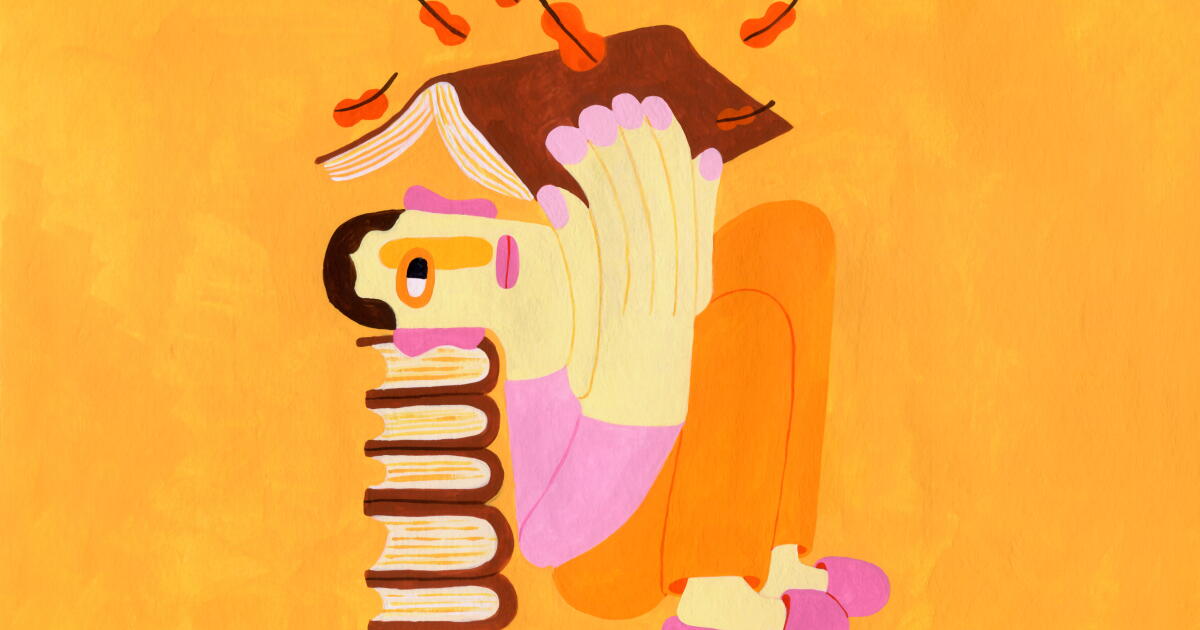

As the lazy days of summer fade and little ones return to school, autumn invites an air of academia. Consider our book reviewers’ recommendations your call for learning, and discovery, this season.
The only guide you need for fall entertainment.
We asked the don of a beloved West Coast lit journal, a prolific book editor, a well-read memoirist, a former National Book Critics Circle president, a longstanding critic and a local literary flâneuse to pick this season’s most anticipated reads. They came back with a list that throws readers into intellectual depths and riveting tales. Our selection includes a work by a Booker Prize longlist nominee and heady ruminations on women and society, along with entrancing translated texts, morally ambitious characters aplenty and a foray into flash fiction (truly, the micro-medium made for our attention-refracted era).
Fall reading list
If you buy books linked on our site, The Times may earn a commission from Bookshop.org, whose fees support independent bookstores.
Personally, I inhaled California writer Laleh Khadivi’s forthcoming novel — written with deft, dazzling prose and packed with surprises — in one weekend. May I suggest you do the same? There’s also elegant historical fiction, a voyage through ancient literature by none other than Emily Wilson (yes, that “Odyssey” translator Wilson), brilliant biographies and stirring meditations on art. While the sun sets earlier and earlier, there’s no better excuse to unplug, curl up and turn the page.
— Sophia Kercher
FICTION

Under Story
By Chloe Benjamin
G.P. Putnam’s Sons
(Sept. 1)
The first half of this riveting book follows a woman’s slightly unhinged decision to become a kitchen worker in the Antarctic. Laurel Salter has left behind her life as a post-graduate in mycology and soon finds her way into the exceedingly odd, brilliant and diverse characters who call the extremely isolated McMurdo Station home. The book’s second half takes readers on a turn as Laurel and her ex-husband, Eli, plunge into uncharted waters that are so deep that they come out on the other side of time. It would be a spoiler to explain more, but it’s no spoiler to reveal that Laurel and Eli have experienced a great tragedy. The author’s solution to their loss requires a near-total suspension of disbelief and basic logic that is so thought-provoking, and twisty, that you won’t want the book to end. — Bethanne Patrick

I Liked Rex
By Diane Williams
NYRB Classics
(Sept. 1)
Williams writes stories like little jewels: multifaceted but sized to rest within your palm. The 36 of them that make up “I Liked Rex” — her 12th collection — are cases in point, pointillist miniatures that shimmer and explode. In “Even Before You Speak,” a woman gets back at the habitual chiding of her father by describing him as “the last and greatest father she will ever have.” “Devotional” involves another of love’s inevitable tangles, revolving around the former inamorati a different narrator now visits only in her mind. “What else to reveal?” Williams asks in “The Greatest Experience.” What else indeed? The wonder of these spare and beveled narratives is the depth of feeling and nuance each one contains. — David L. Ulin

Acid Green Velvet
By Grace Krilanovich
Two Dollar Radio
(Sept. 8)
Los Angeles writer and singular literary voice Krilanovich, author of the novel “The Orange Eats Creeps,” is back with a 19th century California novel of life on the fringes. Her characters are vagrants, swindlers and secret-keepers. The book’s protagonist, Paulette, thought she and her boyfriend Kenny killed her problematic dad, but she keeps that to herself and changes her story daily. “What if I liked my dad best as both dead and living, depending on how it played?” That’s all fine until he shows up in the town where she escaped the hustle for a new life. Written with grimy, enlivening frankness — and an ability to dig into moral ambiguity — every character scrambles to get a leg up. This is a tale that helps us get in touch with, as Krilanovich writes: “the pain of personhood.” — Heather Scott Partington

Switzy
By Emma Cline
Random House
(Sept. 8)
By now everyone knows that Cline’s third novel has made it onto the coveted Booker Prize longlist before being released in the United States. Unlike the author’s first two books, which center on young women, “Switzy” focuses on a man in late middle age who is traveling to Zurich in order to take advantage of that country’s assisted-suicide laws. Along with his young assistant, Cody, David flies to Europe on his former boss’ executive jet. First stop, London, so he can connect with his daughter, then a horrendously awkward evening with David’s school friend Tom and his wife, before heading to the venue for his departure. In this feat accompli (forgive me), Cline restricts the reader’s perspective to David’s mangled one, which results in moments of awful humor (he calls autobahn exits “assfarts” instead of “ausfahrts”) and sad flashes of what the man’s character was like before amyloid plaques multiplied in his brain. — B.P.

Exit Party
By Emily St. John Mandel
Knopf
(Sept. 15)
Many have noted that this is Mandel’s best since her 2014 acclaimed “Station Eleven.” It’s also rooted in Los Angeles in what is now the Republic of California. It’s 2031, and the United States has turned unequivocally chaotic. Ari Walker — last seen as a villain in the author’s novel “The Singer’s Gun” (2009) — attends a party in Echo Park to celebrate a curfew’s lifting. As Ari drifts through the gathering, some guests seem to disappear. The reveal involves a second half in which the “United State” has turned unequivocally fascistic, a duality that reflects Mandel’s concerns while writing; she has said that the book is a product “of my well-founded anxieties around where this country’s going.” — B.P.

Foam
By Kate Zambreno
Semiotext(e)
(Sept. 15)
Over the course of her prolific career, Zambreno has written 10 books — each as puzzling and surprising as the last. She’s a true writer’s writer, the kind who influences MFA students and gives academics plenty to fixate on. Now, she’s meditating on what it means to be foam. Written in a distracted, snappy voice, Zambreno returns with “Foam,” a mysterious and elusive novel loosely inspired by the life and work of artist Eva Hesse. Opening on a hospital floor, the novel follows its narrator through a series of claustrophobic and eerie scenes. The result is a heady rumination on womanhood and the roles women are forced to inherit. While challenging and sophisticated — Zambreno’s attempt at inventing a new form — “Foam” never stops being an entertaining and provocative examination of life. — Maddie Connors

Female Life on Planet Earth
By Laleh Khadivi
Ecco
(Sept. 22)
What do we really know about anybody, especially our parents? And how do we understand our place in history? These classic themes remain ever-profitable to explore in literature, and in her newest novel, Whiting Award-winning author Khadivi adds one more intriguing query into the mix while touching on the others: What does it mean to be a woman? In “Female Life on Planet Earth,” Khadivi brings us Heti, an L.A. accountant tasked with organizing a huge gathering for the one-year anniversary of her immigrant mother’s death. But upon receiving a package from an anonymous sender, she discovers unnerving evidence: photos of her young mother wielding a machine gun and pointing it at a group of cowering women. What follows is an investigation in which “female life” is as unpacked as family history is. — Oscar Villalon

Blood Is Dripping Onto the Courtyard: Stories
By Elvira Navarro, translated by Christina MacSweeney
Two Lines Press
(Sept. 22)
California has been blessed in the past decade or so with the emergence of two stellar publishers of international literature, both located in the Bay Area: Transit Books and Two Lines Press. The latest from Two Lines Press is its fourth book by Spain’s acclaimed Navarro, a story collection infused with disquiet and horror, and a compelling vision. As Sarah Rose Etter writes in the collection’s introduction, Navarro “has the incredible ability to show us how inside of love lives the potential for the sinister, inside of best intentions can be a terrible act, a new ghost.” And yet, “even when the worst is about to happen,” the reader is “too entranced to look away.” — O.V.

American Flash Fiction: An Anthology
Edited by David L. Ulin
Library of America
(Oct. 6)
If you regularly read literary journals — and you really should — or are always drawn to the offbeat sections of the bookstore, then you know all too well about the vogue of the short, short short story. But in this new anthology from the indispensable Library of America, we are once again reminded that there’s nothing new under the sun and that every form of expression carries with it a lineage. Drawing from beyond the “literary” — so, science fiction, crime and horror writing — and ranging from late 19th century writers (Mark Twain, Ambrose Bierce) to contemporary practitioners of flash fiction such as Diane Williams, Peter Orner and Venita Blackburn, editor (and Times contributor/former books editor) Ulin has put together the kind of anthology that begs to be dipped into and savored. These diverse offerings from an equally diverse grouping of 100 all-stars of U.S. literature gives flash fiction the delicious heft it richly deserves. — O.V.

The Occidental Book of the Dead
By T. Geronimo Johnson
William Morrow
(Oct. 6)
This book was not written for me, a privileged white middle-aged woman, and that’s precisely why I am recommending it to everyone out there, regardless of descriptors. Johnson (“Welcome to Braggsville”) pulls no punches, from his dedication (“Dedicated to the future memory of white supremacy”) to his “Axknowledgements,” the first line of which is, “All praise be to the artists unknown to you.” The pages in between, all 650-plus of them, read like Colson Whitehead on acid, and that is meant as a compliment from this privileged white middle-aged woman. The setting is 2005 Atlanta, Georgia, which is called “Atlantis, Gorgeous,” and starts with a literal bang, when a white teen in a Black neighborhood is shot and killed by a police officer. The question of which officer in the team of George Washington Johnson and Lukas Utner hangs in the balance. While Johnson, who is Black, narrates the book, he’s less interested in the outcome of this particular case and more concerned with the long deterioration of his home city and its society. It’s strong stuff, yet the dazzling writing makes it go down easy. — B.P.
Fair Ones: A Double Novel
By Lydia Millet
W.W. Norton
(Oct. 6)

I’ve admired Millet since her 2000 satire, “George Bush, Dark Prince of Love.” Her so-called “extinction trilogy” (“How the Dead Dream,” “Ghost Lights” and “Magnificence”) offers an expansive view of species survival and annihilation, reframing our own narrow existential concerns through the broader lens of Robinson Jeffers’ “transhuman magnificence.” Millet’s new book, “Fair Ones,” pushes a different set of boundaries; it is a “double novel,” as the subtitle suggests. What this means is that there are two narrators, two narratives, paired to recount a single event, the death of a 40-something Brooklynite named Claire. Such a conceit recalls Lauren Groff’s “Fates and Furies,” although the twinning here is less direct. But in focusing on friendship rather than marriage as a defining principle, Millet reminds us that love and loss, pain and longing, take shape in a plethora of forms. — D.L.U.

Vaim Hotel
By Jon Fosse, translated by Damion Searls
Transit Books
(Oct. 6)
In 2023, Norway’s Fosse received the Nobel Prize in literature, and with that his longtime U.S. publisher — Transit Books in Berkeley — received the kind of transcendent validation that makes the toil of small-press publishing worth it: Here was a voice that was indeed worthy of your scant time. “Vaim Hotel” is the second slim volume in Fosse’s trilogy set in the eerie fishing village of Vaim. The first volume, the plainly titled “Vaim,” was described by the Guardian as a “strange miracle,” and that can be attributed to the dream-like quality of Fosse’s straight-ahead yet elegant prose. That same prose, as rendered by Searls, is evident once again in the new book as the novel’s narrator relates how he was drawn to this mysterious outpost and how the place seems to be conspiring against his leaving there. — O.V.

(Farrar, Straus & Giroux)
Music Against the Night
By Yiyun Li
Farrar, Straus & Giroux
(Oct. 13)
Li’s elegant and resonant new novel is a study of two musicians born on different continents: John Field, an Irish-born 18th century child prodigy who influenced Chopin, and Adelaide Percheron, a pianist raised in India. In time, Percheron and Field would enter into a troubled marriage, along the way navigating the political, social and musical upheavals of their era. Historical fiction is nothing new for Li — 2009’s “The Vagrants” explored China’s Cultural Revolution, and 2022’s “The Book of Goose” was set during World War II-era France — but this book, the first in a planned trilogy, is easily her most sweeping and deeply researched novel, suffused with the melancholy tone that defines her best work with some of her richest characterizations, the two central characters, who occupy “a world that is keen to judge and punish dreamers.” — Mark Athitakis

To God
By Esther Yi
Astra House
(Oct. 13)
If you enter Yi’s fiction collection, proceed with caution — you might never leave. To read “To God,” one must surrender completely to the author’s strange and startling vision. This collection isn’t for the sentimental or squeamish. Each story, set against a decaying cityscape, is both grotesque and compelling, like a nightmare you won’t want to wake from. As a follow-up to her brilliant literary debut, “Y/N,” which explored the strange world of K-pop fan fiction, “To God” returns to the same haunting sense of loneliness and alienation. The stories are uncanny and wholly unique: a city of marionettes, bizarre sexual encounters and decaying towns. Yi offers her readers a dazzling cabinet of curiosities, exploring spirituality, desire and the desperate ways people grasp at each other. — M.C.

The Spirits
By Bonnie Jo Campbell
W.W. Norton: 256 pages
(Oct. 13)
At first glance, Campbell’s “The Spirits” seems like a departure: a riff on Charles Dickens’ “A Christmas Carol,” updated to rural Michigan in the present day. Campbell even thanks Dickens “for showing us cruelty and redemption.” And yet, she, too, has written about — or out of — such states for many years. “American Salvage,” her 2009 collection of short fiction, is among the most piercing and beautiful books I know. In that regard, this novel is a continuation more than anything. Set on Christmas Eve, at a family dinner that becomes, in its way, a group confessional, “The Spirits” retraces the hurts and memories, the ghosts and haunts, that death can’t wipe away. “The jumble of decorations and packages,” Campbell writes, “anointed with red, looked like the remnants of a car wreck, pieces of bodies smeared with blood amid the tattered fabric of ruined clothes and debris.” — D.L.U.

This Impossible Life
By Chinelo Okparanta
Mariner
(Nov. 10)
Okparanta’s third novel is a tale of a sibling relationship that smartly expands into a bracing global epic. Born in Nigeria, brother and sister Alohan and Ivie were children when they were forced to cope with the murder of their father, a rainmaker who couldn’t prevent a downpour at a local wedding. Thrust into adulthood in a hurry, their travels take them to the wealthiest and poorest neighborhoods in Lagos, New York City and Italy, where their determination to be free runs into a host of roadblocks. Okparanta, born in Nigeria and a graduate of the Iowa Writers’ Workshop, is gifted at writing about every theme she takes on — the power of folklore, the deceptions of authority and community, the consequences of shifting identities, the bonds of siblinghood and more. “Life was a steady decline into disorder,” Ivie observes, but the novel is also a powerful exploration of what’s needed to survive the chaos. — M.A.
NONFICTION

Crossing the Wine-Dark Sea: Journeys Through Ancient Literature
By Emily Wilson
Liveright
(Sept. 1)
Translator and academic Wilson was everywhere this summer. Nolan mentioned her 2017 translation in an interview about “The Odyssey,” then she panned his film and suddenly she was beefing with Joyce Carol Oates. If the siren song of “The Odyssey” still calls to you, Wilson’s “Crossing the Wine-Dark Sea” offers a glimpse into her approach to classical lit. It’s a behind-the-scenes peek at her work intended for new readers of classical literature and academics alike. She explores what it means to translate writing from another time and culture, and how our contemporary sensibilities alter the lens through which we view the classics. Of note: an essay exploring and comparing the meaning of many translations of “The Odyssey,” and a list of Wilson’s “Twenty Rules” for anyone who wants to attempt the job. — H.S.P.

An Unexpected Life
By Gloria Steinem
Random House
(Sept. 22)
Forgive a fangirl moment: I grew up in the ’70s and ’80s when Steinem’s Ms. Magazine and her activist presence — long streaky hair, enormous aviator glasses and ultra-cool belt buckles — were part of the style zeitgeist as well as the women’s liberation movement. In the now-92-year-old maverick’s second memoir (the first, “My Life on the Road,” came out in 2015), she traces the first glimmers of her political consciousness back to her college education at Smith College but takes care to show how quickly and far she moved beyond genteel 1950s classrooms by meeting (and often reading) the likes of Wilma Mankiller, James Baldwin, bell hooks and … Meghan Markle? Remember, Steinem once went undercover as a Playboy bunny, and she’s absolutely earned the right to hang out with whomever she likes — especially the unexpected. — B.P.

(Farrar, Straus & Giroux)
Said the Dead
By Doireann Ní Ghríofa
Farrar, Straus & Giroux
(Sept. 22)
Irish poet and essayist Ní Ghríofa’s “Said the Dead” defies easy genrefication, but it is equal parts novel and nonfiction. “It began with a mistake,” her protagonist tells us, leading us into a derelict Victorian mental hospital in Cork, and an archival record of the real women who lived and worked there. Ghríofa’s “reader” amplifies these censored voices from the past, struggling with how much of their truth she can reveal. As she did in “A Ghost in the Throat,” her 2021 National Book Critics Circle Award finalist that blended feminist literary interpretation with memoir across time, Ghríofa creates her own arresting form. “For those who knock,” she writes, “I always answer … I have never refused. Never will.” — H.S.P.

“Holding Lightning: The Life, Loves, and Art of Whitney Houston” by Emily J. Lordi
(Mariner)
Holding Lightning: The Life, Loves, and Art of Whitney Houston
By Emily Lordi
Mariner
(Sept. 29)
In “Holding Lightning: The Life, Loves, and Art of Whitney Houston,” Lordi, a cultural critic, reclaims Whitney Houston’s legacy from oversimplification. Houston’s genius has been too long dismissed. She’s seen “not as a visionary but as a femme object we gaze at or gape at … a ‘voice’ whose success was curated by men.” Lordi’s propulsively readable biography explores Houston’s “profoundly underanalyzed body of work” by putting it into the context of Black culture, history and feminist thought. Lordi’s extensive interviews with Houston’s friends and family amplify the high-highs and the low-lows. The lasting effect of the biography is the illumination of Whitney’s legacy: how she continues to “[reach] across the culture” and “the subtle, expansive ways her spirit continues to work in the world.” — H.S.P.

Traumatized
By Catherine Liu
Verso
(Sept. 29)
Humor me: If it were up to me, we’d have cultural theorists lounging on late-night talk-show couches, sermonizing late into the night across from Jimmy Fallon. Liu would be a great first pick — funny, wickedly brilliant and savvy. She’s best known for her writing on the professional class, particularly her book “Virtue Hoarders,” a sharp critique of contemporary social life that I read in one sitting. It’s also wildly entertaining — well, as entertaining as theory can be, anyway. Now Liu is back with “Traumatized,” an ambitious examination of the ways trauma and pain have become social capital, exploited in ways that ultimately serve neither the traumatized nor the public. Reading the book feels refreshing — a clarifying antidote to a culture increasingly obsessed with idolizing and leveraging suffering. — M.C.

Cormac McCarthy: A Legacy Revisited
By Tracy Daugherty
St. Martin’s Press
(Oct. 6)
Author Cormac McCarthy refused to be pinned down. As Daugherty tells us in his rich literary biography of the author, “Cormac McCarthy: A Legacy Revisited,” McCarthy “once said he found discussing his own biography ‘embarrassing.’” It’s no surprise that as his writing became more sparse, so too did his commentary about his life. Pulitzer Prize finalist Daugherty takes us through McCarthy’s rough roots and his stories to reveal how the author came to “[trace] a national odyssey paralleling his personal trajectory,” celebrating his writing as “rich with the history of America’s greed and violence, its spiritual yearnings, its stewardship of the earth’s elements, and most consistently, its linguistic paradoxes.” A remarkable book that fills the silences with extensive research and analysis of McCarthy’s comprehensive literary record. — H.S.P.

The Rush: California Gold, the Civil War, and the Making of the Modern World
By Nathaniel Philbrick
Viking
(Oct. 6)
The discovery of gold in Northern California in the 1840s didn’t just inspire hordes of prospectors and opportunists to head out for the West Coast — it accelerated a debate over slavery and citizenship that in turn hastened the opening of the Civil War. Philbrick, who typically sticks to the Eastern Seaboard in his books — he’s written beautifully about Nantucket, the Mayflower and the American Revolution — uses the Gold Rush as an opportunity to explore the whole of antebellum America in miniature. From scheming legislators to racist thugs to the masses of immigrants who facilitated California’s growth, particularly the development of the transcontinental railroad, Philbrick relates the debate over California’s admission as a free or slave state with remarkable tension, showing how our freedoms have always been precariously close to vanishing. — M.A.

The Last Temptation of Beck: The Untold Story of a Pop Messiah
By Josephine Riesman
Atria
(Oct. 6)
Beck rose to stardom at the height of the irony-soaked ’90s. He had a hit with a song where he declared himself a loser. He tweaked folk, rock and hip-hop like he could take or leave any of them. And he put up a colorful front of leisure-suit slackerdom. That’s meant his true history has always been somewhat obscure, but Riesman’s doggedly researched book details Beck’s upbringing in Scientology (his father was a member of its Celebrity Centre), and suggests that the church played a central role in the creative and romantic upheavals that led to his 2002 melancholy masterpiece, “Sea Change.” Beck didn’t participate in the book, but Riesman finds enough friends, family and associates to assemble a complex portrait of an artist who wants his audiences to see him as fashion-forward but has had a hard time shaking his past. — M.A.

Abandoning a Cat: A Personal Story
By Haruki Murakami
Knopf
(Oct. 20)
If it follows you home at night, chances are it’s fodder for good writing — even if it’s a cat. As a child, the beloved Japanese author Murakami set off with his father to abandon a cat at the beach. What happened next would haunt and astonish him for decades. Following his 2019 essay for the New Yorker, Murakami recounts a compelling history of fatherhood, family and obligation, transforming an uncanny childhood memory into a deeply personal history. Along the way, he offers a gripping portrait of postwar Japan and the generations of men who shaped his family. The ending is bittersweet, as Murakami finally reunites with his father after decades of estrangement. In the end, the things we try to leave behind find their way back to us. — M.C.

The Beverly Hills Housewife: Hockney’s Californian Muse and the World Beyond the Pool
By James Cahill
Thames & Hudson
(Nov. 3)
What a strange and wonderful book, Cahill’s “The Beverly Hills Housewife.” In that, it is not unlike its subject, or one of them: the painter David Hockney, who died this past June at 88. Six decades ago, Hockney was the avatar of a certain kind of Los Angeles iconography, exemplified in his relationship (or was it a collaboration?) with the art collector Betty Freeman. She is the subject of his 1966-67 painting “The Beverly Hills Housewife,” which portrays her standing cool and featureless in a long pink dress, poolside in her Beverly Hills backyard. “In the painting,” Cahill writes in this brilliantly digressive investigation, “Freeman is viewed in a single moment. … Within that single moment, lurking like ghosts, are other moments — longer histories.” Lurking like ghosts, indeed: the ghosts of 1960s Southern California, the ghost of Hockney as he paints. — D.L.U.

(Farrar, Straus & Giroux)
The Telephone: A New History
By James Gleick
Farrar, Straus & Giroux
(Nov. 10)
The telephone “changed every person who used it,” writes Gleick in this lively history. “After a few generations, that was most of humanity.” Stretching from the race between Elisha Gray and Alexander Graham Bell to develop the first telephone patent to the ubiquity and dominance of the smartphone, Gleick uses his skills as a gifted science historian in books like 2011’s “The Information” to consider the phone from every angle: as a device, as a social tool, as an instrument of war, as a status symbol and as a locus of tech innovation. It is also a remarkable story about American business, showing how the end of AT&T’s monopolistic dominance led to decades of restructuring and atomization — mirroring the way the device in our pocket is now designed to serve nothing but our personal interests. — M.A.

Yosemite Falls: Reckoning With California History and the Gospel of John Muir
By Daniel Duane
North Point Press
(Nov. 17)
“Yosemite Falls” is a book for which I’ve been waiting: a history of Yosemite National Park that becomes a history of California, refracted through the lens of myth and family. It also represents a culmination, in which Duane stakes his claim as contemporary chronicler of the Golden State, with all the complexity and contradiction such a role requires. Duane is a fluid writer, able to move from John Muir to the largely forgotten figure of Ishi to himself as both adult and child. “In my earliest mountain memory,” he begins, “I’m a tiny freckle-faced redhead clinging to Dad’s big hand on the dusty John Muir Trail out of Yosemite Valley.” There it is, laid out in a single sentence, the way that, in California, the private cannot help but blur into the public and the present is — must be — infused by the past. — D.L.U.

(University of California Press)
Traces of Intimacy: Native Americans, Mexican Americans, and the Borderlands of Race
By Jedediah H. Kuhn
University of California Press
(Nov. 17)
What’s particularly fascinating about the Golden State are its various histories and encounters among its non-white communities who so often share the same neighborhoods, the same schools, and even the same jobs: This may be especially so when it comes to Californian Mexicans and Native Americans. In “Traces of Intimacy,” Kuhn, an assistant professor of history at the University of Rochester, aims “to explain the messiness of Native American and Mexican American identity and experience in the Sierra Nevada borderlands and how that might offer a way to rethink relations between these groups.” Kuhn, who is Mexican American, has roots in the region and among the communities he’s writing about. And while the book’s scope is specific, it’s easy to see how its themes about identity, race and the need to survive have much wider resonance. — O.V.

As the lazy days of summer fade and little ones return to school, autumn invites an air of academia. Consider our book reviewers’ recommendations your call for learning, and discovery, this season.
The only guide you need for fall entertainment.
We asked the don of a beloved West Coast lit journal, a prolific book editor, a well-read memoirist, a former National Book Critics Circle president, a longstanding critic and a local literary flâneuse to pick this season’s most anticipated reads. They came back with a list that throws readers into intellectual depths and riveting tales. Our selection includes a work by a Booker Prize longlist nominee and heady ruminations on women and society, along with entrancing translated texts, morally ambitious characters aplenty and a foray into flash fiction (truly, the micro-medium made for our attention-refracted era).
Fall reading list
If you buy books linked on our site, The Times may earn a commission from Bookshop.org, whose fees support independent bookstores.
Personally, I inhaled California writer Laleh Khadivi’s forthcoming novel — written with deft, dazzling prose and packed with surprises — in one weekend. May I suggest you do the same? There’s also elegant historical fiction, a voyage through ancient literature by none other than Emily Wilson (yes, that “Odyssey” translator Wilson), brilliant biographies and stirring meditations on art. While the sun sets earlier and earlier, there’s no better excuse to unplug, curl up and turn the page.
— Sophia Kercher
FICTION
Under Story
By Chloe Benjamin
G.P. Putnam’s Sons
(Sept. 1)
The first half of this riveting book follows a woman’s slightly unhinged decision to become a kitchen worker in the Antarctic. Laurel Salter has left behind her life as a post-graduate in mycology and soon finds her way into the exceedingly odd, brilliant and diverse characters who call the extremely isolated McMurdo Station home. The book’s second half takes readers on a turn as Laurel and her ex-husband, Eli, plunge into uncharted waters that are so deep that they come out on the other side of time. It would be a spoiler to explain more, but it’s no spoiler to reveal that Laurel and Eli have experienced a great tragedy. The author’s solution to their loss requires a near-total suspension of disbelief and basic logic that is so thought-provoking, and twisty, that you won’t want the book to end. — Bethanne Patrick
I Liked Rex
By Diane Williams
NYRB Classics
(Sept. 1)
Williams writes stories like little jewels: multifaceted but sized to rest within your palm. The 36 of them that make up “I Liked Rex” — her 12th collection — are cases in point, pointillist miniatures that shimmer and explode. In “Even Before You Speak,” a woman gets back at the habitual chiding of her father by describing him as “the last and greatest father she will ever have.” “Devotional” involves another of love’s inevitable tangles, revolving around the former inamorati a different narrator now visits only in her mind. “What else to reveal?” Williams asks in “The Greatest Experience.” What else indeed? The wonder of these spare and beveled narratives is the depth of feeling and nuance each one contains. — David L. Ulin
Acid Green Velvet
By Grace Krilanovich
Two Dollar Radio
(Sept. 8)
Los Angeles writer and singular literary voice Krilanovich, author of the novel “The Orange Eats Creeps,” is back with a 19th century California novel of life on the fringes. Her characters are vagrants, swindlers and secret-keepers. The book’s protagonist, Paulette, thought she and her boyfriend Kenny killed her problematic dad, but she keeps that to herself and changes her story daily. “What if I liked my dad best as both dead and living, depending on how it played?” That’s all fine until he shows up in the town where she escaped the hustle for a new life. Written with grimy, enlivening frankness — and an ability to dig into moral ambiguity — every character scrambles to get a leg up. This is a tale that helps us get in touch with, as Krilanovich writes: “the pain of personhood.” — Heather Scott Partington
Switzy
By Emma Cline
Random House
(Sept. 8)
By now everyone knows that Cline’s third novel has made it onto the coveted Booker Prize longlist before being released in the United States. Unlike the author’s first two books, which center on young women, “Switzy” focuses on a man in late middle age who is traveling to Zurich in order to take advantage of that country’s assisted-suicide laws. Along with his young assistant, Cody, David flies to Europe on his former boss’ executive jet. First stop, London, so he can connect with his daughter, then a horrendously awkward evening with David’s school friend Tom and his wife, before heading to the venue for his departure. In this feat accompli (forgive me), Cline restricts the reader’s perspective to David’s mangled one, which results in moments of awful humor (he calls autobahn exits “assfarts” instead of “ausfahrts”) and sad flashes of what the man’s character was like before amyloid plaques multiplied in his brain. — B.P.
Exit Party
By Emily St. John Mandel
Knopf
(Sept. 15)
Many have noted that this is Mandel’s best since her 2014 acclaimed “Station Eleven.” It’s also rooted in Los Angeles in what is now the Republic of California. It’s 2031, and the United States has turned unequivocally chaotic. Ari Walker — last seen as a villain in the author’s novel “The Singer’s Gun” (2009) — attends a party in Echo Park to celebrate a curfew’s lifting. As Ari drifts through the gathering, some guests seem to disappear. The reveal involves a second half in which the “United State” has turned unequivocally fascistic, a duality that reflects Mandel’s concerns while writing; she has said that the book is a product “of my well-founded anxieties around where this country’s going.” — B.P.
Foam
By Kate Zambreno
Semiotext(e)
(Sept. 15)
Over the course of her prolific career, Zambreno has written 10 books — each as puzzling and surprising as the last. She’s a true writer’s writer, the kind who influences MFA students and gives academics plenty to fixate on. Now, she’s meditating on what it means to be foam. Written in a distracted, snappy voice, Zambreno returns with “Foam,” a mysterious and elusive novel loosely inspired by the life and work of artist Eva Hesse. Opening on a hospital floor, the novel follows its narrator through a series of claustrophobic and eerie scenes. The result is a heady rumination on womanhood and the roles women are forced to inherit. While challenging and sophisticated — Zambreno’s attempt at inventing a new form — “Foam” never stops being an entertaining and provocative examination of life. — Maddie Connors
Female Life on Planet Earth
By Laleh Khadivi
Ecco
(Sept. 22)
What do we really know about anybody, especially our parents? And how do we understand our place in history? These classic themes remain ever-profitable to explore in literature, and in her newest novel, Whiting Award-winning author Khadivi adds one more intriguing query into the mix while touching on the others: What does it mean to be a woman? In “Female Life on Planet Earth,” Khadivi brings us Heti, an L.A. accountant tasked with organizing a huge gathering for the one-year anniversary of her immigrant mother’s death. But upon receiving a package from an anonymous sender, she discovers unnerving evidence: photos of her young mother wielding a machine gun and pointing it at a group of cowering women. What follows is an investigation in which “female life” is as unpacked as family history is. — Oscar Villalon
Blood Is Dripping Onto the Courtyard: Stories
By Elvira Navarro, translated by Christina MacSweeney
Two Lines Press
(Sept. 22)
California has been blessed in the past decade or so with the emergence of two stellar publishers of international literature, both located in the Bay Area: Transit Books and Two Lines Press. The latest from Two Lines Press is its fourth book by Spain’s acclaimed Navarro, a story collection infused with disquiet and horror, and a compelling vision. As Sarah Rose Etter writes in the collection’s introduction, Navarro “has the incredible ability to show us how inside of love lives the potential for the sinister, inside of best intentions can be a terrible act, a new ghost.” And yet, “even when the worst is about to happen,” the reader is “too entranced to look away.” — O.V.
American Flash Fiction: An Anthology
Edited by David L. Ulin
Library of America
(Oct. 6)
If you regularly read literary journals — and you really should — or are always drawn to the offbeat sections of the bookstore, then you know all too well about the vogue of the short, short short story. But in this new anthology from the indispensable Library of America, we are once again reminded that there’s nothing new under the sun and that every form of expression carries with it a lineage. Drawing from beyond the “literary” — so, science fiction, crime and horror writing — and ranging from late 19th century writers (Mark Twain, Ambrose Bierce) to contemporary practitioners of flash fiction such as Diane Williams, Peter Orner and Venita Blackburn, editor (and Times contributor/former books editor) Ulin has put together the kind of anthology that begs to be dipped into and savored. These diverse offerings from an equally diverse grouping of 100 all-stars of U.S. literature gives flash fiction the delicious heft it richly deserves. — O.V.
The Occidental Book of the Dead
By T. Geronimo Johnson
William Morrow
(Oct. 6)
This book was not written for me, a privileged white middle-aged woman, and that’s precisely why I am recommending it to everyone out there, regardless of descriptors. Johnson (“Welcome to Braggsville”) pulls no punches, from his dedication (“Dedicated to the future memory of white supremacy”) to his “Axknowledgements,” the first line of which is, “All praise be to the artists unknown to you.” The pages in between, all 650-plus of them, read like Colson Whitehead on acid, and that is meant as a compliment from this privileged white middle-aged woman. The setting is 2005 Atlanta, Georgia, which is called “Atlantis, Gorgeous,” and starts with a literal bang, when a white teen in a Black neighborhood is shot and killed by a police officer. The question of which officer in the team of George Washington Johnson and Lukas Utner hangs in the balance. While Johnson, who is Black, narrates the book, he’s less interested in the outcome of this particular case and more concerned with the long deterioration of his home city and its society. It’s strong stuff, yet the dazzling writing makes it go down easy. — B.P.
Fair Ones: A Double Novel
By Lydia Millet
W.W. Norton
(Oct. 6)
I’ve admired Millet since her 2000 satire, “George Bush, Dark Prince of Love.” Her so-called “extinction trilogy” (“How the Dead Dream,” “Ghost Lights” and “Magnificence”) offers an expansive view of species survival and annihilation, reframing our own narrow existential concerns through the broader lens of Robinson Jeffers’ “transhuman magnificence.” Millet’s new book, “Fair Ones,” pushes a different set of boundaries; it is a “double novel,” as the subtitle suggests. What this means is that there are two narrators, two narratives, paired to recount a single event, the death of a 40-something Brooklynite named Claire. Such a conceit recalls Lauren Groff’s “Fates and Furies,” although the twinning here is less direct. But in focusing on friendship rather than marriage as a defining principle, Millet reminds us that love and loss, pain and longing, take shape in a plethora of forms. — D.L.U.
Vaim Hotel
By Jon Fosse, translated by Damion Searls
Transit Books
(Oct. 6)
In 2023, Norway’s Fosse received the Nobel Prize in literature, and with that his longtime U.S. publisher — Transit Books in Berkeley — received the kind of transcendent validation that makes the toil of small-press publishing worth it: Here was a voice that was indeed worthy of your scant time. “Vaim Hotel” is the second slim volume in Fosse’s trilogy set in the eerie fishing village of Vaim. The first volume, the plainly titled “Vaim,” was described by the Guardian as a “strange miracle,” and that can be attributed to the dream-like quality of Fosse’s straight-ahead yet elegant prose. That same prose, as rendered by Searls, is evident once again in the new book as the novel’s narrator relates how he was drawn to this mysterious outpost and how the place seems to be conspiring against his leaving there. — O.V.
(Farrar, Straus & Giroux)
Music Against the Night
By Yiyun Li
Farrar, Straus & Giroux
(Oct. 13)
Li’s elegant and resonant new novel is a study of two musicians born on different continents: John Field, an Irish-born 18th century child prodigy who influenced Chopin, and Adelaide Percheron, a pianist raised in India. In time, Percheron and Field would enter into a troubled marriage, along the way navigating the political, social and musical upheavals of their era. Historical fiction is nothing new for Li — 2009’s “The Vagrants” explored China’s Cultural Revolution, and 2022’s “The Book of Goose” was set during World War II-era France — but this book, the first in a planned trilogy, is easily her most sweeping and deeply researched novel, suffused with the melancholy tone that defines her best work with some of her richest characterizations, the two central characters, who occupy “a world that is keen to judge and punish dreamers.” — Mark Athitakis
To God
By Esther Yi
Astra House
(Oct. 13)
If you enter Yi’s fiction collection, proceed with caution — you might never leave. To read “To God,” one must surrender completely to the author’s strange and startling vision. This collection isn’t for the sentimental or squeamish. Each story, set against a decaying cityscape, is both grotesque and compelling, like a nightmare you won’t want to wake from. As a follow-up to her brilliant literary debut, “Y/N,” which explored the strange world of K-pop fan fiction, “To God” returns to the same haunting sense of loneliness and alienation. The stories are uncanny and wholly unique: a city of marionettes, bizarre sexual encounters and decaying towns. Yi offers her readers a dazzling cabinet of curiosities, exploring spirituality, desire and the desperate ways people grasp at each other. — M.C.
The Spirits
By Bonnie Jo Campbell
W.W. Norton: 256 pages
(Oct. 13)
At first glance, Campbell’s “The Spirits” seems like a departure: a riff on Charles Dickens’ “A Christmas Carol,” updated to rural Michigan in the present day. Campbell even thanks Dickens “for showing us cruelty and redemption.” And yet, she, too, has written about — or out of — such states for many years. “American Salvage,” her 2009 collection of short fiction, is among the most piercing and beautiful books I know. In that regard, this novel is a continuation more than anything. Set on Christmas Eve, at a family dinner that becomes, in its way, a group confessional, “The Spirits” retraces the hurts and memories, the ghosts and haunts, that death can’t wipe away. “The jumble of decorations and packages,” Campbell writes, “anointed with red, looked like the remnants of a car wreck, pieces of bodies smeared with blood amid the tattered fabric of ruined clothes and debris.” — D.L.U.
This Impossible Life
By Chinelo Okparanta
Mariner
(Nov. 10)
Okparanta’s third novel is a tale of a sibling relationship that smartly expands into a bracing global epic. Born in Nigeria, brother and sister Alohan and Ivie were children when they were forced to cope with the murder of their father, a rainmaker who couldn’t prevent a downpour at a local wedding. Thrust into adulthood in a hurry, their travels take them to the wealthiest and poorest neighborhoods in Lagos, New York City and Italy, where their determination to be free runs into a host of roadblocks. Okparanta, born in Nigeria and a graduate of the Iowa Writers’ Workshop, is gifted at writing about every theme she takes on — the power of folklore, the deceptions of authority and community, the consequences of shifting identities, the bonds of siblinghood and more. “Life was a steady decline into disorder,” Ivie observes, but the novel is also a powerful exploration of what’s needed to survive the chaos. — M.A.
NONFICTION
Crossing the Wine-Dark Sea: Journeys Through Ancient Literature
By Emily Wilson
Liveright
(Sept. 1)
Translator and academic Wilson was everywhere this summer. Nolan mentioned her 2017 translation in an interview about “The Odyssey,” then she panned his film and suddenly she was beefing with Joyce Carol Oates. If the siren song of “The Odyssey” still calls to you, Wilson’s “Crossing the Wine-Dark Sea” offers a glimpse into her approach to classical lit. It’s a behind-the-scenes peek at her work intended for new readers of classical literature and academics alike. She explores what it means to translate writing from another time and culture, and how our contemporary sensibilities alter the lens through which we view the classics. Of note: an essay exploring and comparing the meaning of many translations of “The Odyssey,” and a list of Wilson’s “Twenty Rules” for anyone who wants to attempt the job. — H.S.P.
An Unexpected Life
By Gloria Steinem
Random House
(Sept. 22)
Forgive a fangirl moment: I grew up in the ’70s and ’80s when Steinem’s Ms. Magazine and her activist presence — long streaky hair, enormous aviator glasses and ultra-cool belt buckles — were part of the style zeitgeist as well as the women’s liberation movement. In the now-92-year-old maverick’s second memoir (the first, “My Life on the Road,” came out in 2015), she traces the first glimmers of her political consciousness back to her college education at Smith College but takes care to show how quickly and far she moved beyond genteel 1950s classrooms by meeting (and often reading) the likes of Wilma Mankiller, James Baldwin, bell hooks and … Meghan Markle? Remember, Steinem once went undercover as a Playboy bunny, and she’s absolutely earned the right to hang out with whomever she likes — especially the unexpected. — B.P.
(Farrar, Straus & Giroux)
Said the Dead
By Doireann Ní Ghríofa
Farrar, Straus & Giroux
(Sept. 22)
Irish poet and essayist Ní Ghríofa’s “Said the Dead” defies easy genrefication, but it is equal parts novel and nonfiction. “It began with a mistake,” her protagonist tells us, leading us into a derelict Victorian mental hospital in Cork, and an archival record of the real women who lived and worked there. Ghríofa’s “reader” amplifies these censored voices from the past, struggling with how much of their truth she can reveal. As she did in “A Ghost in the Throat,” her 2021 National Book Critics Circle Award finalist that blended feminist literary interpretation with memoir across time, Ghríofa creates her own arresting form. “For those who knock,” she writes, “I always answer … I have never refused. Never will.” — H.S.P.
“Holding Lightning: The Life, Loves, and Art of Whitney Houston” by Emily J. Lordi
(Mariner)
Holding Lightning: The Life, Loves, and Art of Whitney Houston
By Emily Lordi
Mariner
(Sept. 29)
In “Holding Lightning: The Life, Loves, and Art of Whitney Houston,” Lordi, a cultural critic, reclaims Whitney Houston’s legacy from oversimplification. Houston’s genius has been too long dismissed. She’s seen “not as a visionary but as a femme object we gaze at or gape at … a ‘voice’ whose success was curated by men.” Lordi’s propulsively readable biography explores Houston’s “profoundly underanalyzed body of work” by putting it into the context of Black culture, history and feminist thought. Lordi’s extensive interviews with Houston’s friends and family amplify the high-highs and the low-lows. The lasting effect of the biography is the illumination of Whitney’s legacy: how she continues to “[reach] across the culture” and “the subtle, expansive ways her spirit continues to work in the world.” — H.S.P.
Traumatized
By Catherine Liu
Verso
(Sept. 29)
Humor me: If it were up to me, we’d have cultural theorists lounging on late-night talk-show couches, sermonizing late into the night across from Jimmy Fallon. Liu would be a great first pick — funny, wickedly brilliant and savvy. She’s best known for her writing on the professional class, particularly her book “Virtue Hoarders,” a sharp critique of contemporary social life that I read in one sitting. It’s also wildly entertaining — well, as entertaining as theory can be, anyway. Now Liu is back with “Traumatized,” an ambitious examination of the ways trauma and pain have become social capital, exploited in ways that ultimately serve neither the traumatized nor the public. Reading the book feels refreshing — a clarifying antidote to a culture increasingly obsessed with idolizing and leveraging suffering. — M.C.
Cormac McCarthy: A Legacy Revisited
By Tracy Daugherty
St. Martin’s Press
(Oct. 6)
Author Cormac McCarthy refused to be pinned down. As Daugherty tells us in his rich literary biography of the author, “Cormac McCarthy: A Legacy Revisited,” McCarthy “once said he found discussing his own biography ‘embarrassing.’” It’s no surprise that as his writing became more sparse, so too did his commentary about his life. Pulitzer Prize finalist Daugherty takes us through McCarthy’s rough roots and his stories to reveal how the author came to “[trace] a national odyssey paralleling his personal trajectory,” celebrating his writing as “rich with the history of America’s greed and violence, its spiritual yearnings, its stewardship of the earth’s elements, and most consistently, its linguistic paradoxes.” A remarkable book that fills the silences with extensive research and analysis of McCarthy’s comprehensive literary record. — H.S.P.
The Rush: California Gold, the Civil War, and the Making of the Modern World
By Nathaniel Philbrick
Viking
(Oct. 6)
The discovery of gold in Northern California in the 1840s didn’t just inspire hordes of prospectors and opportunists to head out for the West Coast — it accelerated a debate over slavery and citizenship that in turn hastened the opening of the Civil War. Philbrick, who typically sticks to the Eastern Seaboard in his books — he’s written beautifully about Nantucket, the Mayflower and the American Revolution — uses the Gold Rush as an opportunity to explore the whole of antebellum America in miniature. From scheming legislators to racist thugs to the masses of immigrants who facilitated California’s growth, particularly the development of the transcontinental railroad, Philbrick relates the debate over California’s admission as a free or slave state with remarkable tension, showing how our freedoms have always been precariously close to vanishing. — M.A.
The Last Temptation of Beck: The Untold Story of a Pop Messiah
By Josephine Riesman
Atria
(Oct. 6)
Beck rose to stardom at the height of the irony-soaked ’90s. He had a hit with a song where he declared himself a loser. He tweaked folk, rock and hip-hop like he could take or leave any of them. And he put up a colorful front of leisure-suit slackerdom. That’s meant his true history has always been somewhat obscure, but Riesman’s doggedly researched book details Beck’s upbringing in Scientology (his father was a member of its Celebrity Centre), and suggests that the church played a central role in the creative and romantic upheavals that led to his 2002 melancholy masterpiece, “Sea Change.” Beck didn’t participate in the book, but Riesman finds enough friends, family and associates to assemble a complex portrait of an artist who wants his audiences to see him as fashion-forward but has had a hard time shaking his past. — M.A.
Abandoning a Cat: A Personal Story
By Haruki Murakami
Knopf
(Oct. 20)
If it follows you home at night, chances are it’s fodder for good writing — even if it’s a cat. As a child, the beloved Japanese author Murakami set off with his father to abandon a cat at the beach. What happened next would haunt and astonish him for decades. Following his 2019 essay for the New Yorker, Murakami recounts a compelling history of fatherhood, family and obligation, transforming an uncanny childhood memory into a deeply personal history. Along the way, he offers a gripping portrait of postwar Japan and the generations of men who shaped his family. The ending is bittersweet, as Murakami finally reunites with his father after decades of estrangement. In the end, the things we try to leave behind find their way back to us. — M.C.
The Beverly Hills Housewife: Hockney’s Californian Muse and the World Beyond the Pool
By James Cahill
Thames & Hudson
(Nov. 3)
What a strange and wonderful book, Cahill’s “The Beverly Hills Housewife.” In that, it is not unlike its subject, or one of them: the painter David Hockney, who died this past June at 88. Six decades ago, Hockney was the avatar of a certain kind of Los Angeles iconography, exemplified in his relationship (or was it a collaboration?) with the art collector Betty Freeman. She is the subject of his 1966-67 painting “The Beverly Hills Housewife,” which portrays her standing cool and featureless in a long pink dress, poolside in her Beverly Hills backyard. “In the painting,” Cahill writes in this brilliantly digressive investigation, “Freeman is viewed in a single moment. … Within that single moment, lurking like ghosts, are other moments — longer histories.” Lurking like ghosts, indeed: the ghosts of 1960s Southern California, the ghost of Hockney as he paints. — D.L.U.
(Farrar, Straus & Giroux)
The Telephone: A New History
By James Gleick
Farrar, Straus & Giroux
(Nov. 10)
The telephone “changed every person who used it,” writes Gleick in this lively history. “After a few generations, that was most of humanity.” Stretching from the race between Elisha Gray and Alexander Graham Bell to develop the first telephone patent to the ubiquity and dominance of the smartphone, Gleick uses his skills as a gifted science historian in books like 2011’s “The Information” to consider the phone from every angle: as a device, as a social tool, as an instrument of war, as a status symbol and as a locus of tech innovation. It is also a remarkable story about American business, showing how the end of AT&T’s monopolistic dominance led to decades of restructuring and atomization — mirroring the way the device in our pocket is now designed to serve nothing but our personal interests. — M.A.
Yosemite Falls: Reckoning With California History and the Gospel of John Muir
By Daniel Duane
North Point Press
(Nov. 17)
“Yosemite Falls” is a book for which I’ve been waiting: a history of Yosemite National Park that becomes a history of California, refracted through the lens of myth and family. It also represents a culmination, in which Duane stakes his claim as contemporary chronicler of the Golden State, with all the complexity and contradiction such a role requires. Duane is a fluid writer, able to move from John Muir to the largely forgotten figure of Ishi to himself as both adult and child. “In my earliest mountain memory,” he begins, “I’m a tiny freckle-faced redhead clinging to Dad’s big hand on the dusty John Muir Trail out of Yosemite Valley.” There it is, laid out in a single sentence, the way that, in California, the private cannot help but blur into the public and the present is — must be — infused by the past. — D.L.U.
(University of California Press)
Traces of Intimacy: Native Americans, Mexican Americans, and the Borderlands of Race
By Jedediah H. Kuhn
University of California Press
(Nov. 17)
What’s particularly fascinating about the Golden State are its various histories and encounters among its non-white communities who so often share the same neighborhoods, the same schools, and even the same jobs: This may be especially so when it comes to Californian Mexicans and Native Americans. In “Traces of Intimacy,” Kuhn, an assistant professor of history at the University of Rochester, aims “to explain the messiness of Native American and Mexican American identity and experience in the Sierra Nevada borderlands and how that might offer a way to rethink relations between these groups.” Kuhn, who is Mexican American, has roots in the region and among the communities he’s writing about. And while the book’s scope is specific, it’s easy to see how its themes about identity, race and the need to survive have much wider resonance. — O.V.

As the lazy days of summer fade and little ones return to school, autumn invites an air of academia. Consider our book reviewers’ recommendations your call for learning, and discovery, this season.
The only guide you need for fall entertainment.
We asked the don of a beloved West Coast lit journal, a prolific book editor, a well-read memoirist, a former National Book Critics Circle president, a longstanding critic and a local literary flâneuse to pick this season’s most anticipated reads. They came back with a list that throws readers into intellectual depths and riveting tales. Our selection includes a work by a Booker Prize longlist nominee and heady ruminations on women and society, along with entrancing translated texts, morally ambitious characters aplenty and a foray into flash fiction (truly, the micro-medium made for our attention-refracted era).
Fall reading list
If you buy books linked on our site, The Times may earn a commission from Bookshop.org, whose fees support independent bookstores.
Personally, I inhaled California writer Laleh Khadivi’s forthcoming novel — written with deft, dazzling prose and packed with surprises — in one weekend. May I suggest you do the same? There’s also elegant historical fiction, a voyage through ancient literature by none other than Emily Wilson (yes, that “Odyssey” translator Wilson), brilliant biographies and stirring meditations on art. While the sun sets earlier and earlier, there’s no better excuse to unplug, curl up and turn the page.
— Sophia Kercher
FICTION
Under Story
By Chloe Benjamin
G.P. Putnam’s Sons
(Sept. 1)
The first half of this riveting book follows a woman’s slightly unhinged decision to become a kitchen worker in the Antarctic. Laurel Salter has left behind her life as a post-graduate in mycology and soon finds her way into the exceedingly odd, brilliant and diverse characters who call the extremely isolated McMurdo Station home. The book’s second half takes readers on a turn as Laurel and her ex-husband, Eli, plunge into uncharted waters that are so deep that they come out on the other side of time. It would be a spoiler to explain more, but it’s no spoiler to reveal that Laurel and Eli have experienced a great tragedy. The author’s solution to their loss requires a near-total suspension of disbelief and basic logic that is so thought-provoking, and twisty, that you won’t want the book to end. — Bethanne Patrick
I Liked Rex
By Diane Williams
NYRB Classics
(Sept. 1)
Williams writes stories like little jewels: multifaceted but sized to rest within your palm. The 36 of them that make up “I Liked Rex” — her 12th collection — are cases in point, pointillist miniatures that shimmer and explode. In “Even Before You Speak,” a woman gets back at the habitual chiding of her father by describing him as “the last and greatest father she will ever have.” “Devotional” involves another of love’s inevitable tangles, revolving around the former inamorati a different narrator now visits only in her mind. “What else to reveal?” Williams asks in “The Greatest Experience.” What else indeed? The wonder of these spare and beveled narratives is the depth of feeling and nuance each one contains. — David L. Ulin
Acid Green Velvet
By Grace Krilanovich
Two Dollar Radio
(Sept. 8)
Los Angeles writer and singular literary voice Krilanovich, author of the novel “The Orange Eats Creeps,” is back with a 19th century California novel of life on the fringes. Her characters are vagrants, swindlers and secret-keepers. The book’s protagonist, Paulette, thought she and her boyfriend Kenny killed her problematic dad, but she keeps that to herself and changes her story daily. “What if I liked my dad best as both dead and living, depending on how it played?” That’s all fine until he shows up in the town where she escaped the hustle for a new life. Written with grimy, enlivening frankness — and an ability to dig into moral ambiguity — every character scrambles to get a leg up. This is a tale that helps us get in touch with, as Krilanovich writes: “the pain of personhood.” — Heather Scott Partington
Switzy
By Emma Cline
Random House
(Sept. 8)
By now everyone knows that Cline’s third novel has made it onto the coveted Booker Prize longlist before being released in the United States. Unlike the author’s first two books, which center on young women, “Switzy” focuses on a man in late middle age who is traveling to Zurich in order to take advantage of that country’s assisted-suicide laws. Along with his young assistant, Cody, David flies to Europe on his former boss’ executive jet. First stop, London, so he can connect with his daughter, then a horrendously awkward evening with David’s school friend Tom and his wife, before heading to the venue for his departure. In this feat accompli (forgive me), Cline restricts the reader’s perspective to David’s mangled one, which results in moments of awful humor (he calls autobahn exits “assfarts” instead of “ausfahrts”) and sad flashes of what the man’s character was like before amyloid plaques multiplied in his brain. — B.P.
Exit Party
By Emily St. John Mandel
Knopf
(Sept. 15)
Many have noted that this is Mandel’s best since her 2014 acclaimed “Station Eleven.” It’s also rooted in Los Angeles in what is now the Republic of California. It’s 2031, and the United States has turned unequivocally chaotic. Ari Walker — last seen as a villain in the author’s novel “The Singer’s Gun” (2009) — attends a party in Echo Park to celebrate a curfew’s lifting. As Ari drifts through the gathering, some guests seem to disappear. The reveal involves a second half in which the “United State” has turned unequivocally fascistic, a duality that reflects Mandel’s concerns while writing; she has said that the book is a product “of my well-founded anxieties around where this country’s going.” — B.P.
Foam
By Kate Zambreno
Semiotext(e)
(Sept. 15)
Over the course of her prolific career, Zambreno has written 10 books — each as puzzling and surprising as the last. She’s a true writer’s writer, the kind who influences MFA students and gives academics plenty to fixate on. Now, she’s meditating on what it means to be foam. Written in a distracted, snappy voice, Zambreno returns with “Foam,” a mysterious and elusive novel loosely inspired by the life and work of artist Eva Hesse. Opening on a hospital floor, the novel follows its narrator through a series of claustrophobic and eerie scenes. The result is a heady rumination on womanhood and the roles women are forced to inherit. While challenging and sophisticated — Zambreno’s attempt at inventing a new form — “Foam” never stops being an entertaining and provocative examination of life. — Maddie Connors
Female Life on Planet Earth
By Laleh Khadivi
Ecco
(Sept. 22)
What do we really know about anybody, especially our parents? And how do we understand our place in history? These classic themes remain ever-profitable to explore in literature, and in her newest novel, Whiting Award-winning author Khadivi adds one more intriguing query into the mix while touching on the others: What does it mean to be a woman? In “Female Life on Planet Earth,” Khadivi brings us Heti, an L.A. accountant tasked with organizing a huge gathering for the one-year anniversary of her immigrant mother’s death. But upon receiving a package from an anonymous sender, she discovers unnerving evidence: photos of her young mother wielding a machine gun and pointing it at a group of cowering women. What follows is an investigation in which “female life” is as unpacked as family history is. — Oscar Villalon
Blood Is Dripping Onto the Courtyard: Stories
By Elvira Navarro, translated by Christina MacSweeney
Two Lines Press
(Sept. 22)
California has been blessed in the past decade or so with the emergence of two stellar publishers of international literature, both located in the Bay Area: Transit Books and Two Lines Press. The latest from Two Lines Press is its fourth book by Spain’s acclaimed Navarro, a story collection infused with disquiet and horror, and a compelling vision. As Sarah Rose Etter writes in the collection’s introduction, Navarro “has the incredible ability to show us how inside of love lives the potential for the sinister, inside of best intentions can be a terrible act, a new ghost.” And yet, “even when the worst is about to happen,” the reader is “too entranced to look away.” — O.V.
American Flash Fiction: An Anthology
Edited by David L. Ulin
Library of America
(Oct. 6)
If you regularly read literary journals — and you really should — or are always drawn to the offbeat sections of the bookstore, then you know all too well about the vogue of the short, short short story. But in this new anthology from the indispensable Library of America, we are once again reminded that there’s nothing new under the sun and that every form of expression carries with it a lineage. Drawing from beyond the “literary” — so, science fiction, crime and horror writing — and ranging from late 19th century writers (Mark Twain, Ambrose Bierce) to contemporary practitioners of flash fiction such as Diane Williams, Peter Orner and Venita Blackburn, editor (and Times contributor/former books editor) Ulin has put together the kind of anthology that begs to be dipped into and savored. These diverse offerings from an equally diverse grouping of 100 all-stars of U.S. literature gives flash fiction the delicious heft it richly deserves. — O.V.
The Occidental Book of the Dead
By T. Geronimo Johnson
William Morrow
(Oct. 6)
This book was not written for me, a privileged white middle-aged woman, and that’s precisely why I am recommending it to everyone out there, regardless of descriptors. Johnson (“Welcome to Braggsville”) pulls no punches, from his dedication (“Dedicated to the future memory of white supremacy”) to his “Axknowledgements,” the first line of which is, “All praise be to the artists unknown to you.” The pages in between, all 650-plus of them, read like Colson Whitehead on acid, and that is meant as a compliment from this privileged white middle-aged woman. The setting is 2005 Atlanta, Georgia, which is called “Atlantis, Gorgeous,” and starts with a literal bang, when a white teen in a Black neighborhood is shot and killed by a police officer. The question of which officer in the team of George Washington Johnson and Lukas Utner hangs in the balance. While Johnson, who is Black, narrates the book, he’s less interested in the outcome of this particular case and more concerned with the long deterioration of his home city and its society. It’s strong stuff, yet the dazzling writing makes it go down easy. — B.P.
Fair Ones: A Double Novel
By Lydia Millet
W.W. Norton
(Oct. 6)
I’ve admired Millet since her 2000 satire, “George Bush, Dark Prince of Love.” Her so-called “extinction trilogy” (“How the Dead Dream,” “Ghost Lights” and “Magnificence”) offers an expansive view of species survival and annihilation, reframing our own narrow existential concerns through the broader lens of Robinson Jeffers’ “transhuman magnificence.” Millet’s new book, “Fair Ones,” pushes a different set of boundaries; it is a “double novel,” as the subtitle suggests. What this means is that there are two narrators, two narratives, paired to recount a single event, the death of a 40-something Brooklynite named Claire. Such a conceit recalls Lauren Groff’s “Fates and Furies,” although the twinning here is less direct. But in focusing on friendship rather than marriage as a defining principle, Millet reminds us that love and loss, pain and longing, take shape in a plethora of forms. — D.L.U.
Vaim Hotel
By Jon Fosse, translated by Damion Searls
Transit Books
(Oct. 6)
In 2023, Norway’s Fosse received the Nobel Prize in literature, and with that his longtime U.S. publisher — Transit Books in Berkeley — received the kind of transcendent validation that makes the toil of small-press publishing worth it: Here was a voice that was indeed worthy of your scant time. “Vaim Hotel” is the second slim volume in Fosse’s trilogy set in the eerie fishing village of Vaim. The first volume, the plainly titled “Vaim,” was described by the Guardian as a “strange miracle,” and that can be attributed to the dream-like quality of Fosse’s straight-ahead yet elegant prose. That same prose, as rendered by Searls, is evident once again in the new book as the novel’s narrator relates how he was drawn to this mysterious outpost and how the place seems to be conspiring against his leaving there. — O.V.
(Farrar, Straus & Giroux)
Music Against the Night
By Yiyun Li
Farrar, Straus & Giroux
(Oct. 13)
Li’s elegant and resonant new novel is a study of two musicians born on different continents: John Field, an Irish-born 18th century child prodigy who influenced Chopin, and Adelaide Percheron, a pianist raised in India. In time, Percheron and Field would enter into a troubled marriage, along the way navigating the political, social and musical upheavals of their era. Historical fiction is nothing new for Li — 2009’s “The Vagrants” explored China’s Cultural Revolution, and 2022’s “The Book of Goose” was set during World War II-era France — but this book, the first in a planned trilogy, is easily her most sweeping and deeply researched novel, suffused with the melancholy tone that defines her best work with some of her richest characterizations, the two central characters, who occupy “a world that is keen to judge and punish dreamers.” — Mark Athitakis
To God
By Esther Yi
Astra House
(Oct. 13)
If you enter Yi’s fiction collection, proceed with caution — you might never leave. To read “To God,” one must surrender completely to the author’s strange and startling vision. This collection isn’t for the sentimental or squeamish. Each story, set against a decaying cityscape, is both grotesque and compelling, like a nightmare you won’t want to wake from. As a follow-up to her brilliant literary debut, “Y/N,” which explored the strange world of K-pop fan fiction, “To God” returns to the same haunting sense of loneliness and alienation. The stories are uncanny and wholly unique: a city of marionettes, bizarre sexual encounters and decaying towns. Yi offers her readers a dazzling cabinet of curiosities, exploring spirituality, desire and the desperate ways people grasp at each other. — M.C.
The Spirits
By Bonnie Jo Campbell
W.W. Norton: 256 pages
(Oct. 13)
At first glance, Campbell’s “The Spirits” seems like a departure: a riff on Charles Dickens’ “A Christmas Carol,” updated to rural Michigan in the present day. Campbell even thanks Dickens “for showing us cruelty and redemption.” And yet, she, too, has written about — or out of — such states for many years. “American Salvage,” her 2009 collection of short fiction, is among the most piercing and beautiful books I know. In that regard, this novel is a continuation more than anything. Set on Christmas Eve, at a family dinner that becomes, in its way, a group confessional, “The Spirits” retraces the hurts and memories, the ghosts and haunts, that death can’t wipe away. “The jumble of decorations and packages,” Campbell writes, “anointed with red, looked like the remnants of a car wreck, pieces of bodies smeared with blood amid the tattered fabric of ruined clothes and debris.” — D.L.U.
This Impossible Life
By Chinelo Okparanta
Mariner
(Nov. 10)
Okparanta’s third novel is a tale of a sibling relationship that smartly expands into a bracing global epic. Born in Nigeria, brother and sister Alohan and Ivie were children when they were forced to cope with the murder of their father, a rainmaker who couldn’t prevent a downpour at a local wedding. Thrust into adulthood in a hurry, their travels take them to the wealthiest and poorest neighborhoods in Lagos, New York City and Italy, where their determination to be free runs into a host of roadblocks. Okparanta, born in Nigeria and a graduate of the Iowa Writers’ Workshop, is gifted at writing about every theme she takes on — the power of folklore, the deceptions of authority and community, the consequences of shifting identities, the bonds of siblinghood and more. “Life was a steady decline into disorder,” Ivie observes, but the novel is also a powerful exploration of what’s needed to survive the chaos. — M.A.
NONFICTION
Crossing the Wine-Dark Sea: Journeys Through Ancient Literature
By Emily Wilson
Liveright
(Sept. 1)
Translator and academic Wilson was everywhere this summer. Nolan mentioned her 2017 translation in an interview about “The Odyssey,” then she panned his film and suddenly she was beefing with Joyce Carol Oates. If the siren song of “The Odyssey” still calls to you, Wilson’s “Crossing the Wine-Dark Sea” offers a glimpse into her approach to classical lit. It’s a behind-the-scenes peek at her work intended for new readers of classical literature and academics alike. She explores what it means to translate writing from another time and culture, and how our contemporary sensibilities alter the lens through which we view the classics. Of note: an essay exploring and comparing the meaning of many translations of “The Odyssey,” and a list of Wilson’s “Twenty Rules” for anyone who wants to attempt the job. — H.S.P.
An Unexpected Life
By Gloria Steinem
Random House
(Sept. 22)
Forgive a fangirl moment: I grew up in the ’70s and ’80s when Steinem’s Ms. Magazine and her activist presence — long streaky hair, enormous aviator glasses and ultra-cool belt buckles — were part of the style zeitgeist as well as the women’s liberation movement. In the now-92-year-old maverick’s second memoir (the first, “My Life on the Road,” came out in 2015), she traces the first glimmers of her political consciousness back to her college education at Smith College but takes care to show how quickly and far she moved beyond genteel 1950s classrooms by meeting (and often reading) the likes of Wilma Mankiller, James Baldwin, bell hooks and … Meghan Markle? Remember, Steinem once went undercover as a Playboy bunny, and she’s absolutely earned the right to hang out with whomever she likes — especially the unexpected. — B.P.
(Farrar, Straus & Giroux)
Said the Dead
By Doireann Ní Ghríofa
Farrar, Straus & Giroux
(Sept. 22)
Irish poet and essayist Ní Ghríofa’s “Said the Dead” defies easy genrefication, but it is equal parts novel and nonfiction. “It began with a mistake,” her protagonist tells us, leading us into a derelict Victorian mental hospital in Cork, and an archival record of the real women who lived and worked there. Ghríofa’s “reader” amplifies these censored voices from the past, struggling with how much of their truth she can reveal. As she did in “A Ghost in the Throat,” her 2021 National Book Critics Circle Award finalist that blended feminist literary interpretation with memoir across time, Ghríofa creates her own arresting form. “For those who knock,” she writes, “I always answer … I have never refused. Never will.” — H.S.P.
“Holding Lightning: The Life, Loves, and Art of Whitney Houston” by Emily J. Lordi
(Mariner)
Holding Lightning: The Life, Loves, and Art of Whitney Houston
By Emily Lordi
Mariner
(Sept. 29)
In “Holding Lightning: The Life, Loves, and Art of Whitney Houston,” Lordi, a cultural critic, reclaims Whitney Houston’s legacy from oversimplification. Houston’s genius has been too long dismissed. She’s seen “not as a visionary but as a femme object we gaze at or gape at … a ‘voice’ whose success was curated by men.” Lordi’s propulsively readable biography explores Houston’s “profoundly underanalyzed body of work” by putting it into the context of Black culture, history and feminist thought. Lordi’s extensive interviews with Houston’s friends and family amplify the high-highs and the low-lows. The lasting effect of the biography is the illumination of Whitney’s legacy: how she continues to “[reach] across the culture” and “the subtle, expansive ways her spirit continues to work in the world.” — H.S.P.
Traumatized
By Catherine Liu
Verso
(Sept. 29)
Humor me: If it were up to me, we’d have cultural theorists lounging on late-night talk-show couches, sermonizing late into the night across from Jimmy Fallon. Liu would be a great first pick — funny, wickedly brilliant and savvy. She’s best known for her writing on the professional class, particularly her book “Virtue Hoarders,” a sharp critique of contemporary social life that I read in one sitting. It’s also wildly entertaining — well, as entertaining as theory can be, anyway. Now Liu is back with “Traumatized,” an ambitious examination of the ways trauma and pain have become social capital, exploited in ways that ultimately serve neither the traumatized nor the public. Reading the book feels refreshing — a clarifying antidote to a culture increasingly obsessed with idolizing and leveraging suffering. — M.C.
Cormac McCarthy: A Legacy Revisited
By Tracy Daugherty
St. Martin’s Press
(Oct. 6)
Author Cormac McCarthy refused to be pinned down. As Daugherty tells us in his rich literary biography of the author, “Cormac McCarthy: A Legacy Revisited,” McCarthy “once said he found discussing his own biography ‘embarrassing.’” It’s no surprise that as his writing became more sparse, so too did his commentary about his life. Pulitzer Prize finalist Daugherty takes us through McCarthy’s rough roots and his stories to reveal how the author came to “[trace] a national odyssey paralleling his personal trajectory,” celebrating his writing as “rich with the history of America’s greed and violence, its spiritual yearnings, its stewardship of the earth’s elements, and most consistently, its linguistic paradoxes.” A remarkable book that fills the silences with extensive research and analysis of McCarthy’s comprehensive literary record. — H.S.P.
The Rush: California Gold, the Civil War, and the Making of the Modern World
By Nathaniel Philbrick
Viking
(Oct. 6)
The discovery of gold in Northern California in the 1840s didn’t just inspire hordes of prospectors and opportunists to head out for the West Coast — it accelerated a debate over slavery and citizenship that in turn hastened the opening of the Civil War. Philbrick, who typically sticks to the Eastern Seaboard in his books — he’s written beautifully about Nantucket, the Mayflower and the American Revolution — uses the Gold Rush as an opportunity to explore the whole of antebellum America in miniature. From scheming legislators to racist thugs to the masses of immigrants who facilitated California’s growth, particularly the development of the transcontinental railroad, Philbrick relates the debate over California’s admission as a free or slave state with remarkable tension, showing how our freedoms have always been precariously close to vanishing. — M.A.
The Last Temptation of Beck: The Untold Story of a Pop Messiah
By Josephine Riesman
Atria
(Oct. 6)
Beck rose to stardom at the height of the irony-soaked ’90s. He had a hit with a song where he declared himself a loser. He tweaked folk, rock and hip-hop like he could take or leave any of them. And he put up a colorful front of leisure-suit slackerdom. That’s meant his true history has always been somewhat obscure, but Riesman’s doggedly researched book details Beck’s upbringing in Scientology (his father was a member of its Celebrity Centre), and suggests that the church played a central role in the creative and romantic upheavals that led to his 2002 melancholy masterpiece, “Sea Change.” Beck didn’t participate in the book, but Riesman finds enough friends, family and associates to assemble a complex portrait of an artist who wants his audiences to see him as fashion-forward but has had a hard time shaking his past. — M.A.
Abandoning a Cat: A Personal Story
By Haruki Murakami
Knopf
(Oct. 20)
If it follows you home at night, chances are it’s fodder for good writing — even if it’s a cat. As a child, the beloved Japanese author Murakami set off with his father to abandon a cat at the beach. What happened next would haunt and astonish him for decades. Following his 2019 essay for the New Yorker, Murakami recounts a compelling history of fatherhood, family and obligation, transforming an uncanny childhood memory into a deeply personal history. Along the way, he offers a gripping portrait of postwar Japan and the generations of men who shaped his family. The ending is bittersweet, as Murakami finally reunites with his father after decades of estrangement. In the end, the things we try to leave behind find their way back to us. — M.C.
The Beverly Hills Housewife: Hockney’s Californian Muse and the World Beyond the Pool
By James Cahill
Thames & Hudson
(Nov. 3)
What a strange and wonderful book, Cahill’s “The Beverly Hills Housewife.” In that, it is not unlike its subject, or one of them: the painter David Hockney, who died this past June at 88. Six decades ago, Hockney was the avatar of a certain kind of Los Angeles iconography, exemplified in his relationship (or was it a collaboration?) with the art collector Betty Freeman. She is the subject of his 1966-67 painting “The Beverly Hills Housewife,” which portrays her standing cool and featureless in a long pink dress, poolside in her Beverly Hills backyard. “In the painting,” Cahill writes in this brilliantly digressive investigation, “Freeman is viewed in a single moment. … Within that single moment, lurking like ghosts, are other moments — longer histories.” Lurking like ghosts, indeed: the ghosts of 1960s Southern California, the ghost of Hockney as he paints. — D.L.U.
(Farrar, Straus & Giroux)
The Telephone: A New History
By James Gleick
Farrar, Straus & Giroux
(Nov. 10)
The telephone “changed every person who used it,” writes Gleick in this lively history. “After a few generations, that was most of humanity.” Stretching from the race between Elisha Gray and Alexander Graham Bell to develop the first telephone patent to the ubiquity and dominance of the smartphone, Gleick uses his skills as a gifted science historian in books like 2011’s “The Information” to consider the phone from every angle: as a device, as a social tool, as an instrument of war, as a status symbol and as a locus of tech innovation. It is also a remarkable story about American business, showing how the end of AT&T’s monopolistic dominance led to decades of restructuring and atomization — mirroring the way the device in our pocket is now designed to serve nothing but our personal interests. — M.A.
Yosemite Falls: Reckoning With California History and the Gospel of John Muir
By Daniel Duane
North Point Press
(Nov. 17)
“Yosemite Falls” is a book for which I’ve been waiting: a history of Yosemite National Park that becomes a history of California, refracted through the lens of myth and family. It also represents a culmination, in which Duane stakes his claim as contemporary chronicler of the Golden State, with all the complexity and contradiction such a role requires. Duane is a fluid writer, able to move from John Muir to the largely forgotten figure of Ishi to himself as both adult and child. “In my earliest mountain memory,” he begins, “I’m a tiny freckle-faced redhead clinging to Dad’s big hand on the dusty John Muir Trail out of Yosemite Valley.” There it is, laid out in a single sentence, the way that, in California, the private cannot help but blur into the public and the present is — must be — infused by the past. — D.L.U.
(University of California Press)
Traces of Intimacy: Native Americans, Mexican Americans, and the Borderlands of Race
By Jedediah H. Kuhn
University of California Press
(Nov. 17)
What’s particularly fascinating about the Golden State are its various histories and encounters among its non-white communities who so often share the same neighborhoods, the same schools, and even the same jobs: This may be especially so when it comes to Californian Mexicans and Native Americans. In “Traces of Intimacy,” Kuhn, an assistant professor of history at the University of Rochester, aims “to explain the messiness of Native American and Mexican American identity and experience in the Sierra Nevada borderlands and how that might offer a way to rethink relations between these groups.” Kuhn, who is Mexican American, has roots in the region and among the communities he’s writing about. And while the book’s scope is specific, it’s easy to see how its themes about identity, race and the need to survive have much wider resonance. — O.V.
As the lazy days of summer fade and little ones return to school, autumn invites an air of academia. Consider our book reviewers’ recommendations your call for learning, and discovery, this season.
The only guide you need for fall entertainment.
We asked the don of a beloved West Coast lit journal, a prolific book editor, a well-read memoirist, a former National Book Critics Circle president, a longstanding critic and a local literary flâneuse to pick this season’s most anticipated reads. They came back with a list that throws readers into intellectual depths and riveting tales. Our selection includes a work by a Booker Prize longlist nominee and heady ruminations on women and society, along with entrancing translated texts, morally ambitious characters aplenty and a foray into flash fiction (truly, the micro-medium made for our attention-refracted era).
Fall reading list
If you buy books linked on our site, The Times may earn a commission from Bookshop.org, whose fees support independent bookstores.
Personally, I inhaled California writer Laleh Khadivi’s forthcoming novel — written with deft, dazzling prose and packed with surprises — in one weekend. May I suggest you do the same? There’s also elegant historical fiction, a voyage through ancient literature by none other than Emily Wilson (yes, that “Odyssey” translator Wilson), brilliant biographies and stirring meditations on art. While the sun sets earlier and earlier, there’s no better excuse to unplug, curl up and turn the page.
— Sophia Kercher
FICTION
Under Story
By Chloe Benjamin
G.P. Putnam’s Sons
(Sept. 1)
The first half of this riveting book follows a woman’s slightly unhinged decision to become a kitchen worker in the Antarctic. Laurel Salter has left behind her life as a post-graduate in mycology and soon finds her way into the exceedingly odd, brilliant and diverse characters who call the extremely isolated McMurdo Station home. The book’s second half takes readers on a turn as Laurel and her ex-husband, Eli, plunge into uncharted waters that are so deep that they come out on the other side of time. It would be a spoiler to explain more, but it’s no spoiler to reveal that Laurel and Eli have experienced a great tragedy. The author’s solution to their loss requires a near-total suspension of disbelief and basic logic that is so thought-provoking, and twisty, that you won’t want the book to end. — Bethanne Patrick
I Liked Rex
By Diane Williams
NYRB Classics
(Sept. 1)
Williams writes stories like little jewels: multifaceted but sized to rest within your palm. The 36 of them that make up “I Liked Rex” — her 12th collection — are cases in point, pointillist miniatures that shimmer and explode. In “Even Before You Speak,” a woman gets back at the habitual chiding of her father by describing him as “the last and greatest father she will ever have.” “Devotional” involves another of love’s inevitable tangles, revolving around the former inamorati a different narrator now visits only in her mind. “What else to reveal?” Williams asks in “The Greatest Experience.” What else indeed? The wonder of these spare and beveled narratives is the depth of feeling and nuance each one contains. — David L. Ulin
Acid Green Velvet
By Grace Krilanovich
Two Dollar Radio
(Sept. 8)
Los Angeles writer and singular literary voice Krilanovich, author of the novel “The Orange Eats Creeps,” is back with a 19th century California novel of life on the fringes. Her characters are vagrants, swindlers and secret-keepers. The book’s protagonist, Paulette, thought she and her boyfriend Kenny killed her problematic dad, but she keeps that to herself and changes her story daily. “What if I liked my dad best as both dead and living, depending on how it played?” That’s all fine until he shows up in the town where she escaped the hustle for a new life. Written with grimy, enlivening frankness — and an ability to dig into moral ambiguity — every character scrambles to get a leg up. This is a tale that helps us get in touch with, as Krilanovich writes: “the pain of personhood.” — Heather Scott Partington
Switzy
By Emma Cline
Random House
(Sept. 8)
By now everyone knows that Cline’s third novel has made it onto the coveted Booker Prize longlist before being released in the United States. Unlike the author’s first two books, which center on young women, “Switzy” focuses on a man in late middle age who is traveling to Zurich in order to take advantage of that country’s assisted-suicide laws. Along with his young assistant, Cody, David flies to Europe on his former boss’ executive jet. First stop, London, so he can connect with his daughter, then a horrendously awkward evening with David’s school friend Tom and his wife, before heading to the venue for his departure. In this feat accompli (forgive me), Cline restricts the reader’s perspective to David’s mangled one, which results in moments of awful humor (he calls autobahn exits “assfarts” instead of “ausfahrts”) and sad flashes of what the man’s character was like before amyloid plaques multiplied in his brain. — B.P.
Exit Party
By Emily St. John Mandel
Knopf
(Sept. 15)
Many have noted that this is Mandel’s best since her 2014 acclaimed “Station Eleven.” It’s also rooted in Los Angeles in what is now the Republic of California. It’s 2031, and the United States has turned unequivocally chaotic. Ari Walker — last seen as a villain in the author’s novel “The Singer’s Gun” (2009) — attends a party in Echo Park to celebrate a curfew’s lifting. As Ari drifts through the gathering, some guests seem to disappear. The reveal involves a second half in which the “United State” has turned unequivocally fascistic, a duality that reflects Mandel’s concerns while writing; she has said that the book is a product “of my well-founded anxieties around where this country’s going.” — B.P.
Foam
By Kate Zambreno
Semiotext(e)
(Sept. 15)
Over the course of her prolific career, Zambreno has written 10 books — each as puzzling and surprising as the last. She’s a true writer’s writer, the kind who influences MFA students and gives academics plenty to fixate on. Now, she’s meditating on what it means to be foam. Written in a distracted, snappy voice, Zambreno returns with “Foam,” a mysterious and elusive novel loosely inspired by the life and work of artist Eva Hesse. Opening on a hospital floor, the novel follows its narrator through a series of claustrophobic and eerie scenes. The result is a heady rumination on womanhood and the roles women are forced to inherit. While challenging and sophisticated — Zambreno’s attempt at inventing a new form — “Foam” never stops being an entertaining and provocative examination of life. — Maddie Connors
Female Life on Planet Earth
By Laleh Khadivi
Ecco
(Sept. 22)
What do we really know about anybody, especially our parents? And how do we understand our place in history? These classic themes remain ever-profitable to explore in literature, and in her newest novel, Whiting Award-winning author Khadivi adds one more intriguing query into the mix while touching on the others: What does it mean to be a woman? In “Female Life on Planet Earth,” Khadivi brings us Heti, an L.A. accountant tasked with organizing a huge gathering for the one-year anniversary of her immigrant mother’s death. But upon receiving a package from an anonymous sender, she discovers unnerving evidence: photos of her young mother wielding a machine gun and pointing it at a group of cowering women. What follows is an investigation in which “female life” is as unpacked as family history is. — Oscar Villalon
Blood Is Dripping Onto the Courtyard: Stories
By Elvira Navarro, translated by Christina MacSweeney
Two Lines Press
(Sept. 22)
California has been blessed in the past decade or so with the emergence of two stellar publishers of international literature, both located in the Bay Area: Transit Books and Two Lines Press. The latest from Two Lines Press is its fourth book by Spain’s acclaimed Navarro, a story collection infused with disquiet and horror, and a compelling vision. As Sarah Rose Etter writes in the collection’s introduction, Navarro “has the incredible ability to show us how inside of love lives the potential for the sinister, inside of best intentions can be a terrible act, a new ghost.” And yet, “even when the worst is about to happen,” the reader is “too entranced to look away.” — O.V.
American Flash Fiction: An Anthology
Edited by David L. Ulin
Library of America
(Oct. 6)
If you regularly read literary journals — and you really should — or are always drawn to the offbeat sections of the bookstore, then you know all too well about the vogue of the short, short short story. But in this new anthology from the indispensable Library of America, we are once again reminded that there’s nothing new under the sun and that every form of expression carries with it a lineage. Drawing from beyond the “literary” — so, science fiction, crime and horror writing — and ranging from late 19th century writers (Mark Twain, Ambrose Bierce) to contemporary practitioners of flash fiction such as Diane Williams, Peter Orner and Venita Blackburn, editor (and Times contributor/former books editor) Ulin has put together the kind of anthology that begs to be dipped into and savored. These diverse offerings from an equally diverse grouping of 100 all-stars of U.S. literature gives flash fiction the delicious heft it richly deserves. — O.V.
The Occidental Book of the Dead
By T. Geronimo Johnson
William Morrow
(Oct. 6)
This book was not written for me, a privileged white middle-aged woman, and that’s precisely why I am recommending it to everyone out there, regardless of descriptors. Johnson (“Welcome to Braggsville”) pulls no punches, from his dedication (“Dedicated to the future memory of white supremacy”) to his “Axknowledgements,” the first line of which is, “All praise be to the artists unknown to you.” The pages in between, all 650-plus of them, read like Colson Whitehead on acid, and that is meant as a compliment from this privileged white middle-aged woman. The setting is 2005 Atlanta, Georgia, which is called “Atlantis, Gorgeous,” and starts with a literal bang, when a white teen in a Black neighborhood is shot and killed by a police officer. The question of which officer in the team of George Washington Johnson and Lukas Utner hangs in the balance. While Johnson, who is Black, narrates the book, he’s less interested in the outcome of this particular case and more concerned with the long deterioration of his home city and its society. It’s strong stuff, yet the dazzling writing makes it go down easy. — B.P.
Fair Ones: A Double Novel
By Lydia Millet
W.W. Norton
(Oct. 6)
I’ve admired Millet since her 2000 satire, “George Bush, Dark Prince of Love.” Her so-called “extinction trilogy” (“How the Dead Dream,” “Ghost Lights” and “Magnificence”) offers an expansive view of species survival and annihilation, reframing our own narrow existential concerns through the broader lens of Robinson Jeffers’ “transhuman magnificence.” Millet’s new book, “Fair Ones,” pushes a different set of boundaries; it is a “double novel,” as the subtitle suggests. What this means is that there are two narrators, two narratives, paired to recount a single event, the death of a 40-something Brooklynite named Claire. Such a conceit recalls Lauren Groff’s “Fates and Furies,” although the twinning here is less direct. But in focusing on friendship rather than marriage as a defining principle, Millet reminds us that love and loss, pain and longing, take shape in a plethora of forms. — D.L.U.
Vaim Hotel
By Jon Fosse, translated by Damion Searls
Transit Books
(Oct. 6)
In 2023, Norway’s Fosse received the Nobel Prize in literature, and with that his longtime U.S. publisher — Transit Books in Berkeley — received the kind of transcendent validation that makes the toil of small-press publishing worth it: Here was a voice that was indeed worthy of your scant time. “Vaim Hotel” is the second slim volume in Fosse’s trilogy set in the eerie fishing village of Vaim. The first volume, the plainly titled “Vaim,” was described by the Guardian as a “strange miracle,” and that can be attributed to the dream-like quality of Fosse’s straight-ahead yet elegant prose. That same prose, as rendered by Searls, is evident once again in the new book as the novel’s narrator relates how he was drawn to this mysterious outpost and how the place seems to be conspiring against his leaving there. — O.V.
(Farrar, Straus & Giroux)
Music Against the Night
By Yiyun Li
Farrar, Straus & Giroux
(Oct. 13)
Li’s elegant and resonant new novel is a study of two musicians born on different continents: John Field, an Irish-born 18th century child prodigy who influenced Chopin, and Adelaide Percheron, a pianist raised in India. In time, Percheron and Field would enter into a troubled marriage, along the way navigating the political, social and musical upheavals of their era. Historical fiction is nothing new for Li — 2009’s “The Vagrants” explored China’s Cultural Revolution, and 2022’s “The Book of Goose” was set during World War II-era France — but this book, the first in a planned trilogy, is easily her most sweeping and deeply researched novel, suffused with the melancholy tone that defines her best work with some of her richest characterizations, the two central characters, who occupy “a world that is keen to judge and punish dreamers.” — Mark Athitakis
To God
By Esther Yi
Astra House
(Oct. 13)
If you enter Yi’s fiction collection, proceed with caution — you might never leave. To read “To God,” one must surrender completely to the author’s strange and startling vision. This collection isn’t for the sentimental or squeamish. Each story, set against a decaying cityscape, is both grotesque and compelling, like a nightmare you won’t want to wake from. As a follow-up to her brilliant literary debut, “Y/N,” which explored the strange world of K-pop fan fiction, “To God” returns to the same haunting sense of loneliness and alienation. The stories are uncanny and wholly unique: a city of marionettes, bizarre sexual encounters and decaying towns. Yi offers her readers a dazzling cabinet of curiosities, exploring spirituality, desire and the desperate ways people grasp at each other. — M.C.
The Spirits
By Bonnie Jo Campbell
W.W. Norton: 256 pages
(Oct. 13)
At first glance, Campbell’s “The Spirits” seems like a departure: a riff on Charles Dickens’ “A Christmas Carol,” updated to rural Michigan in the present day. Campbell even thanks Dickens “for showing us cruelty and redemption.” And yet, she, too, has written about — or out of — such states for many years. “American Salvage,” her 2009 collection of short fiction, is among the most piercing and beautiful books I know. In that regard, this novel is a continuation more than anything. Set on Christmas Eve, at a family dinner that becomes, in its way, a group confessional, “The Spirits” retraces the hurts and memories, the ghosts and haunts, that death can’t wipe away. “The jumble of decorations and packages,” Campbell writes, “anointed with red, looked like the remnants of a car wreck, pieces of bodies smeared with blood amid the tattered fabric of ruined clothes and debris.” — D.L.U.
This Impossible Life
By Chinelo Okparanta
Mariner
(Nov. 10)
Okparanta’s third novel is a tale of a sibling relationship that smartly expands into a bracing global epic. Born in Nigeria, brother and sister Alohan and Ivie were children when they were forced to cope with the murder of their father, a rainmaker who couldn’t prevent a downpour at a local wedding. Thrust into adulthood in a hurry, their travels take them to the wealthiest and poorest neighborhoods in Lagos, New York City and Italy, where their determination to be free runs into a host of roadblocks. Okparanta, born in Nigeria and a graduate of the Iowa Writers’ Workshop, is gifted at writing about every theme she takes on — the power of folklore, the deceptions of authority and community, the consequences of shifting identities, the bonds of siblinghood and more. “Life was a steady decline into disorder,” Ivie observes, but the novel is also a powerful exploration of what’s needed to survive the chaos. — M.A.
NONFICTION
Crossing the Wine-Dark Sea: Journeys Through Ancient Literature
By Emily Wilson
Liveright
(Sept. 1)
Translator and academic Wilson was everywhere this summer. Nolan mentioned her 2017 translation in an interview about “The Odyssey,” then she panned his film and suddenly she was beefing with Joyce Carol Oates. If the siren song of “The Odyssey” still calls to you, Wilson’s “Crossing the Wine-Dark Sea” offers a glimpse into her approach to classical lit. It’s a behind-the-scenes peek at her work intended for new readers of classical literature and academics alike. She explores what it means to translate writing from another time and culture, and how our contemporary sensibilities alter the lens through which we view the classics. Of note: an essay exploring and comparing the meaning of many translations of “The Odyssey,” and a list of Wilson’s “Twenty Rules” for anyone who wants to attempt the job. — H.S.P.
An Unexpected Life
By Gloria Steinem
Random House
(Sept. 22)
Forgive a fangirl moment: I grew up in the ’70s and ’80s when Steinem’s Ms. Magazine and her activist presence — long streaky hair, enormous aviator glasses and ultra-cool belt buckles — were part of the style zeitgeist as well as the women’s liberation movement. In the now-92-year-old maverick’s second memoir (the first, “My Life on the Road,” came out in 2015), she traces the first glimmers of her political consciousness back to her college education at Smith College but takes care to show how quickly and far she moved beyond genteel 1950s classrooms by meeting (and often reading) the likes of Wilma Mankiller, James Baldwin, bell hooks and … Meghan Markle? Remember, Steinem once went undercover as a Playboy bunny, and she’s absolutely earned the right to hang out with whomever she likes — especially the unexpected. — B.P.
(Farrar, Straus & Giroux)
Said the Dead
By Doireann Ní Ghríofa
Farrar, Straus & Giroux
(Sept. 22)
Irish poet and essayist Ní Ghríofa’s “Said the Dead” defies easy genrefication, but it is equal parts novel and nonfiction. “It began with a mistake,” her protagonist tells us, leading us into a derelict Victorian mental hospital in Cork, and an archival record of the real women who lived and worked there. Ghríofa’s “reader” amplifies these censored voices from the past, struggling with how much of their truth she can reveal. As she did in “A Ghost in the Throat,” her 2021 National Book Critics Circle Award finalist that blended feminist literary interpretation with memoir across time, Ghríofa creates her own arresting form. “For those who knock,” she writes, “I always answer … I have never refused. Never will.” — H.S.P.
“Holding Lightning: The Life, Loves, and Art of Whitney Houston” by Emily J. Lordi
(Mariner)
Holding Lightning: The Life, Loves, and Art of Whitney Houston
By Emily Lordi
Mariner
(Sept. 29)
In “Holding Lightning: The Life, Loves, and Art of Whitney Houston,” Lordi, a cultural critic, reclaims Whitney Houston’s legacy from oversimplification. Houston’s genius has been too long dismissed. She’s seen “not as a visionary but as a femme object we gaze at or gape at … a ‘voice’ whose success was curated by men.” Lordi’s propulsively readable biography explores Houston’s “profoundly underanalyzed body of work” by putting it into the context of Black culture, history and feminist thought. Lordi’s extensive interviews with Houston’s friends and family amplify the high-highs and the low-lows. The lasting effect of the biography is the illumination of Whitney’s legacy: how she continues to “[reach] across the culture” and “the subtle, expansive ways her spirit continues to work in the world.” — H.S.P.
Traumatized
By Catherine Liu
Verso
(Sept. 29)
Humor me: If it were up to me, we’d have cultural theorists lounging on late-night talk-show couches, sermonizing late into the night across from Jimmy Fallon. Liu would be a great first pick — funny, wickedly brilliant and savvy. She’s best known for her writing on the professional class, particularly her book “Virtue Hoarders,” a sharp critique of contemporary social life that I read in one sitting. It’s also wildly entertaining — well, as entertaining as theory can be, anyway. Now Liu is back with “Traumatized,” an ambitious examination of the ways trauma and pain have become social capital, exploited in ways that ultimately serve neither the traumatized nor the public. Reading the book feels refreshing — a clarifying antidote to a culture increasingly obsessed with idolizing and leveraging suffering. — M.C.
Cormac McCarthy: A Legacy Revisited
By Tracy Daugherty
St. Martin’s Press
(Oct. 6)
Author Cormac McCarthy refused to be pinned down. As Daugherty tells us in his rich literary biography of the author, “Cormac McCarthy: A Legacy Revisited,” McCarthy “once said he found discussing his own biography ‘embarrassing.’” It’s no surprise that as his writing became more sparse, so too did his commentary about his life. Pulitzer Prize finalist Daugherty takes us through McCarthy’s rough roots and his stories to reveal how the author came to “[trace] a national odyssey paralleling his personal trajectory,” celebrating his writing as “rich with the history of America’s greed and violence, its spiritual yearnings, its stewardship of the earth’s elements, and most consistently, its linguistic paradoxes.” A remarkable book that fills the silences with extensive research and analysis of McCarthy’s comprehensive literary record. — H.S.P.
The Rush: California Gold, the Civil War, and the Making of the Modern World
By Nathaniel Philbrick
Viking
(Oct. 6)
The discovery of gold in Northern California in the 1840s didn’t just inspire hordes of prospectors and opportunists to head out for the West Coast — it accelerated a debate over slavery and citizenship that in turn hastened the opening of the Civil War. Philbrick, who typically sticks to the Eastern Seaboard in his books — he’s written beautifully about Nantucket, the Mayflower and the American Revolution — uses the Gold Rush as an opportunity to explore the whole of antebellum America in miniature. From scheming legislators to racist thugs to the masses of immigrants who facilitated California’s growth, particularly the development of the transcontinental railroad, Philbrick relates the debate over California’s admission as a free or slave state with remarkable tension, showing how our freedoms have always been precariously close to vanishing. — M.A.
The Last Temptation of Beck: The Untold Story of a Pop Messiah
By Josephine Riesman
Atria
(Oct. 6)
Beck rose to stardom at the height of the irony-soaked ’90s. He had a hit with a song where he declared himself a loser. He tweaked folk, rock and hip-hop like he could take or leave any of them. And he put up a colorful front of leisure-suit slackerdom. That’s meant his true history has always been somewhat obscure, but Riesman’s doggedly researched book details Beck’s upbringing in Scientology (his father was a member of its Celebrity Centre), and suggests that the church played a central role in the creative and romantic upheavals that led to his 2002 melancholy masterpiece, “Sea Change.” Beck didn’t participate in the book, but Riesman finds enough friends, family and associates to assemble a complex portrait of an artist who wants his audiences to see him as fashion-forward but has had a hard time shaking his past. — M.A.
Abandoning a Cat: A Personal Story
By Haruki Murakami
Knopf
(Oct. 20)
If it follows you home at night, chances are it’s fodder for good writing — even if it’s a cat. As a child, the beloved Japanese author Murakami set off with his father to abandon a cat at the beach. What happened next would haunt and astonish him for decades. Following his 2019 essay for the New Yorker, Murakami recounts a compelling history of fatherhood, family and obligation, transforming an uncanny childhood memory into a deeply personal history. Along the way, he offers a gripping portrait of postwar Japan and the generations of men who shaped his family. The ending is bittersweet, as Murakami finally reunites with his father after decades of estrangement. In the end, the things we try to leave behind find their way back to us. — M.C.
The Beverly Hills Housewife: Hockney’s Californian Muse and the World Beyond the Pool
By James Cahill
Thames & Hudson
(Nov. 3)
What a strange and wonderful book, Cahill’s “The Beverly Hills Housewife.” In that, it is not unlike its subject, or one of them: the painter David Hockney, who died this past June at 88. Six decades ago, Hockney was the avatar of a certain kind of Los Angeles iconography, exemplified in his relationship (or was it a collaboration?) with the art collector Betty Freeman. She is the subject of his 1966-67 painting “The Beverly Hills Housewife,” which portrays her standing cool and featureless in a long pink dress, poolside in her Beverly Hills backyard. “In the painting,” Cahill writes in this brilliantly digressive investigation, “Freeman is viewed in a single moment. … Within that single moment, lurking like ghosts, are other moments — longer histories.” Lurking like ghosts, indeed: the ghosts of 1960s Southern California, the ghost of Hockney as he paints. — D.L.U.
(Farrar, Straus & Giroux)
The Telephone: A New History
By James Gleick
Farrar, Straus & Giroux
(Nov. 10)
The telephone “changed every person who used it,” writes Gleick in this lively history. “After a few generations, that was most of humanity.” Stretching from the race between Elisha Gray and Alexander Graham Bell to develop the first telephone patent to the ubiquity and dominance of the smartphone, Gleick uses his skills as a gifted science historian in books like 2011’s “The Information” to consider the phone from every angle: as a device, as a social tool, as an instrument of war, as a status symbol and as a locus of tech innovation. It is also a remarkable story about American business, showing how the end of AT&T’s monopolistic dominance led to decades of restructuring and atomization — mirroring the way the device in our pocket is now designed to serve nothing but our personal interests. — M.A.
Yosemite Falls: Reckoning With California History and the Gospel of John Muir
By Daniel Duane
North Point Press
(Nov. 17)
“Yosemite Falls” is a book for which I’ve been waiting: a history of Yosemite National Park that becomes a history of California, refracted through the lens of myth and family. It also represents a culmination, in which Duane stakes his claim as contemporary chronicler of the Golden State, with all the complexity and contradiction such a role requires. Duane is a fluid writer, able to move from John Muir to the largely forgotten figure of Ishi to himself as both adult and child. “In my earliest mountain memory,” he begins, “I’m a tiny freckle-faced redhead clinging to Dad’s big hand on the dusty John Muir Trail out of Yosemite Valley.” There it is, laid out in a single sentence, the way that, in California, the private cannot help but blur into the public and the present is — must be — infused by the past. — D.L.U.
(University of California Press)
Traces of Intimacy: Native Americans, Mexican Americans, and the Borderlands of Race
By Jedediah H. Kuhn
University of California Press
(Nov. 17)
What’s particularly fascinating about the Golden State are its various histories and encounters among its non-white communities who so often share the same neighborhoods, the same schools, and even the same jobs: This may be especially so when it comes to Californian Mexicans and Native Americans. In “Traces of Intimacy,” Kuhn, an assistant professor of history at the University of Rochester, aims “to explain the messiness of Native American and Mexican American identity and experience in the Sierra Nevada borderlands and how that might offer a way to rethink relations between these groups.” Kuhn, who is Mexican American, has roots in the region and among the communities he’s writing about. And while the book’s scope is specific, it’s easy to see how its themes about identity, race and the need to survive have much wider resonance. — O.V.

As the lazy days of summer fade and little ones return to school, autumn invites an air of academia. Consider our book reviewers’ recommendations your call for learning, and discovery, this season.
The only guide you need for fall entertainment.
We asked the don of a beloved West Coast lit journal, a prolific book editor, a well-read memoirist, a former National Book Critics Circle president, a longstanding critic and a local literary flâneuse to pick this season’s most anticipated reads. They came back with a list that throws readers into intellectual depths and riveting tales. Our selection includes a work by a Booker Prize longlist nominee and heady ruminations on women and society, along with entrancing translated texts, morally ambitious characters aplenty and a foray into flash fiction (truly, the micro-medium made for our attention-refracted era).
Fall reading list
If you buy books linked on our site, The Times may earn a commission from Bookshop.org, whose fees support independent bookstores.
Personally, I inhaled California writer Laleh Khadivi’s forthcoming novel — written with deft, dazzling prose and packed with surprises — in one weekend. May I suggest you do the same? There’s also elegant historical fiction, a voyage through ancient literature by none other than Emily Wilson (yes, that “Odyssey” translator Wilson), brilliant biographies and stirring meditations on art. While the sun sets earlier and earlier, there’s no better excuse to unplug, curl up and turn the page.
— Sophia Kercher
FICTION
Under Story
By Chloe Benjamin
G.P. Putnam’s Sons
(Sept. 1)
The first half of this riveting book follows a woman’s slightly unhinged decision to become a kitchen worker in the Antarctic. Laurel Salter has left behind her life as a post-graduate in mycology and soon finds her way into the exceedingly odd, brilliant and diverse characters who call the extremely isolated McMurdo Station home. The book’s second half takes readers on a turn as Laurel and her ex-husband, Eli, plunge into uncharted waters that are so deep that they come out on the other side of time. It would be a spoiler to explain more, but it’s no spoiler to reveal that Laurel and Eli have experienced a great tragedy. The author’s solution to their loss requires a near-total suspension of disbelief and basic logic that is so thought-provoking, and twisty, that you won’t want the book to end. — Bethanne Patrick
I Liked Rex
By Diane Williams
NYRB Classics
(Sept. 1)
Williams writes stories like little jewels: multifaceted but sized to rest within your palm. The 36 of them that make up “I Liked Rex” — her 12th collection — are cases in point, pointillist miniatures that shimmer and explode. In “Even Before You Speak,” a woman gets back at the habitual chiding of her father by describing him as “the last and greatest father she will ever have.” “Devotional” involves another of love’s inevitable tangles, revolving around the former inamorati a different narrator now visits only in her mind. “What else to reveal?” Williams asks in “The Greatest Experience.” What else indeed? The wonder of these spare and beveled narratives is the depth of feeling and nuance each one contains. — David L. Ulin
Acid Green Velvet
By Grace Krilanovich
Two Dollar Radio
(Sept. 8)
Los Angeles writer and singular literary voice Krilanovich, author of the novel “The Orange Eats Creeps,” is back with a 19th century California novel of life on the fringes. Her characters are vagrants, swindlers and secret-keepers. The book’s protagonist, Paulette, thought she and her boyfriend Kenny killed her problematic dad, but she keeps that to herself and changes her story daily. “What if I liked my dad best as both dead and living, depending on how it played?” That’s all fine until he shows up in the town where she escaped the hustle for a new life. Written with grimy, enlivening frankness — and an ability to dig into moral ambiguity — every character scrambles to get a leg up. This is a tale that helps us get in touch with, as Krilanovich writes: “the pain of personhood.” — Heather Scott Partington
Switzy
By Emma Cline
Random House
(Sept. 8)
By now everyone knows that Cline’s third novel has made it onto the coveted Booker Prize longlist before being released in the United States. Unlike the author’s first two books, which center on young women, “Switzy” focuses on a man in late middle age who is traveling to Zurich in order to take advantage of that country’s assisted-suicide laws. Along with his young assistant, Cody, David flies to Europe on his former boss’ executive jet. First stop, London, so he can connect with his daughter, then a horrendously awkward evening with David’s school friend Tom and his wife, before heading to the venue for his departure. In this feat accompli (forgive me), Cline restricts the reader’s perspective to David’s mangled one, which results in moments of awful humor (he calls autobahn exits “assfarts” instead of “ausfahrts”) and sad flashes of what the man’s character was like before amyloid plaques multiplied in his brain. — B.P.
Exit Party
By Emily St. John Mandel
Knopf
(Sept. 15)
Many have noted that this is Mandel’s best since her 2014 acclaimed “Station Eleven.” It’s also rooted in Los Angeles in what is now the Republic of California. It’s 2031, and the United States has turned unequivocally chaotic. Ari Walker — last seen as a villain in the author’s novel “The Singer’s Gun” (2009) — attends a party in Echo Park to celebrate a curfew’s lifting. As Ari drifts through the gathering, some guests seem to disappear. The reveal involves a second half in which the “United State” has turned unequivocally fascistic, a duality that reflects Mandel’s concerns while writing; she has said that the book is a product “of my well-founded anxieties around where this country’s going.” — B.P.
Foam
By Kate Zambreno
Semiotext(e)
(Sept. 15)
Over the course of her prolific career, Zambreno has written 10 books — each as puzzling and surprising as the last. She’s a true writer’s writer, the kind who influences MFA students and gives academics plenty to fixate on. Now, she’s meditating on what it means to be foam. Written in a distracted, snappy voice, Zambreno returns with “Foam,” a mysterious and elusive novel loosely inspired by the life and work of artist Eva Hesse. Opening on a hospital floor, the novel follows its narrator through a series of claustrophobic and eerie scenes. The result is a heady rumination on womanhood and the roles women are forced to inherit. While challenging and sophisticated — Zambreno’s attempt at inventing a new form — “Foam” never stops being an entertaining and provocative examination of life. — Maddie Connors
Female Life on Planet Earth
By Laleh Khadivi
Ecco
(Sept. 22)
What do we really know about anybody, especially our parents? And how do we understand our place in history? These classic themes remain ever-profitable to explore in literature, and in her newest novel, Whiting Award-winning author Khadivi adds one more intriguing query into the mix while touching on the others: What does it mean to be a woman? In “Female Life on Planet Earth,” Khadivi brings us Heti, an L.A. accountant tasked with organizing a huge gathering for the one-year anniversary of her immigrant mother’s death. But upon receiving a package from an anonymous sender, she discovers unnerving evidence: photos of her young mother wielding a machine gun and pointing it at a group of cowering women. What follows is an investigation in which “female life” is as unpacked as family history is. — Oscar Villalon
Blood Is Dripping Onto the Courtyard: Stories
By Elvira Navarro, translated by Christina MacSweeney
Two Lines Press
(Sept. 22)
California has been blessed in the past decade or so with the emergence of two stellar publishers of international literature, both located in the Bay Area: Transit Books and Two Lines Press. The latest from Two Lines Press is its fourth book by Spain’s acclaimed Navarro, a story collection infused with disquiet and horror, and a compelling vision. As Sarah Rose Etter writes in the collection’s introduction, Navarro “has the incredible ability to show us how inside of love lives the potential for the sinister, inside of best intentions can be a terrible act, a new ghost.” And yet, “even when the worst is about to happen,” the reader is “too entranced to look away.” — O.V.
American Flash Fiction: An Anthology
Edited by David L. Ulin
Library of America
(Oct. 6)
If you regularly read literary journals — and you really should — or are always drawn to the offbeat sections of the bookstore, then you know all too well about the vogue of the short, short short story. But in this new anthology from the indispensable Library of America, we are once again reminded that there’s nothing new under the sun and that every form of expression carries with it a lineage. Drawing from beyond the “literary” — so, science fiction, crime and horror writing — and ranging from late 19th century writers (Mark Twain, Ambrose Bierce) to contemporary practitioners of flash fiction such as Diane Williams, Peter Orner and Venita Blackburn, editor (and Times contributor/former books editor) Ulin has put together the kind of anthology that begs to be dipped into and savored. These diverse offerings from an equally diverse grouping of 100 all-stars of U.S. literature gives flash fiction the delicious heft it richly deserves. — O.V.
The Occidental Book of the Dead
By T. Geronimo Johnson
William Morrow
(Oct. 6)
This book was not written for me, a privileged white middle-aged woman, and that’s precisely why I am recommending it to everyone out there, regardless of descriptors. Johnson (“Welcome to Braggsville”) pulls no punches, from his dedication (“Dedicated to the future memory of white supremacy”) to his “Axknowledgements,” the first line of which is, “All praise be to the artists unknown to you.” The pages in between, all 650-plus of them, read like Colson Whitehead on acid, and that is meant as a compliment from this privileged white middle-aged woman. The setting is 2005 Atlanta, Georgia, which is called “Atlantis, Gorgeous,” and starts with a literal bang, when a white teen in a Black neighborhood is shot and killed by a police officer. The question of which officer in the team of George Washington Johnson and Lukas Utner hangs in the balance. While Johnson, who is Black, narrates the book, he’s less interested in the outcome of this particular case and more concerned with the long deterioration of his home city and its society. It’s strong stuff, yet the dazzling writing makes it go down easy. — B.P.
Fair Ones: A Double Novel
By Lydia Millet
W.W. Norton
(Oct. 6)
I’ve admired Millet since her 2000 satire, “George Bush, Dark Prince of Love.” Her so-called “extinction trilogy” (“How the Dead Dream,” “Ghost Lights” and “Magnificence”) offers an expansive view of species survival and annihilation, reframing our own narrow existential concerns through the broader lens of Robinson Jeffers’ “transhuman magnificence.” Millet’s new book, “Fair Ones,” pushes a different set of boundaries; it is a “double novel,” as the subtitle suggests. What this means is that there are two narrators, two narratives, paired to recount a single event, the death of a 40-something Brooklynite named Claire. Such a conceit recalls Lauren Groff’s “Fates and Furies,” although the twinning here is less direct. But in focusing on friendship rather than marriage as a defining principle, Millet reminds us that love and loss, pain and longing, take shape in a plethora of forms. — D.L.U.
Vaim Hotel
By Jon Fosse, translated by Damion Searls
Transit Books
(Oct. 6)
In 2023, Norway’s Fosse received the Nobel Prize in literature, and with that his longtime U.S. publisher — Transit Books in Berkeley — received the kind of transcendent validation that makes the toil of small-press publishing worth it: Here was a voice that was indeed worthy of your scant time. “Vaim Hotel” is the second slim volume in Fosse’s trilogy set in the eerie fishing village of Vaim. The first volume, the plainly titled “Vaim,” was described by the Guardian as a “strange miracle,” and that can be attributed to the dream-like quality of Fosse’s straight-ahead yet elegant prose. That same prose, as rendered by Searls, is evident once again in the new book as the novel’s narrator relates how he was drawn to this mysterious outpost and how the place seems to be conspiring against his leaving there. — O.V.
(Farrar, Straus & Giroux)
Music Against the Night
By Yiyun Li
Farrar, Straus & Giroux
(Oct. 13)
Li’s elegant and resonant new novel is a study of two musicians born on different continents: John Field, an Irish-born 18th century child prodigy who influenced Chopin, and Adelaide Percheron, a pianist raised in India. In time, Percheron and Field would enter into a troubled marriage, along the way navigating the political, social and musical upheavals of their era. Historical fiction is nothing new for Li — 2009’s “The Vagrants” explored China’s Cultural Revolution, and 2022’s “The Book of Goose” was set during World War II-era France — but this book, the first in a planned trilogy, is easily her most sweeping and deeply researched novel, suffused with the melancholy tone that defines her best work with some of her richest characterizations, the two central characters, who occupy “a world that is keen to judge and punish dreamers.” — Mark Athitakis
To God
By Esther Yi
Astra House
(Oct. 13)
If you enter Yi’s fiction collection, proceed with caution — you might never leave. To read “To God,” one must surrender completely to the author’s strange and startling vision. This collection isn’t for the sentimental or squeamish. Each story, set against a decaying cityscape, is both grotesque and compelling, like a nightmare you won’t want to wake from. As a follow-up to her brilliant literary debut, “Y/N,” which explored the strange world of K-pop fan fiction, “To God” returns to the same haunting sense of loneliness and alienation. The stories are uncanny and wholly unique: a city of marionettes, bizarre sexual encounters and decaying towns. Yi offers her readers a dazzling cabinet of curiosities, exploring spirituality, desire and the desperate ways people grasp at each other. — M.C.
The Spirits
By Bonnie Jo Campbell
W.W. Norton: 256 pages
(Oct. 13)
At first glance, Campbell’s “The Spirits” seems like a departure: a riff on Charles Dickens’ “A Christmas Carol,” updated to rural Michigan in the present day. Campbell even thanks Dickens “for showing us cruelty and redemption.” And yet, she, too, has written about — or out of — such states for many years. “American Salvage,” her 2009 collection of short fiction, is among the most piercing and beautiful books I know. In that regard, this novel is a continuation more than anything. Set on Christmas Eve, at a family dinner that becomes, in its way, a group confessional, “The Spirits” retraces the hurts and memories, the ghosts and haunts, that death can’t wipe away. “The jumble of decorations and packages,” Campbell writes, “anointed with red, looked like the remnants of a car wreck, pieces of bodies smeared with blood amid the tattered fabric of ruined clothes and debris.” — D.L.U.
This Impossible Life
By Chinelo Okparanta
Mariner
(Nov. 10)
Okparanta’s third novel is a tale of a sibling relationship that smartly expands into a bracing global epic. Born in Nigeria, brother and sister Alohan and Ivie were children when they were forced to cope with the murder of their father, a rainmaker who couldn’t prevent a downpour at a local wedding. Thrust into adulthood in a hurry, their travels take them to the wealthiest and poorest neighborhoods in Lagos, New York City and Italy, where their determination to be free runs into a host of roadblocks. Okparanta, born in Nigeria and a graduate of the Iowa Writers’ Workshop, is gifted at writing about every theme she takes on — the power of folklore, the deceptions of authority and community, the consequences of shifting identities, the bonds of siblinghood and more. “Life was a steady decline into disorder,” Ivie observes, but the novel is also a powerful exploration of what’s needed to survive the chaos. — M.A.
NONFICTION
Crossing the Wine-Dark Sea: Journeys Through Ancient Literature
By Emily Wilson
Liveright
(Sept. 1)
Translator and academic Wilson was everywhere this summer. Nolan mentioned her 2017 translation in an interview about “The Odyssey,” then she panned his film and suddenly she was beefing with Joyce Carol Oates. If the siren song of “The Odyssey” still calls to you, Wilson’s “Crossing the Wine-Dark Sea” offers a glimpse into her approach to classical lit. It’s a behind-the-scenes peek at her work intended for new readers of classical literature and academics alike. She explores what it means to translate writing from another time and culture, and how our contemporary sensibilities alter the lens through which we view the classics. Of note: an essay exploring and comparing the meaning of many translations of “The Odyssey,” and a list of Wilson’s “Twenty Rules” for anyone who wants to attempt the job. — H.S.P.
An Unexpected Life
By Gloria Steinem
Random House
(Sept. 22)
Forgive a fangirl moment: I grew up in the ’70s and ’80s when Steinem’s Ms. Magazine and her activist presence — long streaky hair, enormous aviator glasses and ultra-cool belt buckles — were part of the style zeitgeist as well as the women’s liberation movement. In the now-92-year-old maverick’s second memoir (the first, “My Life on the Road,” came out in 2015), she traces the first glimmers of her political consciousness back to her college education at Smith College but takes care to show how quickly and far she moved beyond genteel 1950s classrooms by meeting (and often reading) the likes of Wilma Mankiller, James Baldwin, bell hooks and … Meghan Markle? Remember, Steinem once went undercover as a Playboy bunny, and she’s absolutely earned the right to hang out with whomever she likes — especially the unexpected. — B.P.
(Farrar, Straus & Giroux)
Said the Dead
By Doireann Ní Ghríofa
Farrar, Straus & Giroux
(Sept. 22)
Irish poet and essayist Ní Ghríofa’s “Said the Dead” defies easy genrefication, but it is equal parts novel and nonfiction. “It began with a mistake,” her protagonist tells us, leading us into a derelict Victorian mental hospital in Cork, and an archival record of the real women who lived and worked there. Ghríofa’s “reader” amplifies these censored voices from the past, struggling with how much of their truth she can reveal. As she did in “A Ghost in the Throat,” her 2021 National Book Critics Circle Award finalist that blended feminist literary interpretation with memoir across time, Ghríofa creates her own arresting form. “For those who knock,” she writes, “I always answer … I have never refused. Never will.” — H.S.P.
“Holding Lightning: The Life, Loves, and Art of Whitney Houston” by Emily J. Lordi
(Mariner)
Holding Lightning: The Life, Loves, and Art of Whitney Houston
By Emily Lordi
Mariner
(Sept. 29)
In “Holding Lightning: The Life, Loves, and Art of Whitney Houston,” Lordi, a cultural critic, reclaims Whitney Houston’s legacy from oversimplification. Houston’s genius has been too long dismissed. She’s seen “not as a visionary but as a femme object we gaze at or gape at … a ‘voice’ whose success was curated by men.” Lordi’s propulsively readable biography explores Houston’s “profoundly underanalyzed body of work” by putting it into the context of Black culture, history and feminist thought. Lordi’s extensive interviews with Houston’s friends and family amplify the high-highs and the low-lows. The lasting effect of the biography is the illumination of Whitney’s legacy: how she continues to “[reach] across the culture” and “the subtle, expansive ways her spirit continues to work in the world.” — H.S.P.
Traumatized
By Catherine Liu
Verso
(Sept. 29)
Humor me: If it were up to me, we’d have cultural theorists lounging on late-night talk-show couches, sermonizing late into the night across from Jimmy Fallon. Liu would be a great first pick — funny, wickedly brilliant and savvy. She’s best known for her writing on the professional class, particularly her book “Virtue Hoarders,” a sharp critique of contemporary social life that I read in one sitting. It’s also wildly entertaining — well, as entertaining as theory can be, anyway. Now Liu is back with “Traumatized,” an ambitious examination of the ways trauma and pain have become social capital, exploited in ways that ultimately serve neither the traumatized nor the public. Reading the book feels refreshing — a clarifying antidote to a culture increasingly obsessed with idolizing and leveraging suffering. — M.C.
Cormac McCarthy: A Legacy Revisited
By Tracy Daugherty
St. Martin’s Press
(Oct. 6)
Author Cormac McCarthy refused to be pinned down. As Daugherty tells us in his rich literary biography of the author, “Cormac McCarthy: A Legacy Revisited,” McCarthy “once said he found discussing his own biography ‘embarrassing.’” It’s no surprise that as his writing became more sparse, so too did his commentary about his life. Pulitzer Prize finalist Daugherty takes us through McCarthy’s rough roots and his stories to reveal how the author came to “[trace] a national odyssey paralleling his personal trajectory,” celebrating his writing as “rich with the history of America’s greed and violence, its spiritual yearnings, its stewardship of the earth’s elements, and most consistently, its linguistic paradoxes.” A remarkable book that fills the silences with extensive research and analysis of McCarthy’s comprehensive literary record. — H.S.P.
The Rush: California Gold, the Civil War, and the Making of the Modern World
By Nathaniel Philbrick
Viking
(Oct. 6)
The discovery of gold in Northern California in the 1840s didn’t just inspire hordes of prospectors and opportunists to head out for the West Coast — it accelerated a debate over slavery and citizenship that in turn hastened the opening of the Civil War. Philbrick, who typically sticks to the Eastern Seaboard in his books — he’s written beautifully about Nantucket, the Mayflower and the American Revolution — uses the Gold Rush as an opportunity to explore the whole of antebellum America in miniature. From scheming legislators to racist thugs to the masses of immigrants who facilitated California’s growth, particularly the development of the transcontinental railroad, Philbrick relates the debate over California’s admission as a free or slave state with remarkable tension, showing how our freedoms have always been precariously close to vanishing. — M.A.
The Last Temptation of Beck: The Untold Story of a Pop Messiah
By Josephine Riesman
Atria
(Oct. 6)
Beck rose to stardom at the height of the irony-soaked ’90s. He had a hit with a song where he declared himself a loser. He tweaked folk, rock and hip-hop like he could take or leave any of them. And he put up a colorful front of leisure-suit slackerdom. That’s meant his true history has always been somewhat obscure, but Riesman’s doggedly researched book details Beck’s upbringing in Scientology (his father was a member of its Celebrity Centre), and suggests that the church played a central role in the creative and romantic upheavals that led to his 2002 melancholy masterpiece, “Sea Change.” Beck didn’t participate in the book, but Riesman finds enough friends, family and associates to assemble a complex portrait of an artist who wants his audiences to see him as fashion-forward but has had a hard time shaking his past. — M.A.
Abandoning a Cat: A Personal Story
By Haruki Murakami
Knopf
(Oct. 20)
If it follows you home at night, chances are it’s fodder for good writing — even if it’s a cat. As a child, the beloved Japanese author Murakami set off with his father to abandon a cat at the beach. What happened next would haunt and astonish him for decades. Following his 2019 essay for the New Yorker, Murakami recounts a compelling history of fatherhood, family and obligation, transforming an uncanny childhood memory into a deeply personal history. Along the way, he offers a gripping portrait of postwar Japan and the generations of men who shaped his family. The ending is bittersweet, as Murakami finally reunites with his father after decades of estrangement. In the end, the things we try to leave behind find their way back to us. — M.C.
The Beverly Hills Housewife: Hockney’s Californian Muse and the World Beyond the Pool
By James Cahill
Thames & Hudson
(Nov. 3)
What a strange and wonderful book, Cahill’s “The Beverly Hills Housewife.” In that, it is not unlike its subject, or one of them: the painter David Hockney, who died this past June at 88. Six decades ago, Hockney was the avatar of a certain kind of Los Angeles iconography, exemplified in his relationship (or was it a collaboration?) with the art collector Betty Freeman. She is the subject of his 1966-67 painting “The Beverly Hills Housewife,” which portrays her standing cool and featureless in a long pink dress, poolside in her Beverly Hills backyard. “In the painting,” Cahill writes in this brilliantly digressive investigation, “Freeman is viewed in a single moment. … Within that single moment, lurking like ghosts, are other moments — longer histories.” Lurking like ghosts, indeed: the ghosts of 1960s Southern California, the ghost of Hockney as he paints. — D.L.U.
(Farrar, Straus & Giroux)
The Telephone: A New History
By James Gleick
Farrar, Straus & Giroux
(Nov. 10)
The telephone “changed every person who used it,” writes Gleick in this lively history. “After a few generations, that was most of humanity.” Stretching from the race between Elisha Gray and Alexander Graham Bell to develop the first telephone patent to the ubiquity and dominance of the smartphone, Gleick uses his skills as a gifted science historian in books like 2011’s “The Information” to consider the phone from every angle: as a device, as a social tool, as an instrument of war, as a status symbol and as a locus of tech innovation. It is also a remarkable story about American business, showing how the end of AT&T’s monopolistic dominance led to decades of restructuring and atomization — mirroring the way the device in our pocket is now designed to serve nothing but our personal interests. — M.A.
Yosemite Falls: Reckoning With California History and the Gospel of John Muir
By Daniel Duane
North Point Press
(Nov. 17)
“Yosemite Falls” is a book for which I’ve been waiting: a history of Yosemite National Park that becomes a history of California, refracted through the lens of myth and family. It also represents a culmination, in which Duane stakes his claim as contemporary chronicler of the Golden State, with all the complexity and contradiction such a role requires. Duane is a fluid writer, able to move from John Muir to the largely forgotten figure of Ishi to himself as both adult and child. “In my earliest mountain memory,” he begins, “I’m a tiny freckle-faced redhead clinging to Dad’s big hand on the dusty John Muir Trail out of Yosemite Valley.” There it is, laid out in a single sentence, the way that, in California, the private cannot help but blur into the public and the present is — must be — infused by the past. — D.L.U.
(University of California Press)
Traces of Intimacy: Native Americans, Mexican Americans, and the Borderlands of Race
By Jedediah H. Kuhn
University of California Press
(Nov. 17)
What’s particularly fascinating about the Golden State are its various histories and encounters among its non-white communities who so often share the same neighborhoods, the same schools, and even the same jobs: This may be especially so when it comes to Californian Mexicans and Native Americans. In “Traces of Intimacy,” Kuhn, an assistant professor of history at the University of Rochester, aims “to explain the messiness of Native American and Mexican American identity and experience in the Sierra Nevada borderlands and how that might offer a way to rethink relations between these groups.” Kuhn, who is Mexican American, has roots in the region and among the communities he’s writing about. And while the book’s scope is specific, it’s easy to see how its themes about identity, race and the need to survive have much wider resonance. — O.V.
As the lazy days of summer fade and little ones return to school, autumn invites an air of academia. Consider our book reviewers’ recommendations your call for learning, and discovery, this season.
The only guide you need for fall entertainment.
We asked the don of a beloved West Coast lit journal, a prolific book editor, a well-read memoirist, a former National Book Critics Circle president, a longstanding critic and a local literary flâneuse to pick this season’s most anticipated reads. They came back with a list that throws readers into intellectual depths and riveting tales. Our selection includes a work by a Booker Prize longlist nominee and heady ruminations on women and society, along with entrancing translated texts, morally ambitious characters aplenty and a foray into flash fiction (truly, the micro-medium made for our attention-refracted era).
Fall reading list
If you buy books linked on our site, The Times may earn a commission from Bookshop.org, whose fees support independent bookstores.
Personally, I inhaled California writer Laleh Khadivi’s forthcoming novel — written with deft, dazzling prose and packed with surprises — in one weekend. May I suggest you do the same? There’s also elegant historical fiction, a voyage through ancient literature by none other than Emily Wilson (yes, that “Odyssey” translator Wilson), brilliant biographies and stirring meditations on art. While the sun sets earlier and earlier, there’s no better excuse to unplug, curl up and turn the page.
— Sophia Kercher
FICTION
Under Story
By Chloe Benjamin
G.P. Putnam’s Sons
(Sept. 1)
The first half of this riveting book follows a woman’s slightly unhinged decision to become a kitchen worker in the Antarctic. Laurel Salter has left behind her life as a post-graduate in mycology and soon finds her way into the exceedingly odd, brilliant and diverse characters who call the extremely isolated McMurdo Station home. The book’s second half takes readers on a turn as Laurel and her ex-husband, Eli, plunge into uncharted waters that are so deep that they come out on the other side of time. It would be a spoiler to explain more, but it’s no spoiler to reveal that Laurel and Eli have experienced a great tragedy. The author’s solution to their loss requires a near-total suspension of disbelief and basic logic that is so thought-provoking, and twisty, that you won’t want the book to end. — Bethanne Patrick
I Liked Rex
By Diane Williams
NYRB Classics
(Sept. 1)
Williams writes stories like little jewels: multifaceted but sized to rest within your palm. The 36 of them that make up “I Liked Rex” — her 12th collection — are cases in point, pointillist miniatures that shimmer and explode. In “Even Before You Speak,” a woman gets back at the habitual chiding of her father by describing him as “the last and greatest father she will ever have.” “Devotional” involves another of love’s inevitable tangles, revolving around the former inamorati a different narrator now visits only in her mind. “What else to reveal?” Williams asks in “The Greatest Experience.” What else indeed? The wonder of these spare and beveled narratives is the depth of feeling and nuance each one contains. — David L. Ulin
Acid Green Velvet
By Grace Krilanovich
Two Dollar Radio
(Sept. 8)
Los Angeles writer and singular literary voice Krilanovich, author of the novel “The Orange Eats Creeps,” is back with a 19th century California novel of life on the fringes. Her characters are vagrants, swindlers and secret-keepers. The book’s protagonist, Paulette, thought she and her boyfriend Kenny killed her problematic dad, but she keeps that to herself and changes her story daily. “What if I liked my dad best as both dead and living, depending on how it played?” That’s all fine until he shows up in the town where she escaped the hustle for a new life. Written with grimy, enlivening frankness — and an ability to dig into moral ambiguity — every character scrambles to get a leg up. This is a tale that helps us get in touch with, as Krilanovich writes: “the pain of personhood.” — Heather Scott Partington
Switzy
By Emma Cline
Random House
(Sept. 8)
By now everyone knows that Cline’s third novel has made it onto the coveted Booker Prize longlist before being released in the United States. Unlike the author’s first two books, which center on young women, “Switzy” focuses on a man in late middle age who is traveling to Zurich in order to take advantage of that country’s assisted-suicide laws. Along with his young assistant, Cody, David flies to Europe on his former boss’ executive jet. First stop, London, so he can connect with his daughter, then a horrendously awkward evening with David’s school friend Tom and his wife, before heading to the venue for his departure. In this feat accompli (forgive me), Cline restricts the reader’s perspective to David’s mangled one, which results in moments of awful humor (he calls autobahn exits “assfarts” instead of “ausfahrts”) and sad flashes of what the man’s character was like before amyloid plaques multiplied in his brain. — B.P.
Exit Party
By Emily St. John Mandel
Knopf
(Sept. 15)
Many have noted that this is Mandel’s best since her 2014 acclaimed “Station Eleven.” It’s also rooted in Los Angeles in what is now the Republic of California. It’s 2031, and the United States has turned unequivocally chaotic. Ari Walker — last seen as a villain in the author’s novel “The Singer’s Gun” (2009) — attends a party in Echo Park to celebrate a curfew’s lifting. As Ari drifts through the gathering, some guests seem to disappear. The reveal involves a second half in which the “United State” has turned unequivocally fascistic, a duality that reflects Mandel’s concerns while writing; she has said that the book is a product “of my well-founded anxieties around where this country’s going.” — B.P.
Foam
By Kate Zambreno
Semiotext(e)
(Sept. 15)
Over the course of her prolific career, Zambreno has written 10 books — each as puzzling and surprising as the last. She’s a true writer’s writer, the kind who influences MFA students and gives academics plenty to fixate on. Now, she’s meditating on what it means to be foam. Written in a distracted, snappy voice, Zambreno returns with “Foam,” a mysterious and elusive novel loosely inspired by the life and work of artist Eva Hesse. Opening on a hospital floor, the novel follows its narrator through a series of claustrophobic and eerie scenes. The result is a heady rumination on womanhood and the roles women are forced to inherit. While challenging and sophisticated — Zambreno’s attempt at inventing a new form — “Foam” never stops being an entertaining and provocative examination of life. — Maddie Connors
Female Life on Planet Earth
By Laleh Khadivi
Ecco
(Sept. 22)
What do we really know about anybody, especially our parents? And how do we understand our place in history? These classic themes remain ever-profitable to explore in literature, and in her newest novel, Whiting Award-winning author Khadivi adds one more intriguing query into the mix while touching on the others: What does it mean to be a woman? In “Female Life on Planet Earth,” Khadivi brings us Heti, an L.A. accountant tasked with organizing a huge gathering for the one-year anniversary of her immigrant mother’s death. But upon receiving a package from an anonymous sender, she discovers unnerving evidence: photos of her young mother wielding a machine gun and pointing it at a group of cowering women. What follows is an investigation in which “female life” is as unpacked as family history is. — Oscar Villalon
Blood Is Dripping Onto the Courtyard: Stories
By Elvira Navarro, translated by Christina MacSweeney
Two Lines Press
(Sept. 22)
California has been blessed in the past decade or so with the emergence of two stellar publishers of international literature, both located in the Bay Area: Transit Books and Two Lines Press. The latest from Two Lines Press is its fourth book by Spain’s acclaimed Navarro, a story collection infused with disquiet and horror, and a compelling vision. As Sarah Rose Etter writes in the collection’s introduction, Navarro “has the incredible ability to show us how inside of love lives the potential for the sinister, inside of best intentions can be a terrible act, a new ghost.” And yet, “even when the worst is about to happen,” the reader is “too entranced to look away.” — O.V.
American Flash Fiction: An Anthology
Edited by David L. Ulin
Library of America
(Oct. 6)
If you regularly read literary journals — and you really should — or are always drawn to the offbeat sections of the bookstore, then you know all too well about the vogue of the short, short short story. But in this new anthology from the indispensable Library of America, we are once again reminded that there’s nothing new under the sun and that every form of expression carries with it a lineage. Drawing from beyond the “literary” — so, science fiction, crime and horror writing — and ranging from late 19th century writers (Mark Twain, Ambrose Bierce) to contemporary practitioners of flash fiction such as Diane Williams, Peter Orner and Venita Blackburn, editor (and Times contributor/former books editor) Ulin has put together the kind of anthology that begs to be dipped into and savored. These diverse offerings from an equally diverse grouping of 100 all-stars of U.S. literature gives flash fiction the delicious heft it richly deserves. — O.V.
The Occidental Book of the Dead
By T. Geronimo Johnson
William Morrow
(Oct. 6)
This book was not written for me, a privileged white middle-aged woman, and that’s precisely why I am recommending it to everyone out there, regardless of descriptors. Johnson (“Welcome to Braggsville”) pulls no punches, from his dedication (“Dedicated to the future memory of white supremacy”) to his “Axknowledgements,” the first line of which is, “All praise be to the artists unknown to you.” The pages in between, all 650-plus of them, read like Colson Whitehead on acid, and that is meant as a compliment from this privileged white middle-aged woman. The setting is 2005 Atlanta, Georgia, which is called “Atlantis, Gorgeous,” and starts with a literal bang, when a white teen in a Black neighborhood is shot and killed by a police officer. The question of which officer in the team of George Washington Johnson and Lukas Utner hangs in the balance. While Johnson, who is Black, narrates the book, he’s less interested in the outcome of this particular case and more concerned with the long deterioration of his home city and its society. It’s strong stuff, yet the dazzling writing makes it go down easy. — B.P.
Fair Ones: A Double Novel
By Lydia Millet
W.W. Norton
(Oct. 6)
I’ve admired Millet since her 2000 satire, “George Bush, Dark Prince of Love.” Her so-called “extinction trilogy” (“How the Dead Dream,” “Ghost Lights” and “Magnificence”) offers an expansive view of species survival and annihilation, reframing our own narrow existential concerns through the broader lens of Robinson Jeffers’ “transhuman magnificence.” Millet’s new book, “Fair Ones,” pushes a different set of boundaries; it is a “double novel,” as the subtitle suggests. What this means is that there are two narrators, two narratives, paired to recount a single event, the death of a 40-something Brooklynite named Claire. Such a conceit recalls Lauren Groff’s “Fates and Furies,” although the twinning here is less direct. But in focusing on friendship rather than marriage as a defining principle, Millet reminds us that love and loss, pain and longing, take shape in a plethora of forms. — D.L.U.
Vaim Hotel
By Jon Fosse, translated by Damion Searls
Transit Books
(Oct. 6)
In 2023, Norway’s Fosse received the Nobel Prize in literature, and with that his longtime U.S. publisher — Transit Books in Berkeley — received the kind of transcendent validation that makes the toil of small-press publishing worth it: Here was a voice that was indeed worthy of your scant time. “Vaim Hotel” is the second slim volume in Fosse’s trilogy set in the eerie fishing village of Vaim. The first volume, the plainly titled “Vaim,” was described by the Guardian as a “strange miracle,” and that can be attributed to the dream-like quality of Fosse’s straight-ahead yet elegant prose. That same prose, as rendered by Searls, is evident once again in the new book as the novel’s narrator relates how he was drawn to this mysterious outpost and how the place seems to be conspiring against his leaving there. — O.V.
(Farrar, Straus & Giroux)
Music Against the Night
By Yiyun Li
Farrar, Straus & Giroux
(Oct. 13)
Li’s elegant and resonant new novel is a study of two musicians born on different continents: John Field, an Irish-born 18th century child prodigy who influenced Chopin, and Adelaide Percheron, a pianist raised in India. In time, Percheron and Field would enter into a troubled marriage, along the way navigating the political, social and musical upheavals of their era. Historical fiction is nothing new for Li — 2009’s “The Vagrants” explored China’s Cultural Revolution, and 2022’s “The Book of Goose” was set during World War II-era France — but this book, the first in a planned trilogy, is easily her most sweeping and deeply researched novel, suffused with the melancholy tone that defines her best work with some of her richest characterizations, the two central characters, who occupy “a world that is keen to judge and punish dreamers.” — Mark Athitakis
To God
By Esther Yi
Astra House
(Oct. 13)
If you enter Yi’s fiction collection, proceed with caution — you might never leave. To read “To God,” one must surrender completely to the author’s strange and startling vision. This collection isn’t for the sentimental or squeamish. Each story, set against a decaying cityscape, is both grotesque and compelling, like a nightmare you won’t want to wake from. As a follow-up to her brilliant literary debut, “Y/N,” which explored the strange world of K-pop fan fiction, “To God” returns to the same haunting sense of loneliness and alienation. The stories are uncanny and wholly unique: a city of marionettes, bizarre sexual encounters and decaying towns. Yi offers her readers a dazzling cabinet of curiosities, exploring spirituality, desire and the desperate ways people grasp at each other. — M.C.
The Spirits
By Bonnie Jo Campbell
W.W. Norton: 256 pages
(Oct. 13)
At first glance, Campbell’s “The Spirits” seems like a departure: a riff on Charles Dickens’ “A Christmas Carol,” updated to rural Michigan in the present day. Campbell even thanks Dickens “for showing us cruelty and redemption.” And yet, she, too, has written about — or out of — such states for many years. “American Salvage,” her 2009 collection of short fiction, is among the most piercing and beautiful books I know. In that regard, this novel is a continuation more than anything. Set on Christmas Eve, at a family dinner that becomes, in its way, a group confessional, “The Spirits” retraces the hurts and memories, the ghosts and haunts, that death can’t wipe away. “The jumble of decorations and packages,” Campbell writes, “anointed with red, looked like the remnants of a car wreck, pieces of bodies smeared with blood amid the tattered fabric of ruined clothes and debris.” — D.L.U.
This Impossible Life
By Chinelo Okparanta
Mariner
(Nov. 10)
Okparanta’s third novel is a tale of a sibling relationship that smartly expands into a bracing global epic. Born in Nigeria, brother and sister Alohan and Ivie were children when they were forced to cope with the murder of their father, a rainmaker who couldn’t prevent a downpour at a local wedding. Thrust into adulthood in a hurry, their travels take them to the wealthiest and poorest neighborhoods in Lagos, New York City and Italy, where their determination to be free runs into a host of roadblocks. Okparanta, born in Nigeria and a graduate of the Iowa Writers’ Workshop, is gifted at writing about every theme she takes on — the power of folklore, the deceptions of authority and community, the consequences of shifting identities, the bonds of siblinghood and more. “Life was a steady decline into disorder,” Ivie observes, but the novel is also a powerful exploration of what’s needed to survive the chaos. — M.A.
NONFICTION
Crossing the Wine-Dark Sea: Journeys Through Ancient Literature
By Emily Wilson
Liveright
(Sept. 1)
Translator and academic Wilson was everywhere this summer. Nolan mentioned her 2017 translation in an interview about “The Odyssey,” then she panned his film and suddenly she was beefing with Joyce Carol Oates. If the siren song of “The Odyssey” still calls to you, Wilson’s “Crossing the Wine-Dark Sea” offers a glimpse into her approach to classical lit. It’s a behind-the-scenes peek at her work intended for new readers of classical literature and academics alike. She explores what it means to translate writing from another time and culture, and how our contemporary sensibilities alter the lens through which we view the classics. Of note: an essay exploring and comparing the meaning of many translations of “The Odyssey,” and a list of Wilson’s “Twenty Rules” for anyone who wants to attempt the job. — H.S.P.
An Unexpected Life
By Gloria Steinem
Random House
(Sept. 22)
Forgive a fangirl moment: I grew up in the ’70s and ’80s when Steinem’s Ms. Magazine and her activist presence — long streaky hair, enormous aviator glasses and ultra-cool belt buckles — were part of the style zeitgeist as well as the women’s liberation movement. In the now-92-year-old maverick’s second memoir (the first, “My Life on the Road,” came out in 2015), she traces the first glimmers of her political consciousness back to her college education at Smith College but takes care to show how quickly and far she moved beyond genteel 1950s classrooms by meeting (and often reading) the likes of Wilma Mankiller, James Baldwin, bell hooks and … Meghan Markle? Remember, Steinem once went undercover as a Playboy bunny, and she’s absolutely earned the right to hang out with whomever she likes — especially the unexpected. — B.P.
(Farrar, Straus & Giroux)
Said the Dead
By Doireann Ní Ghríofa
Farrar, Straus & Giroux
(Sept. 22)
Irish poet and essayist Ní Ghríofa’s “Said the Dead” defies easy genrefication, but it is equal parts novel and nonfiction. “It began with a mistake,” her protagonist tells us, leading us into a derelict Victorian mental hospital in Cork, and an archival record of the real women who lived and worked there. Ghríofa’s “reader” amplifies these censored voices from the past, struggling with how much of their truth she can reveal. As she did in “A Ghost in the Throat,” her 2021 National Book Critics Circle Award finalist that blended feminist literary interpretation with memoir across time, Ghríofa creates her own arresting form. “For those who knock,” she writes, “I always answer … I have never refused. Never will.” — H.S.P.
“Holding Lightning: The Life, Loves, and Art of Whitney Houston” by Emily J. Lordi
(Mariner)
Holding Lightning: The Life, Loves, and Art of Whitney Houston
By Emily Lordi
Mariner
(Sept. 29)
In “Holding Lightning: The Life, Loves, and Art of Whitney Houston,” Lordi, a cultural critic, reclaims Whitney Houston’s legacy from oversimplification. Houston’s genius has been too long dismissed. She’s seen “not as a visionary but as a femme object we gaze at or gape at … a ‘voice’ whose success was curated by men.” Lordi’s propulsively readable biography explores Houston’s “profoundly underanalyzed body of work” by putting it into the context of Black culture, history and feminist thought. Lordi’s extensive interviews with Houston’s friends and family amplify the high-highs and the low-lows. The lasting effect of the biography is the illumination of Whitney’s legacy: how she continues to “[reach] across the culture” and “the subtle, expansive ways her spirit continues to work in the world.” — H.S.P.
Traumatized
By Catherine Liu
Verso
(Sept. 29)
Humor me: If it were up to me, we’d have cultural theorists lounging on late-night talk-show couches, sermonizing late into the night across from Jimmy Fallon. Liu would be a great first pick — funny, wickedly brilliant and savvy. She’s best known for her writing on the professional class, particularly her book “Virtue Hoarders,” a sharp critique of contemporary social life that I read in one sitting. It’s also wildly entertaining — well, as entertaining as theory can be, anyway. Now Liu is back with “Traumatized,” an ambitious examination of the ways trauma and pain have become social capital, exploited in ways that ultimately serve neither the traumatized nor the public. Reading the book feels refreshing — a clarifying antidote to a culture increasingly obsessed with idolizing and leveraging suffering. — M.C.
Cormac McCarthy: A Legacy Revisited
By Tracy Daugherty
St. Martin’s Press
(Oct. 6)
Author Cormac McCarthy refused to be pinned down. As Daugherty tells us in his rich literary biography of the author, “Cormac McCarthy: A Legacy Revisited,” McCarthy “once said he found discussing his own biography ‘embarrassing.’” It’s no surprise that as his writing became more sparse, so too did his commentary about his life. Pulitzer Prize finalist Daugherty takes us through McCarthy’s rough roots and his stories to reveal how the author came to “[trace] a national odyssey paralleling his personal trajectory,” celebrating his writing as “rich with the history of America’s greed and violence, its spiritual yearnings, its stewardship of the earth’s elements, and most consistently, its linguistic paradoxes.” A remarkable book that fills the silences with extensive research and analysis of McCarthy’s comprehensive literary record. — H.S.P.
The Rush: California Gold, the Civil War, and the Making of the Modern World
By Nathaniel Philbrick
Viking
(Oct. 6)
The discovery of gold in Northern California in the 1840s didn’t just inspire hordes of prospectors and opportunists to head out for the West Coast — it accelerated a debate over slavery and citizenship that in turn hastened the opening of the Civil War. Philbrick, who typically sticks to the Eastern Seaboard in his books — he’s written beautifully about Nantucket, the Mayflower and the American Revolution — uses the Gold Rush as an opportunity to explore the whole of antebellum America in miniature. From scheming legislators to racist thugs to the masses of immigrants who facilitated California’s growth, particularly the development of the transcontinental railroad, Philbrick relates the debate over California’s admission as a free or slave state with remarkable tension, showing how our freedoms have always been precariously close to vanishing. — M.A.
The Last Temptation of Beck: The Untold Story of a Pop Messiah
By Josephine Riesman
Atria
(Oct. 6)
Beck rose to stardom at the height of the irony-soaked ’90s. He had a hit with a song where he declared himself a loser. He tweaked folk, rock and hip-hop like he could take or leave any of them. And he put up a colorful front of leisure-suit slackerdom. That’s meant his true history has always been somewhat obscure, but Riesman’s doggedly researched book details Beck’s upbringing in Scientology (his father was a member of its Celebrity Centre), and suggests that the church played a central role in the creative and romantic upheavals that led to his 2002 melancholy masterpiece, “Sea Change.” Beck didn’t participate in the book, but Riesman finds enough friends, family and associates to assemble a complex portrait of an artist who wants his audiences to see him as fashion-forward but has had a hard time shaking his past. — M.A.
Abandoning a Cat: A Personal Story
By Haruki Murakami
Knopf
(Oct. 20)
If it follows you home at night, chances are it’s fodder for good writing — even if it’s a cat. As a child, the beloved Japanese author Murakami set off with his father to abandon a cat at the beach. What happened next would haunt and astonish him for decades. Following his 2019 essay for the New Yorker, Murakami recounts a compelling history of fatherhood, family and obligation, transforming an uncanny childhood memory into a deeply personal history. Along the way, he offers a gripping portrait of postwar Japan and the generations of men who shaped his family. The ending is bittersweet, as Murakami finally reunites with his father after decades of estrangement. In the end, the things we try to leave behind find their way back to us. — M.C.
The Beverly Hills Housewife: Hockney’s Californian Muse and the World Beyond the Pool
By James Cahill
Thames & Hudson
(Nov. 3)
What a strange and wonderful book, Cahill’s “The Beverly Hills Housewife.” In that, it is not unlike its subject, or one of them: the painter David Hockney, who died this past June at 88. Six decades ago, Hockney was the avatar of a certain kind of Los Angeles iconography, exemplified in his relationship (or was it a collaboration?) with the art collector Betty Freeman. She is the subject of his 1966-67 painting “The Beverly Hills Housewife,” which portrays her standing cool and featureless in a long pink dress, poolside in her Beverly Hills backyard. “In the painting,” Cahill writes in this brilliantly digressive investigation, “Freeman is viewed in a single moment. … Within that single moment, lurking like ghosts, are other moments — longer histories.” Lurking like ghosts, indeed: the ghosts of 1960s Southern California, the ghost of Hockney as he paints. — D.L.U.
(Farrar, Straus & Giroux)
The Telephone: A New History
By James Gleick
Farrar, Straus & Giroux
(Nov. 10)
The telephone “changed every person who used it,” writes Gleick in this lively history. “After a few generations, that was most of humanity.” Stretching from the race between Elisha Gray and Alexander Graham Bell to develop the first telephone patent to the ubiquity and dominance of the smartphone, Gleick uses his skills as a gifted science historian in books like 2011’s “The Information” to consider the phone from every angle: as a device, as a social tool, as an instrument of war, as a status symbol and as a locus of tech innovation. It is also a remarkable story about American business, showing how the end of AT&T’s monopolistic dominance led to decades of restructuring and atomization — mirroring the way the device in our pocket is now designed to serve nothing but our personal interests. — M.A.
Yosemite Falls: Reckoning With California History and the Gospel of John Muir
By Daniel Duane
North Point Press
(Nov. 17)
“Yosemite Falls” is a book for which I’ve been waiting: a history of Yosemite National Park that becomes a history of California, refracted through the lens of myth and family. It also represents a culmination, in which Duane stakes his claim as contemporary chronicler of the Golden State, with all the complexity and contradiction such a role requires. Duane is a fluid writer, able to move from John Muir to the largely forgotten figure of Ishi to himself as both adult and child. “In my earliest mountain memory,” he begins, “I’m a tiny freckle-faced redhead clinging to Dad’s big hand on the dusty John Muir Trail out of Yosemite Valley.” There it is, laid out in a single sentence, the way that, in California, the private cannot help but blur into the public and the present is — must be — infused by the past. — D.L.U.
(University of California Press)
Traces of Intimacy: Native Americans, Mexican Americans, and the Borderlands of Race
By Jedediah H. Kuhn
University of California Press
(Nov. 17)
What’s particularly fascinating about the Golden State are its various histories and encounters among its non-white communities who so often share the same neighborhoods, the same schools, and even the same jobs: This may be especially so when it comes to Californian Mexicans and Native Americans. In “Traces of Intimacy,” Kuhn, an assistant professor of history at the University of Rochester, aims “to explain the messiness of Native American and Mexican American identity and experience in the Sierra Nevada borderlands and how that might offer a way to rethink relations between these groups.” Kuhn, who is Mexican American, has roots in the region and among the communities he’s writing about. And while the book’s scope is specific, it’s easy to see how its themes about identity, race and the need to survive have much wider resonance. — O.V.
As the lazy days of summer fade and little ones return to school, autumn invites an air of academia. Consider our book reviewers’ recommendations your call for learning, and discovery, this season.
The only guide you need for fall entertainment.
We asked the don of a beloved West Coast lit journal, a prolific book editor, a well-read memoirist, a former National Book Critics Circle president, a longstanding critic and a local literary flâneuse to pick this season’s most anticipated reads. They came back with a list that throws readers into intellectual depths and riveting tales. Our selection includes a work by a Booker Prize longlist nominee and heady ruminations on women and society, along with entrancing translated texts, morally ambitious characters aplenty and a foray into flash fiction (truly, the micro-medium made for our attention-refracted era).
Fall reading list
If you buy books linked on our site, The Times may earn a commission from Bookshop.org, whose fees support independent bookstores.
Personally, I inhaled California writer Laleh Khadivi’s forthcoming novel — written with deft, dazzling prose and packed with surprises — in one weekend. May I suggest you do the same? There’s also elegant historical fiction, a voyage through ancient literature by none other than Emily Wilson (yes, that “Odyssey” translator Wilson), brilliant biographies and stirring meditations on art. While the sun sets earlier and earlier, there’s no better excuse to unplug, curl up and turn the page.
— Sophia Kercher
FICTION
Under Story
By Chloe Benjamin
G.P. Putnam’s Sons
(Sept. 1)
The first half of this riveting book follows a woman’s slightly unhinged decision to become a kitchen worker in the Antarctic. Laurel Salter has left behind her life as a post-graduate in mycology and soon finds her way into the exceedingly odd, brilliant and diverse characters who call the extremely isolated McMurdo Station home. The book’s second half takes readers on a turn as Laurel and her ex-husband, Eli, plunge into uncharted waters that are so deep that they come out on the other side of time. It would be a spoiler to explain more, but it’s no spoiler to reveal that Laurel and Eli have experienced a great tragedy. The author’s solution to their loss requires a near-total suspension of disbelief and basic logic that is so thought-provoking, and twisty, that you won’t want the book to end. — Bethanne Patrick
I Liked Rex
By Diane Williams
NYRB Classics
(Sept. 1)
Williams writes stories like little jewels: multifaceted but sized to rest within your palm. The 36 of them that make up “I Liked Rex” — her 12th collection — are cases in point, pointillist miniatures that shimmer and explode. In “Even Before You Speak,” a woman gets back at the habitual chiding of her father by describing him as “the last and greatest father she will ever have.” “Devotional” involves another of love’s inevitable tangles, revolving around the former inamorati a different narrator now visits only in her mind. “What else to reveal?” Williams asks in “The Greatest Experience.” What else indeed? The wonder of these spare and beveled narratives is the depth of feeling and nuance each one contains. — David L. Ulin
Acid Green Velvet
By Grace Krilanovich
Two Dollar Radio
(Sept. 8)
Los Angeles writer and singular literary voice Krilanovich, author of the novel “The Orange Eats Creeps,” is back with a 19th century California novel of life on the fringes. Her characters are vagrants, swindlers and secret-keepers. The book’s protagonist, Paulette, thought she and her boyfriend Kenny killed her problematic dad, but she keeps that to herself and changes her story daily. “What if I liked my dad best as both dead and living, depending on how it played?” That’s all fine until he shows up in the town where she escaped the hustle for a new life. Written with grimy, enlivening frankness — and an ability to dig into moral ambiguity — every character scrambles to get a leg up. This is a tale that helps us get in touch with, as Krilanovich writes: “the pain of personhood.” — Heather Scott Partington
Switzy
By Emma Cline
Random House
(Sept. 8)
By now everyone knows that Cline’s third novel has made it onto the coveted Booker Prize longlist before being released in the United States. Unlike the author’s first two books, which center on young women, “Switzy” focuses on a man in late middle age who is traveling to Zurich in order to take advantage of that country’s assisted-suicide laws. Along with his young assistant, Cody, David flies to Europe on his former boss’ executive jet. First stop, London, so he can connect with his daughter, then a horrendously awkward evening with David’s school friend Tom and his wife, before heading to the venue for his departure. In this feat accompli (forgive me), Cline restricts the reader’s perspective to David’s mangled one, which results in moments of awful humor (he calls autobahn exits “assfarts” instead of “ausfahrts”) and sad flashes of what the man’s character was like before amyloid plaques multiplied in his brain. — B.P.
Exit Party
By Emily St. John Mandel
Knopf
(Sept. 15)
Many have noted that this is Mandel’s best since her 2014 acclaimed “Station Eleven.” It’s also rooted in Los Angeles in what is now the Republic of California. It’s 2031, and the United States has turned unequivocally chaotic. Ari Walker — last seen as a villain in the author’s novel “The Singer’s Gun” (2009) — attends a party in Echo Park to celebrate a curfew’s lifting. As Ari drifts through the gathering, some guests seem to disappear. The reveal involves a second half in which the “United State” has turned unequivocally fascistic, a duality that reflects Mandel’s concerns while writing; she has said that the book is a product “of my well-founded anxieties around where this country’s going.” — B.P.
Foam
By Kate Zambreno
Semiotext(e)
(Sept. 15)
Over the course of her prolific career, Zambreno has written 10 books — each as puzzling and surprising as the last. She’s a true writer’s writer, the kind who influences MFA students and gives academics plenty to fixate on. Now, she’s meditating on what it means to be foam. Written in a distracted, snappy voice, Zambreno returns with “Foam,” a mysterious and elusive novel loosely inspired by the life and work of artist Eva Hesse. Opening on a hospital floor, the novel follows its narrator through a series of claustrophobic and eerie scenes. The result is a heady rumination on womanhood and the roles women are forced to inherit. While challenging and sophisticated — Zambreno’s attempt at inventing a new form — “Foam” never stops being an entertaining and provocative examination of life. — Maddie Connors
Female Life on Planet Earth
By Laleh Khadivi
Ecco
(Sept. 22)
What do we really know about anybody, especially our parents? And how do we understand our place in history? These classic themes remain ever-profitable to explore in literature, and in her newest novel, Whiting Award-winning author Khadivi adds one more intriguing query into the mix while touching on the others: What does it mean to be a woman? In “Female Life on Planet Earth,” Khadivi brings us Heti, an L.A. accountant tasked with organizing a huge gathering for the one-year anniversary of her immigrant mother’s death. But upon receiving a package from an anonymous sender, she discovers unnerving evidence: photos of her young mother wielding a machine gun and pointing it at a group of cowering women. What follows is an investigation in which “female life” is as unpacked as family history is. — Oscar Villalon
Blood Is Dripping Onto the Courtyard: Stories
By Elvira Navarro, translated by Christina MacSweeney
Two Lines Press
(Sept. 22)
California has been blessed in the past decade or so with the emergence of two stellar publishers of international literature, both located in the Bay Area: Transit Books and Two Lines Press. The latest from Two Lines Press is its fourth book by Spain’s acclaimed Navarro, a story collection infused with disquiet and horror, and a compelling vision. As Sarah Rose Etter writes in the collection’s introduction, Navarro “has the incredible ability to show us how inside of love lives the potential for the sinister, inside of best intentions can be a terrible act, a new ghost.” And yet, “even when the worst is about to happen,” the reader is “too entranced to look away.” — O.V.
American Flash Fiction: An Anthology
Edited by David L. Ulin
Library of America
(Oct. 6)
If you regularly read literary journals — and you really should — or are always drawn to the offbeat sections of the bookstore, then you know all too well about the vogue of the short, short short story. But in this new anthology from the indispensable Library of America, we are once again reminded that there’s nothing new under the sun and that every form of expression carries with it a lineage. Drawing from beyond the “literary” — so, science fiction, crime and horror writing — and ranging from late 19th century writers (Mark Twain, Ambrose Bierce) to contemporary practitioners of flash fiction such as Diane Williams, Peter Orner and Venita Blackburn, editor (and Times contributor/former books editor) Ulin has put together the kind of anthology that begs to be dipped into and savored. These diverse offerings from an equally diverse grouping of 100 all-stars of U.S. literature gives flash fiction the delicious heft it richly deserves. — O.V.
The Occidental Book of the Dead
By T. Geronimo Johnson
William Morrow
(Oct. 6)
This book was not written for me, a privileged white middle-aged woman, and that’s precisely why I am recommending it to everyone out there, regardless of descriptors. Johnson (“Welcome to Braggsville”) pulls no punches, from his dedication (“Dedicated to the future memory of white supremacy”) to his “Axknowledgements,” the first line of which is, “All praise be to the artists unknown to you.” The pages in between, all 650-plus of them, read like Colson Whitehead on acid, and that is meant as a compliment from this privileged white middle-aged woman. The setting is 2005 Atlanta, Georgia, which is called “Atlantis, Gorgeous,” and starts with a literal bang, when a white teen in a Black neighborhood is shot and killed by a police officer. The question of which officer in the team of George Washington Johnson and Lukas Utner hangs in the balance. While Johnson, who is Black, narrates the book, he’s less interested in the outcome of this particular case and more concerned with the long deterioration of his home city and its society. It’s strong stuff, yet the dazzling writing makes it go down easy. — B.P.
Fair Ones: A Double Novel
By Lydia Millet
W.W. Norton
(Oct. 6)
I’ve admired Millet since her 2000 satire, “George Bush, Dark Prince of Love.” Her so-called “extinction trilogy” (“How the Dead Dream,” “Ghost Lights” and “Magnificence”) offers an expansive view of species survival and annihilation, reframing our own narrow existential concerns through the broader lens of Robinson Jeffers’ “transhuman magnificence.” Millet’s new book, “Fair Ones,” pushes a different set of boundaries; it is a “double novel,” as the subtitle suggests. What this means is that there are two narrators, two narratives, paired to recount a single event, the death of a 40-something Brooklynite named Claire. Such a conceit recalls Lauren Groff’s “Fates and Furies,” although the twinning here is less direct. But in focusing on friendship rather than marriage as a defining principle, Millet reminds us that love and loss, pain and longing, take shape in a plethora of forms. — D.L.U.
Vaim Hotel
By Jon Fosse, translated by Damion Searls
Transit Books
(Oct. 6)
In 2023, Norway’s Fosse received the Nobel Prize in literature, and with that his longtime U.S. publisher — Transit Books in Berkeley — received the kind of transcendent validation that makes the toil of small-press publishing worth it: Here was a voice that was indeed worthy of your scant time. “Vaim Hotel” is the second slim volume in Fosse’s trilogy set in the eerie fishing village of Vaim. The first volume, the plainly titled “Vaim,” was described by the Guardian as a “strange miracle,” and that can be attributed to the dream-like quality of Fosse’s straight-ahead yet elegant prose. That same prose, as rendered by Searls, is evident once again in the new book as the novel’s narrator relates how he was drawn to this mysterious outpost and how the place seems to be conspiring against his leaving there. — O.V.
(Farrar, Straus & Giroux)
Music Against the Night
By Yiyun Li
Farrar, Straus & Giroux
(Oct. 13)
Li’s elegant and resonant new novel is a study of two musicians born on different continents: John Field, an Irish-born 18th century child prodigy who influenced Chopin, and Adelaide Percheron, a pianist raised in India. In time, Percheron and Field would enter into a troubled marriage, along the way navigating the political, social and musical upheavals of their era. Historical fiction is nothing new for Li — 2009’s “The Vagrants” explored China’s Cultural Revolution, and 2022’s “The Book of Goose” was set during World War II-era France — but this book, the first in a planned trilogy, is easily her most sweeping and deeply researched novel, suffused with the melancholy tone that defines her best work with some of her richest characterizations, the two central characters, who occupy “a world that is keen to judge and punish dreamers.” — Mark Athitakis
To God
By Esther Yi
Astra House
(Oct. 13)
If you enter Yi’s fiction collection, proceed with caution — you might never leave. To read “To God,” one must surrender completely to the author’s strange and startling vision. This collection isn’t for the sentimental or squeamish. Each story, set against a decaying cityscape, is both grotesque and compelling, like a nightmare you won’t want to wake from. As a follow-up to her brilliant literary debut, “Y/N,” which explored the strange world of K-pop fan fiction, “To God” returns to the same haunting sense of loneliness and alienation. The stories are uncanny and wholly unique: a city of marionettes, bizarre sexual encounters and decaying towns. Yi offers her readers a dazzling cabinet of curiosities, exploring spirituality, desire and the desperate ways people grasp at each other. — M.C.
The Spirits
By Bonnie Jo Campbell
W.W. Norton: 256 pages
(Oct. 13)
At first glance, Campbell’s “The Spirits” seems like a departure: a riff on Charles Dickens’ “A Christmas Carol,” updated to rural Michigan in the present day. Campbell even thanks Dickens “for showing us cruelty and redemption.” And yet, she, too, has written about — or out of — such states for many years. “American Salvage,” her 2009 collection of short fiction, is among the most piercing and beautiful books I know. In that regard, this novel is a continuation more than anything. Set on Christmas Eve, at a family dinner that becomes, in its way, a group confessional, “The Spirits” retraces the hurts and memories, the ghosts and haunts, that death can’t wipe away. “The jumble of decorations and packages,” Campbell writes, “anointed with red, looked like the remnants of a car wreck, pieces of bodies smeared with blood amid the tattered fabric of ruined clothes and debris.” — D.L.U.
This Impossible Life
By Chinelo Okparanta
Mariner
(Nov. 10)
Okparanta’s third novel is a tale of a sibling relationship that smartly expands into a bracing global epic. Born in Nigeria, brother and sister Alohan and Ivie were children when they were forced to cope with the murder of their father, a rainmaker who couldn’t prevent a downpour at a local wedding. Thrust into adulthood in a hurry, their travels take them to the wealthiest and poorest neighborhoods in Lagos, New York City and Italy, where their determination to be free runs into a host of roadblocks. Okparanta, born in Nigeria and a graduate of the Iowa Writers’ Workshop, is gifted at writing about every theme she takes on — the power of folklore, the deceptions of authority and community, the consequences of shifting identities, the bonds of siblinghood and more. “Life was a steady decline into disorder,” Ivie observes, but the novel is also a powerful exploration of what’s needed to survive the chaos. — M.A.
NONFICTION
Crossing the Wine-Dark Sea: Journeys Through Ancient Literature
By Emily Wilson
Liveright
(Sept. 1)
Translator and academic Wilson was everywhere this summer. Nolan mentioned her 2017 translation in an interview about “The Odyssey,” then she panned his film and suddenly she was beefing with Joyce Carol Oates. If the siren song of “The Odyssey” still calls to you, Wilson’s “Crossing the Wine-Dark Sea” offers a glimpse into her approach to classical lit. It’s a behind-the-scenes peek at her work intended for new readers of classical literature and academics alike. She explores what it means to translate writing from another time and culture, and how our contemporary sensibilities alter the lens through which we view the classics. Of note: an essay exploring and comparing the meaning of many translations of “The Odyssey,” and a list of Wilson’s “Twenty Rules” for anyone who wants to attempt the job. — H.S.P.
An Unexpected Life
By Gloria Steinem
Random House
(Sept. 22)
Forgive a fangirl moment: I grew up in the ’70s and ’80s when Steinem’s Ms. Magazine and her activist presence — long streaky hair, enormous aviator glasses and ultra-cool belt buckles — were part of the style zeitgeist as well as the women’s liberation movement. In the now-92-year-old maverick’s second memoir (the first, “My Life on the Road,” came out in 2015), she traces the first glimmers of her political consciousness back to her college education at Smith College but takes care to show how quickly and far she moved beyond genteel 1950s classrooms by meeting (and often reading) the likes of Wilma Mankiller, James Baldwin, bell hooks and … Meghan Markle? Remember, Steinem once went undercover as a Playboy bunny, and she’s absolutely earned the right to hang out with whomever she likes — especially the unexpected. — B.P.
(Farrar, Straus & Giroux)
Said the Dead
By Doireann Ní Ghríofa
Farrar, Straus & Giroux
(Sept. 22)
Irish poet and essayist Ní Ghríofa’s “Said the Dead” defies easy genrefication, but it is equal parts novel and nonfiction. “It began with a mistake,” her protagonist tells us, leading us into a derelict Victorian mental hospital in Cork, and an archival record of the real women who lived and worked there. Ghríofa’s “reader” amplifies these censored voices from the past, struggling with how much of their truth she can reveal. As she did in “A Ghost in the Throat,” her 2021 National Book Critics Circle Award finalist that blended feminist literary interpretation with memoir across time, Ghríofa creates her own arresting form. “For those who knock,” she writes, “I always answer … I have never refused. Never will.” — H.S.P.
“Holding Lightning: The Life, Loves, and Art of Whitney Houston” by Emily J. Lordi
(Mariner)
Holding Lightning: The Life, Loves, and Art of Whitney Houston
By Emily Lordi
Mariner
(Sept. 29)
In “Holding Lightning: The Life, Loves, and Art of Whitney Houston,” Lordi, a cultural critic, reclaims Whitney Houston’s legacy from oversimplification. Houston’s genius has been too long dismissed. She’s seen “not as a visionary but as a femme object we gaze at or gape at … a ‘voice’ whose success was curated by men.” Lordi’s propulsively readable biography explores Houston’s “profoundly underanalyzed body of work” by putting it into the context of Black culture, history and feminist thought. Lordi’s extensive interviews with Houston’s friends and family amplify the high-highs and the low-lows. The lasting effect of the biography is the illumination of Whitney’s legacy: how she continues to “[reach] across the culture” and “the subtle, expansive ways her spirit continues to work in the world.” — H.S.P.
Traumatized
By Catherine Liu
Verso
(Sept. 29)
Humor me: If it were up to me, we’d have cultural theorists lounging on late-night talk-show couches, sermonizing late into the night across from Jimmy Fallon. Liu would be a great first pick — funny, wickedly brilliant and savvy. She’s best known for her writing on the professional class, particularly her book “Virtue Hoarders,” a sharp critique of contemporary social life that I read in one sitting. It’s also wildly entertaining — well, as entertaining as theory can be, anyway. Now Liu is back with “Traumatized,” an ambitious examination of the ways trauma and pain have become social capital, exploited in ways that ultimately serve neither the traumatized nor the public. Reading the book feels refreshing — a clarifying antidote to a culture increasingly obsessed with idolizing and leveraging suffering. — M.C.
Cormac McCarthy: A Legacy Revisited
By Tracy Daugherty
St. Martin’s Press
(Oct. 6)
Author Cormac McCarthy refused to be pinned down. As Daugherty tells us in his rich literary biography of the author, “Cormac McCarthy: A Legacy Revisited,” McCarthy “once said he found discussing his own biography ‘embarrassing.’” It’s no surprise that as his writing became more sparse, so too did his commentary about his life. Pulitzer Prize finalist Daugherty takes us through McCarthy’s rough roots and his stories to reveal how the author came to “[trace] a national odyssey paralleling his personal trajectory,” celebrating his writing as “rich with the history of America’s greed and violence, its spiritual yearnings, its stewardship of the earth’s elements, and most consistently, its linguistic paradoxes.” A remarkable book that fills the silences with extensive research and analysis of McCarthy’s comprehensive literary record. — H.S.P.
The Rush: California Gold, the Civil War, and the Making of the Modern World
By Nathaniel Philbrick
Viking
(Oct. 6)
The discovery of gold in Northern California in the 1840s didn’t just inspire hordes of prospectors and opportunists to head out for the West Coast — it accelerated a debate over slavery and citizenship that in turn hastened the opening of the Civil War. Philbrick, who typically sticks to the Eastern Seaboard in his books — he’s written beautifully about Nantucket, the Mayflower and the American Revolution — uses the Gold Rush as an opportunity to explore the whole of antebellum America in miniature. From scheming legislators to racist thugs to the masses of immigrants who facilitated California’s growth, particularly the development of the transcontinental railroad, Philbrick relates the debate over California’s admission as a free or slave state with remarkable tension, showing how our freedoms have always been precariously close to vanishing. — M.A.
The Last Temptation of Beck: The Untold Story of a Pop Messiah
By Josephine Riesman
Atria
(Oct. 6)
Beck rose to stardom at the height of the irony-soaked ’90s. He had a hit with a song where he declared himself a loser. He tweaked folk, rock and hip-hop like he could take or leave any of them. And he put up a colorful front of leisure-suit slackerdom. That’s meant his true history has always been somewhat obscure, but Riesman’s doggedly researched book details Beck’s upbringing in Scientology (his father was a member of its Celebrity Centre), and suggests that the church played a central role in the creative and romantic upheavals that led to his 2002 melancholy masterpiece, “Sea Change.” Beck didn’t participate in the book, but Riesman finds enough friends, family and associates to assemble a complex portrait of an artist who wants his audiences to see him as fashion-forward but has had a hard time shaking his past. — M.A.
Abandoning a Cat: A Personal Story
By Haruki Murakami
Knopf
(Oct. 20)
If it follows you home at night, chances are it’s fodder for good writing — even if it’s a cat. As a child, the beloved Japanese author Murakami set off with his father to abandon a cat at the beach. What happened next would haunt and astonish him for decades. Following his 2019 essay for the New Yorker, Murakami recounts a compelling history of fatherhood, family and obligation, transforming an uncanny childhood memory into a deeply personal history. Along the way, he offers a gripping portrait of postwar Japan and the generations of men who shaped his family. The ending is bittersweet, as Murakami finally reunites with his father after decades of estrangement. In the end, the things we try to leave behind find their way back to us. — M.C.
The Beverly Hills Housewife: Hockney’s Californian Muse and the World Beyond the Pool
By James Cahill
Thames & Hudson
(Nov. 3)
What a strange and wonderful book, Cahill’s “The Beverly Hills Housewife.” In that, it is not unlike its subject, or one of them: the painter David Hockney, who died this past June at 88. Six decades ago, Hockney was the avatar of a certain kind of Los Angeles iconography, exemplified in his relationship (or was it a collaboration?) with the art collector Betty Freeman. She is the subject of his 1966-67 painting “The Beverly Hills Housewife,” which portrays her standing cool and featureless in a long pink dress, poolside in her Beverly Hills backyard. “In the painting,” Cahill writes in this brilliantly digressive investigation, “Freeman is viewed in a single moment. … Within that single moment, lurking like ghosts, are other moments — longer histories.” Lurking like ghosts, indeed: the ghosts of 1960s Southern California, the ghost of Hockney as he paints. — D.L.U.
(Farrar, Straus & Giroux)
The Telephone: A New History
By James Gleick
Farrar, Straus & Giroux
(Nov. 10)
The telephone “changed every person who used it,” writes Gleick in this lively history. “After a few generations, that was most of humanity.” Stretching from the race between Elisha Gray and Alexander Graham Bell to develop the first telephone patent to the ubiquity and dominance of the smartphone, Gleick uses his skills as a gifted science historian in books like 2011’s “The Information” to consider the phone from every angle: as a device, as a social tool, as an instrument of war, as a status symbol and as a locus of tech innovation. It is also a remarkable story about American business, showing how the end of AT&T’s monopolistic dominance led to decades of restructuring and atomization — mirroring the way the device in our pocket is now designed to serve nothing but our personal interests. — M.A.
Yosemite Falls: Reckoning With California History and the Gospel of John Muir
By Daniel Duane
North Point Press
(Nov. 17)
“Yosemite Falls” is a book for which I’ve been waiting: a history of Yosemite National Park that becomes a history of California, refracted through the lens of myth and family. It also represents a culmination, in which Duane stakes his claim as contemporary chronicler of the Golden State, with all the complexity and contradiction such a role requires. Duane is a fluid writer, able to move from John Muir to the largely forgotten figure of Ishi to himself as both adult and child. “In my earliest mountain memory,” he begins, “I’m a tiny freckle-faced redhead clinging to Dad’s big hand on the dusty John Muir Trail out of Yosemite Valley.” There it is, laid out in a single sentence, the way that, in California, the private cannot help but blur into the public and the present is — must be — infused by the past. — D.L.U.
(University of California Press)
Traces of Intimacy: Native Americans, Mexican Americans, and the Borderlands of Race
By Jedediah H. Kuhn
University of California Press
(Nov. 17)
What’s particularly fascinating about the Golden State are its various histories and encounters among its non-white communities who so often share the same neighborhoods, the same schools, and even the same jobs: This may be especially so when it comes to Californian Mexicans and Native Americans. In “Traces of Intimacy,” Kuhn, an assistant professor of history at the University of Rochester, aims “to explain the messiness of Native American and Mexican American identity and experience in the Sierra Nevada borderlands and how that might offer a way to rethink relations between these groups.” Kuhn, who is Mexican American, has roots in the region and among the communities he’s writing about. And while the book’s scope is specific, it’s easy to see how its themes about identity, race and the need to survive have much wider resonance. — O.V.
As the lazy days of summer fade and little ones return to school, autumn invites an air of academia. Consider our book reviewers’ recommendations your call for learning, and discovery, this season.
The only guide you need for fall entertainment.
We asked the don of a beloved West Coast lit journal, a prolific book editor, a well-read memoirist, a former National Book Critics Circle president, a longstanding critic and a local literary flâneuse to pick this season’s most anticipated reads. They came back with a list that throws readers into intellectual depths and riveting tales. Our selection includes a work by a Booker Prize longlist nominee and heady ruminations on women and society, along with entrancing translated texts, morally ambitious characters aplenty and a foray into flash fiction (truly, the micro-medium made for our attention-refracted era).
Fall reading list
If you buy books linked on our site, The Times may earn a commission from Bookshop.org, whose fees support independent bookstores.
Personally, I inhaled California writer Laleh Khadivi’s forthcoming novel — written with deft, dazzling prose and packed with surprises — in one weekend. May I suggest you do the same? There’s also elegant historical fiction, a voyage through ancient literature by none other than Emily Wilson (yes, that “Odyssey” translator Wilson), brilliant biographies and stirring meditations on art. While the sun sets earlier and earlier, there’s no better excuse to unplug, curl up and turn the page.
— Sophia Kercher
FICTION
Under Story
By Chloe Benjamin
G.P. Putnam’s Sons
(Sept. 1)
The first half of this riveting book follows a woman’s slightly unhinged decision to become a kitchen worker in the Antarctic. Laurel Salter has left behind her life as a post-graduate in mycology and soon finds her way into the exceedingly odd, brilliant and diverse characters who call the extremely isolated McMurdo Station home. The book’s second half takes readers on a turn as Laurel and her ex-husband, Eli, plunge into uncharted waters that are so deep that they come out on the other side of time. It would be a spoiler to explain more, but it’s no spoiler to reveal that Laurel and Eli have experienced a great tragedy. The author’s solution to their loss requires a near-total suspension of disbelief and basic logic that is so thought-provoking, and twisty, that you won’t want the book to end. — Bethanne Patrick
I Liked Rex
By Diane Williams
NYRB Classics
(Sept. 1)
Williams writes stories like little jewels: multifaceted but sized to rest within your palm. The 36 of them that make up “I Liked Rex” — her 12th collection — are cases in point, pointillist miniatures that shimmer and explode. In “Even Before You Speak,” a woman gets back at the habitual chiding of her father by describing him as “the last and greatest father she will ever have.” “Devotional” involves another of love’s inevitable tangles, revolving around the former inamorati a different narrator now visits only in her mind. “What else to reveal?” Williams asks in “The Greatest Experience.” What else indeed? The wonder of these spare and beveled narratives is the depth of feeling and nuance each one contains. — David L. Ulin
Acid Green Velvet
By Grace Krilanovich
Two Dollar Radio
(Sept. 8)
Los Angeles writer and singular literary voice Krilanovich, author of the novel “The Orange Eats Creeps,” is back with a 19th century California novel of life on the fringes. Her characters are vagrants, swindlers and secret-keepers. The book’s protagonist, Paulette, thought she and her boyfriend Kenny killed her problematic dad, but she keeps that to herself and changes her story daily. “What if I liked my dad best as both dead and living, depending on how it played?” That’s all fine until he shows up in the town where she escaped the hustle for a new life. Written with grimy, enlivening frankness — and an ability to dig into moral ambiguity — every character scrambles to get a leg up. This is a tale that helps us get in touch with, as Krilanovich writes: “the pain of personhood.” — Heather Scott Partington
Switzy
By Emma Cline
Random House
(Sept. 8)
By now everyone knows that Cline’s third novel has made it onto the coveted Booker Prize longlist before being released in the United States. Unlike the author’s first two books, which center on young women, “Switzy” focuses on a man in late middle age who is traveling to Zurich in order to take advantage of that country’s assisted-suicide laws. Along with his young assistant, Cody, David flies to Europe on his former boss’ executive jet. First stop, London, so he can connect with his daughter, then a horrendously awkward evening with David’s school friend Tom and his wife, before heading to the venue for his departure. In this feat accompli (forgive me), Cline restricts the reader’s perspective to David’s mangled one, which results in moments of awful humor (he calls autobahn exits “assfarts” instead of “ausfahrts”) and sad flashes of what the man’s character was like before amyloid plaques multiplied in his brain. — B.P.
Exit Party
By Emily St. John Mandel
Knopf
(Sept. 15)
Many have noted that this is Mandel’s best since her 2014 acclaimed “Station Eleven.” It’s also rooted in Los Angeles in what is now the Republic of California. It’s 2031, and the United States has turned unequivocally chaotic. Ari Walker — last seen as a villain in the author’s novel “The Singer’s Gun” (2009) — attends a party in Echo Park to celebrate a curfew’s lifting. As Ari drifts through the gathering, some guests seem to disappear. The reveal involves a second half in which the “United State” has turned unequivocally fascistic, a duality that reflects Mandel’s concerns while writing; she has said that the book is a product “of my well-founded anxieties around where this country’s going.” — B.P.
Foam
By Kate Zambreno
Semiotext(e)
(Sept. 15)
Over the course of her prolific career, Zambreno has written 10 books — each as puzzling and surprising as the last. She’s a true writer’s writer, the kind who influences MFA students and gives academics plenty to fixate on. Now, she’s meditating on what it means to be foam. Written in a distracted, snappy voice, Zambreno returns with “Foam,” a mysterious and elusive novel loosely inspired by the life and work of artist Eva Hesse. Opening on a hospital floor, the novel follows its narrator through a series of claustrophobic and eerie scenes. The result is a heady rumination on womanhood and the roles women are forced to inherit. While challenging and sophisticated — Zambreno’s attempt at inventing a new form — “Foam” never stops being an entertaining and provocative examination of life. — Maddie Connors
Female Life on Planet Earth
By Laleh Khadivi
Ecco
(Sept. 22)
What do we really know about anybody, especially our parents? And how do we understand our place in history? These classic themes remain ever-profitable to explore in literature, and in her newest novel, Whiting Award-winning author Khadivi adds one more intriguing query into the mix while touching on the others: What does it mean to be a woman? In “Female Life on Planet Earth,” Khadivi brings us Heti, an L.A. accountant tasked with organizing a huge gathering for the one-year anniversary of her immigrant mother’s death. But upon receiving a package from an anonymous sender, she discovers unnerving evidence: photos of her young mother wielding a machine gun and pointing it at a group of cowering women. What follows is an investigation in which “female life” is as unpacked as family history is. — Oscar Villalon
Blood Is Dripping Onto the Courtyard: Stories
By Elvira Navarro, translated by Christina MacSweeney
Two Lines Press
(Sept. 22)
California has been blessed in the past decade or so with the emergence of two stellar publishers of international literature, both located in the Bay Area: Transit Books and Two Lines Press. The latest from Two Lines Press is its fourth book by Spain’s acclaimed Navarro, a story collection infused with disquiet and horror, and a compelling vision. As Sarah Rose Etter writes in the collection’s introduction, Navarro “has the incredible ability to show us how inside of love lives the potential for the sinister, inside of best intentions can be a terrible act, a new ghost.” And yet, “even when the worst is about to happen,” the reader is “too entranced to look away.” — O.V.
American Flash Fiction: An Anthology
Edited by David L. Ulin
Library of America
(Oct. 6)
If you regularly read literary journals — and you really should — or are always drawn to the offbeat sections of the bookstore, then you know all too well about the vogue of the short, short short story. But in this new anthology from the indispensable Library of America, we are once again reminded that there’s nothing new under the sun and that every form of expression carries with it a lineage. Drawing from beyond the “literary” — so, science fiction, crime and horror writing — and ranging from late 19th century writers (Mark Twain, Ambrose Bierce) to contemporary practitioners of flash fiction such as Diane Williams, Peter Orner and Venita Blackburn, editor (and Times contributor/former books editor) Ulin has put together the kind of anthology that begs to be dipped into and savored. These diverse offerings from an equally diverse grouping of 100 all-stars of U.S. literature gives flash fiction the delicious heft it richly deserves. — O.V.
The Occidental Book of the Dead
By T. Geronimo Johnson
William Morrow
(Oct. 6)
This book was not written for me, a privileged white middle-aged woman, and that’s precisely why I am recommending it to everyone out there, regardless of descriptors. Johnson (“Welcome to Braggsville”) pulls no punches, from his dedication (“Dedicated to the future memory of white supremacy”) to his “Axknowledgements,” the first line of which is, “All praise be to the artists unknown to you.” The pages in between, all 650-plus of them, read like Colson Whitehead on acid, and that is meant as a compliment from this privileged white middle-aged woman. The setting is 2005 Atlanta, Georgia, which is called “Atlantis, Gorgeous,” and starts with a literal bang, when a white teen in a Black neighborhood is shot and killed by a police officer. The question of which officer in the team of George Washington Johnson and Lukas Utner hangs in the balance. While Johnson, who is Black, narrates the book, he’s less interested in the outcome of this particular case and more concerned with the long deterioration of his home city and its society. It’s strong stuff, yet the dazzling writing makes it go down easy. — B.P.
Fair Ones: A Double Novel
By Lydia Millet
W.W. Norton
(Oct. 6)
I’ve admired Millet since her 2000 satire, “George Bush, Dark Prince of Love.” Her so-called “extinction trilogy” (“How the Dead Dream,” “Ghost Lights” and “Magnificence”) offers an expansive view of species survival and annihilation, reframing our own narrow existential concerns through the broader lens of Robinson Jeffers’ “transhuman magnificence.” Millet’s new book, “Fair Ones,” pushes a different set of boundaries; it is a “double novel,” as the subtitle suggests. What this means is that there are two narrators, two narratives, paired to recount a single event, the death of a 40-something Brooklynite named Claire. Such a conceit recalls Lauren Groff’s “Fates and Furies,” although the twinning here is less direct. But in focusing on friendship rather than marriage as a defining principle, Millet reminds us that love and loss, pain and longing, take shape in a plethora of forms. — D.L.U.
Vaim Hotel
By Jon Fosse, translated by Damion Searls
Transit Books
(Oct. 6)
In 2023, Norway’s Fosse received the Nobel Prize in literature, and with that his longtime U.S. publisher — Transit Books in Berkeley — received the kind of transcendent validation that makes the toil of small-press publishing worth it: Here was a voice that was indeed worthy of your scant time. “Vaim Hotel” is the second slim volume in Fosse’s trilogy set in the eerie fishing village of Vaim. The first volume, the plainly titled “Vaim,” was described by the Guardian as a “strange miracle,” and that can be attributed to the dream-like quality of Fosse’s straight-ahead yet elegant prose. That same prose, as rendered by Searls, is evident once again in the new book as the novel’s narrator relates how he was drawn to this mysterious outpost and how the place seems to be conspiring against his leaving there. — O.V.
(Farrar, Straus & Giroux)
Music Against the Night
By Yiyun Li
Farrar, Straus & Giroux
(Oct. 13)
Li’s elegant and resonant new novel is a study of two musicians born on different continents: John Field, an Irish-born 18th century child prodigy who influenced Chopin, and Adelaide Percheron, a pianist raised in India. In time, Percheron and Field would enter into a troubled marriage, along the way navigating the political, social and musical upheavals of their era. Historical fiction is nothing new for Li — 2009’s “The Vagrants” explored China’s Cultural Revolution, and 2022’s “The Book of Goose” was set during World War II-era France — but this book, the first in a planned trilogy, is easily her most sweeping and deeply researched novel, suffused with the melancholy tone that defines her best work with some of her richest characterizations, the two central characters, who occupy “a world that is keen to judge and punish dreamers.” — Mark Athitakis
To God
By Esther Yi
Astra House
(Oct. 13)
If you enter Yi’s fiction collection, proceed with caution — you might never leave. To read “To God,” one must surrender completely to the author’s strange and startling vision. This collection isn’t for the sentimental or squeamish. Each story, set against a decaying cityscape, is both grotesque and compelling, like a nightmare you won’t want to wake from. As a follow-up to her brilliant literary debut, “Y/N,” which explored the strange world of K-pop fan fiction, “To God” returns to the same haunting sense of loneliness and alienation. The stories are uncanny and wholly unique: a city of marionettes, bizarre sexual encounters and decaying towns. Yi offers her readers a dazzling cabinet of curiosities, exploring spirituality, desire and the desperate ways people grasp at each other. — M.C.
The Spirits
By Bonnie Jo Campbell
W.W. Norton: 256 pages
(Oct. 13)
At first glance, Campbell’s “The Spirits” seems like a departure: a riff on Charles Dickens’ “A Christmas Carol,” updated to rural Michigan in the present day. Campbell even thanks Dickens “for showing us cruelty and redemption.” And yet, she, too, has written about — or out of — such states for many years. “American Salvage,” her 2009 collection of short fiction, is among the most piercing and beautiful books I know. In that regard, this novel is a continuation more than anything. Set on Christmas Eve, at a family dinner that becomes, in its way, a group confessional, “The Spirits” retraces the hurts and memories, the ghosts and haunts, that death can’t wipe away. “The jumble of decorations and packages,” Campbell writes, “anointed with red, looked like the remnants of a car wreck, pieces of bodies smeared with blood amid the tattered fabric of ruined clothes and debris.” — D.L.U.
This Impossible Life
By Chinelo Okparanta
Mariner
(Nov. 10)
Okparanta’s third novel is a tale of a sibling relationship that smartly expands into a bracing global epic. Born in Nigeria, brother and sister Alohan and Ivie were children when they were forced to cope with the murder of their father, a rainmaker who couldn’t prevent a downpour at a local wedding. Thrust into adulthood in a hurry, their travels take them to the wealthiest and poorest neighborhoods in Lagos, New York City and Italy, where their determination to be free runs into a host of roadblocks. Okparanta, born in Nigeria and a graduate of the Iowa Writers’ Workshop, is gifted at writing about every theme she takes on — the power of folklore, the deceptions of authority and community, the consequences of shifting identities, the bonds of siblinghood and more. “Life was a steady decline into disorder,” Ivie observes, but the novel is also a powerful exploration of what’s needed to survive the chaos. — M.A.
NONFICTION
Crossing the Wine-Dark Sea: Journeys Through Ancient Literature
By Emily Wilson
Liveright
(Sept. 1)
Translator and academic Wilson was everywhere this summer. Nolan mentioned her 2017 translation in an interview about “The Odyssey,” then she panned his film and suddenly she was beefing with Joyce Carol Oates. If the siren song of “The Odyssey” still calls to you, Wilson’s “Crossing the Wine-Dark Sea” offers a glimpse into her approach to classical lit. It’s a behind-the-scenes peek at her work intended for new readers of classical literature and academics alike. She explores what it means to translate writing from another time and culture, and how our contemporary sensibilities alter the lens through which we view the classics. Of note: an essay exploring and comparing the meaning of many translations of “The Odyssey,” and a list of Wilson’s “Twenty Rules” for anyone who wants to attempt the job. — H.S.P.
An Unexpected Life
By Gloria Steinem
Random House
(Sept. 22)
Forgive a fangirl moment: I grew up in the ’70s and ’80s when Steinem’s Ms. Magazine and her activist presence — long streaky hair, enormous aviator glasses and ultra-cool belt buckles — were part of the style zeitgeist as well as the women’s liberation movement. In the now-92-year-old maverick’s second memoir (the first, “My Life on the Road,” came out in 2015), she traces the first glimmers of her political consciousness back to her college education at Smith College but takes care to show how quickly and far she moved beyond genteel 1950s classrooms by meeting (and often reading) the likes of Wilma Mankiller, James Baldwin, bell hooks and … Meghan Markle? Remember, Steinem once went undercover as a Playboy bunny, and she’s absolutely earned the right to hang out with whomever she likes — especially the unexpected. — B.P.
(Farrar, Straus & Giroux)
Said the Dead
By Doireann Ní Ghríofa
Farrar, Straus & Giroux
(Sept. 22)
Irish poet and essayist Ní Ghríofa’s “Said the Dead” defies easy genrefication, but it is equal parts novel and nonfiction. “It began with a mistake,” her protagonist tells us, leading us into a derelict Victorian mental hospital in Cork, and an archival record of the real women who lived and worked there. Ghríofa’s “reader” amplifies these censored voices from the past, struggling with how much of their truth she can reveal. As she did in “A Ghost in the Throat,” her 2021 National Book Critics Circle Award finalist that blended feminist literary interpretation with memoir across time, Ghríofa creates her own arresting form. “For those who knock,” she writes, “I always answer … I have never refused. Never will.” — H.S.P.
“Holding Lightning: The Life, Loves, and Art of Whitney Houston” by Emily J. Lordi
(Mariner)
Holding Lightning: The Life, Loves, and Art of Whitney Houston
By Emily Lordi
Mariner
(Sept. 29)
In “Holding Lightning: The Life, Loves, and Art of Whitney Houston,” Lordi, a cultural critic, reclaims Whitney Houston’s legacy from oversimplification. Houston’s genius has been too long dismissed. She’s seen “not as a visionary but as a femme object we gaze at or gape at … a ‘voice’ whose success was curated by men.” Lordi’s propulsively readable biography explores Houston’s “profoundly underanalyzed body of work” by putting it into the context of Black culture, history and feminist thought. Lordi’s extensive interviews with Houston’s friends and family amplify the high-highs and the low-lows. The lasting effect of the biography is the illumination of Whitney’s legacy: how she continues to “[reach] across the culture” and “the subtle, expansive ways her spirit continues to work in the world.” — H.S.P.
Traumatized
By Catherine Liu
Verso
(Sept. 29)
Humor me: If it were up to me, we’d have cultural theorists lounging on late-night talk-show couches, sermonizing late into the night across from Jimmy Fallon. Liu would be a great first pick — funny, wickedly brilliant and savvy. She’s best known for her writing on the professional class, particularly her book “Virtue Hoarders,” a sharp critique of contemporary social life that I read in one sitting. It’s also wildly entertaining — well, as entertaining as theory can be, anyway. Now Liu is back with “Traumatized,” an ambitious examination of the ways trauma and pain have become social capital, exploited in ways that ultimately serve neither the traumatized nor the public. Reading the book feels refreshing — a clarifying antidote to a culture increasingly obsessed with idolizing and leveraging suffering. — M.C.
Cormac McCarthy: A Legacy Revisited
By Tracy Daugherty
St. Martin’s Press
(Oct. 6)
Author Cormac McCarthy refused to be pinned down. As Daugherty tells us in his rich literary biography of the author, “Cormac McCarthy: A Legacy Revisited,” McCarthy “once said he found discussing his own biography ‘embarrassing.’” It’s no surprise that as his writing became more sparse, so too did his commentary about his life. Pulitzer Prize finalist Daugherty takes us through McCarthy’s rough roots and his stories to reveal how the author came to “[trace] a national odyssey paralleling his personal trajectory,” celebrating his writing as “rich with the history of America’s greed and violence, its spiritual yearnings, its stewardship of the earth’s elements, and most consistently, its linguistic paradoxes.” A remarkable book that fills the silences with extensive research and analysis of McCarthy’s comprehensive literary record. — H.S.P.
The Rush: California Gold, the Civil War, and the Making of the Modern World
By Nathaniel Philbrick
Viking
(Oct. 6)
The discovery of gold in Northern California in the 1840s didn’t just inspire hordes of prospectors and opportunists to head out for the West Coast — it accelerated a debate over slavery and citizenship that in turn hastened the opening of the Civil War. Philbrick, who typically sticks to the Eastern Seaboard in his books — he’s written beautifully about Nantucket, the Mayflower and the American Revolution — uses the Gold Rush as an opportunity to explore the whole of antebellum America in miniature. From scheming legislators to racist thugs to the masses of immigrants who facilitated California’s growth, particularly the development of the transcontinental railroad, Philbrick relates the debate over California’s admission as a free or slave state with remarkable tension, showing how our freedoms have always been precariously close to vanishing. — M.A.
The Last Temptation of Beck: The Untold Story of a Pop Messiah
By Josephine Riesman
Atria
(Oct. 6)
Beck rose to stardom at the height of the irony-soaked ’90s. He had a hit with a song where he declared himself a loser. He tweaked folk, rock and hip-hop like he could take or leave any of them. And he put up a colorful front of leisure-suit slackerdom. That’s meant his true history has always been somewhat obscure, but Riesman’s doggedly researched book details Beck’s upbringing in Scientology (his father was a member of its Celebrity Centre), and suggests that the church played a central role in the creative and romantic upheavals that led to his 2002 melancholy masterpiece, “Sea Change.” Beck didn’t participate in the book, but Riesman finds enough friends, family and associates to assemble a complex portrait of an artist who wants his audiences to see him as fashion-forward but has had a hard time shaking his past. — M.A.
Abandoning a Cat: A Personal Story
By Haruki Murakami
Knopf
(Oct. 20)
If it follows you home at night, chances are it’s fodder for good writing — even if it’s a cat. As a child, the beloved Japanese author Murakami set off with his father to abandon a cat at the beach. What happened next would haunt and astonish him for decades. Following his 2019 essay for the New Yorker, Murakami recounts a compelling history of fatherhood, family and obligation, transforming an uncanny childhood memory into a deeply personal history. Along the way, he offers a gripping portrait of postwar Japan and the generations of men who shaped his family. The ending is bittersweet, as Murakami finally reunites with his father after decades of estrangement. In the end, the things we try to leave behind find their way back to us. — M.C.
The Beverly Hills Housewife: Hockney’s Californian Muse and the World Beyond the Pool
By James Cahill
Thames & Hudson
(Nov. 3)
What a strange and wonderful book, Cahill’s “The Beverly Hills Housewife.” In that, it is not unlike its subject, or one of them: the painter David Hockney, who died this past June at 88. Six decades ago, Hockney was the avatar of a certain kind of Los Angeles iconography, exemplified in his relationship (or was it a collaboration?) with the art collector Betty Freeman. She is the subject of his 1966-67 painting “The Beverly Hills Housewife,” which portrays her standing cool and featureless in a long pink dress, poolside in her Beverly Hills backyard. “In the painting,” Cahill writes in this brilliantly digressive investigation, “Freeman is viewed in a single moment. … Within that single moment, lurking like ghosts, are other moments — longer histories.” Lurking like ghosts, indeed: the ghosts of 1960s Southern California, the ghost of Hockney as he paints. — D.L.U.
(Farrar, Straus & Giroux)
The Telephone: A New History
By James Gleick
Farrar, Straus & Giroux
(Nov. 10)
The telephone “changed every person who used it,” writes Gleick in this lively history. “After a few generations, that was most of humanity.” Stretching from the race between Elisha Gray and Alexander Graham Bell to develop the first telephone patent to the ubiquity and dominance of the smartphone, Gleick uses his skills as a gifted science historian in books like 2011’s “The Information” to consider the phone from every angle: as a device, as a social tool, as an instrument of war, as a status symbol and as a locus of tech innovation. It is also a remarkable story about American business, showing how the end of AT&T’s monopolistic dominance led to decades of restructuring and atomization — mirroring the way the device in our pocket is now designed to serve nothing but our personal interests. — M.A.
Yosemite Falls: Reckoning With California History and the Gospel of John Muir
By Daniel Duane
North Point Press
(Nov. 17)
“Yosemite Falls” is a book for which I’ve been waiting: a history of Yosemite National Park that becomes a history of California, refracted through the lens of myth and family. It also represents a culmination, in which Duane stakes his claim as contemporary chronicler of the Golden State, with all the complexity and contradiction such a role requires. Duane is a fluid writer, able to move from John Muir to the largely forgotten figure of Ishi to himself as both adult and child. “In my earliest mountain memory,” he begins, “I’m a tiny freckle-faced redhead clinging to Dad’s big hand on the dusty John Muir Trail out of Yosemite Valley.” There it is, laid out in a single sentence, the way that, in California, the private cannot help but blur into the public and the present is — must be — infused by the past. — D.L.U.
(University of California Press)
Traces of Intimacy: Native Americans, Mexican Americans, and the Borderlands of Race
By Jedediah H. Kuhn
University of California Press
(Nov. 17)
What’s particularly fascinating about the Golden State are its various histories and encounters among its non-white communities who so often share the same neighborhoods, the same schools, and even the same jobs: This may be especially so when it comes to Californian Mexicans and Native Americans. In “Traces of Intimacy,” Kuhn, an assistant professor of history at the University of Rochester, aims “to explain the messiness of Native American and Mexican American identity and experience in the Sierra Nevada borderlands and how that might offer a way to rethink relations between these groups.” Kuhn, who is Mexican American, has roots in the region and among the communities he’s writing about. And while the book’s scope is specific, it’s easy to see how its themes about identity, race and the need to survive have much wider resonance. — O.V.

