



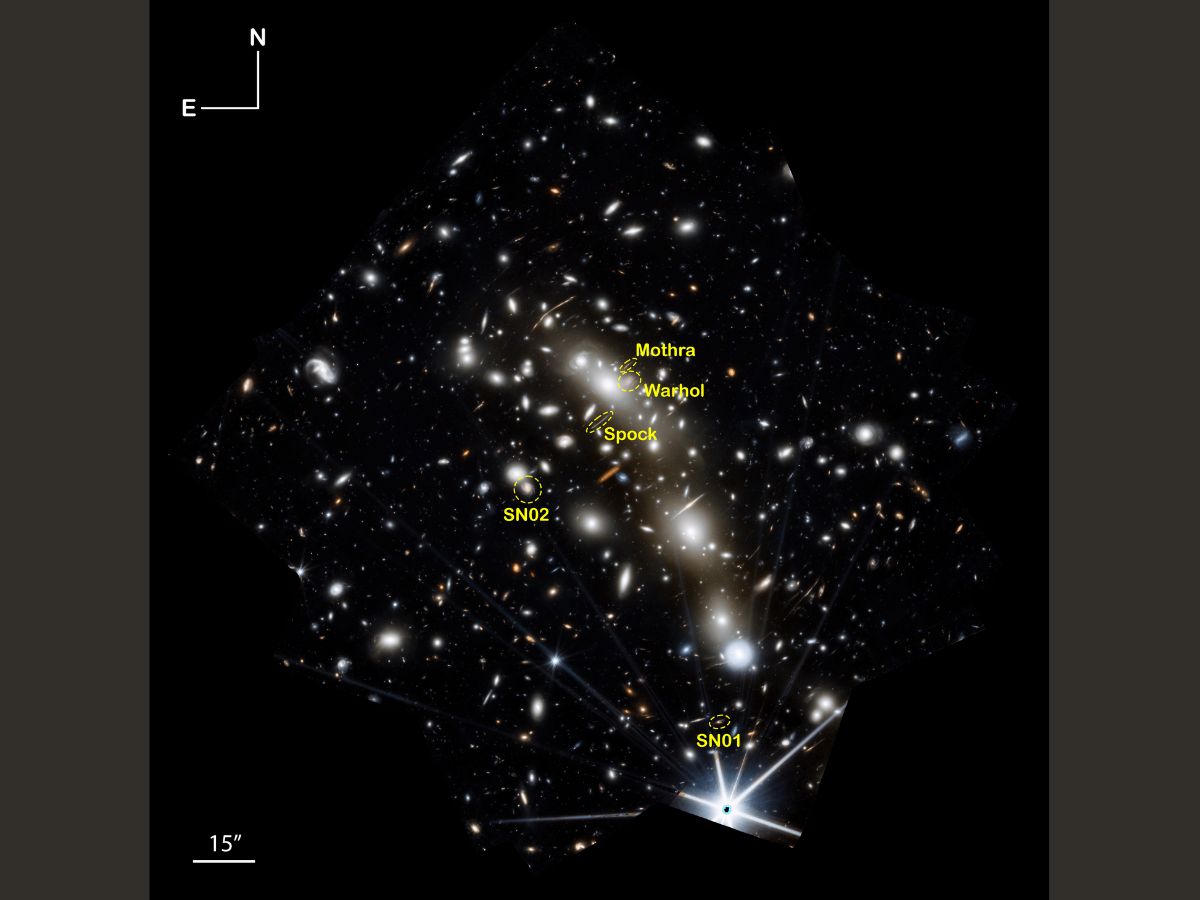
Scientists have discovered 14 new ‘transients’, which are objects in space that appear to suddenly brighten and then fade away, in space, by studying the ‘Christmas Tree Galaxy Cluster’ using NASA’s James Webb Space Telescope (Webb). The official name of the galaxy cluster is MACS0416. It is located 4.3 billion light years from Earth. The team of researchers, led by University of Missouri’s Haojing Yan, created a view of the Christmas Tree Galaxy Cluster by combining visible light data obtained from NASA’s Hubble Space Telescope with Webb’s infrared observations. The researchers created the image by colour-coding the shortest wavelengths of light blue, the longest wavelengths red, and intermediate wavelengths green.
A paper describing the findings has been accepted for publication in the Astrophysical Journal.
MUST READ | How Are Planets Made? NASA’s James Webb Space Telescope Makes Breakthrough Discovery
What is special about Webb’s image of the Christmas Tree Galaxy Cluster?
While both Hubble and Webb’s images feature hundreds of galaxies, the Webb image shows images that are invisible or barely visible in the Hubble image, because the infrared vision of the world’s most powerful space telescope can detect galaxies that are too distant or dusty for Hubble to see.
In Webb’s image, there is a gravitationally lensed background galaxy. Gravitational lensing is a phenomenon in which a foreground galaxy bends the light from a more distant object and magnifies it. The massive celestial body, such as a galaxy cluster, which causes a sufficient curvature of spacetime for the path of light around it to be visibly bent, as if by a lens, is called a gravitational lens.
MUST READ | How Are Planets Made? NASA’s James Webb Space Telescope Makes Breakthrough Discovery
The background galaxy that has been magnified existed about three billion years after the Big Bang.
What is Mothra?
Inside the galaxy, the scientists have found a transient, or an object whose brightness varies overtime. The transient object has been nicknamed “Mothra”.
Gravitational lensing has magnified Mothra by a factor of at least 4,000 times. According to the researchers, not only has the gravity of the Christmas Tree Galaxy Cluster magnified Mothra, but also an object called a “mill-lens”, which probably weighs as much as a globular star cluster, has also contributed to the magnification.
Webb’s advanced technological capabilities helped the scientists confirm what was causing the “flickering lights” or transients that were first seen years ago using Hubble.
MUST READ | Moon’s Age Revealed By Lunar Crystals Brought Back By Apollo 17 Astronauts: Study
In a statement released by the University of Missouri, Yan said transients are objects in space, similar to individual stars, that appear bright only for a short period of time and then are gone. He explained that the scientists called MACS0416 the Christmas Tree Galaxy Cluster because it is colourful, and because of the flickering lights it harbours. Due to gravitational lensing, several transients can be seen in certain regions.
What are the other transients?
According to the university, two of the transients are supernovae, and this will allow the researchers to study the supernovae’s host galaxies.
The remaining 12 transients are extremely magnified stars. Yan explained that the researchers have traced the change in brightness over time through their light curves, and by examining in detail how the light changes over time, they will eventually be able to know what kind of stars they are.
The magnifying glass’s detailed structure may also help scientists understand how it relates to dark matter distribution.
Four sets of observations obtained by Webb’s Near-Infrared Camera (NIRCam) over a period of 126 days were used to create a colour composite image of the Christmas Tree Galaxy Cluster.
Some of the transients apart from Mothra are Warhol, Spock, SN01 (supernova 1), and SN02 (supernova 2).
MUST READ | Ancient Life On Mars? Evidence Of Old Rivers Found On Planet

Scientists have discovered 14 new ‘transients’, which are objects in space that appear to suddenly brighten and then fade away, in space, by studying the ‘Christmas Tree Galaxy Cluster’ using NASA’s James Webb Space Telescope (Webb). The official name of the galaxy cluster is MACS0416. It is located 4.3 billion light years from Earth. The team of researchers, led by University of Missouri’s Haojing Yan, created a view of the Christmas Tree Galaxy Cluster by combining visible light data obtained from NASA’s Hubble Space Telescope with Webb’s infrared observations. The researchers created the image by colour-coding the shortest wavelengths of light blue, the longest wavelengths red, and intermediate wavelengths green.
A paper describing the findings has been accepted for publication in the Astrophysical Journal.
MUST READ | How Are Planets Made? NASA’s James Webb Space Telescope Makes Breakthrough Discovery
What is special about Webb’s image of the Christmas Tree Galaxy Cluster?
While both Hubble and Webb’s images feature hundreds of galaxies, the Webb image shows images that are invisible or barely visible in the Hubble image, because the infrared vision of the world’s most powerful space telescope can detect galaxies that are too distant or dusty for Hubble to see.
In Webb’s image, there is a gravitationally lensed background galaxy. Gravitational lensing is a phenomenon in which a foreground galaxy bends the light from a more distant object and magnifies it. The massive celestial body, such as a galaxy cluster, which causes a sufficient curvature of spacetime for the path of light around it to be visibly bent, as if by a lens, is called a gravitational lens.
MUST READ | How Are Planets Made? NASA’s James Webb Space Telescope Makes Breakthrough Discovery
The background galaxy that has been magnified existed about three billion years after the Big Bang.
What is Mothra?
Inside the galaxy, the scientists have found a transient, or an object whose brightness varies overtime. The transient object has been nicknamed “Mothra”.
Gravitational lensing has magnified Mothra by a factor of at least 4,000 times. According to the researchers, not only has the gravity of the Christmas Tree Galaxy Cluster magnified Mothra, but also an object called a “mill-lens”, which probably weighs as much as a globular star cluster, has also contributed to the magnification.
Webb’s advanced technological capabilities helped the scientists confirm what was causing the “flickering lights” or transients that were first seen years ago using Hubble.
MUST READ | Moon’s Age Revealed By Lunar Crystals Brought Back By Apollo 17 Astronauts: Study
In a statement released by the University of Missouri, Yan said transients are objects in space, similar to individual stars, that appear bright only for a short period of time and then are gone. He explained that the scientists called MACS0416 the Christmas Tree Galaxy Cluster because it is colourful, and because of the flickering lights it harbours. Due to gravitational lensing, several transients can be seen in certain regions.
What are the other transients?
According to the university, two of the transients are supernovae, and this will allow the researchers to study the supernovae’s host galaxies.
The remaining 12 transients are extremely magnified stars. Yan explained that the researchers have traced the change in brightness over time through their light curves, and by examining in detail how the light changes over time, they will eventually be able to know what kind of stars they are.
The magnifying glass’s detailed structure may also help scientists understand how it relates to dark matter distribution.
Four sets of observations obtained by Webb’s Near-Infrared Camera (NIRCam) over a period of 126 days were used to create a colour composite image of the Christmas Tree Galaxy Cluster.
Some of the transients apart from Mothra are Warhol, Spock, SN01 (supernova 1), and SN02 (supernova 2).
MUST READ | Ancient Life On Mars? Evidence Of Old Rivers Found On Planet

Scientists have discovered 14 new ‘transients’, which are objects in space that appear to suddenly brighten and then fade away, in space, by studying the ‘Christmas Tree Galaxy Cluster’ using NASA’s James Webb Space Telescope (Webb). The official name of the galaxy cluster is MACS0416. It is located 4.3 billion light years from Earth. The team of researchers, led by University of Missouri’s Haojing Yan, created a view of the Christmas Tree Galaxy Cluster by combining visible light data obtained from NASA’s Hubble Space Telescope with Webb’s infrared observations. The researchers created the image by colour-coding the shortest wavelengths of light blue, the longest wavelengths red, and intermediate wavelengths green.
A paper describing the findings has been accepted for publication in the Astrophysical Journal.
MUST READ | How Are Planets Made? NASA’s James Webb Space Telescope Makes Breakthrough Discovery
What is special about Webb’s image of the Christmas Tree Galaxy Cluster?
While both Hubble and Webb’s images feature hundreds of galaxies, the Webb image shows images that are invisible or barely visible in the Hubble image, because the infrared vision of the world’s most powerful space telescope can detect galaxies that are too distant or dusty for Hubble to see.
In Webb’s image, there is a gravitationally lensed background galaxy. Gravitational lensing is a phenomenon in which a foreground galaxy bends the light from a more distant object and magnifies it. The massive celestial body, such as a galaxy cluster, which causes a sufficient curvature of spacetime for the path of light around it to be visibly bent, as if by a lens, is called a gravitational lens.
MUST READ | How Are Planets Made? NASA’s James Webb Space Telescope Makes Breakthrough Discovery
The background galaxy that has been magnified existed about three billion years after the Big Bang.
What is Mothra?
Inside the galaxy, the scientists have found a transient, or an object whose brightness varies overtime. The transient object has been nicknamed “Mothra”.
Gravitational lensing has magnified Mothra by a factor of at least 4,000 times. According to the researchers, not only has the gravity of the Christmas Tree Galaxy Cluster magnified Mothra, but also an object called a “mill-lens”, which probably weighs as much as a globular star cluster, has also contributed to the magnification.
Webb’s advanced technological capabilities helped the scientists confirm what was causing the “flickering lights” or transients that were first seen years ago using Hubble.
MUST READ | Moon’s Age Revealed By Lunar Crystals Brought Back By Apollo 17 Astronauts: Study
In a statement released by the University of Missouri, Yan said transients are objects in space, similar to individual stars, that appear bright only for a short period of time and then are gone. He explained that the scientists called MACS0416 the Christmas Tree Galaxy Cluster because it is colourful, and because of the flickering lights it harbours. Due to gravitational lensing, several transients can be seen in certain regions.
What are the other transients?
According to the university, two of the transients are supernovae, and this will allow the researchers to study the supernovae’s host galaxies.
The remaining 12 transients are extremely magnified stars. Yan explained that the researchers have traced the change in brightness over time through their light curves, and by examining in detail how the light changes over time, they will eventually be able to know what kind of stars they are.
The magnifying glass’s detailed structure may also help scientists understand how it relates to dark matter distribution.
Four sets of observations obtained by Webb’s Near-Infrared Camera (NIRCam) over a period of 126 days were used to create a colour composite image of the Christmas Tree Galaxy Cluster.
Some of the transients apart from Mothra are Warhol, Spock, SN01 (supernova 1), and SN02 (supernova 2).
MUST READ | Ancient Life On Mars? Evidence Of Old Rivers Found On Planet
Scientists have discovered 14 new ‘transients’, which are objects in space that appear to suddenly brighten and then fade away, in space, by studying the ‘Christmas Tree Galaxy Cluster’ using NASA’s James Webb Space Telescope (Webb). The official name of the galaxy cluster is MACS0416. It is located 4.3 billion light years from Earth. The team of researchers, led by University of Missouri’s Haojing Yan, created a view of the Christmas Tree Galaxy Cluster by combining visible light data obtained from NASA’s Hubble Space Telescope with Webb’s infrared observations. The researchers created the image by colour-coding the shortest wavelengths of light blue, the longest wavelengths red, and intermediate wavelengths green.
A paper describing the findings has been accepted for publication in the Astrophysical Journal.
MUST READ | How Are Planets Made? NASA’s James Webb Space Telescope Makes Breakthrough Discovery
What is special about Webb’s image of the Christmas Tree Galaxy Cluster?
While both Hubble and Webb’s images feature hundreds of galaxies, the Webb image shows images that are invisible or barely visible in the Hubble image, because the infrared vision of the world’s most powerful space telescope can detect galaxies that are too distant or dusty for Hubble to see.
In Webb’s image, there is a gravitationally lensed background galaxy. Gravitational lensing is a phenomenon in which a foreground galaxy bends the light from a more distant object and magnifies it. The massive celestial body, such as a galaxy cluster, which causes a sufficient curvature of spacetime for the path of light around it to be visibly bent, as if by a lens, is called a gravitational lens.
MUST READ | How Are Planets Made? NASA’s James Webb Space Telescope Makes Breakthrough Discovery
The background galaxy that has been magnified existed about three billion years after the Big Bang.
What is Mothra?
Inside the galaxy, the scientists have found a transient, or an object whose brightness varies overtime. The transient object has been nicknamed “Mothra”.
Gravitational lensing has magnified Mothra by a factor of at least 4,000 times. According to the researchers, not only has the gravity of the Christmas Tree Galaxy Cluster magnified Mothra, but also an object called a “mill-lens”, which probably weighs as much as a globular star cluster, has also contributed to the magnification.
Webb’s advanced technological capabilities helped the scientists confirm what was causing the “flickering lights” or transients that were first seen years ago using Hubble.
MUST READ | Moon’s Age Revealed By Lunar Crystals Brought Back By Apollo 17 Astronauts: Study
In a statement released by the University of Missouri, Yan said transients are objects in space, similar to individual stars, that appear bright only for a short period of time and then are gone. He explained that the scientists called MACS0416 the Christmas Tree Galaxy Cluster because it is colourful, and because of the flickering lights it harbours. Due to gravitational lensing, several transients can be seen in certain regions.
What are the other transients?
According to the university, two of the transients are supernovae, and this will allow the researchers to study the supernovae’s host galaxies.
The remaining 12 transients are extremely magnified stars. Yan explained that the researchers have traced the change in brightness over time through their light curves, and by examining in detail how the light changes over time, they will eventually be able to know what kind of stars they are.
The magnifying glass’s detailed structure may also help scientists understand how it relates to dark matter distribution.
Four sets of observations obtained by Webb’s Near-Infrared Camera (NIRCam) over a period of 126 days were used to create a colour composite image of the Christmas Tree Galaxy Cluster.
Some of the transients apart from Mothra are Warhol, Spock, SN01 (supernova 1), and SN02 (supernova 2).
MUST READ | Ancient Life On Mars? Evidence Of Old Rivers Found On Planet

Scientists have discovered 14 new ‘transients’, which are objects in space that appear to suddenly brighten and then fade away, in space, by studying the ‘Christmas Tree Galaxy Cluster’ using NASA’s James Webb Space Telescope (Webb). The official name of the galaxy cluster is MACS0416. It is located 4.3 billion light years from Earth. The team of researchers, led by University of Missouri’s Haojing Yan, created a view of the Christmas Tree Galaxy Cluster by combining visible light data obtained from NASA’s Hubble Space Telescope with Webb’s infrared observations. The researchers created the image by colour-coding the shortest wavelengths of light blue, the longest wavelengths red, and intermediate wavelengths green.
A paper describing the findings has been accepted for publication in the Astrophysical Journal.
MUST READ | How Are Planets Made? NASA’s James Webb Space Telescope Makes Breakthrough Discovery
What is special about Webb’s image of the Christmas Tree Galaxy Cluster?
While both Hubble and Webb’s images feature hundreds of galaxies, the Webb image shows images that are invisible or barely visible in the Hubble image, because the infrared vision of the world’s most powerful space telescope can detect galaxies that are too distant or dusty for Hubble to see.
In Webb’s image, there is a gravitationally lensed background galaxy. Gravitational lensing is a phenomenon in which a foreground galaxy bends the light from a more distant object and magnifies it. The massive celestial body, such as a galaxy cluster, which causes a sufficient curvature of spacetime for the path of light around it to be visibly bent, as if by a lens, is called a gravitational lens.
MUST READ | How Are Planets Made? NASA’s James Webb Space Telescope Makes Breakthrough Discovery
The background galaxy that has been magnified existed about three billion years after the Big Bang.
What is Mothra?
Inside the galaxy, the scientists have found a transient, or an object whose brightness varies overtime. The transient object has been nicknamed “Mothra”.
Gravitational lensing has magnified Mothra by a factor of at least 4,000 times. According to the researchers, not only has the gravity of the Christmas Tree Galaxy Cluster magnified Mothra, but also an object called a “mill-lens”, which probably weighs as much as a globular star cluster, has also contributed to the magnification.
Webb’s advanced technological capabilities helped the scientists confirm what was causing the “flickering lights” or transients that were first seen years ago using Hubble.
MUST READ | Moon’s Age Revealed By Lunar Crystals Brought Back By Apollo 17 Astronauts: Study
In a statement released by the University of Missouri, Yan said transients are objects in space, similar to individual stars, that appear bright only for a short period of time and then are gone. He explained that the scientists called MACS0416 the Christmas Tree Galaxy Cluster because it is colourful, and because of the flickering lights it harbours. Due to gravitational lensing, several transients can be seen in certain regions.
What are the other transients?
According to the university, two of the transients are supernovae, and this will allow the researchers to study the supernovae’s host galaxies.
The remaining 12 transients are extremely magnified stars. Yan explained that the researchers have traced the change in brightness over time through their light curves, and by examining in detail how the light changes over time, they will eventually be able to know what kind of stars they are.
The magnifying glass’s detailed structure may also help scientists understand how it relates to dark matter distribution.
Four sets of observations obtained by Webb’s Near-Infrared Camera (NIRCam) over a period of 126 days were used to create a colour composite image of the Christmas Tree Galaxy Cluster.
Some of the transients apart from Mothra are Warhol, Spock, SN01 (supernova 1), and SN02 (supernova 2).
MUST READ | Ancient Life On Mars? Evidence Of Old Rivers Found On Planet
Scientists have discovered 14 new ‘transients’, which are objects in space that appear to suddenly brighten and then fade away, in space, by studying the ‘Christmas Tree Galaxy Cluster’ using NASA’s James Webb Space Telescope (Webb). The official name of the galaxy cluster is MACS0416. It is located 4.3 billion light years from Earth. The team of researchers, led by University of Missouri’s Haojing Yan, created a view of the Christmas Tree Galaxy Cluster by combining visible light data obtained from NASA’s Hubble Space Telescope with Webb’s infrared observations. The researchers created the image by colour-coding the shortest wavelengths of light blue, the longest wavelengths red, and intermediate wavelengths green.
A paper describing the findings has been accepted for publication in the Astrophysical Journal.
MUST READ | How Are Planets Made? NASA’s James Webb Space Telescope Makes Breakthrough Discovery
What is special about Webb’s image of the Christmas Tree Galaxy Cluster?
While both Hubble and Webb’s images feature hundreds of galaxies, the Webb image shows images that are invisible or barely visible in the Hubble image, because the infrared vision of the world’s most powerful space telescope can detect galaxies that are too distant or dusty for Hubble to see.
In Webb’s image, there is a gravitationally lensed background galaxy. Gravitational lensing is a phenomenon in which a foreground galaxy bends the light from a more distant object and magnifies it. The massive celestial body, such as a galaxy cluster, which causes a sufficient curvature of spacetime for the path of light around it to be visibly bent, as if by a lens, is called a gravitational lens.
MUST READ | How Are Planets Made? NASA’s James Webb Space Telescope Makes Breakthrough Discovery
The background galaxy that has been magnified existed about three billion years after the Big Bang.
What is Mothra?
Inside the galaxy, the scientists have found a transient, or an object whose brightness varies overtime. The transient object has been nicknamed “Mothra”.
Gravitational lensing has magnified Mothra by a factor of at least 4,000 times. According to the researchers, not only has the gravity of the Christmas Tree Galaxy Cluster magnified Mothra, but also an object called a “mill-lens”, which probably weighs as much as a globular star cluster, has also contributed to the magnification.
Webb’s advanced technological capabilities helped the scientists confirm what was causing the “flickering lights” or transients that were first seen years ago using Hubble.
MUST READ | Moon’s Age Revealed By Lunar Crystals Brought Back By Apollo 17 Astronauts: Study
In a statement released by the University of Missouri, Yan said transients are objects in space, similar to individual stars, that appear bright only for a short period of time and then are gone. He explained that the scientists called MACS0416 the Christmas Tree Galaxy Cluster because it is colourful, and because of the flickering lights it harbours. Due to gravitational lensing, several transients can be seen in certain regions.
What are the other transients?
According to the university, two of the transients are supernovae, and this will allow the researchers to study the supernovae’s host galaxies.
The remaining 12 transients are extremely magnified stars. Yan explained that the researchers have traced the change in brightness over time through their light curves, and by examining in detail how the light changes over time, they will eventually be able to know what kind of stars they are.
The magnifying glass’s detailed structure may also help scientists understand how it relates to dark matter distribution.
Four sets of observations obtained by Webb’s Near-Infrared Camera (NIRCam) over a period of 126 days were used to create a colour composite image of the Christmas Tree Galaxy Cluster.
Some of the transients apart from Mothra are Warhol, Spock, SN01 (supernova 1), and SN02 (supernova 2).
MUST READ | Ancient Life On Mars? Evidence Of Old Rivers Found On Planet
Scientists have discovered 14 new ‘transients’, which are objects in space that appear to suddenly brighten and then fade away, in space, by studying the ‘Christmas Tree Galaxy Cluster’ using NASA’s James Webb Space Telescope (Webb). The official name of the galaxy cluster is MACS0416. It is located 4.3 billion light years from Earth. The team of researchers, led by University of Missouri’s Haojing Yan, created a view of the Christmas Tree Galaxy Cluster by combining visible light data obtained from NASA’s Hubble Space Telescope with Webb’s infrared observations. The researchers created the image by colour-coding the shortest wavelengths of light blue, the longest wavelengths red, and intermediate wavelengths green.
A paper describing the findings has been accepted for publication in the Astrophysical Journal.
MUST READ | How Are Planets Made? NASA’s James Webb Space Telescope Makes Breakthrough Discovery
What is special about Webb’s image of the Christmas Tree Galaxy Cluster?
While both Hubble and Webb’s images feature hundreds of galaxies, the Webb image shows images that are invisible or barely visible in the Hubble image, because the infrared vision of the world’s most powerful space telescope can detect galaxies that are too distant or dusty for Hubble to see.
In Webb’s image, there is a gravitationally lensed background galaxy. Gravitational lensing is a phenomenon in which a foreground galaxy bends the light from a more distant object and magnifies it. The massive celestial body, such as a galaxy cluster, which causes a sufficient curvature of spacetime for the path of light around it to be visibly bent, as if by a lens, is called a gravitational lens.
MUST READ | How Are Planets Made? NASA’s James Webb Space Telescope Makes Breakthrough Discovery
The background galaxy that has been magnified existed about three billion years after the Big Bang.
What is Mothra?
Inside the galaxy, the scientists have found a transient, or an object whose brightness varies overtime. The transient object has been nicknamed “Mothra”.
Gravitational lensing has magnified Mothra by a factor of at least 4,000 times. According to the researchers, not only has the gravity of the Christmas Tree Galaxy Cluster magnified Mothra, but also an object called a “mill-lens”, which probably weighs as much as a globular star cluster, has also contributed to the magnification.
Webb’s advanced technological capabilities helped the scientists confirm what was causing the “flickering lights” or transients that were first seen years ago using Hubble.
MUST READ | Moon’s Age Revealed By Lunar Crystals Brought Back By Apollo 17 Astronauts: Study
In a statement released by the University of Missouri, Yan said transients are objects in space, similar to individual stars, that appear bright only for a short period of time and then are gone. He explained that the scientists called MACS0416 the Christmas Tree Galaxy Cluster because it is colourful, and because of the flickering lights it harbours. Due to gravitational lensing, several transients can be seen in certain regions.
What are the other transients?
According to the university, two of the transients are supernovae, and this will allow the researchers to study the supernovae’s host galaxies.
The remaining 12 transients are extremely magnified stars. Yan explained that the researchers have traced the change in brightness over time through their light curves, and by examining in detail how the light changes over time, they will eventually be able to know what kind of stars they are.
The magnifying glass’s detailed structure may also help scientists understand how it relates to dark matter distribution.
Four sets of observations obtained by Webb’s Near-Infrared Camera (NIRCam) over a period of 126 days were used to create a colour composite image of the Christmas Tree Galaxy Cluster.
Some of the transients apart from Mothra are Warhol, Spock, SN01 (supernova 1), and SN02 (supernova 2).
MUST READ | Ancient Life On Mars? Evidence Of Old Rivers Found On Planet
Scientists have discovered 14 new ‘transients’, which are objects in space that appear to suddenly brighten and then fade away, in space, by studying the ‘Christmas Tree Galaxy Cluster’ using NASA’s James Webb Space Telescope (Webb). The official name of the galaxy cluster is MACS0416. It is located 4.3 billion light years from Earth. The team of researchers, led by University of Missouri’s Haojing Yan, created a view of the Christmas Tree Galaxy Cluster by combining visible light data obtained from NASA’s Hubble Space Telescope with Webb’s infrared observations. The researchers created the image by colour-coding the shortest wavelengths of light blue, the longest wavelengths red, and intermediate wavelengths green.
A paper describing the findings has been accepted for publication in the Astrophysical Journal.
MUST READ | How Are Planets Made? NASA’s James Webb Space Telescope Makes Breakthrough Discovery
What is special about Webb’s image of the Christmas Tree Galaxy Cluster?
While both Hubble and Webb’s images feature hundreds of galaxies, the Webb image shows images that are invisible or barely visible in the Hubble image, because the infrared vision of the world’s most powerful space telescope can detect galaxies that are too distant or dusty for Hubble to see.
In Webb’s image, there is a gravitationally lensed background galaxy. Gravitational lensing is a phenomenon in which a foreground galaxy bends the light from a more distant object and magnifies it. The massive celestial body, such as a galaxy cluster, which causes a sufficient curvature of spacetime for the path of light around it to be visibly bent, as if by a lens, is called a gravitational lens.
MUST READ | How Are Planets Made? NASA’s James Webb Space Telescope Makes Breakthrough Discovery
The background galaxy that has been magnified existed about three billion years after the Big Bang.
What is Mothra?
Inside the galaxy, the scientists have found a transient, or an object whose brightness varies overtime. The transient object has been nicknamed “Mothra”.
Gravitational lensing has magnified Mothra by a factor of at least 4,000 times. According to the researchers, not only has the gravity of the Christmas Tree Galaxy Cluster magnified Mothra, but also an object called a “mill-lens”, which probably weighs as much as a globular star cluster, has also contributed to the magnification.
Webb’s advanced technological capabilities helped the scientists confirm what was causing the “flickering lights” or transients that were first seen years ago using Hubble.
MUST READ | Moon’s Age Revealed By Lunar Crystals Brought Back By Apollo 17 Astronauts: Study
In a statement released by the University of Missouri, Yan said transients are objects in space, similar to individual stars, that appear bright only for a short period of time and then are gone. He explained that the scientists called MACS0416 the Christmas Tree Galaxy Cluster because it is colourful, and because of the flickering lights it harbours. Due to gravitational lensing, several transients can be seen in certain regions.
What are the other transients?
According to the university, two of the transients are supernovae, and this will allow the researchers to study the supernovae’s host galaxies.
The remaining 12 transients are extremely magnified stars. Yan explained that the researchers have traced the change in brightness over time through their light curves, and by examining in detail how the light changes over time, they will eventually be able to know what kind of stars they are.
The magnifying glass’s detailed structure may also help scientists understand how it relates to dark matter distribution.
Four sets of observations obtained by Webb’s Near-Infrared Camera (NIRCam) over a period of 126 days were used to create a colour composite image of the Christmas Tree Galaxy Cluster.
Some of the transients apart from Mothra are Warhol, Spock, SN01 (supernova 1), and SN02 (supernova 2).
MUST READ | Ancient Life On Mars? Evidence Of Old Rivers Found On Planet

