

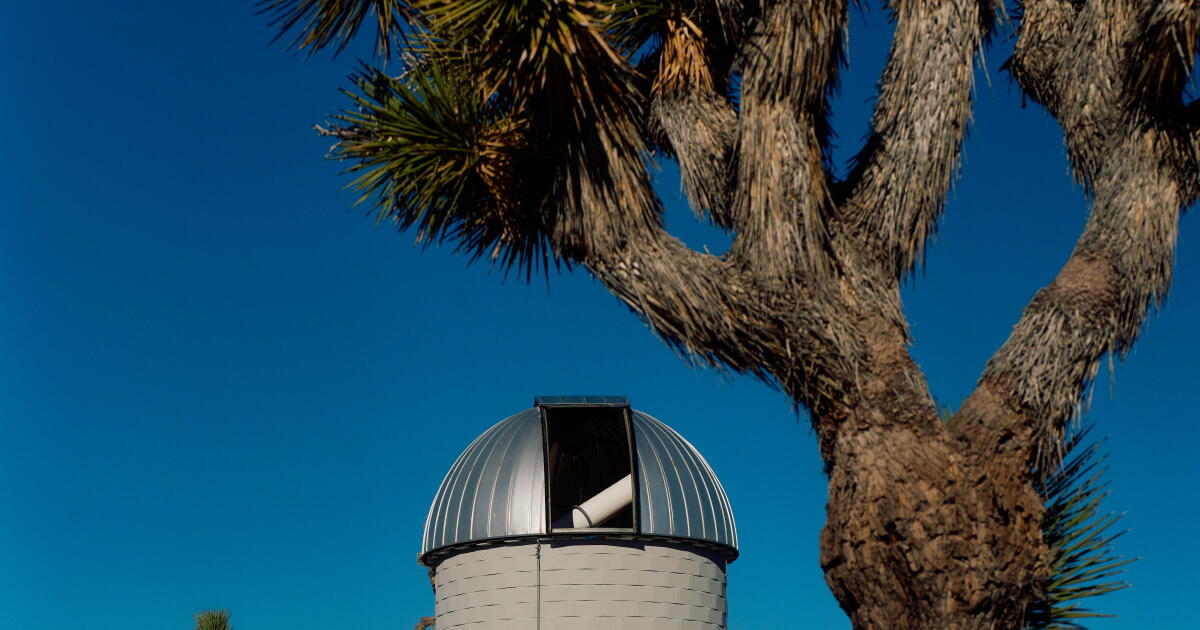

On a high desert hill, in a canyon some 3,000 feet above Pioneertown, printmaker Kyle Simon pushes a button that opens the upper shutter of an observatory dome. Cold wind whistles and shakes the curved walls of the dome, as the shutter slowly creaks open revealing a cloudless sky.
In the background plays the theme song to “Jurassic Park,” a ritual Simon performs for maximum theatricality. The soundtrack makes sense: The landscape below the observatory expands in every direction and evokes a sense of geologic time. It’s not difficult to imagine a brontosaurus pacing the desert floor below.
This is Farrington Press, an off-grid printmaking studio high in a canyon beyond Pioneertown on the site of an old observatory that was left to rot in the sun for decades.
One of two printing presses on the property, both with stories to tell.

Kyle Simon and Sara LaChance, with their dog Blue, on the desert property that houses Farrington Press. They say the project isn’t one thing — it’s forever evolving with art at its core, and stars leading the way.
Founded by Simon and his partner, Sarah LaChance, in 2021, Farrington is invite-only and involves a collaboration between Simon, who spent 12 years as a printmaker at Pace Prints in New York, and artists. He helps translate their work — whether sculpture, paintings or otherwise — into a limited series of prints.
Not quite a residency nor a gallery, LaChance and Simon, both in their 40s with a 5-year-old son, consider the project to be more of an incubator space for artists to experiment while in the rarefied environment of the high desert. “Farrington is first and foremost about the land,” said LaChance. “We don’t see Farrington as any one thing, but rather as something continually evolving.”
As early morning light pours into the upper level of the observatory, with its radial cut wood floors and the telescope that Simon maneuvers gingerly with a red shock cord, he recalls the first time they opened the observatory door, almost a decade prior. “The interior of the observatory hadn’t seen light since the 1970s,” said Simon from atop a ladder, its shadow dancing on the rounded wall of the upper deck across from him. He likes to re-create that experience for anyone who visits the observatory.
Simon has long been a bit obsessed with telescopes and astonomy — his first project at Farrington used sensors on the refurbished telescope to turn light into electrical signals that can drive sound through a synthesizer. “Sirens” is an ongoing sound project he collaborates on with Animal Collective musician Brian Ross Weitz, who goes by the stage name Geologist. One of their first performances was at the observatory where they invited family and friends to experience the sound piece while watching the moon rise.


1. The dome door closing inside the observatory. 2. Kyle Simon moves the telescope inside the observatory.

After hearing about an abandoned observatory, Kyle Simon drove out to inspect it with a friend, eventually buying it with a dream of building something in the desert hills.
Simon first came to the desert for a Pioneertown project in 2014 when he buried sound-etched pottery vases as a time capsule. After about 12 years in New York, he was ready for a change and seeing the stars made him imagine staying. He began thinking about building a telescope to translate light into sound — “I became the telescope guy in town,” said Simon. On another trip back to the desert for a residency, he never left, drawn back to the artists’ community he’d bonded with. He and LaChance, who knew each other from New York, later reconnected; after finishing her master’s in Los Angeles, she joined him in the desert.
In 2016, Simon caught wind of an abandoned and secluded observatory in the mountains. He and a friend drove out and found it. He contacted the owners and eventually bought the site. On their first day as owners, a neighbor welcomed the couple and brought out the observatory’s original telescope lenses, which he had kept safe for years.
At the outset of the pandemic, Simon and LaChance had bought an etching press from a woman in Colorado who demanded they pick it up immediately. They drove straight through, fitting the massive press in a trailer they towed back to the desert. “We bought an entire print studio in one go,” said Simon.

Artist Lily Stockman works on a print inside the studio.
Artist Tara Donovan later sent them another press while changing studios. For the next few years, LaChance and Simon spent hours clearing out decades of debris from the old observatory and cabin that inadvertently housed dozens of rattlesnakes, got the print workshop in shape, and welcomed one of their first collaborations with artist and friend Martha Tuttle.
“It was amazing what they had already constructed,” said Tuttle, who had connected with Simon over astronomy, the West and the desert while they both lived in New York. She loved working in the print shop with the door open to the elements, where she felt her and her work were “less partitioned from the natural world” with the desert landscape and Joshua trees out the corner of her eye. “If there is a dust storm, some dust is going to get into the studio,” said Tuttle, calling it a “reactionary working environment.”
Tuttle said she felt immediately invigorated by the constraints of the space — at the time, no WiFi, weak cell service and the distance from in-town amenities. She was also struck by Simon and LaChance’s resourcefulness and sees Farrington as a model for other art spaces. Farrington is funded through freelance printing, co-publishing, its own editions, and Simon’s independent art sales, with several projects at different stages helping sustain the operation.


1. A paint testing sheet outside the studio. 2. Lily Stockman works on a print. 3. Paint rollers inside the studio space.
“One of the questions all [art] spaces should be asking themselves are ‘how are we using less resources? How are we making our work in a way that uses as little power, uses as little water, uses as little material waste as possible?’” said Tuttle. Simon encourages artists to engage with the landscape around them, taking each artist on a hike to first acclimate them to the environment and to also forage for native pine cones, later using the sap to make rosin for aquatints, a printmaking technique used to create tonal areas and gradations of light and dark.
For Los Angeles artist Lita Albuquerque, who worked at the site in April, the initial draw was traveling out there. The eight-mile trek to Farrington proves a rocky pilgrimage up an unruly ribbon of dirt road through thickets of ancient and massive Joshua trees, tires navigating over loose boulders and mud. It’s a trial by fire for the uninitiated — even experienced desert drivers may find their hearts pounding as they traverse the ravines and steep inclines of the road.
No stranger to the desert — Albuquerque has been making work in various Southwestern deserts for decades — the arrival felt cinematic, seeing the observatory peek over as she climbed the final hill where the landscape gives way to a sweeping vista of mountains, flatlands and endless desert flora.
“Being able to see the light change throughout the day — there’s something about it that’s alive,” said Albuquerque, who said the topography of the environment got her thinking about aliens and outer space.

Kyle Simon prepares a copper plate with ink.
In her four days collaborating at Farrington during her recent residency at High Desert Test Sites, a contemporary arts organization based in Joshua Tree, she revisited ideas and methods she initiated back in the 1970s, inspired by the rocks and the moon. Alongside Simon, she also experimented with gold foil to create a print of a boulder-like shape on a wash of her signature ultramarine blue.
Down at the print shop, which sits at the base of the hill from the observatory, Simon and artist Lily Stockman lean over and study a print of Stockman’s they have just pulled from the press. Both clad in aprons, they discuss the tone of the silver ink Stockman had just mixed outside on a sheet of glass steadied on an old wood burning stove.
“For a lot of these processes you need heat,” explains Simon, whether it’s soft-ground etching, which uses heat to keep the waxy ground soft enough to pick up textures, or aquatint, which uses heat to fuse fine particles of resin onto the metal plate and create areas of tone. Depending on the day, Simon will build a fire in the stove and heat up plates in an old metal pan. “It’s very ‘Old Prospector’ vibes up here,” said Stockman. Adding to the rustic sensibility, Farrington is solar-powered with trucked-in water (as many homes up in the canyons and mesas have to do), so the shop uses as little electricity as possible.

Lilly Stockman had to adapt to the dry desert environment while working at Farrington Press.
The arid climate of the region considerably affects the already very slow process of printmaking. “The paper always has to have some moisture in it,” said Stockman, explaining that when it’s windy and hot, they have to move quickly. “You can’t print fast enough.”
“When you’re working outside in the desert you have these variables that are so extreme,” said Stockman, who lives between Los Angeles and Joshua Tree. “The constraints of the environment become a limit for your creativity and then you have to react around it.”
At Farrington, the limitations of the landscape become part of the process itself.

On a high desert hill, in a canyon some 3,000 feet above Pioneertown, printmaker Kyle Simon pushes a button that opens the upper shutter of an observatory dome. Cold wind whistles and shakes the curved walls of the dome, as the shutter slowly creaks open revealing a cloudless sky.
In the background plays the theme song to “Jurassic Park,” a ritual Simon performs for maximum theatricality. The soundtrack makes sense: The landscape below the observatory expands in every direction and evokes a sense of geologic time. It’s not difficult to imagine a brontosaurus pacing the desert floor below.
This is Farrington Press, an off-grid printmaking studio high in a canyon beyond Pioneertown on the site of an old observatory that was left to rot in the sun for decades.
One of two printing presses on the property, both with stories to tell.
Kyle Simon and Sara LaChance, with their dog Blue, on the desert property that houses Farrington Press. They say the project isn’t one thing — it’s forever evolving with art at its core, and stars leading the way.
Founded by Simon and his partner, Sarah LaChance, in 2021, Farrington is invite-only and involves a collaboration between Simon, who spent 12 years as a printmaker at Pace Prints in New York, and artists. He helps translate their work — whether sculpture, paintings or otherwise — into a limited series of prints.
Not quite a residency nor a gallery, LaChance and Simon, both in their 40s with a 5-year-old son, consider the project to be more of an incubator space for artists to experiment while in the rarefied environment of the high desert. “Farrington is first and foremost about the land,” said LaChance. “We don’t see Farrington as any one thing, but rather as something continually evolving.”
As early morning light pours into the upper level of the observatory, with its radial cut wood floors and the telescope that Simon maneuvers gingerly with a red shock cord, he recalls the first time they opened the observatory door, almost a decade prior. “The interior of the observatory hadn’t seen light since the 1970s,” said Simon from atop a ladder, its shadow dancing on the rounded wall of the upper deck across from him. He likes to re-create that experience for anyone who visits the observatory.
Simon has long been a bit obsessed with telescopes and astonomy — his first project at Farrington used sensors on the refurbished telescope to turn light into electrical signals that can drive sound through a synthesizer. “Sirens” is an ongoing sound project he collaborates on with Animal Collective musician Brian Ross Weitz, who goes by the stage name Geologist. One of their first performances was at the observatory where they invited family and friends to experience the sound piece while watching the moon rise.
1. The dome door closing inside the observatory. 2. Kyle Simon moves the telescope inside the observatory.
After hearing about an abandoned observatory, Kyle Simon drove out to inspect it with a friend, eventually buying it with a dream of building something in the desert hills.
Simon first came to the desert for a Pioneertown project in 2014 when he buried sound-etched pottery vases as a time capsule. After about 12 years in New York, he was ready for a change and seeing the stars made him imagine staying. He began thinking about building a telescope to translate light into sound — “I became the telescope guy in town,” said Simon. On another trip back to the desert for a residency, he never left, drawn back to the artists’ community he’d bonded with. He and LaChance, who knew each other from New York, later reconnected; after finishing her master’s in Los Angeles, she joined him in the desert.
In 2016, Simon caught wind of an abandoned and secluded observatory in the mountains. He and a friend drove out and found it. He contacted the owners and eventually bought the site. On their first day as owners, a neighbor welcomed the couple and brought out the observatory’s original telescope lenses, which he had kept safe for years.
At the outset of the pandemic, Simon and LaChance had bought an etching press from a woman in Colorado who demanded they pick it up immediately. They drove straight through, fitting the massive press in a trailer they towed back to the desert. “We bought an entire print studio in one go,” said Simon.
Artist Lily Stockman works on a print inside the studio.
Artist Tara Donovan later sent them another press while changing studios. For the next few years, LaChance and Simon spent hours clearing out decades of debris from the old observatory and cabin that inadvertently housed dozens of rattlesnakes, got the print workshop in shape, and welcomed one of their first collaborations with artist and friend Martha Tuttle.
“It was amazing what they had already constructed,” said Tuttle, who had connected with Simon over astronomy, the West and the desert while they both lived in New York. She loved working in the print shop with the door open to the elements, where she felt her and her work were “less partitioned from the natural world” with the desert landscape and Joshua trees out the corner of her eye. “If there is a dust storm, some dust is going to get into the studio,” said Tuttle, calling it a “reactionary working environment.”
Tuttle said she felt immediately invigorated by the constraints of the space — at the time, no WiFi, weak cell service and the distance from in-town amenities. She was also struck by Simon and LaChance’s resourcefulness and sees Farrington as a model for other art spaces. Farrington is funded through freelance printing, co-publishing, its own editions, and Simon’s independent art sales, with several projects at different stages helping sustain the operation.
1. A paint testing sheet outside the studio. 2. Lily Stockman works on a print. 3. Paint rollers inside the studio space.
“One of the questions all [art] spaces should be asking themselves are ‘how are we using less resources? How are we making our work in a way that uses as little power, uses as little water, uses as little material waste as possible?’” said Tuttle. Simon encourages artists to engage with the landscape around them, taking each artist on a hike to first acclimate them to the environment and to also forage for native pine cones, later using the sap to make rosin for aquatints, a printmaking technique used to create tonal areas and gradations of light and dark.
For Los Angeles artist Lita Albuquerque, who worked at the site in April, the initial draw was traveling out there. The eight-mile trek to Farrington proves a rocky pilgrimage up an unruly ribbon of dirt road through thickets of ancient and massive Joshua trees, tires navigating over loose boulders and mud. It’s a trial by fire for the uninitiated — even experienced desert drivers may find their hearts pounding as they traverse the ravines and steep inclines of the road.
No stranger to the desert — Albuquerque has been making work in various Southwestern deserts for decades — the arrival felt cinematic, seeing the observatory peek over as she climbed the final hill where the landscape gives way to a sweeping vista of mountains, flatlands and endless desert flora.
“Being able to see the light change throughout the day — there’s something about it that’s alive,” said Albuquerque, who said the topography of the environment got her thinking about aliens and outer space.
Kyle Simon prepares a copper plate with ink.
In her four days collaborating at Farrington during her recent residency at High Desert Test Sites, a contemporary arts organization based in Joshua Tree, she revisited ideas and methods she initiated back in the 1970s, inspired by the rocks and the moon. Alongside Simon, she also experimented with gold foil to create a print of a boulder-like shape on a wash of her signature ultramarine blue.
Down at the print shop, which sits at the base of the hill from the observatory, Simon and artist Lily Stockman lean over and study a print of Stockman’s they have just pulled from the press. Both clad in aprons, they discuss the tone of the silver ink Stockman had just mixed outside on a sheet of glass steadied on an old wood burning stove.
“For a lot of these processes you need heat,” explains Simon, whether it’s soft-ground etching, which uses heat to keep the waxy ground soft enough to pick up textures, or aquatint, which uses heat to fuse fine particles of resin onto the metal plate and create areas of tone. Depending on the day, Simon will build a fire in the stove and heat up plates in an old metal pan. “It’s very ‘Old Prospector’ vibes up here,” said Stockman. Adding to the rustic sensibility, Farrington is solar-powered with trucked-in water (as many homes up in the canyons and mesas have to do), so the shop uses as little electricity as possible.
Lilly Stockman had to adapt to the dry desert environment while working at Farrington Press.
The arid climate of the region considerably affects the already very slow process of printmaking. “The paper always has to have some moisture in it,” said Stockman, explaining that when it’s windy and hot, they have to move quickly. “You can’t print fast enough.”
“When you’re working outside in the desert you have these variables that are so extreme,” said Stockman, who lives between Los Angeles and Joshua Tree. “The constraints of the environment become a limit for your creativity and then you have to react around it.”
At Farrington, the limitations of the landscape become part of the process itself.

On a high desert hill, in a canyon some 3,000 feet above Pioneertown, printmaker Kyle Simon pushes a button that opens the upper shutter of an observatory dome. Cold wind whistles and shakes the curved walls of the dome, as the shutter slowly creaks open revealing a cloudless sky.
In the background plays the theme song to “Jurassic Park,” a ritual Simon performs for maximum theatricality. The soundtrack makes sense: The landscape below the observatory expands in every direction and evokes a sense of geologic time. It’s not difficult to imagine a brontosaurus pacing the desert floor below.
This is Farrington Press, an off-grid printmaking studio high in a canyon beyond Pioneertown on the site of an old observatory that was left to rot in the sun for decades.
One of two printing presses on the property, both with stories to tell.
Kyle Simon and Sara LaChance, with their dog Blue, on the desert property that houses Farrington Press. They say the project isn’t one thing — it’s forever evolving with art at its core, and stars leading the way.
Founded by Simon and his partner, Sarah LaChance, in 2021, Farrington is invite-only and involves a collaboration between Simon, who spent 12 years as a printmaker at Pace Prints in New York, and artists. He helps translate their work — whether sculpture, paintings or otherwise — into a limited series of prints.
Not quite a residency nor a gallery, LaChance and Simon, both in their 40s with a 5-year-old son, consider the project to be more of an incubator space for artists to experiment while in the rarefied environment of the high desert. “Farrington is first and foremost about the land,” said LaChance. “We don’t see Farrington as any one thing, but rather as something continually evolving.”
As early morning light pours into the upper level of the observatory, with its radial cut wood floors and the telescope that Simon maneuvers gingerly with a red shock cord, he recalls the first time they opened the observatory door, almost a decade prior. “The interior of the observatory hadn’t seen light since the 1970s,” said Simon from atop a ladder, its shadow dancing on the rounded wall of the upper deck across from him. He likes to re-create that experience for anyone who visits the observatory.
Simon has long been a bit obsessed with telescopes and astonomy — his first project at Farrington used sensors on the refurbished telescope to turn light into electrical signals that can drive sound through a synthesizer. “Sirens” is an ongoing sound project he collaborates on with Animal Collective musician Brian Ross Weitz, who goes by the stage name Geologist. One of their first performances was at the observatory where they invited family and friends to experience the sound piece while watching the moon rise.
1. The dome door closing inside the observatory. 2. Kyle Simon moves the telescope inside the observatory.
After hearing about an abandoned observatory, Kyle Simon drove out to inspect it with a friend, eventually buying it with a dream of building something in the desert hills.
Simon first came to the desert for a Pioneertown project in 2014 when he buried sound-etched pottery vases as a time capsule. After about 12 years in New York, he was ready for a change and seeing the stars made him imagine staying. He began thinking about building a telescope to translate light into sound — “I became the telescope guy in town,” said Simon. On another trip back to the desert for a residency, he never left, drawn back to the artists’ community he’d bonded with. He and LaChance, who knew each other from New York, later reconnected; after finishing her master’s in Los Angeles, she joined him in the desert.
In 2016, Simon caught wind of an abandoned and secluded observatory in the mountains. He and a friend drove out and found it. He contacted the owners and eventually bought the site. On their first day as owners, a neighbor welcomed the couple and brought out the observatory’s original telescope lenses, which he had kept safe for years.
At the outset of the pandemic, Simon and LaChance had bought an etching press from a woman in Colorado who demanded they pick it up immediately. They drove straight through, fitting the massive press in a trailer they towed back to the desert. “We bought an entire print studio in one go,” said Simon.
Artist Lily Stockman works on a print inside the studio.
Artist Tara Donovan later sent them another press while changing studios. For the next few years, LaChance and Simon spent hours clearing out decades of debris from the old observatory and cabin that inadvertently housed dozens of rattlesnakes, got the print workshop in shape, and welcomed one of their first collaborations with artist and friend Martha Tuttle.
“It was amazing what they had already constructed,” said Tuttle, who had connected with Simon over astronomy, the West and the desert while they both lived in New York. She loved working in the print shop with the door open to the elements, where she felt her and her work were “less partitioned from the natural world” with the desert landscape and Joshua trees out the corner of her eye. “If there is a dust storm, some dust is going to get into the studio,” said Tuttle, calling it a “reactionary working environment.”
Tuttle said she felt immediately invigorated by the constraints of the space — at the time, no WiFi, weak cell service and the distance from in-town amenities. She was also struck by Simon and LaChance’s resourcefulness and sees Farrington as a model for other art spaces. Farrington is funded through freelance printing, co-publishing, its own editions, and Simon’s independent art sales, with several projects at different stages helping sustain the operation.
1. A paint testing sheet outside the studio. 2. Lily Stockman works on a print. 3. Paint rollers inside the studio space.
“One of the questions all [art] spaces should be asking themselves are ‘how are we using less resources? How are we making our work in a way that uses as little power, uses as little water, uses as little material waste as possible?’” said Tuttle. Simon encourages artists to engage with the landscape around them, taking each artist on a hike to first acclimate them to the environment and to also forage for native pine cones, later using the sap to make rosin for aquatints, a printmaking technique used to create tonal areas and gradations of light and dark.
For Los Angeles artist Lita Albuquerque, who worked at the site in April, the initial draw was traveling out there. The eight-mile trek to Farrington proves a rocky pilgrimage up an unruly ribbon of dirt road through thickets of ancient and massive Joshua trees, tires navigating over loose boulders and mud. It’s a trial by fire for the uninitiated — even experienced desert drivers may find their hearts pounding as they traverse the ravines and steep inclines of the road.
No stranger to the desert — Albuquerque has been making work in various Southwestern deserts for decades — the arrival felt cinematic, seeing the observatory peek over as she climbed the final hill where the landscape gives way to a sweeping vista of mountains, flatlands and endless desert flora.
“Being able to see the light change throughout the day — there’s something about it that’s alive,” said Albuquerque, who said the topography of the environment got her thinking about aliens and outer space.
Kyle Simon prepares a copper plate with ink.
In her four days collaborating at Farrington during her recent residency at High Desert Test Sites, a contemporary arts organization based in Joshua Tree, she revisited ideas and methods she initiated back in the 1970s, inspired by the rocks and the moon. Alongside Simon, she also experimented with gold foil to create a print of a boulder-like shape on a wash of her signature ultramarine blue.
Down at the print shop, which sits at the base of the hill from the observatory, Simon and artist Lily Stockman lean over and study a print of Stockman’s they have just pulled from the press. Both clad in aprons, they discuss the tone of the silver ink Stockman had just mixed outside on a sheet of glass steadied on an old wood burning stove.
“For a lot of these processes you need heat,” explains Simon, whether it’s soft-ground etching, which uses heat to keep the waxy ground soft enough to pick up textures, or aquatint, which uses heat to fuse fine particles of resin onto the metal plate and create areas of tone. Depending on the day, Simon will build a fire in the stove and heat up plates in an old metal pan. “It’s very ‘Old Prospector’ vibes up here,” said Stockman. Adding to the rustic sensibility, Farrington is solar-powered with trucked-in water (as many homes up in the canyons and mesas have to do), so the shop uses as little electricity as possible.
Lilly Stockman had to adapt to the dry desert environment while working at Farrington Press.
The arid climate of the region considerably affects the already very slow process of printmaking. “The paper always has to have some moisture in it,” said Stockman, explaining that when it’s windy and hot, they have to move quickly. “You can’t print fast enough.”
“When you’re working outside in the desert you have these variables that are so extreme,” said Stockman, who lives between Los Angeles and Joshua Tree. “The constraints of the environment become a limit for your creativity and then you have to react around it.”
At Farrington, the limitations of the landscape become part of the process itself.

On a high desert hill, in a canyon some 3,000 feet above Pioneertown, printmaker Kyle Simon pushes a button that opens the upper shutter of an observatory dome. Cold wind whistles and shakes the curved walls of the dome, as the shutter slowly creaks open revealing a cloudless sky.
In the background plays the theme song to “Jurassic Park,” a ritual Simon performs for maximum theatricality. The soundtrack makes sense: The landscape below the observatory expands in every direction and evokes a sense of geologic time. It’s not difficult to imagine a brontosaurus pacing the desert floor below.
This is Farrington Press, an off-grid printmaking studio high in a canyon beyond Pioneertown on the site of an old observatory that was left to rot in the sun for decades.
One of two printing presses on the property, both with stories to tell.
Kyle Simon and Sara LaChance, with their dog Blue, on the desert property that houses Farrington Press. They say the project isn’t one thing — it’s forever evolving with art at its core, and stars leading the way.
Founded by Simon and his partner, Sarah LaChance, in 2021, Farrington is invite-only and involves a collaboration between Simon, who spent 12 years as a printmaker at Pace Prints in New York, and artists. He helps translate their work — whether sculpture, paintings or otherwise — into a limited series of prints.
Not quite a residency nor a gallery, LaChance and Simon, both in their 40s with a 5-year-old son, consider the project to be more of an incubator space for artists to experiment while in the rarefied environment of the high desert. “Farrington is first and foremost about the land,” said LaChance. “We don’t see Farrington as any one thing, but rather as something continually evolving.”
As early morning light pours into the upper level of the observatory, with its radial cut wood floors and the telescope that Simon maneuvers gingerly with a red shock cord, he recalls the first time they opened the observatory door, almost a decade prior. “The interior of the observatory hadn’t seen light since the 1970s,” said Simon from atop a ladder, its shadow dancing on the rounded wall of the upper deck across from him. He likes to re-create that experience for anyone who visits the observatory.
Simon has long been a bit obsessed with telescopes and astonomy — his first project at Farrington used sensors on the refurbished telescope to turn light into electrical signals that can drive sound through a synthesizer. “Sirens” is an ongoing sound project he collaborates on with Animal Collective musician Brian Ross Weitz, who goes by the stage name Geologist. One of their first performances was at the observatory where they invited family and friends to experience the sound piece while watching the moon rise.
1. The dome door closing inside the observatory. 2. Kyle Simon moves the telescope inside the observatory.
After hearing about an abandoned observatory, Kyle Simon drove out to inspect it with a friend, eventually buying it with a dream of building something in the desert hills.
Simon first came to the desert for a Pioneertown project in 2014 when he buried sound-etched pottery vases as a time capsule. After about 12 years in New York, he was ready for a change and seeing the stars made him imagine staying. He began thinking about building a telescope to translate light into sound — “I became the telescope guy in town,” said Simon. On another trip back to the desert for a residency, he never left, drawn back to the artists’ community he’d bonded with. He and LaChance, who knew each other from New York, later reconnected; after finishing her master’s in Los Angeles, she joined him in the desert.
In 2016, Simon caught wind of an abandoned and secluded observatory in the mountains. He and a friend drove out and found it. He contacted the owners and eventually bought the site. On their first day as owners, a neighbor welcomed the couple and brought out the observatory’s original telescope lenses, which he had kept safe for years.
At the outset of the pandemic, Simon and LaChance had bought an etching press from a woman in Colorado who demanded they pick it up immediately. They drove straight through, fitting the massive press in a trailer they towed back to the desert. “We bought an entire print studio in one go,” said Simon.
Artist Lily Stockman works on a print inside the studio.
Artist Tara Donovan later sent them another press while changing studios. For the next few years, LaChance and Simon spent hours clearing out decades of debris from the old observatory and cabin that inadvertently housed dozens of rattlesnakes, got the print workshop in shape, and welcomed one of their first collaborations with artist and friend Martha Tuttle.
“It was amazing what they had already constructed,” said Tuttle, who had connected with Simon over astronomy, the West and the desert while they both lived in New York. She loved working in the print shop with the door open to the elements, where she felt her and her work were “less partitioned from the natural world” with the desert landscape and Joshua trees out the corner of her eye. “If there is a dust storm, some dust is going to get into the studio,” said Tuttle, calling it a “reactionary working environment.”
Tuttle said she felt immediately invigorated by the constraints of the space — at the time, no WiFi, weak cell service and the distance from in-town amenities. She was also struck by Simon and LaChance’s resourcefulness and sees Farrington as a model for other art spaces. Farrington is funded through freelance printing, co-publishing, its own editions, and Simon’s independent art sales, with several projects at different stages helping sustain the operation.
1. A paint testing sheet outside the studio. 2. Lily Stockman works on a print. 3. Paint rollers inside the studio space.
“One of the questions all [art] spaces should be asking themselves are ‘how are we using less resources? How are we making our work in a way that uses as little power, uses as little water, uses as little material waste as possible?’” said Tuttle. Simon encourages artists to engage with the landscape around them, taking each artist on a hike to first acclimate them to the environment and to also forage for native pine cones, later using the sap to make rosin for aquatints, a printmaking technique used to create tonal areas and gradations of light and dark.
For Los Angeles artist Lita Albuquerque, who worked at the site in April, the initial draw was traveling out there. The eight-mile trek to Farrington proves a rocky pilgrimage up an unruly ribbon of dirt road through thickets of ancient and massive Joshua trees, tires navigating over loose boulders and mud. It’s a trial by fire for the uninitiated — even experienced desert drivers may find their hearts pounding as they traverse the ravines and steep inclines of the road.
No stranger to the desert — Albuquerque has been making work in various Southwestern deserts for decades — the arrival felt cinematic, seeing the observatory peek over as she climbed the final hill where the landscape gives way to a sweeping vista of mountains, flatlands and endless desert flora.
“Being able to see the light change throughout the day — there’s something about it that’s alive,” said Albuquerque, who said the topography of the environment got her thinking about aliens and outer space.
Kyle Simon prepares a copper plate with ink.
In her four days collaborating at Farrington during her recent residency at High Desert Test Sites, a contemporary arts organization based in Joshua Tree, she revisited ideas and methods she initiated back in the 1970s, inspired by the rocks and the moon. Alongside Simon, she also experimented with gold foil to create a print of a boulder-like shape on a wash of her signature ultramarine blue.
Down at the print shop, which sits at the base of the hill from the observatory, Simon and artist Lily Stockman lean over and study a print of Stockman’s they have just pulled from the press. Both clad in aprons, they discuss the tone of the silver ink Stockman had just mixed outside on a sheet of glass steadied on an old wood burning stove.
“For a lot of these processes you need heat,” explains Simon, whether it’s soft-ground etching, which uses heat to keep the waxy ground soft enough to pick up textures, or aquatint, which uses heat to fuse fine particles of resin onto the metal plate and create areas of tone. Depending on the day, Simon will build a fire in the stove and heat up plates in an old metal pan. “It’s very ‘Old Prospector’ vibes up here,” said Stockman. Adding to the rustic sensibility, Farrington is solar-powered with trucked-in water (as many homes up in the canyons and mesas have to do), so the shop uses as little electricity as possible.
Lilly Stockman had to adapt to the dry desert environment while working at Farrington Press.
The arid climate of the region considerably affects the already very slow process of printmaking. “The paper always has to have some moisture in it,” said Stockman, explaining that when it’s windy and hot, they have to move quickly. “You can’t print fast enough.”
“When you’re working outside in the desert you have these variables that are so extreme,” said Stockman, who lives between Los Angeles and Joshua Tree. “The constraints of the environment become a limit for your creativity and then you have to react around it.”
At Farrington, the limitations of the landscape become part of the process itself.