

How does one follow up “One Battle After Another?” If you are filmmaker Paul Thomas Anderson, it is with a barely 70-minute concert film capturing a prodigiously talented musician, then 23 years old, performing on one of the world’s most famous stages.
Anderson, who might be thought of as a reformed enfant terrible or duly matured former wunderkind, may see something of his younger self in musician Cameron Winter, bursting with ideas and creativity and unsure where to put it all. The film maintains a certain lightness and sense of admiring affection, while also revealing moments of emotional depth.
“Cameron Winter at Carnegie Hall” was shot on Dec. 11, 2025, during what would have been the middle of Anderson’s dizzying “One Battle” awards-season run. It opens with just a few brief shots of concertgoers and ticket-takers to set the scene before Winter walks onstage. Alone at a piano, with a deceptively stark lighting scheme that changes throughout the evening, he gets right to it.
Winter is also part of the acclaimed band Geese, hailed by some as the Gen Z saviors of rock ’n’ roll. For Winter to have released his solo debut, a 2024 collection of mostly downbeat ballads called “Heavy Metal,” in the midst of the band’s ascent is an unusual move, belying a sense of doing things his own way but also a streak that refuses to be readily defined.
A little more than half of “Carnegie Hall” comes from “Heavy Metal,” plus two earlier songs and three previously unheard ones. As heard on the record, the “Heavy Metal” songs, with their sparse instrumentation and haunting arrangements, all seem in danger of collapsing in on themselves. The “Carnegie Hall” performances render those songs sturdier and more complete. Rather than the mumbled warble of the album, on which it sometimes seems that Winter is trying to swallow his own voice, his singing here rings out.
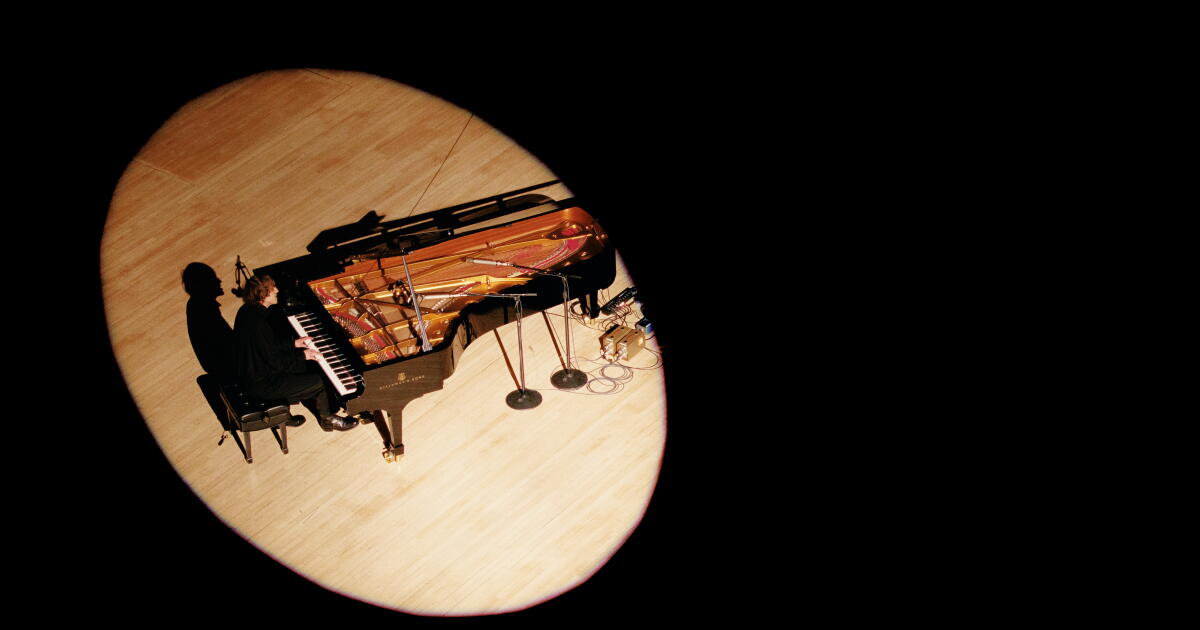
Cameron Winter performing in Paul Thomas Anderson’s documentary “Cameron Winter at Carnegie Hall.”
(Janus Films)
With its witty, impressionistic lyrics (“These songs are meant for bad singers,” Winter croons at one point), the motivating emotions of Winter’s music can often be unclear. It can come across as foggy and hazy but then cut through with a startling clarity, which is especially true in the renditions here.
Situated onstage so he is three-quarters turned away from the crowd, he effectively has his back to most of the audience, as if to more fully place the emphasis on his words and music. In one shot, the camera zooms out from the dimly lit stage and Winter effectively disappears. In another he leans his tall, lanky frame so far toward the keyboard that, shot from behind, it appears he no longer has a head. But there is also an unexpected playfulness to Winter’s performance, as he seems to be fully enjoying the moment, occasionally letting slip a slight, wry smile.
Anderson’s images also have an evolving sense of exploration and fun about them. (Shooting on 35mm and 16mm film, he himself serves as one of the camera operators, as does actor and filmmaker Benny Safdie, also credited as a co-producer.) It doesn’t feel quite as formal as each song having its own shooting grammar, but there is a constantly changing way to where the cameras are placed so the movie never feels static. Twice the viewer is suddenly backstage as two attendants open the stage doors and the camera rushes out onstage in what feels like a thrilling moment of privileged positioning. The movie becomes the best seat in the house.
When he is done, Winter just gets up and walks offstage. The end credits (with the quizzical onscreen subtitle “Dead at 23”) play out, including the entire crew and thank-yous, etc. Then Cameron walks back onstage for one final song, a tender reading of “Vines,” one of his earliest released solo tracks, as something of an encore to the movie itself. More than a just-for-fans document, the collaboration between Anderson and Winter seems to be just what each of them needed at that moment.
‘Cameron Winter at Carnegie Hall’
Not rated
Running time: 1 hour, 15 minutes
Playing: Opens Friday, Nov. 20 in limited release

How does one follow up “One Battle After Another?” If you are filmmaker Paul Thomas Anderson, it is with a barely 70-minute concert film capturing a prodigiously talented musician, then 23 years old, performing on one of the world’s most famous stages.
Anderson, who might be thought of as a reformed enfant terrible or duly matured former wunderkind, may see something of his younger self in musician Cameron Winter, bursting with ideas and creativity and unsure where to put it all. The film maintains a certain lightness and sense of admiring affection, while also revealing moments of emotional depth.
“Cameron Winter at Carnegie Hall” was shot on Dec. 11, 2025, during what would have been the middle of Anderson’s dizzying “One Battle” awards-season run. It opens with just a few brief shots of concertgoers and ticket-takers to set the scene before Winter walks onstage. Alone at a piano, with a deceptively stark lighting scheme that changes throughout the evening, he gets right to it.
Winter is also part of the acclaimed band Geese, hailed by some as the Gen Z saviors of rock ’n’ roll. For Winter to have released his solo debut, a 2024 collection of mostly downbeat ballads called “Heavy Metal,” in the midst of the band’s ascent is an unusual move, belying a sense of doing things his own way but also a streak that refuses to be readily defined.
A little more than half of “Carnegie Hall” comes from “Heavy Metal,” plus two earlier songs and three previously unheard ones. As heard on the record, the “Heavy Metal” songs, with their sparse instrumentation and haunting arrangements, all seem in danger of collapsing in on themselves. The “Carnegie Hall” performances render those songs sturdier and more complete. Rather than the mumbled warble of the album, on which it sometimes seems that Winter is trying to swallow his own voice, his singing here rings out.
Cameron Winter performing in Paul Thomas Anderson’s documentary “Cameron Winter at Carnegie Hall.”
(Janus Films)
With its witty, impressionistic lyrics (“These songs are meant for bad singers,” Winter croons at one point), the motivating emotions of Winter’s music can often be unclear. It can come across as foggy and hazy but then cut through with a startling clarity, which is especially true in the renditions here.
Situated onstage so he is three-quarters turned away from the crowd, he effectively has his back to most of the audience, as if to more fully place the emphasis on his words and music. In one shot, the camera zooms out from the dimly lit stage and Winter effectively disappears. In another he leans his tall, lanky frame so far toward the keyboard that, shot from behind, it appears he no longer has a head. But there is also an unexpected playfulness to Winter’s performance, as he seems to be fully enjoying the moment, occasionally letting slip a slight, wry smile.
Anderson’s images also have an evolving sense of exploration and fun about them. (Shooting on 35mm and 16mm film, he himself serves as one of the camera operators, as does actor and filmmaker Benny Safdie, also credited as a co-producer.) It doesn’t feel quite as formal as each song having its own shooting grammar, but there is a constantly changing way to where the cameras are placed so the movie never feels static. Twice the viewer is suddenly backstage as two attendants open the stage doors and the camera rushes out onstage in what feels like a thrilling moment of privileged positioning. The movie becomes the best seat in the house.
When he is done, Winter just gets up and walks offstage. The end credits (with the quizzical onscreen subtitle “Dead at 23”) play out, including the entire crew and thank-yous, etc. Then Cameron walks back onstage for one final song, a tender reading of “Vines,” one of his earliest released solo tracks, as something of an encore to the movie itself. More than a just-for-fans document, the collaboration between Anderson and Winter seems to be just what each of them needed at that moment.
‘Cameron Winter at Carnegie Hall’
Not rated
Running time: 1 hour, 15 minutes
Playing: Opens Friday, Nov. 20 in limited release

How does one follow up “One Battle After Another?” If you are filmmaker Paul Thomas Anderson, it is with a barely 70-minute concert film capturing a prodigiously talented musician, then 23 years old, performing on one of the world’s most famous stages.
Anderson, who might be thought of as a reformed enfant terrible or duly matured former wunderkind, may see something of his younger self in musician Cameron Winter, bursting with ideas and creativity and unsure where to put it all. The film maintains a certain lightness and sense of admiring affection, while also revealing moments of emotional depth.
“Cameron Winter at Carnegie Hall” was shot on Dec. 11, 2025, during what would have been the middle of Anderson’s dizzying “One Battle” awards-season run. It opens with just a few brief shots of concertgoers and ticket-takers to set the scene before Winter walks onstage. Alone at a piano, with a deceptively stark lighting scheme that changes throughout the evening, he gets right to it.
Winter is also part of the acclaimed band Geese, hailed by some as the Gen Z saviors of rock ’n’ roll. For Winter to have released his solo debut, a 2024 collection of mostly downbeat ballads called “Heavy Metal,” in the midst of the band’s ascent is an unusual move, belying a sense of doing things his own way but also a streak that refuses to be readily defined.
A little more than half of “Carnegie Hall” comes from “Heavy Metal,” plus two earlier songs and three previously unheard ones. As heard on the record, the “Heavy Metal” songs, with their sparse instrumentation and haunting arrangements, all seem in danger of collapsing in on themselves. The “Carnegie Hall” performances render those songs sturdier and more complete. Rather than the mumbled warble of the album, on which it sometimes seems that Winter is trying to swallow his own voice, his singing here rings out.
Cameron Winter performing in Paul Thomas Anderson’s documentary “Cameron Winter at Carnegie Hall.”
(Janus Films)
With its witty, impressionistic lyrics (“These songs are meant for bad singers,” Winter croons at one point), the motivating emotions of Winter’s music can often be unclear. It can come across as foggy and hazy but then cut through with a startling clarity, which is especially true in the renditions here.
Situated onstage so he is three-quarters turned away from the crowd, he effectively has his back to most of the audience, as if to more fully place the emphasis on his words and music. In one shot, the camera zooms out from the dimly lit stage and Winter effectively disappears. In another he leans his tall, lanky frame so far toward the keyboard that, shot from behind, it appears he no longer has a head. But there is also an unexpected playfulness to Winter’s performance, as he seems to be fully enjoying the moment, occasionally letting slip a slight, wry smile.
Anderson’s images also have an evolving sense of exploration and fun about them. (Shooting on 35mm and 16mm film, he himself serves as one of the camera operators, as does actor and filmmaker Benny Safdie, also credited as a co-producer.) It doesn’t feel quite as formal as each song having its own shooting grammar, but there is a constantly changing way to where the cameras are placed so the movie never feels static. Twice the viewer is suddenly backstage as two attendants open the stage doors and the camera rushes out onstage in what feels like a thrilling moment of privileged positioning. The movie becomes the best seat in the house.
When he is done, Winter just gets up and walks offstage. The end credits (with the quizzical onscreen subtitle “Dead at 23”) play out, including the entire crew and thank-yous, etc. Then Cameron walks back onstage for one final song, a tender reading of “Vines,” one of his earliest released solo tracks, as something of an encore to the movie itself. More than a just-for-fans document, the collaboration between Anderson and Winter seems to be just what each of them needed at that moment.
‘Cameron Winter at Carnegie Hall’
Not rated
Running time: 1 hour, 15 minutes
Playing: Opens Friday, Nov. 20 in limited release

How does one follow up “One Battle After Another?” If you are filmmaker Paul Thomas Anderson, it is with a barely 70-minute concert film capturing a prodigiously talented musician, then 23 years old, performing on one of the world’s most famous stages.
Anderson, who might be thought of as a reformed enfant terrible or duly matured former wunderkind, may see something of his younger self in musician Cameron Winter, bursting with ideas and creativity and unsure where to put it all. The film maintains a certain lightness and sense of admiring affection, while also revealing moments of emotional depth.
“Cameron Winter at Carnegie Hall” was shot on Dec. 11, 2025, during what would have been the middle of Anderson’s dizzying “One Battle” awards-season run. It opens with just a few brief shots of concertgoers and ticket-takers to set the scene before Winter walks onstage. Alone at a piano, with a deceptively stark lighting scheme that changes throughout the evening, he gets right to it.
Winter is also part of the acclaimed band Geese, hailed by some as the Gen Z saviors of rock ’n’ roll. For Winter to have released his solo debut, a 2024 collection of mostly downbeat ballads called “Heavy Metal,” in the midst of the band’s ascent is an unusual move, belying a sense of doing things his own way but also a streak that refuses to be readily defined.
A little more than half of “Carnegie Hall” comes from “Heavy Metal,” plus two earlier songs and three previously unheard ones. As heard on the record, the “Heavy Metal” songs, with their sparse instrumentation and haunting arrangements, all seem in danger of collapsing in on themselves. The “Carnegie Hall” performances render those songs sturdier and more complete. Rather than the mumbled warble of the album, on which it sometimes seems that Winter is trying to swallow his own voice, his singing here rings out.
Cameron Winter performing in Paul Thomas Anderson’s documentary “Cameron Winter at Carnegie Hall.”
(Janus Films)
With its witty, impressionistic lyrics (“These songs are meant for bad singers,” Winter croons at one point), the motivating emotions of Winter’s music can often be unclear. It can come across as foggy and hazy but then cut through with a startling clarity, which is especially true in the renditions here.
Situated onstage so he is three-quarters turned away from the crowd, he effectively has his back to most of the audience, as if to more fully place the emphasis on his words and music. In one shot, the camera zooms out from the dimly lit stage and Winter effectively disappears. In another he leans his tall, lanky frame so far toward the keyboard that, shot from behind, it appears he no longer has a head. But there is also an unexpected playfulness to Winter’s performance, as he seems to be fully enjoying the moment, occasionally letting slip a slight, wry smile.
Anderson’s images also have an evolving sense of exploration and fun about them. (Shooting on 35mm and 16mm film, he himself serves as one of the camera operators, as does actor and filmmaker Benny Safdie, also credited as a co-producer.) It doesn’t feel quite as formal as each song having its own shooting grammar, but there is a constantly changing way to where the cameras are placed so the movie never feels static. Twice the viewer is suddenly backstage as two attendants open the stage doors and the camera rushes out onstage in what feels like a thrilling moment of privileged positioning. The movie becomes the best seat in the house.
When he is done, Winter just gets up and walks offstage. The end credits (with the quizzical onscreen subtitle “Dead at 23”) play out, including the entire crew and thank-yous, etc. Then Cameron walks back onstage for one final song, a tender reading of “Vines,” one of his earliest released solo tracks, as something of an encore to the movie itself. More than a just-for-fans document, the collaboration between Anderson and Winter seems to be just what each of them needed at that moment.
‘Cameron Winter at Carnegie Hall’
Not rated
Running time: 1 hour, 15 minutes
Playing: Opens Friday, Nov. 20 in limited release

How does one follow up “One Battle After Another?” If you are filmmaker Paul Thomas Anderson, it is with a barely 70-minute concert film capturing a prodigiously talented musician, then 23 years old, performing on one of the world’s most famous stages.
Anderson, who might be thought of as a reformed enfant terrible or duly matured former wunderkind, may see something of his younger self in musician Cameron Winter, bursting with ideas and creativity and unsure where to put it all. The film maintains a certain lightness and sense of admiring affection, while also revealing moments of emotional depth.
“Cameron Winter at Carnegie Hall” was shot on Dec. 11, 2025, during what would have been the middle of Anderson’s dizzying “One Battle” awards-season run. It opens with just a few brief shots of concertgoers and ticket-takers to set the scene before Winter walks onstage. Alone at a piano, with a deceptively stark lighting scheme that changes throughout the evening, he gets right to it.
Winter is also part of the acclaimed band Geese, hailed by some as the Gen Z saviors of rock ’n’ roll. For Winter to have released his solo debut, a 2024 collection of mostly downbeat ballads called “Heavy Metal,” in the midst of the band’s ascent is an unusual move, belying a sense of doing things his own way but also a streak that refuses to be readily defined.
A little more than half of “Carnegie Hall” comes from “Heavy Metal,” plus two earlier songs and three previously unheard ones. As heard on the record, the “Heavy Metal” songs, with their sparse instrumentation and haunting arrangements, all seem in danger of collapsing in on themselves. The “Carnegie Hall” performances render those songs sturdier and more complete. Rather than the mumbled warble of the album, on which it sometimes seems that Winter is trying to swallow his own voice, his singing here rings out.
Cameron Winter performing in Paul Thomas Anderson’s documentary “Cameron Winter at Carnegie Hall.”
(Janus Films)
With its witty, impressionistic lyrics (“These songs are meant for bad singers,” Winter croons at one point), the motivating emotions of Winter’s music can often be unclear. It can come across as foggy and hazy but then cut through with a startling clarity, which is especially true in the renditions here.
Situated onstage so he is three-quarters turned away from the crowd, he effectively has his back to most of the audience, as if to more fully place the emphasis on his words and music. In one shot, the camera zooms out from the dimly lit stage and Winter effectively disappears. In another he leans his tall, lanky frame so far toward the keyboard that, shot from behind, it appears he no longer has a head. But there is also an unexpected playfulness to Winter’s performance, as he seems to be fully enjoying the moment, occasionally letting slip a slight, wry smile.
Anderson’s images also have an evolving sense of exploration and fun about them. (Shooting on 35mm and 16mm film, he himself serves as one of the camera operators, as does actor and filmmaker Benny Safdie, also credited as a co-producer.) It doesn’t feel quite as formal as each song having its own shooting grammar, but there is a constantly changing way to where the cameras are placed so the movie never feels static. Twice the viewer is suddenly backstage as two attendants open the stage doors and the camera rushes out onstage in what feels like a thrilling moment of privileged positioning. The movie becomes the best seat in the house.
When he is done, Winter just gets up and walks offstage. The end credits (with the quizzical onscreen subtitle “Dead at 23”) play out, including the entire crew and thank-yous, etc. Then Cameron walks back onstage for one final song, a tender reading of “Vines,” one of his earliest released solo tracks, as something of an encore to the movie itself. More than a just-for-fans document, the collaboration between Anderson and Winter seems to be just what each of them needed at that moment.
‘Cameron Winter at Carnegie Hall’
Not rated
Running time: 1 hour, 15 minutes
Playing: Opens Friday, Nov. 20 in limited release

