

On the Shelf
Signals Across Vast Distances: Essays and Tales
By Elizabeth Alexander
W. W. Norton & Co.: 144 pages, $27
If you buy books linked on our site, The Times may earn a commission from Bookshop.org, whose fees support independent bookstores.
While Elizabeth Alexander ‘s career trajectory has taken her from scholar and author to educator, cultural advocate and most recently philanthropy, she considers herself first and foremost a poet. “Day job by day, writer by night,” she quips about her two very different and separate identities.
On the creative side, Alexander’s bona fides as a writer of poetry and prose are impressive: six volumes of poetry, including the 2009 poem for Barack Obama’s presidential inauguration, “Praise Song for the Day,” three essay collections and, most recently, “The Light of the World,” a moving memoir of love, grief and meaning in the wake of loss. On the business front, she’s the president of the Mellon Foundation, the largest private funder of the arts culture and the humanities in the United States. How does she bring such seemingly disparate parts of her life together in service of her work?
It starts with presence.
Over our Zoom call, Alexander is engaging, calm but focused on the things that matter in her life: poetry, family, community, justice and connection. She quotes freely from poetry in conversation, and says she keeps the poems that inspire her in an “internal Rolodex,” as offerings to colleagues and students. And now, readers in “Signals Across Vast Distances,” a collection of transformational essays and stories, 10 years in the making, about life’s challenges and how poetry, art and the humanities can connect and sustain us through difficult times.
A Rolodex of poetic resistance
The book’s title is taken from a 1967 Muriel Rukeyser poem in which she writes of “news pouring out of various devices/Interrupted by attempts to sell products to the unseen” and of people trying to connect to each other through the confusion “to construct peace, to make love, to reconcile…ourselves with each other,/Ourselves with ourselves.”Rukeyser’s poem had been in Alexander’s Rolodex for some time. Its resonance is more profound in a period that she describes as beginning “with the global pandemic and moving into the protests in the aftermath of George Floyd’s murder, the increased nihilistic despair over climate change, and the second coming of authoritarianism.”
Her succinct conclusion: “We are navigating through some very challenging times.”
Poetry like Rukeyser’s and others by Gwendolyn Brooks, Robert Hayden or the essays by James Baldwin that Alexander parses in the book, provide sustenance for the journey. Prescient in its reference to the news reaching people through various “devices,” Rukeyser’s poem also resonates for Alexander, “because as I consider being from a generation that lived through the civil rights movement, women’s movement and gay liberation movements, I felt we were always moving forward. But Rukeyser’s poem reminded me in 1967 the United States [which brought escalation of the Vietnam War, war protests and race riots] had not come to an agreement about what it believed, or how it would move forward. So, I kept hearing that poem in my head, which became not only instructive to me but an offering I could give to others… as encouragement that, even when we are separated from each other, we are still connected.”
Alexander knows that need for connection and a sense of being able to reconcile ourselves with our most essential human values is more urgent that ever. What encourages her, and she offers to readers, is poetry and other literature, which “gives us the encouragement to stay grounded.”
In addition to writing about Gwendolyn Brooks’ “The Second Sermon on the Warpland,” whose line “Conduct your blooming in the noise and the whip of the whirlwind” serves as a Alexander’s mantra to stand and fight for justice, she includes stories from her own life, including anecdotes about her late husband, the artist Ficre Ghebreyesus, and others whose journeys to and lives in America as refugees and citizens spark an essential question: “Will we build homes with open sides that welcome wayfarers into our lives?”
As evidence of Alexander’s deep connection to the humanities, the book includes a dozen beautiful color reproductions of fine art by Rashid Johnson, Elizabeth Catlett, Lorna Simpson and Amy Sherald, among others, including a self-portrait by Ghebreyesus. The art was selected as counterpoint to the essays, another means to draw the reader into reflection and contemplation.
Reshaping who — and what — we choose to remember
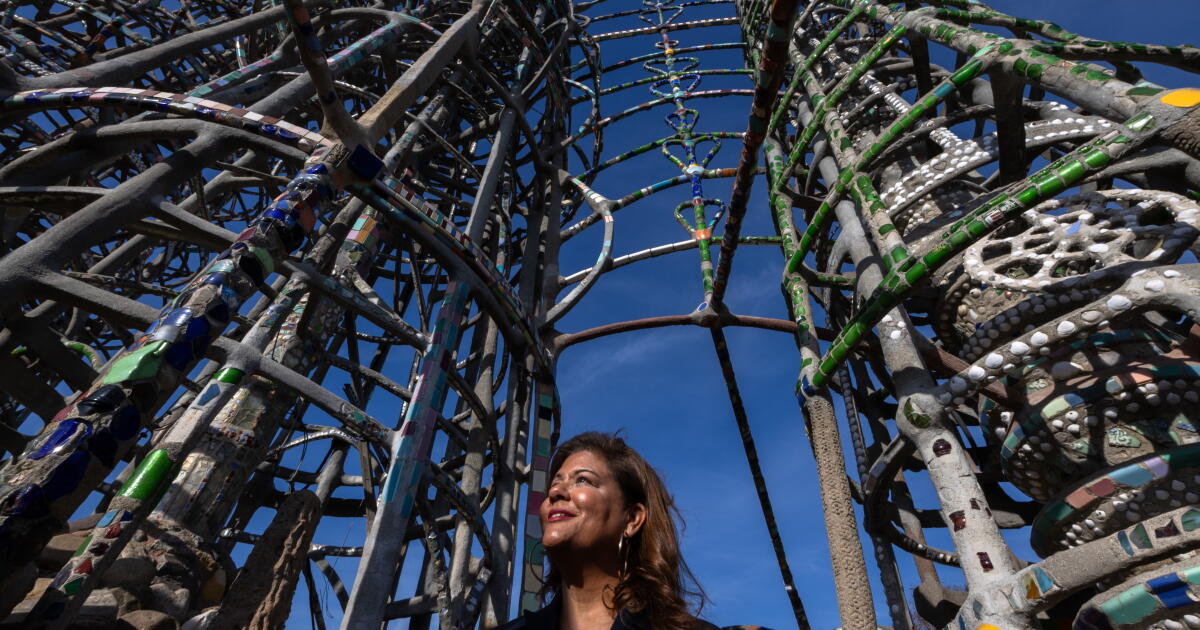
Alexander’s expansive consideration of the importance of the art to expand our understanding of ourselves and inspire connection includes “Notes on the Nation,” an essay that reflects on Simon Rodia’s Watts Tower— which Alexander admires for their “inspirational power and seeming impossibility” — and the monuments she’d like to see “that do not teach us to memorialize was or to commemorate fighting against others because their beliefs are different….I’d like to see those monuments.”
Alexander’s sentiment was shared by the Mellon Foundation’s leaders, who commissioned a study on the nation’s commemorative works that found, among other things, that 50% of monuments were in honor of people who owned other people. That inspired the funding of the Monuments Project, a $500-million, multiyear commitment (the largest in the foundation’s history), which seeks to answer a fundamental question posed on the foundation’s website: “How can we transform our commemorative landscape so that it accurately conveys complexity of our history and the inspiration that is possible in public spaces?”
While perhaps its best known project has been the MONUMENTS exhibit, co-sponsored by the Brick and the Museum of Contemporary Art, which explores the removal and reinterpretation of decommissioned Confederate statues, Alexander also expressed enthusiasm for Kootéeyaa Deiyí, a totem trail on Juneau, Alaska’s waterfront that commemorates the region’s Indigenous communities and Lauren Halsey’s sister dreamer, an ode to the history and vibrancy of South Los Angeles. “I’ve visited that monument several times,” Alexander admits of the monument that sits at the corner of 76th Street and Western Avenue, “and I am awed by the way people have taken to it and claim it as their own.”
The purpose of the project, as is Alexander’s work as a poet and scholar, is to create a more complete picture of our country. “We limit our greatness as a nation,” she argues, “if we think a sanitized history is of any use to anyone!”
Weaving poetry into the margins of everyday life
As important as discussions of language and art can be in connecting us to each other and providing inspiration to seek justice, Alexander is acutely aware that readers live in the real world, where exhortations to speak truth to power are noted side-by-side with reminders to pick up the dry cleaning. So she closes “Signals” with her personal “To Do List,” an idea which came from a another notable poet and friend, Rita Dove, who Alexander reveals includes lines of poetry amid her personal to-do list as a way to remind herself of what’s most important.
Alexander’s list reflects her own particularly hard-won wisdom, like “There should always be salad with dinner.” “Speak up, even when you are afraid.” Or “Give something away every day. Pass along a book when you have finished it. Think about the ecosystem of your actions—what you take in, send out,” the latter of which she includes in a more expansive concept of tithing, of contributing to a common pot for greater good.
There are other thoughts in this essential collection that readers may use to construct their own “to do” lists, which Alexander jokingly says could be “the next great literary genre.” It may be lines of poetry or prose she quotes in the book, or passages from others’ or her own essays that will resonate with readers seeking reconnection with what’s most important in their lives. “As a poet, I know that language is what connects us as human beings,” she asserts. “And I still believe that books are powerful tools to bring us together in a common experience. I want the signals this book sends out across the vast distances of this country to be a conversation starter… and a journey.”
See the author live Nov. 9, 7 p.m. at ALOUD Presents: Elizabeth Alexander in conversation with Jacqueline Stewart at the Mark Taper Forum. 135 N. Grand Ave., L.A.
Woods is a regular contributor to The Times, a member of the National Book Critics Circle and the editor of several anthologies and four novels in the “Charlotte Justice” mystery series.

On the Shelf
Signals Across Vast Distances: Essays and Tales
By Elizabeth Alexander
W. W. Norton & Co.: 144 pages, $27
If you buy books linked on our site, The Times may earn a commission from Bookshop.org, whose fees support independent bookstores.
While Elizabeth Alexander ‘s career trajectory has taken her from scholar and author to educator, cultural advocate and most recently philanthropy, she considers herself first and foremost a poet. “Day job by day, writer by night,” she quips about her two very different and separate identities.
On the creative side, Alexander’s bona fides as a writer of poetry and prose are impressive: six volumes of poetry, including the 2009 poem for Barack Obama’s presidential inauguration, “Praise Song for the Day,” three essay collections and, most recently, “The Light of the World,” a moving memoir of love, grief and meaning in the wake of loss. On the business front, she’s the president of the Mellon Foundation, the largest private funder of the arts culture and the humanities in the United States. How does she bring such seemingly disparate parts of her life together in service of her work?
It starts with presence.
Over our Zoom call, Alexander is engaging, calm but focused on the things that matter in her life: poetry, family, community, justice and connection. She quotes freely from poetry in conversation, and says she keeps the poems that inspire her in an “internal Rolodex,” as offerings to colleagues and students. And now, readers in “Signals Across Vast Distances,” a collection of transformational essays and stories, 10 years in the making, about life’s challenges and how poetry, art and the humanities can connect and sustain us through difficult times.
A Rolodex of poetic resistance
The book’s title is taken from a 1967 Muriel Rukeyser poem in which she writes of “news pouring out of various devices/Interrupted by attempts to sell products to the unseen” and of people trying to connect to each other through the confusion “to construct peace, to make love, to reconcile…ourselves with each other,/Ourselves with ourselves.”Rukeyser’s poem had been in Alexander’s Rolodex for some time. Its resonance is more profound in a period that she describes as beginning “with the global pandemic and moving into the protests in the aftermath of George Floyd’s murder, the increased nihilistic despair over climate change, and the second coming of authoritarianism.”
Her succinct conclusion: “We are navigating through some very challenging times.”
Poetry like Rukeyser’s and others by Gwendolyn Brooks, Robert Hayden or the essays by James Baldwin that Alexander parses in the book, provide sustenance for the journey. Prescient in its reference to the news reaching people through various “devices,” Rukeyser’s poem also resonates for Alexander, “because as I consider being from a generation that lived through the civil rights movement, women’s movement and gay liberation movements, I felt we were always moving forward. But Rukeyser’s poem reminded me in 1967 the United States [which brought escalation of the Vietnam War, war protests and race riots] had not come to an agreement about what it believed, or how it would move forward. So, I kept hearing that poem in my head, which became not only instructive to me but an offering I could give to others… as encouragement that, even when we are separated from each other, we are still connected.”
Alexander knows that need for connection and a sense of being able to reconcile ourselves with our most essential human values is more urgent that ever. What encourages her, and she offers to readers, is poetry and other literature, which “gives us the encouragement to stay grounded.”
In addition to writing about Gwendolyn Brooks’ “The Second Sermon on the Warpland,” whose line “Conduct your blooming in the noise and the whip of the whirlwind” serves as a Alexander’s mantra to stand and fight for justice, she includes stories from her own life, including anecdotes about her late husband, the artist Ficre Ghebreyesus, and others whose journeys to and lives in America as refugees and citizens spark an essential question: “Will we build homes with open sides that welcome wayfarers into our lives?”
As evidence of Alexander’s deep connection to the humanities, the book includes a dozen beautiful color reproductions of fine art by Rashid Johnson, Elizabeth Catlett, Lorna Simpson and Amy Sherald, among others, including a self-portrait by Ghebreyesus. The art was selected as counterpoint to the essays, another means to draw the reader into reflection and contemplation.
Reshaping who — and what — we choose to remember
Alexander’s expansive consideration of the importance of the art to expand our understanding of ourselves and inspire connection includes “Notes on the Nation,” an essay that reflects on Simon Rodia’s Watts Tower— which Alexander admires for their “inspirational power and seeming impossibility” — and the monuments she’d like to see “that do not teach us to memorialize was or to commemorate fighting against others because their beliefs are different….I’d like to see those monuments.”
Alexander’s sentiment was shared by the Mellon Foundation’s leaders, who commissioned a study on the nation’s commemorative works that found, among other things, that 50% of monuments were in honor of people who owned other people. That inspired the funding of the Monuments Project, a $500-million, multiyear commitment (the largest in the foundation’s history), which seeks to answer a fundamental question posed on the foundation’s website: “How can we transform our commemorative landscape so that it accurately conveys complexity of our history and the inspiration that is possible in public spaces?”
While perhaps its best known project has been the MONUMENTS exhibit, co-sponsored by the Brick and the Museum of Contemporary Art, which explores the removal and reinterpretation of decommissioned Confederate statues, Alexander also expressed enthusiasm for Kootéeyaa Deiyí, a totem trail on Juneau, Alaska’s waterfront that commemorates the region’s Indigenous communities and Lauren Halsey’s sister dreamer, an ode to the history and vibrancy of South Los Angeles. “I’ve visited that monument several times,” Alexander admits of the monument that sits at the corner of 76th Street and Western Avenue, “and I am awed by the way people have taken to it and claim it as their own.”
The purpose of the project, as is Alexander’s work as a poet and scholar, is to create a more complete picture of our country. “We limit our greatness as a nation,” she argues, “if we think a sanitized history is of any use to anyone!”
Weaving poetry into the margins of everyday life
As important as discussions of language and art can be in connecting us to each other and providing inspiration to seek justice, Alexander is acutely aware that readers live in the real world, where exhortations to speak truth to power are noted side-by-side with reminders to pick up the dry cleaning. So she closes “Signals” with her personal “To Do List,” an idea which came from a another notable poet and friend, Rita Dove, who Alexander reveals includes lines of poetry amid her personal to-do list as a way to remind herself of what’s most important.
Alexander’s list reflects her own particularly hard-won wisdom, like “There should always be salad with dinner.” “Speak up, even when you are afraid.” Or “Give something away every day. Pass along a book when you have finished it. Think about the ecosystem of your actions—what you take in, send out,” the latter of which she includes in a more expansive concept of tithing, of contributing to a common pot for greater good.
There are other thoughts in this essential collection that readers may use to construct their own “to do” lists, which Alexander jokingly says could be “the next great literary genre.” It may be lines of poetry or prose she quotes in the book, or passages from others’ or her own essays that will resonate with readers seeking reconnection with what’s most important in their lives. “As a poet, I know that language is what connects us as human beings,” she asserts. “And I still believe that books are powerful tools to bring us together in a common experience. I want the signals this book sends out across the vast distances of this country to be a conversation starter… and a journey.”
See the author live Nov. 9, 7 p.m. at ALOUD Presents: Elizabeth Alexander in conversation with Jacqueline Stewart at the Mark Taper Forum. 135 N. Grand Ave., L.A.
Woods is a regular contributor to The Times, a member of the National Book Critics Circle and the editor of several anthologies and four novels in the “Charlotte Justice” mystery series.

On the Shelf
Signals Across Vast Distances: Essays and Tales
By Elizabeth Alexander
W. W. Norton & Co.: 144 pages, $27
If you buy books linked on our site, The Times may earn a commission from Bookshop.org, whose fees support independent bookstores.
While Elizabeth Alexander ‘s career trajectory has taken her from scholar and author to educator, cultural advocate and most recently philanthropy, she considers herself first and foremost a poet. “Day job by day, writer by night,” she quips about her two very different and separate identities.
On the creative side, Alexander’s bona fides as a writer of poetry and prose are impressive: six volumes of poetry, including the 2009 poem for Barack Obama’s presidential inauguration, “Praise Song for the Day,” three essay collections and, most recently, “The Light of the World,” a moving memoir of love, grief and meaning in the wake of loss. On the business front, she’s the president of the Mellon Foundation, the largest private funder of the arts culture and the humanities in the United States. How does she bring such seemingly disparate parts of her life together in service of her work?
It starts with presence.
Over our Zoom call, Alexander is engaging, calm but focused on the things that matter in her life: poetry, family, community, justice and connection. She quotes freely from poetry in conversation, and says she keeps the poems that inspire her in an “internal Rolodex,” as offerings to colleagues and students. And now, readers in “Signals Across Vast Distances,” a collection of transformational essays and stories, 10 years in the making, about life’s challenges and how poetry, art and the humanities can connect and sustain us through difficult times.
A Rolodex of poetic resistance
The book’s title is taken from a 1967 Muriel Rukeyser poem in which she writes of “news pouring out of various devices/Interrupted by attempts to sell products to the unseen” and of people trying to connect to each other through the confusion “to construct peace, to make love, to reconcile…ourselves with each other,/Ourselves with ourselves.”Rukeyser’s poem had been in Alexander’s Rolodex for some time. Its resonance is more profound in a period that she describes as beginning “with the global pandemic and moving into the protests in the aftermath of George Floyd’s murder, the increased nihilistic despair over climate change, and the second coming of authoritarianism.”
Her succinct conclusion: “We are navigating through some very challenging times.”
Poetry like Rukeyser’s and others by Gwendolyn Brooks, Robert Hayden or the essays by James Baldwin that Alexander parses in the book, provide sustenance for the journey. Prescient in its reference to the news reaching people through various “devices,” Rukeyser’s poem also resonates for Alexander, “because as I consider being from a generation that lived through the civil rights movement, women’s movement and gay liberation movements, I felt we were always moving forward. But Rukeyser’s poem reminded me in 1967 the United States [which brought escalation of the Vietnam War, war protests and race riots] had not come to an agreement about what it believed, or how it would move forward. So, I kept hearing that poem in my head, which became not only instructive to me but an offering I could give to others… as encouragement that, even when we are separated from each other, we are still connected.”
Alexander knows that need for connection and a sense of being able to reconcile ourselves with our most essential human values is more urgent that ever. What encourages her, and she offers to readers, is poetry and other literature, which “gives us the encouragement to stay grounded.”
In addition to writing about Gwendolyn Brooks’ “The Second Sermon on the Warpland,” whose line “Conduct your blooming in the noise and the whip of the whirlwind” serves as a Alexander’s mantra to stand and fight for justice, she includes stories from her own life, including anecdotes about her late husband, the artist Ficre Ghebreyesus, and others whose journeys to and lives in America as refugees and citizens spark an essential question: “Will we build homes with open sides that welcome wayfarers into our lives?”
As evidence of Alexander’s deep connection to the humanities, the book includes a dozen beautiful color reproductions of fine art by Rashid Johnson, Elizabeth Catlett, Lorna Simpson and Amy Sherald, among others, including a self-portrait by Ghebreyesus. The art was selected as counterpoint to the essays, another means to draw the reader into reflection and contemplation.
Reshaping who — and what — we choose to remember
Alexander’s expansive consideration of the importance of the art to expand our understanding of ourselves and inspire connection includes “Notes on the Nation,” an essay that reflects on Simon Rodia’s Watts Tower— which Alexander admires for their “inspirational power and seeming impossibility” — and the monuments she’d like to see “that do not teach us to memorialize was or to commemorate fighting against others because their beliefs are different….I’d like to see those monuments.”
Alexander’s sentiment was shared by the Mellon Foundation’s leaders, who commissioned a study on the nation’s commemorative works that found, among other things, that 50% of monuments were in honor of people who owned other people. That inspired the funding of the Monuments Project, a $500-million, multiyear commitment (the largest in the foundation’s history), which seeks to answer a fundamental question posed on the foundation’s website: “How can we transform our commemorative landscape so that it accurately conveys complexity of our history and the inspiration that is possible in public spaces?”
While perhaps its best known project has been the MONUMENTS exhibit, co-sponsored by the Brick and the Museum of Contemporary Art, which explores the removal and reinterpretation of decommissioned Confederate statues, Alexander also expressed enthusiasm for Kootéeyaa Deiyí, a totem trail on Juneau, Alaska’s waterfront that commemorates the region’s Indigenous communities and Lauren Halsey’s sister dreamer, an ode to the history and vibrancy of South Los Angeles. “I’ve visited that monument several times,” Alexander admits of the monument that sits at the corner of 76th Street and Western Avenue, “and I am awed by the way people have taken to it and claim it as their own.”
The purpose of the project, as is Alexander’s work as a poet and scholar, is to create a more complete picture of our country. “We limit our greatness as a nation,” she argues, “if we think a sanitized history is of any use to anyone!”
Weaving poetry into the margins of everyday life
As important as discussions of language and art can be in connecting us to each other and providing inspiration to seek justice, Alexander is acutely aware that readers live in the real world, where exhortations to speak truth to power are noted side-by-side with reminders to pick up the dry cleaning. So she closes “Signals” with her personal “To Do List,” an idea which came from a another notable poet and friend, Rita Dove, who Alexander reveals includes lines of poetry amid her personal to-do list as a way to remind herself of what’s most important.
Alexander’s list reflects her own particularly hard-won wisdom, like “There should always be salad with dinner.” “Speak up, even when you are afraid.” Or “Give something away every day. Pass along a book when you have finished it. Think about the ecosystem of your actions—what you take in, send out,” the latter of which she includes in a more expansive concept of tithing, of contributing to a common pot for greater good.
There are other thoughts in this essential collection that readers may use to construct their own “to do” lists, which Alexander jokingly says could be “the next great literary genre.” It may be lines of poetry or prose she quotes in the book, or passages from others’ or her own essays that will resonate with readers seeking reconnection with what’s most important in their lives. “As a poet, I know that language is what connects us as human beings,” she asserts. “And I still believe that books are powerful tools to bring us together in a common experience. I want the signals this book sends out across the vast distances of this country to be a conversation starter… and a journey.”
See the author live Nov. 9, 7 p.m. at ALOUD Presents: Elizabeth Alexander in conversation with Jacqueline Stewart at the Mark Taper Forum. 135 N. Grand Ave., L.A.
Woods is a regular contributor to The Times, a member of the National Book Critics Circle and the editor of several anthologies and four novels in the “Charlotte Justice” mystery series.

On the Shelf
Signals Across Vast Distances: Essays and Tales
By Elizabeth Alexander
W. W. Norton & Co.: 144 pages, $27
If you buy books linked on our site, The Times may earn a commission from Bookshop.org, whose fees support independent bookstores.
While Elizabeth Alexander ‘s career trajectory has taken her from scholar and author to educator, cultural advocate and most recently philanthropy, she considers herself first and foremost a poet. “Day job by day, writer by night,” she quips about her two very different and separate identities.
On the creative side, Alexander’s bona fides as a writer of poetry and prose are impressive: six volumes of poetry, including the 2009 poem for Barack Obama’s presidential inauguration, “Praise Song for the Day,” three essay collections and, most recently, “The Light of the World,” a moving memoir of love, grief and meaning in the wake of loss. On the business front, she’s the president of the Mellon Foundation, the largest private funder of the arts culture and the humanities in the United States. How does she bring such seemingly disparate parts of her life together in service of her work?
It starts with presence.
Over our Zoom call, Alexander is engaging, calm but focused on the things that matter in her life: poetry, family, community, justice and connection. She quotes freely from poetry in conversation, and says she keeps the poems that inspire her in an “internal Rolodex,” as offerings to colleagues and students. And now, readers in “Signals Across Vast Distances,” a collection of transformational essays and stories, 10 years in the making, about life’s challenges and how poetry, art and the humanities can connect and sustain us through difficult times.
A Rolodex of poetic resistance
The book’s title is taken from a 1967 Muriel Rukeyser poem in which she writes of “news pouring out of various devices/Interrupted by attempts to sell products to the unseen” and of people trying to connect to each other through the confusion “to construct peace, to make love, to reconcile…ourselves with each other,/Ourselves with ourselves.”Rukeyser’s poem had been in Alexander’s Rolodex for some time. Its resonance is more profound in a period that she describes as beginning “with the global pandemic and moving into the protests in the aftermath of George Floyd’s murder, the increased nihilistic despair over climate change, and the second coming of authoritarianism.”
Her succinct conclusion: “We are navigating through some very challenging times.”
Poetry like Rukeyser’s and others by Gwendolyn Brooks, Robert Hayden or the essays by James Baldwin that Alexander parses in the book, provide sustenance for the journey. Prescient in its reference to the news reaching people through various “devices,” Rukeyser’s poem also resonates for Alexander, “because as I consider being from a generation that lived through the civil rights movement, women’s movement and gay liberation movements, I felt we were always moving forward. But Rukeyser’s poem reminded me in 1967 the United States [which brought escalation of the Vietnam War, war protests and race riots] had not come to an agreement about what it believed, or how it would move forward. So, I kept hearing that poem in my head, which became not only instructive to me but an offering I could give to others… as encouragement that, even when we are separated from each other, we are still connected.”
Alexander knows that need for connection and a sense of being able to reconcile ourselves with our most essential human values is more urgent that ever. What encourages her, and she offers to readers, is poetry and other literature, which “gives us the encouragement to stay grounded.”
In addition to writing about Gwendolyn Brooks’ “The Second Sermon on the Warpland,” whose line “Conduct your blooming in the noise and the whip of the whirlwind” serves as a Alexander’s mantra to stand and fight for justice, she includes stories from her own life, including anecdotes about her late husband, the artist Ficre Ghebreyesus, and others whose journeys to and lives in America as refugees and citizens spark an essential question: “Will we build homes with open sides that welcome wayfarers into our lives?”
As evidence of Alexander’s deep connection to the humanities, the book includes a dozen beautiful color reproductions of fine art by Rashid Johnson, Elizabeth Catlett, Lorna Simpson and Amy Sherald, among others, including a self-portrait by Ghebreyesus. The art was selected as counterpoint to the essays, another means to draw the reader into reflection and contemplation.
Reshaping who — and what — we choose to remember
Alexander’s expansive consideration of the importance of the art to expand our understanding of ourselves and inspire connection includes “Notes on the Nation,” an essay that reflects on Simon Rodia’s Watts Tower— which Alexander admires for their “inspirational power and seeming impossibility” — and the monuments she’d like to see “that do not teach us to memorialize was or to commemorate fighting against others because their beliefs are different….I’d like to see those monuments.”
Alexander’s sentiment was shared by the Mellon Foundation’s leaders, who commissioned a study on the nation’s commemorative works that found, among other things, that 50% of monuments were in honor of people who owned other people. That inspired the funding of the Monuments Project, a $500-million, multiyear commitment (the largest in the foundation’s history), which seeks to answer a fundamental question posed on the foundation’s website: “How can we transform our commemorative landscape so that it accurately conveys complexity of our history and the inspiration that is possible in public spaces?”
While perhaps its best known project has been the MONUMENTS exhibit, co-sponsored by the Brick and the Museum of Contemporary Art, which explores the removal and reinterpretation of decommissioned Confederate statues, Alexander also expressed enthusiasm for Kootéeyaa Deiyí, a totem trail on Juneau, Alaska’s waterfront that commemorates the region’s Indigenous communities and Lauren Halsey’s sister dreamer, an ode to the history and vibrancy of South Los Angeles. “I’ve visited that monument several times,” Alexander admits of the monument that sits at the corner of 76th Street and Western Avenue, “and I am awed by the way people have taken to it and claim it as their own.”
The purpose of the project, as is Alexander’s work as a poet and scholar, is to create a more complete picture of our country. “We limit our greatness as a nation,” she argues, “if we think a sanitized history is of any use to anyone!”
Weaving poetry into the margins of everyday life
As important as discussions of language and art can be in connecting us to each other and providing inspiration to seek justice, Alexander is acutely aware that readers live in the real world, where exhortations to speak truth to power are noted side-by-side with reminders to pick up the dry cleaning. So she closes “Signals” with her personal “To Do List,” an idea which came from a another notable poet and friend, Rita Dove, who Alexander reveals includes lines of poetry amid her personal to-do list as a way to remind herself of what’s most important.
Alexander’s list reflects her own particularly hard-won wisdom, like “There should always be salad with dinner.” “Speak up, even when you are afraid.” Or “Give something away every day. Pass along a book when you have finished it. Think about the ecosystem of your actions—what you take in, send out,” the latter of which she includes in a more expansive concept of tithing, of contributing to a common pot for greater good.
There are other thoughts in this essential collection that readers may use to construct their own “to do” lists, which Alexander jokingly says could be “the next great literary genre.” It may be lines of poetry or prose she quotes in the book, or passages from others’ or her own essays that will resonate with readers seeking reconnection with what’s most important in their lives. “As a poet, I know that language is what connects us as human beings,” she asserts. “And I still believe that books are powerful tools to bring us together in a common experience. I want the signals this book sends out across the vast distances of this country to be a conversation starter… and a journey.”
See the author live Nov. 9, 7 p.m. at ALOUD Presents: Elizabeth Alexander in conversation with Jacqueline Stewart at the Mark Taper Forum. 135 N. Grand Ave., L.A.
Woods is a regular contributor to The Times, a member of the National Book Critics Circle and the editor of several anthologies and four novels in the “Charlotte Justice” mystery series.

On the Shelf
Signals Across Vast Distances: Essays and Tales
By Elizabeth Alexander
W. W. Norton & Co.: 144 pages, $27
If you buy books linked on our site, The Times may earn a commission from Bookshop.org, whose fees support independent bookstores.
While Elizabeth Alexander ‘s career trajectory has taken her from scholar and author to educator, cultural advocate and most recently philanthropy, she considers herself first and foremost a poet. “Day job by day, writer by night,” she quips about her two very different and separate identities.
On the creative side, Alexander’s bona fides as a writer of poetry and prose are impressive: six volumes of poetry, including the 2009 poem for Barack Obama’s presidential inauguration, “Praise Song for the Day,” three essay collections and, most recently, “The Light of the World,” a moving memoir of love, grief and meaning in the wake of loss. On the business front, she’s the president of the Mellon Foundation, the largest private funder of the arts culture and the humanities in the United States. How does she bring such seemingly disparate parts of her life together in service of her work?
It starts with presence.
Over our Zoom call, Alexander is engaging, calm but focused on the things that matter in her life: poetry, family, community, justice and connection. She quotes freely from poetry in conversation, and says she keeps the poems that inspire her in an “internal Rolodex,” as offerings to colleagues and students. And now, readers in “Signals Across Vast Distances,” a collection of transformational essays and stories, 10 years in the making, about life’s challenges and how poetry, art and the humanities can connect and sustain us through difficult times.
A Rolodex of poetic resistance
The book’s title is taken from a 1967 Muriel Rukeyser poem in which she writes of “news pouring out of various devices/Interrupted by attempts to sell products to the unseen” and of people trying to connect to each other through the confusion “to construct peace, to make love, to reconcile…ourselves with each other,/Ourselves with ourselves.”Rukeyser’s poem had been in Alexander’s Rolodex for some time. Its resonance is more profound in a period that she describes as beginning “with the global pandemic and moving into the protests in the aftermath of George Floyd’s murder, the increased nihilistic despair over climate change, and the second coming of authoritarianism.”
Her succinct conclusion: “We are navigating through some very challenging times.”
Poetry like Rukeyser’s and others by Gwendolyn Brooks, Robert Hayden or the essays by James Baldwin that Alexander parses in the book, provide sustenance for the journey. Prescient in its reference to the news reaching people through various “devices,” Rukeyser’s poem also resonates for Alexander, “because as I consider being from a generation that lived through the civil rights movement, women’s movement and gay liberation movements, I felt we were always moving forward. But Rukeyser’s poem reminded me in 1967 the United States [which brought escalation of the Vietnam War, war protests and race riots] had not come to an agreement about what it believed, or how it would move forward. So, I kept hearing that poem in my head, which became not only instructive to me but an offering I could give to others… as encouragement that, even when we are separated from each other, we are still connected.”
Alexander knows that need for connection and a sense of being able to reconcile ourselves with our most essential human values is more urgent that ever. What encourages her, and she offers to readers, is poetry and other literature, which “gives us the encouragement to stay grounded.”
In addition to writing about Gwendolyn Brooks’ “The Second Sermon on the Warpland,” whose line “Conduct your blooming in the noise and the whip of the whirlwind” serves as a Alexander’s mantra to stand and fight for justice, she includes stories from her own life, including anecdotes about her late husband, the artist Ficre Ghebreyesus, and others whose journeys to and lives in America as refugees and citizens spark an essential question: “Will we build homes with open sides that welcome wayfarers into our lives?”
As evidence of Alexander’s deep connection to the humanities, the book includes a dozen beautiful color reproductions of fine art by Rashid Johnson, Elizabeth Catlett, Lorna Simpson and Amy Sherald, among others, including a self-portrait by Ghebreyesus. The art was selected as counterpoint to the essays, another means to draw the reader into reflection and contemplation.
Reshaping who — and what — we choose to remember
Alexander’s expansive consideration of the importance of the art to expand our understanding of ourselves and inspire connection includes “Notes on the Nation,” an essay that reflects on Simon Rodia’s Watts Tower— which Alexander admires for their “inspirational power and seeming impossibility” — and the monuments she’d like to see “that do not teach us to memorialize was or to commemorate fighting against others because their beliefs are different….I’d like to see those monuments.”
Alexander’s sentiment was shared by the Mellon Foundation’s leaders, who commissioned a study on the nation’s commemorative works that found, among other things, that 50% of monuments were in honor of people who owned other people. That inspired the funding of the Monuments Project, a $500-million, multiyear commitment (the largest in the foundation’s history), which seeks to answer a fundamental question posed on the foundation’s website: “How can we transform our commemorative landscape so that it accurately conveys complexity of our history and the inspiration that is possible in public spaces?”
While perhaps its best known project has been the MONUMENTS exhibit, co-sponsored by the Brick and the Museum of Contemporary Art, which explores the removal and reinterpretation of decommissioned Confederate statues, Alexander also expressed enthusiasm for Kootéeyaa Deiyí, a totem trail on Juneau, Alaska’s waterfront that commemorates the region’s Indigenous communities and Lauren Halsey’s sister dreamer, an ode to the history and vibrancy of South Los Angeles. “I’ve visited that monument several times,” Alexander admits of the monument that sits at the corner of 76th Street and Western Avenue, “and I am awed by the way people have taken to it and claim it as their own.”
The purpose of the project, as is Alexander’s work as a poet and scholar, is to create a more complete picture of our country. “We limit our greatness as a nation,” she argues, “if we think a sanitized history is of any use to anyone!”
Weaving poetry into the margins of everyday life
As important as discussions of language and art can be in connecting us to each other and providing inspiration to seek justice, Alexander is acutely aware that readers live in the real world, where exhortations to speak truth to power are noted side-by-side with reminders to pick up the dry cleaning. So she closes “Signals” with her personal “To Do List,” an idea which came from a another notable poet and friend, Rita Dove, who Alexander reveals includes lines of poetry amid her personal to-do list as a way to remind herself of what’s most important.
Alexander’s list reflects her own particularly hard-won wisdom, like “There should always be salad with dinner.” “Speak up, even when you are afraid.” Or “Give something away every day. Pass along a book when you have finished it. Think about the ecosystem of your actions—what you take in, send out,” the latter of which she includes in a more expansive concept of tithing, of contributing to a common pot for greater good.
There are other thoughts in this essential collection that readers may use to construct their own “to do” lists, which Alexander jokingly says could be “the next great literary genre.” It may be lines of poetry or prose she quotes in the book, or passages from others’ or her own essays that will resonate with readers seeking reconnection with what’s most important in their lives. “As a poet, I know that language is what connects us as human beings,” she asserts. “And I still believe that books are powerful tools to bring us together in a common experience. I want the signals this book sends out across the vast distances of this country to be a conversation starter… and a journey.”
See the author live Nov. 9, 7 p.m. at ALOUD Presents: Elizabeth Alexander in conversation with Jacqueline Stewart at the Mark Taper Forum. 135 N. Grand Ave., L.A.
Woods is a regular contributor to The Times, a member of the National Book Critics Circle and the editor of several anthologies and four novels in the “Charlotte Justice” mystery series.

