

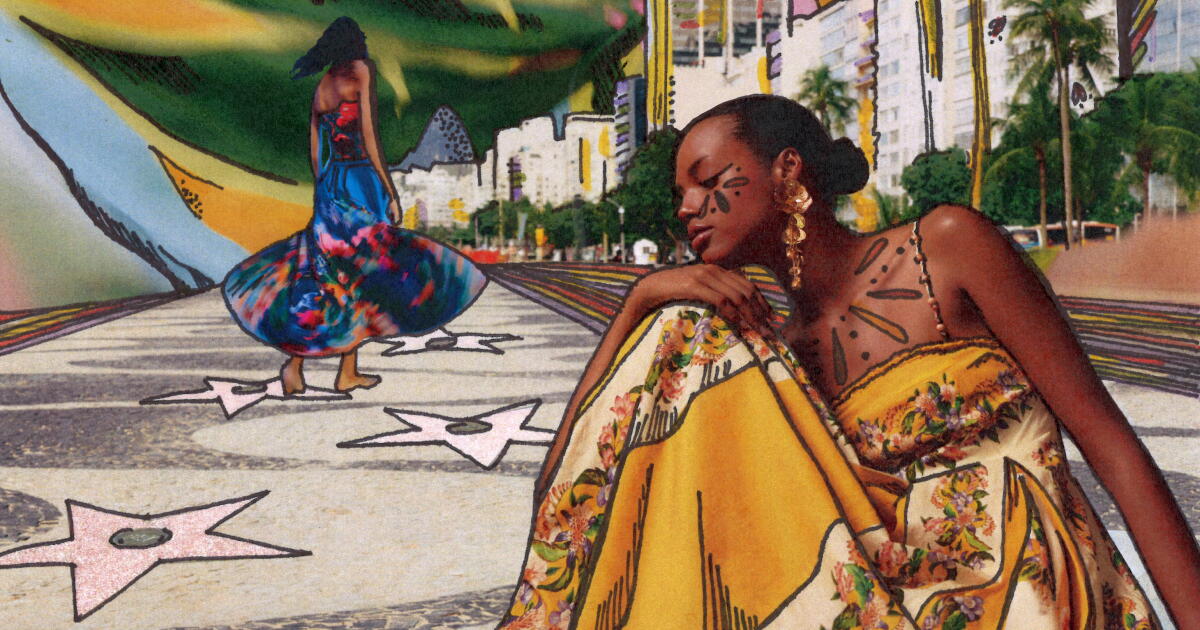
I walked into Farm Rio for the first time, overwhelmed by a sense of kinship and the uncertainty of whether I belonged. There were the audacious, almost violently patterned prints my eyes so longed to see, like a lost limb, ever since I moved from Brazil to suburban Pennsylvania as a girl, and clothing went from colorful to either beige or navy. How pink I turned when the Brazilian attendant asked me if I needed help. I told her in my broken Portuguese that no, thank you, I was just looking. She gave a knowing smile, insisting I try on the skirt I was clutching. My eldest sister (the most Brazilian of us all) gave an approving nod, declaring that it really was “sua cara” — just my type.
When the attendant checked on me in the dressing room, I tried but failed to find the Portuguese to tell her how much I loved that the rainbows, stars and Saturns floated around the pink hibiscus flower and jaguar prowling down the slit of my leg, how all their disparate fantastical bodies were made a cohesive whole by mine’s curvature. Instead, I told her everything was great, fit just right. No words to say that, for the first time, it felt as if a garment had been tailored to sit perfectly on my natural waist, the extra give around the hips letting me fit into the petite that American sizing usually precluded me from. The attendant handed me more pieces she thought I’d look marvelous in — and, porra, she was right. I donned a crop top with every shade of blue, pink, purple and yellow squeezed onto the tiny fabric, completing a look that should’ve been a cacophony of clashing too-muchness, but somehow — in that dressing room wallpapered in tropical motifs, topped with my massive poof of humidity-frizzed curls — transformed into a symphony of boldness that embodied my motherland.
“When you spend a lot of time away from your home country, certain references that seemed natural in childhood cease to be part of your daily life,” Kátia Barros, co-founder of the now globally famous Farm Rio brand, told me over email. “A print, a color, a way of dressing, or a certain body proportion can trigger a memory.” Emotion is integral to how she designs. “Farm doesn’t just want to be beautiful. It wants to evoke a feeling. When you look at a piece, we want there to be a little surprise, a little desire, a little memory, a little zest for life.”
Every purchase from Farm Rio is sprayed with a signature scent. It’s floral, yet not overly sweet. Clean, but with a kick. It’s my sister’s closet when I have nothing to wear but need to look spectacular. It’s my mother’s bathroom as I sit on the toilet seat and watch her getting ready for hours and hours, primping things I didn’t know could be primped. It’s that trademark Brazilian beauty: put together yet effortless, attention-grabbing yet not attention-seeking, sensual rather than sexual.
It sounds silly, imbuing a piece of fabric with all of one’s lost selves. But that space jaguar skirt bestowed upon me a deeper sense of belonging to Brazil than my passport ever did. Even now, on days when nothing else looks right on my ever-fluctuating body, I pull it out of my closet. I adorn myself so loudly in my nationality that the first thing people see isn’t my father’s dominant Swiss genes, but a declaration of my true birthright. No one dares accuse me of “not looking Brazilian” enough (whatever the hell that means).
I feared I had tears in my eyes as I paid at the counter during my first Farm Rio experience. The attendant asked with curiosity where I was from. I told her from here, then nervously recited my script: Born in Salvador, but mostly raised in the USA. Then, as always, I apologized for my gringa Portuguese. No, she said encouragingly. She could tell I was from there.


“That space jaguar skirt bestowed upon me a deeper sense of belonging to Brazil than my passport ever did.”
(Jess Joho)
“Brazil has a very unique ability to blend influences,” Barros explains. “We are the result of many cultures, stories, peoples and languages, and this gives rise to a creativity all our own. But there is a dimension to our culture that goes beyond aesthetics: our openness.”
Much like the country itself, the uniqueness of Farm Rio stems from its capacity to find harmony among contrasts, create unity from difference. Brazil is home to not only the largest African city outside of Africa (Salvador), but also the largest population of Japanese, Lebanese and Italian descendants outside those countries. And unlike other melting pots that demand assimilation, Brazil often assimilates itself to its diasporas, expanding its cultural definitions to include theirs in what it means to be Brazilian. You can hear it in our language, which preserved many indigenous words like “Carioca” (meaning a person from Rio), as well as entire vocabularies from African languages to express our tenderest concepts, like “cafuné” (to run one’s fingers through another’s hair). You can taste it in our food, too, like the popular Brazilian snack called “kibe” that’s really just the Lebanese “kibeh,” and incredible sushi prepared with the same techniques used in Tokyo.
Barros even cites Brazil’s quintessentially warm and inviting nature as the reason Farm’s clothes travel so well. In just 30 years, the brand exploded from a 4×4 meter stand at Rio’s Babilônia Feira Hype into a global fashion powerhouse as iconic as Havaianas, the Brazilian flip-flops that are also now their frequent collaborators. Today, Farm Rio boasts 18 international storefronts across eight countries, including eight in the United States (two in L.A. alone). Yet throughout this expansion into other markets, Barros always emphasized that “adapting doesn’t mean ceasing to be who we are.” So Farm learned to translate its distinct cultural identity into winter collections better suited to the lifestyles of customers who weren’t all beach-going Cariocas. “That’s the most interesting part of internationalization: realizing that Brazilianness can travel without losing its roots, can even take on new meanings,” said Barros.
I think of my Carioca mother who, against all odds, remained unapologetically herself. I think of her hot pink tropical sleeveless top that I wore on Christmas, even as my older sisters scoffed that I’d be embarrassingly out of season. My mother waved the firing squad down. She added a white faux fur vest, and declared me now appropriately dressed for the cold. Looking back on the photos, my sisters were objectively correct. The outfit was hideous, sticking out like a sore thumb amid everyone else’s muted festive wear. But my mother’s lesson transcended the rules of fashion.

“That’s the most interesting part of internationalization: realizing that Brazilianness can travel without losing its roots, can even take on new meanings.”
(LVG / For The Times; Photos from Jess Joho, Farm Rio, Unsplash)
Almost a decade after my first encounter with Farm, I found myself planning a Brazilian wedding to celebrate my marriage to a native Angeleno. My mother had passed away just days after he proposed (he wanted to ensure she could at least be part of the engagement). I mourned not only her person, but another loosening of the roots that grounded me in the land she bore me to. I’d learned a thing or two since my 20s, though. I no longer blushed with shame at my multiplicity, either too American to be Brazilian, or too Brazilian to be wholly American. Instead, I took a page out of Farm’s book: I decided our wedding’s theme would be “Old Hollywood in Brazil” — a marriage of not just my and my fiancé’s heritages, but of the two halves of me I once believed irreconcilably separate. To find the perfect outfits that embodied this enmeshment, I returned to the place where I’d found my first bridge. This time, the Farm Rio on Melrose, where the attendants breathed a sigh of relief after I spoke Portuguese with them without even needing to ask where they were from. I could just tell by the warmth in their smiles: We came from the same place.
Something healed in me over my wedding weekend, watching my gringo groom sweat through his vintage Hollywood tux while learning to dance samba from a passista dressed in her carnival regalia. The next day, for our traditional Feijoada da Ressaca (hangover lunch), I wore a green Farm dress with a palm tree cutout around the waist. It could’ve represented either Brazil or Los Angeles. Or rather, I could represent them both now.
Jess Joho is a Brazilian-American writer based in L.A. whose work ranges from nonfiction to fiction, arts/culture criticism and magical realism.

I walked into Farm Rio for the first time, overwhelmed by a sense of kinship and the uncertainty of whether I belonged. There were the audacious, almost violently patterned prints my eyes so longed to see, like a lost limb, ever since I moved from Brazil to suburban Pennsylvania as a girl, and clothing went from colorful to either beige or navy. How pink I turned when the Brazilian attendant asked me if I needed help. I told her in my broken Portuguese that no, thank you, I was just looking. She gave a knowing smile, insisting I try on the skirt I was clutching. My eldest sister (the most Brazilian of us all) gave an approving nod, declaring that it really was “sua cara” — just my type.
When the attendant checked on me in the dressing room, I tried but failed to find the Portuguese to tell her how much I loved that the rainbows, stars and Saturns floated around the pink hibiscus flower and jaguar prowling down the slit of my leg, how all their disparate fantastical bodies were made a cohesive whole by mine’s curvature. Instead, I told her everything was great, fit just right. No words to say that, for the first time, it felt as if a garment had been tailored to sit perfectly on my natural waist, the extra give around the hips letting me fit into the petite that American sizing usually precluded me from. The attendant handed me more pieces she thought I’d look marvelous in — and, porra, she was right. I donned a crop top with every shade of blue, pink, purple and yellow squeezed onto the tiny fabric, completing a look that should’ve been a cacophony of clashing too-muchness, but somehow — in that dressing room wallpapered in tropical motifs, topped with my massive poof of humidity-frizzed curls — transformed into a symphony of boldness that embodied my motherland.
“When you spend a lot of time away from your home country, certain references that seemed natural in childhood cease to be part of your daily life,” Kátia Barros, co-founder of the now globally famous Farm Rio brand, told me over email. “A print, a color, a way of dressing, or a certain body proportion can trigger a memory.” Emotion is integral to how she designs. “Farm doesn’t just want to be beautiful. It wants to evoke a feeling. When you look at a piece, we want there to be a little surprise, a little desire, a little memory, a little zest for life.”
Every purchase from Farm Rio is sprayed with a signature scent. It’s floral, yet not overly sweet. Clean, but with a kick. It’s my sister’s closet when I have nothing to wear but need to look spectacular. It’s my mother’s bathroom as I sit on the toilet seat and watch her getting ready for hours and hours, primping things I didn’t know could be primped. It’s that trademark Brazilian beauty: put together yet effortless, attention-grabbing yet not attention-seeking, sensual rather than sexual.
It sounds silly, imbuing a piece of fabric with all of one’s lost selves. But that space jaguar skirt bestowed upon me a deeper sense of belonging to Brazil than my passport ever did. Even now, on days when nothing else looks right on my ever-fluctuating body, I pull it out of my closet. I adorn myself so loudly in my nationality that the first thing people see isn’t my father’s dominant Swiss genes, but a declaration of my true birthright. No one dares accuse me of “not looking Brazilian” enough (whatever the hell that means).
I feared I had tears in my eyes as I paid at the counter during my first Farm Rio experience. The attendant asked with curiosity where I was from. I told her from here, then nervously recited my script: Born in Salvador, but mostly raised in the USA. Then, as always, I apologized for my gringa Portuguese. No, she said encouragingly. She could tell I was from there.
“That space jaguar skirt bestowed upon me a deeper sense of belonging to Brazil than my passport ever did.”
(Jess Joho)
“Brazil has a very unique ability to blend influences,” Barros explains. “We are the result of many cultures, stories, peoples and languages, and this gives rise to a creativity all our own. But there is a dimension to our culture that goes beyond aesthetics: our openness.”
Much like the country itself, the uniqueness of Farm Rio stems from its capacity to find harmony among contrasts, create unity from difference. Brazil is home to not only the largest African city outside of Africa (Salvador), but also the largest population of Japanese, Lebanese and Italian descendants outside those countries. And unlike other melting pots that demand assimilation, Brazil often assimilates itself to its diasporas, expanding its cultural definitions to include theirs in what it means to be Brazilian. You can hear it in our language, which preserved many indigenous words like “Carioca” (meaning a person from Rio), as well as entire vocabularies from African languages to express our tenderest concepts, like “cafuné” (to run one’s fingers through another’s hair). You can taste it in our food, too, like the popular Brazilian snack called “kibe” that’s really just the Lebanese “kibeh,” and incredible sushi prepared with the same techniques used in Tokyo.
Barros even cites Brazil’s quintessentially warm and inviting nature as the reason Farm’s clothes travel so well. In just 30 years, the brand exploded from a 4×4 meter stand at Rio’s Babilônia Feira Hype into a global fashion powerhouse as iconic as Havaianas, the Brazilian flip-flops that are also now their frequent collaborators. Today, Farm Rio boasts 18 international storefronts across eight countries, including eight in the United States (two in L.A. alone). Yet throughout this expansion into other markets, Barros always emphasized that “adapting doesn’t mean ceasing to be who we are.” So Farm learned to translate its distinct cultural identity into winter collections better suited to the lifestyles of customers who weren’t all beach-going Cariocas. “That’s the most interesting part of internationalization: realizing that Brazilianness can travel without losing its roots, can even take on new meanings,” said Barros.
I think of my Carioca mother who, against all odds, remained unapologetically herself. I think of her hot pink tropical sleeveless top that I wore on Christmas, even as my older sisters scoffed that I’d be embarrassingly out of season. My mother waved the firing squad down. She added a white faux fur vest, and declared me now appropriately dressed for the cold. Looking back on the photos, my sisters were objectively correct. The outfit was hideous, sticking out like a sore thumb amid everyone else’s muted festive wear. But my mother’s lesson transcended the rules of fashion.
“That’s the most interesting part of internationalization: realizing that Brazilianness can travel without losing its roots, can even take on new meanings.”
(LVG / For The Times; Photos from Jess Joho, Farm Rio, Unsplash)
Almost a decade after my first encounter with Farm, I found myself planning a Brazilian wedding to celebrate my marriage to a native Angeleno. My mother had passed away just days after he proposed (he wanted to ensure she could at least be part of the engagement). I mourned not only her person, but another loosening of the roots that grounded me in the land she bore me to. I’d learned a thing or two since my 20s, though. I no longer blushed with shame at my multiplicity, either too American to be Brazilian, or too Brazilian to be wholly American. Instead, I took a page out of Farm’s book: I decided our wedding’s theme would be “Old Hollywood in Brazil” — a marriage of not just my and my fiancé’s heritages, but of the two halves of me I once believed irreconcilably separate. To find the perfect outfits that embodied this enmeshment, I returned to the place where I’d found my first bridge. This time, the Farm Rio on Melrose, where the attendants breathed a sigh of relief after I spoke Portuguese with them without even needing to ask where they were from. I could just tell by the warmth in their smiles: We came from the same place.
Something healed in me over my wedding weekend, watching my gringo groom sweat through his vintage Hollywood tux while learning to dance samba from a passista dressed in her carnival regalia. The next day, for our traditional Feijoada da Ressaca (hangover lunch), I wore a green Farm dress with a palm tree cutout around the waist. It could’ve represented either Brazil or Los Angeles. Or rather, I could represent them both now.
Jess Joho is a Brazilian-American writer based in L.A. whose work ranges from nonfiction to fiction, arts/culture criticism and magical realism.

I walked into Farm Rio for the first time, overwhelmed by a sense of kinship and the uncertainty of whether I belonged. There were the audacious, almost violently patterned prints my eyes so longed to see, like a lost limb, ever since I moved from Brazil to suburban Pennsylvania as a girl, and clothing went from colorful to either beige or navy. How pink I turned when the Brazilian attendant asked me if I needed help. I told her in my broken Portuguese that no, thank you, I was just looking. She gave a knowing smile, insisting I try on the skirt I was clutching. My eldest sister (the most Brazilian of us all) gave an approving nod, declaring that it really was “sua cara” — just my type.
When the attendant checked on me in the dressing room, I tried but failed to find the Portuguese to tell her how much I loved that the rainbows, stars and Saturns floated around the pink hibiscus flower and jaguar prowling down the slit of my leg, how all their disparate fantastical bodies were made a cohesive whole by mine’s curvature. Instead, I told her everything was great, fit just right. No words to say that, for the first time, it felt as if a garment had been tailored to sit perfectly on my natural waist, the extra give around the hips letting me fit into the petite that American sizing usually precluded me from. The attendant handed me more pieces she thought I’d look marvelous in — and, porra, she was right. I donned a crop top with every shade of blue, pink, purple and yellow squeezed onto the tiny fabric, completing a look that should’ve been a cacophony of clashing too-muchness, but somehow — in that dressing room wallpapered in tropical motifs, topped with my massive poof of humidity-frizzed curls — transformed into a symphony of boldness that embodied my motherland.
“When you spend a lot of time away from your home country, certain references that seemed natural in childhood cease to be part of your daily life,” Kátia Barros, co-founder of the now globally famous Farm Rio brand, told me over email. “A print, a color, a way of dressing, or a certain body proportion can trigger a memory.” Emotion is integral to how she designs. “Farm doesn’t just want to be beautiful. It wants to evoke a feeling. When you look at a piece, we want there to be a little surprise, a little desire, a little memory, a little zest for life.”
Every purchase from Farm Rio is sprayed with a signature scent. It’s floral, yet not overly sweet. Clean, but with a kick. It’s my sister’s closet when I have nothing to wear but need to look spectacular. It’s my mother’s bathroom as I sit on the toilet seat and watch her getting ready for hours and hours, primping things I didn’t know could be primped. It’s that trademark Brazilian beauty: put together yet effortless, attention-grabbing yet not attention-seeking, sensual rather than sexual.
It sounds silly, imbuing a piece of fabric with all of one’s lost selves. But that space jaguar skirt bestowed upon me a deeper sense of belonging to Brazil than my passport ever did. Even now, on days when nothing else looks right on my ever-fluctuating body, I pull it out of my closet. I adorn myself so loudly in my nationality that the first thing people see isn’t my father’s dominant Swiss genes, but a declaration of my true birthright. No one dares accuse me of “not looking Brazilian” enough (whatever the hell that means).
I feared I had tears in my eyes as I paid at the counter during my first Farm Rio experience. The attendant asked with curiosity where I was from. I told her from here, then nervously recited my script: Born in Salvador, but mostly raised in the USA. Then, as always, I apologized for my gringa Portuguese. No, she said encouragingly. She could tell I was from there.
“That space jaguar skirt bestowed upon me a deeper sense of belonging to Brazil than my passport ever did.”
(Jess Joho)
“Brazil has a very unique ability to blend influences,” Barros explains. “We are the result of many cultures, stories, peoples and languages, and this gives rise to a creativity all our own. But there is a dimension to our culture that goes beyond aesthetics: our openness.”
Much like the country itself, the uniqueness of Farm Rio stems from its capacity to find harmony among contrasts, create unity from difference. Brazil is home to not only the largest African city outside of Africa (Salvador), but also the largest population of Japanese, Lebanese and Italian descendants outside those countries. And unlike other melting pots that demand assimilation, Brazil often assimilates itself to its diasporas, expanding its cultural definitions to include theirs in what it means to be Brazilian. You can hear it in our language, which preserved many indigenous words like “Carioca” (meaning a person from Rio), as well as entire vocabularies from African languages to express our tenderest concepts, like “cafuné” (to run one’s fingers through another’s hair). You can taste it in our food, too, like the popular Brazilian snack called “kibe” that’s really just the Lebanese “kibeh,” and incredible sushi prepared with the same techniques used in Tokyo.
Barros even cites Brazil’s quintessentially warm and inviting nature as the reason Farm’s clothes travel so well. In just 30 years, the brand exploded from a 4×4 meter stand at Rio’s Babilônia Feira Hype into a global fashion powerhouse as iconic as Havaianas, the Brazilian flip-flops that are also now their frequent collaborators. Today, Farm Rio boasts 18 international storefronts across eight countries, including eight in the United States (two in L.A. alone). Yet throughout this expansion into other markets, Barros always emphasized that “adapting doesn’t mean ceasing to be who we are.” So Farm learned to translate its distinct cultural identity into winter collections better suited to the lifestyles of customers who weren’t all beach-going Cariocas. “That’s the most interesting part of internationalization: realizing that Brazilianness can travel without losing its roots, can even take on new meanings,” said Barros.
I think of my Carioca mother who, against all odds, remained unapologetically herself. I think of her hot pink tropical sleeveless top that I wore on Christmas, even as my older sisters scoffed that I’d be embarrassingly out of season. My mother waved the firing squad down. She added a white faux fur vest, and declared me now appropriately dressed for the cold. Looking back on the photos, my sisters were objectively correct. The outfit was hideous, sticking out like a sore thumb amid everyone else’s muted festive wear. But my mother’s lesson transcended the rules of fashion.
“That’s the most interesting part of internationalization: realizing that Brazilianness can travel without losing its roots, can even take on new meanings.”
(LVG / For The Times; Photos from Jess Joho, Farm Rio, Unsplash)
Almost a decade after my first encounter with Farm, I found myself planning a Brazilian wedding to celebrate my marriage to a native Angeleno. My mother had passed away just days after he proposed (he wanted to ensure she could at least be part of the engagement). I mourned not only her person, but another loosening of the roots that grounded me in the land she bore me to. I’d learned a thing or two since my 20s, though. I no longer blushed with shame at my multiplicity, either too American to be Brazilian, or too Brazilian to be wholly American. Instead, I took a page out of Farm’s book: I decided our wedding’s theme would be “Old Hollywood in Brazil” — a marriage of not just my and my fiancé’s heritages, but of the two halves of me I once believed irreconcilably separate. To find the perfect outfits that embodied this enmeshment, I returned to the place where I’d found my first bridge. This time, the Farm Rio on Melrose, where the attendants breathed a sigh of relief after I spoke Portuguese with them without even needing to ask where they were from. I could just tell by the warmth in their smiles: We came from the same place.
Something healed in me over my wedding weekend, watching my gringo groom sweat through his vintage Hollywood tux while learning to dance samba from a passista dressed in her carnival regalia. The next day, for our traditional Feijoada da Ressaca (hangover lunch), I wore a green Farm dress with a palm tree cutout around the waist. It could’ve represented either Brazil or Los Angeles. Or rather, I could represent them both now.
Jess Joho is a Brazilian-American writer based in L.A. whose work ranges from nonfiction to fiction, arts/culture criticism and magical realism.

I walked into Farm Rio for the first time, overwhelmed by a sense of kinship and the uncertainty of whether I belonged. There were the audacious, almost violently patterned prints my eyes so longed to see, like a lost limb, ever since I moved from Brazil to suburban Pennsylvania as a girl, and clothing went from colorful to either beige or navy. How pink I turned when the Brazilian attendant asked me if I needed help. I told her in my broken Portuguese that no, thank you, I was just looking. She gave a knowing smile, insisting I try on the skirt I was clutching. My eldest sister (the most Brazilian of us all) gave an approving nod, declaring that it really was “sua cara” — just my type.
When the attendant checked on me in the dressing room, I tried but failed to find the Portuguese to tell her how much I loved that the rainbows, stars and Saturns floated around the pink hibiscus flower and jaguar prowling down the slit of my leg, how all their disparate fantastical bodies were made a cohesive whole by mine’s curvature. Instead, I told her everything was great, fit just right. No words to say that, for the first time, it felt as if a garment had been tailored to sit perfectly on my natural waist, the extra give around the hips letting me fit into the petite that American sizing usually precluded me from. The attendant handed me more pieces she thought I’d look marvelous in — and, porra, she was right. I donned a crop top with every shade of blue, pink, purple and yellow squeezed onto the tiny fabric, completing a look that should’ve been a cacophony of clashing too-muchness, but somehow — in that dressing room wallpapered in tropical motifs, topped with my massive poof of humidity-frizzed curls — transformed into a symphony of boldness that embodied my motherland.
“When you spend a lot of time away from your home country, certain references that seemed natural in childhood cease to be part of your daily life,” Kátia Barros, co-founder of the now globally famous Farm Rio brand, told me over email. “A print, a color, a way of dressing, or a certain body proportion can trigger a memory.” Emotion is integral to how she designs. “Farm doesn’t just want to be beautiful. It wants to evoke a feeling. When you look at a piece, we want there to be a little surprise, a little desire, a little memory, a little zest for life.”
Every purchase from Farm Rio is sprayed with a signature scent. It’s floral, yet not overly sweet. Clean, but with a kick. It’s my sister’s closet when I have nothing to wear but need to look spectacular. It’s my mother’s bathroom as I sit on the toilet seat and watch her getting ready for hours and hours, primping things I didn’t know could be primped. It’s that trademark Brazilian beauty: put together yet effortless, attention-grabbing yet not attention-seeking, sensual rather than sexual.
It sounds silly, imbuing a piece of fabric with all of one’s lost selves. But that space jaguar skirt bestowed upon me a deeper sense of belonging to Brazil than my passport ever did. Even now, on days when nothing else looks right on my ever-fluctuating body, I pull it out of my closet. I adorn myself so loudly in my nationality that the first thing people see isn’t my father’s dominant Swiss genes, but a declaration of my true birthright. No one dares accuse me of “not looking Brazilian” enough (whatever the hell that means).
I feared I had tears in my eyes as I paid at the counter during my first Farm Rio experience. The attendant asked with curiosity where I was from. I told her from here, then nervously recited my script: Born in Salvador, but mostly raised in the USA. Then, as always, I apologized for my gringa Portuguese. No, she said encouragingly. She could tell I was from there.
“That space jaguar skirt bestowed upon me a deeper sense of belonging to Brazil than my passport ever did.”
(Jess Joho)
“Brazil has a very unique ability to blend influences,” Barros explains. “We are the result of many cultures, stories, peoples and languages, and this gives rise to a creativity all our own. But there is a dimension to our culture that goes beyond aesthetics: our openness.”
Much like the country itself, the uniqueness of Farm Rio stems from its capacity to find harmony among contrasts, create unity from difference. Brazil is home to not only the largest African city outside of Africa (Salvador), but also the largest population of Japanese, Lebanese and Italian descendants outside those countries. And unlike other melting pots that demand assimilation, Brazil often assimilates itself to its diasporas, expanding its cultural definitions to include theirs in what it means to be Brazilian. You can hear it in our language, which preserved many indigenous words like “Carioca” (meaning a person from Rio), as well as entire vocabularies from African languages to express our tenderest concepts, like “cafuné” (to run one’s fingers through another’s hair). You can taste it in our food, too, like the popular Brazilian snack called “kibe” that’s really just the Lebanese “kibeh,” and incredible sushi prepared with the same techniques used in Tokyo.
Barros even cites Brazil’s quintessentially warm and inviting nature as the reason Farm’s clothes travel so well. In just 30 years, the brand exploded from a 4×4 meter stand at Rio’s Babilônia Feira Hype into a global fashion powerhouse as iconic as Havaianas, the Brazilian flip-flops that are also now their frequent collaborators. Today, Farm Rio boasts 18 international storefronts across eight countries, including eight in the United States (two in L.A. alone). Yet throughout this expansion into other markets, Barros always emphasized that “adapting doesn’t mean ceasing to be who we are.” So Farm learned to translate its distinct cultural identity into winter collections better suited to the lifestyles of customers who weren’t all beach-going Cariocas. “That’s the most interesting part of internationalization: realizing that Brazilianness can travel without losing its roots, can even take on new meanings,” said Barros.
I think of my Carioca mother who, against all odds, remained unapologetically herself. I think of her hot pink tropical sleeveless top that I wore on Christmas, even as my older sisters scoffed that I’d be embarrassingly out of season. My mother waved the firing squad down. She added a white faux fur vest, and declared me now appropriately dressed for the cold. Looking back on the photos, my sisters were objectively correct. The outfit was hideous, sticking out like a sore thumb amid everyone else’s muted festive wear. But my mother’s lesson transcended the rules of fashion.
“That’s the most interesting part of internationalization: realizing that Brazilianness can travel without losing its roots, can even take on new meanings.”
(LVG / For The Times; Photos from Jess Joho, Farm Rio, Unsplash)
Almost a decade after my first encounter with Farm, I found myself planning a Brazilian wedding to celebrate my marriage to a native Angeleno. My mother had passed away just days after he proposed (he wanted to ensure she could at least be part of the engagement). I mourned not only her person, but another loosening of the roots that grounded me in the land she bore me to. I’d learned a thing or two since my 20s, though. I no longer blushed with shame at my multiplicity, either too American to be Brazilian, or too Brazilian to be wholly American. Instead, I took a page out of Farm’s book: I decided our wedding’s theme would be “Old Hollywood in Brazil” — a marriage of not just my and my fiancé’s heritages, but of the two halves of me I once believed irreconcilably separate. To find the perfect outfits that embodied this enmeshment, I returned to the place where I’d found my first bridge. This time, the Farm Rio on Melrose, where the attendants breathed a sigh of relief after I spoke Portuguese with them without even needing to ask where they were from. I could just tell by the warmth in their smiles: We came from the same place.
Something healed in me over my wedding weekend, watching my gringo groom sweat through his vintage Hollywood tux while learning to dance samba from a passista dressed in her carnival regalia. The next day, for our traditional Feijoada da Ressaca (hangover lunch), I wore a green Farm dress with a palm tree cutout around the waist. It could’ve represented either Brazil or Los Angeles. Or rather, I could represent them both now.
Jess Joho is a Brazilian-American writer based in L.A. whose work ranges from nonfiction to fiction, arts/culture criticism and magical realism.

I walked into Farm Rio for the first time, overwhelmed by a sense of kinship and the uncertainty of whether I belonged. There were the audacious, almost violently patterned prints my eyes so longed to see, like a lost limb, ever since I moved from Brazil to suburban Pennsylvania as a girl, and clothing went from colorful to either beige or navy. How pink I turned when the Brazilian attendant asked me if I needed help. I told her in my broken Portuguese that no, thank you, I was just looking. She gave a knowing smile, insisting I try on the skirt I was clutching. My eldest sister (the most Brazilian of us all) gave an approving nod, declaring that it really was “sua cara” — just my type.
When the attendant checked on me in the dressing room, I tried but failed to find the Portuguese to tell her how much I loved that the rainbows, stars and Saturns floated around the pink hibiscus flower and jaguar prowling down the slit of my leg, how all their disparate fantastical bodies were made a cohesive whole by mine’s curvature. Instead, I told her everything was great, fit just right. No words to say that, for the first time, it felt as if a garment had been tailored to sit perfectly on my natural waist, the extra give around the hips letting me fit into the petite that American sizing usually precluded me from. The attendant handed me more pieces she thought I’d look marvelous in — and, porra, she was right. I donned a crop top with every shade of blue, pink, purple and yellow squeezed onto the tiny fabric, completing a look that should’ve been a cacophony of clashing too-muchness, but somehow — in that dressing room wallpapered in tropical motifs, topped with my massive poof of humidity-frizzed curls — transformed into a symphony of boldness that embodied my motherland.
“When you spend a lot of time away from your home country, certain references that seemed natural in childhood cease to be part of your daily life,” Kátia Barros, co-founder of the now globally famous Farm Rio brand, told me over email. “A print, a color, a way of dressing, or a certain body proportion can trigger a memory.” Emotion is integral to how she designs. “Farm doesn’t just want to be beautiful. It wants to evoke a feeling. When you look at a piece, we want there to be a little surprise, a little desire, a little memory, a little zest for life.”
Every purchase from Farm Rio is sprayed with a signature scent. It’s floral, yet not overly sweet. Clean, but with a kick. It’s my sister’s closet when I have nothing to wear but need to look spectacular. It’s my mother’s bathroom as I sit on the toilet seat and watch her getting ready for hours and hours, primping things I didn’t know could be primped. It’s that trademark Brazilian beauty: put together yet effortless, attention-grabbing yet not attention-seeking, sensual rather than sexual.
It sounds silly, imbuing a piece of fabric with all of one’s lost selves. But that space jaguar skirt bestowed upon me a deeper sense of belonging to Brazil than my passport ever did. Even now, on days when nothing else looks right on my ever-fluctuating body, I pull it out of my closet. I adorn myself so loudly in my nationality that the first thing people see isn’t my father’s dominant Swiss genes, but a declaration of my true birthright. No one dares accuse me of “not looking Brazilian” enough (whatever the hell that means).
I feared I had tears in my eyes as I paid at the counter during my first Farm Rio experience. The attendant asked with curiosity where I was from. I told her from here, then nervously recited my script: Born in Salvador, but mostly raised in the USA. Then, as always, I apologized for my gringa Portuguese. No, she said encouragingly. She could tell I was from there.
“That space jaguar skirt bestowed upon me a deeper sense of belonging to Brazil than my passport ever did.”
(Jess Joho)
“Brazil has a very unique ability to blend influences,” Barros explains. “We are the result of many cultures, stories, peoples and languages, and this gives rise to a creativity all our own. But there is a dimension to our culture that goes beyond aesthetics: our openness.”
Much like the country itself, the uniqueness of Farm Rio stems from its capacity to find harmony among contrasts, create unity from difference. Brazil is home to not only the largest African city outside of Africa (Salvador), but also the largest population of Japanese, Lebanese and Italian descendants outside those countries. And unlike other melting pots that demand assimilation, Brazil often assimilates itself to its diasporas, expanding its cultural definitions to include theirs in what it means to be Brazilian. You can hear it in our language, which preserved many indigenous words like “Carioca” (meaning a person from Rio), as well as entire vocabularies from African languages to express our tenderest concepts, like “cafuné” (to run one’s fingers through another’s hair). You can taste it in our food, too, like the popular Brazilian snack called “kibe” that’s really just the Lebanese “kibeh,” and incredible sushi prepared with the same techniques used in Tokyo.
Barros even cites Brazil’s quintessentially warm and inviting nature as the reason Farm’s clothes travel so well. In just 30 years, the brand exploded from a 4×4 meter stand at Rio’s Babilônia Feira Hype into a global fashion powerhouse as iconic as Havaianas, the Brazilian flip-flops that are also now their frequent collaborators. Today, Farm Rio boasts 18 international storefronts across eight countries, including eight in the United States (two in L.A. alone). Yet throughout this expansion into other markets, Barros always emphasized that “adapting doesn’t mean ceasing to be who we are.” So Farm learned to translate its distinct cultural identity into winter collections better suited to the lifestyles of customers who weren’t all beach-going Cariocas. “That’s the most interesting part of internationalization: realizing that Brazilianness can travel without losing its roots, can even take on new meanings,” said Barros.
I think of my Carioca mother who, against all odds, remained unapologetically herself. I think of her hot pink tropical sleeveless top that I wore on Christmas, even as my older sisters scoffed that I’d be embarrassingly out of season. My mother waved the firing squad down. She added a white faux fur vest, and declared me now appropriately dressed for the cold. Looking back on the photos, my sisters were objectively correct. The outfit was hideous, sticking out like a sore thumb amid everyone else’s muted festive wear. But my mother’s lesson transcended the rules of fashion.
“That’s the most interesting part of internationalization: realizing that Brazilianness can travel without losing its roots, can even take on new meanings.”
(LVG / For The Times; Photos from Jess Joho, Farm Rio, Unsplash)
Almost a decade after my first encounter with Farm, I found myself planning a Brazilian wedding to celebrate my marriage to a native Angeleno. My mother had passed away just days after he proposed (he wanted to ensure she could at least be part of the engagement). I mourned not only her person, but another loosening of the roots that grounded me in the land she bore me to. I’d learned a thing or two since my 20s, though. I no longer blushed with shame at my multiplicity, either too American to be Brazilian, or too Brazilian to be wholly American. Instead, I took a page out of Farm’s book: I decided our wedding’s theme would be “Old Hollywood in Brazil” — a marriage of not just my and my fiancé’s heritages, but of the two halves of me I once believed irreconcilably separate. To find the perfect outfits that embodied this enmeshment, I returned to the place where I’d found my first bridge. This time, the Farm Rio on Melrose, where the attendants breathed a sigh of relief after I spoke Portuguese with them without even needing to ask where they were from. I could just tell by the warmth in their smiles: We came from the same place.
Something healed in me over my wedding weekend, watching my gringo groom sweat through his vintage Hollywood tux while learning to dance samba from a passista dressed in her carnival regalia. The next day, for our traditional Feijoada da Ressaca (hangover lunch), I wore a green Farm dress with a palm tree cutout around the waist. It could’ve represented either Brazil or Los Angeles. Or rather, I could represent them both now.
Jess Joho is a Brazilian-American writer based in L.A. whose work ranges from nonfiction to fiction, arts/culture criticism and magical realism.

