

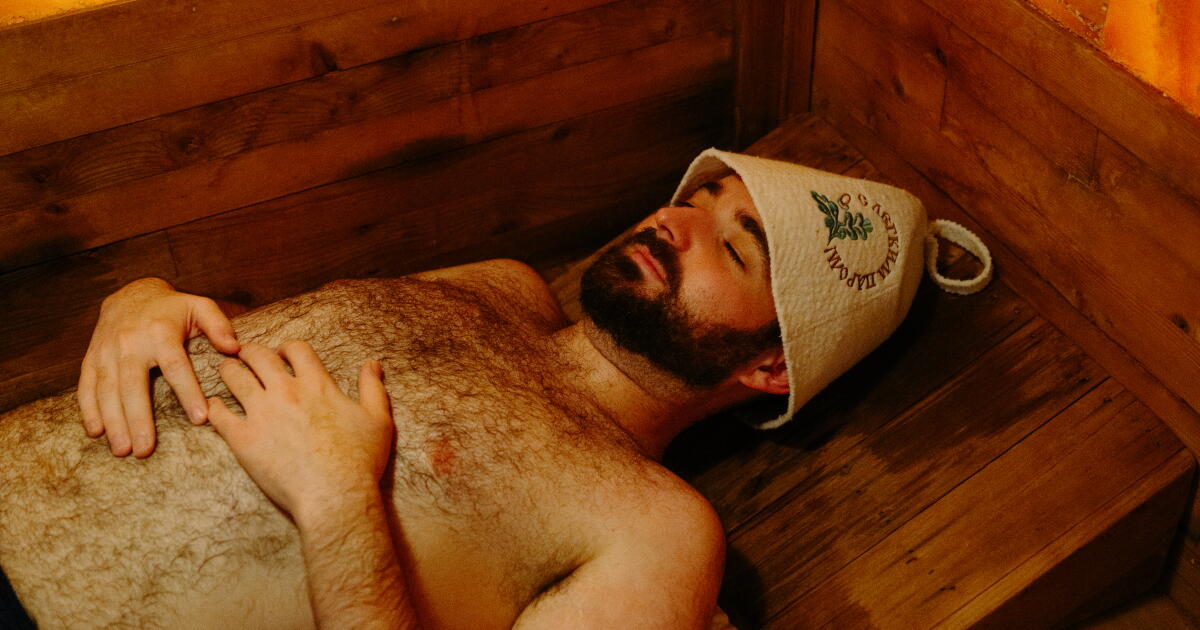
An old piece of Russian bathhouse wisdom: There’s no better place to tell a secret than a banya. It’s one of the few places you can be sure no one is wearing a wire. “There’s this mafia culture around the baths because you can’t get wiretapped in banyas,” says Leah Feygin, who runs Fluid Form, a Substack about Eastern European bathhouse culture.
City Spa in Los Angeles. The Russian bathhouse has been in operation since 1955.
While Korean spas dominate Los Angeles’ bathhouse scene, Russian banyas have their own, quieter history in the city. For decades, immigrant-frequented spots like Voda in West Hollywood and City Spa on Pico Boulevard have served as gathering places for Eastern European communities. Now, that tradition is beginning to reach beyond those communities, thanks to social media. In the next couple of years, New York City sensation Bathhouse is slated to open a massive flagship on Sunset Boulevard, where Amoeba Records once stood.

At City Spa on Pico Boulevard, that history stretches back to 1955, when it began as a social club for Eastern Europeans who migrated to Pico Boulevard. For more than seven decades, the Pico Boulevard bathhouse has been a gathering place for immigrants and, over the years, a destination for celebrities including John Belushi, Kobe Bryant and Joe DiMaggio. In fact, after Marilyn Monroe’s death in 1962, DiMaggio reportedly visited the spa every day to grieve.

That’s not the spa’s only Hollywood lore. In a 1996 L.A. Times article, a writer described the City Spa as an unexpected Hollywood power-player hot spot, frequented by Jeremy Piven, John Travolta and deal-hungry agents gathered around a TV in togas. Rolling Stones icons Mick Jagger and Keith Richards visited before a concert a decade prior, and in 2004, rapper Shifty Shellshock described it to The Times as feeling “like where the Sopranos would go.” (And sure, depending on whom you ask, the spa was once rumored to be a Russian mob haunt in the 1950s and 1960s.)

Beyond the glitz and glamour, Daniel Besharat, whose family owns City Spa, says the bathhouse has always been home to a wide range of immigrants. “It’s just always a place where Eastern European immigrants have just kind of come and hung out with each other, but also because banya is part of their culture.”
That Eastern European diaspora at City Spa encompasses Ukrainians, Uzbeks, Kazakhs, Chechens, Armenians and others. Many speak Russian, but also maintain their own native languages and traditions — dishing out their best gossip in the saunas while a Lakers game buzzes in the background. “They are Russian-speaking, but they also have their own native languages too. This is the only place that they have that’s like a community center,” Besharat says.

Irina Ivanova, left, and Olga Gurskaya cool off in the pool at City Spa.

Anri Torosyan, left, and Emil Petrosyan relax in the steam room at City Spa.
At City Spa, the clientele spans generations and professions. “You have people bringing their kids, and then you have their grandparents coming, and then all ages in between,” says Besharat. Recently, the spa’s oldest client died at age 106. Another regular, now in his 90s, has been visiting since the 1950s.
Beyond that, the spa champions a culture of discretion that attracts celebrities and civilians alike. No phones are allowed inside, offering guests a rare reprieve from the intrusiveness of social media — and, for celebrities, the constant possibility of fan selfies, paparazzi or a DeuxMoi post. “These old Russian guys don’t know who they are. They can completely be by themselves,” says Besharat of the movie-star clientele.
The spa is also a favorite among UFC fighters, who are celebrated as heroes in many Eastern European countries, Besharat explains. “The UFC fighters — they appreciate their fans because it’s their local communities. Imagine you’re a Kazakh guy growing up in a rural village, and then you see a prizefighter sitting next to you in the sauna,” says Besharat.
Inside the spa, which costs $85 to enter, visitors will find saunas as hot as 220 degrees, cold-plunge pools, steam rooms and banya treatments that whisk naked bodies with oak leaves and essential oils. The sauna increases blood flow and circulation, helping sore joints recover faster. For meals, the spa has two chefs — one Armenian, another Uzbek — who prepare fresh Mediterranean dishes, as well as Eastern European classics. The menu includes chicken kebabs, fish branzino, pierogies and borscht. It’s worth noting that Russian bathhouses are generally a higher price point than L.A.’s Korean spas across admission, treatments and dining.
Modern wellness meets Old World traditions
In West Hollywood, home to the largest Russian-speaking enclave outside New York City, Voda Spa has served the community since 2007. Unlike City Spa, which offers co-ed hours on Mondays, Wednesdays and Saturdays, Voda is co-ed every day.

Voda Spa pairs traditional Russian bathhouse rituals with a contemporary approach. The sleek facility, which has a $110 admission fee for nonmembers, offers a sauna, pool, body scrubs and hot-and-cold therapy — all staples of the Russian banya experience plus a smoothie bar. It marries state-of-the-art technology with Old World wisdom, offering facials and poolside green tea masks.
In classic Russian fashion, they add beer to one of the saunas to soften the air. In another dry sauna, they heat boulders overnight so they emit heat continuously. “It’s built with all cedar; it targets our muscles and our joints differently than a wet sauna,” says Voda spa director Heather Warren.


1. Hanging guest towels and banya hats. 2. Men’s spa slippers. 3. The City Spa salt rock room.
Beyond bachelorette parties, social gatherings and couples looking to decompress, Voda remains a destination for Eastern Europeans in the Los Angeles area. “We have been steady with a lot of the same clients since 2007. These people drive in from Glendale, Burbank and the Valley,” says Warren. Some clients stay for a few hours, while others make a day of it as the spa closes at 11 p.m.
As much as the spa functions as a social club, Voda balances that with a space for deep relaxation. “It’s really neat watching everyone coexist together. Everybody is very respectful,” says Warren.

Adam Karelin-Anderson, left, and Andrew Oropeza order refreshments at the spa’s restaurant.
Voda also offers one of the banya’s most distinctive traditional treatments: venik, in which bundles of leafy branches gently stimulate the body in the sauna. “One of our traditional Russian treatments is the venik treatment with the oak leaves,” says Warren. At Voda, they import the oak branches from Ukraine to represent the culture. “It looks like we’re smacking them, but we’re really not hitting them with any force. It’s more about making contact because you want the oils from the leaves and the heat from the sauna to go into your body, and it stimulates capillaries,” says Warren.

Like City Spa, the menu also offers Eastern European crowd-pleasers made in-house from borscht to cream of mushroom soup.
Bathhouse culture as the great equalizer
In November, Feygin plans to host an event at the Wende Museum in Culver City, inviting other first-generation Eastern Europeans to share essays and poetry about their connections to bathing culture. The event complements her Substack which she describes as being “about bathing culture, but specifically through the lens of immigrant communities, LGBTQ communities, and then also these sort of New Age communities.”
Feygin’s mother grew up in Belarus, where she built a makeshift bathhouse from a tarp and generated steam with a woodstove. “According to my dad, times were kind of dark. There was no religion, so people weren’t gathering on a weekly basis,” she says. In the Soviet Union, bathhouse culture became a church-like experience, she says. “It’s for people to get clean, but they would have beer, and it was a place for people to hang out and have fun.”


1. Irina Ivanova cools off in the pool after using the steam room. 2. Irina Ivanova uses two sauna whisks made of branches to spread hot steam on Olga Gurskaya in the steam room at City Spa.
Bathhouses can also double as erotic spaces, she notes, particularly for gay men — a history Feygin says stretches back centuries. “Historically, it was an erotic place for pickups and cruising, but even in the Roman Empire, I see it as this pleasure house, more so for men.” (It’s worth noting actor Bette Midler began her cabaret career by performing in a gay bathhouse in the 1970s.)
Feygin adds that the bathhouse’s role as a gathering place also has roots in Yiddish tradition. “There is this notion called the ‘schvitz,’ which in Yiddish means to sweat,” she says. In the Soviet Union, she explains, Jewish people often had fewer opportunities to gather communally in religious spaces. The banya, in turn, became a place to meet, socialize and maintain a sense of community outside the synagogue.
Strangely, the spa experience also carries a kind of Soviet nostalgia — one in which everyone is stripped of material status. “Banyas are the great equalizers. You can’t tell between upper class, middle class or lower class. Everyone’s naked or wearing togas,” she explains. “So it ends up being this space where everyone feels the same.”

