

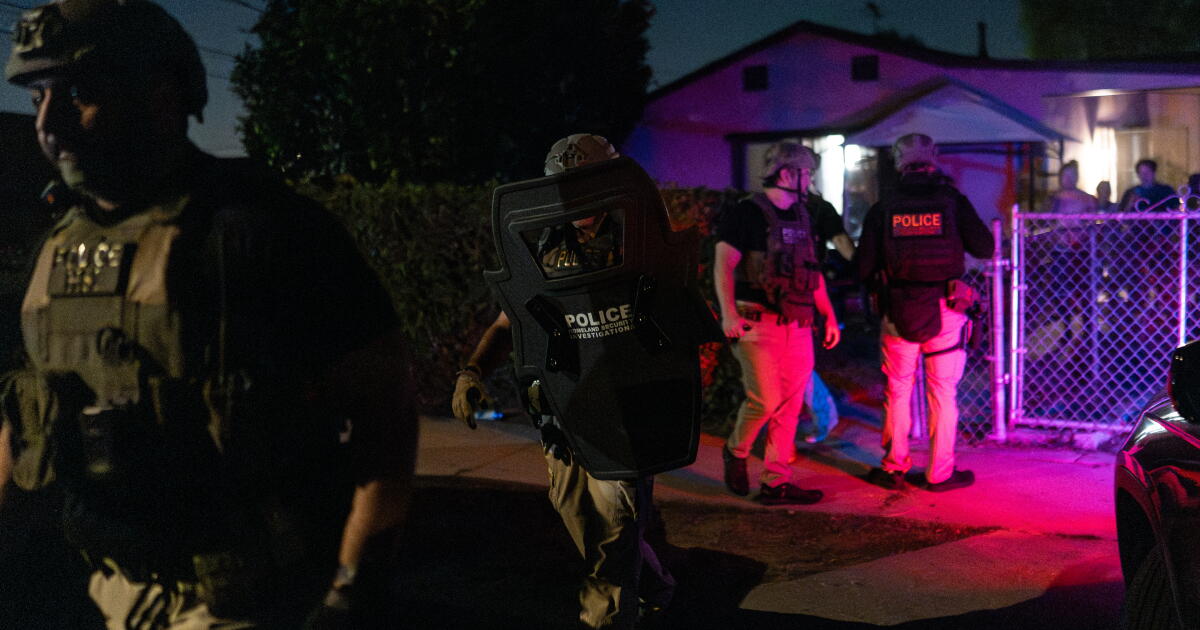

At the federal courthouse in downtown Los Angeles late Monday, several green card holders arrested in a crackdown on alleged California voter fraud expressed confusion over the charges — with some saying they had no recollection of registering to vote, as Trump administration officials accuse them of doing.
Among them was Ana Domínguez, 60, a native of El Salvador living in Long Beach as a lawful permanent resident. Federal authorities accused her Monday of fraudulently registering to vote in July 2006 and then lying about it in her naturalization paperwork in March 2026.
Domínguez said she did not have any memory of registering to vote.
Another man accused of the same crimes as Domínguez said the same: He wasn’t aware of ever registering to vote, as federal prosecutors claimed he had.
Both were among the 28 people charged with federal election-related crimes Monday, including fraudulent voter registration and making false statements in a naturalization application. Federal prosecutors and high-ranking Justice Department officials had touted the arrests during a news conference hours before as proof that California elections are corrupted by noncitizen voters — as President Trump has long alleged.
State officials said the isolated instances of noncitizens voting, if accurate, are not evidence of widespread voter fraud. They also raised questions as to whether the charges could be trusted to be accurate — citing similar accusations being disproved elsewhere in the country.
Election experts have said many instances of noncitizens registering to vote are a result of administrative error or confusion on the part of the immigrant — not intentional criminality.
“We know from past experience that sometimes people register to vote accidentally, as when there is a mistake at the DMV,” Rick Hasen, director of the Safeguarding Democracy Project at UCLA School of Law, wrote Monday in a blog post. “There is only a crime if the government can prove willful violations of federal law.”
Four of the defendants charged Monday had initial court appearances later that afternoon. Beforehand, more than a dozen of their loved ones milled around the federal courthouse in downtown L.A., antsy and clearly worried.
One woman, her baby and young daughter in tow, struggled to find the right courtroom. Another woman — Domínguez’s daughter — cried in the hallway as she waited for her mother’s case to get called up. When Domínguez moved to stand before the judge, she blew a kiss to her husband and daughter in the second row. She wore a black back brace and her legs were cuffed.
A third defendant — Omar Muñoz, 72, a lawful permanent resident from Belize whose arrest at his home in Commerce was captured by photographers in images transmitted around the world — shuffled into a court room shackled at the waist, his feet cuffed, still wearing the red and black pajama pants he’d been arrested in.
Homeland Security Investigations task force officers escort a suspect accused of illegally registering to vote to a processing facility in Los Angeles on Monday.
(Jae C. Hong / Associated Press )
Muñoz was charged with fraudulently registering to vote in September 2019, and then voting in 2020, twice in 2022 and again in 2024. He is also accused of lying on his application to become a naturalized U.S. citizen, when he claimed to have never falsely claimed to be a U.S. citizen in the past.
In the courtroom, Muñoz held a hand over his heart as he waved to his family in the first row of the gallery.
Hasen, the UCLA expert, wrote that the government’s blasting out images of Muñoz being arrested was clearly “meant to convey that the problem of noncitizen voting in California is both pervasive and serious, crimes that are undetected by willfully ignorant California election officials.”
But the reality, he wrote, “is likely far different,” with voter fraud limited to isolated cases, some with less nefarious intent.
First Assistant U.S. Atty. Bill Essayli, the top federal prosecutor in Los Angeles, said Monday that the cases represent strong federal work to ensure that noncitizens aren’t negating the votes of eligible U.S. voters — a problem he said California officials have refused to recognize despite federal authorities providing the proof.
Essayli dismissed the idea that those charged may have been unaware of what they were doing. “You have to go out of your way to register to vote, it’s not something that just happens to you,” Essayli said.
José Antonio Bañuelos-Díaz, 42, a Mexican national and West Adams resident, appeared in court wearing a reflective vest with the name of a landscaping company, blue jeans and boots with the American flag on them. He’d been on his way to work when he was arrested.
During the hearings, the defendants spoke only to acknowledge that they reviewed and understood the charges against them. In every case, the federal prosecutor said the government was not seeking detention.
The magistrate judge ordered the four released on personal recognizance and said they were not required to be under supervision. They are all set to appear in court for a preliminary hearing Nov. 9. Their deputy federal public defenders did not respond to a request for comment.
Lliani Orantes, Muñoz’s daughter and a nurse who was born in the U.S., said her father had been hauled out of the family home by federal authorities after they swarmed and cordoned off the block. She said the family was rushing to figure out what happened, including whether Muñoz could have been confused with younger relatives of the same name, including a U.S.-born son who is a registered voter.
Orantes also expressed frustration with the handling of her father’s arrest — to which federal authorities had clearly alerted some media, who were brought along for the raid.
She said her father is recovering from cervical surgery, rotator cuff repair on a shoulder and a double knee replacement, and that he was pulled out of the family’s home “like he was a dog” as part of what she described as a “political ploy, an example used for the operation” — which federal authorities dubbed “Operation Protect the Vote.”
“They’re trying to instill fear in society,” she said.
“We have so much more in the world to be dealing with, do we really need to focus on these little things that could be taken care of in a different fashion? In a different way? Like, hey, somebody from immigration visit the home,” she said.

Acting U.S. Deputy Atty. Gen. Trent McCotter speaks at a news conference Monday to announce charges against 28 people in California accused of illegally registering to vote as noncitizens.
(David Butow / For The Times)
California Atty. Gen. Rob Bonta — who is defending the state and top election officials for the state and Los Angeles County against a lawsuit from the Justice Department alleging they are not treating alleged voter fraud by noncitizens seriously enough — said Monday that voting illegally is wrong and “one off, isolated incidents” of it should be prosecuted.
But Bonta denied that there is widespread voter fraud in the state, called 28 cases brought out of the 23 million registered voters in California a “drop in the bucket,” and said he’d be watching how those cases play out in court.
“We’ll see what the facts show, and whether they’ll have to drop charges or whether they’ll be able to prosecute,” he said.
About 3 p.m. Monday, the four defendants at the downtown courthouse were released and exited the courtroom, some to family members waiting in the hallway to hug them.
Domínguez wiped away tears as she recounted her arrest, showing bruises on her wrists from the handcuffs.
“They were accusing me of voter fraud since 2006,” she said. Domínguez said the accusations don’t even make sense considering she has never voted.
“If I would have committed all those frauds about voting registration and whatever they’re saying, since 2006, wouldn’t you imagine that I would have been voting all these other years?” she asked.
In a visual presentation at their news conference, federal authorities alleged that 21 of the 28 people charged had actually voted. Domínguez was not one of them.
Domínguez said she’s been a lawful permanent resident since the late 1980s, and that she applied for U.S. citizenship earlier this year. As part of the application process, she said she told an immigration agent that the only people registered to vote in her household were her husband, who previously became a U.S. citizen, and her daughter, who was born in the country.
Since then, Domínguez said she has just been waiting on the citizenship ceremony, “but it never came through.”
Instead, she was arrested Monday when she was about to leave for work as an administrative assistant.
“I never, ever in my entire life … thought this would ever happen to me,” she said.

Acting U.S. Deputy Atty. Gen. Trent McCotter stands next to a display showing photos of people charged with illegally registering to vote.
(Jae C. Hong / Associated Press )
Muñoz and his family gathered outside the courthouse. Muñoz, who declined to comment on the charges against him, said he’d been up to have coffee early that morning when he heard the commotion outside. Agents said if he didn’t open the door, they’d break it down.
He described seeing helicopters, at least eight cars and several agents from different agencies descending on his home, and recalled thinking, “What movie am I in?”
“That’s a lot of money. Taxpayers paying for that,” he said. “They could have sent me a letter saying report to the court.”
Muñoz — who said he came to the U.S. legally in 1975 and has “paid all my taxes” since — said he explained to the arresting agents that he’d had six surgeries recently and they “didn’t care.” He said he didn’t learn about the charges against him until four hours later.
Muñoz’s son, Omar Muñoz Jr., questioned why federal agents didn’t take his father’s age and ailments into consideration.
“We understand that there’s a procedure that has to be addressed at court. But 5 in the morning, handcuffed? It’s just the way everything was done, and what my mom had to go through. It’s not just an impact on my father’s health, but also on my mom,” he said. “There is a law, we understand that. But innocent until proven guilty.”
Muñoz’s wife, Esmeralda, echoed her son’s questions about why so many agents were deployed to their home.
“Seriously? All these people just to come for an elderly person,” she said she told a federal agent. “It’s unbelievable.”

At the federal courthouse in downtown Los Angeles late Monday, several green card holders arrested in a crackdown on alleged California voter fraud expressed confusion over the charges — with some saying they had no recollection of registering to vote, as Trump administration officials accuse them of doing.
Among them was Ana Domínguez, 60, a native of El Salvador living in Long Beach as a lawful permanent resident. Federal authorities accused her Monday of fraudulently registering to vote in July 2006 and then lying about it in her naturalization paperwork in March 2026.
Domínguez said she did not have any memory of registering to vote.
Another man accused of the same crimes as Domínguez said the same: He wasn’t aware of ever registering to vote, as federal prosecutors claimed he had.
Both were among the 28 people charged with federal election-related crimes Monday, including fraudulent voter registration and making false statements in a naturalization application. Federal prosecutors and high-ranking Justice Department officials had touted the arrests during a news conference hours before as proof that California elections are corrupted by noncitizen voters — as President Trump has long alleged.
State officials said the isolated instances of noncitizens voting, if accurate, are not evidence of widespread voter fraud. They also raised questions as to whether the charges could be trusted to be accurate — citing similar accusations being disproved elsewhere in the country.
Election experts have said many instances of noncitizens registering to vote are a result of administrative error or confusion on the part of the immigrant — not intentional criminality.
“We know from past experience that sometimes people register to vote accidentally, as when there is a mistake at the DMV,” Rick Hasen, director of the Safeguarding Democracy Project at UCLA School of Law, wrote Monday in a blog post. “There is only a crime if the government can prove willful violations of federal law.”
Four of the defendants charged Monday had initial court appearances later that afternoon. Beforehand, more than a dozen of their loved ones milled around the federal courthouse in downtown L.A., antsy and clearly worried.
One woman, her baby and young daughter in tow, struggled to find the right courtroom. Another woman — Domínguez’s daughter — cried in the hallway as she waited for her mother’s case to get called up. When Domínguez moved to stand before the judge, she blew a kiss to her husband and daughter in the second row. She wore a black back brace and her legs were cuffed.
A third defendant — Omar Muñoz, 72, a lawful permanent resident from Belize whose arrest at his home in Commerce was captured by photographers in images transmitted around the world — shuffled into a court room shackled at the waist, his feet cuffed, still wearing the red and black pajama pants he’d been arrested in.
Homeland Security Investigations task force officers escort a suspect accused of illegally registering to vote to a processing facility in Los Angeles on Monday.
(Jae C. Hong / Associated Press )
Muñoz was charged with fraudulently registering to vote in September 2019, and then voting in 2020, twice in 2022 and again in 2024. He is also accused of lying on his application to become a naturalized U.S. citizen, when he claimed to have never falsely claimed to be a U.S. citizen in the past.
In the courtroom, Muñoz held a hand over his heart as he waved to his family in the first row of the gallery.
Hasen, the UCLA expert, wrote that the government’s blasting out images of Muñoz being arrested was clearly “meant to convey that the problem of noncitizen voting in California is both pervasive and serious, crimes that are undetected by willfully ignorant California election officials.”
But the reality, he wrote, “is likely far different,” with voter fraud limited to isolated cases, some with less nefarious intent.
First Assistant U.S. Atty. Bill Essayli, the top federal prosecutor in Los Angeles, said Monday that the cases represent strong federal work to ensure that noncitizens aren’t negating the votes of eligible U.S. voters — a problem he said California officials have refused to recognize despite federal authorities providing the proof.
Essayli dismissed the idea that those charged may have been unaware of what they were doing. “You have to go out of your way to register to vote, it’s not something that just happens to you,” Essayli said.
José Antonio Bañuelos-Díaz, 42, a Mexican national and West Adams resident, appeared in court wearing a reflective vest with the name of a landscaping company, blue jeans and boots with the American flag on them. He’d been on his way to work when he was arrested.
During the hearings, the defendants spoke only to acknowledge that they reviewed and understood the charges against them. In every case, the federal prosecutor said the government was not seeking detention.
The magistrate judge ordered the four released on personal recognizance and said they were not required to be under supervision. They are all set to appear in court for a preliminary hearing Nov. 9. Their deputy federal public defenders did not respond to a request for comment.
Lliani Orantes, Muñoz’s daughter and a nurse who was born in the U.S., said her father had been hauled out of the family home by federal authorities after they swarmed and cordoned off the block. She said the family was rushing to figure out what happened, including whether Muñoz could have been confused with younger relatives of the same name, including a U.S.-born son who is a registered voter.
Orantes also expressed frustration with the handling of her father’s arrest — to which federal authorities had clearly alerted some media, who were brought along for the raid.
She said her father is recovering from cervical surgery, rotator cuff repair on a shoulder and a double knee replacement, and that he was pulled out of the family’s home “like he was a dog” as part of what she described as a “political ploy, an example used for the operation” — which federal authorities dubbed “Operation Protect the Vote.”
“They’re trying to instill fear in society,” she said.
“We have so much more in the world to be dealing with, do we really need to focus on these little things that could be taken care of in a different fashion? In a different way? Like, hey, somebody from immigration visit the home,” she said.
Acting U.S. Deputy Atty. Gen. Trent McCotter speaks at a news conference Monday to announce charges against 28 people in California accused of illegally registering to vote as noncitizens.
(David Butow / For The Times)
California Atty. Gen. Rob Bonta — who is defending the state and top election officials for the state and Los Angeles County against a lawsuit from the Justice Department alleging they are not treating alleged voter fraud by noncitizens seriously enough — said Monday that voting illegally is wrong and “one off, isolated incidents” of it should be prosecuted.
But Bonta denied that there is widespread voter fraud in the state, called 28 cases brought out of the 23 million registered voters in California a “drop in the bucket,” and said he’d be watching how those cases play out in court.
“We’ll see what the facts show, and whether they’ll have to drop charges or whether they’ll be able to prosecute,” he said.
About 3 p.m. Monday, the four defendants at the downtown courthouse were released and exited the courtroom, some to family members waiting in the hallway to hug them.
Domínguez wiped away tears as she recounted her arrest, showing bruises on her wrists from the handcuffs.
“They were accusing me of voter fraud since 2006,” she said. Domínguez said the accusations don’t even make sense considering she has never voted.
“If I would have committed all those frauds about voting registration and whatever they’re saying, since 2006, wouldn’t you imagine that I would have been voting all these other years?” she asked.
In a visual presentation at their news conference, federal authorities alleged that 21 of the 28 people charged had actually voted. Domínguez was not one of them.
Domínguez said she’s been a lawful permanent resident since the late 1980s, and that she applied for U.S. citizenship earlier this year. As part of the application process, she said she told an immigration agent that the only people registered to vote in her household were her husband, who previously became a U.S. citizen, and her daughter, who was born in the country.
Since then, Domínguez said she has just been waiting on the citizenship ceremony, “but it never came through.”
Instead, she was arrested Monday when she was about to leave for work as an administrative assistant.
“I never, ever in my entire life … thought this would ever happen to me,” she said.
Acting U.S. Deputy Atty. Gen. Trent McCotter stands next to a display showing photos of people charged with illegally registering to vote.
(Jae C. Hong / Associated Press )
Muñoz and his family gathered outside the courthouse. Muñoz, who declined to comment on the charges against him, said he’d been up to have coffee early that morning when he heard the commotion outside. Agents said if he didn’t open the door, they’d break it down.
He described seeing helicopters, at least eight cars and several agents from different agencies descending on his home, and recalled thinking, “What movie am I in?”
“That’s a lot of money. Taxpayers paying for that,” he said. “They could have sent me a letter saying report to the court.”
Muñoz — who said he came to the U.S. legally in 1975 and has “paid all my taxes” since — said he explained to the arresting agents that he’d had six surgeries recently and they “didn’t care.” He said he didn’t learn about the charges against him until four hours later.
Muñoz’s son, Omar Muñoz Jr., questioned why federal agents didn’t take his father’s age and ailments into consideration.
“We understand that there’s a procedure that has to be addressed at court. But 5 in the morning, handcuffed? It’s just the way everything was done, and what my mom had to go through. It’s not just an impact on my father’s health, but also on my mom,” he said. “There is a law, we understand that. But innocent until proven guilty.”
Muñoz’s wife, Esmeralda, echoed her son’s questions about why so many agents were deployed to their home.
“Seriously? All these people just to come for an elderly person,” she said she told a federal agent. “It’s unbelievable.”

At the federal courthouse in downtown Los Angeles late Monday, several green card holders arrested in a crackdown on alleged California voter fraud expressed confusion over the charges — with some saying they had no recollection of registering to vote, as Trump administration officials accuse them of doing.
Among them was Ana Domínguez, 60, a native of El Salvador living in Long Beach as a lawful permanent resident. Federal authorities accused her Monday of fraudulently registering to vote in July 2006 and then lying about it in her naturalization paperwork in March 2026.
Domínguez said she did not have any memory of registering to vote.
Another man accused of the same crimes as Domínguez said the same: He wasn’t aware of ever registering to vote, as federal prosecutors claimed he had.
Both were among the 28 people charged with federal election-related crimes Monday, including fraudulent voter registration and making false statements in a naturalization application. Federal prosecutors and high-ranking Justice Department officials had touted the arrests during a news conference hours before as proof that California elections are corrupted by noncitizen voters — as President Trump has long alleged.
State officials said the isolated instances of noncitizens voting, if accurate, are not evidence of widespread voter fraud. They also raised questions as to whether the charges could be trusted to be accurate — citing similar accusations being disproved elsewhere in the country.
Election experts have said many instances of noncitizens registering to vote are a result of administrative error or confusion on the part of the immigrant — not intentional criminality.
“We know from past experience that sometimes people register to vote accidentally, as when there is a mistake at the DMV,” Rick Hasen, director of the Safeguarding Democracy Project at UCLA School of Law, wrote Monday in a blog post. “There is only a crime if the government can prove willful violations of federal law.”
Four of the defendants charged Monday had initial court appearances later that afternoon. Beforehand, more than a dozen of their loved ones milled around the federal courthouse in downtown L.A., antsy and clearly worried.
One woman, her baby and young daughter in tow, struggled to find the right courtroom. Another woman — Domínguez’s daughter — cried in the hallway as she waited for her mother’s case to get called up. When Domínguez moved to stand before the judge, she blew a kiss to her husband and daughter in the second row. She wore a black back brace and her legs were cuffed.
A third defendant — Omar Muñoz, 72, a lawful permanent resident from Belize whose arrest at his home in Commerce was captured by photographers in images transmitted around the world — shuffled into a court room shackled at the waist, his feet cuffed, still wearing the red and black pajama pants he’d been arrested in.
Homeland Security Investigations task force officers escort a suspect accused of illegally registering to vote to a processing facility in Los Angeles on Monday.
(Jae C. Hong / Associated Press )
Muñoz was charged with fraudulently registering to vote in September 2019, and then voting in 2020, twice in 2022 and again in 2024. He is also accused of lying on his application to become a naturalized U.S. citizen, when he claimed to have never falsely claimed to be a U.S. citizen in the past.
In the courtroom, Muñoz held a hand over his heart as he waved to his family in the first row of the gallery.
Hasen, the UCLA expert, wrote that the government’s blasting out images of Muñoz being arrested was clearly “meant to convey that the problem of noncitizen voting in California is both pervasive and serious, crimes that are undetected by willfully ignorant California election officials.”
But the reality, he wrote, “is likely far different,” with voter fraud limited to isolated cases, some with less nefarious intent.
First Assistant U.S. Atty. Bill Essayli, the top federal prosecutor in Los Angeles, said Monday that the cases represent strong federal work to ensure that noncitizens aren’t negating the votes of eligible U.S. voters — a problem he said California officials have refused to recognize despite federal authorities providing the proof.
Essayli dismissed the idea that those charged may have been unaware of what they were doing. “You have to go out of your way to register to vote, it’s not something that just happens to you,” Essayli said.
José Antonio Bañuelos-Díaz, 42, a Mexican national and West Adams resident, appeared in court wearing a reflective vest with the name of a landscaping company, blue jeans and boots with the American flag on them. He’d been on his way to work when he was arrested.
During the hearings, the defendants spoke only to acknowledge that they reviewed and understood the charges against them. In every case, the federal prosecutor said the government was not seeking detention.
The magistrate judge ordered the four released on personal recognizance and said they were not required to be under supervision. They are all set to appear in court for a preliminary hearing Nov. 9. Their deputy federal public defenders did not respond to a request for comment.
Lliani Orantes, Muñoz’s daughter and a nurse who was born in the U.S., said her father had been hauled out of the family home by federal authorities after they swarmed and cordoned off the block. She said the family was rushing to figure out what happened, including whether Muñoz could have been confused with younger relatives of the same name, including a U.S.-born son who is a registered voter.
Orantes also expressed frustration with the handling of her father’s arrest — to which federal authorities had clearly alerted some media, who were brought along for the raid.
She said her father is recovering from cervical surgery, rotator cuff repair on a shoulder and a double knee replacement, and that he was pulled out of the family’s home “like he was a dog” as part of what she described as a “political ploy, an example used for the operation” — which federal authorities dubbed “Operation Protect the Vote.”
“They’re trying to instill fear in society,” she said.
“We have so much more in the world to be dealing with, do we really need to focus on these little things that could be taken care of in a different fashion? In a different way? Like, hey, somebody from immigration visit the home,” she said.
Acting U.S. Deputy Atty. Gen. Trent McCotter speaks at a news conference Monday to announce charges against 28 people in California accused of illegally registering to vote as noncitizens.
(David Butow / For The Times)
California Atty. Gen. Rob Bonta — who is defending the state and top election officials for the state and Los Angeles County against a lawsuit from the Justice Department alleging they are not treating alleged voter fraud by noncitizens seriously enough — said Monday that voting illegally is wrong and “one off, isolated incidents” of it should be prosecuted.
But Bonta denied that there is widespread voter fraud in the state, called 28 cases brought out of the 23 million registered voters in California a “drop in the bucket,” and said he’d be watching how those cases play out in court.
“We’ll see what the facts show, and whether they’ll have to drop charges or whether they’ll be able to prosecute,” he said.
About 3 p.m. Monday, the four defendants at the downtown courthouse were released and exited the courtroom, some to family members waiting in the hallway to hug them.
Domínguez wiped away tears as she recounted her arrest, showing bruises on her wrists from the handcuffs.
“They were accusing me of voter fraud since 2006,” she said. Domínguez said the accusations don’t even make sense considering she has never voted.
“If I would have committed all those frauds about voting registration and whatever they’re saying, since 2006, wouldn’t you imagine that I would have been voting all these other years?” she asked.
In a visual presentation at their news conference, federal authorities alleged that 21 of the 28 people charged had actually voted. Domínguez was not one of them.
Domínguez said she’s been a lawful permanent resident since the late 1980s, and that she applied for U.S. citizenship earlier this year. As part of the application process, she said she told an immigration agent that the only people registered to vote in her household were her husband, who previously became a U.S. citizen, and her daughter, who was born in the country.
Since then, Domínguez said she has just been waiting on the citizenship ceremony, “but it never came through.”
Instead, she was arrested Monday when she was about to leave for work as an administrative assistant.
“I never, ever in my entire life … thought this would ever happen to me,” she said.
Acting U.S. Deputy Atty. Gen. Trent McCotter stands next to a display showing photos of people charged with illegally registering to vote.
(Jae C. Hong / Associated Press )
Muñoz and his family gathered outside the courthouse. Muñoz, who declined to comment on the charges against him, said he’d been up to have coffee early that morning when he heard the commotion outside. Agents said if he didn’t open the door, they’d break it down.
He described seeing helicopters, at least eight cars and several agents from different agencies descending on his home, and recalled thinking, “What movie am I in?”
“That’s a lot of money. Taxpayers paying for that,” he said. “They could have sent me a letter saying report to the court.”
Muñoz — who said he came to the U.S. legally in 1975 and has “paid all my taxes” since — said he explained to the arresting agents that he’d had six surgeries recently and they “didn’t care.” He said he didn’t learn about the charges against him until four hours later.
Muñoz’s son, Omar Muñoz Jr., questioned why federal agents didn’t take his father’s age and ailments into consideration.
“We understand that there’s a procedure that has to be addressed at court. But 5 in the morning, handcuffed? It’s just the way everything was done, and what my mom had to go through. It’s not just an impact on my father’s health, but also on my mom,” he said. “There is a law, we understand that. But innocent until proven guilty.”
Muñoz’s wife, Esmeralda, echoed her son’s questions about why so many agents were deployed to their home.
“Seriously? All these people just to come for an elderly person,” she said she told a federal agent. “It’s unbelievable.”

At the federal courthouse in downtown Los Angeles late Monday, several green card holders arrested in a crackdown on alleged California voter fraud expressed confusion over the charges — with some saying they had no recollection of registering to vote, as Trump administration officials accuse them of doing.
Among them was Ana Domínguez, 60, a native of El Salvador living in Long Beach as a lawful permanent resident. Federal authorities accused her Monday of fraudulently registering to vote in July 2006 and then lying about it in her naturalization paperwork in March 2026.
Domínguez said she did not have any memory of registering to vote.
Another man accused of the same crimes as Domínguez said the same: He wasn’t aware of ever registering to vote, as federal prosecutors claimed he had.
Both were among the 28 people charged with federal election-related crimes Monday, including fraudulent voter registration and making false statements in a naturalization application. Federal prosecutors and high-ranking Justice Department officials had touted the arrests during a news conference hours before as proof that California elections are corrupted by noncitizen voters — as President Trump has long alleged.
State officials said the isolated instances of noncitizens voting, if accurate, are not evidence of widespread voter fraud. They also raised questions as to whether the charges could be trusted to be accurate — citing similar accusations being disproved elsewhere in the country.
Election experts have said many instances of noncitizens registering to vote are a result of administrative error or confusion on the part of the immigrant — not intentional criminality.
“We know from past experience that sometimes people register to vote accidentally, as when there is a mistake at the DMV,” Rick Hasen, director of the Safeguarding Democracy Project at UCLA School of Law, wrote Monday in a blog post. “There is only a crime if the government can prove willful violations of federal law.”
Four of the defendants charged Monday had initial court appearances later that afternoon. Beforehand, more than a dozen of their loved ones milled around the federal courthouse in downtown L.A., antsy and clearly worried.
One woman, her baby and young daughter in tow, struggled to find the right courtroom. Another woman — Domínguez’s daughter — cried in the hallway as she waited for her mother’s case to get called up. When Domínguez moved to stand before the judge, she blew a kiss to her husband and daughter in the second row. She wore a black back brace and her legs were cuffed.
A third defendant — Omar Muñoz, 72, a lawful permanent resident from Belize whose arrest at his home in Commerce was captured by photographers in images transmitted around the world — shuffled into a court room shackled at the waist, his feet cuffed, still wearing the red and black pajama pants he’d been arrested in.
Homeland Security Investigations task force officers escort a suspect accused of illegally registering to vote to a processing facility in Los Angeles on Monday.
(Jae C. Hong / Associated Press )
Muñoz was charged with fraudulently registering to vote in September 2019, and then voting in 2020, twice in 2022 and again in 2024. He is also accused of lying on his application to become a naturalized U.S. citizen, when he claimed to have never falsely claimed to be a U.S. citizen in the past.
In the courtroom, Muñoz held a hand over his heart as he waved to his family in the first row of the gallery.
Hasen, the UCLA expert, wrote that the government’s blasting out images of Muñoz being arrested was clearly “meant to convey that the problem of noncitizen voting in California is both pervasive and serious, crimes that are undetected by willfully ignorant California election officials.”
But the reality, he wrote, “is likely far different,” with voter fraud limited to isolated cases, some with less nefarious intent.
First Assistant U.S. Atty. Bill Essayli, the top federal prosecutor in Los Angeles, said Monday that the cases represent strong federal work to ensure that noncitizens aren’t negating the votes of eligible U.S. voters — a problem he said California officials have refused to recognize despite federal authorities providing the proof.
Essayli dismissed the idea that those charged may have been unaware of what they were doing. “You have to go out of your way to register to vote, it’s not something that just happens to you,” Essayli said.
José Antonio Bañuelos-Díaz, 42, a Mexican national and West Adams resident, appeared in court wearing a reflective vest with the name of a landscaping company, blue jeans and boots with the American flag on them. He’d been on his way to work when he was arrested.
During the hearings, the defendants spoke only to acknowledge that they reviewed and understood the charges against them. In every case, the federal prosecutor said the government was not seeking detention.
The magistrate judge ordered the four released on personal recognizance and said they were not required to be under supervision. They are all set to appear in court for a preliminary hearing Nov. 9. Their deputy federal public defenders did not respond to a request for comment.
Lliani Orantes, Muñoz’s daughter and a nurse who was born in the U.S., said her father had been hauled out of the family home by federal authorities after they swarmed and cordoned off the block. She said the family was rushing to figure out what happened, including whether Muñoz could have been confused with younger relatives of the same name, including a U.S.-born son who is a registered voter.
Orantes also expressed frustration with the handling of her father’s arrest — to which federal authorities had clearly alerted some media, who were brought along for the raid.
She said her father is recovering from cervical surgery, rotator cuff repair on a shoulder and a double knee replacement, and that he was pulled out of the family’s home “like he was a dog” as part of what she described as a “political ploy, an example used for the operation” — which federal authorities dubbed “Operation Protect the Vote.”
“They’re trying to instill fear in society,” she said.
“We have so much more in the world to be dealing with, do we really need to focus on these little things that could be taken care of in a different fashion? In a different way? Like, hey, somebody from immigration visit the home,” she said.
Acting U.S. Deputy Atty. Gen. Trent McCotter speaks at a news conference Monday to announce charges against 28 people in California accused of illegally registering to vote as noncitizens.
(David Butow / For The Times)
California Atty. Gen. Rob Bonta — who is defending the state and top election officials for the state and Los Angeles County against a lawsuit from the Justice Department alleging they are not treating alleged voter fraud by noncitizens seriously enough — said Monday that voting illegally is wrong and “one off, isolated incidents” of it should be prosecuted.
But Bonta denied that there is widespread voter fraud in the state, called 28 cases brought out of the 23 million registered voters in California a “drop in the bucket,” and said he’d be watching how those cases play out in court.
“We’ll see what the facts show, and whether they’ll have to drop charges or whether they’ll be able to prosecute,” he said.
About 3 p.m. Monday, the four defendants at the downtown courthouse were released and exited the courtroom, some to family members waiting in the hallway to hug them.
Domínguez wiped away tears as she recounted her arrest, showing bruises on her wrists from the handcuffs.
“They were accusing me of voter fraud since 2006,” she said. Domínguez said the accusations don’t even make sense considering she has never voted.
“If I would have committed all those frauds about voting registration and whatever they’re saying, since 2006, wouldn’t you imagine that I would have been voting all these other years?” she asked.
In a visual presentation at their news conference, federal authorities alleged that 21 of the 28 people charged had actually voted. Domínguez was not one of them.
Domínguez said she’s been a lawful permanent resident since the late 1980s, and that she applied for U.S. citizenship earlier this year. As part of the application process, she said she told an immigration agent that the only people registered to vote in her household were her husband, who previously became a U.S. citizen, and her daughter, who was born in the country.
Since then, Domínguez said she has just been waiting on the citizenship ceremony, “but it never came through.”
Instead, she was arrested Monday when she was about to leave for work as an administrative assistant.
“I never, ever in my entire life … thought this would ever happen to me,” she said.
Acting U.S. Deputy Atty. Gen. Trent McCotter stands next to a display showing photos of people charged with illegally registering to vote.
(Jae C. Hong / Associated Press )
Muñoz and his family gathered outside the courthouse. Muñoz, who declined to comment on the charges against him, said he’d been up to have coffee early that morning when he heard the commotion outside. Agents said if he didn’t open the door, they’d break it down.
He described seeing helicopters, at least eight cars and several agents from different agencies descending on his home, and recalled thinking, “What movie am I in?”
“That’s a lot of money. Taxpayers paying for that,” he said. “They could have sent me a letter saying report to the court.”
Muñoz — who said he came to the U.S. legally in 1975 and has “paid all my taxes” since — said he explained to the arresting agents that he’d had six surgeries recently and they “didn’t care.” He said he didn’t learn about the charges against him until four hours later.
Muñoz’s son, Omar Muñoz Jr., questioned why federal agents didn’t take his father’s age and ailments into consideration.
“We understand that there’s a procedure that has to be addressed at court. But 5 in the morning, handcuffed? It’s just the way everything was done, and what my mom had to go through. It’s not just an impact on my father’s health, but also on my mom,” he said. “There is a law, we understand that. But innocent until proven guilty.”
Muñoz’s wife, Esmeralda, echoed her son’s questions about why so many agents were deployed to their home.
“Seriously? All these people just to come for an elderly person,” she said she told a federal agent. “It’s unbelievable.”

