

Click-clock. Click-clock.
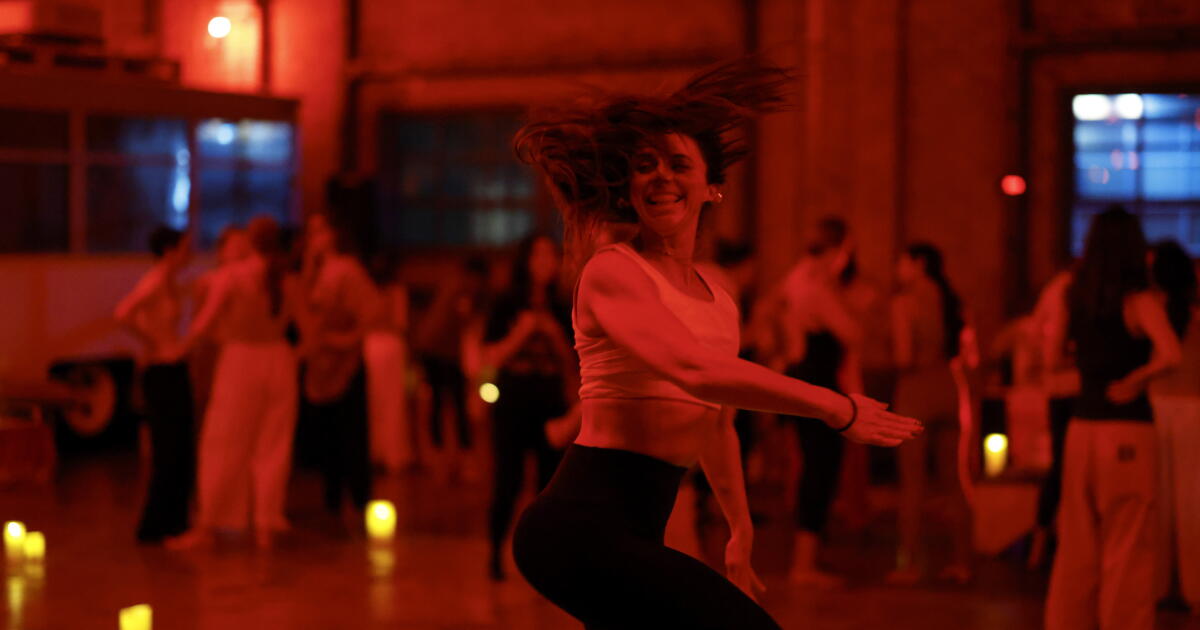
The rhythmic sound of a metronome fills a 12,000-square-foot warehouse-turned-wellness space in Marina del Rey. The room is dimly lighted but for yellow and red string lights that produce radiant, shimmying splotches on the concrete floor.
About 55 women stand in a circle, hands crisscrossed on their chests as they “butterfly tap” their clavicle to the beat — click-clock, click-clock — a collective, insect-like flurry of flapping palms and fluttering fingers bathed in golden hour light.
Participants set up an altar ahead of class.
“Welcome to this Equinox gathering, this meeting point of the light and dark,” says the evening’s host, psychotherapist Jane Garnett, as the metronome ticks on.
We’re at an EMDR “healing rave,” organized by Garnett. Soon the dancing will start up. But, for now, Garnett — who’s wearing a slinky silver jumpsuit and headset, an outfit that says “Dancing With the Stars” meets TED Talk — is giving the crowd a brief, if surface-y, introduction to EMDR. She’s a trained EMDR practitioner and uses the treatment in 1-on-1 therapy sessions; but she aims to make a version of it more accessible through group events that blend movement, music, intention setting and meditative bilateral tapping.
“My dream tonight is to give you the deepest, cheapest most fun therapy session you’ve ever had,” Garnett says into the mic.
EMDR (Eye Movement Desensitization and Reprocessing) is a psychotherapy treatment using bilateral stimulation — through hand-tapping, eye movements, audio stimulation and other approaches — to help participants process trauma and heal or assuage post-traumatic stress disorder, anxiety and depression, among other conditions.
Garnett says her EMDR dance parties are not meant to process “Big-T trauma.” For that, she recommends seeing a trained therapist in a traditional 1-on-1 setting. Her dance parties, instead, aim to introduce participants to EMDR, with “aftercare” resources, and help them “process stuck feelings in everyday life,” she says. “It’s not about the car crash — we’re coming to heal our relationship to ourselves and others. To write a new chapter.”
Tonight’s $25 ticket price is not a bad deal for an all-female dance party in a dynamic setting, but it’s far more rave than EMDR. Still, it’s unequivocally fun. After her brief talk, the music starts up — an ethereal, energetic mix of electronica, African rhythms and pop — and the circle dissolves into free-form dance. Attendees pump, thump and swirl around the room. Some do impromptu handstands against the wall, their feet tapping to the music; others migrate to adjacent gym equipment, pulsing on workout rings, swinging on knotted climbing ropes or swiveling their hips on a Bosu balance ball.
Garnett works her way around the room, dancing and spritzing chilled rose water on participants’ sweaty faces.
Fun has a place in mental health, Garnett says. And through dance — a form of bilateral stimulation — we’re shaking out stress, working up a sweat and steadying our central nervous systems.


1. Participants fill out intention setting cards. 2. A DIY tea ceremony. 3. The dance party ended with a moment of clarity and deep breathing. (Caroline Brehman/For The Times)
Earlier in the evening, held at Primal Moves Venice, guests milled between “healing stations” to get grounded and clear. There was a cauldron of hot hibiscus-ginger tea, beside a bowl of dark chocolate truffles, for a DIY tea ceremony; there were intention setting cards querying participants about courage, passion and celebration; and there was an “altar” that included fresh flowers, Ojai river stones, “ceremonial” tastes of Mezcal (i.e., shots), Tarot cards and a jug of ocean water from Malibu’s Paradise Cove to drop an intention or a release.
“I plan to return the water to the ocean afterwards,” Garnett says.
Garnett came to healing circuitously. She grew up in England, outside of London, the granddaughter of American filmmaker Tay Garnett (who directed “The Postman Always Rings Twice”). Storytelling was in her blood, she felt, and after studying English literature at the University of Oxford, she worked as a researcher at the BBC before moving to America to break into film. She eventually became vice president of production at Leonardo DiCaprio’s Appian Way and later produced 2006’s “The Illusionist,” starring Edward Norton.

Psychotherapist Jane Garnett, at Primal Moves Venice, before the dance party starts up.
Garnett was living the dream: She had a thriving career, was married to a successful film producer and had a beautiful, 1920s home in Santa Monica. But below the surface, she felt something was unfulfilled.
“I found myself in a state of more performance than presence,” she says. “I got to a stage where I checked my own boxes, but it didn’t give me the feeling I was looking for. I knew there was more to discover.”
Garnett returned to school, earning a master’s in clinical psychology and has worked as a licensed marriage and family therapist for nearly 20 years. “Healing circles,” as well as ceremonies and rituals, also interested her: She’d sat in on grief circles and participated in plant medicine gatherings in the past, and has experimented with ecstatic dance, which uses uninhibited, unchoreographed rhythmic movement to achieve a meditative or trance-like state. She also loved attending raves, which she felt were “intrinsically healing containers” combining bilateral movement, rhythm, pleasure and a sense of community and belonging.
Garnett’s EMDR dance parties are an outgrowth of all of those influences, a way to bridge the gap between the underground world of dance parties and the legitimized world of mental health.
“Therapy needs more body and dynamism,” she says. “And these party spaces could use a bit more safety or containment.”
Lacey James, 40, said she came to that night’s healing rave out of curiosity and was pleasantly surprised.
“I had some vague idea of what EMDR is in a therapeutic setting and [wondered]: How do you do that on a dance floor?” she said. “It was more dance than EMDR. But I found the bilateral stimulation really grounding. I really enjoyed that — it was hypnotic in a way.”
Garnett says she plans to beef up the EMDR component for future dance parties, which she aims to hold monthly.

Jane Garnett leads a talk about EMDR.
Ultimately, Garnett’s dance parties are stimulating, giving us “permission to play,” she says; and novelty is healing. It helps with mindfulness, reduces stress, encourages neuroplasticity and boosts mood.
Eva Lee, a 39-year-old fitness trainer who attended the event, would agree.
“It’s something new,” she said. “I had no idea what it was about so I wanted to experience it. I’m all in!”
Garnett puts it simply: “Come to celebrate your aliveness.”

Click-clock. Click-clock.
The rhythmic sound of a metronome fills a 12,000-square-foot warehouse-turned-wellness space in Marina del Rey. The room is dimly lighted but for yellow and red string lights that produce radiant, shimmying splotches on the concrete floor.
About 55 women stand in a circle, hands crisscrossed on their chests as they “butterfly tap” their clavicle to the beat — click-clock, click-clock — a collective, insect-like flurry of flapping palms and fluttering fingers bathed in golden hour light.
Participants set up an altar ahead of class.
“Welcome to this Equinox gathering, this meeting point of the light and dark,” says the evening’s host, psychotherapist Jane Garnett, as the metronome ticks on.
We’re at an EMDR “healing rave,” organized by Garnett. Soon the dancing will start up. But, for now, Garnett — who’s wearing a slinky silver jumpsuit and headset, an outfit that says “Dancing With the Stars” meets TED Talk — is giving the crowd a brief, if surface-y, introduction to EMDR. She’s a trained EMDR practitioner and uses the treatment in 1-on-1 therapy sessions; but she aims to make a version of it more accessible through group events that blend movement, music, intention setting and meditative bilateral tapping.
“My dream tonight is to give you the deepest, cheapest most fun therapy session you’ve ever had,” Garnett says into the mic.
EMDR (Eye Movement Desensitization and Reprocessing) is a psychotherapy treatment using bilateral stimulation — through hand-tapping, eye movements, audio stimulation and other approaches — to help participants process trauma and heal or assuage post-traumatic stress disorder, anxiety and depression, among other conditions.
Garnett says her EMDR dance parties are not meant to process “Big-T trauma.” For that, she recommends seeing a trained therapist in a traditional 1-on-1 setting. Her dance parties, instead, aim to introduce participants to EMDR, with “aftercare” resources, and help them “process stuck feelings in everyday life,” she says. “It’s not about the car crash — we’re coming to heal our relationship to ourselves and others. To write a new chapter.”
Tonight’s $25 ticket price is not a bad deal for an all-female dance party in a dynamic setting, but it’s far more rave than EMDR. Still, it’s unequivocally fun. After her brief talk, the music starts up — an ethereal, energetic mix of electronica, African rhythms and pop — and the circle dissolves into free-form dance. Attendees pump, thump and swirl around the room. Some do impromptu handstands against the wall, their feet tapping to the music; others migrate to adjacent gym equipment, pulsing on workout rings, swinging on knotted climbing ropes or swiveling their hips on a Bosu balance ball.
Garnett works her way around the room, dancing and spritzing chilled rose water on participants’ sweaty faces.
Fun has a place in mental health, Garnett says. And through dance — a form of bilateral stimulation — we’re shaking out stress, working up a sweat and steadying our central nervous systems.
1. Participants fill out intention setting cards. 2. A DIY tea ceremony. 3. The dance party ended with a moment of clarity and deep breathing. (Caroline Brehman/For The Times)
Earlier in the evening, held at Primal Moves Venice, guests milled between “healing stations” to get grounded and clear. There was a cauldron of hot hibiscus-ginger tea, beside a bowl of dark chocolate truffles, for a DIY tea ceremony; there were intention setting cards querying participants about courage, passion and celebration; and there was an “altar” that included fresh flowers, Ojai river stones, “ceremonial” tastes of Mezcal (i.e., shots), Tarot cards and a jug of ocean water from Malibu’s Paradise Cove to drop an intention or a release.
“I plan to return the water to the ocean afterwards,” Garnett says.
Garnett came to healing circuitously. She grew up in England, outside of London, the granddaughter of American filmmaker Tay Garnett (who directed “The Postman Always Rings Twice”). Storytelling was in her blood, she felt, and after studying English literature at the University of Oxford, she worked as a researcher at the BBC before moving to America to break into film. She eventually became vice president of production at Leonardo DiCaprio’s Appian Way and later produced 2006’s “The Illusionist,” starring Edward Norton.
Psychotherapist Jane Garnett, at Primal Moves Venice, before the dance party starts up.
Garnett was living the dream: She had a thriving career, was married to a successful film producer and had a beautiful, 1920s home in Santa Monica. But below the surface, she felt something was unfulfilled.
“I found myself in a state of more performance than presence,” she says. “I got to a stage where I checked my own boxes, but it didn’t give me the feeling I was looking for. I knew there was more to discover.”
Garnett returned to school, earning a master’s in clinical psychology and has worked as a licensed marriage and family therapist for nearly 20 years. “Healing circles,” as well as ceremonies and rituals, also interested her: She’d sat in on grief circles and participated in plant medicine gatherings in the past, and has experimented with ecstatic dance, which uses uninhibited, unchoreographed rhythmic movement to achieve a meditative or trance-like state. She also loved attending raves, which she felt were “intrinsically healing containers” combining bilateral movement, rhythm, pleasure and a sense of community and belonging.
Garnett’s EMDR dance parties are an outgrowth of all of those influences, a way to bridge the gap between the underground world of dance parties and the legitimized world of mental health.
“Therapy needs more body and dynamism,” she says. “And these party spaces could use a bit more safety or containment.”
Lacey James, 40, said she came to that night’s healing rave out of curiosity and was pleasantly surprised.
“I had some vague idea of what EMDR is in a therapeutic setting and [wondered]: How do you do that on a dance floor?” she said. “It was more dance than EMDR. But I found the bilateral stimulation really grounding. I really enjoyed that — it was hypnotic in a way.”
Garnett says she plans to beef up the EMDR component for future dance parties, which she aims to hold monthly.
Jane Garnett leads a talk about EMDR.
Ultimately, Garnett’s dance parties are stimulating, giving us “permission to play,” she says; and novelty is healing. It helps with mindfulness, reduces stress, encourages neuroplasticity and boosts mood.
Eva Lee, a 39-year-old fitness trainer who attended the event, would agree.
“It’s something new,” she said. “I had no idea what it was about so I wanted to experience it. I’m all in!”
Garnett puts it simply: “Come to celebrate your aliveness.”

Click-clock. Click-clock.
The rhythmic sound of a metronome fills a 12,000-square-foot warehouse-turned-wellness space in Marina del Rey. The room is dimly lighted but for yellow and red string lights that produce radiant, shimmying splotches on the concrete floor.
About 55 women stand in a circle, hands crisscrossed on their chests as they “butterfly tap” their clavicle to the beat — click-clock, click-clock — a collective, insect-like flurry of flapping palms and fluttering fingers bathed in golden hour light.
Participants set up an altar ahead of class.
“Welcome to this Equinox gathering, this meeting point of the light and dark,” says the evening’s host, psychotherapist Jane Garnett, as the metronome ticks on.
We’re at an EMDR “healing rave,” organized by Garnett. Soon the dancing will start up. But, for now, Garnett — who’s wearing a slinky silver jumpsuit and headset, an outfit that says “Dancing With the Stars” meets TED Talk — is giving the crowd a brief, if surface-y, introduction to EMDR. She’s a trained EMDR practitioner and uses the treatment in 1-on-1 therapy sessions; but she aims to make a version of it more accessible through group events that blend movement, music, intention setting and meditative bilateral tapping.
“My dream tonight is to give you the deepest, cheapest most fun therapy session you’ve ever had,” Garnett says into the mic.
EMDR (Eye Movement Desensitization and Reprocessing) is a psychotherapy treatment using bilateral stimulation — through hand-tapping, eye movements, audio stimulation and other approaches — to help participants process trauma and heal or assuage post-traumatic stress disorder, anxiety and depression, among other conditions.
Garnett says her EMDR dance parties are not meant to process “Big-T trauma.” For that, she recommends seeing a trained therapist in a traditional 1-on-1 setting. Her dance parties, instead, aim to introduce participants to EMDR, with “aftercare” resources, and help them “process stuck feelings in everyday life,” she says. “It’s not about the car crash — we’re coming to heal our relationship to ourselves and others. To write a new chapter.”
Tonight’s $25 ticket price is not a bad deal for an all-female dance party in a dynamic setting, but it’s far more rave than EMDR. Still, it’s unequivocally fun. After her brief talk, the music starts up — an ethereal, energetic mix of electronica, African rhythms and pop — and the circle dissolves into free-form dance. Attendees pump, thump and swirl around the room. Some do impromptu handstands against the wall, their feet tapping to the music; others migrate to adjacent gym equipment, pulsing on workout rings, swinging on knotted climbing ropes or swiveling their hips on a Bosu balance ball.
Garnett works her way around the room, dancing and spritzing chilled rose water on participants’ sweaty faces.
Fun has a place in mental health, Garnett says. And through dance — a form of bilateral stimulation — we’re shaking out stress, working up a sweat and steadying our central nervous systems.
1. Participants fill out intention setting cards. 2. A DIY tea ceremony. 3. The dance party ended with a moment of clarity and deep breathing. (Caroline Brehman/For The Times)
Earlier in the evening, held at Primal Moves Venice, guests milled between “healing stations” to get grounded and clear. There was a cauldron of hot hibiscus-ginger tea, beside a bowl of dark chocolate truffles, for a DIY tea ceremony; there were intention setting cards querying participants about courage, passion and celebration; and there was an “altar” that included fresh flowers, Ojai river stones, “ceremonial” tastes of Mezcal (i.e., shots), Tarot cards and a jug of ocean water from Malibu’s Paradise Cove to drop an intention or a release.
“I plan to return the water to the ocean afterwards,” Garnett says.
Garnett came to healing circuitously. She grew up in England, outside of London, the granddaughter of American filmmaker Tay Garnett (who directed “The Postman Always Rings Twice”). Storytelling was in her blood, she felt, and after studying English literature at the University of Oxford, she worked as a researcher at the BBC before moving to America to break into film. She eventually became vice president of production at Leonardo DiCaprio’s Appian Way and later produced 2006’s “The Illusionist,” starring Edward Norton.
Psychotherapist Jane Garnett, at Primal Moves Venice, before the dance party starts up.
Garnett was living the dream: She had a thriving career, was married to a successful film producer and had a beautiful, 1920s home in Santa Monica. But below the surface, she felt something was unfulfilled.
“I found myself in a state of more performance than presence,” she says. “I got to a stage where I checked my own boxes, but it didn’t give me the feeling I was looking for. I knew there was more to discover.”
Garnett returned to school, earning a master’s in clinical psychology and has worked as a licensed marriage and family therapist for nearly 20 years. “Healing circles,” as well as ceremonies and rituals, also interested her: She’d sat in on grief circles and participated in plant medicine gatherings in the past, and has experimented with ecstatic dance, which uses uninhibited, unchoreographed rhythmic movement to achieve a meditative or trance-like state. She also loved attending raves, which she felt were “intrinsically healing containers” combining bilateral movement, rhythm, pleasure and a sense of community and belonging.
Garnett’s EMDR dance parties are an outgrowth of all of those influences, a way to bridge the gap between the underground world of dance parties and the legitimized world of mental health.
“Therapy needs more body and dynamism,” she says. “And these party spaces could use a bit more safety or containment.”
Lacey James, 40, said she came to that night’s healing rave out of curiosity and was pleasantly surprised.
“I had some vague idea of what EMDR is in a therapeutic setting and [wondered]: How do you do that on a dance floor?” she said. “It was more dance than EMDR. But I found the bilateral stimulation really grounding. I really enjoyed that — it was hypnotic in a way.”
Garnett says she plans to beef up the EMDR component for future dance parties, which she aims to hold monthly.
Jane Garnett leads a talk about EMDR.
Ultimately, Garnett’s dance parties are stimulating, giving us “permission to play,” she says; and novelty is healing. It helps with mindfulness, reduces stress, encourages neuroplasticity and boosts mood.
Eva Lee, a 39-year-old fitness trainer who attended the event, would agree.
“It’s something new,” she said. “I had no idea what it was about so I wanted to experience it. I’m all in!”
Garnett puts it simply: “Come to celebrate your aliveness.”
Click-clock. Click-clock.
The rhythmic sound of a metronome fills a 12,000-square-foot warehouse-turned-wellness space in Marina del Rey. The room is dimly lighted but for yellow and red string lights that produce radiant, shimmying splotches on the concrete floor.
About 55 women stand in a circle, hands crisscrossed on their chests as they “butterfly tap” their clavicle to the beat — click-clock, click-clock — a collective, insect-like flurry of flapping palms and fluttering fingers bathed in golden hour light.
Participants set up an altar ahead of class.
“Welcome to this Equinox gathering, this meeting point of the light and dark,” says the evening’s host, psychotherapist Jane Garnett, as the metronome ticks on.
We’re at an EMDR “healing rave,” organized by Garnett. Soon the dancing will start up. But, for now, Garnett — who’s wearing a slinky silver jumpsuit and headset, an outfit that says “Dancing With the Stars” meets TED Talk — is giving the crowd a brief, if surface-y, introduction to EMDR. She’s a trained EMDR practitioner and uses the treatment in 1-on-1 therapy sessions; but she aims to make a version of it more accessible through group events that blend movement, music, intention setting and meditative bilateral tapping.
“My dream tonight is to give you the deepest, cheapest most fun therapy session you’ve ever had,” Garnett says into the mic.
EMDR (Eye Movement Desensitization and Reprocessing) is a psychotherapy treatment using bilateral stimulation — through hand-tapping, eye movements, audio stimulation and other approaches — to help participants process trauma and heal or assuage post-traumatic stress disorder, anxiety and depression, among other conditions.
Garnett says her EMDR dance parties are not meant to process “Big-T trauma.” For that, she recommends seeing a trained therapist in a traditional 1-on-1 setting. Her dance parties, instead, aim to introduce participants to EMDR, with “aftercare” resources, and help them “process stuck feelings in everyday life,” she says. “It’s not about the car crash — we’re coming to heal our relationship to ourselves and others. To write a new chapter.”
Tonight’s $25 ticket price is not a bad deal for an all-female dance party in a dynamic setting, but it’s far more rave than EMDR. Still, it’s unequivocally fun. After her brief talk, the music starts up — an ethereal, energetic mix of electronica, African rhythms and pop — and the circle dissolves into free-form dance. Attendees pump, thump and swirl around the room. Some do impromptu handstands against the wall, their feet tapping to the music; others migrate to adjacent gym equipment, pulsing on workout rings, swinging on knotted climbing ropes or swiveling their hips on a Bosu balance ball.
Garnett works her way around the room, dancing and spritzing chilled rose water on participants’ sweaty faces.
Fun has a place in mental health, Garnett says. And through dance — a form of bilateral stimulation — we’re shaking out stress, working up a sweat and steadying our central nervous systems.
1. Participants fill out intention setting cards. 2. A DIY tea ceremony. 3. The dance party ended with a moment of clarity and deep breathing. (Caroline Brehman/For The Times)
Earlier in the evening, held at Primal Moves Venice, guests milled between “healing stations” to get grounded and clear. There was a cauldron of hot hibiscus-ginger tea, beside a bowl of dark chocolate truffles, for a DIY tea ceremony; there were intention setting cards querying participants about courage, passion and celebration; and there was an “altar” that included fresh flowers, Ojai river stones, “ceremonial” tastes of Mezcal (i.e., shots), Tarot cards and a jug of ocean water from Malibu’s Paradise Cove to drop an intention or a release.
“I plan to return the water to the ocean afterwards,” Garnett says.
Garnett came to healing circuitously. She grew up in England, outside of London, the granddaughter of American filmmaker Tay Garnett (who directed “The Postman Always Rings Twice”). Storytelling was in her blood, she felt, and after studying English literature at the University of Oxford, she worked as a researcher at the BBC before moving to America to break into film. She eventually became vice president of production at Leonardo DiCaprio’s Appian Way and later produced 2006’s “The Illusionist,” starring Edward Norton.
Psychotherapist Jane Garnett, at Primal Moves Venice, before the dance party starts up.
Garnett was living the dream: She had a thriving career, was married to a successful film producer and had a beautiful, 1920s home in Santa Monica. But below the surface, she felt something was unfulfilled.
“I found myself in a state of more performance than presence,” she says. “I got to a stage where I checked my own boxes, but it didn’t give me the feeling I was looking for. I knew there was more to discover.”
Garnett returned to school, earning a master’s in clinical psychology and has worked as a licensed marriage and family therapist for nearly 20 years. “Healing circles,” as well as ceremonies and rituals, also interested her: She’d sat in on grief circles and participated in plant medicine gatherings in the past, and has experimented with ecstatic dance, which uses uninhibited, unchoreographed rhythmic movement to achieve a meditative or trance-like state. She also loved attending raves, which she felt were “intrinsically healing containers” combining bilateral movement, rhythm, pleasure and a sense of community and belonging.
Garnett’s EMDR dance parties are an outgrowth of all of those influences, a way to bridge the gap between the underground world of dance parties and the legitimized world of mental health.
“Therapy needs more body and dynamism,” she says. “And these party spaces could use a bit more safety or containment.”
Lacey James, 40, said she came to that night’s healing rave out of curiosity and was pleasantly surprised.
“I had some vague idea of what EMDR is in a therapeutic setting and [wondered]: How do you do that on a dance floor?” she said. “It was more dance than EMDR. But I found the bilateral stimulation really grounding. I really enjoyed that — it was hypnotic in a way.”
Garnett says she plans to beef up the EMDR component for future dance parties, which she aims to hold monthly.
Jane Garnett leads a talk about EMDR.
Ultimately, Garnett’s dance parties are stimulating, giving us “permission to play,” she says; and novelty is healing. It helps with mindfulness, reduces stress, encourages neuroplasticity and boosts mood.
Eva Lee, a 39-year-old fitness trainer who attended the event, would agree.
“It’s something new,” she said. “I had no idea what it was about so I wanted to experience it. I’m all in!”
Garnett puts it simply: “Come to celebrate your aliveness.”

Click-clock. Click-clock.
The rhythmic sound of a metronome fills a 12,000-square-foot warehouse-turned-wellness space in Marina del Rey. The room is dimly lighted but for yellow and red string lights that produce radiant, shimmying splotches on the concrete floor.
About 55 women stand in a circle, hands crisscrossed on their chests as they “butterfly tap” their clavicle to the beat — click-clock, click-clock — a collective, insect-like flurry of flapping palms and fluttering fingers bathed in golden hour light.
Participants set up an altar ahead of class.
“Welcome to this Equinox gathering, this meeting point of the light and dark,” says the evening’s host, psychotherapist Jane Garnett, as the metronome ticks on.
We’re at an EMDR “healing rave,” organized by Garnett. Soon the dancing will start up. But, for now, Garnett — who’s wearing a slinky silver jumpsuit and headset, an outfit that says “Dancing With the Stars” meets TED Talk — is giving the crowd a brief, if surface-y, introduction to EMDR. She’s a trained EMDR practitioner and uses the treatment in 1-on-1 therapy sessions; but she aims to make a version of it more accessible through group events that blend movement, music, intention setting and meditative bilateral tapping.
“My dream tonight is to give you the deepest, cheapest most fun therapy session you’ve ever had,” Garnett says into the mic.
EMDR (Eye Movement Desensitization and Reprocessing) is a psychotherapy treatment using bilateral stimulation — through hand-tapping, eye movements, audio stimulation and other approaches — to help participants process trauma and heal or assuage post-traumatic stress disorder, anxiety and depression, among other conditions.
Garnett says her EMDR dance parties are not meant to process “Big-T trauma.” For that, she recommends seeing a trained therapist in a traditional 1-on-1 setting. Her dance parties, instead, aim to introduce participants to EMDR, with “aftercare” resources, and help them “process stuck feelings in everyday life,” she says. “It’s not about the car crash — we’re coming to heal our relationship to ourselves and others. To write a new chapter.”
Tonight’s $25 ticket price is not a bad deal for an all-female dance party in a dynamic setting, but it’s far more rave than EMDR. Still, it’s unequivocally fun. After her brief talk, the music starts up — an ethereal, energetic mix of electronica, African rhythms and pop — and the circle dissolves into free-form dance. Attendees pump, thump and swirl around the room. Some do impromptu handstands against the wall, their feet tapping to the music; others migrate to adjacent gym equipment, pulsing on workout rings, swinging on knotted climbing ropes or swiveling their hips on a Bosu balance ball.
Garnett works her way around the room, dancing and spritzing chilled rose water on participants’ sweaty faces.
Fun has a place in mental health, Garnett says. And through dance — a form of bilateral stimulation — we’re shaking out stress, working up a sweat and steadying our central nervous systems.
1. Participants fill out intention setting cards. 2. A DIY tea ceremony. 3. The dance party ended with a moment of clarity and deep breathing. (Caroline Brehman/For The Times)
Earlier in the evening, held at Primal Moves Venice, guests milled between “healing stations” to get grounded and clear. There was a cauldron of hot hibiscus-ginger tea, beside a bowl of dark chocolate truffles, for a DIY tea ceremony; there were intention setting cards querying participants about courage, passion and celebration; and there was an “altar” that included fresh flowers, Ojai river stones, “ceremonial” tastes of Mezcal (i.e., shots), Tarot cards and a jug of ocean water from Malibu’s Paradise Cove to drop an intention or a release.
“I plan to return the water to the ocean afterwards,” Garnett says.
Garnett came to healing circuitously. She grew up in England, outside of London, the granddaughter of American filmmaker Tay Garnett (who directed “The Postman Always Rings Twice”). Storytelling was in her blood, she felt, and after studying English literature at the University of Oxford, she worked as a researcher at the BBC before moving to America to break into film. She eventually became vice president of production at Leonardo DiCaprio’s Appian Way and later produced 2006’s “The Illusionist,” starring Edward Norton.
Psychotherapist Jane Garnett, at Primal Moves Venice, before the dance party starts up.
Garnett was living the dream: She had a thriving career, was married to a successful film producer and had a beautiful, 1920s home in Santa Monica. But below the surface, she felt something was unfulfilled.
“I found myself in a state of more performance than presence,” she says. “I got to a stage where I checked my own boxes, but it didn’t give me the feeling I was looking for. I knew there was more to discover.”
Garnett returned to school, earning a master’s in clinical psychology and has worked as a licensed marriage and family therapist for nearly 20 years. “Healing circles,” as well as ceremonies and rituals, also interested her: She’d sat in on grief circles and participated in plant medicine gatherings in the past, and has experimented with ecstatic dance, which uses uninhibited, unchoreographed rhythmic movement to achieve a meditative or trance-like state. She also loved attending raves, which she felt were “intrinsically healing containers” combining bilateral movement, rhythm, pleasure and a sense of community and belonging.
Garnett’s EMDR dance parties are an outgrowth of all of those influences, a way to bridge the gap between the underground world of dance parties and the legitimized world of mental health.
“Therapy needs more body and dynamism,” she says. “And these party spaces could use a bit more safety or containment.”
Lacey James, 40, said she came to that night’s healing rave out of curiosity and was pleasantly surprised.
“I had some vague idea of what EMDR is in a therapeutic setting and [wondered]: How do you do that on a dance floor?” she said. “It was more dance than EMDR. But I found the bilateral stimulation really grounding. I really enjoyed that — it was hypnotic in a way.”
Garnett says she plans to beef up the EMDR component for future dance parties, which she aims to hold monthly.
Jane Garnett leads a talk about EMDR.
Ultimately, Garnett’s dance parties are stimulating, giving us “permission to play,” she says; and novelty is healing. It helps with mindfulness, reduces stress, encourages neuroplasticity and boosts mood.
Eva Lee, a 39-year-old fitness trainer who attended the event, would agree.
“It’s something new,” she said. “I had no idea what it was about so I wanted to experience it. I’m all in!”
Garnett puts it simply: “Come to celebrate your aliveness.”
Click-clock. Click-clock.
The rhythmic sound of a metronome fills a 12,000-square-foot warehouse-turned-wellness space in Marina del Rey. The room is dimly lighted but for yellow and red string lights that produce radiant, shimmying splotches on the concrete floor.
About 55 women stand in a circle, hands crisscrossed on their chests as they “butterfly tap” their clavicle to the beat — click-clock, click-clock — a collective, insect-like flurry of flapping palms and fluttering fingers bathed in golden hour light.
Participants set up an altar ahead of class.
“Welcome to this Equinox gathering, this meeting point of the light and dark,” says the evening’s host, psychotherapist Jane Garnett, as the metronome ticks on.
We’re at an EMDR “healing rave,” organized by Garnett. Soon the dancing will start up. But, for now, Garnett — who’s wearing a slinky silver jumpsuit and headset, an outfit that says “Dancing With the Stars” meets TED Talk — is giving the crowd a brief, if surface-y, introduction to EMDR. She’s a trained EMDR practitioner and uses the treatment in 1-on-1 therapy sessions; but she aims to make a version of it more accessible through group events that blend movement, music, intention setting and meditative bilateral tapping.
“My dream tonight is to give you the deepest, cheapest most fun therapy session you’ve ever had,” Garnett says into the mic.
EMDR (Eye Movement Desensitization and Reprocessing) is a psychotherapy treatment using bilateral stimulation — through hand-tapping, eye movements, audio stimulation and other approaches — to help participants process trauma and heal or assuage post-traumatic stress disorder, anxiety and depression, among other conditions.
Garnett says her EMDR dance parties are not meant to process “Big-T trauma.” For that, she recommends seeing a trained therapist in a traditional 1-on-1 setting. Her dance parties, instead, aim to introduce participants to EMDR, with “aftercare” resources, and help them “process stuck feelings in everyday life,” she says. “It’s not about the car crash — we’re coming to heal our relationship to ourselves and others. To write a new chapter.”
Tonight’s $25 ticket price is not a bad deal for an all-female dance party in a dynamic setting, but it’s far more rave than EMDR. Still, it’s unequivocally fun. After her brief talk, the music starts up — an ethereal, energetic mix of electronica, African rhythms and pop — and the circle dissolves into free-form dance. Attendees pump, thump and swirl around the room. Some do impromptu handstands against the wall, their feet tapping to the music; others migrate to adjacent gym equipment, pulsing on workout rings, swinging on knotted climbing ropes or swiveling their hips on a Bosu balance ball.
Garnett works her way around the room, dancing and spritzing chilled rose water on participants’ sweaty faces.
Fun has a place in mental health, Garnett says. And through dance — a form of bilateral stimulation — we’re shaking out stress, working up a sweat and steadying our central nervous systems.
1. Participants fill out intention setting cards. 2. A DIY tea ceremony. 3. The dance party ended with a moment of clarity and deep breathing. (Caroline Brehman/For The Times)
Earlier in the evening, held at Primal Moves Venice, guests milled between “healing stations” to get grounded and clear. There was a cauldron of hot hibiscus-ginger tea, beside a bowl of dark chocolate truffles, for a DIY tea ceremony; there were intention setting cards querying participants about courage, passion and celebration; and there was an “altar” that included fresh flowers, Ojai river stones, “ceremonial” tastes of Mezcal (i.e., shots), Tarot cards and a jug of ocean water from Malibu’s Paradise Cove to drop an intention or a release.
“I plan to return the water to the ocean afterwards,” Garnett says.
Garnett came to healing circuitously. She grew up in England, outside of London, the granddaughter of American filmmaker Tay Garnett (who directed “The Postman Always Rings Twice”). Storytelling was in her blood, she felt, and after studying English literature at the University of Oxford, she worked as a researcher at the BBC before moving to America to break into film. She eventually became vice president of production at Leonardo DiCaprio’s Appian Way and later produced 2006’s “The Illusionist,” starring Edward Norton.
Psychotherapist Jane Garnett, at Primal Moves Venice, before the dance party starts up.
Garnett was living the dream: She had a thriving career, was married to a successful film producer and had a beautiful, 1920s home in Santa Monica. But below the surface, she felt something was unfulfilled.
“I found myself in a state of more performance than presence,” she says. “I got to a stage where I checked my own boxes, but it didn’t give me the feeling I was looking for. I knew there was more to discover.”
Garnett returned to school, earning a master’s in clinical psychology and has worked as a licensed marriage and family therapist for nearly 20 years. “Healing circles,” as well as ceremonies and rituals, also interested her: She’d sat in on grief circles and participated in plant medicine gatherings in the past, and has experimented with ecstatic dance, which uses uninhibited, unchoreographed rhythmic movement to achieve a meditative or trance-like state. She also loved attending raves, which she felt were “intrinsically healing containers” combining bilateral movement, rhythm, pleasure and a sense of community and belonging.
Garnett’s EMDR dance parties are an outgrowth of all of those influences, a way to bridge the gap between the underground world of dance parties and the legitimized world of mental health.
“Therapy needs more body and dynamism,” she says. “And these party spaces could use a bit more safety or containment.”
Lacey James, 40, said she came to that night’s healing rave out of curiosity and was pleasantly surprised.
“I had some vague idea of what EMDR is in a therapeutic setting and [wondered]: How do you do that on a dance floor?” she said. “It was more dance than EMDR. But I found the bilateral stimulation really grounding. I really enjoyed that — it was hypnotic in a way.”
Garnett says she plans to beef up the EMDR component for future dance parties, which she aims to hold monthly.
Jane Garnett leads a talk about EMDR.
Ultimately, Garnett’s dance parties are stimulating, giving us “permission to play,” she says; and novelty is healing. It helps with mindfulness, reduces stress, encourages neuroplasticity and boosts mood.
Eva Lee, a 39-year-old fitness trainer who attended the event, would agree.
“It’s something new,” she said. “I had no idea what it was about so I wanted to experience it. I’m all in!”
Garnett puts it simply: “Come to celebrate your aliveness.”
Click-clock. Click-clock.
The rhythmic sound of a metronome fills a 12,000-square-foot warehouse-turned-wellness space in Marina del Rey. The room is dimly lighted but for yellow and red string lights that produce radiant, shimmying splotches on the concrete floor.
About 55 women stand in a circle, hands crisscrossed on their chests as they “butterfly tap” their clavicle to the beat — click-clock, click-clock — a collective, insect-like flurry of flapping palms and fluttering fingers bathed in golden hour light.
Participants set up an altar ahead of class.
“Welcome to this Equinox gathering, this meeting point of the light and dark,” says the evening’s host, psychotherapist Jane Garnett, as the metronome ticks on.
We’re at an EMDR “healing rave,” organized by Garnett. Soon the dancing will start up. But, for now, Garnett — who’s wearing a slinky silver jumpsuit and headset, an outfit that says “Dancing With the Stars” meets TED Talk — is giving the crowd a brief, if surface-y, introduction to EMDR. She’s a trained EMDR practitioner and uses the treatment in 1-on-1 therapy sessions; but she aims to make a version of it more accessible through group events that blend movement, music, intention setting and meditative bilateral tapping.
“My dream tonight is to give you the deepest, cheapest most fun therapy session you’ve ever had,” Garnett says into the mic.
EMDR (Eye Movement Desensitization and Reprocessing) is a psychotherapy treatment using bilateral stimulation — through hand-tapping, eye movements, audio stimulation and other approaches — to help participants process trauma and heal or assuage post-traumatic stress disorder, anxiety and depression, among other conditions.
Garnett says her EMDR dance parties are not meant to process “Big-T trauma.” For that, she recommends seeing a trained therapist in a traditional 1-on-1 setting. Her dance parties, instead, aim to introduce participants to EMDR, with “aftercare” resources, and help them “process stuck feelings in everyday life,” she says. “It’s not about the car crash — we’re coming to heal our relationship to ourselves and others. To write a new chapter.”
Tonight’s $25 ticket price is not a bad deal for an all-female dance party in a dynamic setting, but it’s far more rave than EMDR. Still, it’s unequivocally fun. After her brief talk, the music starts up — an ethereal, energetic mix of electronica, African rhythms and pop — and the circle dissolves into free-form dance. Attendees pump, thump and swirl around the room. Some do impromptu handstands against the wall, their feet tapping to the music; others migrate to adjacent gym equipment, pulsing on workout rings, swinging on knotted climbing ropes or swiveling their hips on a Bosu balance ball.
Garnett works her way around the room, dancing and spritzing chilled rose water on participants’ sweaty faces.
Fun has a place in mental health, Garnett says. And through dance — a form of bilateral stimulation — we’re shaking out stress, working up a sweat and steadying our central nervous systems.
1. Participants fill out intention setting cards. 2. A DIY tea ceremony. 3. The dance party ended with a moment of clarity and deep breathing. (Caroline Brehman/For The Times)
Earlier in the evening, held at Primal Moves Venice, guests milled between “healing stations” to get grounded and clear. There was a cauldron of hot hibiscus-ginger tea, beside a bowl of dark chocolate truffles, for a DIY tea ceremony; there were intention setting cards querying participants about courage, passion and celebration; and there was an “altar” that included fresh flowers, Ojai river stones, “ceremonial” tastes of Mezcal (i.e., shots), Tarot cards and a jug of ocean water from Malibu’s Paradise Cove to drop an intention or a release.
“I plan to return the water to the ocean afterwards,” Garnett says.
Garnett came to healing circuitously. She grew up in England, outside of London, the granddaughter of American filmmaker Tay Garnett (who directed “The Postman Always Rings Twice”). Storytelling was in her blood, she felt, and after studying English literature at the University of Oxford, she worked as a researcher at the BBC before moving to America to break into film. She eventually became vice president of production at Leonardo DiCaprio’s Appian Way and later produced 2006’s “The Illusionist,” starring Edward Norton.
Psychotherapist Jane Garnett, at Primal Moves Venice, before the dance party starts up.
Garnett was living the dream: She had a thriving career, was married to a successful film producer and had a beautiful, 1920s home in Santa Monica. But below the surface, she felt something was unfulfilled.
“I found myself in a state of more performance than presence,” she says. “I got to a stage where I checked my own boxes, but it didn’t give me the feeling I was looking for. I knew there was more to discover.”
Garnett returned to school, earning a master’s in clinical psychology and has worked as a licensed marriage and family therapist for nearly 20 years. “Healing circles,” as well as ceremonies and rituals, also interested her: She’d sat in on grief circles and participated in plant medicine gatherings in the past, and has experimented with ecstatic dance, which uses uninhibited, unchoreographed rhythmic movement to achieve a meditative or trance-like state. She also loved attending raves, which she felt were “intrinsically healing containers” combining bilateral movement, rhythm, pleasure and a sense of community and belonging.
Garnett’s EMDR dance parties are an outgrowth of all of those influences, a way to bridge the gap between the underground world of dance parties and the legitimized world of mental health.
“Therapy needs more body and dynamism,” she says. “And these party spaces could use a bit more safety or containment.”
Lacey James, 40, said she came to that night’s healing rave out of curiosity and was pleasantly surprised.
“I had some vague idea of what EMDR is in a therapeutic setting and [wondered]: How do you do that on a dance floor?” she said. “It was more dance than EMDR. But I found the bilateral stimulation really grounding. I really enjoyed that — it was hypnotic in a way.”
Garnett says she plans to beef up the EMDR component for future dance parties, which she aims to hold monthly.
Jane Garnett leads a talk about EMDR.
Ultimately, Garnett’s dance parties are stimulating, giving us “permission to play,” she says; and novelty is healing. It helps with mindfulness, reduces stress, encourages neuroplasticity and boosts mood.
Eva Lee, a 39-year-old fitness trainer who attended the event, would agree.
“It’s something new,” she said. “I had no idea what it was about so I wanted to experience it. I’m all in!”
Garnett puts it simply: “Come to celebrate your aliveness.”
Click-clock. Click-clock.
The rhythmic sound of a metronome fills a 12,000-square-foot warehouse-turned-wellness space in Marina del Rey. The room is dimly lighted but for yellow and red string lights that produce radiant, shimmying splotches on the concrete floor.
About 55 women stand in a circle, hands crisscrossed on their chests as they “butterfly tap” their clavicle to the beat — click-clock, click-clock — a collective, insect-like flurry of flapping palms and fluttering fingers bathed in golden hour light.
Participants set up an altar ahead of class.
“Welcome to this Equinox gathering, this meeting point of the light and dark,” says the evening’s host, psychotherapist Jane Garnett, as the metronome ticks on.
We’re at an EMDR “healing rave,” organized by Garnett. Soon the dancing will start up. But, for now, Garnett — who’s wearing a slinky silver jumpsuit and headset, an outfit that says “Dancing With the Stars” meets TED Talk — is giving the crowd a brief, if surface-y, introduction to EMDR. She’s a trained EMDR practitioner and uses the treatment in 1-on-1 therapy sessions; but she aims to make a version of it more accessible through group events that blend movement, music, intention setting and meditative bilateral tapping.
“My dream tonight is to give you the deepest, cheapest most fun therapy session you’ve ever had,” Garnett says into the mic.
EMDR (Eye Movement Desensitization and Reprocessing) is a psychotherapy treatment using bilateral stimulation — through hand-tapping, eye movements, audio stimulation and other approaches — to help participants process trauma and heal or assuage post-traumatic stress disorder, anxiety and depression, among other conditions.
Garnett says her EMDR dance parties are not meant to process “Big-T trauma.” For that, she recommends seeing a trained therapist in a traditional 1-on-1 setting. Her dance parties, instead, aim to introduce participants to EMDR, with “aftercare” resources, and help them “process stuck feelings in everyday life,” she says. “It’s not about the car crash — we’re coming to heal our relationship to ourselves and others. To write a new chapter.”
Tonight’s $25 ticket price is not a bad deal for an all-female dance party in a dynamic setting, but it’s far more rave than EMDR. Still, it’s unequivocally fun. After her brief talk, the music starts up — an ethereal, energetic mix of electronica, African rhythms and pop — and the circle dissolves into free-form dance. Attendees pump, thump and swirl around the room. Some do impromptu handstands against the wall, their feet tapping to the music; others migrate to adjacent gym equipment, pulsing on workout rings, swinging on knotted climbing ropes or swiveling their hips on a Bosu balance ball.
Garnett works her way around the room, dancing and spritzing chilled rose water on participants’ sweaty faces.
Fun has a place in mental health, Garnett says. And through dance — a form of bilateral stimulation — we’re shaking out stress, working up a sweat and steadying our central nervous systems.
1. Participants fill out intention setting cards. 2. A DIY tea ceremony. 3. The dance party ended with a moment of clarity and deep breathing. (Caroline Brehman/For The Times)
Earlier in the evening, held at Primal Moves Venice, guests milled between “healing stations” to get grounded and clear. There was a cauldron of hot hibiscus-ginger tea, beside a bowl of dark chocolate truffles, for a DIY tea ceremony; there were intention setting cards querying participants about courage, passion and celebration; and there was an “altar” that included fresh flowers, Ojai river stones, “ceremonial” tastes of Mezcal (i.e., shots), Tarot cards and a jug of ocean water from Malibu’s Paradise Cove to drop an intention or a release.
“I plan to return the water to the ocean afterwards,” Garnett says.
Garnett came to healing circuitously. She grew up in England, outside of London, the granddaughter of American filmmaker Tay Garnett (who directed “The Postman Always Rings Twice”). Storytelling was in her blood, she felt, and after studying English literature at the University of Oxford, she worked as a researcher at the BBC before moving to America to break into film. She eventually became vice president of production at Leonardo DiCaprio’s Appian Way and later produced 2006’s “The Illusionist,” starring Edward Norton.
Psychotherapist Jane Garnett, at Primal Moves Venice, before the dance party starts up.
Garnett was living the dream: She had a thriving career, was married to a successful film producer and had a beautiful, 1920s home in Santa Monica. But below the surface, she felt something was unfulfilled.
“I found myself in a state of more performance than presence,” she says. “I got to a stage where I checked my own boxes, but it didn’t give me the feeling I was looking for. I knew there was more to discover.”
Garnett returned to school, earning a master’s in clinical psychology and has worked as a licensed marriage and family therapist for nearly 20 years. “Healing circles,” as well as ceremonies and rituals, also interested her: She’d sat in on grief circles and participated in plant medicine gatherings in the past, and has experimented with ecstatic dance, which uses uninhibited, unchoreographed rhythmic movement to achieve a meditative or trance-like state. She also loved attending raves, which she felt were “intrinsically healing containers” combining bilateral movement, rhythm, pleasure and a sense of community and belonging.
Garnett’s EMDR dance parties are an outgrowth of all of those influences, a way to bridge the gap between the underground world of dance parties and the legitimized world of mental health.
“Therapy needs more body and dynamism,” she says. “And these party spaces could use a bit more safety or containment.”
Lacey James, 40, said she came to that night’s healing rave out of curiosity and was pleasantly surprised.
“I had some vague idea of what EMDR is in a therapeutic setting and [wondered]: How do you do that on a dance floor?” she said. “It was more dance than EMDR. But I found the bilateral stimulation really grounding. I really enjoyed that — it was hypnotic in a way.”
Garnett says she plans to beef up the EMDR component for future dance parties, which she aims to hold monthly.
Jane Garnett leads a talk about EMDR.
Ultimately, Garnett’s dance parties are stimulating, giving us “permission to play,” she says; and novelty is healing. It helps with mindfulness, reduces stress, encourages neuroplasticity and boosts mood.
Eva Lee, a 39-year-old fitness trainer who attended the event, would agree.
“It’s something new,” she said. “I had no idea what it was about so I wanted to experience it. I’m all in!”
Garnett puts it simply: “Come to celebrate your aliveness.”

Click-clock. Click-clock.
The rhythmic sound of a metronome fills a 12,000-square-foot warehouse-turned-wellness space in Marina del Rey. The room is dimly lighted but for yellow and red string lights that produce radiant, shimmying splotches on the concrete floor.
About 55 women stand in a circle, hands crisscrossed on their chests as they “butterfly tap” their clavicle to the beat — click-clock, click-clock — a collective, insect-like flurry of flapping palms and fluttering fingers bathed in golden hour light.
Participants set up an altar ahead of class.
“Welcome to this Equinox gathering, this meeting point of the light and dark,” says the evening’s host, psychotherapist Jane Garnett, as the metronome ticks on.
We’re at an EMDR “healing rave,” organized by Garnett. Soon the dancing will start up. But, for now, Garnett — who’s wearing a slinky silver jumpsuit and headset, an outfit that says “Dancing With the Stars” meets TED Talk — is giving the crowd a brief, if surface-y, introduction to EMDR. She’s a trained EMDR practitioner and uses the treatment in 1-on-1 therapy sessions; but she aims to make a version of it more accessible through group events that blend movement, music, intention setting and meditative bilateral tapping.
“My dream tonight is to give you the deepest, cheapest most fun therapy session you’ve ever had,” Garnett says into the mic.
EMDR (Eye Movement Desensitization and Reprocessing) is a psychotherapy treatment using bilateral stimulation — through hand-tapping, eye movements, audio stimulation and other approaches — to help participants process trauma and heal or assuage post-traumatic stress disorder, anxiety and depression, among other conditions.
Garnett says her EMDR dance parties are not meant to process “Big-T trauma.” For that, she recommends seeing a trained therapist in a traditional 1-on-1 setting. Her dance parties, instead, aim to introduce participants to EMDR, with “aftercare” resources, and help them “process stuck feelings in everyday life,” she says. “It’s not about the car crash — we’re coming to heal our relationship to ourselves and others. To write a new chapter.”
Tonight’s $25 ticket price is not a bad deal for an all-female dance party in a dynamic setting, but it’s far more rave than EMDR. Still, it’s unequivocally fun. After her brief talk, the music starts up — an ethereal, energetic mix of electronica, African rhythms and pop — and the circle dissolves into free-form dance. Attendees pump, thump and swirl around the room. Some do impromptu handstands against the wall, their feet tapping to the music; others migrate to adjacent gym equipment, pulsing on workout rings, swinging on knotted climbing ropes or swiveling their hips on a Bosu balance ball.
Garnett works her way around the room, dancing and spritzing chilled rose water on participants’ sweaty faces.
Fun has a place in mental health, Garnett says. And through dance — a form of bilateral stimulation — we’re shaking out stress, working up a sweat and steadying our central nervous systems.
1. Participants fill out intention setting cards. 2. A DIY tea ceremony. 3. The dance party ended with a moment of clarity and deep breathing. (Caroline Brehman/For The Times)
Earlier in the evening, held at Primal Moves Venice, guests milled between “healing stations” to get grounded and clear. There was a cauldron of hot hibiscus-ginger tea, beside a bowl of dark chocolate truffles, for a DIY tea ceremony; there were intention setting cards querying participants about courage, passion and celebration; and there was an “altar” that included fresh flowers, Ojai river stones, “ceremonial” tastes of Mezcal (i.e., shots), Tarot cards and a jug of ocean water from Malibu’s Paradise Cove to drop an intention or a release.
“I plan to return the water to the ocean afterwards,” Garnett says.
Garnett came to healing circuitously. She grew up in England, outside of London, the granddaughter of American filmmaker Tay Garnett (who directed “The Postman Always Rings Twice”). Storytelling was in her blood, she felt, and after studying English literature at the University of Oxford, she worked as a researcher at the BBC before moving to America to break into film. She eventually became vice president of production at Leonardo DiCaprio’s Appian Way and later produced 2006’s “The Illusionist,” starring Edward Norton.
Psychotherapist Jane Garnett, at Primal Moves Venice, before the dance party starts up.
Garnett was living the dream: She had a thriving career, was married to a successful film producer and had a beautiful, 1920s home in Santa Monica. But below the surface, she felt something was unfulfilled.
“I found myself in a state of more performance than presence,” she says. “I got to a stage where I checked my own boxes, but it didn’t give me the feeling I was looking for. I knew there was more to discover.”
Garnett returned to school, earning a master’s in clinical psychology and has worked as a licensed marriage and family therapist for nearly 20 years. “Healing circles,” as well as ceremonies and rituals, also interested her: She’d sat in on grief circles and participated in plant medicine gatherings in the past, and has experimented with ecstatic dance, which uses uninhibited, unchoreographed rhythmic movement to achieve a meditative or trance-like state. She also loved attending raves, which she felt were “intrinsically healing containers” combining bilateral movement, rhythm, pleasure and a sense of community and belonging.
Garnett’s EMDR dance parties are an outgrowth of all of those influences, a way to bridge the gap between the underground world of dance parties and the legitimized world of mental health.
“Therapy needs more body and dynamism,” she says. “And these party spaces could use a bit more safety or containment.”
Lacey James, 40, said she came to that night’s healing rave out of curiosity and was pleasantly surprised.
“I had some vague idea of what EMDR is in a therapeutic setting and [wondered]: How do you do that on a dance floor?” she said. “It was more dance than EMDR. But I found the bilateral stimulation really grounding. I really enjoyed that — it was hypnotic in a way.”
Garnett says she plans to beef up the EMDR component for future dance parties, which she aims to hold monthly.
Jane Garnett leads a talk about EMDR.
Ultimately, Garnett’s dance parties are stimulating, giving us “permission to play,” she says; and novelty is healing. It helps with mindfulness, reduces stress, encourages neuroplasticity and boosts mood.
Eva Lee, a 39-year-old fitness trainer who attended the event, would agree.
“It’s something new,” she said. “I had no idea what it was about so I wanted to experience it. I’m all in!”
Garnett puts it simply: “Come to celebrate your aliveness.”
Click-clock. Click-clock.
The rhythmic sound of a metronome fills a 12,000-square-foot warehouse-turned-wellness space in Marina del Rey. The room is dimly lighted but for yellow and red string lights that produce radiant, shimmying splotches on the concrete floor.
About 55 women stand in a circle, hands crisscrossed on their chests as they “butterfly tap” their clavicle to the beat — click-clock, click-clock — a collective, insect-like flurry of flapping palms and fluttering fingers bathed in golden hour light.
Participants set up an altar ahead of class.
“Welcome to this Equinox gathering, this meeting point of the light and dark,” says the evening’s host, psychotherapist Jane Garnett, as the metronome ticks on.
We’re at an EMDR “healing rave,” organized by Garnett. Soon the dancing will start up. But, for now, Garnett — who’s wearing a slinky silver jumpsuit and headset, an outfit that says “Dancing With the Stars” meets TED Talk — is giving the crowd a brief, if surface-y, introduction to EMDR. She’s a trained EMDR practitioner and uses the treatment in 1-on-1 therapy sessions; but she aims to make a version of it more accessible through group events that blend movement, music, intention setting and meditative bilateral tapping.
“My dream tonight is to give you the deepest, cheapest most fun therapy session you’ve ever had,” Garnett says into the mic.
EMDR (Eye Movement Desensitization and Reprocessing) is a psychotherapy treatment using bilateral stimulation — through hand-tapping, eye movements, audio stimulation and other approaches — to help participants process trauma and heal or assuage post-traumatic stress disorder, anxiety and depression, among other conditions.
Garnett says her EMDR dance parties are not meant to process “Big-T trauma.” For that, she recommends seeing a trained therapist in a traditional 1-on-1 setting. Her dance parties, instead, aim to introduce participants to EMDR, with “aftercare” resources, and help them “process stuck feelings in everyday life,” she says. “It’s not about the car crash — we’re coming to heal our relationship to ourselves and others. To write a new chapter.”
Tonight’s $25 ticket price is not a bad deal for an all-female dance party in a dynamic setting, but it’s far more rave than EMDR. Still, it’s unequivocally fun. After her brief talk, the music starts up — an ethereal, energetic mix of electronica, African rhythms and pop — and the circle dissolves into free-form dance. Attendees pump, thump and swirl around the room. Some do impromptu handstands against the wall, their feet tapping to the music; others migrate to adjacent gym equipment, pulsing on workout rings, swinging on knotted climbing ropes or swiveling their hips on a Bosu balance ball.
Garnett works her way around the room, dancing and spritzing chilled rose water on participants’ sweaty faces.
Fun has a place in mental health, Garnett says. And through dance — a form of bilateral stimulation — we’re shaking out stress, working up a sweat and steadying our central nervous systems.
1. Participants fill out intention setting cards. 2. A DIY tea ceremony. 3. The dance party ended with a moment of clarity and deep breathing. (Caroline Brehman/For The Times)
Earlier in the evening, held at Primal Moves Venice, guests milled between “healing stations” to get grounded and clear. There was a cauldron of hot hibiscus-ginger tea, beside a bowl of dark chocolate truffles, for a DIY tea ceremony; there were intention setting cards querying participants about courage, passion and celebration; and there was an “altar” that included fresh flowers, Ojai river stones, “ceremonial” tastes of Mezcal (i.e., shots), Tarot cards and a jug of ocean water from Malibu’s Paradise Cove to drop an intention or a release.
“I plan to return the water to the ocean afterwards,” Garnett says.
Garnett came to healing circuitously. She grew up in England, outside of London, the granddaughter of American filmmaker Tay Garnett (who directed “The Postman Always Rings Twice”). Storytelling was in her blood, she felt, and after studying English literature at the University of Oxford, she worked as a researcher at the BBC before moving to America to break into film. She eventually became vice president of production at Leonardo DiCaprio’s Appian Way and later produced 2006’s “The Illusionist,” starring Edward Norton.
Psychotherapist Jane Garnett, at Primal Moves Venice, before the dance party starts up.
Garnett was living the dream: She had a thriving career, was married to a successful film producer and had a beautiful, 1920s home in Santa Monica. But below the surface, she felt something was unfulfilled.
“I found myself in a state of more performance than presence,” she says. “I got to a stage where I checked my own boxes, but it didn’t give me the feeling I was looking for. I knew there was more to discover.”
Garnett returned to school, earning a master’s in clinical psychology and has worked as a licensed marriage and family therapist for nearly 20 years. “Healing circles,” as well as ceremonies and rituals, also interested her: She’d sat in on grief circles and participated in plant medicine gatherings in the past, and has experimented with ecstatic dance, which uses uninhibited, unchoreographed rhythmic movement to achieve a meditative or trance-like state. She also loved attending raves, which she felt were “intrinsically healing containers” combining bilateral movement, rhythm, pleasure and a sense of community and belonging.
Garnett’s EMDR dance parties are an outgrowth of all of those influences, a way to bridge the gap between the underground world of dance parties and the legitimized world of mental health.
“Therapy needs more body and dynamism,” she says. “And these party spaces could use a bit more safety or containment.”
Lacey James, 40, said she came to that night’s healing rave out of curiosity and was pleasantly surprised.
“I had some vague idea of what EMDR is in a therapeutic setting and [wondered]: How do you do that on a dance floor?” she said. “It was more dance than EMDR. But I found the bilateral stimulation really grounding. I really enjoyed that — it was hypnotic in a way.”
Garnett says she plans to beef up the EMDR component for future dance parties, which she aims to hold monthly.
Jane Garnett leads a talk about EMDR.
Ultimately, Garnett’s dance parties are stimulating, giving us “permission to play,” she says; and novelty is healing. It helps with mindfulness, reduces stress, encourages neuroplasticity and boosts mood.
Eva Lee, a 39-year-old fitness trainer who attended the event, would agree.
“It’s something new,” she said. “I had no idea what it was about so I wanted to experience it. I’m all in!”
Garnett puts it simply: “Come to celebrate your aliveness.”
Click-clock. Click-clock.
The rhythmic sound of a metronome fills a 12,000-square-foot warehouse-turned-wellness space in Marina del Rey. The room is dimly lighted but for yellow and red string lights that produce radiant, shimmying splotches on the concrete floor.
About 55 women stand in a circle, hands crisscrossed on their chests as they “butterfly tap” their clavicle to the beat — click-clock, click-clock — a collective, insect-like flurry of flapping palms and fluttering fingers bathed in golden hour light.
Participants set up an altar ahead of class.
“Welcome to this Equinox gathering, this meeting point of the light and dark,” says the evening’s host, psychotherapist Jane Garnett, as the metronome ticks on.
We’re at an EMDR “healing rave,” organized by Garnett. Soon the dancing will start up. But, for now, Garnett — who’s wearing a slinky silver jumpsuit and headset, an outfit that says “Dancing With the Stars” meets TED Talk — is giving the crowd a brief, if surface-y, introduction to EMDR. She’s a trained EMDR practitioner and uses the treatment in 1-on-1 therapy sessions; but she aims to make a version of it more accessible through group events that blend movement, music, intention setting and meditative bilateral tapping.
“My dream tonight is to give you the deepest, cheapest most fun therapy session you’ve ever had,” Garnett says into the mic.
EMDR (Eye Movement Desensitization and Reprocessing) is a psychotherapy treatment using bilateral stimulation — through hand-tapping, eye movements, audio stimulation and other approaches — to help participants process trauma and heal or assuage post-traumatic stress disorder, anxiety and depression, among other conditions.
Garnett says her EMDR dance parties are not meant to process “Big-T trauma.” For that, she recommends seeing a trained therapist in a traditional 1-on-1 setting. Her dance parties, instead, aim to introduce participants to EMDR, with “aftercare” resources, and help them “process stuck feelings in everyday life,” she says. “It’s not about the car crash — we’re coming to heal our relationship to ourselves and others. To write a new chapter.”
Tonight’s $25 ticket price is not a bad deal for an all-female dance party in a dynamic setting, but it’s far more rave than EMDR. Still, it’s unequivocally fun. After her brief talk, the music starts up — an ethereal, energetic mix of electronica, African rhythms and pop — and the circle dissolves into free-form dance. Attendees pump, thump and swirl around the room. Some do impromptu handstands against the wall, their feet tapping to the music; others migrate to adjacent gym equipment, pulsing on workout rings, swinging on knotted climbing ropes or swiveling their hips on a Bosu balance ball.
Garnett works her way around the room, dancing and spritzing chilled rose water on participants’ sweaty faces.
Fun has a place in mental health, Garnett says. And through dance — a form of bilateral stimulation — we’re shaking out stress, working up a sweat and steadying our central nervous systems.
1. Participants fill out intention setting cards. 2. A DIY tea ceremony. 3. The dance party ended with a moment of clarity and deep breathing. (Caroline Brehman/For The Times)
Earlier in the evening, held at Primal Moves Venice, guests milled between “healing stations” to get grounded and clear. There was a cauldron of hot hibiscus-ginger tea, beside a bowl of dark chocolate truffles, for a DIY tea ceremony; there were intention setting cards querying participants about courage, passion and celebration; and there was an “altar” that included fresh flowers, Ojai river stones, “ceremonial” tastes of Mezcal (i.e., shots), Tarot cards and a jug of ocean water from Malibu’s Paradise Cove to drop an intention or a release.
“I plan to return the water to the ocean afterwards,” Garnett says.
Garnett came to healing circuitously. She grew up in England, outside of London, the granddaughter of American filmmaker Tay Garnett (who directed “The Postman Always Rings Twice”). Storytelling was in her blood, she felt, and after studying English literature at the University of Oxford, she worked as a researcher at the BBC before moving to America to break into film. She eventually became vice president of production at Leonardo DiCaprio’s Appian Way and later produced 2006’s “The Illusionist,” starring Edward Norton.
Psychotherapist Jane Garnett, at Primal Moves Venice, before the dance party starts up.
Garnett was living the dream: She had a thriving career, was married to a successful film producer and had a beautiful, 1920s home in Santa Monica. But below the surface, she felt something was unfulfilled.
“I found myself in a state of more performance than presence,” she says. “I got to a stage where I checked my own boxes, but it didn’t give me the feeling I was looking for. I knew there was more to discover.”
Garnett returned to school, earning a master’s in clinical psychology and has worked as a licensed marriage and family therapist for nearly 20 years. “Healing circles,” as well as ceremonies and rituals, also interested her: She’d sat in on grief circles and participated in plant medicine gatherings in the past, and has experimented with ecstatic dance, which uses uninhibited, unchoreographed rhythmic movement to achieve a meditative or trance-like state. She also loved attending raves, which she felt were “intrinsically healing containers” combining bilateral movement, rhythm, pleasure and a sense of community and belonging.
Garnett’s EMDR dance parties are an outgrowth of all of those influences, a way to bridge the gap between the underground world of dance parties and the legitimized world of mental health.
“Therapy needs more body and dynamism,” she says. “And these party spaces could use a bit more safety or containment.”
Lacey James, 40, said she came to that night’s healing rave out of curiosity and was pleasantly surprised.
“I had some vague idea of what EMDR is in a therapeutic setting and [wondered]: How do you do that on a dance floor?” she said. “It was more dance than EMDR. But I found the bilateral stimulation really grounding. I really enjoyed that — it was hypnotic in a way.”
Garnett says she plans to beef up the EMDR component for future dance parties, which she aims to hold monthly.
Jane Garnett leads a talk about EMDR.
Ultimately, Garnett’s dance parties are stimulating, giving us “permission to play,” she says; and novelty is healing. It helps with mindfulness, reduces stress, encourages neuroplasticity and boosts mood.
Eva Lee, a 39-year-old fitness trainer who attended the event, would agree.
“It’s something new,” she said. “I had no idea what it was about so I wanted to experience it. I’m all in!”
Garnett puts it simply: “Come to celebrate your aliveness.”
Click-clock. Click-clock.
The rhythmic sound of a metronome fills a 12,000-square-foot warehouse-turned-wellness space in Marina del Rey. The room is dimly lighted but for yellow and red string lights that produce radiant, shimmying splotches on the concrete floor.
About 55 women stand in a circle, hands crisscrossed on their chests as they “butterfly tap” their clavicle to the beat — click-clock, click-clock — a collective, insect-like flurry of flapping palms and fluttering fingers bathed in golden hour light.
Participants set up an altar ahead of class.
“Welcome to this Equinox gathering, this meeting point of the light and dark,” says the evening’s host, psychotherapist Jane Garnett, as the metronome ticks on.
We’re at an EMDR “healing rave,” organized by Garnett. Soon the dancing will start up. But, for now, Garnett — who’s wearing a slinky silver jumpsuit and headset, an outfit that says “Dancing With the Stars” meets TED Talk — is giving the crowd a brief, if surface-y, introduction to EMDR. She’s a trained EMDR practitioner and uses the treatment in 1-on-1 therapy sessions; but she aims to make a version of it more accessible through group events that blend movement, music, intention setting and meditative bilateral tapping.
“My dream tonight is to give you the deepest, cheapest most fun therapy session you’ve ever had,” Garnett says into the mic.
EMDR (Eye Movement Desensitization and Reprocessing) is a psychotherapy treatment using bilateral stimulation — through hand-tapping, eye movements, audio stimulation and other approaches — to help participants process trauma and heal or assuage post-traumatic stress disorder, anxiety and depression, among other conditions.
Garnett says her EMDR dance parties are not meant to process “Big-T trauma.” For that, she recommends seeing a trained therapist in a traditional 1-on-1 setting. Her dance parties, instead, aim to introduce participants to EMDR, with “aftercare” resources, and help them “process stuck feelings in everyday life,” she says. “It’s not about the car crash — we’re coming to heal our relationship to ourselves and others. To write a new chapter.”
Tonight’s $25 ticket price is not a bad deal for an all-female dance party in a dynamic setting, but it’s far more rave than EMDR. Still, it’s unequivocally fun. After her brief talk, the music starts up — an ethereal, energetic mix of electronica, African rhythms and pop — and the circle dissolves into free-form dance. Attendees pump, thump and swirl around the room. Some do impromptu handstands against the wall, their feet tapping to the music; others migrate to adjacent gym equipment, pulsing on workout rings, swinging on knotted climbing ropes or swiveling their hips on a Bosu balance ball.
Garnett works her way around the room, dancing and spritzing chilled rose water on participants’ sweaty faces.
Fun has a place in mental health, Garnett says. And through dance — a form of bilateral stimulation — we’re shaking out stress, working up a sweat and steadying our central nervous systems.
1. Participants fill out intention setting cards. 2. A DIY tea ceremony. 3. The dance party ended with a moment of clarity and deep breathing. (Caroline Brehman/For The Times)
Earlier in the evening, held at Primal Moves Venice, guests milled between “healing stations” to get grounded and clear. There was a cauldron of hot hibiscus-ginger tea, beside a bowl of dark chocolate truffles, for a DIY tea ceremony; there were intention setting cards querying participants about courage, passion and celebration; and there was an “altar” that included fresh flowers, Ojai river stones, “ceremonial” tastes of Mezcal (i.e., shots), Tarot cards and a jug of ocean water from Malibu’s Paradise Cove to drop an intention or a release.
“I plan to return the water to the ocean afterwards,” Garnett says.
Garnett came to healing circuitously. She grew up in England, outside of London, the granddaughter of American filmmaker Tay Garnett (who directed “The Postman Always Rings Twice”). Storytelling was in her blood, she felt, and after studying English literature at the University of Oxford, she worked as a researcher at the BBC before moving to America to break into film. She eventually became vice president of production at Leonardo DiCaprio’s Appian Way and later produced 2006’s “The Illusionist,” starring Edward Norton.
Psychotherapist Jane Garnett, at Primal Moves Venice, before the dance party starts up.
Garnett was living the dream: She had a thriving career, was married to a successful film producer and had a beautiful, 1920s home in Santa Monica. But below the surface, she felt something was unfulfilled.
“I found myself in a state of more performance than presence,” she says. “I got to a stage where I checked my own boxes, but it didn’t give me the feeling I was looking for. I knew there was more to discover.”
Garnett returned to school, earning a master’s in clinical psychology and has worked as a licensed marriage and family therapist for nearly 20 years. “Healing circles,” as well as ceremonies and rituals, also interested her: She’d sat in on grief circles and participated in plant medicine gatherings in the past, and has experimented with ecstatic dance, which uses uninhibited, unchoreographed rhythmic movement to achieve a meditative or trance-like state. She also loved attending raves, which she felt were “intrinsically healing containers” combining bilateral movement, rhythm, pleasure and a sense of community and belonging.
Garnett’s EMDR dance parties are an outgrowth of all of those influences, a way to bridge the gap between the underground world of dance parties and the legitimized world of mental health.
“Therapy needs more body and dynamism,” she says. “And these party spaces could use a bit more safety or containment.”
Lacey James, 40, said she came to that night’s healing rave out of curiosity and was pleasantly surprised.
“I had some vague idea of what EMDR is in a therapeutic setting and [wondered]: How do you do that on a dance floor?” she said. “It was more dance than EMDR. But I found the bilateral stimulation really grounding. I really enjoyed that — it was hypnotic in a way.”
Garnett says she plans to beef up the EMDR component for future dance parties, which she aims to hold monthly.
Jane Garnett leads a talk about EMDR.
Ultimately, Garnett’s dance parties are stimulating, giving us “permission to play,” she says; and novelty is healing. It helps with mindfulness, reduces stress, encourages neuroplasticity and boosts mood.
Eva Lee, a 39-year-old fitness trainer who attended the event, would agree.
“It’s something new,” she said. “I had no idea what it was about so I wanted to experience it. I’m all in!”
Garnett puts it simply: “Come to celebrate your aliveness.”
Click-clock. Click-clock.
The rhythmic sound of a metronome fills a 12,000-square-foot warehouse-turned-wellness space in Marina del Rey. The room is dimly lighted but for yellow and red string lights that produce radiant, shimmying splotches on the concrete floor.
About 55 women stand in a circle, hands crisscrossed on their chests as they “butterfly tap” their clavicle to the beat — click-clock, click-clock — a collective, insect-like flurry of flapping palms and fluttering fingers bathed in golden hour light.
Participants set up an altar ahead of class.
“Welcome to this Equinox gathering, this meeting point of the light and dark,” says the evening’s host, psychotherapist Jane Garnett, as the metronome ticks on.
We’re at an EMDR “healing rave,” organized by Garnett. Soon the dancing will start up. But, for now, Garnett — who’s wearing a slinky silver jumpsuit and headset, an outfit that says “Dancing With the Stars” meets TED Talk — is giving the crowd a brief, if surface-y, introduction to EMDR. She’s a trained EMDR practitioner and uses the treatment in 1-on-1 therapy sessions; but she aims to make a version of it more accessible through group events that blend movement, music, intention setting and meditative bilateral tapping.
“My dream tonight is to give you the deepest, cheapest most fun therapy session you’ve ever had,” Garnett says into the mic.
EMDR (Eye Movement Desensitization and Reprocessing) is a psychotherapy treatment using bilateral stimulation — through hand-tapping, eye movements, audio stimulation and other approaches — to help participants process trauma and heal or assuage post-traumatic stress disorder, anxiety and depression, among other conditions.
Garnett says her EMDR dance parties are not meant to process “Big-T trauma.” For that, she recommends seeing a trained therapist in a traditional 1-on-1 setting. Her dance parties, instead, aim to introduce participants to EMDR, with “aftercare” resources, and help them “process stuck feelings in everyday life,” she says. “It’s not about the car crash — we’re coming to heal our relationship to ourselves and others. To write a new chapter.”
Tonight’s $25 ticket price is not a bad deal for an all-female dance party in a dynamic setting, but it’s far more rave than EMDR. Still, it’s unequivocally fun. After her brief talk, the music starts up — an ethereal, energetic mix of electronica, African rhythms and pop — and the circle dissolves into free-form dance. Attendees pump, thump and swirl around the room. Some do impromptu handstands against the wall, their feet tapping to the music; others migrate to adjacent gym equipment, pulsing on workout rings, swinging on knotted climbing ropes or swiveling their hips on a Bosu balance ball.
Garnett works her way around the room, dancing and spritzing chilled rose water on participants’ sweaty faces.
Fun has a place in mental health, Garnett says. And through dance — a form of bilateral stimulation — we’re shaking out stress, working up a sweat and steadying our central nervous systems.
1. Participants fill out intention setting cards. 2. A DIY tea ceremony. 3. The dance party ended with a moment of clarity and deep breathing. (Caroline Brehman/For The Times)
Earlier in the evening, held at Primal Moves Venice, guests milled between “healing stations” to get grounded and clear. There was a cauldron of hot hibiscus-ginger tea, beside a bowl of dark chocolate truffles, for a DIY tea ceremony; there were intention setting cards querying participants about courage, passion and celebration; and there was an “altar” that included fresh flowers, Ojai river stones, “ceremonial” tastes of Mezcal (i.e., shots), Tarot cards and a jug of ocean water from Malibu’s Paradise Cove to drop an intention or a release.
“I plan to return the water to the ocean afterwards,” Garnett says.
Garnett came to healing circuitously. She grew up in England, outside of London, the granddaughter of American filmmaker Tay Garnett (who directed “The Postman Always Rings Twice”). Storytelling was in her blood, she felt, and after studying English literature at the University of Oxford, she worked as a researcher at the BBC before moving to America to break into film. She eventually became vice president of production at Leonardo DiCaprio’s Appian Way and later produced 2006’s “The Illusionist,” starring Edward Norton.
Psychotherapist Jane Garnett, at Primal Moves Venice, before the dance party starts up.
Garnett was living the dream: She had a thriving career, was married to a successful film producer and had a beautiful, 1920s home in Santa Monica. But below the surface, she felt something was unfulfilled.
“I found myself in a state of more performance than presence,” she says. “I got to a stage where I checked my own boxes, but it didn’t give me the feeling I was looking for. I knew there was more to discover.”
Garnett returned to school, earning a master’s in clinical psychology and has worked as a licensed marriage and family therapist for nearly 20 years. “Healing circles,” as well as ceremonies and rituals, also interested her: She’d sat in on grief circles and participated in plant medicine gatherings in the past, and has experimented with ecstatic dance, which uses uninhibited, unchoreographed rhythmic movement to achieve a meditative or trance-like state. She also loved attending raves, which she felt were “intrinsically healing containers” combining bilateral movement, rhythm, pleasure and a sense of community and belonging.
Garnett’s EMDR dance parties are an outgrowth of all of those influences, a way to bridge the gap between the underground world of dance parties and the legitimized world of mental health.
“Therapy needs more body and dynamism,” she says. “And these party spaces could use a bit more safety or containment.”
Lacey James, 40, said she came to that night’s healing rave out of curiosity and was pleasantly surprised.
“I had some vague idea of what EMDR is in a therapeutic setting and [wondered]: How do you do that on a dance floor?” she said. “It was more dance than EMDR. But I found the bilateral stimulation really grounding. I really enjoyed that — it was hypnotic in a way.”
Garnett says she plans to beef up the EMDR component for future dance parties, which she aims to hold monthly.
Jane Garnett leads a talk about EMDR.
Ultimately, Garnett’s dance parties are stimulating, giving us “permission to play,” she says; and novelty is healing. It helps with mindfulness, reduces stress, encourages neuroplasticity and boosts mood.
Eva Lee, a 39-year-old fitness trainer who attended the event, would agree.
“It’s something new,” she said. “I had no idea what it was about so I wanted to experience it. I’m all in!”
Garnett puts it simply: “Come to celebrate your aliveness.”
Click-clock. Click-clock.
The rhythmic sound of a metronome fills a 12,000-square-foot warehouse-turned-wellness space in Marina del Rey. The room is dimly lighted but for yellow and red string lights that produce radiant, shimmying splotches on the concrete floor.
About 55 women stand in a circle, hands crisscrossed on their chests as they “butterfly tap” their clavicle to the beat — click-clock, click-clock — a collective, insect-like flurry of flapping palms and fluttering fingers bathed in golden hour light.
Participants set up an altar ahead of class.
“Welcome to this Equinox gathering, this meeting point of the light and dark,” says the evening’s host, psychotherapist Jane Garnett, as the metronome ticks on.
We’re at an EMDR “healing rave,” organized by Garnett. Soon the dancing will start up. But, for now, Garnett — who’s wearing a slinky silver jumpsuit and headset, an outfit that says “Dancing With the Stars” meets TED Talk — is giving the crowd a brief, if surface-y, introduction to EMDR. She’s a trained EMDR practitioner and uses the treatment in 1-on-1 therapy sessions; but she aims to make a version of it more accessible through group events that blend movement, music, intention setting and meditative bilateral tapping.
“My dream tonight is to give you the deepest, cheapest most fun therapy session you’ve ever had,” Garnett says into the mic.
EMDR (Eye Movement Desensitization and Reprocessing) is a psychotherapy treatment using bilateral stimulation — through hand-tapping, eye movements, audio stimulation and other approaches — to help participants process trauma and heal or assuage post-traumatic stress disorder, anxiety and depression, among other conditions.
Garnett says her EMDR dance parties are not meant to process “Big-T trauma.” For that, she recommends seeing a trained therapist in a traditional 1-on-1 setting. Her dance parties, instead, aim to introduce participants to EMDR, with “aftercare” resources, and help them “process stuck feelings in everyday life,” she says. “It’s not about the car crash — we’re coming to heal our relationship to ourselves and others. To write a new chapter.”
Tonight’s $25 ticket price is not a bad deal for an all-female dance party in a dynamic setting, but it’s far more rave than EMDR. Still, it’s unequivocally fun. After her brief talk, the music starts up — an ethereal, energetic mix of electronica, African rhythms and pop — and the circle dissolves into free-form dance. Attendees pump, thump and swirl around the room. Some do impromptu handstands against the wall, their feet tapping to the music; others migrate to adjacent gym equipment, pulsing on workout rings, swinging on knotted climbing ropes or swiveling their hips on a Bosu balance ball.
Garnett works her way around the room, dancing and spritzing chilled rose water on participants’ sweaty faces.
Fun has a place in mental health, Garnett says. And through dance — a form of bilateral stimulation — we’re shaking out stress, working up a sweat and steadying our central nervous systems.
1. Participants fill out intention setting cards. 2. A DIY tea ceremony. 3. The dance party ended with a moment of clarity and deep breathing. (Caroline Brehman/For The Times)
Earlier in the evening, held at Primal Moves Venice, guests milled between “healing stations” to get grounded and clear. There was a cauldron of hot hibiscus-ginger tea, beside a bowl of dark chocolate truffles, for a DIY tea ceremony; there were intention setting cards querying participants about courage, passion and celebration; and there was an “altar” that included fresh flowers, Ojai river stones, “ceremonial” tastes of Mezcal (i.e., shots), Tarot cards and a jug of ocean water from Malibu’s Paradise Cove to drop an intention or a release.
“I plan to return the water to the ocean afterwards,” Garnett says.
Garnett came to healing circuitously. She grew up in England, outside of London, the granddaughter of American filmmaker Tay Garnett (who directed “The Postman Always Rings Twice”). Storytelling was in her blood, she felt, and after studying English literature at the University of Oxford, she worked as a researcher at the BBC before moving to America to break into film. She eventually became vice president of production at Leonardo DiCaprio’s Appian Way and later produced 2006’s “The Illusionist,” starring Edward Norton.
Psychotherapist Jane Garnett, at Primal Moves Venice, before the dance party starts up.
Garnett was living the dream: She had a thriving career, was married to a successful film producer and had a beautiful, 1920s home in Santa Monica. But below the surface, she felt something was unfulfilled.
“I found myself in a state of more performance than presence,” she says. “I got to a stage where I checked my own boxes, but it didn’t give me the feeling I was looking for. I knew there was more to discover.”
Garnett returned to school, earning a master’s in clinical psychology and has worked as a licensed marriage and family therapist for nearly 20 years. “Healing circles,” as well as ceremonies and rituals, also interested her: She’d sat in on grief circles and participated in plant medicine gatherings in the past, and has experimented with ecstatic dance, which uses uninhibited, unchoreographed rhythmic movement to achieve a meditative or trance-like state. She also loved attending raves, which she felt were “intrinsically healing containers” combining bilateral movement, rhythm, pleasure and a sense of community and belonging.
Garnett’s EMDR dance parties are an outgrowth of all of those influences, a way to bridge the gap between the underground world of dance parties and the legitimized world of mental health.
“Therapy needs more body and dynamism,” she says. “And these party spaces could use a bit more safety or containment.”
Lacey James, 40, said she came to that night’s healing rave out of curiosity and was pleasantly surprised.
“I had some vague idea of what EMDR is in a therapeutic setting and [wondered]: How do you do that on a dance floor?” she said. “It was more dance than EMDR. But I found the bilateral stimulation really grounding. I really enjoyed that — it was hypnotic in a way.”
Garnett says she plans to beef up the EMDR component for future dance parties, which she aims to hold monthly.
Jane Garnett leads a talk about EMDR.
Ultimately, Garnett’s dance parties are stimulating, giving us “permission to play,” she says; and novelty is healing. It helps with mindfulness, reduces stress, encourages neuroplasticity and boosts mood.
Eva Lee, a 39-year-old fitness trainer who attended the event, would agree.
“It’s something new,” she said. “I had no idea what it was about so I wanted to experience it. I’m all in!”
Garnett puts it simply: “Come to celebrate your aliveness.”
Click-clock. Click-clock.
The rhythmic sound of a metronome fills a 12,000-square-foot warehouse-turned-wellness space in Marina del Rey. The room is dimly lighted but for yellow and red string lights that produce radiant, shimmying splotches on the concrete floor.
About 55 women stand in a circle, hands crisscrossed on their chests as they “butterfly tap” their clavicle to the beat — click-clock, click-clock — a collective, insect-like flurry of flapping palms and fluttering fingers bathed in golden hour light.
Participants set up an altar ahead of class.
“Welcome to this Equinox gathering, this meeting point of the light and dark,” says the evening’s host, psychotherapist Jane Garnett, as the metronome ticks on.
We’re at an EMDR “healing rave,” organized by Garnett. Soon the dancing will start up. But, for now, Garnett — who’s wearing a slinky silver jumpsuit and headset, an outfit that says “Dancing With the Stars” meets TED Talk — is giving the crowd a brief, if surface-y, introduction to EMDR. She’s a trained EMDR practitioner and uses the treatment in 1-on-1 therapy sessions; but she aims to make a version of it more accessible through group events that blend movement, music, intention setting and meditative bilateral tapping.
“My dream tonight is to give you the deepest, cheapest most fun therapy session you’ve ever had,” Garnett says into the mic.
EMDR (Eye Movement Desensitization and Reprocessing) is a psychotherapy treatment using bilateral stimulation — through hand-tapping, eye movements, audio stimulation and other approaches — to help participants process trauma and heal or assuage post-traumatic stress disorder, anxiety and depression, among other conditions.
Garnett says her EMDR dance parties are not meant to process “Big-T trauma.” For that, she recommends seeing a trained therapist in a traditional 1-on-1 setting. Her dance parties, instead, aim to introduce participants to EMDR, with “aftercare” resources, and help them “process stuck feelings in everyday life,” she says. “It’s not about the car crash — we’re coming to heal our relationship to ourselves and others. To write a new chapter.”
Tonight’s $25 ticket price is not a bad deal for an all-female dance party in a dynamic setting, but it’s far more rave than EMDR. Still, it’s unequivocally fun. After her brief talk, the music starts up — an ethereal, energetic mix of electronica, African rhythms and pop — and the circle dissolves into free-form dance. Attendees pump, thump and swirl around the room. Some do impromptu handstands against the wall, their feet tapping to the music; others migrate to adjacent gym equipment, pulsing on workout rings, swinging on knotted climbing ropes or swiveling their hips on a Bosu balance ball.
Garnett works her way around the room, dancing and spritzing chilled rose water on participants’ sweaty faces.
Fun has a place in mental health, Garnett says. And through dance — a form of bilateral stimulation — we’re shaking out stress, working up a sweat and steadying our central nervous systems.
1. Participants fill out intention setting cards. 2. A DIY tea ceremony. 3. The dance party ended with a moment of clarity and deep breathing. (Caroline Brehman/For The Times)
Earlier in the evening, held at Primal Moves Venice, guests milled between “healing stations” to get grounded and clear. There was a cauldron of hot hibiscus-ginger tea, beside a bowl of dark chocolate truffles, for a DIY tea ceremony; there were intention setting cards querying participants about courage, passion and celebration; and there was an “altar” that included fresh flowers, Ojai river stones, “ceremonial” tastes of Mezcal (i.e., shots), Tarot cards and a jug of ocean water from Malibu’s Paradise Cove to drop an intention or a release.
“I plan to return the water to the ocean afterwards,” Garnett says.
Garnett came to healing circuitously. She grew up in England, outside of London, the granddaughter of American filmmaker Tay Garnett (who directed “The Postman Always Rings Twice”). Storytelling was in her blood, she felt, and after studying English literature at the University of Oxford, she worked as a researcher at the BBC before moving to America to break into film. She eventually became vice president of production at Leonardo DiCaprio’s Appian Way and later produced 2006’s “The Illusionist,” starring Edward Norton.
Psychotherapist Jane Garnett, at Primal Moves Venice, before the dance party starts up.
Garnett was living the dream: She had a thriving career, was married to a successful film producer and had a beautiful, 1920s home in Santa Monica. But below the surface, she felt something was unfulfilled.
“I found myself in a state of more performance than presence,” she says. “I got to a stage where I checked my own boxes, but it didn’t give me the feeling I was looking for. I knew there was more to discover.”
Garnett returned to school, earning a master’s in clinical psychology and has worked as a licensed marriage and family therapist for nearly 20 years. “Healing circles,” as well as ceremonies and rituals, also interested her: She’d sat in on grief circles and participated in plant medicine gatherings in the past, and has experimented with ecstatic dance, which uses uninhibited, unchoreographed rhythmic movement to achieve a meditative or trance-like state. She also loved attending raves, which she felt were “intrinsically healing containers” combining bilateral movement, rhythm, pleasure and a sense of community and belonging.
Garnett’s EMDR dance parties are an outgrowth of all of those influences, a way to bridge the gap between the underground world of dance parties and the legitimized world of mental health.
“Therapy needs more body and dynamism,” she says. “And these party spaces could use a bit more safety or containment.”
Lacey James, 40, said she came to that night’s healing rave out of curiosity and was pleasantly surprised.
“I had some vague idea of what EMDR is in a therapeutic setting and [wondered]: How do you do that on a dance floor?” she said. “It was more dance than EMDR. But I found the bilateral stimulation really grounding. I really enjoyed that — it was hypnotic in a way.”
Garnett says she plans to beef up the EMDR component for future dance parties, which she aims to hold monthly.
Jane Garnett leads a talk about EMDR.
Ultimately, Garnett’s dance parties are stimulating, giving us “permission to play,” she says; and novelty is healing. It helps with mindfulness, reduces stress, encourages neuroplasticity and boosts mood.
Eva Lee, a 39-year-old fitness trainer who attended the event, would agree.
“It’s something new,” she said. “I had no idea what it was about so I wanted to experience it. I’m all in!”
Garnett puts it simply: “Come to celebrate your aliveness.”
Click-clock. Click-clock.
The rhythmic sound of a metronome fills a 12,000-square-foot warehouse-turned-wellness space in Marina del Rey. The room is dimly lighted but for yellow and red string lights that produce radiant, shimmying splotches on the concrete floor.
About 55 women stand in a circle, hands crisscrossed on their chests as they “butterfly tap” their clavicle to the beat — click-clock, click-clock — a collective, insect-like flurry of flapping palms and fluttering fingers bathed in golden hour light.
Participants set up an altar ahead of class.
“Welcome to this Equinox gathering, this meeting point of the light and dark,” says the evening’s host, psychotherapist Jane Garnett, as the metronome ticks on.
We’re at an EMDR “healing rave,” organized by Garnett. Soon the dancing will start up. But, for now, Garnett — who’s wearing a slinky silver jumpsuit and headset, an outfit that says “Dancing With the Stars” meets TED Talk — is giving the crowd a brief, if surface-y, introduction to EMDR. She’s a trained EMDR practitioner and uses the treatment in 1-on-1 therapy sessions; but she aims to make a version of it more accessible through group events that blend movement, music, intention setting and meditative bilateral tapping.
“My dream tonight is to give you the deepest, cheapest most fun therapy session you’ve ever had,” Garnett says into the mic.
EMDR (Eye Movement Desensitization and Reprocessing) is a psychotherapy treatment using bilateral stimulation — through hand-tapping, eye movements, audio stimulation and other approaches — to help participants process trauma and heal or assuage post-traumatic stress disorder, anxiety and depression, among other conditions.
Garnett says her EMDR dance parties are not meant to process “Big-T trauma.” For that, she recommends seeing a trained therapist in a traditional 1-on-1 setting. Her dance parties, instead, aim to introduce participants to EMDR, with “aftercare” resources, and help them “process stuck feelings in everyday life,” she says. “It’s not about the car crash — we’re coming to heal our relationship to ourselves and others. To write a new chapter.”
Tonight’s $25 ticket price is not a bad deal for an all-female dance party in a dynamic setting, but it’s far more rave than EMDR. Still, it’s unequivocally fun. After her brief talk, the music starts up — an ethereal, energetic mix of electronica, African rhythms and pop — and the circle dissolves into free-form dance. Attendees pump, thump and swirl around the room. Some do impromptu handstands against the wall, their feet tapping to the music; others migrate to adjacent gym equipment, pulsing on workout rings, swinging on knotted climbing ropes or swiveling their hips on a Bosu balance ball.
Garnett works her way around the room, dancing and spritzing chilled rose water on participants’ sweaty faces.
Fun has a place in mental health, Garnett says. And through dance — a form of bilateral stimulation — we’re shaking out stress, working up a sweat and steadying our central nervous systems.
1. Participants fill out intention setting cards. 2. A DIY tea ceremony. 3. The dance party ended with a moment of clarity and deep breathing. (Caroline Brehman/For The Times)
Earlier in the evening, held at Primal Moves Venice, guests milled between “healing stations” to get grounded and clear. There was a cauldron of hot hibiscus-ginger tea, beside a bowl of dark chocolate truffles, for a DIY tea ceremony; there were intention setting cards querying participants about courage, passion and celebration; and there was an “altar” that included fresh flowers, Ojai river stones, “ceremonial” tastes of Mezcal (i.e., shots), Tarot cards and a jug of ocean water from Malibu’s Paradise Cove to drop an intention or a release.
“I plan to return the water to the ocean afterwards,” Garnett says.
Garnett came to healing circuitously. She grew up in England, outside of London, the granddaughter of American filmmaker Tay Garnett (who directed “The Postman Always Rings Twice”). Storytelling was in her blood, she felt, and after studying English literature at the University of Oxford, she worked as a researcher at the BBC before moving to America to break into film. She eventually became vice president of production at Leonardo DiCaprio’s Appian Way and later produced 2006’s “The Illusionist,” starring Edward Norton.
Psychotherapist Jane Garnett, at Primal Moves Venice, before the dance party starts up.
Garnett was living the dream: She had a thriving career, was married to a successful film producer and had a beautiful, 1920s home in Santa Monica. But below the surface, she felt something was unfulfilled.
“I found myself in a state of more performance than presence,” she says. “I got to a stage where I checked my own boxes, but it didn’t give me the feeling I was looking for. I knew there was more to discover.”
Garnett returned to school, earning a master’s in clinical psychology and has worked as a licensed marriage and family therapist for nearly 20 years. “Healing circles,” as well as ceremonies and rituals, also interested her: She’d sat in on grief circles and participated in plant medicine gatherings in the past, and has experimented with ecstatic dance, which uses uninhibited, unchoreographed rhythmic movement to achieve a meditative or trance-like state. She also loved attending raves, which she felt were “intrinsically healing containers” combining bilateral movement, rhythm, pleasure and a sense of community and belonging.
Garnett’s EMDR dance parties are an outgrowth of all of those influences, a way to bridge the gap between the underground world of dance parties and the legitimized world of mental health.
“Therapy needs more body and dynamism,” she says. “And these party spaces could use a bit more safety or containment.”
Lacey James, 40, said she came to that night’s healing rave out of curiosity and was pleasantly surprised.
“I had some vague idea of what EMDR is in a therapeutic setting and [wondered]: How do you do that on a dance floor?” she said. “It was more dance than EMDR. But I found the bilateral stimulation really grounding. I really enjoyed that — it was hypnotic in a way.”
Garnett says she plans to beef up the EMDR component for future dance parties, which she aims to hold monthly.
Jane Garnett leads a talk about EMDR.
Ultimately, Garnett’s dance parties are stimulating, giving us “permission to play,” she says; and novelty is healing. It helps with mindfulness, reduces stress, encourages neuroplasticity and boosts mood.
Eva Lee, a 39-year-old fitness trainer who attended the event, would agree.
“It’s something new,” she said. “I had no idea what it was about so I wanted to experience it. I’m all in!”
Garnett puts it simply: “Come to celebrate your aliveness.”

