

“Medicare for All,” that fundamental reform of America’s fractured healthcare system long championed by Sen. Bernie Sanders (I-Vt.) and other progressives, had its heyday about 10 years ago.
That’s when Sanders and Rep. John Conyers (D-Mich.) lined up 140 co-sponsors for a bill that, alas, died in committee, just like the version that Conyers first introduced in 2003. Versions of the same bill have been introduced in every Congress since then, right up through 2025. None got out of committee.
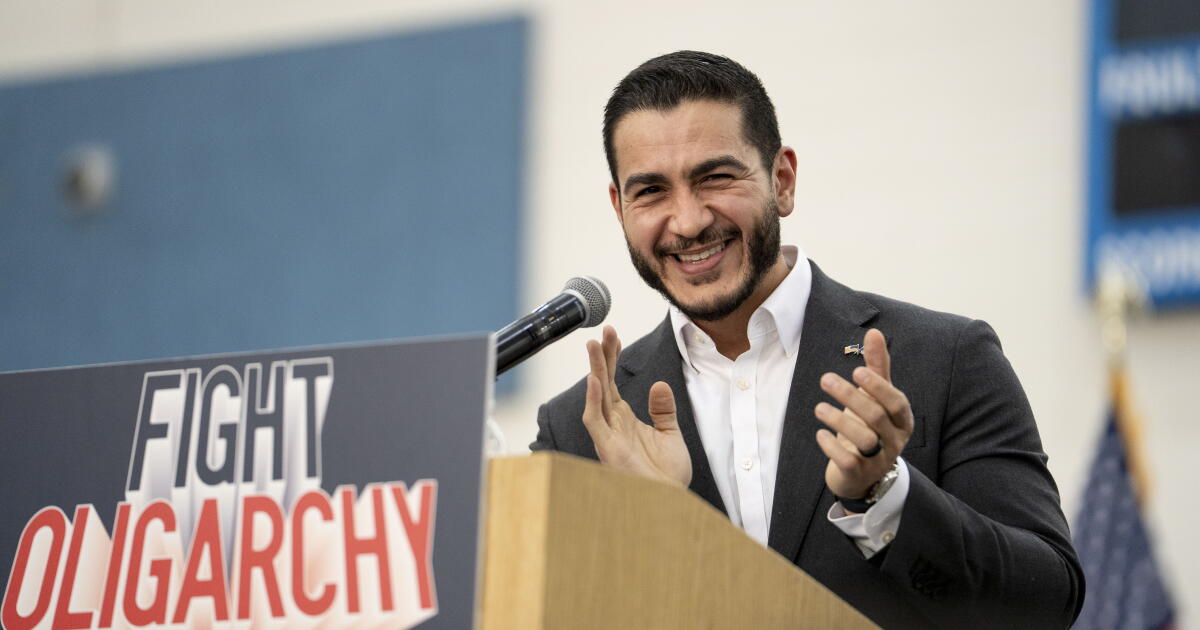
But what seemed over that time span to look like a quixotic effort has lately gained a new foothold in Democratic politics. In Michigan, Abdul El-Sayed, a physician and the Democratic candidate for the U.S. Senate, has placed Medicare for All at the forefront of his campaign.
Americans are increasingly fed up with private health insurers.
— Health insurance reformer Wendell Potter
Discontent with our current healthcare system, which costs twice as much per capita as some other developed countries for materially worse outcomes, is not only a Democratic issue. The hard-right former Rep. Marjorie Taylor Greene (R-Ga.) declared last year on X that she’d like to “see Health Insurance CEOs … getting chewed out on live television.”
Other Republicans, including Sens. Josh Hawley (R-Mo.) and Chuck Grassley (R-Iowa) and Rep. Mark Green (R-Tenn.), have picked up the cudgel against health insurers.
The cost of healthcare under our current system has become a factor in the “affordability” debate, especially since congressional Republicans allowed enhanced premium subsidies for Affordable Care Act plans to expire at the end of last year.
Like most previous iterations of Medicare for All, Sanders’ latest version, which he introduced in April 2025, would effectively outlaw private health insurance for most treatments. The replacement would be a single-payer system in which all U.S. residents would be enrolled. The system would cover hospital and physician services, most prescription drugs, mental health and substance abuse treatment, dental and vision services, long-term care and gender affirming and reproductive care such as contraception and abortions.
There would be no deductibles, co-pays or other forms of cost-sharing, except for some brand-name prescription drugs if generics are available. (Even so, patients’ annual prescription charges would be capped initially at an inflation-adjusted $200 per person.) Private insurers could offer “supplemental” benefits, but couldn’t duplicate coverage provided by the government. States could provide for additional coverage, but would have to pay for it out of their own budgets.
The term “Medicare for All” exploits the popularity of Medicare itself, which kicks in for most people at age 65. In its earliest versions, the idea was simply to allow younger people to enroll in Medicare. But that wouldn’t work very well, because of gaps in that program — it doesn’t cover dental or vision care and has no out-of-pocket cap. Today’s version would expand and improve on Medicare.
What’s the downside, then?
The rap on Medicare for All hasn’t evolved much since 2003. Its principal critics are the health insurance industry (no surprise there) and the same conservative Republicans who have tried repeatedly to repeal the Affordable Care Act. As before, they have mustered lies, misrepresentations and fear-mongering to fight the measure. So let’s examine their arguments.
Health insurers portray themselves as providers of “safe, timely, evidence-based, affordable, and efficient care.” Yet “Americans are increasingly fed up with private health insurers,” observes reform advocate Wendell Potter, citing “complaints about denied care, prior authorization, rising premiums and exorbitant out-of-pocket requirements.” (Potter knows the field — until he experienced his “road-to-Damascus” conversion in 2008, he was the chief PR flack for the health insurance company Cigna.)
The insurers say they bring simplicity and transparency to healthcare, while the truth is the opposite. Trying to find an explanation for why a claim was denied is a fruitless task. Simplicity? To offer a personal example, when a member of my extended family had to schedule a minor diagnostic procedure, they were informed that they’d be receiving four separate bills from providers, including from a surgeon, pathologist, hospital and laboratory, and it was up to them to determine which if any of these providers was within their insurer’s network.
As I wrote in 2019, the health insurance industry hasn’t achieved much beyond establishing itself as a profiteering force within the U.S. healthcare system, driving up costs while failing to improve care. The Affordable Care Act, enacted in 2010, was a crucial step toward reining the insurers in, but partisan opposition killed a proposed “public option” that would have competed with the industry.
The deadliest weapon wielded against Medicare for All is its supposed high cost. The most commonly cited figure is $32.6 trillion over 10 years. This widely debunked figure comes from a 2018 paper by the conservative analyst Charles Blahous of the Koch-associated Mercatus Center of George Mason University.
As I and other critics pointed out at the time, Blahous’ figure applied only to the increase in federal healthcare expenditures. Fair enough: Placing almost all healthcare expenditures in federal hands would certainly increase federal spending.
The flaw in his argument, however, was that it didn’t accommodate the other side of the ledger, which is the savings experienced by individuals, families and businesses by transferring their spending to the government — not to mention the savings that hospitals and physicians would enjoy by no longer having to employ armies of bureaucrats to steer claims to the right insurance companies, or the time-suck facing patients trying to secure coverage.
Those savings, Blahous acknowledged in his paper, would reduce total U.S. healthcare spending — that is, private and government — by $2 trillion over 10 years. In other words, Blahous inadvertently had made the case for Sanders’ Medicare for All proposal. Blahous’ defense was that the reduction was “only” 4% — as though people would consider a $2-trillion reduction in healthcare spending a negligible figure.
One might have expected that the scrutiny Blahous’ math received would put his claim to rest. But it’s still a major component of the anti-Medicare for All argument. It appears, for instance, on the website of the Partnership for America’s Health Care Future, a lobbying organization comprising health insurers and pro-business groups such as local chambers of commerce.
Another common argument is that single-payer systems are inherently inefficient, as evidenced ostensibly by long waits for treatment suffered by patients in single-payer countries such as Canada. Much of that argument is exaggerated, however.
The Wall Street Journal’s editorial board took this bit between its teeth recently with an essay titled “Dying for Medicare for All.” The item asserted that some Medicare and Medicaid cancer patients wait longer for treatment than those with private insurance. Its gist was an attack on single-payer systems such as Medicare and Medicaid.
The piece was based on a recent study from UCLA that found that waiting times for surgery for nonmetastatic breast, colon, lung, pancreatic, gastric and esophageal cancer have lengthened across the board over the last 10 years or so.
The study, however, didn’t attribute the lengthening delays to flaws in the single-payer system, but rather to the increasing complexity of cancer care and changes in hospital practices. It did find that privately insured patients experienced the shortest delays, but those for Medicare patients were only minimally different from the privately insured.
There are no real grounds to doubt that a single-payer system such as Medicare for All would be cheaper and more effective than the hodgepodge we have now. That’s not to say that the reform would be easy: Sanders’ bill anticipates a four-year transition.
There are other concerns, including who would make the decisions about which treatments are suitable for government coverage. Insulating those judgments from healthcare ideologues like Health and Human Services Secretary Robert F. Kennedy Jr., whose anti-vaccine crusade and anti-scientific policies have done immeasurable damage to public health, would be essential.
But one of the pillars of the anti-Medicare for All position, that it’s politically impossible because Americans like their private health insurance so much they’d oppose efforts to replace it, has been crumbling with the passage of time. Democratic majorities in Congress and a Democrat in the White House might find the path easier than it has been for decades. Like El-Sayed, the Democrats should embrace the cause.

“Medicare for All,” that fundamental reform of America’s fractured healthcare system long championed by Sen. Bernie Sanders (I-Vt.) and other progressives, had its heyday about 10 years ago.
That’s when Sanders and Rep. John Conyers (D-Mich.) lined up 140 co-sponsors for a bill that, alas, died in committee, just like the version that Conyers first introduced in 2003. Versions of the same bill have been introduced in every Congress since then, right up through 2025. None got out of committee.
But what seemed over that time span to look like a quixotic effort has lately gained a new foothold in Democratic politics. In Michigan, Abdul El-Sayed, a physician and the Democratic candidate for the U.S. Senate, has placed Medicare for All at the forefront of his campaign.
Americans are increasingly fed up with private health insurers.
— Health insurance reformer Wendell Potter
Discontent with our current healthcare system, which costs twice as much per capita as some other developed countries for materially worse outcomes, is not only a Democratic issue. The hard-right former Rep. Marjorie Taylor Greene (R-Ga.) declared last year on X that she’d like to “see Health Insurance CEOs … getting chewed out on live television.”
Other Republicans, including Sens. Josh Hawley (R-Mo.) and Chuck Grassley (R-Iowa) and Rep. Mark Green (R-Tenn.), have picked up the cudgel against health insurers.
The cost of healthcare under our current system has become a factor in the “affordability” debate, especially since congressional Republicans allowed enhanced premium subsidies for Affordable Care Act plans to expire at the end of last year.
Like most previous iterations of Medicare for All, Sanders’ latest version, which he introduced in April 2025, would effectively outlaw private health insurance for most treatments. The replacement would be a single-payer system in which all U.S. residents would be enrolled. The system would cover hospital and physician services, most prescription drugs, mental health and substance abuse treatment, dental and vision services, long-term care and gender affirming and reproductive care such as contraception and abortions.
There would be no deductibles, co-pays or other forms of cost-sharing, except for some brand-name prescription drugs if generics are available. (Even so, patients’ annual prescription charges would be capped initially at an inflation-adjusted $200 per person.) Private insurers could offer “supplemental” benefits, but couldn’t duplicate coverage provided by the government. States could provide for additional coverage, but would have to pay for it out of their own budgets.
The term “Medicare for All” exploits the popularity of Medicare itself, which kicks in for most people at age 65. In its earliest versions, the idea was simply to allow younger people to enroll in Medicare. But that wouldn’t work very well, because of gaps in that program — it doesn’t cover dental or vision care and has no out-of-pocket cap. Today’s version would expand and improve on Medicare.
What’s the downside, then?
The rap on Medicare for All hasn’t evolved much since 2003. Its principal critics are the health insurance industry (no surprise there) and the same conservative Republicans who have tried repeatedly to repeal the Affordable Care Act. As before, they have mustered lies, misrepresentations and fear-mongering to fight the measure. So let’s examine their arguments.
Health insurers portray themselves as providers of “safe, timely, evidence-based, affordable, and efficient care.” Yet “Americans are increasingly fed up with private health insurers,” observes reform advocate Wendell Potter, citing “complaints about denied care, prior authorization, rising premiums and exorbitant out-of-pocket requirements.” (Potter knows the field — until he experienced his “road-to-Damascus” conversion in 2008, he was the chief PR flack for the health insurance company Cigna.)
The insurers say they bring simplicity and transparency to healthcare, while the truth is the opposite. Trying to find an explanation for why a claim was denied is a fruitless task. Simplicity? To offer a personal example, when a member of my extended family had to schedule a minor diagnostic procedure, they were informed that they’d be receiving four separate bills from providers, including from a surgeon, pathologist, hospital and laboratory, and it was up to them to determine which if any of these providers was within their insurer’s network.
As I wrote in 2019, the health insurance industry hasn’t achieved much beyond establishing itself as a profiteering force within the U.S. healthcare system, driving up costs while failing to improve care. The Affordable Care Act, enacted in 2010, was a crucial step toward reining the insurers in, but partisan opposition killed a proposed “public option” that would have competed with the industry.
The deadliest weapon wielded against Medicare for All is its supposed high cost. The most commonly cited figure is $32.6 trillion over 10 years. This widely debunked figure comes from a 2018 paper by the conservative analyst Charles Blahous of the Koch-associated Mercatus Center of George Mason University.
As I and other critics pointed out at the time, Blahous’ figure applied only to the increase in federal healthcare expenditures. Fair enough: Placing almost all healthcare expenditures in federal hands would certainly increase federal spending.
The flaw in his argument, however, was that it didn’t accommodate the other side of the ledger, which is the savings experienced by individuals, families and businesses by transferring their spending to the government — not to mention the savings that hospitals and physicians would enjoy by no longer having to employ armies of bureaucrats to steer claims to the right insurance companies, or the time-suck facing patients trying to secure coverage.
Those savings, Blahous acknowledged in his paper, would reduce total U.S. healthcare spending — that is, private and government — by $2 trillion over 10 years. In other words, Blahous inadvertently had made the case for Sanders’ Medicare for All proposal. Blahous’ defense was that the reduction was “only” 4% — as though people would consider a $2-trillion reduction in healthcare spending a negligible figure.
One might have expected that the scrutiny Blahous’ math received would put his claim to rest. But it’s still a major component of the anti-Medicare for All argument. It appears, for instance, on the website of the Partnership for America’s Health Care Future, a lobbying organization comprising health insurers and pro-business groups such as local chambers of commerce.
Another common argument is that single-payer systems are inherently inefficient, as evidenced ostensibly by long waits for treatment suffered by patients in single-payer countries such as Canada. Much of that argument is exaggerated, however.
The Wall Street Journal’s editorial board took this bit between its teeth recently with an essay titled “Dying for Medicare for All.” The item asserted that some Medicare and Medicaid cancer patients wait longer for treatment than those with private insurance. Its gist was an attack on single-payer systems such as Medicare and Medicaid.
The piece was based on a recent study from UCLA that found that waiting times for surgery for nonmetastatic breast, colon, lung, pancreatic, gastric and esophageal cancer have lengthened across the board over the last 10 years or so.
The study, however, didn’t attribute the lengthening delays to flaws in the single-payer system, but rather to the increasing complexity of cancer care and changes in hospital practices. It did find that privately insured patients experienced the shortest delays, but those for Medicare patients were only minimally different from the privately insured.
There are no real grounds to doubt that a single-payer system such as Medicare for All would be cheaper and more effective than the hodgepodge we have now. That’s not to say that the reform would be easy: Sanders’ bill anticipates a four-year transition.
There are other concerns, including who would make the decisions about which treatments are suitable for government coverage. Insulating those judgments from healthcare ideologues like Health and Human Services Secretary Robert F. Kennedy Jr., whose anti-vaccine crusade and anti-scientific policies have done immeasurable damage to public health, would be essential.
But one of the pillars of the anti-Medicare for All position, that it’s politically impossible because Americans like their private health insurance so much they’d oppose efforts to replace it, has been crumbling with the passage of time. Democratic majorities in Congress and a Democrat in the White House might find the path easier than it has been for decades. Like El-Sayed, the Democrats should embrace the cause.

“Medicare for All,” that fundamental reform of America’s fractured healthcare system long championed by Sen. Bernie Sanders (I-Vt.) and other progressives, had its heyday about 10 years ago.
That’s when Sanders and Rep. John Conyers (D-Mich.) lined up 140 co-sponsors for a bill that, alas, died in committee, just like the version that Conyers first introduced in 2003. Versions of the same bill have been introduced in every Congress since then, right up through 2025. None got out of committee.
But what seemed over that time span to look like a quixotic effort has lately gained a new foothold in Democratic politics. In Michigan, Abdul El-Sayed, a physician and the Democratic candidate for the U.S. Senate, has placed Medicare for All at the forefront of his campaign.
Americans are increasingly fed up with private health insurers.
— Health insurance reformer Wendell Potter
Discontent with our current healthcare system, which costs twice as much per capita as some other developed countries for materially worse outcomes, is not only a Democratic issue. The hard-right former Rep. Marjorie Taylor Greene (R-Ga.) declared last year on X that she’d like to “see Health Insurance CEOs … getting chewed out on live television.”
Other Republicans, including Sens. Josh Hawley (R-Mo.) and Chuck Grassley (R-Iowa) and Rep. Mark Green (R-Tenn.), have picked up the cudgel against health insurers.
The cost of healthcare under our current system has become a factor in the “affordability” debate, especially since congressional Republicans allowed enhanced premium subsidies for Affordable Care Act plans to expire at the end of last year.
Like most previous iterations of Medicare for All, Sanders’ latest version, which he introduced in April 2025, would effectively outlaw private health insurance for most treatments. The replacement would be a single-payer system in which all U.S. residents would be enrolled. The system would cover hospital and physician services, most prescription drugs, mental health and substance abuse treatment, dental and vision services, long-term care and gender affirming and reproductive care such as contraception and abortions.
There would be no deductibles, co-pays or other forms of cost-sharing, except for some brand-name prescription drugs if generics are available. (Even so, patients’ annual prescription charges would be capped initially at an inflation-adjusted $200 per person.) Private insurers could offer “supplemental” benefits, but couldn’t duplicate coverage provided by the government. States could provide for additional coverage, but would have to pay for it out of their own budgets.
The term “Medicare for All” exploits the popularity of Medicare itself, which kicks in for most people at age 65. In its earliest versions, the idea was simply to allow younger people to enroll in Medicare. But that wouldn’t work very well, because of gaps in that program — it doesn’t cover dental or vision care and has no out-of-pocket cap. Today’s version would expand and improve on Medicare.
What’s the downside, then?
The rap on Medicare for All hasn’t evolved much since 2003. Its principal critics are the health insurance industry (no surprise there) and the same conservative Republicans who have tried repeatedly to repeal the Affordable Care Act. As before, they have mustered lies, misrepresentations and fear-mongering to fight the measure. So let’s examine their arguments.
Health insurers portray themselves as providers of “safe, timely, evidence-based, affordable, and efficient care.” Yet “Americans are increasingly fed up with private health insurers,” observes reform advocate Wendell Potter, citing “complaints about denied care, prior authorization, rising premiums and exorbitant out-of-pocket requirements.” (Potter knows the field — until he experienced his “road-to-Damascus” conversion in 2008, he was the chief PR flack for the health insurance company Cigna.)
The insurers say they bring simplicity and transparency to healthcare, while the truth is the opposite. Trying to find an explanation for why a claim was denied is a fruitless task. Simplicity? To offer a personal example, when a member of my extended family had to schedule a minor diagnostic procedure, they were informed that they’d be receiving four separate bills from providers, including from a surgeon, pathologist, hospital and laboratory, and it was up to them to determine which if any of these providers was within their insurer’s network.
As I wrote in 2019, the health insurance industry hasn’t achieved much beyond establishing itself as a profiteering force within the U.S. healthcare system, driving up costs while failing to improve care. The Affordable Care Act, enacted in 2010, was a crucial step toward reining the insurers in, but partisan opposition killed a proposed “public option” that would have competed with the industry.
The deadliest weapon wielded against Medicare for All is its supposed high cost. The most commonly cited figure is $32.6 trillion over 10 years. This widely debunked figure comes from a 2018 paper by the conservative analyst Charles Blahous of the Koch-associated Mercatus Center of George Mason University.
As I and other critics pointed out at the time, Blahous’ figure applied only to the increase in federal healthcare expenditures. Fair enough: Placing almost all healthcare expenditures in federal hands would certainly increase federal spending.
The flaw in his argument, however, was that it didn’t accommodate the other side of the ledger, which is the savings experienced by individuals, families and businesses by transferring their spending to the government — not to mention the savings that hospitals and physicians would enjoy by no longer having to employ armies of bureaucrats to steer claims to the right insurance companies, or the time-suck facing patients trying to secure coverage.
Those savings, Blahous acknowledged in his paper, would reduce total U.S. healthcare spending — that is, private and government — by $2 trillion over 10 years. In other words, Blahous inadvertently had made the case for Sanders’ Medicare for All proposal. Blahous’ defense was that the reduction was “only” 4% — as though people would consider a $2-trillion reduction in healthcare spending a negligible figure.
One might have expected that the scrutiny Blahous’ math received would put his claim to rest. But it’s still a major component of the anti-Medicare for All argument. It appears, for instance, on the website of the Partnership for America’s Health Care Future, a lobbying organization comprising health insurers and pro-business groups such as local chambers of commerce.
Another common argument is that single-payer systems are inherently inefficient, as evidenced ostensibly by long waits for treatment suffered by patients in single-payer countries such as Canada. Much of that argument is exaggerated, however.
The Wall Street Journal’s editorial board took this bit between its teeth recently with an essay titled “Dying for Medicare for All.” The item asserted that some Medicare and Medicaid cancer patients wait longer for treatment than those with private insurance. Its gist was an attack on single-payer systems such as Medicare and Medicaid.
The piece was based on a recent study from UCLA that found that waiting times for surgery for nonmetastatic breast, colon, lung, pancreatic, gastric and esophageal cancer have lengthened across the board over the last 10 years or so.
The study, however, didn’t attribute the lengthening delays to flaws in the single-payer system, but rather to the increasing complexity of cancer care and changes in hospital practices. It did find that privately insured patients experienced the shortest delays, but those for Medicare patients were only minimally different from the privately insured.
There are no real grounds to doubt that a single-payer system such as Medicare for All would be cheaper and more effective than the hodgepodge we have now. That’s not to say that the reform would be easy: Sanders’ bill anticipates a four-year transition.
There are other concerns, including who would make the decisions about which treatments are suitable for government coverage. Insulating those judgments from healthcare ideologues like Health and Human Services Secretary Robert F. Kennedy Jr., whose anti-vaccine crusade and anti-scientific policies have done immeasurable damage to public health, would be essential.
But one of the pillars of the anti-Medicare for All position, that it’s politically impossible because Americans like their private health insurance so much they’d oppose efforts to replace it, has been crumbling with the passage of time. Democratic majorities in Congress and a Democrat in the White House might find the path easier than it has been for decades. Like El-Sayed, the Democrats should embrace the cause.
“Medicare for All,” that fundamental reform of America’s fractured healthcare system long championed by Sen. Bernie Sanders (I-Vt.) and other progressives, had its heyday about 10 years ago.
That’s when Sanders and Rep. John Conyers (D-Mich.) lined up 140 co-sponsors for a bill that, alas, died in committee, just like the version that Conyers first introduced in 2003. Versions of the same bill have been introduced in every Congress since then, right up through 2025. None got out of committee.
But what seemed over that time span to look like a quixotic effort has lately gained a new foothold in Democratic politics. In Michigan, Abdul El-Sayed, a physician and the Democratic candidate for the U.S. Senate, has placed Medicare for All at the forefront of his campaign.
Americans are increasingly fed up with private health insurers.
— Health insurance reformer Wendell Potter
Discontent with our current healthcare system, which costs twice as much per capita as some other developed countries for materially worse outcomes, is not only a Democratic issue. The hard-right former Rep. Marjorie Taylor Greene (R-Ga.) declared last year on X that she’d like to “see Health Insurance CEOs … getting chewed out on live television.”
Other Republicans, including Sens. Josh Hawley (R-Mo.) and Chuck Grassley (R-Iowa) and Rep. Mark Green (R-Tenn.), have picked up the cudgel against health insurers.
The cost of healthcare under our current system has become a factor in the “affordability” debate, especially since congressional Republicans allowed enhanced premium subsidies for Affordable Care Act plans to expire at the end of last year.
Like most previous iterations of Medicare for All, Sanders’ latest version, which he introduced in April 2025, would effectively outlaw private health insurance for most treatments. The replacement would be a single-payer system in which all U.S. residents would be enrolled. The system would cover hospital and physician services, most prescription drugs, mental health and substance abuse treatment, dental and vision services, long-term care and gender affirming and reproductive care such as contraception and abortions.
There would be no deductibles, co-pays or other forms of cost-sharing, except for some brand-name prescription drugs if generics are available. (Even so, patients’ annual prescription charges would be capped initially at an inflation-adjusted $200 per person.) Private insurers could offer “supplemental” benefits, but couldn’t duplicate coverage provided by the government. States could provide for additional coverage, but would have to pay for it out of their own budgets.
The term “Medicare for All” exploits the popularity of Medicare itself, which kicks in for most people at age 65. In its earliest versions, the idea was simply to allow younger people to enroll in Medicare. But that wouldn’t work very well, because of gaps in that program — it doesn’t cover dental or vision care and has no out-of-pocket cap. Today’s version would expand and improve on Medicare.
What’s the downside, then?
The rap on Medicare for All hasn’t evolved much since 2003. Its principal critics are the health insurance industry (no surprise there) and the same conservative Republicans who have tried repeatedly to repeal the Affordable Care Act. As before, they have mustered lies, misrepresentations and fear-mongering to fight the measure. So let’s examine their arguments.
Health insurers portray themselves as providers of “safe, timely, evidence-based, affordable, and efficient care.” Yet “Americans are increasingly fed up with private health insurers,” observes reform advocate Wendell Potter, citing “complaints about denied care, prior authorization, rising premiums and exorbitant out-of-pocket requirements.” (Potter knows the field — until he experienced his “road-to-Damascus” conversion in 2008, he was the chief PR flack for the health insurance company Cigna.)
The insurers say they bring simplicity and transparency to healthcare, while the truth is the opposite. Trying to find an explanation for why a claim was denied is a fruitless task. Simplicity? To offer a personal example, when a member of my extended family had to schedule a minor diagnostic procedure, they were informed that they’d be receiving four separate bills from providers, including from a surgeon, pathologist, hospital and laboratory, and it was up to them to determine which if any of these providers was within their insurer’s network.
As I wrote in 2019, the health insurance industry hasn’t achieved much beyond establishing itself as a profiteering force within the U.S. healthcare system, driving up costs while failing to improve care. The Affordable Care Act, enacted in 2010, was a crucial step toward reining the insurers in, but partisan opposition killed a proposed “public option” that would have competed with the industry.
The deadliest weapon wielded against Medicare for All is its supposed high cost. The most commonly cited figure is $32.6 trillion over 10 years. This widely debunked figure comes from a 2018 paper by the conservative analyst Charles Blahous of the Koch-associated Mercatus Center of George Mason University.
As I and other critics pointed out at the time, Blahous’ figure applied only to the increase in federal healthcare expenditures. Fair enough: Placing almost all healthcare expenditures in federal hands would certainly increase federal spending.
The flaw in his argument, however, was that it didn’t accommodate the other side of the ledger, which is the savings experienced by individuals, families and businesses by transferring their spending to the government — not to mention the savings that hospitals and physicians would enjoy by no longer having to employ armies of bureaucrats to steer claims to the right insurance companies, or the time-suck facing patients trying to secure coverage.
Those savings, Blahous acknowledged in his paper, would reduce total U.S. healthcare spending — that is, private and government — by $2 trillion over 10 years. In other words, Blahous inadvertently had made the case for Sanders’ Medicare for All proposal. Blahous’ defense was that the reduction was “only” 4% — as though people would consider a $2-trillion reduction in healthcare spending a negligible figure.
One might have expected that the scrutiny Blahous’ math received would put his claim to rest. But it’s still a major component of the anti-Medicare for All argument. It appears, for instance, on the website of the Partnership for America’s Health Care Future, a lobbying organization comprising health insurers and pro-business groups such as local chambers of commerce.
Another common argument is that single-payer systems are inherently inefficient, as evidenced ostensibly by long waits for treatment suffered by patients in single-payer countries such as Canada. Much of that argument is exaggerated, however.
The Wall Street Journal’s editorial board took this bit between its teeth recently with an essay titled “Dying for Medicare for All.” The item asserted that some Medicare and Medicaid cancer patients wait longer for treatment than those with private insurance. Its gist was an attack on single-payer systems such as Medicare and Medicaid.
The piece was based on a recent study from UCLA that found that waiting times for surgery for nonmetastatic breast, colon, lung, pancreatic, gastric and esophageal cancer have lengthened across the board over the last 10 years or so.
The study, however, didn’t attribute the lengthening delays to flaws in the single-payer system, but rather to the increasing complexity of cancer care and changes in hospital practices. It did find that privately insured patients experienced the shortest delays, but those for Medicare patients were only minimally different from the privately insured.
There are no real grounds to doubt that a single-payer system such as Medicare for All would be cheaper and more effective than the hodgepodge we have now. That’s not to say that the reform would be easy: Sanders’ bill anticipates a four-year transition.
There are other concerns, including who would make the decisions about which treatments are suitable for government coverage. Insulating those judgments from healthcare ideologues like Health and Human Services Secretary Robert F. Kennedy Jr., whose anti-vaccine crusade and anti-scientific policies have done immeasurable damage to public health, would be essential.
But one of the pillars of the anti-Medicare for All position, that it’s politically impossible because Americans like their private health insurance so much they’d oppose efforts to replace it, has been crumbling with the passage of time. Democratic majorities in Congress and a Democrat in the White House might find the path easier than it has been for decades. Like El-Sayed, the Democrats should embrace the cause.

“Medicare for All,” that fundamental reform of America’s fractured healthcare system long championed by Sen. Bernie Sanders (I-Vt.) and other progressives, had its heyday about 10 years ago.
That’s when Sanders and Rep. John Conyers (D-Mich.) lined up 140 co-sponsors for a bill that, alas, died in committee, just like the version that Conyers first introduced in 2003. Versions of the same bill have been introduced in every Congress since then, right up through 2025. None got out of committee.
But what seemed over that time span to look like a quixotic effort has lately gained a new foothold in Democratic politics. In Michigan, Abdul El-Sayed, a physician and the Democratic candidate for the U.S. Senate, has placed Medicare for All at the forefront of his campaign.
Americans are increasingly fed up with private health insurers.
— Health insurance reformer Wendell Potter
Discontent with our current healthcare system, which costs twice as much per capita as some other developed countries for materially worse outcomes, is not only a Democratic issue. The hard-right former Rep. Marjorie Taylor Greene (R-Ga.) declared last year on X that she’d like to “see Health Insurance CEOs … getting chewed out on live television.”
Other Republicans, including Sens. Josh Hawley (R-Mo.) and Chuck Grassley (R-Iowa) and Rep. Mark Green (R-Tenn.), have picked up the cudgel against health insurers.
The cost of healthcare under our current system has become a factor in the “affordability” debate, especially since congressional Republicans allowed enhanced premium subsidies for Affordable Care Act plans to expire at the end of last year.
Like most previous iterations of Medicare for All, Sanders’ latest version, which he introduced in April 2025, would effectively outlaw private health insurance for most treatments. The replacement would be a single-payer system in which all U.S. residents would be enrolled. The system would cover hospital and physician services, most prescription drugs, mental health and substance abuse treatment, dental and vision services, long-term care and gender affirming and reproductive care such as contraception and abortions.
There would be no deductibles, co-pays or other forms of cost-sharing, except for some brand-name prescription drugs if generics are available. (Even so, patients’ annual prescription charges would be capped initially at an inflation-adjusted $200 per person.) Private insurers could offer “supplemental” benefits, but couldn’t duplicate coverage provided by the government. States could provide for additional coverage, but would have to pay for it out of their own budgets.
The term “Medicare for All” exploits the popularity of Medicare itself, which kicks in for most people at age 65. In its earliest versions, the idea was simply to allow younger people to enroll in Medicare. But that wouldn’t work very well, because of gaps in that program — it doesn’t cover dental or vision care and has no out-of-pocket cap. Today’s version would expand and improve on Medicare.
What’s the downside, then?
The rap on Medicare for All hasn’t evolved much since 2003. Its principal critics are the health insurance industry (no surprise there) and the same conservative Republicans who have tried repeatedly to repeal the Affordable Care Act. As before, they have mustered lies, misrepresentations and fear-mongering to fight the measure. So let’s examine their arguments.
Health insurers portray themselves as providers of “safe, timely, evidence-based, affordable, and efficient care.” Yet “Americans are increasingly fed up with private health insurers,” observes reform advocate Wendell Potter, citing “complaints about denied care, prior authorization, rising premiums and exorbitant out-of-pocket requirements.” (Potter knows the field — until he experienced his “road-to-Damascus” conversion in 2008, he was the chief PR flack for the health insurance company Cigna.)
The insurers say they bring simplicity and transparency to healthcare, while the truth is the opposite. Trying to find an explanation for why a claim was denied is a fruitless task. Simplicity? To offer a personal example, when a member of my extended family had to schedule a minor diagnostic procedure, they were informed that they’d be receiving four separate bills from providers, including from a surgeon, pathologist, hospital and laboratory, and it was up to them to determine which if any of these providers was within their insurer’s network.
As I wrote in 2019, the health insurance industry hasn’t achieved much beyond establishing itself as a profiteering force within the U.S. healthcare system, driving up costs while failing to improve care. The Affordable Care Act, enacted in 2010, was a crucial step toward reining the insurers in, but partisan opposition killed a proposed “public option” that would have competed with the industry.
The deadliest weapon wielded against Medicare for All is its supposed high cost. The most commonly cited figure is $32.6 trillion over 10 years. This widely debunked figure comes from a 2018 paper by the conservative analyst Charles Blahous of the Koch-associated Mercatus Center of George Mason University.
As I and other critics pointed out at the time, Blahous’ figure applied only to the increase in federal healthcare expenditures. Fair enough: Placing almost all healthcare expenditures in federal hands would certainly increase federal spending.
The flaw in his argument, however, was that it didn’t accommodate the other side of the ledger, which is the savings experienced by individuals, families and businesses by transferring their spending to the government — not to mention the savings that hospitals and physicians would enjoy by no longer having to employ armies of bureaucrats to steer claims to the right insurance companies, or the time-suck facing patients trying to secure coverage.
Those savings, Blahous acknowledged in his paper, would reduce total U.S. healthcare spending — that is, private and government — by $2 trillion over 10 years. In other words, Blahous inadvertently had made the case for Sanders’ Medicare for All proposal. Blahous’ defense was that the reduction was “only” 4% — as though people would consider a $2-trillion reduction in healthcare spending a negligible figure.
One might have expected that the scrutiny Blahous’ math received would put his claim to rest. But it’s still a major component of the anti-Medicare for All argument. It appears, for instance, on the website of the Partnership for America’s Health Care Future, a lobbying organization comprising health insurers and pro-business groups such as local chambers of commerce.
Another common argument is that single-payer systems are inherently inefficient, as evidenced ostensibly by long waits for treatment suffered by patients in single-payer countries such as Canada. Much of that argument is exaggerated, however.
The Wall Street Journal’s editorial board took this bit between its teeth recently with an essay titled “Dying for Medicare for All.” The item asserted that some Medicare and Medicaid cancer patients wait longer for treatment than those with private insurance. Its gist was an attack on single-payer systems such as Medicare and Medicaid.
The piece was based on a recent study from UCLA that found that waiting times for surgery for nonmetastatic breast, colon, lung, pancreatic, gastric and esophageal cancer have lengthened across the board over the last 10 years or so.
The study, however, didn’t attribute the lengthening delays to flaws in the single-payer system, but rather to the increasing complexity of cancer care and changes in hospital practices. It did find that privately insured patients experienced the shortest delays, but those for Medicare patients were only minimally different from the privately insured.
There are no real grounds to doubt that a single-payer system such as Medicare for All would be cheaper and more effective than the hodgepodge we have now. That’s not to say that the reform would be easy: Sanders’ bill anticipates a four-year transition.
There are other concerns, including who would make the decisions about which treatments are suitable for government coverage. Insulating those judgments from healthcare ideologues like Health and Human Services Secretary Robert F. Kennedy Jr., whose anti-vaccine crusade and anti-scientific policies have done immeasurable damage to public health, would be essential.
But one of the pillars of the anti-Medicare for All position, that it’s politically impossible because Americans like their private health insurance so much they’d oppose efforts to replace it, has been crumbling with the passage of time. Democratic majorities in Congress and a Democrat in the White House might find the path easier than it has been for decades. Like El-Sayed, the Democrats should embrace the cause.
“Medicare for All,” that fundamental reform of America’s fractured healthcare system long championed by Sen. Bernie Sanders (I-Vt.) and other progressives, had its heyday about 10 years ago.
That’s when Sanders and Rep. John Conyers (D-Mich.) lined up 140 co-sponsors for a bill that, alas, died in committee, just like the version that Conyers first introduced in 2003. Versions of the same bill have been introduced in every Congress since then, right up through 2025. None got out of committee.
But what seemed over that time span to look like a quixotic effort has lately gained a new foothold in Democratic politics. In Michigan, Abdul El-Sayed, a physician and the Democratic candidate for the U.S. Senate, has placed Medicare for All at the forefront of his campaign.
Americans are increasingly fed up with private health insurers.
— Health insurance reformer Wendell Potter
Discontent with our current healthcare system, which costs twice as much per capita as some other developed countries for materially worse outcomes, is not only a Democratic issue. The hard-right former Rep. Marjorie Taylor Greene (R-Ga.) declared last year on X that she’d like to “see Health Insurance CEOs … getting chewed out on live television.”
Other Republicans, including Sens. Josh Hawley (R-Mo.) and Chuck Grassley (R-Iowa) and Rep. Mark Green (R-Tenn.), have picked up the cudgel against health insurers.
The cost of healthcare under our current system has become a factor in the “affordability” debate, especially since congressional Republicans allowed enhanced premium subsidies for Affordable Care Act plans to expire at the end of last year.
Like most previous iterations of Medicare for All, Sanders’ latest version, which he introduced in April 2025, would effectively outlaw private health insurance for most treatments. The replacement would be a single-payer system in which all U.S. residents would be enrolled. The system would cover hospital and physician services, most prescription drugs, mental health and substance abuse treatment, dental and vision services, long-term care and gender affirming and reproductive care such as contraception and abortions.
There would be no deductibles, co-pays or other forms of cost-sharing, except for some brand-name prescription drugs if generics are available. (Even so, patients’ annual prescription charges would be capped initially at an inflation-adjusted $200 per person.) Private insurers could offer “supplemental” benefits, but couldn’t duplicate coverage provided by the government. States could provide for additional coverage, but would have to pay for it out of their own budgets.
The term “Medicare for All” exploits the popularity of Medicare itself, which kicks in for most people at age 65. In its earliest versions, the idea was simply to allow younger people to enroll in Medicare. But that wouldn’t work very well, because of gaps in that program — it doesn’t cover dental or vision care and has no out-of-pocket cap. Today’s version would expand and improve on Medicare.
What’s the downside, then?
The rap on Medicare for All hasn’t evolved much since 2003. Its principal critics are the health insurance industry (no surprise there) and the same conservative Republicans who have tried repeatedly to repeal the Affordable Care Act. As before, they have mustered lies, misrepresentations and fear-mongering to fight the measure. So let’s examine their arguments.
Health insurers portray themselves as providers of “safe, timely, evidence-based, affordable, and efficient care.” Yet “Americans are increasingly fed up with private health insurers,” observes reform advocate Wendell Potter, citing “complaints about denied care, prior authorization, rising premiums and exorbitant out-of-pocket requirements.” (Potter knows the field — until he experienced his “road-to-Damascus” conversion in 2008, he was the chief PR flack for the health insurance company Cigna.)
The insurers say they bring simplicity and transparency to healthcare, while the truth is the opposite. Trying to find an explanation for why a claim was denied is a fruitless task. Simplicity? To offer a personal example, when a member of my extended family had to schedule a minor diagnostic procedure, they were informed that they’d be receiving four separate bills from providers, including from a surgeon, pathologist, hospital and laboratory, and it was up to them to determine which if any of these providers was within their insurer’s network.
As I wrote in 2019, the health insurance industry hasn’t achieved much beyond establishing itself as a profiteering force within the U.S. healthcare system, driving up costs while failing to improve care. The Affordable Care Act, enacted in 2010, was a crucial step toward reining the insurers in, but partisan opposition killed a proposed “public option” that would have competed with the industry.
The deadliest weapon wielded against Medicare for All is its supposed high cost. The most commonly cited figure is $32.6 trillion over 10 years. This widely debunked figure comes from a 2018 paper by the conservative analyst Charles Blahous of the Koch-associated Mercatus Center of George Mason University.
As I and other critics pointed out at the time, Blahous’ figure applied only to the increase in federal healthcare expenditures. Fair enough: Placing almost all healthcare expenditures in federal hands would certainly increase federal spending.
The flaw in his argument, however, was that it didn’t accommodate the other side of the ledger, which is the savings experienced by individuals, families and businesses by transferring their spending to the government — not to mention the savings that hospitals and physicians would enjoy by no longer having to employ armies of bureaucrats to steer claims to the right insurance companies, or the time-suck facing patients trying to secure coverage.
Those savings, Blahous acknowledged in his paper, would reduce total U.S. healthcare spending — that is, private and government — by $2 trillion over 10 years. In other words, Blahous inadvertently had made the case for Sanders’ Medicare for All proposal. Blahous’ defense was that the reduction was “only” 4% — as though people would consider a $2-trillion reduction in healthcare spending a negligible figure.
One might have expected that the scrutiny Blahous’ math received would put his claim to rest. But it’s still a major component of the anti-Medicare for All argument. It appears, for instance, on the website of the Partnership for America’s Health Care Future, a lobbying organization comprising health insurers and pro-business groups such as local chambers of commerce.
Another common argument is that single-payer systems are inherently inefficient, as evidenced ostensibly by long waits for treatment suffered by patients in single-payer countries such as Canada. Much of that argument is exaggerated, however.
The Wall Street Journal’s editorial board took this bit between its teeth recently with an essay titled “Dying for Medicare for All.” The item asserted that some Medicare and Medicaid cancer patients wait longer for treatment than those with private insurance. Its gist was an attack on single-payer systems such as Medicare and Medicaid.
The piece was based on a recent study from UCLA that found that waiting times for surgery for nonmetastatic breast, colon, lung, pancreatic, gastric and esophageal cancer have lengthened across the board over the last 10 years or so.
The study, however, didn’t attribute the lengthening delays to flaws in the single-payer system, but rather to the increasing complexity of cancer care and changes in hospital practices. It did find that privately insured patients experienced the shortest delays, but those for Medicare patients were only minimally different from the privately insured.
There are no real grounds to doubt that a single-payer system such as Medicare for All would be cheaper and more effective than the hodgepodge we have now. That’s not to say that the reform would be easy: Sanders’ bill anticipates a four-year transition.
There are other concerns, including who would make the decisions about which treatments are suitable for government coverage. Insulating those judgments from healthcare ideologues like Health and Human Services Secretary Robert F. Kennedy Jr., whose anti-vaccine crusade and anti-scientific policies have done immeasurable damage to public health, would be essential.
But one of the pillars of the anti-Medicare for All position, that it’s politically impossible because Americans like their private health insurance so much they’d oppose efforts to replace it, has been crumbling with the passage of time. Democratic majorities in Congress and a Democrat in the White House might find the path easier than it has been for decades. Like El-Sayed, the Democrats should embrace the cause.
“Medicare for All,” that fundamental reform of America’s fractured healthcare system long championed by Sen. Bernie Sanders (I-Vt.) and other progressives, had its heyday about 10 years ago.
That’s when Sanders and Rep. John Conyers (D-Mich.) lined up 140 co-sponsors for a bill that, alas, died in committee, just like the version that Conyers first introduced in 2003. Versions of the same bill have been introduced in every Congress since then, right up through 2025. None got out of committee.
But what seemed over that time span to look like a quixotic effort has lately gained a new foothold in Democratic politics. In Michigan, Abdul El-Sayed, a physician and the Democratic candidate for the U.S. Senate, has placed Medicare for All at the forefront of his campaign.
Americans are increasingly fed up with private health insurers.
— Health insurance reformer Wendell Potter
Discontent with our current healthcare system, which costs twice as much per capita as some other developed countries for materially worse outcomes, is not only a Democratic issue. The hard-right former Rep. Marjorie Taylor Greene (R-Ga.) declared last year on X that she’d like to “see Health Insurance CEOs … getting chewed out on live television.”
Other Republicans, including Sens. Josh Hawley (R-Mo.) and Chuck Grassley (R-Iowa) and Rep. Mark Green (R-Tenn.), have picked up the cudgel against health insurers.
The cost of healthcare under our current system has become a factor in the “affordability” debate, especially since congressional Republicans allowed enhanced premium subsidies for Affordable Care Act plans to expire at the end of last year.
Like most previous iterations of Medicare for All, Sanders’ latest version, which he introduced in April 2025, would effectively outlaw private health insurance for most treatments. The replacement would be a single-payer system in which all U.S. residents would be enrolled. The system would cover hospital and physician services, most prescription drugs, mental health and substance abuse treatment, dental and vision services, long-term care and gender affirming and reproductive care such as contraception and abortions.
There would be no deductibles, co-pays or other forms of cost-sharing, except for some brand-name prescription drugs if generics are available. (Even so, patients’ annual prescription charges would be capped initially at an inflation-adjusted $200 per person.) Private insurers could offer “supplemental” benefits, but couldn’t duplicate coverage provided by the government. States could provide for additional coverage, but would have to pay for it out of their own budgets.
The term “Medicare for All” exploits the popularity of Medicare itself, which kicks in for most people at age 65. In its earliest versions, the idea was simply to allow younger people to enroll in Medicare. But that wouldn’t work very well, because of gaps in that program — it doesn’t cover dental or vision care and has no out-of-pocket cap. Today’s version would expand and improve on Medicare.
What’s the downside, then?
The rap on Medicare for All hasn’t evolved much since 2003. Its principal critics are the health insurance industry (no surprise there) and the same conservative Republicans who have tried repeatedly to repeal the Affordable Care Act. As before, they have mustered lies, misrepresentations and fear-mongering to fight the measure. So let’s examine their arguments.
Health insurers portray themselves as providers of “safe, timely, evidence-based, affordable, and efficient care.” Yet “Americans are increasingly fed up with private health insurers,” observes reform advocate Wendell Potter, citing “complaints about denied care, prior authorization, rising premiums and exorbitant out-of-pocket requirements.” (Potter knows the field — until he experienced his “road-to-Damascus” conversion in 2008, he was the chief PR flack for the health insurance company Cigna.)
The insurers say they bring simplicity and transparency to healthcare, while the truth is the opposite. Trying to find an explanation for why a claim was denied is a fruitless task. Simplicity? To offer a personal example, when a member of my extended family had to schedule a minor diagnostic procedure, they were informed that they’d be receiving four separate bills from providers, including from a surgeon, pathologist, hospital and laboratory, and it was up to them to determine which if any of these providers was within their insurer’s network.
As I wrote in 2019, the health insurance industry hasn’t achieved much beyond establishing itself as a profiteering force within the U.S. healthcare system, driving up costs while failing to improve care. The Affordable Care Act, enacted in 2010, was a crucial step toward reining the insurers in, but partisan opposition killed a proposed “public option” that would have competed with the industry.
The deadliest weapon wielded against Medicare for All is its supposed high cost. The most commonly cited figure is $32.6 trillion over 10 years. This widely debunked figure comes from a 2018 paper by the conservative analyst Charles Blahous of the Koch-associated Mercatus Center of George Mason University.
As I and other critics pointed out at the time, Blahous’ figure applied only to the increase in federal healthcare expenditures. Fair enough: Placing almost all healthcare expenditures in federal hands would certainly increase federal spending.
The flaw in his argument, however, was that it didn’t accommodate the other side of the ledger, which is the savings experienced by individuals, families and businesses by transferring their spending to the government — not to mention the savings that hospitals and physicians would enjoy by no longer having to employ armies of bureaucrats to steer claims to the right insurance companies, or the time-suck facing patients trying to secure coverage.
Those savings, Blahous acknowledged in his paper, would reduce total U.S. healthcare spending — that is, private and government — by $2 trillion over 10 years. In other words, Blahous inadvertently had made the case for Sanders’ Medicare for All proposal. Blahous’ defense was that the reduction was “only” 4% — as though people would consider a $2-trillion reduction in healthcare spending a negligible figure.
One might have expected that the scrutiny Blahous’ math received would put his claim to rest. But it’s still a major component of the anti-Medicare for All argument. It appears, for instance, on the website of the Partnership for America’s Health Care Future, a lobbying organization comprising health insurers and pro-business groups such as local chambers of commerce.
Another common argument is that single-payer systems are inherently inefficient, as evidenced ostensibly by long waits for treatment suffered by patients in single-payer countries such as Canada. Much of that argument is exaggerated, however.
The Wall Street Journal’s editorial board took this bit between its teeth recently with an essay titled “Dying for Medicare for All.” The item asserted that some Medicare and Medicaid cancer patients wait longer for treatment than those with private insurance. Its gist was an attack on single-payer systems such as Medicare and Medicaid.
The piece was based on a recent study from UCLA that found that waiting times for surgery for nonmetastatic breast, colon, lung, pancreatic, gastric and esophageal cancer have lengthened across the board over the last 10 years or so.
The study, however, didn’t attribute the lengthening delays to flaws in the single-payer system, but rather to the increasing complexity of cancer care and changes in hospital practices. It did find that privately insured patients experienced the shortest delays, but those for Medicare patients were only minimally different from the privately insured.
There are no real grounds to doubt that a single-payer system such as Medicare for All would be cheaper and more effective than the hodgepodge we have now. That’s not to say that the reform would be easy: Sanders’ bill anticipates a four-year transition.
There are other concerns, including who would make the decisions about which treatments are suitable for government coverage. Insulating those judgments from healthcare ideologues like Health and Human Services Secretary Robert F. Kennedy Jr., whose anti-vaccine crusade and anti-scientific policies have done immeasurable damage to public health, would be essential.
But one of the pillars of the anti-Medicare for All position, that it’s politically impossible because Americans like their private health insurance so much they’d oppose efforts to replace it, has been crumbling with the passage of time. Democratic majorities in Congress and a Democrat in the White House might find the path easier than it has been for decades. Like El-Sayed, the Democrats should embrace the cause.
“Medicare for All,” that fundamental reform of America’s fractured healthcare system long championed by Sen. Bernie Sanders (I-Vt.) and other progressives, had its heyday about 10 years ago.
That’s when Sanders and Rep. John Conyers (D-Mich.) lined up 140 co-sponsors for a bill that, alas, died in committee, just like the version that Conyers first introduced in 2003. Versions of the same bill have been introduced in every Congress since then, right up through 2025. None got out of committee.
But what seemed over that time span to look like a quixotic effort has lately gained a new foothold in Democratic politics. In Michigan, Abdul El-Sayed, a physician and the Democratic candidate for the U.S. Senate, has placed Medicare for All at the forefront of his campaign.
Americans are increasingly fed up with private health insurers.
— Health insurance reformer Wendell Potter
Discontent with our current healthcare system, which costs twice as much per capita as some other developed countries for materially worse outcomes, is not only a Democratic issue. The hard-right former Rep. Marjorie Taylor Greene (R-Ga.) declared last year on X that she’d like to “see Health Insurance CEOs … getting chewed out on live television.”
Other Republicans, including Sens. Josh Hawley (R-Mo.) and Chuck Grassley (R-Iowa) and Rep. Mark Green (R-Tenn.), have picked up the cudgel against health insurers.
The cost of healthcare under our current system has become a factor in the “affordability” debate, especially since congressional Republicans allowed enhanced premium subsidies for Affordable Care Act plans to expire at the end of last year.
Like most previous iterations of Medicare for All, Sanders’ latest version, which he introduced in April 2025, would effectively outlaw private health insurance for most treatments. The replacement would be a single-payer system in which all U.S. residents would be enrolled. The system would cover hospital and physician services, most prescription drugs, mental health and substance abuse treatment, dental and vision services, long-term care and gender affirming and reproductive care such as contraception and abortions.
There would be no deductibles, co-pays or other forms of cost-sharing, except for some brand-name prescription drugs if generics are available. (Even so, patients’ annual prescription charges would be capped initially at an inflation-adjusted $200 per person.) Private insurers could offer “supplemental” benefits, but couldn’t duplicate coverage provided by the government. States could provide for additional coverage, but would have to pay for it out of their own budgets.
The term “Medicare for All” exploits the popularity of Medicare itself, which kicks in for most people at age 65. In its earliest versions, the idea was simply to allow younger people to enroll in Medicare. But that wouldn’t work very well, because of gaps in that program — it doesn’t cover dental or vision care and has no out-of-pocket cap. Today’s version would expand and improve on Medicare.
What’s the downside, then?
The rap on Medicare for All hasn’t evolved much since 2003. Its principal critics are the health insurance industry (no surprise there) and the same conservative Republicans who have tried repeatedly to repeal the Affordable Care Act. As before, they have mustered lies, misrepresentations and fear-mongering to fight the measure. So let’s examine their arguments.
Health insurers portray themselves as providers of “safe, timely, evidence-based, affordable, and efficient care.” Yet “Americans are increasingly fed up with private health insurers,” observes reform advocate Wendell Potter, citing “complaints about denied care, prior authorization, rising premiums and exorbitant out-of-pocket requirements.” (Potter knows the field — until he experienced his “road-to-Damascus” conversion in 2008, he was the chief PR flack for the health insurance company Cigna.)
The insurers say they bring simplicity and transparency to healthcare, while the truth is the opposite. Trying to find an explanation for why a claim was denied is a fruitless task. Simplicity? To offer a personal example, when a member of my extended family had to schedule a minor diagnostic procedure, they were informed that they’d be receiving four separate bills from providers, including from a surgeon, pathologist, hospital and laboratory, and it was up to them to determine which if any of these providers was within their insurer’s network.
As I wrote in 2019, the health insurance industry hasn’t achieved much beyond establishing itself as a profiteering force within the U.S. healthcare system, driving up costs while failing to improve care. The Affordable Care Act, enacted in 2010, was a crucial step toward reining the insurers in, but partisan opposition killed a proposed “public option” that would have competed with the industry.
The deadliest weapon wielded against Medicare for All is its supposed high cost. The most commonly cited figure is $32.6 trillion over 10 years. This widely debunked figure comes from a 2018 paper by the conservative analyst Charles Blahous of the Koch-associated Mercatus Center of George Mason University.
As I and other critics pointed out at the time, Blahous’ figure applied only to the increase in federal healthcare expenditures. Fair enough: Placing almost all healthcare expenditures in federal hands would certainly increase federal spending.
The flaw in his argument, however, was that it didn’t accommodate the other side of the ledger, which is the savings experienced by individuals, families and businesses by transferring their spending to the government — not to mention the savings that hospitals and physicians would enjoy by no longer having to employ armies of bureaucrats to steer claims to the right insurance companies, or the time-suck facing patients trying to secure coverage.
Those savings, Blahous acknowledged in his paper, would reduce total U.S. healthcare spending — that is, private and government — by $2 trillion over 10 years. In other words, Blahous inadvertently had made the case for Sanders’ Medicare for All proposal. Blahous’ defense was that the reduction was “only” 4% — as though people would consider a $2-trillion reduction in healthcare spending a negligible figure.
One might have expected that the scrutiny Blahous’ math received would put his claim to rest. But it’s still a major component of the anti-Medicare for All argument. It appears, for instance, on the website of the Partnership for America’s Health Care Future, a lobbying organization comprising health insurers and pro-business groups such as local chambers of commerce.
Another common argument is that single-payer systems are inherently inefficient, as evidenced ostensibly by long waits for treatment suffered by patients in single-payer countries such as Canada. Much of that argument is exaggerated, however.
The Wall Street Journal’s editorial board took this bit between its teeth recently with an essay titled “Dying for Medicare for All.” The item asserted that some Medicare and Medicaid cancer patients wait longer for treatment than those with private insurance. Its gist was an attack on single-payer systems such as Medicare and Medicaid.
The piece was based on a recent study from UCLA that found that waiting times for surgery for nonmetastatic breast, colon, lung, pancreatic, gastric and esophageal cancer have lengthened across the board over the last 10 years or so.
The study, however, didn’t attribute the lengthening delays to flaws in the single-payer system, but rather to the increasing complexity of cancer care and changes in hospital practices. It did find that privately insured patients experienced the shortest delays, but those for Medicare patients were only minimally different from the privately insured.
There are no real grounds to doubt that a single-payer system such as Medicare for All would be cheaper and more effective than the hodgepodge we have now. That’s not to say that the reform would be easy: Sanders’ bill anticipates a four-year transition.
There are other concerns, including who would make the decisions about which treatments are suitable for government coverage. Insulating those judgments from healthcare ideologues like Health and Human Services Secretary Robert F. Kennedy Jr., whose anti-vaccine crusade and anti-scientific policies have done immeasurable damage to public health, would be essential.
But one of the pillars of the anti-Medicare for All position, that it’s politically impossible because Americans like their private health insurance so much they’d oppose efforts to replace it, has been crumbling with the passage of time. Democratic majorities in Congress and a Democrat in the White House might find the path easier than it has been for decades. Like El-Sayed, the Democrats should embrace the cause.

“Medicare for All,” that fundamental reform of America’s fractured healthcare system long championed by Sen. Bernie Sanders (I-Vt.) and other progressives, had its heyday about 10 years ago.
That’s when Sanders and Rep. John Conyers (D-Mich.) lined up 140 co-sponsors for a bill that, alas, died in committee, just like the version that Conyers first introduced in 2003. Versions of the same bill have been introduced in every Congress since then, right up through 2025. None got out of committee.
But what seemed over that time span to look like a quixotic effort has lately gained a new foothold in Democratic politics. In Michigan, Abdul El-Sayed, a physician and the Democratic candidate for the U.S. Senate, has placed Medicare for All at the forefront of his campaign.
Americans are increasingly fed up with private health insurers.
— Health insurance reformer Wendell Potter
Discontent with our current healthcare system, which costs twice as much per capita as some other developed countries for materially worse outcomes, is not only a Democratic issue. The hard-right former Rep. Marjorie Taylor Greene (R-Ga.) declared last year on X that she’d like to “see Health Insurance CEOs … getting chewed out on live television.”
Other Republicans, including Sens. Josh Hawley (R-Mo.) and Chuck Grassley (R-Iowa) and Rep. Mark Green (R-Tenn.), have picked up the cudgel against health insurers.
The cost of healthcare under our current system has become a factor in the “affordability” debate, especially since congressional Republicans allowed enhanced premium subsidies for Affordable Care Act plans to expire at the end of last year.
Like most previous iterations of Medicare for All, Sanders’ latest version, which he introduced in April 2025, would effectively outlaw private health insurance for most treatments. The replacement would be a single-payer system in which all U.S. residents would be enrolled. The system would cover hospital and physician services, most prescription drugs, mental health and substance abuse treatment, dental and vision services, long-term care and gender affirming and reproductive care such as contraception and abortions.
There would be no deductibles, co-pays or other forms of cost-sharing, except for some brand-name prescription drugs if generics are available. (Even so, patients’ annual prescription charges would be capped initially at an inflation-adjusted $200 per person.) Private insurers could offer “supplemental” benefits, but couldn’t duplicate coverage provided by the government. States could provide for additional coverage, but would have to pay for it out of their own budgets.
The term “Medicare for All” exploits the popularity of Medicare itself, which kicks in for most people at age 65. In its earliest versions, the idea was simply to allow younger people to enroll in Medicare. But that wouldn’t work very well, because of gaps in that program — it doesn’t cover dental or vision care and has no out-of-pocket cap. Today’s version would expand and improve on Medicare.
What’s the downside, then?
The rap on Medicare for All hasn’t evolved much since 2003. Its principal critics are the health insurance industry (no surprise there) and the same conservative Republicans who have tried repeatedly to repeal the Affordable Care Act. As before, they have mustered lies, misrepresentations and fear-mongering to fight the measure. So let’s examine their arguments.
Health insurers portray themselves as providers of “safe, timely, evidence-based, affordable, and efficient care.” Yet “Americans are increasingly fed up with private health insurers,” observes reform advocate Wendell Potter, citing “complaints about denied care, prior authorization, rising premiums and exorbitant out-of-pocket requirements.” (Potter knows the field — until he experienced his “road-to-Damascus” conversion in 2008, he was the chief PR flack for the health insurance company Cigna.)
The insurers say they bring simplicity and transparency to healthcare, while the truth is the opposite. Trying to find an explanation for why a claim was denied is a fruitless task. Simplicity? To offer a personal example, when a member of my extended family had to schedule a minor diagnostic procedure, they were informed that they’d be receiving four separate bills from providers, including from a surgeon, pathologist, hospital and laboratory, and it was up to them to determine which if any of these providers was within their insurer’s network.
As I wrote in 2019, the health insurance industry hasn’t achieved much beyond establishing itself as a profiteering force within the U.S. healthcare system, driving up costs while failing to improve care. The Affordable Care Act, enacted in 2010, was a crucial step toward reining the insurers in, but partisan opposition killed a proposed “public option” that would have competed with the industry.
The deadliest weapon wielded against Medicare for All is its supposed high cost. The most commonly cited figure is $32.6 trillion over 10 years. This widely debunked figure comes from a 2018 paper by the conservative analyst Charles Blahous of the Koch-associated Mercatus Center of George Mason University.
As I and other critics pointed out at the time, Blahous’ figure applied only to the increase in federal healthcare expenditures. Fair enough: Placing almost all healthcare expenditures in federal hands would certainly increase federal spending.
The flaw in his argument, however, was that it didn’t accommodate the other side of the ledger, which is the savings experienced by individuals, families and businesses by transferring their spending to the government — not to mention the savings that hospitals and physicians would enjoy by no longer having to employ armies of bureaucrats to steer claims to the right insurance companies, or the time-suck facing patients trying to secure coverage.
Those savings, Blahous acknowledged in his paper, would reduce total U.S. healthcare spending — that is, private and government — by $2 trillion over 10 years. In other words, Blahous inadvertently had made the case for Sanders’ Medicare for All proposal. Blahous’ defense was that the reduction was “only” 4% — as though people would consider a $2-trillion reduction in healthcare spending a negligible figure.
One might have expected that the scrutiny Blahous’ math received would put his claim to rest. But it’s still a major component of the anti-Medicare for All argument. It appears, for instance, on the website of the Partnership for America’s Health Care Future, a lobbying organization comprising health insurers and pro-business groups such as local chambers of commerce.
Another common argument is that single-payer systems are inherently inefficient, as evidenced ostensibly by long waits for treatment suffered by patients in single-payer countries such as Canada. Much of that argument is exaggerated, however.
The Wall Street Journal’s editorial board took this bit between its teeth recently with an essay titled “Dying for Medicare for All.” The item asserted that some Medicare and Medicaid cancer patients wait longer for treatment than those with private insurance. Its gist was an attack on single-payer systems such as Medicare and Medicaid.
The piece was based on a recent study from UCLA that found that waiting times for surgery for nonmetastatic breast, colon, lung, pancreatic, gastric and esophageal cancer have lengthened across the board over the last 10 years or so.
The study, however, didn’t attribute the lengthening delays to flaws in the single-payer system, but rather to the increasing complexity of cancer care and changes in hospital practices. It did find that privately insured patients experienced the shortest delays, but those for Medicare patients were only minimally different from the privately insured.
There are no real grounds to doubt that a single-payer system such as Medicare for All would be cheaper and more effective than the hodgepodge we have now. That’s not to say that the reform would be easy: Sanders’ bill anticipates a four-year transition.
There are other concerns, including who would make the decisions about which treatments are suitable for government coverage. Insulating those judgments from healthcare ideologues like Health and Human Services Secretary Robert F. Kennedy Jr., whose anti-vaccine crusade and anti-scientific policies have done immeasurable damage to public health, would be essential.
But one of the pillars of the anti-Medicare for All position, that it’s politically impossible because Americans like their private health insurance so much they’d oppose efforts to replace it, has been crumbling with the passage of time. Democratic majorities in Congress and a Democrat in the White House might find the path easier than it has been for decades. Like El-Sayed, the Democrats should embrace the cause.
“Medicare for All,” that fundamental reform of America’s fractured healthcare system long championed by Sen. Bernie Sanders (I-Vt.) and other progressives, had its heyday about 10 years ago.
That’s when Sanders and Rep. John Conyers (D-Mich.) lined up 140 co-sponsors for a bill that, alas, died in committee, just like the version that Conyers first introduced in 2003. Versions of the same bill have been introduced in every Congress since then, right up through 2025. None got out of committee.
But what seemed over that time span to look like a quixotic effort has lately gained a new foothold in Democratic politics. In Michigan, Abdul El-Sayed, a physician and the Democratic candidate for the U.S. Senate, has placed Medicare for All at the forefront of his campaign.
Americans are increasingly fed up with private health insurers.
— Health insurance reformer Wendell Potter
Discontent with our current healthcare system, which costs twice as much per capita as some other developed countries for materially worse outcomes, is not only a Democratic issue. The hard-right former Rep. Marjorie Taylor Greene (R-Ga.) declared last year on X that she’d like to “see Health Insurance CEOs … getting chewed out on live television.”
Other Republicans, including Sens. Josh Hawley (R-Mo.) and Chuck Grassley (R-Iowa) and Rep. Mark Green (R-Tenn.), have picked up the cudgel against health insurers.
The cost of healthcare under our current system has become a factor in the “affordability” debate, especially since congressional Republicans allowed enhanced premium subsidies for Affordable Care Act plans to expire at the end of last year.
Like most previous iterations of Medicare for All, Sanders’ latest version, which he introduced in April 2025, would effectively outlaw private health insurance for most treatments. The replacement would be a single-payer system in which all U.S. residents would be enrolled. The system would cover hospital and physician services, most prescription drugs, mental health and substance abuse treatment, dental and vision services, long-term care and gender affirming and reproductive care such as contraception and abortions.
There would be no deductibles, co-pays or other forms of cost-sharing, except for some brand-name prescription drugs if generics are available. (Even so, patients’ annual prescription charges would be capped initially at an inflation-adjusted $200 per person.) Private insurers could offer “supplemental” benefits, but couldn’t duplicate coverage provided by the government. States could provide for additional coverage, but would have to pay for it out of their own budgets.
The term “Medicare for All” exploits the popularity of Medicare itself, which kicks in for most people at age 65. In its earliest versions, the idea was simply to allow younger people to enroll in Medicare. But that wouldn’t work very well, because of gaps in that program — it doesn’t cover dental or vision care and has no out-of-pocket cap. Today’s version would expand and improve on Medicare.
What’s the downside, then?
The rap on Medicare for All hasn’t evolved much since 2003. Its principal critics are the health insurance industry (no surprise there) and the same conservative Republicans who have tried repeatedly to repeal the Affordable Care Act. As before, they have mustered lies, misrepresentations and fear-mongering to fight the measure. So let’s examine their arguments.
Health insurers portray themselves as providers of “safe, timely, evidence-based, affordable, and efficient care.” Yet “Americans are increasingly fed up with private health insurers,” observes reform advocate Wendell Potter, citing “complaints about denied care, prior authorization, rising premiums and exorbitant out-of-pocket requirements.” (Potter knows the field — until he experienced his “road-to-Damascus” conversion in 2008, he was the chief PR flack for the health insurance company Cigna.)
The insurers say they bring simplicity and transparency to healthcare, while the truth is the opposite. Trying to find an explanation for why a claim was denied is a fruitless task. Simplicity? To offer a personal example, when a member of my extended family had to schedule a minor diagnostic procedure, they were informed that they’d be receiving four separate bills from providers, including from a surgeon, pathologist, hospital and laboratory, and it was up to them to determine which if any of these providers was within their insurer’s network.
As I wrote in 2019, the health insurance industry hasn’t achieved much beyond establishing itself as a profiteering force within the U.S. healthcare system, driving up costs while failing to improve care. The Affordable Care Act, enacted in 2010, was a crucial step toward reining the insurers in, but partisan opposition killed a proposed “public option” that would have competed with the industry.
The deadliest weapon wielded against Medicare for All is its supposed high cost. The most commonly cited figure is $32.6 trillion over 10 years. This widely debunked figure comes from a 2018 paper by the conservative analyst Charles Blahous of the Koch-associated Mercatus Center of George Mason University.
As I and other critics pointed out at the time, Blahous’ figure applied only to the increase in federal healthcare expenditures. Fair enough: Placing almost all healthcare expenditures in federal hands would certainly increase federal spending.
The flaw in his argument, however, was that it didn’t accommodate the other side of the ledger, which is the savings experienced by individuals, families and businesses by transferring their spending to the government — not to mention the savings that hospitals and physicians would enjoy by no longer having to employ armies of bureaucrats to steer claims to the right insurance companies, or the time-suck facing patients trying to secure coverage.
Those savings, Blahous acknowledged in his paper, would reduce total U.S. healthcare spending — that is, private and government — by $2 trillion over 10 years. In other words, Blahous inadvertently had made the case for Sanders’ Medicare for All proposal. Blahous’ defense was that the reduction was “only” 4% — as though people would consider a $2-trillion reduction in healthcare spending a negligible figure.
One might have expected that the scrutiny Blahous’ math received would put his claim to rest. But it’s still a major component of the anti-Medicare for All argument. It appears, for instance, on the website of the Partnership for America’s Health Care Future, a lobbying organization comprising health insurers and pro-business groups such as local chambers of commerce.
Another common argument is that single-payer systems are inherently inefficient, as evidenced ostensibly by long waits for treatment suffered by patients in single-payer countries such as Canada. Much of that argument is exaggerated, however.
The Wall Street Journal’s editorial board took this bit between its teeth recently with an essay titled “Dying for Medicare for All.” The item asserted that some Medicare and Medicaid cancer patients wait longer for treatment than those with private insurance. Its gist was an attack on single-payer systems such as Medicare and Medicaid.
The piece was based on a recent study from UCLA that found that waiting times for surgery for nonmetastatic breast, colon, lung, pancreatic, gastric and esophageal cancer have lengthened across the board over the last 10 years or so.
The study, however, didn’t attribute the lengthening delays to flaws in the single-payer system, but rather to the increasing complexity of cancer care and changes in hospital practices. It did find that privately insured patients experienced the shortest delays, but those for Medicare patients were only minimally different from the privately insured.
There are no real grounds to doubt that a single-payer system such as Medicare for All would be cheaper and more effective than the hodgepodge we have now. That’s not to say that the reform would be easy: Sanders’ bill anticipates a four-year transition.
There are other concerns, including who would make the decisions about which treatments are suitable for government coverage. Insulating those judgments from healthcare ideologues like Health and Human Services Secretary Robert F. Kennedy Jr., whose anti-vaccine crusade and anti-scientific policies have done immeasurable damage to public health, would be essential.
But one of the pillars of the anti-Medicare for All position, that it’s politically impossible because Americans like their private health insurance so much they’d oppose efforts to replace it, has been crumbling with the passage of time. Democratic majorities in Congress and a Democrat in the White House might find the path easier than it has been for decades. Like El-Sayed, the Democrats should embrace the cause.
“Medicare for All,” that fundamental reform of America’s fractured healthcare system long championed by Sen. Bernie Sanders (I-Vt.) and other progressives, had its heyday about 10 years ago.
That’s when Sanders and Rep. John Conyers (D-Mich.) lined up 140 co-sponsors for a bill that, alas, died in committee, just like the version that Conyers first introduced in 2003. Versions of the same bill have been introduced in every Congress since then, right up through 2025. None got out of committee.
But what seemed over that time span to look like a quixotic effort has lately gained a new foothold in Democratic politics. In Michigan, Abdul El-Sayed, a physician and the Democratic candidate for the U.S. Senate, has placed Medicare for All at the forefront of his campaign.
Americans are increasingly fed up with private health insurers.
— Health insurance reformer Wendell Potter
Discontent with our current healthcare system, which costs twice as much per capita as some other developed countries for materially worse outcomes, is not only a Democratic issue. The hard-right former Rep. Marjorie Taylor Greene (R-Ga.) declared last year on X that she’d like to “see Health Insurance CEOs … getting chewed out on live television.”
Other Republicans, including Sens. Josh Hawley (R-Mo.) and Chuck Grassley (R-Iowa) and Rep. Mark Green (R-Tenn.), have picked up the cudgel against health insurers.
The cost of healthcare under our current system has become a factor in the “affordability” debate, especially since congressional Republicans allowed enhanced premium subsidies for Affordable Care Act plans to expire at the end of last year.
Like most previous iterations of Medicare for All, Sanders’ latest version, which he introduced in April 2025, would effectively outlaw private health insurance for most treatments. The replacement would be a single-payer system in which all U.S. residents would be enrolled. The system would cover hospital and physician services, most prescription drugs, mental health and substance abuse treatment, dental and vision services, long-term care and gender affirming and reproductive care such as contraception and abortions.
There would be no deductibles, co-pays or other forms of cost-sharing, except for some brand-name prescription drugs if generics are available. (Even so, patients’ annual prescription charges would be capped initially at an inflation-adjusted $200 per person.) Private insurers could offer “supplemental” benefits, but couldn’t duplicate coverage provided by the government. States could provide for additional coverage, but would have to pay for it out of their own budgets.
The term “Medicare for All” exploits the popularity of Medicare itself, which kicks in for most people at age 65. In its earliest versions, the idea was simply to allow younger people to enroll in Medicare. But that wouldn’t work very well, because of gaps in that program — it doesn’t cover dental or vision care and has no out-of-pocket cap. Today’s version would expand and improve on Medicare.
What’s the downside, then?
The rap on Medicare for All hasn’t evolved much since 2003. Its principal critics are the health insurance industry (no surprise there) and the same conservative Republicans who have tried repeatedly to repeal the Affordable Care Act. As before, they have mustered lies, misrepresentations and fear-mongering to fight the measure. So let’s examine their arguments.
Health insurers portray themselves as providers of “safe, timely, evidence-based, affordable, and efficient care.” Yet “Americans are increasingly fed up with private health insurers,” observes reform advocate Wendell Potter, citing “complaints about denied care, prior authorization, rising premiums and exorbitant out-of-pocket requirements.” (Potter knows the field — until he experienced his “road-to-Damascus” conversion in 2008, he was the chief PR flack for the health insurance company Cigna.)
The insurers say they bring simplicity and transparency to healthcare, while the truth is the opposite. Trying to find an explanation for why a claim was denied is a fruitless task. Simplicity? To offer a personal example, when a member of my extended family had to schedule a minor diagnostic procedure, they were informed that they’d be receiving four separate bills from providers, including from a surgeon, pathologist, hospital and laboratory, and it was up to them to determine which if any of these providers was within their insurer’s network.
As I wrote in 2019, the health insurance industry hasn’t achieved much beyond establishing itself as a profiteering force within the U.S. healthcare system, driving up costs while failing to improve care. The Affordable Care Act, enacted in 2010, was a crucial step toward reining the insurers in, but partisan opposition killed a proposed “public option” that would have competed with the industry.
The deadliest weapon wielded against Medicare for All is its supposed high cost. The most commonly cited figure is $32.6 trillion over 10 years. This widely debunked figure comes from a 2018 paper by the conservative analyst Charles Blahous of the Koch-associated Mercatus Center of George Mason University.
As I and other critics pointed out at the time, Blahous’ figure applied only to the increase in federal healthcare expenditures. Fair enough: Placing almost all healthcare expenditures in federal hands would certainly increase federal spending.
The flaw in his argument, however, was that it didn’t accommodate the other side of the ledger, which is the savings experienced by individuals, families and businesses by transferring their spending to the government — not to mention the savings that hospitals and physicians would enjoy by no longer having to employ armies of bureaucrats to steer claims to the right insurance companies, or the time-suck facing patients trying to secure coverage.
Those savings, Blahous acknowledged in his paper, would reduce total U.S. healthcare spending — that is, private and government — by $2 trillion over 10 years. In other words, Blahous inadvertently had made the case for Sanders’ Medicare for All proposal. Blahous’ defense was that the reduction was “only” 4% — as though people would consider a $2-trillion reduction in healthcare spending a negligible figure.
One might have expected that the scrutiny Blahous’ math received would put his claim to rest. But it’s still a major component of the anti-Medicare for All argument. It appears, for instance, on the website of the Partnership for America’s Health Care Future, a lobbying organization comprising health insurers and pro-business groups such as local chambers of commerce.
Another common argument is that single-payer systems are inherently inefficient, as evidenced ostensibly by long waits for treatment suffered by patients in single-payer countries such as Canada. Much of that argument is exaggerated, however.
The Wall Street Journal’s editorial board took this bit between its teeth recently with an essay titled “Dying for Medicare for All.” The item asserted that some Medicare and Medicaid cancer patients wait longer for treatment than those with private insurance. Its gist was an attack on single-payer systems such as Medicare and Medicaid.
The piece was based on a recent study from UCLA that found that waiting times for surgery for nonmetastatic breast, colon, lung, pancreatic, gastric and esophageal cancer have lengthened across the board over the last 10 years or so.
The study, however, didn’t attribute the lengthening delays to flaws in the single-payer system, but rather to the increasing complexity of cancer care and changes in hospital practices. It did find that privately insured patients experienced the shortest delays, but those for Medicare patients were only minimally different from the privately insured.
There are no real grounds to doubt that a single-payer system such as Medicare for All would be cheaper and more effective than the hodgepodge we have now. That’s not to say that the reform would be easy: Sanders’ bill anticipates a four-year transition.
There are other concerns, including who would make the decisions about which treatments are suitable for government coverage. Insulating those judgments from healthcare ideologues like Health and Human Services Secretary Robert F. Kennedy Jr., whose anti-vaccine crusade and anti-scientific policies have done immeasurable damage to public health, would be essential.
But one of the pillars of the anti-Medicare for All position, that it’s politically impossible because Americans like their private health insurance so much they’d oppose efforts to replace it, has been crumbling with the passage of time. Democratic majorities in Congress and a Democrat in the White House might find the path easier than it has been for decades. Like El-Sayed, the Democrats should embrace the cause.
“Medicare for All,” that fundamental reform of America’s fractured healthcare system long championed by Sen. Bernie Sanders (I-Vt.) and other progressives, had its heyday about 10 years ago.
That’s when Sanders and Rep. John Conyers (D-Mich.) lined up 140 co-sponsors for a bill that, alas, died in committee, just like the version that Conyers first introduced in 2003. Versions of the same bill have been introduced in every Congress since then, right up through 2025. None got out of committee.
But what seemed over that time span to look like a quixotic effort has lately gained a new foothold in Democratic politics. In Michigan, Abdul El-Sayed, a physician and the Democratic candidate for the U.S. Senate, has placed Medicare for All at the forefront of his campaign.
Americans are increasingly fed up with private health insurers.
— Health insurance reformer Wendell Potter
Discontent with our current healthcare system, which costs twice as much per capita as some other developed countries for materially worse outcomes, is not only a Democratic issue. The hard-right former Rep. Marjorie Taylor Greene (R-Ga.) declared last year on X that she’d like to “see Health Insurance CEOs … getting chewed out on live television.”
Other Republicans, including Sens. Josh Hawley (R-Mo.) and Chuck Grassley (R-Iowa) and Rep. Mark Green (R-Tenn.), have picked up the cudgel against health insurers.
The cost of healthcare under our current system has become a factor in the “affordability” debate, especially since congressional Republicans allowed enhanced premium subsidies for Affordable Care Act plans to expire at the end of last year.
Like most previous iterations of Medicare for All, Sanders’ latest version, which he introduced in April 2025, would effectively outlaw private health insurance for most treatments. The replacement would be a single-payer system in which all U.S. residents would be enrolled. The system would cover hospital and physician services, most prescription drugs, mental health and substance abuse treatment, dental and vision services, long-term care and gender affirming and reproductive care such as contraception and abortions.
There would be no deductibles, co-pays or other forms of cost-sharing, except for some brand-name prescription drugs if generics are available. (Even so, patients’ annual prescription charges would be capped initially at an inflation-adjusted $200 per person.) Private insurers could offer “supplemental” benefits, but couldn’t duplicate coverage provided by the government. States could provide for additional coverage, but would have to pay for it out of their own budgets.
The term “Medicare for All” exploits the popularity of Medicare itself, which kicks in for most people at age 65. In its earliest versions, the idea was simply to allow younger people to enroll in Medicare. But that wouldn’t work very well, because of gaps in that program — it doesn’t cover dental or vision care and has no out-of-pocket cap. Today’s version would expand and improve on Medicare.
What’s the downside, then?
The rap on Medicare for All hasn’t evolved much since 2003. Its principal critics are the health insurance industry (no surprise there) and the same conservative Republicans who have tried repeatedly to repeal the Affordable Care Act. As before, they have mustered lies, misrepresentations and fear-mongering to fight the measure. So let’s examine their arguments.
Health insurers portray themselves as providers of “safe, timely, evidence-based, affordable, and efficient care.” Yet “Americans are increasingly fed up with private health insurers,” observes reform advocate Wendell Potter, citing “complaints about denied care, prior authorization, rising premiums and exorbitant out-of-pocket requirements.” (Potter knows the field — until he experienced his “road-to-Damascus” conversion in 2008, he was the chief PR flack for the health insurance company Cigna.)
The insurers say they bring simplicity and transparency to healthcare, while the truth is the opposite. Trying to find an explanation for why a claim was denied is a fruitless task. Simplicity? To offer a personal example, when a member of my extended family had to schedule a minor diagnostic procedure, they were informed that they’d be receiving four separate bills from providers, including from a surgeon, pathologist, hospital and laboratory, and it was up to them to determine which if any of these providers was within their insurer’s network.
As I wrote in 2019, the health insurance industry hasn’t achieved much beyond establishing itself as a profiteering force within the U.S. healthcare system, driving up costs while failing to improve care. The Affordable Care Act, enacted in 2010, was a crucial step toward reining the insurers in, but partisan opposition killed a proposed “public option” that would have competed with the industry.
The deadliest weapon wielded against Medicare for All is its supposed high cost. The most commonly cited figure is $32.6 trillion over 10 years. This widely debunked figure comes from a 2018 paper by the conservative analyst Charles Blahous of the Koch-associated Mercatus Center of George Mason University.
As I and other critics pointed out at the time, Blahous’ figure applied only to the increase in federal healthcare expenditures. Fair enough: Placing almost all healthcare expenditures in federal hands would certainly increase federal spending.
The flaw in his argument, however, was that it didn’t accommodate the other side of the ledger, which is the savings experienced by individuals, families and businesses by transferring their spending to the government — not to mention the savings that hospitals and physicians would enjoy by no longer having to employ armies of bureaucrats to steer claims to the right insurance companies, or the time-suck facing patients trying to secure coverage.
Those savings, Blahous acknowledged in his paper, would reduce total U.S. healthcare spending — that is, private and government — by $2 trillion over 10 years. In other words, Blahous inadvertently had made the case for Sanders’ Medicare for All proposal. Blahous’ defense was that the reduction was “only” 4% — as though people would consider a $2-trillion reduction in healthcare spending a negligible figure.
One might have expected that the scrutiny Blahous’ math received would put his claim to rest. But it’s still a major component of the anti-Medicare for All argument. It appears, for instance, on the website of the Partnership for America’s Health Care Future, a lobbying organization comprising health insurers and pro-business groups such as local chambers of commerce.
Another common argument is that single-payer systems are inherently inefficient, as evidenced ostensibly by long waits for treatment suffered by patients in single-payer countries such as Canada. Much of that argument is exaggerated, however.
The Wall Street Journal’s editorial board took this bit between its teeth recently with an essay titled “Dying for Medicare for All.” The item asserted that some Medicare and Medicaid cancer patients wait longer for treatment than those with private insurance. Its gist was an attack on single-payer systems such as Medicare and Medicaid.
The piece was based on a recent study from UCLA that found that waiting times for surgery for nonmetastatic breast, colon, lung, pancreatic, gastric and esophageal cancer have lengthened across the board over the last 10 years or so.
The study, however, didn’t attribute the lengthening delays to flaws in the single-payer system, but rather to the increasing complexity of cancer care and changes in hospital practices. It did find that privately insured patients experienced the shortest delays, but those for Medicare patients were only minimally different from the privately insured.
There are no real grounds to doubt that a single-payer system such as Medicare for All would be cheaper and more effective than the hodgepodge we have now. That’s not to say that the reform would be easy: Sanders’ bill anticipates a four-year transition.
There are other concerns, including who would make the decisions about which treatments are suitable for government coverage. Insulating those judgments from healthcare ideologues like Health and Human Services Secretary Robert F. Kennedy Jr., whose anti-vaccine crusade and anti-scientific policies have done immeasurable damage to public health, would be essential.
But one of the pillars of the anti-Medicare for All position, that it’s politically impossible because Americans like their private health insurance so much they’d oppose efforts to replace it, has been crumbling with the passage of time. Democratic majorities in Congress and a Democrat in the White House might find the path easier than it has been for decades. Like El-Sayed, the Democrats should embrace the cause.
“Medicare for All,” that fundamental reform of America’s fractured healthcare system long championed by Sen. Bernie Sanders (I-Vt.) and other progressives, had its heyday about 10 years ago.
That’s when Sanders and Rep. John Conyers (D-Mich.) lined up 140 co-sponsors for a bill that, alas, died in committee, just like the version that Conyers first introduced in 2003. Versions of the same bill have been introduced in every Congress since then, right up through 2025. None got out of committee.
But what seemed over that time span to look like a quixotic effort has lately gained a new foothold in Democratic politics. In Michigan, Abdul El-Sayed, a physician and the Democratic candidate for the U.S. Senate, has placed Medicare for All at the forefront of his campaign.
Americans are increasingly fed up with private health insurers.
— Health insurance reformer Wendell Potter
Discontent with our current healthcare system, which costs twice as much per capita as some other developed countries for materially worse outcomes, is not only a Democratic issue. The hard-right former Rep. Marjorie Taylor Greene (R-Ga.) declared last year on X that she’d like to “see Health Insurance CEOs … getting chewed out on live television.”
Other Republicans, including Sens. Josh Hawley (R-Mo.) and Chuck Grassley (R-Iowa) and Rep. Mark Green (R-Tenn.), have picked up the cudgel against health insurers.
The cost of healthcare under our current system has become a factor in the “affordability” debate, especially since congressional Republicans allowed enhanced premium subsidies for Affordable Care Act plans to expire at the end of last year.
Like most previous iterations of Medicare for All, Sanders’ latest version, which he introduced in April 2025, would effectively outlaw private health insurance for most treatments. The replacement would be a single-payer system in which all U.S. residents would be enrolled. The system would cover hospital and physician services, most prescription drugs, mental health and substance abuse treatment, dental and vision services, long-term care and gender affirming and reproductive care such as contraception and abortions.
There would be no deductibles, co-pays or other forms of cost-sharing, except for some brand-name prescription drugs if generics are available. (Even so, patients’ annual prescription charges would be capped initially at an inflation-adjusted $200 per person.) Private insurers could offer “supplemental” benefits, but couldn’t duplicate coverage provided by the government. States could provide for additional coverage, but would have to pay for it out of their own budgets.
The term “Medicare for All” exploits the popularity of Medicare itself, which kicks in for most people at age 65. In its earliest versions, the idea was simply to allow younger people to enroll in Medicare. But that wouldn’t work very well, because of gaps in that program — it doesn’t cover dental or vision care and has no out-of-pocket cap. Today’s version would expand and improve on Medicare.
What’s the downside, then?
The rap on Medicare for All hasn’t evolved much since 2003. Its principal critics are the health insurance industry (no surprise there) and the same conservative Republicans who have tried repeatedly to repeal the Affordable Care Act. As before, they have mustered lies, misrepresentations and fear-mongering to fight the measure. So let’s examine their arguments.
Health insurers portray themselves as providers of “safe, timely, evidence-based, affordable, and efficient care.” Yet “Americans are increasingly fed up with private health insurers,” observes reform advocate Wendell Potter, citing “complaints about denied care, prior authorization, rising premiums and exorbitant out-of-pocket requirements.” (Potter knows the field — until he experienced his “road-to-Damascus” conversion in 2008, he was the chief PR flack for the health insurance company Cigna.)
The insurers say they bring simplicity and transparency to healthcare, while the truth is the opposite. Trying to find an explanation for why a claim was denied is a fruitless task. Simplicity? To offer a personal example, when a member of my extended family had to schedule a minor diagnostic procedure, they were informed that they’d be receiving four separate bills from providers, including from a surgeon, pathologist, hospital and laboratory, and it was up to them to determine which if any of these providers was within their insurer’s network.
As I wrote in 2019, the health insurance industry hasn’t achieved much beyond establishing itself as a profiteering force within the U.S. healthcare system, driving up costs while failing to improve care. The Affordable Care Act, enacted in 2010, was a crucial step toward reining the insurers in, but partisan opposition killed a proposed “public option” that would have competed with the industry.
The deadliest weapon wielded against Medicare for All is its supposed high cost. The most commonly cited figure is $32.6 trillion over 10 years. This widely debunked figure comes from a 2018 paper by the conservative analyst Charles Blahous of the Koch-associated Mercatus Center of George Mason University.
As I and other critics pointed out at the time, Blahous’ figure applied only to the increase in federal healthcare expenditures. Fair enough: Placing almost all healthcare expenditures in federal hands would certainly increase federal spending.
The flaw in his argument, however, was that it didn’t accommodate the other side of the ledger, which is the savings experienced by individuals, families and businesses by transferring their spending to the government — not to mention the savings that hospitals and physicians would enjoy by no longer having to employ armies of bureaucrats to steer claims to the right insurance companies, or the time-suck facing patients trying to secure coverage.
Those savings, Blahous acknowledged in his paper, would reduce total U.S. healthcare spending — that is, private and government — by $2 trillion over 10 years. In other words, Blahous inadvertently had made the case for Sanders’ Medicare for All proposal. Blahous’ defense was that the reduction was “only” 4% — as though people would consider a $2-trillion reduction in healthcare spending a negligible figure.
One might have expected that the scrutiny Blahous’ math received would put his claim to rest. But it’s still a major component of the anti-Medicare for All argument. It appears, for instance, on the website of the Partnership for America’s Health Care Future, a lobbying organization comprising health insurers and pro-business groups such as local chambers of commerce.
Another common argument is that single-payer systems are inherently inefficient, as evidenced ostensibly by long waits for treatment suffered by patients in single-payer countries such as Canada. Much of that argument is exaggerated, however.
The Wall Street Journal’s editorial board took this bit between its teeth recently with an essay titled “Dying for Medicare for All.” The item asserted that some Medicare and Medicaid cancer patients wait longer for treatment than those with private insurance. Its gist was an attack on single-payer systems such as Medicare and Medicaid.
The piece was based on a recent study from UCLA that found that waiting times for surgery for nonmetastatic breast, colon, lung, pancreatic, gastric and esophageal cancer have lengthened across the board over the last 10 years or so.
The study, however, didn’t attribute the lengthening delays to flaws in the single-payer system, but rather to the increasing complexity of cancer care and changes in hospital practices. It did find that privately insured patients experienced the shortest delays, but those for Medicare patients were only minimally different from the privately insured.
There are no real grounds to doubt that a single-payer system such as Medicare for All would be cheaper and more effective than the hodgepodge we have now. That’s not to say that the reform would be easy: Sanders’ bill anticipates a four-year transition.
There are other concerns, including who would make the decisions about which treatments are suitable for government coverage. Insulating those judgments from healthcare ideologues like Health and Human Services Secretary Robert F. Kennedy Jr., whose anti-vaccine crusade and anti-scientific policies have done immeasurable damage to public health, would be essential.
But one of the pillars of the anti-Medicare for All position, that it’s politically impossible because Americans like their private health insurance so much they’d oppose efforts to replace it, has been crumbling with the passage of time. Democratic majorities in Congress and a Democrat in the White House might find the path easier than it has been for decades. Like El-Sayed, the Democrats should embrace the cause.
“Medicare for All,” that fundamental reform of America’s fractured healthcare system long championed by Sen. Bernie Sanders (I-Vt.) and other progressives, had its heyday about 10 years ago.
That’s when Sanders and Rep. John Conyers (D-Mich.) lined up 140 co-sponsors for a bill that, alas, died in committee, just like the version that Conyers first introduced in 2003. Versions of the same bill have been introduced in every Congress since then, right up through 2025. None got out of committee.
But what seemed over that time span to look like a quixotic effort has lately gained a new foothold in Democratic politics. In Michigan, Abdul El-Sayed, a physician and the Democratic candidate for the U.S. Senate, has placed Medicare for All at the forefront of his campaign.
Americans are increasingly fed up with private health insurers.
— Health insurance reformer Wendell Potter
Discontent with our current healthcare system, which costs twice as much per capita as some other developed countries for materially worse outcomes, is not only a Democratic issue. The hard-right former Rep. Marjorie Taylor Greene (R-Ga.) declared last year on X that she’d like to “see Health Insurance CEOs … getting chewed out on live television.”
Other Republicans, including Sens. Josh Hawley (R-Mo.) and Chuck Grassley (R-Iowa) and Rep. Mark Green (R-Tenn.), have picked up the cudgel against health insurers.
The cost of healthcare under our current system has become a factor in the “affordability” debate, especially since congressional Republicans allowed enhanced premium subsidies for Affordable Care Act plans to expire at the end of last year.
Like most previous iterations of Medicare for All, Sanders’ latest version, which he introduced in April 2025, would effectively outlaw private health insurance for most treatments. The replacement would be a single-payer system in which all U.S. residents would be enrolled. The system would cover hospital and physician services, most prescription drugs, mental health and substance abuse treatment, dental and vision services, long-term care and gender affirming and reproductive care such as contraception and abortions.
There would be no deductibles, co-pays or other forms of cost-sharing, except for some brand-name prescription drugs if generics are available. (Even so, patients’ annual prescription charges would be capped initially at an inflation-adjusted $200 per person.) Private insurers could offer “supplemental” benefits, but couldn’t duplicate coverage provided by the government. States could provide for additional coverage, but would have to pay for it out of their own budgets.
The term “Medicare for All” exploits the popularity of Medicare itself, which kicks in for most people at age 65. In its earliest versions, the idea was simply to allow younger people to enroll in Medicare. But that wouldn’t work very well, because of gaps in that program — it doesn’t cover dental or vision care and has no out-of-pocket cap. Today’s version would expand and improve on Medicare.
What’s the downside, then?
The rap on Medicare for All hasn’t evolved much since 2003. Its principal critics are the health insurance industry (no surprise there) and the same conservative Republicans who have tried repeatedly to repeal the Affordable Care Act. As before, they have mustered lies, misrepresentations and fear-mongering to fight the measure. So let’s examine their arguments.
Health insurers portray themselves as providers of “safe, timely, evidence-based, affordable, and efficient care.” Yet “Americans are increasingly fed up with private health insurers,” observes reform advocate Wendell Potter, citing “complaints about denied care, prior authorization, rising premiums and exorbitant out-of-pocket requirements.” (Potter knows the field — until he experienced his “road-to-Damascus” conversion in 2008, he was the chief PR flack for the health insurance company Cigna.)
The insurers say they bring simplicity and transparency to healthcare, while the truth is the opposite. Trying to find an explanation for why a claim was denied is a fruitless task. Simplicity? To offer a personal example, when a member of my extended family had to schedule a minor diagnostic procedure, they were informed that they’d be receiving four separate bills from providers, including from a surgeon, pathologist, hospital and laboratory, and it was up to them to determine which if any of these providers was within their insurer’s network.
As I wrote in 2019, the health insurance industry hasn’t achieved much beyond establishing itself as a profiteering force within the U.S. healthcare system, driving up costs while failing to improve care. The Affordable Care Act, enacted in 2010, was a crucial step toward reining the insurers in, but partisan opposition killed a proposed “public option” that would have competed with the industry.
The deadliest weapon wielded against Medicare for All is its supposed high cost. The most commonly cited figure is $32.6 trillion over 10 years. This widely debunked figure comes from a 2018 paper by the conservative analyst Charles Blahous of the Koch-associated Mercatus Center of George Mason University.
As I and other critics pointed out at the time, Blahous’ figure applied only to the increase in federal healthcare expenditures. Fair enough: Placing almost all healthcare expenditures in federal hands would certainly increase federal spending.
The flaw in his argument, however, was that it didn’t accommodate the other side of the ledger, which is the savings experienced by individuals, families and businesses by transferring their spending to the government — not to mention the savings that hospitals and physicians would enjoy by no longer having to employ armies of bureaucrats to steer claims to the right insurance companies, or the time-suck facing patients trying to secure coverage.
Those savings, Blahous acknowledged in his paper, would reduce total U.S. healthcare spending — that is, private and government — by $2 trillion over 10 years. In other words, Blahous inadvertently had made the case for Sanders’ Medicare for All proposal. Blahous’ defense was that the reduction was “only” 4% — as though people would consider a $2-trillion reduction in healthcare spending a negligible figure.
One might have expected that the scrutiny Blahous’ math received would put his claim to rest. But it’s still a major component of the anti-Medicare for All argument. It appears, for instance, on the website of the Partnership for America’s Health Care Future, a lobbying organization comprising health insurers and pro-business groups such as local chambers of commerce.
Another common argument is that single-payer systems are inherently inefficient, as evidenced ostensibly by long waits for treatment suffered by patients in single-payer countries such as Canada. Much of that argument is exaggerated, however.
The Wall Street Journal’s editorial board took this bit between its teeth recently with an essay titled “Dying for Medicare for All.” The item asserted that some Medicare and Medicaid cancer patients wait longer for treatment than those with private insurance. Its gist was an attack on single-payer systems such as Medicare and Medicaid.
The piece was based on a recent study from UCLA that found that waiting times for surgery for nonmetastatic breast, colon, lung, pancreatic, gastric and esophageal cancer have lengthened across the board over the last 10 years or so.
The study, however, didn’t attribute the lengthening delays to flaws in the single-payer system, but rather to the increasing complexity of cancer care and changes in hospital practices. It did find that privately insured patients experienced the shortest delays, but those for Medicare patients were only minimally different from the privately insured.
There are no real grounds to doubt that a single-payer system such as Medicare for All would be cheaper and more effective than the hodgepodge we have now. That’s not to say that the reform would be easy: Sanders’ bill anticipates a four-year transition.
There are other concerns, including who would make the decisions about which treatments are suitable for government coverage. Insulating those judgments from healthcare ideologues like Health and Human Services Secretary Robert F. Kennedy Jr., whose anti-vaccine crusade and anti-scientific policies have done immeasurable damage to public health, would be essential.
But one of the pillars of the anti-Medicare for All position, that it’s politically impossible because Americans like their private health insurance so much they’d oppose efforts to replace it, has been crumbling with the passage of time. Democratic majorities in Congress and a Democrat in the White House might find the path easier than it has been for decades. Like El-Sayed, the Democrats should embrace the cause.
“Medicare for All,” that fundamental reform of America’s fractured healthcare system long championed by Sen. Bernie Sanders (I-Vt.) and other progressives, had its heyday about 10 years ago.
That’s when Sanders and Rep. John Conyers (D-Mich.) lined up 140 co-sponsors for a bill that, alas, died in committee, just like the version that Conyers first introduced in 2003. Versions of the same bill have been introduced in every Congress since then, right up through 2025. None got out of committee.
But what seemed over that time span to look like a quixotic effort has lately gained a new foothold in Democratic politics. In Michigan, Abdul El-Sayed, a physician and the Democratic candidate for the U.S. Senate, has placed Medicare for All at the forefront of his campaign.
Americans are increasingly fed up with private health insurers.
— Health insurance reformer Wendell Potter
Discontent with our current healthcare system, which costs twice as much per capita as some other developed countries for materially worse outcomes, is not only a Democratic issue. The hard-right former Rep. Marjorie Taylor Greene (R-Ga.) declared last year on X that she’d like to “see Health Insurance CEOs … getting chewed out on live television.”
Other Republicans, including Sens. Josh Hawley (R-Mo.) and Chuck Grassley (R-Iowa) and Rep. Mark Green (R-Tenn.), have picked up the cudgel against health insurers.
The cost of healthcare under our current system has become a factor in the “affordability” debate, especially since congressional Republicans allowed enhanced premium subsidies for Affordable Care Act plans to expire at the end of last year.
Like most previous iterations of Medicare for All, Sanders’ latest version, which he introduced in April 2025, would effectively outlaw private health insurance for most treatments. The replacement would be a single-payer system in which all U.S. residents would be enrolled. The system would cover hospital and physician services, most prescription drugs, mental health and substance abuse treatment, dental and vision services, long-term care and gender affirming and reproductive care such as contraception and abortions.
There would be no deductibles, co-pays or other forms of cost-sharing, except for some brand-name prescription drugs if generics are available. (Even so, patients’ annual prescription charges would be capped initially at an inflation-adjusted $200 per person.) Private insurers could offer “supplemental” benefits, but couldn’t duplicate coverage provided by the government. States could provide for additional coverage, but would have to pay for it out of their own budgets.
The term “Medicare for All” exploits the popularity of Medicare itself, which kicks in for most people at age 65. In its earliest versions, the idea was simply to allow younger people to enroll in Medicare. But that wouldn’t work very well, because of gaps in that program — it doesn’t cover dental or vision care and has no out-of-pocket cap. Today’s version would expand and improve on Medicare.
What’s the downside, then?
The rap on Medicare for All hasn’t evolved much since 2003. Its principal critics are the health insurance industry (no surprise there) and the same conservative Republicans who have tried repeatedly to repeal the Affordable Care Act. As before, they have mustered lies, misrepresentations and fear-mongering to fight the measure. So let’s examine their arguments.
Health insurers portray themselves as providers of “safe, timely, evidence-based, affordable, and efficient care.” Yet “Americans are increasingly fed up with private health insurers,” observes reform advocate Wendell Potter, citing “complaints about denied care, prior authorization, rising premiums and exorbitant out-of-pocket requirements.” (Potter knows the field — until he experienced his “road-to-Damascus” conversion in 2008, he was the chief PR flack for the health insurance company Cigna.)
The insurers say they bring simplicity and transparency to healthcare, while the truth is the opposite. Trying to find an explanation for why a claim was denied is a fruitless task. Simplicity? To offer a personal example, when a member of my extended family had to schedule a minor diagnostic procedure, they were informed that they’d be receiving four separate bills from providers, including from a surgeon, pathologist, hospital and laboratory, and it was up to them to determine which if any of these providers was within their insurer’s network.
As I wrote in 2019, the health insurance industry hasn’t achieved much beyond establishing itself as a profiteering force within the U.S. healthcare system, driving up costs while failing to improve care. The Affordable Care Act, enacted in 2010, was a crucial step toward reining the insurers in, but partisan opposition killed a proposed “public option” that would have competed with the industry.
The deadliest weapon wielded against Medicare for All is its supposed high cost. The most commonly cited figure is $32.6 trillion over 10 years. This widely debunked figure comes from a 2018 paper by the conservative analyst Charles Blahous of the Koch-associated Mercatus Center of George Mason University.
As I and other critics pointed out at the time, Blahous’ figure applied only to the increase in federal healthcare expenditures. Fair enough: Placing almost all healthcare expenditures in federal hands would certainly increase federal spending.
The flaw in his argument, however, was that it didn’t accommodate the other side of the ledger, which is the savings experienced by individuals, families and businesses by transferring their spending to the government — not to mention the savings that hospitals and physicians would enjoy by no longer having to employ armies of bureaucrats to steer claims to the right insurance companies, or the time-suck facing patients trying to secure coverage.
Those savings, Blahous acknowledged in his paper, would reduce total U.S. healthcare spending — that is, private and government — by $2 trillion over 10 years. In other words, Blahous inadvertently had made the case for Sanders’ Medicare for All proposal. Blahous’ defense was that the reduction was “only” 4% — as though people would consider a $2-trillion reduction in healthcare spending a negligible figure.
One might have expected that the scrutiny Blahous’ math received would put his claim to rest. But it’s still a major component of the anti-Medicare for All argument. It appears, for instance, on the website of the Partnership for America’s Health Care Future, a lobbying organization comprising health insurers and pro-business groups such as local chambers of commerce.
Another common argument is that single-payer systems are inherently inefficient, as evidenced ostensibly by long waits for treatment suffered by patients in single-payer countries such as Canada. Much of that argument is exaggerated, however.
The Wall Street Journal’s editorial board took this bit between its teeth recently with an essay titled “Dying for Medicare for All.” The item asserted that some Medicare and Medicaid cancer patients wait longer for treatment than those with private insurance. Its gist was an attack on single-payer systems such as Medicare and Medicaid.
The piece was based on a recent study from UCLA that found that waiting times for surgery for nonmetastatic breast, colon, lung, pancreatic, gastric and esophageal cancer have lengthened across the board over the last 10 years or so.
The study, however, didn’t attribute the lengthening delays to flaws in the single-payer system, but rather to the increasing complexity of cancer care and changes in hospital practices. It did find that privately insured patients experienced the shortest delays, but those for Medicare patients were only minimally different from the privately insured.
There are no real grounds to doubt that a single-payer system such as Medicare for All would be cheaper and more effective than the hodgepodge we have now. That’s not to say that the reform would be easy: Sanders’ bill anticipates a four-year transition.
There are other concerns, including who would make the decisions about which treatments are suitable for government coverage. Insulating those judgments from healthcare ideologues like Health and Human Services Secretary Robert F. Kennedy Jr., whose anti-vaccine crusade and anti-scientific policies have done immeasurable damage to public health, would be essential.
But one of the pillars of the anti-Medicare for All position, that it’s politically impossible because Americans like their private health insurance so much they’d oppose efforts to replace it, has been crumbling with the passage of time. Democratic majorities in Congress and a Democrat in the White House might find the path easier than it has been for decades. Like El-Sayed, the Democrats should embrace the cause.
“Medicare for All,” that fundamental reform of America’s fractured healthcare system long championed by Sen. Bernie Sanders (I-Vt.) and other progressives, had its heyday about 10 years ago.
That’s when Sanders and Rep. John Conyers (D-Mich.) lined up 140 co-sponsors for a bill that, alas, died in committee, just like the version that Conyers first introduced in 2003. Versions of the same bill have been introduced in every Congress since then, right up through 2025. None got out of committee.
But what seemed over that time span to look like a quixotic effort has lately gained a new foothold in Democratic politics. In Michigan, Abdul El-Sayed, a physician and the Democratic candidate for the U.S. Senate, has placed Medicare for All at the forefront of his campaign.
Americans are increasingly fed up with private health insurers.
— Health insurance reformer Wendell Potter
Discontent with our current healthcare system, which costs twice as much per capita as some other developed countries for materially worse outcomes, is not only a Democratic issue. The hard-right former Rep. Marjorie Taylor Greene (R-Ga.) declared last year on X that she’d like to “see Health Insurance CEOs … getting chewed out on live television.”
Other Republicans, including Sens. Josh Hawley (R-Mo.) and Chuck Grassley (R-Iowa) and Rep. Mark Green (R-Tenn.), have picked up the cudgel against health insurers.
The cost of healthcare under our current system has become a factor in the “affordability” debate, especially since congressional Republicans allowed enhanced premium subsidies for Affordable Care Act plans to expire at the end of last year.
Like most previous iterations of Medicare for All, Sanders’ latest version, which he introduced in April 2025, would effectively outlaw private health insurance for most treatments. The replacement would be a single-payer system in which all U.S. residents would be enrolled. The system would cover hospital and physician services, most prescription drugs, mental health and substance abuse treatment, dental and vision services, long-term care and gender affirming and reproductive care such as contraception and abortions.
There would be no deductibles, co-pays or other forms of cost-sharing, except for some brand-name prescription drugs if generics are available. (Even so, patients’ annual prescription charges would be capped initially at an inflation-adjusted $200 per person.) Private insurers could offer “supplemental” benefits, but couldn’t duplicate coverage provided by the government. States could provide for additional coverage, but would have to pay for it out of their own budgets.
The term “Medicare for All” exploits the popularity of Medicare itself, which kicks in for most people at age 65. In its earliest versions, the idea was simply to allow younger people to enroll in Medicare. But that wouldn’t work very well, because of gaps in that program — it doesn’t cover dental or vision care and has no out-of-pocket cap. Today’s version would expand and improve on Medicare.
What’s the downside, then?
The rap on Medicare for All hasn’t evolved much since 2003. Its principal critics are the health insurance industry (no surprise there) and the same conservative Republicans who have tried repeatedly to repeal the Affordable Care Act. As before, they have mustered lies, misrepresentations and fear-mongering to fight the measure. So let’s examine their arguments.
Health insurers portray themselves as providers of “safe, timely, evidence-based, affordable, and efficient care.” Yet “Americans are increasingly fed up with private health insurers,” observes reform advocate Wendell Potter, citing “complaints about denied care, prior authorization, rising premiums and exorbitant out-of-pocket requirements.” (Potter knows the field — until he experienced his “road-to-Damascus” conversion in 2008, he was the chief PR flack for the health insurance company Cigna.)
The insurers say they bring simplicity and transparency to healthcare, while the truth is the opposite. Trying to find an explanation for why a claim was denied is a fruitless task. Simplicity? To offer a personal example, when a member of my extended family had to schedule a minor diagnostic procedure, they were informed that they’d be receiving four separate bills from providers, including from a surgeon, pathologist, hospital and laboratory, and it was up to them to determine which if any of these providers was within their insurer’s network.
As I wrote in 2019, the health insurance industry hasn’t achieved much beyond establishing itself as a profiteering force within the U.S. healthcare system, driving up costs while failing to improve care. The Affordable Care Act, enacted in 2010, was a crucial step toward reining the insurers in, but partisan opposition killed a proposed “public option” that would have competed with the industry.
The deadliest weapon wielded against Medicare for All is its supposed high cost. The most commonly cited figure is $32.6 trillion over 10 years. This widely debunked figure comes from a 2018 paper by the conservative analyst Charles Blahous of the Koch-associated Mercatus Center of George Mason University.
As I and other critics pointed out at the time, Blahous’ figure applied only to the increase in federal healthcare expenditures. Fair enough: Placing almost all healthcare expenditures in federal hands would certainly increase federal spending.
The flaw in his argument, however, was that it didn’t accommodate the other side of the ledger, which is the savings experienced by individuals, families and businesses by transferring their spending to the government — not to mention the savings that hospitals and physicians would enjoy by no longer having to employ armies of bureaucrats to steer claims to the right insurance companies, or the time-suck facing patients trying to secure coverage.
Those savings, Blahous acknowledged in his paper, would reduce total U.S. healthcare spending — that is, private and government — by $2 trillion over 10 years. In other words, Blahous inadvertently had made the case for Sanders’ Medicare for All proposal. Blahous’ defense was that the reduction was “only” 4% — as though people would consider a $2-trillion reduction in healthcare spending a negligible figure.
One might have expected that the scrutiny Blahous’ math received would put his claim to rest. But it’s still a major component of the anti-Medicare for All argument. It appears, for instance, on the website of the Partnership for America’s Health Care Future, a lobbying organization comprising health insurers and pro-business groups such as local chambers of commerce.
Another common argument is that single-payer systems are inherently inefficient, as evidenced ostensibly by long waits for treatment suffered by patients in single-payer countries such as Canada. Much of that argument is exaggerated, however.
The Wall Street Journal’s editorial board took this bit between its teeth recently with an essay titled “Dying for Medicare for All.” The item asserted that some Medicare and Medicaid cancer patients wait longer for treatment than those with private insurance. Its gist was an attack on single-payer systems such as Medicare and Medicaid.
The piece was based on a recent study from UCLA that found that waiting times for surgery for nonmetastatic breast, colon, lung, pancreatic, gastric and esophageal cancer have lengthened across the board over the last 10 years or so.
The study, however, didn’t attribute the lengthening delays to flaws in the single-payer system, but rather to the increasing complexity of cancer care and changes in hospital practices. It did find that privately insured patients experienced the shortest delays, but those for Medicare patients were only minimally different from the privately insured.
There are no real grounds to doubt that a single-payer system such as Medicare for All would be cheaper and more effective than the hodgepodge we have now. That’s not to say that the reform would be easy: Sanders’ bill anticipates a four-year transition.
There are other concerns, including who would make the decisions about which treatments are suitable for government coverage. Insulating those judgments from healthcare ideologues like Health and Human Services Secretary Robert F. Kennedy Jr., whose anti-vaccine crusade and anti-scientific policies have done immeasurable damage to public health, would be essential.
But one of the pillars of the anti-Medicare for All position, that it’s politically impossible because Americans like their private health insurance so much they’d oppose efforts to replace it, has been crumbling with the passage of time. Democratic majorities in Congress and a Democrat in the White House might find the path easier than it has been for decades. Like El-Sayed, the Democrats should embrace the cause.

