

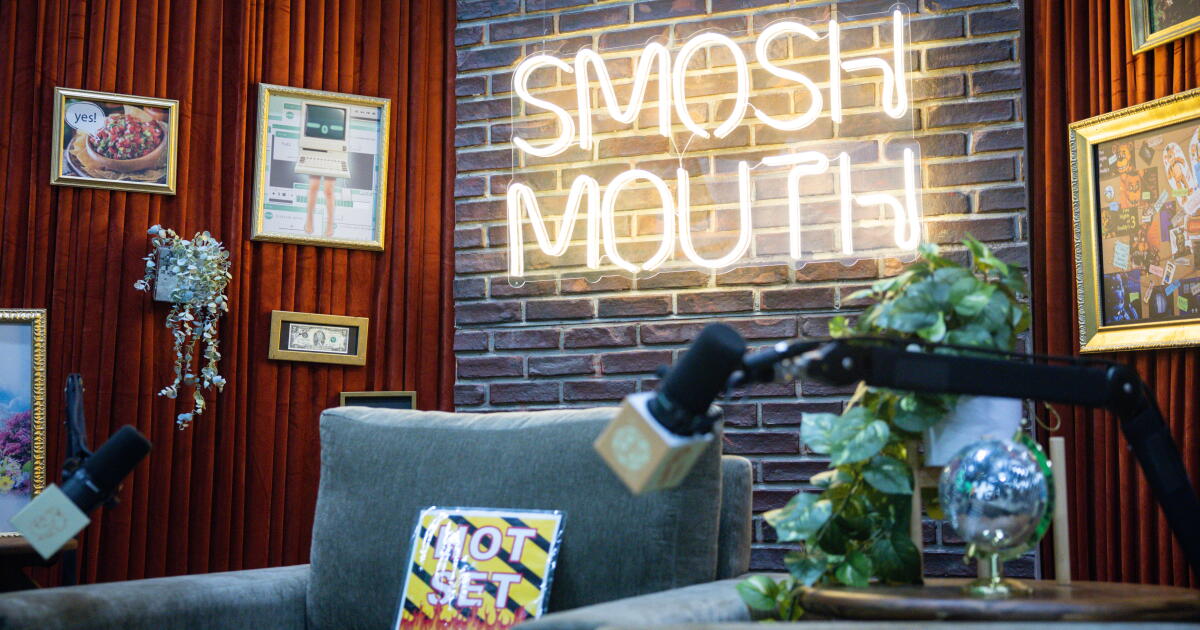
The exterior of the two-story, beige-colored building looks like any other drab office space near the Hollywood Burbank Airport. But on a recent weekday afternoon, the inside was bustling with activity: hairstylists carried brightly colored wigs between soundstages, a prop artist was building a fake leg for an upcoming video and YouTube stars gathered in a lobby, fidgeting with their phones while they waited to film their next scene.
They were among more than 100 employees of Smosh Productions, which this spring moved into the 32,000-square-foot facility, from a much smaller location in the city, to accommodate their programming needs.
It’s the latest creator-run company deepening its roots in Burbank, a neighborhood long defined by such iconic studios as Disney, Warner Bros. and Universal Pictures.
Other influencer-led companies that have expanded production footprints in the city include Rhett McLaughlin and Link Neal’s Mythical Entertainment and Alan Chikin Chow.
Internet content production is one of the few growth categories left in a Los Angeles production landscape that keeps shrinking.
“Being ‘Media City’ is a part of Burbank’s tagline. And it’s still true; we are just a different kind of media,” said Katelyn Hempstead, Smosh’s executive coordinator, on a tour of the new facility.
The company, owned by pioneering YouTubers Ian Hecox and Anthony Padilla, produces up to 10 hours of internet content weekly across five channels. Its programming ranges from sketch comedy to games and challenges for their fans.
Shoot days for digital productions rose 47% in the second quarter to 661 compared with the same period a year ago — even as the overall number of on-location shoot days dropped 13% during that period, according to FilmLA, the nonprofit group that tracks local filming.
“When people have an opportunity to work for a few days on a vertical series or [when] they make an income out of being an influencer and producing regular content for their various social channels, that does help the economy,” said Philip Sokoloski, a spokesman for FilmLA. “They still purchase things. They still utilize equipment. They may rent things from local supply houses.”
Cameras inside the “Who Meme’d It?” studio at Smosh Studios in Burbank.
(Kayla Bartkowski / Los Angeles Times)
Burbank has more than 1,000 media and entertainment companies that generate about 66,000 jobs.
Although the city does not give a breakdown of jobs by category, the creator economy has fueled some of the growth in the city’s entertainment employment over the last six years, said Patrick Prescott, Burbank’s community development director.
Most occupy flexible industrial space in the Airport district, leasing space for $1.65 to $2.81 a square foot, he said.
“It’s definitely a transitional period,” Prescott said. “There’s still something really valuable about sitting in a theater with a bunch of other people. But there’s also a lot of scrolling going on. Who’s generating that content? A lot of it’s generated here.”

Filmmakers work in the theater set at Dhar Mann Studios.
(Jason Armond / Los Angeles Times)
Due to anemic production activity, soundstages across L.A. have struggled to fill their studio spaces. That has opened up opportunities for new types of internet productions to fill at least some of the gap, said Sam Glendon, an industrial broker who’s handled several such deals. Creators building out their own space can pick up a discounted soundstage as a result, he said.
“There’s been this big supply-and-demand imbalance,” Glendon said. “It’s still a very niche type of clientele, but I’m certainly searching YouTube much more for who these people are and how many followers they have. Five years ago, I never did that.”
Controlling a studio matters to creators because it lets them move fast without a major studio’s bureaucracy, and platforms such as YouTube reward a steady, frequent posting cadence.
Alan Chikin Chow, behind the scripted YouTube high school drama series “Alan’s Universe,” moved his 13-person operation into a 10,000-square-foot Burbank facility in 2024 after outgrowing his Koreatown apartment.
“YouTube creators are the new trendsetters, and so we wanted to be associated with the big media in Burbank,” said Moris Zingman, the show’s lead producer. Proximity to the Warner Bros. lot helps land celebrity guests, too — Jacob Moncrief, Mythical’s studio president, said it’s an easy sell for shows like “Last Meals” when guests are already a few minutes away.

Filmmakers rehearse a scene in the restaurant set at Dhar Mann Studios.
(Jason Armond / Los Angeles Times)
Traditional media have taken note. Mythical Entertainment and Alan Chikin Chow both struck deals with Netflix in July. “Good Mythical Morning,” “Mythical Kitchen,” “Last Meals” and “Alan’s Universe” are all set to stream there alongside their YouTube releases starting later this year.
Dhar Mann Studios, one of Burbank’s biggest creator-run operations, added a deal with Disney last week for 20 episodes of family-oriented programming — its second major-studio partnership after a 40-title vertical-video deal with Fox Entertainment earlier this year.
Mann, 42, started making YouTube content in 2018 under the Dhar Mann Studios banner, centered around morality and motivational videos. The company now runs a 125,000-square-foot, three-soundstage facility with roughly 220 employees producing rotating sets — restaurants, school hallways, a courtroom, jail visitation rooms — designed to mimic a small town.
But Dhar Mann Studios doesn’t own its Burbank building — it leases the space — and this month the company bought a 108,000-square-foot production campus in Chatsworth for $23 million, with plans to relocate there by 2027, the Real Deal reported.
It’s the same pattern playing out across L.A.’s creator economy.
“The scale that creators have gotten to is ginormous,” said Sean Atkins, Dhar Mann Studios’ chief executive. “Media companies are always looking at what the next thing is. The answer isn’t that they become us or we become them. It’s somewhere in the messy middle, of which nobody knows right now.”
Most internet content work is mostly non-union and typically pays less than traditional film and TV jobs. SAG-AFTRA and the Motion Picture Editors Guild have started drafting new-media-specific contracts in response.
Even so, some workers welcome the opportunity.
Austin Scott, an editor who built a career cutting reality shows like “MasterChef” and “Dancing With the Stars,” recently landed his first big gig after three years of being unable to find post-production work, editing a YouTube series for Kevin Hart’s Hartbeat. Over eight weeks, he’ll work 12-hour days for $3,500 a week — below the $5,000 to $6,000 a typical TV editing job pays.
“My expectations are that it’s going to be harder work, longer hours, more notes, less money,” Scott said. “But there’s no work, so people are kind of forced to take what they can get.”

The exterior of the two-story, beige-colored building looks like any other drab office space near the Hollywood Burbank Airport. But on a recent weekday afternoon, the inside was bustling with activity: hairstylists carried brightly colored wigs between soundstages, a prop artist was building a fake leg for an upcoming video and YouTube stars gathered in a lobby, fidgeting with their phones while they waited to film their next scene.
They were among more than 100 employees of Smosh Productions, which this spring moved into the 32,000-square-foot facility, from a much smaller location in the city, to accommodate their programming needs.
It’s the latest creator-run company deepening its roots in Burbank, a neighborhood long defined by such iconic studios as Disney, Warner Bros. and Universal Pictures.
Other influencer-led companies that have expanded production footprints in the city include Rhett McLaughlin and Link Neal’s Mythical Entertainment and Alan Chikin Chow.
Internet content production is one of the few growth categories left in a Los Angeles production landscape that keeps shrinking.
“Being ‘Media City’ is a part of Burbank’s tagline. And it’s still true; we are just a different kind of media,” said Katelyn Hempstead, Smosh’s executive coordinator, on a tour of the new facility.
The company, owned by pioneering YouTubers Ian Hecox and Anthony Padilla, produces up to 10 hours of internet content weekly across five channels. Its programming ranges from sketch comedy to games and challenges for their fans.
Shoot days for digital productions rose 47% in the second quarter to 661 compared with the same period a year ago — even as the overall number of on-location shoot days dropped 13% during that period, according to FilmLA, the nonprofit group that tracks local filming.
“When people have an opportunity to work for a few days on a vertical series or [when] they make an income out of being an influencer and producing regular content for their various social channels, that does help the economy,” said Philip Sokoloski, a spokesman for FilmLA. “They still purchase things. They still utilize equipment. They may rent things from local supply houses.”
Cameras inside the “Who Meme’d It?” studio at Smosh Studios in Burbank.
(Kayla Bartkowski / Los Angeles Times)
Burbank has more than 1,000 media and entertainment companies that generate about 66,000 jobs.
Although the city does not give a breakdown of jobs by category, the creator economy has fueled some of the growth in the city’s entertainment employment over the last six years, said Patrick Prescott, Burbank’s community development director.
Most occupy flexible industrial space in the Airport district, leasing space for $1.65 to $2.81 a square foot, he said.
“It’s definitely a transitional period,” Prescott said. “There’s still something really valuable about sitting in a theater with a bunch of other people. But there’s also a lot of scrolling going on. Who’s generating that content? A lot of it’s generated here.”
Filmmakers work in the theater set at Dhar Mann Studios.
(Jason Armond / Los Angeles Times)
Due to anemic production activity, soundstages across L.A. have struggled to fill their studio spaces. That has opened up opportunities for new types of internet productions to fill at least some of the gap, said Sam Glendon, an industrial broker who’s handled several such deals. Creators building out their own space can pick up a discounted soundstage as a result, he said.
“There’s been this big supply-and-demand imbalance,” Glendon said. “It’s still a very niche type of clientele, but I’m certainly searching YouTube much more for who these people are and how many followers they have. Five years ago, I never did that.”
Controlling a studio matters to creators because it lets them move fast without a major studio’s bureaucracy, and platforms such as YouTube reward a steady, frequent posting cadence.
Alan Chikin Chow, behind the scripted YouTube high school drama series “Alan’s Universe,” moved his 13-person operation into a 10,000-square-foot Burbank facility in 2024 after outgrowing his Koreatown apartment.
“YouTube creators are the new trendsetters, and so we wanted to be associated with the big media in Burbank,” said Moris Zingman, the show’s lead producer. Proximity to the Warner Bros. lot helps land celebrity guests, too — Jacob Moncrief, Mythical’s studio president, said it’s an easy sell for shows like “Last Meals” when guests are already a few minutes away.
Filmmakers rehearse a scene in the restaurant set at Dhar Mann Studios.
(Jason Armond / Los Angeles Times)
Traditional media have taken note. Mythical Entertainment and Alan Chikin Chow both struck deals with Netflix in July. “Good Mythical Morning,” “Mythical Kitchen,” “Last Meals” and “Alan’s Universe” are all set to stream there alongside their YouTube releases starting later this year.
Dhar Mann Studios, one of Burbank’s biggest creator-run operations, added a deal with Disney last week for 20 episodes of family-oriented programming — its second major-studio partnership after a 40-title vertical-video deal with Fox Entertainment earlier this year.
Mann, 42, started making YouTube content in 2018 under the Dhar Mann Studios banner, centered around morality and motivational videos. The company now runs a 125,000-square-foot, three-soundstage facility with roughly 220 employees producing rotating sets — restaurants, school hallways, a courtroom, jail visitation rooms — designed to mimic a small town.
But Dhar Mann Studios doesn’t own its Burbank building — it leases the space — and this month the company bought a 108,000-square-foot production campus in Chatsworth for $23 million, with plans to relocate there by 2027, the Real Deal reported.
It’s the same pattern playing out across L.A.’s creator economy.
“The scale that creators have gotten to is ginormous,” said Sean Atkins, Dhar Mann Studios’ chief executive. “Media companies are always looking at what the next thing is. The answer isn’t that they become us or we become them. It’s somewhere in the messy middle, of which nobody knows right now.”
Most internet content work is mostly non-union and typically pays less than traditional film and TV jobs. SAG-AFTRA and the Motion Picture Editors Guild have started drafting new-media-specific contracts in response.
Even so, some workers welcome the opportunity.
Austin Scott, an editor who built a career cutting reality shows like “MasterChef” and “Dancing With the Stars,” recently landed his first big gig after three years of being unable to find post-production work, editing a YouTube series for Kevin Hart’s Hartbeat. Over eight weeks, he’ll work 12-hour days for $3,500 a week — below the $5,000 to $6,000 a typical TV editing job pays.
“My expectations are that it’s going to be harder work, longer hours, more notes, less money,” Scott said. “But there’s no work, so people are kind of forced to take what they can get.”

The exterior of the two-story, beige-colored building looks like any other drab office space near the Hollywood Burbank Airport. But on a recent weekday afternoon, the inside was bustling with activity: hairstylists carried brightly colored wigs between soundstages, a prop artist was building a fake leg for an upcoming video and YouTube stars gathered in a lobby, fidgeting with their phones while they waited to film their next scene.
They were among more than 100 employees of Smosh Productions, which this spring moved into the 32,000-square-foot facility, from a much smaller location in the city, to accommodate their programming needs.
It’s the latest creator-run company deepening its roots in Burbank, a neighborhood long defined by such iconic studios as Disney, Warner Bros. and Universal Pictures.
Other influencer-led companies that have expanded production footprints in the city include Rhett McLaughlin and Link Neal’s Mythical Entertainment and Alan Chikin Chow.
Internet content production is one of the few growth categories left in a Los Angeles production landscape that keeps shrinking.
“Being ‘Media City’ is a part of Burbank’s tagline. And it’s still true; we are just a different kind of media,” said Katelyn Hempstead, Smosh’s executive coordinator, on a tour of the new facility.
The company, owned by pioneering YouTubers Ian Hecox and Anthony Padilla, produces up to 10 hours of internet content weekly across five channels. Its programming ranges from sketch comedy to games and challenges for their fans.
Shoot days for digital productions rose 47% in the second quarter to 661 compared with the same period a year ago — even as the overall number of on-location shoot days dropped 13% during that period, according to FilmLA, the nonprofit group that tracks local filming.
“When people have an opportunity to work for a few days on a vertical series or [when] they make an income out of being an influencer and producing regular content for their various social channels, that does help the economy,” said Philip Sokoloski, a spokesman for FilmLA. “They still purchase things. They still utilize equipment. They may rent things from local supply houses.”
Cameras inside the “Who Meme’d It?” studio at Smosh Studios in Burbank.
(Kayla Bartkowski / Los Angeles Times)
Burbank has more than 1,000 media and entertainment companies that generate about 66,000 jobs.
Although the city does not give a breakdown of jobs by category, the creator economy has fueled some of the growth in the city’s entertainment employment over the last six years, said Patrick Prescott, Burbank’s community development director.
Most occupy flexible industrial space in the Airport district, leasing space for $1.65 to $2.81 a square foot, he said.
“It’s definitely a transitional period,” Prescott said. “There’s still something really valuable about sitting in a theater with a bunch of other people. But there’s also a lot of scrolling going on. Who’s generating that content? A lot of it’s generated here.”
Filmmakers work in the theater set at Dhar Mann Studios.
(Jason Armond / Los Angeles Times)
Due to anemic production activity, soundstages across L.A. have struggled to fill their studio spaces. That has opened up opportunities for new types of internet productions to fill at least some of the gap, said Sam Glendon, an industrial broker who’s handled several such deals. Creators building out their own space can pick up a discounted soundstage as a result, he said.
“There’s been this big supply-and-demand imbalance,” Glendon said. “It’s still a very niche type of clientele, but I’m certainly searching YouTube much more for who these people are and how many followers they have. Five years ago, I never did that.”
Controlling a studio matters to creators because it lets them move fast without a major studio’s bureaucracy, and platforms such as YouTube reward a steady, frequent posting cadence.
Alan Chikin Chow, behind the scripted YouTube high school drama series “Alan’s Universe,” moved his 13-person operation into a 10,000-square-foot Burbank facility in 2024 after outgrowing his Koreatown apartment.
“YouTube creators are the new trendsetters, and so we wanted to be associated with the big media in Burbank,” said Moris Zingman, the show’s lead producer. Proximity to the Warner Bros. lot helps land celebrity guests, too — Jacob Moncrief, Mythical’s studio president, said it’s an easy sell for shows like “Last Meals” when guests are already a few minutes away.
Filmmakers rehearse a scene in the restaurant set at Dhar Mann Studios.
(Jason Armond / Los Angeles Times)
Traditional media have taken note. Mythical Entertainment and Alan Chikin Chow both struck deals with Netflix in July. “Good Mythical Morning,” “Mythical Kitchen,” “Last Meals” and “Alan’s Universe” are all set to stream there alongside their YouTube releases starting later this year.
Dhar Mann Studios, one of Burbank’s biggest creator-run operations, added a deal with Disney last week for 20 episodes of family-oriented programming — its second major-studio partnership after a 40-title vertical-video deal with Fox Entertainment earlier this year.
Mann, 42, started making YouTube content in 2018 under the Dhar Mann Studios banner, centered around morality and motivational videos. The company now runs a 125,000-square-foot, three-soundstage facility with roughly 220 employees producing rotating sets — restaurants, school hallways, a courtroom, jail visitation rooms — designed to mimic a small town.
But Dhar Mann Studios doesn’t own its Burbank building — it leases the space — and this month the company bought a 108,000-square-foot production campus in Chatsworth for $23 million, with plans to relocate there by 2027, the Real Deal reported.
It’s the same pattern playing out across L.A.’s creator economy.
“The scale that creators have gotten to is ginormous,” said Sean Atkins, Dhar Mann Studios’ chief executive. “Media companies are always looking at what the next thing is. The answer isn’t that they become us or we become them. It’s somewhere in the messy middle, of which nobody knows right now.”
Most internet content work is mostly non-union and typically pays less than traditional film and TV jobs. SAG-AFTRA and the Motion Picture Editors Guild have started drafting new-media-specific contracts in response.
Even so, some workers welcome the opportunity.
Austin Scott, an editor who built a career cutting reality shows like “MasterChef” and “Dancing With the Stars,” recently landed his first big gig after three years of being unable to find post-production work, editing a YouTube series for Kevin Hart’s Hartbeat. Over eight weeks, he’ll work 12-hour days for $3,500 a week — below the $5,000 to $6,000 a typical TV editing job pays.
“My expectations are that it’s going to be harder work, longer hours, more notes, less money,” Scott said. “But there’s no work, so people are kind of forced to take what they can get.”
The exterior of the two-story, beige-colored building looks like any other drab office space near the Hollywood Burbank Airport. But on a recent weekday afternoon, the inside was bustling with activity: hairstylists carried brightly colored wigs between soundstages, a prop artist was building a fake leg for an upcoming video and YouTube stars gathered in a lobby, fidgeting with their phones while they waited to film their next scene.
They were among more than 100 employees of Smosh Productions, which this spring moved into the 32,000-square-foot facility, from a much smaller location in the city, to accommodate their programming needs.
It’s the latest creator-run company deepening its roots in Burbank, a neighborhood long defined by such iconic studios as Disney, Warner Bros. and Universal Pictures.
Other influencer-led companies that have expanded production footprints in the city include Rhett McLaughlin and Link Neal’s Mythical Entertainment and Alan Chikin Chow.
Internet content production is one of the few growth categories left in a Los Angeles production landscape that keeps shrinking.
“Being ‘Media City’ is a part of Burbank’s tagline. And it’s still true; we are just a different kind of media,” said Katelyn Hempstead, Smosh’s executive coordinator, on a tour of the new facility.
The company, owned by pioneering YouTubers Ian Hecox and Anthony Padilla, produces up to 10 hours of internet content weekly across five channels. Its programming ranges from sketch comedy to games and challenges for their fans.
Shoot days for digital productions rose 47% in the second quarter to 661 compared with the same period a year ago — even as the overall number of on-location shoot days dropped 13% during that period, according to FilmLA, the nonprofit group that tracks local filming.
“When people have an opportunity to work for a few days on a vertical series or [when] they make an income out of being an influencer and producing regular content for their various social channels, that does help the economy,” said Philip Sokoloski, a spokesman for FilmLA. “They still purchase things. They still utilize equipment. They may rent things from local supply houses.”
Cameras inside the “Who Meme’d It?” studio at Smosh Studios in Burbank.
(Kayla Bartkowski / Los Angeles Times)
Burbank has more than 1,000 media and entertainment companies that generate about 66,000 jobs.
Although the city does not give a breakdown of jobs by category, the creator economy has fueled some of the growth in the city’s entertainment employment over the last six years, said Patrick Prescott, Burbank’s community development director.
Most occupy flexible industrial space in the Airport district, leasing space for $1.65 to $2.81 a square foot, he said.
“It’s definitely a transitional period,” Prescott said. “There’s still something really valuable about sitting in a theater with a bunch of other people. But there’s also a lot of scrolling going on. Who’s generating that content? A lot of it’s generated here.”
Filmmakers work in the theater set at Dhar Mann Studios.
(Jason Armond / Los Angeles Times)
Due to anemic production activity, soundstages across L.A. have struggled to fill their studio spaces. That has opened up opportunities for new types of internet productions to fill at least some of the gap, said Sam Glendon, an industrial broker who’s handled several such deals. Creators building out their own space can pick up a discounted soundstage as a result, he said.
“There’s been this big supply-and-demand imbalance,” Glendon said. “It’s still a very niche type of clientele, but I’m certainly searching YouTube much more for who these people are and how many followers they have. Five years ago, I never did that.”
Controlling a studio matters to creators because it lets them move fast without a major studio’s bureaucracy, and platforms such as YouTube reward a steady, frequent posting cadence.
Alan Chikin Chow, behind the scripted YouTube high school drama series “Alan’s Universe,” moved his 13-person operation into a 10,000-square-foot Burbank facility in 2024 after outgrowing his Koreatown apartment.
“YouTube creators are the new trendsetters, and so we wanted to be associated with the big media in Burbank,” said Moris Zingman, the show’s lead producer. Proximity to the Warner Bros. lot helps land celebrity guests, too — Jacob Moncrief, Mythical’s studio president, said it’s an easy sell for shows like “Last Meals” when guests are already a few minutes away.
Filmmakers rehearse a scene in the restaurant set at Dhar Mann Studios.
(Jason Armond / Los Angeles Times)
Traditional media have taken note. Mythical Entertainment and Alan Chikin Chow both struck deals with Netflix in July. “Good Mythical Morning,” “Mythical Kitchen,” “Last Meals” and “Alan’s Universe” are all set to stream there alongside their YouTube releases starting later this year.
Dhar Mann Studios, one of Burbank’s biggest creator-run operations, added a deal with Disney last week for 20 episodes of family-oriented programming — its second major-studio partnership after a 40-title vertical-video deal with Fox Entertainment earlier this year.
Mann, 42, started making YouTube content in 2018 under the Dhar Mann Studios banner, centered around morality and motivational videos. The company now runs a 125,000-square-foot, three-soundstage facility with roughly 220 employees producing rotating sets — restaurants, school hallways, a courtroom, jail visitation rooms — designed to mimic a small town.
But Dhar Mann Studios doesn’t own its Burbank building — it leases the space — and this month the company bought a 108,000-square-foot production campus in Chatsworth for $23 million, with plans to relocate there by 2027, the Real Deal reported.
It’s the same pattern playing out across L.A.’s creator economy.
“The scale that creators have gotten to is ginormous,” said Sean Atkins, Dhar Mann Studios’ chief executive. “Media companies are always looking at what the next thing is. The answer isn’t that they become us or we become them. It’s somewhere in the messy middle, of which nobody knows right now.”
Most internet content work is mostly non-union and typically pays less than traditional film and TV jobs. SAG-AFTRA and the Motion Picture Editors Guild have started drafting new-media-specific contracts in response.
Even so, some workers welcome the opportunity.
Austin Scott, an editor who built a career cutting reality shows like “MasterChef” and “Dancing With the Stars,” recently landed his first big gig after three years of being unable to find post-production work, editing a YouTube series for Kevin Hart’s Hartbeat. Over eight weeks, he’ll work 12-hour days for $3,500 a week — below the $5,000 to $6,000 a typical TV editing job pays.
“My expectations are that it’s going to be harder work, longer hours, more notes, less money,” Scott said. “But there’s no work, so people are kind of forced to take what they can get.”

The exterior of the two-story, beige-colored building looks like any other drab office space near the Hollywood Burbank Airport. But on a recent weekday afternoon, the inside was bustling with activity: hairstylists carried brightly colored wigs between soundstages, a prop artist was building a fake leg for an upcoming video and YouTube stars gathered in a lobby, fidgeting with their phones while they waited to film their next scene.
They were among more than 100 employees of Smosh Productions, which this spring moved into the 32,000-square-foot facility, from a much smaller location in the city, to accommodate their programming needs.
It’s the latest creator-run company deepening its roots in Burbank, a neighborhood long defined by such iconic studios as Disney, Warner Bros. and Universal Pictures.
Other influencer-led companies that have expanded production footprints in the city include Rhett McLaughlin and Link Neal’s Mythical Entertainment and Alan Chikin Chow.
Internet content production is one of the few growth categories left in a Los Angeles production landscape that keeps shrinking.
“Being ‘Media City’ is a part of Burbank’s tagline. And it’s still true; we are just a different kind of media,” said Katelyn Hempstead, Smosh’s executive coordinator, on a tour of the new facility.
The company, owned by pioneering YouTubers Ian Hecox and Anthony Padilla, produces up to 10 hours of internet content weekly across five channels. Its programming ranges from sketch comedy to games and challenges for their fans.
Shoot days for digital productions rose 47% in the second quarter to 661 compared with the same period a year ago — even as the overall number of on-location shoot days dropped 13% during that period, according to FilmLA, the nonprofit group that tracks local filming.
“When people have an opportunity to work for a few days on a vertical series or [when] they make an income out of being an influencer and producing regular content for their various social channels, that does help the economy,” said Philip Sokoloski, a spokesman for FilmLA. “They still purchase things. They still utilize equipment. They may rent things from local supply houses.”
Cameras inside the “Who Meme’d It?” studio at Smosh Studios in Burbank.
(Kayla Bartkowski / Los Angeles Times)
Burbank has more than 1,000 media and entertainment companies that generate about 66,000 jobs.
Although the city does not give a breakdown of jobs by category, the creator economy has fueled some of the growth in the city’s entertainment employment over the last six years, said Patrick Prescott, Burbank’s community development director.
Most occupy flexible industrial space in the Airport district, leasing space for $1.65 to $2.81 a square foot, he said.
“It’s definitely a transitional period,” Prescott said. “There’s still something really valuable about sitting in a theater with a bunch of other people. But there’s also a lot of scrolling going on. Who’s generating that content? A lot of it’s generated here.”
Filmmakers work in the theater set at Dhar Mann Studios.
(Jason Armond / Los Angeles Times)
Due to anemic production activity, soundstages across L.A. have struggled to fill their studio spaces. That has opened up opportunities for new types of internet productions to fill at least some of the gap, said Sam Glendon, an industrial broker who’s handled several such deals. Creators building out their own space can pick up a discounted soundstage as a result, he said.
“There’s been this big supply-and-demand imbalance,” Glendon said. “It’s still a very niche type of clientele, but I’m certainly searching YouTube much more for who these people are and how many followers they have. Five years ago, I never did that.”
Controlling a studio matters to creators because it lets them move fast without a major studio’s bureaucracy, and platforms such as YouTube reward a steady, frequent posting cadence.
Alan Chikin Chow, behind the scripted YouTube high school drama series “Alan’s Universe,” moved his 13-person operation into a 10,000-square-foot Burbank facility in 2024 after outgrowing his Koreatown apartment.
“YouTube creators are the new trendsetters, and so we wanted to be associated with the big media in Burbank,” said Moris Zingman, the show’s lead producer. Proximity to the Warner Bros. lot helps land celebrity guests, too — Jacob Moncrief, Mythical’s studio president, said it’s an easy sell for shows like “Last Meals” when guests are already a few minutes away.
Filmmakers rehearse a scene in the restaurant set at Dhar Mann Studios.
(Jason Armond / Los Angeles Times)
Traditional media have taken note. Mythical Entertainment and Alan Chikin Chow both struck deals with Netflix in July. “Good Mythical Morning,” “Mythical Kitchen,” “Last Meals” and “Alan’s Universe” are all set to stream there alongside their YouTube releases starting later this year.
Dhar Mann Studios, one of Burbank’s biggest creator-run operations, added a deal with Disney last week for 20 episodes of family-oriented programming — its second major-studio partnership after a 40-title vertical-video deal with Fox Entertainment earlier this year.
Mann, 42, started making YouTube content in 2018 under the Dhar Mann Studios banner, centered around morality and motivational videos. The company now runs a 125,000-square-foot, three-soundstage facility with roughly 220 employees producing rotating sets — restaurants, school hallways, a courtroom, jail visitation rooms — designed to mimic a small town.
But Dhar Mann Studios doesn’t own its Burbank building — it leases the space — and this month the company bought a 108,000-square-foot production campus in Chatsworth for $23 million, with plans to relocate there by 2027, the Real Deal reported.
It’s the same pattern playing out across L.A.’s creator economy.
“The scale that creators have gotten to is ginormous,” said Sean Atkins, Dhar Mann Studios’ chief executive. “Media companies are always looking at what the next thing is. The answer isn’t that they become us or we become them. It’s somewhere in the messy middle, of which nobody knows right now.”
Most internet content work is mostly non-union and typically pays less than traditional film and TV jobs. SAG-AFTRA and the Motion Picture Editors Guild have started drafting new-media-specific contracts in response.
Even so, some workers welcome the opportunity.
Austin Scott, an editor who built a career cutting reality shows like “MasterChef” and “Dancing With the Stars,” recently landed his first big gig after three years of being unable to find post-production work, editing a YouTube series for Kevin Hart’s Hartbeat. Over eight weeks, he’ll work 12-hour days for $3,500 a week — below the $5,000 to $6,000 a typical TV editing job pays.
“My expectations are that it’s going to be harder work, longer hours, more notes, less money,” Scott said. “But there’s no work, so people are kind of forced to take what they can get.”
The exterior of the two-story, beige-colored building looks like any other drab office space near the Hollywood Burbank Airport. But on a recent weekday afternoon, the inside was bustling with activity: hairstylists carried brightly colored wigs between soundstages, a prop artist was building a fake leg for an upcoming video and YouTube stars gathered in a lobby, fidgeting with their phones while they waited to film their next scene.
They were among more than 100 employees of Smosh Productions, which this spring moved into the 32,000-square-foot facility, from a much smaller location in the city, to accommodate their programming needs.
It’s the latest creator-run company deepening its roots in Burbank, a neighborhood long defined by such iconic studios as Disney, Warner Bros. and Universal Pictures.
Other influencer-led companies that have expanded production footprints in the city include Rhett McLaughlin and Link Neal’s Mythical Entertainment and Alan Chikin Chow.
Internet content production is one of the few growth categories left in a Los Angeles production landscape that keeps shrinking.
“Being ‘Media City’ is a part of Burbank’s tagline. And it’s still true; we are just a different kind of media,” said Katelyn Hempstead, Smosh’s executive coordinator, on a tour of the new facility.
The company, owned by pioneering YouTubers Ian Hecox and Anthony Padilla, produces up to 10 hours of internet content weekly across five channels. Its programming ranges from sketch comedy to games and challenges for their fans.
Shoot days for digital productions rose 47% in the second quarter to 661 compared with the same period a year ago — even as the overall number of on-location shoot days dropped 13% during that period, according to FilmLA, the nonprofit group that tracks local filming.
“When people have an opportunity to work for a few days on a vertical series or [when] they make an income out of being an influencer and producing regular content for their various social channels, that does help the economy,” said Philip Sokoloski, a spokesman for FilmLA. “They still purchase things. They still utilize equipment. They may rent things from local supply houses.”
Cameras inside the “Who Meme’d It?” studio at Smosh Studios in Burbank.
(Kayla Bartkowski / Los Angeles Times)
Burbank has more than 1,000 media and entertainment companies that generate about 66,000 jobs.
Although the city does not give a breakdown of jobs by category, the creator economy has fueled some of the growth in the city’s entertainment employment over the last six years, said Patrick Prescott, Burbank’s community development director.
Most occupy flexible industrial space in the Airport district, leasing space for $1.65 to $2.81 a square foot, he said.
“It’s definitely a transitional period,” Prescott said. “There’s still something really valuable about sitting in a theater with a bunch of other people. But there’s also a lot of scrolling going on. Who’s generating that content? A lot of it’s generated here.”
Filmmakers work in the theater set at Dhar Mann Studios.
(Jason Armond / Los Angeles Times)
Due to anemic production activity, soundstages across L.A. have struggled to fill their studio spaces. That has opened up opportunities for new types of internet productions to fill at least some of the gap, said Sam Glendon, an industrial broker who’s handled several such deals. Creators building out their own space can pick up a discounted soundstage as a result, he said.
“There’s been this big supply-and-demand imbalance,” Glendon said. “It’s still a very niche type of clientele, but I’m certainly searching YouTube much more for who these people are and how many followers they have. Five years ago, I never did that.”
Controlling a studio matters to creators because it lets them move fast without a major studio’s bureaucracy, and platforms such as YouTube reward a steady, frequent posting cadence.
Alan Chikin Chow, behind the scripted YouTube high school drama series “Alan’s Universe,” moved his 13-person operation into a 10,000-square-foot Burbank facility in 2024 after outgrowing his Koreatown apartment.
“YouTube creators are the new trendsetters, and so we wanted to be associated with the big media in Burbank,” said Moris Zingman, the show’s lead producer. Proximity to the Warner Bros. lot helps land celebrity guests, too — Jacob Moncrief, Mythical’s studio president, said it’s an easy sell for shows like “Last Meals” when guests are already a few minutes away.
Filmmakers rehearse a scene in the restaurant set at Dhar Mann Studios.
(Jason Armond / Los Angeles Times)
Traditional media have taken note. Mythical Entertainment and Alan Chikin Chow both struck deals with Netflix in July. “Good Mythical Morning,” “Mythical Kitchen,” “Last Meals” and “Alan’s Universe” are all set to stream there alongside their YouTube releases starting later this year.
Dhar Mann Studios, one of Burbank’s biggest creator-run operations, added a deal with Disney last week for 20 episodes of family-oriented programming — its second major-studio partnership after a 40-title vertical-video deal with Fox Entertainment earlier this year.
Mann, 42, started making YouTube content in 2018 under the Dhar Mann Studios banner, centered around morality and motivational videos. The company now runs a 125,000-square-foot, three-soundstage facility with roughly 220 employees producing rotating sets — restaurants, school hallways, a courtroom, jail visitation rooms — designed to mimic a small town.
But Dhar Mann Studios doesn’t own its Burbank building — it leases the space — and this month the company bought a 108,000-square-foot production campus in Chatsworth for $23 million, with plans to relocate there by 2027, the Real Deal reported.
It’s the same pattern playing out across L.A.’s creator economy.
“The scale that creators have gotten to is ginormous,” said Sean Atkins, Dhar Mann Studios’ chief executive. “Media companies are always looking at what the next thing is. The answer isn’t that they become us or we become them. It’s somewhere in the messy middle, of which nobody knows right now.”
Most internet content work is mostly non-union and typically pays less than traditional film and TV jobs. SAG-AFTRA and the Motion Picture Editors Guild have started drafting new-media-specific contracts in response.
Even so, some workers welcome the opportunity.
Austin Scott, an editor who built a career cutting reality shows like “MasterChef” and “Dancing With the Stars,” recently landed his first big gig after three years of being unable to find post-production work, editing a YouTube series for Kevin Hart’s Hartbeat. Over eight weeks, he’ll work 12-hour days for $3,500 a week — below the $5,000 to $6,000 a typical TV editing job pays.
“My expectations are that it’s going to be harder work, longer hours, more notes, less money,” Scott said. “But there’s no work, so people are kind of forced to take what they can get.”
The exterior of the two-story, beige-colored building looks like any other drab office space near the Hollywood Burbank Airport. But on a recent weekday afternoon, the inside was bustling with activity: hairstylists carried brightly colored wigs between soundstages, a prop artist was building a fake leg for an upcoming video and YouTube stars gathered in a lobby, fidgeting with their phones while they waited to film their next scene.
They were among more than 100 employees of Smosh Productions, which this spring moved into the 32,000-square-foot facility, from a much smaller location in the city, to accommodate their programming needs.
It’s the latest creator-run company deepening its roots in Burbank, a neighborhood long defined by such iconic studios as Disney, Warner Bros. and Universal Pictures.
Other influencer-led companies that have expanded production footprints in the city include Rhett McLaughlin and Link Neal’s Mythical Entertainment and Alan Chikin Chow.
Internet content production is one of the few growth categories left in a Los Angeles production landscape that keeps shrinking.
“Being ‘Media City’ is a part of Burbank’s tagline. And it’s still true; we are just a different kind of media,” said Katelyn Hempstead, Smosh’s executive coordinator, on a tour of the new facility.
The company, owned by pioneering YouTubers Ian Hecox and Anthony Padilla, produces up to 10 hours of internet content weekly across five channels. Its programming ranges from sketch comedy to games and challenges for their fans.
Shoot days for digital productions rose 47% in the second quarter to 661 compared with the same period a year ago — even as the overall number of on-location shoot days dropped 13% during that period, according to FilmLA, the nonprofit group that tracks local filming.
“When people have an opportunity to work for a few days on a vertical series or [when] they make an income out of being an influencer and producing regular content for their various social channels, that does help the economy,” said Philip Sokoloski, a spokesman for FilmLA. “They still purchase things. They still utilize equipment. They may rent things from local supply houses.”
Cameras inside the “Who Meme’d It?” studio at Smosh Studios in Burbank.
(Kayla Bartkowski / Los Angeles Times)
Burbank has more than 1,000 media and entertainment companies that generate about 66,000 jobs.
Although the city does not give a breakdown of jobs by category, the creator economy has fueled some of the growth in the city’s entertainment employment over the last six years, said Patrick Prescott, Burbank’s community development director.
Most occupy flexible industrial space in the Airport district, leasing space for $1.65 to $2.81 a square foot, he said.
“It’s definitely a transitional period,” Prescott said. “There’s still something really valuable about sitting in a theater with a bunch of other people. But there’s also a lot of scrolling going on. Who’s generating that content? A lot of it’s generated here.”
Filmmakers work in the theater set at Dhar Mann Studios.
(Jason Armond / Los Angeles Times)
Due to anemic production activity, soundstages across L.A. have struggled to fill their studio spaces. That has opened up opportunities for new types of internet productions to fill at least some of the gap, said Sam Glendon, an industrial broker who’s handled several such deals. Creators building out their own space can pick up a discounted soundstage as a result, he said.
“There’s been this big supply-and-demand imbalance,” Glendon said. “It’s still a very niche type of clientele, but I’m certainly searching YouTube much more for who these people are and how many followers they have. Five years ago, I never did that.”
Controlling a studio matters to creators because it lets them move fast without a major studio’s bureaucracy, and platforms such as YouTube reward a steady, frequent posting cadence.
Alan Chikin Chow, behind the scripted YouTube high school drama series “Alan’s Universe,” moved his 13-person operation into a 10,000-square-foot Burbank facility in 2024 after outgrowing his Koreatown apartment.
“YouTube creators are the new trendsetters, and so we wanted to be associated with the big media in Burbank,” said Moris Zingman, the show’s lead producer. Proximity to the Warner Bros. lot helps land celebrity guests, too — Jacob Moncrief, Mythical’s studio president, said it’s an easy sell for shows like “Last Meals” when guests are already a few minutes away.
Filmmakers rehearse a scene in the restaurant set at Dhar Mann Studios.
(Jason Armond / Los Angeles Times)
Traditional media have taken note. Mythical Entertainment and Alan Chikin Chow both struck deals with Netflix in July. “Good Mythical Morning,” “Mythical Kitchen,” “Last Meals” and “Alan’s Universe” are all set to stream there alongside their YouTube releases starting later this year.
Dhar Mann Studios, one of Burbank’s biggest creator-run operations, added a deal with Disney last week for 20 episodes of family-oriented programming — its second major-studio partnership after a 40-title vertical-video deal with Fox Entertainment earlier this year.
Mann, 42, started making YouTube content in 2018 under the Dhar Mann Studios banner, centered around morality and motivational videos. The company now runs a 125,000-square-foot, three-soundstage facility with roughly 220 employees producing rotating sets — restaurants, school hallways, a courtroom, jail visitation rooms — designed to mimic a small town.
But Dhar Mann Studios doesn’t own its Burbank building — it leases the space — and this month the company bought a 108,000-square-foot production campus in Chatsworth for $23 million, with plans to relocate there by 2027, the Real Deal reported.
It’s the same pattern playing out across L.A.’s creator economy.
“The scale that creators have gotten to is ginormous,” said Sean Atkins, Dhar Mann Studios’ chief executive. “Media companies are always looking at what the next thing is. The answer isn’t that they become us or we become them. It’s somewhere in the messy middle, of which nobody knows right now.”
Most internet content work is mostly non-union and typically pays less than traditional film and TV jobs. SAG-AFTRA and the Motion Picture Editors Guild have started drafting new-media-specific contracts in response.
Even so, some workers welcome the opportunity.
Austin Scott, an editor who built a career cutting reality shows like “MasterChef” and “Dancing With the Stars,” recently landed his first big gig after three years of being unable to find post-production work, editing a YouTube series for Kevin Hart’s Hartbeat. Over eight weeks, he’ll work 12-hour days for $3,500 a week — below the $5,000 to $6,000 a typical TV editing job pays.
“My expectations are that it’s going to be harder work, longer hours, more notes, less money,” Scott said. “But there’s no work, so people are kind of forced to take what they can get.”
The exterior of the two-story, beige-colored building looks like any other drab office space near the Hollywood Burbank Airport. But on a recent weekday afternoon, the inside was bustling with activity: hairstylists carried brightly colored wigs between soundstages, a prop artist was building a fake leg for an upcoming video and YouTube stars gathered in a lobby, fidgeting with their phones while they waited to film their next scene.
They were among more than 100 employees of Smosh Productions, which this spring moved into the 32,000-square-foot facility, from a much smaller location in the city, to accommodate their programming needs.
It’s the latest creator-run company deepening its roots in Burbank, a neighborhood long defined by such iconic studios as Disney, Warner Bros. and Universal Pictures.
Other influencer-led companies that have expanded production footprints in the city include Rhett McLaughlin and Link Neal’s Mythical Entertainment and Alan Chikin Chow.
Internet content production is one of the few growth categories left in a Los Angeles production landscape that keeps shrinking.
“Being ‘Media City’ is a part of Burbank’s tagline. And it’s still true; we are just a different kind of media,” said Katelyn Hempstead, Smosh’s executive coordinator, on a tour of the new facility.
The company, owned by pioneering YouTubers Ian Hecox and Anthony Padilla, produces up to 10 hours of internet content weekly across five channels. Its programming ranges from sketch comedy to games and challenges for their fans.
Shoot days for digital productions rose 47% in the second quarter to 661 compared with the same period a year ago — even as the overall number of on-location shoot days dropped 13% during that period, according to FilmLA, the nonprofit group that tracks local filming.
“When people have an opportunity to work for a few days on a vertical series or [when] they make an income out of being an influencer and producing regular content for their various social channels, that does help the economy,” said Philip Sokoloski, a spokesman for FilmLA. “They still purchase things. They still utilize equipment. They may rent things from local supply houses.”
Cameras inside the “Who Meme’d It?” studio at Smosh Studios in Burbank.
(Kayla Bartkowski / Los Angeles Times)
Burbank has more than 1,000 media and entertainment companies that generate about 66,000 jobs.
Although the city does not give a breakdown of jobs by category, the creator economy has fueled some of the growth in the city’s entertainment employment over the last six years, said Patrick Prescott, Burbank’s community development director.
Most occupy flexible industrial space in the Airport district, leasing space for $1.65 to $2.81 a square foot, he said.
“It’s definitely a transitional period,” Prescott said. “There’s still something really valuable about sitting in a theater with a bunch of other people. But there’s also a lot of scrolling going on. Who’s generating that content? A lot of it’s generated here.”
Filmmakers work in the theater set at Dhar Mann Studios.
(Jason Armond / Los Angeles Times)
Due to anemic production activity, soundstages across L.A. have struggled to fill their studio spaces. That has opened up opportunities for new types of internet productions to fill at least some of the gap, said Sam Glendon, an industrial broker who’s handled several such deals. Creators building out their own space can pick up a discounted soundstage as a result, he said.
“There’s been this big supply-and-demand imbalance,” Glendon said. “It’s still a very niche type of clientele, but I’m certainly searching YouTube much more for who these people are and how many followers they have. Five years ago, I never did that.”
Controlling a studio matters to creators because it lets them move fast without a major studio’s bureaucracy, and platforms such as YouTube reward a steady, frequent posting cadence.
Alan Chikin Chow, behind the scripted YouTube high school drama series “Alan’s Universe,” moved his 13-person operation into a 10,000-square-foot Burbank facility in 2024 after outgrowing his Koreatown apartment.
“YouTube creators are the new trendsetters, and so we wanted to be associated with the big media in Burbank,” said Moris Zingman, the show’s lead producer. Proximity to the Warner Bros. lot helps land celebrity guests, too — Jacob Moncrief, Mythical’s studio president, said it’s an easy sell for shows like “Last Meals” when guests are already a few minutes away.
Filmmakers rehearse a scene in the restaurant set at Dhar Mann Studios.
(Jason Armond / Los Angeles Times)
Traditional media have taken note. Mythical Entertainment and Alan Chikin Chow both struck deals with Netflix in July. “Good Mythical Morning,” “Mythical Kitchen,” “Last Meals” and “Alan’s Universe” are all set to stream there alongside their YouTube releases starting later this year.
Dhar Mann Studios, one of Burbank’s biggest creator-run operations, added a deal with Disney last week for 20 episodes of family-oriented programming — its second major-studio partnership after a 40-title vertical-video deal with Fox Entertainment earlier this year.
Mann, 42, started making YouTube content in 2018 under the Dhar Mann Studios banner, centered around morality and motivational videos. The company now runs a 125,000-square-foot, three-soundstage facility with roughly 220 employees producing rotating sets — restaurants, school hallways, a courtroom, jail visitation rooms — designed to mimic a small town.
But Dhar Mann Studios doesn’t own its Burbank building — it leases the space — and this month the company bought a 108,000-square-foot production campus in Chatsworth for $23 million, with plans to relocate there by 2027, the Real Deal reported.
It’s the same pattern playing out across L.A.’s creator economy.
“The scale that creators have gotten to is ginormous,” said Sean Atkins, Dhar Mann Studios’ chief executive. “Media companies are always looking at what the next thing is. The answer isn’t that they become us or we become them. It’s somewhere in the messy middle, of which nobody knows right now.”
Most internet content work is mostly non-union and typically pays less than traditional film and TV jobs. SAG-AFTRA and the Motion Picture Editors Guild have started drafting new-media-specific contracts in response.
Even so, some workers welcome the opportunity.
Austin Scott, an editor who built a career cutting reality shows like “MasterChef” and “Dancing With the Stars,” recently landed his first big gig after three years of being unable to find post-production work, editing a YouTube series for Kevin Hart’s Hartbeat. Over eight weeks, he’ll work 12-hour days for $3,500 a week — below the $5,000 to $6,000 a typical TV editing job pays.
“My expectations are that it’s going to be harder work, longer hours, more notes, less money,” Scott said. “But there’s no work, so people are kind of forced to take what they can get.”

The exterior of the two-story, beige-colored building looks like any other drab office space near the Hollywood Burbank Airport. But on a recent weekday afternoon, the inside was bustling with activity: hairstylists carried brightly colored wigs between soundstages, a prop artist was building a fake leg for an upcoming video and YouTube stars gathered in a lobby, fidgeting with their phones while they waited to film their next scene.
They were among more than 100 employees of Smosh Productions, which this spring moved into the 32,000-square-foot facility, from a much smaller location in the city, to accommodate their programming needs.
It’s the latest creator-run company deepening its roots in Burbank, a neighborhood long defined by such iconic studios as Disney, Warner Bros. and Universal Pictures.
Other influencer-led companies that have expanded production footprints in the city include Rhett McLaughlin and Link Neal’s Mythical Entertainment and Alan Chikin Chow.
Internet content production is one of the few growth categories left in a Los Angeles production landscape that keeps shrinking.
“Being ‘Media City’ is a part of Burbank’s tagline. And it’s still true; we are just a different kind of media,” said Katelyn Hempstead, Smosh’s executive coordinator, on a tour of the new facility.
The company, owned by pioneering YouTubers Ian Hecox and Anthony Padilla, produces up to 10 hours of internet content weekly across five channels. Its programming ranges from sketch comedy to games and challenges for their fans.
Shoot days for digital productions rose 47% in the second quarter to 661 compared with the same period a year ago — even as the overall number of on-location shoot days dropped 13% during that period, according to FilmLA, the nonprofit group that tracks local filming.
“When people have an opportunity to work for a few days on a vertical series or [when] they make an income out of being an influencer and producing regular content for their various social channels, that does help the economy,” said Philip Sokoloski, a spokesman for FilmLA. “They still purchase things. They still utilize equipment. They may rent things from local supply houses.”
Cameras inside the “Who Meme’d It?” studio at Smosh Studios in Burbank.
(Kayla Bartkowski / Los Angeles Times)
Burbank has more than 1,000 media and entertainment companies that generate about 66,000 jobs.
Although the city does not give a breakdown of jobs by category, the creator economy has fueled some of the growth in the city’s entertainment employment over the last six years, said Patrick Prescott, Burbank’s community development director.
Most occupy flexible industrial space in the Airport district, leasing space for $1.65 to $2.81 a square foot, he said.
“It’s definitely a transitional period,” Prescott said. “There’s still something really valuable about sitting in a theater with a bunch of other people. But there’s also a lot of scrolling going on. Who’s generating that content? A lot of it’s generated here.”
Filmmakers work in the theater set at Dhar Mann Studios.
(Jason Armond / Los Angeles Times)
Due to anemic production activity, soundstages across L.A. have struggled to fill their studio spaces. That has opened up opportunities for new types of internet productions to fill at least some of the gap, said Sam Glendon, an industrial broker who’s handled several such deals. Creators building out their own space can pick up a discounted soundstage as a result, he said.
“There’s been this big supply-and-demand imbalance,” Glendon said. “It’s still a very niche type of clientele, but I’m certainly searching YouTube much more for who these people are and how many followers they have. Five years ago, I never did that.”
Controlling a studio matters to creators because it lets them move fast without a major studio’s bureaucracy, and platforms such as YouTube reward a steady, frequent posting cadence.
Alan Chikin Chow, behind the scripted YouTube high school drama series “Alan’s Universe,” moved his 13-person operation into a 10,000-square-foot Burbank facility in 2024 after outgrowing his Koreatown apartment.
“YouTube creators are the new trendsetters, and so we wanted to be associated with the big media in Burbank,” said Moris Zingman, the show’s lead producer. Proximity to the Warner Bros. lot helps land celebrity guests, too — Jacob Moncrief, Mythical’s studio president, said it’s an easy sell for shows like “Last Meals” when guests are already a few minutes away.
Filmmakers rehearse a scene in the restaurant set at Dhar Mann Studios.
(Jason Armond / Los Angeles Times)
Traditional media have taken note. Mythical Entertainment and Alan Chikin Chow both struck deals with Netflix in July. “Good Mythical Morning,” “Mythical Kitchen,” “Last Meals” and “Alan’s Universe” are all set to stream there alongside their YouTube releases starting later this year.
Dhar Mann Studios, one of Burbank’s biggest creator-run operations, added a deal with Disney last week for 20 episodes of family-oriented programming — its second major-studio partnership after a 40-title vertical-video deal with Fox Entertainment earlier this year.
Mann, 42, started making YouTube content in 2018 under the Dhar Mann Studios banner, centered around morality and motivational videos. The company now runs a 125,000-square-foot, three-soundstage facility with roughly 220 employees producing rotating sets — restaurants, school hallways, a courtroom, jail visitation rooms — designed to mimic a small town.
But Dhar Mann Studios doesn’t own its Burbank building — it leases the space — and this month the company bought a 108,000-square-foot production campus in Chatsworth for $23 million, with plans to relocate there by 2027, the Real Deal reported.
It’s the same pattern playing out across L.A.’s creator economy.
“The scale that creators have gotten to is ginormous,” said Sean Atkins, Dhar Mann Studios’ chief executive. “Media companies are always looking at what the next thing is. The answer isn’t that they become us or we become them. It’s somewhere in the messy middle, of which nobody knows right now.”
Most internet content work is mostly non-union and typically pays less than traditional film and TV jobs. SAG-AFTRA and the Motion Picture Editors Guild have started drafting new-media-specific contracts in response.
Even so, some workers welcome the opportunity.
Austin Scott, an editor who built a career cutting reality shows like “MasterChef” and “Dancing With the Stars,” recently landed his first big gig after three years of being unable to find post-production work, editing a YouTube series for Kevin Hart’s Hartbeat. Over eight weeks, he’ll work 12-hour days for $3,500 a week — below the $5,000 to $6,000 a typical TV editing job pays.
“My expectations are that it’s going to be harder work, longer hours, more notes, less money,” Scott said. “But there’s no work, so people are kind of forced to take what they can get.”
The exterior of the two-story, beige-colored building looks like any other drab office space near the Hollywood Burbank Airport. But on a recent weekday afternoon, the inside was bustling with activity: hairstylists carried brightly colored wigs between soundstages, a prop artist was building a fake leg for an upcoming video and YouTube stars gathered in a lobby, fidgeting with their phones while they waited to film their next scene.
They were among more than 100 employees of Smosh Productions, which this spring moved into the 32,000-square-foot facility, from a much smaller location in the city, to accommodate their programming needs.
It’s the latest creator-run company deepening its roots in Burbank, a neighborhood long defined by such iconic studios as Disney, Warner Bros. and Universal Pictures.
Other influencer-led companies that have expanded production footprints in the city include Rhett McLaughlin and Link Neal’s Mythical Entertainment and Alan Chikin Chow.
Internet content production is one of the few growth categories left in a Los Angeles production landscape that keeps shrinking.
“Being ‘Media City’ is a part of Burbank’s tagline. And it’s still true; we are just a different kind of media,” said Katelyn Hempstead, Smosh’s executive coordinator, on a tour of the new facility.
The company, owned by pioneering YouTubers Ian Hecox and Anthony Padilla, produces up to 10 hours of internet content weekly across five channels. Its programming ranges from sketch comedy to games and challenges for their fans.
Shoot days for digital productions rose 47% in the second quarter to 661 compared with the same period a year ago — even as the overall number of on-location shoot days dropped 13% during that period, according to FilmLA, the nonprofit group that tracks local filming.
“When people have an opportunity to work for a few days on a vertical series or [when] they make an income out of being an influencer and producing regular content for their various social channels, that does help the economy,” said Philip Sokoloski, a spokesman for FilmLA. “They still purchase things. They still utilize equipment. They may rent things from local supply houses.”
Cameras inside the “Who Meme’d It?” studio at Smosh Studios in Burbank.
(Kayla Bartkowski / Los Angeles Times)
Burbank has more than 1,000 media and entertainment companies that generate about 66,000 jobs.
Although the city does not give a breakdown of jobs by category, the creator economy has fueled some of the growth in the city’s entertainment employment over the last six years, said Patrick Prescott, Burbank’s community development director.
Most occupy flexible industrial space in the Airport district, leasing space for $1.65 to $2.81 a square foot, he said.
“It’s definitely a transitional period,” Prescott said. “There’s still something really valuable about sitting in a theater with a bunch of other people. But there’s also a lot of scrolling going on. Who’s generating that content? A lot of it’s generated here.”
Filmmakers work in the theater set at Dhar Mann Studios.
(Jason Armond / Los Angeles Times)
Due to anemic production activity, soundstages across L.A. have struggled to fill their studio spaces. That has opened up opportunities for new types of internet productions to fill at least some of the gap, said Sam Glendon, an industrial broker who’s handled several such deals. Creators building out their own space can pick up a discounted soundstage as a result, he said.
“There’s been this big supply-and-demand imbalance,” Glendon said. “It’s still a very niche type of clientele, but I’m certainly searching YouTube much more for who these people are and how many followers they have. Five years ago, I never did that.”
Controlling a studio matters to creators because it lets them move fast without a major studio’s bureaucracy, and platforms such as YouTube reward a steady, frequent posting cadence.
Alan Chikin Chow, behind the scripted YouTube high school drama series “Alan’s Universe,” moved his 13-person operation into a 10,000-square-foot Burbank facility in 2024 after outgrowing his Koreatown apartment.
“YouTube creators are the new trendsetters, and so we wanted to be associated with the big media in Burbank,” said Moris Zingman, the show’s lead producer. Proximity to the Warner Bros. lot helps land celebrity guests, too — Jacob Moncrief, Mythical’s studio president, said it’s an easy sell for shows like “Last Meals” when guests are already a few minutes away.
Filmmakers rehearse a scene in the restaurant set at Dhar Mann Studios.
(Jason Armond / Los Angeles Times)
Traditional media have taken note. Mythical Entertainment and Alan Chikin Chow both struck deals with Netflix in July. “Good Mythical Morning,” “Mythical Kitchen,” “Last Meals” and “Alan’s Universe” are all set to stream there alongside their YouTube releases starting later this year.
Dhar Mann Studios, one of Burbank’s biggest creator-run operations, added a deal with Disney last week for 20 episodes of family-oriented programming — its second major-studio partnership after a 40-title vertical-video deal with Fox Entertainment earlier this year.
Mann, 42, started making YouTube content in 2018 under the Dhar Mann Studios banner, centered around morality and motivational videos. The company now runs a 125,000-square-foot, three-soundstage facility with roughly 220 employees producing rotating sets — restaurants, school hallways, a courtroom, jail visitation rooms — designed to mimic a small town.
But Dhar Mann Studios doesn’t own its Burbank building — it leases the space — and this month the company bought a 108,000-square-foot production campus in Chatsworth for $23 million, with plans to relocate there by 2027, the Real Deal reported.
It’s the same pattern playing out across L.A.’s creator economy.
“The scale that creators have gotten to is ginormous,” said Sean Atkins, Dhar Mann Studios’ chief executive. “Media companies are always looking at what the next thing is. The answer isn’t that they become us or we become them. It’s somewhere in the messy middle, of which nobody knows right now.”
Most internet content work is mostly non-union and typically pays less than traditional film and TV jobs. SAG-AFTRA and the Motion Picture Editors Guild have started drafting new-media-specific contracts in response.
Even so, some workers welcome the opportunity.
Austin Scott, an editor who built a career cutting reality shows like “MasterChef” and “Dancing With the Stars,” recently landed his first big gig after three years of being unable to find post-production work, editing a YouTube series for Kevin Hart’s Hartbeat. Over eight weeks, he’ll work 12-hour days for $3,500 a week — below the $5,000 to $6,000 a typical TV editing job pays.
“My expectations are that it’s going to be harder work, longer hours, more notes, less money,” Scott said. “But there’s no work, so people are kind of forced to take what they can get.”
The exterior of the two-story, beige-colored building looks like any other drab office space near the Hollywood Burbank Airport. But on a recent weekday afternoon, the inside was bustling with activity: hairstylists carried brightly colored wigs between soundstages, a prop artist was building a fake leg for an upcoming video and YouTube stars gathered in a lobby, fidgeting with their phones while they waited to film their next scene.
They were among more than 100 employees of Smosh Productions, which this spring moved into the 32,000-square-foot facility, from a much smaller location in the city, to accommodate their programming needs.
It’s the latest creator-run company deepening its roots in Burbank, a neighborhood long defined by such iconic studios as Disney, Warner Bros. and Universal Pictures.
Other influencer-led companies that have expanded production footprints in the city include Rhett McLaughlin and Link Neal’s Mythical Entertainment and Alan Chikin Chow.
Internet content production is one of the few growth categories left in a Los Angeles production landscape that keeps shrinking.
“Being ‘Media City’ is a part of Burbank’s tagline. And it’s still true; we are just a different kind of media,” said Katelyn Hempstead, Smosh’s executive coordinator, on a tour of the new facility.
The company, owned by pioneering YouTubers Ian Hecox and Anthony Padilla, produces up to 10 hours of internet content weekly across five channels. Its programming ranges from sketch comedy to games and challenges for their fans.
Shoot days for digital productions rose 47% in the second quarter to 661 compared with the same period a year ago — even as the overall number of on-location shoot days dropped 13% during that period, according to FilmLA, the nonprofit group that tracks local filming.
“When people have an opportunity to work for a few days on a vertical series or [when] they make an income out of being an influencer and producing regular content for their various social channels, that does help the economy,” said Philip Sokoloski, a spokesman for FilmLA. “They still purchase things. They still utilize equipment. They may rent things from local supply houses.”
Cameras inside the “Who Meme’d It?” studio at Smosh Studios in Burbank.
(Kayla Bartkowski / Los Angeles Times)
Burbank has more than 1,000 media and entertainment companies that generate about 66,000 jobs.
Although the city does not give a breakdown of jobs by category, the creator economy has fueled some of the growth in the city’s entertainment employment over the last six years, said Patrick Prescott, Burbank’s community development director.
Most occupy flexible industrial space in the Airport district, leasing space for $1.65 to $2.81 a square foot, he said.
“It’s definitely a transitional period,” Prescott said. “There’s still something really valuable about sitting in a theater with a bunch of other people. But there’s also a lot of scrolling going on. Who’s generating that content? A lot of it’s generated here.”
Filmmakers work in the theater set at Dhar Mann Studios.
(Jason Armond / Los Angeles Times)
Due to anemic production activity, soundstages across L.A. have struggled to fill their studio spaces. That has opened up opportunities for new types of internet productions to fill at least some of the gap, said Sam Glendon, an industrial broker who’s handled several such deals. Creators building out their own space can pick up a discounted soundstage as a result, he said.
“There’s been this big supply-and-demand imbalance,” Glendon said. “It’s still a very niche type of clientele, but I’m certainly searching YouTube much more for who these people are and how many followers they have. Five years ago, I never did that.”
Controlling a studio matters to creators because it lets them move fast without a major studio’s bureaucracy, and platforms such as YouTube reward a steady, frequent posting cadence.
Alan Chikin Chow, behind the scripted YouTube high school drama series “Alan’s Universe,” moved his 13-person operation into a 10,000-square-foot Burbank facility in 2024 after outgrowing his Koreatown apartment.
“YouTube creators are the new trendsetters, and so we wanted to be associated with the big media in Burbank,” said Moris Zingman, the show’s lead producer. Proximity to the Warner Bros. lot helps land celebrity guests, too — Jacob Moncrief, Mythical’s studio president, said it’s an easy sell for shows like “Last Meals” when guests are already a few minutes away.
Filmmakers rehearse a scene in the restaurant set at Dhar Mann Studios.
(Jason Armond / Los Angeles Times)
Traditional media have taken note. Mythical Entertainment and Alan Chikin Chow both struck deals with Netflix in July. “Good Mythical Morning,” “Mythical Kitchen,” “Last Meals” and “Alan’s Universe” are all set to stream there alongside their YouTube releases starting later this year.
Dhar Mann Studios, one of Burbank’s biggest creator-run operations, added a deal with Disney last week for 20 episodes of family-oriented programming — its second major-studio partnership after a 40-title vertical-video deal with Fox Entertainment earlier this year.
Mann, 42, started making YouTube content in 2018 under the Dhar Mann Studios banner, centered around morality and motivational videos. The company now runs a 125,000-square-foot, three-soundstage facility with roughly 220 employees producing rotating sets — restaurants, school hallways, a courtroom, jail visitation rooms — designed to mimic a small town.
But Dhar Mann Studios doesn’t own its Burbank building — it leases the space — and this month the company bought a 108,000-square-foot production campus in Chatsworth for $23 million, with plans to relocate there by 2027, the Real Deal reported.
It’s the same pattern playing out across L.A.’s creator economy.
“The scale that creators have gotten to is ginormous,” said Sean Atkins, Dhar Mann Studios’ chief executive. “Media companies are always looking at what the next thing is. The answer isn’t that they become us or we become them. It’s somewhere in the messy middle, of which nobody knows right now.”
Most internet content work is mostly non-union and typically pays less than traditional film and TV jobs. SAG-AFTRA and the Motion Picture Editors Guild have started drafting new-media-specific contracts in response.
Even so, some workers welcome the opportunity.
Austin Scott, an editor who built a career cutting reality shows like “MasterChef” and “Dancing With the Stars,” recently landed his first big gig after three years of being unable to find post-production work, editing a YouTube series for Kevin Hart’s Hartbeat. Over eight weeks, he’ll work 12-hour days for $3,500 a week — below the $5,000 to $6,000 a typical TV editing job pays.
“My expectations are that it’s going to be harder work, longer hours, more notes, less money,” Scott said. “But there’s no work, so people are kind of forced to take what they can get.”
The exterior of the two-story, beige-colored building looks like any other drab office space near the Hollywood Burbank Airport. But on a recent weekday afternoon, the inside was bustling with activity: hairstylists carried brightly colored wigs between soundstages, a prop artist was building a fake leg for an upcoming video and YouTube stars gathered in a lobby, fidgeting with their phones while they waited to film their next scene.
They were among more than 100 employees of Smosh Productions, which this spring moved into the 32,000-square-foot facility, from a much smaller location in the city, to accommodate their programming needs.
It’s the latest creator-run company deepening its roots in Burbank, a neighborhood long defined by such iconic studios as Disney, Warner Bros. and Universal Pictures.
Other influencer-led companies that have expanded production footprints in the city include Rhett McLaughlin and Link Neal’s Mythical Entertainment and Alan Chikin Chow.
Internet content production is one of the few growth categories left in a Los Angeles production landscape that keeps shrinking.
“Being ‘Media City’ is a part of Burbank’s tagline. And it’s still true; we are just a different kind of media,” said Katelyn Hempstead, Smosh’s executive coordinator, on a tour of the new facility.
The company, owned by pioneering YouTubers Ian Hecox and Anthony Padilla, produces up to 10 hours of internet content weekly across five channels. Its programming ranges from sketch comedy to games and challenges for their fans.
Shoot days for digital productions rose 47% in the second quarter to 661 compared with the same period a year ago — even as the overall number of on-location shoot days dropped 13% during that period, according to FilmLA, the nonprofit group that tracks local filming.
“When people have an opportunity to work for a few days on a vertical series or [when] they make an income out of being an influencer and producing regular content for their various social channels, that does help the economy,” said Philip Sokoloski, a spokesman for FilmLA. “They still purchase things. They still utilize equipment. They may rent things from local supply houses.”
Cameras inside the “Who Meme’d It?” studio at Smosh Studios in Burbank.
(Kayla Bartkowski / Los Angeles Times)
Burbank has more than 1,000 media and entertainment companies that generate about 66,000 jobs.
Although the city does not give a breakdown of jobs by category, the creator economy has fueled some of the growth in the city’s entertainment employment over the last six years, said Patrick Prescott, Burbank’s community development director.
Most occupy flexible industrial space in the Airport district, leasing space for $1.65 to $2.81 a square foot, he said.
“It’s definitely a transitional period,” Prescott said. “There’s still something really valuable about sitting in a theater with a bunch of other people. But there’s also a lot of scrolling going on. Who’s generating that content? A lot of it’s generated here.”
Filmmakers work in the theater set at Dhar Mann Studios.
(Jason Armond / Los Angeles Times)
Due to anemic production activity, soundstages across L.A. have struggled to fill their studio spaces. That has opened up opportunities for new types of internet productions to fill at least some of the gap, said Sam Glendon, an industrial broker who’s handled several such deals. Creators building out their own space can pick up a discounted soundstage as a result, he said.
“There’s been this big supply-and-demand imbalance,” Glendon said. “It’s still a very niche type of clientele, but I’m certainly searching YouTube much more for who these people are and how many followers they have. Five years ago, I never did that.”
Controlling a studio matters to creators because it lets them move fast without a major studio’s bureaucracy, and platforms such as YouTube reward a steady, frequent posting cadence.
Alan Chikin Chow, behind the scripted YouTube high school drama series “Alan’s Universe,” moved his 13-person operation into a 10,000-square-foot Burbank facility in 2024 after outgrowing his Koreatown apartment.
“YouTube creators are the new trendsetters, and so we wanted to be associated with the big media in Burbank,” said Moris Zingman, the show’s lead producer. Proximity to the Warner Bros. lot helps land celebrity guests, too — Jacob Moncrief, Mythical’s studio president, said it’s an easy sell for shows like “Last Meals” when guests are already a few minutes away.
Filmmakers rehearse a scene in the restaurant set at Dhar Mann Studios.
(Jason Armond / Los Angeles Times)
Traditional media have taken note. Mythical Entertainment and Alan Chikin Chow both struck deals with Netflix in July. “Good Mythical Morning,” “Mythical Kitchen,” “Last Meals” and “Alan’s Universe” are all set to stream there alongside their YouTube releases starting later this year.
Dhar Mann Studios, one of Burbank’s biggest creator-run operations, added a deal with Disney last week for 20 episodes of family-oriented programming — its second major-studio partnership after a 40-title vertical-video deal with Fox Entertainment earlier this year.
Mann, 42, started making YouTube content in 2018 under the Dhar Mann Studios banner, centered around morality and motivational videos. The company now runs a 125,000-square-foot, three-soundstage facility with roughly 220 employees producing rotating sets — restaurants, school hallways, a courtroom, jail visitation rooms — designed to mimic a small town.
But Dhar Mann Studios doesn’t own its Burbank building — it leases the space — and this month the company bought a 108,000-square-foot production campus in Chatsworth for $23 million, with plans to relocate there by 2027, the Real Deal reported.
It’s the same pattern playing out across L.A.’s creator economy.
“The scale that creators have gotten to is ginormous,” said Sean Atkins, Dhar Mann Studios’ chief executive. “Media companies are always looking at what the next thing is. The answer isn’t that they become us or we become them. It’s somewhere in the messy middle, of which nobody knows right now.”
Most internet content work is mostly non-union and typically pays less than traditional film and TV jobs. SAG-AFTRA and the Motion Picture Editors Guild have started drafting new-media-specific contracts in response.
Even so, some workers welcome the opportunity.
Austin Scott, an editor who built a career cutting reality shows like “MasterChef” and “Dancing With the Stars,” recently landed his first big gig after three years of being unable to find post-production work, editing a YouTube series for Kevin Hart’s Hartbeat. Over eight weeks, he’ll work 12-hour days for $3,500 a week — below the $5,000 to $6,000 a typical TV editing job pays.
“My expectations are that it’s going to be harder work, longer hours, more notes, less money,” Scott said. “But there’s no work, so people are kind of forced to take what they can get.”
The exterior of the two-story, beige-colored building looks like any other drab office space near the Hollywood Burbank Airport. But on a recent weekday afternoon, the inside was bustling with activity: hairstylists carried brightly colored wigs between soundstages, a prop artist was building a fake leg for an upcoming video and YouTube stars gathered in a lobby, fidgeting with their phones while they waited to film their next scene.
They were among more than 100 employees of Smosh Productions, which this spring moved into the 32,000-square-foot facility, from a much smaller location in the city, to accommodate their programming needs.
It’s the latest creator-run company deepening its roots in Burbank, a neighborhood long defined by such iconic studios as Disney, Warner Bros. and Universal Pictures.
Other influencer-led companies that have expanded production footprints in the city include Rhett McLaughlin and Link Neal’s Mythical Entertainment and Alan Chikin Chow.
Internet content production is one of the few growth categories left in a Los Angeles production landscape that keeps shrinking.
“Being ‘Media City’ is a part of Burbank’s tagline. And it’s still true; we are just a different kind of media,” said Katelyn Hempstead, Smosh’s executive coordinator, on a tour of the new facility.
The company, owned by pioneering YouTubers Ian Hecox and Anthony Padilla, produces up to 10 hours of internet content weekly across five channels. Its programming ranges from sketch comedy to games and challenges for their fans.
Shoot days for digital productions rose 47% in the second quarter to 661 compared with the same period a year ago — even as the overall number of on-location shoot days dropped 13% during that period, according to FilmLA, the nonprofit group that tracks local filming.
“When people have an opportunity to work for a few days on a vertical series or [when] they make an income out of being an influencer and producing regular content for their various social channels, that does help the economy,” said Philip Sokoloski, a spokesman for FilmLA. “They still purchase things. They still utilize equipment. They may rent things from local supply houses.”
Cameras inside the “Who Meme’d It?” studio at Smosh Studios in Burbank.
(Kayla Bartkowski / Los Angeles Times)
Burbank has more than 1,000 media and entertainment companies that generate about 66,000 jobs.
Although the city does not give a breakdown of jobs by category, the creator economy has fueled some of the growth in the city’s entertainment employment over the last six years, said Patrick Prescott, Burbank’s community development director.
Most occupy flexible industrial space in the Airport district, leasing space for $1.65 to $2.81 a square foot, he said.
“It’s definitely a transitional period,” Prescott said. “There’s still something really valuable about sitting in a theater with a bunch of other people. But there’s also a lot of scrolling going on. Who’s generating that content? A lot of it’s generated here.”
Filmmakers work in the theater set at Dhar Mann Studios.
(Jason Armond / Los Angeles Times)
Due to anemic production activity, soundstages across L.A. have struggled to fill their studio spaces. That has opened up opportunities for new types of internet productions to fill at least some of the gap, said Sam Glendon, an industrial broker who’s handled several such deals. Creators building out their own space can pick up a discounted soundstage as a result, he said.
“There’s been this big supply-and-demand imbalance,” Glendon said. “It’s still a very niche type of clientele, but I’m certainly searching YouTube much more for who these people are and how many followers they have. Five years ago, I never did that.”
Controlling a studio matters to creators because it lets them move fast without a major studio’s bureaucracy, and platforms such as YouTube reward a steady, frequent posting cadence.
Alan Chikin Chow, behind the scripted YouTube high school drama series “Alan’s Universe,” moved his 13-person operation into a 10,000-square-foot Burbank facility in 2024 after outgrowing his Koreatown apartment.
“YouTube creators are the new trendsetters, and so we wanted to be associated with the big media in Burbank,” said Moris Zingman, the show’s lead producer. Proximity to the Warner Bros. lot helps land celebrity guests, too — Jacob Moncrief, Mythical’s studio president, said it’s an easy sell for shows like “Last Meals” when guests are already a few minutes away.
Filmmakers rehearse a scene in the restaurant set at Dhar Mann Studios.
(Jason Armond / Los Angeles Times)
Traditional media have taken note. Mythical Entertainment and Alan Chikin Chow both struck deals with Netflix in July. “Good Mythical Morning,” “Mythical Kitchen,” “Last Meals” and “Alan’s Universe” are all set to stream there alongside their YouTube releases starting later this year.
Dhar Mann Studios, one of Burbank’s biggest creator-run operations, added a deal with Disney last week for 20 episodes of family-oriented programming — its second major-studio partnership after a 40-title vertical-video deal with Fox Entertainment earlier this year.
Mann, 42, started making YouTube content in 2018 under the Dhar Mann Studios banner, centered around morality and motivational videos. The company now runs a 125,000-square-foot, three-soundstage facility with roughly 220 employees producing rotating sets — restaurants, school hallways, a courtroom, jail visitation rooms — designed to mimic a small town.
But Dhar Mann Studios doesn’t own its Burbank building — it leases the space — and this month the company bought a 108,000-square-foot production campus in Chatsworth for $23 million, with plans to relocate there by 2027, the Real Deal reported.
It’s the same pattern playing out across L.A.’s creator economy.
“The scale that creators have gotten to is ginormous,” said Sean Atkins, Dhar Mann Studios’ chief executive. “Media companies are always looking at what the next thing is. The answer isn’t that they become us or we become them. It’s somewhere in the messy middle, of which nobody knows right now.”
Most internet content work is mostly non-union and typically pays less than traditional film and TV jobs. SAG-AFTRA and the Motion Picture Editors Guild have started drafting new-media-specific contracts in response.
Even so, some workers welcome the opportunity.
Austin Scott, an editor who built a career cutting reality shows like “MasterChef” and “Dancing With the Stars,” recently landed his first big gig after three years of being unable to find post-production work, editing a YouTube series for Kevin Hart’s Hartbeat. Over eight weeks, he’ll work 12-hour days for $3,500 a week — below the $5,000 to $6,000 a typical TV editing job pays.
“My expectations are that it’s going to be harder work, longer hours, more notes, less money,” Scott said. “But there’s no work, so people are kind of forced to take what they can get.”
The exterior of the two-story, beige-colored building looks like any other drab office space near the Hollywood Burbank Airport. But on a recent weekday afternoon, the inside was bustling with activity: hairstylists carried brightly colored wigs between soundstages, a prop artist was building a fake leg for an upcoming video and YouTube stars gathered in a lobby, fidgeting with their phones while they waited to film their next scene.
They were among more than 100 employees of Smosh Productions, which this spring moved into the 32,000-square-foot facility, from a much smaller location in the city, to accommodate their programming needs.
It’s the latest creator-run company deepening its roots in Burbank, a neighborhood long defined by such iconic studios as Disney, Warner Bros. and Universal Pictures.
Other influencer-led companies that have expanded production footprints in the city include Rhett McLaughlin and Link Neal’s Mythical Entertainment and Alan Chikin Chow.
Internet content production is one of the few growth categories left in a Los Angeles production landscape that keeps shrinking.
“Being ‘Media City’ is a part of Burbank’s tagline. And it’s still true; we are just a different kind of media,” said Katelyn Hempstead, Smosh’s executive coordinator, on a tour of the new facility.
The company, owned by pioneering YouTubers Ian Hecox and Anthony Padilla, produces up to 10 hours of internet content weekly across five channels. Its programming ranges from sketch comedy to games and challenges for their fans.
Shoot days for digital productions rose 47% in the second quarter to 661 compared with the same period a year ago — even as the overall number of on-location shoot days dropped 13% during that period, according to FilmLA, the nonprofit group that tracks local filming.
“When people have an opportunity to work for a few days on a vertical series or [when] they make an income out of being an influencer and producing regular content for their various social channels, that does help the economy,” said Philip Sokoloski, a spokesman for FilmLA. “They still purchase things. They still utilize equipment. They may rent things from local supply houses.”
Cameras inside the “Who Meme’d It?” studio at Smosh Studios in Burbank.
(Kayla Bartkowski / Los Angeles Times)
Burbank has more than 1,000 media and entertainment companies that generate about 66,000 jobs.
Although the city does not give a breakdown of jobs by category, the creator economy has fueled some of the growth in the city’s entertainment employment over the last six years, said Patrick Prescott, Burbank’s community development director.
Most occupy flexible industrial space in the Airport district, leasing space for $1.65 to $2.81 a square foot, he said.
“It’s definitely a transitional period,” Prescott said. “There’s still something really valuable about sitting in a theater with a bunch of other people. But there’s also a lot of scrolling going on. Who’s generating that content? A lot of it’s generated here.”
Filmmakers work in the theater set at Dhar Mann Studios.
(Jason Armond / Los Angeles Times)
Due to anemic production activity, soundstages across L.A. have struggled to fill their studio spaces. That has opened up opportunities for new types of internet productions to fill at least some of the gap, said Sam Glendon, an industrial broker who’s handled several such deals. Creators building out their own space can pick up a discounted soundstage as a result, he said.
“There’s been this big supply-and-demand imbalance,” Glendon said. “It’s still a very niche type of clientele, but I’m certainly searching YouTube much more for who these people are and how many followers they have. Five years ago, I never did that.”
Controlling a studio matters to creators because it lets them move fast without a major studio’s bureaucracy, and platforms such as YouTube reward a steady, frequent posting cadence.
Alan Chikin Chow, behind the scripted YouTube high school drama series “Alan’s Universe,” moved his 13-person operation into a 10,000-square-foot Burbank facility in 2024 after outgrowing his Koreatown apartment.
“YouTube creators are the new trendsetters, and so we wanted to be associated with the big media in Burbank,” said Moris Zingman, the show’s lead producer. Proximity to the Warner Bros. lot helps land celebrity guests, too — Jacob Moncrief, Mythical’s studio president, said it’s an easy sell for shows like “Last Meals” when guests are already a few minutes away.
Filmmakers rehearse a scene in the restaurant set at Dhar Mann Studios.
(Jason Armond / Los Angeles Times)
Traditional media have taken note. Mythical Entertainment and Alan Chikin Chow both struck deals with Netflix in July. “Good Mythical Morning,” “Mythical Kitchen,” “Last Meals” and “Alan’s Universe” are all set to stream there alongside their YouTube releases starting later this year.
Dhar Mann Studios, one of Burbank’s biggest creator-run operations, added a deal with Disney last week for 20 episodes of family-oriented programming — its second major-studio partnership after a 40-title vertical-video deal with Fox Entertainment earlier this year.
Mann, 42, started making YouTube content in 2018 under the Dhar Mann Studios banner, centered around morality and motivational videos. The company now runs a 125,000-square-foot, three-soundstage facility with roughly 220 employees producing rotating sets — restaurants, school hallways, a courtroom, jail visitation rooms — designed to mimic a small town.
But Dhar Mann Studios doesn’t own its Burbank building — it leases the space — and this month the company bought a 108,000-square-foot production campus in Chatsworth for $23 million, with plans to relocate there by 2027, the Real Deal reported.
It’s the same pattern playing out across L.A.’s creator economy.
“The scale that creators have gotten to is ginormous,” said Sean Atkins, Dhar Mann Studios’ chief executive. “Media companies are always looking at what the next thing is. The answer isn’t that they become us or we become them. It’s somewhere in the messy middle, of which nobody knows right now.”
Most internet content work is mostly non-union and typically pays less than traditional film and TV jobs. SAG-AFTRA and the Motion Picture Editors Guild have started drafting new-media-specific contracts in response.
Even so, some workers welcome the opportunity.
Austin Scott, an editor who built a career cutting reality shows like “MasterChef” and “Dancing With the Stars,” recently landed his first big gig after three years of being unable to find post-production work, editing a YouTube series for Kevin Hart’s Hartbeat. Over eight weeks, he’ll work 12-hour days for $3,500 a week — below the $5,000 to $6,000 a typical TV editing job pays.
“My expectations are that it’s going to be harder work, longer hours, more notes, less money,” Scott said. “But there’s no work, so people are kind of forced to take what they can get.”
The exterior of the two-story, beige-colored building looks like any other drab office space near the Hollywood Burbank Airport. But on a recent weekday afternoon, the inside was bustling with activity: hairstylists carried brightly colored wigs between soundstages, a prop artist was building a fake leg for an upcoming video and YouTube stars gathered in a lobby, fidgeting with their phones while they waited to film their next scene.
They were among more than 100 employees of Smosh Productions, which this spring moved into the 32,000-square-foot facility, from a much smaller location in the city, to accommodate their programming needs.
It’s the latest creator-run company deepening its roots in Burbank, a neighborhood long defined by such iconic studios as Disney, Warner Bros. and Universal Pictures.
Other influencer-led companies that have expanded production footprints in the city include Rhett McLaughlin and Link Neal’s Mythical Entertainment and Alan Chikin Chow.
Internet content production is one of the few growth categories left in a Los Angeles production landscape that keeps shrinking.
“Being ‘Media City’ is a part of Burbank’s tagline. And it’s still true; we are just a different kind of media,” said Katelyn Hempstead, Smosh’s executive coordinator, on a tour of the new facility.
The company, owned by pioneering YouTubers Ian Hecox and Anthony Padilla, produces up to 10 hours of internet content weekly across five channels. Its programming ranges from sketch comedy to games and challenges for their fans.
Shoot days for digital productions rose 47% in the second quarter to 661 compared with the same period a year ago — even as the overall number of on-location shoot days dropped 13% during that period, according to FilmLA, the nonprofit group that tracks local filming.
“When people have an opportunity to work for a few days on a vertical series or [when] they make an income out of being an influencer and producing regular content for their various social channels, that does help the economy,” said Philip Sokoloski, a spokesman for FilmLA. “They still purchase things. They still utilize equipment. They may rent things from local supply houses.”
Cameras inside the “Who Meme’d It?” studio at Smosh Studios in Burbank.
(Kayla Bartkowski / Los Angeles Times)
Burbank has more than 1,000 media and entertainment companies that generate about 66,000 jobs.
Although the city does not give a breakdown of jobs by category, the creator economy has fueled some of the growth in the city’s entertainment employment over the last six years, said Patrick Prescott, Burbank’s community development director.
Most occupy flexible industrial space in the Airport district, leasing space for $1.65 to $2.81 a square foot, he said.
“It’s definitely a transitional period,” Prescott said. “There’s still something really valuable about sitting in a theater with a bunch of other people. But there’s also a lot of scrolling going on. Who’s generating that content? A lot of it’s generated here.”
Filmmakers work in the theater set at Dhar Mann Studios.
(Jason Armond / Los Angeles Times)
Due to anemic production activity, soundstages across L.A. have struggled to fill their studio spaces. That has opened up opportunities for new types of internet productions to fill at least some of the gap, said Sam Glendon, an industrial broker who’s handled several such deals. Creators building out their own space can pick up a discounted soundstage as a result, he said.
“There’s been this big supply-and-demand imbalance,” Glendon said. “It’s still a very niche type of clientele, but I’m certainly searching YouTube much more for who these people are and how many followers they have. Five years ago, I never did that.”
Controlling a studio matters to creators because it lets them move fast without a major studio’s bureaucracy, and platforms such as YouTube reward a steady, frequent posting cadence.
Alan Chikin Chow, behind the scripted YouTube high school drama series “Alan’s Universe,” moved his 13-person operation into a 10,000-square-foot Burbank facility in 2024 after outgrowing his Koreatown apartment.
“YouTube creators are the new trendsetters, and so we wanted to be associated with the big media in Burbank,” said Moris Zingman, the show’s lead producer. Proximity to the Warner Bros. lot helps land celebrity guests, too — Jacob Moncrief, Mythical’s studio president, said it’s an easy sell for shows like “Last Meals” when guests are already a few minutes away.
Filmmakers rehearse a scene in the restaurant set at Dhar Mann Studios.
(Jason Armond / Los Angeles Times)
Traditional media have taken note. Mythical Entertainment and Alan Chikin Chow both struck deals with Netflix in July. “Good Mythical Morning,” “Mythical Kitchen,” “Last Meals” and “Alan’s Universe” are all set to stream there alongside their YouTube releases starting later this year.
Dhar Mann Studios, one of Burbank’s biggest creator-run operations, added a deal with Disney last week for 20 episodes of family-oriented programming — its second major-studio partnership after a 40-title vertical-video deal with Fox Entertainment earlier this year.
Mann, 42, started making YouTube content in 2018 under the Dhar Mann Studios banner, centered around morality and motivational videos. The company now runs a 125,000-square-foot, three-soundstage facility with roughly 220 employees producing rotating sets — restaurants, school hallways, a courtroom, jail visitation rooms — designed to mimic a small town.
But Dhar Mann Studios doesn’t own its Burbank building — it leases the space — and this month the company bought a 108,000-square-foot production campus in Chatsworth for $23 million, with plans to relocate there by 2027, the Real Deal reported.
It’s the same pattern playing out across L.A.’s creator economy.
“The scale that creators have gotten to is ginormous,” said Sean Atkins, Dhar Mann Studios’ chief executive. “Media companies are always looking at what the next thing is. The answer isn’t that they become us or we become them. It’s somewhere in the messy middle, of which nobody knows right now.”
Most internet content work is mostly non-union and typically pays less than traditional film and TV jobs. SAG-AFTRA and the Motion Picture Editors Guild have started drafting new-media-specific contracts in response.
Even so, some workers welcome the opportunity.
Austin Scott, an editor who built a career cutting reality shows like “MasterChef” and “Dancing With the Stars,” recently landed his first big gig after three years of being unable to find post-production work, editing a YouTube series for Kevin Hart’s Hartbeat. Over eight weeks, he’ll work 12-hour days for $3,500 a week — below the $5,000 to $6,000 a typical TV editing job pays.
“My expectations are that it’s going to be harder work, longer hours, more notes, less money,” Scott said. “But there’s no work, so people are kind of forced to take what they can get.”
The exterior of the two-story, beige-colored building looks like any other drab office space near the Hollywood Burbank Airport. But on a recent weekday afternoon, the inside was bustling with activity: hairstylists carried brightly colored wigs between soundstages, a prop artist was building a fake leg for an upcoming video and YouTube stars gathered in a lobby, fidgeting with their phones while they waited to film their next scene.
They were among more than 100 employees of Smosh Productions, which this spring moved into the 32,000-square-foot facility, from a much smaller location in the city, to accommodate their programming needs.
It’s the latest creator-run company deepening its roots in Burbank, a neighborhood long defined by such iconic studios as Disney, Warner Bros. and Universal Pictures.
Other influencer-led companies that have expanded production footprints in the city include Rhett McLaughlin and Link Neal’s Mythical Entertainment and Alan Chikin Chow.
Internet content production is one of the few growth categories left in a Los Angeles production landscape that keeps shrinking.
“Being ‘Media City’ is a part of Burbank’s tagline. And it’s still true; we are just a different kind of media,” said Katelyn Hempstead, Smosh’s executive coordinator, on a tour of the new facility.
The company, owned by pioneering YouTubers Ian Hecox and Anthony Padilla, produces up to 10 hours of internet content weekly across five channels. Its programming ranges from sketch comedy to games and challenges for their fans.
Shoot days for digital productions rose 47% in the second quarter to 661 compared with the same period a year ago — even as the overall number of on-location shoot days dropped 13% during that period, according to FilmLA, the nonprofit group that tracks local filming.
“When people have an opportunity to work for a few days on a vertical series or [when] they make an income out of being an influencer and producing regular content for their various social channels, that does help the economy,” said Philip Sokoloski, a spokesman for FilmLA. “They still purchase things. They still utilize equipment. They may rent things from local supply houses.”
Cameras inside the “Who Meme’d It?” studio at Smosh Studios in Burbank.
(Kayla Bartkowski / Los Angeles Times)
Burbank has more than 1,000 media and entertainment companies that generate about 66,000 jobs.
Although the city does not give a breakdown of jobs by category, the creator economy has fueled some of the growth in the city’s entertainment employment over the last six years, said Patrick Prescott, Burbank’s community development director.
Most occupy flexible industrial space in the Airport district, leasing space for $1.65 to $2.81 a square foot, he said.
“It’s definitely a transitional period,” Prescott said. “There’s still something really valuable about sitting in a theater with a bunch of other people. But there’s also a lot of scrolling going on. Who’s generating that content? A lot of it’s generated here.”
Filmmakers work in the theater set at Dhar Mann Studios.
(Jason Armond / Los Angeles Times)
Due to anemic production activity, soundstages across L.A. have struggled to fill their studio spaces. That has opened up opportunities for new types of internet productions to fill at least some of the gap, said Sam Glendon, an industrial broker who’s handled several such deals. Creators building out their own space can pick up a discounted soundstage as a result, he said.
“There’s been this big supply-and-demand imbalance,” Glendon said. “It’s still a very niche type of clientele, but I’m certainly searching YouTube much more for who these people are and how many followers they have. Five years ago, I never did that.”
Controlling a studio matters to creators because it lets them move fast without a major studio’s bureaucracy, and platforms such as YouTube reward a steady, frequent posting cadence.
Alan Chikin Chow, behind the scripted YouTube high school drama series “Alan’s Universe,” moved his 13-person operation into a 10,000-square-foot Burbank facility in 2024 after outgrowing his Koreatown apartment.
“YouTube creators are the new trendsetters, and so we wanted to be associated with the big media in Burbank,” said Moris Zingman, the show’s lead producer. Proximity to the Warner Bros. lot helps land celebrity guests, too — Jacob Moncrief, Mythical’s studio president, said it’s an easy sell for shows like “Last Meals” when guests are already a few minutes away.
Filmmakers rehearse a scene in the restaurant set at Dhar Mann Studios.
(Jason Armond / Los Angeles Times)
Traditional media have taken note. Mythical Entertainment and Alan Chikin Chow both struck deals with Netflix in July. “Good Mythical Morning,” “Mythical Kitchen,” “Last Meals” and “Alan’s Universe” are all set to stream there alongside their YouTube releases starting later this year.
Dhar Mann Studios, one of Burbank’s biggest creator-run operations, added a deal with Disney last week for 20 episodes of family-oriented programming — its second major-studio partnership after a 40-title vertical-video deal with Fox Entertainment earlier this year.
Mann, 42, started making YouTube content in 2018 under the Dhar Mann Studios banner, centered around morality and motivational videos. The company now runs a 125,000-square-foot, three-soundstage facility with roughly 220 employees producing rotating sets — restaurants, school hallways, a courtroom, jail visitation rooms — designed to mimic a small town.
But Dhar Mann Studios doesn’t own its Burbank building — it leases the space — and this month the company bought a 108,000-square-foot production campus in Chatsworth for $23 million, with plans to relocate there by 2027, the Real Deal reported.
It’s the same pattern playing out across L.A.’s creator economy.
“The scale that creators have gotten to is ginormous,” said Sean Atkins, Dhar Mann Studios’ chief executive. “Media companies are always looking at what the next thing is. The answer isn’t that they become us or we become them. It’s somewhere in the messy middle, of which nobody knows right now.”
Most internet content work is mostly non-union and typically pays less than traditional film and TV jobs. SAG-AFTRA and the Motion Picture Editors Guild have started drafting new-media-specific contracts in response.
Even so, some workers welcome the opportunity.
Austin Scott, an editor who built a career cutting reality shows like “MasterChef” and “Dancing With the Stars,” recently landed his first big gig after three years of being unable to find post-production work, editing a YouTube series for Kevin Hart’s Hartbeat. Over eight weeks, he’ll work 12-hour days for $3,500 a week — below the $5,000 to $6,000 a typical TV editing job pays.
“My expectations are that it’s going to be harder work, longer hours, more notes, less money,” Scott said. “But there’s no work, so people are kind of forced to take what they can get.”

