

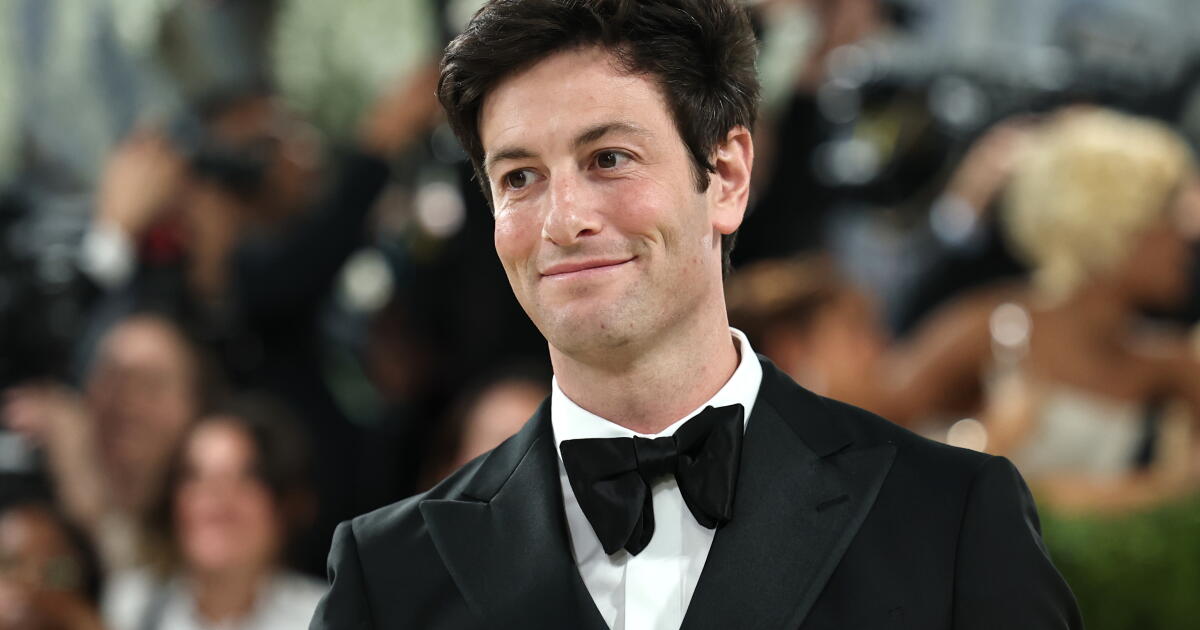
When news broke that Mark Walter’s insurance businesses were under federal investigation and that the Lakers and Dodgers owner might be in financial trouble, Josh Kushner sensed a business opportunity.
The New York venture capitalist called former Disney Chief Executive Bob Iger — his partner in a bid for a new Las Vegas NBA franchise — wondering if they might instead snap up Los Angeles’ marquee basketball team.
The two quickly agreed, Kushner contacted Walter and within 72 hours the deal was done to avoid a bidding war. And with that, the younger brother of Jared Kushner, President Trump’s son-in-law, was thrust into a media spotlight he has largely shunned.
But while Kushner may be relatively unknown compared with his politically active brother, he has rapidly and quietly risen to the upper echelons of business, with an estimated net worth of $16.7 billion.
His Thrive Capital, which he founded in 2010 while attending Harvard Business School, has more than $65 billion under management. Its investments include some of the world’s top young companies, including OpenAI, SpaceX and rapidly expanding Southern California defense contractor Anduril.
Fortune editor Alyson Shontell speaks with Josh Kushner at a 2024 forum in New York.
(Jemal Countess / Getty Images for Fortune Media)
Kushner declined to be interviewed.
People who work with the investor credit his business acumen, low-key demeanor and daunting work ethic, qualities that have attracted partners, founders and mentors alike — including Iger.
“I was immediately impressed with Josh’s curiosity, which seems limitless, and that’s something that draws me to people in general … particularly in people who want to get ahead in the business world,” Iger said in an interview.
But Kushner’s rise has been far from smooth.
He’s had to fend off insults he’s a “nepo baby” and deal with fallout from a scandal surrounding his wealthy developer father, who was sentenced to two years in federal custody for tax evasion and other charges.
A Democratic donor but a registered independent, Kushner also has had to walk a tightrope to avoid entanglement with the Trump administration, for whom his brother is now attempting to broker an Iran peace deal. It’s a challenge complicated by his vocal Democratic wife, supermodel and entrepreneur Karlie Kloss.

Josh Kushner is married to supermodel-entrepreneur Karlie Kloss, a vocal Democrat. Above, they attend a July conference in Sun Valley, Idaho.
(Kevin Dietsch/Getty Images)
Nitin Nohria, the former dean of Harvard’s business school and now executive chairman of Thrive, recalls Kushner approaching him after Trump’s first election in 2016.
“He said, ‘Nitin, what should I do?’ I said, ‘Just stay focused on the business. Say nothing, do nothing. Become as invisible as you can, because you have a great business to run, and this will just be a distraction … once you enter this distraction, it is going to be so big, it’s going to swallow you.’”
The high school ‘general manager’
At 41, Kushner retains a bushy head of hair and boyish demeanor. His life has been intertwined with money, business, politics and privilege — for better or worse.
When he was a seventh-grader in 1997, President Clinton visited the campus of Joseph Kushner Hebrew Academy, a Modern Orthodox K-8 school he attended in his hometown of Livingston, N.J. It was named for his grandfather after a donation by his father.
The 12-year-old student council member spoke about how the shofar, the ram’s horn blown during High Holy Days, awakens Jews to reflect on and reaffirm their beliefs. He told a Jewish paper that Clinton was “such a nice guy” who is “trying to get peace in a very bad time in the Middle East.”
Four years later, Kushner, who now stands 6 foot 3, made the basketball team at Rae Kushner Yeshiva High School, which was named after his grandmother.
“He would get ribbing from kids on the other teams. They would say, ‘Oh, the GM, Kushner, general manager,’” recalls Cory Sandusky, the team’s assistant coach. “He was unflappable. It would fire him up. He would smile at it, and say, ‘OK, let’s go!’”
Sandusky said that Kushner was prepared for the ribbing.
His father, Charles, had expanded the New Jersey real estate development business his grandfather, a Polish Holocaust survivor, had begun after starting out as a construction laborer.

A building owned by Kushner Cos. on Henry Street in the Lower East Side neighborhood of Manhattan.
(Drew Angerer/Getty Images)
Kushner Cos. built and acquired apartments in multiple states, while Charles became a philanthropist and major Democratic Party donor. He was even appointed to the board of the Port Authority of New York and New Jersey, responsible for rebuilding the World Trade Center site after 9/11.
On Thanksgivings, his father would bring him along as he checked out potential real estate purchases.
“The idea was when everyone is relaxing, you should be working,” Kushner told Forbes in 2012. “The ball doesn’t come to you.”
The Zuckerberg effect
Kushner’s hard work got him into Harvard, but just as he entered in 2004, Mark Zuckerberg famously decided to drop out to build what would become Facebook.
Dorm room startups became a thing, and Kushner wasn’t immune. In his junior year, with two Harvard Business School students, he co-founded a Brazilian social network called Vostu, which found success pivoting to game development.
In 2011, he told Bloomberg TV 50% of Brazil’s internet users were registered. Vostu eventually petered out, but it was a good learning experience for the budding entrepreneur and investor.

Josh Kushner, right, attends at 2011 television interview in New York about Vostu, a social media network that later branched into game development.
(Jin Lee / Bloomberg via Getty Images)
After graduating from college in 2008, Kushner followed many of his peers to Wall Street. He spent a year at Goldman Sachs as the financial crisis hit but decided it wasn’t for him.
The next year, he enrolled in Harvard Business School, where he developed the idea for Thrive. Through a literal accident, he also decided he wanted to start a health insurer taking advantage of advances in tech.
After breaking his ankle in a pickup basketball game in 2010, he got the insurance bill.
“I had absolutely no idea what it meant,” Kushner recounted in a 2023 podcast on the Colossus media website. “I said to myself, ‘How is it that the internet and software and data and design are transforming every [other] single industry around us?‘”
Kushner wanted to withdraw from graduate school, feeling he couldn’t give his classes enough attention while pursuing his startups, but was convinced to stay.
“I said, ‘If you’re bold enough to do two things and you think you can get those two done … maybe you’re one of those people who could try three and see how it goes,’” said Nohria, who kept in touch with Kushner.
Kushner had decided he wanted to build a different kind of venture capital firm. It would focus on the best entrepreneurs in various stages and industries and often hold companies longer than is typical — and sometimes co-founding them.
Kushner got his big break in 2010 while still studying for his MBA. He was searching for funding for Thrive when he scored a meeting with venture capitalist Joel Cutler, co-founder of General Catalyst.
Cutler’s mother had just died, and he wasn’t interested in talking business. Kushner showed up — the venture capitalist described him as handsome but also “geeky” — and was ready to listen.
“He’s probably one of the few men that have the sensitivity to be able to sit for hours and talk about personal stuff,” Cutler recalled of the meeting in his Harvard Square offices.
Kushner had experienced his own hell after his father pleaded guilty to tax evasion and illegal campaign contributions resulting in a sentence of two years in prison in 2005.
The scandal surrounding the prosecution was heightened by his father’s attempt to stop his relatives from cooperating with authorities. He pleaded guilty in the case to retaliating against a witness after hiring a prostitute to have sex with his sister’s husband and having a tape of it sent to his sister.

Charles Kushner, center, wades though the media with his legal team and wife to the U.S. District Courthouse in Newark, N.J., in 2004.
(Chris Hondros / Getty Images)
“By the time I was in high school, my father had accomplished a tremendous amount,” Josh Kushner told Colossus. “He was deeply impactful in both the business and philanthropic worlds. And then overnight our family were outcasts.”
Trump pardoned the elder Kushner in 2020 and named him U.S. ambassador to France in 2024.
More recently, Westminster Management, the property management arm of Kushner Cos., paid $3.25 million in civil penalties and restitution in 2022 to settle a lawsuit by the state of Maryland. The suit alleged that thousands of rental tenants were charged illegal fees, while the properties were not maintained.
The company did not admit wrongdoing. Kushner Cos. said in an email that Josh Kushner has never had involvement with the family firm.
As Cutler bonded with Kushner, he seeded Thrive’s initial $5-million fund with a $1-million investment. He also introduced him to the chief of Princeton’s endowment, who invested $10 million in Thrive’s first institutional fund.
“I’m a venture capitalist. My job is to find young people who I think will do extraordinary things in the world that others can’t,” said the now-retired Cutler, who is a close friend of Kushner’s.
Launching an insurance company
One of his early successes at Thrive came in 2012 when Kushner launched a health insurer called Oscar that sold coverage directly to individuals in the marketplaces established by the Affordable Care Act. Mario Schlosser, one of his Vostu co-founders, was put in charge.
It advertised heavily, offered online chats with doctors, some free in-person doctor visits and clear pricing for procedures. Amid skepticism that the venture would last, Oscar faced losses for years but eventually rebounded.
Kushner also made headlines after Thrive beat out rivals to make a $11.5-million investment in Instagram — in a funding round that prompted Zuckerberg to acquire the photo-sharing website 72 hours later for $1 billion. That immediately doubled the value of Thrive’s investment.
The Instagram play presaged a series of lucrative investments involving brand-name startups: Spotify, payments processor Stripe, online glasses retailer Warby Parker, Gillette disruptor Harry’s, Twitch and Reddit.
To be sure, Thrive has invested in its share of flops over the years, including the massively hyped Fab e-commerce platform; and Juicero, which sold an overly complicated high-tech countertop juice press.
Still, in the firm’s first formal investor letter this month, Kushner boasted that its second through its 10th funds rank in the top quartile in a key financial performance metric, with several in the top 5%.
In 2023, Thrive invested $130 million in OpenAI, when the startup was valued at $29 billion. It has invested more than $2 billion in total and today the AI leader is worth roughly $850 billion. Kushner also helped Sam Altman to retain his CEO position after he was pushed out by the board in 2023.
“I do not think a more fearsomely effective, hard-charging, loyal, smart, and pure-hearted VC [venture capitalist] exists than Josh,” Altman said in a statement to The Times. “He and Thrive are ride or die with us.”
Kushner also started Thrive Holdings, a vehicle to buy and retain companies that will benefit from the application of AI into their operations. OpenAI has an ownership stake. Thrive Holdings announced this month it had raised $2 billion from investors, including SoftBank, at a $12-billion valuation.
Highs and lows
This year has been one of extraordinary highs and lows for Kushner.
In April, Kushner formed Thrive Eternal, a vehicle to buy unique businesses and hold on to them indefinitely. A minority stake in the San Francisco Giants was announced as its first deal.
Oscar, the insurer, announced gains in enrollment and profit.
That more than doubled its stock, pushing its market cap above $9 billion, adding to the bottom line of Thrive and Kushner, who is vice chairman and has personal holdings. Meanwhile more than two dozen other startups tied to Obamacare — which has been subject to budget cuts by the Trump administration — have failed.

Former President Clinton, left, moderates a 2015 summit with with Elizabeth Holmes, Josh Kushner, Joe Kiani and Jeffrey Selberg at Renaissance Indian Wells Resort & Spa in California.
(Earl Gibson III / Getty Images)
“It’s a very audacious thing to try to create a new national health insurer, ” said Katherine Hempstead, a healthcare analyst with the Robert Wood Johnson Foundation.
But then came the deal put together by FIFA President Gianni Infantino to create an entity to handle the world soccer organization’s commercial enterprises, including ticket sales, broadcast and sponsorship rights.
Thrive Eternal was to be the lead investor in a $4.2-billion capital raise, but there was an immediate global backlash over concerns that the world’s most popular sport was being overly commercialized.
Nohria was in the meetings at Thrive after FIFA pulled the plug. He said Kushner handled it in an exemplary manner.
“When we had egg on our face on the FIFA deal, he stood up in front of the whole firm and said, ‘I misjudged this situation. Shame on me. We could have done better,’” recalls the former Harvard dean. “When your leader does that, then you know that this is a firm that he has your back.”
Not long afterward, Kushner made the most high profile move of his career, teaming up with Iger to buy a majority stake in the Lakers for a $12.5-billion valuation — the most ever paid for a sports franchise.
Kushner and Iger viewed the Lakers as a rare opportunity to buy an ultra-premium asset and hold it for the long term.
The pair were brought together by their wives, who shared a common background in modeling.
Iger is married to broadcast journalist Willow Bay, a former model who is dean of the USC Annenberg School for Communication and Journalism.
Kushner and Iger had lunch in 2019, with the two hitting it off — so much so Iger invested in Thrive and took an advisory role in 2022, before having to step back when he returned to Disney in November of that year.
“[He] was humble, meaning it quickly kind of suggested he knew what he didn’t know and what he needed to know,” Iger told The Times. “He came prepared, so it wasn’t a waste of my time. He had a lot of specific, very specific questions.”
Iger would not discuss plans for the Lakers or how they financed the deal. He is expected to run the day-to-day operations, while Kushner will focus on Thrive.
A grandmother’s survival story
Amid the din of his frenetic business career, there’s a constant in Kushner’s life that he cites for keeping him grounded.
He celebrates the Sabbath every week, shutting off his cellphone and focusing on his wife and three young children. He called it the “greatest thing we could ever imagine” in the podcast.
But there is something else tied to his Jewish heritage that keeps things in perspective — the struggles his grandmother went through escaping liquidation at the hand of the Nazis in her Polish hometown.
In 1943, she, the remaining members of her family and some 250 other prisoners dug a 600-foot underground tunnel using spoons to escape the Jewish ghetto, as he recounted in another Colossus podcast.
She lived with partisans in the nearby forest for months, spent years with her husband in an Italian refugee camp and arrived in the United States in 1949 to start life over again.
“I’m very proud of what I’ve done … but nothing I ever do will equate to what she has accomplished,” he said.

When news broke that Mark Walter’s insurance businesses were under federal investigation and that the Lakers and Dodgers owner might be in financial trouble, Josh Kushner sensed a business opportunity.
The New York venture capitalist called former Disney Chief Executive Bob Iger — his partner in a bid for a new Las Vegas NBA franchise — wondering if they might instead snap up Los Angeles’ marquee basketball team.
The two quickly agreed, Kushner contacted Walter and within 72 hours the deal was done to avoid a bidding war. And with that, the younger brother of Jared Kushner, President Trump’s son-in-law, was thrust into a media spotlight he has largely shunned.
But while Kushner may be relatively unknown compared with his politically active brother, he has rapidly and quietly risen to the upper echelons of business, with an estimated net worth of $16.7 billion.
His Thrive Capital, which he founded in 2010 while attending Harvard Business School, has more than $65 billion under management. Its investments include some of the world’s top young companies, including OpenAI, SpaceX and rapidly expanding Southern California defense contractor Anduril.
Fortune editor Alyson Shontell speaks with Josh Kushner at a 2024 forum in New York.
(Jemal Countess / Getty Images for Fortune Media)
Kushner declined to be interviewed.
People who work with the investor credit his business acumen, low-key demeanor and daunting work ethic, qualities that have attracted partners, founders and mentors alike — including Iger.
“I was immediately impressed with Josh’s curiosity, which seems limitless, and that’s something that draws me to people in general … particularly in people who want to get ahead in the business world,” Iger said in an interview.
But Kushner’s rise has been far from smooth.
He’s had to fend off insults he’s a “nepo baby” and deal with fallout from a scandal surrounding his wealthy developer father, who was sentenced to two years in federal custody for tax evasion and other charges.
A Democratic donor but a registered independent, Kushner also has had to walk a tightrope to avoid entanglement with the Trump administration, for whom his brother is now attempting to broker an Iran peace deal. It’s a challenge complicated by his vocal Democratic wife, supermodel and entrepreneur Karlie Kloss.
Josh Kushner is married to supermodel-entrepreneur Karlie Kloss, a vocal Democrat. Above, they attend a July conference in Sun Valley, Idaho.
(Kevin Dietsch/Getty Images)
Nitin Nohria, the former dean of Harvard’s business school and now executive chairman of Thrive, recalls Kushner approaching him after Trump’s first election in 2016.
“He said, ‘Nitin, what should I do?’ I said, ‘Just stay focused on the business. Say nothing, do nothing. Become as invisible as you can, because you have a great business to run, and this will just be a distraction … once you enter this distraction, it is going to be so big, it’s going to swallow you.’”
The high school ‘general manager’
At 41, Kushner retains a bushy head of hair and boyish demeanor. His life has been intertwined with money, business, politics and privilege — for better or worse.
When he was a seventh-grader in 1997, President Clinton visited the campus of Joseph Kushner Hebrew Academy, a Modern Orthodox K-8 school he attended in his hometown of Livingston, N.J. It was named for his grandfather after a donation by his father.
The 12-year-old student council member spoke about how the shofar, the ram’s horn blown during High Holy Days, awakens Jews to reflect on and reaffirm their beliefs. He told a Jewish paper that Clinton was “such a nice guy” who is “trying to get peace in a very bad time in the Middle East.”
Four years later, Kushner, who now stands 6 foot 3, made the basketball team at Rae Kushner Yeshiva High School, which was named after his grandmother.
“He would get ribbing from kids on the other teams. They would say, ‘Oh, the GM, Kushner, general manager,’” recalls Cory Sandusky, the team’s assistant coach. “He was unflappable. It would fire him up. He would smile at it, and say, ‘OK, let’s go!’”
Sandusky said that Kushner was prepared for the ribbing.
His father, Charles, had expanded the New Jersey real estate development business his grandfather, a Polish Holocaust survivor, had begun after starting out as a construction laborer.
A building owned by Kushner Cos. on Henry Street in the Lower East Side neighborhood of Manhattan.
(Drew Angerer/Getty Images)
Kushner Cos. built and acquired apartments in multiple states, while Charles became a philanthropist and major Democratic Party donor. He was even appointed to the board of the Port Authority of New York and New Jersey, responsible for rebuilding the World Trade Center site after 9/11.
On Thanksgivings, his father would bring him along as he checked out potential real estate purchases.
“The idea was when everyone is relaxing, you should be working,” Kushner told Forbes in 2012. “The ball doesn’t come to you.”
The Zuckerberg effect
Kushner’s hard work got him into Harvard, but just as he entered in 2004, Mark Zuckerberg famously decided to drop out to build what would become Facebook.
Dorm room startups became a thing, and Kushner wasn’t immune. In his junior year, with two Harvard Business School students, he co-founded a Brazilian social network called Vostu, which found success pivoting to game development.
In 2011, he told Bloomberg TV 50% of Brazil’s internet users were registered. Vostu eventually petered out, but it was a good learning experience for the budding entrepreneur and investor.
Josh Kushner, right, attends at 2011 television interview in New York about Vostu, a social media network that later branched into game development.
(Jin Lee / Bloomberg via Getty Images)
After graduating from college in 2008, Kushner followed many of his peers to Wall Street. He spent a year at Goldman Sachs as the financial crisis hit but decided it wasn’t for him.
The next year, he enrolled in Harvard Business School, where he developed the idea for Thrive. Through a literal accident, he also decided he wanted to start a health insurer taking advantage of advances in tech.
After breaking his ankle in a pickup basketball game in 2010, he got the insurance bill.
“I had absolutely no idea what it meant,” Kushner recounted in a 2023 podcast on the Colossus media website. “I said to myself, ‘How is it that the internet and software and data and design are transforming every [other] single industry around us?‘”
Kushner wanted to withdraw from graduate school, feeling he couldn’t give his classes enough attention while pursuing his startups, but was convinced to stay.
“I said, ‘If you’re bold enough to do two things and you think you can get those two done … maybe you’re one of those people who could try three and see how it goes,’” said Nohria, who kept in touch with Kushner.
Kushner had decided he wanted to build a different kind of venture capital firm. It would focus on the best entrepreneurs in various stages and industries and often hold companies longer than is typical — and sometimes co-founding them.
Kushner got his big break in 2010 while still studying for his MBA. He was searching for funding for Thrive when he scored a meeting with venture capitalist Joel Cutler, co-founder of General Catalyst.
Cutler’s mother had just died, and he wasn’t interested in talking business. Kushner showed up — the venture capitalist described him as handsome but also “geeky” — and was ready to listen.
“He’s probably one of the few men that have the sensitivity to be able to sit for hours and talk about personal stuff,” Cutler recalled of the meeting in his Harvard Square offices.
Kushner had experienced his own hell after his father pleaded guilty to tax evasion and illegal campaign contributions resulting in a sentence of two years in prison in 2005.
The scandal surrounding the prosecution was heightened by his father’s attempt to stop his relatives from cooperating with authorities. He pleaded guilty in the case to retaliating against a witness after hiring a prostitute to have sex with his sister’s husband and having a tape of it sent to his sister.
Charles Kushner, center, wades though the media with his legal team and wife to the U.S. District Courthouse in Newark, N.J., in 2004.
(Chris Hondros / Getty Images)
“By the time I was in high school, my father had accomplished a tremendous amount,” Josh Kushner told Colossus. “He was deeply impactful in both the business and philanthropic worlds. And then overnight our family were outcasts.”
Trump pardoned the elder Kushner in 2020 and named him U.S. ambassador to France in 2024.
More recently, Westminster Management, the property management arm of Kushner Cos., paid $3.25 million in civil penalties and restitution in 2022 to settle a lawsuit by the state of Maryland. The suit alleged that thousands of rental tenants were charged illegal fees, while the properties were not maintained.
The company did not admit wrongdoing. Kushner Cos. said in an email that Josh Kushner has never had involvement with the family firm.
As Cutler bonded with Kushner, he seeded Thrive’s initial $5-million fund with a $1-million investment. He also introduced him to the chief of Princeton’s endowment, who invested $10 million in Thrive’s first institutional fund.
“I’m a venture capitalist. My job is to find young people who I think will do extraordinary things in the world that others can’t,” said the now-retired Cutler, who is a close friend of Kushner’s.
Launching an insurance company
One of his early successes at Thrive came in 2012 when Kushner launched a health insurer called Oscar that sold coverage directly to individuals in the marketplaces established by the Affordable Care Act. Mario Schlosser, one of his Vostu co-founders, was put in charge.
It advertised heavily, offered online chats with doctors, some free in-person doctor visits and clear pricing for procedures. Amid skepticism that the venture would last, Oscar faced losses for years but eventually rebounded.
Kushner also made headlines after Thrive beat out rivals to make a $11.5-million investment in Instagram — in a funding round that prompted Zuckerberg to acquire the photo-sharing website 72 hours later for $1 billion. That immediately doubled the value of Thrive’s investment.
The Instagram play presaged a series of lucrative investments involving brand-name startups: Spotify, payments processor Stripe, online glasses retailer Warby Parker, Gillette disruptor Harry’s, Twitch and Reddit.
To be sure, Thrive has invested in its share of flops over the years, including the massively hyped Fab e-commerce platform; and Juicero, which sold an overly complicated high-tech countertop juice press.
Still, in the firm’s first formal investor letter this month, Kushner boasted that its second through its 10th funds rank in the top quartile in a key financial performance metric, with several in the top 5%.
In 2023, Thrive invested $130 million in OpenAI, when the startup was valued at $29 billion. It has invested more than $2 billion in total and today the AI leader is worth roughly $850 billion. Kushner also helped Sam Altman to retain his CEO position after he was pushed out by the board in 2023.
“I do not think a more fearsomely effective, hard-charging, loyal, smart, and pure-hearted VC [venture capitalist] exists than Josh,” Altman said in a statement to The Times. “He and Thrive are ride or die with us.”
Kushner also started Thrive Holdings, a vehicle to buy and retain companies that will benefit from the application of AI into their operations. OpenAI has an ownership stake. Thrive Holdings announced this month it had raised $2 billion from investors, including SoftBank, at a $12-billion valuation.
Highs and lows
This year has been one of extraordinary highs and lows for Kushner.
In April, Kushner formed Thrive Eternal, a vehicle to buy unique businesses and hold on to them indefinitely. A minority stake in the San Francisco Giants was announced as its first deal.
Oscar, the insurer, announced gains in enrollment and profit.
That more than doubled its stock, pushing its market cap above $9 billion, adding to the bottom line of Thrive and Kushner, who is vice chairman and has personal holdings. Meanwhile more than two dozen other startups tied to Obamacare — which has been subject to budget cuts by the Trump administration — have failed.
Former President Clinton, left, moderates a 2015 summit with with Elizabeth Holmes, Josh Kushner, Joe Kiani and Jeffrey Selberg at Renaissance Indian Wells Resort & Spa in California.
(Earl Gibson III / Getty Images)
“It’s a very audacious thing to try to create a new national health insurer, ” said Katherine Hempstead, a healthcare analyst with the Robert Wood Johnson Foundation.
But then came the deal put together by FIFA President Gianni Infantino to create an entity to handle the world soccer organization’s commercial enterprises, including ticket sales, broadcast and sponsorship rights.
Thrive Eternal was to be the lead investor in a $4.2-billion capital raise, but there was an immediate global backlash over concerns that the world’s most popular sport was being overly commercialized.
Nohria was in the meetings at Thrive after FIFA pulled the plug. He said Kushner handled it in an exemplary manner.
“When we had egg on our face on the FIFA deal, he stood up in front of the whole firm and said, ‘I misjudged this situation. Shame on me. We could have done better,’” recalls the former Harvard dean. “When your leader does that, then you know that this is a firm that he has your back.”
Not long afterward, Kushner made the most high profile move of his career, teaming up with Iger to buy a majority stake in the Lakers for a $12.5-billion valuation — the most ever paid for a sports franchise.
Kushner and Iger viewed the Lakers as a rare opportunity to buy an ultra-premium asset and hold it for the long term.
The pair were brought together by their wives, who shared a common background in modeling.
Iger is married to broadcast journalist Willow Bay, a former model who is dean of the USC Annenberg School for Communication and Journalism.
Kushner and Iger had lunch in 2019, with the two hitting it off — so much so Iger invested in Thrive and took an advisory role in 2022, before having to step back when he returned to Disney in November of that year.
“[He] was humble, meaning it quickly kind of suggested he knew what he didn’t know and what he needed to know,” Iger told The Times. “He came prepared, so it wasn’t a waste of my time. He had a lot of specific, very specific questions.”
Iger would not discuss plans for the Lakers or how they financed the deal. He is expected to run the day-to-day operations, while Kushner will focus on Thrive.
A grandmother’s survival story
Amid the din of his frenetic business career, there’s a constant in Kushner’s life that he cites for keeping him grounded.
He celebrates the Sabbath every week, shutting off his cellphone and focusing on his wife and three young children. He called it the “greatest thing we could ever imagine” in the podcast.
But there is something else tied to his Jewish heritage that keeps things in perspective — the struggles his grandmother went through escaping liquidation at the hand of the Nazis in her Polish hometown.
In 1943, she, the remaining members of her family and some 250 other prisoners dug a 600-foot underground tunnel using spoons to escape the Jewish ghetto, as he recounted in another Colossus podcast.
She lived with partisans in the nearby forest for months, spent years with her husband in an Italian refugee camp and arrived in the United States in 1949 to start life over again.
“I’m very proud of what I’ve done … but nothing I ever do will equate to what she has accomplished,” he said.

When news broke that Mark Walter’s insurance businesses were under federal investigation and that the Lakers and Dodgers owner might be in financial trouble, Josh Kushner sensed a business opportunity.
The New York venture capitalist called former Disney Chief Executive Bob Iger — his partner in a bid for a new Las Vegas NBA franchise — wondering if they might instead snap up Los Angeles’ marquee basketball team.
The two quickly agreed, Kushner contacted Walter and within 72 hours the deal was done to avoid a bidding war. And with that, the younger brother of Jared Kushner, President Trump’s son-in-law, was thrust into a media spotlight he has largely shunned.
But while Kushner may be relatively unknown compared with his politically active brother, he has rapidly and quietly risen to the upper echelons of business, with an estimated net worth of $16.7 billion.
His Thrive Capital, which he founded in 2010 while attending Harvard Business School, has more than $65 billion under management. Its investments include some of the world’s top young companies, including OpenAI, SpaceX and rapidly expanding Southern California defense contractor Anduril.
Fortune editor Alyson Shontell speaks with Josh Kushner at a 2024 forum in New York.
(Jemal Countess / Getty Images for Fortune Media)
Kushner declined to be interviewed.
People who work with the investor credit his business acumen, low-key demeanor and daunting work ethic, qualities that have attracted partners, founders and mentors alike — including Iger.
“I was immediately impressed with Josh’s curiosity, which seems limitless, and that’s something that draws me to people in general … particularly in people who want to get ahead in the business world,” Iger said in an interview.
But Kushner’s rise has been far from smooth.
He’s had to fend off insults he’s a “nepo baby” and deal with fallout from a scandal surrounding his wealthy developer father, who was sentenced to two years in federal custody for tax evasion and other charges.
A Democratic donor but a registered independent, Kushner also has had to walk a tightrope to avoid entanglement with the Trump administration, for whom his brother is now attempting to broker an Iran peace deal. It’s a challenge complicated by his vocal Democratic wife, supermodel and entrepreneur Karlie Kloss.
Josh Kushner is married to supermodel-entrepreneur Karlie Kloss, a vocal Democrat. Above, they attend a July conference in Sun Valley, Idaho.
(Kevin Dietsch/Getty Images)
Nitin Nohria, the former dean of Harvard’s business school and now executive chairman of Thrive, recalls Kushner approaching him after Trump’s first election in 2016.
“He said, ‘Nitin, what should I do?’ I said, ‘Just stay focused on the business. Say nothing, do nothing. Become as invisible as you can, because you have a great business to run, and this will just be a distraction … once you enter this distraction, it is going to be so big, it’s going to swallow you.’”
The high school ‘general manager’
At 41, Kushner retains a bushy head of hair and boyish demeanor. His life has been intertwined with money, business, politics and privilege — for better or worse.
When he was a seventh-grader in 1997, President Clinton visited the campus of Joseph Kushner Hebrew Academy, a Modern Orthodox K-8 school he attended in his hometown of Livingston, N.J. It was named for his grandfather after a donation by his father.
The 12-year-old student council member spoke about how the shofar, the ram’s horn blown during High Holy Days, awakens Jews to reflect on and reaffirm their beliefs. He told a Jewish paper that Clinton was “such a nice guy” who is “trying to get peace in a very bad time in the Middle East.”
Four years later, Kushner, who now stands 6 foot 3, made the basketball team at Rae Kushner Yeshiva High School, which was named after his grandmother.
“He would get ribbing from kids on the other teams. They would say, ‘Oh, the GM, Kushner, general manager,’” recalls Cory Sandusky, the team’s assistant coach. “He was unflappable. It would fire him up. He would smile at it, and say, ‘OK, let’s go!’”
Sandusky said that Kushner was prepared for the ribbing.
His father, Charles, had expanded the New Jersey real estate development business his grandfather, a Polish Holocaust survivor, had begun after starting out as a construction laborer.
A building owned by Kushner Cos. on Henry Street in the Lower East Side neighborhood of Manhattan.
(Drew Angerer/Getty Images)
Kushner Cos. built and acquired apartments in multiple states, while Charles became a philanthropist and major Democratic Party donor. He was even appointed to the board of the Port Authority of New York and New Jersey, responsible for rebuilding the World Trade Center site after 9/11.
On Thanksgivings, his father would bring him along as he checked out potential real estate purchases.
“The idea was when everyone is relaxing, you should be working,” Kushner told Forbes in 2012. “The ball doesn’t come to you.”
The Zuckerberg effect
Kushner’s hard work got him into Harvard, but just as he entered in 2004, Mark Zuckerberg famously decided to drop out to build what would become Facebook.
Dorm room startups became a thing, and Kushner wasn’t immune. In his junior year, with two Harvard Business School students, he co-founded a Brazilian social network called Vostu, which found success pivoting to game development.
In 2011, he told Bloomberg TV 50% of Brazil’s internet users were registered. Vostu eventually petered out, but it was a good learning experience for the budding entrepreneur and investor.
Josh Kushner, right, attends at 2011 television interview in New York about Vostu, a social media network that later branched into game development.
(Jin Lee / Bloomberg via Getty Images)
After graduating from college in 2008, Kushner followed many of his peers to Wall Street. He spent a year at Goldman Sachs as the financial crisis hit but decided it wasn’t for him.
The next year, he enrolled in Harvard Business School, where he developed the idea for Thrive. Through a literal accident, he also decided he wanted to start a health insurer taking advantage of advances in tech.
After breaking his ankle in a pickup basketball game in 2010, he got the insurance bill.
“I had absolutely no idea what it meant,” Kushner recounted in a 2023 podcast on the Colossus media website. “I said to myself, ‘How is it that the internet and software and data and design are transforming every [other] single industry around us?‘”
Kushner wanted to withdraw from graduate school, feeling he couldn’t give his classes enough attention while pursuing his startups, but was convinced to stay.
“I said, ‘If you’re bold enough to do two things and you think you can get those two done … maybe you’re one of those people who could try three and see how it goes,’” said Nohria, who kept in touch with Kushner.
Kushner had decided he wanted to build a different kind of venture capital firm. It would focus on the best entrepreneurs in various stages and industries and often hold companies longer than is typical — and sometimes co-founding them.
Kushner got his big break in 2010 while still studying for his MBA. He was searching for funding for Thrive when he scored a meeting with venture capitalist Joel Cutler, co-founder of General Catalyst.
Cutler’s mother had just died, and he wasn’t interested in talking business. Kushner showed up — the venture capitalist described him as handsome but also “geeky” — and was ready to listen.
“He’s probably one of the few men that have the sensitivity to be able to sit for hours and talk about personal stuff,” Cutler recalled of the meeting in his Harvard Square offices.
Kushner had experienced his own hell after his father pleaded guilty to tax evasion and illegal campaign contributions resulting in a sentence of two years in prison in 2005.
The scandal surrounding the prosecution was heightened by his father’s attempt to stop his relatives from cooperating with authorities. He pleaded guilty in the case to retaliating against a witness after hiring a prostitute to have sex with his sister’s husband and having a tape of it sent to his sister.
Charles Kushner, center, wades though the media with his legal team and wife to the U.S. District Courthouse in Newark, N.J., in 2004.
(Chris Hondros / Getty Images)
“By the time I was in high school, my father had accomplished a tremendous amount,” Josh Kushner told Colossus. “He was deeply impactful in both the business and philanthropic worlds. And then overnight our family were outcasts.”
Trump pardoned the elder Kushner in 2020 and named him U.S. ambassador to France in 2024.
More recently, Westminster Management, the property management arm of Kushner Cos., paid $3.25 million in civil penalties and restitution in 2022 to settle a lawsuit by the state of Maryland. The suit alleged that thousands of rental tenants were charged illegal fees, while the properties were not maintained.
The company did not admit wrongdoing. Kushner Cos. said in an email that Josh Kushner has never had involvement with the family firm.
As Cutler bonded with Kushner, he seeded Thrive’s initial $5-million fund with a $1-million investment. He also introduced him to the chief of Princeton’s endowment, who invested $10 million in Thrive’s first institutional fund.
“I’m a venture capitalist. My job is to find young people who I think will do extraordinary things in the world that others can’t,” said the now-retired Cutler, who is a close friend of Kushner’s.
Launching an insurance company
One of his early successes at Thrive came in 2012 when Kushner launched a health insurer called Oscar that sold coverage directly to individuals in the marketplaces established by the Affordable Care Act. Mario Schlosser, one of his Vostu co-founders, was put in charge.
It advertised heavily, offered online chats with doctors, some free in-person doctor visits and clear pricing for procedures. Amid skepticism that the venture would last, Oscar faced losses for years but eventually rebounded.
Kushner also made headlines after Thrive beat out rivals to make a $11.5-million investment in Instagram — in a funding round that prompted Zuckerberg to acquire the photo-sharing website 72 hours later for $1 billion. That immediately doubled the value of Thrive’s investment.
The Instagram play presaged a series of lucrative investments involving brand-name startups: Spotify, payments processor Stripe, online glasses retailer Warby Parker, Gillette disruptor Harry’s, Twitch and Reddit.
To be sure, Thrive has invested in its share of flops over the years, including the massively hyped Fab e-commerce platform; and Juicero, which sold an overly complicated high-tech countertop juice press.
Still, in the firm’s first formal investor letter this month, Kushner boasted that its second through its 10th funds rank in the top quartile in a key financial performance metric, with several in the top 5%.
In 2023, Thrive invested $130 million in OpenAI, when the startup was valued at $29 billion. It has invested more than $2 billion in total and today the AI leader is worth roughly $850 billion. Kushner also helped Sam Altman to retain his CEO position after he was pushed out by the board in 2023.
“I do not think a more fearsomely effective, hard-charging, loyal, smart, and pure-hearted VC [venture capitalist] exists than Josh,” Altman said in a statement to The Times. “He and Thrive are ride or die with us.”
Kushner also started Thrive Holdings, a vehicle to buy and retain companies that will benefit from the application of AI into their operations. OpenAI has an ownership stake. Thrive Holdings announced this month it had raised $2 billion from investors, including SoftBank, at a $12-billion valuation.
Highs and lows
This year has been one of extraordinary highs and lows for Kushner.
In April, Kushner formed Thrive Eternal, a vehicle to buy unique businesses and hold on to them indefinitely. A minority stake in the San Francisco Giants was announced as its first deal.
Oscar, the insurer, announced gains in enrollment and profit.
That more than doubled its stock, pushing its market cap above $9 billion, adding to the bottom line of Thrive and Kushner, who is vice chairman and has personal holdings. Meanwhile more than two dozen other startups tied to Obamacare — which has been subject to budget cuts by the Trump administration — have failed.
Former President Clinton, left, moderates a 2015 summit with with Elizabeth Holmes, Josh Kushner, Joe Kiani and Jeffrey Selberg at Renaissance Indian Wells Resort & Spa in California.
(Earl Gibson III / Getty Images)
“It’s a very audacious thing to try to create a new national health insurer, ” said Katherine Hempstead, a healthcare analyst with the Robert Wood Johnson Foundation.
But then came the deal put together by FIFA President Gianni Infantino to create an entity to handle the world soccer organization’s commercial enterprises, including ticket sales, broadcast and sponsorship rights.
Thrive Eternal was to be the lead investor in a $4.2-billion capital raise, but there was an immediate global backlash over concerns that the world’s most popular sport was being overly commercialized.
Nohria was in the meetings at Thrive after FIFA pulled the plug. He said Kushner handled it in an exemplary manner.
“When we had egg on our face on the FIFA deal, he stood up in front of the whole firm and said, ‘I misjudged this situation. Shame on me. We could have done better,’” recalls the former Harvard dean. “When your leader does that, then you know that this is a firm that he has your back.”
Not long afterward, Kushner made the most high profile move of his career, teaming up with Iger to buy a majority stake in the Lakers for a $12.5-billion valuation — the most ever paid for a sports franchise.
Kushner and Iger viewed the Lakers as a rare opportunity to buy an ultra-premium asset and hold it for the long term.
The pair were brought together by their wives, who shared a common background in modeling.
Iger is married to broadcast journalist Willow Bay, a former model who is dean of the USC Annenberg School for Communication and Journalism.
Kushner and Iger had lunch in 2019, with the two hitting it off — so much so Iger invested in Thrive and took an advisory role in 2022, before having to step back when he returned to Disney in November of that year.
“[He] was humble, meaning it quickly kind of suggested he knew what he didn’t know and what he needed to know,” Iger told The Times. “He came prepared, so it wasn’t a waste of my time. He had a lot of specific, very specific questions.”
Iger would not discuss plans for the Lakers or how they financed the deal. He is expected to run the day-to-day operations, while Kushner will focus on Thrive.
A grandmother’s survival story
Amid the din of his frenetic business career, there’s a constant in Kushner’s life that he cites for keeping him grounded.
He celebrates the Sabbath every week, shutting off his cellphone and focusing on his wife and three young children. He called it the “greatest thing we could ever imagine” in the podcast.
But there is something else tied to his Jewish heritage that keeps things in perspective — the struggles his grandmother went through escaping liquidation at the hand of the Nazis in her Polish hometown.
In 1943, she, the remaining members of her family and some 250 other prisoners dug a 600-foot underground tunnel using spoons to escape the Jewish ghetto, as he recounted in another Colossus podcast.
She lived with partisans in the nearby forest for months, spent years with her husband in an Italian refugee camp and arrived in the United States in 1949 to start life over again.
“I’m very proud of what I’ve done … but nothing I ever do will equate to what she has accomplished,” he said.
When news broke that Mark Walter’s insurance businesses were under federal investigation and that the Lakers and Dodgers owner might be in financial trouble, Josh Kushner sensed a business opportunity.
The New York venture capitalist called former Disney Chief Executive Bob Iger — his partner in a bid for a new Las Vegas NBA franchise — wondering if they might instead snap up Los Angeles’ marquee basketball team.
The two quickly agreed, Kushner contacted Walter and within 72 hours the deal was done to avoid a bidding war. And with that, the younger brother of Jared Kushner, President Trump’s son-in-law, was thrust into a media spotlight he has largely shunned.
But while Kushner may be relatively unknown compared with his politically active brother, he has rapidly and quietly risen to the upper echelons of business, with an estimated net worth of $16.7 billion.
His Thrive Capital, which he founded in 2010 while attending Harvard Business School, has more than $65 billion under management. Its investments include some of the world’s top young companies, including OpenAI, SpaceX and rapidly expanding Southern California defense contractor Anduril.
Fortune editor Alyson Shontell speaks with Josh Kushner at a 2024 forum in New York.
(Jemal Countess / Getty Images for Fortune Media)
Kushner declined to be interviewed.
People who work with the investor credit his business acumen, low-key demeanor and daunting work ethic, qualities that have attracted partners, founders and mentors alike — including Iger.
“I was immediately impressed with Josh’s curiosity, which seems limitless, and that’s something that draws me to people in general … particularly in people who want to get ahead in the business world,” Iger said in an interview.
But Kushner’s rise has been far from smooth.
He’s had to fend off insults he’s a “nepo baby” and deal with fallout from a scandal surrounding his wealthy developer father, who was sentenced to two years in federal custody for tax evasion and other charges.
A Democratic donor but a registered independent, Kushner also has had to walk a tightrope to avoid entanglement with the Trump administration, for whom his brother is now attempting to broker an Iran peace deal. It’s a challenge complicated by his vocal Democratic wife, supermodel and entrepreneur Karlie Kloss.
Josh Kushner is married to supermodel-entrepreneur Karlie Kloss, a vocal Democrat. Above, they attend a July conference in Sun Valley, Idaho.
(Kevin Dietsch/Getty Images)
Nitin Nohria, the former dean of Harvard’s business school and now executive chairman of Thrive, recalls Kushner approaching him after Trump’s first election in 2016.
“He said, ‘Nitin, what should I do?’ I said, ‘Just stay focused on the business. Say nothing, do nothing. Become as invisible as you can, because you have a great business to run, and this will just be a distraction … once you enter this distraction, it is going to be so big, it’s going to swallow you.’”
The high school ‘general manager’
At 41, Kushner retains a bushy head of hair and boyish demeanor. His life has been intertwined with money, business, politics and privilege — for better or worse.
When he was a seventh-grader in 1997, President Clinton visited the campus of Joseph Kushner Hebrew Academy, a Modern Orthodox K-8 school he attended in his hometown of Livingston, N.J. It was named for his grandfather after a donation by his father.
The 12-year-old student council member spoke about how the shofar, the ram’s horn blown during High Holy Days, awakens Jews to reflect on and reaffirm their beliefs. He told a Jewish paper that Clinton was “such a nice guy” who is “trying to get peace in a very bad time in the Middle East.”
Four years later, Kushner, who now stands 6 foot 3, made the basketball team at Rae Kushner Yeshiva High School, which was named after his grandmother.
“He would get ribbing from kids on the other teams. They would say, ‘Oh, the GM, Kushner, general manager,’” recalls Cory Sandusky, the team’s assistant coach. “He was unflappable. It would fire him up. He would smile at it, and say, ‘OK, let’s go!’”
Sandusky said that Kushner was prepared for the ribbing.
His father, Charles, had expanded the New Jersey real estate development business his grandfather, a Polish Holocaust survivor, had begun after starting out as a construction laborer.
A building owned by Kushner Cos. on Henry Street in the Lower East Side neighborhood of Manhattan.
(Drew Angerer/Getty Images)
Kushner Cos. built and acquired apartments in multiple states, while Charles became a philanthropist and major Democratic Party donor. He was even appointed to the board of the Port Authority of New York and New Jersey, responsible for rebuilding the World Trade Center site after 9/11.
On Thanksgivings, his father would bring him along as he checked out potential real estate purchases.
“The idea was when everyone is relaxing, you should be working,” Kushner told Forbes in 2012. “The ball doesn’t come to you.”
The Zuckerberg effect
Kushner’s hard work got him into Harvard, but just as he entered in 2004, Mark Zuckerberg famously decided to drop out to build what would become Facebook.
Dorm room startups became a thing, and Kushner wasn’t immune. In his junior year, with two Harvard Business School students, he co-founded a Brazilian social network called Vostu, which found success pivoting to game development.
In 2011, he told Bloomberg TV 50% of Brazil’s internet users were registered. Vostu eventually petered out, but it was a good learning experience for the budding entrepreneur and investor.
Josh Kushner, right, attends at 2011 television interview in New York about Vostu, a social media network that later branched into game development.
(Jin Lee / Bloomberg via Getty Images)
After graduating from college in 2008, Kushner followed many of his peers to Wall Street. He spent a year at Goldman Sachs as the financial crisis hit but decided it wasn’t for him.
The next year, he enrolled in Harvard Business School, where he developed the idea for Thrive. Through a literal accident, he also decided he wanted to start a health insurer taking advantage of advances in tech.
After breaking his ankle in a pickup basketball game in 2010, he got the insurance bill.
“I had absolutely no idea what it meant,” Kushner recounted in a 2023 podcast on the Colossus media website. “I said to myself, ‘How is it that the internet and software and data and design are transforming every [other] single industry around us?‘”
Kushner wanted to withdraw from graduate school, feeling he couldn’t give his classes enough attention while pursuing his startups, but was convinced to stay.
“I said, ‘If you’re bold enough to do two things and you think you can get those two done … maybe you’re one of those people who could try three and see how it goes,’” said Nohria, who kept in touch with Kushner.
Kushner had decided he wanted to build a different kind of venture capital firm. It would focus on the best entrepreneurs in various stages and industries and often hold companies longer than is typical — and sometimes co-founding them.
Kushner got his big break in 2010 while still studying for his MBA. He was searching for funding for Thrive when he scored a meeting with venture capitalist Joel Cutler, co-founder of General Catalyst.
Cutler’s mother had just died, and he wasn’t interested in talking business. Kushner showed up — the venture capitalist described him as handsome but also “geeky” — and was ready to listen.
“He’s probably one of the few men that have the sensitivity to be able to sit for hours and talk about personal stuff,” Cutler recalled of the meeting in his Harvard Square offices.
Kushner had experienced his own hell after his father pleaded guilty to tax evasion and illegal campaign contributions resulting in a sentence of two years in prison in 2005.
The scandal surrounding the prosecution was heightened by his father’s attempt to stop his relatives from cooperating with authorities. He pleaded guilty in the case to retaliating against a witness after hiring a prostitute to have sex with his sister’s husband and having a tape of it sent to his sister.
Charles Kushner, center, wades though the media with his legal team and wife to the U.S. District Courthouse in Newark, N.J., in 2004.
(Chris Hondros / Getty Images)
“By the time I was in high school, my father had accomplished a tremendous amount,” Josh Kushner told Colossus. “He was deeply impactful in both the business and philanthropic worlds. And then overnight our family were outcasts.”
Trump pardoned the elder Kushner in 2020 and named him U.S. ambassador to France in 2024.
More recently, Westminster Management, the property management arm of Kushner Cos., paid $3.25 million in civil penalties and restitution in 2022 to settle a lawsuit by the state of Maryland. The suit alleged that thousands of rental tenants were charged illegal fees, while the properties were not maintained.
The company did not admit wrongdoing. Kushner Cos. said in an email that Josh Kushner has never had involvement with the family firm.
As Cutler bonded with Kushner, he seeded Thrive’s initial $5-million fund with a $1-million investment. He also introduced him to the chief of Princeton’s endowment, who invested $10 million in Thrive’s first institutional fund.
“I’m a venture capitalist. My job is to find young people who I think will do extraordinary things in the world that others can’t,” said the now-retired Cutler, who is a close friend of Kushner’s.
Launching an insurance company
One of his early successes at Thrive came in 2012 when Kushner launched a health insurer called Oscar that sold coverage directly to individuals in the marketplaces established by the Affordable Care Act. Mario Schlosser, one of his Vostu co-founders, was put in charge.
It advertised heavily, offered online chats with doctors, some free in-person doctor visits and clear pricing for procedures. Amid skepticism that the venture would last, Oscar faced losses for years but eventually rebounded.
Kushner also made headlines after Thrive beat out rivals to make a $11.5-million investment in Instagram — in a funding round that prompted Zuckerberg to acquire the photo-sharing website 72 hours later for $1 billion. That immediately doubled the value of Thrive’s investment.
The Instagram play presaged a series of lucrative investments involving brand-name startups: Spotify, payments processor Stripe, online glasses retailer Warby Parker, Gillette disruptor Harry’s, Twitch and Reddit.
To be sure, Thrive has invested in its share of flops over the years, including the massively hyped Fab e-commerce platform; and Juicero, which sold an overly complicated high-tech countertop juice press.
Still, in the firm’s first formal investor letter this month, Kushner boasted that its second through its 10th funds rank in the top quartile in a key financial performance metric, with several in the top 5%.
In 2023, Thrive invested $130 million in OpenAI, when the startup was valued at $29 billion. It has invested more than $2 billion in total and today the AI leader is worth roughly $850 billion. Kushner also helped Sam Altman to retain his CEO position after he was pushed out by the board in 2023.
“I do not think a more fearsomely effective, hard-charging, loyal, smart, and pure-hearted VC [venture capitalist] exists than Josh,” Altman said in a statement to The Times. “He and Thrive are ride or die with us.”
Kushner also started Thrive Holdings, a vehicle to buy and retain companies that will benefit from the application of AI into their operations. OpenAI has an ownership stake. Thrive Holdings announced this month it had raised $2 billion from investors, including SoftBank, at a $12-billion valuation.
Highs and lows
This year has been one of extraordinary highs and lows for Kushner.
In April, Kushner formed Thrive Eternal, a vehicle to buy unique businesses and hold on to them indefinitely. A minority stake in the San Francisco Giants was announced as its first deal.
Oscar, the insurer, announced gains in enrollment and profit.
That more than doubled its stock, pushing its market cap above $9 billion, adding to the bottom line of Thrive and Kushner, who is vice chairman and has personal holdings. Meanwhile more than two dozen other startups tied to Obamacare — which has been subject to budget cuts by the Trump administration — have failed.
Former President Clinton, left, moderates a 2015 summit with with Elizabeth Holmes, Josh Kushner, Joe Kiani and Jeffrey Selberg at Renaissance Indian Wells Resort & Spa in California.
(Earl Gibson III / Getty Images)
“It’s a very audacious thing to try to create a new national health insurer, ” said Katherine Hempstead, a healthcare analyst with the Robert Wood Johnson Foundation.
But then came the deal put together by FIFA President Gianni Infantino to create an entity to handle the world soccer organization’s commercial enterprises, including ticket sales, broadcast and sponsorship rights.
Thrive Eternal was to be the lead investor in a $4.2-billion capital raise, but there was an immediate global backlash over concerns that the world’s most popular sport was being overly commercialized.
Nohria was in the meetings at Thrive after FIFA pulled the plug. He said Kushner handled it in an exemplary manner.
“When we had egg on our face on the FIFA deal, he stood up in front of the whole firm and said, ‘I misjudged this situation. Shame on me. We could have done better,’” recalls the former Harvard dean. “When your leader does that, then you know that this is a firm that he has your back.”
Not long afterward, Kushner made the most high profile move of his career, teaming up with Iger to buy a majority stake in the Lakers for a $12.5-billion valuation — the most ever paid for a sports franchise.
Kushner and Iger viewed the Lakers as a rare opportunity to buy an ultra-premium asset and hold it for the long term.
The pair were brought together by their wives, who shared a common background in modeling.
Iger is married to broadcast journalist Willow Bay, a former model who is dean of the USC Annenberg School for Communication and Journalism.
Kushner and Iger had lunch in 2019, with the two hitting it off — so much so Iger invested in Thrive and took an advisory role in 2022, before having to step back when he returned to Disney in November of that year.
“[He] was humble, meaning it quickly kind of suggested he knew what he didn’t know and what he needed to know,” Iger told The Times. “He came prepared, so it wasn’t a waste of my time. He had a lot of specific, very specific questions.”
Iger would not discuss plans for the Lakers or how they financed the deal. He is expected to run the day-to-day operations, while Kushner will focus on Thrive.
A grandmother’s survival story
Amid the din of his frenetic business career, there’s a constant in Kushner’s life that he cites for keeping him grounded.
He celebrates the Sabbath every week, shutting off his cellphone and focusing on his wife and three young children. He called it the “greatest thing we could ever imagine” in the podcast.
But there is something else tied to his Jewish heritage that keeps things in perspective — the struggles his grandmother went through escaping liquidation at the hand of the Nazis in her Polish hometown.
In 1943, she, the remaining members of her family and some 250 other prisoners dug a 600-foot underground tunnel using spoons to escape the Jewish ghetto, as he recounted in another Colossus podcast.
She lived with partisans in the nearby forest for months, spent years with her husband in an Italian refugee camp and arrived in the United States in 1949 to start life over again.
“I’m very proud of what I’ve done … but nothing I ever do will equate to what she has accomplished,” he said.

When news broke that Mark Walter’s insurance businesses were under federal investigation and that the Lakers and Dodgers owner might be in financial trouble, Josh Kushner sensed a business opportunity.
The New York venture capitalist called former Disney Chief Executive Bob Iger — his partner in a bid for a new Las Vegas NBA franchise — wondering if they might instead snap up Los Angeles’ marquee basketball team.
The two quickly agreed, Kushner contacted Walter and within 72 hours the deal was done to avoid a bidding war. And with that, the younger brother of Jared Kushner, President Trump’s son-in-law, was thrust into a media spotlight he has largely shunned.
But while Kushner may be relatively unknown compared with his politically active brother, he has rapidly and quietly risen to the upper echelons of business, with an estimated net worth of $16.7 billion.
His Thrive Capital, which he founded in 2010 while attending Harvard Business School, has more than $65 billion under management. Its investments include some of the world’s top young companies, including OpenAI, SpaceX and rapidly expanding Southern California defense contractor Anduril.
Fortune editor Alyson Shontell speaks with Josh Kushner at a 2024 forum in New York.
(Jemal Countess / Getty Images for Fortune Media)
Kushner declined to be interviewed.
People who work with the investor credit his business acumen, low-key demeanor and daunting work ethic, qualities that have attracted partners, founders and mentors alike — including Iger.
“I was immediately impressed with Josh’s curiosity, which seems limitless, and that’s something that draws me to people in general … particularly in people who want to get ahead in the business world,” Iger said in an interview.
But Kushner’s rise has been far from smooth.
He’s had to fend off insults he’s a “nepo baby” and deal with fallout from a scandal surrounding his wealthy developer father, who was sentenced to two years in federal custody for tax evasion and other charges.
A Democratic donor but a registered independent, Kushner also has had to walk a tightrope to avoid entanglement with the Trump administration, for whom his brother is now attempting to broker an Iran peace deal. It’s a challenge complicated by his vocal Democratic wife, supermodel and entrepreneur Karlie Kloss.
Josh Kushner is married to supermodel-entrepreneur Karlie Kloss, a vocal Democrat. Above, they attend a July conference in Sun Valley, Idaho.
(Kevin Dietsch/Getty Images)
Nitin Nohria, the former dean of Harvard’s business school and now executive chairman of Thrive, recalls Kushner approaching him after Trump’s first election in 2016.
“He said, ‘Nitin, what should I do?’ I said, ‘Just stay focused on the business. Say nothing, do nothing. Become as invisible as you can, because you have a great business to run, and this will just be a distraction … once you enter this distraction, it is going to be so big, it’s going to swallow you.’”
The high school ‘general manager’
At 41, Kushner retains a bushy head of hair and boyish demeanor. His life has been intertwined with money, business, politics and privilege — for better or worse.
When he was a seventh-grader in 1997, President Clinton visited the campus of Joseph Kushner Hebrew Academy, a Modern Orthodox K-8 school he attended in his hometown of Livingston, N.J. It was named for his grandfather after a donation by his father.
The 12-year-old student council member spoke about how the shofar, the ram’s horn blown during High Holy Days, awakens Jews to reflect on and reaffirm their beliefs. He told a Jewish paper that Clinton was “such a nice guy” who is “trying to get peace in a very bad time in the Middle East.”
Four years later, Kushner, who now stands 6 foot 3, made the basketball team at Rae Kushner Yeshiva High School, which was named after his grandmother.
“He would get ribbing from kids on the other teams. They would say, ‘Oh, the GM, Kushner, general manager,’” recalls Cory Sandusky, the team’s assistant coach. “He was unflappable. It would fire him up. He would smile at it, and say, ‘OK, let’s go!’”
Sandusky said that Kushner was prepared for the ribbing.
His father, Charles, had expanded the New Jersey real estate development business his grandfather, a Polish Holocaust survivor, had begun after starting out as a construction laborer.
A building owned by Kushner Cos. on Henry Street in the Lower East Side neighborhood of Manhattan.
(Drew Angerer/Getty Images)
Kushner Cos. built and acquired apartments in multiple states, while Charles became a philanthropist and major Democratic Party donor. He was even appointed to the board of the Port Authority of New York and New Jersey, responsible for rebuilding the World Trade Center site after 9/11.
On Thanksgivings, his father would bring him along as he checked out potential real estate purchases.
“The idea was when everyone is relaxing, you should be working,” Kushner told Forbes in 2012. “The ball doesn’t come to you.”
The Zuckerberg effect
Kushner’s hard work got him into Harvard, but just as he entered in 2004, Mark Zuckerberg famously decided to drop out to build what would become Facebook.
Dorm room startups became a thing, and Kushner wasn’t immune. In his junior year, with two Harvard Business School students, he co-founded a Brazilian social network called Vostu, which found success pivoting to game development.
In 2011, he told Bloomberg TV 50% of Brazil’s internet users were registered. Vostu eventually petered out, but it was a good learning experience for the budding entrepreneur and investor.
Josh Kushner, right, attends at 2011 television interview in New York about Vostu, a social media network that later branched into game development.
(Jin Lee / Bloomberg via Getty Images)
After graduating from college in 2008, Kushner followed many of his peers to Wall Street. He spent a year at Goldman Sachs as the financial crisis hit but decided it wasn’t for him.
The next year, he enrolled in Harvard Business School, where he developed the idea for Thrive. Through a literal accident, he also decided he wanted to start a health insurer taking advantage of advances in tech.
After breaking his ankle in a pickup basketball game in 2010, he got the insurance bill.
“I had absolutely no idea what it meant,” Kushner recounted in a 2023 podcast on the Colossus media website. “I said to myself, ‘How is it that the internet and software and data and design are transforming every [other] single industry around us?‘”
Kushner wanted to withdraw from graduate school, feeling he couldn’t give his classes enough attention while pursuing his startups, but was convinced to stay.
“I said, ‘If you’re bold enough to do two things and you think you can get those two done … maybe you’re one of those people who could try three and see how it goes,’” said Nohria, who kept in touch with Kushner.
Kushner had decided he wanted to build a different kind of venture capital firm. It would focus on the best entrepreneurs in various stages and industries and often hold companies longer than is typical — and sometimes co-founding them.
Kushner got his big break in 2010 while still studying for his MBA. He was searching for funding for Thrive when he scored a meeting with venture capitalist Joel Cutler, co-founder of General Catalyst.
Cutler’s mother had just died, and he wasn’t interested in talking business. Kushner showed up — the venture capitalist described him as handsome but also “geeky” — and was ready to listen.
“He’s probably one of the few men that have the sensitivity to be able to sit for hours and talk about personal stuff,” Cutler recalled of the meeting in his Harvard Square offices.
Kushner had experienced his own hell after his father pleaded guilty to tax evasion and illegal campaign contributions resulting in a sentence of two years in prison in 2005.
The scandal surrounding the prosecution was heightened by his father’s attempt to stop his relatives from cooperating with authorities. He pleaded guilty in the case to retaliating against a witness after hiring a prostitute to have sex with his sister’s husband and having a tape of it sent to his sister.
Charles Kushner, center, wades though the media with his legal team and wife to the U.S. District Courthouse in Newark, N.J., in 2004.
(Chris Hondros / Getty Images)
“By the time I was in high school, my father had accomplished a tremendous amount,” Josh Kushner told Colossus. “He was deeply impactful in both the business and philanthropic worlds. And then overnight our family were outcasts.”
Trump pardoned the elder Kushner in 2020 and named him U.S. ambassador to France in 2024.
More recently, Westminster Management, the property management arm of Kushner Cos., paid $3.25 million in civil penalties and restitution in 2022 to settle a lawsuit by the state of Maryland. The suit alleged that thousands of rental tenants were charged illegal fees, while the properties were not maintained.
The company did not admit wrongdoing. Kushner Cos. said in an email that Josh Kushner has never had involvement with the family firm.
As Cutler bonded with Kushner, he seeded Thrive’s initial $5-million fund with a $1-million investment. He also introduced him to the chief of Princeton’s endowment, who invested $10 million in Thrive’s first institutional fund.
“I’m a venture capitalist. My job is to find young people who I think will do extraordinary things in the world that others can’t,” said the now-retired Cutler, who is a close friend of Kushner’s.
Launching an insurance company
One of his early successes at Thrive came in 2012 when Kushner launched a health insurer called Oscar that sold coverage directly to individuals in the marketplaces established by the Affordable Care Act. Mario Schlosser, one of his Vostu co-founders, was put in charge.
It advertised heavily, offered online chats with doctors, some free in-person doctor visits and clear pricing for procedures. Amid skepticism that the venture would last, Oscar faced losses for years but eventually rebounded.
Kushner also made headlines after Thrive beat out rivals to make a $11.5-million investment in Instagram — in a funding round that prompted Zuckerberg to acquire the photo-sharing website 72 hours later for $1 billion. That immediately doubled the value of Thrive’s investment.
The Instagram play presaged a series of lucrative investments involving brand-name startups: Spotify, payments processor Stripe, online glasses retailer Warby Parker, Gillette disruptor Harry’s, Twitch and Reddit.
To be sure, Thrive has invested in its share of flops over the years, including the massively hyped Fab e-commerce platform; and Juicero, which sold an overly complicated high-tech countertop juice press.
Still, in the firm’s first formal investor letter this month, Kushner boasted that its second through its 10th funds rank in the top quartile in a key financial performance metric, with several in the top 5%.
In 2023, Thrive invested $130 million in OpenAI, when the startup was valued at $29 billion. It has invested more than $2 billion in total and today the AI leader is worth roughly $850 billion. Kushner also helped Sam Altman to retain his CEO position after he was pushed out by the board in 2023.
“I do not think a more fearsomely effective, hard-charging, loyal, smart, and pure-hearted VC [venture capitalist] exists than Josh,” Altman said in a statement to The Times. “He and Thrive are ride or die with us.”
Kushner also started Thrive Holdings, a vehicle to buy and retain companies that will benefit from the application of AI into their operations. OpenAI has an ownership stake. Thrive Holdings announced this month it had raised $2 billion from investors, including SoftBank, at a $12-billion valuation.
Highs and lows
This year has been one of extraordinary highs and lows for Kushner.
In April, Kushner formed Thrive Eternal, a vehicle to buy unique businesses and hold on to them indefinitely. A minority stake in the San Francisco Giants was announced as its first deal.
Oscar, the insurer, announced gains in enrollment and profit.
That more than doubled its stock, pushing its market cap above $9 billion, adding to the bottom line of Thrive and Kushner, who is vice chairman and has personal holdings. Meanwhile more than two dozen other startups tied to Obamacare — which has been subject to budget cuts by the Trump administration — have failed.
Former President Clinton, left, moderates a 2015 summit with with Elizabeth Holmes, Josh Kushner, Joe Kiani and Jeffrey Selberg at Renaissance Indian Wells Resort & Spa in California.
(Earl Gibson III / Getty Images)
“It’s a very audacious thing to try to create a new national health insurer, ” said Katherine Hempstead, a healthcare analyst with the Robert Wood Johnson Foundation.
But then came the deal put together by FIFA President Gianni Infantino to create an entity to handle the world soccer organization’s commercial enterprises, including ticket sales, broadcast and sponsorship rights.
Thrive Eternal was to be the lead investor in a $4.2-billion capital raise, but there was an immediate global backlash over concerns that the world’s most popular sport was being overly commercialized.
Nohria was in the meetings at Thrive after FIFA pulled the plug. He said Kushner handled it in an exemplary manner.
“When we had egg on our face on the FIFA deal, he stood up in front of the whole firm and said, ‘I misjudged this situation. Shame on me. We could have done better,’” recalls the former Harvard dean. “When your leader does that, then you know that this is a firm that he has your back.”
Not long afterward, Kushner made the most high profile move of his career, teaming up with Iger to buy a majority stake in the Lakers for a $12.5-billion valuation — the most ever paid for a sports franchise.
Kushner and Iger viewed the Lakers as a rare opportunity to buy an ultra-premium asset and hold it for the long term.
The pair were brought together by their wives, who shared a common background in modeling.
Iger is married to broadcast journalist Willow Bay, a former model who is dean of the USC Annenberg School for Communication and Journalism.
Kushner and Iger had lunch in 2019, with the two hitting it off — so much so Iger invested in Thrive and took an advisory role in 2022, before having to step back when he returned to Disney in November of that year.
“[He] was humble, meaning it quickly kind of suggested he knew what he didn’t know and what he needed to know,” Iger told The Times. “He came prepared, so it wasn’t a waste of my time. He had a lot of specific, very specific questions.”
Iger would not discuss plans for the Lakers or how they financed the deal. He is expected to run the day-to-day operations, while Kushner will focus on Thrive.
A grandmother’s survival story
Amid the din of his frenetic business career, there’s a constant in Kushner’s life that he cites for keeping him grounded.
He celebrates the Sabbath every week, shutting off his cellphone and focusing on his wife and three young children. He called it the “greatest thing we could ever imagine” in the podcast.
But there is something else tied to his Jewish heritage that keeps things in perspective — the struggles his grandmother went through escaping liquidation at the hand of the Nazis in her Polish hometown.
In 1943, she, the remaining members of her family and some 250 other prisoners dug a 600-foot underground tunnel using spoons to escape the Jewish ghetto, as he recounted in another Colossus podcast.
She lived with partisans in the nearby forest for months, spent years with her husband in an Italian refugee camp and arrived in the United States in 1949 to start life over again.
“I’m very proud of what I’ve done … but nothing I ever do will equate to what she has accomplished,” he said.
When news broke that Mark Walter’s insurance businesses were under federal investigation and that the Lakers and Dodgers owner might be in financial trouble, Josh Kushner sensed a business opportunity.
The New York venture capitalist called former Disney Chief Executive Bob Iger — his partner in a bid for a new Las Vegas NBA franchise — wondering if they might instead snap up Los Angeles’ marquee basketball team.
The two quickly agreed, Kushner contacted Walter and within 72 hours the deal was done to avoid a bidding war. And with that, the younger brother of Jared Kushner, President Trump’s son-in-law, was thrust into a media spotlight he has largely shunned.
But while Kushner may be relatively unknown compared with his politically active brother, he has rapidly and quietly risen to the upper echelons of business, with an estimated net worth of $16.7 billion.
His Thrive Capital, which he founded in 2010 while attending Harvard Business School, has more than $65 billion under management. Its investments include some of the world’s top young companies, including OpenAI, SpaceX and rapidly expanding Southern California defense contractor Anduril.
Fortune editor Alyson Shontell speaks with Josh Kushner at a 2024 forum in New York.
(Jemal Countess / Getty Images for Fortune Media)
Kushner declined to be interviewed.
People who work with the investor credit his business acumen, low-key demeanor and daunting work ethic, qualities that have attracted partners, founders and mentors alike — including Iger.
“I was immediately impressed with Josh’s curiosity, which seems limitless, and that’s something that draws me to people in general … particularly in people who want to get ahead in the business world,” Iger said in an interview.
But Kushner’s rise has been far from smooth.
He’s had to fend off insults he’s a “nepo baby” and deal with fallout from a scandal surrounding his wealthy developer father, who was sentenced to two years in federal custody for tax evasion and other charges.
A Democratic donor but a registered independent, Kushner also has had to walk a tightrope to avoid entanglement with the Trump administration, for whom his brother is now attempting to broker an Iran peace deal. It’s a challenge complicated by his vocal Democratic wife, supermodel and entrepreneur Karlie Kloss.
Josh Kushner is married to supermodel-entrepreneur Karlie Kloss, a vocal Democrat. Above, they attend a July conference in Sun Valley, Idaho.
(Kevin Dietsch/Getty Images)
Nitin Nohria, the former dean of Harvard’s business school and now executive chairman of Thrive, recalls Kushner approaching him after Trump’s first election in 2016.
“He said, ‘Nitin, what should I do?’ I said, ‘Just stay focused on the business. Say nothing, do nothing. Become as invisible as you can, because you have a great business to run, and this will just be a distraction … once you enter this distraction, it is going to be so big, it’s going to swallow you.’”
The high school ‘general manager’
At 41, Kushner retains a bushy head of hair and boyish demeanor. His life has been intertwined with money, business, politics and privilege — for better or worse.
When he was a seventh-grader in 1997, President Clinton visited the campus of Joseph Kushner Hebrew Academy, a Modern Orthodox K-8 school he attended in his hometown of Livingston, N.J. It was named for his grandfather after a donation by his father.
The 12-year-old student council member spoke about how the shofar, the ram’s horn blown during High Holy Days, awakens Jews to reflect on and reaffirm their beliefs. He told a Jewish paper that Clinton was “such a nice guy” who is “trying to get peace in a very bad time in the Middle East.”
Four years later, Kushner, who now stands 6 foot 3, made the basketball team at Rae Kushner Yeshiva High School, which was named after his grandmother.
“He would get ribbing from kids on the other teams. They would say, ‘Oh, the GM, Kushner, general manager,’” recalls Cory Sandusky, the team’s assistant coach. “He was unflappable. It would fire him up. He would smile at it, and say, ‘OK, let’s go!’”
Sandusky said that Kushner was prepared for the ribbing.
His father, Charles, had expanded the New Jersey real estate development business his grandfather, a Polish Holocaust survivor, had begun after starting out as a construction laborer.
A building owned by Kushner Cos. on Henry Street in the Lower East Side neighborhood of Manhattan.
(Drew Angerer/Getty Images)
Kushner Cos. built and acquired apartments in multiple states, while Charles became a philanthropist and major Democratic Party donor. He was even appointed to the board of the Port Authority of New York and New Jersey, responsible for rebuilding the World Trade Center site after 9/11.
On Thanksgivings, his father would bring him along as he checked out potential real estate purchases.
“The idea was when everyone is relaxing, you should be working,” Kushner told Forbes in 2012. “The ball doesn’t come to you.”
The Zuckerberg effect
Kushner’s hard work got him into Harvard, but just as he entered in 2004, Mark Zuckerberg famously decided to drop out to build what would become Facebook.
Dorm room startups became a thing, and Kushner wasn’t immune. In his junior year, with two Harvard Business School students, he co-founded a Brazilian social network called Vostu, which found success pivoting to game development.
In 2011, he told Bloomberg TV 50% of Brazil’s internet users were registered. Vostu eventually petered out, but it was a good learning experience for the budding entrepreneur and investor.
Josh Kushner, right, attends at 2011 television interview in New York about Vostu, a social media network that later branched into game development.
(Jin Lee / Bloomberg via Getty Images)
After graduating from college in 2008, Kushner followed many of his peers to Wall Street. He spent a year at Goldman Sachs as the financial crisis hit but decided it wasn’t for him.
The next year, he enrolled in Harvard Business School, where he developed the idea for Thrive. Through a literal accident, he also decided he wanted to start a health insurer taking advantage of advances in tech.
After breaking his ankle in a pickup basketball game in 2010, he got the insurance bill.
“I had absolutely no idea what it meant,” Kushner recounted in a 2023 podcast on the Colossus media website. “I said to myself, ‘How is it that the internet and software and data and design are transforming every [other] single industry around us?‘”
Kushner wanted to withdraw from graduate school, feeling he couldn’t give his classes enough attention while pursuing his startups, but was convinced to stay.
“I said, ‘If you’re bold enough to do two things and you think you can get those two done … maybe you’re one of those people who could try three and see how it goes,’” said Nohria, who kept in touch with Kushner.
Kushner had decided he wanted to build a different kind of venture capital firm. It would focus on the best entrepreneurs in various stages and industries and often hold companies longer than is typical — and sometimes co-founding them.
Kushner got his big break in 2010 while still studying for his MBA. He was searching for funding for Thrive when he scored a meeting with venture capitalist Joel Cutler, co-founder of General Catalyst.
Cutler’s mother had just died, and he wasn’t interested in talking business. Kushner showed up — the venture capitalist described him as handsome but also “geeky” — and was ready to listen.
“He’s probably one of the few men that have the sensitivity to be able to sit for hours and talk about personal stuff,” Cutler recalled of the meeting in his Harvard Square offices.
Kushner had experienced his own hell after his father pleaded guilty to tax evasion and illegal campaign contributions resulting in a sentence of two years in prison in 2005.
The scandal surrounding the prosecution was heightened by his father’s attempt to stop his relatives from cooperating with authorities. He pleaded guilty in the case to retaliating against a witness after hiring a prostitute to have sex with his sister’s husband and having a tape of it sent to his sister.
Charles Kushner, center, wades though the media with his legal team and wife to the U.S. District Courthouse in Newark, N.J., in 2004.
(Chris Hondros / Getty Images)
“By the time I was in high school, my father had accomplished a tremendous amount,” Josh Kushner told Colossus. “He was deeply impactful in both the business and philanthropic worlds. And then overnight our family were outcasts.”
Trump pardoned the elder Kushner in 2020 and named him U.S. ambassador to France in 2024.
More recently, Westminster Management, the property management arm of Kushner Cos., paid $3.25 million in civil penalties and restitution in 2022 to settle a lawsuit by the state of Maryland. The suit alleged that thousands of rental tenants were charged illegal fees, while the properties were not maintained.
The company did not admit wrongdoing. Kushner Cos. said in an email that Josh Kushner has never had involvement with the family firm.
As Cutler bonded with Kushner, he seeded Thrive’s initial $5-million fund with a $1-million investment. He also introduced him to the chief of Princeton’s endowment, who invested $10 million in Thrive’s first institutional fund.
“I’m a venture capitalist. My job is to find young people who I think will do extraordinary things in the world that others can’t,” said the now-retired Cutler, who is a close friend of Kushner’s.
Launching an insurance company
One of his early successes at Thrive came in 2012 when Kushner launched a health insurer called Oscar that sold coverage directly to individuals in the marketplaces established by the Affordable Care Act. Mario Schlosser, one of his Vostu co-founders, was put in charge.
It advertised heavily, offered online chats with doctors, some free in-person doctor visits and clear pricing for procedures. Amid skepticism that the venture would last, Oscar faced losses for years but eventually rebounded.
Kushner also made headlines after Thrive beat out rivals to make a $11.5-million investment in Instagram — in a funding round that prompted Zuckerberg to acquire the photo-sharing website 72 hours later for $1 billion. That immediately doubled the value of Thrive’s investment.
The Instagram play presaged a series of lucrative investments involving brand-name startups: Spotify, payments processor Stripe, online glasses retailer Warby Parker, Gillette disruptor Harry’s, Twitch and Reddit.
To be sure, Thrive has invested in its share of flops over the years, including the massively hyped Fab e-commerce platform; and Juicero, which sold an overly complicated high-tech countertop juice press.
Still, in the firm’s first formal investor letter this month, Kushner boasted that its second through its 10th funds rank in the top quartile in a key financial performance metric, with several in the top 5%.
In 2023, Thrive invested $130 million in OpenAI, when the startup was valued at $29 billion. It has invested more than $2 billion in total and today the AI leader is worth roughly $850 billion. Kushner also helped Sam Altman to retain his CEO position after he was pushed out by the board in 2023.
“I do not think a more fearsomely effective, hard-charging, loyal, smart, and pure-hearted VC [venture capitalist] exists than Josh,” Altman said in a statement to The Times. “He and Thrive are ride or die with us.”
Kushner also started Thrive Holdings, a vehicle to buy and retain companies that will benefit from the application of AI into their operations. OpenAI has an ownership stake. Thrive Holdings announced this month it had raised $2 billion from investors, including SoftBank, at a $12-billion valuation.
Highs and lows
This year has been one of extraordinary highs and lows for Kushner.
In April, Kushner formed Thrive Eternal, a vehicle to buy unique businesses and hold on to them indefinitely. A minority stake in the San Francisco Giants was announced as its first deal.
Oscar, the insurer, announced gains in enrollment and profit.
That more than doubled its stock, pushing its market cap above $9 billion, adding to the bottom line of Thrive and Kushner, who is vice chairman and has personal holdings. Meanwhile more than two dozen other startups tied to Obamacare — which has been subject to budget cuts by the Trump administration — have failed.
Former President Clinton, left, moderates a 2015 summit with with Elizabeth Holmes, Josh Kushner, Joe Kiani and Jeffrey Selberg at Renaissance Indian Wells Resort & Spa in California.
(Earl Gibson III / Getty Images)
“It’s a very audacious thing to try to create a new national health insurer, ” said Katherine Hempstead, a healthcare analyst with the Robert Wood Johnson Foundation.
But then came the deal put together by FIFA President Gianni Infantino to create an entity to handle the world soccer organization’s commercial enterprises, including ticket sales, broadcast and sponsorship rights.
Thrive Eternal was to be the lead investor in a $4.2-billion capital raise, but there was an immediate global backlash over concerns that the world’s most popular sport was being overly commercialized.
Nohria was in the meetings at Thrive after FIFA pulled the plug. He said Kushner handled it in an exemplary manner.
“When we had egg on our face on the FIFA deal, he stood up in front of the whole firm and said, ‘I misjudged this situation. Shame on me. We could have done better,’” recalls the former Harvard dean. “When your leader does that, then you know that this is a firm that he has your back.”
Not long afterward, Kushner made the most high profile move of his career, teaming up with Iger to buy a majority stake in the Lakers for a $12.5-billion valuation — the most ever paid for a sports franchise.
Kushner and Iger viewed the Lakers as a rare opportunity to buy an ultra-premium asset and hold it for the long term.
The pair were brought together by their wives, who shared a common background in modeling.
Iger is married to broadcast journalist Willow Bay, a former model who is dean of the USC Annenberg School for Communication and Journalism.
Kushner and Iger had lunch in 2019, with the two hitting it off — so much so Iger invested in Thrive and took an advisory role in 2022, before having to step back when he returned to Disney in November of that year.
“[He] was humble, meaning it quickly kind of suggested he knew what he didn’t know and what he needed to know,” Iger told The Times. “He came prepared, so it wasn’t a waste of my time. He had a lot of specific, very specific questions.”
Iger would not discuss plans for the Lakers or how they financed the deal. He is expected to run the day-to-day operations, while Kushner will focus on Thrive.
A grandmother’s survival story
Amid the din of his frenetic business career, there’s a constant in Kushner’s life that he cites for keeping him grounded.
He celebrates the Sabbath every week, shutting off his cellphone and focusing on his wife and three young children. He called it the “greatest thing we could ever imagine” in the podcast.
But there is something else tied to his Jewish heritage that keeps things in perspective — the struggles his grandmother went through escaping liquidation at the hand of the Nazis in her Polish hometown.
In 1943, she, the remaining members of her family and some 250 other prisoners dug a 600-foot underground tunnel using spoons to escape the Jewish ghetto, as he recounted in another Colossus podcast.
She lived with partisans in the nearby forest for months, spent years with her husband in an Italian refugee camp and arrived in the United States in 1949 to start life over again.
“I’m very proud of what I’ve done … but nothing I ever do will equate to what she has accomplished,” he said.
When news broke that Mark Walter’s insurance businesses were under federal investigation and that the Lakers and Dodgers owner might be in financial trouble, Josh Kushner sensed a business opportunity.
The New York venture capitalist called former Disney Chief Executive Bob Iger — his partner in a bid for a new Las Vegas NBA franchise — wondering if they might instead snap up Los Angeles’ marquee basketball team.
The two quickly agreed, Kushner contacted Walter and within 72 hours the deal was done to avoid a bidding war. And with that, the younger brother of Jared Kushner, President Trump’s son-in-law, was thrust into a media spotlight he has largely shunned.
But while Kushner may be relatively unknown compared with his politically active brother, he has rapidly and quietly risen to the upper echelons of business, with an estimated net worth of $16.7 billion.
His Thrive Capital, which he founded in 2010 while attending Harvard Business School, has more than $65 billion under management. Its investments include some of the world’s top young companies, including OpenAI, SpaceX and rapidly expanding Southern California defense contractor Anduril.
Fortune editor Alyson Shontell speaks with Josh Kushner at a 2024 forum in New York.
(Jemal Countess / Getty Images for Fortune Media)
Kushner declined to be interviewed.
People who work with the investor credit his business acumen, low-key demeanor and daunting work ethic, qualities that have attracted partners, founders and mentors alike — including Iger.
“I was immediately impressed with Josh’s curiosity, which seems limitless, and that’s something that draws me to people in general … particularly in people who want to get ahead in the business world,” Iger said in an interview.
But Kushner’s rise has been far from smooth.
He’s had to fend off insults he’s a “nepo baby” and deal with fallout from a scandal surrounding his wealthy developer father, who was sentenced to two years in federal custody for tax evasion and other charges.
A Democratic donor but a registered independent, Kushner also has had to walk a tightrope to avoid entanglement with the Trump administration, for whom his brother is now attempting to broker an Iran peace deal. It’s a challenge complicated by his vocal Democratic wife, supermodel and entrepreneur Karlie Kloss.
Josh Kushner is married to supermodel-entrepreneur Karlie Kloss, a vocal Democrat. Above, they attend a July conference in Sun Valley, Idaho.
(Kevin Dietsch/Getty Images)
Nitin Nohria, the former dean of Harvard’s business school and now executive chairman of Thrive, recalls Kushner approaching him after Trump’s first election in 2016.
“He said, ‘Nitin, what should I do?’ I said, ‘Just stay focused on the business. Say nothing, do nothing. Become as invisible as you can, because you have a great business to run, and this will just be a distraction … once you enter this distraction, it is going to be so big, it’s going to swallow you.’”
The high school ‘general manager’
At 41, Kushner retains a bushy head of hair and boyish demeanor. His life has been intertwined with money, business, politics and privilege — for better or worse.
When he was a seventh-grader in 1997, President Clinton visited the campus of Joseph Kushner Hebrew Academy, a Modern Orthodox K-8 school he attended in his hometown of Livingston, N.J. It was named for his grandfather after a donation by his father.
The 12-year-old student council member spoke about how the shofar, the ram’s horn blown during High Holy Days, awakens Jews to reflect on and reaffirm their beliefs. He told a Jewish paper that Clinton was “such a nice guy” who is “trying to get peace in a very bad time in the Middle East.”
Four years later, Kushner, who now stands 6 foot 3, made the basketball team at Rae Kushner Yeshiva High School, which was named after his grandmother.
“He would get ribbing from kids on the other teams. They would say, ‘Oh, the GM, Kushner, general manager,’” recalls Cory Sandusky, the team’s assistant coach. “He was unflappable. It would fire him up. He would smile at it, and say, ‘OK, let’s go!’”
Sandusky said that Kushner was prepared for the ribbing.
His father, Charles, had expanded the New Jersey real estate development business his grandfather, a Polish Holocaust survivor, had begun after starting out as a construction laborer.
A building owned by Kushner Cos. on Henry Street in the Lower East Side neighborhood of Manhattan.
(Drew Angerer/Getty Images)
Kushner Cos. built and acquired apartments in multiple states, while Charles became a philanthropist and major Democratic Party donor. He was even appointed to the board of the Port Authority of New York and New Jersey, responsible for rebuilding the World Trade Center site after 9/11.
On Thanksgivings, his father would bring him along as he checked out potential real estate purchases.
“The idea was when everyone is relaxing, you should be working,” Kushner told Forbes in 2012. “The ball doesn’t come to you.”
The Zuckerberg effect
Kushner’s hard work got him into Harvard, but just as he entered in 2004, Mark Zuckerberg famously decided to drop out to build what would become Facebook.
Dorm room startups became a thing, and Kushner wasn’t immune. In his junior year, with two Harvard Business School students, he co-founded a Brazilian social network called Vostu, which found success pivoting to game development.
In 2011, he told Bloomberg TV 50% of Brazil’s internet users were registered. Vostu eventually petered out, but it was a good learning experience for the budding entrepreneur and investor.
Josh Kushner, right, attends at 2011 television interview in New York about Vostu, a social media network that later branched into game development.
(Jin Lee / Bloomberg via Getty Images)
After graduating from college in 2008, Kushner followed many of his peers to Wall Street. He spent a year at Goldman Sachs as the financial crisis hit but decided it wasn’t for him.
The next year, he enrolled in Harvard Business School, where he developed the idea for Thrive. Through a literal accident, he also decided he wanted to start a health insurer taking advantage of advances in tech.
After breaking his ankle in a pickup basketball game in 2010, he got the insurance bill.
“I had absolutely no idea what it meant,” Kushner recounted in a 2023 podcast on the Colossus media website. “I said to myself, ‘How is it that the internet and software and data and design are transforming every [other] single industry around us?‘”
Kushner wanted to withdraw from graduate school, feeling he couldn’t give his classes enough attention while pursuing his startups, but was convinced to stay.
“I said, ‘If you’re bold enough to do two things and you think you can get those two done … maybe you’re one of those people who could try three and see how it goes,’” said Nohria, who kept in touch with Kushner.
Kushner had decided he wanted to build a different kind of venture capital firm. It would focus on the best entrepreneurs in various stages and industries and often hold companies longer than is typical — and sometimes co-founding them.
Kushner got his big break in 2010 while still studying for his MBA. He was searching for funding for Thrive when he scored a meeting with venture capitalist Joel Cutler, co-founder of General Catalyst.
Cutler’s mother had just died, and he wasn’t interested in talking business. Kushner showed up — the venture capitalist described him as handsome but also “geeky” — and was ready to listen.
“He’s probably one of the few men that have the sensitivity to be able to sit for hours and talk about personal stuff,” Cutler recalled of the meeting in his Harvard Square offices.
Kushner had experienced his own hell after his father pleaded guilty to tax evasion and illegal campaign contributions resulting in a sentence of two years in prison in 2005.
The scandal surrounding the prosecution was heightened by his father’s attempt to stop his relatives from cooperating with authorities. He pleaded guilty in the case to retaliating against a witness after hiring a prostitute to have sex with his sister’s husband and having a tape of it sent to his sister.
Charles Kushner, center, wades though the media with his legal team and wife to the U.S. District Courthouse in Newark, N.J., in 2004.
(Chris Hondros / Getty Images)
“By the time I was in high school, my father had accomplished a tremendous amount,” Josh Kushner told Colossus. “He was deeply impactful in both the business and philanthropic worlds. And then overnight our family were outcasts.”
Trump pardoned the elder Kushner in 2020 and named him U.S. ambassador to France in 2024.
More recently, Westminster Management, the property management arm of Kushner Cos., paid $3.25 million in civil penalties and restitution in 2022 to settle a lawsuit by the state of Maryland. The suit alleged that thousands of rental tenants were charged illegal fees, while the properties were not maintained.
The company did not admit wrongdoing. Kushner Cos. said in an email that Josh Kushner has never had involvement with the family firm.
As Cutler bonded with Kushner, he seeded Thrive’s initial $5-million fund with a $1-million investment. He also introduced him to the chief of Princeton’s endowment, who invested $10 million in Thrive’s first institutional fund.
“I’m a venture capitalist. My job is to find young people who I think will do extraordinary things in the world that others can’t,” said the now-retired Cutler, who is a close friend of Kushner’s.
Launching an insurance company
One of his early successes at Thrive came in 2012 when Kushner launched a health insurer called Oscar that sold coverage directly to individuals in the marketplaces established by the Affordable Care Act. Mario Schlosser, one of his Vostu co-founders, was put in charge.
It advertised heavily, offered online chats with doctors, some free in-person doctor visits and clear pricing for procedures. Amid skepticism that the venture would last, Oscar faced losses for years but eventually rebounded.
Kushner also made headlines after Thrive beat out rivals to make a $11.5-million investment in Instagram — in a funding round that prompted Zuckerberg to acquire the photo-sharing website 72 hours later for $1 billion. That immediately doubled the value of Thrive’s investment.
The Instagram play presaged a series of lucrative investments involving brand-name startups: Spotify, payments processor Stripe, online glasses retailer Warby Parker, Gillette disruptor Harry’s, Twitch and Reddit.
To be sure, Thrive has invested in its share of flops over the years, including the massively hyped Fab e-commerce platform; and Juicero, which sold an overly complicated high-tech countertop juice press.
Still, in the firm’s first formal investor letter this month, Kushner boasted that its second through its 10th funds rank in the top quartile in a key financial performance metric, with several in the top 5%.
In 2023, Thrive invested $130 million in OpenAI, when the startup was valued at $29 billion. It has invested more than $2 billion in total and today the AI leader is worth roughly $850 billion. Kushner also helped Sam Altman to retain his CEO position after he was pushed out by the board in 2023.
“I do not think a more fearsomely effective, hard-charging, loyal, smart, and pure-hearted VC [venture capitalist] exists than Josh,” Altman said in a statement to The Times. “He and Thrive are ride or die with us.”
Kushner also started Thrive Holdings, a vehicle to buy and retain companies that will benefit from the application of AI into their operations. OpenAI has an ownership stake. Thrive Holdings announced this month it had raised $2 billion from investors, including SoftBank, at a $12-billion valuation.
Highs and lows
This year has been one of extraordinary highs and lows for Kushner.
In April, Kushner formed Thrive Eternal, a vehicle to buy unique businesses and hold on to them indefinitely. A minority stake in the San Francisco Giants was announced as its first deal.
Oscar, the insurer, announced gains in enrollment and profit.
That more than doubled its stock, pushing its market cap above $9 billion, adding to the bottom line of Thrive and Kushner, who is vice chairman and has personal holdings. Meanwhile more than two dozen other startups tied to Obamacare — which has been subject to budget cuts by the Trump administration — have failed.
Former President Clinton, left, moderates a 2015 summit with with Elizabeth Holmes, Josh Kushner, Joe Kiani and Jeffrey Selberg at Renaissance Indian Wells Resort & Spa in California.
(Earl Gibson III / Getty Images)
“It’s a very audacious thing to try to create a new national health insurer, ” said Katherine Hempstead, a healthcare analyst with the Robert Wood Johnson Foundation.
But then came the deal put together by FIFA President Gianni Infantino to create an entity to handle the world soccer organization’s commercial enterprises, including ticket sales, broadcast and sponsorship rights.
Thrive Eternal was to be the lead investor in a $4.2-billion capital raise, but there was an immediate global backlash over concerns that the world’s most popular sport was being overly commercialized.
Nohria was in the meetings at Thrive after FIFA pulled the plug. He said Kushner handled it in an exemplary manner.
“When we had egg on our face on the FIFA deal, he stood up in front of the whole firm and said, ‘I misjudged this situation. Shame on me. We could have done better,’” recalls the former Harvard dean. “When your leader does that, then you know that this is a firm that he has your back.”
Not long afterward, Kushner made the most high profile move of his career, teaming up with Iger to buy a majority stake in the Lakers for a $12.5-billion valuation — the most ever paid for a sports franchise.
Kushner and Iger viewed the Lakers as a rare opportunity to buy an ultra-premium asset and hold it for the long term.
The pair were brought together by their wives, who shared a common background in modeling.
Iger is married to broadcast journalist Willow Bay, a former model who is dean of the USC Annenberg School for Communication and Journalism.
Kushner and Iger had lunch in 2019, with the two hitting it off — so much so Iger invested in Thrive and took an advisory role in 2022, before having to step back when he returned to Disney in November of that year.
“[He] was humble, meaning it quickly kind of suggested he knew what he didn’t know and what he needed to know,” Iger told The Times. “He came prepared, so it wasn’t a waste of my time. He had a lot of specific, very specific questions.”
Iger would not discuss plans for the Lakers or how they financed the deal. He is expected to run the day-to-day operations, while Kushner will focus on Thrive.
A grandmother’s survival story
Amid the din of his frenetic business career, there’s a constant in Kushner’s life that he cites for keeping him grounded.
He celebrates the Sabbath every week, shutting off his cellphone and focusing on his wife and three young children. He called it the “greatest thing we could ever imagine” in the podcast.
But there is something else tied to his Jewish heritage that keeps things in perspective — the struggles his grandmother went through escaping liquidation at the hand of the Nazis in her Polish hometown.
In 1943, she, the remaining members of her family and some 250 other prisoners dug a 600-foot underground tunnel using spoons to escape the Jewish ghetto, as he recounted in another Colossus podcast.
She lived with partisans in the nearby forest for months, spent years with her husband in an Italian refugee camp and arrived in the United States in 1949 to start life over again.
“I’m very proud of what I’ve done … but nothing I ever do will equate to what she has accomplished,” he said.
When news broke that Mark Walter’s insurance businesses were under federal investigation and that the Lakers and Dodgers owner might be in financial trouble, Josh Kushner sensed a business opportunity.
The New York venture capitalist called former Disney Chief Executive Bob Iger — his partner in a bid for a new Las Vegas NBA franchise — wondering if they might instead snap up Los Angeles’ marquee basketball team.
The two quickly agreed, Kushner contacted Walter and within 72 hours the deal was done to avoid a bidding war. And with that, the younger brother of Jared Kushner, President Trump’s son-in-law, was thrust into a media spotlight he has largely shunned.
But while Kushner may be relatively unknown compared with his politically active brother, he has rapidly and quietly risen to the upper echelons of business, with an estimated net worth of $16.7 billion.
His Thrive Capital, which he founded in 2010 while attending Harvard Business School, has more than $65 billion under management. Its investments include some of the world’s top young companies, including OpenAI, SpaceX and rapidly expanding Southern California defense contractor Anduril.
Fortune editor Alyson Shontell speaks with Josh Kushner at a 2024 forum in New York.
(Jemal Countess / Getty Images for Fortune Media)
Kushner declined to be interviewed.
People who work with the investor credit his business acumen, low-key demeanor and daunting work ethic, qualities that have attracted partners, founders and mentors alike — including Iger.
“I was immediately impressed with Josh’s curiosity, which seems limitless, and that’s something that draws me to people in general … particularly in people who want to get ahead in the business world,” Iger said in an interview.
But Kushner’s rise has been far from smooth.
He’s had to fend off insults he’s a “nepo baby” and deal with fallout from a scandal surrounding his wealthy developer father, who was sentenced to two years in federal custody for tax evasion and other charges.
A Democratic donor but a registered independent, Kushner also has had to walk a tightrope to avoid entanglement with the Trump administration, for whom his brother is now attempting to broker an Iran peace deal. It’s a challenge complicated by his vocal Democratic wife, supermodel and entrepreneur Karlie Kloss.
Josh Kushner is married to supermodel-entrepreneur Karlie Kloss, a vocal Democrat. Above, they attend a July conference in Sun Valley, Idaho.
(Kevin Dietsch/Getty Images)
Nitin Nohria, the former dean of Harvard’s business school and now executive chairman of Thrive, recalls Kushner approaching him after Trump’s first election in 2016.
“He said, ‘Nitin, what should I do?’ I said, ‘Just stay focused on the business. Say nothing, do nothing. Become as invisible as you can, because you have a great business to run, and this will just be a distraction … once you enter this distraction, it is going to be so big, it’s going to swallow you.’”
The high school ‘general manager’
At 41, Kushner retains a bushy head of hair and boyish demeanor. His life has been intertwined with money, business, politics and privilege — for better or worse.
When he was a seventh-grader in 1997, President Clinton visited the campus of Joseph Kushner Hebrew Academy, a Modern Orthodox K-8 school he attended in his hometown of Livingston, N.J. It was named for his grandfather after a donation by his father.
The 12-year-old student council member spoke about how the shofar, the ram’s horn blown during High Holy Days, awakens Jews to reflect on and reaffirm their beliefs. He told a Jewish paper that Clinton was “such a nice guy” who is “trying to get peace in a very bad time in the Middle East.”
Four years later, Kushner, who now stands 6 foot 3, made the basketball team at Rae Kushner Yeshiva High School, which was named after his grandmother.
“He would get ribbing from kids on the other teams. They would say, ‘Oh, the GM, Kushner, general manager,’” recalls Cory Sandusky, the team’s assistant coach. “He was unflappable. It would fire him up. He would smile at it, and say, ‘OK, let’s go!’”
Sandusky said that Kushner was prepared for the ribbing.
His father, Charles, had expanded the New Jersey real estate development business his grandfather, a Polish Holocaust survivor, had begun after starting out as a construction laborer.
A building owned by Kushner Cos. on Henry Street in the Lower East Side neighborhood of Manhattan.
(Drew Angerer/Getty Images)
Kushner Cos. built and acquired apartments in multiple states, while Charles became a philanthropist and major Democratic Party donor. He was even appointed to the board of the Port Authority of New York and New Jersey, responsible for rebuilding the World Trade Center site after 9/11.
On Thanksgivings, his father would bring him along as he checked out potential real estate purchases.
“The idea was when everyone is relaxing, you should be working,” Kushner told Forbes in 2012. “The ball doesn’t come to you.”
The Zuckerberg effect
Kushner’s hard work got him into Harvard, but just as he entered in 2004, Mark Zuckerberg famously decided to drop out to build what would become Facebook.
Dorm room startups became a thing, and Kushner wasn’t immune. In his junior year, with two Harvard Business School students, he co-founded a Brazilian social network called Vostu, which found success pivoting to game development.
In 2011, he told Bloomberg TV 50% of Brazil’s internet users were registered. Vostu eventually petered out, but it was a good learning experience for the budding entrepreneur and investor.
Josh Kushner, right, attends at 2011 television interview in New York about Vostu, a social media network that later branched into game development.
(Jin Lee / Bloomberg via Getty Images)
After graduating from college in 2008, Kushner followed many of his peers to Wall Street. He spent a year at Goldman Sachs as the financial crisis hit but decided it wasn’t for him.
The next year, he enrolled in Harvard Business School, where he developed the idea for Thrive. Through a literal accident, he also decided he wanted to start a health insurer taking advantage of advances in tech.
After breaking his ankle in a pickup basketball game in 2010, he got the insurance bill.
“I had absolutely no idea what it meant,” Kushner recounted in a 2023 podcast on the Colossus media website. “I said to myself, ‘How is it that the internet and software and data and design are transforming every [other] single industry around us?‘”
Kushner wanted to withdraw from graduate school, feeling he couldn’t give his classes enough attention while pursuing his startups, but was convinced to stay.
“I said, ‘If you’re bold enough to do two things and you think you can get those two done … maybe you’re one of those people who could try three and see how it goes,’” said Nohria, who kept in touch with Kushner.
Kushner had decided he wanted to build a different kind of venture capital firm. It would focus on the best entrepreneurs in various stages and industries and often hold companies longer than is typical — and sometimes co-founding them.
Kushner got his big break in 2010 while still studying for his MBA. He was searching for funding for Thrive when he scored a meeting with venture capitalist Joel Cutler, co-founder of General Catalyst.
Cutler’s mother had just died, and he wasn’t interested in talking business. Kushner showed up — the venture capitalist described him as handsome but also “geeky” — and was ready to listen.
“He’s probably one of the few men that have the sensitivity to be able to sit for hours and talk about personal stuff,” Cutler recalled of the meeting in his Harvard Square offices.
Kushner had experienced his own hell after his father pleaded guilty to tax evasion and illegal campaign contributions resulting in a sentence of two years in prison in 2005.
The scandal surrounding the prosecution was heightened by his father’s attempt to stop his relatives from cooperating with authorities. He pleaded guilty in the case to retaliating against a witness after hiring a prostitute to have sex with his sister’s husband and having a tape of it sent to his sister.
Charles Kushner, center, wades though the media with his legal team and wife to the U.S. District Courthouse in Newark, N.J., in 2004.
(Chris Hondros / Getty Images)
“By the time I was in high school, my father had accomplished a tremendous amount,” Josh Kushner told Colossus. “He was deeply impactful in both the business and philanthropic worlds. And then overnight our family were outcasts.”
Trump pardoned the elder Kushner in 2020 and named him U.S. ambassador to France in 2024.
More recently, Westminster Management, the property management arm of Kushner Cos., paid $3.25 million in civil penalties and restitution in 2022 to settle a lawsuit by the state of Maryland. The suit alleged that thousands of rental tenants were charged illegal fees, while the properties were not maintained.
The company did not admit wrongdoing. Kushner Cos. said in an email that Josh Kushner has never had involvement with the family firm.
As Cutler bonded with Kushner, he seeded Thrive’s initial $5-million fund with a $1-million investment. He also introduced him to the chief of Princeton’s endowment, who invested $10 million in Thrive’s first institutional fund.
“I’m a venture capitalist. My job is to find young people who I think will do extraordinary things in the world that others can’t,” said the now-retired Cutler, who is a close friend of Kushner’s.
Launching an insurance company
One of his early successes at Thrive came in 2012 when Kushner launched a health insurer called Oscar that sold coverage directly to individuals in the marketplaces established by the Affordable Care Act. Mario Schlosser, one of his Vostu co-founders, was put in charge.
It advertised heavily, offered online chats with doctors, some free in-person doctor visits and clear pricing for procedures. Amid skepticism that the venture would last, Oscar faced losses for years but eventually rebounded.
Kushner also made headlines after Thrive beat out rivals to make a $11.5-million investment in Instagram — in a funding round that prompted Zuckerberg to acquire the photo-sharing website 72 hours later for $1 billion. That immediately doubled the value of Thrive’s investment.
The Instagram play presaged a series of lucrative investments involving brand-name startups: Spotify, payments processor Stripe, online glasses retailer Warby Parker, Gillette disruptor Harry’s, Twitch and Reddit.
To be sure, Thrive has invested in its share of flops over the years, including the massively hyped Fab e-commerce platform; and Juicero, which sold an overly complicated high-tech countertop juice press.
Still, in the firm’s first formal investor letter this month, Kushner boasted that its second through its 10th funds rank in the top quartile in a key financial performance metric, with several in the top 5%.
In 2023, Thrive invested $130 million in OpenAI, when the startup was valued at $29 billion. It has invested more than $2 billion in total and today the AI leader is worth roughly $850 billion. Kushner also helped Sam Altman to retain his CEO position after he was pushed out by the board in 2023.
“I do not think a more fearsomely effective, hard-charging, loyal, smart, and pure-hearted VC [venture capitalist] exists than Josh,” Altman said in a statement to The Times. “He and Thrive are ride or die with us.”
Kushner also started Thrive Holdings, a vehicle to buy and retain companies that will benefit from the application of AI into their operations. OpenAI has an ownership stake. Thrive Holdings announced this month it had raised $2 billion from investors, including SoftBank, at a $12-billion valuation.
Highs and lows
This year has been one of extraordinary highs and lows for Kushner.
In April, Kushner formed Thrive Eternal, a vehicle to buy unique businesses and hold on to them indefinitely. A minority stake in the San Francisco Giants was announced as its first deal.
Oscar, the insurer, announced gains in enrollment and profit.
That more than doubled its stock, pushing its market cap above $9 billion, adding to the bottom line of Thrive and Kushner, who is vice chairman and has personal holdings. Meanwhile more than two dozen other startups tied to Obamacare — which has been subject to budget cuts by the Trump administration — have failed.
Former President Clinton, left, moderates a 2015 summit with with Elizabeth Holmes, Josh Kushner, Joe Kiani and Jeffrey Selberg at Renaissance Indian Wells Resort & Spa in California.
(Earl Gibson III / Getty Images)
“It’s a very audacious thing to try to create a new national health insurer, ” said Katherine Hempstead, a healthcare analyst with the Robert Wood Johnson Foundation.
But then came the deal put together by FIFA President Gianni Infantino to create an entity to handle the world soccer organization’s commercial enterprises, including ticket sales, broadcast and sponsorship rights.
Thrive Eternal was to be the lead investor in a $4.2-billion capital raise, but there was an immediate global backlash over concerns that the world’s most popular sport was being overly commercialized.
Nohria was in the meetings at Thrive after FIFA pulled the plug. He said Kushner handled it in an exemplary manner.
“When we had egg on our face on the FIFA deal, he stood up in front of the whole firm and said, ‘I misjudged this situation. Shame on me. We could have done better,’” recalls the former Harvard dean. “When your leader does that, then you know that this is a firm that he has your back.”
Not long afterward, Kushner made the most high profile move of his career, teaming up with Iger to buy a majority stake in the Lakers for a $12.5-billion valuation — the most ever paid for a sports franchise.
Kushner and Iger viewed the Lakers as a rare opportunity to buy an ultra-premium asset and hold it for the long term.
The pair were brought together by their wives, who shared a common background in modeling.
Iger is married to broadcast journalist Willow Bay, a former model who is dean of the USC Annenberg School for Communication and Journalism.
Kushner and Iger had lunch in 2019, with the two hitting it off — so much so Iger invested in Thrive and took an advisory role in 2022, before having to step back when he returned to Disney in November of that year.
“[He] was humble, meaning it quickly kind of suggested he knew what he didn’t know and what he needed to know,” Iger told The Times. “He came prepared, so it wasn’t a waste of my time. He had a lot of specific, very specific questions.”
Iger would not discuss plans for the Lakers or how they financed the deal. He is expected to run the day-to-day operations, while Kushner will focus on Thrive.
A grandmother’s survival story
Amid the din of his frenetic business career, there’s a constant in Kushner’s life that he cites for keeping him grounded.
He celebrates the Sabbath every week, shutting off his cellphone and focusing on his wife and three young children. He called it the “greatest thing we could ever imagine” in the podcast.
But there is something else tied to his Jewish heritage that keeps things in perspective — the struggles his grandmother went through escaping liquidation at the hand of the Nazis in her Polish hometown.
In 1943, she, the remaining members of her family and some 250 other prisoners dug a 600-foot underground tunnel using spoons to escape the Jewish ghetto, as he recounted in another Colossus podcast.
She lived with partisans in the nearby forest for months, spent years with her husband in an Italian refugee camp and arrived in the United States in 1949 to start life over again.
“I’m very proud of what I’ve done … but nothing I ever do will equate to what she has accomplished,” he said.

When news broke that Mark Walter’s insurance businesses were under federal investigation and that the Lakers and Dodgers owner might be in financial trouble, Josh Kushner sensed a business opportunity.
The New York venture capitalist called former Disney Chief Executive Bob Iger — his partner in a bid for a new Las Vegas NBA franchise — wondering if they might instead snap up Los Angeles’ marquee basketball team.
The two quickly agreed, Kushner contacted Walter and within 72 hours the deal was done to avoid a bidding war. And with that, the younger brother of Jared Kushner, President Trump’s son-in-law, was thrust into a media spotlight he has largely shunned.
But while Kushner may be relatively unknown compared with his politically active brother, he has rapidly and quietly risen to the upper echelons of business, with an estimated net worth of $16.7 billion.
His Thrive Capital, which he founded in 2010 while attending Harvard Business School, has more than $65 billion under management. Its investments include some of the world’s top young companies, including OpenAI, SpaceX and rapidly expanding Southern California defense contractor Anduril.
Fortune editor Alyson Shontell speaks with Josh Kushner at a 2024 forum in New York.
(Jemal Countess / Getty Images for Fortune Media)
Kushner declined to be interviewed.
People who work with the investor credit his business acumen, low-key demeanor and daunting work ethic, qualities that have attracted partners, founders and mentors alike — including Iger.
“I was immediately impressed with Josh’s curiosity, which seems limitless, and that’s something that draws me to people in general … particularly in people who want to get ahead in the business world,” Iger said in an interview.
But Kushner’s rise has been far from smooth.
He’s had to fend off insults he’s a “nepo baby” and deal with fallout from a scandal surrounding his wealthy developer father, who was sentenced to two years in federal custody for tax evasion and other charges.
A Democratic donor but a registered independent, Kushner also has had to walk a tightrope to avoid entanglement with the Trump administration, for whom his brother is now attempting to broker an Iran peace deal. It’s a challenge complicated by his vocal Democratic wife, supermodel and entrepreneur Karlie Kloss.
Josh Kushner is married to supermodel-entrepreneur Karlie Kloss, a vocal Democrat. Above, they attend a July conference in Sun Valley, Idaho.
(Kevin Dietsch/Getty Images)
Nitin Nohria, the former dean of Harvard’s business school and now executive chairman of Thrive, recalls Kushner approaching him after Trump’s first election in 2016.
“He said, ‘Nitin, what should I do?’ I said, ‘Just stay focused on the business. Say nothing, do nothing. Become as invisible as you can, because you have a great business to run, and this will just be a distraction … once you enter this distraction, it is going to be so big, it’s going to swallow you.’”
The high school ‘general manager’
At 41, Kushner retains a bushy head of hair and boyish demeanor. His life has been intertwined with money, business, politics and privilege — for better or worse.
When he was a seventh-grader in 1997, President Clinton visited the campus of Joseph Kushner Hebrew Academy, a Modern Orthodox K-8 school he attended in his hometown of Livingston, N.J. It was named for his grandfather after a donation by his father.
The 12-year-old student council member spoke about how the shofar, the ram’s horn blown during High Holy Days, awakens Jews to reflect on and reaffirm their beliefs. He told a Jewish paper that Clinton was “such a nice guy” who is “trying to get peace in a very bad time in the Middle East.”
Four years later, Kushner, who now stands 6 foot 3, made the basketball team at Rae Kushner Yeshiva High School, which was named after his grandmother.
“He would get ribbing from kids on the other teams. They would say, ‘Oh, the GM, Kushner, general manager,’” recalls Cory Sandusky, the team’s assistant coach. “He was unflappable. It would fire him up. He would smile at it, and say, ‘OK, let’s go!’”
Sandusky said that Kushner was prepared for the ribbing.
His father, Charles, had expanded the New Jersey real estate development business his grandfather, a Polish Holocaust survivor, had begun after starting out as a construction laborer.
A building owned by Kushner Cos. on Henry Street in the Lower East Side neighborhood of Manhattan.
(Drew Angerer/Getty Images)
Kushner Cos. built and acquired apartments in multiple states, while Charles became a philanthropist and major Democratic Party donor. He was even appointed to the board of the Port Authority of New York and New Jersey, responsible for rebuilding the World Trade Center site after 9/11.
On Thanksgivings, his father would bring him along as he checked out potential real estate purchases.
“The idea was when everyone is relaxing, you should be working,” Kushner told Forbes in 2012. “The ball doesn’t come to you.”
The Zuckerberg effect
Kushner’s hard work got him into Harvard, but just as he entered in 2004, Mark Zuckerberg famously decided to drop out to build what would become Facebook.
Dorm room startups became a thing, and Kushner wasn’t immune. In his junior year, with two Harvard Business School students, he co-founded a Brazilian social network called Vostu, which found success pivoting to game development.
In 2011, he told Bloomberg TV 50% of Brazil’s internet users were registered. Vostu eventually petered out, but it was a good learning experience for the budding entrepreneur and investor.
Josh Kushner, right, attends at 2011 television interview in New York about Vostu, a social media network that later branched into game development.
(Jin Lee / Bloomberg via Getty Images)
After graduating from college in 2008, Kushner followed many of his peers to Wall Street. He spent a year at Goldman Sachs as the financial crisis hit but decided it wasn’t for him.
The next year, he enrolled in Harvard Business School, where he developed the idea for Thrive. Through a literal accident, he also decided he wanted to start a health insurer taking advantage of advances in tech.
After breaking his ankle in a pickup basketball game in 2010, he got the insurance bill.
“I had absolutely no idea what it meant,” Kushner recounted in a 2023 podcast on the Colossus media website. “I said to myself, ‘How is it that the internet and software and data and design are transforming every [other] single industry around us?‘”
Kushner wanted to withdraw from graduate school, feeling he couldn’t give his classes enough attention while pursuing his startups, but was convinced to stay.
“I said, ‘If you’re bold enough to do two things and you think you can get those two done … maybe you’re one of those people who could try three and see how it goes,’” said Nohria, who kept in touch with Kushner.
Kushner had decided he wanted to build a different kind of venture capital firm. It would focus on the best entrepreneurs in various stages and industries and often hold companies longer than is typical — and sometimes co-founding them.
Kushner got his big break in 2010 while still studying for his MBA. He was searching for funding for Thrive when he scored a meeting with venture capitalist Joel Cutler, co-founder of General Catalyst.
Cutler’s mother had just died, and he wasn’t interested in talking business. Kushner showed up — the venture capitalist described him as handsome but also “geeky” — and was ready to listen.
“He’s probably one of the few men that have the sensitivity to be able to sit for hours and talk about personal stuff,” Cutler recalled of the meeting in his Harvard Square offices.
Kushner had experienced his own hell after his father pleaded guilty to tax evasion and illegal campaign contributions resulting in a sentence of two years in prison in 2005.
The scandal surrounding the prosecution was heightened by his father’s attempt to stop his relatives from cooperating with authorities. He pleaded guilty in the case to retaliating against a witness after hiring a prostitute to have sex with his sister’s husband and having a tape of it sent to his sister.
Charles Kushner, center, wades though the media with his legal team and wife to the U.S. District Courthouse in Newark, N.J., in 2004.
(Chris Hondros / Getty Images)
“By the time I was in high school, my father had accomplished a tremendous amount,” Josh Kushner told Colossus. “He was deeply impactful in both the business and philanthropic worlds. And then overnight our family were outcasts.”
Trump pardoned the elder Kushner in 2020 and named him U.S. ambassador to France in 2024.
More recently, Westminster Management, the property management arm of Kushner Cos., paid $3.25 million in civil penalties and restitution in 2022 to settle a lawsuit by the state of Maryland. The suit alleged that thousands of rental tenants were charged illegal fees, while the properties were not maintained.
The company did not admit wrongdoing. Kushner Cos. said in an email that Josh Kushner has never had involvement with the family firm.
As Cutler bonded with Kushner, he seeded Thrive’s initial $5-million fund with a $1-million investment. He also introduced him to the chief of Princeton’s endowment, who invested $10 million in Thrive’s first institutional fund.
“I’m a venture capitalist. My job is to find young people who I think will do extraordinary things in the world that others can’t,” said the now-retired Cutler, who is a close friend of Kushner’s.
Launching an insurance company
One of his early successes at Thrive came in 2012 when Kushner launched a health insurer called Oscar that sold coverage directly to individuals in the marketplaces established by the Affordable Care Act. Mario Schlosser, one of his Vostu co-founders, was put in charge.
It advertised heavily, offered online chats with doctors, some free in-person doctor visits and clear pricing for procedures. Amid skepticism that the venture would last, Oscar faced losses for years but eventually rebounded.
Kushner also made headlines after Thrive beat out rivals to make a $11.5-million investment in Instagram — in a funding round that prompted Zuckerberg to acquire the photo-sharing website 72 hours later for $1 billion. That immediately doubled the value of Thrive’s investment.
The Instagram play presaged a series of lucrative investments involving brand-name startups: Spotify, payments processor Stripe, online glasses retailer Warby Parker, Gillette disruptor Harry’s, Twitch and Reddit.
To be sure, Thrive has invested in its share of flops over the years, including the massively hyped Fab e-commerce platform; and Juicero, which sold an overly complicated high-tech countertop juice press.
Still, in the firm’s first formal investor letter this month, Kushner boasted that its second through its 10th funds rank in the top quartile in a key financial performance metric, with several in the top 5%.
In 2023, Thrive invested $130 million in OpenAI, when the startup was valued at $29 billion. It has invested more than $2 billion in total and today the AI leader is worth roughly $850 billion. Kushner also helped Sam Altman to retain his CEO position after he was pushed out by the board in 2023.
“I do not think a more fearsomely effective, hard-charging, loyal, smart, and pure-hearted VC [venture capitalist] exists than Josh,” Altman said in a statement to The Times. “He and Thrive are ride or die with us.”
Kushner also started Thrive Holdings, a vehicle to buy and retain companies that will benefit from the application of AI into their operations. OpenAI has an ownership stake. Thrive Holdings announced this month it had raised $2 billion from investors, including SoftBank, at a $12-billion valuation.
Highs and lows
This year has been one of extraordinary highs and lows for Kushner.
In April, Kushner formed Thrive Eternal, a vehicle to buy unique businesses and hold on to them indefinitely. A minority stake in the San Francisco Giants was announced as its first deal.
Oscar, the insurer, announced gains in enrollment and profit.
That more than doubled its stock, pushing its market cap above $9 billion, adding to the bottom line of Thrive and Kushner, who is vice chairman and has personal holdings. Meanwhile more than two dozen other startups tied to Obamacare — which has been subject to budget cuts by the Trump administration — have failed.
Former President Clinton, left, moderates a 2015 summit with with Elizabeth Holmes, Josh Kushner, Joe Kiani and Jeffrey Selberg at Renaissance Indian Wells Resort & Spa in California.
(Earl Gibson III / Getty Images)
“It’s a very audacious thing to try to create a new national health insurer, ” said Katherine Hempstead, a healthcare analyst with the Robert Wood Johnson Foundation.
But then came the deal put together by FIFA President Gianni Infantino to create an entity to handle the world soccer organization’s commercial enterprises, including ticket sales, broadcast and sponsorship rights.
Thrive Eternal was to be the lead investor in a $4.2-billion capital raise, but there was an immediate global backlash over concerns that the world’s most popular sport was being overly commercialized.
Nohria was in the meetings at Thrive after FIFA pulled the plug. He said Kushner handled it in an exemplary manner.
“When we had egg on our face on the FIFA deal, he stood up in front of the whole firm and said, ‘I misjudged this situation. Shame on me. We could have done better,’” recalls the former Harvard dean. “When your leader does that, then you know that this is a firm that he has your back.”
Not long afterward, Kushner made the most high profile move of his career, teaming up with Iger to buy a majority stake in the Lakers for a $12.5-billion valuation — the most ever paid for a sports franchise.
Kushner and Iger viewed the Lakers as a rare opportunity to buy an ultra-premium asset and hold it for the long term.
The pair were brought together by their wives, who shared a common background in modeling.
Iger is married to broadcast journalist Willow Bay, a former model who is dean of the USC Annenberg School for Communication and Journalism.
Kushner and Iger had lunch in 2019, with the two hitting it off — so much so Iger invested in Thrive and took an advisory role in 2022, before having to step back when he returned to Disney in November of that year.
“[He] was humble, meaning it quickly kind of suggested he knew what he didn’t know and what he needed to know,” Iger told The Times. “He came prepared, so it wasn’t a waste of my time. He had a lot of specific, very specific questions.”
Iger would not discuss plans for the Lakers or how they financed the deal. He is expected to run the day-to-day operations, while Kushner will focus on Thrive.
A grandmother’s survival story
Amid the din of his frenetic business career, there’s a constant in Kushner’s life that he cites for keeping him grounded.
He celebrates the Sabbath every week, shutting off his cellphone and focusing on his wife and three young children. He called it the “greatest thing we could ever imagine” in the podcast.
But there is something else tied to his Jewish heritage that keeps things in perspective — the struggles his grandmother went through escaping liquidation at the hand of the Nazis in her Polish hometown.
In 1943, she, the remaining members of her family and some 250 other prisoners dug a 600-foot underground tunnel using spoons to escape the Jewish ghetto, as he recounted in another Colossus podcast.
She lived with partisans in the nearby forest for months, spent years with her husband in an Italian refugee camp and arrived in the United States in 1949 to start life over again.
“I’m very proud of what I’ve done … but nothing I ever do will equate to what she has accomplished,” he said.
When news broke that Mark Walter’s insurance businesses were under federal investigation and that the Lakers and Dodgers owner might be in financial trouble, Josh Kushner sensed a business opportunity.
The New York venture capitalist called former Disney Chief Executive Bob Iger — his partner in a bid for a new Las Vegas NBA franchise — wondering if they might instead snap up Los Angeles’ marquee basketball team.
The two quickly agreed, Kushner contacted Walter and within 72 hours the deal was done to avoid a bidding war. And with that, the younger brother of Jared Kushner, President Trump’s son-in-law, was thrust into a media spotlight he has largely shunned.
But while Kushner may be relatively unknown compared with his politically active brother, he has rapidly and quietly risen to the upper echelons of business, with an estimated net worth of $16.7 billion.
His Thrive Capital, which he founded in 2010 while attending Harvard Business School, has more than $65 billion under management. Its investments include some of the world’s top young companies, including OpenAI, SpaceX and rapidly expanding Southern California defense contractor Anduril.
Fortune editor Alyson Shontell speaks with Josh Kushner at a 2024 forum in New York.
(Jemal Countess / Getty Images for Fortune Media)
Kushner declined to be interviewed.
People who work with the investor credit his business acumen, low-key demeanor and daunting work ethic, qualities that have attracted partners, founders and mentors alike — including Iger.
“I was immediately impressed with Josh’s curiosity, which seems limitless, and that’s something that draws me to people in general … particularly in people who want to get ahead in the business world,” Iger said in an interview.
But Kushner’s rise has been far from smooth.
He’s had to fend off insults he’s a “nepo baby” and deal with fallout from a scandal surrounding his wealthy developer father, who was sentenced to two years in federal custody for tax evasion and other charges.
A Democratic donor but a registered independent, Kushner also has had to walk a tightrope to avoid entanglement with the Trump administration, for whom his brother is now attempting to broker an Iran peace deal. It’s a challenge complicated by his vocal Democratic wife, supermodel and entrepreneur Karlie Kloss.
Josh Kushner is married to supermodel-entrepreneur Karlie Kloss, a vocal Democrat. Above, they attend a July conference in Sun Valley, Idaho.
(Kevin Dietsch/Getty Images)
Nitin Nohria, the former dean of Harvard’s business school and now executive chairman of Thrive, recalls Kushner approaching him after Trump’s first election in 2016.
“He said, ‘Nitin, what should I do?’ I said, ‘Just stay focused on the business. Say nothing, do nothing. Become as invisible as you can, because you have a great business to run, and this will just be a distraction … once you enter this distraction, it is going to be so big, it’s going to swallow you.’”
The high school ‘general manager’
At 41, Kushner retains a bushy head of hair and boyish demeanor. His life has been intertwined with money, business, politics and privilege — for better or worse.
When he was a seventh-grader in 1997, President Clinton visited the campus of Joseph Kushner Hebrew Academy, a Modern Orthodox K-8 school he attended in his hometown of Livingston, N.J. It was named for his grandfather after a donation by his father.
The 12-year-old student council member spoke about how the shofar, the ram’s horn blown during High Holy Days, awakens Jews to reflect on and reaffirm their beliefs. He told a Jewish paper that Clinton was “such a nice guy” who is “trying to get peace in a very bad time in the Middle East.”
Four years later, Kushner, who now stands 6 foot 3, made the basketball team at Rae Kushner Yeshiva High School, which was named after his grandmother.
“He would get ribbing from kids on the other teams. They would say, ‘Oh, the GM, Kushner, general manager,’” recalls Cory Sandusky, the team’s assistant coach. “He was unflappable. It would fire him up. He would smile at it, and say, ‘OK, let’s go!’”
Sandusky said that Kushner was prepared for the ribbing.
His father, Charles, had expanded the New Jersey real estate development business his grandfather, a Polish Holocaust survivor, had begun after starting out as a construction laborer.
A building owned by Kushner Cos. on Henry Street in the Lower East Side neighborhood of Manhattan.
(Drew Angerer/Getty Images)
Kushner Cos. built and acquired apartments in multiple states, while Charles became a philanthropist and major Democratic Party donor. He was even appointed to the board of the Port Authority of New York and New Jersey, responsible for rebuilding the World Trade Center site after 9/11.
On Thanksgivings, his father would bring him along as he checked out potential real estate purchases.
“The idea was when everyone is relaxing, you should be working,” Kushner told Forbes in 2012. “The ball doesn’t come to you.”
The Zuckerberg effect
Kushner’s hard work got him into Harvard, but just as he entered in 2004, Mark Zuckerberg famously decided to drop out to build what would become Facebook.
Dorm room startups became a thing, and Kushner wasn’t immune. In his junior year, with two Harvard Business School students, he co-founded a Brazilian social network called Vostu, which found success pivoting to game development.
In 2011, he told Bloomberg TV 50% of Brazil’s internet users were registered. Vostu eventually petered out, but it was a good learning experience for the budding entrepreneur and investor.
Josh Kushner, right, attends at 2011 television interview in New York about Vostu, a social media network that later branched into game development.
(Jin Lee / Bloomberg via Getty Images)
After graduating from college in 2008, Kushner followed many of his peers to Wall Street. He spent a year at Goldman Sachs as the financial crisis hit but decided it wasn’t for him.
The next year, he enrolled in Harvard Business School, where he developed the idea for Thrive. Through a literal accident, he also decided he wanted to start a health insurer taking advantage of advances in tech.
After breaking his ankle in a pickup basketball game in 2010, he got the insurance bill.
“I had absolutely no idea what it meant,” Kushner recounted in a 2023 podcast on the Colossus media website. “I said to myself, ‘How is it that the internet and software and data and design are transforming every [other] single industry around us?‘”
Kushner wanted to withdraw from graduate school, feeling he couldn’t give his classes enough attention while pursuing his startups, but was convinced to stay.
“I said, ‘If you’re bold enough to do two things and you think you can get those two done … maybe you’re one of those people who could try three and see how it goes,’” said Nohria, who kept in touch with Kushner.
Kushner had decided he wanted to build a different kind of venture capital firm. It would focus on the best entrepreneurs in various stages and industries and often hold companies longer than is typical — and sometimes co-founding them.
Kushner got his big break in 2010 while still studying for his MBA. He was searching for funding for Thrive when he scored a meeting with venture capitalist Joel Cutler, co-founder of General Catalyst.
Cutler’s mother had just died, and he wasn’t interested in talking business. Kushner showed up — the venture capitalist described him as handsome but also “geeky” — and was ready to listen.
“He’s probably one of the few men that have the sensitivity to be able to sit for hours and talk about personal stuff,” Cutler recalled of the meeting in his Harvard Square offices.
Kushner had experienced his own hell after his father pleaded guilty to tax evasion and illegal campaign contributions resulting in a sentence of two years in prison in 2005.
The scandal surrounding the prosecution was heightened by his father’s attempt to stop his relatives from cooperating with authorities. He pleaded guilty in the case to retaliating against a witness after hiring a prostitute to have sex with his sister’s husband and having a tape of it sent to his sister.
Charles Kushner, center, wades though the media with his legal team and wife to the U.S. District Courthouse in Newark, N.J., in 2004.
(Chris Hondros / Getty Images)
“By the time I was in high school, my father had accomplished a tremendous amount,” Josh Kushner told Colossus. “He was deeply impactful in both the business and philanthropic worlds. And then overnight our family were outcasts.”
Trump pardoned the elder Kushner in 2020 and named him U.S. ambassador to France in 2024.
More recently, Westminster Management, the property management arm of Kushner Cos., paid $3.25 million in civil penalties and restitution in 2022 to settle a lawsuit by the state of Maryland. The suit alleged that thousands of rental tenants were charged illegal fees, while the properties were not maintained.
The company did not admit wrongdoing. Kushner Cos. said in an email that Josh Kushner has never had involvement with the family firm.
As Cutler bonded with Kushner, he seeded Thrive’s initial $5-million fund with a $1-million investment. He also introduced him to the chief of Princeton’s endowment, who invested $10 million in Thrive’s first institutional fund.
“I’m a venture capitalist. My job is to find young people who I think will do extraordinary things in the world that others can’t,” said the now-retired Cutler, who is a close friend of Kushner’s.
Launching an insurance company
One of his early successes at Thrive came in 2012 when Kushner launched a health insurer called Oscar that sold coverage directly to individuals in the marketplaces established by the Affordable Care Act. Mario Schlosser, one of his Vostu co-founders, was put in charge.
It advertised heavily, offered online chats with doctors, some free in-person doctor visits and clear pricing for procedures. Amid skepticism that the venture would last, Oscar faced losses for years but eventually rebounded.
Kushner also made headlines after Thrive beat out rivals to make a $11.5-million investment in Instagram — in a funding round that prompted Zuckerberg to acquire the photo-sharing website 72 hours later for $1 billion. That immediately doubled the value of Thrive’s investment.
The Instagram play presaged a series of lucrative investments involving brand-name startups: Spotify, payments processor Stripe, online glasses retailer Warby Parker, Gillette disruptor Harry’s, Twitch and Reddit.
To be sure, Thrive has invested in its share of flops over the years, including the massively hyped Fab e-commerce platform; and Juicero, which sold an overly complicated high-tech countertop juice press.
Still, in the firm’s first formal investor letter this month, Kushner boasted that its second through its 10th funds rank in the top quartile in a key financial performance metric, with several in the top 5%.
In 2023, Thrive invested $130 million in OpenAI, when the startup was valued at $29 billion. It has invested more than $2 billion in total and today the AI leader is worth roughly $850 billion. Kushner also helped Sam Altman to retain his CEO position after he was pushed out by the board in 2023.
“I do not think a more fearsomely effective, hard-charging, loyal, smart, and pure-hearted VC [venture capitalist] exists than Josh,” Altman said in a statement to The Times. “He and Thrive are ride or die with us.”
Kushner also started Thrive Holdings, a vehicle to buy and retain companies that will benefit from the application of AI into their operations. OpenAI has an ownership stake. Thrive Holdings announced this month it had raised $2 billion from investors, including SoftBank, at a $12-billion valuation.
Highs and lows
This year has been one of extraordinary highs and lows for Kushner.
In April, Kushner formed Thrive Eternal, a vehicle to buy unique businesses and hold on to them indefinitely. A minority stake in the San Francisco Giants was announced as its first deal.
Oscar, the insurer, announced gains in enrollment and profit.
That more than doubled its stock, pushing its market cap above $9 billion, adding to the bottom line of Thrive and Kushner, who is vice chairman and has personal holdings. Meanwhile more than two dozen other startups tied to Obamacare — which has been subject to budget cuts by the Trump administration — have failed.
Former President Clinton, left, moderates a 2015 summit with with Elizabeth Holmes, Josh Kushner, Joe Kiani and Jeffrey Selberg at Renaissance Indian Wells Resort & Spa in California.
(Earl Gibson III / Getty Images)
“It’s a very audacious thing to try to create a new national health insurer, ” said Katherine Hempstead, a healthcare analyst with the Robert Wood Johnson Foundation.
But then came the deal put together by FIFA President Gianni Infantino to create an entity to handle the world soccer organization’s commercial enterprises, including ticket sales, broadcast and sponsorship rights.
Thrive Eternal was to be the lead investor in a $4.2-billion capital raise, but there was an immediate global backlash over concerns that the world’s most popular sport was being overly commercialized.
Nohria was in the meetings at Thrive after FIFA pulled the plug. He said Kushner handled it in an exemplary manner.
“When we had egg on our face on the FIFA deal, he stood up in front of the whole firm and said, ‘I misjudged this situation. Shame on me. We could have done better,’” recalls the former Harvard dean. “When your leader does that, then you know that this is a firm that he has your back.”
Not long afterward, Kushner made the most high profile move of his career, teaming up with Iger to buy a majority stake in the Lakers for a $12.5-billion valuation — the most ever paid for a sports franchise.
Kushner and Iger viewed the Lakers as a rare opportunity to buy an ultra-premium asset and hold it for the long term.
The pair were brought together by their wives, who shared a common background in modeling.
Iger is married to broadcast journalist Willow Bay, a former model who is dean of the USC Annenberg School for Communication and Journalism.
Kushner and Iger had lunch in 2019, with the two hitting it off — so much so Iger invested in Thrive and took an advisory role in 2022, before having to step back when he returned to Disney in November of that year.
“[He] was humble, meaning it quickly kind of suggested he knew what he didn’t know and what he needed to know,” Iger told The Times. “He came prepared, so it wasn’t a waste of my time. He had a lot of specific, very specific questions.”
Iger would not discuss plans for the Lakers or how they financed the deal. He is expected to run the day-to-day operations, while Kushner will focus on Thrive.
A grandmother’s survival story
Amid the din of his frenetic business career, there’s a constant in Kushner’s life that he cites for keeping him grounded.
He celebrates the Sabbath every week, shutting off his cellphone and focusing on his wife and three young children. He called it the “greatest thing we could ever imagine” in the podcast.
But there is something else tied to his Jewish heritage that keeps things in perspective — the struggles his grandmother went through escaping liquidation at the hand of the Nazis in her Polish hometown.
In 1943, she, the remaining members of her family and some 250 other prisoners dug a 600-foot underground tunnel using spoons to escape the Jewish ghetto, as he recounted in another Colossus podcast.
She lived with partisans in the nearby forest for months, spent years with her husband in an Italian refugee camp and arrived in the United States in 1949 to start life over again.
“I’m very proud of what I’ve done … but nothing I ever do will equate to what she has accomplished,” he said.
When news broke that Mark Walter’s insurance businesses were under federal investigation and that the Lakers and Dodgers owner might be in financial trouble, Josh Kushner sensed a business opportunity.
The New York venture capitalist called former Disney Chief Executive Bob Iger — his partner in a bid for a new Las Vegas NBA franchise — wondering if they might instead snap up Los Angeles’ marquee basketball team.
The two quickly agreed, Kushner contacted Walter and within 72 hours the deal was done to avoid a bidding war. And with that, the younger brother of Jared Kushner, President Trump’s son-in-law, was thrust into a media spotlight he has largely shunned.
But while Kushner may be relatively unknown compared with his politically active brother, he has rapidly and quietly risen to the upper echelons of business, with an estimated net worth of $16.7 billion.
His Thrive Capital, which he founded in 2010 while attending Harvard Business School, has more than $65 billion under management. Its investments include some of the world’s top young companies, including OpenAI, SpaceX and rapidly expanding Southern California defense contractor Anduril.
Fortune editor Alyson Shontell speaks with Josh Kushner at a 2024 forum in New York.
(Jemal Countess / Getty Images for Fortune Media)
Kushner declined to be interviewed.
People who work with the investor credit his business acumen, low-key demeanor and daunting work ethic, qualities that have attracted partners, founders and mentors alike — including Iger.
“I was immediately impressed with Josh’s curiosity, which seems limitless, and that’s something that draws me to people in general … particularly in people who want to get ahead in the business world,” Iger said in an interview.
But Kushner’s rise has been far from smooth.
He’s had to fend off insults he’s a “nepo baby” and deal with fallout from a scandal surrounding his wealthy developer father, who was sentenced to two years in federal custody for tax evasion and other charges.
A Democratic donor but a registered independent, Kushner also has had to walk a tightrope to avoid entanglement with the Trump administration, for whom his brother is now attempting to broker an Iran peace deal. It’s a challenge complicated by his vocal Democratic wife, supermodel and entrepreneur Karlie Kloss.
Josh Kushner is married to supermodel-entrepreneur Karlie Kloss, a vocal Democrat. Above, they attend a July conference in Sun Valley, Idaho.
(Kevin Dietsch/Getty Images)
Nitin Nohria, the former dean of Harvard’s business school and now executive chairman of Thrive, recalls Kushner approaching him after Trump’s first election in 2016.
“He said, ‘Nitin, what should I do?’ I said, ‘Just stay focused on the business. Say nothing, do nothing. Become as invisible as you can, because you have a great business to run, and this will just be a distraction … once you enter this distraction, it is going to be so big, it’s going to swallow you.’”
The high school ‘general manager’
At 41, Kushner retains a bushy head of hair and boyish demeanor. His life has been intertwined with money, business, politics and privilege — for better or worse.
When he was a seventh-grader in 1997, President Clinton visited the campus of Joseph Kushner Hebrew Academy, a Modern Orthodox K-8 school he attended in his hometown of Livingston, N.J. It was named for his grandfather after a donation by his father.
The 12-year-old student council member spoke about how the shofar, the ram’s horn blown during High Holy Days, awakens Jews to reflect on and reaffirm their beliefs. He told a Jewish paper that Clinton was “such a nice guy” who is “trying to get peace in a very bad time in the Middle East.”
Four years later, Kushner, who now stands 6 foot 3, made the basketball team at Rae Kushner Yeshiva High School, which was named after his grandmother.
“He would get ribbing from kids on the other teams. They would say, ‘Oh, the GM, Kushner, general manager,’” recalls Cory Sandusky, the team’s assistant coach. “He was unflappable. It would fire him up. He would smile at it, and say, ‘OK, let’s go!’”
Sandusky said that Kushner was prepared for the ribbing.
His father, Charles, had expanded the New Jersey real estate development business his grandfather, a Polish Holocaust survivor, had begun after starting out as a construction laborer.
A building owned by Kushner Cos. on Henry Street in the Lower East Side neighborhood of Manhattan.
(Drew Angerer/Getty Images)
Kushner Cos. built and acquired apartments in multiple states, while Charles became a philanthropist and major Democratic Party donor. He was even appointed to the board of the Port Authority of New York and New Jersey, responsible for rebuilding the World Trade Center site after 9/11.
On Thanksgivings, his father would bring him along as he checked out potential real estate purchases.
“The idea was when everyone is relaxing, you should be working,” Kushner told Forbes in 2012. “The ball doesn’t come to you.”
The Zuckerberg effect
Kushner’s hard work got him into Harvard, but just as he entered in 2004, Mark Zuckerberg famously decided to drop out to build what would become Facebook.
Dorm room startups became a thing, and Kushner wasn’t immune. In his junior year, with two Harvard Business School students, he co-founded a Brazilian social network called Vostu, which found success pivoting to game development.
In 2011, he told Bloomberg TV 50% of Brazil’s internet users were registered. Vostu eventually petered out, but it was a good learning experience for the budding entrepreneur and investor.
Josh Kushner, right, attends at 2011 television interview in New York about Vostu, a social media network that later branched into game development.
(Jin Lee / Bloomberg via Getty Images)
After graduating from college in 2008, Kushner followed many of his peers to Wall Street. He spent a year at Goldman Sachs as the financial crisis hit but decided it wasn’t for him.
The next year, he enrolled in Harvard Business School, where he developed the idea for Thrive. Through a literal accident, he also decided he wanted to start a health insurer taking advantage of advances in tech.
After breaking his ankle in a pickup basketball game in 2010, he got the insurance bill.
“I had absolutely no idea what it meant,” Kushner recounted in a 2023 podcast on the Colossus media website. “I said to myself, ‘How is it that the internet and software and data and design are transforming every [other] single industry around us?‘”
Kushner wanted to withdraw from graduate school, feeling he couldn’t give his classes enough attention while pursuing his startups, but was convinced to stay.
“I said, ‘If you’re bold enough to do two things and you think you can get those two done … maybe you’re one of those people who could try three and see how it goes,’” said Nohria, who kept in touch with Kushner.
Kushner had decided he wanted to build a different kind of venture capital firm. It would focus on the best entrepreneurs in various stages and industries and often hold companies longer than is typical — and sometimes co-founding them.
Kushner got his big break in 2010 while still studying for his MBA. He was searching for funding for Thrive when he scored a meeting with venture capitalist Joel Cutler, co-founder of General Catalyst.
Cutler’s mother had just died, and he wasn’t interested in talking business. Kushner showed up — the venture capitalist described him as handsome but also “geeky” — and was ready to listen.
“He’s probably one of the few men that have the sensitivity to be able to sit for hours and talk about personal stuff,” Cutler recalled of the meeting in his Harvard Square offices.
Kushner had experienced his own hell after his father pleaded guilty to tax evasion and illegal campaign contributions resulting in a sentence of two years in prison in 2005.
The scandal surrounding the prosecution was heightened by his father’s attempt to stop his relatives from cooperating with authorities. He pleaded guilty in the case to retaliating against a witness after hiring a prostitute to have sex with his sister’s husband and having a tape of it sent to his sister.
Charles Kushner, center, wades though the media with his legal team and wife to the U.S. District Courthouse in Newark, N.J., in 2004.
(Chris Hondros / Getty Images)
“By the time I was in high school, my father had accomplished a tremendous amount,” Josh Kushner told Colossus. “He was deeply impactful in both the business and philanthropic worlds. And then overnight our family were outcasts.”
Trump pardoned the elder Kushner in 2020 and named him U.S. ambassador to France in 2024.
More recently, Westminster Management, the property management arm of Kushner Cos., paid $3.25 million in civil penalties and restitution in 2022 to settle a lawsuit by the state of Maryland. The suit alleged that thousands of rental tenants were charged illegal fees, while the properties were not maintained.
The company did not admit wrongdoing. Kushner Cos. said in an email that Josh Kushner has never had involvement with the family firm.
As Cutler bonded with Kushner, he seeded Thrive’s initial $5-million fund with a $1-million investment. He also introduced him to the chief of Princeton’s endowment, who invested $10 million in Thrive’s first institutional fund.
“I’m a venture capitalist. My job is to find young people who I think will do extraordinary things in the world that others can’t,” said the now-retired Cutler, who is a close friend of Kushner’s.
Launching an insurance company
One of his early successes at Thrive came in 2012 when Kushner launched a health insurer called Oscar that sold coverage directly to individuals in the marketplaces established by the Affordable Care Act. Mario Schlosser, one of his Vostu co-founders, was put in charge.
It advertised heavily, offered online chats with doctors, some free in-person doctor visits and clear pricing for procedures. Amid skepticism that the venture would last, Oscar faced losses for years but eventually rebounded.
Kushner also made headlines after Thrive beat out rivals to make a $11.5-million investment in Instagram — in a funding round that prompted Zuckerberg to acquire the photo-sharing website 72 hours later for $1 billion. That immediately doubled the value of Thrive’s investment.
The Instagram play presaged a series of lucrative investments involving brand-name startups: Spotify, payments processor Stripe, online glasses retailer Warby Parker, Gillette disruptor Harry’s, Twitch and Reddit.
To be sure, Thrive has invested in its share of flops over the years, including the massively hyped Fab e-commerce platform; and Juicero, which sold an overly complicated high-tech countertop juice press.
Still, in the firm’s first formal investor letter this month, Kushner boasted that its second through its 10th funds rank in the top quartile in a key financial performance metric, with several in the top 5%.
In 2023, Thrive invested $130 million in OpenAI, when the startup was valued at $29 billion. It has invested more than $2 billion in total and today the AI leader is worth roughly $850 billion. Kushner also helped Sam Altman to retain his CEO position after he was pushed out by the board in 2023.
“I do not think a more fearsomely effective, hard-charging, loyal, smart, and pure-hearted VC [venture capitalist] exists than Josh,” Altman said in a statement to The Times. “He and Thrive are ride or die with us.”
Kushner also started Thrive Holdings, a vehicle to buy and retain companies that will benefit from the application of AI into their operations. OpenAI has an ownership stake. Thrive Holdings announced this month it had raised $2 billion from investors, including SoftBank, at a $12-billion valuation.
Highs and lows
This year has been one of extraordinary highs and lows for Kushner.
In April, Kushner formed Thrive Eternal, a vehicle to buy unique businesses and hold on to them indefinitely. A minority stake in the San Francisco Giants was announced as its first deal.
Oscar, the insurer, announced gains in enrollment and profit.
That more than doubled its stock, pushing its market cap above $9 billion, adding to the bottom line of Thrive and Kushner, who is vice chairman and has personal holdings. Meanwhile more than two dozen other startups tied to Obamacare — which has been subject to budget cuts by the Trump administration — have failed.
Former President Clinton, left, moderates a 2015 summit with with Elizabeth Holmes, Josh Kushner, Joe Kiani and Jeffrey Selberg at Renaissance Indian Wells Resort & Spa in California.
(Earl Gibson III / Getty Images)
“It’s a very audacious thing to try to create a new national health insurer, ” said Katherine Hempstead, a healthcare analyst with the Robert Wood Johnson Foundation.
But then came the deal put together by FIFA President Gianni Infantino to create an entity to handle the world soccer organization’s commercial enterprises, including ticket sales, broadcast and sponsorship rights.
Thrive Eternal was to be the lead investor in a $4.2-billion capital raise, but there was an immediate global backlash over concerns that the world’s most popular sport was being overly commercialized.
Nohria was in the meetings at Thrive after FIFA pulled the plug. He said Kushner handled it in an exemplary manner.
“When we had egg on our face on the FIFA deal, he stood up in front of the whole firm and said, ‘I misjudged this situation. Shame on me. We could have done better,’” recalls the former Harvard dean. “When your leader does that, then you know that this is a firm that he has your back.”
Not long afterward, Kushner made the most high profile move of his career, teaming up with Iger to buy a majority stake in the Lakers for a $12.5-billion valuation — the most ever paid for a sports franchise.
Kushner and Iger viewed the Lakers as a rare opportunity to buy an ultra-premium asset and hold it for the long term.
The pair were brought together by their wives, who shared a common background in modeling.
Iger is married to broadcast journalist Willow Bay, a former model who is dean of the USC Annenberg School for Communication and Journalism.
Kushner and Iger had lunch in 2019, with the two hitting it off — so much so Iger invested in Thrive and took an advisory role in 2022, before having to step back when he returned to Disney in November of that year.
“[He] was humble, meaning it quickly kind of suggested he knew what he didn’t know and what he needed to know,” Iger told The Times. “He came prepared, so it wasn’t a waste of my time. He had a lot of specific, very specific questions.”
Iger would not discuss plans for the Lakers or how they financed the deal. He is expected to run the day-to-day operations, while Kushner will focus on Thrive.
A grandmother’s survival story
Amid the din of his frenetic business career, there’s a constant in Kushner’s life that he cites for keeping him grounded.
He celebrates the Sabbath every week, shutting off his cellphone and focusing on his wife and three young children. He called it the “greatest thing we could ever imagine” in the podcast.
But there is something else tied to his Jewish heritage that keeps things in perspective — the struggles his grandmother went through escaping liquidation at the hand of the Nazis in her Polish hometown.
In 1943, she, the remaining members of her family and some 250 other prisoners dug a 600-foot underground tunnel using spoons to escape the Jewish ghetto, as he recounted in another Colossus podcast.
She lived with partisans in the nearby forest for months, spent years with her husband in an Italian refugee camp and arrived in the United States in 1949 to start life over again.
“I’m very proud of what I’ve done … but nothing I ever do will equate to what she has accomplished,” he said.
When news broke that Mark Walter’s insurance businesses were under federal investigation and that the Lakers and Dodgers owner might be in financial trouble, Josh Kushner sensed a business opportunity.
The New York venture capitalist called former Disney Chief Executive Bob Iger — his partner in a bid for a new Las Vegas NBA franchise — wondering if they might instead snap up Los Angeles’ marquee basketball team.
The two quickly agreed, Kushner contacted Walter and within 72 hours the deal was done to avoid a bidding war. And with that, the younger brother of Jared Kushner, President Trump’s son-in-law, was thrust into a media spotlight he has largely shunned.
But while Kushner may be relatively unknown compared with his politically active brother, he has rapidly and quietly risen to the upper echelons of business, with an estimated net worth of $16.7 billion.
His Thrive Capital, which he founded in 2010 while attending Harvard Business School, has more than $65 billion under management. Its investments include some of the world’s top young companies, including OpenAI, SpaceX and rapidly expanding Southern California defense contractor Anduril.
Fortune editor Alyson Shontell speaks with Josh Kushner at a 2024 forum in New York.
(Jemal Countess / Getty Images for Fortune Media)
Kushner declined to be interviewed.
People who work with the investor credit his business acumen, low-key demeanor and daunting work ethic, qualities that have attracted partners, founders and mentors alike — including Iger.
“I was immediately impressed with Josh’s curiosity, which seems limitless, and that’s something that draws me to people in general … particularly in people who want to get ahead in the business world,” Iger said in an interview.
But Kushner’s rise has been far from smooth.
He’s had to fend off insults he’s a “nepo baby” and deal with fallout from a scandal surrounding his wealthy developer father, who was sentenced to two years in federal custody for tax evasion and other charges.
A Democratic donor but a registered independent, Kushner also has had to walk a tightrope to avoid entanglement with the Trump administration, for whom his brother is now attempting to broker an Iran peace deal. It’s a challenge complicated by his vocal Democratic wife, supermodel and entrepreneur Karlie Kloss.
Josh Kushner is married to supermodel-entrepreneur Karlie Kloss, a vocal Democrat. Above, they attend a July conference in Sun Valley, Idaho.
(Kevin Dietsch/Getty Images)
Nitin Nohria, the former dean of Harvard’s business school and now executive chairman of Thrive, recalls Kushner approaching him after Trump’s first election in 2016.
“He said, ‘Nitin, what should I do?’ I said, ‘Just stay focused on the business. Say nothing, do nothing. Become as invisible as you can, because you have a great business to run, and this will just be a distraction … once you enter this distraction, it is going to be so big, it’s going to swallow you.’”
The high school ‘general manager’
At 41, Kushner retains a bushy head of hair and boyish demeanor. His life has been intertwined with money, business, politics and privilege — for better or worse.
When he was a seventh-grader in 1997, President Clinton visited the campus of Joseph Kushner Hebrew Academy, a Modern Orthodox K-8 school he attended in his hometown of Livingston, N.J. It was named for his grandfather after a donation by his father.
The 12-year-old student council member spoke about how the shofar, the ram’s horn blown during High Holy Days, awakens Jews to reflect on and reaffirm their beliefs. He told a Jewish paper that Clinton was “such a nice guy” who is “trying to get peace in a very bad time in the Middle East.”
Four years later, Kushner, who now stands 6 foot 3, made the basketball team at Rae Kushner Yeshiva High School, which was named after his grandmother.
“He would get ribbing from kids on the other teams. They would say, ‘Oh, the GM, Kushner, general manager,’” recalls Cory Sandusky, the team’s assistant coach. “He was unflappable. It would fire him up. He would smile at it, and say, ‘OK, let’s go!’”
Sandusky said that Kushner was prepared for the ribbing.
His father, Charles, had expanded the New Jersey real estate development business his grandfather, a Polish Holocaust survivor, had begun after starting out as a construction laborer.
A building owned by Kushner Cos. on Henry Street in the Lower East Side neighborhood of Manhattan.
(Drew Angerer/Getty Images)
Kushner Cos. built and acquired apartments in multiple states, while Charles became a philanthropist and major Democratic Party donor. He was even appointed to the board of the Port Authority of New York and New Jersey, responsible for rebuilding the World Trade Center site after 9/11.
On Thanksgivings, his father would bring him along as he checked out potential real estate purchases.
“The idea was when everyone is relaxing, you should be working,” Kushner told Forbes in 2012. “The ball doesn’t come to you.”
The Zuckerberg effect
Kushner’s hard work got him into Harvard, but just as he entered in 2004, Mark Zuckerberg famously decided to drop out to build what would become Facebook.
Dorm room startups became a thing, and Kushner wasn’t immune. In his junior year, with two Harvard Business School students, he co-founded a Brazilian social network called Vostu, which found success pivoting to game development.
In 2011, he told Bloomberg TV 50% of Brazil’s internet users were registered. Vostu eventually petered out, but it was a good learning experience for the budding entrepreneur and investor.
Josh Kushner, right, attends at 2011 television interview in New York about Vostu, a social media network that later branched into game development.
(Jin Lee / Bloomberg via Getty Images)
After graduating from college in 2008, Kushner followed many of his peers to Wall Street. He spent a year at Goldman Sachs as the financial crisis hit but decided it wasn’t for him.
The next year, he enrolled in Harvard Business School, where he developed the idea for Thrive. Through a literal accident, he also decided he wanted to start a health insurer taking advantage of advances in tech.
After breaking his ankle in a pickup basketball game in 2010, he got the insurance bill.
“I had absolutely no idea what it meant,” Kushner recounted in a 2023 podcast on the Colossus media website. “I said to myself, ‘How is it that the internet and software and data and design are transforming every [other] single industry around us?‘”
Kushner wanted to withdraw from graduate school, feeling he couldn’t give his classes enough attention while pursuing his startups, but was convinced to stay.
“I said, ‘If you’re bold enough to do two things and you think you can get those two done … maybe you’re one of those people who could try three and see how it goes,’” said Nohria, who kept in touch with Kushner.
Kushner had decided he wanted to build a different kind of venture capital firm. It would focus on the best entrepreneurs in various stages and industries and often hold companies longer than is typical — and sometimes co-founding them.
Kushner got his big break in 2010 while still studying for his MBA. He was searching for funding for Thrive when he scored a meeting with venture capitalist Joel Cutler, co-founder of General Catalyst.
Cutler’s mother had just died, and he wasn’t interested in talking business. Kushner showed up — the venture capitalist described him as handsome but also “geeky” — and was ready to listen.
“He’s probably one of the few men that have the sensitivity to be able to sit for hours and talk about personal stuff,” Cutler recalled of the meeting in his Harvard Square offices.
Kushner had experienced his own hell after his father pleaded guilty to tax evasion and illegal campaign contributions resulting in a sentence of two years in prison in 2005.
The scandal surrounding the prosecution was heightened by his father’s attempt to stop his relatives from cooperating with authorities. He pleaded guilty in the case to retaliating against a witness after hiring a prostitute to have sex with his sister’s husband and having a tape of it sent to his sister.
Charles Kushner, center, wades though the media with his legal team and wife to the U.S. District Courthouse in Newark, N.J., in 2004.
(Chris Hondros / Getty Images)
“By the time I was in high school, my father had accomplished a tremendous amount,” Josh Kushner told Colossus. “He was deeply impactful in both the business and philanthropic worlds. And then overnight our family were outcasts.”
Trump pardoned the elder Kushner in 2020 and named him U.S. ambassador to France in 2024.
More recently, Westminster Management, the property management arm of Kushner Cos., paid $3.25 million in civil penalties and restitution in 2022 to settle a lawsuit by the state of Maryland. The suit alleged that thousands of rental tenants were charged illegal fees, while the properties were not maintained.
The company did not admit wrongdoing. Kushner Cos. said in an email that Josh Kushner has never had involvement with the family firm.
As Cutler bonded with Kushner, he seeded Thrive’s initial $5-million fund with a $1-million investment. He also introduced him to the chief of Princeton’s endowment, who invested $10 million in Thrive’s first institutional fund.
“I’m a venture capitalist. My job is to find young people who I think will do extraordinary things in the world that others can’t,” said the now-retired Cutler, who is a close friend of Kushner’s.
Launching an insurance company
One of his early successes at Thrive came in 2012 when Kushner launched a health insurer called Oscar that sold coverage directly to individuals in the marketplaces established by the Affordable Care Act. Mario Schlosser, one of his Vostu co-founders, was put in charge.
It advertised heavily, offered online chats with doctors, some free in-person doctor visits and clear pricing for procedures. Amid skepticism that the venture would last, Oscar faced losses for years but eventually rebounded.
Kushner also made headlines after Thrive beat out rivals to make a $11.5-million investment in Instagram — in a funding round that prompted Zuckerberg to acquire the photo-sharing website 72 hours later for $1 billion. That immediately doubled the value of Thrive’s investment.
The Instagram play presaged a series of lucrative investments involving brand-name startups: Spotify, payments processor Stripe, online glasses retailer Warby Parker, Gillette disruptor Harry’s, Twitch and Reddit.
To be sure, Thrive has invested in its share of flops over the years, including the massively hyped Fab e-commerce platform; and Juicero, which sold an overly complicated high-tech countertop juice press.
Still, in the firm’s first formal investor letter this month, Kushner boasted that its second through its 10th funds rank in the top quartile in a key financial performance metric, with several in the top 5%.
In 2023, Thrive invested $130 million in OpenAI, when the startup was valued at $29 billion. It has invested more than $2 billion in total and today the AI leader is worth roughly $850 billion. Kushner also helped Sam Altman to retain his CEO position after he was pushed out by the board in 2023.
“I do not think a more fearsomely effective, hard-charging, loyal, smart, and pure-hearted VC [venture capitalist] exists than Josh,” Altman said in a statement to The Times. “He and Thrive are ride or die with us.”
Kushner also started Thrive Holdings, a vehicle to buy and retain companies that will benefit from the application of AI into their operations. OpenAI has an ownership stake. Thrive Holdings announced this month it had raised $2 billion from investors, including SoftBank, at a $12-billion valuation.
Highs and lows
This year has been one of extraordinary highs and lows for Kushner.
In April, Kushner formed Thrive Eternal, a vehicle to buy unique businesses and hold on to them indefinitely. A minority stake in the San Francisco Giants was announced as its first deal.
Oscar, the insurer, announced gains in enrollment and profit.
That more than doubled its stock, pushing its market cap above $9 billion, adding to the bottom line of Thrive and Kushner, who is vice chairman and has personal holdings. Meanwhile more than two dozen other startups tied to Obamacare — which has been subject to budget cuts by the Trump administration — have failed.
Former President Clinton, left, moderates a 2015 summit with with Elizabeth Holmes, Josh Kushner, Joe Kiani and Jeffrey Selberg at Renaissance Indian Wells Resort & Spa in California.
(Earl Gibson III / Getty Images)
“It’s a very audacious thing to try to create a new national health insurer, ” said Katherine Hempstead, a healthcare analyst with the Robert Wood Johnson Foundation.
But then came the deal put together by FIFA President Gianni Infantino to create an entity to handle the world soccer organization’s commercial enterprises, including ticket sales, broadcast and sponsorship rights.
Thrive Eternal was to be the lead investor in a $4.2-billion capital raise, but there was an immediate global backlash over concerns that the world’s most popular sport was being overly commercialized.
Nohria was in the meetings at Thrive after FIFA pulled the plug. He said Kushner handled it in an exemplary manner.
“When we had egg on our face on the FIFA deal, he stood up in front of the whole firm and said, ‘I misjudged this situation. Shame on me. We could have done better,’” recalls the former Harvard dean. “When your leader does that, then you know that this is a firm that he has your back.”
Not long afterward, Kushner made the most high profile move of his career, teaming up with Iger to buy a majority stake in the Lakers for a $12.5-billion valuation — the most ever paid for a sports franchise.
Kushner and Iger viewed the Lakers as a rare opportunity to buy an ultra-premium asset and hold it for the long term.
The pair were brought together by their wives, who shared a common background in modeling.
Iger is married to broadcast journalist Willow Bay, a former model who is dean of the USC Annenberg School for Communication and Journalism.
Kushner and Iger had lunch in 2019, with the two hitting it off — so much so Iger invested in Thrive and took an advisory role in 2022, before having to step back when he returned to Disney in November of that year.
“[He] was humble, meaning it quickly kind of suggested he knew what he didn’t know and what he needed to know,” Iger told The Times. “He came prepared, so it wasn’t a waste of my time. He had a lot of specific, very specific questions.”
Iger would not discuss plans for the Lakers or how they financed the deal. He is expected to run the day-to-day operations, while Kushner will focus on Thrive.
A grandmother’s survival story
Amid the din of his frenetic business career, there’s a constant in Kushner’s life that he cites for keeping him grounded.
He celebrates the Sabbath every week, shutting off his cellphone and focusing on his wife and three young children. He called it the “greatest thing we could ever imagine” in the podcast.
But there is something else tied to his Jewish heritage that keeps things in perspective — the struggles his grandmother went through escaping liquidation at the hand of the Nazis in her Polish hometown.
In 1943, she, the remaining members of her family and some 250 other prisoners dug a 600-foot underground tunnel using spoons to escape the Jewish ghetto, as he recounted in another Colossus podcast.
She lived with partisans in the nearby forest for months, spent years with her husband in an Italian refugee camp and arrived in the United States in 1949 to start life over again.
“I’m very proud of what I’ve done … but nothing I ever do will equate to what she has accomplished,” he said.
When news broke that Mark Walter’s insurance businesses were under federal investigation and that the Lakers and Dodgers owner might be in financial trouble, Josh Kushner sensed a business opportunity.
The New York venture capitalist called former Disney Chief Executive Bob Iger — his partner in a bid for a new Las Vegas NBA franchise — wondering if they might instead snap up Los Angeles’ marquee basketball team.
The two quickly agreed, Kushner contacted Walter and within 72 hours the deal was done to avoid a bidding war. And with that, the younger brother of Jared Kushner, President Trump’s son-in-law, was thrust into a media spotlight he has largely shunned.
But while Kushner may be relatively unknown compared with his politically active brother, he has rapidly and quietly risen to the upper echelons of business, with an estimated net worth of $16.7 billion.
His Thrive Capital, which he founded in 2010 while attending Harvard Business School, has more than $65 billion under management. Its investments include some of the world’s top young companies, including OpenAI, SpaceX and rapidly expanding Southern California defense contractor Anduril.
Fortune editor Alyson Shontell speaks with Josh Kushner at a 2024 forum in New York.
(Jemal Countess / Getty Images for Fortune Media)
Kushner declined to be interviewed.
People who work with the investor credit his business acumen, low-key demeanor and daunting work ethic, qualities that have attracted partners, founders and mentors alike — including Iger.
“I was immediately impressed with Josh’s curiosity, which seems limitless, and that’s something that draws me to people in general … particularly in people who want to get ahead in the business world,” Iger said in an interview.
But Kushner’s rise has been far from smooth.
He’s had to fend off insults he’s a “nepo baby” and deal with fallout from a scandal surrounding his wealthy developer father, who was sentenced to two years in federal custody for tax evasion and other charges.
A Democratic donor but a registered independent, Kushner also has had to walk a tightrope to avoid entanglement with the Trump administration, for whom his brother is now attempting to broker an Iran peace deal. It’s a challenge complicated by his vocal Democratic wife, supermodel and entrepreneur Karlie Kloss.
Josh Kushner is married to supermodel-entrepreneur Karlie Kloss, a vocal Democrat. Above, they attend a July conference in Sun Valley, Idaho.
(Kevin Dietsch/Getty Images)
Nitin Nohria, the former dean of Harvard’s business school and now executive chairman of Thrive, recalls Kushner approaching him after Trump’s first election in 2016.
“He said, ‘Nitin, what should I do?’ I said, ‘Just stay focused on the business. Say nothing, do nothing. Become as invisible as you can, because you have a great business to run, and this will just be a distraction … once you enter this distraction, it is going to be so big, it’s going to swallow you.’”
The high school ‘general manager’
At 41, Kushner retains a bushy head of hair and boyish demeanor. His life has been intertwined with money, business, politics and privilege — for better or worse.
When he was a seventh-grader in 1997, President Clinton visited the campus of Joseph Kushner Hebrew Academy, a Modern Orthodox K-8 school he attended in his hometown of Livingston, N.J. It was named for his grandfather after a donation by his father.
The 12-year-old student council member spoke about how the shofar, the ram’s horn blown during High Holy Days, awakens Jews to reflect on and reaffirm their beliefs. He told a Jewish paper that Clinton was “such a nice guy” who is “trying to get peace in a very bad time in the Middle East.”
Four years later, Kushner, who now stands 6 foot 3, made the basketball team at Rae Kushner Yeshiva High School, which was named after his grandmother.
“He would get ribbing from kids on the other teams. They would say, ‘Oh, the GM, Kushner, general manager,’” recalls Cory Sandusky, the team’s assistant coach. “He was unflappable. It would fire him up. He would smile at it, and say, ‘OK, let’s go!’”
Sandusky said that Kushner was prepared for the ribbing.
His father, Charles, had expanded the New Jersey real estate development business his grandfather, a Polish Holocaust survivor, had begun after starting out as a construction laborer.
A building owned by Kushner Cos. on Henry Street in the Lower East Side neighborhood of Manhattan.
(Drew Angerer/Getty Images)
Kushner Cos. built and acquired apartments in multiple states, while Charles became a philanthropist and major Democratic Party donor. He was even appointed to the board of the Port Authority of New York and New Jersey, responsible for rebuilding the World Trade Center site after 9/11.
On Thanksgivings, his father would bring him along as he checked out potential real estate purchases.
“The idea was when everyone is relaxing, you should be working,” Kushner told Forbes in 2012. “The ball doesn’t come to you.”
The Zuckerberg effect
Kushner’s hard work got him into Harvard, but just as he entered in 2004, Mark Zuckerberg famously decided to drop out to build what would become Facebook.
Dorm room startups became a thing, and Kushner wasn’t immune. In his junior year, with two Harvard Business School students, he co-founded a Brazilian social network called Vostu, which found success pivoting to game development.
In 2011, he told Bloomberg TV 50% of Brazil’s internet users were registered. Vostu eventually petered out, but it was a good learning experience for the budding entrepreneur and investor.
Josh Kushner, right, attends at 2011 television interview in New York about Vostu, a social media network that later branched into game development.
(Jin Lee / Bloomberg via Getty Images)
After graduating from college in 2008, Kushner followed many of his peers to Wall Street. He spent a year at Goldman Sachs as the financial crisis hit but decided it wasn’t for him.
The next year, he enrolled in Harvard Business School, where he developed the idea for Thrive. Through a literal accident, he also decided he wanted to start a health insurer taking advantage of advances in tech.
After breaking his ankle in a pickup basketball game in 2010, he got the insurance bill.
“I had absolutely no idea what it meant,” Kushner recounted in a 2023 podcast on the Colossus media website. “I said to myself, ‘How is it that the internet and software and data and design are transforming every [other] single industry around us?‘”
Kushner wanted to withdraw from graduate school, feeling he couldn’t give his classes enough attention while pursuing his startups, but was convinced to stay.
“I said, ‘If you’re bold enough to do two things and you think you can get those two done … maybe you’re one of those people who could try three and see how it goes,’” said Nohria, who kept in touch with Kushner.
Kushner had decided he wanted to build a different kind of venture capital firm. It would focus on the best entrepreneurs in various stages and industries and often hold companies longer than is typical — and sometimes co-founding them.
Kushner got his big break in 2010 while still studying for his MBA. He was searching for funding for Thrive when he scored a meeting with venture capitalist Joel Cutler, co-founder of General Catalyst.
Cutler’s mother had just died, and he wasn’t interested in talking business. Kushner showed up — the venture capitalist described him as handsome but also “geeky” — and was ready to listen.
“He’s probably one of the few men that have the sensitivity to be able to sit for hours and talk about personal stuff,” Cutler recalled of the meeting in his Harvard Square offices.
Kushner had experienced his own hell after his father pleaded guilty to tax evasion and illegal campaign contributions resulting in a sentence of two years in prison in 2005.
The scandal surrounding the prosecution was heightened by his father’s attempt to stop his relatives from cooperating with authorities. He pleaded guilty in the case to retaliating against a witness after hiring a prostitute to have sex with his sister’s husband and having a tape of it sent to his sister.
Charles Kushner, center, wades though the media with his legal team and wife to the U.S. District Courthouse in Newark, N.J., in 2004.
(Chris Hondros / Getty Images)
“By the time I was in high school, my father had accomplished a tremendous amount,” Josh Kushner told Colossus. “He was deeply impactful in both the business and philanthropic worlds. And then overnight our family were outcasts.”
Trump pardoned the elder Kushner in 2020 and named him U.S. ambassador to France in 2024.
More recently, Westminster Management, the property management arm of Kushner Cos., paid $3.25 million in civil penalties and restitution in 2022 to settle a lawsuit by the state of Maryland. The suit alleged that thousands of rental tenants were charged illegal fees, while the properties were not maintained.
The company did not admit wrongdoing. Kushner Cos. said in an email that Josh Kushner has never had involvement with the family firm.
As Cutler bonded with Kushner, he seeded Thrive’s initial $5-million fund with a $1-million investment. He also introduced him to the chief of Princeton’s endowment, who invested $10 million in Thrive’s first institutional fund.
“I’m a venture capitalist. My job is to find young people who I think will do extraordinary things in the world that others can’t,” said the now-retired Cutler, who is a close friend of Kushner’s.
Launching an insurance company
One of his early successes at Thrive came in 2012 when Kushner launched a health insurer called Oscar that sold coverage directly to individuals in the marketplaces established by the Affordable Care Act. Mario Schlosser, one of his Vostu co-founders, was put in charge.
It advertised heavily, offered online chats with doctors, some free in-person doctor visits and clear pricing for procedures. Amid skepticism that the venture would last, Oscar faced losses for years but eventually rebounded.
Kushner also made headlines after Thrive beat out rivals to make a $11.5-million investment in Instagram — in a funding round that prompted Zuckerberg to acquire the photo-sharing website 72 hours later for $1 billion. That immediately doubled the value of Thrive’s investment.
The Instagram play presaged a series of lucrative investments involving brand-name startups: Spotify, payments processor Stripe, online glasses retailer Warby Parker, Gillette disruptor Harry’s, Twitch and Reddit.
To be sure, Thrive has invested in its share of flops over the years, including the massively hyped Fab e-commerce platform; and Juicero, which sold an overly complicated high-tech countertop juice press.
Still, in the firm’s first formal investor letter this month, Kushner boasted that its second through its 10th funds rank in the top quartile in a key financial performance metric, with several in the top 5%.
In 2023, Thrive invested $130 million in OpenAI, when the startup was valued at $29 billion. It has invested more than $2 billion in total and today the AI leader is worth roughly $850 billion. Kushner also helped Sam Altman to retain his CEO position after he was pushed out by the board in 2023.
“I do not think a more fearsomely effective, hard-charging, loyal, smart, and pure-hearted VC [venture capitalist] exists than Josh,” Altman said in a statement to The Times. “He and Thrive are ride or die with us.”
Kushner also started Thrive Holdings, a vehicle to buy and retain companies that will benefit from the application of AI into their operations. OpenAI has an ownership stake. Thrive Holdings announced this month it had raised $2 billion from investors, including SoftBank, at a $12-billion valuation.
Highs and lows
This year has been one of extraordinary highs and lows for Kushner.
In April, Kushner formed Thrive Eternal, a vehicle to buy unique businesses and hold on to them indefinitely. A minority stake in the San Francisco Giants was announced as its first deal.
Oscar, the insurer, announced gains in enrollment and profit.
That more than doubled its stock, pushing its market cap above $9 billion, adding to the bottom line of Thrive and Kushner, who is vice chairman and has personal holdings. Meanwhile more than two dozen other startups tied to Obamacare — which has been subject to budget cuts by the Trump administration — have failed.
Former President Clinton, left, moderates a 2015 summit with with Elizabeth Holmes, Josh Kushner, Joe Kiani and Jeffrey Selberg at Renaissance Indian Wells Resort & Spa in California.
(Earl Gibson III / Getty Images)
“It’s a very audacious thing to try to create a new national health insurer, ” said Katherine Hempstead, a healthcare analyst with the Robert Wood Johnson Foundation.
But then came the deal put together by FIFA President Gianni Infantino to create an entity to handle the world soccer organization’s commercial enterprises, including ticket sales, broadcast and sponsorship rights.
Thrive Eternal was to be the lead investor in a $4.2-billion capital raise, but there was an immediate global backlash over concerns that the world’s most popular sport was being overly commercialized.
Nohria was in the meetings at Thrive after FIFA pulled the plug. He said Kushner handled it in an exemplary manner.
“When we had egg on our face on the FIFA deal, he stood up in front of the whole firm and said, ‘I misjudged this situation. Shame on me. We could have done better,’” recalls the former Harvard dean. “When your leader does that, then you know that this is a firm that he has your back.”
Not long afterward, Kushner made the most high profile move of his career, teaming up with Iger to buy a majority stake in the Lakers for a $12.5-billion valuation — the most ever paid for a sports franchise.
Kushner and Iger viewed the Lakers as a rare opportunity to buy an ultra-premium asset and hold it for the long term.
The pair were brought together by their wives, who shared a common background in modeling.
Iger is married to broadcast journalist Willow Bay, a former model who is dean of the USC Annenberg School for Communication and Journalism.
Kushner and Iger had lunch in 2019, with the two hitting it off — so much so Iger invested in Thrive and took an advisory role in 2022, before having to step back when he returned to Disney in November of that year.
“[He] was humble, meaning it quickly kind of suggested he knew what he didn’t know and what he needed to know,” Iger told The Times. “He came prepared, so it wasn’t a waste of my time. He had a lot of specific, very specific questions.”
Iger would not discuss plans for the Lakers or how they financed the deal. He is expected to run the day-to-day operations, while Kushner will focus on Thrive.
A grandmother’s survival story
Amid the din of his frenetic business career, there’s a constant in Kushner’s life that he cites for keeping him grounded.
He celebrates the Sabbath every week, shutting off his cellphone and focusing on his wife and three young children. He called it the “greatest thing we could ever imagine” in the podcast.
But there is something else tied to his Jewish heritage that keeps things in perspective — the struggles his grandmother went through escaping liquidation at the hand of the Nazis in her Polish hometown.
In 1943, she, the remaining members of her family and some 250 other prisoners dug a 600-foot underground tunnel using spoons to escape the Jewish ghetto, as he recounted in another Colossus podcast.
She lived with partisans in the nearby forest for months, spent years with her husband in an Italian refugee camp and arrived in the United States in 1949 to start life over again.
“I’m very proud of what I’ve done … but nothing I ever do will equate to what she has accomplished,” he said.
When news broke that Mark Walter’s insurance businesses were under federal investigation and that the Lakers and Dodgers owner might be in financial trouble, Josh Kushner sensed a business opportunity.
The New York venture capitalist called former Disney Chief Executive Bob Iger — his partner in a bid for a new Las Vegas NBA franchise — wondering if they might instead snap up Los Angeles’ marquee basketball team.
The two quickly agreed, Kushner contacted Walter and within 72 hours the deal was done to avoid a bidding war. And with that, the younger brother of Jared Kushner, President Trump’s son-in-law, was thrust into a media spotlight he has largely shunned.
But while Kushner may be relatively unknown compared with his politically active brother, he has rapidly and quietly risen to the upper echelons of business, with an estimated net worth of $16.7 billion.
His Thrive Capital, which he founded in 2010 while attending Harvard Business School, has more than $65 billion under management. Its investments include some of the world’s top young companies, including OpenAI, SpaceX and rapidly expanding Southern California defense contractor Anduril.
Fortune editor Alyson Shontell speaks with Josh Kushner at a 2024 forum in New York.
(Jemal Countess / Getty Images for Fortune Media)
Kushner declined to be interviewed.
People who work with the investor credit his business acumen, low-key demeanor and daunting work ethic, qualities that have attracted partners, founders and mentors alike — including Iger.
“I was immediately impressed with Josh’s curiosity, which seems limitless, and that’s something that draws me to people in general … particularly in people who want to get ahead in the business world,” Iger said in an interview.
But Kushner’s rise has been far from smooth.
He’s had to fend off insults he’s a “nepo baby” and deal with fallout from a scandal surrounding his wealthy developer father, who was sentenced to two years in federal custody for tax evasion and other charges.
A Democratic donor but a registered independent, Kushner also has had to walk a tightrope to avoid entanglement with the Trump administration, for whom his brother is now attempting to broker an Iran peace deal. It’s a challenge complicated by his vocal Democratic wife, supermodel and entrepreneur Karlie Kloss.
Josh Kushner is married to supermodel-entrepreneur Karlie Kloss, a vocal Democrat. Above, they attend a July conference in Sun Valley, Idaho.
(Kevin Dietsch/Getty Images)
Nitin Nohria, the former dean of Harvard’s business school and now executive chairman of Thrive, recalls Kushner approaching him after Trump’s first election in 2016.
“He said, ‘Nitin, what should I do?’ I said, ‘Just stay focused on the business. Say nothing, do nothing. Become as invisible as you can, because you have a great business to run, and this will just be a distraction … once you enter this distraction, it is going to be so big, it’s going to swallow you.’”
The high school ‘general manager’
At 41, Kushner retains a bushy head of hair and boyish demeanor. His life has been intertwined with money, business, politics and privilege — for better or worse.
When he was a seventh-grader in 1997, President Clinton visited the campus of Joseph Kushner Hebrew Academy, a Modern Orthodox K-8 school he attended in his hometown of Livingston, N.J. It was named for his grandfather after a donation by his father.
The 12-year-old student council member spoke about how the shofar, the ram’s horn blown during High Holy Days, awakens Jews to reflect on and reaffirm their beliefs. He told a Jewish paper that Clinton was “such a nice guy” who is “trying to get peace in a very bad time in the Middle East.”
Four years later, Kushner, who now stands 6 foot 3, made the basketball team at Rae Kushner Yeshiva High School, which was named after his grandmother.
“He would get ribbing from kids on the other teams. They would say, ‘Oh, the GM, Kushner, general manager,’” recalls Cory Sandusky, the team’s assistant coach. “He was unflappable. It would fire him up. He would smile at it, and say, ‘OK, let’s go!’”
Sandusky said that Kushner was prepared for the ribbing.
His father, Charles, had expanded the New Jersey real estate development business his grandfather, a Polish Holocaust survivor, had begun after starting out as a construction laborer.
A building owned by Kushner Cos. on Henry Street in the Lower East Side neighborhood of Manhattan.
(Drew Angerer/Getty Images)
Kushner Cos. built and acquired apartments in multiple states, while Charles became a philanthropist and major Democratic Party donor. He was even appointed to the board of the Port Authority of New York and New Jersey, responsible for rebuilding the World Trade Center site after 9/11.
On Thanksgivings, his father would bring him along as he checked out potential real estate purchases.
“The idea was when everyone is relaxing, you should be working,” Kushner told Forbes in 2012. “The ball doesn’t come to you.”
The Zuckerberg effect
Kushner’s hard work got him into Harvard, but just as he entered in 2004, Mark Zuckerberg famously decided to drop out to build what would become Facebook.
Dorm room startups became a thing, and Kushner wasn’t immune. In his junior year, with two Harvard Business School students, he co-founded a Brazilian social network called Vostu, which found success pivoting to game development.
In 2011, he told Bloomberg TV 50% of Brazil’s internet users were registered. Vostu eventually petered out, but it was a good learning experience for the budding entrepreneur and investor.
Josh Kushner, right, attends at 2011 television interview in New York about Vostu, a social media network that later branched into game development.
(Jin Lee / Bloomberg via Getty Images)
After graduating from college in 2008, Kushner followed many of his peers to Wall Street. He spent a year at Goldman Sachs as the financial crisis hit but decided it wasn’t for him.
The next year, he enrolled in Harvard Business School, where he developed the idea for Thrive. Through a literal accident, he also decided he wanted to start a health insurer taking advantage of advances in tech.
After breaking his ankle in a pickup basketball game in 2010, he got the insurance bill.
“I had absolutely no idea what it meant,” Kushner recounted in a 2023 podcast on the Colossus media website. “I said to myself, ‘How is it that the internet and software and data and design are transforming every [other] single industry around us?‘”
Kushner wanted to withdraw from graduate school, feeling he couldn’t give his classes enough attention while pursuing his startups, but was convinced to stay.
“I said, ‘If you’re bold enough to do two things and you think you can get those two done … maybe you’re one of those people who could try three and see how it goes,’” said Nohria, who kept in touch with Kushner.
Kushner had decided he wanted to build a different kind of venture capital firm. It would focus on the best entrepreneurs in various stages and industries and often hold companies longer than is typical — and sometimes co-founding them.
Kushner got his big break in 2010 while still studying for his MBA. He was searching for funding for Thrive when he scored a meeting with venture capitalist Joel Cutler, co-founder of General Catalyst.
Cutler’s mother had just died, and he wasn’t interested in talking business. Kushner showed up — the venture capitalist described him as handsome but also “geeky” — and was ready to listen.
“He’s probably one of the few men that have the sensitivity to be able to sit for hours and talk about personal stuff,” Cutler recalled of the meeting in his Harvard Square offices.
Kushner had experienced his own hell after his father pleaded guilty to tax evasion and illegal campaign contributions resulting in a sentence of two years in prison in 2005.
The scandal surrounding the prosecution was heightened by his father’s attempt to stop his relatives from cooperating with authorities. He pleaded guilty in the case to retaliating against a witness after hiring a prostitute to have sex with his sister’s husband and having a tape of it sent to his sister.
Charles Kushner, center, wades though the media with his legal team and wife to the U.S. District Courthouse in Newark, N.J., in 2004.
(Chris Hondros / Getty Images)
“By the time I was in high school, my father had accomplished a tremendous amount,” Josh Kushner told Colossus. “He was deeply impactful in both the business and philanthropic worlds. And then overnight our family were outcasts.”
Trump pardoned the elder Kushner in 2020 and named him U.S. ambassador to France in 2024.
More recently, Westminster Management, the property management arm of Kushner Cos., paid $3.25 million in civil penalties and restitution in 2022 to settle a lawsuit by the state of Maryland. The suit alleged that thousands of rental tenants were charged illegal fees, while the properties were not maintained.
The company did not admit wrongdoing. Kushner Cos. said in an email that Josh Kushner has never had involvement with the family firm.
As Cutler bonded with Kushner, he seeded Thrive’s initial $5-million fund with a $1-million investment. He also introduced him to the chief of Princeton’s endowment, who invested $10 million in Thrive’s first institutional fund.
“I’m a venture capitalist. My job is to find young people who I think will do extraordinary things in the world that others can’t,” said the now-retired Cutler, who is a close friend of Kushner’s.
Launching an insurance company
One of his early successes at Thrive came in 2012 when Kushner launched a health insurer called Oscar that sold coverage directly to individuals in the marketplaces established by the Affordable Care Act. Mario Schlosser, one of his Vostu co-founders, was put in charge.
It advertised heavily, offered online chats with doctors, some free in-person doctor visits and clear pricing for procedures. Amid skepticism that the venture would last, Oscar faced losses for years but eventually rebounded.
Kushner also made headlines after Thrive beat out rivals to make a $11.5-million investment in Instagram — in a funding round that prompted Zuckerberg to acquire the photo-sharing website 72 hours later for $1 billion. That immediately doubled the value of Thrive’s investment.
The Instagram play presaged a series of lucrative investments involving brand-name startups: Spotify, payments processor Stripe, online glasses retailer Warby Parker, Gillette disruptor Harry’s, Twitch and Reddit.
To be sure, Thrive has invested in its share of flops over the years, including the massively hyped Fab e-commerce platform; and Juicero, which sold an overly complicated high-tech countertop juice press.
Still, in the firm’s first formal investor letter this month, Kushner boasted that its second through its 10th funds rank in the top quartile in a key financial performance metric, with several in the top 5%.
In 2023, Thrive invested $130 million in OpenAI, when the startup was valued at $29 billion. It has invested more than $2 billion in total and today the AI leader is worth roughly $850 billion. Kushner also helped Sam Altman to retain his CEO position after he was pushed out by the board in 2023.
“I do not think a more fearsomely effective, hard-charging, loyal, smart, and pure-hearted VC [venture capitalist] exists than Josh,” Altman said in a statement to The Times. “He and Thrive are ride or die with us.”
Kushner also started Thrive Holdings, a vehicle to buy and retain companies that will benefit from the application of AI into their operations. OpenAI has an ownership stake. Thrive Holdings announced this month it had raised $2 billion from investors, including SoftBank, at a $12-billion valuation.
Highs and lows
This year has been one of extraordinary highs and lows for Kushner.
In April, Kushner formed Thrive Eternal, a vehicle to buy unique businesses and hold on to them indefinitely. A minority stake in the San Francisco Giants was announced as its first deal.
Oscar, the insurer, announced gains in enrollment and profit.
That more than doubled its stock, pushing its market cap above $9 billion, adding to the bottom line of Thrive and Kushner, who is vice chairman and has personal holdings. Meanwhile more than two dozen other startups tied to Obamacare — which has been subject to budget cuts by the Trump administration — have failed.
Former President Clinton, left, moderates a 2015 summit with with Elizabeth Holmes, Josh Kushner, Joe Kiani and Jeffrey Selberg at Renaissance Indian Wells Resort & Spa in California.
(Earl Gibson III / Getty Images)
“It’s a very audacious thing to try to create a new national health insurer, ” said Katherine Hempstead, a healthcare analyst with the Robert Wood Johnson Foundation.
But then came the deal put together by FIFA President Gianni Infantino to create an entity to handle the world soccer organization’s commercial enterprises, including ticket sales, broadcast and sponsorship rights.
Thrive Eternal was to be the lead investor in a $4.2-billion capital raise, but there was an immediate global backlash over concerns that the world’s most popular sport was being overly commercialized.
Nohria was in the meetings at Thrive after FIFA pulled the plug. He said Kushner handled it in an exemplary manner.
“When we had egg on our face on the FIFA deal, he stood up in front of the whole firm and said, ‘I misjudged this situation. Shame on me. We could have done better,’” recalls the former Harvard dean. “When your leader does that, then you know that this is a firm that he has your back.”
Not long afterward, Kushner made the most high profile move of his career, teaming up with Iger to buy a majority stake in the Lakers for a $12.5-billion valuation — the most ever paid for a sports franchise.
Kushner and Iger viewed the Lakers as a rare opportunity to buy an ultra-premium asset and hold it for the long term.
The pair were brought together by their wives, who shared a common background in modeling.
Iger is married to broadcast journalist Willow Bay, a former model who is dean of the USC Annenberg School for Communication and Journalism.
Kushner and Iger had lunch in 2019, with the two hitting it off — so much so Iger invested in Thrive and took an advisory role in 2022, before having to step back when he returned to Disney in November of that year.
“[He] was humble, meaning it quickly kind of suggested he knew what he didn’t know and what he needed to know,” Iger told The Times. “He came prepared, so it wasn’t a waste of my time. He had a lot of specific, very specific questions.”
Iger would not discuss plans for the Lakers or how they financed the deal. He is expected to run the day-to-day operations, while Kushner will focus on Thrive.
A grandmother’s survival story
Amid the din of his frenetic business career, there’s a constant in Kushner’s life that he cites for keeping him grounded.
He celebrates the Sabbath every week, shutting off his cellphone and focusing on his wife and three young children. He called it the “greatest thing we could ever imagine” in the podcast.
But there is something else tied to his Jewish heritage that keeps things in perspective — the struggles his grandmother went through escaping liquidation at the hand of the Nazis in her Polish hometown.
In 1943, she, the remaining members of her family and some 250 other prisoners dug a 600-foot underground tunnel using spoons to escape the Jewish ghetto, as he recounted in another Colossus podcast.
She lived with partisans in the nearby forest for months, spent years with her husband in an Italian refugee camp and arrived in the United States in 1949 to start life over again.
“I’m very proud of what I’ve done … but nothing I ever do will equate to what she has accomplished,” he said.
When news broke that Mark Walter’s insurance businesses were under federal investigation and that the Lakers and Dodgers owner might be in financial trouble, Josh Kushner sensed a business opportunity.
The New York venture capitalist called former Disney Chief Executive Bob Iger — his partner in a bid for a new Las Vegas NBA franchise — wondering if they might instead snap up Los Angeles’ marquee basketball team.
The two quickly agreed, Kushner contacted Walter and within 72 hours the deal was done to avoid a bidding war. And with that, the younger brother of Jared Kushner, President Trump’s son-in-law, was thrust into a media spotlight he has largely shunned.
But while Kushner may be relatively unknown compared with his politically active brother, he has rapidly and quietly risen to the upper echelons of business, with an estimated net worth of $16.7 billion.
His Thrive Capital, which he founded in 2010 while attending Harvard Business School, has more than $65 billion under management. Its investments include some of the world’s top young companies, including OpenAI, SpaceX and rapidly expanding Southern California defense contractor Anduril.
Fortune editor Alyson Shontell speaks with Josh Kushner at a 2024 forum in New York.
(Jemal Countess / Getty Images for Fortune Media)
Kushner declined to be interviewed.
People who work with the investor credit his business acumen, low-key demeanor and daunting work ethic, qualities that have attracted partners, founders and mentors alike — including Iger.
“I was immediately impressed with Josh’s curiosity, which seems limitless, and that’s something that draws me to people in general … particularly in people who want to get ahead in the business world,” Iger said in an interview.
But Kushner’s rise has been far from smooth.
He’s had to fend off insults he’s a “nepo baby” and deal with fallout from a scandal surrounding his wealthy developer father, who was sentenced to two years in federal custody for tax evasion and other charges.
A Democratic donor but a registered independent, Kushner also has had to walk a tightrope to avoid entanglement with the Trump administration, for whom his brother is now attempting to broker an Iran peace deal. It’s a challenge complicated by his vocal Democratic wife, supermodel and entrepreneur Karlie Kloss.
Josh Kushner is married to supermodel-entrepreneur Karlie Kloss, a vocal Democrat. Above, they attend a July conference in Sun Valley, Idaho.
(Kevin Dietsch/Getty Images)
Nitin Nohria, the former dean of Harvard’s business school and now executive chairman of Thrive, recalls Kushner approaching him after Trump’s first election in 2016.
“He said, ‘Nitin, what should I do?’ I said, ‘Just stay focused on the business. Say nothing, do nothing. Become as invisible as you can, because you have a great business to run, and this will just be a distraction … once you enter this distraction, it is going to be so big, it’s going to swallow you.’”
The high school ‘general manager’
At 41, Kushner retains a bushy head of hair and boyish demeanor. His life has been intertwined with money, business, politics and privilege — for better or worse.
When he was a seventh-grader in 1997, President Clinton visited the campus of Joseph Kushner Hebrew Academy, a Modern Orthodox K-8 school he attended in his hometown of Livingston, N.J. It was named for his grandfather after a donation by his father.
The 12-year-old student council member spoke about how the shofar, the ram’s horn blown during High Holy Days, awakens Jews to reflect on and reaffirm their beliefs. He told a Jewish paper that Clinton was “such a nice guy” who is “trying to get peace in a very bad time in the Middle East.”
Four years later, Kushner, who now stands 6 foot 3, made the basketball team at Rae Kushner Yeshiva High School, which was named after his grandmother.
“He would get ribbing from kids on the other teams. They would say, ‘Oh, the GM, Kushner, general manager,’” recalls Cory Sandusky, the team’s assistant coach. “He was unflappable. It would fire him up. He would smile at it, and say, ‘OK, let’s go!’”
Sandusky said that Kushner was prepared for the ribbing.
His father, Charles, had expanded the New Jersey real estate development business his grandfather, a Polish Holocaust survivor, had begun after starting out as a construction laborer.
A building owned by Kushner Cos. on Henry Street in the Lower East Side neighborhood of Manhattan.
(Drew Angerer/Getty Images)
Kushner Cos. built and acquired apartments in multiple states, while Charles became a philanthropist and major Democratic Party donor. He was even appointed to the board of the Port Authority of New York and New Jersey, responsible for rebuilding the World Trade Center site after 9/11.
On Thanksgivings, his father would bring him along as he checked out potential real estate purchases.
“The idea was when everyone is relaxing, you should be working,” Kushner told Forbes in 2012. “The ball doesn’t come to you.”
The Zuckerberg effect
Kushner’s hard work got him into Harvard, but just as he entered in 2004, Mark Zuckerberg famously decided to drop out to build what would become Facebook.
Dorm room startups became a thing, and Kushner wasn’t immune. In his junior year, with two Harvard Business School students, he co-founded a Brazilian social network called Vostu, which found success pivoting to game development.
In 2011, he told Bloomberg TV 50% of Brazil’s internet users were registered. Vostu eventually petered out, but it was a good learning experience for the budding entrepreneur and investor.
Josh Kushner, right, attends at 2011 television interview in New York about Vostu, a social media network that later branched into game development.
(Jin Lee / Bloomberg via Getty Images)
After graduating from college in 2008, Kushner followed many of his peers to Wall Street. He spent a year at Goldman Sachs as the financial crisis hit but decided it wasn’t for him.
The next year, he enrolled in Harvard Business School, where he developed the idea for Thrive. Through a literal accident, he also decided he wanted to start a health insurer taking advantage of advances in tech.
After breaking his ankle in a pickup basketball game in 2010, he got the insurance bill.
“I had absolutely no idea what it meant,” Kushner recounted in a 2023 podcast on the Colossus media website. “I said to myself, ‘How is it that the internet and software and data and design are transforming every [other] single industry around us?‘”
Kushner wanted to withdraw from graduate school, feeling he couldn’t give his classes enough attention while pursuing his startups, but was convinced to stay.
“I said, ‘If you’re bold enough to do two things and you think you can get those two done … maybe you’re one of those people who could try three and see how it goes,’” said Nohria, who kept in touch with Kushner.
Kushner had decided he wanted to build a different kind of venture capital firm. It would focus on the best entrepreneurs in various stages and industries and often hold companies longer than is typical — and sometimes co-founding them.
Kushner got his big break in 2010 while still studying for his MBA. He was searching for funding for Thrive when he scored a meeting with venture capitalist Joel Cutler, co-founder of General Catalyst.
Cutler’s mother had just died, and he wasn’t interested in talking business. Kushner showed up — the venture capitalist described him as handsome but also “geeky” — and was ready to listen.
“He’s probably one of the few men that have the sensitivity to be able to sit for hours and talk about personal stuff,” Cutler recalled of the meeting in his Harvard Square offices.
Kushner had experienced his own hell after his father pleaded guilty to tax evasion and illegal campaign contributions resulting in a sentence of two years in prison in 2005.
The scandal surrounding the prosecution was heightened by his father’s attempt to stop his relatives from cooperating with authorities. He pleaded guilty in the case to retaliating against a witness after hiring a prostitute to have sex with his sister’s husband and having a tape of it sent to his sister.
Charles Kushner, center, wades though the media with his legal team and wife to the U.S. District Courthouse in Newark, N.J., in 2004.
(Chris Hondros / Getty Images)
“By the time I was in high school, my father had accomplished a tremendous amount,” Josh Kushner told Colossus. “He was deeply impactful in both the business and philanthropic worlds. And then overnight our family were outcasts.”
Trump pardoned the elder Kushner in 2020 and named him U.S. ambassador to France in 2024.
More recently, Westminster Management, the property management arm of Kushner Cos., paid $3.25 million in civil penalties and restitution in 2022 to settle a lawsuit by the state of Maryland. The suit alleged that thousands of rental tenants were charged illegal fees, while the properties were not maintained.
The company did not admit wrongdoing. Kushner Cos. said in an email that Josh Kushner has never had involvement with the family firm.
As Cutler bonded with Kushner, he seeded Thrive’s initial $5-million fund with a $1-million investment. He also introduced him to the chief of Princeton’s endowment, who invested $10 million in Thrive’s first institutional fund.
“I’m a venture capitalist. My job is to find young people who I think will do extraordinary things in the world that others can’t,” said the now-retired Cutler, who is a close friend of Kushner’s.
Launching an insurance company
One of his early successes at Thrive came in 2012 when Kushner launched a health insurer called Oscar that sold coverage directly to individuals in the marketplaces established by the Affordable Care Act. Mario Schlosser, one of his Vostu co-founders, was put in charge.
It advertised heavily, offered online chats with doctors, some free in-person doctor visits and clear pricing for procedures. Amid skepticism that the venture would last, Oscar faced losses for years but eventually rebounded.
Kushner also made headlines after Thrive beat out rivals to make a $11.5-million investment in Instagram — in a funding round that prompted Zuckerberg to acquire the photo-sharing website 72 hours later for $1 billion. That immediately doubled the value of Thrive’s investment.
The Instagram play presaged a series of lucrative investments involving brand-name startups: Spotify, payments processor Stripe, online glasses retailer Warby Parker, Gillette disruptor Harry’s, Twitch and Reddit.
To be sure, Thrive has invested in its share of flops over the years, including the massively hyped Fab e-commerce platform; and Juicero, which sold an overly complicated high-tech countertop juice press.
Still, in the firm’s first formal investor letter this month, Kushner boasted that its second through its 10th funds rank in the top quartile in a key financial performance metric, with several in the top 5%.
In 2023, Thrive invested $130 million in OpenAI, when the startup was valued at $29 billion. It has invested more than $2 billion in total and today the AI leader is worth roughly $850 billion. Kushner also helped Sam Altman to retain his CEO position after he was pushed out by the board in 2023.
“I do not think a more fearsomely effective, hard-charging, loyal, smart, and pure-hearted VC [venture capitalist] exists than Josh,” Altman said in a statement to The Times. “He and Thrive are ride or die with us.”
Kushner also started Thrive Holdings, a vehicle to buy and retain companies that will benefit from the application of AI into their operations. OpenAI has an ownership stake. Thrive Holdings announced this month it had raised $2 billion from investors, including SoftBank, at a $12-billion valuation.
Highs and lows
This year has been one of extraordinary highs and lows for Kushner.
In April, Kushner formed Thrive Eternal, a vehicle to buy unique businesses and hold on to them indefinitely. A minority stake in the San Francisco Giants was announced as its first deal.
Oscar, the insurer, announced gains in enrollment and profit.
That more than doubled its stock, pushing its market cap above $9 billion, adding to the bottom line of Thrive and Kushner, who is vice chairman and has personal holdings. Meanwhile more than two dozen other startups tied to Obamacare — which has been subject to budget cuts by the Trump administration — have failed.
Former President Clinton, left, moderates a 2015 summit with with Elizabeth Holmes, Josh Kushner, Joe Kiani and Jeffrey Selberg at Renaissance Indian Wells Resort & Spa in California.
(Earl Gibson III / Getty Images)
“It’s a very audacious thing to try to create a new national health insurer, ” said Katherine Hempstead, a healthcare analyst with the Robert Wood Johnson Foundation.
But then came the deal put together by FIFA President Gianni Infantino to create an entity to handle the world soccer organization’s commercial enterprises, including ticket sales, broadcast and sponsorship rights.
Thrive Eternal was to be the lead investor in a $4.2-billion capital raise, but there was an immediate global backlash over concerns that the world’s most popular sport was being overly commercialized.
Nohria was in the meetings at Thrive after FIFA pulled the plug. He said Kushner handled it in an exemplary manner.
“When we had egg on our face on the FIFA deal, he stood up in front of the whole firm and said, ‘I misjudged this situation. Shame on me. We could have done better,’” recalls the former Harvard dean. “When your leader does that, then you know that this is a firm that he has your back.”
Not long afterward, Kushner made the most high profile move of his career, teaming up with Iger to buy a majority stake in the Lakers for a $12.5-billion valuation — the most ever paid for a sports franchise.
Kushner and Iger viewed the Lakers as a rare opportunity to buy an ultra-premium asset and hold it for the long term.
The pair were brought together by their wives, who shared a common background in modeling.
Iger is married to broadcast journalist Willow Bay, a former model who is dean of the USC Annenberg School for Communication and Journalism.
Kushner and Iger had lunch in 2019, with the two hitting it off — so much so Iger invested in Thrive and took an advisory role in 2022, before having to step back when he returned to Disney in November of that year.
“[He] was humble, meaning it quickly kind of suggested he knew what he didn’t know and what he needed to know,” Iger told The Times. “He came prepared, so it wasn’t a waste of my time. He had a lot of specific, very specific questions.”
Iger would not discuss plans for the Lakers or how they financed the deal. He is expected to run the day-to-day operations, while Kushner will focus on Thrive.
A grandmother’s survival story
Amid the din of his frenetic business career, there’s a constant in Kushner’s life that he cites for keeping him grounded.
He celebrates the Sabbath every week, shutting off his cellphone and focusing on his wife and three young children. He called it the “greatest thing we could ever imagine” in the podcast.
But there is something else tied to his Jewish heritage that keeps things in perspective — the struggles his grandmother went through escaping liquidation at the hand of the Nazis in her Polish hometown.
In 1943, she, the remaining members of her family and some 250 other prisoners dug a 600-foot underground tunnel using spoons to escape the Jewish ghetto, as he recounted in another Colossus podcast.
She lived with partisans in the nearby forest for months, spent years with her husband in an Italian refugee camp and arrived in the United States in 1949 to start life over again.
“I’m very proud of what I’ve done … but nothing I ever do will equate to what she has accomplished,” he said.
When news broke that Mark Walter’s insurance businesses were under federal investigation and that the Lakers and Dodgers owner might be in financial trouble, Josh Kushner sensed a business opportunity.
The New York venture capitalist called former Disney Chief Executive Bob Iger — his partner in a bid for a new Las Vegas NBA franchise — wondering if they might instead snap up Los Angeles’ marquee basketball team.
The two quickly agreed, Kushner contacted Walter and within 72 hours the deal was done to avoid a bidding war. And with that, the younger brother of Jared Kushner, President Trump’s son-in-law, was thrust into a media spotlight he has largely shunned.
But while Kushner may be relatively unknown compared with his politically active brother, he has rapidly and quietly risen to the upper echelons of business, with an estimated net worth of $16.7 billion.
His Thrive Capital, which he founded in 2010 while attending Harvard Business School, has more than $65 billion under management. Its investments include some of the world’s top young companies, including OpenAI, SpaceX and rapidly expanding Southern California defense contractor Anduril.
Fortune editor Alyson Shontell speaks with Josh Kushner at a 2024 forum in New York.
(Jemal Countess / Getty Images for Fortune Media)
Kushner declined to be interviewed.
People who work with the investor credit his business acumen, low-key demeanor and daunting work ethic, qualities that have attracted partners, founders and mentors alike — including Iger.
“I was immediately impressed with Josh’s curiosity, which seems limitless, and that’s something that draws me to people in general … particularly in people who want to get ahead in the business world,” Iger said in an interview.
But Kushner’s rise has been far from smooth.
He’s had to fend off insults he’s a “nepo baby” and deal with fallout from a scandal surrounding his wealthy developer father, who was sentenced to two years in federal custody for tax evasion and other charges.
A Democratic donor but a registered independent, Kushner also has had to walk a tightrope to avoid entanglement with the Trump administration, for whom his brother is now attempting to broker an Iran peace deal. It’s a challenge complicated by his vocal Democratic wife, supermodel and entrepreneur Karlie Kloss.
Josh Kushner is married to supermodel-entrepreneur Karlie Kloss, a vocal Democrat. Above, they attend a July conference in Sun Valley, Idaho.
(Kevin Dietsch/Getty Images)
Nitin Nohria, the former dean of Harvard’s business school and now executive chairman of Thrive, recalls Kushner approaching him after Trump’s first election in 2016.
“He said, ‘Nitin, what should I do?’ I said, ‘Just stay focused on the business. Say nothing, do nothing. Become as invisible as you can, because you have a great business to run, and this will just be a distraction … once you enter this distraction, it is going to be so big, it’s going to swallow you.’”
The high school ‘general manager’
At 41, Kushner retains a bushy head of hair and boyish demeanor. His life has been intertwined with money, business, politics and privilege — for better or worse.
When he was a seventh-grader in 1997, President Clinton visited the campus of Joseph Kushner Hebrew Academy, a Modern Orthodox K-8 school he attended in his hometown of Livingston, N.J. It was named for his grandfather after a donation by his father.
The 12-year-old student council member spoke about how the shofar, the ram’s horn blown during High Holy Days, awakens Jews to reflect on and reaffirm their beliefs. He told a Jewish paper that Clinton was “such a nice guy” who is “trying to get peace in a very bad time in the Middle East.”
Four years later, Kushner, who now stands 6 foot 3, made the basketball team at Rae Kushner Yeshiva High School, which was named after his grandmother.
“He would get ribbing from kids on the other teams. They would say, ‘Oh, the GM, Kushner, general manager,’” recalls Cory Sandusky, the team’s assistant coach. “He was unflappable. It would fire him up. He would smile at it, and say, ‘OK, let’s go!’”
Sandusky said that Kushner was prepared for the ribbing.
His father, Charles, had expanded the New Jersey real estate development business his grandfather, a Polish Holocaust survivor, had begun after starting out as a construction laborer.
A building owned by Kushner Cos. on Henry Street in the Lower East Side neighborhood of Manhattan.
(Drew Angerer/Getty Images)
Kushner Cos. built and acquired apartments in multiple states, while Charles became a philanthropist and major Democratic Party donor. He was even appointed to the board of the Port Authority of New York and New Jersey, responsible for rebuilding the World Trade Center site after 9/11.
On Thanksgivings, his father would bring him along as he checked out potential real estate purchases.
“The idea was when everyone is relaxing, you should be working,” Kushner told Forbes in 2012. “The ball doesn’t come to you.”
The Zuckerberg effect
Kushner’s hard work got him into Harvard, but just as he entered in 2004, Mark Zuckerberg famously decided to drop out to build what would become Facebook.
Dorm room startups became a thing, and Kushner wasn’t immune. In his junior year, with two Harvard Business School students, he co-founded a Brazilian social network called Vostu, which found success pivoting to game development.
In 2011, he told Bloomberg TV 50% of Brazil’s internet users were registered. Vostu eventually petered out, but it was a good learning experience for the budding entrepreneur and investor.
Josh Kushner, right, attends at 2011 television interview in New York about Vostu, a social media network that later branched into game development.
(Jin Lee / Bloomberg via Getty Images)
After graduating from college in 2008, Kushner followed many of his peers to Wall Street. He spent a year at Goldman Sachs as the financial crisis hit but decided it wasn’t for him.
The next year, he enrolled in Harvard Business School, where he developed the idea for Thrive. Through a literal accident, he also decided he wanted to start a health insurer taking advantage of advances in tech.
After breaking his ankle in a pickup basketball game in 2010, he got the insurance bill.
“I had absolutely no idea what it meant,” Kushner recounted in a 2023 podcast on the Colossus media website. “I said to myself, ‘How is it that the internet and software and data and design are transforming every [other] single industry around us?‘”
Kushner wanted to withdraw from graduate school, feeling he couldn’t give his classes enough attention while pursuing his startups, but was convinced to stay.
“I said, ‘If you’re bold enough to do two things and you think you can get those two done … maybe you’re one of those people who could try three and see how it goes,’” said Nohria, who kept in touch with Kushner.
Kushner had decided he wanted to build a different kind of venture capital firm. It would focus on the best entrepreneurs in various stages and industries and often hold companies longer than is typical — and sometimes co-founding them.
Kushner got his big break in 2010 while still studying for his MBA. He was searching for funding for Thrive when he scored a meeting with venture capitalist Joel Cutler, co-founder of General Catalyst.
Cutler’s mother had just died, and he wasn’t interested in talking business. Kushner showed up — the venture capitalist described him as handsome but also “geeky” — and was ready to listen.
“He’s probably one of the few men that have the sensitivity to be able to sit for hours and talk about personal stuff,” Cutler recalled of the meeting in his Harvard Square offices.
Kushner had experienced his own hell after his father pleaded guilty to tax evasion and illegal campaign contributions resulting in a sentence of two years in prison in 2005.
The scandal surrounding the prosecution was heightened by his father’s attempt to stop his relatives from cooperating with authorities. He pleaded guilty in the case to retaliating against a witness after hiring a prostitute to have sex with his sister’s husband and having a tape of it sent to his sister.
Charles Kushner, center, wades though the media with his legal team and wife to the U.S. District Courthouse in Newark, N.J., in 2004.
(Chris Hondros / Getty Images)
“By the time I was in high school, my father had accomplished a tremendous amount,” Josh Kushner told Colossus. “He was deeply impactful in both the business and philanthropic worlds. And then overnight our family were outcasts.”
Trump pardoned the elder Kushner in 2020 and named him U.S. ambassador to France in 2024.
More recently, Westminster Management, the property management arm of Kushner Cos., paid $3.25 million in civil penalties and restitution in 2022 to settle a lawsuit by the state of Maryland. The suit alleged that thousands of rental tenants were charged illegal fees, while the properties were not maintained.
The company did not admit wrongdoing. Kushner Cos. said in an email that Josh Kushner has never had involvement with the family firm.
As Cutler bonded with Kushner, he seeded Thrive’s initial $5-million fund with a $1-million investment. He also introduced him to the chief of Princeton’s endowment, who invested $10 million in Thrive’s first institutional fund.
“I’m a venture capitalist. My job is to find young people who I think will do extraordinary things in the world that others can’t,” said the now-retired Cutler, who is a close friend of Kushner’s.
Launching an insurance company
One of his early successes at Thrive came in 2012 when Kushner launched a health insurer called Oscar that sold coverage directly to individuals in the marketplaces established by the Affordable Care Act. Mario Schlosser, one of his Vostu co-founders, was put in charge.
It advertised heavily, offered online chats with doctors, some free in-person doctor visits and clear pricing for procedures. Amid skepticism that the venture would last, Oscar faced losses for years but eventually rebounded.
Kushner also made headlines after Thrive beat out rivals to make a $11.5-million investment in Instagram — in a funding round that prompted Zuckerberg to acquire the photo-sharing website 72 hours later for $1 billion. That immediately doubled the value of Thrive’s investment.
The Instagram play presaged a series of lucrative investments involving brand-name startups: Spotify, payments processor Stripe, online glasses retailer Warby Parker, Gillette disruptor Harry’s, Twitch and Reddit.
To be sure, Thrive has invested in its share of flops over the years, including the massively hyped Fab e-commerce platform; and Juicero, which sold an overly complicated high-tech countertop juice press.
Still, in the firm’s first formal investor letter this month, Kushner boasted that its second through its 10th funds rank in the top quartile in a key financial performance metric, with several in the top 5%.
In 2023, Thrive invested $130 million in OpenAI, when the startup was valued at $29 billion. It has invested more than $2 billion in total and today the AI leader is worth roughly $850 billion. Kushner also helped Sam Altman to retain his CEO position after he was pushed out by the board in 2023.
“I do not think a more fearsomely effective, hard-charging, loyal, smart, and pure-hearted VC [venture capitalist] exists than Josh,” Altman said in a statement to The Times. “He and Thrive are ride or die with us.”
Kushner also started Thrive Holdings, a vehicle to buy and retain companies that will benefit from the application of AI into their operations. OpenAI has an ownership stake. Thrive Holdings announced this month it had raised $2 billion from investors, including SoftBank, at a $12-billion valuation.
Highs and lows
This year has been one of extraordinary highs and lows for Kushner.
In April, Kushner formed Thrive Eternal, a vehicle to buy unique businesses and hold on to them indefinitely. A minority stake in the San Francisco Giants was announced as its first deal.
Oscar, the insurer, announced gains in enrollment and profit.
That more than doubled its stock, pushing its market cap above $9 billion, adding to the bottom line of Thrive and Kushner, who is vice chairman and has personal holdings. Meanwhile more than two dozen other startups tied to Obamacare — which has been subject to budget cuts by the Trump administration — have failed.
Former President Clinton, left, moderates a 2015 summit with with Elizabeth Holmes, Josh Kushner, Joe Kiani and Jeffrey Selberg at Renaissance Indian Wells Resort & Spa in California.
(Earl Gibson III / Getty Images)
“It’s a very audacious thing to try to create a new national health insurer, ” said Katherine Hempstead, a healthcare analyst with the Robert Wood Johnson Foundation.
But then came the deal put together by FIFA President Gianni Infantino to create an entity to handle the world soccer organization’s commercial enterprises, including ticket sales, broadcast and sponsorship rights.
Thrive Eternal was to be the lead investor in a $4.2-billion capital raise, but there was an immediate global backlash over concerns that the world’s most popular sport was being overly commercialized.
Nohria was in the meetings at Thrive after FIFA pulled the plug. He said Kushner handled it in an exemplary manner.
“When we had egg on our face on the FIFA deal, he stood up in front of the whole firm and said, ‘I misjudged this situation. Shame on me. We could have done better,’” recalls the former Harvard dean. “When your leader does that, then you know that this is a firm that he has your back.”
Not long afterward, Kushner made the most high profile move of his career, teaming up with Iger to buy a majority stake in the Lakers for a $12.5-billion valuation — the most ever paid for a sports franchise.
Kushner and Iger viewed the Lakers as a rare opportunity to buy an ultra-premium asset and hold it for the long term.
The pair were brought together by their wives, who shared a common background in modeling.
Iger is married to broadcast journalist Willow Bay, a former model who is dean of the USC Annenberg School for Communication and Journalism.
Kushner and Iger had lunch in 2019, with the two hitting it off — so much so Iger invested in Thrive and took an advisory role in 2022, before having to step back when he returned to Disney in November of that year.
“[He] was humble, meaning it quickly kind of suggested he knew what he didn’t know and what he needed to know,” Iger told The Times. “He came prepared, so it wasn’t a waste of my time. He had a lot of specific, very specific questions.”
Iger would not discuss plans for the Lakers or how they financed the deal. He is expected to run the day-to-day operations, while Kushner will focus on Thrive.
A grandmother’s survival story
Amid the din of his frenetic business career, there’s a constant in Kushner’s life that he cites for keeping him grounded.
He celebrates the Sabbath every week, shutting off his cellphone and focusing on his wife and three young children. He called it the “greatest thing we could ever imagine” in the podcast.
But there is something else tied to his Jewish heritage that keeps things in perspective — the struggles his grandmother went through escaping liquidation at the hand of the Nazis in her Polish hometown.
In 1943, she, the remaining members of her family and some 250 other prisoners dug a 600-foot underground tunnel using spoons to escape the Jewish ghetto, as he recounted in another Colossus podcast.
She lived with partisans in the nearby forest for months, spent years with her husband in an Italian refugee camp and arrived in the United States in 1949 to start life over again.
“I’m very proud of what I’ve done … but nothing I ever do will equate to what she has accomplished,” he said.

